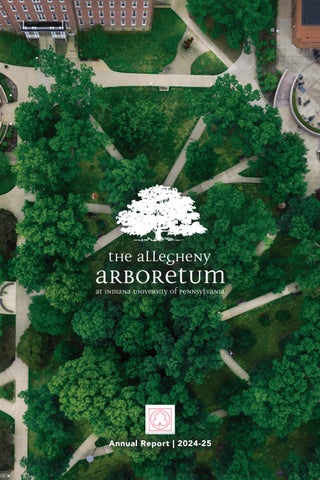
Annual Report | 2024-25

![]()


Annual Report | 2024-25

I wish to inform you that on June 30, 2025, I retired as executive director of the Allegheny Arboretum Board. Taking my place are board members Ms. Barbara Hauge and Dr. Michael Tyree, who will be co-executive directors of the board. I want to personally thank all the individuals at IUP and the Indiana community who have supported me in my efforts to create the Allegheny Arboretum. It has been a joy working with so many talented and dedicated individuals.
This report highlights:
• A 25-year review of selected arboretum activities.
• The Fern Hollow Project, associated with Kopchick Hall.
• A look at the past and present activities at the East Lawn in front of Sutton Hall.
• A follow-up to the birds of Confluence Discovery Park (CDP).
• Examples of how IUP faculty and students utilize the campus.
• A summary of activities associated with the A.G. Shields Herbarium.
On behalf of the arboretum board and IUP, I wish to express our gratitude to all of you who have generously provided support to the Allegheny Arboretum. The arboretum is an ongoing project that will continue to evolve as part of the IUP and Indiana communities. Without your support, we will not be able to accomplish our goals.
There are many ways in which you can help the arboretum succeed. Toward that end, a form for your use is included on the last page of this report. We thank you in advance for your support. Please feel free to contact us.
Cordially,
Dr. Jerry L. Pickering, Executive Director Allegheny Arboretum Board Indiana University of Pennsylvania Robertshaw Building 650 South 13th Street Indiana, PA 15705-1087 Email: jlpicker@live.iup.edu
It started over 50 years ago in 1970. Dr. Jerry Pickering joined the biology department in 1969 and was part of the “lunch group” that met in the basement of Weyandt Hall, which shared stories and complaints while enjoying our “bag lunches”. On one occasion, the Core Arboretum at West Virginia University was mentioned, which led to the idea that an arboretum should be created at IUP. However, it was not pursued, but the seed for an arboretum had been planted. A seed that remained dormant for 30 years!
During that time, Dr. Pickering saw many changes in the IUP campus. When he came to Indiana in 1969, then-President Willis Pratt was known to frequently walk the campus to ensure everything was in tip-top shape. Priorities changed after his departure. As a botanist, Dr. Pickering observed these changes on the campus. He witnessed trees dying and not being replaced, and the campus grounds seemed to be a lower priority. This was a concern not only as a botanist but also as a member of the IUP community. As an undergraduate student at Iowa State University, Jerry had experienced the beauty of a campus and the importance it played to potential students and the well-being of the university and community. He arranged a meeting in 1999 with President Larry Pettit and Mr. Ed Receski (former vice president of building and grounds) to present a proposal to create an IUP arboretum. After presenting reasons for the need and benefits of a campus arboretum, they said “yes”. Oh boy, now what?
Starting in 2000, the first arboretum board was established. Over the next several years, it worked diligently to create the IUP arboretum. One of the first decisions was to name it the Allegheny Arboretum at IUP. This was decided due to the proximity of the Allegheny Mountains and the location of Indiana County on the Allegheny Plateau. Bylaws, mission, and goals were written, and in 2004, the arboretum became a 501 (c) (3) organization governed by IUP’s vice president of administration and finance. These milestones, and many others, are summarized below:
Selected Allegheny Arboretum 25-Year Activities
2000 Arboretum established.
2001 Approved name: Allegheny Arboretum at IUP, consisting of the entire campus. Goals, objectives, and collection policies of the arboretum were established.
2002 Awarded $5,000.00 matched by IUP to fund Phase I of the “Oak Grove Renovation and Preservation Project”. Maintenance was done on Oak Grove trees. IUP Magazine feature article, “The Campus Becomes An Arboretum”.
2003 Arboretum web page developed. White oak was removed from campus, becoming the first tree of the “Harvest to Use Initiative” that recycles campus trees to be used for projects by the Wood Center at IUP.
2004 Allegheny Arboretum officially becomes part of IUP under the vice president for administration and finance. Arboretum becomes a 501 (c) (3) organization with all finances maintained by the Foundation for IUP. Board member and director of IUP’s Center for Turning and Furniture Design, Chris Weiland, designs the arboretum logo.
2005 First campus tree tour map and guide published. Dr. Dennis Ausel, from IUP’s Department of Communications Media, had his class in electronic imaging develop posters that could be used for marketing the arboretum. Over the next seven years, students created 80 posters.
2006 Allegheny Arboretum exhibit at the University Museum, cosponsored by the Evergreen Garden Club, with displays on botanical art prints from the Hunt Botanical Institute and the lumbering history of western Pennsylvania.
2007 As part of the arboretum’s outreach program, 12 identification plaques were placed on selected trees in the Indiana County Memorial Park. The locations of each of the 40 total trees in the park were also mapped.
2008 Construction begins on the “heritage garden” that replaced the “touch and smell garden”.
2009 Wood drying building constructed near the Robertshaw building as part of the “harvest to use initiative”.
2010 Allegheny Arboretum is included in the 2030 campus facilities master plan. First steps taken in the construction of the Stouffer Hall Outdoor Learning and Teaching Laboratory.
2011 Allegheny Arboretum concept overlay plan completed.
2012 Stouffer Hall Outdoor Learning and Teaching Laboratory dedicated.
2013 Tree inventory and management plan for the IUP campus completed.
2014 Allegheny Arboretum receives a Level I accreditation from the ArbNet Arboretum Accreditation Program. Arboretum video released (www.iup.edu/ arboretum). The annual report cover is Teamwork painting by Mark Bender, ‘83.
2015 Best College Reviews ranks Allegheny Arboretum 10th in a listing of the 50 most beautiful college arboretums. The annual report featured “Art in the Arboretum” of all the sculptures on campus.
2016 Inaugural “Art in the Arboretum” student sculpture awarded.
2017 Received $220,000.00 from the Pennsylvania Department of Community & Economic Development and a $33,000.00 matching grant from IUP to develop the “Confluence Discovery Park” master plan.
2018 Andropogon Associates, Ltd began to develop a master plan for “Confluence Discovery Park”. Subconsultants included Biohabitats; Civil & Environmental Consultants, Inc.; and GBBN architects.
2019 Confluence Discovery Park 2030 Master Plan completed. Arboretum receives a Level I reaccreditation from the ArbNet Arboretum Accreditation Program.
2020 The League of Women Voters of Indiana County awarded the 2020 Peggy Clark Grassroots Environmental Leadership Award to the Allegheny Arboretum.
2021 An anonymous donor contributed $400,000.00 to the Allegheny Arboretum.
2022 The ARM Group completed an environmental review titled: CDP Master Plan Environmental Summary Report which provides data on the current environmental status of CDP and potential “next step” actions. Raymond Kinter ‘67, M’68, provided funds to purchase the Crimson Hawk sculpture, Soar Like a Hawk,
that is placed in front of the Performing Arts Buildings. Allegheny Arboretum joins the Pennsylvania Public Horticulture Coalition (PPHC). PPHC is a consortium of over 30 public gardens throughout Pennsylvania whose mission is to amplify the collective voices and impact of Pennsylvania’s public horticulture organizations.
2023 Fern Hollow was created in association with Kopchick Hall. The 2023 edition of the Map and Guide to the Living Collection of the 109 different tree species on campus was published.
2024 Young & Associates completed a physical feature, topographic, and boundary survey of the CDP site. ARM Group completes a Limited Phase II Environmental Assessment Report (ESA) on selected parcels of the CDP site. PPHC name updated to PA Gardens.
2025 CDP listed as a “catalytic project” in the 2025 Indiana Borough Comprehensive Plan Update. Allegheny Arboretum joins a partnership with Alan and Rhonda Luckey to provide fifty commemorative Weaver’s Perfect Memory apparatuses for the 150th anniversary of IUP.


Contributed by Ms. Barbara Hauge
In December 2024, members of the board, with assistance from Eden Zenisek (Indiana Borough Communications Grant Coordinator), submitted an EPA Thriving Communities Tier III Grant application for $300,000 to fund remediation and then removal of 13 structures and the underground storage tank located on the CDP site. Unfortunately, the grant was not awarded to the project. This funding source was part of a grant cycle, with no guarantee of definite funding in the future. Additional funding sources are being investigated.
On April 21, a presentation was given to the Evergreen Garden Club about CDP. The presentation was well received.
The mission of the Confluence Discovery Park 2030 Master Plan is to transform a historically flooded, abandoned, industrial parcel into a multi-use and aesthetically attractive property that occupies a strategically important gateway to the university and the Indiana community. The CDP Master Plan is available at the arboretum’s website: IUP.edu/arboretum.


Contributed by Dr. Ellen Yerger
Work continues on the development of Fern Hollow (FH). The soil pH was tested and found to be too basic. To lower the pH, sulfur powder was applied by SFS (Students for Sustainability Club) students and Dr. Ellen Yerger. In the summer of 2024, 10 dense blazing stars (Liatris spicata) were planted in FH. In the fall of 2024, preen was applied for weed control, and mulch was applied by SFS students. In September of 2024, 50 plugs of each of six perennial herbaceous plant species were planted in selected zones at the site. Each species was marked with specific color-coded plastic labels.

Planted in September 2024
• Butterfly Milkweed, Asclepias tuberosa
• Tall Blue Wild Indigo, Baptisia australis
• Foxglove Beardtongue, Penstemon digitalis
• Great Blue Lobelia, Lobelia siphilitica
• Narrow leaf mountain mint, Pycnanthemum tenuifolium
• Brown eyed Susan, Rudbeckia triloba
Due to the damage done to the FH plants by rabbits, in the spring of 2025, “rabbit fencing” was installed around three of the FH zones. Since its installation, there has been little rabbit damage to the plants. Also, in the spring of 2025, 10 prairie blazing star (Liatris pycnostachya) and two species of clubmoss: ground pine (Lycopodium clavatum) and stiff clubmoss (L. annotinum), several jackin-the-pulpit (Arisaema triphyullum) and several New York ferns (Parathelypteris noveboracensis) were planted in FH.
Planted in May 2025
• Bloodroot, Sanguinaria canadensis
• Wild Geranium, Geranium maculatum
• Jack-in-the-Pulpit, Arisaema triphyllum
• Mayapple, Podophyllum peltatum
• Partridge Berry, Mitchella repens
• Prairie Blazing Star, Liatris pycnostachya
In July of 2025, five trees were planted

on the north side of FH. During the summer of 2025, students were hired to work on weeding at the FH site. The students were paid via federal work study funds, and arboretum funds were used for $202.50 of the student wages for summer garden maintenance. The students were supervised by Dr. Ellen Yerger. The total number of different plant species planted to date in FH for each of the plant groups is: fern and fern allies-8, trees-5, herbaceous pernnials-17, shrubs-3. Additional plants will be added to FH in 2026.

Contributed by Dr. Michael Tyree
John Sutton Hall (Image 1) was the first and only building when IUP (formerly known as Indiana Normal School) was founded in 1875. Aerial photographs from the 1920s (Image 2) show the area to the east of Sutton Hall designated as the “East Lawn”. This area served as a gathering place for students and continues today (150 years later) to be an area of reflection and beauty (Image 3).
The first inventory (student report by H.R. Lupham) of the trees planted on the East Lawn is from 1961. Over the last 64 years, this space has seen dramatic changes in both its design and the diversity of trees and shrubs that adorn the East Lawn (Image 4). Interestingly, the total number of trees only increased by a modest 7% over this time period (71 to 76 trees). The area witnessed
the construction of Ackerman Hall, the removal of Keith Hall and Flagstone Theatre, and the rerouting of Pratt Drive (Image 4; Table 1).
Though the overall number of trees was relatively constant, the average size of the trees increased, as did the diversity of species represented (67% increase since 1961). Today, there are over 40 unique species from 22 families. The most common trees from 1961 were silver maple, larch, and white oak, making up over one-third of the relative abundance. Today, the top three trees are pin oak, white oak, and American sycamore, making up a little less than one-third of the relative abundance.
The Allegheny Arboretum continues to advocate for the planting of additional trees and shrubs to maximize diversity and beauty.

Total trees/shrubs: 71
Unique species: 24
Genera: 16
Families: 12
Total trees/shrubs: 76 7% increase
Unique species: 40 67% increase
Genera: 27 69% increase
Families: 22 83% increase

Image 1. John Sutton Hall during construction. First known picture of the IUP campus.


Image 2. Aerial image of Sutton Hall and the East Lawn taken in the 1920s. Credit: Indiana University of Pennsylvania posted June 26, 2025; www.facebook.com/iupedu

Image 3. The left shows students gathering around the fountain (date unknown), and the image to the right (2009) shows students next to the Flagstone Theater.

Image 4. The diagram above was drawn in 1961, and it shows the location of each tree included in the inventory. The map on the right was generated using Google Maps and shows the new boundary of the East Lawn. Images are not represented on the same scale.

Dr. John Taylor provided this information as a "follow-up" on the previous two articles in the arboretum's annual reports about the birds at the CDP site.
As Yogi Berra once said, it was “déjà vu all over again” this summer as the standing water disappeared from the CDP site during an extended dry spell, driving even the mallards and Canada Geese that nested there earlier in the year to relocate to other locations with a more reliable supply of water. There were still colorful flying creatures to admire at the site in August and early September, but not of the vertebrate type. The waterfowl and wading birds had given way to butterflies feeding on the minerals left behind on the desiccated surface as the water evaporated away, a behavior referred to as “puddling”. On one visit, I found multiple clusters of Clouded Sulfurs present, along with Monarchs, and a few Viceroys, distinguishable from the Monarchs only by their slightly smaller size and diagonal black lines on the hind wings. A lovely sight, but rather weak stuff for a report on the birds of the CDP.
Although no new or even particularly unusual birds were seen at the CDP site this past year, there were plenty of memorable sightings of the common resident and migrant species. One of the latter worth mentioning is the Palm
Warbler, which comes through at this time of year. Even in the more subdued non-breeding plumage it sports in the fall, the brighter eastern race of this small insectivore is nicely colorcoordinated with the dazzling yellow of the goldenrod as it reaches its peak brilliance in late September. A chance to admire this little gem as it clambers acrobatically through the weeds, gleaning insects from the flowers, is an annual treat for bird enthusiasts in this area. The breeding birds at the site contributed valuable data through the late spring and summer for the third Pennsylvania Bird Atlas (PBA3), a five-year project to survey the breeding birds of the state that was initiated in 2024. Even with only two years of data collected, breeding already has been confirmed for dozens of species at the CDP site through sightings of adult birds carrying food to nestlings or feeding recently fledged young: Yellow Warbler, Common Yellowthroat, Carolina Wren, House Wren, Red-winged Blackbird, Northern Mockingbird, House Finch, and Gray Catbird, to name just a few.
However, perhaps my most memorable sighting from the past year occurred during the transition from the rainy conditions of the early summer to late summer drought, when standing water was reduced to a few small pools. That isolation forced water birds visiting the site to congregate tightly, among them some of the early migrating shorebirds. One such visitor was the


Solitary Sandpiper, named (even in its Latin binomen, Tringa solitaria) for its unusual habit of traveling solo, as compared to other shorebirds which migrate in flocks. The sight that greeted me on arrival one day of not one, but five Solitary Sandpipers clustered together around one of the small pools, was something I don’t think I’ve ever seen before. The unusual sight prompted me to consider what name might be coined
to refer to such an atypical group of this solitary species, comparable to collective names that are already in use for more flocks of more gregarious species, such as a “murder” of crows, a “parliament” of owls, and a “charm” of finches. And it came to me. What I had just come across was a “contradiction” of Solitary Sandpipers.

In 2025, the Allegheny Arboretum was informed that it received ongoing recognition as a Level I Arboretum Accreditation from the ArbNet Arboretum Accreditation Program administered by the Morton Arboretum Register of Arboreta. The Allegheny Arboretum originally received its Level I recognition in 2014.
The Keystone News listed the Allegheny Arboretum as one of 11 stunning public gardens in Pennsylvania. It noted that the centerpiece of the arboretum is IUP’s Oak Grove, where students regularly relax or study under the shade of dozens of trees.
The Allegheny Arboretum continues to be a paid member of Pennsylvania Gardens and the American Public Gardens Association (APGA).


At the Board of Trustees meeting in May 2025, Dr. Jerry L. Pickering received a “resolution of appreciation” for his 25 years of service and leadership of the Allegheny Arboretum.

Contributed by Dr. Ellen Yerger, Chair
Academic Committee
Since the Fern Hollow garden is growing nicely with ferns and wildflowers, it has attracted some interesting ecological interactions. Biology department faculty have utilized this in their courses, specifically in Biology 201: Ecology and Evolution. Drs. Townsend, Tyree, and Yerger have taken their laboratory classes there. The highlight was eight monarch caterpillars feeding on butterfly milkweed plants, an interaction many students had never seen “in the wild”. Faculty also utilize the Heritage Garden and the Oak Grove for classes, as well as many of the smaller landscaped places around the buildings on campus.
Dr. Holly Travis has used the campus landscaping for four different weeks of lab, for two lab sections in Science 104: Environmental Biology, highlighting flower-pollinator and seed dispersal adaptations, food chains and energy flow through organisms, deciduous forest observations of trees, leaves, and flowers, and a scavenger hunt in the Oak Grove.
The IUP campus also includes the outlying areas at the South Woods, College Lodge, and the Co-Op University Farm. The biology department faculty often takes their lab classes to these areas as well.
The following information was submitted by Dr. Michael Tyree, Curator of the A.G. Shields Herbarium at IUP.

A herbarium is a collection of pressed and preserved plants that are used for a wide variety of teaching and research purposes. The A.G. Shields Herbarium was officially dedicated in 1973 in honor of Arthur G. Shields, a former biology faculty member and original curator of the herbarium (below). It is housed within the biology department and has been affiliated with the Allegheny Arboretum for the last five years.
The A.G. Shields main collection includes approximately 10,000 plant specimens with emphasis on plants native to western Pennsylvania. In addition, there are a number of subcollections which include: mosses and lichens, fungi, aquatic plants, plants from Honduras, and others.
Over the last 10 years the A.G. Shields Herbarium has undergone an inventory process with the goal of fully digitizing the plant collection. To date, we have 100% of the main collection, 100% of the Honduras collection, and approximately 80% of the A.G. Shields collection completely inventoried.
Over the last three years ,we have joined the Mid-Atlantic Herbaria Consortia. This resource includes many collections from the region and has allowed our collection to be digitally available to the public midatlanticherbaria.org/portal/ collections.
There are currently 2,310 unique species from 935 genera and 190 families represented. This work was only possible through the efforts of our student herbarium workers. Since 2015, there have been 13 students working on inventorying the herbarium collection. Two years ago, the A.G. Shields collection was packed and moved from its previous location in a small faculty office in Weyandt Hall, with no climate control to its new home within the larger IUP Natural History Museum located in Kopchick Hall (right).
This move has taken two years of packing, hand carrying, freeze treating, and unpacking each specimen into its new home. Happily, we are now 100% complete with the plant collection and anticipate the plant library and the

Herbarium located in an empty faculty office in Weyandt Hall (above) and new location in IUP Natural Science Museum in Kopchick Hall (below).


Commemoration of A.G. Shields Herbarium, 1973. Dr. Jerry Pickering (Herbarium Curator 1972-2004; left) presents the herbarium commemoration plaque to Dr. Arthur Shields (center) during the official naming ceremony of the Biology Plant Collection. They are joined by Dr. Frank Liegey, Chair Biology Dept.
remainder of the fungi collection to be completed in the fall of 2025.
Our goal for this collection is to fully digitize it, making the collection available to the public, and we have taken steps towards that end. First, by joining the Mid-Atlantic Herbaria Consortia, we now have a managed platform that is searchable. There are numerous checks on accuracy, changes in taxonomic names are automatically updated, and digital images can be attached to each specimen. Second, the imaging equipment can be made available to IUP for little to no cost once we are ready, and we have bar-coding supplies that can be made available and placed on each specimen as they are being imaged.
Progress has been slow, but steady and we are excited to be in our new location and optimistic about reaching our nearterm goals.
This work, coordinated by Dr. Lara Homsey-Messer in the IUP Department of Anthropology, is a partnership with Soil Hub, LLC. Soil Hub is an approved Pennsylvania Department of Environmental Protection training sponsor for Sewage Enforcement Officers (SEOs) and is contracted to develop and administer mandatory soils training courses for individuals in private industry and the public sector at the municipal, county, and state levels. The partnership with IUP and Soil Hub, LLC is supporting soils training and research conducted on the IUP South Woods.
Three large, permanent backhoe pits in the South Woods are available for training: at six-feet wide, 10-feet long, and three to six-feet deep. The first IUP training for Soil Hub was in 2020. The COVID-19 pandemic intervened during the spring of 2020 and 2021. In 2024, there were 15 students. In 2025, there were 25 students. All Soil Hub training at IUP has been taught by Mr. Joseph Valentin ‘74, B.S. in biology.


Two dedication benches were purchased this year.
• Michael Pivarnik donated a bench. The plaque reads:
Marla Ann Pivarnik
2013 Graduate Bachelor of Arts
Magna Cum Laude Psychology

• The Evergreen Garden Club donated a bench. The plaque reads:
In Memory
Jean Williams Evergreen Garden Club
A total of 52 dedicated benches have been placed on campus.
Two trees that died were replanted. A red oak - Quercus rubra (2025-05) and a white oak - Q. alba (2025-06). Both are located in front of Sutton Hall.
A total of 343 trees have been planted on campus, and 85 of those are dedicated trees purchased by individuals or organizations.
Two trees that died were replanted. A red oak - Quercus rubra (2024-01) and a white oak - Q. alba (2024-02). Both are located in front of Sutton Hall.
A total of 343 trees have been planted on campus, and 85 of those are dedicated trees purchased by individuals or organizations.


from Foundation for IUP endowment)
An arboretum endowment fund of $200,000.00 was established with the IUP Foundation in 2022. The fund will provide approximately $5,595.00 annually to the arboretum budget.
Since January 2001, 574 individuals/organizations have contributed a total of $467,742.36 to the arboretum’s IUP Foundation account.
Additional funding:
2002 Kiski Basin Initiative Matching Grant, Oak Grove tree maintenance: $10,000.00
2003 Kiski Basin Imitative Matching Grant, East lawn tree maintenance: $6,000.00
2016 “Art in the Arboretum” student sculpture competition, funding from Mr. Ray Kinter: $3,000.00
2017 Pennsylvania Department of Community & Economic Development Grant with contributions from IUP, Confluence Discovery Park Master Plan: $253,000.00
2019 Crimson Hawk sculpture and four benches: funding from Mr. Ray Kinter: $75,000.00
2022 Anonymous donation of $400,000.00. An endowment fund of $200,000.00 was established with the IUP Foundation.
2023 $11,485.00 has been generated by the endowment and the funds deposited in the arboretum’s general fund. The remaining $200,000.00 was deposited in the arboretum’s general fund.
Total 25-year generated funds: $1,014,742.36

Mr. Laurence Miller, IUP Director of Facilities Maintenance and Operations, retired and was replaced by Mr. Kirby Devaughn, IUP Grounds Supervisor.

New members of the board included:
• Ms. Carol Hanna, Indiana County Court of Common Pleas Judge, retired
• Ms. Marie Price, Evergreen Garden Club Representative
• Dr. Ellen Yerger, IUP Biology Department, Chair Arboretum Academic Committee
Dr.Tyree in herbarium

1. Coordinate efforts with the ARM Group, PADEP, Confluence Discovery Park Committee, IUP Facilities Department, and the arboretum board to implement the recommendations of the “action plan” developed by the ARM Group based on their review of the environmental studies of the proposed CDP site. This will involve identifying possible funding sources for starting the next phase of remediation of the CDP site.
2. Continue to inform the university and Indiana community about the Confluence Discovery Park 2030 Master Plan.
3. Continue to carry out arboretum “basic” functions.
• Coordinate tree plantings and bench donations
• Update, maintain, and mount accession tags
• Maintain tree accession list
• Update, order, maintain, and mount tree plaques
• Coordinate bill payments and budget
• Write and supervise the publication of annual report
• Update the arboretum’s web page
4. Continue to implement the goals of the following committees.
• Confluence Discovery Park Committee
• Fern Hollow Committee
• Plant Selection Committee
5. Continue to cultivate contacts with local organizations.
6. Continue to work with administrators, faculty and students at IUP to promote Allegheny Arboretum related projects.
7. Continue to implement the goals and objectives of the Allegheny Arboretum.
Mr. W. Thomas Borellis
Assistant to the VP for Administration & Finance for Special Projects, IUP, retired
Ms. Marge Bucci Indiana Garden Club
Mr. Robert Crusan Urban Forestry Consultants
Mr. Kirby Devaughn Grounds Supervisor, IUP
Mr. Matt Genchur
Regulatory Specialist, Resource Environmental Solutions
Mr. Charles Flynn
Musser Forest, retired
Treasured Trees Nursery, owner
Ms. Carol Hanna
Indiana County Court of Common Pleas Judge, retired
Ms. Beth Ann Harrington Director, Wood Center Art Department, IUP

Ms. Barbara Hauge, RLA, ASLA
UpStreet Architects, Inc.
Co-Assistant Executive Director, Allegheny Arboretum Board
Ms. Laura Herrington
Executive Director of the Indiana County Tourist Bureau
Dr. Jerry L. Pickering
Executive Director, Allegheny Arboretum Board
Biology Department, IUP, retired
Mr. Robert Pollock
Penn State Cooperative Extension
Dr. Holly Travis
Biology Department, IUP
Dr. Michael Tyree
Biology Department, IUP
Co-Assistant Executive Director, Allegheny Arboretum Board
Dr. Ellen Yerger
Biology Department, IUP Chair, Academic Committee


Transformation of the East Lawn from 2009 (left) to 2025 (right).


Transformation of the Heritage Garden from 2008 (left) to 2025 (right).


Transformation of the South Campus "no mow zone" from 2013 (left) to 2025 (right).


Stouffer Hall Outdoor Learning & Teaching Laboratory from 2010 (left) to 2025 (right).


(left) Members of Club Scout Pack 29 in Indiana plant a sugar maple tree in Indiana’s Memorial Park in 2011.
(right) The planted sugar maple tree in 2025 from Indiana’s Memorial Park.
Anonymous -2
Darcy Balcer
Faye Bradwick and Donald Lancaster
Bret Buterbaugh and Marie Meredith
Buterbaugh
Maria Catignani
Jeffrey Cehlar ‘00 and Courtney Cehlar
Michele Chazen
Gerard Dougherty ‘78, M’80 and Yvonne Dougherty
John Enders
Evergreen Garden Club
Michelle Fryling and Calvin Fryling
Katelyn Geesey
Jack Herbst ‘19
R Craig Martin ‘72 and Margaret Kremer

Pat Mazanek ‘73, M’82 and Patti Shannahan Mazanek ‘74, M’86
Jack McMillen ‘75, M’79
Janna Roumm Mundis ‘84 and Michael Mundis
Tonya Patterson
Susan Pickering ‘85, M’89 and Jerry Pickering
Michael Pivarnik
Ruth Riesenman ‘64
Daniel Shively and Joanne Shively
Ron Thomas and Gerri Thomas
Holly Travis M’03, D’07
Pauline Wells ‘94
Sandra Whitson
Christina Wiggins


(left) Dr. Daniel J. Kupas '88 and Dr. Jerry Pickering are shown in front of an American elm tree, planted in 2014. Dr. Kupas received a cutting from the Oklahoma City tree that had survived the bombing in 1995.
(right) The planted "survivor tree" from Dr. Kupas on the IUP campus in 2025.
“
If I had one wish for my children, I would wish they were interested in natural history, because I think there you get a spiritual wellbeing that you can get no other way, and what is more, life can never be long enough.”
Dame Miriam Louisa Rothchild
With Your Support...The Allegheny Arboretum at IUP continues to grow, but additional funding is needed in order to continue the efforts of the arboretum. Operating solely through private funding, the Allegheny Arboretum is grateful for the continued support of individuals, businesses, organizations, and foundations.
Since January 2000, the arboretum has planted, nurtured, and developed green spaces on the IUP campus. The restoration and revitalization of the Oak Grove; planting of trees and placing of benches in recognition of friends, family, and loved ones; creation of new niche gardens; and so many other developments have been accomplished through the efforts of everyone involved with the Allegheny Arboretum at IUP.
Your gift makes a difference. Each tree, each garden, each bench leaves a legacy of memories for students, families, friends, and the Indiana community. To make your gift, complete the form below, visit IUP.edu/giveagift, or call the Office of Annual Giving at 724-357-5555.
NAME
ADDRESS
8-Digit ID # from Arboretum Annual Report mailing label @
Please accept my gift to the Foundation for IUP and designate it to Project of greatest need Project of my choice
Please charge my gift of $ to my
Or, I would like to make a pledge of $ and have reminders sent 1 2 3 4 consecutive months
Visit IUP.edu/giveagift to make a one-time or recurring gift online.
Or, please make checks payable to the Foundation for IUP and mail to Foundation for IUP, Sutton Hall, Room G1, 1011 South Drive, Indiana, PA 15705.
Does your employer, spouse’s employer, or former employer (for retirees) match contributions to higher education? Please check with your Human Resources office to see if you can double the impact of your gift by including a matching gift from your employer.
Allegheny Arboretum at IUP
Robertshaw Building
650 South 13th St. Indiana, PA 15705-1087
This report summarizes the activities of the Allegheny Arboretum Board from July 1, 2024, through June 30, 2025, and presents some projects the board will pursue in the coming year. This 25th anniversary report also summarizes some important activities of the arboretum over the past 25 years.