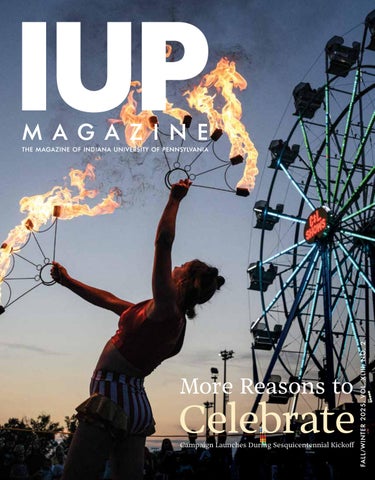
Celebrate Campaign Launches During Sesquicentennial Kickoff
FA LL/ LL 20 WINTER 24, V OL 2 025, . X LI IVO , NO L. .XLI 2 I I, NO . 2
More Reasons to
BR IAN HEN R Y
A drone’s view from above the East Lawn shows, counterclockwise from center, the IUP Performing Arts Center, Stapleton and Stabley libraries, and Leonard, Sutton, McElhaney, Kopchick, and Wilson halls. See more views at IUP.edu/AerialIUP.
MESSAGE FROM THE
PRESIDENT
Time to Reflect and Spring Forward As we continue celebrating IUP’s 150th anniversary, we stand at the intersection of memory and momentum. This milestone is more than a marker of time—it’s a tribute to generations who have shaped our university through leadership, philanthropy, and enduring successes and who have built IUP into a launchpad for the next chapter of innovation and impact. This issue of IUP Magazine is packed with that spirit. We’re spotlighting our Impact 150 campaign, which launched last summer alongside our sesquicentennial celebration. It’s more than a fundraising effort—it’s a bold vision for the future, powered by the same passion and generosity that have defined IUP for generations. There is also a memoir by Marianne Dougherty ’70, who takes us back to her student days. Her memories—sharing one hallway phone in Sutton Hall, discovering new music in the Student Union, waiting tables at Lefty Raymond’s College Inn, and navigating the dating scene with a 5:1 femaleto-male ratio—are funny, vivid, and deeply nostalgic. They remind us that while campus life has changed, the heart of IUP hasn’t: it’s still a place where students grow, connect, and find their path. That same energy is driving us forward today. You can read about the Crimson Core curriculum redesign, the exciting progress on our proposed college of osteopathic medicine, and a series of noncredit classes offered for adult learners seeking additional training to further their careers. It’s all part of the future we are building together—in which every student has opportunities to succeed and make an impact. Anniversaries like this one are a chance to reflect—but they’re also a springboard. We’re not just celebrating our past; we’re shaping our future. And we’re doing it together—with alumni, donors, students, faculty, and friends all playing a part. And that includes you. IUP’s story is one of impact. It’s written in the lives of those who have walked these halls, taught in our classrooms, supported our mission, and carried our values into the world. And now, as we look to the next 150 years, we do so with excitement, determination, and deep gratitude. Thanks for being part of the IUP story. Let’s keep building together. Michael Driscoll President
IUP.EDU/MAGAZINE 1
IUPMAGAZINE FALL/WINTER 2025, VOL. XLIII, NO. 2
F E A T U R E S
4
6
8
10 16
18
A Smash Hit Find out why IUP Day at PNC Park has become one of the most anticipated alumni events.
Distinguished Alumni See the latest graduates to earn the alumni association’s top honor.
More to Celebrate On top of its 150th-anniversary revelry, IUP launched its largest campaign ever.
Old School Travel back to 1960s IUP with alumna Marianne Dougherty.
Crimson Core After 36 years of Liberal Studies, general education got an overhaul.
Future of Division II Find out how allowing Division I student-athletes to be paid impacts DII schools like IUP.
D E P A R T M E N T S
7 14 15 21 22 24
Letters Achievements Milestone Generosity Mentors Namedroppers All About Alumni
ABOVE: At the start of fall classes, IUP sesquicentennial reminders hung from light poles on campus and beyond—from the Oak Grove to downtown Indiana. COVER: Fire dancers and a Ferris wheel were among the attractions at an August carnival to kick off IUP’s 150th anniversary celebration and its Impact 150 fundraising campaign. Coverage starts on page 8. Photo by Brian Henry
2 IUP.EDU/MAGAZINE
IUPMAGAZINE PRESIDENT OF INDIANA UNIVERSITY OF PENNSYLVANIA: Michael Driscoll EDITOR: Elaine Jacobs Smith ’93 CONTRIBUTING EDITORS: Karen Philippi Gresh ’67, Bob Fulton ’75 NAMEDROPPERS EDITOR: Matthew Burglund ’98 CONTRIBUTING WRITERS: Mary Ann Slater, Jason Levan ’97 DESIGN: Meghan McMeans Strittmatter ’13 PHOTOGRAPHY: Brian Henry
IUP Magazine is published by Indiana University of Pennsylvania, a member of Pennsylvania’s State System of Higher Education.
BR IA N H E N R Y
The magazine’s address is John Sutton Hall, Room 321, 1011 South Drive, Indiana, PA 157051046 (telephone 724-357-3112; email iupmagazine@iup.edu). Correspondence regarding any aspect of the magazine may be directed to this office. Print and web images derived from photos submitted for publication become the property of Indiana University of Pennsylvania and may be reprinted at the discretion of the university.
I U P WEB
M A G A Z I N E
O N L I N E
Aerial IUP
IUP Magazine welcomes contributions to help defray the cost of publishing. The Official IUP Magazine Form may be used for this purpose. ©2025 by Indiana University of Pennsylvania. All rights reserved. Indiana University of Pennsylvania is an equal opportunity/affirmative action employer committed to excellence through diversity.
Take to the skies for breathtaking views of IUP while learning about its history, traditions, and folklore. Go to IUP.edu/AerialIUP. WEB
Homecoming 2025 Find photos from the parade, the Crimson Huddle pregame party, tailgating, the football game and Crimson Court recognition, and the “Fifth Quarter” concert featuring the Clarks and Chris Higbee ’01 at IUP.edu/homecoming2025.
IUP.EDU/MAGAZINE 3
BRIAN HEN RY
BR IA N H E N R Y
A Smash Hit
IUP Day Takes Alumni Out to the Ballgame By Bob Fulton
A
s Mary Morgan ’91 and others in the alumni office prepared for the first IUP Day at Pittsburgh’s PNC Park, they weren’t sure there would be a second. Would a midweek Pirates game draw sufficient interest to continue the event? They had their doubts. “Honestly, we thought maybe this was a one-and-done thing,” said Morgan, who was director of Alumni Relations when the event debuted in 2016 and, now in retirement, is president of the IUP Alumni Association Board of Directors. “Could we even get people out for this? We didn’t know. But the excitement it generated was just incredible. It blew our minds.” IUP Day at PNC Park has since morphed into one of the most anticipated dates on the university’s calendar. The numbers have steadily increased, from some 300 tickets sold for the inaugural event to 723 this year. Fans came from as far away as California.
4 IUP.EDU/MAGAZINE
When she coordinated the very first IUP Day, Sara Barnett Lawer ’06, M’08 couldn’t have imagined such a surge in participation. “Who would’ve thought from 2016 it would have grown into something like this?” said Lawer, former associate director of Alumni Relations and now vice president of the alumni association board. “It’s pretty amazing, really.” The 2025 edition of IUP Day at PNC Park, held on a steamy August afternoon, followed a familiar pattern. University alumni, students, employees, and their families enjoyed food and drink together in the Left Field Lounge; they received small gifts from the alumni office and a co-branded IUP-Pirates item—a button-down, white Pirates jersey with crimson and gray trim; and they beamed with pride when IUP was acknowledged on the Jumbotron. In addition, the ceremonial first pitch was again delivered by someone with IUP ties.
Mark Mahoney delivering the first pitch
This year, that honor went to the winner of a random drawing of those who, between January and August, contributed at least $150 to the university, a nod to the ongoing 150th anniversary celebration of IUP’s founding. Mark Mahoney ’79, who worked in aerospace and as a physical therapist before retiring, came all the way from La Mesa, California, to deliver the first pitch.
What could have been a nerve-racking experience for Mahoney—attempting to throw a strike with more than 21,000 pairs of eyes locked on him—was made more so by one of his buddies. “I told him I got selected, and he sent me a first-pitch blooper tape,” Mahoney said. “There are people literally throwing the ball into the ground. One lady—the cameraman’s off to the left, 10 feet away, and she hit him right in the head. There were a couple people who threw the ball into the stands. So I was definitely a little worried. I didn’t want to end up on a blooper tape.” Fortunately, IUP baseball coach Steve Kline, a former major league pitcher, was on hand to give Mahoney some pointers and help him relax. Kline was part of a sizable IUP contingent gathered on the diamond before the game. “I love that this year we had so many opportunities provided to us by the Pirates to get our people down there on the field and to weave IUP into so many things,” said Karen Douglas Cramer ’84, director of Alumni Engagement. “That was really special.” IUP’s Army ROTC Color Guard, made up of cadets Adrianna Carozza, Julia King, Joshua Scanlan, and Kevin Tate, presented the colors during the singing of the national anthem. And a pregame group salute included President Michael Driscoll; Kline and three of his players, Elijah Dunn, David
Kessler, and Derrick Shields; and softball coach Shawna Bellaud and two of her players, Nichole Benvenuti and Madison Griffin. In addition, the Kids Take the Field feature, part of every Sunday game at PNC Park, was reserved exclusively for the children of IUP employees. The youngsters were introduced by the PA announcer before they each trotted to a designated position on the field and were soon joined by the corresponding Pirates starter. The players signed a baseball and exchanged a few words with each of the star-struck youngsters. “Oh, my gosh, they were so excited,” said nursing faculty member Brittanie Perla, whose children—Mayson, 14; Madilyn, 13; and Myles, 11—took part, matched with second baseman Nick Gonzales, third baseman Isiah Kiner-Falefa, and shortstop Jared Triolo, respectively. “We are a baseball-loving family, so just the fact that they got to do that, they were beyond thrilled. It was such a cool experience for all the kids.” IUP Day at PNC Park was a cool experience for everyone with ties to the university, especially Ashley Smith ’16. Her boyfriend, Scott Knowlson, proposed to her before the game—in the ballpark, with the city skyline as a backdrop. Several IUP classmates, including Mackenzie Dye Baker; Ashley’s sister Courtney Smith ’20; her uncle Robert Sartain ’90; and other friends and family were there to celebrate as she said yes.
Many event participants, like Smith, reconnected with old friends. Some made new ones, and all had an opportunity to mingle with IUP administrators in an informal setting. “It’s just a great environment to meet other people, other alumni,” Cramer said. “You get to meet some of the IUP leadership. Dr. Driscoll is there. People from the alumni office are there. College deans are there. It’s just a fun time.” It certainly was for Mahoney, who relished his moment in the spotlight. After his introduction over the PA system, he threw the ceremonial first pitch to his nephew Jake Schramm, with Jake’s toddler son, Malcolm, and Mark’s niece Melissa Osburn standing nearby. Mahoney was relieved he avoided the kind of wayward toss that has landed others on blooper tapes. What’s more, he got to keep the baseball as a souvenir. Mahoney so enjoyed his time at IUP Day that he’s considering a return next year, despite the many miles that separate Pittsburgh and his Southern California home. “It was just an awesome experience,” he said. “It couldn’t have been better. This event was so much fun and so well done. And it was fantastic they had such a great turnout.” A turnout that Mary Morgan and others in the alumni office could never have imagined was possible back in 2016. m
BR IAN H E N R Y
Clockwise from top left: President Michael Driscoll with softball coach Shawna Bellaud, Jenn Luzier Dunsmore ’98 and Mary Morgan ’91 registering guests, first-pitch catcher Jake Schramm with son Malcolm, and the IUP contingent in the Left Field Lounge.
IUP.EDU/MAGAZINE 5
2025
Distinguished Alumni Awards Recipients of the 2025 Distinguished Alumni Award were honored in April at a gala sponsored by the IUP Alumni Association. The following information is from the time of the award presentation. Video profiles appear at www.alumni.iup.edu.
Having spent much of his career specializing in both domestic and international taxation, Pittsburgher David Bluemling ’85 now works as a fiduciary representing foundations, trusts, and estates. He is a recently retired partner of Forvis Mazars/ BKD CPAs and Advisors and a former leader of several nonprofits. He currently serves on the YMCA of Greater Pittsburgh Board of Directors (for which he is a past chair), the board of the Foundation for IUP, and the Eberly College of Business Advisory Council. Previously recognized by Pittsburgh Business Times as a Fast Tracker, he has also been featured in the Pittsburgh Post-Gazette and Pittsburgh Tribune-Review.
6 IUP.EDU/MAGAZINE
Danielle Mashaw Brown ’93, senior vice president and chief information officer for Whirlpool Corporation in Michigan, has risen through the ranks of several leading corporations, including DuPont and Brunswick. She is lauded for creating value through the use of technology while managing investment and operational spending to improve efficiency. Coming to IUP from North Versailles, she went on to earn master’s degrees from Penn State and Drexel. Boards on which she serves include those of Corewell Health, Michigan’s largest health system; the Executive Leadership Council, a nonprofit that fosters the development of Black executives; and Performance Food Group, one of North America’s largest food and food-service distributors.
A managing director and partner in the Boston Consulting Group, Thomas A. Baker ’05 is also global leader of the lowcarbon energy and infrastructure sector. An alumnus of the Cook Honors College who came to IUP from Bloomsburg, he left the university for Harvard with numerous prestigious fellowships and awards. At Harvard, he earned a master’s degree and a PhD and went on to do postdoctoral work at the University of California at Berkeley. Today, he works in San Francisco, lives in Arizona, and is a thought leader and speaker in the clean-tech business. He is also on the board for the Southwest Autism Research & Resource Center.
Michael Burton ’74 is retired from a career that is many a youngster’s dream. For more than 20 years, he served the animals of Busch Gardens Tampa Bay as senior veterinarian. Supervising the collection’s preventive medicine program, he also co-starred in The Wildlife Docs, an Emmynominated TV series that ran for five years on ABC’s Saturday morning lineup. A Wellsboro native, he obtained his veterinary degree at the University of Pennsylvania. Earlier in his career, he pursued his profession at zoos in Colorado Springs and Wellington, New Zealand. Today, he lives in Inverness, Florida, where he creates awardwinning sculptures of wildlife.
Pittsburgher Donta Green ’10 may be best known as football coach at the city’s Westinghouse High School. In this role he is also a mentor to players and a source of assistance for parents and community members. Twice, he has been named a Pennsylvania Football Writers Coach of the Year, and KDKA selected him as a Hometown Hero. In 2022, Pittsburgh magazine said he “helps Pittsburghers leap over barriers” when it selected him for its 40 Under 40 award and called attention to his role as CEO of the Trade Institute of Pittsburgh. He had, the magazine said, “reenergized [the institute’s] mission.”
LETTERS Bringing Cheer I was looking through my IUP Magazine when, to my delight, I discovered a picture of my late father, Edward R. Marian, when he was a cheerleader in 1935 [from “When Yearbooks Became History,” Spring 2025]. My father is on the left. He was a French major at Indiana. I am a 1973 graduate in Spanish Education, so I am especially pleased to see my father remembered. Sadly, my father did not become a French teacher. He discovered that his Italian temperament was not well-suited for the teaching profession. He ended up doing government civil
Everette Penn D’00 is a professor of criminology at the University of HoustonClear Lake and executive director of TAPS Academy, which he cofounded in 2011, with the goal of reducing the social distance between youth and law enforcement. Constantly adding innovative programs, the academy has received more than $4 million in funding. With a bachelor’s degree from Rutgers and a master’s from what has now become Texas A&M, he taught at several universities and was a Fulbright professor of American Studies in Egypt. Widely published, he serves on numerous boards and has been repeatedly recognized with community awards and honors.
service during the war and then served as an accountant in various places. Interestingly, his roommate at Indiana was S. Trevor Hadley [’37]. Charles Davis [’34], of Swing Out fame, was also a classmate. I remember visiting Dr. Hadley when I first visited campus, and, when Dad went to see me perform in Kismet, he had a chance to visit with Prof. Davis, so our connection to Indiana is strong. His sister, Evelyn Marian Stevenson [’33], also attended Indiana and went on to teach in the Latrobe/Jeannette area for many years. Erma Marian MacPherson ’73 Pittsburgh
Going for Gold My husband, Ted McQuilkin, and his friend, Blair Schrecongost, were art students
Kimberly Bender Steinhauer ’85, president and CEO of Estill Voice International, founded the Pittsburgh-based company more than two decades ago. Renowned for its innovative voice software and healthcare products, the woman-owned business also developed the globally acclaimed Estill Voice Training curriculum and certification program in six languages. Steinhauer holds a degree in music education from IUP and graduate degrees in communication sciences from Pennsylvania State University and the University of Pittsburgh. With extensive teaching experience from elementary to higher education, she established and serves as treasurer of the Estill Education Fund, a nonprofit that supports voice training scholarships and research projects.
at Indiana State Teachers College, and they worked on the 1949 yearbook as seniors. They were excited, because it was so innovative to use gold leaf on the cover, and they were very proud of that yearbook. Ted and Blair were both local boys who did design work for the King Leather Company catalog to earn money for college. King Leather manufactured products like wallets, purses, and belts. They were also World War II veterans. As students, we were warned to stay away from those “nasty veterans.” I thought it was funny, because we all ended up marrying them. Jo-Anne Couch McQuilkin ’51 Indiana, PA
Aid That Endures I was shocked to read about the death of Mr. William “Bill” Srsic. When I enrolled at IUP in 1982, Mr. Srsic handled my financial aid. He explained the various types of financial aid, including student loans. He handled my financial aid packages in a very courteous and professional manner. When I graduated in 1987, I always kept in touch with Mr. Srsic. I sent him postcards from the various places I visited when I enlisted in the US Navy. And when I came home on leave, I always dropped in to the Financial Aid office just to say hello. I will miss Mr. Srsic very much. Natalie Balitski Duggan ’87 Sandusky, OH
IUP.EDU/MAGAZINE 7
More Reasons to Celebrate Campaign Launches During Sesquicentennial Kickoff
O
n the day IUP officially began celebrating the 150-year anniversary of its founding as Indiana State Normal School, it also launched its largest-ever comprehensive fundraising campaign, called Impact 150. It was the Saturday before the start of fall classes, and under a hot August sun, the stadium parking lots came alive with a carnival to kick off the celebration. A Ferris wheel, slides, food trucks, games, music, and performers entertained the crowd throughout the evening until the campaign announcement was made from a stage on the lots’ southern edge. A fireworks show after the program punctuated the good news: more than $81 million—54 percent of the campaign’s $150-million goal—had already been raised from more than 11,000 donors during the campaign’s quiet phase. (Funds raised had surpassed $97.8 million by the end of September.) But Impact 150 is about more than a number, President Michael Driscoll said from the stage.
BRI AN HEN RY
“It represents scholarships that open doors for students, programs that prepare graduates for an evolving world, faculty research that strengthens the lives of
people around the world, and new ways of teaching and learning that will keep IUP strong for generations,” he said. “While this campaign comes at a time when we are celebrating IUP’s 150th birthday and honoring our incredible history and legacy, Impact 150 is really about the future, keeping students at the center of all we do.” The campaign theme has three components: healthy students, a healthy university, and healthy communities. “Healthy students” addresses needs for scholarships, academic support, and personal development; “healthy university” encourages support for innovation, faculty research, and high-quality education; and “healthy communities” builds on IUP’s work to establish a college of osteopathic medicine. So far, more than $34 million has been raised for the proposed medical college. Laurie Frisina Kuzneski ’93, vice chair of the IUP Council of Trustees, and her husband, Andy Kuzneski III, are cochairs of the Impact 150 campaign. Their son, Andrew Kuzneski IV, is a May graduate of IUP and an alumnus of the Cook Honors College. Originally from Waterford, Erie County, Kuzneski said IUP is where she grew up.
A fireworks show closed the 150th-anniversary kickoff carnival.
8 IUP.EDU/MAGAZINE
BRIAN HEN RY
National Campaign Cabinet for Impact 150 • Laurie Frisina Kuzneski ’93 and Andy Kuzneski III, campaign cochairs • Bonnie Harbison Anderson ’80 • Richard Caruso ’83 • Tim Cejka ’73 and Debra Phillips Cejka ’73 • John Kopchick ’72, M’75 and Char Labay Kopchick ’73 • William Madia ’69, M’71 and Audrey DeLaquil Madia ’70 • Regina Dressel Stover ’75 and Dennis Stover ’76 • Christine Toretti
Laurie Kuzneski during the campaign announcement “The experiences I had inside and outside the classroom launched me into multiple careers that I have loved, gave me lifelong friendships, helped me find out who I really was, and prepared me to become who I really wanted to be,” she said. “Giving back . . . is how we say, ‘I remember what IUP did for me, and I am so grateful that I want to be part of making that happen for someone else.’”
Marriage Vows Under the Oaks To close out its sesquicentennial celebration, IUP will hold a wedding vow renewal ceremony for alumni couples, also known as Crimson Couples, on June 6, 2026, at 2:00 p.m. in the Oak Grove. This is also an opportunity for alumni couples planning marriage to make it official in the recognized heart of campus. Nondenominational officiants will be on hand to perform these ceremonies for registered couples with valid marriage licenses. A reception featuring live music, a traditional western Pennsylvania cookie table, and other light refreshments will follow. Registration is required for all couples by May 10, 2026, at IUP.edu/vowrenewal.
Kuzneski recognized members of the campaign leadership team, called the National Campaign Cabinet. Donors of $100,000 or more who were at the launch were also introduced. Each received a commemorative gift, a Weaver’s Perfect Memory tool made from felled Oak Grove trees. These gifts were donated by their designer, Alan Luckey ’87, M’89, and his wife, retired IUP vice president Rhonda Luckey. Impact 150 builds on the success of IUP’s previous fundraising campaign, Imagine Unlimited, which concluded in 2021 and raised $81.36 million, exceeding the campaign goal by more than $6 million.
IUP will continue to mark the sesquicentennial during major spring events: the Employee Service Awards in March; Celebration Weekend, including the Distinguished Alumni Awards Gala, in April; and Spring Commencement in May. Find more details about the anniversary at IUP.edu/150 and about the Impact 150 campaign at IUP.edu/impact150. m
T-shirt design contest winner Luke Leccia with celebration cochairs Molly Russell and Jenn Luzier Dunsmore ’98
BR IAN HE NRY
Following up on anniversary-related activities that took place in the spring, winning artwork from the 150th Anniversary T-shirt Design Contest was revealed at the carnival, and printed shirts were distributed to students. (Shirts are still available through the Co-op Store at www.iupstore. com.) The artist, IUP senior Luke Leccia, is a graphic design and illustration major from Elizabeth. He is also a cymbalist in the marching band and had to be retrieved from Miller Stadium, where the band was warming up for its Friends and Family Show, to be recognized on stage.
A collection of Crimson Couples stories, with an option to submit your own, is also available on the IUP alumni website at IUP.edu/CrimsonCouples.
IUP.EDU/MAGAZINE 9
COU RTESY OF M ARIAN N E D OU G HERTY
IU P ARCHIVES
Old School
When It Might Be Perry Como on the Hallway Phone By Marianne Dougherty
A John Sutton Hall from the East Lawn in 1975 Above, right: Marianne Dougherty at IUP in the late ’60s
10 IUP.EDU/MAGAZINE
s a product of the Baby Boom, which resulted in the largest generation in US history, I was one of the first in my family to go to college. My family was middle-class at best, so I applied to a couple of state-supported schools. Room, board, and tuition at Indiana State College were about $900 a year, and I was accepted as part of a program that required me to start classes in the summer, take the fall semester off, and return in January. Apparently, I’d applied too late, and enrollment for fall was at capacity, but statistics showed that
When I arrived just days after graduating from high school in June 1965, I was assigned to a room on the fourth floor of John Sutton Hall. I’d gone to high school with my roommate, but she went home every weekend to see her boyfriend, so I made new friends. Sixty years later, I still get together for reunions with Claudia, Julie, Jayne, and Sharon; Sharon calls us the John Sutton Chicks. At the risk of an “OK, Boomer” eyeroll from anyone under 50, things were just different in the analog world of my college days. We got calls on a black rotary phone in the hallway that was tethered to a jack in the wall by a long cord. When it rang, someone almost always answered, which is how Sharon ended up having several conversations with Perry Como, the legendary crooner from Canonsburg. As it turned out, his niece lived on our floor, and he was calling to say hello. We communicated by snail mail in 1965, and since many of us were away from home for the first time, we hoped to find letters from family or friends in our mailbox. If one of those letters was from a boy you liked, the thrill was palpable. Handwriting has become something of a lost art, but there’s something so tactile about it that, when we read those love letters, we could hear the sound of his voice in our head, like a voiceover in a movie.
In those days, smoking seemed glamorous and sophisticated, but the only place we could light up was in a room on John Sutton Hall’s second floor that we called the smoker. It was the only room that had a television. We played cutthroat games of Canasta, and Sharon had her ears pierced in the smoker. It would be several years before girls went to department stores to have their ears pierced with a stud gun, so the whole procedure was fairly barbaric. An ice cube was thought to numb the pain, but I doubt it did much good, since someone would then shove a needle through your earlobe into a cork.
COU RTESY OF JOHN BU SOVICK I
enough students would drop out, flunk out, or transfer after their first semester to make room for me that spring. It wasn’t the way I’d imagined starting college life, but because of the lifelong friendships I forged that summer, it turned out to be one of the best things that ever happened to me.
Curfews were strictly enforced: 10:00 p.m. on weeknights, 11:00 p.m. on weekends. You had to check in with the housemother, who kept a sign-in sheet in her room. Music majors practiced piano in the basement of Thomas Sutton, and we ate all our meals in the cafeteria on the first floor. Sometimes we’d walk downtown to the Capitol Restaurant for a special treat, a giant cinnamon bun, or Capitol roll, that cost a quarter. I was sad to learn that the restaurant closed in 1976. If a boy came to call, he was asked to wait in the Blue Room, where the decor was inspired by a room in Florence’s Pitti Palace. Since the ratio of girls to boys at IUP was 5-to-1, dating was a competitive sport. A group of guys, usually football players or fraternity brothers, throwing a party would send an emissary to call the house phone and ask that 10 girls show up in the Blue
While college students today opt for casual clothing like jeans, T-shirts, and hoodies, when I was a freshman, girls were required to wear dresses or skirts with dark tights. The most popular hairstyle in the summer of ’65 was the bouffant. Getting “all dolled up” to go out in public required a lot of work. We used Pan Stik, a cream foundation in stick form from Max Factor, lined our eyes in black, and, like the Ronettes, wore white lipstick. While menswear-inspired clothing, especially shirts and ties, has become trendy in women, Claudia and I were ahead of the curve, shopping for preppy clothes like Bermuda shorts, button-down cotton shirts, and Bass Weejuns loafers at Leon’s, a men’s clothing store on Philadelphia Street. It’s the 700 Shop now. The Capitol Restaurant in downtown Indiana was a frequent stop for students in the 1960s and ’70s.
IUP.EDU/MAGAZINE 11
CO UR TE S Y O F M A R IA N N E DO UG H E R TY
IU P ARCHIVES
IU P ARCHIVES
Clockwise from top left: Lefty Raymond’s, in the building that became home to Pizza House and now Vocelli Pizza; Debbie in the 1969 Oak; Marianne (with Jayne) on her wedding day in 1968; Claudia, Sharon, Marianne, and Jayne in State College in the 1980s; Sharon’s Sigma, Sigma, Sigma portrait; Marianne with Tom Lentz after their 1970 graduation; and Jayne and Julie in Sutton Hall. Room in 15 minutes. At least twice that many, like contestants on The Bachelor, would fight for the chance to be selected. By the time I returned in January 1966 to complete my freshman year, Indiana State College had become Indiana University of Pennsylvania, which carried a higher level of prestige. I was assigned to live in Grant House with three other girls, theater majors, who hoped to land roles in The Fantasticks. While they listened to show tunes, I was playing “Nowhere Man” on my portable record player. Let’s just say it was not a good fit. So, I got a pass to spend the weekends in John Sutton Hall with the friends I’d made that summer.
12 IUP.EDU/MAGAZINE
When we returned as sophomores in September, six of us lived on the first floor of John Sutton Hall in an apartment that included two bedrooms, a common living area, and a balcony. Claudia and Julie shared one bedroom, while Jayne and I shared the other. Sharon and her roommate, Debbie, slept in bunk beds in a hallway across from the bathroom. Jayne was the only one of us who loved jazz. So, to torment her, we locked her out on the balcony and played “Walk Away Renée” by the Left Banke on repeat. The Student Union had a soundproof room where you could listen to music on headphones. Jayne remembers listening to Bolero by Maurice Ravel, and I remember hearing “Somebody to Love” by Jefferson Airplane for the first time.
I had a job as a waitress at Lefty Raymond’s College Inn. The location became the home of Pizza House and now houses Vocelli Pizza. It was snowing pretty hard one night, and after my shift, I got a lift back to the dorm with a boy I knew. We sat in the parking lot behind John Sutton Hall listening to the radio, which was playing “Sittin’ on the Dock of the Bay” by Otis Redding. We learned from the local DJ that the singer died in a plane crash that night. If that had happened today, the news would be all over social media. Kids in San Francisco may have been wearing flowers in their hair and smoking marijuana in Haight-Ashbury, but at Indiana, we were insulated from so much of what
Jayne and I shared a room in John Sutton Hall in the fall of our junior year before moving to a brand-new dorm, Stewart Hall (at the center of the Tri-Halls at Maple and 11th streets). One of the girls on our floor had a television in her room, and on March 31, 1968, I watched from the doorway while Lyndon Johnson announced he would not seek reelection. Four days later, Martin Luther King Jr. was assassinated. We had led a sheltered life in rural Pennsylvania, but it was becoming clear that the world was changing, and so were we. There had already been a march for civil rights on Philadelphia Street in 1965, and a young professor in the English Department named Gerald Stern was one of several faculty members who helped desegregate Mack Pool. A lifelong activist, Stern became one of the country’s most respected poets, winning the National Book Award for Poetry in 1998. Student opposition to the war in Vietnam escalated between 1965 and 1968. IUP not only had a chapter of Students for a Democratic Society, a national organization known for its anti-Vietnam activism, but the student newspaper, The Penn, reported on protests and demonstrations. Senator Eugene McCarthy, who was running for president on an antiwar platform in 1968, had a campaign office in Indiana, and I planned to vote for him in November if he was the Democratic party’s nominee. By May, I was a married woman living over a plumbing supply store on Philadelphia Street. Neither my husband nor I was old enough to walk into Coney Island and order a beer. In June 1968, Robert F. Kennedy was shot and killed, just like his brother Jack five years earlier. Six months later, at the tail end of one of the most tumultuous decades in American history, I gave birth to my daughter Rachel. Her sister Erin likes to joke that their generation was raised on hose water and neglect, while I had a different kind of childhood, and she’s right up to a point. Baby Boomers like me, born into prosperity after a global depression and a world war, lived a privileged existence for the most part in two-parent households with stay-at-home moms. Going to college in a small town in what felt like the middle of nowhere when technology was virtually nonexistent was a gift. The campus occupied 70 acres, and we knew just about everyone; today it’s more than five times that size. Bombarded with social media and breaking news on their mobile phones, members of Gen Z have no escape. Just imagine the stories they’ll tell in 60 years.
COU RTESY OF MARIAN N E D OU GHERTY
was going on in other parts of the country. There were keg parties, which were illegal, and dances in the Student Union with Motown blaring from the speakers: the Four Tops, the Supremes, Little Anthony and the Imperials. In 1966, Tommy James and the Shondells had a hit song, “Hanky Panky,” that got everyone out on the dance floor.
Julie, Marianne, Sharon, Claudia, and Jayne in Orlando in 2015
The John Sutton Chicks Over the years, we’ve been there for each other through good times and bad: marriage and divorce, milestone birthdays, births of children and grandchildren, deaths of parents and siblings, and the loss of Claudia’s son Cale in 2020, our friend Debbie in 2021, and Jayne’s husband, Bob, in 2025. Both Claudia and Julie are breast cancer survivors. Sharon and Jayne became greatgrandparents this year. To paraphrase the Grateful Dead, what a long, strange trip it’s been. Marianne Jacob Lentz Dougherty (the author) grew up in Pittsburgh and enrolled with the Class of ’69. She married Thomas Lentz in 1968 and graduated with him in January 1970. A longtime magazine editor, she earned a master’s in English from the University of Scranton and is a member of the John Updike Society. She has a daughter, Rachel, from her first marriage and a daughter, Erin, from her second. Divorced and living in Santa Barbara, California, she is on the faculty of the Santa Barbara Writers Conference. Her first novel, What We Remember, was published in 2023 and is available through major retailers. Learn more at mariannedougherty.com. Sharon Davich Samko was born in Johnstown. She married Michael Samko in 1967, finished her degree in elementary education at Slippery Rock, and earned a master’s degree from the University of Central Florida. She and Mike, who live in coastal Georgia, have been married for 58 years and have two children, four grandchildren, and a great-grandson. Claudia Lison Clemente was raised in the Lawrenceville neighborhood of Pittsburgh and finished her degree in elementary education at the University of Pittsburgh. She married Frank Clemente ’67 and raised eight children, four of them adopted, in State College, where Frank was a Penn State sociology professor. They now live in Orlando and have 14 grandchildren. Julie Todd Cundiff ’69 grew up in Aliquippa. She taught art in Oneonta, New York, for a year before becoming a flight attendant for TWA. Married to Jim Cundiff for 36 years, she lives in Tucson, Arizona, and has a painting studio. See her work at fineartamerica.com. Jayne Hubley Mitten ’69 grew up in York. She and classmate Robert Mitten were married for 55 years, raised two daughters, had five grandchildren, and had just become great-grandparents when Bob died earlier this year. Jayne lives in Raleigh, North Carolina. Debbie Ferraco Glover ’69 was born in the Bloomfield neighborhood of Pittsburgh. She and husband Terry Glover met at IUP and were inseparable until her death in 2021. With Terry, she had two daughters and three grandchildren, who called her “G.” m
IUP.EDU/MAGAZINE 13
ACHIEVEMENTS BRIAN HEN RY
College, who joined the faculty in 2000. Distinguished Faculty Award for Research to Varinder Sharma, professor of marketing, a faculty member since 1996.
Distinguished Professor Alex Heckert, professor of sociology, was named IUP’s Distinguished University Professor for 2025-26. A faculty member for 33 years, he is known for his research on domestic violence, addiction, and other mental health and public health issues. In 1998, Heckert became a research fellow at the center now known as the Mid-Atlantic Research and Training Institute, which he has directed for the last four years. He also chaired the Sociology Department for 18 years and coordinated the Administration and Leadership Studies PhD program. During his year as Distinguished University Professor, Heckert plans to introduce a new theoretical framework, called the integrated anomie framework, to the sociology and criminology fields and to work with IUP colleagues to develop a new concept pertaining to identity work done by parents on behalf of their children.
Senate Awards Last spring, the University Senate presented the following faculty awards: Distinguished Faculty Award for Creative Arts to Chauna Craig, professor of English and director of the Cook Honors
14 IUP.EDU/MAGAZINE
Distinguished Faculty Award for Teaching to Jeffrey Santicola, chair of the Hospitality and Employment Relations Department, who came to IUP in 2014.
Honorary Doctorate At its May commencement ceremonies, IUP awarded an honorary doctor of public service degree to keynote speaker Barry Gasdek ’64, a retired lieutenant colonel in the US Army who earned many of the nation’s highest military honors for his service in Vietnam. Originally from Westmoreland County, he now lives in Laramie, Wyoming, where he remains active in military and service organizations. He is a 2015 Distinguished Alumni Award recipient and a 2012 IUP Athletics Hall of Fame inductee.
Volunteer Awards In April, IUP presented its Award of Excellence in Volunteer Leadership in four categories: The Advancement Support award went to retired IUP administrator Donna McCrea Griffith ’74, M’77, who spearheads the Women’s Basketball Education Day program. Over the past seven years, the program has brought more than 5,000 area students to IUP to engage with women’s basketball team members. The Regional Impact award went to Blane Dessy ’73, a
At May Commencement: Provost Lara Luetkehans, Barry Gasdek, and President Michael Driscoll regional alumni ambassador who assisted the marching band in attending an IUP football game at Mercyhurst and who has opened his Erie home to incoming IUP students, their parents, and others for send-off events. The Aspiring Alumni award went to Kaylee BeckerGeorge, a May graduate and an alumna of the Cook Honors College whose contributions as a student included serving as Student Government Association president and assisting with an archaeology project that explored an early multiethnic settlement near Johnstown. The Affinity Service award went to Alan Luckey ’87, M’89 and retired IUP vice president Rhonda Luckey. For the university’s 150th anniversary, they donated special commemorative versions of a weaving tool of Alan’s design made with wood from felled Oak Grove trees. Keynote speaker for this recognition event was Kevin Bailey ’86, M’90, vice chancellor for Student Affairs at the University of North Carolina at Charlotte, a member of the IUP Alumni Association board, and a 2019 recipient of IUP’s Distinguished Alumni Award.
Carnegie Honor Last spring, the Carnegie Foundation and the American
Council on Education designated IUP a “Higher Access, Higher Earnings” institution, which recognizes colleges and universities whose graduates earn 50 percent more than their peers from other schools. The designation also recognizes the access these schools provide. Only 20 Pennsylvania public institutions and 16 percent of all colleges and universities nationwide received this honor.
Accreditation In August, the Middle States Commission on Higher Education, a global institutional accrediting agency, reaffirmed IUP’s accreditation. This followed the university’s submission of a comprehensive self-study and visits by a Middle States evaluation team to IUP instructional sites, including in India. The accreditation has been consecutively reaffirmed since it was first awarded in 1941.
Alumni Board Over the summer, the IUP Alumni Association Board of Directors welcomed two new members: Matthew Kovatch ’88 and Channing Porter Moreland ’10, M’13. The board also appointed the following officers: Mary Morgan ’91, president; Sara Barnett Lawer ’06, M’08, vice president; Valerie Sutton ’88, M’96, treasurer; and Chad Jurica ’07, M’09, secretary.
Milestone Generosity The university community is grateful to the following donors, who made gifts totaling $25,000 or more to the Foundation for IUP between January 1 and June 30, 2025. Stephen Abel ’73, gifts to support the IUP Veterans Assistance Fund; IUP Food Pantry and Help Center; Fund for IUP; Office of Alumni and Friends; dean’s innovation funds for the College of Arts, Humanities, Media, and Public Affairs, the College of Education and Human Services, and the Kopchick College of Natural Sciences and Mathematics; enhancement funds for the History, Geography, and Regional Planning programs; Army ROTC Fund; and matching gifts American Culinary Federation, a gift to establish the ACF Groundhog Chapter Sweet Success Scholarship for full-time students pursuing a degree or certification in culinary arts or baking and pastry arts in the Academy of Culinary Arts An anonymous gift to support the creation of a college of osteopathic medicine at IUP An anonymous planned gift to establish a scholarship for full-time students pursuing an undergraduate music degree An anonymous gift to support the Eberly College of Business Dean’s Innovation Fund
An anonymous gift to support the IUP Alumni Veterans Scholarship for Athletics Beaumont Foundation of America, C. Edward Keller ’74, and Judy Keller, a gift to support the C. Edward Keller Scholarship for students pursuing a degree in criminology Jack and Linda Brose, a gift to establish the Dr. Jack and Linda Brose Medical Scholarship for students in the proposed college of osteopathic medicine. Preference will be given to students from rural Pennsylvania. Tim Cejka ’73 and Debra Phillips Cejka ’73, a gift to support the Crimson Scholars Circle and Promising Scholars programs Miriam Chaiken and William Conelly, a planned gift to support the Drs. Phillip and Sarah Neusius Scholarship for Anthropology Fairman Family Foundation, a gift to support the creation of a college of osteopathic medicine at IUP Glenn Fitzgerald ’69, a gift to the Kathleen Rankin Fitzgerald Scholarship for Elementary Education for students pursuing an elementary education degree and to the Glenn Fitzgerald Scholarship for Natural Science for students pursuing a natural science degree
Frederick Garbinski ’65 and Judith Garbinski, gifts to support the Fred Garbinski Family Scholarship and the 1964 Football Team Scholarship Larry Kubala ’68 and Barbara Bentrim Kubala ’68, M’73, a gift to establish the Kubala Athletic Fund to provide support for the golf team and for football facility improvements The Estate of Dorothy McKinney, a gift to support the creation of a college of osteopathic medicine at IUP Dennis Popovec ’77 and Ann Marie Popovec, a gift to support the Popovec Outstanding Student Athlete Scholarship for full-time students in the Eberly College of Business who are members of an NCAArecognized IUP athletic team The Robert and Nellie Reynolds Fund, a gift through the Pittsburgh Foundation to the Student General Scholarship Fund. Both Robert Reynolds and Nellie Byers Reynolds were members of the Class of 1948. Rodney Ruddock ’65, M’75 and Ellen Sylves Ruddock ’66, a gift to support the creation of a college of osteopathic medicine at IUP and to support the IUP Army ROTC, the football and men’s basketball programs, and IUP Special Collections and University Archives Thomas Smith M’76, gifts to establish the Margaret “Peg” A. Smith English Education
Scholarship, the Thomas R. Smith Counseling Enhancement Fund, and the Robert L. Smith Economics and Finance Scholarship; a gift to support the creation of a college of osteopathic medicine at IUP; and gifts to support the Dave LaPorte Memorial Enhancement Fund, Fund for the IUP Libraries, Legend Club, Career and Professional Development Fund, IUP Food Pantry and Help Center, Fund for IUP Athletics, and Fund for IUP Stephen Sterner, a gift to support the Kralik Family Scholarship for full-time students in the Human Development and Family Science, Family and Consumer Sciences Education, Interior Design, or Fashion Studies programs Mary Swinker, a gift to support the Culinary Academy Enhancement Fund
Make a gift to a fund of your choice using the Online Gift Form at IUP.edu/makeagift.
IUP.EDU/MAGAZINE 15
From Liberal Studies to Crimson Core
Graduate assistant Hunter Bash verified student attendance at a FLY (First Learning Year) Friday event in August.
General Education Gets First Major Overhaul in 36 Years By Jason Levan
T
o help prepare students for life after college, IUP has launched a new general education curriculum that replaces and modernizes what many current and former students know as Liberal Studies. Called Crimson Core, the new program went into effect with first-year students this fall. This is the university’s first major overhaul of the general education curriculum since it introduced Liberal Studies in 1989. The program’s director, Dawn Smith-Sherwood, who is also a professor of Spanish, believes the changes will better prepare students in many ways. “There’s a big focus on getting students ready for post-IUP success,” she said. “While an element of career readiness was suggested in the former Liberal Studies program, we are asking students to think
16 IUP.EDU/MAGAZINE
more intentionally about that—to start thinking about their careers from the first semester they are here. We’re hoping that by making that intervention in the first semester, it will show them how to be prepared for the work world.” Crimson Core categorizes courses in 10 competency areas, aligned with the Pennsylvania State System of Higher Education’s General Education policy, the American Association of Colleges and Universities’ essential learning outcomes, and the National Association of Colleges and Employers’ career readiness competencies. Students will take at least one course in each competency area, and, within their minimum requirement of 40 credits, they will have room for controlled electives so they can go back to an area for more emphasis, Smith-Sherwood said. Academic
disciplines from across campus contribute courses to Crimson Core. “Generally, it’s more of a competencies approach, so it’s based on what you can do more so than what you know,” she said. “There’s been such a revolution in the availability of information. Now we need to be careful to make sure the information we receive is good information.” While students can select from familiar course topics, such as algebra, public speaking, and psychology, they can also choose something new and different—from Civic Savvy to Teamwork and Leadership in Science, Health, and Engineering to Design Thinking or Once upon a True Crime. But, the biggest difference with Crimson Core may be the courses tailored to students in their first two years: First
Learning Year and Sophomore Area Readiness, better known as FLY and SOAR. Three-credit FLY aims to develop students’ intrapersonal skills, to promote personal wellness, and to incorporate the “life design” concept in the context of exploring both a major and a career. “We help students think about what they can participate in that will help them when they do go out for their first jobs and how to talk about the ways in which they have developed themselves,” Smith-Sherwood said. “How do you tell your story? What’s your elevator pitch?”
“There are so many things we do throughout college that also prepare us for our first job. Athletics, leadership roles, internships, research—all of those experiences are precareer activities that help us develop.” All students will have different experiences and knowledge, she said. The idea is to package those experiences to make students more marketable after they graduate.
thing we needed to get a job,” SmithSherwood said. “There are so many things we do throughout college that also prepare us for our first job, but maybe we don’t recognize them or know how to talk about them. Athletics, leadership roles, internships, research—all of those experiences are precareer activities that help us develop. So, it’s not just the transcript and the GPA. It’s all of those things taken together.” The program also addresses career preparation beyond the first job. “We all know how the work world continues to change,” she said, “so what kind of durable skills can we also provide students so they are ready to adapt throughout their careers?” Planning for this major curriculum update began in 2021, when a group was charged with looking into general education at IUP to see what changes might be needed. In spring 2023, the effort gained steam when the work group surveyed faculty and staff members about reimagining the curriculum. From those surveys, a common theme emerged: what students need most is to be prepared for life after college. In May 2024, the IUP Council of Trustees approved the Crimson Core framework.
Dawn Smith-Sherwood with advisee Ava Gabriel
Crimson Core’s 10 Competency Areas •
Civic Readiness
•
Global Learning
•
Human and Creative Inquiry
•
Leadership, Teamwork, and Project Development
•
Lifelong Learning, Career, and Self-Development
•
Oral Communication
•
“It’s been quite a process,” Smith-Sherwood said.
Quantitative Reasoning and Data Analysis
•
Scientific Reasoning
•
Values and Ethics
“Crimson Core still has some aspects of Liberal Studies, but we have added new aspects and changed the way we think about it as a whole,” she said. “Students will see Crimson Core as the foundation and infrastructure upon which their curricular and cocurricular experiences are built.” m
•
Written Communication
Learn more at IUP.edu/CrimsonCore.
As part of the course, FLY Fridays take place weekly, each with a different theme. These events give students a chance to connect with members of the faculty, staff, and community. The hope, Smith-Sherwood said, is that students begin to feel like part of the IUP and Indiana communities early in their academic careers. Worth one credit, SOAR is focused on career preparation. It encourages students to explore research opportunities, internships, or part-time jobs; to job shadow; or to interview someone who works in their field of study. SOAR also helps them develop preprofessional plans and goals that relate to their major. It even offers a career-readiness assessment tool that both identifies and makes suggestions to improve skill sets in need of further development. “We used to think about undergraduate education and having that degree as the
Jeremy Risinger ’16, M’18, one of the First Learning Year instructors, helps with FLY Fridays.
IUP.EDU/MAGAZINE 17
G R A P H IC BY G A V IN S CH UCKE R ’ 2 2
The Future of Division II Keeping Up with Money-Driven College Sports Could Prove Difficult By Matthew Burglund On the eve of his team’s annual spring scrimmage in April, one of IUP’s best football players received a call from an area code in Texas. On the other end was a Division I coach, dangling a six-figure deal: transfer schools and pocket $100,000 from the program’s NIL collective—a booster-backed fund created to pay student-athletes for use of their name, image, and likeness.
18 IUP.EDU/MAGAZINE
It might sound like something out of a spy movie, but it’s real. And although it violates many NCAA rules, scenarios like this are common and increasingly the norm in college athletics today. It’s one example of how recent changes in Division I athletics have impacted Division II, leading to questions about the future of athletics for schools like IUP. “I worry about the long-term sustainability of Division II,” said IUP President Michael Driscoll. “Division II has always been about ‘life in the balance’—helping students become good people, good citizens, and earn their degrees while learning leadership through competition. If we lose that, we lose what makes Division II special.” This apocalyptic new world primarily affects the so-called “big three” college sports: football and men’s and women’s basketball. But it has the potential to impact them all.
“I think everyone in the industry is still trying to figure things out,” said Todd Garzarelli M’22, director of athletics. “I’m talking to colleagues and friends, even at the Division I level, and they’re still trying to sift through it all. The only thing we can be sure of is that whatever happens in Division I usually trickles down to Division II.”
More Money, More Problems For decades, Division I schools made a lot of money from TV rights, product branding, and ticket sales, but student-athletes at that level received only a scholarship in exchange for their athletic talents. Many thought it was an unfair trade-off, as student-athletes didn’t get a penny from the millions of dollars they helped generate. And those who chose not to finish their college education when their eligibility clock ran out were left empty-handed.
“We can’t dismiss the fact that they are athletes, but what we’re seeing in Division I stems from a belief that there was inequity—that student-athletes were being taken advantage of—and that’s a fair concern,” said Thomas Segar, vice president for the Division of Student Affairs, which includes IUP Athletics. In response to those concerns, the Name, Image, and Likeness system was created; the transfer portal opened, making the names of athletes interested in switching schools readily available; and the recent House v. NCAA settlement came down, allowing Division I student-athletes to be paid directly by their university. All of it has led to unprecedented instability in college athletics. That’s not to mention the elimination of two key policies: the oneyear sit-out rule, which required athletes transferring up a division or between Division I schools to sit out a season before competing, and the restriction that limited athletes to no more than two transfers during their college career. The result is a college sports landscape in which every offseason looks like free agency does in pro sports. “I came to Division II to get away from yearround recruiting,” said head football coach Paul Tortorella, who had stops at Division I Maryland and Akron before coming to IUP in 1995. “But now it’s year-round again. I have to recruit my own roster every year, hoping our guys will stay. It never stops.”
“Division II has always been about ‘life in the balance.’ If we lose that, we lose what makes Division II special.” The 2014 creation of the College Football Playoff, which generates an estimated $1.3 billion per year, has led to high earnings for the “Power 4” Division I conferences—the Atlantic Coast, Big Ten, Big 12, and Southeastern. Division I schools begrudgingly dole out some revenue to the NCAA to be shared with Division II and III schools. However, it isn’t enough for the smaller schools to afford the same perks that Division I schools offer their studentathletes. Another significant source of revenue is the NCAA Division I men’s basketball tournament, which earned more than $900 million in 2024. Some of that trickles down to the lower divisions, but the lion’s share stays with the big conferences and their schools.
The current TV deal for the basketball tournament expires in 2032. Steve Murray, commissioner of the Division II Pennsylvania State Athletic Conference, in which IUP competes, said he expects changes that could have far-reaching effects on Division II. “I think they’ll start negotiating a new deal by 2029,” he said. “I think whatever deal they make will tell you a lot about what the future of Division II and the NCAA will look like.” While Division I schools, fueled by billiondollar TV deals, push these changes, Division II schools are left with strained budgets, disrupted rosters, and fundamental questions about whether some programs can survive in this new world. The conferences these schools compete in also face uncertainty, because some of their operational budgets come from Division I. And now and then, there are rumblings that the Power 4 conferences are talking about breaking away from the NCAA and creating their own for-profit governing body. If that were to happen, what would become of Division II? In 2020, the PSAC Board of Directors asked Murray to develop a contingency plan in case funding from Division I schools was unexpectedly cut. As a result, the PSAC now has enough financial reserves to operate independently for a short time. However, it would need to decide what to do in the long term. Disbanding, sponsoring fewer sports, and merging with another conference could be among the options.
Transfer Mania Fortunately for Tortorella and the IUP football program, the player who got the call from Texas couldn’t accept the offer—because of NCAA rules. In Division I, student-athletes have five calendar years to play four seasons of a sport, and this player had already been in college longer than that, so his eligibility had run out. That didn’t stop the Division I coach from trying. “It’s a shotgun approach,” Tortorella said. “Those coaches just call a bunch of players and hope some of them transfer.” This kind of hunting expedition puts a lot of stress on young people who might not be equipped to make a sound decision when faced with such an offer. On one hand, they know they can excel on Division II playing fields and courts, and they’re making progress toward a degree; on the other, cash is king, and the need to make
money now trumps any academic work the student-athlete might be undertaking.
“I have to recruit my own roster every year, hoping our guys will stay. It never stops.” “They may not play much or have a championship experience, but they’ll chase the money,” Garzarelli said. “For some families, that’s hard to turn down.” Transferring up to Division I may sound like a solid career move, and in the short term, it may be. However, it could also slow a student-athlete’s academic progress. Considering that only about 2 percent of college athletes become professional athletes, a college degree should be the goal, although often it’s not. “I think the most important thing is that institutions need to be more vigilant about prioritizing the needs of student-athletes as students and learners,” Segar said. “So, we have to balance both realities: the desire of student-athletes to benefit from their talents and our responsibility to support and educate them. “Educating students is key. We need to prepare them to be successful, wherever they go.”
An Uncertain Future All of this leaves schools like IUP—which has been a Division II institution since the NCAA adopted the three-division system in 1973—wondering what the future holds for athletics. “The problem is the [NCAA] membership dictates the legislation,” Garzarelli said, “and when a Power 4 school doesn’t like the legislation, they sue the NCAA. They’re suing against the legislation they helped create. Until the membership decides what it wants and how it wants to be governed, the NCAA is going to keep having issues.” The House v. NCAA settlement, which more or less allows schools to create payrolls for their student-athletes, is Division I-only right now. But it could eventually make its way to Division II, creating an even wider gap between the haves and the have-nots. Driscoll said that’s a future that fans of IUP Athletics certainly won’t like. “If paying our student-athletes becomes a requirement,” he said, “we’ll likely see [Division II] sports disappear. That means
IUP.EDU/MAGAZINE 19
Understanding D2 Scholarships The common belief about college athletes is that these are students who get a free education and play their favorite sport.
G R A P H IC BY G A V I N S CHU CK ER ’ 2 2
That’s true in Division I. Most studentathletes at that level get a full scholarship to cover their cost of attendance, which includes housing and dining, books, and other associated fees. But that’s not how Division II operates.
fewer students getting the chance to go to college to earn a degree.” But Murray isn’t sure the future would be that bleak. “I don’t think it would change that much,” he said. “I don’t see schools dropping sports. I just see them having conversations about how we want to approach this. The NAIA [National Association of Intercollegiate Athletics] is out there as a possibility. Some schools depend on sports for enrollment, so they wouldn’t want to give that up. They’ll just have to find a way to do it within their means.” For now, Division II schools face an uncertain future as they wait for Division I to settle its affairs. “The next 7 to 10 years will be interesting to watch,” Murray said. “Once the curtain was pulled by Division I, there was no stopping it.” While the transfer portal, NIL money, House settlement, and revised transfer rules have muddied the college sports water more than ever, Driscoll is sure of one thing. “We’ve lost something,” he said, “and I don’t know if we can get it back.”
20 IUP.EDU/MAGAZINE
IUP and other Division II schools award what the NCAA calls “scholarship equivalencies.” Each school raises money to give to student-athletes to help defray the cost of attendance, and the coaches award that money at their discretion. Few, if any, student-athletes receive full scholarships. Instead, they get a portion. At IUP, student-athletes receive anywhere from a couple hundred to several thousand dollars per year, but they still have a balance to pay. Sometimes grants and federal student aid cover that, but not all students qualify. By law, Pennsylvania public universities are not permitted to use state tax dollars for scholarships—athletic or academic—so every dollar handed out to students must be raised by the university. Some schools raise more money and give out more scholarship equivalencies than others, although Division II sets an upper limit on how many can be awarded in each sport. Currently, IUP does not offer the maximum in any of its 19 varsity sports. To donate to IUP Athletics in support of student-athletes, go to www.alumni.iup.edu/chaa. m
N ICHOLAS SCHM ID T/ IU P ATHLETIC COMMU N ICATION S
Coach Paul Tortorella
a new pipe organ at Worthington Lutheran Church in Armstrong County. She has been a member of the IUP faculty since 1999. Faculty and Dean Deaths AN D Y ZHOU
COU RTESY OF JERRY PICK ERIN G
MENTORS
Jerry Pickering with a red oak donated in his honor on the East Lawn
Branching Off After 25 years as executive director of the Allegheny Arboretum at IUP, Jerry Pickering stepped down from that voluntary role at the end of June. The arboretum consists of the entire Indiana campus, which is home to 1,200 trees representing more than a hundred species. Under Pickering’s leadership, the arboretum grew in both number and diversity of trees and achieved Level 1 accreditation through the ArbNet Arboretum Accreditation Program. Pickering also led the establishment of Fern Hollow, a niche garden just north of Kopchick Hall, and led efforts still in progress to develop Confluence Discovery Park, south of the Kovalchick Complex. These projects prioritize education, which was Pickering’s main goal for the arboretum when he first pitched the idea to President Lawrence Pettit in 1999. In May, the IUP Council of Trustees recognized Pickering’s contributions with a resolution of appreciation. Succeeding him in the arboretum’s leadership are codirectors Barbara Hauge, a local landscape architect, and Michael Tyree, professor of biology. Pickering retired from IUP as a professor of biology in 2004 after 35 years of service.
Science and Sports Skills
In his 30 years of teaching chemistry, Pothen Varughese also researched quaternary ammonium salts and their antibacterial applications. Retired since 2004, he finds that the same discipline, patience, Pothen Varughese at and problem-solving Kennedy-King Park skills needed in science in October also apply to sports. In the National Senior Games pickleball tournament, Varughese has won five gold medals in men’s doubles. He earned his most recent title in July, with partner Bill Hunsberger, in the 85+ bracket. But he’s done more than chase medals. After playing pickleball for the first time on a trip to Arizona in 2008, he returned to Indiana, where he introduced the sport at the YMCA and later helped establish six courts at Kennedy-King Park. He also cofounded the Indiana Pickleball Club, now approaching 300 members. The sport’s benefits, he said, extend beyond love of the game, especially for seniors. “It’s heart-healthy and brain-healthy. You’re exercising your muscles and your mind,” he told physics professor Andy Zhou, who wrote a story on Varughese for the Madia Department of Chemistry, Biochemistry, and Physics website. Read Zhou’s story at IUP. edu/Varughese. Pipe Organ Crawl In October, Organ Studio Director Christine Clewell led six students on a “pipe organ crawl” in and around Manhattan. The trip started with a performance at First Presbyterian Church in Stamford, Connecticut. Over the next two days, studio members explored instruments at the West Point Cadet Chapel, home of the world’s fourth-largest pipe organ; St. Patrick’s Cathedral near Rockefeller Center; Holy Trinity Lutheran Church on the Upper West Side; Church of the Heavenly Rest on the Upper East Side; St. Paul’s Chapel, which served as a hub for rescue workers after the 9/11 attacks; and finally St. John’s Lutheran Church, back in Stamford. “To have this full-immersion experience of visiting, playing, and learning about the history of the instruments and the churches that house these magnificent instruments” was incredible, Clewell said. A week before the tour, students joined Clewell in a performance celebrating the installation of
Timothy Brown, a professor emeritus who retired from the Academy of Culinary Arts in 2006 after nine years of service, died February 12, 2025. Malcolm Day, a professor who retired from the English Department in 1992 after 22 years of service, died January 6, 2025. Alice Dickie, a professor emerita who retired from the Health and Physical Education Department in 1994 after 28 years of service, died June 1, 2025. Eleanor Mihalyi Gallati ’54, a professor emerita who retired from the Home Economics Education Department in 1989 after 22 years of service, died April 19, 2025. William Habacivch D’21, who taught in the Sociology Department between 2013 and 2015, died April 18, 2025. Richard Kolaczkowski, a professor who retired from the Chemistry Department in 1997 after 30 years of service, died April 7, 2025. Ronald Mabon ’79, M’85, an instructor in the Journalism Department in the 1980s and a longtime administrator, died October 20, 2025. He retired as director of the Design Studio in the Office of Marketing and Communications in 2022 after 27 years of service. Kathleen Millward, who taught English at the Punxsutawney Regional Campus from 2004 to 2014, died May 12, 2025. Patricia Scott ’81, D’06, who retired as dean of the Northpointe Regional Campus in 2010 after 20 years of service, died September 5, 2025. John Scroxton, a professor emeritus who retired from the Chemistry Department in 1994 after 30 years of service, died July 27, 2025. Frederick Seinfelt, a professor emeritus who retired from the English Department in 1986 after 26 years of service, died August 6, 2025. Emma Lou Shaffor ’60, who taught in the Mathematics Department for four years, died August 18, 2025. Thomas Van Dyke ’73, a faculty member who retired from the Hospitality Management Department in 2013 after 22 years of service, died May 11, 2025. Rosemary Voelker, who retired from the History Department in 1999 after 18 years of service, died April 16, 2025. Donald Walter, who taught in the Health and Physical Education Department, died May 7, 2025.
IUP.EDU/MAGAZINE 21
NAMEDROPPERS By Matt Burglund
J US TIN E ATO N / IU P ATHLETICS
The IUP Athletics Hall of Fame inducted its Class of 2025. Front row, from left: Frank Condino, Dennis Stover, Regina Dressel Stover, and Kerri McIntyre Joyce. Back row: IUP President Michael Driscoll, Zack Kempa, Rob Zinsmeister, Denise Raymond Erb, Allyson Mitidieri-Washick, Bob Johnston, James Welker, Eric Shafer, and IUP Athletics Director Todd Garzarelli. The 1974 women’s tennis team was also inducted. Find a photo at IUP.edu/magazine.
The IUP Athletics Hall of Fame added nine individuals and one team to its roster at its annual induction ceremony in September at the Kovalchick Complex. Established in 1996, the hall of fame now has 340 members. Inductees are selected based on athletic achievement, contributions to IUP sports, and postgraduate accomplishments. The 2025 class includes Allyson Mitidieri-Washick ’14, M’16 (swimming), Denise Raymond Erb ’86 (gymnastics), Kerri McIntyre Joyce ’99 and Eric Shafer ’91 (cross country and track and field), Zack Kempa ’14 (golf), Rob Zinsmeister ’13 and Bob Johnston ’72 (baseball), and James Welker ’89 (tennis). Frank Condino, a longtime coach and administrator, was chosen in the coach/ administrator category. The 1974 women’s tennis team, which had a combined singles and doubles record of 59-1 under coach Mary Louise Eltz, was selected in the team category. Regina Dressel Stover ’75 and Dennis Stover ’76 were recognized with the Honorary Bell Ringer Award for their longstanding support of IUP Athletics. 22 IUP.EDU/MAGAZINE
Made in the PSAC As part of its 75th anniversary celebration, the Pennsylvania State Athletic Conference recognized 75 “former studentathletes that have gone on to influential careers after graduation” with its “Made in the PSAC” designation. Among them are six IUPaffiliated honorees: the late Frank Cignetti ’60, M’65, former standout football and basketball player (1957 to 1960), director of athletics (1982 to 1998), and head football coach (1986 to 2005), who was inducted into the College Football Hall of Fame in 2013; Frank Condino, who came to IUP as an assistant football coach in 1984 and eventually served as director of athletics from 1998 to 2014; Chad Hurley ’99, cofounder of YouTube, who ran cross country at IUP; Matt Kohler ’83, a three-time AllAmerica swimmer and retired three-star Navy admiral with 36 years of service; Rodney Ruddock ’65, M’75, who played baseball at IUP from 1962 to 1965 and went on to careers in the military (retiring as a US Army major general), in public education, and as an Indiana County commissioner; and John Wingfield ’85, M’88, a member of the IUP swimming
team who went on to coach the US Olympic diving team in the 2008 Beijing Olympics.
Making Headlines After coaching the Indiana High School baseball team to its first-ever state championship, Dan Petroff ’12 was named 2025 High School Coach of the Year by the Pittsburgh Union Progress. In his second season as coach, Petroff led Indiana to four extra-inning wins in the playoffs before his team beat Montoursville for the state championship. Petroff works in the IUP Office of International Education. Fresh off winning the Arena Football One Offensive Player of the Year award, Duane Brown signed a contract with the Memphis Showboats of the United Football League. With the AFO’s Albany Firebirds last spring, Brown scored 30 touchdowns in 10 games and caught 61 passes for 909 yards. Brown was a standout wide receiver and running back at IUP from 2017 to 2022, catching 176 passes for 2,884 yards and 38 touchdowns and rushing for 655 yards and 12 scores in 43 career games. Former IUP basketball player Gina Adams ’24 has put away the high-tops for a new sport.
She recently signed with the WWE’s Next in Line program, joining a group of collegiate athletes transitioning into the world of professional wrestling. The Next in Line program teaches its students the basics of wrestling and serves as a proving ground that could lead to a contract with WWE’s main wrestling company. In April, four IUP alumni were inducted into the Armstrong County Sports Hall of Fame: former football player Tye Desiderio ’07, M’11, University of Ashland athletics director and former IUP sports information assistant director Al King M’83, Belmont Complex director Gary Montebell, and football player Paul Noonan ’69, M’85, a member of IUP’s 1968 Boardwalk Bowl team. In May, Mickey Curtis ’78 was announced as one of nine inductees into the Massachusetts State Collegiate Athletic Conference Hall of Fame. Curtis served as Westfield State University’s sports information director and later as its associate athletic director from 1987 to 2014. John Rajaski ’65, who was the men’s head basketball coach at Cecil College from 1983 to 1995, was posthumously inducted
into the college’s Athletics Hall of Fame in July. In addition to coaching basketball at the Maryland community college, Rajaski coached tennis and golf and taught physical education until he retired in 2009.
Making Moves Former Pittsburgh Steelers and Philadelphia Eagles executive Brandon Hunt ’03, M’06 was named vice president of player personnel for the Las Vegas Raiders. Hunt, who played
football at IUP, has been in the NFL in various roles since 2005. Former NFL player Kris Griffin ’14 recently accepted a position as athletic director at the Saint Constantine School in Houston, Texas. Griffin, who played football at IUP from 2002 to 2004, played for the Kansas City Chiefs, Cleveland Browns, and Jacksonville Jaguars between 2005 and 2010.
Kalista Gioglio ’19 was named director of executive operations for the Division I Atlantic Sun Conference, based in Jacksonville, Florida. As a member of IUP’s field hockey team, she was a four-year letter winner and a four-time National Field Hockey Coaches Association scholar-athlete. She joined the Atlantic Sun after serving as a special assistant to the athletic director at Jacksonville University.
In Memoriam
Pennsylvania’s declining number of high school graduates, the fall data showed positive signs. More than 78 percent of new, first-time, fulltime, bachelor’s degree-seeking students who entered IUP in fall 2024 returned for fall 2025. That’s an increase of nearly 3 percentage points over firstyear retention from fall 2023 to fall 2024 and 7 points from fall 2022 to fall 2023. Also, the number of new undergraduates this fall totaled 1,887, an 8.3 percent increase from fall 2024. As of October, fall enrollment included 7,118 undergraduates, 1,632 graduate students, 332 career preparation program students, 855 veteran and military-affiliated students, 125 dual enrollment students (high school students taking IUP classes), 321 international students from 64 countries, and 1,803 (20 percent) who identify as minority students.
of Illinois Urbana-Champaign and his undergraduate degree in music education from the University of Tennessee, Knoxville. He succeeded Cassidy Nalepa ’03, who served as interim director from August 2024 to July 2025.
Billy Hunter ’50, who played six seasons in the major leagues in the 1950s and later managed the Texas Rangers for two seasons, died July 3, 2025, at 97. A native of Punxsutawney, he was a three-sport star at Indiana State Teachers College in the 1940s and, after his playing days, was the athletic director at what’s now Towson State. He was inducted into the IUP Athletics Hall of Fame in 1997.
IN BRIEF Proposed Medical College Update In August, IUP’s efforts to establish a college of osteopathic medicine reached a critical milestone when the proposed college was awarded “candidate status” by the American Osteopathic Association’s Commission on Osteopathic College Accreditation. This status recognizes that IUP has met the qualifications and has the resources necessary to work toward the next step in the accreditation process: pre-accreditation status. Acquiring that status takes up to 16 months and involves steps including site visits by COCA’s accrediting team. With pre-accreditation status, IUP can begin recruiting medical students. Securing clinical training sites for students is another requirement for accreditation. Typically, students in colleges of osteopathic medicine spend their first two years in the classroom and their next two at clinical sites in the community. In October, IUP secured its 18th clinical training site, providing well above the number of spots required for accreditation. In September, the IUP Council of Trustees accepted the proposed
college’s mission statement, which centers on increasing the number of physicians to meet the healthcare needs of Pennsylvania’s rural and underserved areas. As of October, IUP had secured more than $34.3 million in private and government funding for the proposed college, a key component of IUP’s Impact 150 comprehensive fundraising campaign (See page 8). Find the latest news on the proposed medical college at IUP.edu/ president/proposed-com.
Professional Growth Badges In the spring, IUP will pilot a variety of noncredit learning opportunities, or badges, to help adult learners advance in their professions or explore other interests. Topics are expected to range from data analytics and generative artificial intelligence to sales, marketing, project management, and business administration. In-person and online learning options will be available. Watch for more information at IUP.edu/badges.
Fall Enrollment IUP’s total enrollment for fall 2025 remained steady at 9,082—up one student from fall 2024. In light of western
Marching Band Leadership In August, William Sugg became interim director of the IUP Marching Band and associate director of bands. Previously, he was assistant director of bands at the University of Pittsburgh. He earned his doctoral and master’s degrees in wind band conducting from the University
Eighth Street Initiative Over the summer, Indiana Borough officials launched an initiative to improve the physical connection between IUP and downtown Indiana. The borough’s website calls for transforming Eighth Street into a “safer, more vibrant, and more connected corridor” between School Street, just north of the former Pratt Hall site, and Philadelphia Street. In September, planners held a two-day workshop at various downtown locations to collect community input on the project. Partners on the “Eighth Street Initiative” are Downtown Indiana Inc., the Indiana County Office of Planning and Development, and IUP, including its Student Government Association and Planning Student Organization. Learn more at www.indianaboro. com/8th-street-initiative.
IUP.EDU/MAGAZINE 23
1940s After she turned 100 in June, Mary Simkovich Coroneos ’46 was featured on Today. com, which highlighted her regular workouts with weights and other healthy habits that are likely to contribute to her longevity. Mary works out three times a week with trainers at a Norwalk, Connecticut, gym. She has always been active, having played volleyball and basketball at Indiana State Teachers College. And, she waited until her 70s to retire from teaching and continued to substitute into her 90s. Read more at IUP. edu/alumninotes. William Mullen ’49 died February 9, 2025, at 101. Originally from Ridgway, he entered Indiana State Teachers College after serving with distinction in World War II. He and his first wife, the late Juanita Farr Mullen ’48, had two children, Sallie Mullen Gardner ’78 and Thomas Mullen ’81. Bill retired in 1993 after more than 40 years with Erie Insurance. Photos from his 100th birthday and from his 2024 acceptance of a Pennsylvania State Senate WWII Veterans Recognition Medal are at IUP.edu/alumninotes.
1950s “Of the 150 years of IUP’s history, I make up 97 of them,” Robert Himes ’51 wrote. After graduating from Indiana State Teachers College and spending four years in the US Navy, he taught in Bakersfield, California, where he continues to live. Retired since 1989, he also holds a master’s degree from Cal State Berkeley. In July, he was planning a trip to Pennsylvania with a stop at IUP.
1960s In retirement, Charles Springer ’61 continues his research on
24 IUP.EDU/MAGAZINE
marsh beetles. The August 2021 issue of Insecta Mundi included a paper he wrote on a new species, Scirtes goodrichi Springer and Waller, which he discovered in his Norfolk, Virginia, backyard. He is publishing another paper on the six known species of Scirtes and five new species for the US. His son, also Charles, is a third-year medical resident specializing in pulmonary and intensive care in Rochester, New York. In August, Herb Moore ’67 was inducted into the Somerset County Old-Timers Baseball Association Hall of Fame for his service as an umpire and coach. He retired from ShadeCentral City High School in 2004 after decades as a teacher and a basketball and football coach. Now the vice president of Windber Borough Council, he also spent 12 years on the school board. His family includes these alumni: his late mother, Dorothy Daniels Moore ’42; his brother, Bert Moore ’73, married to Carol Stewart Moore ’71; and his stepdaughter, Michelle Wise Kaniuk ’94. For Indiana native Michael Lambert ’68, M’69, the most memorable college lecture came during English professor Maurice Rider’s course on John Milton’s epic poem Paradise Lost. Read his reminiscence at IUP.edu/GreatestLecture. Now living in Virginia, Mike is a Distance Education Accrediting Commission executive director emeritus and a 1998 recipient of IUP’s Distinguished Alumni Award.
1970s Two years after they met at a welcome-back event in the Oak Grove, Becky Blocker ’70 and David Walzak ’71 got married and “headed off on life’s adventure,” they wrote. Starting as teachers in Maryland, they soon took different career paths. David continued in
COU RTESY OF AG G IE ELWELL
ALL ABOUT ALUMNI
Aggie Elwell, left, and her Czech Republic guide, Christa Petraskova, in 2008 For more than 30 years, Aggie Klucinec Elwell ’63, originally from Tarentum, has collected and researched Czechoslovakian costume jewelry. In 2008, her research took her to the Czech Republic to see the world’s largest collection of it, housed in the Museum of Glass and Jewellery in Jablonec nad Nisou. This past summer, she released a book, Timeless Treasures: An Identification Guide to
education while Becky entered the financial services industry. Since 1998, they have lived in Florida, where Becky started an operational risk and quality management consulting company. David joined her at the company in 2008. Now retired, they have two children and seven grandchildren and have made time to visit all seven continents, all 50 states, and 75 countries. Read their full story at IUP.edu/Walzak. As a result of an IUP records system error, Mary Ann Kokolis Hlusko ’71 was incorrectly listed among the deceased in the Summer 2009 issue of IUP Magazine. The magazine and records team apologize for this error and for the delay in correcting it. More than 50 years since Charles Waszczak ’72 was a student working in Thomas Sutton Dining Hall, he still appreciates the friends he made
Czechoslovakian Costume Jewelry, 1918-1939, available through major retailers. Aggie retired in 2021 after 35 years as an accountant and payroll administrator at the Vermont League of Cities and Towns in Montpelier. Before that, she taught math in Albion and Carnegie, Pennsylvania, and in Shelburne, Vermont. Learn more at www.PinkSkyVT.com.
on the job. Recently, he honored them with “Order of the Spoon” awards, which feature unused, silver-plated soup spoons found in the early ’70s in a stairwell cubby in Thomas Sutton Hall’s unoccupied basement. The awards went to George Lorah, Jerry Ray, Shirley Davis Ray ’70, Tom Rothrauff ’73, and Dave Slezickey ’73, in addition to Chuck. “We were a band of brothers and sisters,” he said. “You don’t know you’re forming that type of bond until years later.” Last summer, retired HomerCenter School District teachers Gene and June Bicego, both ’73 master’s graduates, hosted a picnic at their Indiana home for alumni who worked in the elementary school reading center under the direction of the late Emily DeCicco, a former faculty member. A photo of the Bicegos with Regis D’Angelo, Arlene Bufalini Lowry, Terry Sippel, Nancy Cullings Spencer,
Larry Steinly, and Stephanie Nagy Steinly, all ’78 bachelor’s and ’79 master’s graduates, appears at IUP.edu/alumninotes. In the 1970s, members of the IUP Outing Club spent weekends and breaks backpacking, canoeing, spelunking, camping, and rock climbing. Decades later, they’re taking it easier but still getting out. An October 2024 outing in Hammondsport, New York, brought together Maryellen Shook Mross ’73, M’77, M’80 and Ken Mross ’77, Marlene Maiolie Cross ’75 and husband Clarence, Jim Egelston ’75 and Carol Lamb Egelston M’76, Bill Davis ’76, Bob Kaminski ’76 and wife Cecelia, Fran Costanzo Keltz ’76 and Ben Keltz ’77, and Dave Ridyard ’76. The IUP University Museum’s spring 2025 exhibit, IUP/NYC, showcased the work, artistic journeys, and global impact of
three alumni painters, Chuck Olson ’74, M’76, Richard Purdy ’78, and Micheal Madigan ’80, M’86. The exhibit ran from March through May. “Friends for life” and 1974 classmates Doris DiCenzo Olinger, Barbara Yoest Patton, Kathy Baum Philson, and Barbara Hintz Rupinski got together to celebrate the 50th anniversary of their graduation. See a photo at IUP.edu/ alumninotes. For the last nine years, IUP friends from the ’70s who lived in Carriage House and Aqua House (across Oakland Avenue from the Newman Center) have been getting together again. In September 2024, they met in Watkins Glen, New York. Mark Romig ’74 shared a photo that includes his wife, Kathryn Beck ’72; Diane Bolewitz Finefrock ’73 and husband Ron; Susan Liggett McConnell ’73 and
DESIGNATION OF CODES | AA ASSOCIATE OF ARTS DEGREE
Robert McConnell ’74; Faye Bolton Millen ’73; Jan Hervey Sweny ’73 and husband Dave; Carol Measel Moser ’74 and Howard Moser ’74; and David Thomas ’74 and wife Katie. Rodney Frey ’74 and his wife, Dorothea, also regularly attend the gatherings. See IUP.edu/ alumninotes. Mark Strawcutter ’76, who retired from Information Technology Services at IUP in 2015 after 36 years of service, died October 1, 2025. A longtime franchise industry expert, business strategist, and mentor, Don Schin ’77 received the Central Penn Business Journal Icon Award last spring. The award recognizes people over 60 who have made significant contributions to their industries and communities. National law firm Fox Rothschild hired Vickie Smith
CO UR TE S Y O F TA M M Y S L US S E R
TOM STEEN LAN D
Accordion virtuoso Guy Klucevsek ’69, known for exploring a range of musical genres that, for his instrument, are unconventional, died May 22 at his home in Staten Island. He was 78. According to a Washington Post obituary, his accordion music “nudged” in the direction of hip. In 2005, he told the San Jose Mercury News, “They ask me what I play, and I say, ‘Accordion, but not that kind.’” In a
career spanning nearly four decades, he composed more than 100 pieces, recorded more than 20 albums, and worked with artists including Laurie Anderson, Bill Frisell, Tom Waits, and John Zorn. A founding member of the international group Accordion Tribe, he appeared on Mister Rogers’ Neighborhood, performed with soprano Renée Fleming at Senator John McCain’s funeral, and contributed to several film scores by John Williams. Born in New York City, Guy started formal accordion lessons after his family moved to the Pittsburgh suburb of Springdale. He and his wife, the former Jan Gibson, met at IUP and were married for 55 years. A tribute concert for Guy is planned for February 25, 2026, at Roulette Intermedium in Brooklyn. Learn more at guyklucevsek.com.
Longosz ’78 as counsel in the Real Estate Department in the firm’s Washington, DC, office. She advises clients on affordable housing development, compliance, and finance. Her experience in affordable housing includes work in the Office of General Counsel of the US Department of Housing and Urban Development. She earned her juris doctor degree from Ohio Northern University Law School. See IUP.edu/alumninotes. Diane Botti McDonald ’78 recently shared photos of her husband of 44 years, David McDonald ’78, who died in October 2024. At IUP, he held offices in Kappa Delta Rho fraternity and in the Interfraternity Council. He was employed by Wesco for 45 years. A photo from a 2024 meetup in Florida shows Dave with his IUP friends Richie Boro
Don and Tammy Slusser Don Slusser ’73, IUP’s first All-American in both track and field and cross country and a legend in western Pennsylvania distancerunning circles, died in April as a result of a kayaking accident. He was 73. Don completed more than 100 marathons, finished ninth in the 1976 Boston Marathon, and logged over 200,000 miles as a runner. A longtime health and physical education teacher in the Woodland Hills School District, he once went more than 27 years without missing a day of running. He even ran the
CA ACADEMY OF CULINARY ARTS
day he wed fellow IUP AllAmerican Tammy Donnelly ’87, who joined him on the starting line of the Butler 10K that morning. The NCAA Division II 10,000-meter champion in 1986, she twice won the Pittsburgh Marathon and has raced on all six inhabited continents. In 2020, Lifetime Running magazine reported that the Slussers “in all likelihood” held the world record for most miles run by a couple. Both were inducted into the IUP Athletics and Pittsburgh Marathon halls of fame.
D DOCTORAL DEGREE
M MASTER’S DEGREE
IUP.EDU/MAGAZINE 25
BRIAN HEN RY
As keynote speaker for IUP’s 2025 commemoration of the
’79, M’85, Marty Fabac ’79, Bill McKool ’77, M’79, Rob “Catfish” Norris ’79, and Joe and John Spinozi. See IUP.edu/alumninotes. After retiring from UPS in 2018, Mark Rudel ’79 became a career coach in the Marketing program at Kennesaw State University’s Coles College of Business. The school has the largest enrollment of business students in Georgia, Mark said.
1980s
COUR TESY OF D AN CLIF FOR D
Executive director and cofounder of the nonprofit Let’s Play America, Pat Abramski
September 11, 2001, attacks, Robin Swan ’78 encouraged audience members to honor the anniversary with kindness and service. He also suggested visiting one of the event’s major memorials in Shanksville, New York City, or Arlington, Virginia. A retired US Army brigadier general and member of the Senior Executive Service, Robin had a 32-year military career and retired from civilian service as director of the Army Office of Enterprise Management. He received IUP’s Distinguished Alumni Award in 2023.
Rumbaugh ’80 wrote an article for the Summer 2025 edition of Canadian magazine Play Outdoors about fitting in playtime in the morning, afternoon, or evening. A retired coach and physical education teacher, Pat started her organization in 2014 to encourage people of all ages to play daily. IUP hockey club members from the 1970s to the early ’90s—when home ice was the Belmont Complex in Kittanning—continue to get together for annual matchups. In April 2026, the club’s earlier
Dan Clifford and Corinne Howe Although their time at IUP may have overlapped, Dan Clifford ’81 and Corinne Howe, a university employee in the ’80s and ’90s, met for the first time in Bailey, Colorado, last July. Corinne noticed Dan’s IUP jacket
26 IUP.EDU/MAGAZINE
when he stopped at her son’s restaurant, the Shaggy Sheep. A 2024 Distinguished Alumni Award recipient, Dan is a judge in the Montgomery County Court of Common Pleas.
members (the Vinyls) will take on its more recent players (the CDs) at the Belmont. For more information, contact Paul Bucher ’81 at paul@thebuchers. com. Scranton Hall friends Kathy Hofmeister, Chris Brown Martin, Ronda Urey Rios, and Dina Nunziata Schock, all of the Class of ’82, got together in Indiana last July. “We met the first hour of our first day in August 1978,” Dina wrote. During their recent visit, they stopped in the Oak Grove for a photo. Find it at IUP.edu/ alumninotes. After reading in the Spring 2025 IUP Magazine about 2007 Academy of Culinary Arts graduates Dylan Moot and Rosie Gerard Moot, who run Pico Taqueria on Chincoteague Island, Kathy Baan Wig ’82 and her husband made the hourlong drive to the restaurant from their home outside Ocean City, Maryland. “We had a delicious lunch,” she wrote. Daniel Holmes ’83 had a similar idea but saw on the alumni website that Kathy “beat us to the punch.” At the Chincoteague hot spot, he got together with Cathleen Brown Nosel ’81 and her husband, Tom; Richard Keys ’82 and his wife, Venessa; Martha Sayers Meissner ’82; and Ted Sikorski. See photos at IUP.edu/alumninotes. In December 2024, Tim Bintrim ’82 retired from the US government broadcasting organization Voice of America. As an IUP student, he worked for the radio and television stations and performed in Theater Department productions. In more than 40 years as a cameraman, he worked for major networks, Major League Baseball, the NFL, and more. He lives in North Beach, Maryland, with his wife, Candace. Having recently returned to Pennsylvania after living in New Mexico, Daniel Holmes ’83 now serves as first assistant district attorney to DA Andy Watson in Potter County. “Holmes and Watson, together again, fighting crime,” he wrote. A graduate of Syracuse College of Law, Daniel has been an assistant
DA for more than 20 years. The crime-solving duo dressed the part for a photo. See IUP.edu/ alumninotes. After 40 years in various financial roles, Raul Perez ’83 is retiring as vice president and chief financial officer of Lancaster Leaf Tobacco, the global leader among leaf tobacco suppliers for cigar makers. He also served as CFO for Swedish Match International in Indonesia. In addition to his IUP accounting degree, he earned two master’s degrees— an MBA from the University of New Haven and a master of taxation from the University of Tulsa. After 38 years in insurance and construction safety, David Poliziani ’83 retired in December 2021. Bruce Dries ’84 reported that his friend Douglas Wise, who entered IUP with the Class of ’84, died September 18, 2025. Doug was a member of Phi Kappa Theta and served in the Pennsylvania Army National Guard. An associate professor at Albany State University in Georgia, Roger Marietta M’84 was promoted to coordinator of Political Science programs and was reelected to the Faculty Senate. Last March, Class of ’85 members Dave Bluemling, Doug Hammer, Mark Head, Jim Jordan, Jim Kladnik, Jon Stein, and Jim Stoof traveled to Bradenton, Florida, for a weekend of watching Pirates spring training games. See IUP. edu/alumninotes. In June, Tom Clemente ’85 retired as Eugene W. Price Distinguished Professor of Biotechnology in the Department of Agronomy and Horticulture at the University of Nebraska-Lincoln. He led many agricultural research initiatives, including the development of a weed-management tool used on most of the soybean and cotton fields in the US. See IUP. edu/alumninotes. In June, Staunton Farm Foundation, which works to improve the lives of people with
marked her second anniversary with Beal Bank.
Dan Honkus at the trailheads in Pittsburgh (left) with Rick Ferris and in Cumberland, Maryland (right), with Mike Hutton After a 40-year career in accounting and finance in Cambria and Somerset counties, Daniel Honkus ’83 retired in April as controller of Somerset Trust Company. In May, he celebrated with former roommate Rick Ferris ’82 by biking the 150-mile Great Allegheny Passage, from Pittsburgh
mental illness and substance use disorders, presented Kami Anthony Anderson ’86 with its Albert B. Craig Jr. Award. Kami is executive director of Armstrong-Indiana-Clarion Drug and Alcohol Commission. Under her leadership, the commission grew by 40 employees and added a third county to its service area. See IUP.edu/alumninotes. For his dedication to the growth and support of fraternities and sororities, Kevin Bailey ’86, M’90 was named the 2025 recipient of the Association of Fraternity/Sorority Advisors’ Dr. Kent L. Gardner Award. A 2019 recipient of IUP’s Distinguished Alumni Award, Kevin is vice chancellor for Student Affairs at the University of North Carolina at Charlotte. Members of the IUP Tooters (Men’s Rugby Club) from the 1980s continue to get together
to Cumberland, Maryland. Through the ride, they raised $7,000 for Easterseals Western and Central Pennsylvania. In July, Dan again took to the trails, this time with Mike Hutton ’84 on the 184-mile C&O Canal Towpath from Cumberland to Washington, DC. Dan and his wife, Barbara Blake Honkus ’83, live in Davidsville and have three adult children: Mary, Jackie, and Joshua. They encourage IUP friends to contact them at molly31790@breezeline.net.
to celebrate friendships that started on the pitches nearly 40 years ago. Find photos with Paul Humenik ’86, Rob Snyder ’86, Gabe Weinberg ’86, Bob “Bubba” Catley ’88, Bill Hepner ’89, and James “Chip” Lenzi ’89 at IUP.edu/alumninotes. Chris Villella ’87 was recently promoted to chief commercial officer at EverWash, a car wash membership program. Joining the company in 2022, he most recently served as vice president of business development. In June, Dan Helman ’88 became chief executive officer of Think Power Solutions, a Dallas-based electric utility infrastructure company. He previously served as chief operating officer. See IUP.edu/ alumninotes. A retail banking specialist, Joanne Lipnicky Garloff ’89
A former student affairs professional, Anita Kaltenbaugh M’94 now lives on Mexico’s Sea of Cortez coast, where she writes suspense novels and children’s books under the name A. K. Smith. At IUP, she was Wallace Hall’s residence director and a graduate assistant for major events and on-campus fraternity housing. She said her work with students, first at IUP and later at Western Maryland College and Arizona State University, heavily influenced her children’s books, in which the title character, Glowy the Fish, lifts other sea creatures through kindness while tackling topics like autism and bullying. “These books let me continue that mission of building empathy and understanding, just with a younger audience,” she said. Learn more about her work, including her new collection of inspirational short stories, It’s Going to Be a Good Day, at www.authoraksmith.com. In March, Almar Latour ’94 was interviewed on Decoder with Nilay Patel, a podcast on technology news website The Verge, about artificial intelligence, press freedom,
COU RT ESY OF C OLLEEN MCELR OY
COU RTESY OF D AN HON K U S
1990s
and the future of journalism. He is the publisher of The Wall Street Journal and CEO of its parent company, Dow Jones. A 2010 selection for IUP’s Distinguished Alumni Award, he came to campus six years later to accept it. Find his interview at www.theverge.com. Matt Murphey ’94 was looking for others who lived on Wallace Hall’s fourth floor between fall 1991 and spring 1993 to join him, as well as Karen Peters Rinehart ’95 and Barb Moore Wright ’95, for an October get-together on campus. Contact Matt for the next one at mmurphey1@yahoo.com. After 31 years with the National Park Service, Douglas Richardson ’94 recently retired. He worked at historic preservation sites for the Johnstown Flood, Allegheny Portage Railroad, birthplace of Abraham Lincoln, Fort Donelson battlefield, and home of Harry S. Truman before becoming an NPS Equal Employment Opportunity specialist. In September, award-winning wildlife photographer Lea Barshinger Frye ’95 released her first book, Wildlife Through the Lens: Animal Stories from Montana and the Rocky Mountains, coauthored with her husband, Scot Bealer. The
From left: Colleen McElroy; Bella, Michele, and Gianna Cavalari; and Tom Tope Now living in Peoria, Arizona, Colleen McElroy ’86 was surprised to make an IUP connection at a Women’s Premier Soccer League match in the Phoenix suburbs. She met Desert Dreams defender Bella Cavalari, who majors in criminology at IUP and plays
for the Crimson Hawks. Colleen, who has three alumni siblings, Frank ’88, Kathleen ’90, and Patrick ’93, also met Bella’s mom, Michele Liotta Cavalari ’98, at the June game. “Bella was such a great rep for IUP,” Colleen said.
IUP.EDU/MAGAZINE 27
book includes animal facts and photography tips in addition to photos and stories. Published by Sweetgrass Books, it is available through major retailers. IUP’s Economics Club and Student Finance Association welcomed the following alumni speakers in spring 2025: Mike Secrist ’95, first vice president, Alliant Insurance Services; Jennifer Trimble Faught ’03, M’05, director of Occupancy and Administration, IUP Housing; Helena Rados-Derr ’04, M’10, senior investment professional, Pennsylvania Public School Employees’ Retirement System; Sean Barber ’08, principal, Hamilton Lane; Brendan Bash ’08, M’09, vice president of capital markets, CBRE Group; Justin Foran ’21, student, Widener University Commonwealth Law School; and Tavan Davis ’23, credit analyst, Goldman Sachs. Suzanne Cleary D’96 recently published her fifth poetry book, The Odds, for which she won the 2024 Laura Boss Narrative Poetry Prize. New York Quarterly Books released the collection last spring. Learn more at suzanneclearypoet.com. Over the summer, Lisa Haglan Suydam ’97 was named principal of LeTort Elementary in the Penn Manor School
28 IUP.EDU/MAGAZINE
District in Millersville. Her previous roles in the district include assistant principal at Central Manor Elementary, acting dean of students at Manor Middle School, and elementary teacher. See IUP.edu/ alumninotes. Franz Kellermanns M’98 is a professor of management and the Addison H. and Gertrude C. Reese Endowed Chair in International Business in UNC Charlotte’s Belk College of Business. In March, he received the 2025 First Citizens Bank Scholars Medal, recognizing outstanding scholarship, creativity, and research among UNC’s senior faculty members. His PhD is from the University of Connecticut.
2000s An information technology specialist and cybersecurity team lead in the US Department of Veterans Affairs, Tiffany Weitoish ’01, M’03 has been selected for inclusion in Marquis Who’s Who. Her previous employers have included SAIC, Halfaker and Associates, and AT&T. She has a master’s in cybersecurity from American Military University and a PhD in cyber leadership from Capitol Technology University. See IUP. edu/alumninotes.
In nearly two decades in the business, Nashville-based Erin Krueger ’02 has built one of RealTrends’ top-ranked realestate teams in the nation. Last spring, she shared her blueprint for success in her first book, Capture the Culture, published by Ethos Collective. Available through major retailers, the book guides the development of an effective culture and team in any industry. Learn more at erinkrueger.com. Cook Honors College alumnus Luke Matthews ’02 is a senior behavioral scientist at RAND and a professor of policy analysis at the RAND School of Public Policy. His research involves using data science, anthropology, and social modeling to understand how ideas—such as public health myths and racial extremism— spread. His research has appeared in The New York Times, The Washington Post, and other major publications. When he’s not working, he enjoys traveling by RV and painting fantasy miniatures for tabletop games. Jean Smolich AA’02, who retired from IUP Payroll Services in 2004 after 32 years of service, died April 23, 2025.
C OUR TESY OF TA R A H A CK W E L DE R
N AVY JAG CORPS
In August, the US Navy welcomed David Bligh ’88, a major general in the US Marine Corps, as judge advocate general, the Navy’s highest-ranking uniformed
lawyer. As JAG, he oversees 2,500 officers, enlisted personnel, civilians, and Reserve members assigned to his office and other legal offices and commands. David is the first Marine to serve as the Navy’s chief legal officer since Col. William Butler Remey held the post from 1878 to 1892, nearly a century before the Navy JAG Corps was established in 1967. Previously, David served as assistant judge advocate general of the Navy and later as staff judge advocate to the commandant of the Marine Corps. Raised in Athens, Pennsylvania, he is also a graduate of the University of Georgia School of Law.
In August, Misty Musselman Motter ’03 became head athletic trainer at Westminster College in New Wilmington. She has been with the college for 21 years and earned a master’s degree there in 2014. Misty has also served as an adjunct professor at Youngstown State. She and her husband, Mathew Motter ’00, live in Enon Valley and have two sons. In April, faculty members in IUP’s Student Affairs in Higher Education program presented the Ronald Lunardini (’69) Distinguished Alumni Award to Katie Motycki M’04, director of Student Orientation and Transition Programs at Penn State. Katie has also worked at IUP and La Roche University. In April, Cook Honors College alumnus Thomas A. Baker ’05 spoke at IUP on the evolving landscape of renewable energy, the role of artificial intelligence in sustainability, and advancements in clean technology. A managing director and partner in the Boston Consulting Group, he was in Indiana to receive the 2025 Distinguished Alumni Award. See page 6.
Tara Hackwelder with a photo of her daughter, Elizabeth In August, leaders of the ZTTK SON-Shine Foundation, including its founder, Tara Hackwelder M’07 of Butler County, rang the New York Stock Exchange opening bell to kick off ZTTK Awareness Month in September. Tara’s daughter, Elizabeth, was one of the first patients diagnosed with ZTTK syndrome, a rare neurodevelopmental disorder caused by
mutations in the SON gene. The foundation Tara started supports research to develop effective treatments and, ultimately, a cure for the syndrome. The NYSE ceremony followed the foundation’s first ZTTK Community Conference, a global event that welcomed researchers, healthcare professionals, rare-disease advocates, and affected families. Learn more at zttk.org.
THE OFFICIAL IUP MAGAZINE FORM: SHARE YOUR NEWS By completing and mailing the form below, you help IUP keep your records up to date and IUP Magazine coming to you. Doing this also ensures that the information reaches the magazine. If you’d prefer to save a stamp, you’re welcome to send the same information to the magazine’s editor at iup-magazine@iup.edu or simply complete the online form at IUP.edu/magazine. Name __________________________________
Spouse’s name ___________________________
Maiden name_____________________________
Spouse’s maiden name _____________________
Address ________________________________
Spouse’s grad. yr. (if IUP) ____________________
______________________________________
Spouse’s job title __________________________
Graduation year __________________________
Spouse’s employer ________________________
Home phone (
) ________________________
Phone (
Business phone (
) ______________________
) _____________________________
IUP retiree: faculty/staff
Years_______________
Email address____________________________
News__________________________________
Job title________________________________
______________________________________
Employer________________________________
______________________________________
(Check one or more)
WEDDINGS 1970s
Gary Watson ’74 to JoAnna McQuaide, April 20, 2024.
2000s
Brittany Molnar ’09 to Tyler Martin, April 25, 2021.
2010s
Daniel Minkel ’12 to Abraham Cha, March 31, 2025.
2020s
Matthew Conjelko ’22 to Erica Goble ’22, January 25, 2025
____ I/We would like to make a gift to help defray the cost of publishing IUP Magazine. (Please make checks payable to the Foundation for IUP.) ____ Here is news for All About Alumni (Class Notes, Lost and Found, Weddings, Arrivals, or Deaths) or Mentors. I understand it may appear in both the print magazine and online. Please note: News that appears in Class Notes for this issue arrived in the magazine office by September 23, 2025. If your news came in after that date, it will appear in the Spring 2026 issue. Submissions for the Spring issue must arrive in the magazine office no later than January 31, 2026. News arriving after that date will appear in the Fall 2026 issue. News for All About Alumni, Weddings, and Arrivals must be reported either by or with the explicit approval of the subject(s). Photos become the magazine’s property and may or may not be returned. The magazine does not report engagements. ____ My/Our address is new.
____ I/We get more than one magazine. Enclosed are labels.
Signature _________________________________________________________ By signing this form, you have authorized the university to make changes to your biographical data. These changes affect all personal and academic records (including your transcript) maintained by the university. Mail to Elaine Jacobs Smith, IUP Magazine, John Sutton Hall, Room 321, 1011 South Drive, Indiana, PA 15705 or send this information via email to iup-magazine@iup.edu.
Rhode Island’s BankNewport has named James Cohill ’05 its senior vice president and director of commercial banking. Previously, he worked at Citizens Bank in Rhode Island and at Commerce Bank and Bank of America in his hometown of Philadelphia. He now lives in East Greenwich. See IUP.edu/alumninotes. In a bipartisan vote in June, the Pennsylvania State Senate confirmed Jessica Shirley ’06 as secretary of the Department of Environmental Protection. She has been with the department
for 14 years and served as policy director before stepping in as acting secretary last year. See IUP.edu/alumninotes. A senior vice president at Carter Bank in Virginia, Caleb Moore ’07, M’18 returned to IUP in April to speak to Yaya Sissoko’s Financial Institutions and Markets class. In his 18 years in banking, Caleb has also worked for Mellon, BNY, S&T, First Commonwealth, and Martin banks. After a decade of honing her skills at the Italian furniture company B&B Italia, Megan
Pasda Pisano ’07 launched her own firm, Megan Pisano Design, in 2017. Her approach to interior design is to create spaces that blend luxury, functionality, and comfort. Also a certified yoga instructor, she lives in Chatham, New Jersey, with her two young boys. See IUP.edu/alumninotes. An alumna of IUP’s Cook Honors College, Zoë Thorkildsen ’07 graduated in May with a PhD in public policy and public administration from the Trachtenberg School at George Washington University. Her dissertation, “EvidenceBased Policing: A Theoretical
ARRIVALS 2000s
To Brittany Molnar Martin ’09 and Tyler Martin, daughters Tybee Rae, July 27, 2021, and Lucy Lynn, September 9, 2024.
2010s
To Alison Parsons Renn ’16 and Brady Renn ’16, a daughter, Jovie, March 24, 2024.
and Evaluative Review of the US Department of Justice ‘Smart Policing Initiative’ Program,” will be available through ProQuest. Bill Kennedy ’09 participated in Season 18, Episode 6, of Naked and Afraid, a Discovery Channel reality show that tasks two strangers with surviving a harsh environment with no clothes and very few supplies. Titled “The Beauty and the Bro,” the episode originally aired March 30. It documents Bill and partner Jolie Faulkner’s attempt to complete a 14-day fan challenge on Palawan, a remote island of the Philippines. Learn
IUP.EDU/MAGAZINE 29
These alumni friends traveled from Pittsburgh, Philadelphia, and Washington, DC, to Ocean City, Maryland, for their first group vacation, complete with specially made IUP shirts. Included are Jacki Kliber Blair ’11, Bethany Nold Cali ’13, Stefanie
more at www.discovery.com/ shows/naked-and-afraid. In April, Christina Rost ’09, M’12 received the National Science Foundation’s Faculty Early Career Development Award, recognizing her pioneering research on high-entropy oxides, a novel class of ceramics with potential for cuttingedge applications. An assistant professor of materials science at Virginia Tech, Tina earned her PhD in materials science and engineering from North Carolina State University.
2010s An orthopedic surgeon and former IUP football player, Eric Goodrich ’10 has joined the Cullman Regional Medical Group in Alabama. He completed medical school and his residency at Lake Erie College of Osteopathic Medicine, followed by a fellowship at Hughston Foundation in Georgia. After training at the Naval Aerospace Medical Institute, he became a senior flight surgeon and medical department head with the US Navy at Naval Air Station Pensacola. See IUP.edu/ alumninotes. Earlier this fall, Johnstown native Kayla Grasser Anthony
30 IUP.EDU/MAGAZINE
Stitely Pastors ’13, Katie Hutchinson ’14, Nick Lattanzo ’14 and Brittany Hogg Lattanzo ’15, Jodi Mueller ’14, Katrina Billie Shearer ’15, Cody Stitely ’15, Chris Garaffa, and Kristina Wesling Yost. Look for more at IUP.edu/alumninotes.
’11 headed to Queen Mary University of London as a Fulbright scholar. She is studying the use of technology in historic spaces, which she’ll use in her role as executive director of the Philadelphia Society for the Preservation of Landmarks. Known as PhilaLandmarks, this nonprofit stewards four 18th-century historic houses, including the Powel House. Learn more at IUP. edu/alumninotes. After his son Leo went through cancer treatment, Daniel Kushnir ’12 started a nonprofit, Leo’s League, to raise awareness about pediatric cancer and to assist other Lehigh Valley families affected by it. The organization gets support through donations, merchandise sales, and special events, such as its Pediatric Cancer Fund Fest on May 9, 2026, in Schnecksville. Leo was diagnosed with Stage IV kidney cancer in 2022 and has been in remission since 2023. Learn more at www.leosleague.org. Surrounded by friends, family, and the Pittsburgh drag scene, Daniel Minkel ’12 and longtime partner Abraham Cha were married in March. An elementary music teacher in the Mt. Lebanon district, Rebecca Wojtaszek Showalter ’12 is a finalist for the 2026
In July, Eden Ratliff ’13, M’14 started a new position as manager of Middletown Township, Bucks County. Originally from Chester County, he managed Ford City Borough, Greencastle Borough, and Kennett Township before serving as deputy city manager for Charlottesville, Virginia. See IUP.edu/alumninotes. The executive general manager of two Hendrick Automotive Group dealerships in Alabama, Nicole Bruce Moley ’14 was named to the 2025 Automotive News 40 Under 40 class. A former IUP field hockey player, she has made employee wellness a priority, initiating sponsored gym memberships, remote-operated standing
COU R TESY OF A BIG A IL BA CH M A N
COU RTESY OF JACK I BLAIR
Pennsylvania Teacher of the Year award. Nominees were chosen based on school and community involvement, written feedback from colleagues and parents, classroom videos, interviews, and more. The winner will be announced in December. Rebecca previously taught in the Canon-McMillan and Conemaugh Township Area districts.
desks, and treadmill desks. See IUP.edu/alumninotes. Decades after his father died, Michael Reyka D’15 set out to uncover the World War II story his father never told. A heavy machine gunner with the 180th Infantry Regiment, his father was among the Battle of Frémifontaine survivors who eluded capture as they fought their way through the dense forests of the Vosges Mountains. Michael researched official military documents and retraced the path of his father’s company through France. The resulting book, Stand of the Thunderbirds, was released by Casemate Publishers in September. See IUP.edu/ alumninotes. Last spring, Kacey Osborne ’16 was named the 2024 Clearfield County Law Enforcement Officer of the Year for her leadership of a child sexual assault investigation that led to the suspect’s arrest. A 2019 graduate of the Pennsylvania State Police Academy in Hershey, Kacey serves in the Criminal Investigation Unit of Troop C in Punxsutawney.
Abigail Bachman on the Miss America stage Crowned Miss Nevada in June, Abigail Bachman ’20 competed in the Miss America 2026 pageant in September. Originally from York County, she got her start as Miss Hanover Area in 2015 and went on to win several more titles throughout the commonwealth. In 2019, she finished in the top three for Miss Pennsylvania. Just days before becoming Miss
Nevada, Abigail earned her occupational therapy doctorate from New Yorkbased Touro University. As Miss Nevada, she works to advance opportunities for people with disabilities. She is executive director of the Nevada Miss Amazing organization, which aims to build self-esteem in women and girls with disabilities. Learn more at IUP.edu/ alumninotes.
president of operations. See IUP. edu/alumninotes. Main Street Mercantile in Bellwood now sells pastries by Gabriella Finn CA’22, AA’24, ’25. Her business, Goodies by G, also offers pickup and delivery in the Altoona area. Find her goods on Facebook and Instagram with the handle @goodiesbygllc.
Sarah Grandinette with biology professor Cuong Diep in 2021 A PhD candidate at the University of Pennsylvania, Sarah Grandinette ’22 conducted gene-editing research that received national attention last spring. She was part of a team that customdeveloped gene-editing therapy for an infant diagnosed with a very rare enzyme deficiency that often results in death. Sarah was co-lead author on a paper describing the work, published in the New England Journal of Medicine in May. A Today Show report described the
2020s Bass-baritone Ben Strong ’20 recently joined the Metropolitan Opera as a member of the Lindemann Young Artist Development Program, considered one of the best for preparing singers for international careers. Find performance clips at BenStrongOpera.com.
infant as “thriving” after treatment and said baseediting therapy could be a “blueprint for the future, revolutionizing the way doctors treat other rare types of diseases.” At IUP, Sarah was a student in the Cook Honors College and worked with biology professor Cuong Diep to study the ability of zebrafish to regenerate kidneys. As IUP’s 2021 Kopchick Summer Fellow, she also conducted research at MD Anderson Cancer Center in Houston.
Last summer, Kelli Mills M’21 was named vice president of managed communities for EverTrue, the management partner of Philadelphia Protestant Home, a senior living community. Before that, she was the home’s interim executive director under a previous management contract. Kelli also spent 30 years at Messiah Lifeways, starting as a certified nursing assistant and rising through the ranks to vice
A research technologist at Penn State’s Center for Nanotechnology Education and Utilization, Trey Shirley ’22 spoke to the IUP Physics Club in September about the demand for engineers trained in nanotechnology and microprocessing. Last spring, Angel Alcantara ’23, M’25 visited IUP economics professor Jim Jozefowicz’s Advanced Econometrics class to show students how to use Tableau, a data visualization tool. Angel is an instructor in IUP’s Department of School Psychology, Special Education, and Sociology. Former River Valley girls’ volleyball coach AnnaLise Shank ’23 now leads the North Hills girls’ volleyball program. In her only season at River Valley, the team had an eight-win improvement over the previous year. In the off-season, AnnaLise is a club coach for the Sky Elite volleyball U-17 team. See IUP. edu/alumninotes. After graduating last May with a management degree, Verona native Kayona McIntoshPerkins ’25 completed an internship with the US Golf Association at Oakmont Country Club. See IUP.edu/ alumninotes.
REUNIONS AND MORE IUP Night at PPG Paints Arena, Pittsburgh Penguins vs. Philadelphia Flyers, January 15, 2026 Delta Gamma 45th Anniversary Reunion, IUP, March 27-29, 2026 Housing Staff Reunion, IUP, April 17-19, 2026 1973-1993 Hockey Club Reunion, Belmont Complex, Kittanning, April 24 and 25, 2026 (Contact Paul Bucher ’81 at paul@ thebuchers.com) Sigma Pi Reunion, IUP, May 1-3, 2026 Nursing Class of 1976 50th Anniversary Reunion, IUP, May 16 and 17, 2026 Find details at www.alumni.iup.edu.
Prefer Digital?
If you would prefer to read IUP Magazine in digital format instead of print, please contact the magazine office at iup-magazine@iup. edu. If you requested the digital version through last summer’s IUP Magazine survey, you will start to receive that version with the Spring 2026 issue.
IUP.EDU/MAGAZINE 31
DEATHS The following alumni deaths were reported between January 1 and June 30, 2025. 1944: Jean Metzger Hower 1945: Margaret Leviseur Smith 1947: Garnet Mourer Clark, Margaret Hile Stairs 1949: William Mullen 1951: Jane Jackson Fetterman, Barbara Snyder Hoskins, Lucille Bowser Klingensmith, Beverly Owens, Eleanor Rhodes Hahn, Richard Rice, Stella Smith 1952: Donna Fleck Manseau 1953: Mary Lucas Farmakis, Armena Rukavina Reese, Mary Ghrist Sanford, Jacqueline Hains Spang 1954: Joseph Deblase, Eleanor Mihalyi Gallati*, Jesse Young 1955: Ruth Blohm Mohr 1956: Jean Sumner Conner, Donna Mundo Donati, Doris Leibfreid Siehl, Robert Stiffler 1957: Frank Delsandro, Donald Gauntner 1958: John Cipollini, Ronald Littlejohn, Robert McFarland, Joseph Palmiscno, Richard Reed, Dickson Tattersall 1959: William Geppert, Karen McCall Huey, Howard Stilley 1960: Stanley Akins (M), Allen Hooks 1961: John Nesbitt, Judith Paul, Patsy Raschiatore, James Stangarone, Linda Webb 1962: Suzanne Wright Hawk, Louis Menegatti, Marian Myers Patton 1963: Anne Thompson Forsht, Frances Hendricks Leach (M), James Peters, Joan Kroboth Rolin 1964: Clair Brumbaugh, Julius Ciuffoletti, Robert Gourley, Sally Johnston Groves, Robert Hartman, Dorothy Shiner Kociban, Edward Novalis, Samuel Saloum, Gary Stonbraker, Thomas Wolfe 1965: Norman Amorose, Lawrence Hanley, Clarence
32 IUP.EDU/MAGAZINE
Kunkle, Walter Myers, Dan Rothermel 1966: Judith Anderson, Diane Zimmerman Grzelak, Judith Good Kostic, Anthony Maniccia, Robert Melago (M), Carol Simkovic Nelson, Joyce Ziegler Omlor, Mary Reen Picone, Ronald Poister, James Pryce 1967: Austin Behan, John Constant, William Coulson, Donald Douds, Larry Guerrieri, Willard Lathers, Susan Hazen Nycum, Mary Kohan Osborne (M), John Prater (M), Cynthia Princeler, David Thomas 1968: Patricia Toth Derickson, Keith Gnagey, Nancy Read Gotwald, Sharon Heckman, Raymond Marcon, James Pavlik, Connie Palmo Stewart, Thomas Williams
1977: Donald Forsythe, James Goshorn, Edward Mathay (M), Anne Molloy Rullo 1978: Kevin Cramer, Tamra Saylor Fine, Kathleen Brobeck Glunt (M), John Sonneborn 1979: Mark Bradbury, Susan Bloom Carl, Barbara George, Oren Hilty, Kathy Henkel Rideout, Ellen Taricani 1980: Scott Hoke, Steven Kreamer, Dennis McGurgan, Mark Scanlan, Leo Stepanian 1981: Thomas Eichenlaub, Donald Nowak, Susanne Kaniuk Senyo 1982: Denise McIntyre Kvederis, Dawn Shoff, Martin Wisniowski 1983: Ruth Dunn, Joseph Durci, Beth Glenn Heroux, Joseph Jackman, Joseph Sesti
1969: Judy Rosenberger Benford, Mary Steele Bilzi, Richard Gordon, Bridget Brochin Jerome (M), Jean Alsdork Kerr, Guy Klucevsek, Robert Mitten, Scott Neely, Anthony Petchar, Kathleen Wilson Rachel, George Rushe, Judith Kralik Sterner, Richard Trudgen
1984: Jacqueline McCall Bobal, James Dougherty (M)*, Tammy Henry Menk
1970: Carol Kondravy Barker, Alan Carnahan, Cathy Sproat Dixon, Melody Fieo, Louis Gasbarre, Domenick Kurtz, Barbara Walk Maulsby, Anthony Ricchuito, Ronald Russell, Valerie King Toms
1990: Eugene Calabrese, Keith Martin (M)
1971: Gregory Bell, Steven Fluke, Margaret Goodman (M), Cynthia Hanna Goodman, David Konesni, David McCullough, Peter Melani, Cheryl Zimmerman Raudabaugh, George Stark 1972: Patricia Edleman Abadie, James Allen, Robert Barrett, Marsha Tyger Freshwater, Carol Johnson Hinds (M), Janet DiBucci Hyde, John Marsiglio, Daniel Nowakowski, Andrew Peck 1973: Mary Nicely Armitage, Patricia Johnson Bongiorno, Annamarie Gaurich, Paul Maljan, Charles Rizzo, Donald Slusser, Lawrence Smith, Shirley Shrum Zundel 1974: Cathy Ganoe, Barbara Kuykendall Sunner 1975: Terrence Flaherty, Barbara Vavreck 1976: Sharyl Unrath Giel
1986: Ronald Evans, Leiwei Li (M), Terry Magee, Sandra Setree, Steven Stockton 1988: Sandra Dutcher, Donald Miller 1989: John Lefdahl
1991: James Baker, Kimberly Jones 1992: John Jaworski 1993: Marc Feldman, Michael Gensamer (CA) 1994: Yvonne Kosker (M) 1995: Jason Anthony, David Bork, Steven Printz (M) 1998: Aimee Guth Finnan (CA), Justin Knewstub, Loretta Cribbs Reeger, Raymond Sharick (M), Kevin Van Shura (M), James Thompson (M) 1999: Christopher Caldwell (CA), Donna Smojice Livingston 2000: Robert Filipovich 2001: Benjamin Zylka 2002: Daniel Felix, Matthew Gergely, Jean Smolich (AA)* 2004: Chad Brown (AA) 2005: Ronald Stewart 2006: Aaron Skerkavich 2008: Margaret S. Harper 2012: James Imhof, Brandy O’Reilly 2013: Courtney Wood (CA)
2019: Angel Manzueta 2021: William Habacivch (D)* *current or former faculty member, staff member, or administrator Note: In cases in which an IUP degree beyond the bachelor’s degree was earned, only the bachelor’s degree is indicated. Faculty deaths are reported in the Mentors section. Other Deaths James Brady, who retired from the Facilities Management Department in 2024 after six years of service, died August 31, 2025. Roger Cessna, who retired from the Facilities Management Department in 2007 after 35 years of service, died September 6, 2025. William Donatelli, who was director of Public Safety in the 1970s and a firearms instructor at the IUP Police Academy, died June 2, 2025. Nicholas Finnigan, a first-year psychology major, died April 27, 2025. Diana Harmon, who retired from Pechan Health Center in 1990 after 18 years of service, died May 25, 2025. Irene Husoskey, who retired from Housekeeping in 1990 after 21 years of service, died September 27, 2025. Frances Jones, who retired from the Payroll Office in 1991, died July 18, 2025. Judith Larsen, who retired from the Office of Public Safety in 2007 after 24 years of service, died August 29, 2025. Edward Mackey, a former member of the Foundation for IUP Board of Directors, died July 30, 2025. A board member from 1982 to 1987, he was president for two years. Autumn Raffaele, an undergraduate nursing student, died August 5, 2025. David Strong, who retired as senior administrative analyst in the Office of the Budget in 2011 after 27 years of service, died October 18, 2025.
BRIAN HEN RY
Ruth Riesenman in the Oak Grove
policy along the way from the University of Pittsburgh. Riesenman retired from IUP as executive assistant to the president in 2005. Today, she is grateful for the opportunities IUP presented, including that first RA post. “I always credit IUP for setting me on the career path that I followed for 42 years,” she said. That appreciation is a major reason she contributes so generously to IUP. At the August launch of IUP’s Impact 150 campaign, she was among donors honored for contributing $100,000 or more. Her primary cause has been the Dr. Ruth A. Riesenman Scholarship, which benefits Cook Honors College students. Riesenman’s support for undergraduate education stems from her awareness that college costs are steep. “I was the fifth one in my family to go to college,” she said. She knows her parents worked hard to pay tuition 50 years ago and that the financial strain can be even tougher for families today. She has also supported IUP with her time. She served on the Foundation for IUP board for 14 years and, since 2016, has volunteered on the advancement council for what is now the College of Arts, Humanities, Media, and Public Affairs. Councils like this help IUP colleges advance their priorities by developing relationships with alumni and area residents.
Gifts Made in Gratitude In her sophomore year at Indiana State College, Ruth Riesenman accepted a post as a resident assistant in Wahr Hall, a women’s dormitory. Little did she know how fortuitous that decision would be.
for a hall housing 600 women. Later, her résumé caught the attention of Washington & Jefferson officials, who tapped her as associate dean for Student Personnel in 1970. That was the first year in the school’s 190-year history that it accepted female students.
After three years as an RA, Riesenman graduated in 1964 and moved to Ohio to teach history. Four years later, she started a master’s program in counseling at Kent State University and received a graduate assistantship to be residence director
In 1979, she moved back to Indiana and found a job at her alma mater, which had since become IUP. She started as assistant director of Career Services, rose to director, and finally joined the Office of the President, earning a doctorate in administration and
“Ruth is a true leader,” said Jennifer Luzier Dunsmore ’98, assistant vice president for University Advancement. “She knows so many people, both through her time here and the connections she has made with members of the community. She has helped us make connections with so many people that have given back to IUP.” Riesenman said her efforts are inspired by a core belief: “Why wouldn’t you give back to where you worked and had a wonderful career? To me, it’s just something you would do.”
To support IUP through a gift or service, please call University Advancement at 724-357-5661 or email iup-giving@iup.edu.
SUTTON HALL, ROOM 321 1011 SOUTH DRIVE INDIANA, PENNSYLVANIA 15705-1046
Non-Profit Org US Postage Paid Lynchburg, VA Permit No. 215
IUP.EDU/MAGAZINE 4005851001 CHANGE SERVICE REQUESTED
HOMECOMING 2026 IS OCTOBER 10.
BR IAN H ENR Y
IUP.edu/homecoming
FAMILIAR FACES: The Clarks, with special guest Chris Higbee ’01, returned to IUP to headline the “Fifth Quarter” concert at the Kovalchick Complex on Homecoming weekend. From left: Rob James ’87, Noah Minarik, Scott Blasey ’87, David Minarik ’88 (on drums), and Greg Joseph ’85. Find more photos at IUP.edu/homecoming2025.