ITI Australia - Metsa Kerto LVL E13.2 - Specification Guide
FLOOR & ROOFN3
Growth through premier brands and innovation
Since establishment in 1987 in Five Dock, NSW, Independent Timber Importers has been on a mission to redefine the timber industry wholesale/distribution landscape. ITI has worked closely with industry suppliers, customers and associations to promote the strength, beauty and environmental benefits of using timber. At the same time ITI redefined the role of the wholesaler with its distribution and service models. With its large investments in distribution centres, product development, people and service standards; in early 2002 ITI dropped the name Independent Timber Importers and replaced this with ITI and introducing the new logo with the “Innovative Timber Ideas” phrase which more accurately describes the attitude of the company.
Today ITI consists of 9 distribution sites across Australia with over 130,000m2 of undercover storage, a state of the art re-manufacturing, treating and priming plant in Chile, an office in Indonesia, 3 distribution locations in New Zealand and growing sales in the USA.
True to its name, the success of ITI lies in its commitment to innovation in both service and product development. This commitment has led to premier brands such as Design Pine, EziTrim Plus and Spec Beam along with the distribution of market leading products such as Pacific Woodtech, Metsa Wood, Weathertex and Modwood. ITI has also led the way with service standards winning countless industry awards for its service.
ITI Engineered Wood Products
ITI source Engineered Wood Products from leading manufacturers to ensure the needs of building designers through to the end users are met with the best available product.
ITI Engineered Wood Products offering is comprised of 3 major products with each intended on complimenting the next. Laminated Veneer Lumber (LVL), I-Joists and Glue Laminated Timber Beams (GL). These products along with innovated construction details and dedicated support staff form an innovative platform which set ITI Engineered Wood Products apart from the rest.
Single Member Design Software
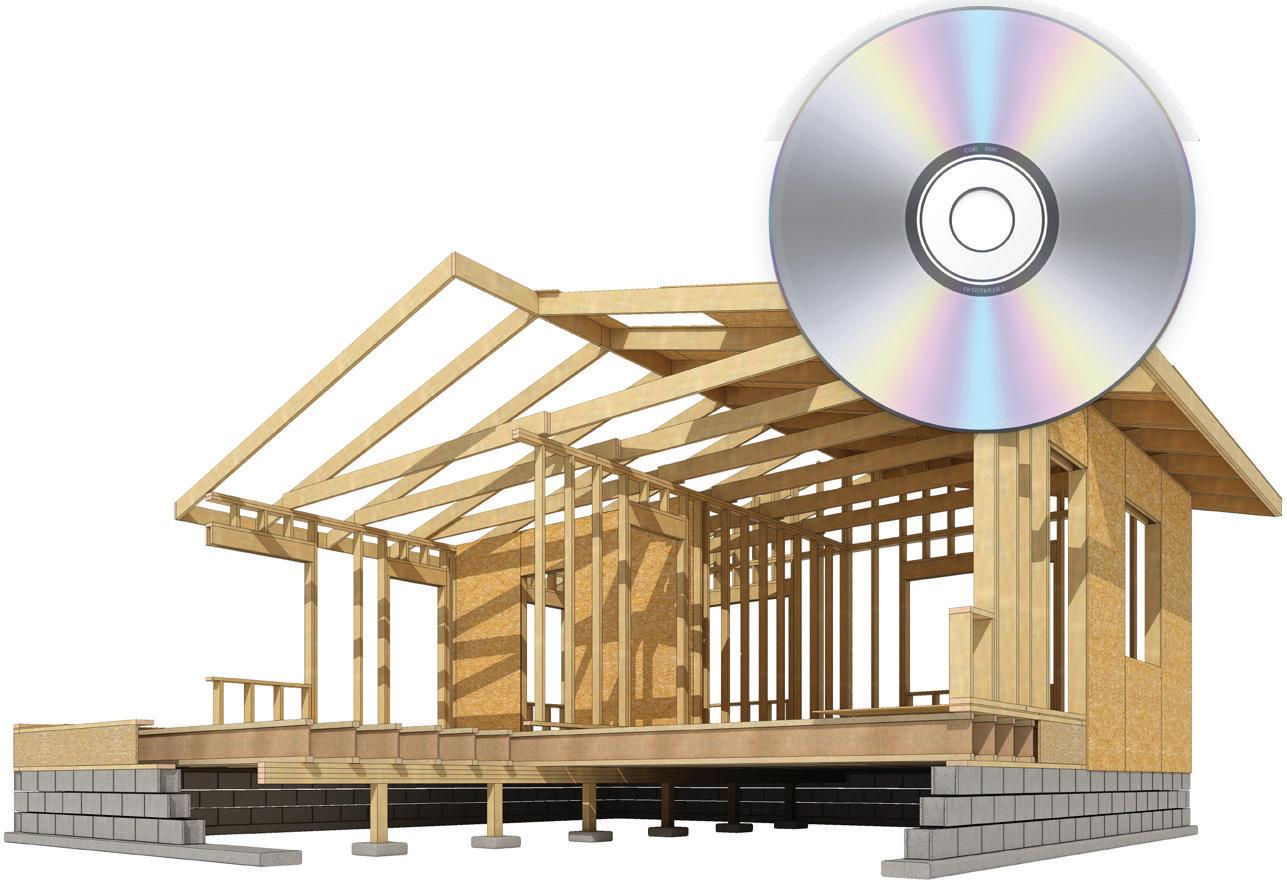
Available from ITI Australia is ITI Design Spec. A single member design software developed to assist industry professionals with the specification of ITI’s vast range of structural timber products. Free licences are available to suit builders, timber merchants, frame & truss professionals and engineers. Head to www. itiaustralia.com.au to download for free.
Metsä Kerto® LVL S-beam E13.2 is a laminated veneer lumber product used in all types of construction projects, from new buildings to renovation and repair. Kerto LVL is light, strong and dimensionally stable. Kerto LVL derives its high strength from the homogeneous bonded structure.
Kerto LVL is produced from 3 mm thick, rotary-peeled softwood veneers that are glued together to form a continuous billet. The billet is cut to length and sawn into a wide range of LVL beams.
Raw wood material comes from the sustainably managed and PEFC-certified forests of Metsä Group’s Finnish forest owner members, ensuring that the origin of the raw material is traceable.
It is a requirement of the Australian standard for manufacturing Laminated Veneer Lumber that an external A bond be achieved between the veneers by using a phenolic type adhesive.
Kerto® LVL WeatherGuard® Protection against weather during construction
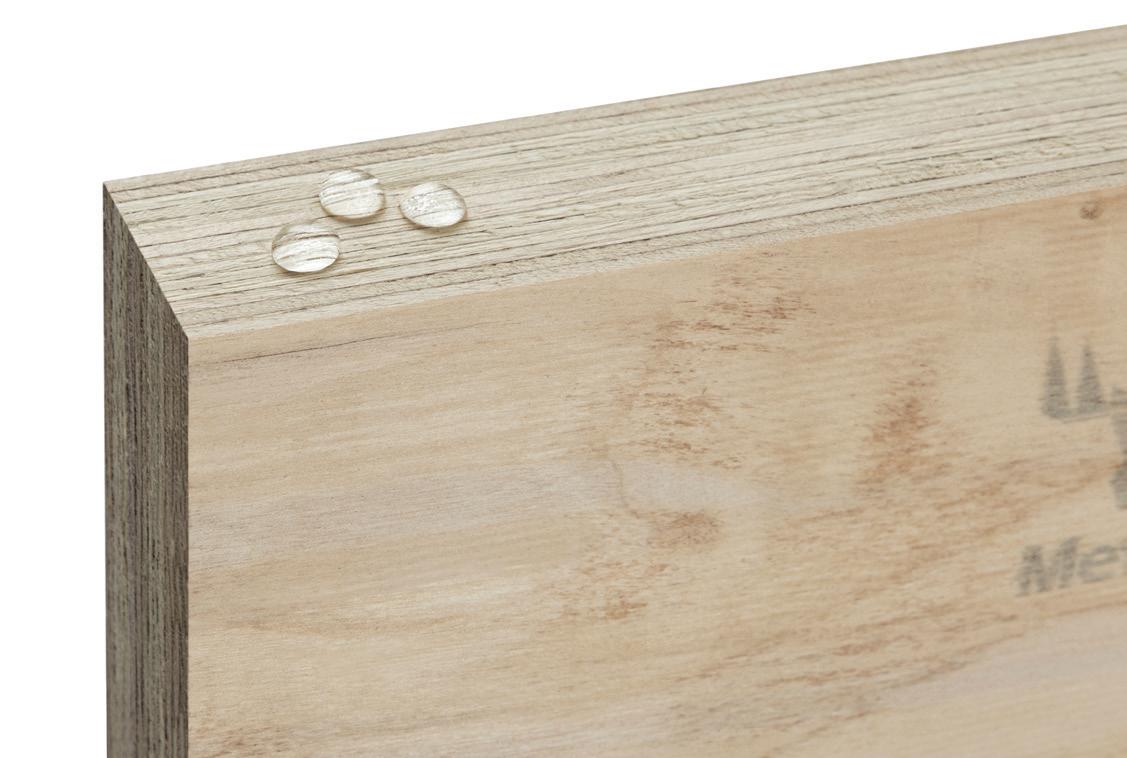
Kerto WeatherGuard® is a hydrophobic surface treatment applied to the Kerto-S® Beam LVL E13.2. The transparent special surface treatment provides temporary protection for the product against rain during the construction period. Thus it significantly reduces swelling and other unwanted effects of moisture. The treatment does not affect the strength properties of the product.
Kerto® LVL WeatherGuard performance
• The strength and stiffness properties are as good as those of an unprotected Kerto® LVL.
• Applied to all sides and edges of members 150mm deep and over. Applied to faces only of members under 150mm deep
• Kerto® LVL WeatherGuard treatment does not contain any formaldehyde.
• Kerto® LVL WeatherGuard does not contain any biocides (chemical agents against harmful organisms)
• Kerto® LVL WeatherGuard can be disposed like standard LVL as it contains nothing classified as hazardous waste.
• The treatment does not affect the reaction and resistance to fire, slip resistance or corrosion of the fasteners compared to unprotected Kerto® LVL.
laminating multiple lvls
Nail Lamination of 2 & 3 Ply Members
Nail Lamination - 2-Ply & 3-Ply Members
Minimum Nail Sizes
45mm Members - 2.80x75mm
63mm Members - 2.80x100mm
NAIL LAMINATION NOTES:
1. Minimum 2 Rows for Depths up to 305mm
2. Minimum 3 Rows for Depths up to 450mm
3. Drive opposing nail pattern to opposite side of member
4. Nails to penetrate second member by at least 50%
5. First nails to be located approx. 135mm from the edge
6. Additional nails added under point loads and over supports
7. Repeat nailing to nailing pattern to each lamination
Bolt Lamination of 2 & 3 Ply Members
2 Ply Lamination requires 2 Rows of Bolts
3 Ply Lamination requires 3 Rows of Bolts
BOLT LAMINATION NOTES:
1. M12 (8.8/S) bolts with 55mm washers at 600mm centres staggered in 2 rows for 2 ply beams
2. M12 (8.8/S) bolts with 55mm washers at 600mm centres staggered in 3 rows for 3 ply beams
3. Minimum 60mm edge clearance required
4. Ensure pre-camber of Glue Laminated Beams is set in the upward direction
5. Apply an additional 2 or 3 M12 bolts directly under any point loads
6. Bolt members together prior to applying loads
SCREW CONNECTION
Screw Lamination of 2 & 3 Ply Members
(1) Screws to be driven through the face of the 45mm member
(2) 63mm member to be positioned in the centre. Screws driven from either side through the face of 45mm members
SCREW LAMINATION NOTES:
1. Detail applicable to a 14g Bugle Head Batten Screw
2. Not acceptable for 36mm members in any configuration or 2 ply 45mm members
3. Drive opposing screw pattern to opposite side of member for 3 ply configurations
4. Not acceptable for members less than 200mm in depth
5. 2 Rows for 2 ply configurations
6. 3 Rows for 3 ply configurations
7. Refer to table for minimum edge and end distance requirements
8. Minimum of 45mm embedment into second member required
9. Suitable for both face and top loaded members
Roof Batten to Rafter Connections
D/3 max.
holes & notches in lvl
D/2 max.
B/4 max.
6 x B min.
D/4 max.
100mm Max.
Notch may be over support
Notch may be over support
D/2 max.
D/8 max. No min.
D/8 max.
min.
D/4 max.
100mm Max.
D/8 or 25mm max.
D/8 or 25mm max.
Notes:
D, less than 200mm
D/2 or 100mm max.
D/6 min.
D/2 max.
D, 200mm+
1. No more than 2 holes are permitted within an 1800mm length
2. For more information refer to Section 4.1.6 of AS 1684.
50mm max.
D/3 min.
D/3 min.
Greater than Hole Dia. 50mm min.
ROOF LOADINGS & DEFINITIONS
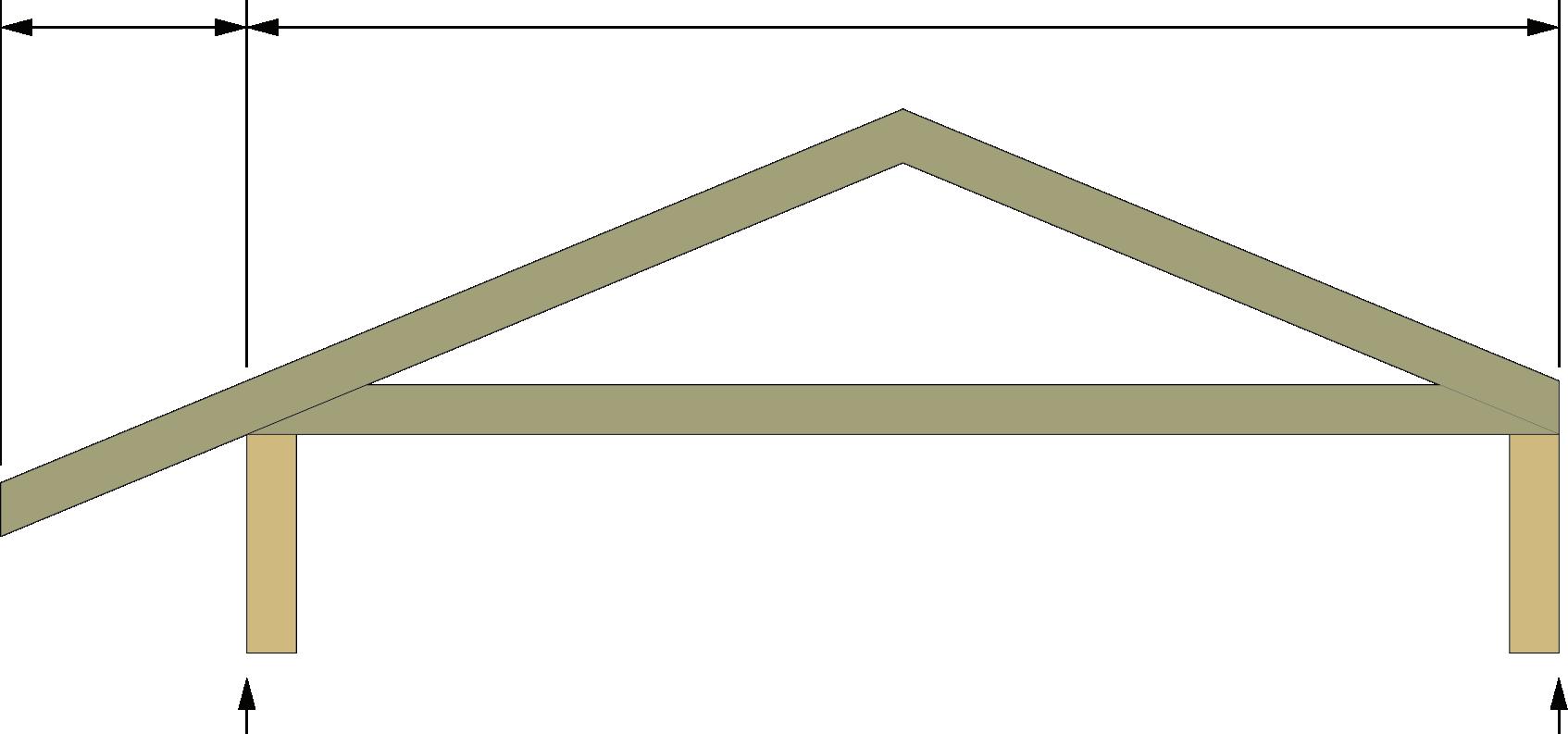
Determining Roof Load Width (RLW) at Supports - Trussed Roof
Overhang
Determining Roof Load Width (RLW) at Supports - Pitched Roof
Determining Ceiling Load Width (CLW) at Supports
Rafter & Beam
Single Span Continuous Span
Span A
Single Span Continuous Span
Span A
Span B
Span A
Span A
Span B
A continuous span only applies when the smaller of the spans is no less than half the larger span. Where this does not apply; both spans are to be treated as singles spans or further design analysis is required. Measure spans between internal faces of the supports.
Lateral restraint to Counter, Hanging and Strutting Beams
(a) Block skew nailed to beam and support with 3/75mm framing nails to each member
(b) Minimum 35x32mm tie nailed to the top of the beam and to the support with 2/75mm framing nails at each end
(c) G.I. Strap looped over beam with 2/30x2.8mm nails at either end and into the beam
Rafter / Taper Cut to Counter, Hanging and Strutting Beams
17.5o Minimum cut angle
The greater of ‘D’/3 or 100mm
Roof beam ends may be taper cut to avoid interference with roof coverings. It may be necessary to cantilever roof battens and butt into the side of these members. This detail may be used for Counter, Hanging, Strutting Beams as well as combination Strutting / Counter and Strutting / Hanging Beams.
FLOOR LOADINGS & DEFINITIONS
Floor Framing Deflection
Examples:
Maximum Dead Load Deflection on a 6000mm span is 15mm as 6000/300=20mm which exceeds the 15mm limit.
Maximum Floor Live Load Deflection on a 3000mm span is 8.3mm as 3000/360=8.3mm which is below the 9mm limit.
Bearer & Joist Span Types
A continuous span only applies when the smaller of the spans is no less than half the larger span. Where this does not apply; both spans are to be treated as singles spans or further design analysis is required. Measure spans between internal faces of the supports.
Determining Floor Load Width (FLW) at Supports
Cantilever
FLOOR JOISTS & BLOCKING
Floor joists are members which run parallel in series designed to support floor loads. The spacing of floor joists shall be such that it meets the requirements of the supported flooring / floor sheet.
Blocking Type
1 Intermittent blocking over external support at start / end of joist run
2 Intermittent blocking over internal support at start / end of joist run
3 Intermittent blocking over external support at 1800mm centres
4 Continuous Blocking to cantilevered joists
5 Rimboard / Fascia Beam to ends of cantilevered joist
Common Studs
Full Height Blocking min. 35mm Thick
Blocking to Concentrated Loads
Concentrated Load
Bottom Plate
Floor Joists
Support Framing
Blocking is required to provide resistance to lateral loads applied to the floor diaphragm, transfer concentrated loads down into the support structure. Unlike Common Blocking; Concentrated Load Blocking needs to be full height and a minimum of 35mm thick.
14
FLOOR BEARERS / tRIMMERS
Floor bearer or trimmer
Floor Bearers / Trimmers are members which run perpendicular to, and support Floor Joists. Floor Joists can be supported on the top or into the face of floor bearers via a joist hanger. Where Floor Joists run continuously over a floor bearer or cantilever off a bearer; the bearer is required to be a minimum of 60mm wide.
2/75x3.05 Nails(1)
(1) Where additional uplift is not generated through abnormal span conditions or imposed loads
Minimum Member Bearing Lengths
Wind Classification Joists to Bearer / Support Skew Nailed N2
C3
FLOOR BEARERS SUPPORTING ROOF LOADS
Where Bearers are required to support roof and wall loads additional dead loads need to be applied to the members. Common loads can be found in the following 2 tables.
Bearer supporting roof and wall loads
VOID tRIMMER JOISTS
Trimmer Joist
Trimmer
Void Trimmer Joists are members which run parallel to the floor joists and support 1 or 2 trimmers to frame out a void area. Void Trimmers connect to Void Trimmer Joists via a proprietary joist hanger or a designed screwed connection. It is not recommended to use cleats as bolts may protrude into the void causing issues with the plaster board lining.
Trimmer Joist Load Area
Trimmer Joist Support Void Trimmer Joist Support
Trimmer Span
Trimmer Joist
Trimmer
Trimmer Support
Design Notes:
1. Minimum Void width assumed as 1.0m
2. Single Void Trimmer assumes the void opening to be positioned at one end of the Trimmer Joists span
3. Double Void Trimmer assumes the void opening to be positioned centrally in the Trimmer Joists Span.
4. Combine the supported Floor Load Area of both Void Trimmers to determine the correct loads per the above table
Wind Beam
Upper Wall Framing
WIND / VOID BEAMS
Lower Wall Framing
Wind Beams are horizontal members positioned in between the upper and lower wall frames where there is no floor framing, such as stair voids. The purpose of Wind Beams is to transfer the horizontal wall loads, directly or indirectly, back to the braced walls.
Vertical roof and wall loads above the Wind Beam are assumed to be transfered directly to the lower wall framing. Wind Beam designs do not consider these loads.
Allowable Horizontal Deflection of Wind Beams is the less of Span/200 or 15mm. This may result in damage to brittle claddings or wall linings during extreme weather events.
Bottom Plate of Upper Frame and Top / Ribbon Plate of Lower Frame to be fixed to the Wind Beam at a maximum of 600mm centres.
Trimmer Joist
Trimmer Joist
Fix flooring to rimboard by driving 2.80x65mm framing nails at 150mm centres
Fix rimboard to each joist by driving 1x 2.80x75mm framing nail into each flange
Fix rimboard to top plate by skew nailing 2.80x65mm framing nails at 150mm centres
A6 CONTINUOUS BLOCKING OVER SUPPORTS
Same depth as Joist
A4 blocking over support 1 block at 1800mm centres
Fix flooring to each block by driving 2.80x65mm framing nails at 150mm centres
Fix blocking to top plate by skew nailing 2.80x65mm framing nails at 150mm centres Blocks required at both ends of joist runs
B2 support Nailing
Fix flooring to each block by driving 2.80x65mm framing nails at 150mm centres
Fix blocking to top plate by skew nailing 2.80x65mm framing nails at 150mm centres
c2 standard cantilever
Rimboard / fascia beam to be fitted to ends of cantilever using a 2/75x3.05mm nail.
Min. Joist Depth -20mm
Minimum of 35mm clearance required from end of Joist
Fix to support by skew nailing 75x3.05 nails through the joist on either side
e1 face mount hanger JOIST to timber connection
Min. Joist Depth -20mm
Continuous blocking to be installed to joists over the cantilevers support
Hanger required to be a minimum of 2/3 the depth of the supported member
3.75x40mm nails are to be fitted to every round hole in hanger
Guide Notes - Floor Framing
1. Refer to page 3 of this guide to check product availability in your area
2. Refer to page 9 of this guide for span and span type definitions
3. Floor joist centres should be selected as such to obtain adequate support for flooring / floor sheeting
4. Refer to page 9 for common floor covering types and their required joist centres
5. Floor framing members are to be installed per AS1684.2, AS1684.3 and good building practice
6. Flooring to be installed per AS1684.2 and AS1684.3. Particle board flooring to be installed per AS1860.2
7. Member size specified based on serviceability criteria outlined in AS170.3 Tables 4.1.3.4 & 4.2.3.5
8. Members shown in darker shaded cells analysed using Category 2 conditions
9. Floor Trimmer / Bearer details shown are based on the floor joists supported continuously over
10. Where members are supporting roof loads a maximum roof pitch of 35 degrees has been accounted for in calculations
11. Where members are supporting roof loads an N3 wind load has been applied
12. Void Trimmer Joists Minimum Void width assumed as 1.0m
13. Single Void Trimmer assumes the void opening to be positioned at one end of the Trimmer Joists span
14. Floor Trimmer Joist supporting 2 Void Trimmers assumes the void opening to be positioned centrally in the Trimmer Joists Span.
15. Combine the supported Floor Load Area of both Void Trimmers to determine the correct loads per the table on page 26
16. Member sizes nominated are based on the product being fully protected from moisture and maintains an average moisture content of 15% or less, over a period of 12 months i.e. K4 = 1.0 per AS1720.1 clause 2.4.2.3.
17. Member sizes nominated are based on construction in coastal areas south of latitude 250 and south of latitude 160 in all other areas i.e. k6 = 1.0 per AS1720.1 clause 2.4.3
18. Information in the guide is to be used for Metsa Kerto S-beam LVL only
Refer to page 45 for Product Storage & Handling requirements
StruttingBeamSpan
ROOF RAFTERS
RafterSpan
Rafters are members positioned parallel to each other designed to support and fix the roof covering. Rafters may also be designed to support the ceiling for cathedral type roofs.
Considerations for rafter centres should include; performance of the rafter, the span of roof battens and the plasterboard or ceiling joists.
Rafters are to be fixed and tied-down at all supports to accommodate any uplift generated by wind loads. Rafters are to be supplied in a single length or joined over a support.
Roof Strut
Ceiling Joist
Strutting Beam
Underpurlin
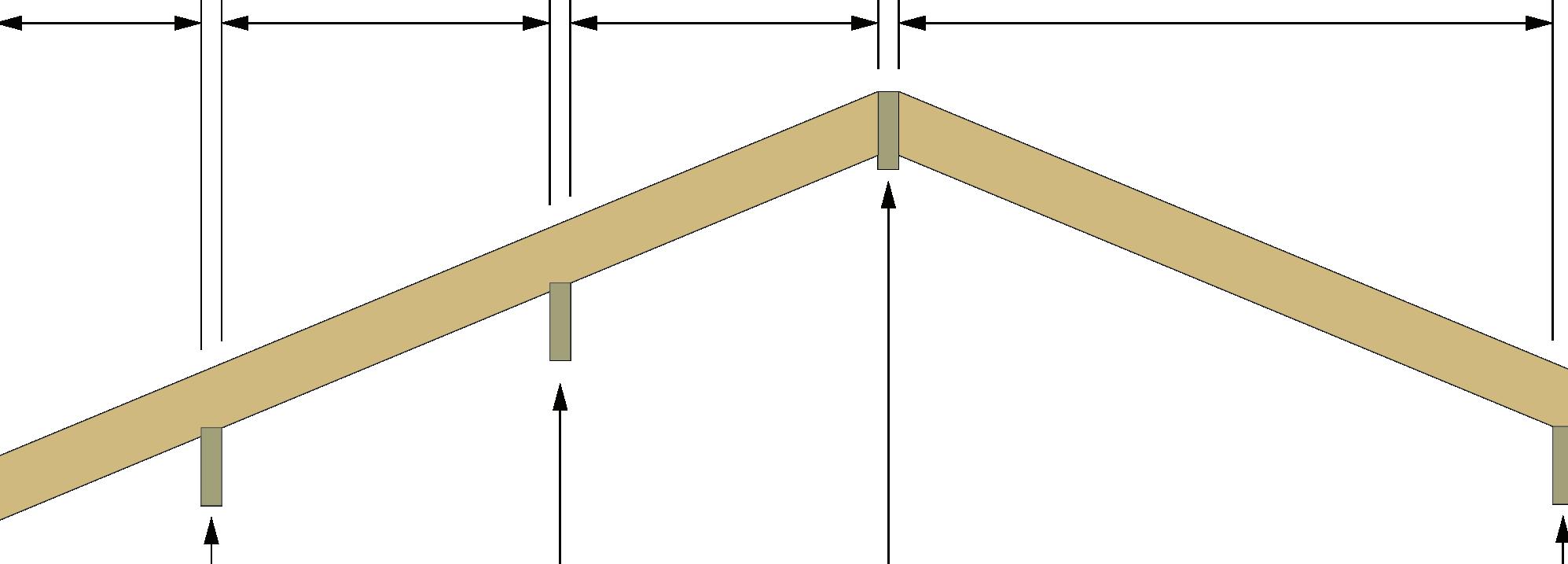
Ridge Beam / Board
Rafter
RafterSpan
Birdsmouth
Maximum allowable birds-mouth to be no greater than 1/3 the rafter depth
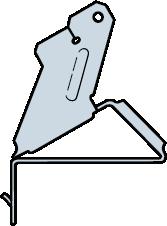
Simpson Strong-Tie VPA Connector
Wedge or Tapered Plate
Wedge or Tapered Plate
Edges to be fixed down to the support without any splitting. Tie-down the rafters directly to supports
To Support 8x 75x3.75 Nails Uplift Dead 1.58 kN 2.88 kN
To Supported Member 2x 40x3.75 Nails
Simpson Strong-Tie VPA connector with additional tie-down to rafters as required. 1.58 kN maximum tie-down supplied by VPA connector.
Capacities shown apply to the VPA being fixed to a plate with a minimum joint group of JD4 using all connections as indicated in the table above.
Installation of VPA Connectors
Flange
Flange
Step 1: Install top and face 3.75x75 nails in the “A” flange to outside wall top plate
Step 2: Seat rafter with a hammer, adjusting the “B” flange to the required pitch
Step 4: Install 3.75x30 nails into face of rafter both sides
Refer to page 33 for specification notes
Step 3: Install “B” flange 3.75x75 nails in the round nail holes, locking the pitch
ROOF BEAMs
Roof Beams are members designed to support Rafters. Rafters may be supported by butting into the face of Roof Beams or supported over Roof Beams. Roof Beams can be designed to transfer either just roof or roof and ceiling loads supported by the rafters.
Care should be taken to ensure the correct supports are applied to each Roof Beam support and that sufficient tie-downs have been applied. Refer to Australian Standard AS1684 for more information.
Intermediate Roof Beam
Rafter
Ridge Beam
RafterSpan
RafterSpan
RoofBeamSpan
StruttingBeamSpan
STRUTTING BEAMs
Strutting beams run parallel to ceiling joists and are design to take a point load from a Roof Strut supporting an Underpurlin. The supported Underpurlin will be supporting overlying Rafters. The span of the Strutting Beams shown in the span table have been determined by supporting the Underpurlin in the worst case scenario.
Strutting Beams support roof loads only via the Roof Strut. Where a point load is applied by a Hanging Beam these must be designed as a Strutting Hanging Beam. It is not recommended to fix the underlying plaster board ceiling to the Strutting Beam as this may result in a ‘shadow line’ being created through a variation in deflection between the Strutting Beam and the Ceiling Joists.
Rafter
Ridge Beam / Board
Underpurlin
Ceiling Joist
Strutting Beam
Roof Strut
UnderpurlinSpan
Determining Roof Area supported by Strutting Beam
Ridge / Roof Beam
Support to Strutting Beam
Rafters supported by Underpurlin
Underpurlin supported by Strutting Beam
Strutting Beams supporting Underpurlins via Roof Struts
Support to Strutting Beam
Supported roof area
Installation of Strutting Beams
Approximately 25mm clearance between the underside of the Ceiling Joists and the Strutting Beam at mid span
Span Tables shown for Strutting beams are to be restrained at the location of the Roof Strut support and in accordance with AS1684 as a minimum.
Block to raise Strutting Beam
Rafter
Underpurlin
Block
Roof Strut
Ceiling Joist
Counter Beam
CEILING JOISTS
CeilingJoistSpan
CeilingJoistSpan
Hanging Beam
Ceiling Joists are members which support the ceiling lining only. Ceiling Joist spacing shall be governed by the maximum allowable span of the supported ceiling lining.
Ceiling Joists may free span between internal supports or be supported intermediately by Hanging Beams (see page 36). Ceiling Joists are to be fixed to Hanging Beams via either 35x32mm timber cleats / droppers with 2/ 75x3.15 framing nails to each member, 25x1.6mm galvanized strap, ceiling joist hangers or Simpson Strong-Tie TCP clips.
Counter Beam
HANGING BEAMS
Hanging Beam CeilingJoistSpan
Ceiling Joist CeilingJoistSpan
Block
Hanging Beams are designed to support loads transferred via the ceiling joists only. Hanging Beams are generally positioned perpendicular to the Ceiling Joists which are then hung from the underside of the member.
Where Hanging Beams are supported by external walls which also support Rafters; provisions are required to the end of the member to prevent extrusion through the roof covering. A premanufactured Splayed Beam or Jack Trimmer Joist will be required.
Support of Hanging Beam with Jack Trimmer Joist
Timber Cleat fixed to with 2/75x3.15 Nails to both Hanging Beam and Block
Block the same depth as Ceiling Joists and same width as Hanging Beam
2x M10 Bolts through Hanging Beam and paired rafter
Joist
Ceiling
Rafter
COUNTER BEAMS
Counter Beams run parallel to Ceiling Joists and are design to support Hanging Beams. The supported Hanging Beam will be supporting underlying ceiling joists. The spans published for Counter Beams have been determined by supporting the Hanging Beam in the worst case scenario.
Counter Beams support ceiling loads only. Where a point load is applied by a roof strut onto either the Counter Beam or the Hanging Beam these must be designed as a Counter Strutting Beam or Hanging Strutting Beam respectively.
Refer to page 45 for specification notes
Determining Ceiling Area supported by Counter Beam
Support to Counter Beam Counter Beam
Recommended Hanging Beam to Counter Beam Connection
Hanging Beams supporting Ceiling Joists
Ceiling Joists
Support to Counter Beam
Supported Ceiling Area
Joist Hanger
Strutting / Hanging Beam
STRUTTING / hanging BEAMs
BEAMS
Strutting / Hanging Beams are Hanging Beams which support an additional load applied by a Roof Strut carrying an Underpurlin.
Two elements need to be considered when selecting the correct member size. The first is the Ceiling Load Width. Information on determining this can be found on page 7 of this guide. The second is the point load applied to the member from the Underpurlin’s transferred via the Roof Strut. Information on determining this point load can be found on page 9.
The span of the Strutting / Hanging Beams shown in the span table has been determined by locating the point load from the supporting Underpurlin in the worst case scenario.
For more information on Strutting / Hanging Beams refer to Australian Standard AS1684.
/
Roof Strut
Underpurlin
Roof / Ridge Beam
Ceiling
Joist
Rafter
Strutting/HangingBeamSpan
STRUTTING / COUNTER BEAMS
Strutting/CounterBeamSpan
Strutting / Counter Beams are Counter Beams which support an additional load applied by a Roof Strut carrying an Underpurlin.
Two elements need to be considered when selecting the correct member size. The first is the point load from the Hanging Beam. Information on determining this can be found on page 38 of this guide. The second is the point load applied to the member from the Underpurlins transferred via the Roof Strut. Information on determining this point load can be found on page 33.
Alternatively the Strutting / Counter Beam span table can be used to nominate the section size of a Counter Beam supporting a Strutting / Hanging Beam. Design elements remain as a point load of ceiling and roof loads.
The span of the Strutting / Counter Beams shown in the span table has been determined by locating the point load from the supporting Underpurlin in the worst case scenario.
For more information on Strutting / Hanging Beams refer to Australian Standard AS1684.
Strutting / Counter Beam
Roof / Ridge Beam
Rafter
Ceiling
Joist
Hanging Beam
Underpurlin
Roof Strut
UNDERPURLINS
Underpulins are compact, lightweight intermediate roof members used to support rafters while being concealed in the roof cavity. Underpurlins bear down onto Strutting Beams or other supports via Roof Struts. Underpurlin’s span tables accommodate loads from the rafters and roof covering only. No ceiling loads are accounted for.
90x63 Metsa Kerto
Terracotta
UnderpurlinSpan
Roof Beam
Rafter
Ceiling Joist
Underpurlin
Strutting Beam
Roof Battens
RoofBattenSpan
Roof Battens are members which span over and across rafters. They are designed to support the roof covering only. Roof Battens are installed on the flat and are to span across a minimum of 3 rafters.
Batten Centres
Roof Batten
Rafter
Roof Beam
Roof Batten Cantilever to be the lesser of the Cantilever value shown above and half the actual Roof Batten Span.
Guide Notes - Roof Framing
1. Refer to page 3 of this guide to check product availability in your area
2. Refer to page 8 of this guide for span and span type definitions
3. Rafter and Ceiling joist spacings / centres should be selected as such to obtain adequate support for Roof batten or Ceiling Material respectively. Refer to product manufacturer for details
4. Always confirm the required roof batten centres against the roofing manufacturers recommendations
5. Refer to page 26 for common roof covering types and their weights
6. Roof framing members to be installed per AS1684.2 and good building practice
7. Member sizes specified based on serviceability criteria outlined in the tables in AS170.3 Section 2
8. Beam details shown are based on the Rafter being supported continuously over
9. Where members are supporting roof loads a maximum roof pitch of 35 degrees has been accounted for in calculations
10. Member sizes nominated are based on the product being fully protected from moisture and maintains an average moisture content of 15% or less over a period of 12 months i.e. K4 = 1.0 per AS1720.1 clause 2.4.2.3.
11. Member sizes nominated are based on construction in coastal areas south of latitude 250 and south of latitude 160 in all other areas i.e. k6 = 1.0 per AS1720.1 clause 2.4.3
12. Information in the guide is to be used for Metsa Kerto S-beam LVL only
Product Handling & Storage
Kerto® products – like all other engineered wood products – must be handled and stored properly and carefully. Incorrect handling and storage may introduce defects on product’s surfaces, edges or corners. Furthermore, the dimensional stability of the product may suffer.
Transport
While transporting or storing the product, increased moisture caused by rain or splashing must be avoided. If Kerto products are moved with a forklift truck, wide enough forks must be used in order to avoid damaging the product. When lifting several packs at a time, the distance between forks must be wide enough to ensure safe lifting. Surface-treated products should be delivered direct to site without additional, unnecessary off-loading during delivery.
Storage
Kerto products must be stored under cover. When storing the products temporarily on site, a solid, straight and dry platform should be used. The height of ground bearers must be at least 300 mm. To avoid twisting of the product, the bearers between packs must be aligned vertically with the ground bearing timbers. The plastic wrapping of each pack must be cut open from underneath to enable moisture to evaporate from the bundles. If the products are stored on site for longer than one week, the bundles must be covered with an additional protective covering. Conditions of the products and protective cover must be monitored regularly during storage.
Handling
Kerto product packs may be unloaded on site with either a forklift or a crane. Approved webbing slings must be used if unloading with crane. It is forbidden to use chains or wires. If unloading is done manually, the pack is opened and the products are carried one-by-one. While cutting the banding, beware of band’s ends. Kerto products should not be dragged or dropped.
Kerto is a light-weight material and is easy to shape, which means notable time and cost savings in construction. Kerto products can be processed with conventional wood working and power tools. There is no need for separate specialist tools.
Surface-treated products should be unloaded individually. If needed, a cellular plastic padding that does not stain, should be used under the webbing slings.
Simpson Strong-Tie is one of the largest suppliers of structural building products in the world, including timber connectors, fasteners, fastening systems, anchors and lateral-force resisting systems. The company is known for its commitment to product development, engineering, testing and training as well as providing customers with quality products and exceptional service. Today, Simpson Strong-Tie has more than 3,100 employees and more than 50 factories, offices and warehouses all around the globe.
Simpson Strong-Tie began manufacturing engineered structural connectors for timber-framed construction in 1956 in California, USA. Nearly 40 years later, the company entered the anchoring industry, and the product line has expanded to include many anchoring, crack-injection repair and masonry adhesives, and a full line of powder-actuated tools and fasteners.
Simpson Strong-Tie Beam to Beam Hangers
1. Hangers to be a minimum of 2/3 the depth of the I-Joists.
2. Nails are required to be installed to all pre-determined holes in I-Joist hangers.
3. Minimum of 65x3.75mm nails to be used into the supported member use using LUS type hangers
4. Refer to ITI Spec Sheet 2 for product capacities
Dunnings understands the needs of truss and trade businesses. Through experience, expertise and local manufacturing capability, Dunnings supply products that meet or exceed all relevant Australian standards.
Dunnings engineering capability is fully supported by a large in-house Australian engineering team. Dunnings supply the fixing and load capacities for their whole range of timber connectors and builders’ hardware through their Engineering Data Book.
Manufacturing since 1951, the business is Australian owned and operated and continues to manufacture here in Australia.
We offer a comprehensive range of Australian-made timber connectors and builders hardware, as well as products sourced globally.
Dunnings Beam to Beam Hangers
Dunnings Cleats
SPECFRAME 10.0 10.0
Spec Frame 10.0 is ITI’s engineered Laminated Veneer Lumber (LVL) alternative to MGP10. Make wall framing straight the first time and eliminate the need to sight your framing for bow, spring or twist. With a joint group of JD3, Spec Frame 10.0, provides superior fixing capacity for bracing components.
Spec Frame 12.1 is ITI’s engineered Laminated Veneer Lumber (LVL) alternative to MGP12. Make wall framing straight the first time and eliminate the need to sight your framing for bow, spring or twist. With a joint group of JD3, Spec Frame 12.1, provides superior fixing capacity for bracing components.
Spec Beam 13.2 is the economical choice for LVL E13.2. Available in all the commonly specified sizes by engineering professionals you can always find an option for your beams, rafters or joists. ITI laminated veneer lumber products are compliant to Australian regulations for structural adequacy as well as responsible forestry.
Available in Victoria and Tasmania, Spec Beam 14.5 is the simple, modern, sustainable, alternative to F17 hardwood and a direct replacement for 42mm LVL 15. It is available in the same section sizes as traditional F17 hardwoods. Readility available in long straight lengths and is easy to hande.
Form Spec LVL is either lightweight New Zealand Radiata Pine or Europen Spruce designed specifically for concrete soffit forming. Weighing as much as 25% less than other products available in Australia, Form Spec LVL is ideally suited for the agile process of form working.
Edge Form is a concrete edge forming laminated veneer lumber board designed to resist deformation generated by uneven uptake of moisture which occurs during the concrete pouring process. It boasts high quality veneers to the outer faces for a clean finish and small pencil round corners for ease of handling.
Available in New South Wales & Queensland, Spec Joists Wooden I-Joists are comprised of high grave LVL top & bottom flanges with as OSB web. The combination of these components creates an ideal timber joist with a 300mm deep option capable of spanning 6.0m. Spec Joists can be provided docked to length and with service holes pre-cut to save time on site - consult your local timber supplier for more details.
Spec Lam 15+ is an Australian-manufactured structural gluelaminated beam product developed specifically to match the depth of ITI’s broader range of Laminated Veneer Lumber and Wooden I-Joist products, along with open-web trusses commonly used in floor framing systems. Spec Lam 15+ is a non-visual / structural grade replacement for GL17 timber glue laminated beams.
CONTACT US:
ITI Technical Support Centre
68-80 Kirkham Road West, Keysborough, Victoria 3173
P || 03 9394 8400
E || ewp@iti.net.au
E || ewp@iti.net.au
ITI Queensland (Townsville)
54-62 Enterprise Street, Bohle, Queensland 4818
P || 07 4724 5509
P || 03 9392 8400 (Brisbane) 63 Creek Street, Bundamba, Queensland 4034 8400
E || ewpqld@iti.net.au
ITI Queensland (Brisbane)
62 Creek Street, Bundamba, Queensland 4034
P || 07 3436 8400
E || ewpqld@iti.net.au
ITI New South Wales (Sydney) Dunheved Circuit, St Marys, New South Wales 2760 8805 5000 ewpnsw@iti.net.au
ITI New South Wales (Newcastle) 19 Nelson Road, Cardiff, New South Wales 2285
P || 02 4953 7666
E || ewpnsw@iti.net.au
South Australia (Adelaide) 82-94 Grand Trunkway, Gillman, South Australia 5013 8447 0400 ewpsa@iti.net.au
ITI TASMANIA (BELL BAY) 17 Bell Bay Road Bell Bay, Tasmania 7253
P || 03 9394 8400
E || ewptas@iti.net.au
ITI Queensland (Townsville) 46-50 Perkins Street West Railway Estate 4724 5509 ewpqld@iti.net.au
ITI New South Wales (Sydney) 59 Dunheved Circuit, St Marys, New South Wales 2760
P || 02 8805 5000
E || ewpnsw@iti.net.au
John Cook & Sons (Sydney) 116 Links Road, 9833 0355 ewp@johncook.net.au
ITI Victoria (Melbourne) 68-80 Kirkham Road West, Keysborough, Victoria 3173
ITI South Australia (Adelaide) 82-94 Grand Trunkway, Gillman, South Australia 5013
P || 08 8447 0400
E || ewpsa@iti.net.au
New South Wales (Newcastle) 19 Nelson Road, Cardiff, New South Wales 2285 4953 7666 ewpnsw@iti.net.au
ITI Western Australia (Perth) 102-108 Bannister Road, Canning Vale, Western Australia 6155