HEALTH & WELL-BEING
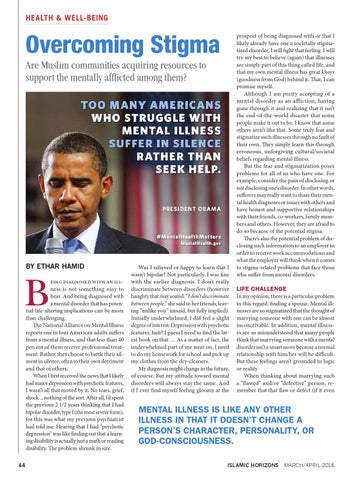
Overcoming Stigma Are Muslim communities acquiring resources to support the mentally afflicted among them?
BY ETHAR HAMID
B
eing diagnosed with an illness is not something easy to hear. And being diagnosed with a mental disorder that has potential-life-altering implications can be more than challenging. The National Alliance on Mental Illness reports one in four American adults suffers from a mental illness, and that less than 40 percent of them receive professional treatment. Rather, they choose to battle their ailment in silence, often to their own detriment and that of others. When I first received the news that I likely had major depression with psychotic features, I wasn’t all that moved by it. No tears, grief, shock ... nothing of the sort. After all, I’d spent the previous 2 1/2 years thinking that I had bipolar disorder, type I (the most severe form), for this was what my previous psychiatrist had told me. Hearing that I had “psychotic depression” was like finding out that a learning disability is actually just a math or reading disability. The problem shrunk in size.
44
Was I relieved or happy to learn that I wasn’t bipolar? Not particularly. I was fine with the earlier diagnosis. I don’t really discriminate between disorders (however haughty that may sound. “I don’t discriminate between people,” she said to her friends, leaving “unlike you” unsaid, but fully implied). Initially underwhelmed, I did feel a slight degree of interest. Depression with psychotic features, huh? I guess I need to find the latest book on that … As a matter of fact, the underwhelmed part of me went on, I need to do my homework for school and pick up my clothes from the dry-cleaners. My diagnosis might change in the future, of course. But my attitude toward mental disorders will always stay the same. And if I ever find myself feeling gloomy at the
prospect of being diagnosed with or that I likely already have one a societally stigmatized disorder, I will fight that feeling. I will try my best to believe (again) that illnesses are simply part of this thing called life, and that my own mental illness has great khayr (goodness from God) behind it. That, I can promise myself. Although I am pretty accepting of a mental disorder as an affliction, having gone through it and realizing that it isn’t the end-of-the-world disaster that some people make it out to be, I know that some others aren’t like that. Some truly fear and stigmatize such illnesses through no fault of their own. They simply learn this through erroneous, unforgiving cultural/societal beliefs regarding mental illness. But the fear and stigmatization poses problems for all of us who have one. For example, consider the pain of disclosing or not disclosing one’s disorder. In other words, sufferers may really want to share their mental health diagnoses or issues with others and have honest and supportive relationships with their friends, co-workers, family members and others. However, they are afraid to do so because of the potential stigma. There’s also the potential problem of disclosing such information to an employer in order to receive work accommodations and what the employer will think when it comes to stigma-related problems that face those who suffer from mental disorders.
LIFE CHALLENGE In my opinion, there is a particular problem in this regard: finding a spouse. Mental illnesses are so stigmatized that the thought of marrying someone with one can be almost inconceivable. In addition, mental illnesses are so misunderstood that many people think that marrying someone with a mental disorder isn’t a smart move because a normal relationship with him/her will be difficult. But these feelings aren’t grounded in logic or reality. When thinking about marrying such a “flawed” and/or “defective” person, remember that that flaw or defect (if it even
MENTAL ILLNESS IS LIKE ANY OTHER ILLNESS IN THAT IT DOESN’T CHANGE A PERSON’S CHARACTER, PERSONALITY, OR GOD-CONSCIOUSNESS. ISLAMIC HORIZONS MARCH/APRIL 2016