15 TH ANNUAL ISNA EDUCATION FORUM
Education Forum Inspires, Unites BY EMAN SHURBAJI
J
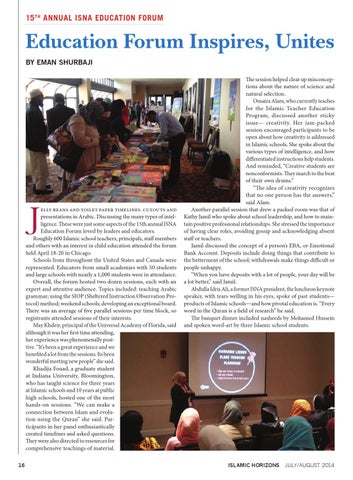
elly beans and toilet paper timelines. Cutouts and presentations in Arabic. Discussing the many types of intelligence. These were just some aspects of the 15th annual ISNA Education Forum loved by leaders and educators. Roughly 600 Islamic school teachers, principals, staff members and others with an interest in child education attended the forum held April 18-20 in Chicago. Schools from throughout the United States and Canada were represented. Educators from small academies with 50 students and large schools with nearly a 1,000 students were in attendance. Overall, the forum hosted two dozen sessions, each with an expert and attentive audience. Topics included: teaching Arabic grammar; using the SIOP (Sheltered Instruction Observation Protocol) method; weekend schools; developing an exceptional board. There was an average of five parallel sessions per time block, so registrants attended sessions of their interests. May Khdeir, principal of the Universal Academy of Florida, said although it was her first time attending, her experience was phenomenally positive. “It’s been a great experience and we benefited a lot from the sessions. Its been wonderful meeting new people” she said. Khadija Fouad, a graduate student at Indiana University, Bloomington, who has taught science for three years at Islamic schools and 10 years at public high schools, hosted one of the most hands-on sessions. “We can make a connection between Islam and evolution using the Quran” she said. Participants in her panel enthusiastically created timelines and asked questions. They were also directed to resources for comprehensive teachings of material. 16
The session helped clear up misconceptions about the nature of science and natural selection. Omaira Alam, who currently teaches for the Islamic Teacher Education Program, discussed another sticky issue— creativity. Her jam-packed session encouraged participants to be open about how creativity is addressed in Islamic schools. She spoke about the various types of intelligence, and how differentiated instructions help students. And reminded, “Creative students are nonconformists. They march to the beat of their own drums.” “The idea of creativity recognizes that no one person has the answers,” said Alam. Another parallel session that drew a packed room was that of Kathy Jamil who spoke about school leadership, and how to maintain positive professional relationships. She stressed the importance of having clear roles, avoiding gossip and acknowledging absent staff or teachers. Jamil discussed the concept of a person’s EBA, or Emotional Bank Account. Deposits include doing things that contribute to the betterment of the school; withdrawals make things difficult or people unhappy. “When you have deposits with a lot of people, your day will be a lot better,” said Jamil. Abdulla Idris Ali, a former ISNA president, the luncheon keynote speaker, with tears welling in his eyes, spoke of past students— products of Islamic schools—and how pivotal education is. “Every word in the Quran is a field of research” he said. The banquet dinner included nasheeds by Mohamed Hussein and spoken word-art by three Islamic school students.
ISLAMIC HORIZONS JULY/AUGUST 2014