Palette of stories
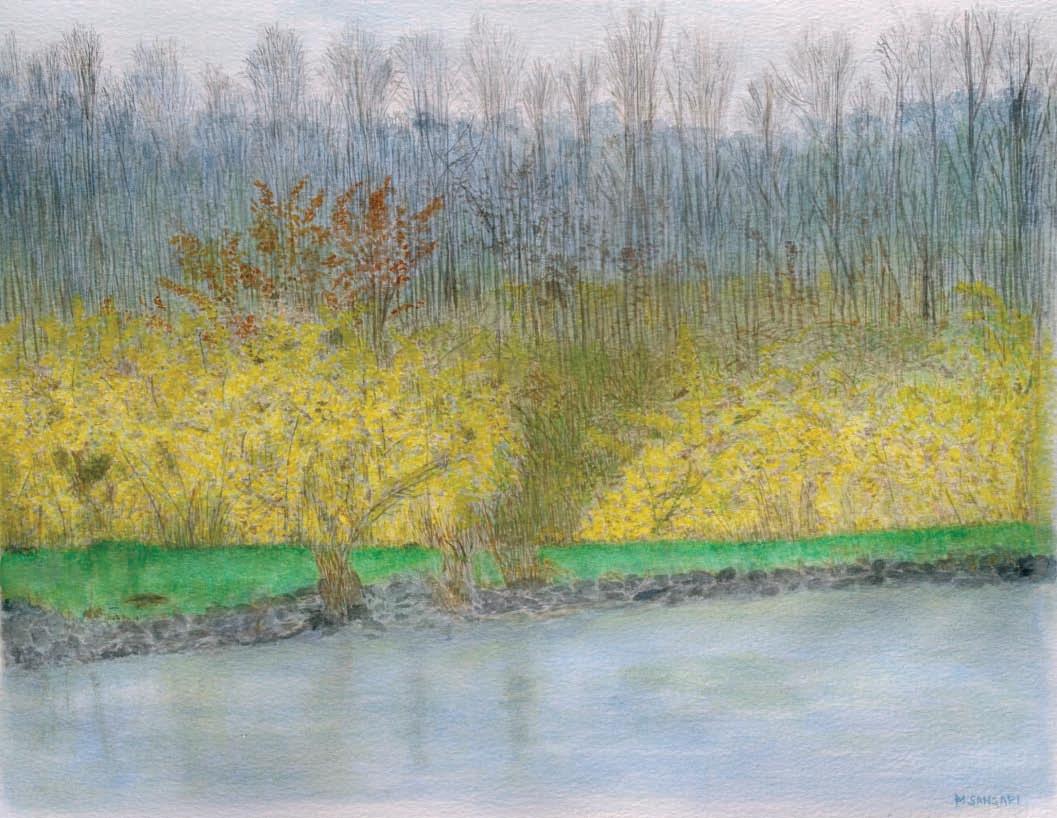
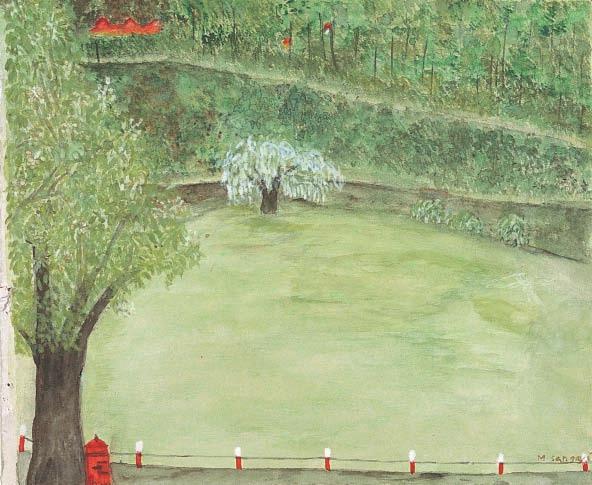
Manu Sangari’s palette of stories calls one into them as though into the familiars of magical thinking. Magical thinking recalls scenes, people, the long dense lines of streets, snatches of plots, the syncopation of tinted conversations, so that one can inhabit the places one left behind, one can recall them in a now once they have gone by. Magical thinking enables a past one can live in to help ease the thinned out grief of loss. In opening up the world of his memory scapes to a viewer, some spoken in the language of landscape, some versed in the nuances of a city street or hastily set up bazaar stall, Manu brings a viewer into them so gently, so tenderly that as you stand before them, you know you will gather them up as memories that have now become your habitation. Each painting almost appears to choose the shades, shadows, thickness of overlay, or lightness of the brush touch most appropriate to telling its tale. Their seeming artlessness seduces viewers into believing that their eye just traveled into the paintings by accident. But each painting gives the eye the lineaments of a journey in patterns of color that echo so subtly across each other, that as with Manet one is commanded to look at its surface, pulled towards the skin by spills of ochre, splotches of firebox/blood red, plates of baby blue, skeins of veridian, their abstraction traceries of collusion. The skin gives the story. Each painting or sequences of paintings from one trip or place or cluster of relationships not only to overcome degradation and depletion,” his sensibilities offer visitors a chance to encounter the spaces which Manu has “transformed (s) into pictorial subtleties.” One can see these chronicled with such tender care, but viewers seduced by the sensibilities in Red letterbox and green water (Zameen Aasmaan patterns tilled into landscapes with the canny accuracy of a 2004). A squat red letter box leans against a burnt umber tree trunk surveyor’s speculative eye will find themselves traveling into the stretching up into leaf green speckled in white, all its freshness membrane of scenes, walking through them as though they were countermanded by the sticks of red, tipped in milk, strung together, Tang or Sung dynasty garden or mountain scapes. fencing one length of a pond. The letter box at the bottom of the Nilima Sheikh calls Manu a hesitant Utopian,“a worried painting echoes the posts and then spots of red and red humps ecologist who moves from one site to another to tend and nurture, towards the top lead the eye back upwards. Green tamped with white outlines the angled paths that curve together to meet outside the plane of the painting. A tree showered in white bloom sits in or alongside the pond, which is the same tamped green as the paths, their promises thickened by the white fleshed into the pond water. The water has lost its pellucid quality; it is so dense with the other colors in the painting that you know something is not quite right. But you are drawn to the water again and again, your eye catches it, almost reflects it because of the way that the colors array themselves the reds and whites keep on pulling you along making you circle the edges and back down towards the middle. Even though the painting is meant not to make you recoil, its tones are a lovely pleasure, something about the circling feels as though you are both drawn to and trying to shy away from the pond the way that something muted by decaying smells draws you inexorably towards it even as you edge away with the peculiar frisson of horror.
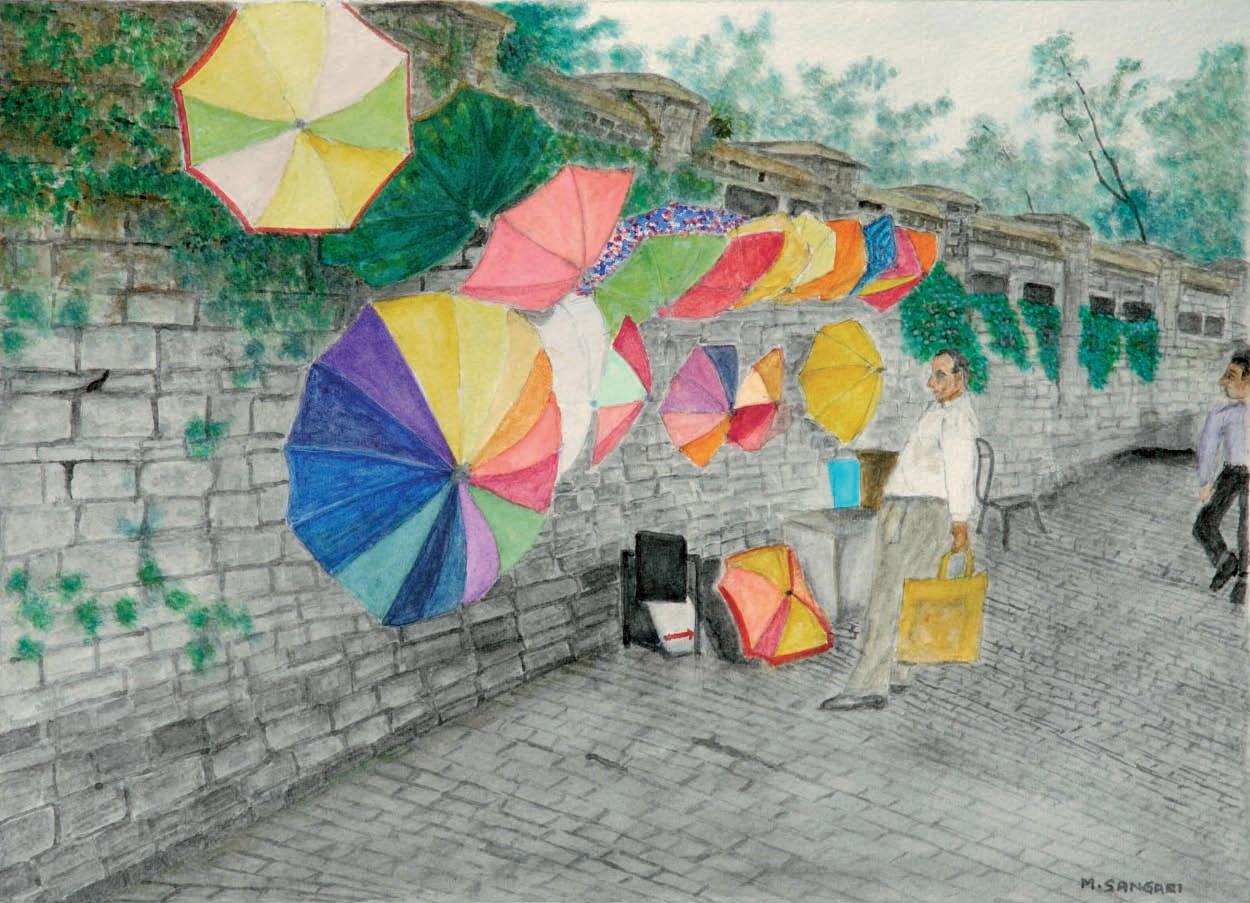
In the Kasauli street scene, Tafreeh, a man trousered in pallid grey, comfortably rounded, white shirt filled by a stomach pushing gently against it; umbrellas slung from the wall before him, a riot of
Red letterbox and green water Nainital, 1992, 26 x 21 cm, watercolour on paper
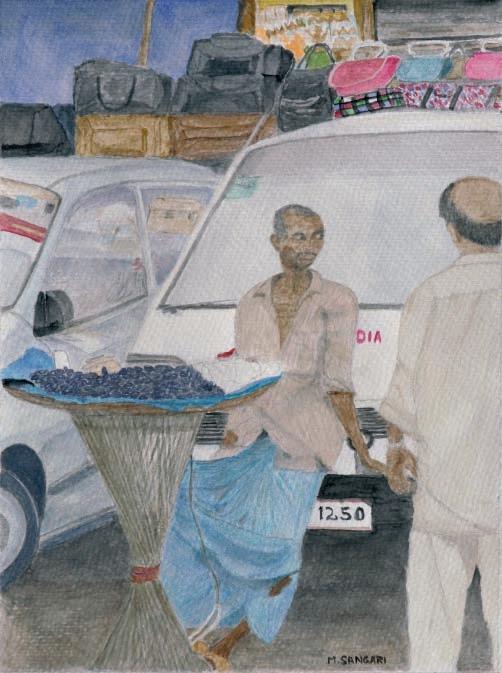
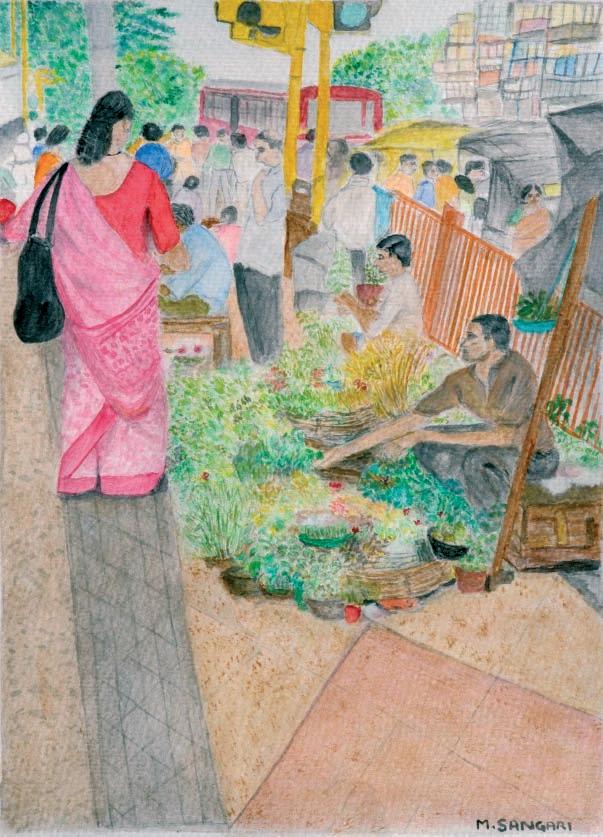
Kolkata: Footpath, 28 x 22 cm, Calcutta, 2006, watercolour on paper
ice cream colors, fun house mirrors of his shape as it assembles Manu’s landscapes lie in the genres of Japanese Ukiyo-e print itself before them. He stands against a chair back outlined in black or Hiroshi Yoshida’s travel print: landscapes that bring the most that seems to hold his lean upright almost as though he would fall purist form of nature, to nature carved into an aesthete’s delight and over backwards from his heft if it were not there. The ochre of his the street, the water front, the bridge, cities roaming with figures. bag held low levers itself against the ochre of the umbrella whose But the ways in which colors syntax across space to hold the eye in a point stares him in the eye. Moss green topped finials. Green drifts stillness that demands roaming, offering an entrée into wandering hanging down from deep grey niches shadowed in black, deep green feelings, the tale is told in a subtlety of form, and arrangements that augmented in deep blue, froth of tree tracery, each with black unspool themselves on the skin of paper: these are the armature of linings and speckles that rebound from the far left corner into the the idioms peculiar to Manu’s painting and drawing. The antinomian journey embedded in and through Red letterbox and right. As your eyes pull back down into the street grey brick of the green water, the walking paths around a pond once pellucidly clean wall, the slate soot brick of the foot path heads out, scrawny, now thickened with scummy junk, seems at odds with so many scribbled lines shortening and tightening towards one side. The others, such as those in the Calcutta street scenes that are rendered
perspectival point lengthens past a black trousered, black haired, with consummate grace, but in a way it promises the same things: blue grey shirted man, half out of the frame, his face pulled side that you will join Manu in his traversals, and that those traversals, ways to look back at the promises dreaming in the rainbow however gentle, however feathery the touch will be conducted with cornucopia: burnt red, flesh pink, purple, violet, foam green, indigo, deft, nuanced, lucid, unflinching honesty. white, aqua, cobalt, speckled, striped. Like the man, we too are tugged and jostled in the syncopation between the ground, almost stern grey lines that thin out into the distance on the left, a slender red arrow beckoning in the midst of a white paper perhaps, and the
GEETA
PATEL billowing umbrellas that keep on calling back upwards toward the Middle Eastern and South Asian Languages and Cultures right, the final one an exclamation, outlined in red, paled with the Studies in Women and Gender, University of Virginia light of green, yellows and white.
June 2008
Tafreeh, 32 x 23 cm, Kasauli, 2006, watercolour on paper
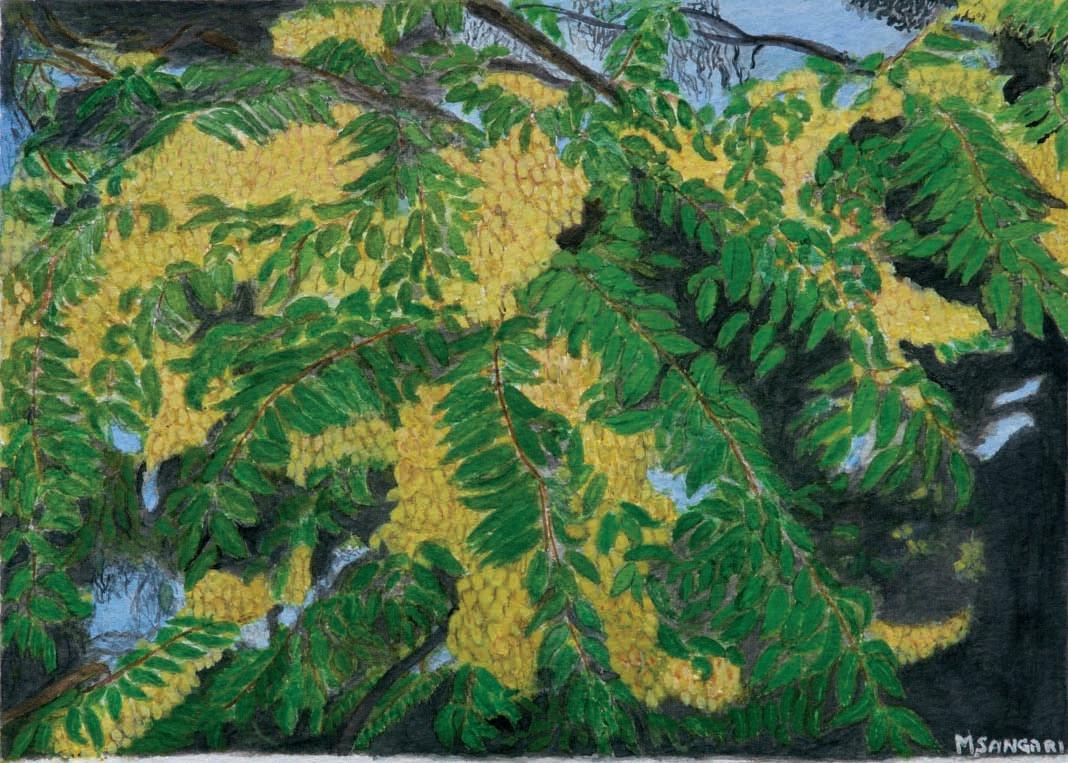
Top: Kolkata ke Jamun, 28 x 22 cm, Calcutta, 2006, watercolour on paper
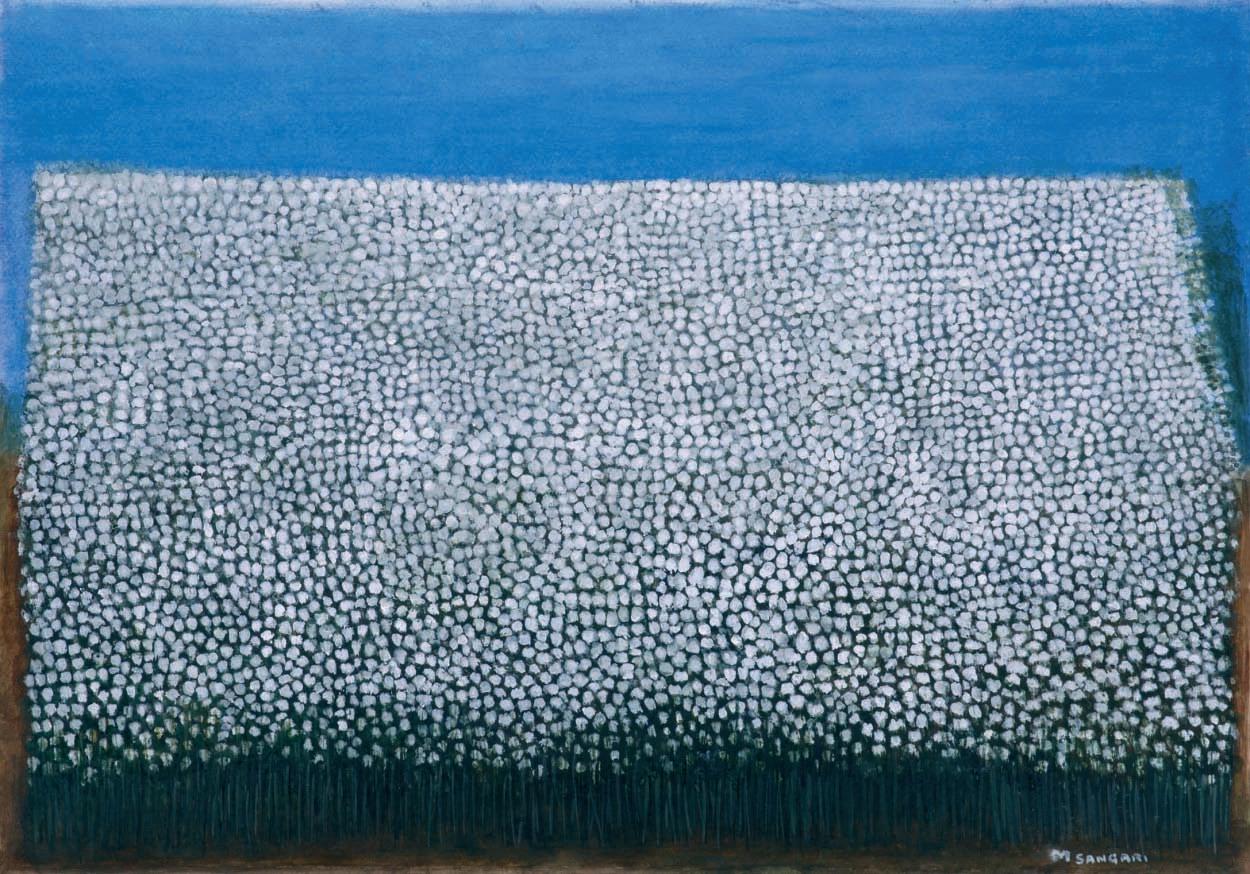
Above: Cotton Field, 48 x 34 cm, 2004, watercolour on paper
Above: Barsaati, Delhi, 2007, 47 x 33 cm, watercolour on paper
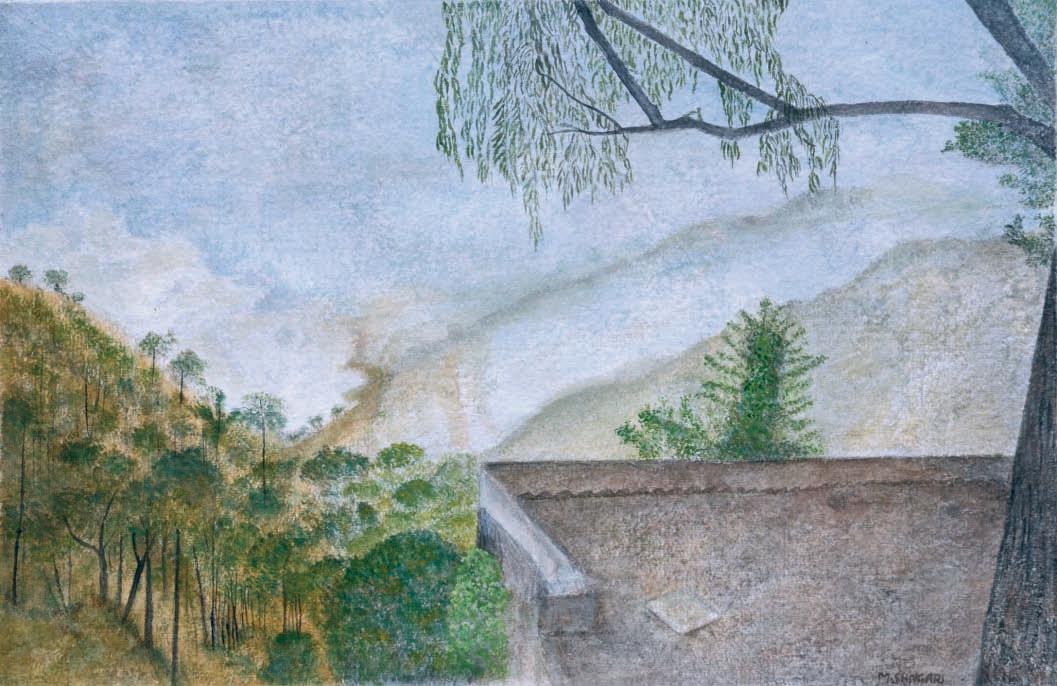
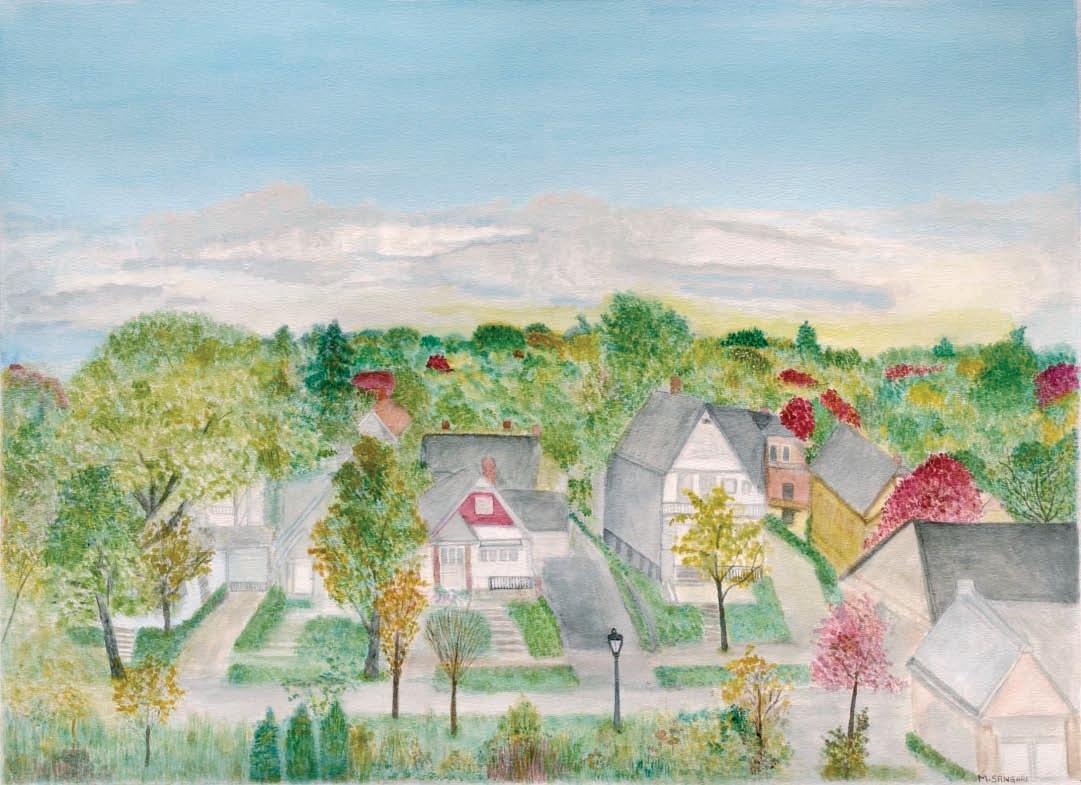
Top: A Terrace View, 57 x 43 cm, 2007, Milwaukee, watercolour on paper
Mahendra (Manu) Sangari, born in 1947 in Lonavala, studied in Bombay, Delhi and Leeds, and has been painting seriously for many years. He works with pastels, oils, acrylic and watercolour. He has had solo exhibitions in Habiart Gallery (Zameen Aasmaan, India Habitat Centre, Delhi, 2004) and Green Gallery (Milwaukee, 2005); his work has been displayed in group exhibitions at ‘Confluence of Colours’ (Habiart Gallery, Delhi 2005) and the Milwaukee International Art Fair (Milwaukee, 2006). This exhibition of watercolours, Zameen Aasmaan 2 (2008), continues two of the series inaugurated in Zameen Aasmaan (2004).
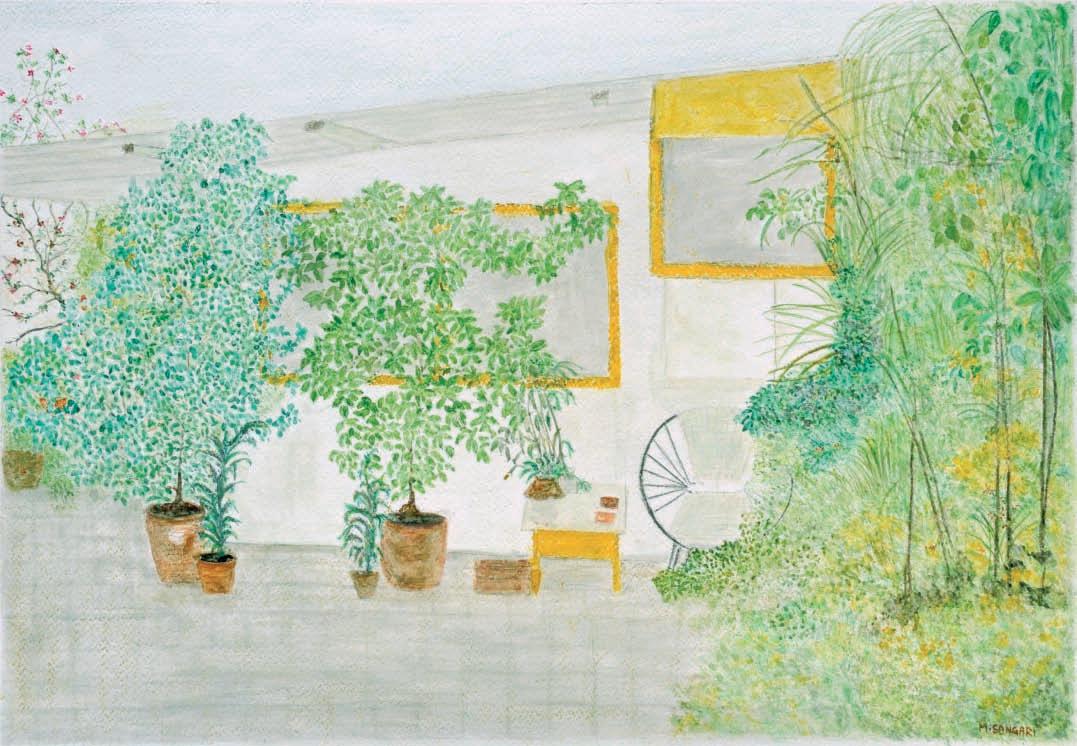
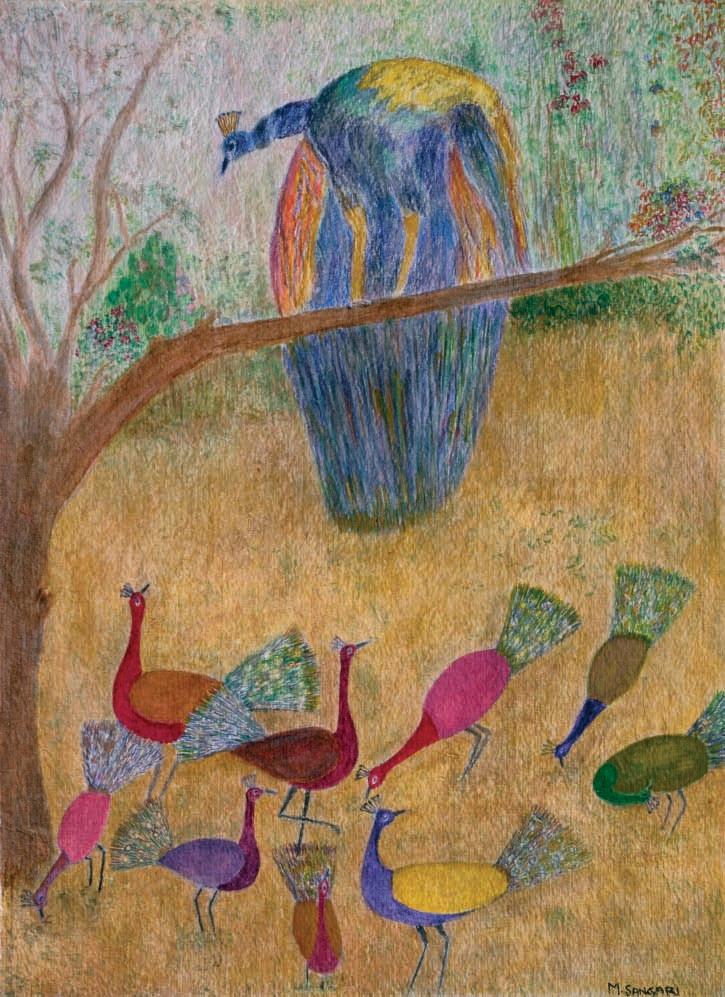
The first, a series named Rangrez, creates imagined landscapes and suggests a dyer (sometimes reticent, sometimes bold) who recolours and repatterns a given world. This series has now expanded into a quixotic engagement with cricket and peacocks. The second named ‘Sceneries’, represents visited landscapes in delicate detail. Zameen Aasmaan 2 also begins a new series, Streetscapes, that resculpt the tiny overlooked acts of dailiness – waiting, walking, working, selling or just looking – into a domain of modest pleasures. The stylistic range in these series seems to seek, and find, forms for the smallest emotion.
Mahendra (Manu) Sangari
Ph: (011) 24633781, 41033781, 9810261773
E-mail: manusangari@gmail.com
The artist would like to thank Nilima Sheikh, Sheba Chhechhi, Tania Gangulee Batra Rajinder Arora and Anuradha Kapur for their help. He is grateful to Geeta Kapur for her assistance in displaying the paintings.
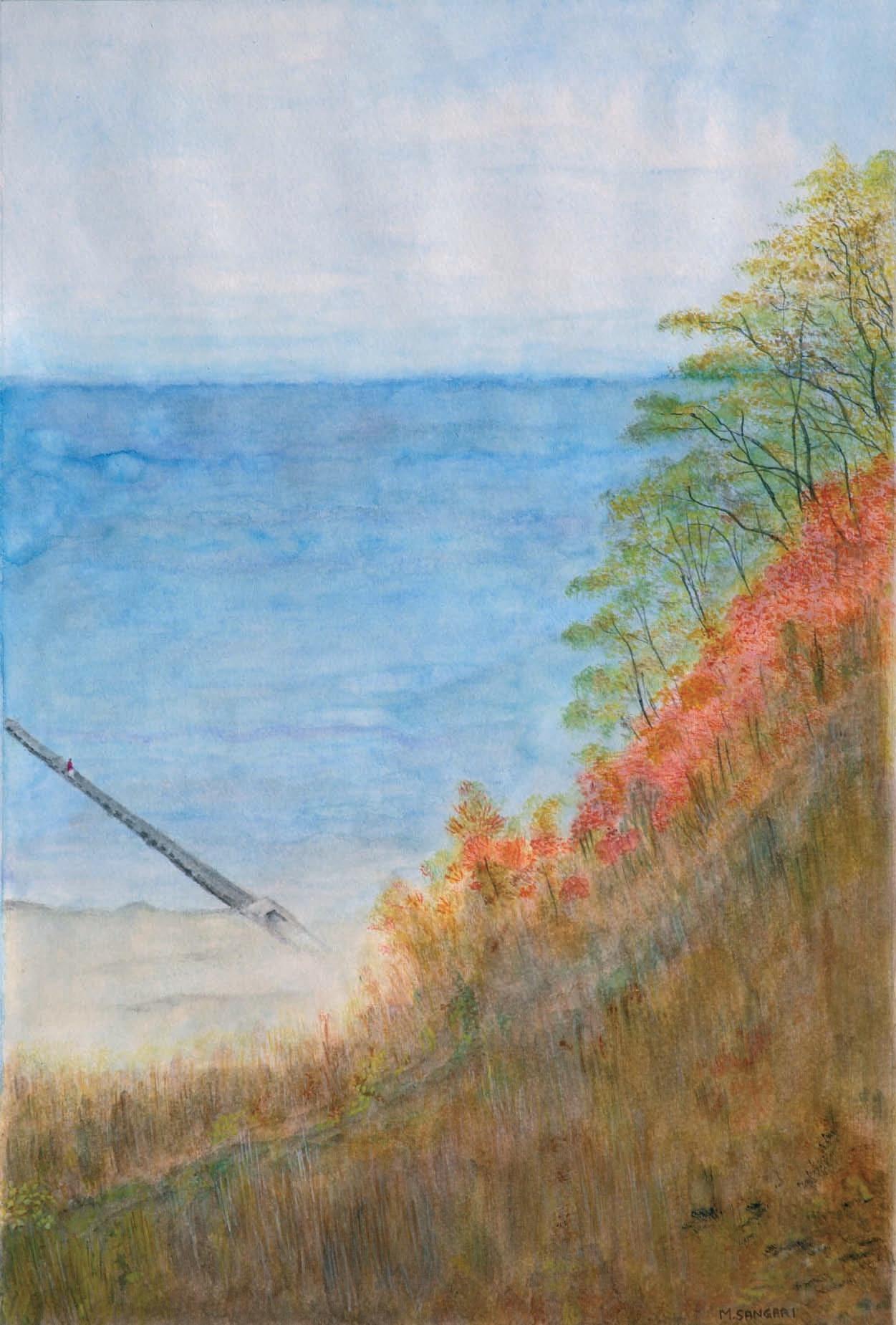
Cover: Atwater, 46 x 30 cm, 2005, Milwaukee, watercolour on paper
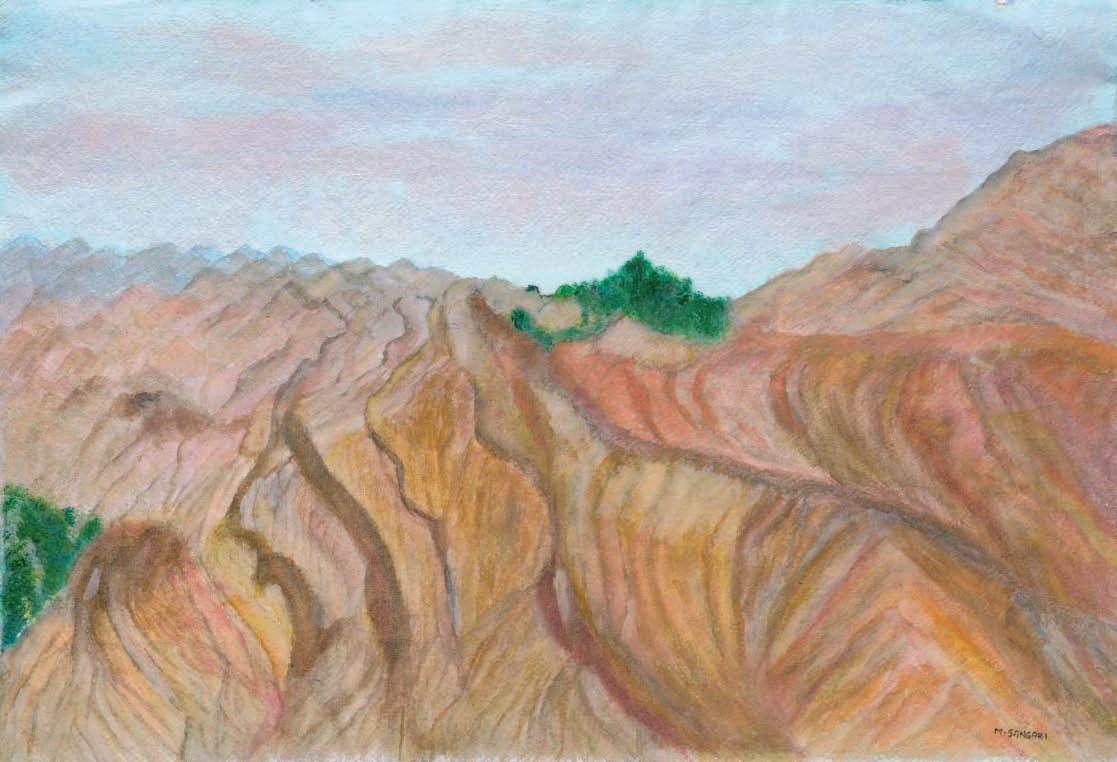
Dil-Gudaz, 35 x 26 cm, 2008, watercolour on paper