Fall 2025 Intersections

Page 1


Intersections

SCHOOL OF INFORMATION SCIENCES FALL 2025

The iSchool at Illinois educates leaders in the information sciences who impact our communities, nation, and world.

FALL 2025

School of Information Sciences

University of Illinois Urbana-Champaign

Published by iSchool Communications and Marketing. For more information or to submit story ideas, please contact brya@illinois.edu.

Interim Dean: Emily Knox

Editor: Cindy Brya

Contributing Writers: Cindy Brya, Amanda Nguyen, Natasha Sims

Photography: Cindy Brya, Michelle Hassel, Amanda Nguyen, Zui Tao, ThompsonMcClellan Photography

Design: Pat Mayer

501 East Daniel Street

Champaign, Illinois 61820 ischool.illinois.edu

Phone: (217) 333-3280

Email: ischool@illinois.edu

People use information for analysis, inquiry, collaboration, and play—and in so doing, change the world. The iSchool at Illinois is dedicated to shaping the future of information through research, education, and engagement, both public and professional. Intersections highlights our current work in these areas as well as achievements of our students, alumni, faculty, and staff.

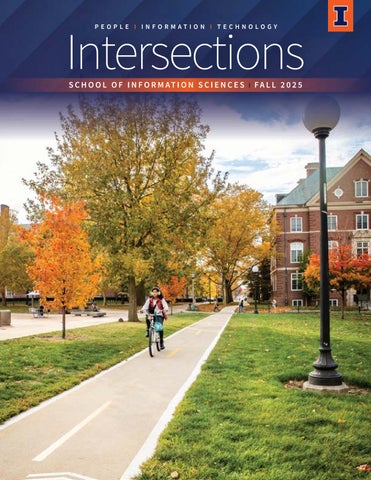
On the cover: A cyclist rides to class on the South Quad’s bike path. As a silver-level Bicycle Friendly University, the UrbanaChampaign campus can accommodate nearly 14,000 bicycles, and almost all campus buildings have a bike rack within 150 feet.

NEWS

1 Letter from the interim dean

2 Downie appointed executive associate dean

Faculty receive promotions

Fall 2025 student enrollment

3 New faces—Fall 2025

4 Associate Professor Emeritus Terry Weech passes away

5 Knox recognized as a University Scholar

2024 Downs Intellectual Freedom Award given to Shannon M. Oltmann

The latest in Library Trends

RESEARCH

6 iSchool welcomes new postdoctoral research associates

New tool helps estimate societal impact of droughts

7 New books address topics of human–AI interaction, data storytelling, information history, and more

8 Chin receives NSF CAREER award

Wang appointed to Autism Data Privacy Advisory Group

Researchers work to make AI systems safer

9 iSchool researchers explore youth and AI

FEATURES

10 iSchool community gathers to celebrate the Hendersons

11 Ravury selected to serve on Homecoming Court

Bhupal recognized by Research Park for business innovation

Maimone receives ALISE Youth Services Graduate Student Travel Award

ALUMNI

12 Garnes receives Coretta Scott King-Virginia Hamilton Award for Lifetime Achievement

Get to know Payal Narvekar, CRM analyst

13 2025 ISAA award recipients announced

Jones maps his way back to the School

14 Class notes

GIVING

16 Volkmann Scholarship honors library director and mentor

17 Greetings from Nick Giacchina, director of advancement

Volkmann Scholarship recipient pays it forward by supporting students’ access to resources

Letter from the interim dean

The iSchool researchers featured in this issue are making AI safer, developing technology for lifelong learning, analyzing the societal consequences of environmental crises, and working with educators to design AI literacy curricula for K–12 teachers, parents, and students.”

Since we launched our BS in information sciences (BSIS) degree five years ago, our undergraduate enrollment (which now includes BSIS + data science) has grown to more than 900 students. This is a major shift in our School’s culture since we are no longer a small school with only graduate students, and I’m excited for the change. To accommodate our growing undergraduate program, we have hired three new advisors, with more on the way. You will see these new staff members in this issue.

This fall, we also welcomed three new faculty members whose research spans health informatics, human–computer interaction, and causal data science. Our faculty are leading the profession and tackling real-world problems in their research. The iSchool researchers featured in this issue are making AI safer, developing technology for lifelong learning, analyzing the societal consequences of environmental crises, and working with educators to design AI literacy curricula for K–12 teachers, parents, and students.

The rapid increase of faculty, staff, and students in recent years has led to growing pains in terms of office and classroom space, and we have been working to address this problem. This academic year, we added two new classrooms in our building at 501 East Daniel Street, and it’s been nice to see a steady stream of students enter and exit the building. We are currently working on a remodeling project of our space on the fourth floor of 614 East Daniel Street, which will give us additional offices and labs. We will share more details on these construction projects in the spring issue of our magazine.

In October, I had the pleasure of meeting with alumni at a reception we hosted during the AISLE conference. This year’s conference was held in Champaign, and it was great to have nearly 80 alumni join us for our event. If you are planning a trip to campus, please let us know. We would love to catch up and to show you all the changes taking place.

While our school may be growing in size, the close-knit community that we have built over the years and the values that we hold dear haven’t changed. We appreciate your support of our programs and people.

Downie appointed executive associate dean

TheiSchool is pleased to announce that

Professor J. Stephen Downie has been appointed executive associate dean. In this role, he will work closely with Interim Dean Emily Knox to realize the iSchool’s strategic goals and objectives. He also will provide leadership for the internal administration of the School, coordinate the work of associate deans and assigned staff, and facilitate faculty affairs.

“I am eager to work with the dean, faculty, staff, and students of the iSchool to make an already awesome School of Information Sciences even stronger and more impactful,” said Downie.

Downie joined the iSchool faculty in 1998 and has served as associate dean for research since 2011. He has also served on the iSchool’s Executive Committee as both an ex officio member and an elected member of the faculty.

“Stephen’s dedication and deep understanding of our School’s programs and community make him an excellent choice for this role,” said Knox. “I look forward to continuing to work with Stephen as executive associate dean to move our School forward.”

Downie’s research interests include music information retrieval, digital libraries, and information retrieval evaluation. He serves as co-director of the HathiTrust Research Center (HTRC), a collaborative research center co-located at Indiana University and the University of Illinois Urbana-Champaign that enables large-scale analysis of works in the HathiTrust Digital Library. He was principal investigator on the Bookworm text analysis project, joint principal investigator for TORCHLITE, and co-principal investigator for SCWAReD.

In addition to his contributions to digital humanities research, Downie is the founder and first president of the International Society for Music Information Retrieval. He holds a bachelor’s degree in music theory and composition, along with master’s and doctoral degrees in library and information science, all from the University of Western Ontario.

Faculty receive promotions

Ninefaculty members received new appointments at the start of the fall semester.

Anita Say Chan, Kate McDowell, and Dong Wang have been promoted to professor. Nigel Bosch, Jessie Chin, Melissa Ocepek, Matthew Turk, and Karen Wickett have been promoted to associate professor with indefinite tenure. Associate Professor Rachel Adler has been granted indefinite tenure.

Chan’s research includes globalization and digital cultures; innovation networks and the “periphery;” science and technology studies in Latin America; and feminist and decolonial approaches to technology.

McDowell’s interdisciplinary work examines how storytelling plays a vital role in humanizing data analysis and communication.

Wang’s research includes social sensing, intelligence and computing, humancentered AI, and big data analytics.

Bosch’s research includes machine learning/data mining methods to study human behaviors, especially in learning contexts, with an emphasis on model generalization and fair treatment of users.

Chin is a translational cognitive scientist with multidisciplinary research training in cognitive science, human factors, human–computer interaction, and health informatics.

Ocepek’s research and teaching interests include everyday information behavior, cultural theory, critical theory, food studies, and research methods.

Turk’s research is focused on how individuals interact with data and how that data is processed and understood.

Wickett’s research includes the conceptual and logical foundations of information organization systems and artifacts.

Adler’s research covers human–computer interaction, accessibility, and computing education.

New faces—Fall 2025

Cory Castaneda

Academic Advisor and Coordinator

Provides academic advising and support to students in the BS in information sciences (BSIS) and BSIS + data science (BSIS+DS) programs.

Corissa Clark

Office Administrator

Ensures accurate scheduling and efficient course management for the iSchool’s graduate programs.

Yildiz Esener

Teaching Assistant Professor

Focuses on health informatics, human–computer interaction, and social media analysis to understand mental health experiences and advance digital health.

Yonghan Jung

Assistant Professor

Focuses on causal data science, developing new methods to understand causal effects in complex and imperfect data, with applications in trustworthy AI and health care science.

Dara (DL) Lawyer

Academic Advisor and Coordinator

Provides academic advising and support to students in the BS in information sciences (BSIS) and BSIS + data science (BSIS+DS) programs.

Keri Marion

Academic Advisor and Coordinator

Provides academic advising and support to students in the BS in information sciences (BSIS) and BSIS + data science (BSIS+DS) programs.

Rachael Sanders

Office Manager

Ensures accurate scheduling and efficient course management for the iSchool’s undergraduate programs.

Nitin Verma

Teaching Assistant Professor

Focuses on human–AI interaction, information ethics and policy, credibility and trust in information, scholarly communication, and misinformation and disinformation studies.

Associate Professor Emeritus Terry Weech passes away

Associate

Professor Emeritus Terry Laverne

Weech passed away on June 5, 2025, in Staunton, Virginia. He was the widower of Eunice Hovis Weech, who passed away on October 16, 2022. He is survived by his sister-in-law, Brenda Bruce, and her husband, Timothy, and cousins, Wilber Rehmann and Susan Henry Anderson.

Weech was born on July 8, 1937, in Knox County, Illinois. He graduated from Knox College in Galesburg, Illinois, where he majored in philosophy. He earned an MS and PhD in library science from the University of Illinois. He served as head of the Library Science department at the Mississippi University for Women in Columbus and as an assistant professor in the School of Library Science at the University of Iowa in Iowa City.

For over forty years, Weech served as an associate professor in the Graduate School of Library and Information Science (now the School of Information Sciences) at the University of Illinois. He taught courses covering topics such as reference services, government publications, history of LIS, and libraries, information, and society. His research interests included reference services and sources, government information, library administration, library cooperation and networks, library use instruction, and economics of information.

“Terry’s work teaching introductory courses for LIS students influenced generations of librarians,” said Professor Kate McDowell. “His extensive travels went hand-in-hand with his commitment to introducing students to the experience of professional conferences.”

He was honored with a Scroll of Appreciation from the International Federation of Library Associations and Institutions (IFLA) for his distinguished contribution to the association and the library profession, especially in the internationalization of LIS education. An active member of IFLA, he authored or co-authored numerous research reports and lectured on librarianship and LIS education in more than thirty countries in Europe, Asia, Africa, and North and South America. Weech received more than five Fulbright Senior Specialist and similar funded awards for international travel to share his expertise with students, faculty, and practicing librarians.

“I knew of Terry before coming to Illinois because I would assign his work as readings when I taught international librarianship at UCLA, and then I was able to serve with him on the IFLA Section on Education and Training,” said Clara Chu, iSchool affiliate professor and director of the Mortenson Center for International Library Programs. “At Illinois, he contributed to many of the activities of the Mortenson Center, including hosting the associates at his home and meeting with them, and participating in our initiatives. We last collaborated to co-organize the IFLA 2016 Satellite Meeting on ‘International Quality Assessment of LIS Education Programs,’

which led to the creation of Building Strong LIS Education, a working group of IFLA.”

“I first met Terry in 2001, at a conference in Sweden,” recalled Professor Emeritus Alistair Black. “The topic was libraries at times of utopian thought and social protest in the 1960s and 1970s. The theme of that event captures the essence of Terry’s professional motivation. He was a champion of free speech and emancipation, having worked conscientiously in the civil rights movement in the 1960s. He was also a committed internationalist, engaging over the decades with IFLA and other international agencies and fostering relations with scholars, students, and professionals abroad, thereby enhancing the reputation of the School and indeed his country.”

Black added, “Terry had a generous spirit. I will never forget the time he turned up at my apartment in Orchard Downs, the morning after I had arrived on campus to take up my post. I had little idea of the town’s geography, bus routes, or the location of supermarkets. Without a car, and with a foot of January snow lying on the ground, I jumped at his offer to drive me to buy much needed provisions. I was deeply grateful for his empathy and help, on this and other occasions.”

“I’m proud to have been a member of two of the many cohorts of GSLIS [iSchool] students who were able to participate in the annual BOBCATSSS symposium thanks to Terry’s dedication to international library work,” said Angela Maycock (MSLIS ’06), who serves as a continuing education manager at the Public Library Association. “Terry and I travelled to Prague and Tallinn together and presented our research to an international audience, something I would not have imagined possible without his guidance and support. In later years, we frequently reconnected at receptions for the Downs Intellectual Freedom Award at ALA conferences and for lunch when he was visiting ALA headquarters for Committee on Accreditation meetings. Terry was wise and warm and generous in sharing his connections across the library world. His kindness extended to when he and Eunice hosted me at their home early in my professional career when I visited campus to speak to the ALA student chapter— one of the many opportunities that Terry helped make possible in my life.”

“Terry Weech was a wonderful colleague here at the iSchool and in the national and international library community. He taught a broad range of core LIS courses and was instrumental in securing relationships with library education programs around the world. I will especially miss him in faculty meetings where he always emphasized faculty governance (and more management courses). I hope that we will continue to live out his call for openness and transparency,” said Interim Dean Emily Knox.

He and his wife established the Terry and Eunice Weech Intellectual Freedom Endowment Fund at the University of Illinois Foundation to advocate and educate for intellectual freedom. The family requests that memorial donations be made to this fund or to the American Cancer Society. Burial will be private in the family burial plot in the Oneida Cemetery in Oneida, Illinois.

Knox recognized as a University Scholar

Interim

Dean and Professor Emily Knox is among the five professors at the University of Illinois who have been named 2025 University Scholars in recognition of their achievements in teaching, scholarship, and service. The program honors faculty excellence and provides $15,000 to each scholar for three years to enhance their academic careers. That money may be used for travel, equipment, research assistants, books, or other purposes.

Knox has dedicated much of her professional life to advocating for intellectual freedom, the freedom to read, and the importance of libraries to communities. Her research uniquely examines censorship as a constellation of social practices, focusing on the justifications and discourse of those who seek to restrict access to information.

Knox’s scholarship in these topics culminated in her appearance as an expert witness before the U.S. Senate Committee on the Judiciary during its hearing on book bans in September 2023. She won the 2023 Eli M. Oboler Prize for best published work in the area of intellectual freedom and has received numerous national teaching awards. As a celebrated educator and curriculum innovator, Knox also played a vital role in developing the iSchool’s undergraduate program and serves in leadership roles in major national organizations and university committees.

“I am truly honored by this recognition from the University of Illinois System,” said Knox. “It is a pleasure to be in the company of past University Scholars from the iSchool, including Ann Bishop, Betsy Hearne, Donald Krummel, and F. W. Lancaster. As we work to transform our School for the twentyfirst century, I hope to see this list grow as more of our faculty are recognized for their scholarship.”

2024 Downs Intellectual Freedom Award given to Shannon M. Oltmann

For translating her research on censorship and intellectual freedom into practical guidance for library workers, Shannon M. Oltmann, associate professor in the School of Information Science at the University of Kentucky, has been named the 2024 recipient of the Robert B. Downs Intellectual Freedom Award. The award is given annually by the iSchool at the University of Illinois and is co-sponsored by Sage, a global academic publisher of books, journals, and library resources.

A self-described “free speech maximalist,” Oltmann is passionate about intellectual freedom, freedom of speech, libraries, and information ethics. She is the author of Practicing Intellectual Freedom in Libraries and editor of The Fight Against Book Bans: Perspectives from the Field. Oltmann has presented practitioner-focused webinars and conference presentations to national and regional audiences, including the Alabama School Library Association, Texas Library Association, and Kentucky Public Library Association. She has also given invited talks related to intellectual freedom to the Kentucky Department of Libraries and Archives, Pierce County Library System, Illinois Reaching Across Illinois Library System, and American Library Association (ALA).

Oltmann was honored at the Intellectual Freedom Awards reception held during the 2025 American Library Association Annual Conference in Philadelphia, Pennsylvania.

The latest in Library Trends

TheiSchool’s scholarly journal, Library Trends, has been exploring critical trends in professional librarianship for more than 70 years.

This summer, Library Trends completed a two-part series on the intersection of generative AI and libraries in 73 (3) and 73 (4). In “Generative AI and Libraries: Applications and Ethics, Part I,” the authors discuss how librarians are grappling with the ethics of generative AI and its effects on libraries. Part II focuses on academic libraries, exploring the uses and perceptions of AI by faculty and students, and discussing the ethical implications of AI use in academia. Melissa A. Wong, adjunct lecturer and editor in chief of Library Trends, served as the guest editor for both issues.

In September, Library Trends published 74 (1), “Genres and Their Uses in Cultural Documentation: Exploring Generic Access to Creative Worlds,” in which the authors explore genre classifications and how they facilitate access to creative works in libraries and beyond. This issue featured Pauline Rafferty, Philip Hider, and Deborah Lee as guest editors.

All Library Trends issues published in 2025, including these three, are freely available online through Subscribe to Open, an open access publishing model.

iSchool welcomes new postdoctoral research associates

Thisyear marks the fourth cohort of the iSchool’s Postdoctoral Research Associate Program. The program prepares candidates for tenure-track assistant professor or other appointments inside and outside of academia. The iSchool welcomed five new postdocs in the 2025–2026 academic year.

New postdocs and their research interests include:

• Bogeum Choi, PhD in Information and Library Science, University of North Carolina at Chapel Hill

Information behavior, human–computer interaction, interactive information retrieval, search as learning, and health informatics.

• Ece Gumusel, PhD in Information Science, Indiana University Bloomington Intersection of usable privacy and security in human-computer interaction, with a particular focus on conversational AI and regulatory compliance.

• Edwin (Teddy) Roland, PhD in English Literature, University of California, Santa Barbara

Digital humanities and new media studies, history and theory of machine learning, computational literary study, AI applications in humanities research and teaching, and contemporary American literature.

• Tian Wang, PhD in Informatics, University of Illinois Urbana-Champaign

Privacy in AI and IoT, privacy policies and frameworks, user-centered privacy, user behaviors and perceptions in digital privacy, social media, and AI governance.

• Qiqi Xie, MD, Nanchang University, Jiangxi, China

Multi-agent artificial intelligence for complex biomedical problems, large-scale transcriptomics data analysis, cellular systems behavior, and disease modeling. They join current postdocs Janaynne Carvalho do Amaral, Hyanghee Park, and Cheeno Marlo Sayuno.

Each postdoc is assigned to an iSchool faculty mentor who provides guidance and support for their area of study. In addition to developing their research agendas, postdocs teach up to one course per semester and serve on at least one service committee in the iSchool. They also participate in workshops on topics such as applying for grants, building a scholarly profile, and crafting a professional portfolio.

New tool helps estimate societal impact of droughts

Droughtsare increasingly recognized as environmental crises with far-reaching consequences, not just on water availability, but on agriculture, the economy, public health, and society. While current drought monitoring systems primarily focus on assessing drought severity using quantitative measurements, such as meteorological and hydrological data or economic losses, they often miss what matters most: how societies and communities are affected.

A new study led by Professor Dong Wang introduces SIDE (Socially Informed Drought Estimation), a novel socially informed AI-driven drought estimation framework that estimates both drought severity and its societal impact using data from social and news media. SIDE is the first tool of its kind to capture what the researchers call the “social-physical interdependence of droughts,” the way human behavior and environmental conditions influence each other. For example, as water becomes scarce, communities might respond by increasing usage in fear of shortage, worsening the situation. These behavioral patterns, often captured in local reporting or social media, could offer valuable insights into the real-world consequences of environmental crises.

By offering timely, human-centric insights, SIDE can support faster and smarter decisionmaking by government agencies, water resource managers, agricultural organizations, and community leaders and members. The tool could also be adapted to other environmental crises, such as floods, wildfires, and extreme weather events.

New postdoctoral research associates Tian Wang, Qiqi Xie, Ece Gumusel, and Bogeum Choi stand in front of the iSchool building.

New books address topics of human–AI interaction, data storytelling, information history, and more

Critical Data Storytelling for Libraries: Crafting Ethical Narratives for Advocacy and Impact

ALA Neal-Schuman, 2025

Authored by Professor Kate McDowell

Provides a toolkit to help readers transform data into storytelling narratives that can be used to enhance library advocacy, social justice, and inclusivity.

Social Intelligence: The New Frontier of Integrating Human Intelligence and Artificial Intelligence in Social Space

Springer Nature, 2025

Co-authored by Professor Dong Wang, iSchool PhD alum Lanyu Shang (Loyola Marymount University), and Yang Zhang (Miami University)

Presents a set of novel human-centered AI techniques to address the challenges of social intelligence applications, robust and generalizable frameworks, and AI designs, all through the lens of realworld scenarios, including social media misbehavior identification and mitigation, multimodal truth discovery, explainable AI and machine learning, disaster response and damage assessment, AI and crowdsourcing for education, and social sensing in smart city applications.

The Routledge Handbook of Information History

Routledge, 2025

Co-edited by Professor Emeritus Alistair Black and Associate Professor Bonnie Mak, along with Toni Weller (De Montfort University) and Laura Skouvig (University of Copenhagen)

Provides a field-defining, comprehensive study of information history through the examination of how society, politics, culture, and technology have shaped information practices over millennia.

The Future of Memory: A History of Lossless Format Standards in the Moving Image Archive

University of Illinois Press, 2025

Co-authored by Adjunct Lecturer Jimi Jones (MSLIS ’07 and PhD ’19) and Marek Jancovic (Vrije Universiteit Amsterdam)

Examines video file standards and the tensions that have emerged between the film industry and the archiving community that is tasked with preserving cultural cinematic productions.

Navigating Artificial Intelligence for Cultural Heritage Organisations

UCL Press, 2025

Co-edited by Glen Layne-Worthey, associate director for research support services for the HathiTrust Research Center (HTRC); J. Stephen Downie, professor and HTRC co-director; Lise Jaillant (Loughborough University); Claire Warwick (Durham University); Paul Gooding (University of Glasgow); and Katherine Aske, (Napier University)

Explores how AI and machine learning are reshaping cultural heritage. Authors explore technologies being applied to digitized and born-digital records within libraries, archives, and other heritage organizations, including innovative approaches in computer vision, ChatGPT, and user experience.

PROMISE — PROMoting AI’s Safe usage for Elections

Springer Nature, 2025

Co-edited by Director of Research and Technology Innovation and Research Scientist Anita Nikolich, Biplav Srivastava (University of South Carolina), Andrea Hickerson (University of Mississippi), and Tarmo Koppel (Tallinn University of Technology, Estonia)

Explores the evolving role of artificial intelligence in electoral processes, focusing on its potential to improve data-driven decision-making amid the growing challenges of misinformation, manipulation, and voter suppression.

Chin receives NSF CAREER award

AssociateProfessor Jessie Chin has received a National Science Foundation (NSF) CAREER award to support lifelong learning and foster information literacy. This prestigious award is given in support of early-career faculty who have the potential to serve as academic role models in research and education and to lead advances in the mission of their department or organization. Chin’s project, “Search as a Mechanism for Learning,” will be supported by a five-year, $629,451 grant from the NSF.

Her project will examine how information retrieval (IR) systems are used for lifelong learning. While users commonly turn to the internet to learn about unfamiliar topics, the internet’s algorithm-mediated IR systems, including search engines and conversational agents, have limitations when it comes to adequately supporting users with complex information needs. This is especially true when it comes to learning-oriented searches, with IR models unable to fully explain and predict how and what people search to learn. For example, motivations and metacognition are often neglected in representing the search intents during learning. Hence, relying on metrics like semantic relevance or past user behavior in IR systems may inadvertently result in suboptimal information experience of learners.

This research will guide the development of personalized technologies that promote lifelong learning in various educational settings, including online adult vocational education and individualized tutoring systems for all learners. The overarching goal of the project is to empower adults across the lifespan to adapt to evolving information environments for lifelong learning.

Wang appointed to Autism Data Privacy Advisory Group

Professor Yang Wang has been appointed by Illinois Governor JB Pritzker to serve on the newly created Autism Data Privacy Advisory Group, established under Executive Order 2025-02 to strengthen protections for the civil and human rights of people with autism in Illinois. The Advisory Group brings together thirteen leaders in medicine, law, education, advocacy, and technology to safeguard sensitive data and advance privacy, opportunity, and inclusion for Illinoisans with autism.

“I’m glad to see that the State of Illinois is paying attention to the important issue of data privacy for autistic individuals,” said Wang. “I look forward to working with other advisors to create good policies and promote best practices of data privacy. This could set an example for other parts of the country and the world.”

The Advisory Group will begin meeting this fall and will deliver recommendations to the Governor over the next year.

Wang’s research interests include usable privacy and security technologies, social computing, human–computer interaction, and explainable artificial intelligence. His research has gained support from the National Science Foundation, Department of Health and Human Services, Google, Meta, Alcatel-Lucent, and The Privacy Project. He earned his PhD in information and computer science from the University of California, Irvine.

Researchers work to make AI systems safer

Large language models—artificial intelligence systems trained on vast amounts of data—are the basis for generative AI chatbots. At their core, LLMs are built on a very simple premise: a user asks a question and the chatbot answers it.

Developers build LLMs with safety protocols that are designed to recognize malicious queries and avoid providing harmful information in response to the user’s prompt. However, users have discovered techniques—also called “jailbreaks”—to bypass the safety guardrails.

Through several research projects, Assistant Professor Haohan Wang and PhD student Haibo Jin are testing jailbreak techniques against LLM vulnerabilities in order to make the systems safer. The researchers developed JAMBench, a model that tests the moderation guardrails that dictate an LLM’s responses to questions. JAMBench employs new methods to attack the guardrails for four risk categories: hate and fairness, violence, sexual acts and sexual violence, and self-harm. In their research paper on JAMBench, they present countermeasures that reduced jailbreak success rate to zero percent across various chatbots models.

In another project, Wang and Jin developed a method to test compliance with government AI security guidelines. They found that the guidelines’ abstract language (for example, “AI should not violate human rights”) could be sidestepped with specific prompts because the safety measures lacked precise and actionable instructions for LLMs to follow.

In a final project, Wang and Jin found that using excessive linguistic complexity and fake sources allowed them to bypass the safety guardrails and trick LLMs into answering a harmful query, a strategy they called “information overload.” While an LLM might recognize and refuse to answer a malicious question in a 13-word prompt, that same LLM’s moderation guidelines would fail when that same question was buried within a 300-word prompt.

As a means for continued testing, Wang and Jin created GuardVal, an evaluation system that continually tests jailbreak methods as a way for LLMs and developers to adapt security measures as new threats emerge.

iSchool researchers explore youth and AI

With the rapid rise of artificial intelligence (AI), understanding how young people interact with these technologies is exceedingly important. iSchool researchers are studying how AI shapes youth experiences—from the risks they face online to the ways that they learn. By working directly with young people, their families, and educators across Illinois, researchers aim to make AI safer, more accessible, and better aligned with the needs and perspectives of youth. The projects highlighted here represent a snapshot of the research in this area being conducted by the iSchool.

Youth AI safety and risk

“Youth face a wide range of risks, such as privacy violations, exposure to toxic content, and mental well-being risks,” said Professor Yang Wang, who partnered with Associate Professor Yun Huang and a group of students for a project focused on AI safety for youth. Led by PhD student Yaman Yu, the team created the first comprehensive youth AI risk taxonomy, which outlines risks youth face when using generative AI. In addition to establishing the first benchmark for youth AI safety, they designed a guardrail model that outperforms existing models in detecting risks.

“So many teachers and parents tell us they feel ‘scared’ of AI in the hands of kids, but they also feel ashamed or guilty for feeling that way.”

Through their research, the team discovered a significant threat to young people related to grooming or sycophancy, where AI says flattering statements about young users, seemingly to gain their trust and possibly later exploit that trust. They also found that parents and youth perceive different types of risks: Parents are more worried about age-inappropriate content, misinformation, and hallucinations, whereas youth are mainly concerned about addictive AI usage.

“Youth AI safety is critical,” explained Wang, which is why the researchers are advocating for “a more nuanced and developmentally appropriate approach to safeguard youth–AI interactions.”

The team has met with AI teams at industry companies about youth AI safety, and their research has been featured in interviews with major media outlets, including CBS, The New York Times, Forbes, and MIT Technology Review

AI literacy and education

Many local schools have been shifting toward a no cell phone/social media use policy for part or all of the school day, while simultaneously facing pressure to teach with AI. This leaves teachers and parents feeling conflicted and fearful.

“So many teachers and parents tell us they feel ‘scared’ of AI in the hands of kids, but they also feel ashamed or guilty for feeling that way,” said Professor Anita Say Chan. “They often assume they are Luddites or backward if they feel this way, since they are getting other signals that ‘AI is the future’ and they will be ‘left behind’ if they don’t get on the bandwagon.”

Chan pointed to recent cases in which AI platforms have coached teens into suicide and noted that even cybersecurity professionals and hackers have voiced their frustrations about their kids’ use of commercial AI and LLM platforms.

“Teachers and parents have good reason not to trust these systems, and we should be shaming commercial AI companies—not families—for what they do or don’t do with these systems,” she added.

Chan is leading a community-based collaboration with Project Success, a network of afterschool educators and teachers in Vermilion County. Hosted by the Community Data Clinic, this project builds on more than five years of partnership to develop AI literacy curricula for local K–12 teachers, parents, and students. A prototype of the new curriculum for educators will be available by the year’s end.

iSchool community gathers to celebrate the Hendersons

The

iSchool celebrated the contributions of Professor Emerita Kathryn (Kathie) Luther Henderson and William T (Bill) Henderson at a special reception on August 27. The Hendersons’ legacy lives on in the School through a named professorship, scholarship fund, and conference room. Their enduring influence is further evident in the generations of students they taught, who stayed in touch with the couple for decades.

Kathie earned all her degrees from the University of Illinois Urbana-Champaign: an AB in history and English in 1944, a BS in library science in 1948, and an MS in library science in 1951. She held positions in the University of Illinois Library, first as a clerical assistant and then as a serial cataloger. Bill received a scholarship to the University of Illinois to study floriculture and earned his bachelor’s degree in 1951. After graduation, he was commissioned a second lieutenant in the U.S. Army’s Quartermaster Corps and served in Korea until 1953.

Kathie and Bill met through their involvement in the McKinley Foundation student group on campus. They were married on August 22, 1953, and moved to Chicago, where Bill earned his Master of Divinity at McCormick Seminary and master’s degree in library science from the University of Chicago. Kathie held positions as circulation librarian and head cataloger

at the seminary, while Bill served as the seminary’s first acquisitions librarian and was ordained as a minister.

In 1965, Kathie was asked to join the faculty of the Graduate School of Library and Information Science (now the iSchool) and returned to Urbana. Bill took a position in the University Library as preservation librarian, and Kathie taught Cataloging and Classification I and II. She subsequently developed and jointly taught Technical Services Functions and Preserving Information Resources with Bill.

Kathie was recognized for her exceptional teaching by the University of Illinois, American Library Association, and Association for Library and Information

Science Education. In 1993, Kathie received the Distinguished Alumnus Award from the Library School Alumni Association, in recognition of her many contributions as an educator. In 2011, the association presented Bill with the Distinguished Service Award for his outstanding service to the School.

Kathie was a founding member and first national secretary of Beta Phi Mu, the international honor society for library and information studies. For many years, Bill served as the Alpha chapter secretary. In 2014, Alpha Chapter established the Kathryn Luther and William T Henderson Award in recognition of their contributions.

Bill passed away on June 11, 2020, and Kathie passed away on August 18, 2022.

Mark Tucker (PhD ’83); Evelyn Curry (PhD ’81); Professor Emerita and Senior Dean’s Fellow Linda Smith (MSLIS ’72); William (Bud) and Rebecca Berbaum, the Hendersons’ friends and farm manager; Professor and Special Advisor for Strategic Initiatives Allen Renear; Barbara Ford (MSLIS ’73); Interim Dean and Professor Emily Knox (MSLIS ’03); and Sally Eakin, retired iSchool staff member.

Ravury selected to serve on Homecoming Court

BSISstudent Lauren Ravury has a new item to add to her resume: member of the 2025 Homecoming Court at the University of Illinois. Ravury’s resume is already impressive. She serves as president of the Student Alumni Ambassadors (SAA), an organization dedicated to fostering school spirit at U. of I. Last year, she served as president of the Asian Pre-Law Association, a stint that led to her receiving the Outstanding Asian & Asian American Undergraduate Student Leader Award from the Asian American Cultural Center. During her tenure as president, the association was named the 2025 Outstanding Asian & Asian American Student Organization. In addition, she has held leadership positions in Science Policy Group, Illinois Student Council, and Kappa Alpha Pi.

“Being involved at the University of Illinois has been the source of some of my greatest memories in college,” said Ravury.

After taking Social Aspects of Information Technology (IS 202) with Assistant Professor Madelyn Rose Sanfilippo, Ravury was inspired to change her major to information sciences. Her previous academic path was computer science + philosophy and political science.

“I loved how information sciences enabled me to understand technology through a humanities perspective. The professors at the iSchool are amazing and I found myself loving learning about topics regarding data privacy, algorithmic bias, the growth of technology in society, and the existing legal landscape when it comes to technology and information policy. The classes at the iSchool have been fundamental in my thinking as both an aspiring technologist and an aspiring legal expert,” she said.

Future plans include attending law school and becoming an attorney who practices technology or data privacy law. Her resume includes internships with Representative Janice Schakowsky in the U.S. House of Representatives in Washington D.C., the Physicists Coalition for Nuclear Threat Reduction, and Land of Lincoln Legal Aid. She currently serves as a Charles P. Wolff Intern for the Institute of Government and Public Affairs and Lou Liay Intern at the University of Illinois Alumni Association.

“I have loved every second of my experience being a student at the University of Illinois. This university has opened so many opportunities for me as a first-generation student that have been monumental to my professional growth. It also has instilled in me a love for learning and provided me with some of my best friends.”

Bhupal recognized by Research Park for business innovation

Shravani Bhupal, MSIM student, was honored for her internship performance at the 19th Annual Research Park Intern Awards ceremony. The University of Illinois’ Research Park is home to over 120 companies and more than 800 interns. Bhupal, who served as an intern at COUNTRY Financial DigitaLab, received the Best Business Innovation Award for her work.

During her eleven-week internship, Bhupal worked on developing data models, automating reporting processes, and creating interactive dashboards that enhanced financial insights and streamlined decision-making across key projects. In her nomination, Julia Hart (pictured above), DigitaLab’s site director, noted that Bhupal’s “precision, innovation, and ability to bridge technical and business needs earned praise from leadership, who highlighted her fresh perspective and strong communication on complex financial data.”

Maimone receives ALISE Youth Services Graduate Student Travel Award

Doctoral candidate Jessie Maimone has received the 2025 Association for Library and Information Science Education (ALISE) Youth Services Graduate Student Travel Award. She presented her research at ALISE 2025 as part of the Youth Services SIG panel titled “Youth Services: Youth Voices, Perspectives, and Experiences,” as well as in the Jean TagueSutcliffe Doctoral Student Research Poster Competition.

Maimone’s dissertation will examine the experiences of Black teens in public libraries and how race affects their experiences. She is working with the Hampton (VA) Public Library and Big Brothers Big Sisters of Hampton Roads to recruit Black teens for interviews to gather suggestions and feedback on creating library spaces where they feel welcome. Maimone holds an MSLIS from the University of Illinois, MS in publishing from Pace University, and BA in English from James Madison University.

Garnes receives Coretta Scott King-Virginia Hamilton Award for Lifetime Achievement

Carolyn L. Garnes (MSLIS ’72) has received the 2025 Coretta Scott King-Virginia Hamilton Award for Lifetime Achievement from the American Library Association (ALA). The annual award, named in honor of award-winning children’s book author Virginia Hamilton, is presented in odd years “to a practitioner for substantial contributions through active engagement with youth using award-winning African American literature for children and/or young adults, via implementation of reading and readingrelated activities/programs.”

Garnes was employed with the AtlantaFulton Public Library for over thirty years, retiring as deputy director of the library system. After retirement, she served for six years as a media specialist in the Fulton County Schools district. In 2013, Garnes established Aunt Lil’s Reading Room, a Georgia nonprofit organization named in honor of her mother. The nonprofit, which closed during the pandemic, aimed to connect children of color with authors, illustrators, and books specifically created for them.

“We provided opportunities for in-person interactions with both local and nationally recognized authors,” said Garnes. “During its operation, Aunt Lil’s Reading Room hosted several authors in Atlanta, including Sharon Draper, Brian Collier, and Patricia McKissack.”

Garnes was a member of the Carnegie Scholars, a group of thirty minority students who were recruited in the early 1970s to attend the Graduate School of Library and Information Science (now the iSchool) at the University of Illinois. As an MSLIS student, she researched Black children’s literature and wrote a paper referencing

with

Charlemae Hill Rollins’ work, We Build Together: A Guide to Negro Life and Literature for Elementary and High School Use (National Council of Teachers of English, 1967).

“My research highlighted the contributions of Augusta Baker and Effie Lee Morris to this bibliography, emphasizing the need for more accurate depictions of African Americans in children’s literature. This inquiry sparked a passion that ignited my interest in the field and set the course for my career journey,” she said.

Garnes held a leadership role with Coretta Scott King Book Awards, during which time she had the chance to get to know Coretta Scott King personally.

Emma K. McNamara, chair of the Coretta Scott King-Virginia Hamilton Award Committee, noted in ALA’s press release that “Garnes was instrumental in taking the CSK Books Awards Task Force from an independent entity to being a part of ALA. Because of her work, CSKBART celebrated its 55th anniversary in 2024.”

Garnes was announced as the award winner during ALA’s LibLearnX: The Library Learning Experience in Phoenix, Arizona.

“For over four decades, I have passionately devoted myself to the promotion of literature for African American children. Inspired by the profound words of George Washington Carver—‘No individual has any right to come into the world and go out of it without leaving behind distinct and legitimate reasons for having passed through it’—I see my efforts in this field as a significant and purposeful contribution,” said Garnes. “As I reflect on my journey, I realize that I have been a vibrant voice, not merely a fleeting echo, championing the importance of representation and inspiration through stories that resonate deeply with young readers.”

Get to know Payal Narvekar, CRM

analyst

Payal Narvekar (MSIM ’23) works as a junior CRM (customer relationship management) analyst at Surya, a home furnishings company. In her position, she creates Salesforce and Power BI (Business Intelligence) reports for the Sales and Marketing teams and handles Salesforce administration.

What do you like best about your job?

I love the collaborative nature of my job. I work in the Marketing department but work closely with the Sales and Product Development team as well. These cross-functional discussions often lead to fresh ideas and innovative approaches to projects. At Surya, the work I do directly impacts key business processes, which is very different from my previous experience. I also enjoy being part of projects that are making our workflows more efficient and data-driven. Along the way, I’ve learned a great deal about data-related processes.

How did the iSchool at Illinois help you get to where you are today?

My coursework at the iSchool emphasized analytics and data visualization, which laid a strong foundation for my current role. The concepts and techniques I learned proved invaluable during my co-op internship at Bose and continue to help me at Surya. The iSchool taught me to approach problems from multiple perspectives, which has allowed me to enhance and optimize the dashboards and reports we build for better usability and impact. I still work extensively with Power BI and occasionally revisit my Python notes when troubleshooting. Beyond academics, I’ve also built lasting connections with iSchool alumni who continue to be an incredibly supportive and inspiring community.

2025 ISAA award recipients announced

The iSchool Alumni Association (ISAA) is pleased to announce the recipients of its annual awards.

Karen Schneider (MSLIS ’92) is the recipient of the Distinguished Alumnus Award, which recognizes an alum who has made an outstanding contribution to the field of library and information science. A leader in public, academic, and special libraries, Schneider has led innovations in library automation and worked diligently to keep librarians informed about technological trends. She has served on numerous library committees, including the ALA Executive Board. In 2014 Schneider received the Elizabeth Futas Catalyst for Change Award. She is an enthusiastic speaker and educator (adjunct faculty for SUNY Albany and San Jose State University) and co-moderated PUBLIB, a discussion list for public librarians, for close to twenty years.

Hailley Fargo (MSLIS ’16) is the recipient of the Leadership Award, which honors an alum who graduated in the past ten years and has shown leadership in LIS. Acting as interim associate dean and head of education and outreach services at Northern Kentucky University, Fargo oversees a BS in library informatics program and leads a team in providing instruction and outreach to students. Her previous awards include the ALA Emerging Leader Award and the University Libraries Section Outstanding Professional Development Award, which recognizes her work as a cofounder and editorial board member of The Librarian Parlor (LibParlor), an online space for sharing and discussing research in library and information science.

Melissa A. Wong (MSLIS ’94) is the recipient of the Distinguished Service Award, which recognizes an individual who has served the ISAA or the iSchool in an exceptional way. During her twenty-four years as an adjunct lecturer, Wong has mentored hundreds of students and is dedicated to improving online teaching and accessibility. She is consistently recognized on the List of Teachers Ranked as Excellent by Their Students and was the first adjunct faculty member to be recognized at the campus level with the Campus Award for Excellence in Online and Distance Teaching. She currently serves as the editor in chief of Library Trends, the iSchool’s scholarly journal.

Jones maps his way back to the School

Google Senior Engineering Manager M. Cameron Jones (PhD ’10) returned to campus to serve as the iSchool’s 2025 Convocation speaker. In his work, Jones supports the teams responsible for the Google Maps routing and navigation services. Outside of the office, Jones enjoys traveling with his wife, Jin Ha Lee (MS ’02, PhD ’08), and two daughters to visit family and experience different cultures and foods.

What do you see as the most important impact of your work?

We help a billion users navigate and find their way in the world through products like Google Maps; we support mobility, delivery, and rideshare businesses through our developer APIs and services; and we build custom routing solutions for Google’s auto partners. I feel lucky to get to work on a product that so many people rely on and love.

What has it meant to you to be an alum of the iSchool at Illinois?

As a manager, I continually challenge myself to bring the same patience and mentorship to my team that the faculty at Illinois showed me. I often catch myself repeating the advice I received from Professors Twidale and Downie when I was a student.

I am immensely proud to be an alum of the iSchool at Illinois. I thought coming to Google with a background in a field outside of core computer science would put me at a disadvantage. However, I realized that the interdisciplinary nature of the iSchool uniquely prepared me for the challenges of my job. Every day, I have to synthesize diverse opinions and perspectives, quickly identify critical information, and align decisions across multiple stakeholders. I often joke that many of my daily interactions feel like reference interviews—trying to get past people’s superficial requests to identify their “true information need” and how best to help them. I have to be fluent in data science and be able to extract meaningful metrics and insights from petabytes of data and then communicate them in ways that facilitate decision-making.

Alumni

Class Notes

1950s

Norma Poinsett (MSLIS ’53) passed away on January 26, 2025.

1970s

Rita Bartholomew (MSLIS ’76) passed away in March 2025.

Peggy Tutor (MSLIS ’77) passed away on December 22, 2024.

1980s

Scott Finet (MSLIS ’84) retired from his position as legal information manager at the Board of Governors of the Federal Reserve System, District of Columbia.

Lorraine J. Haricombe (MSLIS ’88, PhD ’92) retired from her position as vice provost and director of the University of Texas Libraries after leading the libraries for almost 11 years.

Carol Leibiger (MSLIS ’87) has been named professor emerita in the University Libraries at the University of South Dakota. She retired from her position as information literacy coordinator after 36 years at the university.

1990s

Jon Mark Bolthouse (MSLIS ’99) recently started his new job as director of the North Suburban Library District near Rockford, Illinois.

Jill Gengler (MSLIS ’99) started work as a seventh grade science teacher at Edison Middle School in Champaign in October 2024.

Lisa Janicke Hinchliffe (MSLIS ’95) was elected to the International Federation of Library Associations and Institutions (IFLA) Governing Board.

Tom Kmetz (MSLIS ’97) retired in September 2025 as coordinator of instructional and research services at Camden-Carroll Library at Morehead State University in Morehead, Kentucky.

Donna J. Lilly (MSLIS ’92) passed away on December 28, 2024.

The Library History Round Table of the American Library Association selected Eric C. Novotny (MSLIS ’94) as the recipient of the 2025 Innovation and Advocacy in Library History Award.

Melissa Wong (MSLIS ’94) was featured as the Association of College and Research Libraries (ACRL) Member of the Week for the week of September 29, 2025.

2000s

Taliah Abdullah (MSLIS ’03) began her new role as executive director of The Urbana Free Library in July 2025.

Mitch Barber (MSLIS ’08) recently accepted a position as librarian for the California Department of Corrections and Rehabilitation. “My journey back to librarianship was a 14-year one and I am pleased to be back in the library saddle.”

Rob DeLand (MSLIS ’08) retired from his position as head librarian and archivist at Ruppel Library at the VanderCook College of Music in July 2025. In his message to the iSchool, Deland noted having many fond memories of Linda Smith, Leigh Estabrook, Scott Schwartz, John Wagstaff (Music Library), and many others in the School who helped prepare him for his career.

Tiffany (Torbeck) Erickson (MSLIS ’06) has published her first picture book, The Snack Thief, with Lawley Publishing. The book is described as “a delicious whodunit for ages 3–5.”

Beverly Frett (MSLIS ’04) received the 2025 Lifetime Membership Honor Award from the Association of Illinois School Library Educators (AISLE). The award recognizes the contributions of an individual for faithful, exceptional service to the association.

Leah Gregory (MSLIS ’04) was honored in the Advocates category in Library Journal’s 2025 class of Movers & Shakers, an annual list that recognizes 50 professionals who are moving the library field forward as a profession.

Jimi Jones (MSLIS ’07, PhD ’19) has accepted a position at the University of Illinois Foundation as manager of gifts documentation.

Carolyn Kinsella (MSLIS ’03) received AISLE’s 2025 Polestar Award, which is presented to a member who has made outstanding contributions to school library media programs in Illinois.

Nancy Kirkpatrick (MSLIS ’07) began her new role as dean of libraries for Smith College in August 2025.

Karen Kohn (MSLIS ’02) has published a book, Assessing Academic Library Collections for Diversity, Equity, and Inclusion, with Bloomsbury

Jennie Mills (MSLIS ’00) was featured in the ILA Member Spotlight on September 15, 2025.

2010s

Emily Bradshaw (MSLIS ’17) was featured in the ILA Member Spotlight on August 25, 2025.

Maria Emerson (MSLIS ’14) received the 2024–2025 Outstanding Faculty Award from the University Library at the University of Illinois.

Sam Helmick (MSLIS ’12), community and access services coordinator at Iowa City (IA) Public Library, was inaugurated American Library Association (ALA) President for 2025–2026.

A Little Like Magic, an author-illustrated picture book by Sarah Kurpiel (MSLIS ’11), was awarded the 2025 Schneider Family Book Award by ALA.

Kristi Lear (MSLIS ’18) has been promoted to archival program administrator, overseeing the Operations Division at the Illinois State Archives. In September 2024, Lear was awarded the Ancestry Leadership Award at the Council of State Archivists Annual Meeting.

Sarah Lindenbaum (MSLIS ’13) recently started her new job as associate director of donor research at Dickinson College.

Nisha Mody (MSLIS ’17), life coach for liberatory dreamers and trauma-informed facilitator for libraries, presented two workshops for the iSchool on traumainformed and relational care for libraries.

Ryan A. Ross (MSLIS ’10) won a 2025 Folio: Eddie Award for “Best Profile” for his Illinois Alumni magazine story about U. of I.’s wheelchair racing coach, Adam Bleakney. The Folio: Eddie Award is one of the most prestigious honors in the magazine publishing industry, recognizing excellence in editorial content.

Laura Sheets (MSLIS ’12) was promoted to associate professor with tenure in the University Libraries at Bowling Green State University.

Liz Svoboda (MSLIS ’12) was named the Michigan Academic Librarian of the Year in 2025 by the Michigan Academic Library Association and was honored at the Michigan Library Awards ceremony in October.

Kelli Trei (MSLIS ’12), biosciences librarian at the University of Illinois Urbana-Champaign, has been appointed as the transition director through July 2026 for the Biodiversity Heritage Library, the world’s largest open access digital library dedicated to biodiversity literature.

Billy Tringali (MSLIS ’19) was honored in the Innovators category in Library Journal’s 2025 class of Movers & Shakers.

2020s

Lauren (Huff) Anderson (MSLIS ’22) began a new position as a metadata management librarian at the University of Oregon.

Manas Godha (BSIS ’24), is a growth and strategy consultant for Advaiya. “My time at the iSchool was amazing, especially being part of the first batch of BSIS. I was part of the Academic Support Center as the head tutor and had so many opportunities to learn and grow!”

Katie Higley (MSLIS ’25) began a new position as an instruction and reference sharing librarian at Saint Mary’s University of Minnesota at the Winona Campus.

Colton Keiser (BSIS ’24) is an IT auditor and Python developer at a consulting firm, working with clients on IT compliance while developing tools using Python, Azure, and LangChain.

Chloe Miller (MSLIS ’25) accepted the role of research and instruction librarian at McKendree University in Lebanon, Illinois. She began her new position in October 2025.

Sid Patil (MSIM ’24) joined the University of Illinois Alumni Association as director of data strategy and alumni insights.

Rachel Riffe-Albright (MSLIS ’23) was a 2025 fellow with the Society for Scholarly Communication. She served on the President’s Early Career Panel and presented a poster discussing the professional needs of early career library and publishing professionals.

Abigail Sewall (MSLIS ’20) has worked in public libraries in the Denver Metro Area since graduating. She has specialized in

We’d love to hear from you! Send us your updates, employment/internship openings, or iSchool alumni networking opportunities in your area.

Office of Advancement and Alumni Relations School of Information Sciences ischool-advancement@illinois.edu (217) 300-5746

ischool.illinois.edu/engage/alumni

library outreach, primarily working on bookmobiles, and is grateful for her iSchool education and the valuable experience she received in her graduate assistantship roles.

Jessica Smith (MSLIS ’24) has authored a new Choose Your Own Adventure book, Curse of Great Winter Academy, under her pen name Jessika Fleck.

Peeya Thacker (MSIM ’25) has joined COUNTRY Financial as a product owner, where she works on an internal insurance issuing tool, enhancing efficiency and equipping insurance representatives with the resources they need to better serve clients and streamline operations across the organization.

After 28 years of service at Portland State University Library, Kimberly Willson-St. Clair (MSLIS ’21) was awarded the rank of professor emerita.

Your gift makes a difference in the educational experience of our students.

When you support iSchool students, you can change the course of someone’s life. Every gift, large or small, matters. There are a number of ways to give to the iSchool. These include short- and long-term options. The iSchool Advancement Office is happy to work with you to determine which option best fits your needs.

Eileen Prillaman Assistant Dean for Advancement (217) 333-7344 prillamn@illinois.edu

Nick Giacchina Director of Advancement (217) 300-3430 ngiacch2@illinois.edu

Volkmann Scholarship honors library director and mentor

CarlVolkmann served as a mentor to many librarians throughout his twelveyear tenure as director of Lincoln Library in Springfield, Illinois. Volkmann passed away in 2013, but his commitment to helping future public librarians lives on through the Volkmann Scholarship he and his family established at the iSchool.

Volkmann was born and raised in Toluca, Illinois. He earned a bachelor’s degree from Wartburg College in Waverly, Iowa, and Master of Divinity degree from Wartburg Seminary in Dubuque, Iowa. While he started his professional career as a high school history and English teacher, his focus shifted from teaching to librarianship in the 1960s, leading to an MSLIS from the University of Illinois in 1969.

In 1970, Volkmann started working at Lincoln Library as a young adult librarian. He held several appointments including acquisitions librarian, assistant director, and associate director, before serving as library director from 1981 until his retirement in 1993.

Volkmann was involved in numerous boards and commissions. He was named a 2004 recipient of the Illinois Humanities Council’s Studs Terkel Humanities Service Award for his forty years of service as an educator, librarian, and community volunteer in Springfield. His published works include Springfield’s Sculptures, Monuments, and Plaques (Arcadia Publishing, 2008), co-authored with his wife, Roberta, and Lincoln in Sculpture (Illinois State Historical Society, 2009).

Three years before his death, he and his family established the Volkmann Scholarship Fund to support students pursuing a professional career in public librarianship. After Volkmann passed away, Roberta and their children, Joan and Curt, continued to donate to the scholarship fund, honoring his legacy by helping other students follow in his footsteps.

“Of all his

professional accomplishments, Dad was proudest of the many achievements of those whom he mentored. It is fitting that his legacy is a continuation of support for beginning professionals.

“Dad was an excellent listener who helped people feel seen,” Joan said. “As the son of a Lutheran minister who also had a divinity degree, he was very principled and a good judge of character. As the assistant director at Lincoln Library, he did all the hiring for many years, so when he became the director, he had hired every one of the professional employees. Many of those employees have shared with us how Dad was a mentor to them, and several of them

went on to run their own libraries in other communities.”

Among those Volkmann hired and mentored is Gwen Harrison (MSLIS ’97), who serves as the Lincoln Library’s current director.

“I was an experimental hire for the Lincoln Library circulation desk and the first high school student to serve in this position,” recalled Harrison. “Mr. Volkmann was a man of few words, contemplative, and trusted. He accompanied me on my first-ever Amtrak trip, smiling indulgently at my elation over the train ride. Mr. Volkmann hired me immediately after I graduated from Illinois State University with my BS in library science. While working at Lincoln Library, I went on to obtain my MSLIS at the University of Illinois—another great move, thanks to the visionary Mr. Volkmann.”

In the years since the scholarship fund was endowed, nine MSLIS students have benefitted from the Volkmann family’s generosity.

“Of all his professional accomplishments, Dad was proudest of the many achievements of those whom he mentored. It is fitting that his legacy is a continuation of support for beginning professionals,” said Joan.

“My career has come full circle as thirtynine years after first meeting Mr. Volkmann as a high school student, I now sit in the role of director at Lincoln Library. I want to express again, Mr. Volkmann, thank you for taking a chance on me. It indeed worked,” added Harrison.

Whether on campus or during my travels, I look forward to hearing your stories, learning about your experiences, and sharing how the iSchool is shaping the next generation of leaders.”

Greetings from Nick Giacchina, director of advancement

“I’m

extremely interested in Open Education (making educational materials free to all) and would love to continue doing that as I pursue a career in libraries and archives.”

It is my pleasure to introduce myself as the iSchool’s new director of advancement. Since joining the team in August, I have enjoyed getting to know our vibrant community of faculty, staff, and students. In addition, learning about our School’s impact in advancing knowledge, innovation, and public engagement has been truly inspiring.

I join the iSchool from National University, where I served as manager of strategic partnerships and marketing for the Midwest region. Previously, I served in corporate and development roles at Kettering University and Wayne State University. My educational background includes an MBA from Kettering University and a BA in history from the University of Michigan. For over a decade, my goal has been to help institutions grow by building strong alumni connections, encouraging meaningful giving, and creating partnerships that make a real difference.

As I continue to learn more about the iSchool’s remarkable history and bright future, I am especially eager to connect with you, our alumni and friends, whose support makes this work possible. Whether on campus or during my travels, I look forward to hearing your stories, learning about your experiences, and sharing how the iSchool is shaping the next generation of leaders.

Thank you for the warm welcome I have already received. I look forward to working with you in the months and years to come.

Volkmann Scholarship recipient pays it forward by supporting students’ access to resources

“This scholarship is helping me finish my graduate degree without having to take gaps,” said Doxey Kamara, current recipient of the Volkmann Scholarship.

Originally from Houston, Texas, Kamara decided to earn his MSLIS because of the positive experience he had working in the library at Tulane University as an undergraduate majoring in psychology and English. His employment at the library not only helped him pay for some of his college expenses, but it also gave Kamara an opportunity to help other students—an experience that stuck with him.

“After undergrad, I worked to support the university in making resources—from free textbooks to tech and equipment—available to students like me, who would struggle to afford them without support. I’m extremely interested in Open Education (making educational materials free to all) and would love to continue doing that as I pursue a career in libraries and archives,” he said.

As an MSLIS student, Kamara continues to help make college more affordable for students through his work on the University Library’s guide on Open Educational Resources. He also works at the Champaign-Urbana Community Fab Lab, a makerspace located on campus.

“I’d love to thank the Volkmann family for the scholarship—their funding is helping me keep afloat and keep helping people,” said Kamara.

University of Illinois Urbana-Champaign

501 East Daniel Street, MC-493 Champaign, IL 61820-6211

iSchool welcomes new cohort of Bolashak Scholars

Champaign, IL

For the second year, the iSchool is partnering with Global Education and Training (GET) to cohost data science scholars and professionals participating in the Bolashak Program, an initiative created by the government of Kazakhstan. The iSchool Research Services team is working with GET and program instructors to design activities such as course auditing, mentoring, workshops, lectures, and panels that relate to various aspects of data science.

Bolashak Scholars pictured with GET staff

Turn static files into dynamic content formats.
Create a flipbook
Issuu converts static files into: digital portfolios, online yearbooks, online catalogs, digital photo albums and more. Sign up and create your flipbook.