International Research Journal of Engineering and Technology (IRJET) e ISSN: 2395 0056

Volume: 09 Issue: 07 | July 2022 www.irjet.net p ISSN: 2395 0072
International Research Journal of Engineering and Technology (IRJET) e ISSN: 2395 0056
Volume: 09 Issue: 07 | July 2022 www.irjet.net p ISSN: 2395 0072
1Associate Professor, Dept. of Civil Engineering, NSS College of Engineering, Palakkad, Kerala, India 2,3,4 B.Tech student, Dept. of Civil Engineering, NSS College of Engineering, Palakkad, Kerala, India ***
Abstract Kerala, having almost 130 rainy days per year, has a wet and maritime tropical climate. Storm water runoff over the pavements causes its degradation, threatens the longevity of pavement due to stripping and leads to formation of potholes. Presence of water in bituminous pavement may cause failure at binder aggregate interface which lead to stripping. The affinity between bitumen and aggregate may be enhanced by adding small amount of chemicals, known as anti stripping agents, which change the behaviour of aggregates or the bitumen to have increased affinity towards each other. The objective of this study is to evaluate the effect of anti stripping agents on the performance of bituminous concrete with locally available aggregates. Various laboratory tests are conducted on aggregates, bitumen, and the modified bituminous concrete samples
Key Words: Bituminouspavements,anti strippingagent, RedisetLQ1102,tensilestrengthratio,TSR.
Bituminousconcrete(BC)isamixtureofcoarseaggregates and sand with bitumen as the binding material and is provided as surfacing layer in bituminous roads, parking lots,airportsaswellasthecoreofembankmentdams.Many developments in the recent past have improved the performancesofbituminousmixturesandallowedtheuseof recycled of materials demolished pavements But the significance of bitumen aggregate adhesion is often disregard. ThedistressesinflexiblePavementsduetoaction of water is the most common problem leading to its prematurefailure.Themaincontributingfactortothisissue isthepooradhesionbetweenbitumenandaggregateswhich causeswatertofilterinbetweenthematerials,leadingtothe prematureagingofthebituminousmixture,andformationof instabilitiesthatimpairthepavementperformance.Useof anti stripping agents in the mix can ensure improved adhesion between aggregates and bitumen. Even though Keralahastworainyseasonsbywhichroadsareconstantly in contact with moisture and water, the usage of anti strippingagentsisnotsopopularandhencestudiesinthis areacanhelpincreaseitsusageandunderstandthecorrect dosageofeachunderlocalconditions.
Throughout the years many researchers have studied the modifications applicable for bituminous concrete under moisturesusceptibility.Somehavebeenappliedwidelyin pavement constructions. Similarly, one such way of improvingmoisturesusceptibilityistheuseofanti stripping agentsinthebituminousconcrete.Goeletal.[1]conducted studiesonthevariationin TensileStrengthRatio(TSR) of bituminousmixesonadditionofantistrippingagents(ASA) to two different bituminous binders, VG30 and CRMB55. Accordingtohisstudies,adosageof0.05%ofASAwithVG30 fulfilledtherequirementof80%TSRvaluewhereasCRMB55 satisfiedtherequirementsevenwithoutASA Mansourkhaki etal[2]studiedeffectofaliquidNanomaterialanti stripping agent,namelyZycotherm,onasphaltmixture(AM).Wet/dry Indirect Tensile Strength (ITS) tests were conducted to checkthemoisturesusceptibilityanditwasinferredfrom the results that a dosage of 0.1% improved the fatigue performanceofwarmmixasphalt.Zhuetal.[3]investigated the influence of anti stripping agents likeM5000, M1 and LOF 6500 on the rheological properties of asphalt binder anditwasfoundfromtheresultsthatalltheASAmodified asphaltbindersshowedthelowerhightemperaturestability compared with blank sample. All ASA modified asphalt bindersafterRTFOhadthehigher,complexmodulus,phase anglevaluesandeffectivelyimprovedabilitytoresistRTFO. Themechanical properties andmoisture sensitivity ofthe Sulphur Extended Asphalts (SEA) mixtures modified with ASAwerestudiedbyFaramarzietal.[4].Itwasfoundthat the mechanical characteristics were improved and the adhesionbetweenaggregatesandsulphur extendedasphalt wasenhancedbytheadditionofASA.Amathematicalmodel between the stripping failure and the factors which affect longterm resistance ofasphaltmixturesagainststripping wasdevelopedbyHaghshenasetal[5] Themodelpredicts the rehabilitation time, and also explains the influence of eachindividualfactoronthestrippingprocess.Theinfluence of porous asphalt incorporating Sasobit prepared with hydratedlimeandanewlydevelopedanti strippingknown asPavementModifier(PMD)wasinvestigatedbyAmanetal [6].Theresistancetomoisturedamagewasdeterminedfrom the indirect tensile strength test (ITS) for dry and conditioned specimens. It was found that, specimens prepared with PMD exhibits better tensile strength and greaterresistancetomoisturedamageat125°Ccomparedto
International Research Journal of Engineering and Technology (IRJET) e ISSN: 2395 0056
Volume: 09 Issue: 07 | July 2022 www.irjet.net p ISSN: 2395 0072
specimens prepared with hydrated lime. Hesami et al. [7] conducted tensile strength ratio (TSR) and semi circular Bending(SCB)teststostudytheeffectsoftwotypesofliquid amine based anti stripping agents on the performance of HMA and the results showed that the efficiency of the additiveswassignificantlyreducedafterlong termheating for HMA production. Also, it was recommended that the dosage of anti stripping additives, suggested by the manufacturershouldbecarefullyexamined.Fromtheabove studies,itcanbeunderstoodthatanti strippingagentscan improvethemoisturesusceptibilityofbituminousconcrete. Keralabeingaplacewithawetclimateforabouthalfofthe year,itwouldbeusefultoconductstudiesontheinfluenceof anti strippingagentsinimprovingtheperformanceofour roads.
RedisetLQ1102CE.Itisacompactionaidforhotandwarm mixes and a heat stable adhesion promoter. It permits a decreaseinmixingandpavingtemperaturesalongwithan anti stripping effect. The dosage suggested by the manufactureris0.3to1%byweightofbitumen.
Among the various methods available for mix design, Marshallmethodofmixdesignisthemostpopularoneand isusedhere.
To study the utilization of anti stripping agents in bituminousconstruction.
Tocomparethe propertiesofthemodifiedbituminous mixwiththeconventionalmix.
The methodology consists of collection of aggregates, bitumen and anti stripping agents, and conducting the respectivetestsontheirpropertiesandfinallypreparation ofnormalandmodifiedmarshalspecimenandtheirtesting.
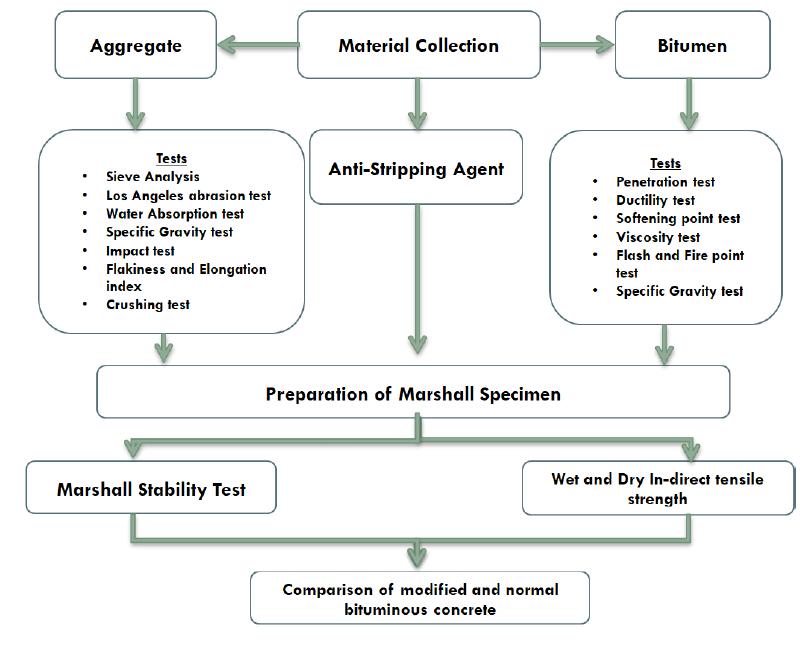
The aggregates used for the study is taken from a nearby quarry.BitumenusedisVG30. Thephysical properties of theaggregatesand bitumen usedfor bituminous concrete mixdesignweredeterminedtocheckitssuitability.Marshall specimens were prepared and both wet and dry stability tests were conducted. The results of the different experimentsandstabilitytestsareincludedinthissection
The physical properties of aggregates and bitumen were tested in the laboratory and the results along with the requiredspecificationsasperMoRTH[8]aregivenintables 1and2.
Properties
Obtained Value Specification
SpecificGravity 2.64 2.5 3
WaterAbsorption(%) 0.55 Max2 ImpactValue(%) 20.4 Max24
Combined Flakiness and ElongationIndices(%) 34.2 Max35 CrushingValue(%) 33.7 Max35
Table 2: PropertiesofBitumen
Properties
The bonding between asphalt and aggregate is very importantasitisthekeyfactorthatinfluencesthereliability of the pavement. The adhesion between aggregates and bitumencanbeimprovedthroughtheusageofanti stripping agents.Theanti strippingagentusedinthepresentstudyis
Obtained Value
Penetration (100g,5sec@25°C), mm 67
Ductility@27°C,cm 77 Softening Point (Ring and Ball apparatus),°C 57.5 FlashPoint,°C 205 FirePoint,°C 214
SpecificGravity 0.99
International Research Journal of Engineering and Technology (IRJET) e ISSN: 2395 0056
Volume: 09 Issue: 07 | July 2022 www.irjet.net p ISSN: 2395 0072
The aggregate gradation was selected in order to get the combinedgradingspecifiedinTable500 17ofSpecifications forRoad&BridgeWorks(FifthRevision),publishedbythe Indian Roads Congress [8]. The midpoint of Grade 2 for BituminousConcretewasselectedforuniformityintesting, andtheresultsaregiveninTable4
Table 4: GradationofAggregates(BC Grade2)
IS Sieve (mm)
Cumulative%byweight of total aggregate passing
Cumulative % by weight taken for experiment
19 100 100 13.2 90 100 95 9.5 70 88 79 4.75 53 71 62 2.36 42 58 50 1.18 34 48 41 0.6 26 38 32 0.3 18 28 23 0.15 12 20 16 0.075 04 10 7
Marshall tests were conducted on specimens having differentbitumencontents(%byweightoftotalaggregates) asperthespecificationstofixtheoptimumbitumencontent required.TheseresultsaregiveninTable3.6and3.7.
Table -5: Stabilityandflowvaluesofspecimenswithout ASA
Bitumen content(%) Stability value (kN)
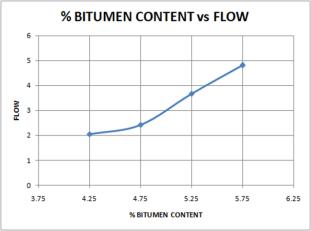
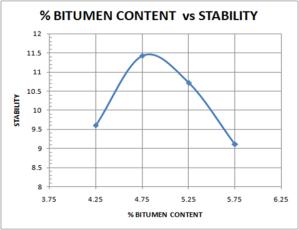
Flow value (mm)
Tensile Strengthof Water Conditioned Specimen(kN)
Tensile Strength Ratio (%)
4.25 9.61 2.05 7.17 71.66
4.75 11.43 2.42 9.06 76.30
5.25 10.72 3.67 9.22 80.04
5.75 9.11 4.71 8.12 77.13
Table 6: Densityandvoidanalysisofspecimenswithout ASA Bitume n content %
Wt. in air, (Wm ) kg
Wt. in water , (Ww) kg
Theoretic al Spec. Gravity, Gt
Spec. Gravit y of mix, Gm
Vv (% )
Vb (%) VMA (%) VFB (%)
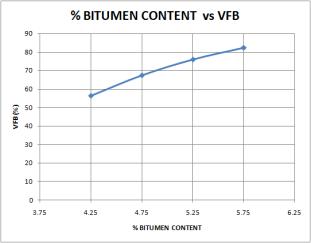
4.25 1.25 0.71 2.50 2.31 7.4 2 9.63 17.0 5 56.4 7
4.75 1.27 0.73 2.48 2.35 5.2 4 10.8 8 16.1 3 67.4 8
5.25 1.28 0.74 2.46 2.37 3.8 0 12.0 6 15.8 7 76.0 4
5.75 1.26 0.73 2.45 2.38 2.8 3 13.1 9 16.0 2 82.3 4
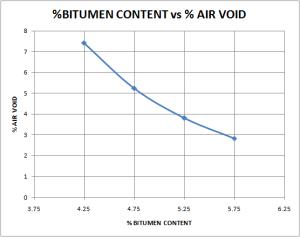
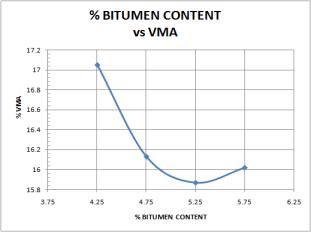
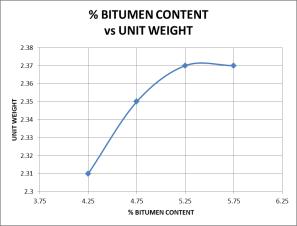
Marshall graphs are plotted as shown in fig 2 to find the optimumbitumencontent(OBC) a b c d e f
Chart -1a-f:GraphicalplotsofspecimenswithoutASA
2022, IRJET | Impact Factor value: 7.529 | ISO 9001:2008 Certified Journal
International Research Journal of Engineering and Technology (IRJET) e ISSN: 2395 0056
Volume: 09 Issue: 07 | July 2022 www.irjet.net p ISSN: 2395 0072
Considering binder content corresponding to maximum stability, binder content corresponding to maximum bulk specific gravity (Gm) and binder content corresponding to themedianofdesignedlimitsofpercentageairvoids(Vv)in the total mix (i.e. 4%), the optimum bitumen content is obtainedas5.2%.Theobtainedvalueofoptimumbitumen content as per calculation is 5.2%, but the minimum optimum bitumen content specified for bituminous construction as per MoRTH specifications is 5.4%. The stabilityvalue,flowvalue,andVFBat5.4%arecheckedwith theMarshallmixdesignspecification.Theoptimumbitumen contentof5.4%isadopted.
Marshall Testswereconducted onspecimens atOBC with differentpercentagesoftheanti strippingagentRedisetLQ 1102 Theseresultsaregivenintable6.TheTensilestrength ratios (TSR) of mixes with and without ASA are found to check the variation in moisture susceptibility of mixes on additionofASA.Theresultsaregivenintable7
Table 6: ComparisonofspecimenswithandwithoutASA
Mix Parameter
Obtained value Mix Without ASA
Mix With 0.55% ASA
OnconductingMarshallTestsonspecimenswithoutAnti StrippingAgentstheoptimumbitumencontentisfoundto be5.4%.
Theadditionofanti strippingagentRedisetLQ1102CEat OBCreducesthepercentageairvoidsinthemixesatOBC. Thebulkdensityisslightlyincreased.
SpecimenspreparedwithAnti StrippingAgentshowsan increaseinthestabilityofthemix.
After conducting tests on dry and water conditioned specimens with and without Anti stripping Agents, it is observedthatthereisanincreaseintheTensileStrength RatioofmixesonadditionofASA.
Hence, in areas like Kerala with a wet and maritime tropical climate, it will be a better option to use Anti stripping Agents in bituminous mixes for pavement constructiontoimprovethelongevityofroads.
Mix With 0.75% ASA
BitumenContent,% 5.4 5.4 5.4 MarshallStability,KN 10.24 11.08 11.86 Flow,mm 3.4 3.4 3.6 MarshallQuotient, KN/mm 3.01 3.26 3.29 BulkDensity,kg/m3 2390 2401 2412 percentageairvoids, Vv% 3.81 3.76 3.72
VoidsFilledwith Bitumen(VFB),% 73.04 73.38 73.45
VoidsinMineral Aggregate(VMA),% 13.5 13.67 13.72
Table 7: TSRvaluesofmixes
Mix Type
TSR VALUE (%)
VG30withoutASA 79.16
VG30with0.65%ASA 86.32
VG30with0.75%ASA 88.56
The study can be further extended on aggregates from different places and different types of Anti stripping AgentsandfindingtheoptimumdosagesofASAsineach case.
Furtherstudiescanalsobedoneinthistopicbyconducting tests on the other properties of adhesion between the aggregatesandbitumen.
The authors would like to acknowledge the Kerala State CouncilforScience,TechnologyandEnvironment(KSCSTE) forthefinancialassistancereceived.
[1] G. Goel, S. N. Sachdeva, “Performance of bituminous concretemixeswithmodifiedbinderandanti stripping agent”,IndianHighways,vol47,Sep2019.
[2] Z. A. Mansourkhaki, A Aghasi, “Performance of rubberizedasphaltcontainingliquidnanomaterialanti stripagent”,ConstructionandBuildingMaterials,vol. 214,July2019,pp468 474
[3] C Zhu,GgXu,H Zhang,F Xiao,S Amirkhanian,C Wu, “Influence of different anti stripping agents on the rheological properties of asphalt binder at high temperature”,ConstructionandBuildingMaterials,vol. 164,March2018,pp317 325.
2022, IRJET | Impact Factor value: 7.529 | ISO 9001:2008 Certified Journal
International Research Journal of Engineering and Technology (IRJET) e ISSN: 2395 0056
Volume: 09 Issue: 07 | July 2022 www.irjet.net p ISSN: 2395 0072
[4] M. Faramarzi , B. Golestani , K. W. Lee, “Improving moisture sensitivity and mechanical properties of sulphur extended asphalt mixture by nano antistripping agent”, Construction and Building Materials,vol.133,15Feb2017,pp534 542
[5] H. F. Haghshenas, A. Khodaii, M. Saleh, “Long term effectiveness of anti stripping agents”. Construction andBuildingMaterials.Vol.76,Fob2015,pp307 312.
[6] Y.B.A.Mohamad,O.H.Meor,“EffectsofAnti Stripping Additives on Moisture Sensitivity of Warm Porous Asphalt Mixtures”, International Journal of ConstructionTechnologyandManagement,Vol.1,Feb 2014.
[7] E.Hesami,G.Mehdizadeh,“Studyoftheamine based liquid anti stripping agents by simulating hot mix asphalt plant production process”, Construction and Building Materials, Vol. 157,30 Dec 2017, pp 1011 1017.
[8] MinistryofRoadTransport&Highways:Specifications for Road and Bridge works (Fifth Revision). Indian RoadsCongress,NewDelhi,2013.
2022, IRJET | Impact Factor value: 7.529 | ISO 9001:2008 Certified Journal