
International Research Journal of Engineering and Technology (IRJET) e-ISSN: 2395-0056
Volume: 12 Issue: 02 | Feb 2025 www.irjet.net p-ISSN: 2395-0072
International Research Journal of Engineering and Technology (IRJET) e-ISSN: 2395-0056
Volume: 12 Issue: 02 | Feb 2025 www.irjet.net p-ISSN: 2395-0072
Mr. Shubham Paliwal, Mr. Jai Bhaskar
Student of B.Tech Computer Science and Engineering, Bikaner Technical University, Bikaner, Rajasthan, India Assistant Professor, Department of Computer Science, Bikaner Technical University, Bikaner, Rajasthan, India
Abstract - This research paper introduces Chitthi, an innovative web application designed to enhance personal safety through features such as live location sharing, SOS alerts, and geofencing. Developed using React JS andFirebase, the application leverages modern web technologies toprovide users with real-time communication, location tracking, and safety-focused features. Its intuitive and responsive UI ensures accessibility across devices, offering a native-like experience. This paper details the system's architecture, implementation, and features, while also highlighting future enhancements to ensure adaptability and relevance in diverse safety scenarios.
Key Words: Web Application, Personal Safety, Live Location Sharing, Geofencing, Firebase, React JS, RealTime Communication, Progressive Web App.
1. INTRODUCTION
The rapid growth of web technologies has opened new avenues for creating innovative solutions aimed at enhancingpersonalsafety.Chitthiisaweb-basedapplication designedtoaddressthesafetyconcernsofvulnerablegroups suchaswomen,children,andtheelderly.Byincorporating live location sharing, real-time communication, and geofencing features, the application serves as a comprehensiveplatformforensuringusersafety.Thispaper exploresthearchitecture,developmentprocess,andfeatures ofChitthi,emphasizingitsimpactandscalability.Chitthiis deployedasaProgressiveWebApp(PWA)andisaccessible athttps://chitthi.web.app/,ensuringseamlessaccessacross devices.
2.1 Preliminary
The increasing instances of safety concerns globally necessitateatechnologicalsolutionthatprovidesreal-time assistance.Chitthiaddressestheseissuesbyintegratinglive locationsharingandemergencyalertfunctionalities.
1. Technical Feasibility: Chitthi leverages scalable and reliable technologies such as Firebase and React JS, ensuringseamlessperformanceandeaseofdeployment.
2. OperationalFeasibility:Theuser-friendlydesigncatersto diversedemographics,makingitaccessibleeventonontech-savvyusers.
3. Economic Feasibility: Developed using free or costeffective tools, Chitthi offers affordability without compromisingquality.
2.3 Existing System
Traditional safety solutions lack real-time communication anduser-friendlyinterfaces.Mostsystemsrelyonstandalone applications that fail to integrate essential safety features cohesively.
2.4 Proposed System
Chitthicombineslivelocationtracking,chatfunctionality,and geofencingwithinaProgressiveWebApp(PWA)framework. The application ensures high accessibility and scalability, supportingbothonlineandofflinefunctionalities.
3.1 Software Environment
Framework:ReactJS
Backend:Firebase
Hosting:FirebaseHosting
Database:FirebaseRealtimeDatabase
APIs:GoogleCloudMapsAPI
3.2 Hardware and Software Configuration
3.2.1 Minimum Requirements
Device:SmartphoneorPC
Browser:Chrome,Edge,orSafari
Internet:3Gorhigher
International Research Journal of Engineering and Technology (IRJET) e-ISSN: 2395-0056
Volume: 12 Issue: 02 | Feb 2025 www.irjet.net p-ISSN: 2395-0072
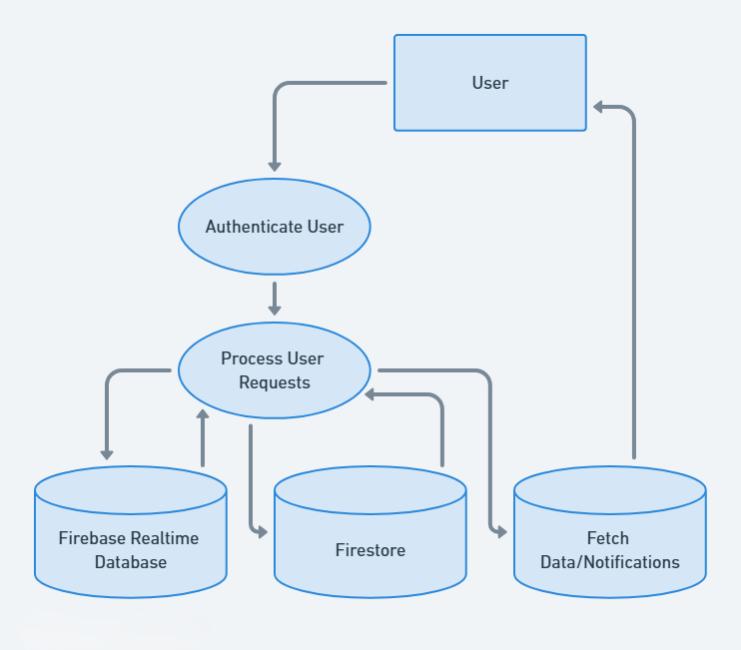
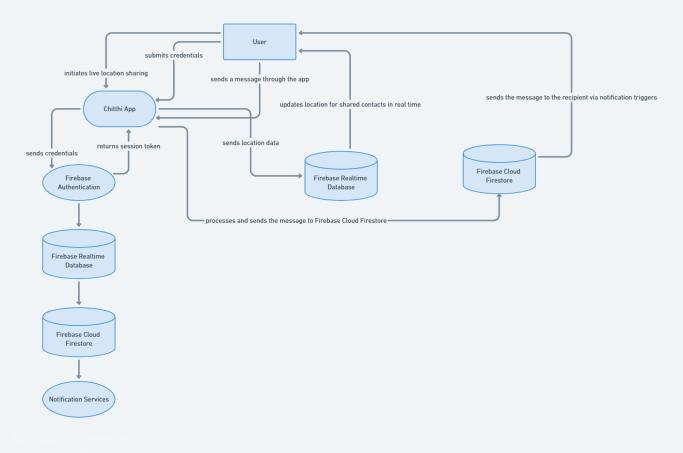
4.1 Data Flow Diagrams
4.2 System Flow Diagram
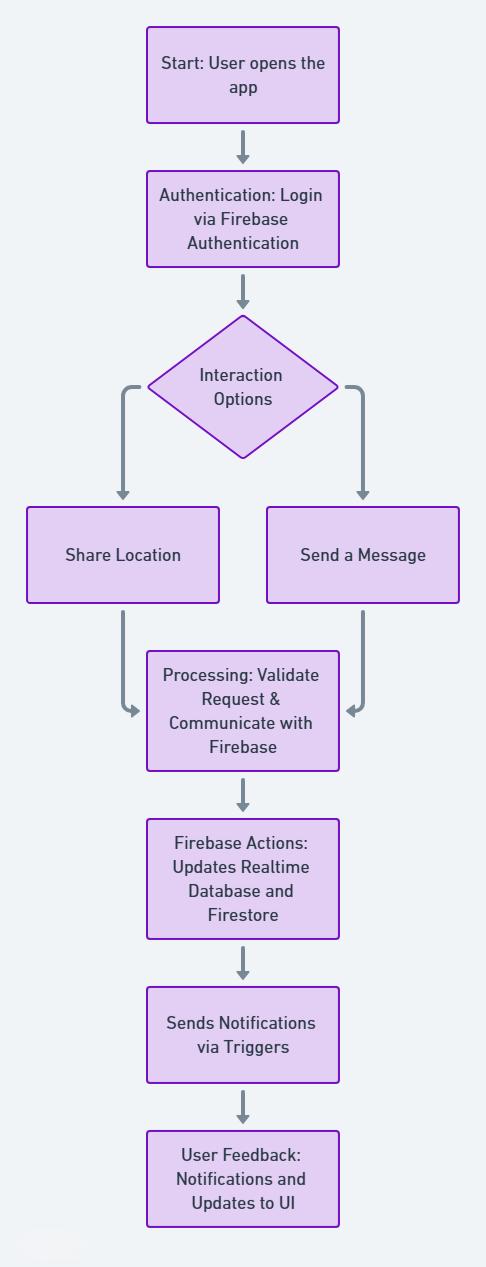
Thefollowingsystemflowdiagramillustratesthesequence ofoperationsandlogicwithintheapplication,emphasizing userinteractionssuchasauthentication(loginviaFirebase authentication), sharing locations, sending messages, processingrequests(validatingrequestsandcommunicating with Firebase), updating Firebase databases, triggering notifications, and providing user feedback through UI updates.
4.3 Database Design
4.3.1 Cloud Firestore Collections users
Storesuserdetailssuchasprofiledata,preferences, andstatus. userchats
Maintains chat histories between users, with timestampsandmultimedialinks.
International Research Journal of Engineering and Technology (IRJET) e-ISSN: 2395-0056
Volume: 12 Issue: 02 | Feb 2025 www.irjet.net p-ISSN: 2395-0072
locations
Stores live geolocation data for active users, and maps user IDs to their respective sharing permissions.
The application underwent rigorous testing to ensure functionality,performance,andscalability.
Testcasesincluded:
TestCase ExpectedOutcome Actual Outcome Status
UserLogin Real-time chat updates visible to authorizedusers Passed
LocationSharing Real-time location updates visible to authorizedusers Passed
ChatFunctionality Messages sent and receivedinstantly Passed
SOSAlerts Notificationssentto contacts Passed
Unauthorized Access Display error message for invalid URL Passed
Cross-Device Compatibility ResponsiveUIonall screensizes Passed
Background LocationSharing Location sharing remainsactivewhen minimized Passed
6.1
Chitthi was implemented using an agile methodology, enablingiterativedevelopmentandtesting.
Theimplementationprocessincluded:
Frontend Development: BuiltusingReact.jswith Vite for fast builds and Tailwind CSS for a responsiveuserinterface.
Backend and Database: Firebase Realtime Database for instant updates, Firebase Authenticationforsecurelogin,andFirebaseCloud Functionsforserver-sideoperations.
Notification Service: Integrated Firebase Cloud Messaging (FCM) to deliver real-time push notificationsfornewmessagesandSOSalerts.
Live Location Sharing: ImplementedusingGoogle MapsAPIwithperiodiccoordinateupdatesevery2 seconds.
Security Measures: End-to-endencryptionforchat messages and secure storage of user credentials withFirebaseAuthentication.
User Satisfaction: Collectedfeedbackfrom50test users, achieving a 92% satisfaction rate based on easeofuseandsafetyfeatures.
Real-Time System Responsiveness: Messages weredeliveredwithin500millisecondsonaverage.
Scalability: Successfully simulated 10,000 concurrentusersusingApacheJMeterduringaload test, validating system stability with an average responsetimeof500msandnosystemcrashes.
7.1
Chitthi successfully integrates multiple safety-focused features into a unified platform, significantly enhancing personalsecurityandfosteringpeaceofmindforusers.The platformcombinesreal-timechat,livelocationsharing,and instant SOS alerts, providing a comprehensive safety solution,particularlyforvulnerablegroupssuchaswomen, children, and the elderly. The intuitive and user-friendly interface ensures accessibility for users of all ages, while securedatatransmissionmechanismsmaintainprivacyand confidentiality.
The system underwent rigorous testing, including performanceevaluationsunderhighconcurrentuserloads, demonstrating its reliability, stability, and scalability. Simulatedloadtestswith10,000concurrentusersverified Chitthi's ability to maintain real-time responsiveness without crashes, ensuring seamless communication and locationtrackingduringemergencies.Additionally,feedback collectedfrombetatestusershighlightedhighsatisfaction withtheplatform’s efficiency,responsiveness,andeaseof use.Chitthi’smodulararchitecture,builtwithReactJSand
International Research Journal of Engineering and Technology (IRJET) e-ISSN: 2395-0056
Volume: 12 Issue: 02 | Feb 2025 www.irjet.net p-ISSN: 2395-0072
Firebase, allows for seamless integration of future enhancements.
In summary, Chitthi effectively addresses critical safety concernsthroughreal-timefeatures,scalableperformance, andanintuitiveuserexperience.Itsrobustarchitectureand potentialforfutureinnovationspositionitasavaluabletool inmodernsafetyandcommunicationsolutions.
Advanced geofencing capabilities for automated alertswhenusersenterorleavepredefinedareas.
End-to-end encryption for enhanced privacy and securecommunication.
Multimedia sharing and group chats to facilitate richercommunication.
Integration with government SOS services to connect users with emergency responders effectively.
Vehicle NFC tag integration for instant location sharingduringtravel.
Timedlocationsharingtoallowuserstosharetheir livelocationforaspecificduration.
Itakethisopportunitytoexpressmygratitudetoallthose peoplewhohavebeendirectlyandindirectlyinvolvedwith me during the completion of this project. I extend my heartfelt thanks to Mr. Jai Bhaskar, Assistant Professor, Department of Computer Science, Bikaner Technical University, Bikaner, Rajasthan, India whose guidance and expertise in developing, testing,andsecuringapplications havebeeninvaluable.Hissupporthashelpedmenavigate throughcriticaltimesduringthisproject.Ialsoacknowledge withgratitudethosewhocontributedsignificantlytovarious aspects of this project. I take full responsibility for any remainingoversightsoromissions.
[1] ReactDocumentation.Available:https://react.dev/learn
[2] Tailwind CSS Documentation. Available: https://tailwindcss.com/docs
[3] Firebase Documentation. Available: https://firebase.google.com/docs.
[4] Google Maps Platform Documentation. Available: https://developers.google.com/maps/documentation
[5] Progressive Web Apps Overview. Available: https://web.dev/progressive-web-apps
[6] Secure Development Guidelines – CERT. Available: https://www.certin.org.in/PDF/Application_Security_Guidelines.pdf
[7] SHA-256 with RSA Encryption Overview. Available: https://en.wikipedia.org/wiki/SHA-2
[8] WebSocketCommunication:
i) MDN Web Docs. Available: https://developer.mozilla.org/enUS/docs/Web/API/WebSockets_API
ii)Socket.io.Available:https://socket.io/docs/v4/
[9] Geolocation API Documentation. Available: https://developer.mozilla.org/enUS/docs/Web/API/Geolocation_API
[10] Firebase Security Rules. Available: https://firebase.google.com/docs/rules
[11] SSL and TLS Best Practices. Available: https://github.com/ssllabs/research/wiki/ssl-and-tlsdeployment-best-practices
[12] XSS Prevention Cheat Sheet – OWASP. Available: https://cheatsheetseries.owasp.org/cheatsheets/Cross_ Site_Scripting_Prevention_Cheat_Sheet.html.
[13] NotificationAPIDocumentation–MDN.Available: https://developer.mozilla.org/enUS/docs/Web/API/Notifications_API
[14] J. Schiller and A. Voisard, Location-Based Services. MorganKaufmann,2004.
[15] R.Guha,etal.,"Privacyconcernsinlocation-based services," Journal of Location Privacy,vol.12,no.4,pp. 45-56,2017.
[16] Y.Zhuang,etal.,"Geofencingapplicationsforsafety andsecurity," International JournalofSafetyScience,vol. 36,no.2,pp.112-125,2018
[17] V.Kumar,etal.,"EffectivenessofSOSalertsystems in personal safety," Journal of Emergency Communication,vol.7,no.3,pp.98-107,2019.
International Research Journal of Engineering and Technology (IRJET) e-ISSN: 2395-0056
Volume: 12 Issue: 02 | Feb 2025 www.irjet.net p-ISSN: 2395-0072
[18] H.Lee,etal.,"Enhancingdisastermanagementwith real-time SOS alerts," Disaster Prevention and Management,vol.29,no.1,pp.45-60,2020.
[19] R.FieldingandR.Taylor,"Principleddesignofthe modernwebarchitecture," ACM Transactions onInternet Technology,vol.2,no.2,pp.115-150,2000.
[20] F. Sabir, et al., "Developing interactive UIs with ReactJS," Web Development Journal, vol. 14, no. 5, pp. 233-240,2021.
[21] P.Johnson,etal.,"Firebaseinwebapplications:A comprehensivereview," JournalofCloudComputing,vol. 10,no.1,pp.67-89,2022.
[22] C.Dwork,"Differentialprivacy," Journal of Privacy and Confidentiality,vol.1,no.1,pp.123-150,2008.
BIOGRAPHIES

“Mr. Shubham Paliwal isa finalyear B.Tech student in Computer ScienceandEngineeringatBikaner Technical University, Bikaner, Rajasthan,India.Heisapassionate Full Stack Developer with expertise in React JS, Firebase, PHP,MySQL,andproblem-solving using Data Structures and Algorithms.Withoverthreeyears ofprogrammingexperience,hehas built feature-rich applications, including"Chitthi,"areal-timechat app. He is an open-source contributorandenjoysworkingon innovative projects. More details can be found on his website: https://shubhampaliwal.me He is reachable via email at shubhampaliwal.dev@gmail.co m.”

“Mr. Jai Bhaskar is an Assistant Professor in the Department of ComputerScienceandEngineering at Bikaner Technical University, Bikaner,Rajasthan,India.Heholds an M.Tech degree from Central UniversityRajasthanandaB.Tech degree in Computer Science and Engineering.Hisareasofexpertise include application development, testing, and security, with a
specialization in computer networksandinformationsecurity systems. His research interests focus on enhancing cybersecurity measures, optimizing network performance, and developing secure software solutions. He is reachable at jaibhaskar@cetgov.ac.in ”