International Research Journal of Engineering and Technology (IRJET) e ISSN:2395 0056

Volume: 09 Issue: 06 | June 2022 www.irjet.net p ISSN:2395 0072

International Research Journal of Engineering and Technology (IRJET) e ISSN:2395 0056
Volume: 09 Issue: 06 | June 2022 www.irjet.net p ISSN:2395 0072
1Department of Computer Science and Engineering, School Of Engineering,MIT Art, Design and Technology University, Pune, Maharashtra 412201 ***
Abstract The amount of data on the internet is increasing day by day. So it becomes more difficult to retrieve important points from large documents without reading the whole document. Manually extracting key components from large documents requires a lot of time and energy. Therefore an automatic summarizer is must needed which will produce the summary of a document on its own. In this, a text is given to the computer and the computer using algorithms produces a summary of the text as output. In this paper, we have discussed our attempt to prepare an extraction based automatic text summarizer in which paragraphs of documents are split into sentences and then these sentences are ranked based on some features of summarization where higher rank sentences are found to be important which is used to generate the summary.
TheWorldoftextisvastandisevolvingconstantly.Most informationavailableontheinternetisstillinatextformat. We humans as frequent users of the internet have to go through large and many different documents to gain that information whichtakes lotsofour timeas well as energy. Duetothismassiveincreaseintextinformation,asummary of this information is must needed which will extract the important points from a large set of information or documents. Therefore, a process of producing a concise summarywhilemaintainingimportantinformationandthe overallmeaningofthetextiscalledTextSummarization.
Whenitcomestosummarizingtext,humansunderstand the context of documents and create a summary that conveys the same meaning as the original text but when it comes to automation this task becomes way too complex. Text Summarization is one of the use cases of Natural LanguageProcessing(NLP).NaturalLanguageProcessingis the branchofArtificial Intelligenceconcerned with making computers understand text and words in the same way as humanbeingsusedtounderstandthem.WecandivideText summarizationintotwocategories:
1. Extractive Summarization: In this, the most importantpartsofsentencesareselectedfromthe text andasummaryisgeneratedfromit.
2. Abstractive Summarization: In this method, summary involves the words which are generally not present in the actual text it means that it produces a summary in a new way by selecting words on semantic analysis just like how humans read articles and then write thesummaryofitintheirownwords.
Over the years, there has been a lot of discussion regarding text summarization and how to deal with its problems. Several papers have been published that discuss various approaches to dealing with automating text summarization. In this paper, we have extended this area in novel ways and contributed to the area of text summarization especially in the Ex tractive approach because computers still cannot understand every aspect of the Abstractive approach of text summarization. Our study canbesummarizedasfollows:
• We have presented the TextRank approach to deal withextractivetextsummarization.
• Also, we have performed evaluation measures and describedthemindetail.
• Further, we have made a comparison of our proposed systemwithexistingMS Wordapproaches.
Theoutlineoftherestofthepaperisasfollows:Insection II we have presented a literature review of text summarization. Section III describes our pro posed idea/system of extractive text summarization. Section IV describes the working algorithm we have used in our proposed system. In section V, the result of our proposed system is discussed which involves evaluation as well as performancemeasuresofoursystem.SectionVIincludesthe futurescopeofoursystemandconcludesourstudy.
International Research Journal of Engineering and Technology (IRJET) e ISSN:2395 0056
Volume: 09 Issue: 06 | June 2022 www.irjet.net p ISSN:2395 0072
There has been a lot of development in the field of Text Summarizing in the past 9 years. With every advancement comes a new technique with a more optimized approach. Someofthesetechniquesarementionedbelow
The aim is to summarize large documents to extract the key components from the text which makes it very convenient to understand the context and main points of thetext.Thispaperwaspublishedintheyear2021andthe authorwasAbdullahKhilji.
The approach described in the paper uses a baseline machine learning model for summarizing long text. This model takes raw text as input and gives a predicted summaryasoutput.Theyexperimentwithbothabstractive and extractive based text summarization techniques. For verifying the model they use BELU, ROGUE, and a textual entailmentmethod.
Dataset being used is Amazon fine foods reviews which consistofhalfamillionreviewscollectedover10years.The methodology being used is Sequence to Sequence and Generative Adversarial. However, the paper is missing detailsofextractivesummarizationtechniques.
This paper describes the classification of summarization techniques and also the criteria that are important for the systemtogeneratethesummary.Thispaperwaspublished in2009andtheauthorwasSaeedehGholamrezazadeh.
The extractive approach is described as reusing the portionsofthemaintextwhichareitalics,boldphrases,the first line of each paragraph, special names, etc. For Abstractive approachinvolvesrewritingthe original textin a short version by replacing large words with their short alternatives.
Drawbacks of Extractive summarization include inconsistencies, lack of balance, and lack of cohesion. Examples of extractive summarization are Summ It applet and examples of abstractive summarization are SUMMARIST.
This paper focuses on Automatic Text Summarization to getthecondensedversionofthetext.Themethodmentioned also takes into account the title of the paper, the words mentionedinit,andhowtheyarerelevanttothedocument. However, the summary might not include all the topics mentionedintheinputtext.Thispaperwaspublishedinthe year2020byA´ngelHern´andez Castan˜eda.
The proposed approach first passes the text to feature generation methods like D2V, LDA, etc. to generate vectors for each sentence. Then it undergoes clustering which measures the proximity among different vectors generated in the previous step. Then LDA is used to get the main sentencesabovetherestofallsentenceswhicharethenused togeneratethesummary.
This paper explains the whole process in a very precise manner however there is less information on the methods being used in some steps of the proposed flow. No info on termfrequencyandinversetermfrequencyispresentinthe paper.
This paper talks about the graph based method for summarizing text. It also tells about how to graph based method can be used to implement abstractive as well as extractive text summarization. This paper was published in theyear2018andisauthoredbyAtifKhan.
According to almost all graph based methods text is consideredasa bagofwordsandforsummarization,it uses content similarity measure but it might fail to detect semantically equivalent redundant sentences. The proposed systemhastwopartsoneformakingthesemanticgraphand theotherpartforimprovingtherankingalgorithmbasedon the weighted graph. Finally, after both parts are executed successfully,anabstractivesummaryofthetextisgenerated.
The paper has good information on the graph based ranking algorithm and improved versions of it. However, there is no mention of the text rank algorithm. Also, a comparisonbetweenthegraph basedrankingalgorithmand textrankrankingalgorithmisabsent.
In this paper the main motivation is to make computers understand the documents with any extension and how to
International Research Journal of Engineering and Technology (IRJET) e ISSN:2395 0056
Volume: 09 Issue: 06 | June 2022 www.irjet.net p ISSN:2395 0072
make it generate the summary. In this method the system usesacombinationofbothstatisticalandlinguisticanalysis. Thispaper was publishedin theyear2014and isauthored byMs.AnushaPai.
Thesystemintroducedinthepapertakestextinput from user. For summarizing this input it firstly separates the phases, then removes the stop words from the input. After this it performs Statistical and Linguistic analysis to generate the summary. This output is then sent and stored inthedatabase.
The system proposed generates summary according to theinputgivenbytheuser.Thiscanfurtherbeimprovedby adding synonyms resolution to the model which will treat synonyms words as same. Also multiple documents summarizationsupportcanbeadded.
In this paper a new possibility is introduced, abstractive text summarization might compose of novel sentences, whicharenotpresentintheoriginaldocument.Themethod introduced uses an unsupervised document summarization method which uses clustering and extracting to generate a summaryof the textinthe maindocument.Thispaper was published in 2009 by Rasim Algulie This method uses Sentenceclusteringtoclassifysentencesbasedonsimilarity measureswhichclassifythesentencesinclusters.After this objective function is used to calculate their importance. Along with this Modified Discrete Differential Evolution Algorithmisalsomentionedinthepaper.
No information is given about the Graph based approach andalsonocomparisonbetweenthegraphbasedapproach and objective function is given. Also, the result is less optimizedthantheapproacheswesawinotherpapers.
This paper talks about current present approaches for summarization. It also talks about Extractive and Abstractive text summarization. This paper was published intheyear2017andisauthoredbySan toshKumarBharti.
This paper has divided Automatic Text Summarization into 4 types Simple Statistics, Linguistic, Machine Learning, and Hybrid. These are techniques in which we can implement Automatic Text Summarization. In Simple Statistics, we have Inverse Document Frequency, Relative Frequency Ratio, Term Frequency, etc. In the Linguistic Approach, we have Electronic Dictionary, Tree Tagger, n
Grams, WordNet, etc. In Machine Learning we have SVM, Bagging,HMM,etc.Hybridisthecombinationoftheprevious threementioned.
This paper contains all the techniques present to the date however since 2017 there has been a lot of improvement in this field. This paper needs to be updated with the latest technologies.
Thispaperwaspublishedintheyear2017andisauthored by Santosh Kumar Bharti. It takes about implementing Extractive Summarization in everyday life for summarizing e Newspaperarticles.
This paper shows the comparison between TF IDF, TF AIDF, NFA, and Proposed methods. It uses F measure as a parameter to measure the efficiencies of the techniques. It canbeseenthattheproposedmethodismoreefficientthan theotherthreemethods.
The paper only mentioned model implementation in Newspaperarticlesandnotinanyothertypeofarticles.Also, only Extractive Summarization is used for this model. This model should be tested on different articles and also using differentmethodologies.
This paper focuses on the approach used for selecting keywords from the text input given by the user. The comparison is done between the supervised and unsupervised approaches to identify keywords. This paper waspublishedintheyear2008bythewriterMarinaLitvak.
Thisapproachtakesintoaccountsomestructured document features using the graph based syntactic representation of the text and web documents which improves the traditional vector space model. For the supervisedapproach,asummarizedcollectionofdocuments is used to train the classification algorithm which induces a keyword identification model. Similarly, for the unsupervised approach, the HITS algorithm is used on the document graphs. This is done under the assumption that the top ranked nodes are representing the document keywords.
The supervised Classification model provides the best keyword identification accuracy. But a simple degree based ranking reaches the highest F measure. Also, the only first
International Research Journal of Engineering and Technology (IRJET) e ISSN:2395 0056
Volume: 09 Issue: 06 | June 2022 www.irjet.net p ISSN:2395 0072
iteration of HITS is enough instead of running it till we get convergence,
This paper implements the Extractive approach but uses a different approach. It uses two matrices for sentence overlap and edits distance to measure sentence similarity. This paper was published in the year 2021 by the author KastriotKadriu.
The proposed model takes a document as input. The document undergoes tokenization after which lemmatization is performed and is checked for de pendency parsing. Then the model checks for sentence overlap and edits distance if necessary. After this graph representation is done. Now we can apply different algorithmstogenerateasummaryofthetext.
In the paper, the author has taken into account different methods for generating the summary. This includes Pagerank,hits,closeness,betweenness,degree,andclusters. Finally, the summary is generated. The paper also shows a comparison between different methods and how accurate their summary is. We use F score to measure their effectiveness.
This paper implemented and compared the performance of three text summarizations developed using existing summarization systems to achieve connectionism. This paper was published in 2010 by the authors Rajesh ShardanandPrasadandUdayKulkarni.
Three approaches used in the paper are based on semantic nets, fuzzy logic, and evolutionary programming respectively. The results they got were that the first approach performs better than MS Word, the second approach was resulting in an efficient system and the third approach showed the most promising results in the case of precisionandF measure.ThepaperhasusedtheDUC2002 dataset to evaluate summarized results based on precision andF measure.
Approachesusedinthispaperfocusonlyonsmalldetails relatedtogeneralsummarizationratherthandevelopingan entire summarization system and thus are only helpful for researchpurposes.
This paper aims at creating a feature based text summarizer that is applied to different sizes of documents. This paper was published in the year 2012 by author Dr. RajeshPrasad.
This paper follows the extractive way of summarizing the textandutilizesthecombinationofninefeaturestocalculate thefeaturescoresofeachsentenceandrankthemaccording tothescorestheyget.Thehigherrank sentencesarepartof thefinalsummaryofthetext.Theyhaveuseddifferenttypes of documents that require different features to get a summary as a data set for their model. This approach gave better results when compared to MS word in terms of precision,RecallandF measureinmosttypesofdocuments.
This paper shows great results for different types of documents but some documents may require features more thanthispaperhasusedsofurtherresearchisneededinthis approach.
This paper aims to review various architectures which have been proposed for automatic text summarization. This paper was published in the year 2013 by its authors Tejas Yedke,VishalJain,andDr.RajeshPrasad.
In this paper, different techniques for text summarization are discussed and their advantages and drawbacks are also reviewed.DUC2002datasetisusedtocalculateresultsthat which approach per forms better for which type of document in terms of precision, recall and F measure. The limitation of this paper is that it doesn’t provide the most effectivetechniqueforsummarization.
This paper aims at developing an extractive text summarizer using the Genetic algorithm. This paper was published in the year 2017 by its authors Alok Rai, Yashashree Patil, Pooja Sulakhe, Gaurav Lal, and Dr.Rajesh Prasad.
The approach this paper follows involves feature extraction, fuzzy logic, and a genetic algorithm to train the machine to produce better results in automatic summarization.ThispaperdefinesGeneticalgorithmsasthe search strategies that cop with the population of simultaneously seeking positions. Ac cording to the input
International Research Journal of Engineering and Technology (IRJET) e ISSN:2395 0056
Volume: 09 Issue: 06 | June 2022 www.irjet.net p ISSN:2395 0072
file and compression rate given by the user, the authors resulted in forming a meaningful summary as output text. According to the paper genetic algorithm is a sentence choice basedtechniqueandgivesthebestresultswhentext summarizationisdone.
This paper aims to create an efficient tool that can summarize large documents easily using the evolving connectionist approach. This paper was published in the year 2009 by Rajesh S.Prasad, Dr. U.V Kulkarni, and JayashreeR.Prasad.
In this paper, a novel approach is proposed for part of speech disambiguation using a recurrent neural network, which deals with sequential data. Fifty random different articleswereusedasdatasetsforthispaper. Authorsfound the accuracy of ECTS was ranging from 95 to 100 percent which average accuracy of 94 percent when compared to othersummarizers.
Though this paper has explained the connectionist approach very well there lies some issues in POS disambiguationanddeviationsfoundinECTSforacoupleof sentences.
This paper was published in the year 2019 andis authored by Abu Kaisar Mohammad Masum. It takes about how bi directional RNN and LSTM canbeusedin the encoding layer along with the attention model in the decoding layer for performing abstractive text summarizationontheamazonfinefood review dataset.
The focus of this paper is Abstractive Summarization by the use of sequence to sequence RNNs. It performs Data Processing in which we Split Text, Add Contractions, Remove stop words and perform Lemmatization. After verifying if the text is purified, we count the size of the vocabulary and add aword embedding file.
The next step is the addition of special tokens which mark important waypoints in the dataset.After this, an Encoder layer and Decoder Layer arepresent in LSTM andthentheSequencetoSequencemodel is built.
Themodelisthen trained withdata forgenerating the response summary. Even though the above model
performs well for short text it suffers when long text input is given. Another drawback is thatit is currently trained for the English language but no such summarizerisavailableforotherlanguages.
This paper was published in the year 2017 andis authored by Diksha Kumar. Instead of building a text summarizer, this paper focuses on improvingthe currently available Automatic Text Summarizer to achieve more coherent and meaningful summaries.The model introduced in the paper uses an automatic feature based extractive text summarizer tobetter understand the document and improve its coherence. The summary of the given input is generated basedonlocalscoringand local ranking. Wecan select the top n sentences in the ranking for thesummary. Here n depends on the compression ratio of the summarizer. Feature Extraction can be done based on differentcriteria.Itcanbedonebasedonthefrequencyof a word appearing in a sentence by selecting the words occurringthemost,basedonthelengthofthesentenceby avoiding too short or too long sentences, based on the position of the sentence by giving a highscore to the first sentenceandlesstothesecondsentenceandsoon, based onsentencesoverlappingthetitleorheadingwhichcanbe considered important and based on similarity of a sentenceconcerningallother sentences in the document.
This paper was published in the year 2009 and is authoredbyDanielLeite.Thispaperfocusesonthe fuzzy based ranking system to select the sentences for performing extractive summarization on the input data set.
The fuzzy knowledge base used in this model was generated by a genetic algorithm. For fitness function, ROGUE in formativeness measures were adopted and a corpus of newswire text is being used along with their human generated summaries for defining the fuzzy classification rules.
ThepaperalsotalksaboutSuPor 2featureswhichusea Na¨ıve Bayes probabilistic classifier to find the relevance ofasentencetobeextractedfromthedataset to be in the generatedsummary.Ithas11featuresthataddresseither the surface or the linguistic factors that interact with one another to find the relevance of a sentence. For future scope, the paper talks about using ideal mutation and
International Research Journal of Engineering and Technology (IRJET) e ISSN:2395 0056
Volume: 09 Issue: 06 | June 2022 www.irjet.net p ISSN:2395 0072
crossing rates in the evolution phase for the genetic algorithm. Also, membership functions can be explored for modeling fuzzy sets.
This paper was published in the year 2017 and is authored by Maya John. This paper aims to enhance the performance of the currently present deep learning model used for text summarization.
Incurrent deep learning models,thesummarysentences form the minority class which is very small when comparedtothemajorityclasswhichleadsto inaccuracyin a summary generation. To enhance the performance, data can be resampled before giving it to the deep learning model.
The proposed system is divided into steps for simplicity. These are text preprocessing, feature extraction, resampling, and classification. Inside text preprocessing we have tokenization, stop word removal, stemming, and lemmatization. Along with this several resampling, mechanisms are discussed in the paper which can be used on the data set for improving the classifier performance.
This paper was published in the year 2000 and is authored by Hongyan Jing. This paper’s text summarization model is based on the examination of humanwrittenabstractsforaspecifictext.
Themodelextractstextfromtheinputforgenerating a summary and removes the inessential phrases from the text. The phrases are given as output and then joined together to form coherency. This is done based on a statistically based sentence decomposition program whichfindswherethephrasesofasummarybegininthe original text input. This produces an aligned corpus of the summary along with the articles used to make the summary.
The model uses a Corpus of human written abstracts foranalyzingtheinput. ItalsousesWordNetforSentence reduction and Sentence combination. Even though it is very accurate, when we test this model with current modelsitisverysimpleandoldcomparedtotheonesthat are being used currently. A lot of advancement has been doneinthisfieldsincethetimethispaperwaspublished.
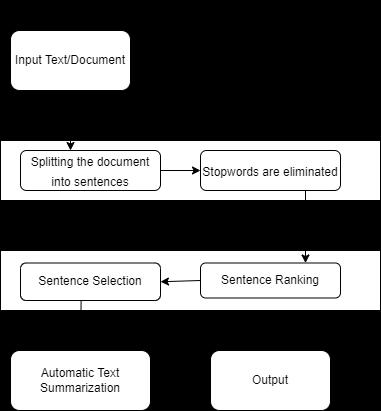
Preprocessinginvolvesthetakingtextasinputfromthe user in different forms like Wikipedia or other links, simple text box and upload text document, etc. and stop wordsfromthesentencesareremoved.
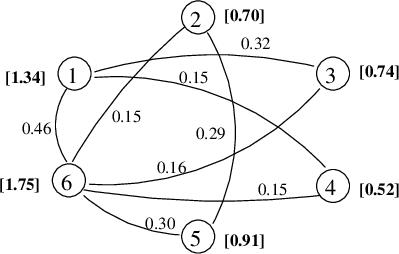
Thesesentencesarerepresentedasnodeswithalltheir properties and edges representing interest (similarity) betweentwosentences.
The concept of Sentence Ranking tells that a document rankshighintermsofranking,ifhighrankingdocuments are linked to it. Here we have used a Textrank algorithm inspired by the Pagerank algorithm which extracts all sentencesfrominputtext,createvectorsforallsentences, then the similarity between sentence pairs is calculated andfinally,sentencesarerankedbasedonscore.
Based on the Similarity Score obtained from the similaritymatrixthetopNsentencesaretobeincluded in the final summary and thus Summary is generated from theoriginaltextastheoutputofthesystem.
International Research Journal of Engineering and Technology (IRJET) e ISSN:2395 0056
Volume: 09 Issue: 06 | June 2022 www.irjet.net p ISSN:2395 0072
PageRank(Z)=(1 d)+d*(PageRank(A)/2)
Text Rank has similar logic as PageRank but there are some changes like in place of web pages Text sentences are taken and a similarity matrix is calculated based on similarity values between two sentences using maximum common words. So accordingto the algorithm to create a graph of sentence ranking a vertex of each sentence is created and added to the graph. Further, the similarity between the two sentences is calculated based on the commonwordtoken present in the two sentences. In the graph, an edge between two vertices or sentences denotesthesimilarcontentorinterestamongtwosentences. Longsentencesareavoidedtoberecommendedinsummary bymultiplyingwitha normalizingfactor.
FIG.1.ProposedSystemArchitectureorFlowDiagram 4. ALGORITHM
Thealgorithm thatwehaveused hereiscalled as Text Rank Algorithm which is inspired by Google’s Page rank algorithm and is used for ranking web pages. Consider a webpageAwhichhasalinktoawebpageZ.APageRank score is calculated based on the probability of users visitingthatpagetorankthesepages.AMatrixiscreated to store the probabilities of users navigating from one page to another is called Similarity Matrix. The probability of going from page A to Z is M[A][Z] initialized as 1/(number of unique linkson the website). Suppose A which contains links to 2 pages, so the contribution of A to PageRank of Z will be PageRank (A)/2. If there is no link between web pages then probabilityshouldbeinitializedas0.Tosolvethisissuea constant d called as damping constant is added. So final equationwillbe:
FIG.2.Similaritygraphdrawnbasedonsimilarity matrix for sentence similarity
Thesimilarity between thetwo sentencesisgivenby: wheregiventwosentencesSiandSj,withasentenceas set N words appear in that sentence. Let’s take an exampletoillustratetheworkingofalgorithm:
Lettherebethreesentencesasfollows:
A=’Heisatallguy’
B=’Hehasalotoffriends’
C=’Jayishisclosefriend’
Initialize TextRank(A), TextRank(B), TextRank(C) as 1 andtakedas0.85.
Figure3showshowthesimilarity matrixiscreatedfor theabovesentences.
TextRank(A) =(1 0.85) + 0.85 * (TextRank(B) * M[B,A] +
International Research Journal of Engineering and Technology (IRJET) e ISSN:2395 0056
Volume: 09 Issue: 06 | June 2022 www.irjet.net p ISSN:2395 0072
TextRank(C)*M[B,C])
=0.15+0.85*(1*0.5+1*0.9)=1.340
TextRank(B) = (1-0.85) + 0.85 * (TextRank(B) * M[A,B] +
TextRank(C)*M[A,C]) =0.15+0.85*(1.34*0.5+1*0.2)=0.889 TextRank(C) = (1 0.85) + 0.85 * (TextRank(A) * M[C,A] + TextRank(B)*M[C,B])
Applying the proposed idea and algorithm we have implemented an automatic text summarization system that takes text as input from the user and gives him precise summary. The experimental results and analysis of our proposed system is been discussed in this section. The proposed summarization system is implemented in Python using Flask and nltk library. For testing purposes, we have used BBC News summary data set from Kaggle. This data set contains the documents of news articles in different categories and their extractive reference summaryrespectively.
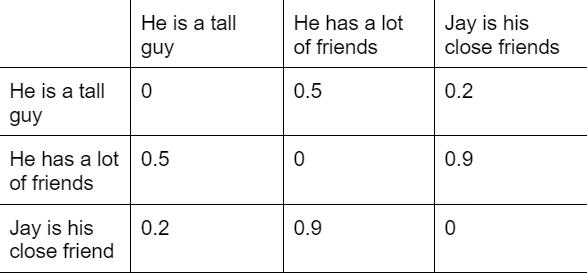
FIG.3.SimilarityMatrixwherevaluesshowsthe similaritybetweentwosentences
=0.15+0.85*(0.889*0.2+1.34*0.9)=1.326
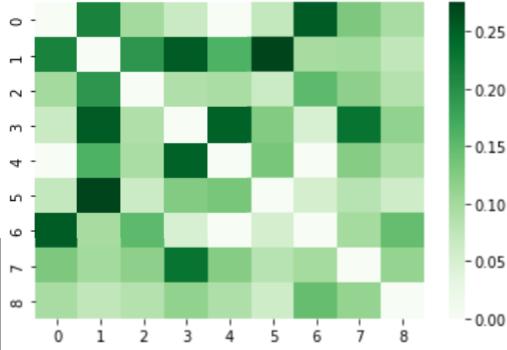
The above process is continue for every sentence for n iterations. Therefore all the sentences are arranged according to their text ranks and the most important sentencesareaddedtoasummary. Graphicalheatmaprepresentationofsimilaritymatrixis showninFIG.4
Evaluation Measures: Evaluation of our proposed Text Summarization System is carried out to determine the quality of the summary produced by the system. We have evaluated our system using the ROUGE evaluation measure. ROUGE stands for Recall Oriented Understudy forGistingEvaluationwhichisasetofmetricstoevaluate the quality of the summary produced by the system. ROUGE N measures the number of matching n grams between our model generated summary and human generated summary. ROUGE 1 measures for uni gram. Similarly ROUGE 2 measures for bi grams. ROUGE L measuresthelongestcommonsub sequencebetweenour model and referenced summary. We have calculated the precision,recall,andf measureofeachROUGE 1,ROUGE 2andROUGE L.Precisionistheproportionofcorrectness of sentences in the summary. For precision, higher the value,betterthesystemperformstogeneratesummary.
Precision = RetrievedSentences∩RelevantSentences
The Recall is the ratio of the relevant sentence in the summary.
Recall = RetrievedSentences∩ RelevantSentences
F measure calculates the harmonic mean of precision and recall.
Higheristhevalue, higheristhesimilaritybetween the model generated and referenced summary.
FIG.4.GraphicalrepresentationofSimilarityMatrix using a Heat map
Performance Measures: When it comes to the performance of the summarizer it should give a concise summary of text similar to a human generated summary. The performance of our system is evaluated
International Research Journal of Engineering and Technology (IRJET) e ISSN:2395 0056
Volume: 09 Issue: 06 | June 2022 www.irjet.net p ISSN:2395 0072
on summary available in BBC news dataset using evaluation measures described above. We havetaken 5 documents from the dataset of each category. Then we generated a summary for each document using our proposed summarizer. For experimentation, the summary is generated for differentpercentages of the summary that the user wants to generate, and this generated summary is evaluated on the extractive summary available in the dataset using evaluation measures.
To check for the efficiency of our proposed systemwe used it to generate summary of different documents and then compared that with the summary generated by one of the currently present system forgenerating summary. Tochecktheefficiencywehave
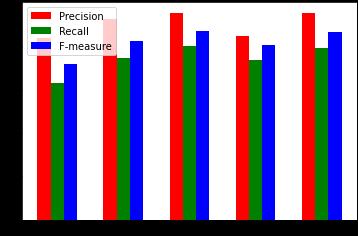
3 evaluations. First, we compare our proposed system generated summary with the original summary of the input. Wecanfindtheoriginalsummaryofthedocument inthedatabasealongwiththeinputdocument.Bythiswe can check the accuracy of our model. Secondly, we compare our proposed system generated summary with the summary generated for the same document by some other currently present summarization model. By this we can check the performance of our model with respect to the currently present model. Lastly, we check our system generatedsummarywiththesummarymadebyahuman. Thisisoneofthemostimportantevaluationas itgivesus the exact idea of the summary that is required by a user and how much of it is present in the summary generated by our model. We have tested our model for 2 different lengths of generated summary: 15% and 30% length of the input document. When the summary for different documentsisevaluatedattherateof15%ofthesummary the computed evaluation measures we got can be seen in FIG.5 and similarly for a rate of 30% of summary the computedevaluationcanbeseeninFIG.6.
To test the summarizer we have summarized the different documents from the dataset based on domains of politics, entertainment, sports, technology, etc. This is done to see how our proposed system reacts to documents of different types, different lengths, etc. and how the generated summary is affected by these. Precision, recall, and F measure for each document was calculated to test the content understanding of our proposedsummarizationsystem.
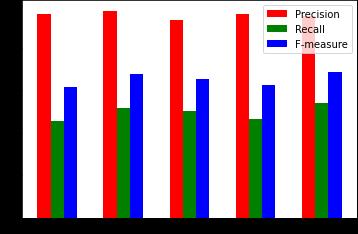
FIG.5.Comparisonofprecision,recallandf measureof5 documentswhensummarygeneratedis15%ofthetotal document length
TABLEI.Comparisonofprecisionvaluesofproposed system withrespectto existing MS word system
Methods Dataset R 1 R 2 R L
D1 0.9607 0.8833 0.9411
D2 0.9756 0.9313 0.9756
D3 0.9324 0.9052 0.9324
TextRank
D4 0.9583 0.8852 0.9583
D5 0.9487 0.9189 0.9487
Average 0.9551 0.9047 0.9512
D1 0.9534 0.8333 0.9534
D2 0.909 0.8645 0.909
D3 0.9 0.8809 0.9
FIG.6.Comparisonofprecision,recallandf measureof5 documentswhensummarygeneratedis30%ofthetotal document length
D4 0.7619 0.5925 0.7619
D5 0.7391 0.6144 0.7391
Average 0.8526 0.7571 0.8526
International Research Journal of Engineering and Technology (IRJET) e ISSN:2395 0056
Volume: 09 Issue: 06 | June 2022 www.irjet.net p ISSN:2395 0072
These evaluation measures are further compared with MS WORD 2007 Summarizer systems to test how well our proposed system works compared to the existing summarization tool. The result shown in Table I shows the comparison of average values of precision for different ROUGEmeasures
i.e.ROUGE 1(R 1),ROUGE 2(R 2)andROUGE L(R L) of our proposed system and MS Word 2007 summarizationsystem,similarlyresultshowninTable II shows the average values of recall of our proposed system and MS Word 2007 summarization system and TableIIIresultshowstheaveragevalues ofF measureof our proposed system and MS Word 2007 summarization system.
TABLEII.Comparisonofrecallvaluesofproposedsystem withrespecttoexistingMS wordsystem
Methods Dataset R 1 R 2 R L
TABLEIII.Comparisonoff-measurevalues of proposed system withrespectto existing MS-word system
Methods Dataset R 1 R 2 R L
D1 0.6163 0.5326 0.6037
D2 06779 05846 06779
D3 0654 05791 0654
TextRank
D4 06258 0532 06258
D5 0.5401 0.4766 0.5401
Average 06228 0541 06203
D1 0543 04278 0543
D2 0.606 0.5203 0.606
D3 06086 05174 06086
MS Word
D4 05925 04304 05925
D5 03722 02383 03722
TextRank
D1 0.4537 0.3812 0.4444 D2 05194 0426 05194 D3 05036 04257 05036 D4 04646 03802 04646 D5 0.5401 0.4766 0.5401 Average 04963 04179 04944
D1 03796 02877 03796
MS Word
D2 0.4545 0.3721 0.4545 D3 0.4598 0.3663 0.4598 D4 04848 0338 04848
D5 03722 02383 03722
Average 0.4662 0.3736 0.4652
Average 0.5872 0.4891 0.5858
Graphs above show that the Precision, recall and, fmeasure values of our model for different length of summary shows that the proposed system extracts a good amount of retrieved sentences from the document in the summary which shows the sign of good accuracy of our proposed summarization system. Also for 30% summarygeneratedwecansee thatprecision,recalland f-measure values are better compared to when 15% summaryisgenerated.
Thus, our system performs better for longer length of summary.
As shown in Table I it is clear that the average precision values of our proposed system are better compared to the values we get from the MS Word summarizer for three documents and are close to equal for two documents. Similarly in Table II and Table III shows that our system also gives better recall and fmeasure average values when compared to MS-Word 2007summarizationsystem.
A Multilingual feature is also added to our summarization modelwhichcanhelpgeneratesummary ofdifferent spoken languages text documents so that the people around the world can also use our Text summarizationsystem.
28 66
International Research Journal of Engineering and Technology (IRJET) e ISSN:2395 0056
Volume: 09 Issue: 06 | June 2022 www.irjet.net p ISSN:2395 0072
It is concluded that the achieved results of our pro posedtextsummarizationmodelarebetterinmost ofthe aspects compared to existing models and therefore it can beagoodstarttofurtherstudies.
As extractive summarization is evolving day by day withincreaseinitsresearchandmorealgorithms coming out, in the future we will try to get more accuracy in generating summary using extractive approach which would be more feature based i. e it will include more features than just sentence ranking based on correlation between them such as sentence length, word based similarity, title features, etc. Also we would try to use more advanced algorithms like neural networks for generatingsummary.
The extractive approach is more straightforward because copying big sections of text from the original documentensuresgrammarandaccuracy.Para phrasing, Generalization and, Assimilation are a part of abstractive summarization.Eventhoughabstractivesummarizationis a more difficult process, thanks to recent improvements in the deep learning field, there has been some progress. Infutureitmightbepossiblethatthesummarygenerated using extractive approach can be more accurate and meaningfulcomparedtoabstractiveapproach.
[1] AbdullahFaizUrRahmanKhilji,Utkarsh Sinha,Pintu Singh, AdnanAli, and Partha Pakray. Abstractive text summarization approaches with analysis of evaluation techniques. In International Conference on Computational Intelligence in Communications and Business Analytics, pages 243 258. Springer, 2021.
[2] Saeedeh Gholamrezazadeh, Mohsen Amini Salehi, and Bahareh Gholamzadeh. A comprehensive survey on text summarization systems. In 2009 2nd International Conference on Computer Science and itsApplications,pages1 6.IEEE,2009.
[3] A´ngel Hern´andez Castan˜eda, Ren´e Arnulfo Garc´ıa Hern´andez, Yulia Ledeneva, and Christian Eduardo Mill´an Hernandez. Extractive automatic text summarization based on lexical semantic keywords. IEEE Access, 8:49896 49907, 2020.
[4] Atif Khan, Naomie Salim, Haleem Farman, Murad Khan, Bilal Jan, Awais Ahmad, Imran Ahmed, and AnandPaul.Abstractivetextsummarizationbasedon improved semantic graph approach. International
Journal of Parallel Programming, 46(5):992 1016, 2018.
[5] A Pai. Text summarizer using abstractive and extractive method. International Journal of Engineering Research & Technology, 3(5):22780181,2014.
[6] Rasim Alguliev, Ramiz Aliguliyev, et al. Evolutionary algorithm for extractive text summarization. Intelligent Information Management, 1(02):128, 2009.
[7] Santosh Kumar Bharti and Korra Sathya Babu. Automatic keyword extraction for text summarization: A survey. arXiv preprint arXiv:1704.03242,2017.
[8] Santosh Kumar Bharti, Korra Sathya Babu, Anima Pradhan, S Devi, TE Priya, E Orhorhoro, O Orhorhoro, V Atumah, E Baruah, P Konwar, et al. Automatic keyword extraction for text summarization in multi-document e-newspapers articles. European Journal of Advances in EngineeringandTechnology,4(6):410 427,2017.
[9] Marina Litvak and Mark Last. Graph-based keyword extraction for single-document summarization. In Coling 2008: Proceedings of the work- shop Multisource Multilingual Information Extraction and Summarization, pages 17 24,2008.

[10] KastriotKadriuand Milenko Obradovic. Extractive approachfortextsummarisationusinggraphs.arXiv preprintarXiv:2106.10955,2021.
[11] Rajesh Shardan and Uday Kulkarni. Implementation and evaluation of evolutionary connectionist approachestoautomatedtextsummarization.2010.
[12] Rajesh Shardanand Prasad, Nitish Milind Uplavikar, Sanket Shantilalsa Wakhare, VY Jain, Tejas Avinash, et al. Feature based text summarization. International journal of advances in computing and informationresearches,1,2012.
[13] Tejas Yedke, Vishal Jain, and RS Prasad. Review of proposed architectures for automated text summarization. In Proceedings of International Conference on Advances in Computing, pages 155 161.Springer,2013.
[14] Alok Rai, Yashashree Patil, Pooja Sulakhe, Gaurav Lal,andRajesh S Prasad. Automatic extractivetext summarizer (aets): Using genetic algorithm. no, 3:2824 2833,2017.
International Research Journal of Engineering and Technology (IRJET) e ISSN:2395 0056
Volume: 09 Issue: 06 | June 2022 www.irjet.net p ISSN:2395 0072
[15] Rajesh S Prasad, UV Kulkarni, and Jayashree R Prasad. A novel evolutionary connectionist text summarizer (ects). In 2009 3rd International Conference on Anti counterfeiting, Security, and Identification in Communication, pages 606 610. IEEE,2009.
[16] Abu Kaisar Mohammad Masum, Sheikh Abujar, Md AshrafulIslamTalukder,AKMShahariarAzadRabby, and Syed Akhter Hossain. Abstractive method of text summarization with sequence to sequence rnns. In 2019 10th International Conference on Computing, Communication and Networking Technologies (ICCCNT),pages1 5.IEEE,2019.
[17] Hari Disle Sameer Gorule Ketan Gotaranr Diksha Kumar, Sumeet Bhalekar. Automatic text summarization using local scoring and ranking. In 2017 international conference on computing methodologies and communication (ICCMC), pages 59 64.IJRTI,2019.
[18] Daniel Leite and L Rino. A genetic fuzzy automatic text summarizer. Csbc2009. Inf. Ufrgs.Br, 2007:779 788,2009.
[19] MayaJohnandJS Jayasudha.Enhancing performance of deep learning based text summarizer. Int. J. Appl. Eng.Res,12(24):15986 15993,2017.
[20] Hongyan Jing and Kathleen McKeown. Cut and paste based text summarization. In 1st Meeting of the North American Chapter of the Association for ComputationalLinguistics,2000.