
International Research Journal of Engineering and Technology (IRJET) e-ISSN: 2395-0056
Volume: 12 Issue: 06 | Jun 2025 www.irjet.net p-ISSN: 2395-0072
International Research Journal of Engineering and Technology (IRJET) e-ISSN: 2395-0056
Volume: 12 Issue: 06 | Jun 2025 www.irjet.net p-ISSN: 2395-0072
Anushree M1 , GopalaKrishnan N2 , H C Muddaraju3
1Post graduate student, Dept. of Civil Engineering UVCE College (University) Bangalore, Karnataka, India.
2Assistant Professor Department of Civil Engineering Presidency University, Bengaluru.
3Associate Professor, Dept. of Civil Engineering, UVCE College Bangalore, Karnataka, India.
Abstract - Thisstudyinvestigatesthesettlementbehaviorof Composite Piled Raft Foundations (CPRF) through a parametric numerical analysis using PLAXIS 3D, focusing on varying raft thickness, pile length, and pile diameter. The primary objective is to evaluate the combined effects of these parameters on total and differential settlements in soil conditions, typical of high-rise construction challenges. The resultsdemonstratethatincreasingraftthicknessconsistently reduces total settlement, with the most significant reduction (12.7%) observed at an 18 m pile length and 0.5 m pile diameter,identifyingthiscombinationasthemostefficientfor balanced stiffness and load distribution. Increasing pile diameter also leads to a marked reduction in differential settlement up to 23.94% for thinner rafts, though this effect diminishesasraftthicknessincreases.Thefindingsemphasize that while thicker rafts and larger pile diameters both contribute to improved foundation performance, their effectivenessvariesdependingontheinteractionbetweenpile geometry and raft rigidity. An optimal design is achieved by strategically balancing these parameters, particularly favoring moderate pile lengths and smaller diameters in combination with thicker rafts to minimize both total and differential settlements. This study confirms CPRF as a technically efficient and economically viable foundation solution for complex geotechnical conditions.
Key Words: Combined Piled Raft Foundation, PLAXIS 3D, Settlement, Raft Thickness (Rt), Pile length (Lp), Pile diameter (Pd).
1. INTRODUCTION
Designingafoundationsystemthatisbothstructurallysafe and economically viable is a critical aspect of high-rise buildingconstruction,especiallyonchallengingsoilprofiles. Traditionally, raft foundations and pile foundations have been used depending on the soil conditions and load demands.Whileraftsareeffectiveinsoilswithgoodbearing capacity, they may result in excessive settlement on soft soils.Pilefoundations,thoughcommonlyused,oftenrequire greaterdepthandnumberofpiles,makingthemcostlyand time-consuming.
Toaddressthelimitationsofbothsystems,theconcept of Combined Piled Raft Foundation (CPRF) has evolved,
integratingtheload-sharingbenefitsofbothpilesandrafts. InCPRFsystems,therafttransferspartoftheloaddirectlyto the soil, while piles reduce settlement by sharing the remainingloadthroughendbearingandskinfriction.This hybridapproachnotonlyenhancesbearingperformancebut also controls differential settlement more effectively than individual systems. With advancements in theoretical research, experimental studies, and numerical modelling, CPRFhasbecomeareliable andcost-effectivesolutionfor high-risebuildingsandcomplexinfrastructureprojectssuch as thermal power plants, oil tanks, offshore platforms, tunnels,andrailwaystructures.
Several studies have supported the efficiency of CPRF systems.ParavitaSriWulandarietal.(2015)[8]highlighted thatbeyondanoptimalpilenumberandlength,additional piles do not significantly reduce settlement, stressing the importance of economicallybalanced designs. HamidReza Bolouri Bazaz et al. (2021) [3] demonstrated that CPRF significantly improves seismic performance on soft soils, especially when structures are placed on the surface, reducingbaseshearbyupto40%.KiyoshiYamashitaetal. (2023)[6]analyzedseismicresponsesandconcludedthat both kinematic and inertial forces significantly affect pile head moments, with soil-structureperiod ratios playing a keyroleinCPRFbehaviorunderearthquakeloading.
Thestudywascarriedoutthroughnumericalanalysisusing PLAXIS3D.Inordertoensurethesafety,serviceability,and structural adequacy of the foundation system, a comprehensive geotechnical modelling approach was adoptedinPLAXIS3D.Thisenabledaccuratesimulationof substructure behavior under applied loading conditions, conformingtorelevantIndianStandards.
Thestructuralloadsactingonthefoundationwerederived fromapriorstructuralanalysisofthesuperstructure,which includedseismicloadingconsiderations.Theseloadswere thenappliedasinputtoageotechnicalmodeldevelopedin PLAXIS3D.Adetailedmodelofthesubstructure,including soil strata, pile elements, and a raft foundation, was constructed.Thesoilpropertiesusedin theanalysiswere derived from the site-specific soil investigation report,
International Research Journal of Engineering and Technology (IRJET) e-ISSN: 2395-0056
Volume: 12 Issue: 06 | Jun 2025 www.irjet.net
ensuring realistic input for modelling. The detailed geotechnicalparametersadoptedforvarioussoillayersare presentedinthecorrespondingtable1
Table 1: Soilandrockparametersusedintheanalysis.
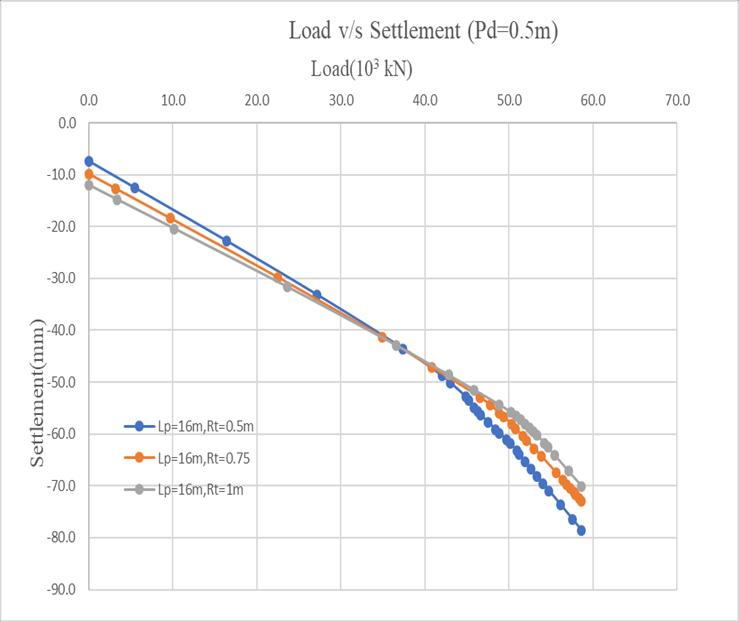
1: EffectofRaft
Thesoilwasmodeledusingmohr-columbmodelwhichisa appropriateconstitutivemodeltocaptureitsbehaviorunder loading, while pile and raft elements were defined using embeddedbeamandplateelementandmaterialproperties adoptedintheanalysisisgiveninthetablebelow(Table2) The interaction between the soil and structural elements wassimulatedusinginterfaceelementstoensureaccurate assessment of stress distribution and settlement characteristics. This integrated approach allowed for a comprehensiveanalysisoftheloadtransfermechanismand performance of the pile-raft foundation system under variousloadingconditions.
Table 2: Materialproperties
onLoad-SettlementCurve (Lp=16m,Pd=0.5m)
Fig1 shows theLoad vs Settlement response forvarying raft thicknesseswithafixedpilelengthof16m.Settlement reducesfrom78.59mmat0.5mraftthicknessto72.94mm at0.75mand70.05mm at 1.0m,indicatinga decrease of 7.18%and10.86%.Thistrendhighlightsimprovedstiffness andloaddistributionwithincreasedraftthickness.Hence, thickerraftscontributetobettersettlementcontrolinpiled raftfoundations.
ii. Load vs. Settlement Response for 0.5m Pile Diameter and18mPileLengthwithVaryingRaftThicknesses.
Fig2showstheLoadvsSettlementresponseforapilelength of 18 m with varying raft thicknesses. The settlement observed for a 0.5 m raft thickness is 68.99 mm, which reducesto63.6mmfor0.75mandfurtherto60.16mmfor 1.0m.Thiscorrespondstoasettlementreductionof7.72% and12.7%respectively.Theresultsindicatethatincreasing raft thickness improves overall stiffness and load distribution,therebyreducingsettlementsignificantly.
3.1. INFLUENCE OF RAFT THICKNESS ON OVERALL SETTLEMENT
i. Load vs. Settlement Response for 0.5m Pile Diameter and16mPileLengthwithVaryingRaftThicknesses.
International Research Journal of Engineering and Technology (IRJET) e-ISSN: 2395-0056
Volume: 12 Issue: 06 | Jun 2025 www.irjet.net p-ISSN: 2395-0072
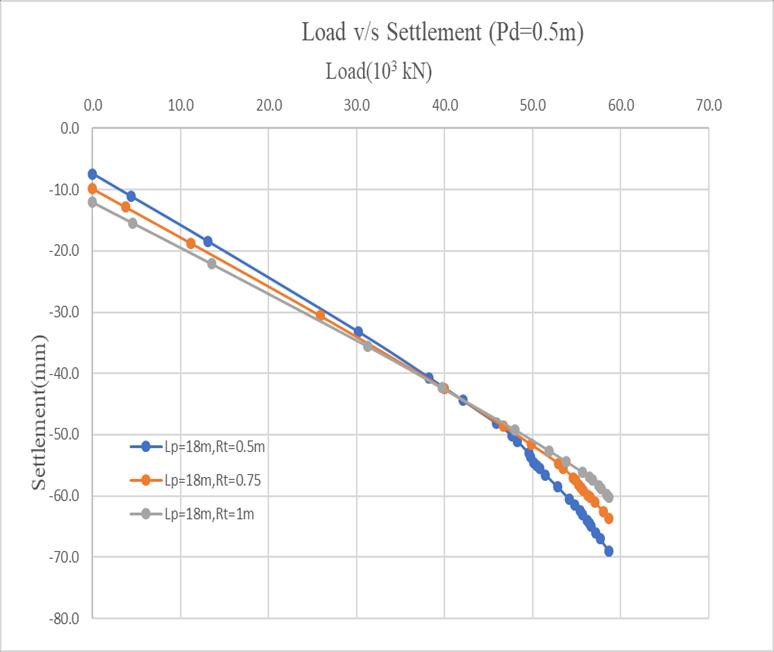
2: EffectofRaftThicknessonLoad-SettlementCurve (Lp=18m,Pd=0.5m)
iii. Load vs. Settlement Response for 0.5m Pile Diameter and20mPileLengthwithVaryingRaftThicknesses.
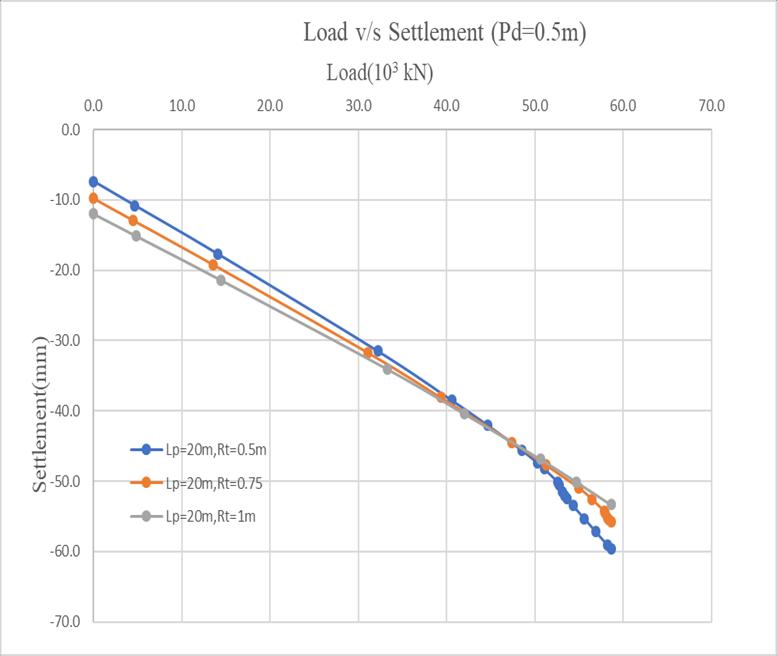
Fig 3: EffectofRaftThicknessonLoad-SettlementCurve (Lp=20m,Pd=0.5m)
Fig 3 illustrates the effect of varying raft thickness on settlement for a constant pile length of 20 m. For a raft thicknessof0.5m, thesettlement is 59.65mm;for0.75m, itreducesto55.73mm;andfor1.0m,itfurtherdecreasesto 53.34 mm. This corresponds to a settlement reduction of 6.57%and10.5%,indicatingthatincreasingraftthickness improves the structural rigidity of the foundation and promotesmoreefficientloadtransfertothesubsoil,thereby minimizingsettlement.
iv. Loadvs.Settlement Responsefor0.6m Pile Diameter and16mPileLengthwithVaryingRaftThicknesses.
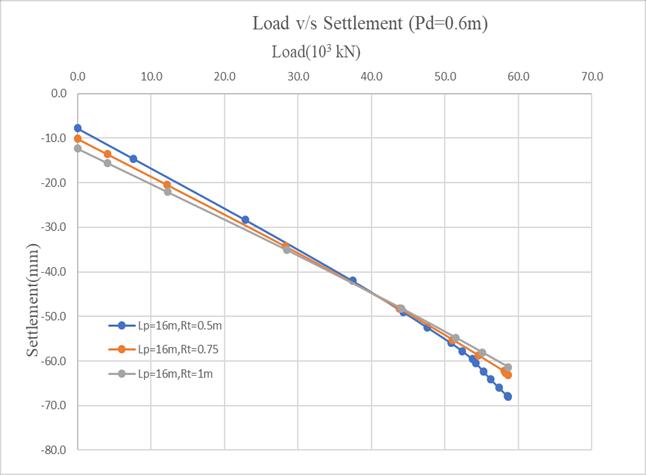
Fig 4: EffectofRaftThicknessonLoad-SettlementCurve (Lp=16m,Pd=0.6m)
Fig4showstheLoadvsSettlementresponseforvaryingraft thicknesses with a fixed pile length of 16 m. Settlement reducesfrom68.02 mmat0.5 mraftthicknessto63.20 mm at 0.75 m and 61.39 mm at 1.0 m, indicating a decrease of 7.07%and9.74%.Thistrendhighlightsimprovedstiffness andloaddistributionwithincreasedraftthickness.Hence, thickerraftscontributetobettersettlementcontrolinpiled raftfoundations.
v. Loadvs.Settlement Responsefor0.6m Pile Diameter and18mPileLengthwithVaryingRaftThicknesses.
Fig5showstheLoadvsSettlementresponseforapilelength of 18 m with varying raft thicknesses. The settlement observed for a 0.5 m raft thickness is 58.37 mm, which reducesto56.82 mmfor0.75 mandfurtherto55.88mmfor 1.0 m.Thiscorrespondstoasettlementreductionof2.65% and4.27%respectively.Theresultsindicatethatincreasing raft thickness improves overall stiffness and load distribution,therebyreducingsettlementsignificantly.
International Research Journal of Engineering and Technology (IRJET) e-ISSN: 2395-0056
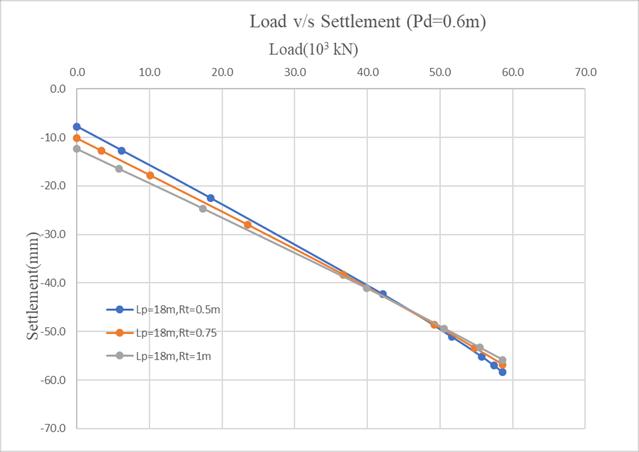
Fig 5: EffectofRaftThicknessonLoad-SettlementCurve (Lp=18m,Pd=0.6m)
vi. Load vs.Settlement Responsefor0.6m Pile Diameter and20mPileLengthwithVaryingRaftThicknesses.
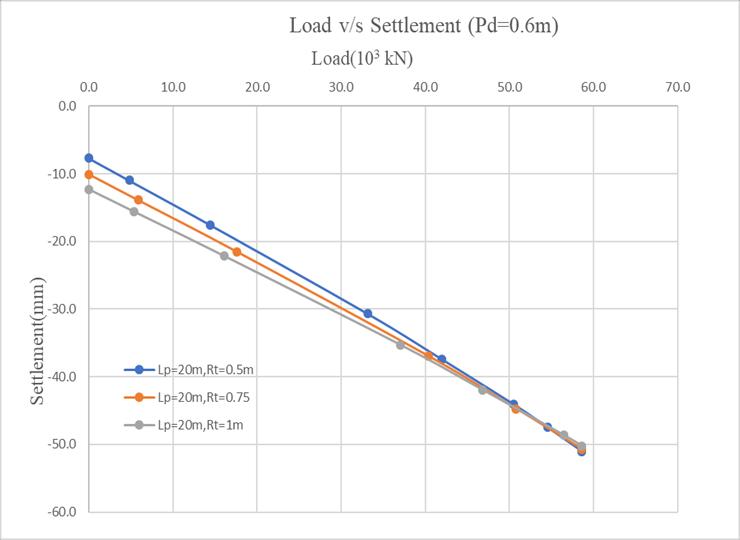
Fig 6: EffectofRaftThicknessonLoad-SettlementCurve (Lp=20m,Pd=0.6m)
Fig 6 illustrates the effect of varying raft thickness on settlement for a constant pile length of 20 m. For a raft thicknessof0.5 m,thesettlementis51.01 mm;for0.75 m,it reducesto50.68 mm;andfor1.0 m,itfurtherdecreasesto
50.21 mm. This corresponds to a settlement reduction of 0.65%and1.57%,indicatingthatincreasingraftthickness improves the structural rigidity of the foundation and promotesmoreefficientloadtransfertothesubsoil,thereby minimizingsettlement.
The analysis of various load–settlement responses across different pile lengths and diameters clearly demonstrates thatincreasingraftthicknessconsistentlycontributestoa reduction in overall settlement, highlighting its positive influenceonfoundationperformance.Amongtheevaluated configurations,apilelengthof18 myieldedthemaximum percentagereductioninsettlement,suggestinganoptimal interaction between the raft and pile system that ensures effective stress distribution and improved settlement control.However,aspilelengthincreasesbeyondthispoint, therelativeimpactofraftthicknessdiminishes,indicating thatdeeperpilescontributemoresignificantlytosettlement reductionbydirectlytransferringloadtodeeper,stiffersoil strata. A comparative assessment of results for 16 m pile lengthacrossdifferentpilediametersconfirmsthatthicker rafts enhance foundation stiffness and load distribution regardless of the initial settlement values. Furthermore, increasingraftthicknessismoreeffectivewithsmallerpile diameters;a0.5 mpileshowedmorepronouncedsettlement reduction compared to a 0.6 m pile. As pile diameter increases, the system becomes inherently stiffer, thus reducingtheadditionalbenefitsofincreasedraftthickness. This trend was particularly evident when comparing configurationswith20 mpilelengths,wheretheinfluenceof raft thickness was minimal in the presence of larger diameter piles. Collectively, these findings emphasize that while increasing raft thickness is a reliable strategy for improving settlement behavior, its effectiveness is influencedbybothpilelengthanddiameter,necessitatinga balanced design approach for optimal foundation performance.
3.3. INFLUENCE OF PILE DIAMETER ON DIFFERENTIAL SETTLEMENT FOR A GIVEN RAFT THICKNESS AND PILE LENGTH.
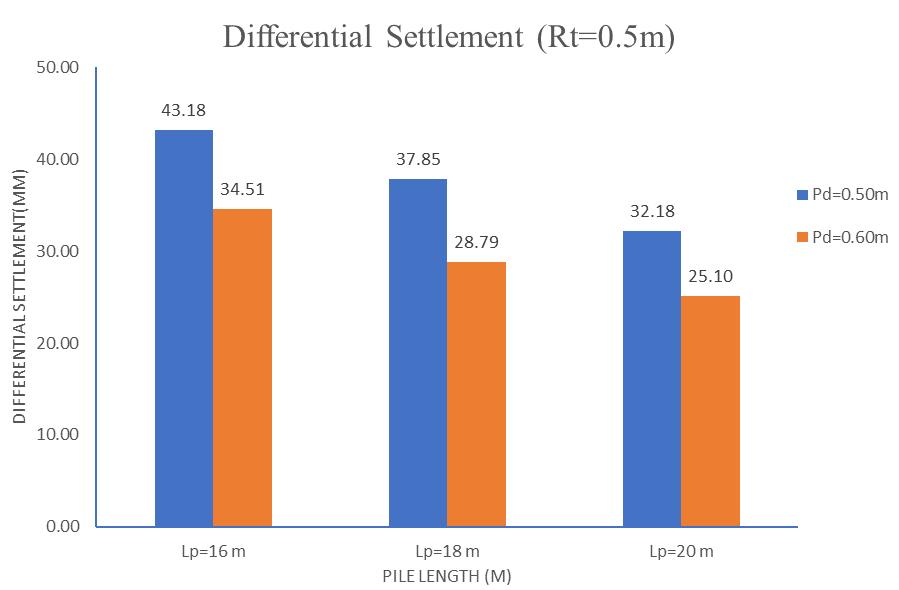
i. For0.5mraftthickness
Fig7showstheeffectofincreasingpilediameterfrom0.50 m to 0.60 m on differential settlement across varying pile lengths. It can be observed that for all pile lengths, the differential settlement decreases with an increase in pile diameter. The percentage reductions in settlement are approximately20.08%forapilelengthof16m,23.94%for 18m,and22.02%for20m.Thistrendindicatesthatalarger pile diameter enhances the stiffness of the foundation systemandimprovesloaddistribution,leadingtoreduced differentialsettlement.
Volume: 12 Issue: 06 | Jun 2025 www.irjet.net p-ISSN: 2395-0072 © 2025, IRJET | Impact Factor value: 8.315 | ISO 9001:2008
International Research Journal of Engineering and Technology (IRJET) e-ISSN: 2395-0056
Volume: 12 Issue: 06 | Jun 2025 www.irjet.net p-ISSN: 2395-0072
ii. For0.75mraftthickness
Fig8showstheeffectofincreasingpilediameterfrom0.50m to0.60mondifferentialsettlementfordifferentpilelengths. The results indicate a consistent reduction in differential settlementwithincreasedpilediameteracrossallcases.The percentage reduction is approximately 16.29% for a pile lengthof16m,16.25%for18m,and12.61%for20m.This consistent reduction occurs because larger pile diameters increase the pile's lateral stiffness and bearing area, enhancing load-carrying capacity and uniformity in settlementacrossthefoundation.
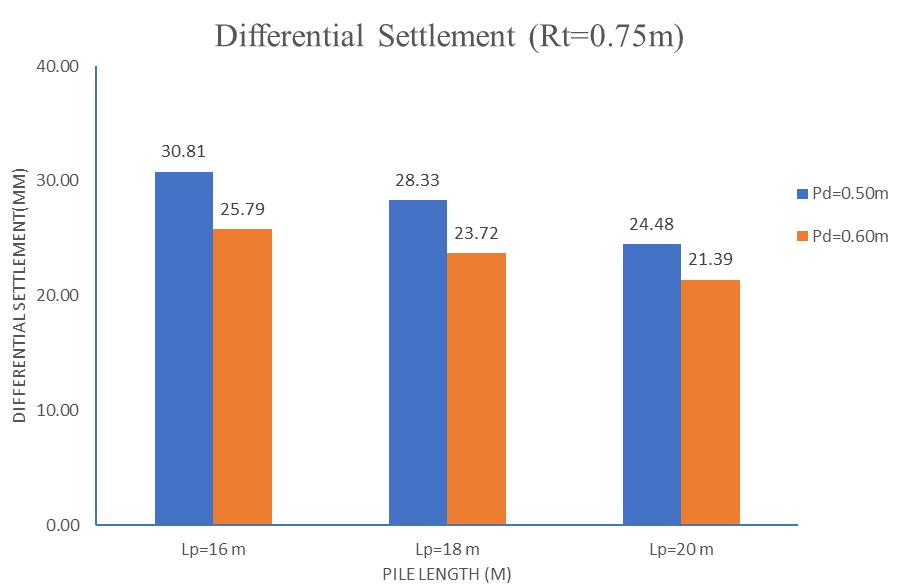
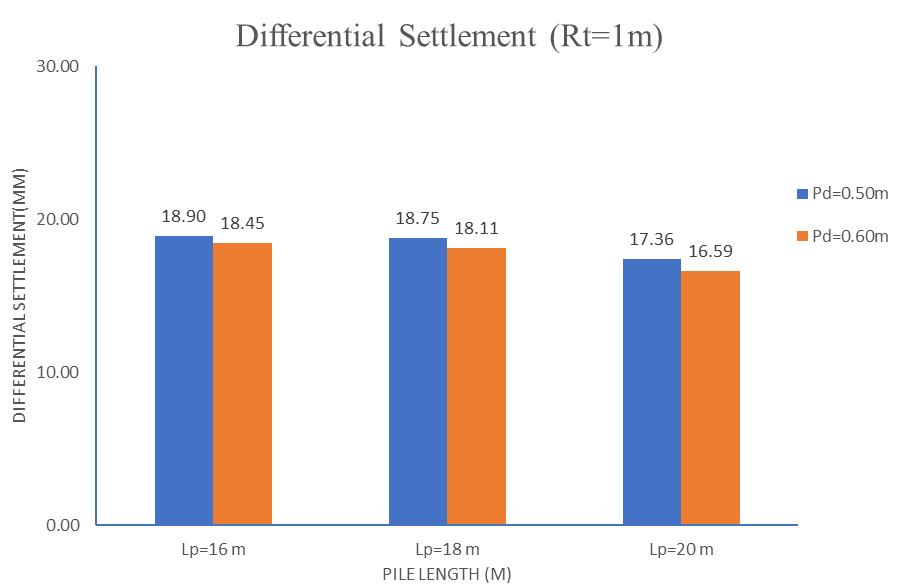
Fig9showstheinfluenceofincreasingpilediameterfrom 0.50mto0.60mondifferentialsettlementforvariouspile lengths. The results reveal a marginal reduction in differential settlement with increased pile diameter. Specifically, the percentage reductions are approximately 2.36%forapilelengthof16m,3.40%for18m,and4.47% for 20 m. These relatively smaller improvements suggest that at higher raft thickness, the effect of increasing pile diameteronreducingdifferentialsettlementbecomesless significant, likely due to the already enhanced stiffness providedbythethickerraft.
Thecomparisonof(Fig.7,Fig.8andFig.9)demonstratesthat increasing pile diameter consistently contributes to a reduction in differential settlement across varying pile lengths.However,thedegreeofimprovementdiminishesas raft thickness increases. In thinner rafts, the impact of increasing pile diameter is more pronounced due to the greaterneedforenhancedstiffnessandloaddistribution.As the raft becomes thicker, the system’s inherent stiffness improves,reducingtherelativeinfluenceofpilediameter. Overall, while larger pile diameters are beneficial in minimizing differential settlement, their effectiveness is moresignificantinsystemswithlowerraftthickness.
This study investigated the settlement behavior of Composite Piled Raft Foundations (CPRF) by varying raft thickness(0.5 m,0.75 m,and1.0 m),pilelength(16 m,18 m, and20 m),andpilediameter(0.5 mand0.6 m).Theanalysis revealedthatincreasingraftthicknessconsistentlyreduced
International Research Journal of Engineering and Technology (IRJET) e-ISSN: 2395-0056
Volume: 12 Issue: 06 | Jun 2025 www.irjet.net p-ISSN: 2395-0072
totalsettlementacrossallconfigurations.Forinstance,ata pile length of 18 m and pile diameter of 0.5 m, settlement decreasedfrom68.99 mmto60.16 mm(a12.7%reduction) asraftthicknessincreasedfrom0.5 mto1.0 m,highlighting thiscombinationasthemostefficientinbalancingstiffness andload-sharing.
It was also observed that the optimal pile length for maximum settlement reduction, when combined with increasingraftthickness,was18 m.Thislengthappearsto providethemostefficientinteractionbetweenraftandpiles, resultinginawell-balancedload-sharingmechanism.Longer piles (20 m) showed slightly diminished improvements, suggestingdiminishingreturnsbeyondacertaindepthdue toincreasedstiffnessandreducedadditionalloadtransfer benefits.
The effect of pile diameter was analyzed across three raft thicknesses (0.5 m, 0.75 m, and 1.0 m). Increasing the diameterfrom0.5 mto0.6 mledtoasignificantreductionin differential settlement, particularly for thinner rafts. For instance, at 0.5 m raft thickness, differential settlement reductions of 20.08% to 23.94% were observed across different pile lengths. However, as the raft thickness increasedto1.0 m,theinfluenceofpilediameteronreducing differential settlement became less significant, with improvements dropping to around 2–4%. This trend highlights that while larger pile diameters contribute to foundation stiffness and better settlement control, their relativeeffectismostprominentwhentheraftisrelatively flexible.
In all the graphs, it was noted that an initial settlement occurredevenbeforetheapplicationofexternalload,which can be attributed to the self-weight of the raft inducing compression in the underlying soil strata. This initial settlementbehaviorreinforcestheimportanceofaccounting fordeadloadeffectsinCPRFdesign.
Overall, the analysis demonstrates that increasing raft thickness is the most effective and consistently beneficial parameter for minimizing both total and differential settlementsinCPRFsystems.Whilepilelengthanddiameter alsocontributetoimprovedperformance,theirinfluenceis moresituationalandsubjecttodiminishingreturnsbasedon thestiffnessoftheoverallfoundationsystem.Thefindings underlinetheneedforanoptimizeddesignapproachthat considers the interaction between all three parameters to achievestructuralsafety,serviceability,andcostefficiencyin real-worldfoundationengineeringapplications.
1. B.K. Maheshwari , Mohd Firoj, “ Seismic response of combined piled raft foundation using advanced liquefaction model”, 0267-7261/© 2024 Elsevier Ltd. https://doi.org/10.1016/j.soildyn.2024.108694
2. DongyuParkandJunhwanLee,“ComparativeAnalysis of Various Interaction Effects for Piled Rafts in Sands Using Centrifuge Tests”, J. Geodetic. Geoenviron. Eng. doi:10.1061/(ASCE)GT.1943-5606.0001183.
3. HamidReza Bolouri Bazaz , Ali Akhtarpour , Abbas Karamodin, “A study on the effects of piled-raft foundations on the seismic response of a high rise building resting on clayey soil”, 0267-7261/© 2021 Elsevier
4. Irfan Jamil , IrshadAhmad, IrshadKhan , WaliUllah, Aqeel UrRehman,Shahid AliKhan,“Factorsaffecting thelateralcontributionofaraftinapiledraftsystem” 2090-4479/ 2022 Published by Elsevier BV https://doi.org/10.1016/j.asej.2022.101968
5. Irfan Jamil ,1 Irshad Ahmad,1 Shahid Ali Khan,1 Wali Ullah,1 MaazAmjad,1BeenishJehanKhan,2 andHassan Nasir3 “Analysis and Design of Piled Raft Foundation Taking into Account Interaction Factors”, Hindawi Advances in Civil Engineering https://doi.org/10.1155/2022/1334136
6. Kiyoshi Yamashita , Junji Hamada, “Kinematic and inertialeffectsonpiledraftsinsoftgroundsupporting isolatedandnon-isolatedbuildingsobservedduringthe 2011Tohokuearthquake”,2023Productionandhosting by Elsevier B.V. https://doi.org/10.1016/j.sandf.2023.101372
7. Lua Thi Hoang , Tatsunori Matsumoto, “Long-term behaviorofpiledraftfoundationmodelssupportedby jacked-in piles on saturated clay”, https://doi.org/10.1016/j.sandf.2020.02.005
8. ParavitaSriWulandaria,*,DanielTjandraa,“Analysisof piled raft foundation on soft soil using PLAXIS 2D”, 1877-7058©2015TheAuthors.PublishedbyElsevier Ltd.doi:10.1016/j.proeng.2015.11.083
9. Phung Duc Long, “Piled Raft –A Cost- Effective Foundation Method for High-Rises”, Geotechnical EngineeringJournaloftheSEAGS&AGSSEAVol.41No.3 September 2010 ISSN 0046-5828, https://www.researchgate.net/publication/290988187.
10. PlabanDeb ,BarnaliDebnath,RaiBahadurReang,Sujit KumarPal, “Structuralanalysisofpiledraftfoundation insoftsoil:Anexperimentalsimulationandparametric study with numerical method”, 0029-8018/© 2022 ElsevierLtdhttps://doi.org/10.1016/j.oceaneng.2022.1 12139