Certified Journal | Page1375
International Research Journal of Engineering and Technology (IRJET) e ISSN: 2395 0056
Vehicle Traffic Analysis using CNN Algorithm
Key Words: CNN, Classification, Deep learning, Traffic Analysis , traffic signal, deep learning, Congestion detection ,YOLO v3 etc.
Traffic control and management are essential issues in a number of regions, particularly those with expanding populations and large cities. Traffic lights utilize time divisionmultiplexingtoalleviatecongestionatintersections. Invariouscountries,fixed cyclecontrollersare employed atallsignalizedintersections.Thesoledisadvantageofusing atrafficlightisthedelayinreachingyourdestination(stop time or waiting time). Thedelay at an intersection is a performance indicator of a traffic signal controller's efficiency.Thephases,sequence,andtimingoftrafficsignals allcontributetotheefficiencyoftrafficmovementacrossan intersection. Theadaptive signal controller is in charge phases, sequence,and timing. When it comes to reducing trafficcongestion,thetimingandsequenceoftrafficsignals mustbeoptimized.Trafficsignaltimemanagementistough and blind due to unpredictability and a plethora of other factors. this project is to develop a real time adaptiveof trafficsignals.
Thecurrenttrafficcontrolsystemworksbasedontimeto switchthetrafficlights.Butmanyresearchesareconducted tochangethecurrenttrafficlightsystemintoautomaticand adaptive system to solve the problems with the traffic congestion. Some researchers used hardware installation such as sensors and Radio Frequency Identification [8] to thentheAshwinisystemonalgorithmbasedThelightButchanged,[1]imagesolvedifficultdetectthecrowdednessofvehicles,butthisisexpensiveandtoimplement.Someresearchersarealsoworkingtotheproblemwiththehelpofimageprocessingusingsubtractionmethodtocalculatethedensityofvehicles[4].Theyhaveusedafixedimagethatcannotbeasareferenceimageinimagesubtractionmethod.thismethodisnotefficientinthenighttime,becausetheconditioninthenighttimeisnotsameasindaytime.decisionmakingforswitchingthetrafficlightworksonthecalculateddensity.Anurag[1]usedantodeterminetheapproximatedensityofvehiclestheroadwithfourlanes.Usingthisalgorithmthedynamic[1]improves35%overthehardcodedsystem.[2]usedamotiondetectionalgorithmtoestimatecountofvehiclesontheroad;theestimatedcountwillusedtocontrolthetrafficsignal
Abstrac
3Student, Dept. of Information Technloogy, Dr.D.Y.Patil Institute of Technology, Pimpri Pune, Maharashtra, India 4Professor, Project Guide, Dept. of Information Technology, Dr.D.Y.Patil Institute of Technology, Pimpri Pune, Maharashtra, India t
1
The goal is to build a traffic light system that changes based on how many people are in the area. When there is a lot of traffic at an intersection, the signal time automatically changes. Many major cities around the world have a lot of traffic, which makes it hard to get to work every day. Traditional traffic signal systems are based on the idea that each side of the intersection has a set amount of time. They can't be changed to account for more traffic. People can't change the times of the intersections that have been setup for them. There may be more traffic on one intersection, which could make it more difficult for the typical greenperiodtoend. After processing and translating the traffic signal object detection into a simulator, a threshold is set anda contour is drawn many cars are in the area. After , we can figure out which side has the most carsbased on the signals sent to each side. Paper provides a solution based on camera feed at crossing for each lane process the data through and allocates the ”green” time according to its traffic flow density using YOLO v3 and also takes care of starvation issue that might arise of the solution. As a result ,the flow of traffic oneachlane is automatically optimized and the congestion that used to happen unnecessarily is eliminated earlier and results show significant benefits in reducing traffic waiting time
Student, Dept. of Information Technology, Dr.D.Y.Patil Institute of Technology, Pimpri Pune, Maharashtra, India
***
Althoughtheimportanceoftrafficlightswhichgivesafety totheusersonroads,thetrafficjamcauses greatloosein time and energy (fuel) for some people, while others crossingroadorroundabouthavenotrafficjam.Themain objective of this paper is to design and implement a suitable algorithm and its simulation for an intelligent traffic signal simulator. The system developed is able to sensethepresenceorabsenceofvehicleswithinacertain range by setting the appropriate duration for the traffic signals to react accordingly. By employing mathematical functionstocalculatetheappropriatetimingforthegreen signal to illuminate, the system can help to solve the problem of traffic congestion. The reason depends on resentfixedprogrammingtime.So,ourtargetinthispaper istomakethistimeunfixedaccordingtothesizeoftraffic jam,Whenthereisatrafficjaminanyroadthegreenlight whichmeanspermeationgivesfulltimetotheuserofthe road.Ifthereisnotrafficjam,thegreenlightdoesnotgive
Volume: 09 Issue: 01 | Jan 2022 www.irjet.net p ISSN: 2395 0072 © 2022, IRJET | Impact Factor value: 7.529 | ISO 9001:2008
2Student, Dept. of Information Technology, Dr.D.Y.Patil Institute of Technology, Pimpri Pune, Maharashtra India
Pragati Bhosale1 , Ankita Kawatikawar2 , Pritee Jadhav3 , Prof.Sonali Patil4
1. INTRODUCTION

2. LITERATURE SURVEY
3. PROPOSED SYSTEM
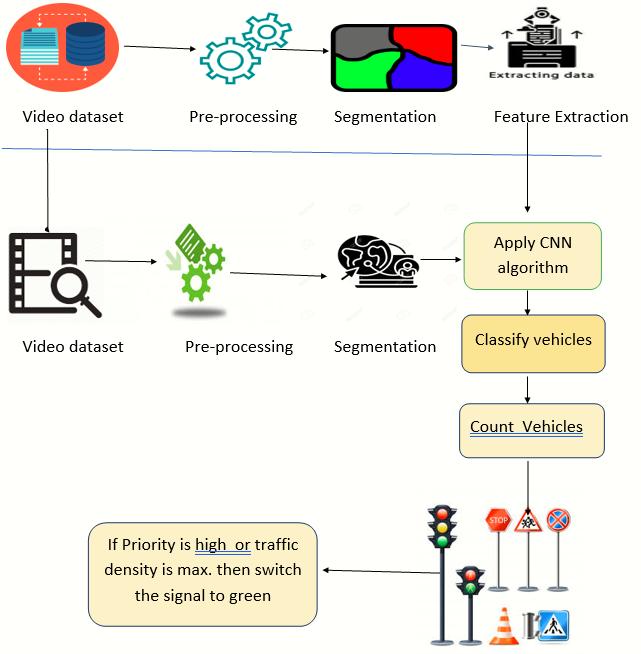
Inthissystemwearetakinginputasanimage.Asweknow that we are performing image processing operation on system, so that we are using four modules of image processing like preprocessing, segmentation, feature extraction and classification where we use our CNN algorithm.Sofirstwehavepassedinputasanimagethenin donepreprocessingRGBconversionandthenBinaryconversionisthen.Fig.1.SystemArchitecture fulltime,butitgivesprogrammingtime.Thenewtiming schemethatwasimplementedpromisesanimprovement in the current traffic light system and this system is feasible, affordable and ready to be implemented especiallyduringpeakhours[35].
Vehicle Classification techniques Comparison by Machine learningonroadsidesensorsshowsthatThedatasetof3074 samples is processed for vehicle classification by using different algorithms of machine learning. Various classification techniques are used such as SVM, neural networksandlogicalregression.Logicalregressionshows the results had high performance when comparing with other methods of machine learning with the classification rateis93.4%Themaindifficultyinthismethodistheusage ofdatasets,asitwasfocusedmainlyonsingleclasswhichis verydifficulttosearchwhileclassification[13].
The proposed system is to develop a smart traffic light switchingwiththetechniquesofimageprocessingthatcan switchthetrafficsignalsindifferentwaysforday timeand night time.Intheday timethesystemmeasuresthedensity ofthevehiclesontheroadandinthenight timethesystem countsthenumberofvehiclesontheroadusingthevehicle’s headlight,basedonthesemeasurementsthetrafficlightwill be switched. Apart from that the proposed system will improvethefunctionalitiesofthepreviousworks,suchthat it can detect the traffic violations such as a red light violation,stoplineandlaneviolations.Eachofthelightswill havetheirownadditional features,suchthatthe redlight detects a stop line and red light violations, and the green light will also detect the lane violation. In the proposed systemsomefilteringtechniques,imageenhancementand segmentationwillbeusedtoremoveanoiseandimprove thequalityofthecapturedimagesothattheaccuracyand efficiencyofthesystemwillbeimprovedaccordingly[11].
vehicle detection and classification in real time video streamsDistributedmethod ofreal timevehicle detection andclassificationsystemisproposedbyKuletal.[17].Other techniques used here are vehicle classification, feature extraction, detection of foreground and background ansubtraction.Inbroaddaylighttheresultsarepromisingwithaccuracyof89.4%Innightandbadconditionsofweather theydidn’t performany work.[16]Z.Dong,Y. Wu,M.Pei, andY.JiaSemi supervisedConvolutionalNeuralNetworkis usedforvehicleclassification[15]. Semi supervised Convolutional Neural Network is used whiletheclassificationofvehicles.Thedatasetconsists of 9850highresolutionimagesareused.Thedatasetholdsonly front views of vehicles. In daylight 96.1% accuracy is problemstestedinsensitiveprovedvehiclebackground,tracking.vehiclealsotheTheforbasedFeatureincorrectregisteredandinNight89.4%MisclassificationoccursduetolabelsintheBITdataset[18].BasedTrackingTheproposedmethodisfeaturetrackingmethodwhichusesfeaturedescriptorofSIFTtracking.Itformsarichrepresentationofobjectclasses.proposedapproachprovidesbetterperformance.Whenviewischangedthesystemisineffectiveandocclusionnottested[19].ColorandPatternBasedTrackingThecolorandpatternofimageseriesoftrafficvideosurveillanceareusedforItconsistsofsegmentationofforegroundandvehicleflow,shaderemoval,vehiclevelocity,count,vehiclelocationtotrackobjects.ThissystemistoworkindifferentclimaticconditionsandistolightingconditionsThesystemneedstobeunderextremeweatherconditionsandocclusionalsoneedtobechecked[21].
International Research Journal of Engineering and Technology (IRJET) e ISSN: 2395 0056 Volume: 09 Issue: 01 | Jan 2022 www.irjet.net p ISSN: 2395 0072 © 2022, IRJET | Impact Factor value: 7.529 | ISO 9001:2008
Certified Journal | Page1376
Comparison of vehicle type: Various Schemes of Classification shows that Vehicles are classified into four differentclassescar,bus,vanandmotorcycle.Twotypesof methods used here, SVM and random forest which is a feature.TheaccuracyofSVMis96.26%morerobustthanRF Due to similar image size and shape of car, bus and van, miscalculationoccurs[14].
4. DESIGN AND METHODOLOGY
Fig.2Workflowofproposedsystem
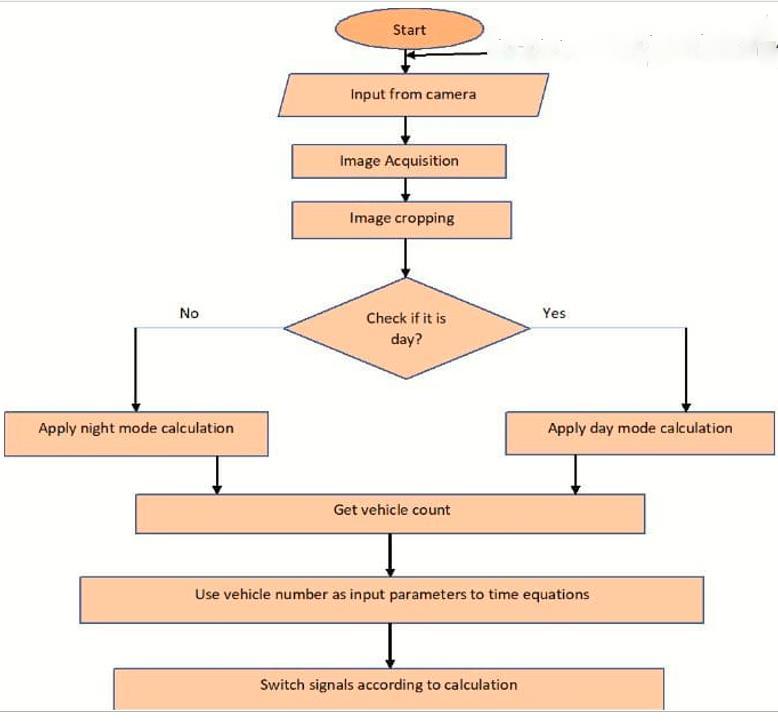
Thesystemwilluseimageextractionmethodtocalculatethe amount pixels occupied by vehicles on the road. The proposedsystemusestwodifferentmethodsi.e.inday time and night time. At day time, Density of vehicles will be calculated,becausetherateof vehiclesaremorevisiblein thedaytimethaninthenight time.Soitiseffectivetouse densitycountinsteadof vehiclecountinday time.Counting thenumberofvehiclesinthedaytimemayleadtoafalseor ambiguous result becausetwoveryclosevehiclesmaybe countedasaonevehicle. The proposed algorithm checks the time, if it is a day or nightinordertoswitchthesystemsignalaccordingly.The decisionmodulereceivesdensitycount(numberofvehicles) ingreensignalandredsignals(2)(3).Basedonthesevalues, thedecisionmodulewillcalculatetheamountof thegreen signaltime(TDiandTNi)anddecidewhichsideoftheroad willbeswitch toagreensignal.
Computer vision and pattern recognition benefit greatly from the use of fully convolutional networks. CNNs are frequentlyemployedinimageanalysistaskssuchasimage recognition,objectrecognition,andimagesegmentation. Deep neural networks consist of four layers.In traditionalneuralnetworks,eachinputneuronhiddenunit. orlayersnodesgeneratedarraylayer,It'sunits.EachinputneuronLayerisonlylinkedtootherinputneuronOnlyafewofCNNcommunicatewithlayerbelowit.reducingthethreedimensionalitytheCNN'shiddenactivationandmaximumpooling.AonedimensionaliscreatedbyflatteningdatabeforemovingisbyflatteningConnectedTiersarethelastfewthatarealllinkedtogethercompletely.Fullylinkedreceiveasinputsmoothedoutputfrompriorpoolingpoolinglayers.Sothat'showitworks,asitwere.CNNimplementationsteps:
• Step4:FullConnection. • Step4(b):Dense() • Step4(c):Optimizer()
• Step4(d):compile()
5.1CNN (CONVOLUTION NEURAL NETWORK)
• Step1:ConvolutionOperation(Filterimage)
Afterthatinthesegmentationparttheimageisdividedinto the small pixels then after segmentation in the extraction part system extract the geometry based feature of traffic sign.theninclassificationwhereweuseourCNNalgorithm to classify and prediction[8],wepassthisgeometrybased thenandfeaturesoftrafficsigntotheclassificationtoforclassificationprediction,thenonthatbasisitdetectthetrafficsignalconvertitintothevoicealert.
5. ALGORITHMS
• Step3:Flattening(CovertMatrixinto1DArray)
5.2 YOLO V3(OBJECT DETECTION AND CLASSIFICATION ALGORITHM)
International Research Journal of Engineering and Technology (IRJET) e ISSN: 2395 0056 Volume: 09 Issue: 01 | Jan 2022 www.irjet.net p ISSN: 2395 0072 © 2022, IRJET | Impact Factor value: 7.529 | ISO 9001:2008 Certified Journal | Page1377
• Step2:Pooling(usedmaxpoolingfunction)
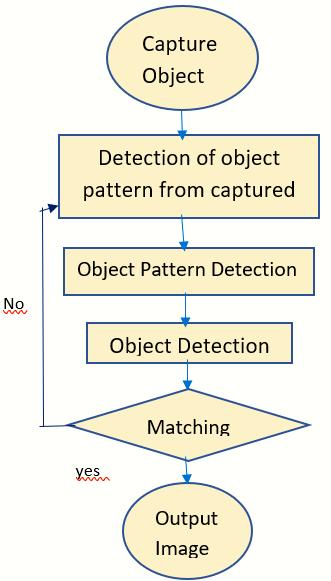
YOLOv3 (You Only Look Once, Version 3) is a object detectionalgorithmthatperformrealtimeobjectdetection thatanddetecttheobjects specifiedinimage,videoandlive feeds It usesfeatureslearnedbyadeep learningtechnique basedonconvolutionalneuralnetworkforobjectdetection
• Step1(b):ReLULayer
ImplementationofYOLOisdonebyusingKerasorOpenCV deeplearninglibraries
HOW THE SIGNAL WILL BE SWITCHED
Thedensity/countfor thevehiclesfromsidesofthe road is determined and will be used as a input parametertoswitchthesignals. count)ofGreensignalTimeiscalculatedusingdensityorcountvehiclesinoneroadperthetotaldensity(vehicleinallsidesoftheintersectionroad.
Finally the density of vehicles on the road will be calculated (not number of vehicles). The value of vehicle density determines the amount for which portionoftheroadisoccupiedbyvehicles[4].��=�� ��=1Ibw����=1(2)Herenisnumberofrowsandm isnumberofcolumns.Onlythewhitepixelvaluesin allrowsandcolumnswillbeaddedtodensity(D) 5.4
WDi is a weight factor at a particular road in the (4)intersectionroadwillcalculatedas:WDi=Dinj=1Dj
In each step of the image acquisition process, a noise may be there so Image filtering techniques will be applied to remove noises, here median filteringwillbeusedtoremove peppernoisesand saltandwillproduceafilteredimage.
VEHICLE DENSITY COUNT
Thisresultsthefinalblackandwhiteimage(Ibw).It is further is used for calculation of density count. Hereifthepixelvalue[pv]isnotazero,whichwill be considered as an object or vehicle . But if pv is zero, which is considered as a background (non object) that needs to be eliminated.Ibw=1if pv≥10else(1).
Certified Journal | Page1378 Fig.3
Inthefilteredgenerated result,imagetheremaybe somenonvehiclesdetectedasforeground.Inorder toimprovequalityofresultimagethenonvehicles objectneedtoberemove..Sothatthresholdingthat willbeappliedtodifferentiatetheobjects(white) and non object (black). Dilation morphological techniquewill alsobe used tofill theholesinside vehicleobjects; Forexaminingandexpandingthe shapesoftheimageand toextendtheborderand regionsoftheobjectsdilationisused.
Thetime(TNi)forgreenlightthatwillbeassignedto ithroadinthenight timeiscalculatedby:TNi=Tc× WNi(7)
The proposed method uses the formula in [4] to calculatethe greensignaltime,Itwill producethree outputsfromtheinputparametersgiven;weighted time(WD,WN)andtrafficcycle(Tc).Totalamountof time for one complete cycle of the traffic lights is givenbyTc.
6. CONCLUSION In order to record real time traffic condition notifications,wemayintegrateoursystemwithanapp that analyses official traffic signals. As a result, inthe worst case situation, our system will be able to signal traffic related events at the same time the console's resultsaredisplayedonthewebsites.In termsoffeature coverage,wearealsoinvestigatingtheintegrationofour system into a more extensive traffic monitoring
WNi is a weight factor at a particular road in the intersectionroadand will as:WNi=Cinj=1Cj(5) WhereWDiisaweightfactorofithroadinday time, WNi is a weight factor of ith road at night time, density calculated in day time is D, vehicle count calculatedinnight timeisC,andthetotalnumberof roadintheintersectionisN.
Finally, this received value will be sent to signal controllerand itwill switchthesignalsaccordingly basedonthedecisionphasemodule.Themaximum green light provided toa lane must be 60 Sec and minimumis15sec.
The following are steps to calculate the density of vehicles.
5.3
Imageacquisition:Theproposedsystemwillstart bycapturing a livereal timevideo,inputvideoor imagesusinga videocamera.
International Research Journal of Engineering and Technology (IRJET) e ISSN: 2395 0056
Thetime(TDi)ofgreenlightatithroadintheday timeiscalculatedby:TDi=Tc×WDi(6)
Initially, the images capture by system will be emptyroadswithnovehiclesanditwillbeusedasa reference image RI. The system will capture a continuous sequence image frames from the live videoorfromgivenvideo/image peronesecond, which is used as a current image (CI). For both croppedforbothreferenceandcurrentimagesOnly the interested target area of the road will be, to eliminate theunnecessaryparts
Volume: 09 Issue: 01 | Jan 2022 www.irjet.net p ISSN: 2395 0072 © 2022, IRJET | Impact Factor value: 7.529 | ISO 9001:2008 FlowchartofYOLO
Toseparatetheforegroundobjects(vehicles)from thebackground theBackgroundsubtractionwillbe appliedineachsequenceofimageframes,thenthe result image (I) will be obtained .Processing of subtractedimagewillbedoneby convertingfrom RGB (Red Green Blue) to Grayscale for further processing.
ACKNOWLEDGEMENT
8) HarpalSingh,SatinderJeetSingh,Ravinder PalSi,RedLightViolationDetectionUsing RFID, Proceedings of ‘I Society 2012’ at GKU,TalwandiSaboBathinda(Punjab)
9) Chandrasekhar. M, Saikrishna. C, Chakradhar. B, Phaneendra Kumar. P & Sasanka. C, Traffic Control using Digital ImageProcessing,ISSN(Print):2278 8948, Volume 2,Issue 5,2013
5) Adi Nurhadiyatna, Wisnu Jatmiko, Benny HardjonoAriWibisono1,IbnuSina,Petrus Mursanto, Background Subtraction Using GaussianMixtureModelEnhancedbyHole Filling Algorithm (GMMHF), 2013 IEEE InternationalConferenceonSystems,Man, andCybernetics,978 1 4799 0652 9/13 $31.00©2013IEEE
12) Dr. S.V. Viraktamath Madhuri Yavagal Rachita Byahatti “Object Detection and Classification using YOLOv3 “http://www.ijert.org ISSN: 2278 0181 IJERTV10IS020078 Vol. 10 Issue 02, February 2021.
WearethankfultoourguideProf.SonaliPatil who provideusguidance,support andexpertise.Wearealso thankful to our Principal Dr.Pramod Patil and HOD of dept.ofInformationTechnologyProf.S.A Nalawade for thesupport.
REFERENCES
13) D.Kleyko,R.Hostettler,W.Birk,E.Osipov, "Comparison of Machine Learning TechniquesforVehicleClassificationUsing Road Side Sensors", 2015 IEEE 18th Int. Conf. Intell. Transp. Syst., pp. 572 577, 2015.
International Research Journal of Engineering and Technology (IRJET) e ISSN: 2395 0056 Volume: 09 Issue: 01 | Jan 2022 www.irjet.net p ISSN: 2395 0072 © 2022, IRJET | Impact Factor value: 7.529 | ISO 9001:2008 Certified Journal | 1379
6) Marcos Paulo Batista, Patrick Y. Shinzato, Denis F. Wolf and Diego Gomes, Lane 2/14/$31.00Robocontrol.SBRImage,DetectionandEstimationusingPerspective2014JointConferenceonRobotics:LARSRoboticsSymposiumand978147995180©2014IEEE
7) Ramesh Marikhu, Jednipat Moonrinta, cVioWorldSupakornMongkolEkpanyapongandMatthewDailey,Siddhichai,PoliceEyes:RealAutomatedDetectionofTrafficlations,9781479905454/13/$31.002013IEEE
10) A.H.M Almawgani “ Design of real time Smarttrafficcontrolsystem‘‘Departmentof Electrical Engineering, College of Engineering, Najran University, Najran, SaudiArabia
Page
4) Md. Munir Hasan, Gobinda Saha, Aminul Hoque, Md. Badruddoja Majumder, Smart TrafficControlSystemwithApplicationof Image Processing Techniques, 3rd international conference on informatics, electronics & vision 2014, 978 1 4799 6711 7/14$31.00©2014IEEE
infrastructure. This infrastructure could include improvedphysicalsensorsaswellassocialsensorslike socialmediastreams.Socialsensors,inparticular,have the potential to provide low cost comprehensive coverageoftheroadnetwork,especiallyinareaswhere traditional traffic sensors are sparse (e.g., urban and suburban areas).The proposed strategy limits traffic delay which helps to reduce traffic congestions, proposedvideointroducedproposedenvironmentaleffects.Theconstraintofthisworkis,thetechniquereliesuponthevisionframeworkatconvergencefocusesthathavevariableproperties.Inafuturework,trytoinstallthemethod
11) Dipti Kapoor Sarmah “Smart Traffic Light ControllingAndViolationDetectionSystem Using Digital Image Processing” /304131240https://www.researchgate.net/publicationaugust,2016
14) Z.Chen,T.EllisandS.A.Velastin"Vehicle type categorization: A comparison of classificationschemes",14thIEEEAnnual Conference on Intelligent Transportation Systems, the George Washington University,Washington,DC,USA.pp.74 79, Oct.5 7,2011.
1) Anurag Kanungo, Ayush Sharma, Chetan Singla,SmartTraffic LightsSwitchingand Traffic Density Calculation using Video Processing, Proceedings of 2014 RAECS UIETPanjabUniversityChandigarh,06 08 March, 2014, 978 1 4799 2291 8/14/$31.00©2014IEEE 2) AshwiniD.Bharade,SurabhiS.Gaopande, Robust and Adaptive Traffic Surveillance System for Urban Intersections on Embedded Platform, 2014 Annual IEEE IndiaConference(INDICON),978 1 4799 5364 6/14/$31.00©2014IEEE 3) M.Ashwin,B.KArvind,R.BarathKumar,S. Arun Karthik, Pixel Detection and Elimination Algorithm to Control Traffic Congestion Aided by Fuzzy Logic, 2013 5/13/$31.00ComputingFifthInternationalConferenceonAdvanced(ICoAC),978147993448©2013IEEE
16) Z.Dong,Y.Wu,M.Pei,andY.Jia,―Vehicle TypeClassificationUsingaSemisupervised Convolutional Neural Network,‖ IEEE Trans.Intell.Transp.Syst.,vol.16,no.4,pp. 2247 2256,Aug.2015 17) Girisha,R.andMurali,S.(2011).Tracking Humans using Novel Optical Flow Algorithm for Surveillance Videos, Proceedings of the Fourth Annual ACM BangaloreConference,ACM,pp:7. 18) Tzagkarakis, G., Charalampidis, P., Tsagkatakis,G.,Starck,J. L.andTsakalides, (PCS),Resources,forP.(2012).CompressiveVideoClassificationDecisionSystemswithLimitedPictureCodingSymposium2012,IEEE,pp.353356.
Journal | Page1380
15) S.Kul,S.Eken,andA.Sayar,―Distributed andcollaborativerealtimevehicledetection andclassificationoverthevideostreams,‖ Int. J. Adv. Robot. Syst., vol. 14, no. 4, p. 172988141772078,Jul.2017.
23) .Ondr´uˇskaandI.Posner,(2016).,―Deep tracking: Seeing beyond seeing using recurrent neural networks,‖ in The Thirtieth AAAI Conference on Artificial Intelligence(AAAI),Phoenix,ArizonaUSA, February2016 24) Posner,P.Ondr´uˇska,J.Dequaire,D.Z.Wang,andI.(2016).,―End to endtrackingand semantic segmentation using recurrent neural networks,‖ arXiv preprint arXiv:1604.05091,2016.
25) JingXin,XingDu,JianZhang(2017),Deep andInternationalTracking,LearningForRobustOutdoorVehicleVisualProceedingsoftheIEEEConferenceonMultimediaExpo(ICME)2017.*
19) M. Xiaoxu and W. E. L. Grimson, "Edge based rich representation for vehicle classification," in Computer Vision, 2005. ICCV 2005. Tenth IEEE International Conferenceon,2005,pp.1185 1192Vol.2. 20) W. Hsieh, et al., "Automatic traffic 175Systems,classification,"surveillancesystemforvehicletrackingandIntelligentTransportationIEEETransactionson,vol.7,pp.187,2006.
27) W.TaoandZ.Zhigang,"Realtimemoving vehicle detection and reconstruction for WorkshopComputerimprovingclassification,"inApplicationsofVision(WACV),2012IEEEon,2012,pp.497502.
26) W.Zhang,etal.,"Movingvehiclesdetection Signalbasedonadaptivemotionhistogram,"Digit.Process.,vol.20,pp.793805,2010.
29) Witten, D. M. and Tibshirani, R. (2011). Penalized Classification using Fisher’s LinearDis criminant,JournaloftheRoyal Statistical Society: Series B (Statistical Methodology)73(5):753 772.
33) Chen,Z.,Pears,N.,Freeman,M.andAustin, J.(2009).Roadvehicleclassificationusing support vector machines, Intelligent Computing andIntelligent Systems, 2009. ICIS 2009. IEEE International Conference on,Vol.4,IEEE,pp.214 218. 34) Asha,G.,Kumar,K.A.andKumar,D.D.N.P. (2012).ARealTimeVideoObjectTracking Using SVM, International Journal of Engineering Science and Innovative Technology(IJESIT) 35) A.Albaqul ,H.G.Hamed ,A.Zaragoun Design and Fabrication of a Smart Traffic Light
21) H.Mao ChiandY.Shwu Huey,"Areal time andcolorbasedcomputervisionfortraffic monitoring system," in Multimedia and Expo, 2004. ICME '04. 2004 IEEE International Conference on, 2004, pp. 2119 2122Vol.3. 22) YoussefZINBI,YoussefCHAHIR,S.―Moving objectsegmentationusingopticalflowwith activecontourmodel‖.IEEEConferenceon ICTTA,2008,pp.1 5.
30) Sonka,M.,Hlavac,V.andBoyle,R.(1999). Image Processing, Analysis, and Machine Vision,PWSPub. 31) Han,F.,Shan,Y.,Cekander,R.,Sawhney,H. and Kumar, R. (2006). A TwoStage ApproachtoPeopleandVehicleDetection withHog BasedSVM,PerformanceMetrics for Intelligent Systems Workshop in conjunctionwiththeIEEESafety,Security, andRescueRobotics Conference,pp.133 140. 32) Ramakrishnan, V., Prabhavathy, A. K. and Devishree, J. (2012). A Survey on Vehicle ApplicationsInternationalDetectionTechniquesinAerialSurveillance,JournalofComputer55(18).
28) C. Yen Lin, et al., "Real time vision based multiplevehicledetectionandtrackingfor nighttimetrafficsurveillance,"inSystems, Man and Cybernetics, 2009. SMC 2009. 3352IEEEInternationalConferenceon,2009,pp.3358
International Research Journal of Engineering and Technology (IRJET) e ISSN: 2395 0056 Volume: 09 Issue: 01 | Jan 2022 www.irjet.net p ISSN: 2395 0072 © 2022, IRJET | Impact Factor value: 7.529 | ISO 9001:2008 Certified
Journal | Page1381
37) kzavyaPWalad,JyothiShetty,TrafficLight Control System Using Image Processing, Vol.2,SpecialIssue5,October2014
International Research Journal of Engineering and Technology (IRJET) e ISSN: 2395 0056 Volume: 09 Issue: 01 | Jan 2022 www.irjet.net p ISSN: 2395 0072 © 2022, IRJET | Impact Factor value: 7.529 | ISO 9001:2008 Certified
ControlSystemPublished2012Computer Science International Conference on Electronics, Computers and Artificial Intelligence(ECAI),2012. 36) Hazim Hamza, Prof. Paul Whelan, Night inTimeCarRecognitionUsingMATLAB,MEngElectronicSystems2013.
38) Xiaoling Wang, Li Min Meng, Biaobiao Zhang, Junjie Lu, K, L. Ju, A video based traffic violation detection system, 978 1 4799 2565 0/13/$31.00©2013IEEE 39) Waing, Dr. Nyein Aye, On the Automatic DetectionSystemofStopLineViolationfor MyanmarVehicles(Car),Volume1 Issue4 November2013 40) Md.RifatRayhan,Faysal,Mohammad,Md. Taslim Reza, Improvement of a Traffic SystemusingImageandVideoProcessing, Volume2,Issue3(May. Jun.2013),