International Research Journal of Engineering and Technology (IRJET)
e-ISSN: 2395-0056
Volume: 04 Issue: 09 | Sep -2017
p-ISSN: 2395-0072
www.irjet.net
CONTROL OF GRID CONNECTED PV INVERTER USING LMF ADAPTIVE METHOD N. Narasimhulu 1, B. Sahithi 2, Dr. R. Ramachandra3 1Associate Professor and Head,Department of EEE, SKD College of Engineering, Gooty, AP, India 2PG Student, SKD College of Engineering, Gooty, AP, India 3Principal, SKD College of Engineering, Gooty, AP, India
------------------------------------------------------------------------------***------------------------------------------------------------------------------II. PHOTO VOLTAIC SYSTEM Abstract - The objective of this paper is to develop model of least mean square fourth (LMF) based algorithm for One technology to generate electricity in a renewable way single stage three phase grid connected photovoltaic (PV) is to use solar cells to convert the energy delivered by the system. The proposed LMF based control algorithm has been solar irradiance into electricity. PV energy generation is implemented for the harmonics extraction from the the current subject of much commercial and academic sinusoids. It is considered better from existing conventional interest. Recent work indicates that in the medium to algorithms (SRFT, IRPT etc.) in ways that it involves simple longer term PV generation may become commercially so computation, easy to implement as it makes use of simple attractive that there will be large-scale implementation in mathematical blocks for calculation whereas SRFT and IRPT many parts of the developed world. involve complex blocks, more stable, takes less time to settle and is proved to be more reliable. The simulations were The integration of a large number of embedded PV performed in the environment of MATLAB/SIMULINK. generators will have far reaching consequences not only on the distribution networks but also on the national Keywords: LMF, Photovoltaic, SRFT transmission and generation system. If the PV generators are built on the roof and sides of buildings, most of them I. INTRODUCTION will be located in urban areas and will be electrically close to loads. On the other hand, these PV generating units may Demand for clean, economical, and renewable energy has be liable to common mode failures that might cause the increased consistently over the past few decades. Among a sudden or rapid disconnection of a large proportion of variety of renewable energy resources available, solar operating PV capacity. energy appears to be a major contender due to its abundance and pollution-free conversion to electricity through photovoltaic (PV) process. Increasing interest in PV systems, demands growth in research and development activities in various aspects such as Maximum Power Point Tracking (MPPT), PV arrays, anti-islanding protection, stability and reliability, power quality and power electronic interface. With increase in penetration level of PV systems in the existing power systems, these issues are expected to become more critical in time since they can have noticeable impact on the overall system performance. More efficient and cost-effective PV modules are being developed and manufactured, in response to the concerns raised by the PV system developers, utilities and customers. Numerous standards have been designed to address power quality and grid-integration issues. Extensive research in the field of MPPT has resulted in fast and optimized method to track the maximum power point. Regarding power electronic converter to interface PV arrays to the grid, Voltage Source Inverter (VSI) is a widely used topology to date.
© 2017, IRJET
|
Impact Factor value: 5.181
|
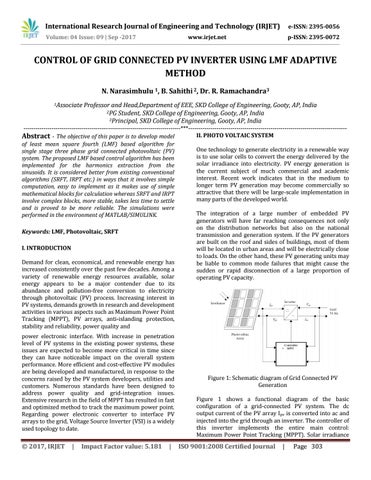
Figure 1: Schematic diagram of Grid Connected PV Generation Figure 1 shows a functional diagram of the basic configuration of a grid-connected PV system. The dc output current of the PV array Ipv is converted into ac and injected into the grid through an inverter. The controller of this inverter implements the entire main control: Maximum Power Point Tracking (MPPT). Solar irradiance
ISO 9001:2008 Certified Journal
|
Page 303
International Research Journal of Engineering and Technology (IRJET)
e-ISSN: 2395-0056
Volume: 04 Issue: 09 | Sep -2017
p-ISSN: 2395-0072
www.irjet.net
is the radiant power incident per unit area upon a surface. It is usually expressed in w/m2. Radiant power is the rate of flow of electromagnetic energy. The most severe fluctuations in the output power of PV systems usually occur at maximum irradiance level around noon. This period usually coincides with the off-peak loading period of the electric network, and thus, the operating penetration level of the PV system is greatest.
Figure 4: Basic MPPT system To generate gating signals for switching of the VSC, an indirect current control technique is used with a hysteresis regulator. The error current signal is calculated from the difference between reference grid currents (i∗sa, i∗sb, i∗sc) and sensed grid currents (isa, isb, isc). IV. SIMULATION RESULT ANALYSIS In this section, simulations are given to demonstrate the validity and advantage of the proposed method. The proposed single-stage three phase SPV power generating system integrated with the grid is modeled and simulated in MATLAB/Simulink.
Figure 2 shows an equivalent circuit diagram of a PV cell which consists of a light-generated current source IL, a parallel diode, a shunt resistance Rsh, and a series resistance Rs.
60
Ipv (A)
Figure 2: Circuit diagram of PV cell
40
20 0.55
0.56
0.57
0.58
0.59
0.6
0.59
0.6
0.59
0.6
Time (sec)
(a) PV output current
Vpv (V)
900
Figure 3: Circuit diagram of PV array Figure 3 shows an electrical equivalent circuit diagram of a PV array, where Ns is the number of cells in series and Np is the number of modules in parallel.
700
500 0.55
0.56
0.57
0.58 Time (sec)
(b) PV Voltage
III. MPPT BASED PHOTOVOLTAIC
4
4
3.5
Ppv (kW)
For maximum power transfer, the load should be matched to the resistance of the PV panel at MPP. Therefore, to operate the PV panels at its MPP, the system should be able to match the load automatically and also change the orientation of the PV panel to track the Sun if possible. A controller that tracks the maximum power point locus of the PV array is known as a MPPT controller.
x 10
3
2.5
2 0.55
0.56
0.57
0.58 Time (sec)
(c) Maximum Power
© 2017, IRJET
|
Impact Factor value: 5.181
|
ISO 9001:2008 Certified Journal
|
Page 304
International Research Journal of Engineering and Technology (IRJET)
e-ISSN: 2395-0056
Volume: 04 Issue: 09 | Sep -2017
p-ISSN: 2395-0072
www.irjet.net 50
iLa (A)
Vdc (V)
900
700
500 0.55
0.56
0.57
0.58
0.59
0.6
0
-50 0.55
Time (sec)
0.56
0.57
(d) DC Voltage
0.58
0.59
0.6
Time (sec)
0
(i) Load Current
Ps (W)
-2000
Figure5: Steady state response under nonlinear load
-4000
Figure 5 depicts the steady state behavior of the proposed topology under a nonlinear load. Figure 6 shows the dynamic behavior and intermediate signals of proposed system respectively under unbalanced load from 0.70 to 0.75 s. Even under the load unbalancing, the grid currents are maintained sinusoidal with grid voltages and the dc link voltage are regulated to desired value.
-6000 -8000 -10000 0.55
0.56
0.57
0.58 Time (sec)
0.59
0.6
(e) Supply real power 1
0
800
Vdc (V)
900
Qs (kVAR)
0.5
-0.5 -1 0.55
0.56
0.57 0.58 Time (sec)
0.59
700
600
0.6
(f) Reactive Power
500 0.7
500
0.72
0.74
0.76
0.78
0.8
0.78
0.8
0.78
0.8
Time (sec)
(a) DC Voltage Vsabc (V)
500
Vsabc (V)
0
-500 0.55
0.56
0.57
0.58
0.59
0
0.6
Time (sec) -500 0.7
0.72
(g) Grid Voltage
0.74
0.76 Time (sec)
(b) Grid Voltage
50
0
-50 0.55
isabc (A)
Isabc (A)
60
0.56
0.57
0.58
0.59
0
0.6
-60 0.7
Time (sec)
0.72
0.74
0.76 Time (sec)
(c) Grid Current
(h) Grid Current
© 2017, IRJET
|
Impact Factor value: 5.181
|
ISO 9001:2008 Certified Journal
|
Page 305
International Research Journal of Engineering and Technology (IRJET)
e-ISSN: 2395-0056
Volume: 04 Issue: 09 | Sep -2017
p-ISSN: 2395-0072
www.irjet.net
iLa (A)
50
0
-50 0.7
0.72
0.74
0.76
0.78
0.8
Time (sec)
(d) Load current Fig.ure 6: Dynamic response under unbalanced nonlinear load V. CONCLUSION In this paper, the control algorithm has been based on a least mean fourth adaptive filtering technique is proposed. This technique has been designed for grid connected Photovoltaic power system. The simulation results have depicted and maximum power is extracted from the solar photovoltaic power system. The results of the proposed system have proved to be efficient and consistent in comparison with existing conventional control algorithms. REFERENCES [1]. P. Moutis, A. Vassilakis, A. Sampani, and N. D. Hatziargyriou, “DC switch driven active power output control of photovoltaic inverters for the provision of frequency regulation,” IEEE Trans. Sustain. Energy, vol. 6, no. 4, pp. 1485–1493, Oct. 2015. [2]. B. Subudhi and R. Pradhan, “A comparative study on maximum power point tracking techniques for photovoltaic power systems,” IEEE Trans. Sustain. Energy, vol. 4, no. 1, pp. 89–98, Jan. 2013. [3]. K. Sundareswaran, P. Sankar, P. S. R. Nayak, S. P. Simon, and S. Palani, “Enhanced energy output from a PV system under partial shaded conditions through artificial bee colony,” IEEE Trans. Sustain. Energy, vol. 6, no. 1, pp. 198–209, Jan. 2015. [4]. C. Kai, T. Shulin, C. Yuhua, and B. Libing, “An Improved MPPT controller for photovoltaic system under partial shading condition,” IEEE Trans.Sustain. Energy, vol. 5, no. 3, pp. 978–985, Jul. 2014. [5]. S. Saxena and Y. Hote, “Load frequency control in power systems via internal model control scheme and model-order reduction,” IEEE Trans. Power Sys., vol. 28, no. 3, pp. 2749–2757, Aug. 2013. [6]. P. C. Sekhar and S. Mishra, “Takagi–Sugeno fuzzybased incremental conductance algorithm for maximum power point tracking of a photovoltaic
© 2017, IRJET
|
Impact Factor value: 5.181
|
generating system,” IET Renewable Power Gener., vol. 8, no. 8, pp. 900–914, Nov. 2014. [7]. S. K. Kollimalla and M. K. Mishra, “Variable perturbation size adaptive P&O MPPT algorithm for sudden changes in irradiance,” IEEE Trans. Sustain. Energy, vol. 5, no. 3, pp. 718–728, Jul. 2014 [8]. S. A. George and F.M. Chacko, “Comparison of different control methods for integrated system of MPPT powered PV module and STATCOM,” in Proc. Int. Conf. Renew. Energy Sustain. Energy, Dec. 5–6, 2013, pp. 207–212. [9]. B. Singh, D. T. Shahani, and A. K. Verma, “IRPT based control of a 50 kW grid interfaced solar photovoltaic power generating system with power quality improvement,” in Proc. IEEE 4th Int. Symp. Power Electron. Distrib. Gener. Syst., Jul. 8–11, 2013, pp. 1–8. [10]. B. Singh, D. T. Shahani, and A. K. Verma, “Neural network controlled grid interfaced solar photovoltaic power generation,” IET Power Electron., vol. 7, no. 3, pp. 614–626, Mar. 2014. [11]. S. Kumar, A. K. Verma, I. Hussain, and B. Singh, “Performance of grid interfaced SPV system under variable solar intensity,” in Proc. IEEE 6th India Int. Conf. Power Electron., Dec. 8–10, 2014, pp. 1–6. [12]. C. Jain and B. Singh, “A Three-phase grid tied SPV system with adaptive DC link voltage for CPI voltage variations,” IEEE Trans. Sustain. Energy, vol. 7, no. 1, pp. 337–344, Jan. 2016. [13]. E. Walach and B. Widrow, “The least mean fourth (LMF) adaptive algorithm and its family,” IEEE Trans. Inf. Theory, vol. 30, no. 2, pp. 275–283, Mar. 1984 [14]. G. Gui, W. Peng, and F. Adachi, “Adaptive system identification using robust LMS/F algorithm,” Int. J. Commun. Syst., vol. 27, pp. 2956–2963, 2014. [15]. P. I. Hubscher, J. C.M. Bermudez, and V. H. Nascimento, “Amean-square stability analysis of the least mean fourth adaptive algorithm,” IEEE Trans. Signal. Process., vol. 55, no. 8, pp. 4018–4028, Aug. 2007. Author Details Mr. N. Narasimhulu has completed his professional career of education in B. Tech (EEE) from JNTU Hyderabad in the year 2003. He obtained M. Tech degree from JNTU, HYDERABAD, in year 2008. He is pursuing Ph. D in the area of power system in JNTU Anantapuramu. He has worked as Assistant Professor from 2003-2008 and at present working as an Associate Professor and Head of the EEE Department in Srikrishna Devaraya Engineering College, Gooty of Anantapuramu district (AP). He is a life member
ISO 9001:2008 Certified Journal
|
Page 306
International Research Journal of Engineering and Technology (IRJET)
e-ISSN: 2395-0056
Volume: 04 Issue: 09 | Sep -2017
p-ISSN: 2395-0072
www.irjet.net
of ISTE, FIE, IEEE. His areas of interests include Electrical Power Systems, Electrical Circuits and Control Systems B.SAHITHI has completed her professional career of education in B. Tech (EEE) at SKD in the year of 2015 and pursuing M. Tech from Sri Krishnadevaraya Engineering College, Gooty, Anantapur (AP). Her areas of interests include Electrical Power Systems. Dr. R. RAMACHANDRA has completed his professional career of education in B. Tech (MECHANICAL) from JNTU Hyderabad. He obtained M. Tech degree from JNTU, Hyderabad. He obtained Ph. D degree from JNTU, Hyderabad At present working as Professor and Principal in Sri krishna Devaraya Engineering College, Gooty of Anantapuramu district (AP).
© 2017, IRJET
|
Impact Factor value: 5.181
|
ISO 9001:2008 Certified Journal
|
Page 307