International Research Journal of Engineering and Technology (IRJET)
e-ISSN: 2395 -0056
Volume: 03 Issue: 09 | Sep-2016
p-ISSN: 2395-0072
www.irjet.net
Recognizing Face Images with Age and Weight Variations T.Vijay Kanth1, Dr.S.V.Jagadeesh Chandra2, Dr.A.NarendraBabu3, Dr.G.Srinivasa Rao4 Department of Electronics and communication Engineering, LBRCE, Andhra Pradesh, India,vijay.vijju499@gmail.com Department of Electronics and communication Engineering, LBRCE, Andhra Pradesh, India,svjchandra@gmail.com Department of Electronics and communication Engineering, LBRCE, Andhra Pradesh, India, narendraalur@gmail.com Department of Electronics and communication Engineering, LBRCE, Andhra Pradesh, India, srinniwasarau@gmail.com -----------------------------------------------------------------------------***----------------------------------------------------------------------------
Abstract - Facial appearances are difficult to recognize
when ages and weight are changed in humans. Physiological studies have proven that the human visual system can recognize familiar faces at different ages from the face outline alone. Craniofacial growth is common during childhood years, but after the age of 18, the texture variations start to show as the effect of facial aging. The proposed algorithm utilizes neural network and random decision forest to encode age variations across different weight categories.
Keywords: Face recognition, biometrics, facial aging, who is it data base
1. INTRODUCTION Facial image recognition plays an important role in the daily life like verification of passport, missing children, theft etc. It is often observed that with age variations, the weight of an individual also changes. Within a limited period of time, there can be significant weight changes and within a long period of time, the weight may not change. The studies concerning facial recognition under the aging effect have acquired a great deal of importance recently, mainly because of the challenging issues associated with the facial aging process, as well as the need for robust age-invariant facial recognition systems.
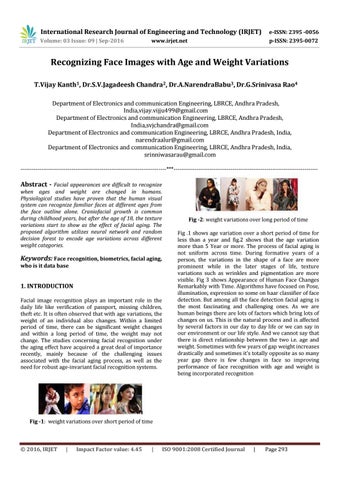
Fig -2: weight variations over long period of time Fig .1 shows age variation over a short period of time for less than a year and fig.2 shows that the age variation more than 5 Year or more. The process of facial aging is not uniform across time. During formative years of a person, the variations in the shape of a face are more prominent while in the later stages of life, texture variations such as wrinkles and pigmentation are more visible. Fig 3 shows Appearance of Human Face Changes Remarkably with Time. Algorithms have focused on Pose, illumination, expression so some on haar classifier of face detection. But among all the face detection facial aging is the most fascinating and challenging ones. As we are human beings there are lots of factors which bring lots of changes on us. This is the natural process and is affected by several factors in our day to day life or we can say in our environment or our life style. And we cannot say that there is direct relationship between the two i.e. age and weight. Sometimes with few years of gap weight increases drastically and sometimes it’s totally opposite as so many year gap there is few changes in face so improving performance of face recognition with age and weight is being incorporated recognition
Fig -1: weight variations over short period of time
© 2016, IRJET
|
Impact Factor value: 4.45
|
ISO 9001:2008 Certified Journal
|
Page 293
International Research Journal of Engineering and Technology (IRJET)
e-ISSN: 2395 -0056
Volume: 03 Issue: 09 | Sep-2016
p-ISSN: 2395-0072
www.irjet.net
progression) and age-estimation. In 30 subjects participated with 100 pairs of face images randomly selected from the FGNet Database For each test pair, subjects were requested to tell if the two images are from the same person and if the images belong to the same age group. The human performance is compared to Support Vector Machine classifiers using Mahalanobis distance. Experiments demonstrated that the SVM classifiers could perform better than the human performances. Geng et al. collected the human performance of an age-estimation experiment, where 29 subjects were asked to estimate the ages of images from the FGNet database. Then, they provided a method by learning a representative subspace to model the aging pattern. Experiments showed promising performances to the results of human experiments. Compared to previous work, our study is more thorough in several aspects: (1) A much larger database is used, (2)We conducted experiments on both face-verification and age-estimation tasks, and (3) Rigorous statistical analysis of the experimental results is provided.
Fig -3: Appearance of Human Face Changes Remarkably with Time
2. PREVIOUS METHODS Face recognition across age progression and age estimation have been studied widely in recent years. Large numbers of algorithms have been implemented based on different databases. One of the earliest works in Lanitis et al. uses a statistical model to capture the variation of facial shapes over age progression. Then, the model is used for age estimation and face recognition on a database containing 500 face images of 60 subjects. In Ramanathan and Chellappa use the probabilistic Eigen space framework for face recognition. Ling et al. proposes gradient orientation pyramids operators derived from multiple resolutions and then uses SVM to perform face recognition experiments. These two algorithms are conducted on a private passport database. A recent work in Biswas et al. studies feature drifting on face images at different ages and apply it to face verification tasks. Other studies using age transformation for recognition include
2.1 Face-Verification Experiment
For age-estimation problem, Fu and Huang construct a low-dimensional manifold from a set of age separated face images to estimate the ages of faces. Manifold learning approach adopted in Guo et al. is to estimate the age from the low-dimensional representation of faces. Hybrid features are recently included to further improve the estimation accuracy Other related researches in age estimation can be found in a major issue in the research of age-related facial image analysis is the database. For a long time, the FGNet face aging database, which is collected by Lanitis and colleagues, is the only publicly available database dedicated to face aging study the data set contains about 1000 facial photos from 82 subjects taken at different ages. Since its introduction, the FGNet database has been widely used in face aging analysis. Recently, Ricanek and Tesafaye introduce the MORPH Database, which contains across age photos from a large amount of subjects. Albert and Ricanek implemented a baseline facial verification on the MORPH database using the Eigen face algorithm. In our experiment, the MORPH database is used, because it involves more subjects as well and larger age ranges than other public and private databases. The most related works to ours are previous studies of human ability for face recognition (with age © 2016, IRJET
|
Impact Factor value: 4.45
|
In the face-verification experiment, each participant attends trials. In each trial, a pair of face images is randomly selected from the database and then presented to the participant. The participant is requested to decide if the two photos come from the same person. Among the different trials, about 30% are from the same persons. When a pair of photos is shown, the participant is required to click either the “Same” button, if they think the two photos are of the same person, or the “Diff” button, if they think otherwise. The choice and reaction time of each trial is recorded.
2.2 Age-Estimation Experiment In the age-estimation experiment, similar to the verification experiment, each participant attends trials. In each trial, a participant is requested to estimate the age of a photo randomly selected from the whole database. Given a photo, the participant is request to “choose” among buttons named “1” to “80”, corresponding to age 1 to 80, respectively. Note that the actual age range of the MORPH dataset is 15– 68. We purposely allow a participant to choose from a larger range to avoid bias. 3. PROPOSED WORK As earlier face has been used in many applications but with only the age factors but as body fat increases then it would be the real challenge to recognize so in this we
ISO 9001:2008 Certified Journal
|
Page 294
International Research Journal of Engineering and Technology (IRJET)
e-ISSN: 2395 -0056
Volume: 03 Issue: 09 | Sep-2016
p-ISSN: 2395-0072
www.irjet.net
identified that with the weight to recognize the face images. Proposed system uses age and weight variations and WHOISIT database for face recognition using techniques, namely
affected by the number of training samples for each face. Most of current FR techniques assume that several (at least two) samples of the same person are always available for training. Fig5 shows the output of the training data. Unfortunately, in many real-world applications, the number of training samples we actually have is by far smaller than that we supposedly have. More specifically, in many application scenarios, especially in large-scale Identification applications, Such as law enforcement, driver license or passport card identification there is usually only one training sample per person in the database.
3.1 Viola Jones This algorithms basic principal is to detect the faces from the given input image. Before this there were so many images processing approach but all of them were time consuming due to making the entire image to the fix size and then run the image in the detector
3.2 Support Vector Machines (SVM) In support vector machine is used to analyze the complex data and gives the result. SVM is very useful in finding patterns which are very useful and not complex.
3.3 Neural Network Designing a generative model that incorporates both weight and age variations requires significant amount of training data with all combinations of age and weight. The proposed algorithm incorporates the effect of weight by training three different neural networks, one for each weight category. Since it is a learning based algorithm, it is primarily divided into two parts: training and testing.
Fig -5: Output of the training set
Fig -4: Flowchart of the training set The training data is divided into three categories: thin, Moderate and heavy. Fig4 shows how the training can be done for weights. Using all the thin images in the training database, a mean thin weight image is created. Similarly, Mean moderate and mean heavy weight images are also created from the training database. However, with probe image, we cannot assume that weight category is known and it’s challenging to estimate the weight category by only using face information. Therefore, the proposed algorithm registers the training image with respect to mean face of all three weight categories. Three neural networks are jointly trained, one for each weight category. The nodes in the first hidden layer of the network are composed of Gabor filters with variations in scale and orientation parameters one of the key components of appearance-based methods is their learning mechanism, whose performance is heavily © 2016, IRJET
|
Impact Factor value: 4.45
|
Fig6 shows the neural network for proposed face algorithm. Three neural networks are jointly trained, one for each weight category. The nodes in the first hidden layer of the network are composed of Gabor filters with variations in scale and orientation parameters. RDF is an ensemble based multiclass classifier which is fast to train and classify. It can handle non linearity as well as large number of classes, details of RDF can be found in Input to RDF is weighted HOG descriptors and output is class label. The parameters of RDF (i.e., the number of trees in the forest) and weights of the network are trained using stochastic back propagation learning and descending epsilon technique with rank-1 accuracy as fitness function for improved generalization and faster convergence. Here, all three sub-networks and RDF are trained in a cohesive manner that encodes the variations due to thin, moderate and heavy weight variations over a period of time.
3.4 Testing At the probe level, a query face image is given as input and three registered images are created with respect to the three mean faces obtained during training. Gabor convoluted sigmoid outputs are used for HOG feature extraction which is provided to RDF for classification. RDF provides a probabilistic match score for each class which denotes the probability with which the query
ISO 9001:2008 Certified Journal
|
Page 295
International Research Journal of Engineering and Technology (IRJET)
e-ISSN: 2395 -0056
Volume: 03 Issue: 09 | Sep-2016
p-ISSN: 2395-0072
www.irjet.net
belongs to the particular class. The class with the maximum probability is selected as the final class of the image
34.29 years, subject, i.e. difference between the age of the oldest image and the youngest image, is 28.78 years.
Fig -7: Mean image for mean, moderate and heavy weight
3.6 Local Binary Patterns (LBP) LBP is one of the binary patterns which are used for the feature extraction. In this the face image is firstly divided into small regions from which LBP features are extracted gives the output. LBP is used because there are micro patterns which are invariant of monotonic grey transformation. Combining all this gives the face image.LBP is widely used in many applications due to its high tolerance against object recognition texture analysis and high discriminative power. Fig8 shows the example of the LBP of the Original/input image. . Fig -6: Neural Network for proposed face algorithm
3.5 Weight variation Over the years, several researchers have shown that age variations affect the performance of both human and automatic face recognition. However, the effect of weight on face recognition performance has not been established yet. To validate our assertion that along with age, weight also affects the performance of face recognition. The training data is divided into three categories: thin, moderate and heavy. Using all the thin images in the training database, a mean thin weight image is created. Similarly, mean moderate and mean heavy weight images are also created from the training database. Fig.7 shows mean images of the three weight categories along with mean image of the entire training database. Body weight variations are an integral part of a person’s aging process. However, the lack of association between the age and the weight of an individual makes it challenging to model these variations for automatic face recognition. In this paper, we propose a regularize based approach to learn weight invariant facial representations contains images of public figures collected from the Internet and it is ensured that some age variations are maintained throughout for each subject. The average age of all the images in WIT is
© 2016, IRJET
|
Impact Factor value: 4.45
|
Fig -8: LBP of the input image
4. EXPERIMENTAL RESULTS
Fig -9: input image given to the probe ISO 9001:2008 Certified Journal
|
Page 296
International Research Journal of Engineering and Technology (IRJET)
e-ISSN: 2395 -0056
Volume: 03 Issue: 09 | Sep-2016
p-ISSN: 2395-0072
www.irjet.net
The WHOISIT database is partitioned into two equal unseen sets: training and testing. Images pertaining to 50% subjects are used for training and the remaining subjects are used for testing. This train-test partitioning is repeated number of times for random sub sampling based cross validation. The training database is divided into three parts depending on the weights: thin, moderate and heavy. Fig9 shows the input given to the probe. In the testing database, the youngest image is taken as gallery and the remaining images are taken as probe. Discriminating model based algorithm is able to encode aging variations but it fails to effectively encode weight variations. As mentioned earlier, weight variations can significantly affect the facial appearance and therefore, for recognition, both aging and weight variations should be learnt, as in the case of the proposed algorithm. The skeletal structure can change only with major age variations but body fat can change within a small time interval as well. Therefore, incorporating weight information for face recognition can help in improving the performance at smaller time intervals as well. Even with small age difference, an individual can have significant weight variations and with large age variations, the weight variations can be small we propose a neural network and random decision forest based classification algorithm that learns the age variations for different weight variations to recognize the identity of a given face image. Due to the Unavailability of a public database containing both age and weight information, we have also created a new database, WhoIsIt database and the results are reported on this database.
incorporating weight information for recognizing age separated face images improves the identification performance. Fig10 shows the age identification of an input image. In future, we plan to extend the database and improve the algorithm with age and weight invariant feature extraction.Fig11 The proposed algorithm yields 75.34%Results pertaining to the proposed algorithm, Viola Jones, and SVM suggest that for improved Recognition performance, the algorithm should incorporate both age and Weight variations, which can be learnt from the training data.
Fig -11: CMC for the proposed method 5. CONCLUSION
Fig -10: Age identification of an output image The performance of the proposed algorithm is compared with several existing face recognition algorithms including a commercial system. The results show that © 2016, IRJET
|
Impact Factor value: 4.45
|
The system preserved the simplicity since it did not require building aging models or any pre-processing step prior to performing verification and identification. Such system is promising towards real-time applications that require high performance, and also relatively low processing time. In future orientations, the researchers have planned to facilitate the proposed system to work with large populations in real-time applications, specifically, detecting criminals and terrorists in public facilities, such as international airports. Such orientations may require improving the abilities of the system in discriminating among large number of classes (probably extending the feature sets without trading the computational complexity). In addition, the researchers have created a face database collected from the FBI records and other internet resources. The database encompasses a large number of terrorists, criminals and fugitives face images at different ages. Such database should assist in evaluating the ability of the proposed system in detecting violent elements in large populations.
ISO 9001:2008 Certified Journal
|
Page 297
International Research Journal of Engineering and Technology (IRJET)
e-ISSN: 2395 -0056
Volume: 03 Issue: 09 | Sep-2016
p-ISSN: 2395-0072
www.irjet.net
6. REFERENCES 1
Geng, X., Zhou, Z.-H., Smith-Miles, K.: ‘Automatic age estimation based on facial aging patterns’, IEEE Trans. Pattern Anal. Mach. Intell., 2007, 29, (12), pp. 2234–2240. 2 GeorghiadeAthinodoros S, Belhumeu Peter N, and Kriegman David J, "From few to many: Illumination cone models for face recognition under variable lighting and pose," Pattern Analysis and Machine Intelligence, IEEE Transactions on, vol. 23, no. 6, pp. 643-660, 2001. 3 Jain Vidit and Mukherjee Amitabha, "The Indian face database," 2002 4 Henry Rowley, Baluja S. &Kanade T. (1999) “Neural Network-Based Face Detection, Computer Vision and Pattern Recognition”, Neural Network-Based Face Detection, Pitts-burgh, Carnegie Mellon University, PhD thesis 5 Henry A. Rowley, ShumeetBaluja&Takeo Kanade. (1997) Rotation Invariant Neural Network-BasedFace Detection, December, CMU-CS-97-201 6 Jeffrey S. Norris (1999) Face Detection and Recognition in Office Environments, thesis, Dept. of Electrical Eng. and CS, Master of Eng in Electrical Eng., Massachusetts Institute of Technology. 7 Hazem M. El-Bakry (2002), Face Detection Using Neural Networks and Image Decomposition Lecture Notes in Computer Science Vol. 22, pp:205-215. 8 Lin-Lin Huang, et al (2003) “Face detection from cluttered images using a polynomial neural network”, Neurocomputing, Vol.51, pp197 – 211. 9 Masakazu Matsugu (2003) “Subject independent facial expression recognition with robust facedetection using a convolutional neural network”, Neural Networks, Vol.16, pp555–559. 10 Stefan W., Christian I. &Uwe H (2004) “Evolutionary Optimization of Neural Networks for FaceDetection”, Proceedings of the 12th European Symposium on Artificial Neural Networks, Evere,Belgium: d-side publications. 11 N. Ramanathan and R. Chellappa, “Face verification across age progression,” IEEE Trans. Image Process., vol. 15, no. 11, pp. 3349–3361, Nov. 2006 12 U. Park, Y. Tong, and A. K. Jain, “Age invariant face recognition,” IEEE Trans. Pattern Anal. Mach. Intell., vol. 32, no. 5, pp. 947–954, May 2010 13 D. Lowe, “Distinctive image features from scaleinvariant keypoints,”Int. J. Comput. Vis., vol. 60, no. 2, pp. 91–110, 2004 14 Bagging, Boosting and the Random Subspace Method for Linear Classifiers Marina Skurichina and Robert P. W. Duin Pattern Recognition Group, Department of Applied Physics, Faculty of Applied Sciences, Delft University of Technology, Delft, The Netherlands 15 P. Belhumeur, J. Hespanda, and D. Kiregeman, “Eigenfaces versus Fisherfaces: Recognition using © 2016, IRJET
|
Impact Factor value: 4.45
|
16
17
18
19
20
class specific linear projection,” IEEE Trans. Pattern Anal. Mach. Intell., vol. 19, no. 7, pp. 711–720, Jul. 1997. Z. Li, D. Lin, and X. Tang, “Nonparametric discriminant analysis for face recognition,” IEEE Trans. Pattern Anal. Mach. Intell., vol. 31, no. 4, pp. 755–761, Apr. 2009. T. Ojala, M. Pietikainen, and T. Maenpaa, “Multiresolution gray-scale and rotation invariant texture classification with local binary patterns,” IEEE Trans. Pattern Anal. Mach. Intell., vol. 24, no. 7, pp. 971–987, Jul. 2002. A.S. Geoghiades, D.J. Kriegman, P.N. Belhumeur, Illumination cones for recognition under variable lighting: faces, in: Proceedings, IEEE Conference on Computer Vision and Pattern Recognition, 1998,pp. 52–58. S.G. Shan, W. Gao, D. Zhao, Face identification based on facespecific subspace, Int. J. Image Syst. Technol. 13 (1) (2003) 23–32 (Special issue on face processing, analysis and synthesis). G.Wen, S. Shan, et al., Virtual face image generation for illumination and pose insensitive face recognition,
ISO 9001:2008 Certified Journal
|
Page 298
International Research Journal of Engineering and Technology (IRJET)
e-ISSN: 2395 -0056
Volume: 03 Issue: 09 | Sep-2016
p-ISSN: 2395-0072
www.irjet.net
21 Proceedings of ICASSP2003,vol. IV, Hong Kong, 2003, pp. 776–779. 22 M. Donahue, D. Geiger, R. Hummel, T. Liu, Sparse representations for image decompositions with occlusions, IEEE Conference on Computer Vision and Pattern Recognition, vol. 1, 1996, pp. 7–12. 23 D.W. Jacobs, D. Weinshall, Y. Gdalyahu, Classification with nonmetric distances: image retrieval and class representation, IEEE Trans. Pattern Anal. Mach. Intell. 22 (6) (2000) 583–600. 24 M.D. Kelly, Visual identification of people by computer, Technical Report AI-130, Stanford AI Project, Stanford, CA, 1970. 25 T. Kanade, Picture processing by computer complex and recognition of human faces, Technical Report, Department of Information Science, Kyoto University, 1973. 26 A.J. Goldstein, L.D. Harmon, A.B. Lesk, Identification of human faces, Proc. IEEE 59 (5) (1971) 748–760. 27 Y. Kaya, K. Kobayashi, A basic study on human face recognition, in: S. Watanabe (Ed.), Frontiers of Pattern Recognition, 1972,pp. 265–289. 28 P.R. Villeala, J. uanHumbertoSossa Azuela, Improving pattern recognition using several feature vectors, Lecture Notes in Computer Science, Springer, Heidelberg, 2002. 29 L.I. Kuncheva, C.J. Whitaker, Feature subsets for classifier combination: an enumerative experiment, in: J. Kittler, F. Roli (Eds.), Lecture Notes in Computer Science, vol. 2096, Springer, Berlin, 2001, pp. 228– 237.
© 2016, IRJET
|
Impact Factor value: 4.45
|
30 J. Kittler, M. Hatef, R.P.W. Duin, J. Matas, On combining classifiers, IEEE Trans. Pattern Anal. Mach. Intell. 20 (3) (1998) 226–239. 31 H.A. Rowley, S. Baluja, T. Kanade, Neural networkbased face detection, IEEE Trans. Pattern Anal. Mach. Intell. 20 (1) (1998) 23–38.C. Wu, C. Liu, et al., Automatic eyeglasses removal from face image, IEEE Trans. Pattern Anal. Mach. Intell. 26 (3) (2004) 322– 336. 32 A. Lanitis, C.J. Taylor, T.F. Cootes, Automatic face identification system using flexible appearance models, Image Vis. Comput. 13 (5) (1995) 393–401. 33 A.K. Jain, Y. Zhong, S. Lakshmanan, Object matching using deformable templates, IEEE Trans. Pattern Anal. Mach. Intell. 22 (1) (2000) 4–37. 34 T.S. Lee, Image representation using 2-d Gabor wavelets, IEEE Trans. Pattern Anal. Mach. Intell. 18 (10) (1996) 959–971. 35 J. Zhang, Y. Yan, M. Lades, Face recognition: eigenface, elastic matching and neural nets, Proc. IEEE 85 (9) (1997) 1423–1435. 36 A.M. Martínez, R. Benavente, The AR face database, CVC Technical Report No. 24, June 1998. 37 F. Samaria, Face segmentation for identification using hidden Markov models, in: British Machine Vision Conference, BMVA Press, 1993, pp. 399–408. 38 T. Kölsch, D. Keysers, H. Ney, R. Paredes, Enhancements for local feature based image classification, in: International Conference on Pattern Recognition (ICPR 2004), vol. I, Cambridge, UK, August2004, pp. 248–251.
ISO 9001:2008 Certified Journal
|
Page 299