International Research Journal of Engineering and Technology (IRJET)
e-ISSN: 2395 -0056
Volume: 03 Issue: 09 | Sep-2016
p-ISSN: 2395-0072
www.irjet.net
Nature Magnificent technique in Wireless Sensor Network to overcome the Energy Utilization Manpreet kaur1, Ruchika Markan2 1Manpreet Kaur
Research scholar
Department of computer science and Engineering RIMT university, Fatehgarh Sahib, Punjab, India 2Ruchika Markan
Assistant professor Department of computer science and Engineering RIMT university, Fatehgarh Sahib, Punjab, India
---------------------------------------------------------------------***--------------------------------------------------------------------1.1 WSN ENERGY ISSUES Abstract - A wireless sensor network is a network consisting of spatially distributed autonomous devices using sensors to monitor physical or environmental conditions. A WSN system incorporates a gateway that provides wireless connectivity back to the wired world and distributed nodes. The main issue in wireless network is that if any node in the network runs out of energy and goes dead; its replacement is very difficult task. So our main goal is to design an algorithm using which it’s avoided the low energy nodes to not take part in forwarding the route request messages to find a route to destination node. Ant Colony optimization is the algorithm which is used in the proposed scheme to trace the path for the route request message. In the proposed work; there is alternative broadcasting of data in between the cells of the nodes and no node can take part in the Route Request forwarding message if their energy is less than the average energy.
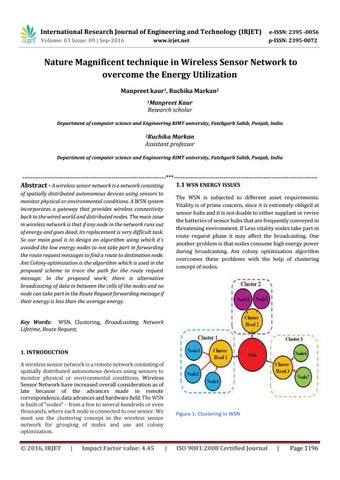
The WSN is subjected to different asset requirements. Vitality is of prime concern, since it is extremely obliged at sensor hubs and it is not doable to either supplant or revive the batteries of sensor hubs that are frequently conveyed in threatening environment. If Less vitality nodes take part in route request phase it may affect the broadcasting. One another problem is that nodes consume high energy power during broadcasting. Ant colony optimization algorithm overcomes these problems with the help of clustering concept of nodes.
Key Words: WSN, Clustering, Broadcasting, Network Lifetime, Route Request,
1. INTRODUCTION A wireless sensor network is a remote network consisting of spatially distributed autonomous devices using sensors to monitor physical or environmental conditions. Wireless Sensor Network have increased overall consideration as of late because of the advances made in remote correspondence, data advances and hardware field. The WSN is built of "nodes" – from a few to several hundreds or even thousands, where each node is connected to one sensor. We must use the clustering concept in the wireless sensor network for grouping of nodes and use ant colony optimization.
© 2016, IRJET
|
Impact Factor value: 4.45
Figure 1: Clustering in WSN
|
ISO 9001:2008 Certified Journal
|
Page 1196
International Research Journal of Engineering and Technology (IRJET)
e-ISSN: 2395 -0056
Volume: 03 Issue: 09 | Sep-2016
p-ISSN: 2395-0072
www.irjet.net
2. LITERATURE SURVEY
M Karthikeyan and Dr. K. V enkatalakshm 2012[18] PSO joined cuckoo burn streamlining algorithm for bunching in
Riham and Mustufa 2014 [16] proposed vitality mindful
vitality mindful way and thought about it with cuckoo burn
bunch head choice utilizing LEACH and PSO are actualized in
calculation. The unpleasant proficient bunching of WSN we
the remote sensor systems. The choice of a group head
are lessening the aggregate correspondence separation as
utilizing PSO minimizes the intra group separation between
well as giving more likelihood to higher vitality hub to be
bunch head and the group part, and the streamlining of
bunch head. The proposed algorithm gives progressed
vitality administration of the system. From the reproduction
lifetime than LEACH, SEP and cuckoo burn algorithm.
results, it is seen that Vitality mindful Optimal bunch head
Xia Li et al., 2013 [19] proposed technique in which they
determination utilizing PSO approach builds the system
joins the enhanced molecule swarm grouping calculation
lifetime of the bunch in such a route by lessening the
with the between bunch directing calculation to shape an
aggregate vitality utilization than Drain usage. Vitality
versatile vitality proficient grouping directing convention,
mindful bunch head choice utilizing LEACH and PSO are
alluded to as AECRP. Reenactment results demonstrate that
actualized in the remote sensor systems. The choice of a
this convention not just adjusts the vitality utilization of the
group head utilizing PSO minimizes the intra group
general system, postpones the demise time of the hubs,
separation between bunch head and the group part, and the
additionally gives more dependable information conveyance.
streamlining of vitality administration of the system. From the reproduction results, it is seen that Vitality mindful
Abdo et al., 2014 [20] proposed improvement in leach
Optimal bunch head determination utilizing PSO approach
protocol using a novel algorithm to select cluster heads with
builds the system lifetime of the bunch in such a route by
highest and balanced energy in wireless sensor networks
lessening the aggregate vitality utilization than Drain usage.
and choose the cluster heads with highest energy. Cluster head collect the data and send it to base station without
M.Natarajan 2013 [17] proposed proper organization of
considering security. Here RSA algorithm is used to secure
nodes becomes one of the major techniques to expand the
the packets during send to both cluster head and base
life span of the whole network through aggregating data at
station.
the cluster head(CH).LEACH (Low Energy Adaptive Clustering
Hierarchy)
and
PSO
(Particle
Swarm
Agam et al., 2014 [21] proposed the self knowledge
Optimization) are applied for producing energy-aware
technique in which SCHP (sub cluster head protocol is used
clusters with optimal selection of cluster head. The
to reduce delay occurs in link stability problem in SCHP.
determination of a group head utilizing PSO minimizes the
Each node knows about its neighbors by using its self
intra cluster separation between group head and the cluster
knowledge. Receiver will send its receiving capacity and
part, and the improvement of vitality administration of the
sender will send data according to that capacity. So link
system. From the recreation results, it is seen that Vitality
becomes more stable. In Self knowledge technique sender
mindful Optimal cluster head choice utilizing PSO approach
keeps the information regarding its one hop neighbors. All
builds the system lifetime of the group in such a route by
important parameters like delay, threshold, packet size,
diminishing the aggregate vitality utilization than Drain
energy are considered before sending data to the next node.
execution.
© 2016, IRJET
|
Impact Factor value: 4.45
|
ISO 9001:2008 Certified Journal
|
Page 1197
International Research Journal of Engineering and Technology (IRJET)
e-ISSN: 2395 -0056
Volume: 03 Issue: 09 | Sep-2016
p-ISSN: 2395-0072
www.irjet.net
3. RESULTS In proposed work, there are clustering of nodes and we use the ant colony optimization technique for broadcasting. Following are the screenshots of the related work:-
Figure 5: Path from Source to Destination
4. CONCLUSION Clustering is one of the popular approaches considered in wireless sensor network to achieve energy efficiency and prolong the lifetime of the network. This study focuses on the same, i.e. using clustering in the wireless sensor network by dividing the network into grids having equal number of nodes. However, after the clusters have been formed the task to select the best path from source to destination is given prime importance. The proposed scheme improves the path finding criteria by using modified approach for broadcasting of request packets. The methodology has been implemented on NS2.35 which is open source simulator. The performance of the scheme has been analyzed on the basis of delay, throughput and energy consumption in the network.
Figure 2: Source Node
REFERENCES Riham S. Elhabyan, Mustapha C.E. Yagoub " Energy Efficient Clustering Protocol for WSN using PSO" in
Figure 3: Clustering of Nodes
IEEE,2014. M. Natarajan, R. Arthi Ramanujan, K. Murugan Ramanujan, "Energy Aware Optimal Cluster Head Selection in Wireless Sensor Networks" in IEEE July ,2013 M Karthikeyan and Dr.K. V enkatalakshm, " Energy Conscious Clustering of Wireless Sensor Network Using PSO Incorporated Cuckoo Search" in IEEE July 2012. Xia Li, Wang Gang, Liu Zongqi, Zhang Yanyan, "An energyefficient routing protocol based on particle swarm clustering Figure 4: Broadcasting
algorithm and inter-cluster routing algorithm for WSN" in IEEE 2013. K Venice and S Deepika, “Effective and secure transmission approach for multi cluster based wireless sensor networks”
© 2016, IRJET
|
Impact Factor value: 4.45
|
ISO 9001:2008 Certified Journal
|
Page 1198
International Research Journal of Engineering and Technology (IRJET)
e-ISSN: 2395 -0056
Volume: 03 Issue: 09 | Sep-2016
p-ISSN: 2395-0072
www.irjet.net
in international journal of innovative research in computer and communication engineering, 2014. Agam Gupta and Mansi Gupta, “Improved energy efficiency and reduced delay using self knowledge with SCHP in wireless sensor networks” in international journal of advanced research in computer science and management studies, Aug 2014. N. Thangadurai and R.Dhanasekaran, “Energy efficient cluster based routing protocol” in International Journal of Engineering Research & Technology, May 2013. Aduma Murtala, Zungeru Kah Phooi Seng, “Termite-hill: Performance optimized swarm intelligence based routing algorithm for wireless sensor networks” in Termite-hill: Performance optimized swarm intelligence based routing algorithm for wireless sensor networks,2012. Feng Liu, Luwei Ding and Yuling, “The improvement of Leach protocol in WSN”, in computer science and network technology, international conference IEEE 2011.
© 2016, IRJET
|
Impact Factor value: 4.45
|
ISO 9001:2008 Certified Journal
|
Page 1199