International Research Journal of Engineering and Technology (IRJET)
e-ISSN: 2395 -0056
Volume: 03 Issue: 09 | Sep -2016
p-ISSN: 2395-0072
www.irjet.net
EFFECT OF FLOATING COLUMNS ON SEISMIC RESPONSE OF MULTISTORY BUILDING Sampath kumar M.P[1] , V.S.Jagadeesh[2] 1Post Graduate Student, Department of civil engineering, S.J.M.I.T Chitradurga, Karnataka, India 2Professor, Dept. of Civil Engineering, S.J.M.I.T,Chitradurga, Karnataka, India
---------------------------------------------------------------------***---------------------------------------------------------------------
Abstract – Soft storey building and Mass irregular building with Floating column are the typical features in the modern multistory constructions in India. These are highly undesirable in building built in seismically active areas. In this study the effect of Floating columns which are adopted in soft story and mass irregular building in Zone5 are revealed. To achieve this objective six G+15stories rc bare frame structures which are having 3mt and 4mt column height regular structure are considered. These structures are analyzed, and compared the base shear and displacement with the base shear and displacement of soft story and also mass irregular structure using ETABS 9.7.4. Key Words: Floating column, Equivalent Static Analysis, Response spectrum Analysis, soft story, Displacement, Story Shear, Story Drift
1. INTRODUCTION 1.1 General The configuration of tall structures with Floating column basically includes a theoretical outline, clear investigation, preparatory outline and advancement, to securely convey gravity and lateral loads. The outline criteria are strength, serviceability, stability and human comfort. Presently a day's framed Structure are extremely mainstream in India, and column assumes an essential part in these Structural working with Floating column. This is a common place element in the present day multi-storey building development in India. Such components are profoundly undesirable in seismically active ranges. In basic Engineering a column should be a vertical part beginning from establishment level and exchange the auxiliary burden to the ground through establishment, the term Floating column is additionally a vertical component which closes at its lower load level lies on a beam which is horizontal member and exchange the load of the structure through column to beam. The beam in term transfers the load to other columns below it. Such column where the heap was considered as point load hypothetically such structure investigated and designed. In urban region multi-storey structures have open first story as an unavoidable component, this open space might be required for get together corridor or stopping reason. These are highly undesirable in building built in seismically active areas © 2016, IRJET
| Impact Factor value: 4.45
|
usually the civil engineering infra structures are subjected to two classes of loads, static and dynamic loads. The static loads such as dead load, live load are independent with respect to time In case of dynamic loads, loads are changing with respect to time. Most of the cases the structures are designed with the assumptions that all the loads applied are static. Generally the dynamic loads i.e. earthquake loads are not taking an account in the design because the buildings are not regularly subjected to earthquakes, and also it takes more time to solve these parameters in the analysis and also its more difficult to solve the solution.
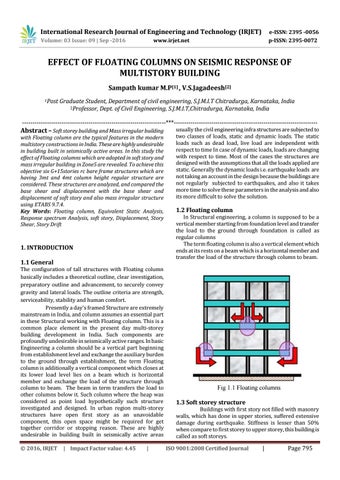
1.2 Floating column In Structural engineering, a column is supposed to be a vertical member starting from foundation level and transfer the load to the ground through foundation is called as regular columns The term floating column is also a vertical element which ends at its rests on a beam which is a horizontal member and transfer the load of the structure through column to beam.
Fig 1.1 Floating columns 1.3 Soft storey structure
Buildings with first story not filled with masonry walls, which has done in upper stories, suffered extensive damage during earthquake. Stiffness is lesser than 50% when compare to first storey to upper storey, this building is called as soft storeys. ISO 9001:2008 Certified Journal
|
Page 795
International Research Journal of Engineering and Technology (IRJET)
e-ISSN: 2395 -0056
Volume: 03 Issue: 09 | Sep -2016
p-ISSN: 2395-0072
www.irjet.net Concrete Grade Steel Grade
: M25 : Fe500
D) Loading Gravity loading: Member load and floor load is calculated as per IS 456 part1 and Live load on the floor is taken as 3 Kn/m2. And the live load at the terrace is taken as 1.5 Kn/m2. E) Plans and models Plans and 3D models considered for the analysis purpose, Floating columns at different locations in the building also considered.
1.4 Mass irregular structure It shall be considered that seismic weight of the any storey is more than 200% of that of its adjacent storey's
Fig 2.1 plan of the soft story building
2. METHODOLOGY
To determine seismic behaviour of the Buildings with and without floating columns for zone V the basic components like inter storey drift, lateral displacement analysis has been carried using the software ETABS 9.7.4. For the analysis purpose Equivalent static method, and Response spectrum methods are adopted. A) Assumptions The following are the assumptions made, Plan of the building is regular, soft storey and Mass irregular building 24mX24m has considered and each storey height is 3m, situated at zone 5 with medium soil condition,4m story height is also considered for Analysis of the building. C) Group properties Beam : 0.3x0.45m Column : 0.45x0.45m Slab : 0.150m © 2016, IRJET
| Impact Factor value: 4.45
Fig 2.2 Framed building
|
ISO 9001:2008 Certified Journal
|
Page 796
International Research Journal of Engineering and Technology (IRJET)
e-ISSN: 2395 -0056
Volume: 03 Issue: 09 | Sep -2016
p-ISSN: 2395-0072
www.irjet.net Displacement in mm
Fig 2.3 Floating coloumns in the building F) Load combinations considered for the building analysis The following are the load combinations are adopted for the analysis & design of building as per IS 1893(Part1):2002, as shown in table
STOREY
MODEL 1
MODEL 2
MODEL 3
MODEL 4
MODEL 5
MODEL 6
15 14 13 12
141.4
153.9
166.57
300.98
335.95
362.33
138.4 133.9 127.8
150.28 145.09 138.37
161.79 155.37 147.52
294.68 285.17 272.6
328.16 317.18 303.16
352.19 338.74 322.44
11
120.5
130.35
138.44
257.47
286.51
303.69
10
112
121.21
128.3
240.07
267.64
282.89
9
102.6
111.15
117.4
220.84
246.91
260.38
8 7 6 5 4 3
92.5 81.8 70.67 59.2 47.6 35.96
100.35 88.97 77.15 65.03 52.72 40.33
105.78 93.63 81.09 68.29 55.32 42.29
200.12 178.23 155.47 132.12 108.4 84.5
224.69 201.29 177.02 152.12 126.85 101.4
236.49 211.54 185.79 159.5 132.89 106.17
2 1
24.32 12.93
27.95 15.79
29.3 16.54
60.72 37.18
75.97 50.7
79.4 53.09
0
2.9
4.73
4.96
14.78
26.35
27.53
Fig 3.1 Displacement graph in MM Model 1 - G+15 Regular building, 3m column Model 2 - G+15 Soft storey building, 3m column Model 3 – G+15 Mass irregular building, 3m column Model 4 - G+15 Regular building, 4m column Model 5 - G+15 Soft storey building, 4M column Model 6 – G+15 Mass irregular building, 4M column
3. RESULTS AND DISCUSSIONS 3.1Equivalent Static Analysis 3.1.1 Lateral Displacements. Lateral displacement profile for building models obtained from the equivalent static and response spectrum methods are shown in figures
© 2016, IRJET
| Impact Factor value: 4.45
|
1)From the figure it’s clearly shows that Displacement varies with respect to stiffness of the building , Displacement greater in the soft storey building in which we used floating column and also displacement increased in Mass irregular building due to load variation. 2) It is observed from figure that the displacement increases as the storey height increases, this is due to the fact that , as the storey height increases ,lateral instability increase when compared to lesser storey height . 3) Mass irregular buildings should be naturally lateralled instable irrespective of the height and storey.
ISO 9001:2008 Certified Journal
|
Page 797
International Research Journal of Engineering and Technology (IRJET)
e-ISSN: 2395 -0056
Volume: 03 Issue: 09 | Sep -2016
p-ISSN: 2395-0072
www.irjet.net
3.1.2 Storey drift STOREY DRIFT -EQX MODEL 1
MODEL 2
MODEL 3
MODEL 4
MODEL 5
MODEL 6
0.00098 0.00151
0.00120 0.00173
0.00159 0.00214
0.00175 0.00237
0.00194 0.00274
0.00253 0.00336
12
0.00201 0.00245
0.00223 0.00267
0.00261 0.00302
0.00313 0.00379
0.00350 0.00416
0.00407 0.00468
11
0.00282
0.00304
0.00336
0.00434
0.00471
0.00520
10
0.00312 0.00337
0.00335 0.003
0.00364 0.00387
0.00480 0.00518
0.00518 0.00555
0.00562 0.00597
0.00356 0.003709
0.00379 0.00393
0.0040 0.0041
0.00547 0.00568
0.00584 0.0060
0.00623 0.00643
0.00380 0.00386
0.0040 0.00410
0.00426 0.00432
0.00583 0.00592
0.00622 0.00631
0.00657 0.00665
0.00389 0.0038 0.00379 0.00331
0.00413 0.00412 0.00405 0.00368
0.00434 0.00433 0.00425 0.00386
0.00596 0.00595 0.00588 0.00559
0.00636 0.00635 0.006 0.00615
0.00668 0.00666 0.00659 0.0063
0.00145
0.0023
0.00248
0.00369
0.00458
0.00488
STOREY 15 14 13
9 8 7 6 5 4 3 2 1 0
Fig 3.3 Base shear 1) Base shear reduces due to presence of floating column in building as the mass is less for building with floating column. 2) Base shear more for mass irregular structure 3.2 DYNAMIC ANALYSIS 3.2.1 LATERAL DISPLACEMENTS Displacement in mm DISPLACEMENT -SPECX
Fig 3.2 Displacement graph in MM
STOREY
MODEL 1
MODEL 2
MODEL 3
MODEL 4
MODEL 5
MODEL 6
15 14 13 12 11 10 9 8 7 6 5
111.6768 109.7057 106.7212 102.7391 97.8591 92.1701 85.7439 78.6379 70.8934 62.5396 53.6007
120.1286 117.6549 114.1825 109.7261 104.3875 98.2563 91.4048 83.8897 75.7507 67.0135 57.6983
130.0845 126.8146 122.4967 117.2489 111.1738 104.347 96.829 88.6685 79.9003 70.5499 60.6389
238.9096 234.6107 228.263 219.9476 209.8715 198.1855 185.0127 170.4704 154.6595 137.6612 119.5586
258.96 253.68 246.4 237.28 226.43 214.03 200.2 185.08 168.73 151.25 132.69
279.27 272.41 263.51 252.82 240.51 226.74 211.59 195.20 177.63 158.96 139.24
4 3 2
44.0968 34.044 23.4927
47.8211 37.3934 26.45
50.1831 39.1897 27.6902
100.4299 80.2976 59.1237
113.13 92.60 71.09
118.51 96.91 74.30
1 0
12.6886 2.8786
15.1957 4.6405
15.8939 4.8483
37.0067 14.9547
48.6 25.87
50.79 26.97
Storey Drift variation in percentage Regular building – soft storey building drift varies 18% Regular building – Mass irregular building drift varies 38% Regular building 3mt column – Regular building 4mt column 43% In this combination it is observed that the lateral drift of the building is more compared to the regular building. Storey drift increases due to presence of floating columns. 3.1.3 Base shear
Fig 3.4 Displacement graph © 2016, IRJET
| Impact Factor value: 4.45
|
ISO 9001:2008 Certified Journal
|
Page 798
International Research Journal of Engineering and Technology (IRJET)
e-ISSN: 2395 -0056
Volume: 03 Issue: 09 | Sep -2016
p-ISSN: 2395-0072
www.irjet.net
Displacement variation in percentage Regular building – soft storey building displacement varies 7.0% Regular building – Mass irregular building displacement varies 14.15% Regular building 3mt column – Regular building 4mt column 40% From the above values its clearly shows that in Dynamic analysis, Displacement is greater in the soft storey building in which we used floating column and also displacement increased in Mass irregular building due to load variation. 3.2.2 Storey Drift Storey drift in mm
Storey drift increases due to presence of floating column 3.2.3 Base shear
STOREY DRIFT -SPECX STOREY
MODEL 1
MODEL 2
MODEL 3
MODEL 4
MODEL 5
MODEL 6
15
0.000823 0.001301 0.00172 0.002046 0.002304
0.00097 0.00144 0.00186 0.0021 0.00245
0.001321 0.001808 0.002182 0.002466 0.002697
0.0011 0.0017 0.0023 0.00272 0.0030
0.0013 0.0019 0.0025 0.0029 0.0032
0.0017 0.0024 0.0029 0.0032 0.0035
0.002521 0.002706 0.002866 0.003015 0.003156
0.00267 0.00285 0.00301 0.00315 0.00329
0.002895 0.003066 0.003218 0.00336 0.003495
0.0033 0.0035 0.003 0.0039 0.00414
0.003 0.0037 0.0039 0.00411 0.004333
0.0037 0.0040 0.0042 0.0044 0.0045
0.00329 0.003419 0.003543 0.003606 0.00327 0.001439
0.0034 0.00355 0.0036 0.00375 0.00351 0.0023
0.003621 0.003743 0.003866 0.00394 0.003683 0.002424
0.0042 0.0044 0.0045 0.0046 0.00418 0.0014
0.00449 0.00462 0.0047 0.0048 0.00451 0.0022
0.0047 0.0048 0.0050 0.0051 0.0047 0.0023
14 13 12 11 10 9 8 7 6 5 4 3 2 1 0
Fig 3.5 Story Drift Storey Drift variation in percentage Regular building – soft storey building displacement varies 15% Regular building – Mass irregular building displacement varies 37% Regular building 3mt column – Regular building 4mt column 26% © 2016, IRJET
| Impact Factor value: 4.45
|
Fig 3.6 Base Shear In dynamic Analysis Storey shear reduces due to presence of floating column in building as the mass is less for building with floating column.
4. CONCLUSIONS
Conclusions are made on the basis of present study,In this work, the effect of floating column on seismic response of multi-storied building are analysed for seismic and gravity condition . The seismic parameters such as lateral displacement, base shear, fundamental period and inter storey drift are studied The conclusions are: Lateral displacement increases with the height of the building. Displacement is more for the floating column buildings compared with the regular building. Building with 4m column height displacement is more than that of building with 3m column height, displacement increases with the height of column. Mass irregular building displacement is higher than that of regular building and soft story building. The inter storey drift also increases from top up few storey , later the storey drift reduces due to stiffness near fixed end at base. As the mass and stiffness increases the base shear also increases. Therefore, the base shear is more for the Mass irregular building to the conventional building. Base shear lesser in the floating column building when compare to regular building due to decrease in column weight. Hence, from the study it can be concluded that as for as possible, the floating columns are to be avoided especially In the seismic prone areas.
ISO 9001:2008 Certified Journal
|
Page 799
International Research Journal of Engineering and Technology (IRJET)
e-ISSN: 2395 -0056
Volume: 03 Issue: 09 | Sep -2016
p-ISSN: 2395-0072
www.irjet.net
REFERENCES 1) Srikanth.m.k, Yogeendra.r.Holebagilu ; “Seismic Response of Complex Buildings with Floating Column for Zone ii and Zone v”, International journal of Engineering Research-Online A Peer Reviewed International Journal Articles available online http://www.ijoer.in, Vol.2., Issue.4, 2014 2) Hardik Bhensdadia, Siddharth Shah ; “Pushover Analysis of RC Frame Structure with Floating Column and Soft Story in different Earthquake Zones”, IJRET: International Journal of Research in Engineering and Technology eISSN: 2319-1163 | pISSN: 2321-7308 3) Isha Rohilla, S.M. Gupta, Babita Saini ; “Seismic Response of Multi-storey Irregular Building with Floating Column”, IJRET: International Journal of Research in Engineering and Technology eISSN: 2319-1163 | pISSN: 2321-7308 4) Susanta Banerjee, Sanjaya Kumar Patro ; “Estimation of the Park-Ang Damage Index for Floating Column Building with Infill Wall”, World Academy of Science, Engineering and TechnologyInternational Journal of Civil, Environmental, Structural, Construction and Architectural Engineering Vol:8, No:6, 2014 5)Nikhil bandwal, Anant pande, Vaishali mendhe, Amruta yadav ; “To Study Seismic Behaviour of RC Building with Floating Columns”, Intenational Journal of Scientific Engineering and Technology Research, www.semargroup.org, www.ijsetr.com , ISSN 2319-8885 Vol.03,Issue.08, May-2014, Pages:1593-1596 6) Shiwli Roy, Gargi Danda de #Civil Engg, , BIT Durg, CG,1 ME Scholar - BIT Durg, 2Assistant Professor (Civil Engg dept.); “Comparative studies of Floating Column of different multistoried building ”, International Journal for Research in Applied Science & Engineering Technology (IJRASET) , www.ijraset.com Volume 3 Issue VIII, August 2015IC Value: 13.98 ISSN: 2321-9653 7) Sabari S, Mr.Praveen J.V ; “Seismic Analysis of Multistorey Building with Floating Column “,International Journal of Civil and Structural Engineering Research ISSN 2348-7607 (Online)Vol. 2, Issue 2, pp: (12-23), Month: October 2014 March 2015, Available at www.researchpublish.com 8) S.K DUGAL ,Earthquake Resistant Design of Structures,
BIOGRAPHIES Sampath kumar M.P M.Tech (Structural Engineering) S.J.M.I.T, Chitradurga, Karnataka, India,
V.S.Jagadeesh M.Tech (Structural Engineering) Professor in S.J.M.I.T Chitradurga, Karnataka, India.
9) IS 1893(part 1)-2002, Criteria for earthquake resistant design of structures( fifth Revision ) , Bureau of Indian Standard, New Delhi, India Page no (21-25) 10) IS 456:2000 ,Plain reinforced concrete –code of practice (fourth edition),Bureau of Indian Standards, New Delhi, Page no 16, 20 11) Earth quake resistant Design of Building Structures, DR VINOD HOSUR
© 2016, IRJET
| Impact Factor value: 4.45
|
ISO 9001:2008 Certified Journal
|
Page 800