International Research Journal of Engineering and Technology (IRJET)
e-ISSN: 2395 -0056
Volume: 03 Issue: 02 | Feb-2016
p-ISSN: 2395-0072
www.irjet.net
Survey on Different Methods for Defect Detection Bhavini Patel1, Hetal Bhaidasna2 1Student, Dept. of Computer Science and Engineering, Parul Institute of Engineering and Technology, Gujarat,
India
2Ass. Professor, Dept. Of Computer Science and Engineering, Parul Institute of Engineering and Technology,
Gujarat, India ---------------------------------------------------------------------***--------------------------------------------------------------------machine vision based inspection systems are Abstract - Visional examination is an essential unit for the dramatically increasing. Although many researches quality regulation of products in any industry. Defect detection is nowadays an operational area to enhance the performance have been accomplished in this direction, this problem and to maintain the quality of products. In the preceding era, has still focus attention of many researchers. this examination is done with the use of human based There are many methods proposed for detection of inspection system. But this system led to several defects. These methods can be summarized as methods disadvantages. To defeat these drawbacks, machine vision based on statistical approach, model based methods, based techniques are designed to detect the defects. Defect filtering based methods, spectral approaches and detection methods are used for quality control of any product learning based approaches. In this paper brief in an industry. This paper presents survey on various methods description of these methods has been given. In section used for the defect detection. 2 introduction of each method is given. Next, section 3 gives comparison of these methods. Final section Key Words: Defect Detection, Image Processing, Wavelet concludes the paper. Transform, Gabor Transform 1. INTRODUCTION Digital image processing is used to carry out various techniques and algorithms on digital images to perform various operations. Digital imaging is used to extract useful information from digital image or to enhance the image. Following are various operations that can be performed on images: a) Image Enhancement b) Image Restoration c) Morphological operations d) Image Segmentation e) Object recognition f) Image Compression g) Color image processing
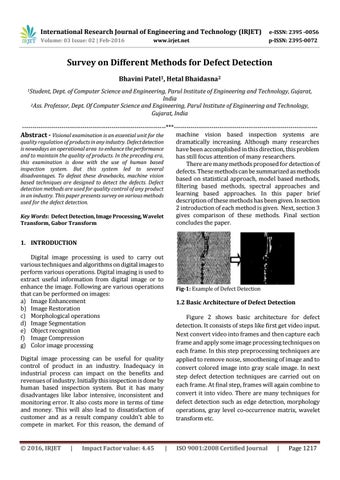
Fig-1: Example of Defect Detection
1.2 Basic Architecture of Defect Detection Figure 2 shows basic architecture for defect detection. It consists of steps like first get video input. Next convert video into frames and then capture each frame and apply some image processing techniques on each frame. In this step preprocessing techniques are applied to remove noise, smoothening of image and to convert colored image into gray scale image. In next step defect detection techniques are carried out on each frame. At final step, frames will again combine to convert it into video. There are many techniques for defect detection such as edge detection, morphology operations, gray level co-occurrence matrix, wavelet transform etc.
Digital image processing can be useful for quality control of product in an industry. Inadequacy in industrial process can impact on the benefits and revenues of industry. Initially this inspection is done by human based inspection system. But it has many disadvantages like labor intensive, inconsistent and monitoring error. It also costs more in terms of time and money. This will also lead to dissatisfaction of customer and as a result company couldn’t able to compete in market. For this reason, the demand of
© 2016, IRJET
|
Impact Factor value: 4.45
|
ISO 9001:2008 Certified Journal
|
Page 1217
International Research Journal of Engineering and Technology (IRJET)
e-ISSN: 2395 -0056
Volume: 03 Issue: 02 | Feb-2016
p-ISSN: 2395-0072
www.irjet.net
Fig-2: Basic Steps of Defect Detection
2. DEFECT DETECTION METHODS
constructed using large sized primitive than this methods shows poor performance [1].
Defect detection methods are mainly categorized in statistical approach, spectral approach and model based approach. These approaches are briefly described as below:
Mathematical Morphology Mathematical morphology takes out useful components from image for the description and representation of regional shape [1]. In this method operations such as erosion, dilation, opening and closing are performed on image using structuring element [1]. The benefit of this method is that it gives response to various defect size and shapes. It is also better for segmentation. It is mostly suitable for unidirectional textures [1].
2.1 Statistical Approach Methods in this approach mainly focus on statistical behavior of different regions of image. Statistical approach describes spatial distribution of gray level by two representations auto-correlation function and co-occurrence matrix [1].
Edge Detection Edge detection techniques are also very effective in detection of defects. The distribution of number of edges is the important feature in texture images. In an image point, line and edge defects can be represented using number of gray level transition in an image [3]. These features can be used to detect defects. But this method has also some drawbacks. This approach is only suitable to plain weave fabric images [3]. With these method defects nearby edges are hard to detect.
Auto-correlation Function Auto-correlation function measures spatial frequency of image and it gives maxima of that frequency at different locations according to the length of repetitive primitive on image. These maxima will be constant for the primitive that has been perfect throughout the image and different for the primitives that are changed and imperfect in replication. As a result those primitives can be considered as defective [1]. This method is mostly used for regular patterned images. It measures regularity and coarseness of pattern. But this method has limitation. It needs reference frame of tonal primitive to carry out analysis of texture.
2.2 Spectral Approach Methods in these approaches are applicable when texture images are composed of reoccurrence of some basic primitive with acceptance of specific rules of displacement [3]. Therefore, spectral approaches are not suitable for the images with random texture features.
Co-occurrence Matrix Co-occurrence matrix is the most widely used method for texture classification. It uses 2D matrices to accumulate various texture features of images such as energy, contrast, entropy, correlation, homogeneity etc [2]. These texture features are characterized as secondorder statistic which is the measure of spatial dependence of gray values for specific distance [1]. This method has some limitations. The size of cooccurrence matrix is important. So number of gray values must be reduced to meet the memory requirements [2]. If the texture features are
© 2016, IRJET
|
Impact Factor value: 4.45
Fourier Transform Fourier transform can be derived from Fourier series. While spatial domain is sensitive to noise and difficult to detect defect, Fourier transform utilizes frequency domain to detect defects [1]. This transform has the properties of noise immunity, optimal characterization of periodic features and translation invariance. Fourier transform can be categorized in two categories: Discrete Fourier transform and Optical Fourier transform. The DFT based approaches are ineffective |
ISO 9001:2008 Certified Journal
|
Page 1218
International Research Journal of Engineering and Technology (IRJET)
e-ISSN: 2395 -0056
Volume: 03 Issue: 02 | Feb-2016
p-ISSN: 2395-0072
www.irjet.net
for the images in which frequency component of defects appear in image are highly mixed with each other in frequency domain. In OFT, defect detection of fabric image is very easy and fast because it is obtained in optical domain by using lenses and spatial filter [3].
In spatial domain, images are filtered out by using gradient filters to extract dots, lines and edges. In this approach first Sobel, Canny, Robert, Laplacian, Daubechies and Law filters are used to measure edge density.
Wavelet Transform
Many other methods use frequency domain filtering approach in the case when there are no straightforward kernels can be found. In this approach image is first transformed to Fourier domain, multiplied with filter function and then again re-transformed to spatial domain [2]. Example of frequency domain filters are Ring filter and Wedge filters.
Wavelet transform is another spectral approach for defect detection. Wavelet represents decomposition of multi-resolution signal. Fourier transforms are sinusoidal whereas wavelet transform are small waves of varying frequency and some specific duration called wavelets. Wavelet transform provides more local support from vertical, horizontal and diagonal direction for any inputted image [1]. The multi-scale wavelet representation has the property of shift invariance and it can detect defects by examining image at different scales.
2.3 Model based Approach Texture is usually considered as a complex pictorial pattern. Any random field in mage can be defined by stochastic model which is modeled by simple function of an array of random variables [1]. This modeling based approach has advantage that it can produced texture that can match the observed texture [3]. Modelbased approaches are mostly suitable to fabric images with stochastic surface variations or for randomly textured fabrics for which the statistical and spectral approaches have not yet shown good results [3]. Model based methods include autoregressive model, fractal model, markov random field model and the Texem model.
Gabor transform The general form of Gabor function is in a nonorthogonal basis set. Gabor filter provides optimal joint localization in both spatial and spatial-frequency domain [1]. The texture features that represent frequency content in local region in spatial domain can be extracted by localized spatial filtering. Gabor filters provide this type of filtering [3]. The implementation of Gabor filter is categorized in two ways [1]:
3. COMPARATIVE METHODS
1) Filter bank consisting group of filters with predetermined parameters in frequency and orientation to adequately cover frequency plane. 2) Implementation of optimal filters with the use of few filters but correct choice for that filters is hard and crucial.
1) Spatial domain filtering which is applied directly on pixels 2) Frequency domain filtering which is based on Fourier transforms. 3) Joint spatial-frequency domain filtering. Impact Factor value: 4.45
DIFFERENT
Table -1: Comparison of various defect detection methods Method Advantages Disadvantages
Filtering technique is used in many applications to filter out image for smoothening of image by suppressing high frequency or for enhancing image by suppressing low frequency. Filtering is performed between image neighborhood and filtering mask [1]. In Filtering approach there are three kinds of methods [2]:
|
OF
Table 1 shows the comparison among the different methods used for the detection of defects in images.
Filtering approach
© 2016, IRJET
STUDY
|
Edge Detection [4]
Identify defects effectively and accurate.
It is not working with various defects other than crack and holes.
Morphological Operations [5]
It gives smooth image with less lightning disturbance.
It is sensitive to defect size and shape.
ISO 9001:2008 Certified Journal
|
Page 1219
International Research Journal of Engineering and Technology (IRJET)
e-ISSN: 2395 -0056
Volume: 03 Issue: 02 | Feb-2016
p-ISSN: 2395-0072
Wavelet Transform [8]
Thresholding [6]
Co-occurrence Matrix [7]
www.irjet.net
Performs better for line defects such as horizontal, vertical and diagonal line defects.
Failed to detect defect in presence of color variance and smooth edges in images.
It selects appropriate threshold value automatically.
Work well only with image to be threshold has clear peek and valleys.
Ability to detect defect which has invariant of luminance.
It can only work with invariant environment condition.
[3] Computer-Vision-Based Fabric Defect Detection: A Survey Ajay Kumar, Member, IEEE, IEEE TRANSACTIONS ON INDUSTRIAL ELECTRONICS, VOL. 55, NO. 1, JANUARY 2008. [4] An Algorithm to Detect and Identify Defects of Industrial Pipes Using Image Processing, Md. Ashraful Alam, M MNaushad Ali, Musaddeque Anwar AI-Abedin Syed, Nawaj Sorif, Md. Abdur Rahaman, 978-1-47996399-7114/$31.00 ©20 14 IEEE. [5] Fabric Defect Detection Algorithm Using Morphological Processing and DCT, Mahmoud Abdel Aziz, Ali S. Haggag and Mohammed S. Sayed, Dept. of Electronics and Communications Engineering, Zagazig University, Zagazig, Egypt, 978-1-4673-2821-0/13/$31.00 ©2013 [6] Metal Surface Defect Detection using Iterative thresholding Technique, M.Senthikumar, Dr.V.Palanisamy, Dr.J.Jaya, 2nd International Conference on Current Trends in Engineering and Technology, ICCTET’14, © IEEE 2014.
More demanding in terms of computational and memory requirement.
[7] Fabric defect detection based on GLCM and Gabor filter: A comparison, Jagdish Lal Raheja, Sunil Kumar, Ankit Chaudhary, Optik 124 (2013) 6469– 6474.
4. CONCLUSIONS
[8] Fabric Defect Detection using Wavelet Filter, Mr. Vaibhav V. Karlekar, Prof. M.S.Biradar & Mr. K.B.Bhangale, 2015 International Conference on Computing Communication Control and Automation, 978-1-4799-6892-3/15 $31.00 © 2015 IEEE.
In this paper, survey of various methodologies for detection of defects is presented. These methods can be classified into three categories: statistical, spectral and model based approach. A brief description of these method including advantages and disadvantages is given wherever known. The statistical, spectral and model based approaches give different results. So the combination of these approaches can give better result instead of using individual approach. REFERENCES [1] Automated fabric defect detection—A review, Henry Y.T. Ngan, Grantham K.H. Pang , Nelson H.C. Yung, Image and Vision Computing 29 (2011) 442–458. [2] A Review of Recent Advances in Surface Defect Detection using Texture analysis Techniques, Xianghua Xie, Department of Computer Science, University of Wales Swansea, Swansea SA2 8PP, United Kingdom, Electronic Letters on Computer Vision and Image Analysis 7(3):1-22, 2008
© 2016, IRJET
|
Impact Factor value: 4.45
|
ISO 9001:2008 Certified Journal
|
Page 1220