International Research Journal of Engineering and Technology (IRJET)
e-ISSN: 2395 -0056
Volume: 03 Issue: 02 | Feb-2016
p-ISSN: 2395-0072
www.irjet.net
Electromyogram Signals for Multiuser Interface- A Review Sanjyot Burhade1, Prof. A.B.Kanwade2 1PG Student, Dept of E&TC Engineering, Sinhgad Institute of Technology and Science Pune Professor A.B. Kanwade, Dept. of E&TC Engineering, Sinhgad Institute of Technology and Science Pune, Maharashtra, India.
---------------------------------------------------------------------***---------------------------------------------------------------------
Abstract - An inability to adapt myoelectric interface for
analysis of the signal like estimation of phase, mean value of signal, average value of signal, variance, acquiring the exact information the signal and eliminating the various noises in the signal. There are various types of noise associated with the EMG signal like the inherent noise and recording of the equipment, and it cannot be eliminated. Ambient noise is due to the wires, electric bulbs etc. Another factor is the inherent instability of the signal.
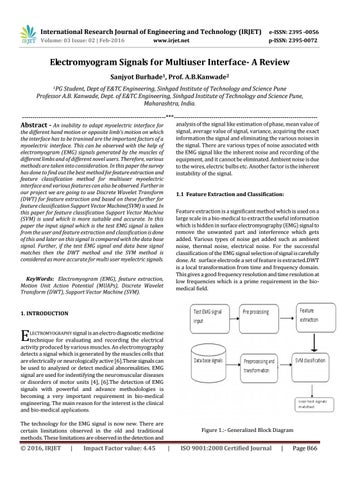
the different hand motion or opposite limb’s motion on which the interface has to be tranined are the important factors of a myoelectric interface. This can be observed with the help of electromyogram (EMG) signals generated by the muscles of different limbs and of different novel users. Therefore, various methods are taken into consideration. In this paper the survey has done to find out the best method for feature extraction and feature classification method for multiuser myoelectric interface and various features can also be observed. Further in our project we are going to use Discrete Wavelet Transform (DWT) for feature extraction and based on these further for feature classification Support Vector Machine(SVM) is used. In this paper for feature classification Support Vector Machine (SVM) is used which is more suitable and accurate. In this paper the input signal which is the test EMG signal is taken from the user and feature extraction and classification is done of this and later on this signal is compared with the data base signal. Further, if the test EMG signal and data base signal matches then the DWT method and the SVM method is considered as more accurate for multi user myelectric signals.
1.1 Feature Extraction and Classification: Feature extraction is a significant method which is used on a large scale in a bio-medical to extract the useful information which is hidden in surface electromyography (EMG) signal to remove the unwanted part and interference which gets added. Various types of noise get added such as ambient noise, thermal noise, electrical noise. For the successful classification of the EMG signal selection of signal is carefully done. At surface electrode a set of feature is extracted.DWT is a local transformation from time and frequency domain. This gives a good frequency resolution and time resolution at low frequencies which is a prime requirement in the biomedical field.
KeyWords: Electromyogram (EMG), feature extraction, Motion Unit Action Potential (MUAPs), Discrete Wavelet Transform (DWT), Support Vector Machine (SVM).
1. INTRODUCTION
E
LECTROMYOGRAPHY signal is an electro diagnostic medicine
technique for evaluating and recording the electrical activity produced by various muscles. An electromyography detects a signal which is generated by the muscles cells that are electrically or neurologically active [6].These signals can be used to analyzed or detect medical abnormalities. EMG signal are used for indentifying the neuromuscular diseases or disorders of motor units [4], [6].The detection of EMG signals with powerful and advance methodologies is becoming a very important requirement in bio-medical engineering. The main reason for the interest is the clinical and bio-medical applications. The technology for the EMG signal is now new. There are certain limitations observed in the old and traditional methods. These limitations are observed in the detection and
© 2016, IRJET
|
Impact Factor value: 4.45
Figure 1.:- Generalized Block Diagram
|
ISO 9001:2008 Certified Journal
|
Page 866
International Research Journal of Engineering and Technology (IRJET)
e-ISSN: 2395 -0056
Volume: 03 Issue: 02 | Feb-2016
p-ISSN: 2395-0072
www.irjet.net
1.2 EMG Analysis:
techniques such as Independent Component Analysis (ICA) is used. The main disadvantage of this ICA algorithm is that they do not compute with the task of extracting the underlying sources from a single-channel EMG measurement. The ensemble empirical mode decomposition algorithm decomposes the single-channel EMG signal into a set of noise-canceled intrinsic mode functions, which are then separated by the fast ICA algorithm. Then this reduced set of extracted features is classified by the linear discriminate analysis.
Traditionally the EMG signals were analyzed in time domain only. Now, with the help of advance techniques and algorithm the EMG signals are analyzed in both time and frequency domains [14]. In time domain the maximum amplitude (MAX), Standard Deviation (SD), Root Mean Square (RMS) these values are calculated. The features in time domain is the non-stationary property of the EMG signal, changes in statistical property over time this is the main disadvantage. Some frequency domain techniques are mean and median frequency this can be determine with the help of fast Fourier transform but detailed analysis cannot be obtained. Also wavelet transform can analyze non-periodic and non-stationary signal [12].It can also compute different time-domain signals at different frequencies. It is a type of signal which gives the frequency content of the signal at a particular instant of time.
In 2014 [6], Tahereh kamali, Reza Boostani and Hosseni Parsaei studied that the time domain features and the time frequency domain features were used to represent an each Motion Unit Action Potential (MUAP). The time domain features for the MUAP which were extracted was rise time, duration, spike duration, peak-to-peak amplitude, area, phase, peak to peak sample number etc. For this the SVM (Support Vector Machine) classifier is used. And the frequency features of the MUAPs were extracted by using Discrete Wavelet Transform (DWT) technique.
2. Survey of Work Done:
In 2014 [4],A.B.M.S.U Doulah, S.A. Fattah used two schemes for neuromuscular diseases classification from EMG signals are proposed based on the Discrete Wavelet Transform (DWT) features. In the first scheme, a few high energy DWT coefficients along with the maximum value are extracted in a frame by frame manner from the given EMG data. In the second scheme, motor unit action potentials (MUAPs) are first extracted from the EMG data via template matching based decomposition technique. A feature extraction scheme is based on some stastical properties of the DWT coefficients of dominant MUAPs is proposed. For the purpose of classification, the K-nearest neighborhood (KNN) classifier is employed.
In 2009 [5],Yuse Horiuchi and Toshiharu Kishi investigate whether it is possible to associate the around-shoulder muscle activities with the motions of hand and direction of arm movements. Through the analysis it turned out clearly that it is possible to distinguish the motion direction of arm and the hand grip motion from the around shoulder muscle activities. Moreover the appropriate combination of muscle sites improved the discrimination of the muscle. For this a classifier based on K-means was used. This method calculates the distance between an input vector and the center of gravity of clusters. In 2011 [8], John A. Spanias, Eric J. Perreault used myoelctric pattern recognition algorithm for the control of powered lower limb prostheses, but EMG signal disturbances remained an obstacle to clinical implementation. Linear Discriminate classifier that uses the log likelihood to decide between using the combination of EMG and mechanical sensors or using mechanical sensors only, to predict locomotion modes. When EMG signals contained disturbances our classifier was able to detect those disturbances and disregard EMG data. The log likelihood threshold could also be applied to individual EMG channels.
In 2014 [7], Paul McCool, Graham D. Fraser, studied the new methods for the automatic identification of commonly occurring contaminant types is typically not known in advance. So for this the Support Vector Machine (SVM) is used as the main classification system. Contamination identification is performed through pattern classification using support vector machine. The feature extraction process involved quantifying the contamination in the EMG signals using different methods.
In 2013 [11], Ganesh R. Naik, S. Easter Selvan and Hung T. Nguyen had done the analysis of the EMG signals foe the neuromuscular disorders, prosthesis and other related applications. Since the measured signals are the mixture of the mixtures of the electric potentials that enemata from the surrounding muscles. For this the EMG signal processing
© 2016, IRJET
|
Impact Factor value: 4.45
In 2015 [3], Adenike A. Adewuyi analyzed a combination of four EMG time-domain features (mean, absolute value, number of zero-crossing, waveform length) and a coefficients of a autoregressive model were extracted from each EMG channel. For this the Linear Discriminate Analysis
|
ISO 9001:2008 Certified Journal
|
Page 867
International Research Journal of Engineering and Technology (IRJET)
e-ISSN: 2395 -0056
Volume: 03 Issue: 02 | Feb-2016
p-ISSN: 2395-0072
www.irjet.net
(LDA) is used for the analysis. The combination of time domain and autoregressive features has been used extensively.
Analysis
In 2015 [10], Kishor Koriala, Meera Dasog, Pu Liu and Edward A. Clancy developed the EMG pattern recognition to interpret the performance of different functional movements. Suitable features in the time domain are extracted from three different hand movements i.e. elbow, wrist and arm by using a pair of Ag/Agcl surface electrodes on the right and the left anthebrachium. Recognition accuracy for similar movements is more than 95% and for different movements is also more than 93%-97%.
4.
5.
sources from a single-channel EMG measurement.
Discrete Wavelet Transform
Support vector Machine
Time domain and frequency domain are used to represent each MUAP.
Discrete Wavelet Transform
KNN(nearest neighborhood)
A high energy DWT coefficients along with the maximum value are extracted
Pattern Classification
Support Vector Machine
Feature extraction process involved quantifying the contamination in the EMG signals.
autoregressive model
Linear Discriminate
Time domain and autoregressive features combination has been used extensively.
3. Conclusion and Discussion
It is need to find out the easy technique to perform and physiologically accurate method for the EMG signals. New techniques have been developed for the feature extraction and the feature classification technique. Here various feature extraction technique survey is done and the one suitable for the extraction of multiuser features is the Discrete Wavelet Transform technique as both the time domain as well as the frequency domain features can be extracted for non-periodic and stationary signals. For the classification technique Support Vector Machine is used.
6.
Table -1: Comparison of Feature Extraction Technique and Classification.
Sr.No
1.
2.
3.
Survey Work Done Feature Feature Classification Extraction Method Method
7.
Remarks
Motion of hands and direction of muscle
K-means classifier
Calculates the gravity of clusters.
Pattern Recognition Algorithm
Linear Discriminate
Able to detect the disturbances in the EMG signal.
REFERENCES
They do not compute extracting the
[1] M. Jahan, Munish Manas, Bharat BhushanSharma,etal(A Central University) New Delhi,India Department of Energy ”Feature Extractionand Pattern Recognition of EMG based
Independent Component
© 2016, IRJET
|
Linear Discriminate
Impact Factor value: 4.45
8.
|
Pattern Recognition System
ISO 9001:2008 Certified Journal
For this method accuracy is more than 95%
|
Page 868
International Research Journal of Engineering and Technology (IRJET)
e-ISSN: 2395 -0056
Volume: 03 Issue: 02 | Feb-2016
p-ISSN: 2395-0072
www.irjet.net
Signal for Hand Movements”. [2] Meena AbdelMaseeh, Tsu-Wei Chen, and Daniel Stashuk,”Extraction and Classification of Multichannel Electromyography Activation Trajectories for Hand Movement Recognition”, IEEE Transactions on Neural Systems and Rehabilitation Engineering, VOL.3, NO 5.2015.
Rehabilitation Engineering, VOL. 22, NO. 5, SEPTEMBER 2014. [10] Kishor Koirala, Meera Dasog, Pu Liu, and Edward A. Clancy, “Using the Electromyogram to Anticipate Torques about the Elbow”, IEEE Transaction on Neural System and Rehabilitation Engineering,
[3] Adenike A. Adewuyi, Student Member, IEEE, Levi J. Hargrove”An Analysis of Intrinsic and Extrinsic Hand Muscle EMG for Improved Pattern Recognition Control”, IEEE Transactions on Neural Systems and Rehabilitation Engineering, VOL.2, NO 8.2015.
[11] Ganesh R. Naik, S. Easter Selvan, and Hung T. Nguyen“Single-Channel EMG Classification With EnsembleEmpirical-Mode-Decomposition-Based ICA for Diagnosing Neuromuscular Disorders”, IEEE Transaction on Neural System and Rehabilitation Engineering, VOL. 22, NO. 5, SEPTEMBER 2015
[4] A. B. M. S. U. Doulah, Student Member, IEEE, S. A. Fattah, Member, IEEE, W.-P. Zhu, Senior Member, IEEE, and M. O. Ahmad, Fellow, “Wavelet Domain Feature Extraction Scheme Based on Dominant Motor Unit Action Potential of EMG Signal for Neuromuscular Disease Classification”, IEEE Transaction on Biomedical Circuits and Systems, VOL.8, NO. 2, APRIL 2014.
[12] Shahid S. Higher Order Statistics Techniques Applied to EMG Signal Analysis and Characterization. Ph.D. thesis, University of Limerick; Ireland, 2004.
[5] Yuse Horiuchi, Toshiharu Kishi, Jose Gonzalez Student Member, andWenwei Yu, Member, IEEE,”A Study on Classification of Upper Limb Motions from Around-Shoulder Muscle Activities”,2009 IEEE 11th International Conference on Rehabilitation Robotics Kyoto International Conference Center, Japan, June 23-26, 2009.ELECTROMYOGRAM SIGNALS FOR MULTIUSER MYOELECTRIC INTERFACES [6] Tahereh Kamali, Reza Boostani, and Hossein Parsaei,”Multi-Classifier Approach to MUAP Classification for Diagnosis of Neuromuscular Disorders”, IEEE Transaction on Neural System and Rehabilitation Engineering, VOL. 22, NO. 1, JANUARY 2014. [7] Paul McCool, Graham D. Fraser, Member, IEEE,”Identification of Contaminant Type in Surface Electromyography (EMG) Signals”, IEEE Transaction on Neural System and Rehabilitation Engineering, VOL. 22, NO. 4, JULY 2014. [8] John A. Spanias, Eric J. Perreault,”Detection of and Compensation for EMG Disturbances for Powered Lower Limb Prosthesis Control”, IEEE Transactions on Neural Systems and Rehabilitation Engineering. [9] Rui Sun, Rong Song, Kai-yu Tong, “Complexity Analysis of EMG Signals for Patients After Stroke During Robot-Aided Rehabilitation Training Using Fuzzy Approximate Entropy”,IEEE Transaction on Neural System and
© 2016, IRJET
|
Impact Factor value: 4.45
|
ISO 9001:2008 Certified Journal
|
Page 869