International Research Journal of Engineering and Technology (IRJET)
e-ISSN: 2395 -0056
Volume: 03 Issue: 10 | Oct -2016
p-ISSN: 2395-0072
www.irjet.net
PERFORMANCE ANALYSIS OF DISCRETE ANAMORPHIC STRETCH TRANSFORM IN IMAGE COMPRESSION SYSTEM V.LAKSHMI SOWJANYA1, T.VISHNU PRIYA2 1P.G Student,Department of Electronics and Communication Engineering,SRKIT,Vijayawada,India 2Assistant Professor ,Department Of Electronics And Communication Engineering,SRKIT,Vijayawada,India
---------------------------------------------------------------------***---------------------------------------------------------------------
Abstract - To compact with the exponential increase of
(i) a low resolution, TV quality, color video image which has 512 x 512 pixels/color,8 bits/pixel, and 3 colors approximately consists of 6 x 10⁶ bits;(ii) a 24 x 36 mm negative photograph scanned at 12 x 10⁻⁶mm:3000 x 2000 pixels/color, 8 bits/pixel, and 3 colors nearly contains 144 x 10⁶ bits; (3) a 14 x 17 inch radiograph scanned at 70 x 10⁻⁶mm: 5000 x 6000 pixels, 12 bits/pixel nearly contains 360 x 10⁶bits.Thus storage of even a few images could cause a problem. As another example of the need for image compression ,consider the transmission of low resolution 512 x 512 x 8 bits/pixel x 3-color video image over telephone lines. Using a 96000 bauds(bits/sec) modem, the transmission would take approximately 11 minutes for just a single image, which is unacceptable for most applications.
digital data, new compression technologies are needed for more efficient information. This paper introduces a physicsbased transform that enables image compression by increasing the spatial coherency.In this paper, performance analysis of discrete anamorphic stretch transform in image compression system is presented and the analysis is done for parameters. The proposed method also presents the Stretched Modulation Distribution with a new density function in image compression. Experimental results show encrytion and decryption using the proposed method improved the performance of JPEG 2000 format.
Key Words: Anamorphic transform, spatial coherency, image compression, physics based data compression, warped stretch transform,encryption, decryption.
2. REVIEW OF PREVIOUS METHOD:DISCRETE ANAMORPHIC STRETCH TRANSFORM
1.INTRODUCTION
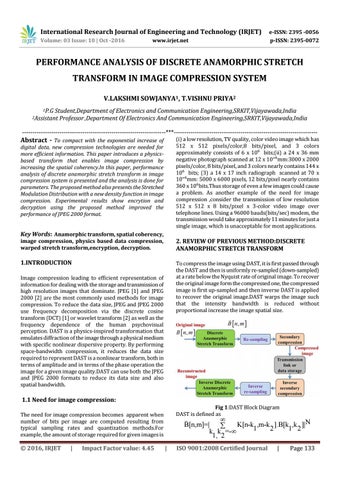
To compress the image using DAST, it is first passed through the DAST and then is uniformly re-sampled (down-sampled) at a rate below the Nyquist rate of original image. To recover the original image form the compressed one, the compressed image is first up-sampled and then inverse DAST is applied to recover the original image.DAST warps the image such that the intensity bandwidth is reduced without proportional increase the image spatial size.
Image compression leading to efficient representation of information for dealing with the storage and transmission of high resolution images that dominate. JPEG [1] and JPEG 2000 [2] are the most commonly used methods for image compression. To reduce the data size, JPEG and JPEG 2000 use frequency decomposition via the discrete cosine transform (DCT) [1] or wavelet transform [2] as well as the frequency dependence of the human psychovisual perception. DAST is a physics-inspired transformation that emulates diffraction of the image through a physical medium with specific nonlinear dispersive property. By performing space-bandwidth compression, it reduces the data size required to represent DAST is a nonlinear transform, both in terms of amplitude and in terms of the phase operation the image for a given image quality.DAST can use both the JPEG and JPEG 2000 formats to reduce its data size and also spatial bandwidth.
1.1 Need for image compression: Fig 1:DAST Block Diagram DAST is defined as
The need for image compression becomes apparent when number of bits per image are computed resulting from typical sampling rates and quantization methods.For example, the amount of storage required for given images is
© 2016, IRJET
|
Impact Factor value: 4.45
B[n,m]=| K[n-k ,m-k ].B[k ,k ]|N 1 2 1 2 k k =- 1, 2
|
ISO 9001:2008 Certified Journal
|
Page 133
International Research Journal of Engineering and Technology (IRJET)
e-ISSN: 2395 -0056
Volume: 03 Issue: 10 | Oct -2016
p-ISSN: 2395-0072
www.irjet.net
where is || the absolute operator. For DAST operation, the original image is convolved with DAST Kernel , and then the N-th power magnitude of the result is computed.The Kernel is described by a nonlinear phase operation,To compress the image, the nonlinear phase profile should be chosen such that DAST applies a spatial warp to the image with a particular profile. To describe the applied warp, we define the DAST Local Frequency (LF) profile as the 2D spatial gradient (derivative) of the DAST Kernel phase function. LF is the equivalent of time domain instantaneous frequency but in 2D spatial domain.
coherence and reduces the amount of data needed to represent the image. An example of the phase function is shown in Fig. 3. The slope of the LF profile at the origin (related to and ) determines the amount of intensity bandwidth compression. After the proper choice of and , the resulting spatial image size is related to the warping strength (related to and ). After the anamorphic transform with proper phase profile the brightness bandwidth is compressed (the coherence increased). The transformed image can now be re-sampled at a lower rate without losing information given by the amount of brightness bandwidth compression after DAST. The compressed image including the re-sampled transformed image and its filtered one using the discriminator kernel (described below) along with the data , and re-sampling factor is sent to the transmission channel or storage device. We note that only five parameters (real numbers) are required for reconstruction, resulting in negligible data overhead. The algorithm can also be combined with vector quantization [19] and entropy encoding to further reduce the image data size. Also, the resampled image can be compressed further by a secondary compression, e.g. JPEG or JPEG 2000. For application to color images the DAST image compression is applied to each of the constituent color components.
Fig2 :streched modulation distribution
3.PROPOSED METHOD Different steps for implementation of DAST for application to image compression are shown in Fig. 1. To encrypt and compress the image using our method, it is first passed through the DAST and then encryption is done . after the encryption, the encrypted image is comprssed.
Fig. 4:Analysis of Discrete Anamorphic Stretch Transform (DAST) effect onLena image.
4.FLOWCHART FOR PROPOSED METHOD Flowchart shows that how DAST with encryption and decryption can change the values of parameters Mean square error, peak to signal ratio, normalized cross correlation, average difference, structural content, maximum difference, normalized absolute error.
Fig3:block diagram of proposed method. To recover the original image from the compressed one, the compressed image is decompressed and the decompressed image is decrypted .and then inverse DAST is applied to recover the original image. DAST warps the image such that the intensity bandwidth is reduced without proportional increase the image spatial size. This increases the spatial
© 2016, IRJET
|
Impact Factor value: 4.45
|
ISO 9001:2008 Certified Journal
|
Page 134
International Research Journal of Engineering and Technology (IRJET)
e-ISSN: 2395 -0056
Volume: 03 Issue: 10 | Oct -2016
p-ISSN: 2395-0072
www.irjet.net
Fig6(b):encrypted image
Fig6(c):compression after encryption
Fig 5:flowchart of propsed model
5.EXPERIMENTAL RESULTS In this section, we study an example to show the effect of DAST on images. We also examine the proposed image compression method and compare it to JPEG 2000 image compression format. The phase and Local Frequency (LF) profiles of the DAST Kernel for the examples presented are shown in Fig. 6(a).
Fig6(d): decrypted image
Fig6(a):original image
© 2016, IRJET
|
Impact Factor value: 4.45
Fig6(e): reconstructed image
|
ISO 9001:2008 Certified Journal
|
Page 135
International Research Journal of Engineering and Technology (IRJET)
e-ISSN: 2395 -0056
Volume: 03 Issue: 10 | Oct -2016
p-ISSN: 2395-0072
www.irjet.net
7. CONCLUSIONS
The parameters in these plots are normalized to the dimensions of the image in each case. We first study the effect of DAST on gray-scale Lena image512X512 with pixels with 8 bits/pixel accuracy in TIF format.To understand how the image data is compressed, in Fig. 6(b) we compare the auto-correlation of the original image with the transformed image. As it can be seen, the autocorrelation is broadened leading to increased spatial coherence andreduced spatial intensity bandwidth (Fig. 6(c)). This is done without an image spatial size increase, i.e. the original and transformed images have the same 512X512 pixels with 8 bits/pixel accuracy. The reduced spatial bandwidth (increased coherence) allows one to re-sample the transformed image at the lower rate,to achieve compression. However, it should be noted that compression is not merely obtained from the re-sampling, but ratherfrom the increase in correlation caused by the reshaping.
In this project, it is shown that how DAST pre-encryption and compression can improve the performance of JPEG for high compression factor and high PSNR. And also shown how image compression is done using DAST pre- encryption and compression followed by JPEG.The DAST method can be to extend to digital compression for Big Data as Big Data can present big problems, especially in fields where the events being studied happen at rates that are too fast to be sampled and converted into digital data in real time.
REFERENCES [1].Discrete Anamorphic Transform for Image Compression Mohammad H. Asghari, Member, IEEE, and Bahram Jalali, Fellow, IEEE [2] W. B. Pennebaker and J. L. Mitchell, JPEG still image data compression standard, 3rd ed. Berlin, Germany: Springer, 1993. [3] A. Skodras, C. Christopoulos, and T. Ebrahimi, “The JPEG 2000 still image compression standard",” IEEE Signal Process. Mag., vol. 18, pp. 36–58, 2001. [4] E. J. Candes and M. B. Wakin, “An introduction to compressive sampling,” IEEE Signal Process. Mag., vol. 25, pp. 21–30, 2008. [5] R. Baraniuk, “Compressive sensing,” IEEE Signal Process. Mag., vol. 24, pp. 118–121, 2007. [6] M. Lustig, D. Donoho, and J. M. Pauly, “Sparse MRI: The application of compressed sensing for rapid MR imaging,” Magn. Reson. Med.,vol. 58, pp. 1182–1195, 2007. [7] J. Mait, R. Athale, and J. Gracht, “Evolutionary paths in imaging and recent trends,” Optics Exp., vol. 11, pp. 2093– 2101, 2003. [8] A. Ashok, P. Baheti, and M. A. Neifeld, “Compressive imaging system design using task-specific information,” Appl. Opt., vol. 47, pp. 4457–471, 2008. [9] A. Oppenheim and D. Johnson, “Computation of spectra with unequalresolution using the fast fourier transform,” Proc. IEEE, vol. 59, pp. 299–301, 1971. [10] N. I. Cho and S. K. Mitra, “Warped discrete cosine transform and its application in image compression,” IEEE Trans. Circuits Syst. Video Technol., vol. 10, pp. 1364–1373, 2000. [11] L. R. Rabiner, R. W. Schafer, and C. M. Rader, “The chirp z-transformalgorithm and its applications",” Bell Syst. Tech. J., vol. 48, pp.
6. Analysis Of Different Parameters In DAST Table 1:analysis of parameters Parameters
Mean square error
Peak signal to noise ratio
Normalized cross correlation
Average difference
Structural content
Encryption
Compressed
4.1720
6.9038
18.4312
Decompressed
Decryption
5.3782
1.6941
16.4333
21.7084 17.4346
0.7370
0.6229
0.6864 0.8273
39.6369
32.4349
31.9798
19.4540
2.3263
2.6746
2.4293
2.2610
208
172
0.4891
0.3231
203
Maximum difference
184
Normalized absolute error
0.4408
0.5183
© 2016, IRJET
|
Impact Factor value: 4.45
|
ISO 9001:2008 Certified Journal
|
Page 136