Optimizing Task Scheduling in Mobile Cloud Computing Using Particle Swarm Optimization (PSO) Algorithm
 Shouaib Scander1 , Souheil Khawatmi2 , Yaser Fawaz 3
1pursuing a M. S. System and Computer Networks at the Faculty of Informatics Engineering, University of Aleppo, Syria.
2associate professor at the Faculty of Informatics Engineering, University of Aleppo, Syria.

3associate professor at the Faculty of Informatics Engineering, University of Aleppo, Syria. ***
Abstract - Cloud computing is a modern type of shared infrastructure that could interconnectlargegroupsofsystems and allows user to connect via the Internet. The term cloud is an expression used to refer to the internet and The Internet is the basis on which cloud computing depends. One of the most necessary requirements in cloud computing system is task scheduling, which plays a mainroleintheperformanceofeach part of cloud computing equipment. Task scheduling determines tasks that need to be sent to the appropriate virtual device to meet user-defined quality of service (QoS) constraints such as completion time and cost in cloud. In our paper, we have proposed a comprehensive multi-purposetask scheduling optimization model which reduces task transmitting time, execution time and cost. The proposed model is built based on Particle Swarm Optimization (PSO), and the implementation results offer that the new proposed model is more dynamic in speeding up tasks execution and decreasing costs.
Key Words: Offloading, Mobile Cloud Computing, Tasks Scheduling,ParticleSwarmOptimization(PSO)
1.INTRODUCTION
Cloudcomputingisanewtypeofcomputingthatprovides applications, data and all computer services dynamically over the internet [1]. Now it has become one of the most important fields of information technology. Organizations thatneedadditionalresourcestodeveloptheirdatacenters rent these resources from the cloud computing system insteadofpurchasingthoseresourcesandpayaccordingto theiruseoftheseadditionalresources[2].
Manyapplicationsrequirepowerfulcomputingdevicesand consumetoomuchenergy.Therefore,itisnotagoodideato run such applications on constrained-resources devices, suchasmobiledevices,sincetheyhavelimitedcomputing power and battery life [3]. To handle this situation, researchersproposedtasksoffloadingtoruntheresourcehungryapplicationsonthecloud[4].
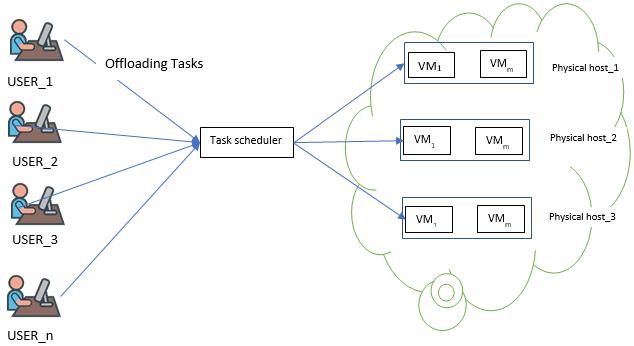
Offloading is a technology by which large applications or partsofthemi.e.,tasksonlocaldevices,aresenttothecloud torunthere,asshowninFigure1.Then,theresultsaresent backtotheenddevices,thus,theoffloadingprocessreduces
theexecutiontimeandpowerconsumptionofanytaskrun onmobiledevices[5].
Althoughcloudcomputingprovidesmanyservices,thereare manyproblems withit.one oftheseproblems,scheduling tasks that is one of the most critical problems due to the needtoestablishasuitablesequencetodividethesetasks [6].Therefore,cloudcomputingusesschedulingalgorithms to assign confirmed tasks to nominated resources at an accurate time [7], mostly focused on cloud performance optimization which is bandwidth, memory and time discount.
Tasksschedulingare splitintotwo parts:oneisusedasa unifiedschedulerfortheresourcegathering,fundamentally responsibleforschedulingcloudAPIsandapplications,and theotheroneisforschedulingunifiedportresourcesinthe cloud such as task scheduler. [8].In this field, some researchers have published papers on the problem of scheduling tasks to get better performance using most optimization methods. The aim of these papers was to reducecost,responsetime,uptimeandresourceusage[9].
The rest of this paper is organized as follows: section II presents Research motivation. section III presents Background and related works. section IV presents Mathematical models. section V presents Implementation and performance evaluation. section VI Conclusion and futurework.
© 2023, IRJET | Impact Factor value: 8.226 | ISO 9001:2008 Certified Journal | Page864
Journal of Engineering and Technology (IRJET) e-ISSN: 2395-0056
Figure 1:Taskscheduling-basedcloudscheme
International Research
p-ISSN:
Volume: 01 Issue: 04 | Apr 2023 www.irjet.net
2395-0072
2. Research motivation
In cloud computing, there are a large number of virtual devices that have different processing and storage capabilities.Therefore,thecloudusagedependsontheability ofthevirtualmachinestoprocess,store,transmitthedata, takingintoaccountthemaintenanceofhardwareandcloud resourcesconsumption[6].
Optimizingperformanceandresourceusagehasaninverse relationshipi.e.,increasingresourceusageleadstowaiting timeandthusreducingdeviceperformanceonthecloud[9].
Therefore, to achieve the maximum use of resources and withoutaffectingperformance,resourcesshouldbeallocated efficientlySimultaneouslytoachievecommongoalsbetween consumersandserviceproviders[10].
AsshowninFigure2,therearesomeoftaskswithnumber (n)andagroupofvirtualdevices(m).Anytaskcanbecarried outbyanyvirtual devices.Inourpaper,wetrytofind the bestsolutionfordistributingtasksonvirtualdevicesinorder toreducetheexecutiontimeandcostofthetask.
3.2. Particle swarm optimization algorithm:
Itisoneofthedynamicschedulingalgorithms,andswarm intelligence is one of the branches of artificial intelligence thatstudiesthecollectivebehaviorofseveralcomponents, widelyusedinsolvingoptimizationproblems[15].
ThealgorithmofParticleSwarmOptimizationbelongstothe classofswarmintelligencetechniques,inwhichobtainingthe optimalsolutionisdonebysimulatingthebehaviorofbirds while searching for food [16]. Therefore, any system that depends on this algorithm will initially be formed from a random pool of random solutions. Then, the algorithm searchesfortheoptimalsolutionwithinthisassembly.
Inourmodel,wecalleverysolutiona"bird"inthesearch field"particle",andevery"particle"have"fitness"valuesthat arecalculatedusing"fitnessfunction"inordertoreachthe optimalsolution.
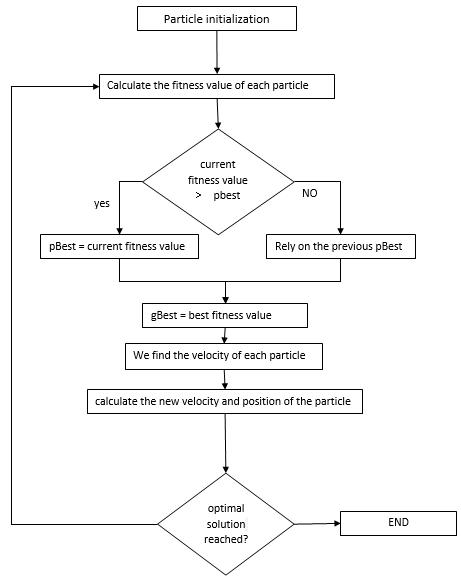
Thealgorithm,asillustratedinFigure3,isinitializedwitha set of random birds (solutions). After that, the optimal solution is searched by updating the generations. In each cycle, each bird is updated depending on the following variables:
1. The best "Fitness" this bird has reached, which is alwaysbestoredas"Pbest"
2. The best fitness thisswarmhas reached,calledas "Gbest".
3. The value of the bestlocal positioning ofthis bird comparedtotheneighboringbirds,calledas"Ibest".
Afterselectingthebestvalueof"Gbest",thebirdchanges itsspeedandpositionfollowingthesetwoequations:
3. Background and related works
3.1 Task scheduling algorithms in the cloud:
As shown in TABLE I, task scheduling algorithms are classifiedintothetwocategories:
1. Staticschedulingalgorithms:Algorithmsofthistypeare considered simple compared to dynamic algorithms. They depend on the previous known information of thesystem, andtheydonotconsiderthecurrentstateofdevicesonthe cloudserver,astheyonlydividetasksonvirtualdevicesin thecloudserver[11].
2. Dynamicschedulingalgorithms:thesealgorithmsdonot considerthesystem'spreviousknowninformationbutrather thevirtualdevicescurrentstate.Tasksaredistributedtothe virtual machines according to their current computational ability[11].
V[]=v[]+C1*rand()*(Pbest[]-present[])+C2*rand()*(Gbest[]present[]) (1)
Present[]=present[]+v[] (2)
WhereV[]isthespeedofthebird, Pbest[]andGbest[] are randomnumbersbetween(0and1),C1 andC2 arelearning factors (generallyC1 =C2 =2),andPresent[]isthecurrent bird.
© 2023, IRJET | Impact Factor value: 8.226 | ISO 9001:2008 Certified Journal | Page865
Figure 2:Assigningtaskstovirtualmachines
{T1,T2,…….,Tn} VM1 VM2 VMm International Research Journal of Engineering and Technology (IRJET) e-ISSN: 2395-0056
01 Issue: 04 | Apr 2023 www.irjet.net p-ISSN: 2395-0072
Volume:
TABLE I: A COMPARISON OF TASKS SCHEDULING ALGORITHMS
Algorithms Methodology Advantages Disadvantages
GA[12] Itisoneofthe algorithmsthat dependsonasetof randomlygenerated solutions
ACO[13] Itisoneofthe SwarmIntelligence, Atechniquefor processing computationaltasks bysearchingthe shortestpath
FCFS(first comefirst serve)[14]
SJF(shortest jobfirst)[14]
Theorderoftasksin thealgorithm dependsonthe networklatency.
Thealgorithmreducesthe searchspace.
Thealgorithmconsumesagood amountoftimewhenthesearchspace isrelativelylargebecauseitis executingalargenumberofiterations
Theantcolonyalgorithmis basicallyadistributed parallelalgorithmanditis powerfulandeasyto integratewithother methods.
•Simpleandpopulartask schedulingalgorithm
•Morejusticethanother schedulingalgorithms
•ItdependsonFIFO.
Antcolonyalgorithmhasslow convergencespeed,longcomputation time
•Thewaitingtimefortasksis relativelylarge.
•Itdoesnotgiveimportancetoany task,i.e.,ifatthebeginningofthe queuethereisalargetask,alltasks willwaitalongtime.
•Itdoesnotutilizeresourcesinan optimalway.
Tasksarearranged accordingtotheir priority,where priorityisset dependingonthe lengthofthetask (smalltask=high priority).
MAX-MIN[14] Thetasksare classifiedaccording tothetimerequired toexecute,asthe tasksthatrequirea considerable executiontimeare executedfirst.
Averagewaitingtimeis lessthanotheralgorithms.
Largeturnaroundtimeforlargetasks, andtheworstcaseisthatthewaiting timeforalargetaskisinfinite.
optimalinvestigationof resourcesand The performanceoftheMAXMINalgorithmisbetter thanlastalgorithms.
Waitingtimeforsmalltasksis relativelylarge.
International Research Journal of Engineering and Technology (IRJET) e-ISSN: 2395-0056 Volume: 01 Issue: 04 | Apr 2023 www.irjet.net p-ISSN: 2395-0072 © 2023, IRJET | Impact Factor value: 8.226 | ISO 9001:2008 Certified Journal | Page866
4. Mathematical models:
First,wewillstartbydefiningasetofsymbolsnecessaryto buildamathematicalmodelforschedulingtasks,asfollows: Figure 3: FlowchartofthealgorithmPSO
1. nrepresentsthenumberoftaskswillbeprocessed
2. ��={T1,T2,…,Tn }representstask "t " with index " i " where " i " between{1}and{n}.

3. mrepresentsthenumberofVM,and����={VM1,VM2,…, VMm ) aretheavailablevirtualmachines.
4. S����k represents the capacity of the virtual machine withindexkwhere1 ≤ �� ≤ ��

5. ����ikisthebandwidthbetweenthetasknumber(��)and thevirtualmachinenumber(k).
6. Xikisusedtoassignataskitoavirtualdevicek,i.e.,Xik= 1 means task i is sent to virtual device while Xik =0 meanstaskiisexecutedlocally.
7. Wti weightofataskiwhichneedstobeoffloadedtoa virtualdevice.
8. istheamountofdataexchangedbetweentask i, whichcreatedthisdata,andtheVMkthatwillexecute thetask.
9. Tsend isthetimeneededtosenddatatothecloudserver.
10. Texe Isthetimerequiredforexecutionontheserverin thecloud.
Theexecutiontimeweneedtoassigntaskstovirtual devicescanbecalculatedusingtheequation(3):
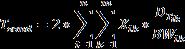
SendTime,whichisthetimeforthetransmittingthe methodfrommobiledevicetothecloudandbacktothe mobiledevice,iscalculatedusingtheequation(4):
(4)
ThetotaltimecanbecalculatedbyaddingtheTexe to theTsend usingtheequation(5):
Total_time=Texe +Tsend (5)
5. Implementation and performance evaluation:
In order to test our proposed model, we used the followingsettings:
The length of tasks is set to be between 50 and 200 MillionInstructionsPerSecond(MIPS).
Thecapacityofthevirtualmachineisbetween2.0and 4.0MIPS.
Transmitteddatasizevariesfrom50to150Kb/sec.
Bandwidthvariesbetween25and50kb/s.
International Research Journal of Engineering and Technology (IRJET) e-ISSN: 2395-0056 Volume: 01 Issue: 04 | Apr 2023 www.irjet.net p-ISSN: 2395-0072 © 2023, IRJET | Impact Factor value: 8.226 | ISO 9001:2008 Certified Journal | Page867
(3)
WeusedaPC,whichhasCPUIntel(R)Core(TM)i3with4GB RAMtotestthealgorithmunderMicrosoftwindowsOS.The experimentcarriedoutontheCloudSimsimulatorwithinthe NetBeansenvironment[17].
For 5 physical devices, there are 16 virtual devices were randomlydistributedtoassigntaskstovirtualmachines.The resultswereasfollows:
As shown in Figure 4, the execution time using swarm scheduling took less time comparing with random scheduling,andtheimprovementwasnearto31%
In this article, we suggested using the particle swarm optimization algorithm, which has greatly improved the optimaldistributionoftasksonvirtualmachines.
Themainideaofthispaperistoachieveefficiencyintasks scheduling on the cloud. We used a cloud simulator to implement the proposed algorithm and presented the results, which showed a significant improvement in balancingthedistributionoftasksonvirtualdevicesinthe cloud.
Asafuturework,wearegoingtousethegeneticalgorithm to balance the load of virtual machines on the physical machines.Thus,theoutputofthegeneticalgorithmwillbe used as an input to the particle swarm optimization algorithmto balancethedistributionoftasksonavailable virtualdevices.
REFERENCES
[1] Biswas, Milon, and M. D. Whaiduzzaman. "Efficient mobile cloud computing through computation offloading."Int.J.Adv.Technol10.2(2018):32.
[2] Hao,Jialu&Xian,Ming&Wang,Huimei&Tang,Fengyi &Xiao,Pu.(2018).MobileCloudComputing:theStateof Art, Application Scenarios and Challenges. 1-5. 10.1109/CIACT.2018.8480365.
As shown in Figure 5, the running task Cost using swarm schedulingwasalsolesscomparingrandomscheduling,and theimprovementwasnearto30%
[3] Oliveira,RômuloReisdeetal.“ImprovingtheTrade-Off between Performance and Energy Saving in Mobile Devices through a Transparent Code Offloading Technique.” (2019).
[4] Jin,Xiaomin,etal."Asurveyofresearchoncomputation offloading in mobile cloud computing." Wireless Networks(2022):1-23.
[5] Raji,BabatundeO.,andOlusolaO.Ajayi."Implementing a Mobile Cloud Computing Framework with an OptimizedComputationalOffloadingAlgorithm."(2019).
[6] Ramotra,AtulKumar,andAnjuGuideBala.Task-Aware Priority Based Scheduling in Cloud Computing. Diss. 2013.
6. CONCLUSIONS and Future Work
Theprocessoffloadingtasksfrommobiledevicestothe cloudledtoanincreaseintheloadontheserversinthe cloud,whichalsoledtothedelayinexecutingtasks,soa schedulingalgorithmwasworkedoutinordertoreduce theload.
[7] B. A. Al-Maytami, P. Fan, A. Hussain, T. Baker and P. Liatsis, "A Task Scheduling Algorithm With Improved Makespan Based on Prediction of Tasks Computation TimealgorithmforCloudComputing,"inIEEEAccess, vol. 7, pp. 160916-160926, 2019, doi: 10.1109/ACCESS.2019.2948704.
[8] Volkova V. N., Chernenkaya L. V., Desyatirikova E. N., Hajali Moussa, Khodar Almothana, Alkaadi Osama ―LoadBalancinginCloudComputing‖inProc.Of2018 IEEE Conference of Russian Young Researchers in ElectricalandElectronicEngineering(2018ElConRus),
International Research Journal of Engineering and Technology (IRJET) e-ISSN: 2395-0056 Volume: 01 Issue: 04 | Apr 2023 www.irjet.net p-ISSN: 2395-0072 © 2023, IRJET | Impact Factor value: 8.226 | ISO 9001:2008 Certified Journal | Page868
0 1000 2000 3000 4000 5000 6000 7000 20 tasks 30 tasks 40 tasks 50 tasks PSO Random
Figure 4: Executiontime
0 100 200 300 400 500 600 700 800 20tasks 30tasks 40tasks 50tasks
Figure 5: Processingandtransmissiondatacost
St. Petersburg and Moscow, Russia, January 29February1,2018,pp.397400\.doi:10.1109/EIConRus.201 8.8317113.
[9] S.Shukla,A.K.SinghandV.KumarSharma,"Surveyon Importance of Load Balancing for Cloud Computing," 2021 3rd International Conference on Advances in Computing, Communication Control and Networking (ICAC3N), 2021, pp. 1479-1484, doi: 10.1109/ICAC3N53548.2021.9725442.
[10] Kumar Garg S, Buyya R. Green Cloud Computing and Environmental Sustainability, Australia: Cloud Computing and Distributed Systems (CLOUDS) Laboratory Department of Computer Science and Software Engineering, The University of Melbourne; 2012
[11] Ibrahim, Ibrahim Mahmood. "Task scheduling algorithms in cloud computing: A review." Turkish Journal of Computer and Mathematics Education (TURCOMAT)12.4(2021):1041-1053.
[12] D. Subramoney and C. N. Nyirenda, "A Comparative EvaluationofPopulation-basedOptimizationAlgorithms forWorkflowSchedulinginCloud-FogEnvironments," 2020 IEEE Symposium Series on Computational Intelligence (SSCI), 2020, pp. 760-767, doi: 10.1109/SSCI47803.2020.9308549.
[13] Yamini, R., and M. Germanus Alex. "Comparison of resourceoptimizationalgorithmsincloudcomputing." InternationalJournalofPureandAppliedMathematics 116,no.21(2017):847-855.
[14] Aladwani,Tahani."Typesoftaskschedulingalgorithms incloudcomputingenvironment."SchedulingProblemsNewApplicationsandTrends(2020).
[15] A.Khodar,L.V.Chernenkaya,I.Alkhayat,H.A.FadhilAlAfareandE.N.Desyatirikova,"DesignModeltoImprove TaskSchedulinginCloudComputingBasedonParticle SwarmOptimization,"2020IEEEConferenceofRussian Young Researchers in Electrical and Electronic Engineering (EIConRus), 2020, pp. 345-350, doi: 10.1109/EIConRus49466.2020.9039501.
[16] Al-Olimat, Hussein S., et al. "Cloudlet scheduling with particleswarmoptimization."CommunicationSystems and Network Technologies (CSNT), 2015 Fifth InternationalConferenceon.IEEE,2015.
[17] Dejan Bulaja, Kristina Božić, Nikola Penevski Nebojša BačaninDžakula.”INTRODUCTIONTOCLOUDSIM”,2019
BIOGRAPHIES
Shouaib scanderreceivedhisB. S. degree from the Faculty of Informatics Engineering, Tishreen University, Syria in 2018.Heiscurrentlypursuinga M. S. Computer Networks at the Faculty of Informatics Engineering, University of Aleppo, Syria. His current researchinterestsincludemobile cloudcomputing

Dr. Souheil Khawatmi received hisB.S.degreefromtheFaculty of Computer Engineering, UniversityofAleppo,Syria in 1982 and PhD degrees from theInstituteofsaint-Petersburg forCommunication,Germanyin 1989. He is currently an associate professor at the Faculty of Informatics Engineering, University of Aleppo, Syria. His current research focuses on Computer Networks and Wireless Communication
Dr.YaserFawaz

He received his PhD from INSAofLyon-France. Currently, he is the head of systems and computer networks at the faculty of informatics Engineering. UniversityofAleppo

International Research Journal of Engineering and Technology (IRJET) e-ISSN: 2395-0056 Volume: 01 Issue: 04 | Apr 2023 www.irjet.net p-ISSN: 2395-0072 © 2023, IRJET | Impact Factor value: 8.226 | ISO 9001:2008 Certified Journal | Page869