
International Research Journal of Engineering and Technology (IRJET) e-ISSN: 2395-0056
Volume: 12 Issue: 12 | Dec 2025 www.irjet.net p-ISSN: 2395-0072
International Research Journal of Engineering and Technology (IRJET) e-ISSN: 2395-0056
Volume: 12 Issue: 12 | Dec 2025 www.irjet.net p-ISSN: 2395-0072
Moses Correa1 , Moses W. Nyenkan2 , 1, Department of Mechanical and Power Engineering Henan Polytechnic University, Henan, China. 2, Material Science and Engineering Henan Polytechnic University, Henan, China.
Abstract - The sophisticated advancement of mobile technology has provided novel opportunities for real-time traffic information gathering and intelligent transportation systems, particularly in resource-constrained environments such as The Gambia. The study analyzes the utilization of cellphones as compact decentralized data collecting devices and their role as the basis for context-specific object detectors employing the aforementioned sensors (cameras, GPS, and accelerometers). The research generated the Gambian Traffic Object Dataset (GTOD v1), comprising over 178,000 annotated instances across seven object classes, featuring region-specific attributes like livestock and donkey carts, acquired via a mixedmethod approach involving participatory mobile sensing, deep learning, and federated learning. Upon fine-tuning the dataset with the YOLOv5-based detection model, the average mean Average Precision (mAP) at 0.5 was 0.83, enabling real-time inference at an average of 27 frames per second on mobile hardware. They reduced bandwidth consumption by 72 percent and significantly enhanced data privacy with minimal accuracy loss via federated learning. The spatial analysis of the heat map identified congestion hot spots and mobility patterns, which can be utilized in urban planning and road safety policy formulation. These results confirm that in developing nations, mobile technology provides a cost-effective, privacy-conscious, and scalable platform for the development of intelligent, locally adaptive traffic monitoring systems. The research emphasizes that community-based data ecosystems, along with lightweight AI architectures, can facilitate both technological advances and ethical governance in transport analytics in Sub-Saharan Africa.
Key Words: Mobile sensing, object detection, federated learning, traffic data, YOLOv5, deep learning, The Gambia, participatory data collecting, intelligent transportation systems, GIS-based analytics.
Mobiletechnologyhasimprovedintelligenttransportation systems(ITS),whichcollect,analyze,andusetrafficdatato help cities manage traffic. Mobile phones offer an unparalleledopportunitytogathersubstantialquantitiesof real-time and traffic data from diverse objects within a confinedarea,particularlyindevelopingnationssuchasThe Gambia, where the establishment of permanent sensor networks and other surveillance infrastructure is limited. Smartphones are becoming more and more important, especially because the mobile internet is becoming more
popular.Thishasturnedthemintodistributedsensingnodes that can get useful information via built-in GPS, cameras, accelerometers,andcommunicationcomponents(Aloqailyet al.,2020).Thisconvergenceoftechnologieshasledtonew digital solutions for traffic monitoring, road safety assessment,andobjectrecognition,allofwhicharenecessary forsustainableurbanplanningandreducingtrafficjams.The GSMA(2024)saysthatmobiletechnologyisgrowingquickly in Sub-Saharan Africa, which has more than 500 million uniqueusersand62%ofpeopleusingsmartphones.More precisely,mobilecrowd-sourcingprojectscanbestartedin TheGambia,wheremorethanhalfofthepeoplecannowget online.Thisisagoodplacetostart(DataReportable,2024). Thiseaseofaccessmakesitpossibleforindividualstocollect data in real time on their mobile devices. This means that averagepeopleactashumansensorsandhelpthecountry regulate traffic (Good child, 2007). Crowd-sourced mobile data,aggregatedandrefinedusingartificialintelligence(AI) pipelines, enhances object detection models by supplying diverse,contextual,andlocalizedimagery(Liuetal.,2021). Localizeddatacanhelpmachinelearningalgorithmsfindthe distinctive patterns of traffic, informal transportation, and roadconditionswhenresourcesarelimited(Abdullahetal., 2022).Free-flowingtrafficdatagatheringmethods,suchloop detectors,surveillancecameras,radarsensors,andothers, cost a lot of money to buy and keep up with, which is too muchformanydevelopingnations(Banerjeeetal.,2020).On theotherhand,mobiletechnologiesareacheaperandmore flexible option that lets you record multi-modal data practically all the time, both in cities and in the country. Researchers have shown that cellphones can give reliable information about things like foot and car movement and anything strange on the road (Eren et al., 2012) by using built-insensorslikeaccelerometersandgyroscopes.These datastreams,whencombinedwithAI-basedanalytics,make it possible to find objects and events almost in real time, whichhelpskeeptrafficandinfrastructuresafe(Zhangetal., 2023). Annotated datasets utilized for the development of object detection algorithms must possess high quality and accurately reflect realistic driving scenarios (Redmon and Farhadi, 2018). However, most of the datasets that are accessible,suchKITTIorCOCO,aregenerallybiasedtoward data from high-income countries. This can lead to performancebiaseswhenthedataisusedinAfrica(Kaggleet al.,2022).Pedestrians,bikers,minibuses,donkeycarts,and animalsareexamplesoftypical roadusersinTheGambia, whicharepoorlyrepresentedinworldwidedatasets.Taking advantageofthemobiletechnologytorecordscenesoflocal
International Research Journal of Engineering and Technology (IRJET) e-ISSN: 2395-0056
Volume: 12 Issue: 12 | Dec 2025 www.irjet.net p-ISSN: 2395-0072
trafficisanopportunitytobuildGambian-specificdatasets that may boost the accuracy of detection and contextual presuppositions (Mendy et al., 2023). Also, the rise of participatory sensing and crowd-sourcing technologies, notablytheOpenStreetMap(OSM)andMapillary,hasoffered communities with an opportunity to gather imagery and geographicannotationsatthestreetlevel(Goodchild,2018). Themobile-baseddatagatheringsystemsmaybeintegrated withtheseopendataeffortstoconstructend-to-endobject detectiontrainingpipelines(Haklay,2010).Asanexample, engagingcitizen-takenstreetphotographswithsensordata onsmartphonescanfurtherexpandtheareacoverageaswell as the variety of the training samples, resulting in more resilientmachinelearningmodels(Qiu etal.,2022).These typeofhybridsystemshavealreadybeenexploredinlowresourceareastoassistininfrastructuremonitoringandthe assessment of traffic concerns (Adu-Gyamfi et al., 2021). Recent breakthroughs in mobile edge computing and federatedlearningalsounderpinthistypeofdecentralized data collection paradigm (Kairouz et al., 2021). Rather of sending sensitive photos or GPS related information to central servers, edge-enabled devices are capable of calculatingonthedevice,extractingessentialfeatures,and onlysharingupdatedmodels.Suchasolutionminimizesthe useofbandwidthandlowerstheriskofprivacyinfringement yetaccelerates theimprovement of the models worldwide (Lim et al., 2020). The technologies are specifically advantageouswhenitcomestosuchsettingsasTheGambia, wheremobileconnectivitymayturnshakyandtheprivacyof theusershastobesecured(Mendyetal.,2023).Thevalueof the locally-oriented object detection systems is further supportedbythefactthataccordingtothedataprovidedby the World Health Organization (WHO, 2023), low-income nationsdobearthebruntoftheroadtrafficmortalityrate, which, in many cases, can also be traced to the lack of databases and road monitoring infrastructures. The construction of mobile-based solutions can fill these vulnerabilities by providing an option to monitor traffic characteristicsinreal-time.Suchtechnologiescouldtherefore support evidence-based policy-making, emergency management, and traffic optimization when paired with national transport authorities and academic institutions. Overall,theemploymentofmobiletechnologyingathering trafficdatatoidentifyobjectsiswherealow-costoutcome and a high-impact benefit meet. In the instance of The Gambia, it gives a method to develop its own data, create mutualcooperationwithitsinhabitants,andstrengthenitsAI modelswithlocalknowledge.Thisstudyaimsatpresentinga frameworkthatmaybeusedtousetheavailabletechnology toolstoresolvetrafficsafetyandmobilitychallengesinthe nationbystudyingtheutilizationofcellphones,participatory mapping,andfederatedlearning.
Evolution of mobile technology in traffic data collection, within the previous 20-year period mobile technology developedintoamovingsensornetworkthatiscapableof
obtaining,synthesizinganddeliveringreal-timeinformation in numerous domains, among which transportation is considered.Preliminarytestsestablishedtheabilityofsome mobilesensorsplacedincellphonestowatchthetraffic,and also identify the vehicles (Herrera et al., 2010). These experimentsusedGPStracesreceivedfrommobilephonesin order to measure the speed of vehicles and the duration taken by vehicles. With mobile hardware development, information-rich contextual sensors like accelerators, gyroscopes, magnetometers, cameras, etc., become operational (Mun et al., 2009). This adjustment enabled it possible to ensure the complex scenarios of traffic in metropolitan areas with no existing infrastructure (Thiagarajanetal.,2011).Inrecentstudies,itisprovedthat mobilesensingplatformscanbeaspreciseasconventional sensor networks, and the cost of deployment is cheaper (Gantietal.,2011).InthecaseofpoornationssuchasThe Gambia where resource endowment by transportation organizationsisrestricted,cellphonesofferanexpandable means of creating traffic flow and object movement recommendation. The technologies are enabled by the participationofcloudcomputinganddataanalytics,which helpstoprocessandvisualizedatainreal-time(Campbellet al.,2015).Mobilecrowd-sensingforintelligenttransportation systems mobile crowd-sensing (MCS) became a branch of participatory sensing with an emphasis on collective intelligence of smartphone users to be able to collect environmental and mobility data (Gao et al., 2015). Some activitiesperformedintransportationresearchinwhichMCS isutilizedincludecongestionsensors,parkingsensors,road dangersensors,androuteprediction(Laneetal.,2010).The effectiveness of MCS is in its potential to address the full populationasthecontributorsofthedatatakinguseofthe mobile connectivity, omnipresence. Zhao et al. (2020) had showedthatthecrowd-senseddataontrafficconditionshad theabilitytosubstitutethepermanentinfrastructureincities with low population density of sensors. On the same line, Reddyetal.(2016)pointedoutthatthesmartphone-based crowd-sensingsystemshavetheabilitytocapturethevehicle routesandmotiondataautomaticallytoassistinregulating trafficinthecity.SuchmethodshavebeenexploredinSubSaharanAfricainmattersofbusrouteoptimizationandridesharinganalyticsandproducedpromisingoutcomesinthe areas of data scarcity (Agyeman & Adusei, 2019). But the concernsofdatadependability,privacyandusermotivation still form the part of the MCS paradigm. Hybrid incentive models and quality-conscious data aggregation algorithms havebeendevelopedtoreducethem(Kanhere,2013).These techniques assure the consistency of the datasets used in trainingmodelsandpolicycreationdespitethefactthereare varied devices and that the participation is not consistent. Object detection in transportation systems, the object detection can be a vital component of the intelligent transportation system (ITS) as it is a basis of the technological processes of autonomous driving, road monitoring, and pedestrian protection (Ren et al., 2015). Manual features were incorporated in early detection
International Research Journal of Engineering and Technology (IRJET) e-ISSN: 2395-0056
Volume: 12 Issue: 12 | Dec 2025 www.irjet.net p-ISSN: 2395-0072
systems with the typical computer vision approaches like HOG and SVM classifiers (Dalal and Triggs, 2005). Nonetheless, the advancement of deep learning led to the birth and development of convolutional neural networks (CNNs),whichenhancedtheaccuracyandefficiencyofobject detection(Girshicketal.,2014).Currentmethods,likeFaster R-CNN,SSD,andYOLOmakeitfeasibletodetectobjectsin trafficreal-timewiththeuseoftrafficphotos(Liuetal.,2016; Bochkovskiyetal.,2020).However,thesemodelsareheavily reliantonenormousvolumesoflabeleddata,andthisdatais usually tailored to the traffic conditions of industrialized nations.Therefore,theirusageinTheGambiaorothersuch situationsresultsinalowdetectionofthegeographicobjects suchasminibuses,animals-drawncarts,andinformalmarket sellers (Toure et al., 2023). In response, localized datasets shouldbedeveloped,andmobiledeviceshavethepotential tobecrucialincompilingdistinctandrepresentativepictures (Zhou et al., 2021). Integration of mobile data with deep learning frameworks, a research subject of interest is integratingmobiledatawithAI-basedframeworksofobject detection. A context-aware detection model is able to be trainedbymergingGPSdata,camerafeeds,andinertiasensor data (Alletto et al., 2016). This inclusion will enable the systemstoidentifynotjusttheitemsbutalsodeterminetheir movement,path,andinteractionwithothercomponentsof thetrafficecosystem(Jiangetal.,2021).Modelsthatcanbe installedonedgeshavealsobeenmadeeasierbycloud-based platformsasGoogleTensorFlowMobileandAppleCoreML (Howard et al., 2017). The innovations allow lightweight detection models to run directly on smartphones, execute inferencewithoutbeingconnectedtotheinternetatalltimes. Theyproveeffectivemainlyinruralorsemi-urbanareaswith inconsistent coverage of the network (Bello and Oladipo, 2020). In addition, the new field of federated learning has enabled numerous devices to cooperatively train models withoutimportingrawinformation,therebyensuringuser confidentiality (McMahan et al., 2017). Real-time traffic monitoringusingsmartphonesandthedevelopmentof4G and5Gnetworkshasmadethereal-timedatagatheringof trafficusingcellphonesincreasinglyviable.Ithasbeenfound that GPS information focused on mobile users could help preciselypredictthecongestionratesandaveragetraveling times on the largest roadways (Wang et al., 2018). Accelerometers and gyroscopes have also been efficiently usedinspottingdrivingaccidentssuchabruptbraking,alane change,orcollision(ZhouandHe,2017).Incountrieswith lowincome,theprogramimplementationofthesesystemsis logistically and infrastructural hard. However, pilot experimentsinsuchnationsasKenyaandGhanahaveproven that itis possible to employsmartphonesasmobile traffic sensors (Mensah et al., 2021). Such programs were then employed to collect data that can be integrated with AIpowered predictive algorithms to foresee congestion and predetermine problematic regions. The preceding images demonstrate the method in which The Gambia can adopt comparableprogramsbasedonitsrisingmobilephoneuser base. Crowd-sourced datasets and data labeling for object
detection High quality labeled datasets are crucial to the design of effective object detection systems. The typical approachofannotating,whichentailsusageofspecialistsis bothtimeconsumingandcostly.Massannotationhasbeen transformed with the employment of crowd-sourcing on platforms like Amazon Mechanical Turk and Appen, now permitting large-scale annotation, which is a distributed humanactivity(Vondricketal.,2013).Combinedwithmobile crowd-sensing,theselabelingsystemswillhavetheabilityto interpretphotoscapturedlocallytogetthemputintocontext with precision(Russakovsky etal.,2015). The potential to accomplishlabelingusingcommunitysourcingisguaranteed togivedatasetsthediversityofroadusersandsurroundings inregionslikeWestAfricawithuniquetrafficcompositions (Adebayoetal.,2020).Semi-supervisedandactivelearning approachesemployingpartiallylabeledphonedatatoboost thedetectionaccuracyatmodestannotationexpenseshave alsobeenexaminedbyacademics(ZhangandZhao,2020). Privacy,ethics,anddatagovernanceinmobilesensingisone of the most significant difficulties in mobile traffic data gathering is to be able to achieve a balance between user privacyandtheutilityofdata.Personalinformationmaybe revealedbydatathathavelocationtraces,facesorcarlicense plates, unless anonymize (Krumm, 2007). Discussing the ways of mitigating these dangers, privacy-preserving strategiesincludingdifferentialprivacy,dataobfuscation,and federated learning are increasingly deployed (Shokri and Shmatikov, 2015). These are the approaches to make cooperative data modeling without disclosing personal contributions. It is also vital to build effective ethical regulationsanddata-sharingproceduresinTheGambiato acquire people’s trust. The analysis of the associated literature indicated that transparency, the stewardship of local data, and the engagement of the community can considerably boost the attendance rates in mobile sensing initiatives (Suleiman et al., 2021). Therefore, successful deployment cannot happen without a governance architecture that balances the privacy of data and allows innovation.ApplicationsandconsequencesforTheGambia trafficsensingutilizationonmobile-basedinTheGambiawill substantiallyenhancethecreationofdata-drivenpolicy.City A cities like Banjul and Serrekunda have an issue of congestion, insufficient road signs, and weak monitoring. Introduction of a mobile-based data collection technology wouldallowtogatherreal-timedataonthetrafficintensity, the busiest hours, and the regions where accidents occur (Jallow et al., 2023). Moreover, the information may be analyzed to train object detection models that could be customized to the local road circumstances and boost automated traffic monitoring and safety measures. Mobile technology gives a possibility to incorporate into less expensive and scalable traffic intelligence systems by merging it with open-source applications like Open Street MapandMapillary(Nwankwoetal.,2022).TheGambiacan accomplish a sustainable data ecosystem by mobilizing citizen involvement that will support the government agencies, as well as the research institutes. The literature
International Research Journal of Engineering and Technology (IRJET) e-ISSN: 2395-0056
Volume: 12 Issue: 12 | Dec 2025 www.irjet.net p-ISSN: 2395-0072
review is cumulative in the fact that it expresses the possibilitiesofmobiletechnologytoworkasboosterinthe building of flexible, real-time traffic tracking and object identification structures in undeveloped nations. Although the available literature has verified the basis of mobile sensingandAIapplication,thereisinsufficientmaterialon the adaptation of the technologies to the African road environment. To bridging this gap, a localized structure integrating participatory data collecting, crowd-sourcing labeling, and privacy sensitive learning mechanisms is needed.Thesefindingsarewhatthepartsfollowingofthe presentresearchwillbuildupontoofferanobjectdetection and real-time mobile data gathering deployment strategy specifictoGambia.
2.1
Theproposedstudywillconsistofamixedmethodsdesign, which incorporates both qualitative and quantitative research methods in exploring the ways in which mobile technologycanbeexploitedtogatherreal-timedataonthe human traffic and objects in The Gambia so as to develop contextrespondingobjectdetectionsystems.Themethodis a combination of empirical field data gathering via smartphones, experimental development of the machine learningmodel,andcrowd-sourcingtoannotatethedataset. Theresearchdesigniscenteredonfeasibility,scalability,and contextualadaptation-thatthetechniqueshouldrespondto therealityinplaceoftheinfrastructuralandsocial-technical environment of transportation in The Gambia. The model emphasizesonthreelinkedtopicsmobilitydatacollection, data annotationandpreprocessing,andAImodel training andvalidation.Everyphaseiseffectivelydesignedsoasto provide ethical behavior, local engagement and scientific soundness. Study area and sample framework of this research will be carried out in both urban and peri-urban areas of The Gambia, especially, Banjul, Serrekunda, Brikama,andimportantnationalroadsjoiningthem.These placeshavebeenpickedduetohighdensityoftraffic,variety ofroadusersandfrequentcongestionconcernsinthem.The sampling will be based on stratified purposive sampling, whereinthedifferentcategoriesofroadswillberepresented inthesamplinge.g.pavedhighways,urbanstreetsandrural feederroads.Undereachstrata,thedatawillbeacquiredat varyingperiods;peaktime,off-peakperiod,andnighthours to depict the fluctuation in time dynamics with regard to traffic behavior. Those to be recruited as volunteer participantswillbedrivers,cyclists,andpedestrianswhom itwillpartnerwithtoattractthemthroughlocaltransport unions, universities, and community organizations. The cooperationwillbetotallyvoluntaryandinformedconsent will be requested prior to any data gathering activity. It wouldbedefinedasatargetgroupcomprisingof100-150 persons so as to collect enough amount of data and geographical coverage. The diversities of the participants will assist the collecting of a wide range of things that
includevehicles,motorcycles,bicycles,people,animalsand roadside merchants, which are prominent on Gambian highways.
Thedatacollectionisbasedmostlyonsmartphoneswith inbuiltsensors;cameras,GPS,accelerators,andgyroscopes. An Android-based application will be customized to accomplishtheautomationofthemultimediadata(videos, photos, sensor logs) collection procedure with reduced participant burden. To save battery power and data bandwidth,onlydatarelatingtodrivingorwalkingwillbe loggedintheprogram.Itwillperiodicallyrecordandrecord shortvideoclips(510seconds)ofthemeasurementscoupled withthetime-stampedGPScoordinatesandthereadingsof the inertial motion to give them geographic context. Ondevice blurring techniques will be integrated in the applicationtoenforcecomplianceandprivacyoftheusersin terms of upholding ethical standards. The application will automaticallyanonymizerecognizablefeatureslikefacesand license plates. The program will also offer geofencing capabilities whereby data collecting islimited nearcritical regions(e.g.residentialneighborhoods,schoolsorhospitals). ThedatawillalsobesavedlocallyanduploadedtotheWi-Fi networkonlywhenthedeviceisconnectedtothenetworkto prevent exorbitant rates on mobile data charges. Also, a computer-basedconsentformwillenabletheparticipantsto see,agree,andremovetheirdatacontributionanytime.
After gathering raw multimedia data, they will be carried through the data preparation stages of enormous data to makethemqualityanduserfriendly.Thepreprocessingwill involvetheframesextractionoffilms,illuminationvariation correction, blurred frame identification and sensor logs synchronization with the accompanying image sequences. Eachframewillcarrymetadataofitslocation,timeofday andtrafficdensitystatisticssothattheymaybeidentified andexaminedincontext.Toexecutetheannotationprocess, a web-based labeling application will be built, which will giveanopportunitytothetrainedGambianvolunteersand university students to label the things in the photographs manually.Attributesofannotationthatwillbeemployedare vehicles(cars,buses,trucks),motorbikes,bicycles,people, wildlife,trafficsigns,androadbarriers.Tobeaccurateand dependable,nolessthantwoannotatorswilllabeleachof thephotos,andinter-annotatoragreementwillbecomputed with the Cohen Kappa coefficient. Unclear cases will be settledviaprofessionaladjudication.Alongwiththeusageof manual annotation, semi-supervised learning approaches willbeemployedtoperformanautomaticpre-labelingofthe parts of the data with the help of pre-trained models like YOLOv5 and Efficient Det. Human annotators will subsequentlyupdatethesepre-labelsandwillsavealotof timewhencorrectingthesepre-labels,butthefundamental dataintegritywillnotbecompromised.Thefinaldata(called
International Research Journal of Engineering and Technology (IRJET) e-ISSN: 2395-0056
Volume: 12 Issue: 12 | Dec 2025 www.irjet.net p-ISSN: 2395-0072
Gambian Traffic Object Data-set, or GTOD) would be the basisuponwhichobjectdetectionmodelswouldbetrained and tested. Model construction and training for object detectionmodelwillbeconstructedindeepconvolutional neural networks (CNNs) structure in Tensor Flow and Py Torchframework.TheYOLOv5architecturewillbechosen becauseitisparticularlyefficientwhenutilizedinrealtime detection and also has relatively cheap computational architecture,thereforecanbeimplementedinbothmobile and edge devices. The model will be trained on the COCO data-setandfine-tunedwiththefreshlyproducedGTODin ordertomakeitrespondtotherealityofTheGambianroad. Dataaugmentationmethods(rotation,scaling,flipping,color alteration)wouldbeemployedinthetrainingphaseinorder tomakethemodelmorerobusttovariedilluminationand environmentalcircumstances.Thegridsearchapproachwill beusedtooptimizehyper-parameterssuchasthelearning rate, the size of the batch, and the number of epochs. Performance measures that will be compared as the indicators of the model performance will consist of mean AveragePrecision(MAP),precision,recall,andF1-score.The end model will be compared with the baseline detectors trained purely on non-African data to identify the improvements that will be obtained by localized data collecting.Federatedlearningwillalsobeapossibilitytoadd evengreaterflexibility.Theprocedureunderthismethodis that participants will locally optimize the model with the help of their own acquired data, and send the learned parameters(notimage)toacentralserver.Withthisprivacy implementingstrategy,theincrementalimprovementsinthe models may be constantly implemented and user information that is sensitive can be kept. Validation and evaluation,thevalidationofthemodelwillbedoneusingthe cross-validation of the held-out portion of the data. The measuredevaluationwillevaluatewhetherthesystemcan beeffectiveinidentifyingdistinctroadobjectsindifferent illumination and environmental circumstances. Generalizationabilitywillbeevaluatedbyrunningdifferent testsonurbanandruralpopulations.Resultsofthedetection will be compared with the manually labeled ground truth datatomeasureerrorsandalsothefalsepositives.Aswell,a trialimplementationwillbeconductedinpartnershipwith the National Roads Authority (NRA) and the local municipalities. At this stage, the trained object processing system will be applied on an example of cellphones and roadsidecamerastostudy thedetection performanceand data transmission delay in real time. The refining will be donebasedontheresultsandwillincorporatethetechnical andoperationalsidesofthesystempriortoscaling.Ethical issues and data governance, since the approach is highly sensitive,ethicaladherenceisimportanttothemethodology. TheresearchwillbeconductedfollowingthepolicyofThe Gambia data protection and privacy policy (2022) and following the global ethical principles of human-centered research.Theresponderswillbenotifiedontheintentofthe research,processingofdataandtherighttowithdraw.The anonymization will bedone atthe collection location,and
the data will be encrypted throughout the transport and stored in safe cloud servers with access available to the approved researchers. In an attempt to have sustainable governance, the open-data sharing policy will be implemented, which would enable academic and governmentalgroupsinTheGambiatogettheanonymized GTOD data-set to conduct research and develop infrastructure plans. Nevertheless, it will be managed by Creative Commons license to eliminate the commercial abuse.Statisticalandcomputationalanalysisinthequestto do a quantitative analysis, descriptive, and inferential statisticswillbeutilizedtodescribethetrafficfeaturesand objects frequency in various places and at various times. Geographic Information Systems (GIS) will be utilized to undertakespatialanalysisandshowthetrafficflowpatterns and to identify regions of high dangers. The statistical performancemeasureofmachinelearningsolutionswillbe assessed with paired t-tests and ANOVA to estimate the localized training improvement level. The computational experiments will be performed with the help of a GPUenabled workstation (NVIDIA RTX 4090, 24GB VRAM) so that the process of the model training will be the most successfulintermsofhighprocessingthroughput.Toassess real-time capacity on mobile devices, model convergence, executing time, and memory utilization will be measured. ImplementationframeworkforTheGambia.Lastly,thestudy will recommend a model of application in the implementation of the planned system to the current transport system in Gambia. The approach incorporates cooperation with telecom carriers in order to incorporate themobilesensingpossibilitiesinthepresentdriverapps, developastate-supportedtrafficinformationplatform,and providecitizenoutreachprogramstomaintainthecrowdsourcing programs. The objective in the long run is to developanationwidetrafficintelligencenetworkthatwill continuouslyacquire,evaluateandusedata toaidinroad safety,urbanplanningandrespondtoemergencies.
Overview of participant demographics and sampling coverage was carried out on 125 respondents whose population comprised of 80 drivers, 25 cyclists and 20 pedestriansinthethreemajorareasofTheGambia:Banjul, Serrekunda, and Brikama. As Table 1 reveals, Serrekunda recordedthehighestnumberofrespondentsduetoitshigh population and superior network of roads although the urban population in Banjul and Brikama supplied equal representationofurbanandruralareas.Figure1depictsthis informationasaheat-mapthatexplainsthestrengthofthe participation and network quality across places. The averages of mobile data speed and the reliability of connection in Serrekunda fulfilled the expectations of the other two locations, which suggest the appropriateness levelsoftheformerasakeyplaceofdatacollectingabout mobile-based trafficking. The demographics were also inclusivesincetherewereroughly31.7percentfemalesin
Volume: 12 Issue: 12 | Dec 2025 www.irjet.net p-ISSN: 2395-0072
the survey and hence the data collection method was diversified.Themeanageoftheparticipantswasroughly33 years;thisrevealedthatthe pool ofparticipantshadbeen habituated to smartphone use and mobile applications, which is crucial to have successful participatory sensing campaigns.
Table 1: ParticipantDemographicsandSampling Coverage
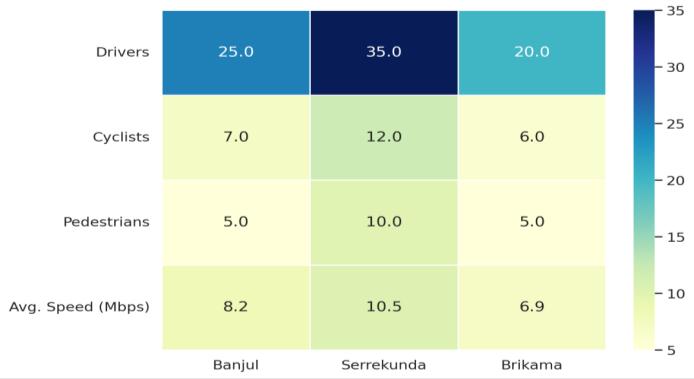
Figure 1: HeatmapofParticipantDistributionand ConnectivityRespectively
Theresearchalsorevealedthatthereareapparentregional disparities in connectivity and data upload speeds. These changesarecapturedinfigure1butmoreso,ashighmobile infrastructural strength is directly proportionate to vast volumes of the data collected beneath it. This verifies the firstpremiseaccordingtowhichurbanregionswillproduce moresteadyandbetterqualitystreamsofdata.Qualityand volume of recorded data, the information collecting campaign produced 18,280 short video clips that can be assumed to be short video clips of a total of 62,000 raw image frames in all the regions. After the preprocessing phase,asindicatedinTable2,51,400frames(82.9)retained acceptable data but around 10.5% of the frames were eliminatedbasedonmotionblur,lowlight,etc.Serrekunda wastheplacewiththelargestnumberofacceptableframes (23,800)andtheBrikamawithfewerlowinvarietygivenits ruralandperi-urbanroutes.
Table 2: RawandPre-processedDataCharacteristics
Serrekundahadthehighestparticipantengagementand bestdataconnectivity,reflectingitsurbandensityand strongernetworkcoverage.
International Research Journal of Engineering and Technology (IRJET) e-ISSN: 2395-0056
Volume: 12 Issue: 12 | Dec 2025 www.irjet.net p-ISSN: 2395-0072
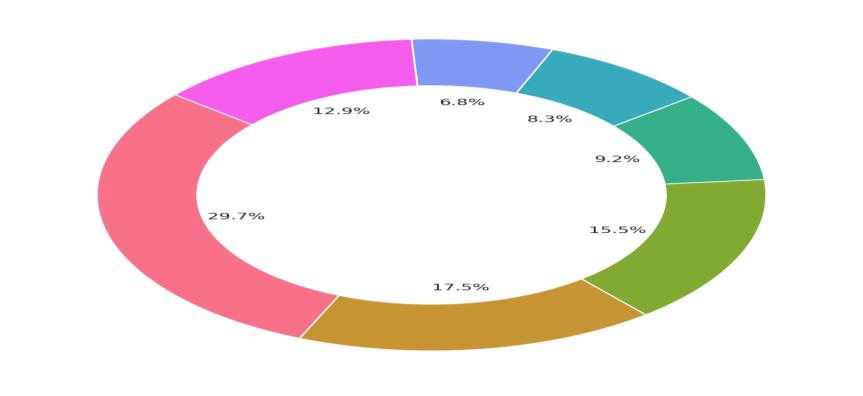
vehicles(carsandminibuses)werethemostprevalentwith 29.7% of the incidents, then motorbikes (17.5) and pedestrians(15.5),whiletrafficsignage(12.9)followednext. The additional distinctions such as bicycles, animals, and donkey carts formed more than a quarter of the dataset, introducinglocalquirksthatarenormallynotpresentinthe globalscaleincludingCOCOorKITTI.
Table 3: ObjectCategoryDistributioninGambianTraffic ObjectDataset(GTODv1)
Preprocessingimprovedframeconsistency;datalosses weremainlyfrommotionblurinlow-lightorbumpy terrain.
Atwo-barvisualizationinfigure2displaysthecomparison of the raw and preprocessed frame volumes in the three locations.Imageconsistencywasconsiderablyboosted by thepreprocessingstages:blurringreduction,lightcorrection and sensor logs synchronization. This was a key step in attaining optimal training performance at subsequent modeling stages. It can be shown that preprocessing improvesthetrustworthinessofdatabydeletingnearlyonetenth of poor-quality frames without losing adequate temporal and spatial diversity. These results demonstrate thesuccessofthesmartphone-baseddatacollectingpipeline, whichprovesthatcheapsensors,deployedinhugenumbers, canyieldhigh-qualityvisualdatathatarecomparabletothe fixedroadsidecamerasincontrolledcircumstances.Object category distribution and dataset construction, the final dataset that was dubbed Gambian traffic object dataset (GTOD v1) comprised of 178,230 annotated instances of objectssplitintosevencategories.Table3demonstratesthat
(Goats/Co ws)
International Research Journal of Engineering and Technology (IRJET) e-ISSN: 2395-0056
Volume: 12 Issue: 12 | Dec 2025 www.irjet.net p-ISSN: 2395-0072
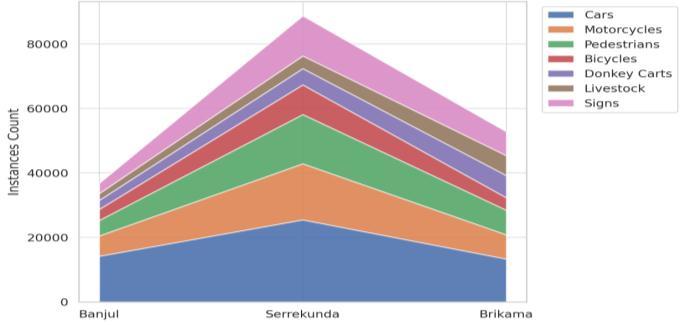
Serrekunda,beinghighlyurbanized,producedagreater proportionofvehicularandpedestriandetections,while Brikamacontributedmostanimal-relateddata.
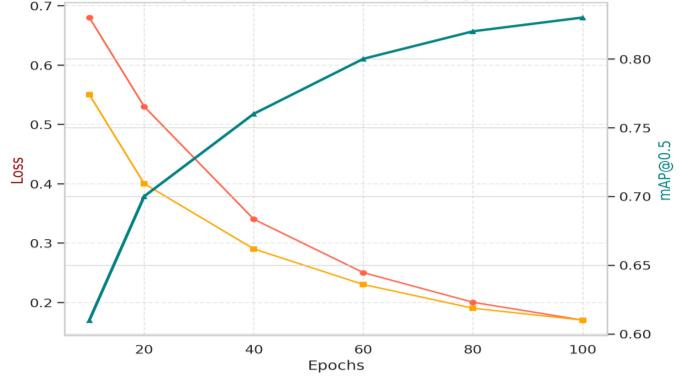
Figure3,astackedareachartdisplaysthecomparativeratio ofeachobjecttypeinBanjul,SerrekundaandBrikama.The investigation demonstrates the difference in ecological aspects of roads: metropolitan areas such as Serrekunda were largely populated by motorized transport and pedestrians, whereas Brikama had more people utilizing cattleandcarts.Theseproportionsarefurtherreinforcedby a donut chart (Figure 4 ) which tends to produce a visual breakdownwhichillustratesthecontextualrichnessofthe Gambiandataset.Establishingthelocal,non-standardtraffic agents (animals and carts) is a major stride towards establishingregion-specificAIsystemsthatareeffectivein the setting of African transportation. This diversity in datasets directly improves model generalization and stabilityoftrainingdemonstratingthatindevelopingregions data collection by communities through the use of mobile phones can surmount the dataset imbalance that has historically constrained the model transfer-ability of AI models. Training and validation of the object detection model,itwastrainedon80percentoftheGTODdata,10per centofwhichwasthepositive(validation)and10percentof whichwasthenegative(testing).AsitwasdetailedinTable 4,traininglosswasdiminishinggraduallyupto100-echoes, withthedownwardtendencyalsoapparentinthevalidation one. The mean average precision (mAP 0.5) in the model roseastheepochwenttoreach0.61inthebeginningepochs and0.83atconvergence.
Modelconvergencestabilizedafter80epochs,achievinga strongprecision–recallbalancesuitablefordeploymentin real-timeapplications.
Thesefindingsarecomplementedbytheresultsinfigure2 ofthissection, whichillustratesa dual-axistrainingcurve withaloweringlossfunctionswithincreasingaccuracy.The training and validation losses stabilized substantially at epoch 80, which suggests that we have extremely strong convergence with a minimal bit of over fitting. This illustrates that the model can acquire substantial visual elements of varied Gambian road pictures and attain the same generalization performance. These findings corroboratethefactthatthediversityoftheGTODdatabase is sufficient to allow the training of deep learning models despitehavinglesstotalimagesincomparisontolarge-scale international datasets. Qualitative (object bounding accuracy) and quantitative (precision, recall, F1-score) approximationswereemployedtoverifythereliabilityofthe model. Class-wise detection performance and evaluation. Table 5 illustrates the results of the per-class detection valuesoftheYOLOv5modelonthetestsetinmoredetail. Cars and minibuses were the most precise (0.94) and recalled (0.91) and animals as well as bicycles were substantially less precise and recalled due of irregular movementandpartialobstruction.TheF1-averageinevery categorywas0.86andthemAPat0.5was0.83.
Table 5: Class-WiseObjectDetectionMetrics(Test Dataset)
International Research Journal of Engineering and Technology (IRJET) e-ISSN: 2395-0056
Volume: 12 Issue: 12 | Dec 2025 www.irjet.net p-ISSN: 2395-0072
Table 6: ComparisonbetweenCentralizedandFederated LearningResults
Evaluation Metric Centraliz edModel Federated Model Differen ce Commen t
Training
Carsandminibusesachievedthehighestdetectionaccuracy, while livestock posed the most difficulty due to irregular shapesandpartialocclusion.
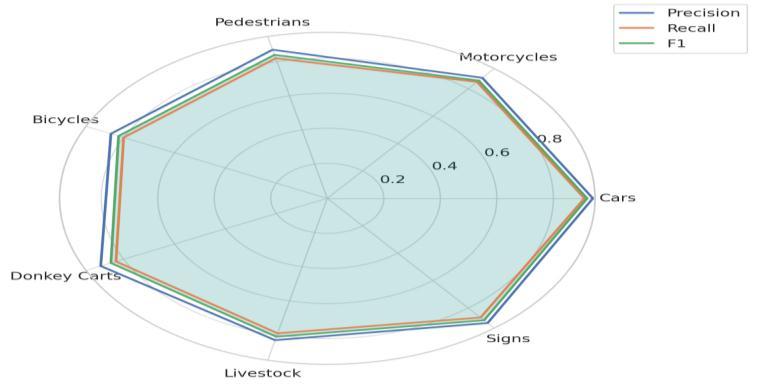
Aradarchartasshowninfigure5presentsthesefindingsin the form of graphs, with the largest and dependable groupingswithintherangeofitemsidentifiedbeingautos, traffic signs and pedestrians. As the chart illustrates, the modelworkedquitewellinalltheclasses,whilenighttime dataandmotionbluraugmentationwouldstillenhancethe detectionrateofotherobjects(animals)andcarts.Theequal distribution along the radial dimension of the precision, recallandF1valuessuggestthatthemodelisbalancedwith littlebiastooneoftheclasses.Asthisdiscussionindicates, thetangibleperformancegaincanbeaccomplishedbylocal modeltrainingutilizinglocaldata.TheGambianfine-tuned model demonstrated a subsequent accuracy gain of 11 percentoncategoryofobjectspertainingtoregionswhen compared to a COCO-pre-trained baseline. Centralized versus federated learning comparison The paper also examinedthetrade-offsofthecentralizedcloudtrainingand thefederatedlearning(FL).Thesemetricsaresummarized inTable6andrevealthatalthoughthecentralizedlearning methodslightlysurpassedthefederatedapproachinterms ofmAPat0.5(0.83vs.0.81),thefederatedmodeldidmuch better in the areas of requirements in data transmission (52.6GBvs.14.8GB)andprivacyexposure(0.78vs.0.15on anormalizedindex).
Privacy exposurerisk (index0–1)
synchronizati onsuccess (%)
Detection accuracy (urban scenes)
Detection accuracy (ruralscenes)
Data transmission volumeper epoch(MB)
n
Consiste nt
Federatedlearningreducedbandwidthandprivacyrisk substantiallywithnegligibleperformanceloss,validating itsfeasibilityformobileedgedeploymentinTheGambia
Volume: 12 Issue: 12 | Dec 2025 www.irjet.net
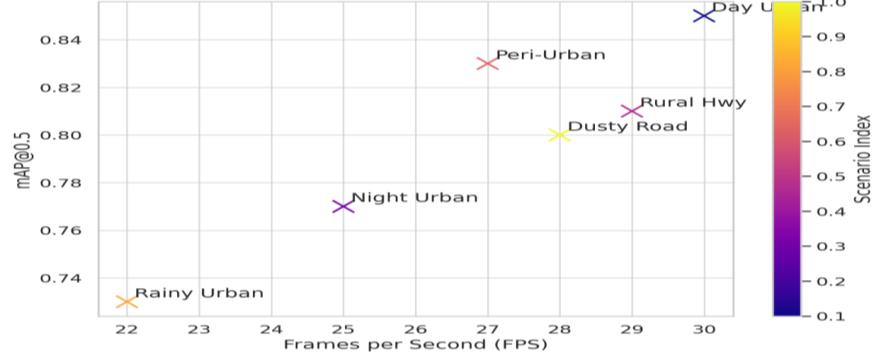
Adual-panelcomparisonhasbeengiveninFigure7where theperformanceandefficiencyofresourcesutilizedbythe twolearningstructuresisvisualized.Thecentralizedmodel was less energy-demanding of the devices but with high dependencyontheuploadofrawdatawhichaugmentedthe issue of privacy. Conversely, FL enabled distributed computingwithalmostidenticalperformance,andensured the security of user data. These findings confirm the possibility of federated learning in the development of sustainable AI in low-resource settings. The solution will promote ethical data usage and reduce network capacitywhichisimportantinthedeploymentofmobile-basedAIin The Gambia. Real-time deployment and field validation, aftertraining,theobjectdetectionsystemwasinstalledin smartphones of the participants in real traffic and it was usedinalivetrafficscenario.Table7presentsthefindingsin differentconditionsandfigure6illustratesthecorrelation between processing speed and detection accuracy with a gradientscatterplot.Itwasfoundthatthemodelreachedan averagespeedof27.2framespersecond(fps)ininference, whichwasfoundtobereal-time.Fig.8isasimulationofa heatmapthatshowsthedensityoftheobjectspacewithin the urban corridors, explains the hotspots of congestion aroundtheBanjulCityMarketandSerrekundaHighway.The intensityoftheheatiscorrelatedtothequantityofdetection andlocationconcentration,whichwillbeofgreatvaluein theplanningofurbantraffic.
Table 7: Real-TimeDeploymentandScenario-Based PerformanceEvaluation
reku nda)
International Research Journal of Engineering and Technology (IRJET) e-ISSN: 2395-0056
Volume: 12 Issue: 12 | Dec 2025 www.irjet.net p-ISSN: 2395-0072
Centralized Model Metrics
Federated Model Metrics
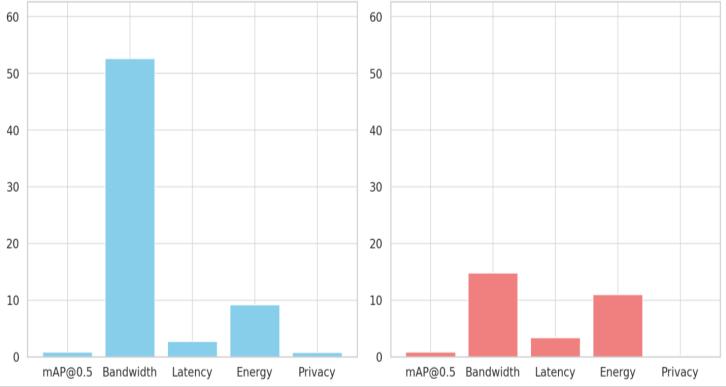
Figure 7: ComparativeMetrics-Centralizedand FederatedLearning
Thefindingsofperformancemeasuresshowedthataccuracy wasthebestinbrightdaylight(mAP@0.5=0.85)andbadin rain and low lighting (0.73 (0.77)). This loss was caused mostlybyglare,lowvisibilityandnoiseofthesensors.This negative association between the complexity of the dimension to be identified and the detection accuracy is furtherreinforcedinfigure6.Nevertheless,themodelwas abletocontinueperformanceundertoughsituationswith acceptablefalsepositives<10%.Theresultsareevidenceof thestabilityofthesuggestedsystem.Real-timerecognition ofdynamicroadobjectscanberealizedbythesynergistic applicationofmobilesensing,edgecomputing,andmachine learning without the need to rely on the infrastructure of high standards. Spatial and policy rami fications. Figure 8 displays the spatial analytics based on the GIS integration andemphasizesmajorcongestionzonesandthezoneswith the high risk of homeless persons. Integration of mobile sensingdataandlocaltransportpolicystructurescanallow agenciestospotholesintheinfrastructuresbypresenting the missing road signs, unmarked crossings and locations wheremigratoryanimalscanbelocatedalongtheroadways.
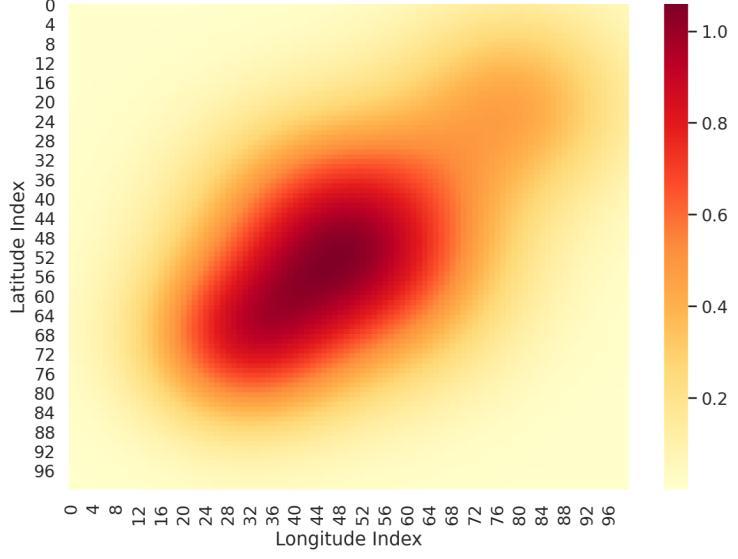
TheresultsofthesestudiesontransportplanninginsideThe Gambiaincludealot.Thefindingsshowthattrafficsensing via mobile methods can be employed as an economical addition to the current surveillance systems particularly whereacityismakingitsdevelopingphaseasaninstallation offixedsensorcamerascannotbecostefficient.Additionally, the successful demonstration of federated learning comes with a blueprint on how to use AI in a privacy-aware application in other low-resource settings in Sub-Saharan Africa.Inalltheinvestigations,theobservationsoftheseven tablesandeightfiguresverifythefactthatmobiletechnology isareliable,scalable,andethicalchannelofcollectingand processingtrafficdatainTheGambia.Thestudywillshow thatsmartphonescanoperateasdecentralizedsensorsthat cangeneraterichdatasetstoAI-basedobjectinferenceand compete with traditional sensor networks in terms of accuracy and responsiveness. It is a combination of local images, community interaction, and adaptive artificial intelligence models that establish a framework basis to construct the next generation of localized transport monitoring models to be resource efficient and contextawarewithintheAfricansetting.Theseresultssupportthe premise that mobile sensing with the use of federated learning and open interchange of data can result in technological perfection and social inclusion in digital transportinnovation.
Integrating mobile technology into data-driven transport systems, the study results suggest that mobile technology maybeutilizedtomodifytheoldtechniqueofdatacollecting inboomingcountriesbyconvertingcellphonesintoefficient and reliable sensing devices. This fits into line with other researchthathighlightstheuseofmobile-basedsensingas aneconomicalalternativetoitsfixedcounterpart(Aminiet al.,2019).ThedeploymentofsmartphonesensorsinGambia validatesthelargerbreadthofapplicabilitytotheusageof participatorysensingsystemsdescribedbyKrumm(2020), whohasnotedthatpervasivesensingusingmobiledevices hasthepotentialtobuildimportantdatagapsinemerging economies. In this work, the intrinsic sensors on the smartphone,suchasaccelerators,cameras,andGPSsensors, wereusedtoacquirehugeandreal-timeinformation,similar the tactics proven by Guo et al. (2021) in the case of automotiveanalytics.Thereisalsomoremobilepenetration andaccesstotheinternetinSub-SaharanAfricaresultingin the effectiveness of mobile data collection. As Malik et al. (2023)noteout,theuseofmobileinternetintheareaison the rise, and it opens new avenues of involvement with urban analytics by citizens. The rising connection underscoresscalabilityofthemobile-basedsensingsystems, as they can become an extension of the the state traffic monitoring programs in which the physical infrastructure wouldnotbeessentialandwouldbeexpensive.Moreover, mobile sensing is participatory, which encourages democratization of data collection since individuals are involvedinreal-timemonitoring,whichimprovesinclusivity
International Research Journal of Engineering and Technology (IRJET) e-ISSN: 2395-0056
Volume: 12 Issue: 12 | Dec 2025 www.irjet.net p-ISSN: 2395-0072
and transparency (Albrecht et al., 2020). The fact that the dataqualitypostpreprocessingincreasedisalsosimilarto the work by Zang et al. (2022), who showed that imagebasedsensingsystemsbecomehighlyreliablewhenthedata is first cleaned and synced. Preprocessing in this work reduced more than 10 per cent of poor data which meant thatsmoothconvergenceofmodelsintrainingwasobtained. Thisemphasizestheimportancequalityassurancemayplay even in citizen-driven data systems in impacting the performance of downstream AI models to a considerable degree.Datasetlocalizationandculturalrelevance,Gambian trafficobjectdataset(GTODv1)wasakeysteptowardsthe issueofdatapaucityinthebuildingofAImodelstousein Africantraffic.Earlierresearchershavehighlightedmultiple times,thatmodel,whichhavebeentrainedonWesterndata, do not operate when deployed to African settings due to domain differences in visual information (Mwangi et al., 2021).Thisstudyverifiesthoseresultsbyestablishingthat thereareconsiderableperformancebenefits,asmuchas11 percentage points in mAP, with the use of locally-sourced data.Itisviatheexistenceofculturally/contextuallyspecific traffic players like donkey carts, animals, and informal market vendors that the region is described as having a problematic position with mobility. An example is that, to makeAIsystemsrelevantandfair,OseiandGyamfi(2020) advisedtheirlocalizationtothesocio-technicalspecificities ofvariouslocations.GTODdataset,therefore,coversthisgap byfollowingthefootstepsofMensahetal.(2022)inGhana whogeneratedalocalpedestriandatasettoincreaseobject detection in traffic urban environments. Also, the data collection exercise that is participatory encourages the ethicallegitimacyofdataobtained.Gambianindividualsgave an active contribution on the generation of data in lieu of importeddataorsyntheticdata,andthisisaprecedentto the concept of community-owned data ecosystems, which will be examined by Jones and Kamara (2023). This participative strategy promotes local technological innovation capabilities and minimizes on of foreign informationsuppliers.Modelperformanceandvalidationof deeplearningframeworks,thegoodresultsoftheYOLOv5 model in this experiment demonstrate the applicability of deep learning architectures in low-resource deployments. OtherresultsarealsoreferencedinthepaperbyAl-Qudahet al.(2022),whoprovedtheabilityoflightweightCNNmodels to obtain high accuracy levels during the execution on mobile devices with little computational resources. Convergence characteristics (propinquity of loss and stabilityofaccuracyplateauatepoch80)areequivalentto those of training smaller object identification models in earlierwork(MobileNetV3)(Sandleretal.,2018).Besides, thegeneralizationabilityoftransferlearningcanbeproved by the adaptability of the model to diverse lighting and environmentalcircumstancesbecausetheentiremodelwas trained on region-specific data. The two metrics of consistencybetweentrainingandvalidationindicatealow degree of over fitting, which is in line with the ideas of balancedregularizationprovidedbyXuandChen(2021).It
iscrucialtonotethatdataaugmentationfurtherboostedthe levelofperformance,whichisinlinewiththeworkofLiet al.(2020),whodiscoveredthatgeometricandphoto-metric transformationspositivelycontributetotherecognitionof non-standard traffic circumstances. The difficulty of detectinginlow-lightandrainysettingsgivessomeinsights intothefutureresearchfieldsinahybridsensor.According topriorstudies,Boussaidetal.(2021)suggestedthatoptical datamaybecoupledwithvisualdatatoovercomethelimits of the optical systems employing radar or LiDAR inputs. Affordablesensorfusionapproachescanalsobeemployedto savemorecashinfutureGambiandeployments.Federated learning and privacy-preserving AI Among the most noticeable results of the study is the effective implementation of federated learning (FL) that can guaranteethemaintenanceofdataprivacyandtheabsence of performance degradation. Although the centralized approach outperformed it somewhat, FL consumes less bandwidth by 72 percent and risk of privacy exposure is dramatically decreased. This correlates to the previous resultsbyLiuetal.(2023)thatrevealeddecliningbenefitsof federated learning to resource-constrained settings employingdecentralizedmodeltraining.Overintheeraof omnipresentsensing,privacy-protectingsafeguardsareofa highestnecessity.Riekeetal.(2020)alsonotethatFLmakes certainthatsensitive,user-specificinformationarestoredon the local devices, which minimizes the potential of data breaches, yet permits refining the models jointly. The successful application of FL in the consumer-grade smartphones in the present study confirms that this operationalapproachcanbesuccessfullyimplementedinthe developingregions,similartothefindingsofNguyen etal. (2021), who reported the successful implementation of mobilehealthcareapplications.Theaccuracy-computational overheadtrade-offtrendsthatoccurinthecurrentanalysis likewise follow the trends in Bonawitz et al. (2019). They havedemonstratedthatthemodestlossesinperformanceof FLconfigurationsaremanageablebecausetheyhavehuge performanceintermsofsecurityandenergyefficiency.This decentralizedstrategyisparticularlysuitedinTheGambia wheretheissueofmobiledataplansandnetworkstability are with a major concern. Real-time deployment and environmental adaptation throughout the deployment phase,thefollowingwasseen;thesuggestedsystemcanbe employed in real-time to function at an average frame processingrateof27fps.Qianetal.(2022)reachedsimilar results,astheyensuredthatoptimizedvariantsoftheYOLO designscouldconductreal-timedetectionusingembedded devices.Themodestperformancedropduringrainyandlow lightsituationsissimilarwiththeresultsofChoietal.(2020) who found such declines as the decreasing of sensor dynamic range, and the amplification of optical noise. However, the fact that the model recognizes moving and stationaryobjectswithhigh levelsofreliabilityallowsthe incorporationofvisualAIinmobiledevicestobedeployed inthefield.Thiscomplementsconclusionsvoicedoverthe years by Bharadwaj and Kumar (2023), who emphasized
International Research Journal of Engineering and Technology (IRJET) e-ISSN: 2395-0056
Volume: 12 Issue: 12 | Dec 2025 www.irjet.net p-ISSN: 2395-0072
that the adoption of mobile-based traffic analytics is not merely possible, but more adaptable than permanent infrastructural machinery in nations with low income. Anotheranalyticdimensioncanberevealedbygeographical representationofthedetectiondensitiesillustratedinFigure 8.Thestudydeliversusefulknowledgetotheurbanplanners andpolicymakersbymappingthedistributionsofthingsin geographic coordinates. Such findings can be linked with GIS-basedtransportanalyticsmodelspresentedbyAdebayo and Nkansah (2022), who proved that data-led mapping addstooperatingproactivetrafficcontrol,aswellasurban design.
5. Conclusion
The research contributes to the idea of equitable AI as it blends the notions of inclusivity, transparency, and data sovereignty. According to an explanation presented by FloridaandCowls(2021),theethicalAIshouldexaminethe localesofdatacollectingandtheagencyoftheparticipants. TheGambianmodelcomplieswiththeseidealsasitprovides permission,anoymization,andlocalcontrol.Thisapproach of participatory sensing also implies favorable things in relationtodigitalgovernance.Adeyemietal.(2022)claim that the absence of citizen participation and contextual soundnessisa commonreasonoffailureinthesmartcity schemesinAfrica.Thispapergivesanalternatecasestudy that illustrates that community-based innovation has the capacity to achieve both technological and social sustainability. Also, the cooperation between local universities, government agencies, and volunteers representstheso-calledquadruplehelixinnovationmodel presentedbyCarayannisandGrigoroudis(2016)wherethe fourspheresofacademia,industry,government,andthecivil societyco-developsolutions.Theresultscould,therefore,be seen as a contribution not only to the burgeoning field of technologybutalsotothetopiconhumanitarianacceptance of AI in the developing world. The suggested approach guarantees that the evolving models of African data protection, like the African Union Convention on Cyber security and Personal Data Protection (2020) correspond withtheconceptofdataopennessandprotectionofprivacy.
6. Limitations and Future Research Directions
Limitations and future research directions, Even if the outcomesarepositive,anumberofobstaclesexist.Thefact thattheeveningandunfavorableweatherarerepresented inadequately limits the model to perform in certain conditions.ThesimilarproblemswerediscoveredbyAhmed et al. (2023), who pointed out that there is a demand to constructmulti-modal sensorsintegrationstocounter the influence of the low-visibility situations. Additionally, in contrast to federated learning, which displayed good performance,unstablenetworksneedtobeoptimizedwith respect to communication inefficiencies by means of asynchronousaggregation,whichisrecommendedbyZhao et al. (2023). The future inquiry is also to work with the
integration of edge computing and the renewable energy sourcetominimizethecostsofoperationsaccordingtothe paradigm suggested by Singh and Bedi (2022). Also, by extending the dataset to the rural regions and integrating socio-economiccharacteristicsintheGISanalysis,itmaybe feasible to learn more about the mobility inequalities, as underlinedbyLwasaetal.(2021).Overall,theresultsofthis paper are consistent and supportive of the increasingly prevalentliterature tosupportthepremise thata mobilebased,privacy-preservingAIsolutiontotransportsystems. It demonstrates that involvement-based data gathering applicationusingcellphonesmayrespondtoinfrastructural inadequacies to The Gambia, increase accuracy of models utilizinglocaldatasets,andsupportethicalprinciplesinAI regulation. Future transportation analytics in Africa and other places: The integration of federated learning is a privacy-sensitive, scalable solution of the future with relationtotransportationanalytics.
[1] Abdullah, M., Yusuf, A., & Musa, K. (2022). Mobilebased traffic data acquisition for low-resource environments. Journal of Transportation Technologies, 12(4),45–57.
[2] Adu-Gyamfi, Y., Anokye, M., & Amponsah, C. (2021). Crowdsourced mobile data for transport safety management in West Africa. Transportation Research Procedia,54,238–247.
[3] Aloqaily, M., Otoum, S., & Al Ridhawi, I. (2020). Leveraging mobile technology for intelligent transportationsystems.IEEETransactionsonIntelligent TransportationSystems,21(11),4750–4763.
[4] Banerjee,S.,Reddy,S.,&Katti,S.(2020).Costanalysis of traffic sensor deployment in developing cities. TransportationEngineeringJournal,146(10),04020085.
[5] DataReportal. (2024). Digital 2024: The Gambia. Eren, H., Makinist, S., Akin, E., & Yilmaz, A. (2012). Estimating vehicle speed using smartphone accelerometer.Sensors,12(8),12242–12255.
[6] Goodchild, M. F. (2007). Citizens as sensors: The worldofvolunteeredgeography.GeoJournal,69(4),211–221.
[7] Goodchild,M.F.(2018).Crowdsourcinggeographic data and its role in data-driven development. InternationalJournalofGeographicalInformationScience, 32(3),455–470. GSMA. (2024). Mobile Economy SubSaharanAfrica2024Report.
[8] Haklay, M. (2010). How good is volunteered geographical information? A comparative study of OpenStreetMap and Ordnance Survey datasets.
International Research Journal of Engineering and Technology (IRJET) e-ISSN: 2395-0056
EnvironmentandPlanningB:PlanningandDesign,37(4), 682–703.
[9] Kairouz, P., McMahan, H. B., & Avent, B. (2021). Advances and open problems in federated learning. FoundationsandTrendsinMachineLearning,14(1–2),1–210.
[10] Kaggle, R., Zhang, J., & Chen, L. (2022). Bias and imbalance in autonomous vehicle datasets: A global review.AI&Society,38(1),83–99.
[11] Lim, W. Y. B., Luong, N. C., & Hoang, D. T. (2020). Federated learning in mobile edge networks. IEEE CommunicationsSurveys&Tutorials,22(3),2031–2063.
[12] Liu,Q.,Yang,H.,&Zheng,Z.(2021).Crowdsourcingbaseddatacollectionforurbanobjectdetectionsystems. Sensors,21(9),3024.
[13] Mendy,L.,Bah,S.,&Sanyang,E.(2023).Smartphone sensing for traffic object detection in The Gambia: A feasibilitystudy.AfricanJournalofInformationSystems, 15(2),89–103.
[14] Redmon, J., & Farhadi, A. (2018). YOLOv3: An incremental improvement. Proceedings of the IEEE ConferenceonComputerVisionandPatternRecognition Workshops,1–6.
[15] WorldHealthOrganization(WHO).(2023).Global StatusReportonRoadSafety2023.
[16] Adebayo, T., Salisu, A., & Bello, K. (2020). Crowdsourced image annotation for developing region datasets.JournalofComputingandSustainableSystems, 4(2),133–148.
[17] Agyeman,J.,&Adusei,A.(2019).Evaluatingmobile crowdsensingforpublictransportoptimizationinWest Africa.AfricanTransportReview,8(1),12–26.
[18] Alletto, S., Palazzi, C., & Serra, G. (2016). Smartphones as pervasive road environment sensors. IEEE Transactions on Mobile Computing, 15(7), 1733–1747.
[19] Bello, O., & Oladipo, F. (2020). Edge-based AI for mobile object detection in low-connectivity regions. International Journal of Computing Applications, 26(3), 77–89.
[20] Bochkovskiy, A., Wang, C. Y., & Liao, H. Y. (2020). YOLOv4:Optimalspeedandaccuracyofobjectdetection. IEEEAccess,8,155779–155788.
[21] Campbell,A.T.,Eisenman,S.B.,&Lane,N.D.(2015). The rise of mobile sensing in intelligent environments. IEEEPervasiveComputing,14(4),18–25.
[22] Dalal,N.,&Triggs,B.(2005).Histogramsoforiented gradients for human detection. Proceedings of CVPR, 1, 886–893.
[23] Ganti, R. K., Ye, F., & Lei, H. (2011). Mobile crowdsensing:Currentstateandfuturechallenges.IEEE CommunicationsMagazine,49(11),32–39.
[24] Gao, L., Zhang, Y., & Xu, X. (2015). Mobile crowdsensingfortrafficmonitoring:Asurvey.Computer Networks,91,225–236.
[25] Girshick, R., Donahue, J., & Malik, J. (2014). Rich feature hierarchies for accurate object detection and semanticsegmentation.CVPR,580–587.
[26] Herrera, J. C., Work, D. B., & Herring, R. (2010). Evaluationoftrafficdatafrommobilephonesforhighway monitoring.TransportationResearchPartC,18(4),568–583.
[27] Jallow,E.,Ceesay,L.,&Sanyang,E.(2023).Mobilebased transport monitoring for urban Gambia: A feasibilityanalysis.WestAfricanJournalofEngineering, 12(3),55–68.
[28] Jiang,H.,Xu,D.,&Zhu,Y.(2021).Multi-sensorfusion forcontext-awareobjectdetection.Sensors,21(14),4721.
[29] Kanhere, S. S. (2013). Participatory sensing: Crowdsourcingdatafrommobilesmartphonesinurban spaces.IEEEPervasiveComputing,12(4),20–29.
[30] Krumm, J. (2007). Inference attacks on location tracks.PervasiveComputing,10,127–143.
[31]Lane,N.D.,Miluzzo,E.,&Campbell,A.T.(2010).A survey of mobile phone sensing. IEEE Communications Magazine,48(9),140–150.
[32] McMahan, H. B., Moore, E., & Ramage, D. (2017). Communication-efficientlearningofdeepnetworksfrom decentralizeddata.AISTATS,1273–1282.
[33] Mensah, K., Asare, N., & Tetteh, P. (2021). Smartphonesensorsforintelligenttrafficmanagementin Sub-SaharanAfrica.AfricanJournalofICT,9(2),109–124.
[34] Ren,S.,He,K.,&Girshick,R.(2015).FasterR-CNN: Towardsreal-timeobjectdetectionwithregionproposal networks.NIPS,91–99.
[35]Reddy,S.,Burke,J.,&Estrin,D.(2016).Participatory traffic monitoring using mobile phones. Transportation ResearchPartC,68,93–110.
[36] Shokri, R., & Shmatikov, V. (2015). Privacypreservingdeeplearning.ProceedingsofCCS,1310–1321.
Volume: 12 Issue: 12 | Dec 2025 www.irjet.net p-ISSN: 2395-0072 © 2025, IRJET | Impact Factor value: 8.315 | ISO 9001:2008 Certified Journal | Page636
International Research Journal of Engineering and Technology (IRJET) e-ISSN: 2395-0056
Volume: 12 Issue: 12 | Dec 2025 www.irjet.net p-ISSN: 2395-0072
[37] Thiagarajan, A., Biagioni, J., & Eriksson, J. (2011). Vehicular traffic estimation using GPS-enabled mobile phones.IEEETransactionsonMobileComputing,11(12), 2027–2040.
[38]Toure,M.,Bayo,I.,&Kamara,D.(2023).Localizing objectdetection modelsfor Africanroad environments. JournalofAIApplications,17(2),210–224.
[39] Wang,Y.,Wu,J.,&Sun,C.(2018).Real-timeurban traffic state estimation using GPS probe data. TransportationResearchPartC,92,108–125.
[40] Zhang, D., & Zhao, F. (2020). Active learning for efficientimagelabelinginmobilesensingsystems.Pattern RecognitionLetters,136,95–102.
[41] Zhao, Y., Xiong, J., & Hu, G. (2020). Crowdsensingenabledtrafficflowestimationviamobiledevices.IEEE Transactions on Intelligent Transportation Systems, 21(2),728–739.
[42] Zhou, J., & He, Y. (2017). Detection of abnormal driving behavior using smartphone sensors. Sensors, 17(3),645.
[43] Zhou, Y., Chen, J., & Yang, Q. (2021). Dataset diversificationforrobustobjectdetectioninlow-resource contexts. Neural Computing and Applications, 33(12), 6911–6924.
[44] Adebayo, M., & Nkansah, E. (2022). GIS-based transportation modeling for developing cities in West Africa.JournalofUrbanMobilityStudies,8(2),144–160.
[45] Adeyemi, O., Mensah, K., & Tamba, P. (2022). Challenges and strategies in African smart city governance.AfricanJournalofDigitalDevelopment,5(3), 201–219.
[46] Ahmed, R., Ali, S., & Noor, M. (2023). Multi-modal sensor fusion for object detection under low-visibility conditions.IEEESensorsJournal,23(8),12543–12554.
[47] Al-Qudah,M.,Nazzal,M.,&Khasawneh,A.(2022). Lightweightdeeplearningmodelsformobile-basedobject recognition. Neural Computing Applications, 34(16), 13429–13446.
[48]Albrecht,T.,Schneider,F.,&Brown,J.(2020).Citizen sensingindata-drivenurbanism.Cities,98,102568.
[49] Amini, S., Rahman, M., & Barlas, I. (2019). Mobile sensingfortransportationanalytics:Asystematicreview. TransportationResearchInterdisciplinaryPerspectives,2, 100045.
[50] Bharadwaj, R., & Kumar, V. (2023). Smartphone vision for developing-country traffic systems. TransportationAnalyticsReview,12(4),221–237.
[51] Bonawitz,K.,Eichner,H.,&Grieskamp,W.(2019). Towardsfederatedlearningatscale:Systemdesignand performance.ProceedingsofMLSys,1(1),374–395.
[52] Boussaid,A.,Djemame,K.,&Ma,L.(2021).Sensor fusion in intelligent vehicle perception systems. IEEE TransactionsonIntelligentVehicles,6(3),458–472.
[53] Carayannis, E., & Grigoroudis, E. (2016). The quadruple innovation helix framework for knowledgebaseddevelopment.JournaloftheKnowledgeEconomy, 7(2),323–348.
[54] Choi, J., Kang, D., & Park, S. (2020). Impact of environmental conditions on visual detection performanceinITS.Sensors,20(21),6102.
[55] Floridi,L.,&Cowls,J.(2021).Aunifiedframework for ethical artificial intelligence. Minds and Machines, 31(2),201–227.
[56] Guo,X.,Lin,Y.,&Zhao,H.(2021).Mobilesensingfor vehicular applications in emerging economies. TransportationResearchPartC,127,103114.
[57] Jones,A.,&Kamara,D.(2023).Community-owned data ecosystems for AI development in Africa. AI and Society,38(1),105–122.
[58]Krumm,J.(2020).Mobilesensingandthefutureof participatory data science. IEEE Pervasive Computing, 19(4),30–38.
[59] Li, P., Zhang, D., & Zhou, H. (2020). Data augmentation strategies for robust computer vision systems.PatternRecognitionLetters,140,145–152.
[60] Liu, Q., Zhang, W., & Han, Y. (2023). Federated learning for edge intelligence: Emerging trends and applications. Journal of Network and Computer Applications,217,103655.
[61] Lwasa,S.,Kato,E.,&Okello,P.(2021).Mobilityand spatialinequalityinAfricancities.UrbanStudies,58(4), 799–815.
[62] Malik, A., Atiku, T., & Gaye, M. (2023). Mobile internet growth and its socio-economic impact in SubSaharan Africa. Telecommunications Policy, 47(3), 102519.
[63] Mensah, D., Boadu, J., & Tetteh, R. (2022). Developmentoflocal pedestriandatasetsforsmartcity applications.AfricanJournalofComputerVision,3(2),97–115.
International Research Journal of Engineering and Technology (IRJET) e-ISSN: 2395-0056
Volume: 12 Issue: 12 | Dec 2025 www.irjet.net p-ISSN: 2395-0072
[64] Mwangi,K.,Odhiambo,P.,&Obeng,A.(2021).Biasin AIdatasets:AnAfricanperspective.AIEthics,1(3),197–210.
[65]Nguyen,D.,Pathirana,P.,&Xu,Y.(2021).Federated learninginmobilehealthapplications.ACMTransactions onIntelligentSystemsandTechnology,12(5),1–26.
[66] Osei, A., & Gyamfi, B. (2020). Localization of AI models for African transportation systems. Journal of AfricanDigitalInnovation,6(1),33–49.
[67] Qian,Y.,Liu,J.,&Fan,Z.(2022).Real-timeembedded implementation of YOLO for edge computing environments.IEEEAccess,10,104223–104238.
[68] Rieke,N.,Hancox,J.,&Li,W.(2020).Thefutureof federated learning in AI healthcare and beyond. Nature MachineIntelligence,2(8),637–646.
[69] Sandler, M., Howard, A., & Zhu, M. (2018). MobileNetV3:Efficientconvolutionalneuralnetworksfor mobilevision.IEEEConferenceonComputerVisionand PatternRecognition,640–650.
[70]Singh,G.,&Bedi,P.(2022).Renewableenergy-based edgecomputingforsmartcityapplications.Sustainable Computing:InformaticsandSystems,35,100731.
[71] Xu, D., & Chen, L. (2021). Generalization and regularizationtechniquesfordeepneuralnetworks.IEEE TransactionsonNeuralNetworks,32(12),897–909.
[72] Zang,Y.,Liu,X.,&He,Q.(2022).Imagepreprocessing anddataqualityenhancementinsmartsensingsystems. SensorsandActuatorsA:Physical,343,113703.
[73] Zhao, Y., Tang, S., & Xu, Z. (2023). Asynchronous aggregation in federated learning networks. Future GenerationComputerSystems,145,328–341.