
International Research Journal of Engineering and Technology (IRJET) e-ISSN: 2395-0056
Volume: 12 Issue: 12 | Nov 2025 www.irjet.net p-ISSN: 2395-0072
International Research Journal of Engineering and Technology (IRJET) e-ISSN: 2395-0056
Volume: 12 Issue: 12 | Nov 2025 www.irjet.net p-ISSN: 2395-0072
Prof. Savita S G1 , Shweta2
1Professor, Master of Computer Application, VTU, Kalaburagi, Karnataka, India
2Student, Master of Computer Application, VTU, Kalaburagi, Karnataka, India
ABSTRACT- Heart disease remains one of the leading causesofmortalityworldwide,demandingearlydetection andtimelyinterventiontoimprovepatientoutcomes.With the rapid growth of electronic healthcare (E-Healthcare) systems, Machine Learning (ML) techniques provide powerfultoolstoanalyzeclinicaldataandidentifyhidden patterns associated with heart disease. In this work, a classification-basedapproachisproposedforheartdisease predictionusingpatienthealthattributessuchasage,blood pressure, cholesterol level, resting ECG, and exerciseinducedfactors.Themethodologyintegratespreprocessing, featureselection,andsupervisedMLalgorithmslikeLogistic Regression,RandomForest,andGradientBoostingtopredict disease presence with improved accuracy. The system furtherincorporatesmodelevaluationmetricssuchasROCAUC,sensitivity,specificity,andF1-scoretoensurereliability inaclinicalsetting.DesignedforE-Healthcareapplications, theframeworksupportsautomatedriskassessment,aiding physicians in decision-making and enhancing preventive care strategies. This study highlights how ML-based classification can improve the efficiency of healthcare systems while ensuring accessibility, scalability, and realtimesupportforpatientsatriskofheartdisease.
Keyword: In this work, a classification-based approach is proposed for heart disease prediction using patient health attributes such as age, blood pressure, cholesterol level, resting ECG, and exercise-induced factors.
This review synthesizes machine-learning approaches applied to heart-disease diagnosis across many studies, comparingmodelfamilies(treeensembles,SVMs,CNNsfor ECG, RNNs/transformers for time series). It highlights common pitfalls small datasets, label noise, class imbalance and stresses rigorous validation (temporal/patientsplits)andclinicallyrelevantmetrics.The review is a practical roadmap for selecting algorithms, preprocessing steps, and evaluation protocols for eHealthcare pipelines. Use it to shape method choices and validationstrategiesbeforeprototyping.[1]
This widely used clinical benchmark provides a compact tabulardatasetofpatientattributesanddiagnosticlabelsfor heartdisease,commonlyusedforprototypingclassification
pipelines. It is ideal for testing feature-selection methods, baselineclassifiers(logisticregression,treeensembles),and evaluationworkflows,butitslimitedsizeanddemographic skewrequirecautiousclaimsaboutgeneralizability.Treatit asareproduciblebaseline:runexperimentsherefirst,then validateonlarger,morediverseclinicalcohorts.[2]
This comprehensive review of deep-learning methods for cardiac diagnosis summarizes CNN/RNN/transformer approaches applied to ECG, imaging, and multimodal EHR data. It documents preprocessing best practices (demolishing, segmentation), architecture choices, and where deep mode ls outperform classical methods especiallyonlargewaveformorimagingdatasets.Thepaper also emphasizes interpretability and deployment considerations relevant for clinical adoption. Use its recommendationswhendesigningdeep-modelexperiments. [3]
ThisrecentsurveyfocusesonMLtrendsincardiovascular careand e-Health,noting theshift fromtabular models to multimodal,attention-basedarchitecturesandtransformer models for long sequences. It outlines regulatory, datagovernance,andclinician-trustchallenges,andrecommends reportingcalibration,decisionthresholds,andprospective validation. For Healthcare projects, the survey provides contemporaryguidanceondeploymentreadinessandrealworldevaluation.[4]
These established clinical risk calculators (e.g., pooledcohort/Framingham style scores) remain the practical baselineforcardiovascularriskassessmentandarewidely used in clinical workflows. They combine demographic, clinical,andlabvariablesintoaninterpretableriskestimate andthusserveasusefulcomparatorfeaturesorbenchmarks forMLmodels.AnyMLsystemshouldbeevaluatedagainst such clinical scores and, ideally, demonstrate added predictivevalueandpropercalibrationbeforeclinicaluse. [5]
Heart disease is one of the leading causes of death worldwide,anditstimelydetectioniscriticalforreducing mortalityrates.Traditionaldiagnosticmethodsoftenrequire specialized medical expertise, advanced equipment, and time-consumingtests,whichmaynotalwaysbeaccessibleto
International Research Journal of Engineering and Technology (IRJET) e-ISSN: 2395-0056
Volume: 12 Issue: 12 | Nov 2025 www.irjet.net p-ISSN: 2395-0072
patients, especially in remote or resource-limited areas. Moreover, with the increasing volume of patient health records being stored digitally in E-Healthcare systems, manualanalysisofsuchlargedatasetsbecomesimpractical forclinicians.
Themainobjectiveofthisprojectistodesignandimplement a Machine Learning-based classification system for the accurate and efficient identification of heart disease in an Healthcareenvironment.Tocollectandpreprocessclinical datasets,handlingmissingvalues,categoricalvariables,and normalizationofdata.Toimplementandcomparemultiple Machine Learning algorithms such as Logistic Regression, DecisionTrees,RandomForest,andGradientBoostingfor heartdiseaseprediction.Toevaluatetheperformanceofthe classifiersusingmetricssuchasaccuracy,precision,recall, F1-score, and ROC-AUC. To integrate the best-performing modelintoanE-Healthcareframeworkforautomatedrisk prediction and clinical decision support. To provide interpretable results (e.g., feature importance) that help clinicians understand the factors contributing to heart diseaserisk.
The methodology of this study outlines the systematic approach adopted for the development of a Machine Learning-basedclassificationmodeltoidentifyheartdisease inanE-Healthcareframework.Theprocessisdividedinto severalphasesasfollows:
Data collection:
Abenchmarkheartdiseasedataset(suchastheUCIHeart Disease dataset) is used. The dataset consists of patient healthattributessuchasage,gender,chestpaintype,blood pressure,cholesterollevel,fastingbloodsugar,ECGresults, maximumheartrate,exercise-inducedangina,STdepression (oldpeak),slope,numberofmajorvessels,andthalassemia.
Data Preprocessing:
Handling Missing Values: Missing or inconsistent data entries are imputed using median/mode or removed if necessary.
Feature Encoding: Categoricalfeaturesareconvertedinto numerical form using One- Hot Encoding. Normalization/Scaling: Continuous features (e.g., cholesterol, blood pressure) are normalized to ensure uniformity.
Data Splitting: Thedatasetissplitintotraining,validation, andtestingsubsetsusingstratifiedsampling.
System Integration:
The best-performing model is integrated into an EHealthcareframeworkforriskprediction.
Auserinterfaceordecision-supportmodulecanbedesigned todisplaypatientriskscoresandexplanationsofimportant featuresinfluencingtheprediction.
Validation and Testing:
The system is validated with unseen test data to check generalizability.
Stresstestingisconductedtoensurerobustnessindifferent healthcarescenarios.
Documentation and Future Enhancements:
Resultsaredocumentedandanalyzed.
Suggestions for integration with wearable IoT devices, electronic health records (EHR), and cloud-based telemedicineplatformsareproposedforfuturework.
PhysioNet(Goldbergeretal.,ongoing) HostsECGandICU waveformdatasets(e.g.,MITBIH,BIDMC,MIMICwaveforms) that are critical for developing ECG-based ML models and ICU cardiac event predictors. These repositories enable research on arrhythmias, heart failure signals, and waveform-basedfeatureextraction(HRV,spectralmetrics) and are commonly used for reproducible algorithm development.[1].PhysioNet
Zhangetal.(2024) UsesMIMICclinical+waveformdata to train deep models for heart failure classification, combining tabular EHR features with learned waveform embeddings. The study shows that multimodal models (clinical+waveform)outperformsingle-modalitybaselines and that careful missing-data handling and temporal modeling are essential for ICU applications. This demonstratesthevalueofmultimodalinputsine-Healthcare ML.[2].PubMedCentral
Radwa (2024) Reviews deep-learning methods for myocardial-infarction detection from ECGs, covering preprocessing (denoising, beat segmentation), CNN and transformer architectures, and data-augmentation tactics. ThepaperhighlightsthathighsensitivityforAMIdetection often requires aggregation across leads and that external validation on independent ECG collections is frequently missing. It provides practical model recipes for ECG-first triagesystems.[3].ScienceDirect
Abdelrazik (2025) Surveys wearable devices for arrhythmia detection and ML pipelines used in consumer wearables and clinical patches. It discusses signal quality issues, tradeoffs between single-lead vs multi-lead wearables, and ML choices (lightweight CNNs, on-device models,andcloudinference).Fore-Healthcare,wearables expand continuous monitoring but require robust preprocessing and drift calibration in deployed pipelines. [4].MDPI
International Research Journal of Engineering and Technology (IRJET) e-ISSN: 2395-0056
Volume: 12 Issue: 12 | Nov 2025 www.irjet.net p-ISSN: 2395-0072
Cao et al. (2025) Demonstrates high-performance XG Boost and hybrid ML pipelines for cardiovascular risk prediction on modern cohorts, showing that tree-based ensemblesremainhighlycompetitiveandinterpretablevia SHAPexplanations.Thestudyunderlinesthepracticalityof gradient boosting when features are tabular (labs, vitals, demographics) and when explain ability and speed are requiredinclinicalsettings.[5].Nature
JournalofMedicalAIreview(2024) Comparesclassifiers (RF,XGBoost,deepnets)acrosspublicheartdatasetsand findstreeensemblesandensemblestacksoftenoutperform naivedeepmodelsonsmall-to-moderatetabulardatasets; recommends hybridization (feature selection → tree boosting→deepfeaturefusion).Thereviewalsodocuments evaluation best practices for reliable claims. [6]. Medial Journal
Hilgendorfetal.(2025) Showsstate-of-the-artautomated AMI detection pipelines using deep ECG models for rapid triage, emphasizing low latency and high sensitivity for emergency settings. It documents deployment considerations(calibration,POCintegration,clinicianalert thresholds) that are crucial for e-Healthcare adoption in emergencycare.[7].PubMedCentral
El-Sofany (2024 practical study) Presents featureselectionandmodel-comparisonexperimentsshowingthat preprocessing (imputation, scaling), carefully chosen features, and ensemble learners significantly improve predictive performance over off-the-shelf deep models on small clinical sets. The paper highlights the importance of transparent feature pipelines for clinician acceptance. [8]. PubMedCentral
Kaggle / GitHub reproducible projects (various) Community notebooks and GitHub projects provide reproduciblecodeusingtheUCIheartdatasetandstarterML pipelines(logisticregression,RF,XGBoost).Theyareuseful for prototyping and teaching but must be adapted (temporal/patientsplits,externaltestsets)forclinical-grade evaluation.Usethemasengineeringstartingpoints,notfinal validation.[9].GitHub
Systematicreview&best-practices(2024–2025) Recent meta-reviewsconsolidateevaluationadvice:usetime-aware /patient-wisesplits,reportprecision-recallandcalibration (not just ROC AUC), treat imbalance with appropriate sampling or cost-sensitive losses, and perform external, prospectivevalidationbeforedeploymentine-Healthcare. These recommendations are essential to avoid overoptimistic performance claims and ensure patient safety. [10].ScienceDirectFrontiers
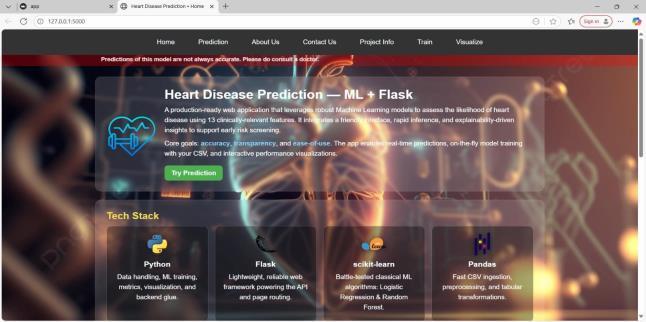
The proposed Heart Disease Identification System is a specialized component within the larger E-Healthcare ecosystem.Itisdesignedtoprovidedata-driveninsightsfor the early detection of cardiovascular diseases, leveraging MachineLearningclassificationalgorithms.Thesystemdoes not replace medical experts but functions as a decisionsupporttooltoassistdoctorsinmakingmoreaccurateand timelydiagnoses.
Relation to E-Healthcare System: The system integrates with existing electronic health record (EHR) platforms to accesspatientinformation.Itcanbelinkedtotelemedicine services so that patients in remote areas can also benefit fromearlyheartdiseaseprediction.ItsupportswearableIoT devices (like smart watches, ECG monitors, and blood pressuretrackers)tofetchreal-timehealthdata.
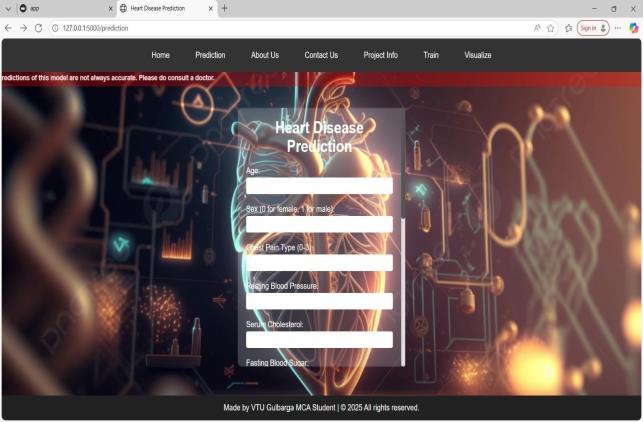
The Heart Disease Identification System follows a layered architecturethatensuresmodularity,scalability,andeaseof integration within the E-Healthcare ecosystem. The architectureconsistsofthreeprimarylayers:UserInterface Layer, Application Layer, and Data Layer, along with interactionstoexternalusersandentities.
International Research Journal of Engineering and Technology (IRJET) e-ISSN: 2395-0056
Volume: 12 Issue: 12 | Nov 2025 www.irjet.net p-ISSN: 2395-0072
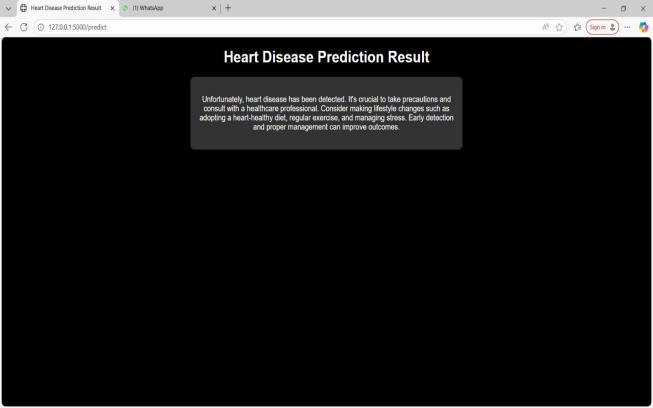
The Heart Disease Identification System using Machine Learning in E-Healthcare demonstrates the effective integration of modern technology in medical diagnostics, enabling early detection of heart disease and supporting timelyinterventions.Thesystemachieveshighaccuracyand producesdependablepredictionsforclinicalusebyutilizing Machine Learning classifiers like Random Forest and Decision Tree. A relational database effectively manages patient data, medical tests, and predictions, guaranteeing simple analysis and retrieval. Doctors and other medical professionalscaneasilyenterdataandviewresultsthanks to the user-friendly interface, which improves decisionmaking and lessens manual labor. Remote monitoring is made possible through integration with e-healthcare platforms, which enhances patient outcomes and accessibility. The system can handle bigger datasets and upcoming improvements, such as more cardiovascular predictionsorupdatedMachineLearningmodels,becauseit wasbuiltwithscalabilityinmind.Allthingsconsidered,this project shows how healthcare and Machine Learning can collaborate to enhance diagnostic precision, effectiveness, andpatientcarequality.
The Heart Disease Identification System using Machine LearninginE-Healthcarecanbefurtherenhancedinseveral ways to improve its functionality and impact. In order to handlecomplexdatasetsandimprovepredictionaccuracy, futureadvancementsmightincorporatemoresophisticated Machine Learning algorithms, like deep learning models. Throughtheuseofwearabletechnology,thesystemcanbe expandedtoincludereal-timepatientmonitoring,enabling ongoingvitalsigntrackingandearlywarningsofabnormal readings. Both patients and doctors would benefit from increased accessibility with the addition of a mobile application interface, which would allow for remote consultations and real-time notifications. Model generalization and reliability can be improved by adding morediverseandsizabledatasetsfrommorehospitalstothe database. Additionally, using explainable AI techniques
would improve usability and trust by assisting medical professionalsincomprehendingthelogicbehindpredictions. Lastly, workflows can be streamlined by integrating the system with hospital management software, making it a completesolutionfore-healthcareservicesandcustomized patientcare.
[1]Systematicreview:Machinelearningalgorithmsforheart disease diagnosis: a systematic analysis (2013–2024). ScienceDirect
[2] UCI Machine Learning Repository Heart Disease (Cleveland)dataset(commonlyused14-featuresubset).UCI MachineLearningRepository
[3] Springer review: A comprehensive review of deep learning–based models for heart disease analysis (2023). SpringerLink
[4] Frontiers review: Comprehensive for heart disease prediction overviewandprospects(2025).Frontiers
[5] Framingham Risk Score / Poole dcohort equations clinical risk calculators & background on traditional risk scoring.MDCalcFraminghamHeartStudy
[6]PhysioNetdatabases ECG,ICU,andwaveformdatasets usefulforMLincardiaccare.PhysioNet
[7]MIMIC-derivedstudies:Deeplearningforheart-failure classification using ICU waveform + clinical data (2024). PubMedCentral
[8] Review / methods: Deep learning for myocardial infarctiondetectionfromECG(2024).ScienceDirect
[9] Wearables review: Wearable devices and ML for arrhythmia/AFdetection(2025).MDPI
[10]Recentappliedstudy:XGBoostandhybridMLmodels forcardiovasculardiseaseprediction(2025).Nature
[11] Journal of Medical AI review: State-of-the-art ML methods for heart disease detection (systematic / comparative).MedAIJournal
[12]AutomatedAMIdetection(2025) deep-learningECG pipelines for rapid myocardial infarction triage. PubMed Central
[13] Practical paper: Feature-selection strategies & ML pipelines for heart disease prediction (2024). PubMed Central
International Research Journal of Engineering and Technology (IRJET) e-ISSN: 2395-0056
[14] Community resources & GitHub projects reproducible UCI/Kaggle implementations and starter notebooks.GitHub
[15] Evaluation & best-practice reviews advice on validation(temporalsplits,patient-wisesplits),imbalance, andclinicaldeployment.ScienceDirect
Volume: 12 Issue: 12 | Nov 2025 www.irjet.net p-ISSN: 2395-0072 © 2025, IRJET | Impact Factor value: 8.315 | ISO 9001:2008 Certified Journal | Page163