
International Research Journal of Engineering and Technology (IRJET)
Volume: 12 Issue: 11 | Nov 2025 www.irjet.net
e-ISSN: 2395-0056
p-ISSN: 2395-0072
International Research Journal of Engineering and Technology (IRJET)
Volume: 12 Issue: 11 | Nov 2025 www.irjet.net
e-ISSN: 2395-0056
p-ISSN: 2395-0072
Ankita Nagnath Jadhav1 , Prathamesh Narayan Virape2 , Dnyaneshwar Ganesh Gond3 , Yash
Shravan Shelake4 , Satyajeet Dipak Mokashi5 , Vaishnavi Amar Awatade6
1(B.Tech Student, Dept.of Mechanical Engineering, SVERI College of Engineering Pandharpur, Solapur)
2,3(B.Tech Student, Dept.of Computer Science & Engineering, SVERI College of Engineering Pandharpur)
4,5(B.Tech Student, Dept.of Electronic & Telecom. Engineering, SVERI College of Engineering Pandharpur)
6(B.Tech Student, Dept.of Civil Engineering, SVERI College of Engineering Pandharpur)
Agriculture plays a crucial role in India’s economy, but traditional fertilizer application methods are still manual, time-consuming, and often inaccurate. Farmers frequently face uneven fertilizer distribution, leading to nutrient imbalance and reduced yield. To overcome this, we developed an IoT and Sensor-Based Automated Solid Fertilizer Distribution Machine that provides precise, smart, and uniform fertilizer application. This machine distributes only solid fertilizer based on plant detection using sensors and a microcontroller The farmer controls thesystemthroughamobileappinterface,wheretheycan set fertilizer quantity, operation mode, and movement speed Thesensorsdetecteachplant’spositionandrelease the fertilizer accurately near its roots If crops are not planted in straight lines, the system uses a controlled spreading mechanism to ensure balanced coverage This machine is suitable for multiple crops like maize, jowar, sugarcane, wheat, and bajra, and its modular and adjustable design allows easy use on different farm sizes Experimental results show reduced fertilizer wastage, lower labor effort, and increased productivity The system represents a steptoward affordableandsmart automation inIndianagriculture.
Keywords: IoT, Sensors, Automation, Fertilizer Distribution, Smart Farming, Adjustable System.
Fertilizer management is a vital aspect of modern agriculture as it directly influences soil fertility, crop growth, and overall yield. Traditional methods offertilizer application are mostly manual, which require more labor, time, and often result in uneven distribution. Overuse of fertilizers damages soil health and increases cost, while underuse reduces plant productivity. To overcome these issues,theproposedsystemintroducesan IoT and sensorbased automated solid fertilizer distribution machine that detects plant presence using infrared and proximity sensors and precisely releasesfertilizerneartherootarea. The machine is fully controlled through a mobile application,allowingfarmersto monitor and adjust the
fertilizer level remotely It ensures uniform fertilizer distributionformultiplecropslikemaize,jowar,sugarcane, and bajra, regardless of row pattern The system is designed with an adjustable frame and dual outlet discs for efficient spreading in various field conditions. This innovation minimizes human effort, reduces fertilizer wastage, saves time, and enhances field efficiency By integrating mechanical design, electronics, and IoT technology, the project promotes smart and sustainable farmingforfutureagriculture
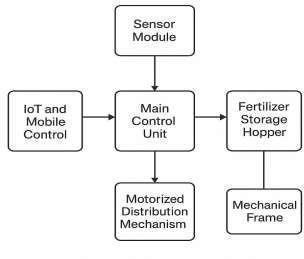
Themachineisdesignedwithseveralmaincomponents:
2.1 Main Control Unit:
Acts as the brain of the system (Arduino) controlling allsensors,motors,andcommunicationfunctions
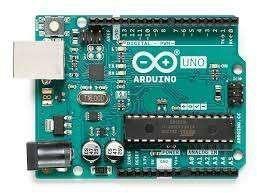
Fig.01-Microcontroller(Arduino)
2.2 IoT and Mobile Control:
The machine connects to a mobile app via Wi-Fi or Bluetooth Farmerscanselectthecroptype,fertilizerlevel, operation speed, and mode The system status and total fertilizerusedaredisplayedontheapp
International Research Journal of Engineering and Technology (IRJET)
Volume: 12 Issue: 11 | Nov 2025 www.irjet.net
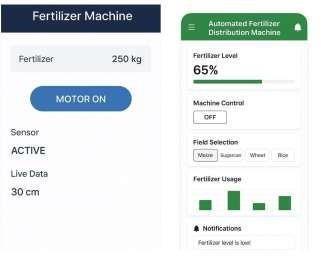
Fig.02-UserInterface
2.3 Sensor Module:
Detects the presence and position of plants. Oncea plant is detected, itsendsasignaltorelease fertilizer.
e-ISSN: 2395-0056
p-ISSN: 2395-0072
2.5 Motorized Distribution Mechanism:
When sensors detect a plant, the motor activates and rotates the fertilizer dispensingunit, dropping a fixed quantity near the root zone For irregular crop patterns, a spreading attachment ensures even coverageacrossthearea.
The motor activates and rotates the spreading
IR Sensor – Detects the presenceofaplant. the plant discs. Fertilizer is accurately released near roots
Proximity Sensor –Measures the exact positionoftheplant.
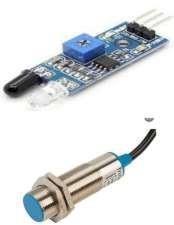
03-SensorTechnology(IR&ProximitySensor)
2.4 Fertilizer Storage Hopper:
A specially designed storage container that holds the solid fertilizer and releases it evenly when triggered by thecontroller
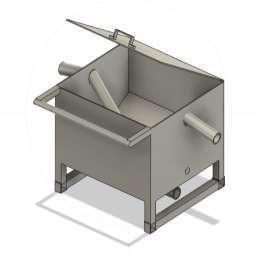
04-FertilizerStorageHopper
2.6 Mechanical Frame:
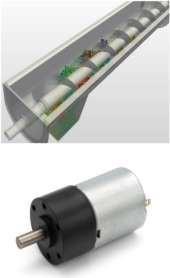
05-Conveyor&DCMotor
The frame is height and width adjustable, making it compatible with different crop heights and field types Its modular structure allows easy assembly and transport
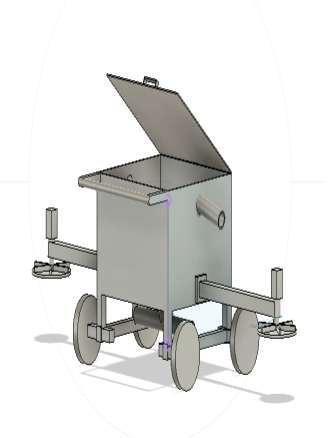
Fig.06-MainMachineMechanicalFrame
3. WORKING PRINCIPLE
The working of the Automated Solid Fertilizer Distribution Machine is based on the principle of sensorbased detection and controlled mechanical distribution The system operates automatically once it is set up in the fieldandconnectedtothemobileapplication
Volume: 12 Issue: 11 | Nov 2025 www.irjet.net
At the center of the machine lies a hopper, designed to store the required amount of solid fertilizer. The fertilizer gradually moves downward due to gravity and is guided toward the two outlet pipes positioned at an angle on either side of the hopper These outlets are connected to rotating distribution discs, which ensure uniform spreadingofthefertilizerneartherootzoneofeachplant
When the machine moves forward in the field, infrared (IR) or proximity sensors continuously monitor the ground to detect the presenceand spacing of plants Upon detecting a plant, the sensor sends a signal to the microcontroller, which in turn activates the DC motor attached to the distribution disc The motor rotates for a specific duration, releasing the exact quantity of fertilizer requiredforthatplant
If the plants are arranged in irregular rows, the spreading discs disperse fertilizer in a wider pattern to maintain even coverage across the area Conversely, when crops are planted in straight rows, the system dispenses fertilizer directly beside each plant,minimizingwastage
The entire process is controlled through a mobile app thatallowsthefarmerto:
➢ Setthefertilizerquantityperplantorperarea,
➢ Adjustmotorspeedandmovementrate,
➢ Startorstopthemachineremotely,and
➢ Monitortotalfertilizerusedinreal-time.
As the machine progresses through the farm, sensors ensure that fertilizer is released only when necessary, avoidingcontinuousfloworover-distribution Oncetheset quantity is dispensed, the motor automatically stops, conservingfertilizer
Thesupportwheelsprovidestabilityandsmoothmotion, while the adjustable frame allows the system to adapt to differentcropheightsandrowwidths
e-ISSN: 2395-0056
p-ISSN: 2395-0072
After extensive field testing of the automated fertilizer distribution machine across multiple crop types such as maize, sugarcane, and jowar, several significant outcomes were recorded. The system demonstrated a reduction in fertilizer usage by 30–40%, due to precise delivery of nutrients only when and where required. The operational time decreased by approximately 50%, as the machine coveredalargerfieldareainlesstimecomparedtomanual spreading.Thefertilizerapplicationwasfoundtobehighly accurate and uniform, eliminating overuse and minimizing wastage
Theoverallcropyieldimprovedbynearly25%,owingto balanced nutrient supply and optimized soil health Additionally, labor cost was reduced drastically, since a single operator could control and monitor the machine remotely via mobile connectivity The sensors responded effectively to variations in crop spacing, ensuring correct fertilizer release only near plant roots Field trials confirmed that the machine performs reliably on different soil conditions and terrains, making it a cost-effective and scalablesolutionformodernfarmingpractices
The results clearly indicate that the Automated Fertilizer Distribution Machine using IoT and Sensor Technology successfully addresses the major challenges faced in traditional fertilizer management. The system’s ability to detect plant position and dispense fertilizer precisely neartherootzoneensures targeted andefficient application, which directly improves soil health and crop productivity.The reductioninfertilizer consumptionby 30–40%notonlylowersfarmingcostsbutalsominimizes environmentalimpactcausedbyexcesschemicalusage.
The integration of IoT-based remote control and monitoring provides farmers with real-time access to operational data, enabling them to make quick and accurateadjustmentsduringfieldoperation.Thisfeatureis especially beneficial for large-scale farms where manual supervision is difficult. The machine’s adjustable mechanical design allows it to be used for multiple crops andvaryingrowpatterns,ensuringhighversatility.
Furthermore, the system significantly contributes to environmental sustainability by reducing excessive fertilizer runoff into soil and water bodies, thereby preventing pollution and maintaining ecological balance.It also proves to be highly cost-effective, as it minimizes labor requirements and optimizes fertilizer utilization helping small and medium-scale farmers achieve better productivityatloweroperationalcosts
International Research Journal of Engineering and Technology (IRJET)
Volume: 12 Issue: 11 | Nov 2025 www.irjet.net
Moreover, the system demonstrates strong potential for scalability; additional sensors such as moisture and pH detectors can be integrated in the future to further enhance automation The positive increase in crop yield (up to 25%) highlights the effectiveness of precise fertilizer placement in improving nutrient absorption Overall,thediscussionconcludesthattheproposedsystem offers a smart, reliable, and eco-friendly solution that can transformtraditionalfarmingintoamoredata-drivenand sustainableprocess
TheAutomatedSolidFertilizerDistributionMachineisan innovative step toward smart and precise agriculture It eliminates manual effort, reduces fertilizer waste, and enhances productivity The machine can easily adapt to different crops and field conditions through its adjustable design
By combining IoT, sensors, and automation, this system makes fertilizer application simple, accurate, and affordable In the future, features like AI-based plant detection, automatic navigation, and cloud-based data analyticscanbeaddedtomakethesystemmoreadvanced Overall, this project represents a technological revolution in farming, helping farmers save time, reduce cost, and increase yield a perfect example of modern engineering meetingtraditionalagriculture
1 N. Verma, A. Yadav, and D. Reddy, “Design and Implementation of Sensor-Based Fertilizer Distribution System,” International Journal of Research in Engineering and Technology (IJRET),vol.8,no.6,pp. 45–49,2021.
2 R K Chaturvedi and S S Mehta, “Precision Agriculture Using IoT and Automation,” in IEEE Conference on Emerging Trends in Engineering and Technology (ICETET), pp.102–107,2022.
3 J Thomas, “Smart Agriculture: Role of Sensors and IoT in Precision Farming,” Springer Nature, pp 150– 157, 2021
4 S Pawar,P N Virape,etal,“Automated SolidFertilizer Distribution Machine Using IoT and Sensor Technology,” International Research Journal of Engineering and Technology (IRJET), vol 12, issue 3, pp 1–5, 2025 (Under Review)
5 S Mahajan and R Patil, “IoT Based Smart Fertilization and Irrigation Control System,” International Journal of Science and Research (IJSR), vol. 10, no. 5, pp. 220–224, 2021.
e-ISSN: 2395-0056
p-ISSN: 2395-0072