
International Research Journal of Engineering and Technology (IRJET) e-ISSN:2395-0056
Volume: 12 Issue: 11 | Nov 2025 www.irjet.net p-ISSN:2395-0072
International Research Journal of Engineering and Technology (IRJET) e-ISSN:2395-0056
Volume: 12 Issue: 11 | Nov 2025 www.irjet.net p-ISSN:2395-0072
Anirudh Kulkarni1 , Darur Eashwar2 , Godeshwari3 , Aishwarya Hipparagi4 , S N Kugali5
1234Student, 5Assistant Professor Department of Information Science and Engineering, Basaveshwar Engineering College, Bagalkote, India
ABSTRACT-
The AI-Based Cognitive Education (ACE) system integrates artificial intelligence and cognitive science to deliver a personalized, adaptive learning experience. It analyzes learners’ performance and behavior to tailor content, provide real-time feedback, and enhance understanding and skill development. ACE transforms admin-uploaded Pd's into a retrieval-augmented study and interview workflow, generating structured learning paths and difficulty-controlled question sets. Using an Ollama-compatible LLM, it evaluates responses with grounded references, while a Fast API vision service employing YOLO face detection and Insight-face embeddings ensures identity verification. Built on a Node.js/Expressback-endwithMongoDBandRedis,ACE optimizes latency through a cache radius parameter. Evaluation metrics such as Precision, Recall, and F1score assess LLM accuracy. By combining AI driven automation with cognitive principles, ACE advances smart,accessible,andfuture-readyeducation.
Key Words: AI in Education, Cognitive Learning, Adaptive Learning Systems, Personalized Education, Intelligent Tutoring System, Machine Learning, RAG, guided study, LLM evaluation, proctoring, YOLO, InsightFace,MongoDB,Redis
In today’s digital age, the rapid growth of online education has created vast opportunities for learners, yet it has also introduced challenges such as scattered learningresources,limitedpracticalevaluation,andlack of personalized feedback. Traditional e-learning platforms often focus solely on theoretical knowledge, overlooking the importance of real-world skill assessmentandadaptivelearningexperiences.
TheAI-PoweredE-Learning&InterviewProctor System is designed to bridge this gap by combining artificial intelligence with cognitive learning principles. The system curates high-quality educational content, simulatesreal-worldinterviewenvironments, andoffers instant, personalized feedback to help learners identify strengths and areas for improvement. Through intelligent monitoring and data-driven analysis, ACE not only ensures academic integrity during
assessments but also enhances learner engagement and performance. by integrating AI-based evaluation, adaptive learning, and automated interview proctoring, this project aims to create a holistic digital learningecosystem that prepares students for both academic success and professional readiness in an increasinglycompetitiveworld.
Fragmented learning makes it hard to progress from materialstomasteryandassessment.ACEintegrates:
- Admin‑driven PDF ingestion to build a domain knowledgestore.
- Guided study recommendations based on observed mastery.
- Retrieval‑augmented interviews and LLM rubric evaluation.
- Vision‑based proctoring (YOLO detection + InsightFaceverification).
- Acache “redius” framework to reduce latency under load.
To build an adaptive learning platform that delivers personalized study paths tailored to individual learners
To curate and organize learning resources in a structured manner, ensuring accessibility, clarity, andrelevancefordiverselearners.
Toenablereal-timeanalyticandpersonalized feedback toaccelerateskillimprovement
To simulate real-world interview environments that help users practice communication, technical, and problem-solvingskillseffectively.
To provide instant, data-driven feedback and analytics for continuous performance improvement and career readiness.
International Research Journal of Engineering and Technology (IRJET) e-ISSN:2395-0056
Volume: 12 Issue: 11 | Nov 2025 www.irjet.net p-ISSN:2395-0072
1. Optimizing React Components For Improving The Performance Of MERN Stack Application.
Key Findings:-
ThispaperexploreseffectivestrategiestoimproveReact component performance in MERN stack (MongoDB, Express.js, React, Node.js) applications. As apps grow morecomplex,afastandefficientUIiscrucial.Thegoalis to provide developers with clear, practical methods to boostReactperformanceandenhanceuserexperience.
2. InnovativeE-Learning SystemEmpowering Education ThroughEngagementandPersonalization
Key Findings:-
This paper introduces a modern e-learning platform developed using the MERN stack (MongoDB, Express, React, Node.js), addressing the limitations of current systems such as lack of personalization, real-time feedback,andsupport.Keyfeaturesincludepersonalized course recommendations (SVD), real-time video quizzes with auto-grading, gamification (leaderboards, badges), automated certifications, and a rule-based chatbot for course-specific,real-timeassistance.
3.Evaluating the Efficacy of Open-Source LLMs in Enterprise-SpecificRAGSystems:AComparativeStudyof PerformanceandScalability
Key Findings:- This paper evaluates open-source LLMs inRetrieval-AugmentedGeneration(RAG)forenterprise data, showing that effective embeddings enhance accuracy and efficiency, making them a cost-effective alternativetoproprietarysystems.
4. A Systematic Review of Machine Learning TechniquesinOnlineLearningPlatforms.
Key Findings:-
Education has shifted to online platforms enhanced by AI, especially machine learning. Techniques like deep learning, NLP, and reinforcement learning improve personalization and performance. This study reviews 2015–2021 research on ML use, trends, and challenges ine-learning.
5. StudyNotion:MERNbasedEd-TechPlatform
Key Findings:-
StudyNotion is a MERN stack–based ed-tech platform that enables content creation, learning, and rating with secure,scalablearchitecture.Ithighlightssystemdesign, deployment, and testing, focusing on accessibility, performance, and student-centric learning enhancements.
6. Enhancing Comprehension with LLM, TTS, andRAG: TranscriptionofTextintoPodcastsandChatbot.
Key Findings:-
This paper presents a system combining LLMs, Text-toSpeech, and Retrieval-Augmented Generation (RAG) to convert documents into interactive podcasts and chatbots. It enhances comprehension, engagement, and accessibility by enabling conversational, audio-based learning experiences with contextual responses and realisticvoicesynthesis.
7. A Retriever–Analyzer–Generator (RAG) Pipeline for InteractiveInterviewPreparationusingLLMs.
Key Findings:-
Thispaper presentsan AI-driven interview preparation system using a Retriever–Analyzer–Generator (RAG) pipeline. The system retrieves domain knowledge, analyzes user responses to detect skill gaps, and generates adaptive interview questions via LLMs, enabling personalized mock interviews and real-time feedbacktoenhancecandidateperformance.
8. Analysis on AI Proctoring System Using Various ML Models
Key Findings:-
ThispaperproposesanAI-basedproctoringsystemthat removes the need for human supervision in online exams. Using YOLO for real-time object detection and FaceNet for accurate facial recognition, the system detects unauthorized objects, verifies identities, and adapts to emerging security threats. A multi-modal approach enhances accuracy, scalability, and speed compared to existing models, offering an intuitive interface for both proctors and test-takers and providingreal-timealertsforsuspiciousbehavior.
Introduction :-
Despite the rapid growth of e-learning platforms, most lackpersonalization,structuredlearningpaths,andrealtime evaluation. Learners struggle to identify relevant content, measure progress, and prepare effectively for real-world job scenarios. Existing systems focus mainly on knowledge delivery rather than practical skill assessment.
To address these challenges, the proposed ACE (AIBasedCognitiveEducation)systemaimstointegrate AIdriven adaptive learning, automated interview simulation, and performance analytics within a unified platform.Theobjectiveistocreateanintelligent
International Research Journal of Engineering and Technology (IRJET) e-ISSN:2395-0056
Volume: 12 Issue: 11 | Nov 2025 www.irjet.net p-ISSN:2395-0072
learning environment that personalizes study content, trackslearnerprogress,providesinstantfeedback,and enhances job readiness through cognitive automation[2].
- rag- Retrieval‑Augmented Generation for grounded questionanswering.
- adaptive_learning- Mastery and recommendation modelsforpersonalizedstudy.
- proctoring- Face detection/verification for integrity (YOLO,InsightFace).
- llm_scoring- Automated evaluators and reliability analysesineducation.
Toensureaseamlessandscalableuserexperience,the system is built using the MERN (MongoDB, Express.js, React, Node.js) stack, which provides efficient data handling, modular APIs, and dynamic front-end rendering suitable for adaptive e-learning environments[1],[2],[5].
(Retrieval-Augmented Generation) [6][7]
RAG is a technique by which a large language model (LLM) is augmented with an external document retrieval component so that it can reference specific knowledge bases (e.g., uploaded PDFs, domain documents)ratherthanrelyingsolelyonitspretrained parameters.
InACE,theRAGworkflowworksasfollows:
The system ingests domain-specific course materials (PDFs) and chunks and embeds them into a vector store.At interview runtime, given a learner’s prompt, the retrieval module fetches the top-k relevant chunks.These retrieved passages are appended to or used in constructing the prompt for the LLM, ensuring generation is grounded in domain-specific content ratherthanunconstrained.
This approach reduces hallucinations, enables up-todate content usage, and aligns responses with the curatedcorpusoftheplatform.
Additionally, a Text-to-Speech (TTS) component [6] is integrated into the RAG module to convert AIgenerated responses into natural voice outputs. This enhances accessibility and provides a more interactive learning experience, especially for visually impaired learnersorhands-freeenvironments.
adaptability, and engagement in educational platforms. However, these systems often face limitations such as restricted access to real-world datasets, privacy constraints, and inconsistent data availability, as many online learning platforms do not publicly share user information. This makes it challenging to train and evaluate robust models on proprietary data. Despite these challenges, there remains a vast opportunity for machine learning models like YOLO (You Only Look Once) to strengthen online systems by providing secure andadaptiveuserexperiences[8].
YOLO is a real-time object (in this case, face) detection framework widely used in computer vision tasks for its speedandaccuracy.
In ACE’s proctoring module:
YOLOisusedtodetectthelearner’sfaceinthevideofeed at the start and during the interview session. its output (facecount,presence,boundingboxes)iscombinedwith an embedding verification system (e.g., using InsightFace) to check identity and session integrity.If multiple faces appear, or the face is absent or occluded, thesystemflagsthesessionforintegrityviolation.[8].
This integration of YOLO ensures that the proctoring system is responsive in real-time, enabling detection of suspiciousbehaviourorimpersonation. VisionProctoringwithYOLOandInsightFace
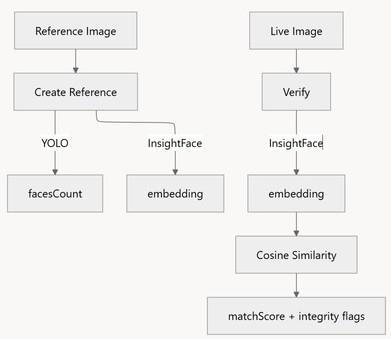
This module ensures identity verification and integrity monitoring during AI-based interviews. It integrates YOLO for real-time face detection and InsightFace for facialembeddingandverification.
The system captures both a reference image and a liveimagefromtheuser.
YOLO detects the user’s face and counts multiple detections(toflagpossibleimpersonation).
InsightFace generates normalized facial embeddings and compares them using cosine similarity to verify identity.
An integrity model combines match scores and event flags (like multiple faces or missing faces) to produceanoverallintegrityscore.
This process ensures that only the legitimate candidateisactiveduringtheinterview,maintaining authenticityandfairness.
Recentstudiesonmachinelearningintegrationinonline learning [4] have shown that techniques such as deep learning, reinforcement learning, and natural language processinghavesignificantlyimprovedpersonalization,
International Research Journal of Engineering and Technology (IRJET) e-ISSN:2395-0056
Volume: 12 Issue: 11 | Nov 2025 www.irjet.net
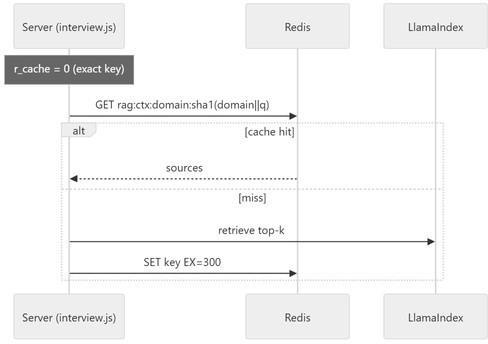
This component focuses on optimizing system performance by reducing retrieval latency during learning and interview sessions. It uses Redis as a caching layer to store and quickly access frequently requestedcontentandqueryresults.
A cache radius parameter (r_cache) determines how widelydataiscached:
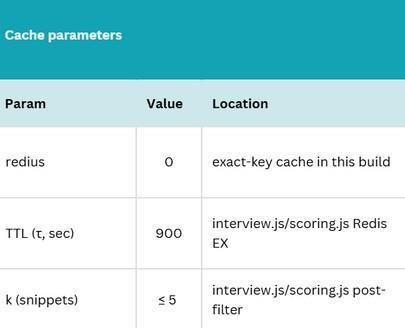
r_cache = 0 → exact key caching (high specificity, lowerreuse).
r_cache > 0 → normalized/bucketed caching (higherreuse,lowerlatency).
The system retrievesdata fromRedis if available(cache hit) or fetches from the LLM and database if not (cache miss).
Cached data is stored with a time-to-live (TTL) valuetoensurefreshnessandefficiency.
Increasing the cache radius improves hit rate and responsetime,balancingaccuracyandspeed.
p-ISSN:2395-0072
The ACE (AI-Based Cognitive Education) system integrates multiple Large Language Models (LLMs) for retrieval,evaluation,andfeedbackgeneration.
Main Evaluation Model: Llama 3.1 8B Instruct (q4_K_M) used for rubric-based interview scoring and report generation. Configured with a low temperature (0–0.2) and medium context window (512– 1536 tokens) to ensure consistent, reasoningfocused outputs while maintaining efficiency through quantization.
Lightweight Evaluator: Llama 3.2 1B Instruct employed for rapid per-answer scoring and nextquestionrecommendations,offeringhighspeedandlow resourceusageforshortresponses.
Embedding Model: nomic-embed-text generates dense semantic embeddings for RAG (RetrievalAugmented Generation) to enable accurate, contextbasedretrievalfromstudymaterials.
As evident from Llama3 outperforming Mistral, especiallyforproprietaryenterprise[3].Themodelsare hosted locally through Ollama, interfaced via /api/generate and /api/embeddings endpoints, and integrated using LlamaIndex for efficient retrieval and inference. Operational flags like FAST_FLOW and DEFER_EVAL optimize evaluation latency and system responsiveness. Fully local inference ensures data privacy and eliminates external dependencies, while quantized models balance speed and accuracy. However,the1Bmodelshowslimitedreasoningability, and the 8B model’s shorter context window requires carefulretrievalcuration.
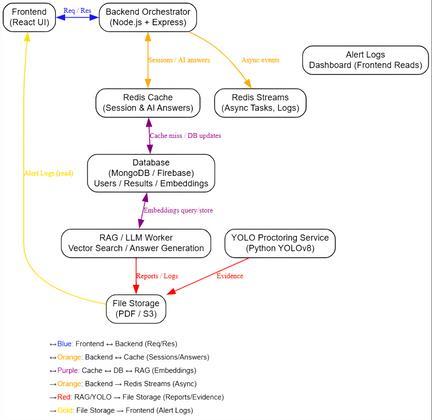
This diagram represents the end-to-end architecture of an intelligent web-based system that integrates AIpowered processing, real-time proctoring, and data management. The architecture ensures scalability, efficiency, and secure communication between various components.Thesystemleveragesamodularstructure, enabling each layer including frontend interfaces, backendservices,AIengines,andproctoringmodules to operate independently while still communicating smoothlythroughwell-definedAPIs.
International Research Journal of Engineering and Technology (IRJET) e-ISSN:2395-0056
Volume: 12 Issue: 11 | Nov 2025 www.irjet.net p-ISSN:2395-0072
ArchitectureOverview
1.Frontend(ReactUI):Userinterfaceforinteractions, reports,andalerts.
2.Backend (Node.js + Express): Handles API requests,sessions,andasynctasks.
3.Redis Cache: Stores temporary sessions and AI answersforfastaccess.
4.Redis Streams: Manages background tasks and systemlogs.
5.Database (MongoDB / Firebase): Stores users, results,andembeddings.
6.RAG / LLM Worker: Performs vector search and AI-basedanswergeneration.
7.YOLOProctoring(YOLOv8):Detectsandrecords proctoringevidenceusingAI.
8.File Storage (PDF / S3): Saves reports, logs, and evidence.
9.Alert Dashboard: Displays alerts and logs in realtime.
10.Flow:-Frontend↔Backend ↔Redis ↔Database ↔RAG/YOLO→FileStorage→Dashboard
6. IMPLEMENTATION
FLOW CHART
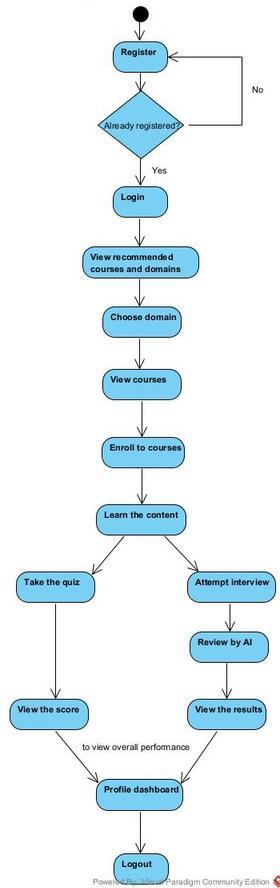
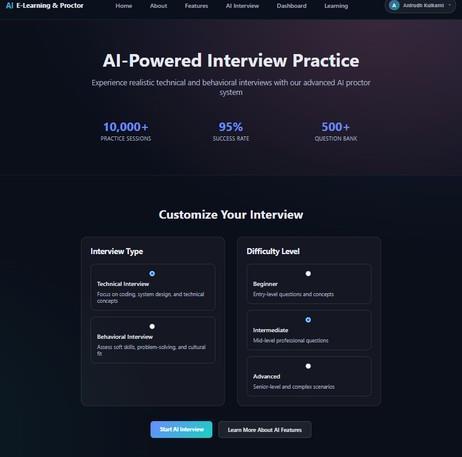
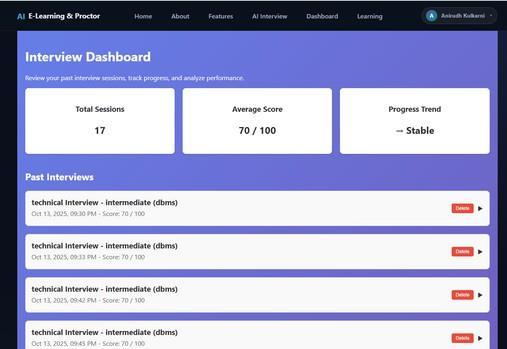
The activity diagram illustrates the step-by-step workflow of the ACE system. It begins with user registration and login, followed by viewing recommended courses and selecting a preferred domain. The user then enrolls in courses, learns the content, and proceeds to either take quizzesorattemptAI-basedinterviews.
The AI module reviews the user’s performance, providesresultsandfeedback,anddisplaystheoverall progress in the profile dashboard. The process concludeswiththeuserloggingout.
International Research Journal of Engineering and Technology (IRJET) e-ISSN:2395-0056
Volume: 12 Issue: 11 | Nov 2025 www.irjet.net p-ISSN:2395-0072
International Research Journal of Engineering and Technology (IRJET)
Volume: 12 Issue: 11 | Nov 2025
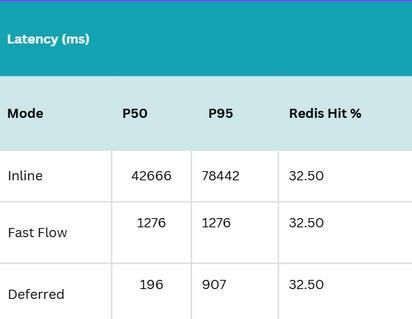
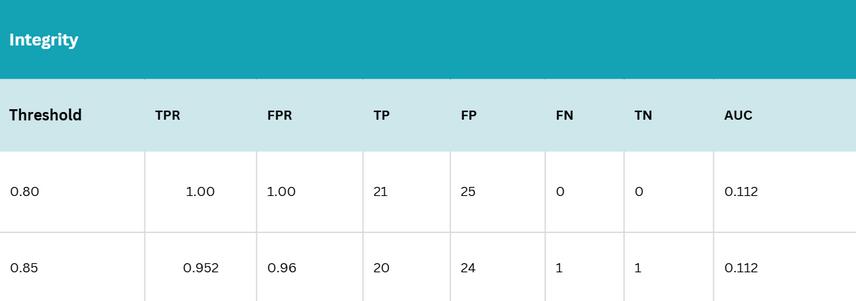
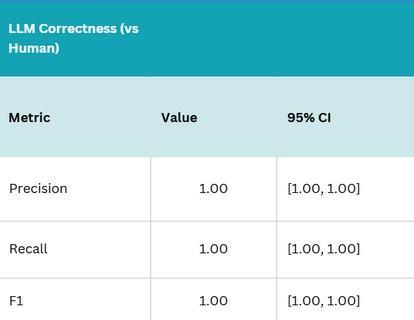
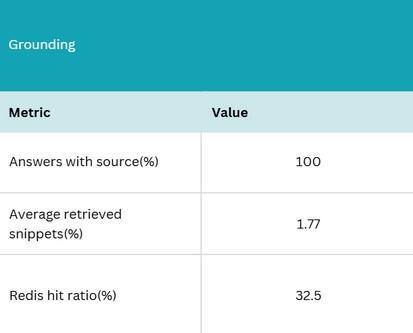
These 5 tables present comprehensive analysis of the system’sperformance,groundingcapability,integrity,and correctness across different evaluation modes, as illustratedinTables6.1to6.5.Table6.1compareslatency across Inline, Fast Flow, and Deferred modes, showing that Inline incurs the highest delay due to synchronous evaluation,whileDeferredachievesthelowestlatencyby postponingheavycomputations,withaconstantRedishit ratio across modes. Table 6.2 highlights grounding performance, where 100% of responses were supported by retrieved sources, an average snippet contribution of 77%, and a Redis hit ratio of 32.5%, indicating effective but optimizable caching. Table 6.3 focuses on integrity evaluation under varying thresholds, demonstrating consistent classifier stability (AUC = 0.112) with high true positive rates and balanced specificity, confirming reliable integrity detection. Table 6.4 compares LLM correctness against human evaluations, showing perfect Precision,Recall,andF1-scores(all1.00)with confidence intervals [1.00, 1.00], validating the accuracy of the rubric-based automated evaluation approach. Finally, Table 6.5 details cache configuration parameters Redis radius set to 0 for exact-key matching, TTL fixed at900secondsforfreshness,andsnippetcount(k≤5)to ensure concise retrieval collectively optimizing inference performance and reliability across evaluation processes.
Test Case 1:InvalidLoginCredentials
Input: User enters incorrect email or password during login.
Expected Result: Display an error message "Invalid emailorpassword.Pleasetryagain.“
Test Case 2: InvalidRegistrationDetails
Input: User leaves mandatory fields (e.g., email or password)emptyduringregistration.
Expected Result: Display error message – "Please fill all requiredfields."
Test Case 3: Face Detection Failure (AI Proctoring)
Input: User’s face is not visible or detected during interview.
Expected Result: Display message – "Face not detected. Pleaseensureproperlightingandcameraposition."
Test Case 4: ProctoringIntegrityViolation
Input: User’s face is not continuously visible or multiple facesdetectedduringAIinterview.
Expected Result: System flags session for review –"Integritywarning:Multiplefacesdetected."
www.irjet.net p-ISSN:2395-0072
Test Case 5:Facevisibilitypercentage
Input: Userappearsforinterview
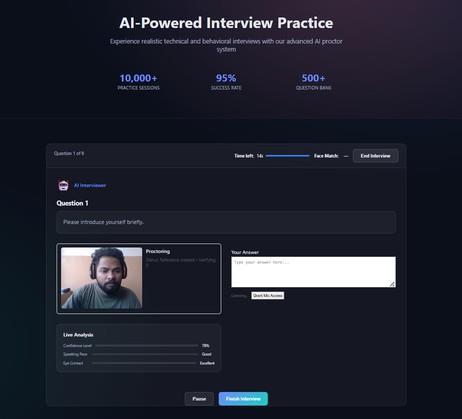
Expected Result: Detects the precentage of face matchanddisplays–Match:0.93
Test Case 6: AIInterviewScoringValidationInput: User provides irrelevant or blank responses during AI interview.
Expected Result: System displays low score and feedback–"Answernotrelevanttothequestion."
Test Case 7: FeedbackDisplayCheck
Input: User completes AI interview and submits. Expected Result: AI-generated feedback and performance analysis displayed correctly on the dashboard.
Test Case 8: LogoutFunctionality
Input: User clicks on "Logout" after completing all activities.
Expected Result: User is securely logged out and redirectedtotheloginpage.


International Research Journal of Engineering and Technology (IRJET) e-ISSN:2395-0056
Volume: 12 Issue: 11 | Nov 2025 www.irjet.net p-ISSN:2395-0072




International Research Journal of Engineering and Technology (IRJET) e-ISSN:2395-0056
Volume: 12 Issue: 11 | Nov 2025 www.irjet.net p-ISSN:2395-0072
The AI-Based Cognitive Education (ACE) system unifies admin ingestion, guided study, retrieval-augmented (RAG) interviews, LLM-based scoring, and YOLO-backed proctoring within a low-latency cache radius framework. By integrating AI and cognitive science, ACE delivers personalized learning, adaptiveassessments,andAI-driveninterviewsthatenhance both understanding and job readiness. Its modular architecture built with Node.js, FastAPI, and MongoDB/Redis ensures scalability, security, and efficiency. Evaluation metrics such as Precision, Recall, and F1-scorevalidateitsreliability.ACE bridgesthegapbetween self-learning and professional competency, advancing smart, accessible, and future-ready education. Future work will explorenormalizedcaching,richerconceptgraphs,advanced integritycues,andbroaderevaluations.
[1]Optimizing React Components For Improving The PerformanceOfMERNStackApplication
Dr.Raj Kumar Parida, Gaurav Singh, Aditya Nath Pal. Proceedings of the 2025 Seventh International Conference on Computational Intelligence and Communication Technologies(CCICT)IEEE Year of Publication :2025.
[2] Innovative E-Learning System Empowering Education ThroughEngagementandPersonalization. PremKumarDuraisamy,KavyaSriB,KishoreRamB,Monisha ChitharthanaS.
Proceedings of the 2025 7th International Conference on IntelligentSustainableSystems(ICISS) YearofPublication:2025.
[3] Evaluating the Efficacy of Open-Source LLMs in Enterprise-Specific RAG Systems: A ComparativeStudy ofPerformanceandScalability. GautamBalakrishnan,AnupamPurwar.
Proceedings of the 2024 IEEE 21st India Council InternationalConference(INDICON) YearofPublication:2024
[4] A Systematic Review of Machine Learning TechniquesinOnlineLearningPlatforms. Cyril Elorm Kodjo Agbewali, Md. Atiqur Rahman, Mohamed Hamada, Mohammad Ameer Ali, Lutfun NaharOysharja, Md.TazmimHossain.
Proceedings of the 2022 IEEE 15th International Symposium on Embedded Multicore/Many-core Systems-on-Chip(MCSoC) YearofPublication:2022
[5]StudyNotion: MERN based Ed-Tech Platform. Mohammad Aamash Alvi, Anuradha Misha, Atul Srivastava,
KamleshKumarSingh.
Proceedings of the 2024 2nd International Conference on Computational and Characterization Techniques in Engineering&Sciences(IC3TES) YearofPublication:2025
[6] Enhancing Comprehension with LLM, TTS, and RAG:TranscriptionofTextintoPodcastsandChatbots. Arya Jalindar Kadam,Chinmay Ashok Kale, Chaitali Shewale, Prasad Rajaram Kute, Kushal Bhoraji Pathave, PawanWawage.
2025 International Conference on Intelligent and Innovative Technologies in Computing, Electrical and Electronics(IITCEE) YearofPublication:2024
[7]A Retriever–Analyzer–Generator (RAG) Pipeline for Interactive Interview Preparation using LLMs Samay Patel, Jeet Patel, Dhairya Shah, Parth Goel, BankimPatel.
Publisher:IEEE|ISBN:979-8-3503-8960-9| YearofPublication:2024.
[8] Analysis on AI Proctoring System Using VariousMLModels
Sangjukta Sharma, Awindrila Manna, Dr. N. Arunachalam
Publisher: IEEE | ISBN: 979-8-3503-5306-8 | Year of Publication:2024