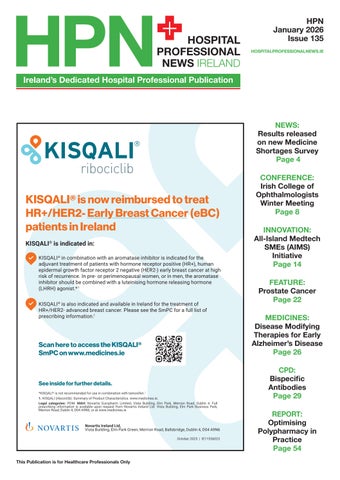
Results released on new Medicine Shortages Survey Page 4
KISQALI® is indicated in:
KISQALI® in combination with an aromatase inhibitor is indicated for the adjuvant treatment of patients with hormone receptor positive (HR+), human epidermal growth factor receptor 2 negative (HER2-) early breast cancer at high risk of recurrence. In pre- or perimenopausal women, or in men, the aromatase inhibitor should be combined with a luteinising hormone releasing hormone (LHRH) agonist.* 1
KISQALI® is also indicated and available in Ireland for the treatment of HR+/HER2- advanced breast cancer. Please see the SmPC for a full list of prescribing information.1
Scan here to access the KISQALI® SmPC on www.medicines.ie
A9N6 KISQALI® is now reimbursed to treat HR+/HER2- Early Breast Cancer (eBC) patients in Ireland
*KISQALI® is not recommended for use in combination with tamoxifen.1
1. KISQALI (ribociclib). Summary of Product Characteristics. www.medicines.ie. Legal categories: POM. MAH: Novartis Europharm Limited, Vista Building, Elm Park, Merrion Road, Dublin 4. Full prescribing information is available upon request from Novartis Ireland Ltd. Vista Building, Elm Park Business Park, Merrion Road, Dublin 4, D04 A9N6, or at www.medicines.ie See inside for further details.
Ireland Ltd, Vista Building, Elm Park Green, Merrion Road, Ballsbridge, Dublin 4,
Irish College of Ophthalmologists Winter Meeting Page 8
All-Island Medtech SMEs (AIMS) Initiative Page 14 FEATURE: Prostate Cancer Page 22 MEDICINES: Disease Modifying Therapies for Early Alzheimer’s Disease Page 26
Bispecific Antibodies Page 29 REPORT: Optimising Polypharmacy in Practice Page 54
For healthcare professionals in Ireland only. Abbreviated Prescribing Information can be found below.
Generic Product Launch
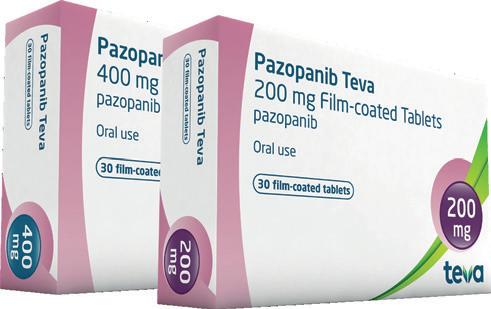
Pazopanib Teva
Film-coated Tablets
pazopanib
30 film-coated tablets
High Tech Prescription Medicine
Indications
Renal cell carcinoma (RCC)
Pazopanib Teva is indicated in adults for the first-line treatment of advanced renal cell carcinoma (RCC) and for patients who have received prior cytokine therapy for advanced disease.
Soft-tissue sarcoma (STS)
Pazopanib Teva is indicated for the treatment of adult patients with selective subtypes of advanced soft-tissue sarcoma (STS) who have received prior chemotherapy for metastatic disease or who have progressed within 12 months after (neo) adjuvant therapy.
Efficacy and safety has only been established in certain STS histological tumour subtypes.
Presentation: Each film-coated tablet contains pazopanib hydrochloride equivalent to 200mg and 400mg pazopanib respectively. Indications: Indicated in adults for the first-line treatment of advanced renal cell carcinoma (RCC) and for patients who have received prior cytokine therapy for advanced disease. Also, indicated for the treatment of adult patients with selective subtypes of advanced soft-tissue sarcoma (STS) who have received prior chemotherapy for metastatic disease or who have progressed within 12 months after (neo) adjuvant therapy. Dosage and administration: Oral use. Adults: The recommended dose of pazopanib for the treatment of RCC or STS is 800mg once daily. Children and Adolescents (Aged <18 years of age): Not suitable for use. Elderly: There are limited data on the use of pazopanib in patients aged 65 years and older. Overall, no clinically significant differences in safety of pazopanib were observed between subjects aged at least 65 years and younger subjects, but greater sensitivity of some elderly patients cannot be ruled out. Renal impairment: No dose adjustment is required in patients with creatinine clearance above 30ml/min. Caution is advised in patients with creatinine clearance below 30ml/min as there is no experience of pazopanib in this patient population. Hepatic impairment: Administration of pazopanib to patients with mild or moderate hepatic impairment should be undertaken with caution and close monitoring of tolerability. 800mg pazopanib once daily is the recommended dose in patients with mild abnormalities in serum liver tests. A reduced pazopanib dose of 200mg once daily is recommended in patients with moderate hepatic impairment. Pazopanib is not recommended in patients with severe hepatic impairment. Contraindications: Hypersensitivity to the active substance or to any of the excipients. Precautions and warnings: Cases of hepatic failure (including fatalities) have been reported during use of pazopanib and is not recommended in patients with severe hepatic impairment. Serum liver tests should be performed before initiation of treatment with pazopanib, at weeks 3, 5, 7 and 9, then at months 3 and 4, with additional tests as clinically indicated. Periodic testing should then continue after month 4. In clinical studies with pazopanib, events of hypertension including newly diagnosed symptomatic episodes of elevated blood pressure (hypertensive crisis) have occurred, therefore, blood pressure should be well controlled prior to initiating pazopanib. Patients should be monitored for hypertension early after starting treatment (no longer than one week after starting pazopanib) and frequently thereafter to ensure blood pressure control. Pazopanib should be discontinued if there is evidence of hypertensive crisis or if hypertension is severe and persists despite anti-hypertensive therapy and pazopanib dose reduction. Posterior reversible encephalopathy syndrome (PRES)/Reversible posterior leukoencephalopathy syndrome (RPLS) and Interstitial lung disease (ILD)/Pneumonitis have been reported in association with pazopanib and can be fatal. Patients developing PRES/RPLS/ILD/pneumonitis should discontinue treatment with pazopanib. The risks and benefits of pazopanib should be considered before beginning therapy in patients who have pre-existing cardiac dysfunction. The safety and pharmacokinetics of pazopanib in patients with moderate to severe heart failure or those with a below normal left ventricular ejection fraction (LVEF) have not been studied. Interruption of pazopanib and/or dose reduction should be combined with treatment of hypertension in patients with significant reductions in LVEF, as clinically indicated. Patients should be carefully monitored for clinical signs or symptoms of congestive heart failure. Baseline and periodic evaluation of LVEF is recommended in patients at risk of cardiac dysfunction. Pazopanib should be used with caution in patients with a history of QT interval prolongation, in patients taking antiarrhythmics or other medicinal products that may prolong QT interval and in patients with relevant pre-existing cardiac disease. In clinical studies with pazopanib, myocardial infarction, myocardial ischaemia, ischaemic stroke and transient ischaemic attack were observed, with some events being fatal. Pazopanib should be used with caution in patients who are at increased risk of thrombotic events or who have had a history of thrombotic events. In clinical studies with pazopanib, venous thromboembolic events including venous thrombosis and fatal pulmonary embolus have occurred. Thrombotic microangiopathy (TMA) has been reported in clinical studies of pazopanib as monotherapy, in combination with bevacizumab, and in combination with topotecan. Patients developing TMA should permanently discontinue treatment with pazopanib. In clinical studies with pazopanib haemorrhagic events have been reported, including fatal haemorrhagic events. Pazopanib should be used with caution in patients with significant risk of haemorrhage. Before initiating pazopanib, this risk of aneurysm and/or artery dissection formations should be carefully considered in patients with risk factors such as hypertension or history of aneurysms. Pazopanib should be used with caution in patients at risk for gastrointestinal perforation or fistula, as fatal perforation events have occurred in clinical studies. Pazopanib should be discontinued in patients with wound dehiscence. In clinical studies with pazopanib, events of hypothyroidism have occurred. All patients should be observed closely for signs and symptoms of thyroid dysfunction on pazopanib treatment. In clinical studies with pazopanib, proteinuria has been reported. Baseline and periodic urinalysis during treatment is recommended and patients should be monitored for worsening proteinuria. Pazopanib should be discontinued if the patient develops nephrotic syndrome. The occurrence of Tumour lysis syndrome (TLS), including fatal TLS, has been associated with the use of pazopanib. Patients at risk should be closely monitored and treated as clinically indicated. Patients on pazopanib treatment should
Teva Pharmaceuticals Ireland, Digital Office Centre Swords, Suite 101 - 103, Balheary Demesne, Balheary Road, Swords, Co Dublin, K67E5AO, Ireland.
Freephone: 1800 - 201 700 | Email: info@teva.ie
Product subject to prescription which may be renewed (B)
be observed closely for signs and symptoms of pneumothorax. Cases of serious infections (with or without neutropenia), in some cases with fatal outcome, have been reported. Interactions: Pazopanib metabolism is mediated primarily by CYP3A4, with minor contributions from CYP1A2 and CYP2C8, therefore, inhibitors and inducers of CYP3A4 may alter the metabolism of pazopanib. Coadministration of pazopanib with strong inhibitors of the CYP3A4 family (e.g. ketoconazole, itraconazole, clarithromycin, atazanavir, indinavir, nefazodone, nelfinavir, ritonavir, saquinavir, telithromycin, voriconazole) may increase pazopanib concentrations. Grapefruit juice contains an inhibitor of CYP3A4 and may also increase plasma concentrations of pazopanib. Concomitant use of pazopanib with a strong CYP3A4 inhibitor should be avoided. If no medically acceptable alternative to a strong CYP34A inhibitor is available, the dose of pazopanib should be reduced during concomitant administration. In such cases there should be close attention to adverse drug reaction, and further dose reduction may be considered if possible drug-related adverse events are observed. Combination with strong P-gp or BCRP inhibitors should be avoided, or selection of an alternate concomitant medicinal product with no or minimal potential to inhibit Pgp or BCRP is recommended. CYP3A4 inducers such as rifampin may decrease plasma pazopanib concentrations. Co-administration of pazopanib with potent P-gp or BCRP inducers may alter the exposure and distribution of pazopanib. In vitro studies with human liver microsomes showed that pazopanib inhibited CYP enzymes 1A2, 3A4, 2B6, 2C8, 2C9, 2C19, and 2E1. Concomitant use of pazopanib and simvastatin increases the incidence of ALT elevations. If a patient receiving concomitant simvastatin develops ALT elevations, follow guidelines for pazopanib posology and discontinue simvastatin. Concomitant use of pazopanib and other statins should be undertaken with caution. Administration of pazopanib with a high-fat or low-fat meal results in an approximately 2-fold increase in AUC and Cmax, therefore, pazopanib should be administered at least 1 hour before or 2 hours after a meal. Concomitant administration of pazopanib with esomeprazole decreases the bioavailability of pazopanib by approximately 40%, and co-administration of pazopanib with medicines that increase gastric pH should be avoided. Pregnancy and lactation: Pazopanib should not be used during pregnancy unless the clinical condition of the patient requires treatment with pazopanib. If pazopanib is used during pregnancy, or if the patient becomes pregnant while receiving pazopanib, the potential hazard to the foetus should be explained to the patient. Patients of childbearing potential should be advised to use adequate contraception during treatment and for at least 2 weeks after the last dose of pazopanib and to avoid becoming pregnant while receiving treatment with pazopanib. Male patients (including those who have had vasectomies) should use condoms during sexual intercourse while taking pazopanib and for at least 2 weeks after the last dose of pazopanib to avoid potential exposure to the medicinal product for pregnant partners and female partners of reproductive potential. Breast-feeding should be discontinued during treatment with pazopanib, as a risk to the breastfed child cannot be excluded. Effects on ability to drive and use machines: No or negligible influence on the ability to drive and use machines. A detrimental effect on such activities cannot be predicted from the pharmacology of pazopanib. The clinical status of the patient and the adverse event profile of pazopanib should be borne in mind when considering the patient’s ability to perform tasks that require judgement, motor or cognitive skills. Patients should avoid driving or using machines if they feel dizzy, tired or weak. Adverse reactions: Thrombocytopenia, neutropenia, leukopenia, thrombotic microangiopathy, hypothyroidism, tumour lysis syndrome, peripheral sensory neuropathy, transient ischaemic attack, cerebrovascular accident, ischaemic stroke, posterior reversible encephalopathy/reversible posterior leukoencephalopathy syndrome, bradycardia, cardiac dysfunction, myocardial ischaemia, venous thromboembolic event, hypertensive crisis, haemorrhage, aneurysms and artery dissections, interstitial lung disease/pneumonitis, pancreatitis, rectal haemorrhage, gastrointestinal haemorrhage, melaena, anal haemorrhage, large intestine perforation, mouth haemorrhage, upper gastrointestinal haemorrhage, enterocutaneous fistula, haematemesis, haemorrhoidal haemorrhage, ileal perforation, oesophageal haemorrhage, retroperitoneal haemorrhage, hepatotoxicity, jaundice, hepatic failure, palmar-plantar erythrodysaesthesia syndrome, haemorrhage urinary tract, vaginal haemorrhage, metrorrhagia. Very Common: Decreased appetite, dysgeusia, headache, hypertension, diarrhoea, nausea, vomiting, abdominal pain, hair colour change, alopecia, rash, proteinuria, fatigue. Common: Infections, hypophosphataemia, dehydration, insomnia, dizziness, lethargy, paraesthesia, vision blurred, flushing, epistaxis, dysphonia, dyspnoea, haemoptysis, stomatitis, dyspepsia, flatulence, abdominal distension, mouth ulceration, dry mouth, hyperbilirubinaemia, hepatic function abnormal, skin hypopigmentation, dry skin, pruritus, erythema, skin depigmentation, hyperhidrosis, arthralgia, myalgia, muscle spasms, musculoskeletal pain, mucosal inflammation, asthenia, oedema, chest pain. Consult the Summary of Product Characteristics in relation to other side effects. Overdose: Pazopanib doses up to 2000 mg have been evaluated in clinical studies. Grade 3 fatigue (dose-limiting toxicity) and Grade 3 hypertension were each observed in 1 of 3 patients dosed at 2000 mg and 1000 mg daily, respectively. There is no specific antidote for overdose with pazopanib and treatment of overdose should consist of general supportive measures. Legal category: POM. Marketing Authorisation Number: PA22579/006/001- 002. Marketing Authorisation Holder: Teva GmbH, Graf- Arco-Str. 3, 89079 Ulm, Germany. Job Code: MED-IE- 00101. Date of Preparation: October 2025
Adverse events should be reported. Reporting forms and information can be found at www.hpra.ie.
Adverse events should also be reported to Teva UK Limited on +44 (0) 207 540 7117 or medinfo@tevauk.com
Date of Preparation: October 2025 | Job Code: GEN-IE-00153
Further information is available on request or in the SmPC. Product Information also available on the HPRA website.
Contents Foreword
Warning issued on Health
Inequalities P7
Irish College of Ophthalmologists
Winter Meeting P8
The Establishment and Management of Addiction Research Network Ireland (ARNI) P10
Enhancing Cross-Border Endometriosis Care P12
New data from TILDA shows under diagnosis of high blood pressure P13
New Study on Cervical Screening P16
Disease Modifying Therapies for Early Alzheimer’s Disease P26
Milestone for Irish Medication Safety Network P52
REGULARS
Feature: Urological Cancers P34
Feature: Type II Diabetes P46
CPD: Bispecific Antibodies P29
Hospital Professional News is a publication for Hospital Professionals and Professional educational bodies only.
All rights reserved by Hospital Professional News. All material published in Hospital Professional News is copyright and no part of this magazine may be reproduced, stored in a retrieval system or transmitted in any form without written permission.
IPN Communications Ltd have taken every care in compiling the magazine to ensure that it is correct at the time of going to press, however the publishers assume no responsibility for any effects from omissions or errors.
This issue comes at a time when the Irish health system is reflecting deeply on its future workforce, its research priorities and the sustainability of innovation in care. Across the pages that follow, a common thread emerges: the need for robust evidence, long-term planning and collaboration to ensure that our health services can meet the needs of patients in the years ahead.
The Medical Council’s newly published research on the medical workforce registered in 2024 provides important insight into one of the most pressing challenges facing Irish healthcare – retention. As Medical Council President Dr Suzanne Crowe highlights, understanding why doctors choose to renew their registration in Ireland yet opt to work overseas is essential if we are to build a stable, supported and motivated workforce. These findings are not simply of academic interest; they speak directly to service planning, training capacity, working conditions and the broader policy environment that shapes where clinicians choose to build their careers. For pharmacists working alongside medical colleagues across all sectors, workforce stability is fundamental to delivering safe, timely and integrated care.
Also in this issue, we report on the establishment of the Alcohol and Other Drugs Research Network Ireland (ARNI), commissioned by the Department of Health and the Health Research Board. Under the leadership of Professor Jo-Hanna Ivers, this ambitious initiative will bring together academic experts, policymakers, clinicians, and people with lived experience to strengthen Ireland’s addiction research ecosystem. The breadth of disciplines involved – from epidemiology and pharmacology to health economics, psychiatry, public health and citizen science – reflects the complexity of substance use disorders and the need for coordinated, evidencebased responses. For pharmacy professionals, the development of this network is particularly significant, given the expanding role of pharmacists in harm reduction, medicines optimisation and community-based addiction services.
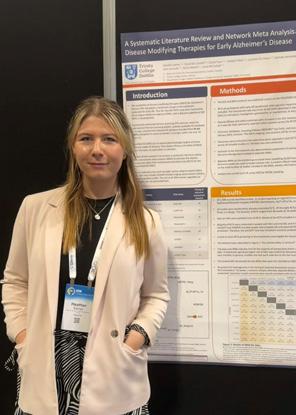
Finally, this issue features an in-depth analysis from Heather Eames, Senior Pharmacist at Trinity College Dublin and the National Centre for Pharmacoeconomics, on disease-modifying therapies for early Alzheimer’s disease. As a new generation of treatments emerges, questions of clinical benefit, safety, affordability and value for money will become increasingly urgent. Her article illustrates how health technology assessment can reduce uncertainty for decision-makers and help ensure that innovation is aligned with both patient outcomes and the sustainability of the health system.
Together, these contributions underline the importance of evidenceinformed policy, interdisciplinary collaboration and forward-looking investment in people and research. As healthcare continues to evolve, the role of pharmacy – in clinical care, research, economics and public health – remains central to shaping a system that is resilient, equitable and fit for the future.
IMO Publish Workforce Report
The Irish Medical Council has published research on the medical workforce registered with the Medical Council in 2024.
The Supplementary Workforce Report bulletin focuses on two cohorts of doctors who renewed, or retained their place on the Register but were not clinically active in Ireland in 2024:
• Doctors who were clinically active outside of Ireland only (abroad only)
• Doctors who were not clinically active at all (neither in Ireland or abroad)
It is a supplementary bulletin to the main Medical Workforce Intelligence Report, published earlier last year. The Medical Workforce Intelligence Report analyses the data collected during the 2024 annual retention process. The 2024 report focused on the clinically active medical workforce in Ireland, including the quantitative analyses of demographics and divisional
Dr Suzanne Crowe, President, Irish Medical Council
status and details on employment, practice, medical disciplines and specialities.
In 2024, 26,591 doctors retained their place on the Medical Council’s Register. 21.2% (5,628) of these doctors were either practising medicine abroad only (4,160) or not actively practising medicine (1,468).
Key highlights from the bulletin include:
EAHP 2025 Medicines Shortages Survey
The European Association of Hospital Pharmacists (EAHP) released the results of its new Shortages Survey, assessing and monitoring shortages of medicines and medical devices experienced in hospitals since the last survey carried out in 2023. EAHP has been actively working on the issue of medicines shortages since 2012, when it launched its first European Medicines Shortages Survey.
The survey gathered responses from hospital pharmacists, other hospital professionals and patients, with findings showing that medicines and medical devices shortages remain persistent across Europe.
Hospital pharmacists confirmed that medicines shortages affect patient care (89%) and pharmacy operations (79%), with global shortages of active pharmaceutical
ingredients, manufacturing issues, and pricing identified as the main causes. All respondent hospital pharmacists experienced shortages of critical medicines at least one to three times in 2024.
Medical device shortages also remain significant, with 53% of hospital pharmacist reporting impacts on patient care and 45% on pharmacy operations, mainly due to supply chain problems and shortages or discontinuation of components.
Hospital pharmacists consistently reported delays in care or therapy, cancellation of care, and suboptimal treatment as major consequences of medicines shortages. While for medical devices shortages, they reported delays in care, increased length of stay in hospital, and cancellation of care as major consequences.
Overall, the findings confirm that shortages persist, continuing to affect both patient care and hospital pharmacy activities.
To ensure patients always receive the appropriate medicines and medical devices, EAHP urges policymakers at the European and national level to:
• Enhance coordination between European institutions and Member States, ensuring the involvement of all supply chain actors, including hospital pharmacists and other healthcare professionals.
• Strengthen solidarity among European countries.
• The mean age of this group was 43.7 years, and a slight majority were between 35 and 44 years of age (28.5%). Just over two thirds were male (67.8%).
• Just under one in five of this cohort had an Irish qualification (19.1%, equating to 796 doctors), while 23.0% (956 doctors) qualified in the EU or UK and 57.9% (2,408 doctors) had international qualifications from outside of Ireland, the EU and the UK.
• The majority of Irish graduates were working in Australia (29.6%) or the UK (24.4%), while the majority of graduates from the EU and UK were working in the UK (33.9%) and the majority of international graduates were working in Pakistan (25.9%) or the UK (17.8%).
Dr Suzanne Crowe, President of the Medical Council said, “At a time when retaining doctors in Ireland is so important, it is essential that we seek to understand what motivates doctors to renew their registration but opt to travel and work overseas. These insights are critical in shaping a sustainable, well-supported medical workforce that can meet patient needs into the future.”
Doctors who retained their place on the Register and were clinically active outside of Ireland only:
• Set-up national task forces, comprised of agencies, industries and frontline healthcare professionals like hospital pharmacists to discuss and adopt proactive measures for combatting shortages including performing joint risk assessments, based on timely provided information.
• Require safety plans and risk assessments for manufacturers.
• Support and increase risk assessment practices in hospitals.
• Support the European production of active pharmaceutical ingredients, especially when it comes to products with a high dependency on outside sources.
• Safeguard and facilitate hospital pharmacists’ role in compounding to offer adequate patient care.
• Introduce procurement practices based on comprehensive set of criteria, not solely on the price.
Hospital Consultants set up New Panel
Hospital Consultants from across the country recently attended two workshops in Dublin as part of a drive to establish a panel of expert witnesses from the Irish medical community, to enhance standards of independence and excellence in medical negligence cases.
The Expert Witness Training Workshops were organised by the Irish Hospital Consultants Association (IHCA) and The Expert Witness Site.
The IHCA has partnered with The Expert Witness Site – an Irish organisation founded by barristers who source expert witnesses for legal teams involved in clinical negligence cases – to offer these masterclasses designed to reduce the Irish legal system’s reliance on overseas testimony.
Led by experienced barristers, the workshops gave consultants a clear understanding of what acting as an expert witness entails, by enhancing their knowledge of current case law, explaining the duties of experts as established in court rules, and ensuring they do not fall into the common pitfalls often encountered by expert witnesses from home and abroad.
The workshops form part of a wider move by the IHCA to champion a number of progressive reforms aimed at controlling the ever-increasing cost of medical negligence cases to the State and reducing the financial and emotional burden placed on patients and their families going through the claims process.
These reforms also include: the introduction of pre-action
protocols involving earlier disclosure of patient records, mediation and opportunities for settlement, with sanctions for any party who fails to adhere to them; the resumption of phased or periodic payments that spread the cost of claims over a lifetime; and a review of the real rate of return, which is the percentage applied by the courts to adjust the compensation awarded.
Welcoming the workshops, the IHCA reiterated its call for the Government to fully implement the recommendations of the Department of Health’s 2024 report on the rising cost of healthrelated claims, which was chaired by Consultant Obstetrician and Specialist in Fetal and Maternal Medicine Prof Rhona Mahony and which recommended all of the above reforms.
Ireland-USA Medical Collaboration
OncoAssure, an Irish medtech company and a leading innovator in precision oncology diagnostics, has announced the signing of a research collaboration agreement with the Icahn School of Medicine at Mount Sinai, in New York, which will facilitate the performance of a new validation study utilising OncoAssure’s Prostate Cancer Test and curated clinical samples from Icahn School of Medicine at Mount Sinai.
The Icahn School of Medicine at Mount Sinai is an international leader in biomedical education, research, and patient care and is the medical school for the Mount Sinai Health System in New York, which includes seven hospital campuses.
The OncoAssure Prostate Test is a next generation prognostic test designed to support clinical decision-making for men diagnosed with localised prostate cancer. The novel test helps assess the risk of aggressive disease and disease recurrence and can be used at two key decision points in the prostate cancer pathway, post-biopsy and post-surgery.
The new study will be led by Ash Tewari, MD, a physician-scientist and world-renowned urologist and prostate cancer specialist, in collaboration with basic and
Pictured at NovaUCD in Dublin is Des O'Leary, co-founder and CEO, OncoAssure. (Credit - Vincent Hoban, UCD)
translational cancer researchers, Sujit S. Nair, PhD, and Dimple Chakravarty, PhD.
They will analyse prostate biopsy tissue from men with low- to intermediate-risk prostate cancer (as defined by the US National Comprehensive Cancer Network guidelines), with the primary objective of assessing the prognostic value of the OncoAssure Prostate Test in a representative cohort. The study will also evaluate the added prognostic value of the OncoAssure Prostate Test beyond routinely used clinical and pathological information.
The OncoAssure Prostate Test was developed using a novel process that identifies ‘Master Driver’ genes that are strong
The Department of Health’s Expert Group report, chaired by the former Master of the National Maternity Hospital, was comprised of membership from across relevant government departments and agencies, and was established by former Minister for Health Stephen Donnelly, who at the time of its publication called for its recommendations to be “implemented without delay”.
Commenting on the workshops and the need for reform, IHCA President Prof Gabrielle Colleran said the current protracted claims processes are not fit for purpose and are resulting in not only increased legal costs that are among the highest in the world, but also significant human costs resulting from the litigation process.
indicators of disease progression. The test also incorporates the widely used CAPRA (Cancer of the Prostate Risk Assessment) score in the result, allowing seamless integration into current care pathways.
By integrating advanced genomic insights with clinical data, OncoAssure Prostate provides
a more accurate assessment of disease prognosis, empowering physicians, along with their patients, to make more precise and personalised treatment decisions.
OncoAssure was co-founded by Des O’Leary and Professor William Gallagher in 2021 and is headquartered at NovaUCD in Dublin.
Advancing Precision Medicine in Respiratory and Neurological Care
The Institute of Medicine’s annual Symposium took place at the end of last year, drawing a large audience both onsite and online.
This year’s event, featuring the prestigious Stearne Lecture and Bryan Alton Medal Lecture, brought two internationally renowned clinician-scientists to the RCPI podium.
Opening the symposium, Professor Edward McKone, Dean of the Institute of Medicine, welcomed attendees and emphasised the importance of these annual lectures in honouring leaders whose work has shaped modern medicine. “These lectures are about more than scientific discovery; they honour those who have transformed clinical practice and set new standards for patient care,” he remarked.
This year’s Stearne Lecture was delivered by Professor John V. Fahy, an international leader in
respiratory medicine, who spoke on “Sub-phenotyping asthma and COPD for targeted therapies.” The Stearne Lecture commemorates John Stearne (1624–69), founder and first President of the Royal College of Physicians of Ireland, and recognises physicians whose research has had a direct impact on patient care.
Professor Fahy explained that sub-phenotyping allows clinicians to identify meaningful differences between patients: “A patient’s phenotype describes the particular type of disease they have in terms of severity, allergic inflammation, imaging features and treatment responses. Sub-phenotyping is important because research to identify the molecular mechanisms underlying these differences can lead to targeted treatments. This is precision medicine and it replaces a one-size-fits-all approach that fails many patients.”
The PMI Pharma Summit 2026
Professor Orla Hardiman, The Bryan Alton Medal for 2025 recipient
Professor Fahy also explored airway mucus pathology in patients with COPD and asthma, an area of growing clinical importance. Recent CT-based studies show that many patients are “mucus plug-high” a phenotype associated with more severe disease and poorer lung function. “These findings raise the possibility that treating mucus plugs by making mucus plughigh patients mucus plug-low will improve lung health,” he noted.
Professor Fahy also spoke about his own career path, reflecting on how clinical practice shaped his transition into a physician-scientist.
The Bryan Alton Medal for 2025 was awarded to Professor Orla Hardiman for her exceptional contribution to clinical neurology and translational research in Amyotrophic Lateral Sclerosis (ALS). The award honours the legacy of Bryan Alton, RCPI President from 1974 to 1977, who championed medical education and training in Ireland.
Prof. Hardiman’s lecture, “Deconstructing Amyotrophic Lateral Sclerosis: From Bedside to Bench and Back Again,” examined why ALS remains so difficult to treat and how emerging technologies are helping to unravel its complexity.
The Pharmaceutical Managers’ Institute (PMI) Annual Pharma Summit takes place this year at Croke Park on Thursday, March 2026 – an unmissable event that promises to be a cornerstone of industry innovation and collaboration.
The theme for the day is: “Transform & Thrive,” and the team behind the Pharma Summit will be exploring this topic across the backdrop of continuous change, disruption and evolution in across the industry, with stakeholders and . This flagship event will bring together a wide range of attendees, including industry leaders, subject matter experts, and thought leaders.
She highlighted the profound heterogeneity of ALS, noting that while it is classically defined by motor neuron degeneration, many patients also experience cognitive and behavioural impairment. “Understanding the basis of heterogeneity is crucial to the success of future drug development,” she explained.
Prof. Hardiman shared insights from her research philosophy, emphasising that the bedside must inform the bench and not the other way around. “By focusing on patient attributes at the bedside as the starting point, our objective is to provide a scientifically robust pathway back from the bench to guide future therapeutics,” she said.
Looking ahead, she described how the Precision ALS programme, an Ireland-led project supported by Research Ireland, ADAPT and FutureNeuro, will combine clinical data, biomarker results, genomic information and device-based measures in one large system.
“To make real progress, we need large-scale human datasets and improved analytic tools. Unless we embrace this approach, we risk repeating past errors, and the likelihood of developing truly effective disease-modifying therapies will be greatly reduced,” she argued.
Closing the evening, Professor McKone thanked both speakers for their outstanding contributions to what he described as “a stimulating and inspiring programme that highlights the very best of clinical and translational research.”
In February, the PMI will also be hosting a Stakeholder Briefing – CPU update. They will host Linda Fitzharris, Head of the CPU for a breakfast briefing on 5th February. Linda will share some insights into the role of the CPU in managing the complex processes of medicine pricing and reimbursement under the various national health schemes.
This will be an essential stakeholder briefing for all PMI members, particularly those involved in market access, commercial and external stakeholder management roles. It takes place from 7.30-9.30am at The Address, Citywest, Dublin 22. Visit www.thepmi.com for more information.
Addressing Health Inequality
The President of the Irish Medical Organisation (IMO) has warned that more needs to be done to address health inequalities from early childhood, noting that a failure to properly focus on early intervention and eradicate existing waiting lists for children will eventually lead to immense –and avoidable – pressure on the health system.
Dr Anne Dee, who is also a public health consultant, was speaking at the IMO’s ‘Health on the Margins’ conference, which took place on Saturday in Limerick.
Dr Dee warned that, more than ever before, an Irish person’s health outcomes were largely dictated by their housing quality, educational and work opportunities, and their lived environment.
She said: “By not doing enough to mitigate the risks of health inequality from birth, we are running the risk of condemning future generations to the same poor health outcomes as their
Dr Anne Dee, President, Irish Medical Organisation
parents, perpetuating the same inequalities that have sadly been allowed to fester in Irish society for far too long.
“We need to see a whole-ofGovernment approach to the problem of children at risk from before they are born, identifying young families and pregnant mothers who are at risk, supporting these families to help address the risks in a holistic way, and working with key stakeholders across all the domains of society towards redressing the imbalance.
Dr Dee added: “More resourcing and staffing are urgently needed in the health service to cater for the increasingly complex needs of a fast-growing and ageing population living in deprivation, where ageing and frailty occur at a much younger age than their affluent counterparts. But there are other ways we can mitigate this
demand and ease the pressure on the system, which is overloaded at present. A comprehensive, social determinants of healthbased approach is needed to help improve the poor health outcomes which are the reality for far too many people in this country.
“If we do not adequately develop a far-reaching plan to address this problem and focus especially on early intervention, then we will only be passing a bigger issue on to future generations and it will be harder to tackle.
Student awarded inaugural A.Menarini scholarship for diabetes research
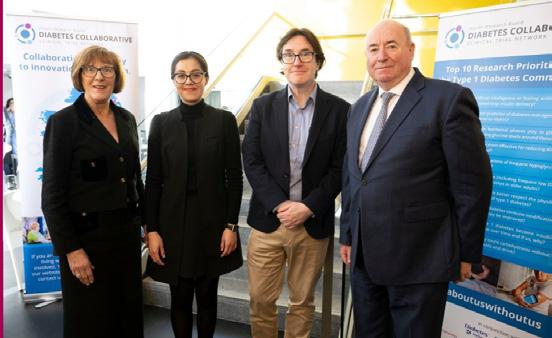
University of Galway, in partnership with the HRB Diabetes Collaborative Clinical Trial Network, has announced the inaugural A.Menarini Pharmaceuticals Ireland Scholarship.
The successful student is Ruth Alejandra Huerta Sinesio, originally from Mexico City, who was awarded the scholarship for her outstanding achievements and commitment to advancing diabetes research and patient care.
The A.Menarini Pharmaceuticals Ireland Scholarship, supported by Galway University Foundation, provides full financial support for a student in the Master of Science in Clinical Research.
Ruth Alejandra Huerta Sinesio was selected from a highly competitive field of candidates, demonstrating a strong dedication to improving health outcomes through her work and experience. The award will enable her to pursue advanced
From left, Professor Fidelma Dunne, Director, HRB Diabetes Collaborative Clinical Trial Network, University of Galway with scholarship recipient Ruth Alejandra Huerta Sinesio, Professor Martin O’Donnell, Executive Dean, College of Medicine Nursing and Health Sciences, University of Galway, and Francis Lynch, CEO, A.Menarini Pharmaceuticals Ireland. Photos –Credit Andrew Downes, Xposure
training and to contribute to pioneering research activities, as well as strengthening her role within the Diabetes Collaborative Clinical Trial Network and broader diabetes community.
Professor Fidelma Dunne, Director of the HRB Diabetes Collaborative Clinical Trial Network and the Institute for Clinical Trials at University of Galway, said, “We are immensely proud of Ruth Alejandra and all she has accomplished to date in her career. Her passion, drive, and commitment embody exactly what this scholarship stands for. We are deeply grateful to A.Menarini for their generous
support, which enables us to nurture the next generation of clinical researchers who will make a transformative difference in Ireland and far beyond. Their investment in education and research ultimately supports the lives of people living with diabetes.”
As part of A.Menarini Pharmaceuticals Ireland support for students at University of Galway, the company will provide three further annual scholarships in the coming years to support students demonstrating academic excellence, leadership, community engagement, or financial need. The company has also pledged support for education and training within the HRB Diabetes Collaborative Clinical Trial Network, including professional development, multidisciplinary training and expanded Patient and Public Involvement (PPI) initiatives. The investment will strengthen Ireland’s capacity to deliver world-class clinical research and foster a new generation of leaders dedicated to improving diabetes care across the globe.
Irish College of Ophthalmologists Winter Meeting and Montgomery Lecture 2025
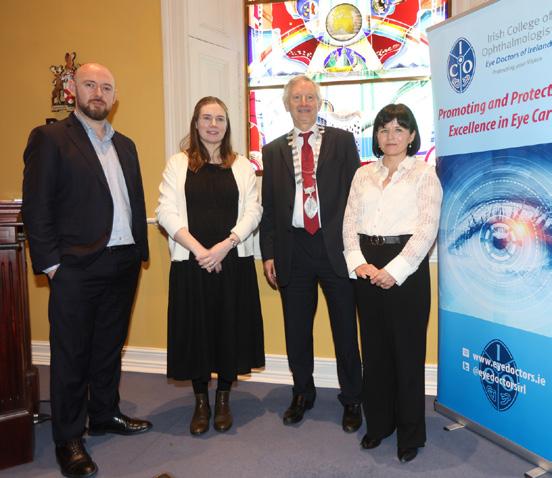
The Irish College of Ophthalmologists held their Winter Meeting and Montgomery Lecture 2025 towards the end of last year. Presenters included Dr Patrick Nicholson, Consultant Neurointerventional Radiologist, Beaumont Hospital and Beacon Hospital, Ms Áine Ní Mhéalóid, Consultant Ophthalmic Surgeon, Royal Victoria Eye and Ear Hospital, Ms Lisa McAnena, Consultant Ophthalmic Surgeon, Beaumont Hospital and Mater Misericordiae University Hospital and Mr Gerry Fahy, President, Irish College of Ophthalmologists and Consultant Ophthalmic Surgeon, Blackrock Health Galway.
Mr Gerry Fahy, President of the Irish College of Ophthalmologists, introducing Professor Anthony King, Consultant Ophthalmologist at Nottingham University Hospital, NHS Trust, who presented the Annual Montgomery Lecture 2025 at the ICO Winter Meeting at the Albert Theatre, Royal College of Surgeons in Ireland, on Friday, November 21st
The session was dedicated to the subspecialty of Neuroophthalmology, featuring a distinguished panel of experts from both Ireland and the United Kingdom. Joining the panel of speakers on the day were Miss Ruchika Batra, Consultant Neuro-ophthalmologist at Queen
Elizabeth Hospital Birmingham, NHS Foundation Trust and Dr Tasanee Braithwaite, Consultant Ophthalmologist in Neuroophthalmology and Uveitis at the Medical Eye Unit, Guy's and St Thomas' Hospital in London.
The Annual Montgomery Lecture, hosted by the ICO, took place
Dr Patrick Nicholson, Consultant Neurointerventional Radiologist, Beaumont Hospital and Beacon Hospital, Ms Áine Ní Mhéalóid, Consultant Ophthalmic Surgeon, Royal Victoria Eye and Ear Hospital, Ms Lisa McAnena, Consultant Ophthalmic Surgeon, Beaumont Hospital and Mater Misericordiae University Hospital and Mr Gerry Fahy, President, Irish College of Ophthalmologists and Consultant Ophthalmic Surgeon, Blackrock Health Galway
at the same venue that evening. The lecture entitled "Journey of an Accidental Academic” was delivered by Professor Anthony King, Consultant Ophthalmologist at Nottingham University Hospital, NHS Trust whose primary research interest is in the clinical management of glaucoma, focusing particularly on advanced glaucoma and patient-centered delivery of care.
Keynote speakers included Miss Ruchika Batra, Consultant Neuro-ophthalmologist at Queen Elizabeth Hospital Birmingham, NHS Foundation Trust, Ms Áine Ní Mhéalóid, Consultant Ophthalmic Surgeon, Royal
Victoria Eye and Ear Hospital, Mr Gerry Fahy, President, Irish College of Ophthalmologists, Dr Tasanee Braithwaite, Consultant Ophthalmologist in Neuroophthalmology and Uveitis at the Medical Eye Unit, Guy's and St Thomas' Hospital in London and Ms Lisa McAnena, Consultant Ophthalmic Surgeon, Beaumont Hospital and Mater Misericordiae University Hospital.
Annual Montgomery Lecture 2025
Professor Anthony King, Consultant Ophthalmologist at Nottingham University Hospital, NHS Trust, presented the Annual Montgomery Lecture 2025 at the ICO Winter Meeting on Friday, November 21st.
Professor Anthony King delivering the Montgomery Lecture 2025 - "Journey of an Accidental Academic”
Professor King’s primary research interest is in the clinical management of glaucoma, focusing particularly on advanced glaucoma and patient-centered delivery of care.
Miss Ruchika Batra, Consultant Neuro-ophthalmologist at Queen Elizabeth Hospital Birmingham, NHS Foundation Trust, Ms Áine Ní Mhéalóid, Consultant Ophthalmic Surgeon, Royal Victoria Eye and Ear Hospital, Mr Gerry Fahy, President, Irish College of Ophthalmologists, Dr Tasanee Braithwaite, Consultant Ophthalmologist in Neuro-ophthalmology and Uveitis at the Medical Eye Unit, Guy's and St Thomas' Hospital in London and Ms Lisa McAnena, Consultant Ophthalmic Surgeon, Beaumont Hospital and Mater Misericordiae University Hospital
In his lecture, entitled "Journey of an Accidental Academic”, Professor King discussed the importance of definitions when reporting outcomes of glaucoma trials and the management of patients presenting with advanced glaucoma. His talk charted his experience along the pathway from a rookie researcher to a randomised controlled trial (RCT), discussing the realities of undertaking research, while strongly encouraging young
ophthalmologists to embark on this journey.
Professor King is currently the Chief Investigator of the NIHR funded Treatment of Advanced Glaucoma Study (TAGS). He is a past President of the UK and Eire Glaucoma Society and previously served as the Royal College of Ophthalmologist glaucoma lead for the development of a national ophthalmic database for trabeculectomy.
6. Mr Jim O'Reilly and Dr Margaret Morgan 1 2 3 4 5 6
1. Mr Brendan Cummings, Dr Sarah Powell, Dr Aine Kelly, Dr Alison Greene and Dr Ross Layden
2. Dr David Gildea, Miss Marie Hickey Dwyer and Dr Ed Ahern
3. Dr Michele Coffey-Harkin and Dr Mary Jo Ryan
4. Dr Brian Woods, Dr Deirdre Harford and Dr Fiona Kearns
5. Dr Emer Henry, Professor Anthony King, Annual Montgomery Lecturer 2025 and Mr John Stokes
Professor Anthony King (pictured right), Consultant Ophthalmologist at Nottingham University Hospital, NHS Trust
The Establishment and Management of Addiction Research Network Ireland (ARNI)
The Department of Health has commissioned the Health Research Board (HRB) to establish a network to support the development of alcohol and other drugs research in Ireland. The ARNI will facilitate partnerships among academic institutions, policymakers, individuals with lived and living experience, and citizen scientists.
The Department of Public Health & Primary Care, at Trinity is uniquely positioned to lead this work. As Ireland’s most researchintensive university, Trinity brings international research recognition, robust infrastructure, and strong interdisciplinary leadership. Trinity’s Department of Public Health offers unrivalled expertise in addiction research and knowledge translation, demonstrated through extensive engagement in nationally and internationally funded projects and through international policy advisory roles.
Professor Jo-Hanna Ivers is an international leader in addiction science and brings a proven record of collaborative and participatory research in complex systems. She will be joined by a number of national experts and advisors from across a range of disciplines that contribute to the advancement of addiction science, including Epidemiology; Health
Economics and Health Policy and Management; Psychiatry and Psychology; Public Health and Medicine; Sociology; Implementation Science; Pharmacology, Toxicology and Biochemistry; and Citizen Science and Public and Patient Involvement (PPI).
Participants will include senior academics, early career researchers, and students from across Ireland, as well as an International Advisory Board representing Australia, Belgium, France, Portugal, Spain, and the United Kingdom.
ARNI will deliver an actionable, evidence-based, and strategic work plan focused on four core objectives: building a resilient substance use research community; facilitating research prioritisation; supporting the contribution of evidence to policy and practice decision-making; and working towards network sustainability.These objectives will be underpinned by three activity strands: Convening; Concept Development and Planning; and Capacity Building.
At the heart of this approach is a commitment to equity, inclusion, and consultation. The first major deliverable will be a comprehensive, sectorwide action plan (2026–2028),
developed through five collective intelligence workshops, an audit of higher education institution (HEI) addiction research activity, and a national researcher directory. This work will prioritise early career researchers, embrace knowledge translation, and enable meaningful public and patient involvement.
ARNI will provide national and international coordination of drug and alcohol research, establishing a strong foundation for a sustainable, policy-engaged, and inclusive future for addiction research in Ireland.
Trinity College Dublin is Ireland’s most research-intensive university and is internationally recognised for excellence in health, social science, and translational research. It is home to a significant portfolio of interdisciplinary research in addiction, population health, public policy, and neuroscience. The School of Medicine’s Department of Public Health & Primary Care, where ARNI will be hosted, is a national leader in evidence-informed policymaking, population-level intervention design, and translational research. The Department houses expertise in implementation science, epidemiology, biostatistics, and behavioural sciences, all of which are critical to advancing addiction research. It maintains deep and sustained partnerships with the Health Service Executive, the Health Research Board, the Department of Health, and community-based service providers across Ireland.
Professor Jo-Hanna Ivers, as Principal Investigator, is uniquely positioned to lead this initiative. She is Principal Investigator of the Neurobehavioral Addiction Research Group at Trinity and Founder and Director of the M.Sc. in Addiction Recovery. Her research is anchored in a neurobio-psycho-social understanding of addiction, integrating behavioural science, neurobiology, epidemiology, and addiction science. Her approach offers advanced, multi-level insight into addiction, prevention, treatment, and recovery.
Professor Ivers has held multiple national advisory roles, including with the Citizens’ Assembly on Drugs and the Rapid Response Group on Emerging Drug Trends. Internationally, she is a member of the EUDA Scientific Committee, a former member of the EMCDDA Scientific Committee, and a member of the Council of Europe’s Pompidou Group Expert Group on Human Rights and Drug Policy. She is also connected to research consortia across the UK, US, Canada, and Europe. Her strategic leadership and collaborative approach position her to lead ARNI with rigour and innovation.
Professor Ivers said, “ARNI enables Ireland to shape the future direction of addiction science, one that is collaborative, transdisciplinary, and deeply informed by lived experience. Ireland already has exceptional researchers working not only in addiction but across many disciplines that can significantly strengthen and enrich addiction science. ARNI will bring this expertise together to build national capacity, meet the ambitions of national and European drugs strategies, respond to emerging health and social challenges, and grow the next generation of addiction researchers. By uniting our strengths, ARNI ensures that Ireland is strongly positioned to shape global knowledge and compete at the highest levels of European research funding.”
Brian Galvin, Programme Manager for Drug and Alcohol Research in the Health Research Board’s Evidence Centre, ADDED, “The Health Research Board welcomes Addiction Research Network Ireland and looks forward to working with colleagues in Trinity College Dublin on this exciting project. The establishment of this network is an important milestone in the development of the knowledge base around drugs in Ireland and will help to ensure that early career researchers are attracted to the field and Irish universities can participate in consortia in competitions for international funding. It will strengthen the evidence base supporting those working in policy, services and advocacy as we embark on a new national drugs strategy.”
Professor Jo-Hanna Ivers
Abstract Guidelines - 2026
Abstract Guidelines - 2026
Abstract Guidelines - 2026
Abstract Guidelines - 2026
** Accepted IMF 2026 abstracts will be published in the August edition of the Irish Medical Journal (IMJ)** Please note that the IMJ cannot publish abstracts with diagrams or references.
** Accepted IMF 2026 abstracts will be published in the August edition of the Irish Medical Journal (IMJ)** Please note that the IMJ cannot publish abstracts with diagrams or references.
** Accepted IMF 2026 abstracts will be published in the August edition of the Irish Medical Journal (IMJ)** Please note that the IMJ cannot publish abstracts with diagrams or references.
** Accepted IMF 2026 abstracts will be published in the August edition of the Irish Medical Journal (IMJ) Please note that the IMJ cannot publish abstracts with diagrams or references.
• How can I submit my abstract?
• How can I submit my abstract?
• How can I submit my abstract?
How can I submit my abstract?
Abstracts can ONLY be submitted electronically to: abstracts@ccis.ie
Abstracts can ONLY be submitted electronically to: abstracts@ccis.ie
Abstracts can ONLY be submitted electronically to: abstracts@ccis.ie
Abstracts can ONLY be submitted electronically to: abstracts@ccis.ie
• Please name your word doc. file by lead author as follows: Surname, Initial Abstract IMF Category (Basic Research or Clinical Research)
• Please name your word doc. file by lead author as follows: Surname, Initial Abstract IMF Category (Basic Research or Clinical Research) e.g. Murphy, J Abstract IMF Basic Research
• Please name your word doc. file by lead author as follows: Surname, Initial Abstract IMF Category (Basic Research or Clinical Research)
• Please name your word doc. file by lead author as follows: Surname, Initial Abstract IMF Category (Basic Research or Clinical Research)
e.g. Murphy, J Abstract IMF Basic Research
e.g. Murphy, J Abstract IMF Basic Research
• What is the maximum length for the title of my abstract?
e.g. Murphy, J Abstract IMF Basic Research
• What is the maximum length for the title of my abstract?
• What is the maximum length for the title of my abstract?
What is the maximum length for the title of my abstract?
There is no maximum length for the title. However, the characters in the title will count toward your total character count.
There is no maximum length for the title. However, the characters in the title will count toward your total character count.
There is no maximum length for the title. However, the characters in the title will count toward your total character count.
• How many characters can be included in my abstract?
• How many characters can be included in my abstract?
• How many characters can be included in my abstract?
There is no maximum length for the title. However, the characters in the title will count toward your total character count.
How many characters can be included in my abstract?
The total character count for a single abstract is 2,000. Characters include everything in the title, abstract body, and table but do not include spaces. Author names and institutions also are not included in the total.
The total character count for a single abstract is 2,000. Characters include everything in the title, abstract body, and table but do not include spaces. Author names and institutions also are not included in the total.
The total character count for a single abstract is 2,000. Characters include everything in the title, abstract body, and table but do not include spaces. Author names and institutions also are not included in the total.
• Do I have to enter my abstract in a specific format?
• Do I have to enter my abstract in a specific format?
• Do I have to enter my abstract in a specific format?
The total character count for a single abstract is 2,000. Characters include everything in the title, abstract body, and table but do not include spaces. Author names and institutions also are not included in the total.
Yes, the abstract body text should contain the following headings. Aim/Background, Methods, Results, and Conclusion.
Yes, the abstract body text should contain the following headings Aim/Background, Methods, Results, and Conclusion.
Yes, the abstract body text should contain the following headings Aim/Background, Methods, Results, and Conclusion.
Do I have to enter my abstract in a specific format?
• May I include a table with my abstract?
• May I include a table with my abstract?
• May I include a table with my abstract?
Yes, the abstract body text should contain the following headings. Aim/Background, Methods, Results, and Conclusion.
Yes, one table may be included in the abstract. All characters in the table count towards the total character count. No figures or images may be included.
Yes, one table may be included in the abstract. All characters in the table count towards the total character count. No figures or images may be included.
Yes, one table may be included in the abstract. All characters in the table count towards the total character count. No figures or images may be included.
• Is there a recommended type setting?
May I include a table with my abstract?
• Is there a recommended type setting?
• Is there a recommended type setting?
Yes, your word doc. font should be 12pt Calibri with 1.15 line spacing.
Yes, your word doc. font should be 12pt Calibri with 1.15 line spacing.
Yes, your word doc. font should be 12pt Calibri with 1.15 line spacing.
• What is the deadline for abstract submissions? – Tuesday 7th April 2026 – 5.00pm
Yes, one table may be included in the abstract. All characters in the table count toward s the total character count. No figures or images may be included.
• What is the deadline for abstract submissions? – Tuesday 7th April 2026 – 5.00pm
• What is the deadline for abstract submissions? – Tuesday 7th April 2026 – 5.00pm
Shortlisted abstracts authors will be invited to make oral presentations in person at the meeting.
Is there a recommended type setting?
Shortlisted abstracts authors will be invited to make oral presentations in person at the meeting. All accepted abstracts will be invited to exhibit in physical poster format at O’Reilly Hall on 2 9th May 2026
All accepted abstracts will be invited to exhibit in physical poster format at O’Reilly Hall on 2 9th May 2026
Yes, your word doc. font should be 12pt Calibri with 1.15 line spacing.
Shortlisted abstracts authors will be invited to make oral presentations in person at the meeting. All accepted abstracts will be invited to exhibit in physical poster format at O’Reilly Hall on 2 9th May 2026 Poster size: 84.1 cm (wide) x 118.9 cm (high)
Poster size: 84.1 cm (wide) x 118.9 cm (high)
What is the deadline for abstract submissions? – Tuesday 7th April 2026 – 5.00pm
Poster size: 84.1 cm (wide) x 118.9 cm (high) NB ***PORTRAIT ONLY *** (equivalent to A0)
Shortlisted abstracts authors will be invited to make oral presentations in person at the meeting.
Enhancing Cross-Border Endometriosis Care
Healthcare Abroad, Ireland's leading cross-border healthcare facilitator, has announced a new partnership with the Endometriosis Centre of Excellence at Viamed Santa Elena Hospital in Madrid, significantly expanding access to specialist care for Irish women living with endometriosis. Through the EU Cross Border Directive, the collaboration will offer Irish patients timely access to internationally recognised expertise, advanced diagnostics, and complex surgical treatment.
The multidisciplinary centre is led by Dr. Lucas Minig, internationally renowned Gynaecologic Oncologist and expert in complex endometriosis minimally invasive surgeries. With more than 20
years’ experience, Dr. Minig travels from Valencia to Madrid regularly and has capacity to perform up to 20 surgeries per month, prioritising Irish patients.
Endometriosis is one of the most debilitating and underdiagnosed conditions affecting women’s health. The disease occurs when tissue similar to the lining of the uterus is found elsewhere in the body, often causing moderate to severe period pain, chronic pelvic pain, and in some cases fertility issues. According to the Endometriosis Association of Ireland, an estimated 155,000 women in Ireland are affected, and many women are facing lengthy waits to access specialist assessment and treatment.
Dr. Lucas Minig
Paul Byrne, COO of Healthcare Abroad, said, “For too long, Irish women suffering with endometriosis have faced prolonged waits and limited access to the gold-standard care they need. This partnership represents a major step forward in providing real, practical solutions for women who cannot afford to wait. By connecting Irish women with leading international specialists like Dr. Minig, we are ensuring they receive the timely, expert treatment they deserve.”
Dr. Lucas Minig added, “Endometriosis is a complex disease that requires specialised surgical expertise and a truly multidisciplinary approach. We focus on fully removing the endometriosis using minimally invasive surgery, which helps patients get back to their normal routines within a few weeks. With this centre, our goal is to offer women from Ireland the highest world-class standard of care, without experiencing long waiting lists. Every woman deserves access to treatment that can restore her quality of life, and we are proud to help make that possible.”
The internationally recognised gold-standard treatment, excision surgery, can be difficult to access due to the limited number of specialists able to perform this advanced procedure in Ireland. The Centre of Excellence in Madrid responds directly to this unmet
Milestone in Chronic Disease Management
Since its launch in April 2024, the COPD Virtual Care Pathway has significantly improved patient outcomes while reducing pressure on hospital services.
The innovative programme, developed by Galway University Hospitals (GUH) in partnership with the Galway City Integrated Care Hub and the HIVE Laboratory, University of Galway, is transforming how care is delivered to people living with chronic obstructive pulmonary disease (COPD).
The Virtual Care Pathway is reducing hospital attendances,
preventing unnecessary admissions, and saving hundreds of bed days. To date, the service has delivered 139 episodes of care, saving more than 1,000 hospital bed days. Patients participating in virtual care now have an average length of stay of 5.3 days, representing a 53.57% improvement compared with the national inpatient average.
By using secure digital technology, the service allows patients to receive high-quality respiratory specialist supervision from home while remaining under the care of their treating doctors
and respiratory team. The pathway provides structured daily monitoring through a userfriendly app, where patients record daily symptoms, optimise self-management skills and use monitoring devices to track key health indicators such as oxygen levels, respiratory rate, temperature, blood pressure and heart rate. Any concerning changes trigger real-time alerts, enabling clinicians to intervene promptly and tailor treatment plans before issues escalate.
The virtual care option also supports patients who present
need, and will offer Irish patients access to expert assessment, advanced diagnostics, and specialist surgical care under the EU Cross Border Directive, a HSE-backed EU wide scheme that allows Irish residents to receive planned medical treatment in any EU country.
The Centre provides:
• A multidisciplinary team across gynaecology, surgery, and urology
• High-contrast MRI and enhanced diagnostic imaging upon patient arrival
• Comprehensive treatment for all stages of endometriosis
• Advanced surgical care adhering to the global gold standard of excision
Under the EU Cross-Border Healthcare Directive, Irish residents are entitled to travel to any European Union country to receive planned medical treatment. Residents can access any treatment that is publicly available and funded in Ireland, with medical costs reimbursed by the HSE. Healthcare Abroad has a strong track record of helping women access timely and specialised gynaecological care unavailable domestically. The new partnership reflects the organisation’s commitment to improving pathways to high-quality endometriosis management and supporting domestic health services as they work to expand capacity.
to the Emergency Department with stable COPD exacerbations, offering a safe alternative to hospital admission and helping to shorten stays for those already admitted.
Professor Derek O'Keeffe, Consultant Physician, Galway University Hospitals and Director of the HIVE Laboratory said: "The GUH COPD Virtual Care Pathway has shown how innovative clinical models, powered by digital health technology, can redefine and significantly improve patient care."
Substantial Under Diagnosis of High Blood Pressure
TILDA’s most recent data shows that 62% of people aged 50 and over have high blood pressure that is not being managed leading to serious potential health risks.
High blood pressure becomes more common after the age of 40 yet new research from The Irish Longitudinal Study on Ageing (TILDA) at Trinity College shows that many people in Ireland with hypertension are still not optimally diagnosed or treated based on European guidelines. The new study is published in the international journal Open Heart.
High blood pressure (hypertension) is a significant risk factor for cardiovascular disease, stroke, dementia, and chronic kidney disease, yet it often causes no symptoms and can go undetected for years. This 12-year longitudinal study, involving over 8,000 participants, provides a detailed national picture of how high blood pressure is being managed in Ireland and examines adherence to the latest European Society of Cardiology (ESC) guidelines, including the 2024 recommendations.
Drawing on more than a decade of TILDA data, the researchers show that unmet need in hypertension care is not a new problem, but one that has persisted over time. At the most recent data collection, 62% (approximately 445,000 people aged 50 and over) with high blood pressure were not appropriately managed: they had undiagnosed
Key findings from the study
Regius Professor Rose Anne Kenny, Principal Investigator of TILDA and Professor of Medical Gerontology at Trinity College Dublin
hypertension, were diagnosed but not receiving treatment, or were on treatment but had blood pressure above recommended targets.
When the lower blood pressure target of <130/80 mmHg, as advised by the 2024 ESC guidelines, is applied, this figure rises to 77% — meaning more than three out of every four older adults with hypertension in Ireland are not optimally managed.
Dr Caoimhe McGarvey, Research Fellow at TILDA and Specialist Registrar in Geriatric Medicine at St James’s Hospital Dublin and lead author on the new study, commented, “High blood pressure is a common and treatable condition. However, when left untreated it can cause heart disease, kidney disease, stroke and dementia. This study highlights a significant unmet need in the management of high blood pressure in Ireland. Systematically addressing this need has the potential to dramatically reduce avoidable complications and improve the health outcomes for older adults across the country.”
Professor Donal Sexton, Consultant Nephrologist and Associate Professor at Trinity College Dublin, added, “This study exemplifies the unique ability of the TILDA study to assess how well we are performing as a nation in the treatment of modifiable risk factors for cardiovascular disease, chronic kidney disease and premature death. It emphasises the unmet need in the management of high blood pressure in Ireland and the urgent requirement to improve its recognition and treatment.”
Regius Professor Rose Anne Kenny, Principal Investigator of TILDA and Professor of Medical Gerontology at Trinity College Dublin, said, “The message for the public is simple: if you are
• Hypertension prevalence remained consistently high, increasing from 63% to 71% over 12 years.
• Only 56% of those with hypertension are aware they have it, highlighting substantial ongoing under-diagnosis.
• 71% of those with hypertension were taking a medication, treatment intensity was often suboptimal: only 14% were prescribed a guideline-recommended dual therapy and only 57% guideline-recommended monotherapy.
• Among those receiving treatment, just 33% achieved the guideline-recommended blood pressure target of <130/80 mmHg, while 54% were controlled to <140/90 mmHg.
• Overall, 62% (445,000 people) with hypertension in Ireland were not appropriately managed according to the 2018 ESC guidelines, consistent with previous TILDA evidence showing poor long-term control of modifiable cardiovascular risk factors.
• Forty per cent of the population had elevated blood pressure (SBP value of 120–139mmHg or a DBP value of 70-89mmHg) and 71% of this group had evidence of high cardiovascular risk.
• People aged 85 years and older and those with moderate to severe frailty were less likely to have undiagnosed hypertension and were more likely to be taking guideline-recommended medications similar rates of blood pressure control when compared to the wider population.
• People with chronic kidney disease (CKD) were more likely to receive guideline-recommended treatment and achieve blood pressure control to a target of <140/90mmHg, suggesting targeted care can be effective in high-risk groups.
40 years or over get your blood pressure checked. It’s quick, painless, and can make a lifechanging difference.
"TILDA has been highlighting gaps in the detection and control of high blood pressure for over a decade. What makes this study particularly powerful is the maturity of the TILDA dataset, following the same people over more than 12 years gives Ireland a unique national asset for understanding how health changes as we age and how well our health system is responding.”
This long-term evidence shows that, despite clear guidelines and effective treatments, too many older adults are still living with poorly controlled hypertension. High blood pressure is one of the most modifiable risk factors for stroke, heart disease and dementia, and improving its management represents one of the most effective opportunities we must support healthier ageing in Ireland.
The research also aligns closely with current Health Service Executive (HSE) and Department of Health priorities, which emphasise the early detection and effective management of chronic conditions to support healthy ageing and reduce avoidable illness. High blood pressure is easy to check and can often be managed effectively once identified. Adults are encouraged to have their blood pressure checked regularly with their GP or local pharmacist, particularly as they get older or if they have other health conditions. Early detection and appropriate treatment can significantly reduce the risk of heart disease, stroke, kidney disease and dementia.
Innovation
Healthcare Innovation Adoption
Ireland’s public procurement environment is predominately focused on larger vendors and price based competition rather than outcomes based evaluations. ‘The Buying All-Island in Healthcare – North and South’ report published the findings and recommendations of the All-Island Medtech SMEs (AIMS) initiative, delivered through a unique crossborder partnership of HSE and Enterprise Ireland initiative, Health Innovation Hub Ireland (HIHI), and Health Innovation Research Alliance Northern Ireland (HIRANI), supported by InterTradeIreland. The primary objective of the AIMS initiative was to collaborate with cross-border SMEs, start-ups and healthcare stakeholders to identify procurement barriers and solutions. Analysis of these within an EU innovation procurement context provided the foundation to develop a framework of recommendations
to support procurement of innovative indigenous products from small vendors in Ireland and Northern Ireland, fostering allisland health and socio-economic benefits. Many of the procurement barriers identified mirror those that impede the adoption of new therapeutics and digital therapeutics in Irish hospitals, where pathways for approval, reimbursement and procurement are fragmented and slow. Globally, health systems that accelerate innovation adoption share several common features: clear innovation mandates, ringfenced funding and structured mechanisms for testing and evaluation. In the EU, countries such as France, Germany and the Netherlands have dedicated innovation procurement budgets that allow health systems to evaluate, pilot and purchase novel technologies,
Written by Eimear Galvin, HIHI Regional Manager (Dublin)
About the Author
Eimear leads the Dublin hub of HSE and Enterprise Ireland partnership, Health Innovation Hub Ireland (HIHI). HIHI is a government initiative of the Department of Health and the Department of Enterprise Trade and Employment. Additionally, Eimear leads HIHI national support on adoption and procurement, and the HIHI GreenTech health initiative for sustainable product alternatives.
continually demonstrate strong international potential but limited domestic adoption.
Recent research identified the current procurement pathway as the primary challenge experienced by ROI health tech SMEs and start-ups. The process of engagement from ‘procurement’ through to ‘use’ took on average 12 – 24 months.
A timeline such as this is particularly challenging for fastevolving therapeutic categories such as digital therapeutics (DTx), AI-enabled diagnostics. Long delays can render technologies outdated before adoption. Procurement processes are often the most significant barrier to adopting new therapeutics and technologies in Irish hospitals , one fortified by single year budgets, which limit investment in long term transformation.
including emerging therapeutics and digital therapeutics, in a controlled environment before large scale rollout.
An alignment of industrial policy and clinical need has enabled these countries to introduce health innovations at pace, offering lessons for Ireland as therapeutic pipelines become more complex, personalised and digitally enabled. Treatment now spans medical devices, digital therapeutics, AI-supported care and hybrid clinical pathways.
There are now an estimated 550 companies in health tech operating in the Republic of Ireland (RoI), employing 84,000 people directly. The life sciences sector has exports of an estimated ¤105 billion. Irish tech enabled therapeutic innovations, from digital cognitive therapies to remote monitoring platforms,
The AIMS framework for innovation procurement proposes a roadmap for change. It identifies key enablers that can transform how innovative products are adopted system wide - protected innovation budgets within hospital and regional procurement plans with pilot-based assessments. By bringing together key stakeholders from health, industry, policy, state agency, academia and procurement, AIMS identified common challenges within the Irish (North and South) market. Outdated assessments for software products, lack of innovation procurement and funding for its mechanisms, limited use of dynamic purchasing systems and purchasing standards that vary widely across secondary care sites in RoI. A slow, conservative system inadvertently penalises innovation. For hospital clinicians and managers, the result is frustrating. Proven advances, from minimally invasive interventions to algorithm supported treatment planning and digital behavioural therapies, remain locked out of use due to procedural delays. This affects not only devices but also digital therapeutics, remote treatment models and hybrid clinical pathways that rely on integrated procurement and rapid evaluation cycles.
Testing and developing products in Irish clinical settings for over a decade, HIHI’s track record demonstrates how structured pilot and evaluation programmes produce procurement evidence.
HIHI pilots convert research outputs into quantifiable value propositions. Such evidence is essential for clinicians seeking to champion new products and for procurement officers balancing innovation against fiscal risk. HIHI’s pilots, ranging from respiratory interventions to digital behavioural health tools investigate safety, usability and patient benefit.
Evidence as delivered by HIHI pilots and evaluations offers a critical bridge between the world of research and procurement. Within healthcare, pilots do more than test feasibility. Bespoke design and measurement criteria means they produce the evidence hierarchy that decision makers require to justify innovation adoption.
The European Commission encourages public buyers to utilise innovation procurement mechanisms COM, 2021, 267/2). However, there are no specific Irish policy frameworks to implement similar. Contrastingly, European neighbours, Austria, Belgium, Finland, have specific action plans for innovation procurement. Denmark, Estonia, Greece, France and Sweden include specific objectives on innovation procurement in national strategies, with a dedicated budget and commitment of key stakeholders. The core recommendation in the AIMS framework for innovation procurement is to create a protected healthcare budget in Ireland for the procurement of innovation, implementing EU
approved mechanisms. Public Procurement of Innovative solutions (PPI) is one such mechanism.
The public sector uses its purchasing power to act as an early adopter of innovative solutions that are not yet available on a large scale commercial basis.
PPI targets specific healthcare challenges and through phased testing reduces risks. Starting with several innovative solutions in one pilot, PPIs allows site(s) to test and find the best fit. This model is applicable to among others, digital therapeutics, and AI-enabled treatment supports, which require controlled real world evaluation before system wide adoption.
PPI shortens the route to market and releases the potential of early adopters to implement an innovation. Used throughout EU member states for decades, PPI encourages collaboration between healthcare providers, researchers and industry to codevelop and validate solutions that improve patient outcomes, increase efficiency and reduce costs. For therapeutics, this includes digital care pathways, algorithm-supported prescribing, peri-operative optimisation tools, remote therapy delivery platforms and adjunctive digital therapeutics. It transforms procurement from a transactional process to a driver of innovation, sustainability and quality improvement.
A further key recommendation highlighted in the AIMS framework,
and increasingly in use by HSE procurement, is Dynamic Purchasing System (DPS). Unlike traditional frameworks, which are closed once awarded, a DPS remains open for qualified suppliers to join at any time. This agility allows the system to source innovative therapeutics and technologies as they emerge, without waiting for multi-year tender renewals. For hospital buyers, DPS offers rapid access to validated innovations, streamlined approval of suppliers vetted for compliance and a competitive market environment aligned with clinical demand. Digital transformation of procurement, including electronic catalogues, real-time performance tracking and sustainability scoring, would further enhance this.
‘Public Procurement in Ireland: A Roadmap for Digital Development 2025–2031’, published by Department of Public Expenditure, National Development Plan Delivery and Reform (DPENDPDR) in December 2025, reflects this. The roadmap is built on the principle that procurement should be usercentric, efficient, transparent and data-driven, enabling buyers and suppliers to navigate processes seamlessly from end-to-end. Digital procurement capabilities will become increasingly critical as drug-device integrations, companion apps and digital therapeutics become standard elements of treatment pathways.
The evolution of therapeutics in Irish hospitals is inseparable from the evolution of how innovation is procured. This is not simply a clinical imperative but an economic one. When HIHI tests new therapies or technologies inside Irish hospitals, delivering pilot data, connecting that evidence to procurement pathways, while also linking innovators to Enterprise Ireland’s supports (funding, mentoring, export pathways), Irish health innovations can scale faster and compete globally.
This includes tech enabled therapeutics, diagnostics, digital tools and hybrid care models, all of which require real-world evaluation. Evidence generated locally accelerates reimbursement decisions abroad. Investment in innovation adoption frameworks, therefore, yields triple dividends: improved patient outcomes, reduced operational costs and enhanced export competitiveness. Ireland possesses world class research institutions, a thriving health tech and life sciences sector and a health system eager to innovate. What the system now requires is a coherent, evidence based innovation adoption mechanism. One that bridges clinical insight, policy ambition and procurement practice. Innovation is transforming care, extending treatment beyond traditional pharmacology to digitally enabled, data-driven and precision based approaches. The challenge is to ensure that the system is equipped to adopt it.
Clinical Study
Ireland’s Cervical Screening Programme Has Prevented More Than 5,500 Cancers, New Study Estimates
A new study has estimated that Ireland’s national cervical screening programme has prevented more than 5,500 cases of cervical cancer since it was introduced in 2008, highlighting the profound but often unseen impact of population-wide public health interventions.
Using advanced mathematical modelling, researchers analysed national screening and cancer registry data to estimate how many cancers would likely have developed if organised cervical screening had not been in place. Their findings suggest that thousands of women across Ireland have been spared a lifethreatening illness, while the health system has avoided substantial treatment costs.
The study, published in the European Journal of Public Health, provides one of the most comprehensive assessments to date of the long-term impact of Ireland’s CervicalCheck
programme. It also introduces a novel modelling framework that could be applied internationally to evaluate cervical screening programmes in other countries.
Making the invisible visible
Cervical screening is widely recognised as a life-saving public health intervention. By identifying and treating precancerous changes before they progress, screening dramatically reduces the incidence of cervical cancer. Yet one of the paradoxes of successful prevention is that its benefits are largely invisible. Cancers that never develop do not appear in statistics, and lives that are not disrupted by serious illness often go uncounted.
“Public health is often a victim of its own success,” said David Robert Grimes, Assistant Professor in Biostatistics and co-lead author of the study. “When screening works well, nothing happens — and that makes its impact harder to quantify.”
Because it is impossible to directly observe events that never occur, the research team turned to mathematical modelling to answer a counterfactual question: what would have happened to women with cervical abnormalities if screening had not existed?
A novel modelling approach
The researchers developed a new Markov-chain model that simulates the progression of human papillomavirus (HPV) infection to cervical abnormalities and, in some cases, to cancer. The model uses transition probabilities validated against international literature to reflect how cervical disease typically develops over time in the absence of screening.
This framework was then applied to rich national data from CervicalCheck, Ireland’s organised cervical screening programme, covering the period from August 2008 to August 2022. CervicalCheck publishes detailed information on screening
David Robert Grimes, Assistant
Professor in Biostatistics, Trinity College Dublin
outcomes, including the number of HPV infections detected, the incidence of low-grade and high-grade abnormalities, and the number of cancers diagnosed each year.
By combining this screening data with cancer incidence data from the National Cancer Registry of Ireland, the researchers were able to estimate how detected abnormalities would likely have progressed without intervention. From this, they calculated how many cancers were prevented through screening.
The results were striking. The model suggests that between 2008 and 2022, CervicalCheck prevented an estimated 5,557 cervical cancers, with a 95% confidence interval ranging from 5,114 to 6,000 cases. In addition, the study estimates that the programme saved approximately ¤102 million in future treatment costs, excluding inflation.
Detecting cancer earlier — or preventing it entirely
Beyond preventing cancers altogether, the study also sheds light on how screening has changed patterns of cancer detection in Ireland. The researchers estimate that 48.8% of all cervical cancers diagnosed between 2008 and 2022 were detected through screening, rather than presenting clinically with symptoms.
This suggests that many cancers are now being identified earlier, when treatment is more effective and less invasive. Early detection improves survival rates and reduces the physical, emotional, and financial burden on patients and families.
The study also found evidence that cervical cancer rates in
Ireland, which had been rising steadily from the mid-1990s, now appear to be declining, even as the population continues to grow. While multiple factors contribute to cancer trends, the authors note that organised screening has likely played a significant role in reversing this pattern.
“It is likely that screening is detecting cancers before they become symptomatic,” said Grimes. “Earlier diagnosis generally means better outcomes for patients and more effective use of healthcare resources.”
A programme with national and global relevance
Ireland introduced CervicalCheck in 2008 as a population-based screening programme offering free cervical screening to eligible women. Over time, the programme has evolved, including the introduction of HPV primary screening, aligning Ireland with international best practice.
While the programme has faced significant challenges — including public scrutiny following controversies around disclosure and governance — this study focuses squarely on its populationlevel impact on cancer prevention.
The researchers emphasise that their findings do not diminish the importance of transparency, accountability, and trust in
screening services. Instead, they argue that robust evaluation of outcomes is essential to maintaining public confidence and guiding future policy decisions.
Importantly, the modelling framework developed in this study is not limited to Ireland. The authors believe it could be adapted for use in other countries with organised screening programmes, particularly those that collect detailed screening and cancer registry data.
“To our knowledge, this is a very novel way of answering an important public health question,” said Grimes. “It is flexible enough to be applied internationally, allowing health systems to estimate benefits that would otherwise remain hidden.”
Quantifying the human impact
Behind the numbers lie thousands of individual stories — women who avoided a cancer diagnosis, families spared the trauma of serious illness, and communities benefiting from improved population health.
The researchers stress that while modelling outputs are statistical estimates, their real-world implications are deeply human. Preventing cancer not only saves lives but also avoids the physical and psychological toll of treatment, time away from work
and family, and long-term health complications.
From an economic perspective, the estimated ¤102 million in avoided treatment costs represents a significant return on investment for the health system. Cervical cancer treatment can involve surgery, radiotherapy, chemotherapy, or combinations of these, often with long-term followup care.
“Screening is not just clinically effective; it is economically sensible,” the authors note. “Preventing disease is almost always less costly than treating it.”
Looking ahead: sustaining and strengthening screening
The study comes at a time when public health systems worldwide are grappling with how to maintain and strengthen preventive services in the face of rising healthcare demands. Cervical screening programmes must continue to adapt to changes in technology, population demographics, and disease patterns.
The authors highlight the importance of sustained participation in screening, ongoing monitoring of programme performance, and integration with HPV vaccination strategies, which are expected to further reduce cervical cancer incidence over time.
Health App Registrations Soar
More than 125,000 people have registered for the Health Service Executive’s Health App since its launch earlier this year, with total downloads now exceeding 210,000, according to figures released at the start of the month.
The HSE has attributed the increase in use to the gradual expansion of the app’s functionality, including new features added in Version 4, released in November. The update allows users to see hospital waiting lists they are on for day case and inpatient treatment, removing the need to rely on letters or phone calls for confirmation. Users receive notifications when appointments are scheduled.
The latest version also provides access to information on GP
general referrals, which account for the majority of referrals made within the health system. The HSE has indicated that specialist referral information is expected to be added in mid-2026.
Additional data has been introduced for patients enrolled in the Structured Chronic Disease Management Programme, including diagnosis details and recorded vital measurements.
Minister for Health Jennifer Carroll MacNeill said the level of uptake reflects growing public interest in digital access to health information. She said the app is intended to give patients greater visibility over appointments, referrals and vaccination records, with further developments planned over the coming year.
They also argue that transparent evaluation methods, such as the modelling approach used in this study, are critical for informed decision-making and public accountability.
“We cannot measure things that did not happen,” said Grimes. “But with the right data and the right models, we can make robust estimates of what would likely have occurred in the absence of screening. That allows us to properly value prevention.”
A clearer picture of prevention
Ultimately, the study provides compelling evidence that Ireland’s cervical screening programme has delivered substantial public health benefits since its inception. By preventing thousands of cancers and detecting many others earlier, CervicalCheck has played a key role in reducing the burden of cervical cancer in Ireland.
Just as importantly, the research offers a way to make prevention visible — translating unseen successes into evidence that can inform policy, support public trust, and guide future investment in screening and vaccination.
As healthcare systems increasingly focus on prevention and early intervention, the ability to quantify “what didn’t happen” may prove just as important as counting what did.
HSE Chief Technology and Transformation Officer Damien McCallion said the inclusion of waiting list and referral information allows patients to track their care pathway more easily. He said the app forms part of the HSE’s wider Digital for Care programme, which aims to expand the use of digital tools across health services.
Users of the app can currently view hospital appointments from 35 hospitals and BreastCheck screening services, check day case and inpatient waiting lists, and see details of GP general referrals made on their behalf. Other features include access to COVID-19 and influenza vaccination records, digital versions of health cards such as the Medical Card and European Health Insurance Card, and tools
to support smoking cessation and pregnancy care.
The app also allows users to keep a personal list of medicines and allergies and to search for health services.
The HSE plans to issue quarterly updates to the app throughout 2026. Forthcoming releases are expected to include access to scan and test results, additional hospital and community appointment information, and tools to support physical activity and chronic disease management.
Longer-term plans include enabling users to view estimated waiting times for scheduled tests and treatments, receive conditionspecific guidance, and access clearer information before and after clinical appointments.
2025 Asthma Focus
Ireland’s Asthma Crisis: What 2025 Revealed and What Must Change in 2026
Asthma is one of Ireland’s most common chronic respiratory conditions, affecting around one in ten people. In 2025, major progress was made in understanding and managing the disease through innovative strategies aimed at improving outcomes and reducing preventable deaths. National healthcare reforms and updated GINA guidelines are driving personalised community care, emphasising early intervention, better inhaler technique, and reduced reliance on short-acting relievers to improve control and cut hospital admissions. These developments reflect a growing emphasis on proactive care, education, and community support.
Asthma is one of Ireland’s most common chronic respiratory conditions, affecting around one in ten people. In 2025, major progress was made in understanding and managing the disease through innovative strategies aimed at improving outcomes and reducing preventable deaths. National healthcare reforms and updated GINA guidelines are driving personalised community care, emphasising early intervention, better inhaler technique, and reduced reliance on short-acting relievers to improve control and
cut hospital admissions. These developments reflect a growing emphasis on proactive care, education, and community support.
The Asthma Society of Ireland plays a central role in advancing patient-centred care within this evolving landscape. We empower patients through our free services, education campaigns, and tailored resources. Our policy priorities –including free MART inhalers and a severe asthma registry – focus on equity, efficacy and prevention.
Ireland’s collaborative approach – uniting policymakers, clinicians, and patient organisations – offers a promising path forward. With targeted action and investment in key areas, we can build a healthier future for those living with asthma. This review highlights the challenges and opportunities ahead in asthma care.
Challenges and pressures
Asthma affects an estimated 450,000 people in Ireland and remains a major public health challenge, compounded by under-diagnosis, poor symptom control, and unequal access to care. Environmental shifts, an ageing population, the effects of poor housing, and overreliance on treatments to relieve symptoms are
Written by Mary McDonald, Patient Services Manager, Asthma Society Ireland
adding pressure to the healthcare system. Asthma-related deaths have increased by 42% in five years – from 66 in 2019 to 94 in 2024 – while emergency visits and hospital admissions consistently exceed the EU average.
Despite welcome Sláintecare reforms, pressures on hospital respiratory services continued to intensify throughout 2025. Many hospitals experienced sustained demand for urgent reviews during exacerbations, alongside long waiting lists for pulmonary function testing and challenges in accessing specialist severe asthma pathways. These pressures increasingly affect continuity of care between hospital and community settings, highlighting the importance of integrated care and consistent guideline implementation. The HSE’s Adult Asthma Model of Care aims to tackle these challenges. Ambulatory respiratory hubs, focusing on chronic disease prevention and management, have significantly reduced waiting times in 2025 for consultant-led diagnostic clinics. Direct GP referrals for diagnostics and education bring treatment closer to home.
GP feedback shows integrated community systems deliver high-quality asthma care, with 87% reporting better outcomes. However, the phased rollout prioritises areas with the longest waits and highest disease burden, leaving some rural regions without hubs. Further pressures arise from shortages of respiratory nurse specialists and physiologists in some hubs.
Critically, Ireland is an outlier among our European counterparts in not having a national severe asthma registry to support service planning, outcome tracking, and research. Approximately 5% of asthma patients develop severe asthma. The Asthma Society raised this need in this year’s pre-budget meetings with the Minister for Health and Oireachtas health committee members, along with the need for equitable access to severe asthma care and treatments.
Continued investment into the Chronic Disease Management (CDM) Programme has yielded favourable results. Yet certain challenges are evident. While GP participation has grown steadily in 2025, some practices – particularly rural – continue to face capacity challenges. Resource constraints hinder consistent 2025 GINA and BTS guideline implementation. Studies indicate that GPs would welcome further training and support in implementing them, particularly around Pulmonary Function Test interpretation, inhaler device selection, and distinguishing COPD from asthma. Regrettably, there is no dedicated paediatric asthma model of care. This limits timely access to specialist care for children and risks inconsistent management due to the absence of a standardised pathway across care levels.
In 2025, intermittent shortages of certain asthma medications occurred, but the HPRA, GPs, and pharmacists provided excellent guidance and advice on suitable alternatives to support patients. Medication accessibility was further hindered by cost-of-living pressures in 2025. In an Asthma Society survey, over half of respondents reported struggling to make ends meet in the previous 12 months and 24% reported going without asthma medication in the previous three months due to financial constraints.
Persistent health inequalities and environmental factors, such as poor air quality, remain major concerns. Ireland’s housing crisis also impacts asthma patients, with substandard accommodation, poor ventilation and air quality exacerbating – and even causing – asthma.
KISQALI® is the only CDK4/6i approved for the broadest range of HR+/ HER2- patients including those with high-risk N0 or N+ disease 2,15,16
KISQALI® demonstrated a predictable, manageable and reversible safety profile. Most AEs are asymptomatic and QoL was maintained compared to baseline. The most common grade 3/4 AEs were neutropenia, abnormal liver function tests and leukopenia2,8-11 NATALEE1 iDFS ACHIEVED
KISQALI® reduced the relative risk of invasive disease recurrence by 28.4% vs NSAI alone1
Fictional healthcare professional and patient.
AEs, adverse events; aBC, advanced breast cancer; CDK4/6i, cyclin-dependent kinase 4 and 6 inhibitor.
ABBREVIATED PRESCRIBING INFORMATION
Please refer to Summary of Product Characteristics (SmPC) before prescribing. Kisqali (ribociclib) 200 mg film-coated tablets
Presentation: Film coated tablets (FCT) containing 200 mg of ribociclib and 0.344 mg soya lecithin. Indications: Early breast cancer - Kisqali in combination with an aromatase inhibitor is indicated for the adjuvant treatment of patients with hormone receptor (HR)-positive, human epidermal growth factor receptor 2 (HER2)-negative early breast cancer at high risk of recurrence (see section 5.1 for selection criteria). In pre- or perimenopausal women, or in men, the aromatase inhibitor should be combined with a luteinising hormone-releasing hormone (LHRH) agonist. Advanced or metastatic breast cancer - Kisqali is indicated for the treatment of women with HR-positive, HER2-negative locally advanced or metastatic breast cancer in combination with an aromatase inhibitor or fulvestrant as initial endocrine-based therapy, or in women who have received prior endocrine therapy. In pre- or perimenopausal women, the endocrine therapy should be combined with a LHRH agonist. Dosage and administration: Patient selection for treatment with Kisqali based on the tumour expression of HR and HER2 should be assessed by a CE-marked in vitro diagnostic (IVD) medical device with the corresponding intended purpose. If the CE-marked IVD is not available, an alternative validated test should be used. Adults: Early breast cancer - The recommended dose is 400 mg (two 200 mg FCT) taken orally, once daily for 21 consecutive days followed by 7 days off treatment, resulting in a complete cycle of 28 days. In patients with early breast cancer, Kisqali should be taken until completion of 3 years of treatment or until disease recurrence or unacceptable toxicity occur. When Kisqali is used in combination with an aromatase inhibitor (AI), the AI should be taken orally once daily continuously throughout the 28-day cycle. Please refer to the Summary of Product Characteristics (SmPC) of the AI for additional details. In pre- or perimenopausal women, or in men, the aromatase inhibitor should be combined with a LHRH agonist. Advanced or metastatic breast cancer - The recommended dose is 600 mg (3 x 200 mg FCT) taken orally, once daily for 21 consecutive days followed by 7 days off treatment, resulting in a complete cycle of 28 days. When Kisqali is used in combination with an AI, the AI should be taken orally once daily continuously throughout the 28 day cycle. Please refer to the Summary of Product Characteristics (SmPC) of the AI for additional details. When Kisqali is used in combination with fulvestrant, fulvestrant is administered intramuscularly on days 1, 15 and 29, and once monthly thereafter. Please refer to the SmPC of fulvestrant for additional details. Treatment of pre and perimenopausal women with the approved Kisqali combinations should also include an LHRH agonist in accordance with local clinical practice. Management of severe or intolerable adverse reactions (ARs) may require temporary dose interruption, reduction or discontinuation of Kisqali. Please see section 4.2 of SmPC for recommended dose modification guidelines. Kisqali can be taken with or without food (see section 4.5 of SmPC). The tablets should be swallowed whole and should not be chewed, crushed or split prior to swallowing. Special populations: ♦Renal impairment: Mild or moderate: No dose adjustment is necessary. Severe: A starting dose of 200 mg is recommended in patients with severe renal impairment. Kisqali has not been studied in breast cancer patients with severe renal impairment. Caution should be used in patients with severe renal impairment with close monitoring for signs of toxicity. ♦Hepatic impairment: No dose adjustment is necessary in patients with early breast cancer with hepatic impairment (see section SmPC 5.2). In patients with advanced or metastatic breast cancer, no dose adjustment is necessary in patients with mild hepatic impairmentModerate or severe: Dose adjustment is required, and the starting dose of 400 mg once daily is recommended. ♦Elderly (>65 years): No dose adjustment is required. ♦Pediatrics(<18 years): Safety and efficacy have not been established. Contraindications: Hypersensitivity to the active substance or to peanut, soya or any of the excipients. Warnings/Precautions: ♦Neutropenia was most frequently reported AR. A complete blood count (CBC) should be performed before initiating treatment. CBC should be monitored every 2 weeks for the first 2 cycles, at the beginning of each of the subsequent 4 cycles, then as clinically indicated. Febrile neutropenia was reported in 1.7% of patients exposed to Kisqali in the phase III clinical studies. Patients should be instructed to report any fever promptly. Based on the severity of the neutropenia, Kisqali may require dose interruption, reduction, or discontinuation as described in Table 2 (see section 4.2 of SmPC). ♦Hepatobiliary toxicity increases in transaminases have been reported. Liver function tests (LFTs) should be performed before initiating treatment. LFTs should be monitored every 2 weeks for the first 2 cycles, at the beginning of each of the subsequent 4 cycles, then as clinically indicated. If grade ≥2 abnormalities are noted, more frequent monitoring is recommended. Recommendations for patients who have elevated AST/ALT grade ≥ 3 at baseline have not been established. Based on the severity of transaminase elevations, Kisqali may require dose interruption, reduction, or discontinuation as described in Table 3 (see section 4.2). ♦QT interval prolongation has been reported with Kisqali. The use of Kisqali should be avoided in patients who have already or who are at significant risk of developing QTc prolongation. This includes patients with long QT syndrome, with uncontrolled or significant cardiac disease, including recent myocardial infarction, congestive heart failure, unstable angina and bradyarrhythmias and patients with electrolyte abnormalities. The use of Kisqali with medicinal products known to prolong QTc interval and/or strong CYP3A4 inhibitors should be avoided as this may lead to clinically meaningful prolongation of the QTcF interval (see SmPC sections 4.2, 4.5 and 5.1). If co-administration of Kisqali with a strong CYP3A4 inhibitor cannot be avoided, the Kisqali dose should be changed as described in SmPC section 4.2. QT interval prolongation in early breast cancer –study O12301C (NATALEE), a QTcF interval increase >60 msec from baseline was observed in 19 (0.8%) patients receiving Kisqali plus AI. The ECG should be assessed prior to initiation of treatment. Treatment with Kisqali should be initiated only in patients with QTcF values <450 msec. The ECG should be repeated at approximately Day 14 of the first cycle then as clinically indicated. In case of QTcF prolongation during treatment, more frequent ECG monitoring is recommended. Appropriate monitoring of serum electrolytes (including potassium, calcium, phosphorous, and magnesium) should be performed prior to initiation of treatment, at the beginning of the first 6 cycles, and then as clinically
Reporting suspected adverse reactions after authorisation of the medicinal product is important. It allows continued monitoring of the
indicated. Any abnormality should be corrected before the start of Kisqali treatment. Based on the observed QT prolongation during treatment, Kisqali may require dose interruption, reduction, or discontinuation as described in Table 4 (see section 4.2 of SmPC). Based on the E2301 study QTcF interval data, Kisqali is not recommended for use in combination with tamoxifen. ♦Critical visceral disease. The efficacy and safety of ribociclib have not been studied in patients with critical visceral disease. ♦Severe cutaneous reactions Toxic epidermal necrolysis (TEN) has been reported with Kisqali treatment. If signs and symptoms suggestive of severe cutaneous reactions (e.g. progressive widespread skin rash often with blisters or mucosal lesions) appear, Kisqali should be discontinued immediately. ♦Interstitial lung disease/pneumonitis ILD/pneumonitis has been reported with CDK4/6 inhibitors including Kisqali. Patients should be monitored for pulmonary symptoms indicative of ILD/pneumonitis which may include hypoxia, cough and dyspnoea and dose modifications should be managed in accordance with Table 5 (see section 4.2 of SmPC) Based on the severity of the ILD/pneumonitis, which may be fatal, Kisqali may require dose interruption, reduction or discontinuation as described in Table 5 (see section 4.2 of SmPC). ♦Blood creatinine increase ribociclib may cause blood creatinine increase – if this occurs it is recommended that further assessment of the renal function be performed to exclude renal impairment. ♦CYP3A4 substrates ribociclib may interact with medicinal products which are metabolised via CYP3A4, which may lead to increased serum concentrations of CYP3A4 substrates (see section 4.5 of SmPC). Caution is recommended in case of concomitant use with sensitive CYP3A4 substrates with a narrow therapeutic index and the SmPC of the other product should be consulted for the recommendations regarding co administration with CYP3A4 inhibitors. Pregnancy, Fertility and Lacation ♦Pregnancy: Pregnancy status should be verified prior to starting treatment as Kisqali can cause foetal harm when administered to a pregnant woman. Kisqali is not recommended during pregnancy and in women of childbearing potential not using contraception. ♦Women of childbearing potential who are receiving Kisqali should use effective contraception (e.g. double-barrier contraception) during therapy and for at least 21 days after stopping treatment with Kisqali. ♦Breast‑feeding: Patients receiving Kisqali should not breast feed for at least 21 days after the last dose. ♦Fertility: There are no clinical data available regarding effects of ribociclib on fertility. Based on animal studies, ribociclib may impair fertility in males of reproductive potential. ♦Effects on ability to drive and use machines Patients should be advised to be cautious when driving or using machines in case they experience fatigue, dizziness or vertigo during treatment with Kisqali. Interactions: ♦Concomitant use of strong CYP3A4 inhibitors should be avoided, including, but not limited to, clarithromycin, indinavir, itraconazole, ketoconazole, lopinavir, ritonavir, nefazodone, nelfinavir, posaconazole, saquinavir, telaprevir, telithromycin, verapamil, and voriconazole. Alternative concomitant medicinal products with less potential to inhibit CYP3A4 should be considered. Patients should be monitored for ARs. If concomitant use of a strong CYP3A4 inhibitor cannot be avoided, the dose of Kisqali should be reduced (see section 4.2 of SmPC). ♦Grapefruit or grapefruit juice should be avoided. ♦Concomitant use of strong CYP3A4 inducers should be avoided, including, but not limited to, phenytoin, rifampicin, carbamazepine and St John’s Wort (Hypericum perforatum). An alternative medicinal product with no or minimal potential to induce CYP3A4 should be considered. ♦Caution is recommended when Kisqali is administered with sensitive CYP3A4 substrates with narrow therapeutic index (including, but not limited to, alfentanil, ciclosporin, everolimus, fentanyl, sirolimus, and tacrolimus), and their dose may need to be reduced. ♦Concomitant administration of Kisqali with the following CYP3A4 substrates should be avoided: alfuzosin, amiodarone, cisapride, pimozide, quinidine, ergotamine, dihydroergotamine, quetiapine, lovastatin, simvastatin, sildenafil, midazolam, triazolam. ♦Caution and monitoring for toxicity are advised during concomitant treatment with sensitive substrates of drug transporters P-gp, BCRP, OATP1B1/1B3, OCT1, OCT2, MATE1 and BSEP which exhibit a narrow therapeutic index, including but not limited to digoxin, pitavastatin, pravastatin, rosuvastatin and metformin. ♦Co-administration of Kisqali with medicinal products with known potential to prolong the QT interval should be avoided such as anti-arrhythmic medicinal products (including, but not limited to, amiodarone, disopyramide, procainamide, quinidine and sotalol) and other medicinal products known to prolong the QT interval including, but not limited to, chloroquine, halofantrine, clarithromycin, ciprofloxacin, levofloxacin, azithromycin, haloperidol, methadone, moxifloxacin, bepridil, pimozide and intravenous ondansetron. Kisqali is not recommended for use in combination with tamoxifen. Adverse reactions – advanced or metastatic breast cancer: ♦Very common: Infections, neutropenia, leukopenia, anaemia, lymphopenia, decreased appetite, headache, dizziness, dyspnoea, cough, nausea, diarrhoea, vomiting, constipation, stomatitis, abdominal pain, dyspepsia, alopecia, rash, pruritus, back pain, fatigue, peripheral oedema, asthenia, pyrexia, abnormal liver function tests. ♦Common: thrombocytopenia, febrile neutropenia, hypocalcaemia, hypokalaemia, hypophosphataemia, vertigo, lacrimation increased, dry eye, syncope, dysgeusia, hepatotoxicity, erythema, dry skin, vitiligo, dry mouth, oropharyngeal pain, blood creatinine increased, electrocardiogram QT prolonged, interstitial lung disease (ILD)/pneumonitis. ♦Rare: Erythema multiforme ♦Not known: Toxic epidermal necrolysis (TEN) ♦ Please refer to SmPC for a full list of adverse reactions. Adverse reactions - early breast cancer: ♦Very common: Infections, neutropenia, leukopenia, headache, Cough, Nausea, diarrhoea, constipation, abdominal pain, alopecia, fatigue, asthenia, pyrexia, abnormal liver function tests ♦Common: Anaemia, thrombocytopenia, lymphopenia, hypocalcaemia, hypokalaemia, appetite decreased, dizziness, dyspnoea, interstitial lung disease (ILD) / pneumonitis, vomiting, stomatitis, hepatotoxicity, rash, pruritus, peripheral oedema, oropharyngeal pain, blood creatinine increased, electrocardiogram QT prolonged ♦Uncommon: Febrile neutropenia ♦ Please refer to SmPC for a full list of adverse reactions. Legal Category: POM. Pack sizes: Unit packs containing 21, 42 or 63 FCTs. Not all pack sizes may be marketed. Marketing Authorisation Holder: Novartis Europharm Limited Vista Building
Adverse events can also be reported to Novartis preferably at www.novartis.com/report, by emailing
References 1. Crown JP, et al. Presented at the European Society For Medical Oncology Congress 2025, 17–21 October, Berlin, Germany. 2. KISQALI (ribociclib). Summary of Product Characteristics. 3. Hortobagyi GN, et al. Ann Oncol. 2024:S09237534(24)04064-X. 4. Hortobagyi GN, et al. N Engl J Med. 2022;386(10):942–950. 5. Neven P, et al. Breast Cancer Res. 2023;25:103. 6. Im S-A, et al. N Eng J Med. 2019;381:307–316. 7. Yardley DA, et al. Ann Oncol. 2022; 33(S7):S629. 8. Verma S, et al. Br Cancer Res Treat. 2018;170:535–545. 9. Beck JT, et al. Cancer Res. 2019;79 (4_Supplement):P6-18-14. 10. Fasching PA, et al. Breast. 2020;54:148–154. 11. Harbeck N, et al. Ther Adv Med Oncol. 2020;12:1–8. 12. Fasching PA et al., Annals of Oncology, Volume 34, Issue 10, 2023, Pages 951-953. 13. Lu et al., JCO 42, 2812-2821(2024). 14. Burris et al.Br J Cancer. 2021 Aug;125(5):679-686. 15. Slamon DJ, et al. Ther Adv Med Oncol. 2023;15:1–16. 16. Slamon D, et al. N Engl J Med. 2024; 390:1080-1091. 17. Fasching PA, et al. Oral LBA13. Presented at the European Society for Medical Oncology Congress 2024, 13–17 September, Barcelona, Spain. October 2025 | IE11536045 Novartis Ireland Ltd, Vista Building, Elm Park Green, Merrion Road, Ballsbridge, Dublin 4, D04 A9N6
2025 Asthma Focus
These combined pressures result in increased morbidity and mortality, school and work absences, and reduced quality of life. They also contribute to rising system costs and strain across healthcare services.
Progress and achievements
In 2025, asthma management in Ireland advanced through updated international guidelines and national reforms. GINA 2025 advised discontinuing SABA-only treatment due to links with severe asthma and mortality. The updated BTS/NICE/SIGN guideline, published in late 2024 promotes accurate diagnosis, monitoring, and long-term management for all age groups to improve control and reduce attack risk.
The rollout of Integrated Respiratory Hubs under Sláintecare and the HSE’s Enhanced Care in the Community programme has transformed asthma care. The Programme prioritises community-based, patient-centred approaches to reduce hospital admissions and improve quality of life. Previously, patients faced waits of up to three years for specialist care. In 2025, many regions reported substantial reductions in specialist wait times through community-based diagnostic services.
Patients are now supported to manage their asthma at home and in the community, reducing reliance on specialist care and empowering greater control over their health. Asthma action plans, inhaler technique training, symptom monitoring, and self-management strategies are key priorities.
Pharmacists played a particularly important role in 2025 by supporting patients with correct inhaler technique, medicines optimisation, and adherence monitoring — areas where errors remain highly prevalent across all age groups. Pharmacists also contributed to antimicrobial stewardship by helping patients distinguish between asthma exacerbations and respiratory infections. Further integration of pharmacists into multidisciplinary asthma care presents an opportunity to reduce exacerbations and improve longterm disease control.
Growing demand for our patient services in 2025 reflects the continued need for accessible support and education to strengthen self-management. Our Asthma Adviceline (1800 44 54 64) offers free 30-minute calls, as required, with our nurse or physiotherapist. We will handle close to 5,000 calls by year’s end – an increase of 50% on last year. Our webinar series was viewed by 1,040 patients and healthcare professionals. These services are delivering measurable system value: evaluation data from Q1–Q3 show that 57% of users reported fewer GP visits and 48% avoided ED or hospital attendance, contributing to an estimated ¤3 million in avoided healthcare costs annually. The service improves health, reduces unscheduled care, and empowers self-management. It is not an emergency service and is complemented by signposting to expert online and written resources.
Healthcare professionals, including pharmacists, can now refer people
directly to the Asthma Adviceline via a short referral form on asthma.ie. Our Nurse WhatsApp messaging service (086 059 0132) is ideal for busy parents – with our short videos and infographics delivered straight to their phone. All information booklets were updated and approved by the Medical Advisory Group to reflect the latest asthma management guidelines.
The Asthma Society has through our ongoing advocacy influenced policy and budgetary discussions on affordability of and access to MART combination inhalers advanced therapies, the need for a national severe asthma registry and enhanced specialist care. Looking ahead to 2026
For 2026, priorities for asthma care and the Asthma Society include improving access, affordability, and quality of care. Key goals are the phased subsidisation of MART combination inhalers, the establishment of a national severe asthma registry, reviewing asthmarelated deaths, and improving access to high-tech medications. National priorities align, focusing on strengthening communitybased services, and integrating digital health tools for better monitoring and continuity of care.
In 2026, the Asthma Society will continue to build engagement across healthcare settings, including working with GPs to support the implementation of asthma guidelines.
Two key guideline updates are planned for 2026. The ICGP Asthma Control in General Practice guidelines will be revised to align
¤3m Investment in Mental Health Research
with the latest evidence, aiming to standardise primary care and improve outcomes. The National Clinical Guideline for Managing Acute Asthma Attacks in Adults is also under review, ensuring best practices for patient safety and consistent emergency care across all settings.
The Society also plans to expand our multidisciplinary patient services team, enable seamless referrals by healthcare professionals to our Adviceline and extend our reach into underserved communities.
We will leverage digitalisation, automations and strategic partnerships to reach more patients and improve outcomes.
The HSE Digital Health Strategy will introduce virtual reviews, digital action plans and integrated records for asthma patients. Innovations like INCA devices and platforms such as Phyxiom track inhaler use and provide real-time adherence data. The Asthma Society actively promotes the adoption of these strategies and collaborates on digital innovation projects that use smart devices to monitor asthma, air quality, and wellbeing, supporting earlier intervention and self-management. In 2026, for example, we will begin a multi-stakeholder research programme funded by the European Commission to develop an asthma fitness app for coaches and patients.
Moving into 2026, the Society remains committed to advocacy, education, and policy development to improve asthma and quality of life outcomes for the 450,000 people we represent.
Minister for Mental Health Mary Butler TD has announced a ¤3 million investment in mental health research to advance understanding in areas such as youth mental health, ADHD in adults, women’s mental health, and loneliness in older people.
A grant of ¤1 million will establish a new all-island ‘Collaborative Research Network’ in mental health which will be led by Maynooth University, in partnership with the University of Galway, and the National Suicide Research Foundation at University College Cork. The new research network will embed lived experience in mental health research through co-production of studies between academics and public involvement, whilst also building capacity and career opportunities for researchers in the area of mental health. The network will also coordinate mental health research by identifying research gaps and fostering partnerships between academic institutions in Ireland and internationally.
A further ¤2 million will fund 10 separate mental health research projects, directly delivering on commitments in the National Mental Health Research Strategy and Sharing the Vision – A Mental Health Policy for Everyone.
These investments are supported by the Health Research Board’s dedicated mental health research budget provided by the Minister for Mental Health, which has tripled since 2022, underscoring the Minister’s strong commitment to evidence-based policy and innovation in mental health. Health Research Board CEO, Gráinne Gorman said, “We welcome Minister Butler’s continued commitment to advance mental health research which has seen the HRB’s dedicated mental health research budget triple since 2022. This recent investment demonstrates the power of co-production and collaboration in driving research that improves mental health and wellbeing, especially among priority and underserved populations, across the island of Ireland.”
Collaborative Research Network - The Collaborative Research Network – CO-PRIME (Co-producing and Promoting Research & Innovation in Mental Health) – led by Professor Sinead McGilloway from Maynooth University, will receive ¤1 million over five years from the Health Research Board. This network was called for in the National Mental Health Research Strategy.
Project funding for 10 new studies - The Health Research Board has also invested ¤2 million in 10 new mental health research projects through the Applied Partnership Awards scheme, which brings together knowledge users and researchers to co-develop projects that address real-world needs in health and social care. In this round of the scheme, the Health Research Board specifically requested applications in mental health, and there was a very high level of interest across the research community. The funded projects reflect Sharing the Vision’s emphasis on the need for whole-of-government and whole-of-population approaches to mental health.
XTANDI is indicated for the treatment of adult men with metastatic castration-resistant prostate cancer who are asymptomatic or mildly symptomatic after failure of androgen - deprivation therapy, in whom chemotherapy is not yet clinically indicated.1
XTANDI is also indicated for the treatment of adult men with metastatic castration-resistant prostate cancer whose disease has progressed on or after docetaxel.1
ABBREVIATED SUMMARY OF PRODUCT CHARACTERISTICS
For full prescribing information refer to the Summary of Product Characteristics (SPC). NAME OF THE MEDICINAL PRODUCT: Xtandi ‑ 40 mg film‑coated tablets & Xtandi ‑ 80 mg film‑coated tablets QUALITATIVE AND QUANTITATIVE COMPOSITION: Xtandi ‑ 40 mg film‑coated tablets: Each film coated tablet contains 40 mg of enzalutamide. Xtandi ‑ 80 mg film‑coated tablets: Each film coated tablet contains 80 mg of enzalutamide. For the full list of excipients, see section 6.1 of the SPC. PHARMACEUTICAL FORM: Film coated tablet. Xtandi ‑ 40 mg film‑coated tablets: Yellow round – film‑coated tablets, debossed with E 40. Xtandi ‑ 80 mg film‑coated tablets: Yellow oval – film‑coated tablets, debossed with E 80. CLINICAL PARTICULARS: Therapeutic indications: Xtandi is indicated: as monotherapy or in combination with androgen deprivation therapy for the treatment of adult men with high‑risk biochemical recurrent (BCR) non metastatic hormone‑sensitive prostate cancer (nmHSPC) who are unsuitable for salvage‑radiotherapy (see section 5.1 of the SPC); in combination with androgen deprivation therapy for the treatment of adult men with metastatic hormone sensitive prostate cancer (mHSPC) (see section 5.1 of the SPC); for the treatment of adult men with high risk non metastatic castration resistant prostate cancer (CRPC) (see section 5.1 of the SPC); for the treatment of adult men with metastatic CRPC who are asymptomatic or mildly symptomatic after failure of androgen deprivation therapy in whom chemotherapy is not yet clinically indicated (see section 5.1 of the SPC); for the treatment of adult men with metastatic CRPC whose disease has progressed on or after docetaxel therapy. Posology and method of administration: Treatment with enzalutamide should be initiated and supervised by specialist physicians experienced in the medical treatment of prostate cancer. Posology: The recommended dose is 160 mg enzalutamide (four 40 mg film‑coated tablets or two 80 mg film‑coated tablets) as a single oral daily dose. Medical castration with a luteinising hormone releasing hormone (LHRH) analogue should be continued during treatment of patients with CRPC or mHSPC who are not surgically castrated. Patients with high risk BCR nmHSPC may be treated with Xtandi with or without a LHRH analogue. For patients who receive Xtandi with or without a LHRH analogue, treatment can be suspended if PSA is undetectable (< 0.2 ng/mL) after 36 weeks of therapy. Treatment should be reinitiated when PSA has increased to ≥ 2.0 ng/mL for patients who had prior radical prostatectomy or ≥ 5.0 ng/mL for patients who had prior primary radiation therapy. If PSA is detectable (≥ 0.2 ng/mL) after 36 weeks of therapy, treatment should continue (see section 5.1 of the SPC). If a patient misses taking Xtandi at the usual time, the prescribed dose should be taken as close as possible to the usual time. If a patient misses a dose for a whole day, treatment should be resumed the following day with the usual daily dose. If a patient experiences a ≥ Grade 3 toxicity or an intolerable adverse reaction, dosing should be withheld for one week or until symptoms improve to ≤ Grade 2, then resumed at the same or a reduced dose (120 mg or 80 mg) if warranted. Concomitant use with strong CYP2C8 inhibitors: The concomitant use of strong CYP2C8 inhibitors should be avoided if possible. If patients must be co‑administered a strong CYP2C8 inhibitor, the dose of enzalutamide should be reduced to 80 mg once daily. If co‑administration of the strong CYP2C8 inhibitor is discontinued, the enzalutamide dose should be returned to the dose used prior to initiation of the strong CYP2C8 inhibitor (see section 4.5 of the SPC). Elderly: No dose adjustment is necessary for elderly patients (see sections 5.1 and 5.2 of the SPC). Hepatic impairment: No dose adjustment is necessary for patients with mild, moderate or severe hepatic impairment (Child Pugh Class A, B or C, respectively). An increased half life of enzalutamide has however been observed in patients with severe hepatic impairment (see sections 4.4 and 5.2 of the SPC). Renal impairment: No dose adjustment is necessary for patients with mild or moderate renal impairment (see section 5.2 of the SPC). Caution is advised in patients with severe renal impairment or end‑stage renal disease (see section 4.4 of the SPC). Paediatric population: There is no relevant use of enzalutamide in the paediatric population in the indication of treatment of adult men with CRPC, mHSPC, or high‑risk BCR nmHSPC. Method of administration: Xtandi is for oral use. The film‑coated tablets should not be cut, crushed or chewed but should be swallowed whole with a sufficient amount of water, and can be taken with or without food. Contraindications: Hypersensitivity to the active substance(s) or to any of the excipients listed in section 6.1 of the SPC. Women who are or may become pregnant (see sections 4.6 and 6.6 of the SPC). Special warnings and precautions for use: Risk of seizure: Use of enzalutamide has been associated with seizure (see section 4.8 of the SPC). The decision to continue treatment in patients who develop seizures should be taken case by case. Posterior reversible encephalopathy syndrome: There have been rare reports of posterior reversible encephalopathy syndrome (PRES) in patients receiving Xtandi (see section 4.8 of the SPC). PRES is a rare, reversible, neurological disorder which can present with rapidly evolving symptoms including seizure, headache, confusion, blindness, and other visual and neurological disturbances, with or without associated hypertension. A diagnosis of PRES requires confirmation by brain imaging, preferably magnetic resonance imaging (MRI). Discontinuation of Xtandi in patients who develop PRES is recommended. Second Primary Malignancies: Cases of second primary malignancies have been reported in patients treated with enzalutamide in clinical studies. In phase 3 clinical studies, the most frequently reported events in enzalutamide treated patients, and greater than placebo, were bladder cancer (0.3%), adenocarcinoma of the colon (0.2%), transitional cell carcinoma (0.2%) and malignant melanoma (0.2%). Patients should be advised to promptly seek the attention of their physician if they notice signs of gastrointestinal bleeding, macroscopic haematuria, or other symptoms such as dysuria or urinary urgency develop during treatment with enzalutamide. Concomitant use with other medicinal products: Enzalutamide is a potent enzyme inducer and may lead to loss of efficacy of many commonly used medicinal products (see examples in section 4.5 of the SPC). A review of concomitant medicinal products should therefore be conducted when initiating enzalutamide treatment. Concomitant use of enzalutamide with medicinal products that are sensitive substrates of many metabolising enzymes or transporters (see section 4.5 of the SPC) should generally be avoided if their therapeutic effect is of large importance to the patient, and if dose adjustments cannot easily be performed based on monitoring of efficacy or plasma concentrations. Co‑administration with warfarin and coumarin‑like anticoagulants should be avoided. If Xtandi is co‑administered with an anticoagulant metabolised by CYP2C9 (such as warfarin or acenocoumarol), additional International Normalised Ratio (INR) monitoring should be conducted (see section 4.5 of the SPC). Renal impairment Caution is required in patients with severe renal impairment as enzalutamide has not been studied in this patient population. Severe hepatic impairment: An increased half life of enzalutamide has been observed in patients with severe hepatic impairment, possibly related to increased tissue distribution. The clinical relevance of this observation remains unknown. A prolonged time to reach steady state concentrations is however anticipated, and the time to maximum pharmacological effect as well as time for onset and decline of enzyme induction (see section 4.5 of the SPC) may be increased. Recent cardiovascular disease The phase 3 studies excluded patients with recent myocardial infarction (in the past 6 months) or unstable angina (in the past 3 months), New York Heart Association Class (NYHA) III or IV heart failure except if Left Ventricular Ejection Fraction (LVEF) ≥ 45%, bradycardia or uncontrolled hypertension. This should be taken into account if Xtandi is prescribed in these patients. Androgen deprivation therapy may prolong the QT interval: In patients with a history of or risk factors for QT prolongation and in patients receiving concomitant medicinal products that might prolong the QT interval (see section 4.5 of the SPC) physicians should assess the benefit risk ratio including the potential for Torsade de pointes prior to initiating Xtandi. Use with chemotherapy: The safety and efficacy of concomitant use of Xtandi with cytotoxic chemotherapy has not been established. Co administration of enzalutamide has no clinically relevant effect on the pharmacokinetics of intravenous docetaxel (see section 4.5 of the SPC); however, an increase in the occurrence of docetaxel induced neutropenia cannot be excluded. Severe skin reactions: Severe cutaneous adverse reactions (SCARs), including Stevens Johnson syndrome, which can be life threatening or fatal, has been reported with enzalutamide treatment. At the time of prescription, patients should be advised of the signs and symptoms and monitored closely for skin reactions. If signs and symptoms suggestive of this reaction appear, enzalutamide should be withdrawn immediately and an alternative treatment considered (as appropriate). Hypersensitivity reactions Hypersensitivity reactions manifested by symptoms including, but not limited to, rash, or face, tongue, lip, or pharyngeal oedema, have been observed with enzalutamide (see section 4.8 of the SPC). Xtandi as monotherapy in patients with high‑risk BCR nmHSPC: Results of the EMBARK study suggest that Xtandi as monotherapy and in combination with androgen deprivation therapy are not equivalent treatment options in patients with high‑risk BCR nmHSPC (see sections 4.8 and 5.1 of the SPC). Xtandi in combination with androgen deprivation therapy is considered the preferred treatment option except for cases in which the addition of androgen deprivation therapy may result in unacceptable toxicity or risk. Dysphagia related to product formulation: There have been reports of patients experiencing difficulty swallowing Xtandi, including reports of choking. The swallowing difficulties and choking events were mostly reported with the capsule formulation, which could be related to a larger product size. Patients should be advised to swallow the tablets whole with a sufficient amount of water. Excipients This medicine contains less than 1 mmol sodium (less than 23 mg) per film coated tablet, that is to say essentially ‘sodium free’. Interactions: Potential for other medicinal products to affect enzalutamide exposures: CYP2C8 inhibitors: CYP2C8 plays an important role in the elimination of enzalutamide and in the formation of its active metabolite. Strong inhibitors (e.g. gemfibrozil) of CYP2C8 are to be avoided or used with caution during enzalutamide treatment. If patients must be co‑administered a strong CYP2C8 inhibitor, the dose of enzalutamide should be reduced to 80 mg once daily (see section 4.2 of the SPC). CYP3A4 plays a minor role in the metabolism of enzalutamide. No dose adjustment is necessary when Xtandi is co‑administered with inhibitors of CYP3A4. No dose adjustment is necessary when Xtandi is co administered with inducers of CYP2C8 or CYP3A4. Potential for enzalutamide to affect exposures to other medicinal products: Enzalutamide is a potent enzyme inducer and increases the synthesis of many enzymes and transporters; therefore, interaction with many common medicinal products that are substrates of enzymes or transporters is expected. Enzymes that may be induced include CYP3A in the liver and gut, CYP2B6, CYP2C9, CYP2C19, and uridine 5’‑diphospho‑glucuronosyltransferase (UGTs glucuronide conjugating enzymes). Some transporters may also be induced, e.g. multidrug resistance associated protein 2 (MRP2) and the organic anion transporting polypeptide 1B1 (OATP1B1). In vivo studies have shown that enzalutamide is a strong inducer of CYP3A4 and a moderate inducer of CYP2C9 and CYP2C19. The full induction potential of enzalutamide may not occur until approximately 1 month after the start of treatment, when steady state plasma concentrations of enzalutamide are reached, although some induction effects may be apparent earlier. Patients taking medicinal products that are substrates of CYP2B6, CYP3A4, CYP2C9, CYP2C19 or UGT1A1 should be evaluated for possible loss of pharmacological effects (or increase in effects in cases where active metabolites are formed) during the first month of enzalutamide treatment and dose adjustment should be considered as appropriate. In consideration of the long half life of enzalutamide (5.8 days, see section 5.2 of the SPC), effects on enzymes may persist for one month or longer after stopping enzalutamide. In vitro data indicate that enzalutamide may be an inhibitor of the efflux transporter P‑gp. A mild inhibitory effect of enzalutamide, at steady‑state, on P gp was observed in a study in patients with prostate cancer that received a single oral dose of the probe P gp substrate digoxin before and concomitantly with enzalutamide (concomitant administration followed at least 55 days of once daily dosing of 160 mg enzalutamide). The plasma levels of digoxin were measured using a validated liquid chromatography tandem mass spectrometry assay. The AUC and C of digoxin increased by 33% and 17%, respectively. Medicinal products with a narrow therapeutic range that are substrates for P‑gp (e.g. colchicine, dabigatran etexilate, digoxin) should be used with caution when administered concomitantly with Xtandi and may require dose adjustment to maintain optimal plasma concentrations. Falsely elevated digoxin plasma level results with the chemiluminescent microparticle immunoassay (CMIA) have been identified in patients treated with enzalutamide, independently of being treated with digoxin. Therefore, results of digoxin plasma levels obtained by CMIA should be interpreted with caution and confirmed by another type of assay before taking any action with digoxin doses. At steady‑state, enzalutamide did not cause a clinically meaningful change in exposure to the probe breast cancer resistance protein (BCRP) substrate rosuvastatin in patients with prostate cancer that received a single oral dose of rosuvastatin before and concomitantly with enzalutamide (concomitant administration followed at least 55 days of once daily dosing of 160 mg enzalutamide). The AUC of rosuvastatin decreased by 14% while Cmax increased by 6%. Based on in vitro data, inhibition of MRP2 (in the intestine),
as well as organic anion transporter 3 (OAT3) and organic cation transporter 1 (OCT1) (systemically) cannot be excluded. Theoretically, induction of these transporters is also possible, and the net effect is presently unknown. Since androgen deprivation treatment may prolong the QT interval, the concomitant use of Xtandi with medicinal products known to prolong the QT interval or medicinal products able to induce Torsade de pointes should be carefully evaluated (see section 4.4 of the SPC). Fertility, pregnancy and lactation: It is not known whether enzalutamide or its metabolites are present in semen. A condom is required during and for 3 months after treatment with enzalutamide if the patient is engaged in sexual activity with a pregnant woman. Enzalutamide is not for use in women. Enzalutamide is contraindicated in women who are or may become pregnant (see sections 4.3, 5.3, and 6.6 of the SPC). It is not known if enzalutamide is present in human milk. Enzalutamide and/or its metabolites are secreted in rat milk (see section 5.3 of the SPC). Animal studies showed that enzalutamide affected the reproductive system in male rats and dogs (see section 5.3 of the SPC). Effects on ability to drive and use machines: Xtandi may have moderate influence on the ability to drive and use machines as psychiatric and neurologic events including seizure have been reported (see section 4.8 of the SPC). Undesirable effects: Summary of the safety profile The most common adverse reactions are asthenia/fatigue, hot flush, hypertension, fractures, and fall. Other important adverse reactions include ischemic heart disease and seizure. Seizure occurred in 0.6% of enzalutamide treated patients, 0.1% of placebo treated patients and 0.3% in bicalutamide treated patients. Rare cases of posterior reversible encephalopathy syndrome have been reported in enzalutamide treated patients (see section 4.4 of the SPC). Stevens‑Johnson syndrome has been reported with enzalutamide treatment (see section 4.4 of the SPC). Tabulated list of adverse reactions: Adverse reactions observed during clinical studies are listed below by frequency category. Frequency categories are defined as follows: very common (≥ 1/10); common (≥ 1/100 to < 1/10); uncommon (≥ 1/1,000 to < 1/100); rare (≥ 1/10,000 to < 1/1,000); very rare (< 1/10,000); not known (cannot be estimated from the available data). Within each frequency grouping, adverse reactions are presented in order of decreasing seriousness.
Table 1: Adverse reactions identified in controlled clinical trials and post-marketing
Adverse reaction and frequency
MedDRA System organ class
Blood and lymphatic system disorders Uncommon: leucopenia, neutropenia Not known : thrombocytopenia
Immune system disorders Not known : face oedema, tongue oedema, lip oedema, pharyngeal oedema
Metabolism and nutrition disorders Not known : decreased appetite
Psychiatric disorders
Nervous system disorders
Cardiac disorders
Common: anxiety Uncommon: visual hallucination
Common: headache, memory impairment, amnesia, disturbance in attention, dysgeusia, restless legs syndrome, cognitive disorder Uncommon: seizure¥ Not known : posterior reversible encephalopathy syndrome
Common: ischemic heart disease†
Not known : QT prolongation (see sections 4.4 and 4.5 of the SPC)
Vascular disorders Very common: hot flush, hypertension
Gastrointestinal disorders Not known : dysphagia∞, nausea, vomiting, diarrhoea
Hepatobiliary disorders
Skin and subcutaneous tissue disorders
Uncommon: hepatic enzymes increased
Common: dry skin, pruritus Not known : erythema multiforme, Stevens‑Johnson syndrome, rash
Musculoskeletal and connective tissue disorders Very common: fractures‡ Not known : myalgia, muscle spasms, muscular weakness, back pain
Reproductive system and breast disorder Common: gynaecomastia, nipple pain# breast tenderness#
General disorders and administration site conditions Very common: asthenia, fatigue
Injury, poisoning and procedural complications Very common: fall
* Spontaneous reports from post marketing experience. ¥ As evaluated by narrow SMQs of ‘Convulsions’ including convulsion, grand mal convulsion, complex partial seizures, partial seizures, and status epilepticus. This includes rare cases of seizure with complications leading to death. † As evaluated by narrow SMQs of ‘Myocardial Infarction’ and ‘Other Ischemic Heart Disease’ including the following preferred terms observed in at least two patients in randomized placebo controlled phase 3 studies: angina pectoris, coronary artery disease, myocardial infarctions, acute myocardial infarction, acute coronary syndrome, angina unstable, myocardial ischaemia, and arteriosclerosis coronary artery. ‡ Includes all preferred terms with the word ‘fracture’ in bones. # Adverse reactions for enzalutamide as monotherapy. ∞ There have been reports of dysphagia, including reports of choking. Both events have mostly been reported with the capsule formulation, which could be related to a larger product size (see section 4.4 of the SPC).
Description of selected adverse reactions: Seizure: In controlled clinical studies, 31 patients (0.6%) experienced a seizure out of 5110 patients treated with a daily dose of 160 mg enzalutamide, whereas four patients (0.1%) receiving placebo and one patient (0.3%) receiving bicalutamide, experienced a seizure. Dose appears to be an important predictor of the risk of seizure, as reflected by preclinical data, and data from a dose escalation study. In the controlled clinical studies, patients with prior seizure or risk factors for seizure were excluded. In the 9785 CL 0403 (UPWARD) single arm trial to assess incidence of seizure in patients with predisposing factors for seizure (whereof 1.6% had a history of seizures), 8 of 366 (2.2%) patients treated with enzalutamide experienced a seizure. The median duration of treatment was 9.3 months. The mechanism by which enzalutamide may lower the seizure threshold is not known but could be related to data from in vitro studies showing that enzalutamide and its active metabolite bind to and can inhibit the activity of the GABA gated chloride channel. Ischemic Heart Disease: In randomised placebo controlled clinical studies, ischemic heart disease occurred in 3.5% of patients treated with enzalutamide plus ADT compared to 2% of patients treated with placebo plus ADT. Fourteen (0.4%) patients treated with enzalutamide plus ADT and 3 (0.1%) patients treated with placebo plus ADT had an ischemic heart disease event that led to death. In the EMBARK study, ischemic heart disease occurred in 5.4% of patients treated with enzalutamide plus leuprolide and 9% of patients treated with enzalutamide as monotherapy. No patients treated with enzalutamide plus leuprolide and one (0.3%) patient treated with enzalutamide as monotherapy had an ischemic heart disease event that led to death. Gynaecomastia: In the EMBARK study, gynaecomastia (all grades) was observed in 29 of 353 patients (8.2%) who were treated with enzalutamide plus leuprolide and 159 of 354 patients (44.9%) who were treated with enzalutamide as monotherapy. Grade 3 or higher gynaecomastia was not observed in any patients who were treated with enzalutamide plus leuprolide, and was observed in 3 patients (0.8%) who were treated with enzalutamide as monotherapy. Nipple pain: In the EMBARK study, nipple pain (all grades) was observed in 11 of 353 patients (3.1%) who were treated with enzalutamide plus leuprolide and 54 of 354 patients (15.3%) who were treated with enzalutamide as monotherapy. Grade 3 or higher nipple pain was not observed in any patients who were treated with enzalutamide plus leuprolide or with enzalutamide as monotherapy. Breast tenderness: In the EMBARK study, breast tenderness (all grades) was observed in 5 of 353 patients (1.4%) who were treated with enzalutamide plus leuprolide and 51 of 354 patients (14.4%) who were treated with enzalutamide as monotherapy. Grade 3 or higher breast tenderness was not observed in any patients who were treated with enzalutamide plus leuprolide or with enzalutamide as monotherapy. Overdose: There is no antidote for enzalutamide. In the event of an overdose, treatment with enzalutamide should be stopped and general supportive measures initiated taking into consideration the half‑life of 5.8 days. Patients may be at increased risk of seizures following an overdose. Reporting of suspected adverse reactions Reporting suspected adverse reactions after authorisation of the medicinal product is important. It allows continued monitoring of the benefit/ risk balance of the medicinal product. Healthcare professionals are asked to report any suspected adverse reactions via the national reporting system. België/Belgique: Federaal Agentschap voor Geneesmiddelen en Gezondheidsproducten / Agence fédérale des médicaments et des produits de santé www.fagg.be / www.afmps.be; Afdeling Vigilantie / Division Vigilance: Website/Site internet: www.eenbijwerkingmelden.be/ www.notifieruneffetindesirable.be; e mail: adr@fagg afmps.be Ireland: HPRA Pharmacovigilance, Website: www.hpra.ie or Astellas Pharma Co. Ltd. Tel: +353 1 467 1555, E mail: irishdrugsafety@astellas.com Nederland: Nederlands Bijwerkingen Centrum Lareb; Website: www.lareb.nl Luxembourg/Luxemburg: Centre Régional de Pharmacovigilance
Prostate Cancer
Prostate cancer incidence and mortality in Europe: implications for screening activities
risks and benefits demonstrated by these studies, almost all European countries, except Lithuania, have chosen not to implement population-based screening programs for prostate cancer. Instead, they have preferred to promote shared decision-making between healthy adults (i.e., without symptoms attributable to prostate cancer) and their doctors regarding frequency and age at which to conduct PSA tests.
Prostate cancer in Europe: the statistics
Written by Dr Salvatore Vaccarella, Scientist - Cancer Inequalities Team https://cancer-inequalities.iarc.who.int/ Cancer Surveillance Branch International Agency for Research on Cancer
result in fewer benefits (in terms of lives saved) and more risks of overdiagnosis.
Individual attitudes and local practices regarding the PSA test, in a context of opportunistic screening without clear protocols, may lead to a different balance between benefits and at the population level than what was observed in randomized clinical trials. In particular, there is concern that this approach may result in fewer benefits (in terms of lives saved) more risks of overdiagnosis.
A recent IARC population-based study
Prostate cancer is the most commonly diagnosed cancer in men and the third leading cause of cancer-related deaths among males in Europe. In the European Economic Area, which includes the 26 member states of the European Union, Iceland, Liechtenstein, and Norway, with a population of 219 million men, approximately 341,000 were diagnosed with prostate cancer in 2020 (accounting for 23% of all male cancers). In the same year, around 71,000 men died from prostate cancer (representing 10% of all male cancer-related deaths). There is a significant gap between the number of new diagnoses and the number of deaths from this malignancy, which explains why about 4 million Europeans (equivalent to 1.7% of all men) are living after a prostate cancer diagnosis.
lifetime, nor symptoms, nor death (for example, because they grow slowly, or because the patient is affected by other diseases that will compromise their survival before the cancer itself). A screening program needs to balance benefits and harms, i.e., reduced mortality against harms, like overdiagnosis and unnecessary treatments.
A recent IARC population-based study
Recently, we at the International Agency for Research on Cancer (IARC), in collaboration with researchers from institutions including the Centro di Riferimento Oncologico di Aviano and Sun Yat-sen University in Guangzhou, China, have analysed the epidemiological patterns of prostate cancer incidence and mortality across 26 European countries. We have assessed how incidence rates vary geographically and over time, also considering the frequency of PSA testing in each population.
Recently, we at the International Agency for Research on Cancer (IARC), in collaboration researchers from institutions including the Centro di Riferimento Oncologico di Aviano Sun Yat-sen University in Guangzhou, China, have analysed the epidemiological patterns prostate cancer incidence and mortality across 26 European countries. We have assessed incidence rates vary geographically and over time, also considering the frequency of testing in each population.
In the case of prostate cancer, screening with the PSA test (prostate-specific antigen) aims to reduce mortality from prostate cancer, but it can lead to overdiagnosis and overtreatment. Studies have shown that up to one-third of men of screening age might have prostate cancer that will never produce symptoms. The two largest randomized studies on prostate cancer screening with PSA have shown conflicting results, and due to the delicate
Variations in Incidence and Mortality
balance between risks and benefits demonstrated by these studies, almost all European countries, except for Lithuania, have chosen not to implement population-based screening programs for prostate cancer. Instead, they have preferred to promote shared decision-making between healthy adults (i.e., without symptoms attributable to prostate cancer) and their doctors regarding the frequency and age at which to conduct PSA tests.
Individual attitudes and local practices regarding the PSA test, in a context of opportunistic screening without clear protocols, may lead to a different balance between benefits and risks at the population level than what was observed in randomized clinical trials. In particular, there is concern that this approach may
Variations in Incidence and Mortality
Between 1980 and 2017, prostate cancer incidence rates increased across Europe, but the magnitude of this rise varied significantly between countries (Figure 1). In
Between 1980 and 2017, prostate cancer incidence rates increased across Europe, but magnitude of this rise varied significantly between countries (Figure 1). In contrast, mortality rates were much lower and exhibited far less variation compared to incidence rates. countries experienced a consistent decline in mortality, with smaller temporal differences among nations. During the study period, a twenty-fold difference in incidence rates observed between the countries with the highest and lowest incidence, while the variation mortality rates between countries was five-fold (Figure 1).
Prostate cancer screening with PSA: a controversial history
Screening is the systematic application of tests or examinations to identify individuals with a potential disease or condition within an asymptomatic population. The main goal of a population-based cancer screening program is to reduce mortality from a specific cancer or to decrease its incidence, meaning the number of new malignant cases (for example, by removing precancerous lesions, as in the case of cervical or colorectal cancers). However, while screening aims to detect diseases early and improve outcomes, it can also lead to overdiagnosis, i.e., the diagnosis of a cancer that, if left undetected, would not have caused any negative effects on the person's health during their
Figure 1. Prostate cancer incidence and mortality in Europe among men aged 35–84 years
Source: Vaccarella S et al. BMJ 2024 ; https://doi.org/10.1136/bmj2023-077738
Temporal correlation between prostate cancer incidence and PSA testing use It is particularly significant that, in each country, the variation in prostate cancer incidence rates closely followed the temporal changes in the frequency of PSA testing, as shown in Figure 2.
Figure 2. Temporal variation in prostate cancer incidence rates in relation to the temporal trends of PSA testing. Source: Vaccarella S et al. BMJ 2024 ; https://doi.org/10.1136/bmj-2023-077738
Interpretation of results
contrast, mortality rates were much lower and exhibited far less variation compared to incidence rates. Most countries experienced a consistent decline in mortality, with smaller temporal differences among nations. During the study period, a twenty-fold difference in incidence rates was observed between the countries with the highest and lowest incidence, while the variation in mortality rates between countries was fivefold (Figure 1).
Temporal correlation between prostate cancer incidence and PSA testing use
It is particularly significant that, in each country, the variation in prostate cancer incidence rates closely followed the temporal changes in the frequency of PSA testing, as shown in Figure 2.
Interpretation of results
These findings, based on consistent population data, are consistent with a significant overdiagnosis of prostate cancer, driven by opportunistic screening with the PSA test, and suggest a possible minimal reduction in mortality.
Implications for the new EU recommendations
This study is particularly relevant given that the European Union, through the "Europe’s Beating Cancer Plan" has recently issued recommendations for a new prostate cancer screening strategy. Specifically, the EU suggests that countries proceed gradually, starting with pilot projects and conducting further research to understand whether it is possible
Figure 2. Temporal variation in prostate cancer incidence rates in relation to the temporal trends of PSA testing. Source: Vaccarella S et al. BMJ 2024 ; https://doi. org/10.1136/bmj-2023-077738
to organize programs that effectively contain overdiagnosis. These programs propose PSA testing (a blood test) for men up to 70 years old, along with MRI scans as a follow-up test in cases of elevated PSA values. The use of MRI before biopsy and targeted prostate biopsies, as opposed to systematic biopsies, is expected to reduce the risk of overdiagnosis or unnecessary treatments for diseases that are indolent and do not require intervention.
Given the already high levels of overdiagnosis, and the uncertainty about how MRI usage can reduce it, the national healthcare system, supported by the medical-scientific community, will need to implement these recommendations carefully. This should include considering the impact on waiting lists and ensuring, as much as possible,
that individuals do not seek these tests privately, which would exacerbate disparities between those who can afford healthcare costs and those who cannot.
Conclusions
The results of this new study suggest that spontaneous screening programs for prostate cancer offer limited benefits in terms of population-level mortality reduction but result in a high rate of overdiagnosis among men. The potential implementation of national or regional organized prostate cancer screening programs must be approached with great caution to minimize the harms of overdiagnosis, which is already widespread in Europe. Even if the use of MRI reduces overdiagnosis, it is still unclear to what extent this can be mitigated, making it essential to carefully evaluate the risks and benefits of such programs and continuously monitor them through population studies and cancer registries.
Vaccarella S, et al. Prostate cancer incidence and mortality in Europe: a baseline for proposed prostate cancer screening programmes in the European Union. BMJ, 4 September 2024 ; https://doi. org/10.1136/bmj-2023-077738
Fresenius Kabi is introducing Azacitidine
Kabi
25 mg/ml powder for suspension for injection (azacitidine)
Fresenius Kabi
Azacitidine Kabi is indicated for the treatment of adult patients who are not eligible for haematopoietic stem cell transplantation (HSCT) with: 1
• Intermediate-2 and high-risk myelodysplastic syndromes (MDS) according to the International Prognostic Scoring System (IPSS),
• Chronic myelomonocytic leukemia (CMML) with 10-29% marrow blasts without myeloproliferative disorder
• Acute myeloid leukemia (AML) with 20-30% blasts and multi-lineage dysplasia, according to World Health Organization (WHO) classification,• AML with > 30% marrow blasts according to the WHO classification.
* Please refer to the abbreviated prescribing information overleaf forfull details on the indications
Azacitidine Kabi
Abbreviated prescribing information
PRESCRIBING INFORMATION – Azacitidine Kabi 25 mg/mL powder for suspension for injection. Consult the Summary of Product Characteristics (SmPC) for full information. Additional information is available on request. Active ingredients: Each vial contains 100 mg azacitidine. After reconstitution, each mL of suspension contains 25 mg azacitidine Indications: Treatment of adult patients who are not eligible for haematopoietic stem cell transplantation (HSCT) with: Intermediate-2 and high-risk myelodysplastic syndromes (MDS) according to the international prognostic scoring system (IPSS), chronic myelomonocytic leukaemia (CMML) with 10-29% marrow blasts without myeloproliferative disorder, acute myeloid leukaemia (AML) with 20-30% blasts and multi-lineage dysplasia, according to World Health Organisation (WHO) classification, AML with > 30% marrow blasts according to the WHO classification. Dosage and administration: Initiate and monitor under supervision of a physician experienced in the use of chemotherapeutic agents. Patients should be premedicated with anti-emetics for nausea and vomiting. Recommended starting dose for the first treatment cycle, for all patients regardless of baseline haematology laboratory values, is 75 mg/m2 of body surface area, injected subcutaneously, daily for 7 days, followed by rest period of 21 days (28-day treatment cycle). Recommended that patients be treated for a minimum of 6 cycles. Treatment should be continued for as long as the patient continues to benefit or until disease progression. Monitor for haematologic response/toxicity and renal toxicities (see section 4.4 of SmPC for further guidance) a delay in starting next cycle or dose reduction may be necessary. Should not be used interchangeably with oral azacitidine. Dose and schedule recommendations for oral azacitidine differ to injectable azacitidine – verify medicinal product name, dose and administration route. Determine liver function tests, serum creatinine and serum bicarbonate prior to therapy initiation and each treatment cycle. Perform complete blood counts prior to therapy initiation and as needed to monitor response and toxicity, but at a minimum, prior to each treatment cycle. Elderly patients - No specific dose adjustments recommended. May be useful to monitor renal function. Renal impairment - Can be administered to patients with renal impairment without initial dose adjustment. If unexplained reductions in serum bicarbonate levels to <20 mmol/L, reduce dose by 50% on next cycle. If unexplained elevations in serum creatinine or blood urea nitrogen (BUN) to ≥ 2-fold above baseline values and above upper limit of normal (ULN) occur, delay next cycle until values return to normal or baseline and reduce dose by 50% on next treatment cycle. Hepatic impairment - No formal studies conducted in patients with hepatic impairment. Carefully monitor patients with severe hepatic organ impairment for adverse events. No specific modification to starting dose recommended for patients with hepatic impairment prior to starting treatment; subsequent dose modifications should be based on haematology laboratory values. Contraindicated in patients with advanced malignant hepatic tumours. Paediatric population - Safety and efficacy in children aged 0-17 years not yet been established. Currently available data described in sections 4.8, 5.1 and 5.2 of SmPC but no recommendation on posology. Method of administration - Inject reconstituted Azacitidine Kabi subcutaneously into upper arm, thigh or abdomen. Rotate injection sites. Give new injections at least 2.5cm from previous site and never into areas where site is tender, bruised, red, or hardened. Suspension should not be filtered after reconstitution. For instructions on reconstitution of the medicinal product before administration, see section 6.6 of SmPC Contraindications: Hypersensitivity to active substance or to any of the excipients, advanced malignant hepatic tumours, breast-feeding. Special warnings and precautions for use: Haematological toxicity Azacitidine treatment is associated with anaemia, neutropenia and thrombocytopenia, particularly during first 2 cycles. Perform complete blood counts as needed to monitor response and toxicity, but at least prior to each treatment cycle After administration of recommended dose for first cycle, reduce dose for subsequent cycles or delay administration based on nadir counts and haematological response. Advise patients to promptly report febrile episodes. Hepatic Impairment Patients and physicians also advised to be observant for signs and symptoms of bleeding. Patients with extensive tumour burden due to metastatic disease reported to experience progressive hepatic coma and death during azacitidine treatment, especially where baseline serum albumin <30g/L. Azacitidine is contraindicated in patients with advanced malignant hepatic tumours Renal impairment Renal abnormalities ranging from elevated serum creatinine to renal failure and death reported in patients treated with intravenous azacitidine in combination with other chemotherapeutic agents. Renal tubular acidosis, defined
as a fall in serum bicarbonate to <20 mmol/L in association with an alkaline urine and hypokalaemia (serum potassium < 3 mmol/L) developed in 5 subjects with chronic myelogenous leukaemia (CML) treated with azacitidine and etoposide. If unexplained reductions in serum bicarbonate (< 20 mmol/L) or elevations of serum creatinine or BUN occur, dose should be reduced or administration delayed. Advise patients to report oliguria and anuria to the health care provider immediately. Closely monitor patients with renal impairment for toxicity since azacitidine and/ or its metabolites are primarily excreted by the kidney. Laboratory tests Determine liver function tests, serum creatinine and serum bicarbonate, prior to therapy initiation and each treatment cycle. Perform complete blood counts prior to therapy initiation and as needed to monitor response and toxicity, but at a minimum, prior to each treatment cycle Cardiac and pulmonary disease Safety and efficacy of azacitidine in patients with history of severe congestive heart failure, clinically unstable cardiac disease or pulmonary disease has not been established. Recent data from a clinical study in patients with a known history of cardiovascular or pulmonary disease showed a significantly increased incidence of cardiac events with azacitidine; exercise caution when prescribing azacitidine to these patients. Consider cardiopulmonary assessment before and during treatment. Necrotising fasciitis, including fatal cases, reported in azacitidine treated patients. Therapy should be discontinued if necrotising fasciitis develops and appropriate treatment promptly initiated. Patients with high tumour burden prior to treatment are at risk of tumour lysis syndrome; monitor closely and take appropriate precautions. Cases of differentiation syndrome (also known as retinoic acid syndrome) reported in patients receiving injectable azacitidine. Consider treatment with high-dose IV corticosteroids and haemodynamic monitoring at first onset of symptoms or signs suggestive of differentiation syndrome. Differentiation syndrome may be fatal. Please see SmPC for further details. Consider temporary discontinuation of injectable azacitidine until resolution of symptoms and if resumed, caution advised. Caution recommended when driving or operating machines. Fertility, pregnancy and lactation: Women of childbearing potential have to use effective contraception during and for at least 6 months after treatment. Men should be advised not to father a child while receiving treatment and must use effective contraception during and for at least 3 months after treatment. Due to the potential serious adverse reactions in the nursing child, breast-feeding is contraindicated. Undesirable effects: Very common (≥1/10) – Pneumonia (bacterial, viral, fungal), nasopharyngitis, febrile neutropenia, neutropenia, leukopenia, thrombocytopenia, anaemia, anorexia, decreased appetite, hypokalemia, insomnia, dizziness, headache, dyspnoea, epistaxis, diarrhoea, vomiting, constipation, nausea, abdominal pain, petechiae, pruritus, rash, ecchymosis, arthralgia, musculoskeletal pain, pyrexia, fatigue, asthenia, chest pain, injection site erythema, injection site pain, injection site reaction. Common (≥ 1/100 to < 1/10) – Sepsis, neutropenic sepsis, respiratory tract infection, urinary tract infection, cellulitis, diverticulitis, oral fungal infection, sinusitis, pharyngitis, rhinitis, herpes simplex, skin infection, pancytopenia, bone marrow failure, dehydration, confusional state, anxiety, intracranial haemorrhage, syncope, somnolence, lethargy, eye haemorrhage, conjunctival haemorrhage, pericardial effusion, hypotension, hypertension, orthostatic hypotension, haematoma, pleural effusion, dyspnoea exertional, pharyngolaryngeal pain, gastrointestinal haemorrhage, haemorrhoidal haemorrhage, stomatitis, gingival bleeding, dyspepsia, purpura, alopecia, urticaria, erythema, rash macular, muscle spasms, myalgia, renal failure, haematuria, elevated serum creatinine, bruising, haematoma, induration, rash, pruritus, inflammation, discoloration, nodule and haemorrhage at injection site, malaise, chills, catheter site haemorrhage. Uncommon (≥1/1,000 to <1/100) – Hypersensitivity reactions, pericarditis, hepatic failure, progressive hepatic coma, acute febrile neutrophilic dermatosis, pyoderma gangrenosum, renal tubular acidosis. Rare (≥1/10,000 to <1/1,000) – Tumour- lysis syndrome, interstitial lung disease, injection site necrosis. Frequency not known – Necrotising fasciitis, differentiation syndrome, cutaneous vasculitis. Legal category: POM Marketing authorisation number: EU/1/23/1777/001 Marketing Authorisation Holder: Fresenius Kabi Deutschland GmbH, Else-Kroener-Straβe-1, Bad Homburg 61352, Germany. Further information: Available from Fresenius Kabi Limited, Cestrian Court, Eastgate Way, Manor Park, Runcorn, Cheshire, WA7 1NT. Tel +44 (0)1928 533 533. Date of preparation: July 2025 IE--2500022
Adverse events should be reported. Reporting forms and information can be found at: https://www.hpra.ie/report-an-issue
Adverse events should also be reported to Fresenius Kabi Limited, Cestrian Court, Eastgate Way, Manor Park, Runcorn, Cheshire, WA7 1NT Tel +44 (0)1928 533 533.
Fresenius Kabi Limited
Fresenius Kabi Ireland
Unit 3B Fingal Bay, Balbriggan, Co. Dublin, Ireland
Website: www.fresenius-kabi.com/ie/
Email: FK-enquiries.ireland@fresenius-kabi.com
Phone: +353 (0)1 841 3030
Job Code::IE--2500025
Date of Preparation: August 2025
Alzheimer’s Disease
Disease Modifying Therapies for Early Alzheimer’s Disease
What Therapies are Coming and are they Cost-Effective?
Alzheimer’s Disease
Dementia is an umbrella term used to define a category of diseases characterised by progressive loss of memory, cognitive skills, and physical function. Alzheimer’s Disease (AD) is the leading cause of dementia, estimated to contribute up to 60% to 80% of total dementia cases globally. AD is best conceptualized as a biological and clinical continuum, covering both the preclinical and clinical phases of AD. To date, standard of care drugs licensed for AD aim to provide symptomatic relief only, but do not slow the underlying progression of the neurodegeneration that characterises AD.
The exact prevalence of AD is uncertain, given that not all
patients living with AD seek a diagnosis, and due to capacity in the pathway of care for patients with AD. However, it is estimated there are 64,000 people living with dementia, including AD, in Ireland. This number is set to double in the next 25 years to over 150,000 by 2045. People living with dementia can remain fit and healthy with an AD diagnosis for many years. However, many will require care and support across different care settings as their AD progresses, for which there is an associated cost. The impact of AD also extends to their care partners, who can also often experience adverse physical, mental and social outcomes. The most recent estimate of the total economic burden of dementia in Ireland, including AD, in 2014 was estimated as €1.9 billion,
Written by Heather Eames, Senior Pharmacist, Department
of Pharmacology and Therapeutics, Trinity College Dublin/National Centre for Pharmacoeconomics (NCPE
About the author
Heather Eames is a Senior Pharmacist and is in the second year of her PhD based in the Department of Pharmacology and Therapeutics in Trinity College Dublin and the National Centre for Pharmacoeconomics (NCPE). Following completion of her Master’s in Health Economics in the University of Galway, Heather has worked as a Health Technology Assessor at the NCPE. She is also a member of the Dementia Research Network Ireland.
Heather’s PhD is titled ‘Health Technology Assessment of Disease Modifying Therapies for Early Alzheimer’s Disease’. This research is conducted at the NCPE under the supervision of Dr Laura McCullagh and Professor Michael Barry. For the purposes of research and teaching, the NCPE is affiliated with the Discipline of Pharmacology & Therapeutics at Trinity College Dublin. Research conducted at the NCPE aims to identify and address gaps in the evidence required to make informed reimbursement decisions, and to inform national and international guidance on HTA.
incorporating both formal and informal care costs. Without a cure for AD, there is a high unmet need for disease modifying therapies for AD (AD DMTs) which aim to delay progression to more severe stages of disease.
Novel disease modifying therapies
The development pipeline of AD drugs has grown rapidly in recent years. The emergence of AD DMTs, represents a change in the treatment paradigm for AD. These aim to target the pathological steps leading to AD and delay progression to later stages on the AD continuum. The underlying pathology of AD remains subject to debate, however the well-recognised pathological features of AD, including;
accumulation of amyloid plaques, neurofibrillary tangles, and also neuroinflammation, synaptic and neuronal loss, are widely recognised. Disease modification is proposed to be achieved through targeting of one of several pathways, which include; amyloid-beta, tau, inflammation, neuroprotection, among several others.
In 2025, the first AD DMTs, lecanemab and donanemab, were awarded a marketing authorisation by the European Medicines Agency (EMA). The overall number and types of AD DMTs likely to become available in Ireland in the coming years is uncertain. Thus, availability of all novel AD DMTs is associated with several challenges.
From a clinical perspective, the relative efficacy and safety of AD DMTs to standard of care, is uncertain. In the case of lecanemab and donanemab, this was highlighted by the EMA’s Committee for Human Medicinal Products (CHMP), who even following restriction of the clinical trial population to a narrower subpopulation, remained divergent on their recommendation. Some novel AD DMTs are linked to safety issues, notably the incidence of amyloid-related imaging abnormalities (ARIA) which are associated with amyloid-targeting drugs, such as lecanemab and donanemab. Thus, assessment of the risk-benefit of AD DMTs will be an upcoming challenge for healthdecision makers (including healthpolicy makers, the health-payer, clinicians, patients and carers), for which there is a demand for uncertainty to be characterised. From a health-economic perspective, the availability of AD DMTs is anticipated to increase demand on screening services. Delivery and monitoring of use of AD DMTs will increase the pressure on the healthcare system. Several other AD DMTs, including those with differing modes of administration and pharmacologic targets, are in late stages of development, which may pose further challenges to healthdecision makers.
Health Technology Assessment
For my PhD research, the uncertainties and challenges associated with the availability of these AD DMTs will be explored through health technology assessment (HTA).
HTA is a multidisciplinary process that evaluates information about the medical, social, economic and ethical issues related to the use of a health technology (including drugs), in a systematic, transparent, unbiased, robust manner.
There are several steps involved in a HTA. The relative efficacy (how well a new drug works compared to the reference drug(s)) is evaluated through appraisal of relative clinical efficacy and safety data. The cost-effectiveness of a drug is evaluated through the development, validation and appraisal of a health-economic model, and the parameters (including the relative treatment efficacy, cost, and health-related quality of life data) applied within. Outputs of the health-economic model can then be compared against referenced thresholds to determine whether a new drug is considered to be cost-effective. It is of paramount importance that the uncertainty associated with the underlying health-economic model and parameters are described, to ascertain how uncertain costeffectiveness estimates are. The health-economic model may also be used in value of information analysis, which estimates of the value, in terms of cost and health outcomes, of collecting more data on key parameters that influence a decision, such as reimbursement. An assessment of the potential budget impact is also conducted as part of the HTA, based on epidemiology, market share, and cost data.
My research so far:
The overall aim of my PhD research is to identify AD DMTs that may receive regulatory approval within the next 10 years. Also, to conduct a HTA of these AD DMTs where I will investigate their relative clinical efficacy and safety, cost-effectiveness, and expected budget impact.
Horizon Scanning
One method used to identify what other drugs may become available soon is through horizon scanning (HS). HS is a systematic process of identifying new drugs, using clinical trial databases, publicly available information from pharmaceutical companies, and other media.
In my HS research, I have identified AD DMTs that are in development and that are supported by Randomised Controlled Trials (RCTs) that met a set of predefined criteria. I have validated these criteria with clinical experts working with patients living with AD in Ireland, and the available literature. I am fortunate to work with colleagues, at the NCPE, who are internationally recognised experts in HS. Through these collaborations, I have gained advice on the criteria typically required to support a registrational trial, based on trial design and representativeness of the trial population to the anticipated patient cohort. The NCPE is also a member of the International Horizon Scanning Initiative (IHSI), which is a semi-automated global database which tracks pharmaceutical developments from Phase I trials to marketing authorisation. Which, when used in combination with other publicly available HS databases, has allowed me to identify 34 AD DMTs, to date, that are anticipated to become available in Ireland within the next 10 years. It is noted that these drugs remain in clinical development, and that not all will ultimately be awarded a marketing authorisation.
Early identification of these drugs allows me to pre-emptively identify what alternative drugs (comparators) should be considered in my HTA research. Furthermore, the HS outputs will be used to estimate the potential budget impact of these drugs, given their potential to displace use
of current standard of care drugs. HS also allows for the predicting what future healthcare resource use will be required to deliver these drugs. This would include, for example, the identification of those drugs for which there will be certain biomarker testing requirements, particular monitoring requirements and /or those drugs that must be administered within a healthcare setting.
Evidence synthesis
As outlined in the national HTA guidance, evidence to support the effectiveness of a technology (including drugs) should be derived by systematic literature review (SLR). The novel AD DMTs identified in the HS research have informed the eligibility for criteria for a SLR of the efficacy and safety of the identified drugs. To our knowledge, this represents the first SLR that sought to use novel HS methods capture drugs still in the development pipeline. The quality of this evidence will be narratively synthesised and the quality of the RCTs will be interrogated. The scope of the SLR has been published a priori on the PROSPERO database. Preliminary outcomes from this research have been presented at Alzheimer Europe and the Professional Society for Health Economics and Outcomes Research (ISPOR) Europe conferences in 2025.
Next steps
While this SLR is ongoing, it has become evident that no RCT compared any of the eligible AD DMTs to each other. To address
the uncertainty of the relative efficacy and safety of the novel AD DMTs, to each other, an indirect treatment comparison is required. For this, I will conduct a network meta-analysis, which is a mathematical method that combines direct evidence from different RCTs, to estimate the relative efficacy and safety of drugs otherwise not compared in a head-to-head RCT. The aim is that the outputs from this work will allow us to determine the relative efficacy and safety of the identified AD DMTs. Data from the evidence synthesis will be used to inform the lifetime, cost-effectiveness model, that will be developed as part of my HTA. An assessment of the potential budget impact will also undertaken, based on epidemiology, market share, and cost data.
Conclusion
There is a vast pipeline of different AD DMTs in development. These drugs span several mechanisms of action, and modes of delivery. In doing this research, I will demonstrate the benefit of HTA in evaluating the quality of evidence and in predicting the relative efficacy, safety and cost of novel AD DMTs over a lifetime horizon. This work will add to the literature on how HTA can inform health-policy decision making both nationally and globally. Importantly, it will decrease the uncertainty met by health-decision makers (including healthcare-policy makers and payers, healthcare providers, patients and carers) when making their decisions about the use of these drugs.
Irish Cancer Society
Irish Cancer Society 2025 Focus: Confronting Delays, Championing Equity and Supporting Patients Through Rising Demand
2025 was a pivotal and challenging year for cancer care in Ireland. The Irish Cancer Society continued to act as the leading national voice highlighting critical gaps in the system, championing equity in access, and providing essential services to thousands of patients at a time of growing need. From campaign-driven advocacy to major service demands and policy interventions, the Society played a central role in calling for urgent investment and systemic reform.
A National Wake-Up Call on Cancer Delays
The most urgent warning of the year came in July, when the Society published stark new data showing extensive delays in cancer diagnosis and treatment. These delays—affecting chemotherapy, radiotherapy, and urgent breast and prostate assessments— varied dramatically depending on where patients live. The Society condemned this “postcode lottery” and pointed to serious systemic causes: insufficient staffing, outdated facilities, and inadequate equipment in cancer centres.
CEO Averil Power warned that treatment delays are directly costing lives. Research shows that every four-week delay in starting treatment can raise mortality by 10%, and Ireland already has the third-highest cancer mortality rate in Western Europe. With cancer incidence projected to double by 2045, the Society’s message was unequivocal: Budget 2026 must significantly expand investment in cancer staff, infrastructure and equipment.
Budget 2025: Exposing Years of Underfunding
In June, the Society launched its Budget 2025 submission, revealing that the National Cancer Strategy has been underfunded by almost ¤180 million since 2017. Underinvestment has hindered screening expansion, delayed surgery, limited radiotherapy capacity, slowed clinical trial development and impeded access to new cancer medicines.
The country’s leading oncology bodies united behind the Society’s call for a ringfenced annual
investment of at least ¤20 million for the National Cancer Control Programme, alongside multiannual funding to plan effectively for a growing cancer burden.
Breast Screening and Tackling Inequality
In October, ahead of Breast Cancer Awareness Month, the Society warned that screening uptake remains too low— particularly among marginalised and underserved communities. While Ireland reached a 71% uptake in 2023, leading countries exceed 80%. The Society pressed Government to expand targeted outreach and remove barriers faced by people with disabilities, migrants and economically disadvantaged groups. Early detection saves lives, and the Society stressed that Ireland must strive for world-leading performance.
A Year of Extraordinary Patient Support Demand
2025 also saw dramatic increases in demand for the Society’s free patient support services. Building
on record figures from 2023, the Society again saw rising use of its Support Line, Daffodil Centres, and Night Nursing programme. Transport Service drivers covered millions of kilometres helping patients access chemotherapy— support that many describe as “a lifeline” during the hardest periods of their illness.
With the State providing only 5% of its funding, the Society relied heavily on public generosity for Daffodil Day. Averil Power appealed to communities to “go all in against cancer,” underscoring the ¤25 million needed yearly to sustain and expand these essential services.
Looking Ahead: A Call for Equity, Investment and Action
Across 2025, one message was constant: Ireland cannot continue to accept delays, inequalities and underfunding in cancer care. As incidence rises and services strain, the Society is doubling down on its mission—ensuring every person affected by cancer receives timely treatment, compassionate support and the best chance of survival.
With targeted government investment, expanded screening, stronger cancer staffing and modernised infrastructure, Ireland can reverse mortality trends and deliver the high-quality cancer care its population deserves. The Irish Cancer Society ends 2025 with a clear mandate for change—and a renewed commitment to advocate, support and fight for every patient in 2026 and beyond.
Irish Cancer Society CEO Averil Power
Continuing Professional Development
CPD
CPD
60 Second Summary
Bispecific antibodies (BsAbs) represent a major advance in the treatment of relapsed and refractory multiple myeloma, particularly in patients who are triple-class exposed to proteasome inhibitors, immunomodulatory drugs and anti-CD38 antibodies. These “off-the-shelf” immunotherapies redirect T-cells to myeloma cells by simultaneously binding a tumour antigen, such as BCMA or GPRC5D, and CD3 on T-cells, triggering targeted immunemediated cell death. Licensed agents including teclistamab, elranatamab, linvoseltamab and talquetamab achieve high overall response rates and can be delivered more rapidly and widely than CAR T-cell therapies. As a result, they are now being explored in earlier lines of treatment and in combination regimens.
However, BsAbs are associated with important immune-related toxicities, most notably cytokine release syndrome (CRS), immune effector cell-associated neurotoxicity syndrome (ICANS) and a high risk of infection. CRS is common but usually low grade, driven by cytokine-mediated endothelial activation and vascular leak. Although many centres hospitalise patients during stepup dosing, emerging evidence suggests that outpatient or hybrid models, supported by careful monitoring and, in some cases, prophylactic tocilizumab, can be safe, cost-effective and improve patient experience.
ICANS occurs less frequently and is typically mild, but requires prompt neurological assessment and exclusion of alternative causes. Infection remains the leading cause of non-relapse mortality, driven by profound humoral and cellular immune suppression, prior therapies and treatment-related cytopenias. Strategies to mitigate risk include optimising dosing schedules, immunoglobulin replacement, growth factor support, antiviral prophylaxis, vaccination and targeted antimicrobial measures. As BsAbs move earlier in the treatment pathway, developing safe, scalable delivery models and robust infection prevention strategies will be essential.
Written by Hannah Victoria Giles1,2,* and Bhuvan Kishore1
1 Department of Clinical Haematology, University Hospitals Birmingham NHS Foundation Trust, Birmingham B15 2TH, UK
2 Birmingham Health Partners Fellow, College of Medicine and Health, University of Birmingham, Birmingham B15 2TT, UK
1. REFLECT - Before reading this module, consider the following: Will this clinical area be relevant to my practice?
2. IDENTIFY - If the answer is no, I may still be interested in the area but the article may not contribute towards my continuing professional development (CPD). If the answer is yes, I should identify any knowledge gaps in the clinical area.
3. PLAN - If I have identified a
knowledge gap - will this article satisfy those needs - or will more reading be required?
4. EVALUATE - Did this article meet my learning needs - and how has my practise changed as a result? Have I identified further learning needs?
5. WHAT NEXT - At this time you may like to record your learning for future use or assessment. Follow the
4 previous steps, log and record your findings.
Published by HPN. Copies can be downloaded from www.irishpharmacytraining.ie
Disclaimer: All material published is copyright, no part of this can be used in any other publication without permission of the publishers and author.
Bispecific Antibodies: Strategies Available to Optimise Their Safe
Delivery in Patients with Multiple Myeloma
Multiple myeloma (MM) is a neoplastic plasma cell disorder which, despite therapeutic advances, remains incurable. Bispecific antibodies (BsAbs) have emerged as promising agents with overall response rates (ORR) of 61–74% in patients with relapsed/refractory MM (RRMM) who have previously been treated with proteasome inhibitors, immunomodulatory drugs, and anti-CD38 antibodies.1,2,3,4 These patients are referred to as being triple-class exposed (TCE). The antigenic targets and efficacy data of the BsAbs licensed for use in patients with RRMM are summarised in Table 1 (page 30).
BsAbs simultaneously bind a tumor antigen on the MM cells, such as BCMA or GPRC5D, and CD3 on T-cells. Additional antigenic targets, such as FcRH5, are being explored as well as dual targeting antibodies that bind two tumor antigens and CD3 simultaneously.6 The simultaneous binding of an antigen on the MM cells and CD3 on the T-cells enables the formation of an “immunological synapse” and leads to T-cell activation, proliferation, and degranulation. The activated T-cells release perforin, which creates pores in the MM cell membranes. Granzyme B
enters the MM cells through these pores and induces apoptosis of MM cells via caspase activation.7
Several BsAbs—teclistamab, elranatamab, linvoseltamab, and talquetamab—have received regulatory approval for the treatment of TCE patients with RRMM. The off-the-shelf availability of BsAbs contrasts with CAR T-cell therapies, which are resource-intensive and timeconsuming. This means that the BsAbs can be administered quickly and to a broader population. Owing to their relative convenience and the increasing frequency of patients becoming TCE within 1–2 lines of treatment, BsAbs are being explored in earlier lines of treatment and in combination with other anti-MM drugs with encouraging results.8,9,10,11,12,13,14,15,16
Like CAR T-cell products, BsAbs can induce immune-related toxicities including cytokine release syndrome (CRS) and immune effector cell-associated neurotoxicity syndrome (ICANS), although severe cases are much less common. The risk of CRS and ICANS have important implications for the delivery and monitoring of patients being treated with these agents. As a class, the BsAbs also carry a significant risk of infection and infection is the leading cause
of non-relapse mortality in RRMM patients being treated with BsAbs. This article reviews the nature and incidence of these complications and suggests practical solutions to mitigate and address these adverse effects.
CRS
CRS is a systemic hyperinflammatory response that is characterised by fever, hypotension, and hypoxia and can lead to organ dysfunction.17 CRS occurs due to the activation and proliferation of multiple immune cell types, including T-cells, B cells, NK cells, macrophages, and dendritic cells and the subsequent release of pro-inflammatory cytokines. IL-6 signaling plays a central role in the pathophysiology of CRS by activating vascular endothelial cells. Endothelial cell activation triggers the secretion of further pro-inflammatory cytokines and drives a self-perpetuating feedback loop. This cascade of events leads to increased vascular permeability, which can lead to hypotension, pulmonary edema, and acute respiratory distress syndrome.18,19
Outpatient Delivery of Step-Up Dosing
Although the requirement for daily assessments and the fast administration time of the
IgG2 kappa antibody derived from two monoclonal antibodies
MajesTEC-1 (165 patients)
MagnetisMM-3 (123 patients)
Monotherapy for patients with RRMM who are TCE and have received at least three prior lines of therapy by EMA and four prior lines of therapy by FDA and have demonstrated progressive disease (PD)
Monotherapy for patients with RRMM who are TCE and have received at least three prior lines of therapy by EMA and four prior lines of therapy by FDA and have demonstrated PD
subcutaneous preparations make these agents suitable for initiation in the outpatient setting, many institutions are hospitalising patients for the entire duration of the BsAb step-up dosing. The factors that should be considered when assessing patient suitability for outpatient delivery of BsAbs are summarised in Figure 1 (page 31).
The low uptake of outpatient delivery of the step-up dosing phase is driven by the high incidence of CRS and variations in direct access to haematooncology services where specialist assessment and treatment of CRS can be initiated in a timely
LINKER-MM1 (117 patients received the licensed dose of 200 mg)
MonumenTAL-1 (375 patients)
Monotherapy for patients with RRMM who are TCE and have received at least three prior lines of therapy by EMA and four prior lines of therapy by FDA and have demonstrated PD
Monotherapy for patients with RRMM who are TCE and have received at least three prior lines of therapy by EMA and four prior lines of therapy by FDA and have demonstrated PD
manner. This is a particular issue for centers where the haematooncology day unit is only open during weekdays.
In a survey of 19 centers across the United States of America, only 5/19 were delivering the stepdosing of teclistamab as a fully outpatient or hybrid program. In addition, 4/5 of the centers that were delivering the step-up dosing in an outpatient or hybrid setting hospitalised all patients with any grade of CRS. The single center managing patients with grade 1 CRS in an outpatient setting was the only center that had the ability to deliver tocilizumab in the outpatient setting.24
In an effort to overcome the barrier of concerns over outpatient management of CRS, the use of prophylactic tocilizumab has been explored and has been shown to reduce the overall incidence of CRS to 0–26.3%, although it does not reduce the incidence of grade 2 CRS.23,25,26,27,28,29,30 Importantly, the use of prophylactic tocilizumab does not have any adverse effect on the efficacy of the BsAbs in laboratory or clinical studies.25,29,30,31
Despite the encouraging results with the use of prophylactic tocilizumab to facilitate the delivery of step-up performance in an outpatient or hybrid model,
months for 0.4
dose 11.2 months for 0.8 mg/Kg dose Not reached. 76.0% 12month OS for 0.4 mg/Kg
77.0% 12month OS for 0.8 mg/Kg dose
implementation has been limited to date.24 The infrequent utilisation of this prophylactic strategy is largely driven by the financial cost and reimbursement concerns as this is an off-license use of tocilizumab. However, Puttkammer et al. reported that exclusive outpatient delivery of teclistamab and talquetamab can provide cost savings, with a medication margin of USD 115,004.23 The ability to manage grade 1 CRS without tocilizumab is another important factor, with many centers managing this with either antipyretics alone or dexamethasone.
The benefits of an ambulatory or hybrid model for the delivery
of the step-up dosing for BsAbs go beyond financial gains. These non-cost-saving benefits include reducing the risk of hospitalacquired infections; patients being able to spend more time in their own home with friends and family; and less inpatient bed utilisation. Whilst the BsAbs are currently only being used in later lines, the patient numbers are smaller as there is significant attrition across the lines of therapy, with only around 60% of patients receiving treatment beyond third-line.32 However, with patients becoming TCE earlier in their treatment journeys and the possibility that BsAbs may be more efficacious in earlier lines when T-cell fitness will be greater, larger numbers of patients may be treated with BsAbs in earlier lines in the future.8,9,10,11,12,13,14,15,33 This will lead to significant bed pressures in already stretched healthcare services if the majority of patients continue to be hospitalised for the duration of their step-up dosing.
Whilst predictive models for the risk of CRS have been developed for lymphoma patients being treated with BsAbs,34 research is ongoing regarding which biomarkers and patient characteristics could be used to predict CRS risk in MM patients being treated with BsAbs. Disease burden is a wellestablished risk factor for CRS in other settings, but baseline disease
burden has not been reported to predict CRS incidence or severity in patients treated with elranatamab or teclistamab.35,36 Ethnicity may be a risk factor as higher rates of CRS have been reported in MM patients from East Asia treated with BsAbs37,38 but this requires further evaluation. A lower rate of CRS in patients who had previously been treated with a T-cell redirecting therapy was reported by Hamadeh et al., but this finding has not been consistent.39,40
ICANS
ICANS is characterised by confusion, reduced consciousness level, aphasia, raised intracranial pressure, and seizures. It is thought to be caused by cytokinemediated endothelial activation and disruption of the blood–brain barrier. It therefore typically occurs alongside CRS but can occur after CRS has resolved. ICANS can also rarely occur in the absence of CRS. The incidence of ICANS in patients treated with BsAbs is much lower than the incidence of CRS. Overall, ICANS occurs in 3.0–14% of patients treated with BsAbs and cases of ICANS grade 3 or above are rare.1,2,3,5,21,22,41,42
Grading and Management of ICANS
The severity of ICANS is graded using the ICE score and management is guided by the severity. It is crucial that non-ICANS causes for any new
onset neurological symptoms are evaluated concurrently. Toxic, metabolic, and infectious aetiologies should be excluded in all patients with new onset neurological symptoms. If an infectious etiology is being considered, a lumbar puncture should also be considered. A CT or MRI head should be performed in all patients with ICANS grade ≥ 2 to exclude cerebral edema or other acute abnormalities, such as a bleed, and an EEG should be performed.
Infection Risk in MM Patients Treated with BsAbs
Infection is the leading cause of non-relapse mortality in patients treated with BsAbs.21,43 Across clinical trials and real-world data series, infections of any grade have been reported in 42–80.0% of patients and grade 3 or 4 infections have been reported in 22–56% of patients.1,2,22,41,43,44,45,46,47 The highest rates of grade ≥ 3 infections are seen in patients treated with BsAbs in combination with other anti-MM agents and the lowest in patients treated with GPRC5D-targeting BsAbs. The rates of infection observed in the clinical trials of the BsAbs with regulatory approval are summarised in Table 2.
Table 2: Infections Rates in Patients with RRMM Treated with BsAbs as Monotherapy1,2,3,4
MONUMENTAL-1 59.0% in 0.4 mg/Kg cohort 68.0% of 0.8 mg/Kg cohort 20.0% of 0.4 mg/Kg cohort 18.0% of 0.8 mg/Kg cohort
Figure 1. Factors to consider when evaluating patient suitability for outpatient delivery of BsAb step-up dosing
Table 2: Infections Rates in Patients with RRMM Treated with BsAbs as Monotherapy
32 CPD 121: ANTIBODIES
The principal drivers of infection are as follows: hypogammaglobulinaemia due to apoptosis of normal plasma cells due to on-target off-tumor effects of the BCMA-targeting BsAbs; T-cell exhaustion due to chronic T-cell engagement; the cumulative effect of multiple prior lines of immunosuppressive therapy; treatment and diseaserelated neutropenia; and frequent healthcare contacts that increase exposure to pathogens.
The upper and lower respiratory tract are the most common sites for infection and the most common pathogens are viruses and bacteria.2,22,41,43 During any active infection, the BsAb should be paused and targeted treatment for the specific pathogen should be initiated promptly. To facilitate this, nasopharyngeal aspirates or respiratory secretions should be sent for PCR testing for respiratory viruses in all patients with symptoms consistent with a respiratory tract infection alongside cultures for microscopy, culture, and sensitivity. Patients with influenza should be treated with direct acting antivirals. The choice of agent between oseltamivir, zanamivir, and baloxavir is guided by local protocols. Follow-up testing should be considered in patients who have not responded after five days of oseltamavir treatment to exclude oseltamivir resistance. If there is concern for oseltamivir resistance, treatment with zanamvir or baloxavir should be considered.48,49,50,51 All MM on BsAbs with COVID-19 infection should be regarded as high-risk for progression to severe disease.
Viral reactivations, including cytomegalovirus and hepatitis B, have been reported in patients treated with BsAbs.2,43,46,54,55 The clinical significance of many of the CMV reactivations is uncertain and has led to heterogeneity in terms of treatment in the absence of organ-related symptoms.20,54 Symptomatic CMV infection should be treated first-line with valganciclovir or ganciclovir.20,51
Strategies to Reduce the Risk of Infection in Patients
Receiving BsAbs
Reducing BsAb Dosing
Frequency or Total Treatment
Duration
The risk of new grade ≥ 3 infections remains significant throughout treatment, reflecting the ongoing humoral and cellular
immune impairment. Reducing the frequency of the BsAbs in responding patients can ameliorate this risk46 and many of the ongoing trials are utilising less frequent dosing schedules. Encouraging high rates of sustained remissions after stopping BsAbs have been reported and ongoing studies are also investigating fixed-duration BsAb treatment.56
5.2. Immunoglobulin Replacement Therapy
Administration of intravenous or subcutaneous immunoglobulin replacement therapy reduces the risk of infection by addressing the treatment-induced humoral impairment.44,57,58,59,60 Primary prophylaxis with immunoglobulin therapy has also been shown to improve overall survival in patients treated with BsAbs.44 In patients treated with BCMAtargeting BsAbs, the polyclonal IgG typically falls to <1 g/L within the first 1–2 months of therapy and immunoglobulin replacement therapy should be initiated when the polyclonal IgG level has fallen below 4 g/L.20,46,61
Whilst immunoglobulin supplementation has been shown to be important for optimising the outcomes for patients receiving BsAbs, it is still an area with some controversy. Firstly, given the significantly lower infection risk in patients treated with talquetamab compared to the BCMA-targeting BsAbs, it is less clear whether immunoglobulin prophylaxis is required for patients receiving talquetamab with a polyclonal IgG level below 4 g/L. This is pertinent as although the polyclonal IgG level tends to fall in the first few months of treatment, the IgG levels improve to above baseline levels in the longer term in responding patients.4 Secondly, it is not yet known how less frequent dosing of BsAbs impacts the need, dosing, and frequency of immunoglobulin supplementation. Thirdly, it is not known how long it takes for the polyclonal immunoglobulin background to recover after discontinuation of BsAb therapy and therefore how long immunoglobulin replacement needs to be continued after treatment when a BsAb is discontinued. Finally, there is heterogeneity in the type of immunoglobulin replacement being used. Whilst some centers have access to both subcutaneous and intravenous immunoglobulin replacement therapy, other centers
only have access to intravenous immunoglobulin replacement. Intravenous immunoglobulin replacement involves long infusion times, which may have a significant impact on day unit capacity in the long term as well as increasing time toxicity (the time spent on the delivery of cancer treatment, monitoring of its efficacy, and the delivery treatments required to prevent or manage treatment-related adverse effects) for patients.
Further work is needed to address these areas of controversy and ensure that this important but limited and expensive resource is used most efficiently and appropriately. This will be crucial to ensure that supply issues do not prevent patients who need immunoglobulin replacement therapy from gaining access to it in a timely manner in the future.
Management of Neutropenia
Grade 3 or 4 neutropenia (neutrophils 0.5–1.0 × 10⁹/L and neutrophils < 0.5 × 10⁹/L, respectively) are seen in 21.0–65.5% patients.1,2,22,41,46 Neutropenia can be managed supportively with G-CSF. A reduction in the dosing frequency should also be considered in responding patients with grade 4 neutropenia.20,62
Antiviral Prophylaxis
All patients being treated with BsAbs should receive antiviral prophylaxis against herpes simplex virus and varicella zoster virus with either acyclovir or valaciclovir. Owing to the risk of hepatic failure with hepatitis B reactivation, hepatitis B core antibody testing should be performed in all patients prior to initiation of a BsAb. Any patients at risk of hepatitis B reactivation should receive entecavir prophylaxis throughout their BsAb treatment.20
Vaccination
Live vaccinations are contraindicated in patients being treated with BsAbs, but non-live vaccinations are recommended and should ideally be given prior to treatment initiation. Antibody responses to vaccination are significantly impaired in patients being treated with BCMA-targeting BsAbs. In a study by Frerichs et al. of patients in a partial response or better on teclistamab, only 5.9% responded to H. influenzae vaccination, 0% of patients had detectable anti-SARS-CoV-2
spike antibodies, and only 7.1% responded to S. pneumoniae vaccination.59 Although vaccines can also induce T-cell-mediated immunity, T-cell responses may also be impaired in the setting of BsAb treatment as even after monthly administration, most circulating T-cells remain bound to the BsAbs.63
Antibacterial Prophylaxis
Antibacterial prophylaxis has been shown to reduce the risk of grade ≥ 3 infections.43 However, this strategy is not universally employed. The TEAMM study of fluroquinolone prophylaxis for the first twelve weeks of treatment in patients with newly diagnosed MM showed a benefit in terms of the reduction in febrile episodes, but there is no randomised trial data of this strategy in patients treated with BsAbs. Fluroquinolones are associated with an up to seven-fold increased risk of tendon rupture and two-fold increased risk of heart valve problems.64,65 This strategy should therefore be considered in line with local guidance and the risk benefit profile of this strategy should be evaluated on an individual patient basis.
Antifungal Prophylaxis
Although neutropenia is common with BsAbs, invasive fungal infections, excluding Pneumocystis jirovecii, are uncommon.43,46 Routine antifungal prophylaxis is therefore not required in the absence of prolonged neutropenia.20 All patients should be given prophylaxis against Pneumocystis jirovecii.
Conclusions
BsAbs represent an important therapeutic addition to the MM treatment armamentarium. CRS is common but usually lowgrade, so it should not be seen as a complete contraindication to outpatient delivery. Further research is needed to identify the optimal model for delivery, which may differ according to the facilities available at different health centers and reimbursement models for supportive medications such as tocilizumab.
Infections are common, particularly in patients treated with BCMAtargeting BsAbs. Vigilant attention should therefore be paid to the optimal dosing frequency and supportive medications to minimise the risk of excessive nonrelapse mortality due to infection.
Call for papers: make your contribution to Hospital Professional News
Articles
Research Papers
Reviews
Programme Descriptions
Reports
Case Reports
Letters to Editor
Support fellow hospital professionals as well as aspiring junior professionals and early-year hospital pharmacists
Practice reports share innovations on any area of practice, including delivering clinical services, pharmacy administration, or new approaches to inform and engage with patients
Perspective articles focus on a specific field or discipline and discuss current advances or future directions, and may include original data as well as expert insight and opinions
Prostate Cancer
Harnessing organoid technology in urological cancer: advances and applications in urinary system tumors
Written by Xiaoting Wang, Danyan Lin and Ninghan Feng
Urinary cancers, including prostate, bladder, and renal cancers, are major global health concerns. Prostate cancer ranks as the second most common malignancy in men and is the fifth leading cause of cancer-related death worldwide [1]. Bladder cancer, with 82,290 new cases and 16,710 deaths reported globally in 2023, is the tenth most prevalent cancer, exerting a significant strain on healthcare systems [2]. Kidney cancer accounting for 5% of all cancer cases, is also among the top ten most frequent malignancies [3]. In total, recent reports estimate 168,560 new cases of urological cancers, with approximately 70% occurring in men, underscoring the male population's heightened vulnerability to these diseases [3]. Given the high incidence and associated mortality, developing innovative and effective research models is crucial.
Traditional models for tumor research, such as twodimensional (2D) cell cultures and patient-derived xenografts (PDX), have been instrumental but have significant limitations. 2D cultures fail to replicate the complex three-dimensional (3D) architecture of tissues, leading to altered cellular behavior that limits their reliability. Hidalgo et al. highlighted the limitations of PDX models, including their slow establishment, high cost, and the confounding influence of the murine microenvironment on tumor behavior. While PDX models retain the in vivo architecture of tumors, they are not ideal for high-throughput drug screening due to these challenges [4]. These shortcomings highlight the urgent need for more accurate, scalable, and cost-effective alternatives for cancer research.
Organoid technology has emerged as a groundbreaking solution, addressing many of the limitations associated with conventional methods. Organoids exhibit biomimetic structural features, enabling them to retain and express essential molecular signatures and genetic characteristics of their tissue of origin over extended periods. Additionally, organoids are relatively simple to cultivate and can be rapidly expanded, making them suitable for large-scale drug screening and gene-editing applications (Fig. 1A).
Organoids are self-organising, 3D cell aggregates that replicate the architecture and function of in vivo organs. Derived from embryonic, induced pluripotent, or adult stem cells, organoids preserve the genetic stability and heterogeneity of the originating tissue, offering an in vitro model that mimics the complexities of human organs [5]. Their rapid and cost-effective development makes them an attractive alternative to traditional models, while maintaining the cellular diversity observed in tumor tissues.
The formation of organoids begins with isolating stem cells from the target organ or tissue, which are embedded in matrix gels or scaffolds [6]. Under appropriate conditions, these scaffolds undergo structural changes to create a 3D environment that supports cell proliferation and attachment. Growth factors and cell-specific nutrients drive the differentiation of these cells into mature organoid structures, closely mimicking their in vivo behavior [7]. Organoids typically begin forming within days and mature within a week, providing a highly efficient platform for experimental applications (Fig. 1B).
Compared to traditional 2D in vitro models, organoids offer significantly higher accuracy for clinical modeling, with success rates reaching up to 80% in high-throughput drug screening [8]. Furthermore, a recent shift in FDA policy, which eliminated the mandatory use of animal testing in drug development, underscores the growing preference for alternative research methods such as organoid technology [9]. Although challenges remain, such as the inability to fully replicate vascular and immune components, organoids have substantially advanced our understanding of cancer biology and therapeutic responses. The integration of technologies like CRISPR/Cas9 and microfluidics has further enhanced their capacity to model complex tumor microenvironments, providing valuable insights into disease mechanisms and drug efficacy testing [10, 11].
While both traditional 3D cultures and organoid systems aim to mimic aspects of in vivo tissue, there are fundamental differences. Traditional 3D cultures, such
as spheroids, often consist of homogeneous cell populations aggregated in a scaffold or matrix. In contrast, organoid cultures are stem cell-derived, self-organising systems that develop into miniature tissue-like structures, maintaining the cellular diversity, spatial architecture, and functional characteristics of the original organ or tumor.
The design of organoid models is governed by both biochemical and biophysical cues. Biochemically, growth factors and extracellular matrix (ECM) components direct cell fate and lineage specification. Biophysically, mechanical forces and spatial constraints influence morphogenesis, tissue organisation, and cellular function. Together, these cues enable organoids to recapitulate complex tissue dynamics, offering a physiologically relevant platform for disease modeling and drug testing. Organoids are now central to precision medicine, enabling the development of patient-specific disease models. These models facilitate testing various drug combinations and therapeutic strategies, predicting treatment efficacy while minimising the risks of toxicity and adverse effects. By leveraging patient-derived genetic data, organoid platforms have also become essential for geneediting experiments, offering new opportunities for genetic correction in disease management (Fig. 1C). In recent years, integrating organoids with advanced bioengineering tools, such as 3D bioprinting, microfluidics and artificial intelligence (AI), has emerged as a novel and promising strategy. 3D bioprinting is a technology that uses advanced manufacturing techniques to precisely arrange cells and biomaterials in three dimensions, creating tissue-like structures that more accurately replicate the tumor microenvironment (TME). This allows for better modeling of cellular interactions within tumors and enhances drug testing (see 3D Bioprinting and tumor organoids for detailed discussion).
Microfluidics involves the use of miniature channels to precisely control the environment in which cells are cultured, mimicking fluid flow and nutrient distribution found in human organs. This technique is especially useful in creating Organoids-on-a-chip,
which simulates the behavior of tumors under different conditions (see Microfluidic organoids-ona-chip for drug screening and personalised therapy for detailed discussion). AI plays a key role in analysing large datasets generated by organoid experiments, such as imaging data. AI-driven platforms are used for automated analysis of organoid growth and drug response, improving the speed and accuracy of research (see Genetic engineering of tumor organoids for detailed discussion).
These interdisciplinary approaches aim to address key limitations in current urological cancer models, such as lack of a dynamic tumor microenvironment, scalability, and limited predictive power for clinical translation. By employing microfluidic devices, organoids can be cultured under more physiologically relevant conditions that better mimic tissue architecture, while AIpowered image analysis enables more precise quantification of cellular behavior and drug response. This review explores the potential of combining organoid technologies with such bioengineering tools to pave the way for more accurate, highthroughput, and clinically relevant models for urological cancers.
This review not only summarises the progress of organoid technologies in urological cancers, but also proposes a translational framework that emphasises their potential to bridge preclinical research and personalised medicine. By introducing a novel classification of organoid systems based on their clinical readiness, and by evaluating the integration of modern tools such as microfluidics, immune cocultures, and AI, we aim to provide a forward-looking perspective on how organoid platforms can be optimised for real-world clinical application.
Establishment and application of urinary system tumor organoids
The development of the urological tumor organoid platform is divided into four aspects: isolation of tumor cells from patients; 3D culture by scaffolding materials such as Matrigel; validation and characterisation by various techniques such as hematoxylin and eosin staining, immunohistochemistry, immunofluorescence, gene
profiling, and flow cytometry; and finally, incorporation of validated organoid into organoid biobanks for molecular research, drug discovery, and therapeutic evaluation of precision medicine, tumorigenesis and development. Finally, the validated organoids will be incorporated into organoid biobanks for use in precision
medicine, molecular research on tumorigenesis and development, drug discovery and efficacy assessment (Fig. 2).
Prostate cancer organoids
The development of organoid technology has made significant strides since the pioneering work of Sato et al. in 2009, who first
established intestinal organoids from Lgr5(+) stem cells [6]. This success laid the groundwork for later advances in cultivating organoids from prostate cancer tissue. Gao et al. were among the first to develop prostate cancer organoids from tumor biopsies and circulating tumor cells, successfully capturing the
1
genomic diversity of metastatic prostate cancer, including PTEN deletions, TMPRSS2-ERG fusions, and SPOP mutations [12]. Drost et al. demonstrated that prostate cancer organoids preserve the key features of the primary tumor, including functional androgen receptor signaling, which is critical for prostate cancer growth. These organoids not only maintain the genomic fidelity of the original tumor but also offer a reproducible and scalable platform for functional assays. Importantly, organoids can be genetically manipulated to study specific tumor-driving mutations, something that PDX models or standard 2D cultures cannot replicate as efficiently [13]. These organoids effectively replicate the heterogeneity of prostate cancer, providing a powerful tool for studying disease mechanisms and therapeutic responses.
Research using prostate cancer organoids has revealed critical insights into tumorigenesis. Studies, such as those by Karthaus et al., have identified luminal progenitor cells as key contributors to prostate cancer development [14]. By closely mimicking the native prostate architecture, luminal cell-derived organoids have advanced our understanding of cancer initiation and progression. Additionally, prostate cancer organoid models have been pivotal in evaluating androgen receptor (AR) signaling, which is central to prostate cancer pathogenesis [15]. Androgen deprivation therapy (ADT) is widely used to treat prostate cancer, but resistance mechanisms, particularly in castration-resistant prostate cancer (CRPC), remain a major clinical challenge [16].
Figure
Prostate Cancer
have shown enhanced anticancer activity in prostate cancer models [23]. Despite their success, scaling organoid models and fully replicating the complex biology of in vivo tissues remain key challenges. Future research will focus on refining culture methods and integrating advanced imaging technologies to improve clinical relevance.
Renal cancer organoids
Organoid models have become indispensable for high-throughput drug screening. Jansson et al., for example, screened 110 compounds on 15 prostate cancer organoid lines and identified HSP90 inhibitors as potent agents against prostate cancer [17]. Quantitative high-throughput imaging has also been integrated with organoid models to monitor drug responses in real-time, providing detailed insights into structural and compositional changes post-treatment [18]. Several therapeutic candidates, such as RGFP966, an HDAC3 inhibitor, and NEO2734, a BETCBP/p300 dual inhibitor, have shown promise in prostate cancer organoid studies [19, 20].
Targeted therapies have also been explored using organoid models. The dual-mTOR inhibitor RapaLink-1 and the fatty acid synthase inhibitor IPI-9119 have demonstrated efficacy in inhibiting tumor growth in organoids [22, 62]. Additionally, O-GlcNAc transferase (OGT) inhibitors, when combined with CDK9 inhibitors,
Renal cancer organoid models have been developed from both adult and pluripotent stem cells, offering new avenues for studying kidney cancer. Early work by Lam et al. and Morizane et al. showed that renal progenitor cells could be differentiated into structures resembling nephron units [54, 63]. These kidney organoids represent key functional units of the kidney, such as podocytes and tubules. However, the development of functional vascular systems within kidney organoids remains a significant hurdle. Studies utilising decellularised extracellular matrix (dECM) hydrogels and endothelial cell co-culture systems have advanced vascularisation efforts, although challenges persist [55]. In a related study by Schutgens et al., kidney cancer organoids (tubuloids) were developed from patient-derived urine and kidney tissues. These organoids more accurately reflected the histological structure and functional behavior of renal cell carcinoma compared to 2D cell cultures. Moreover, compared to PDX models, organoids offer a scalable and efficient platform for testing drug responses in a manner that aligns more closely with the complex biology of renal cancers [56].
Renal cell carcinoma (RCC) accounts for the majority of kidney cancers, and recent advancements in organoid technology have allowed researchers to model specific RCC subtypes, including clear cell RCC (ccRCC). Na et al. successfully cultivated ccRCC organoids that retained key histopathological features of the original tumor, including lipid-rich cytoplasm and clear cell morphology 57. These organoids have been instrumental in drug screening efforts and in understanding the molecular drivers of RCC.
Given RCC's resistance to conventional therapies, organoids have been valuable in testing novel treatment approaches. Anti-VEGF therapies, multi-kinase inhibitors, and immunotherapies have all been evaluated in RCC organoids. For example, Grassi et al. used organoids to assess foretinib, a multi-kinase inhibitor, demonstrating its potential to induce apoptosis in RCC cells [58]. Organoid models have also been applied to immunotherapy research, with studies on CAR-T cells targeting CD70 and c-MET showing promising results in both in vitro and in vivo models [59]. However, the lack of immune components in current organoid models limits their utility for immunotherapy research, highlighting the need for more complex co-culture systems (experimental models that integrate multiple cell types—such as immune cells, fibroblasts, and tumor cells—into a shared environment to more accurately replicate the tumor microenvironment).
Bladder cancer organoids
Bladder cancer research has traditionally been limited by a lack of effective in vitro models. While early studies focused on culturing human urothelial cells, these models failed to fully capture the complexity of bladder cancer. Recent efforts have shifted toward organoid systems, which better replicate tumor architecture and cellular diversity. Kang et al. and Shin et al. made key advances in differentiating pluripotent stem cells into bladder urothelial cells, providing new insights into bladder cancer development and progression [60, 61]. As highlighted in Lee et al., bladder cancer organoids derived from patient samples exhibited superior genomic stability and heterogeneity compared to traditional 2D cultures. These organoids not only preserved the molecular characteristics of the primary tumors but also provided more accurate predictions of drug responses, mirroring clinical outcomes better than the monolayer cultures typically used in preclinical drug testing [33].
Bladder cancer organoid biobanks have been established to provide a diverse array of models for studying drug responses and tumor evolution. Lee et al. created a biobank of organoids derived from 22 bladder cancer patients, which has since expanded to 53 samples [33]. These organoids retain the histopathological and genetic characteristics of the original tumors, offering a valuable resource for personalised medicine and drug testing.
Bladder cancer treatment strategies are highly dependent on tumor pathology, with non-muscle-
Figure 2
For healthcare professionals in Ireland only. Abbreviated Prescribing Information can be found below.
Generic Product Launch
Rivaroxaban Teva
film-coated tablets rivaroxaban
Indications
Rivaroxaban Teva 10 mg film-coated tablets
Prevention of venous thromboembolism (VTE) in adult patients undergoing elective hip or knee replacement surgery.
Treatment of deep vein thrombosis (DVT) and pulmonary embolism (PE), and prevention of recurrent DVT and PE in adults.
Prevention of stroke and systemic embolism in adult patients with non-valvular atrial fibrillation with one or more risk factors, such as congestive heart failure, hypertension, age ≥ 75 years, diabetes mellitus, prior stroke or transient ischaemic attack.
Treatment of deep vein thrombosis (DVT) and pulmonary embolism (PE), and prevention of recurrent DVT and PE in adults.
Rivaroxaban Teva Film-Coated Tablets Abbreviated Prescribing Information
Presentation: Rivaroxaban Film-coated Tablets contain 10 mg, 15 mg and 20 mg rivaroxaban. Indications: For 10 mg, prevention of venous thromboembolism (VTE) in adult patients undergoing elective hip or knee replacement surgery. For 15 mg and 20 mg, prevention of stroke and systemic embolism in adult patients with nonvalvular atrial fibrillation with one or more risk factors, such as congestive heart failure, hypertension, age ≥ 75 years, diabetes mellitus, prior stroke or transient ischaemic attack. For all strengths, treatment of deep vein thrombosis (DVT) and pulmonary embolism (PE), and prevention of recurrent DVT and PE in adults. Dosage and administration: For oral use. Adults: Prevention of VTE in adult patients undergoing elective hip or knee replacement surgery: The recommended dose is 10 mg rivaroxaban taken orally once daily. The duration of treatment depends on the individual risk of the patient for venous thromboembolism which is determined by the type of orthopaedic surgery. Treatment of DVT, treatment of PE and prevention of recurrent DVT and PE: The recommended dose for the initial treatment of acute DVT or PE is 15 mg twice daily for the first three weeks followed by 20 mg once daily for the continued treatment and prevention of recurrent DVT and PE. When extended prevention of recurrent DVT and PE is indicated (following completion of at least 6 months therapy for DVT or PE), the recommended dose is 10 mg once daily. In patients in whom the risk of recurrent DVT or PE is considered high, such as those with complicated comorbidities, or who have developed recurrent DVT or PE on extended prevention with Rivaroxaban Teva 10 mg once daily, a dose of Rivaroxaban Teva 20 mg once daily should be considered. Children: Rivaroxaban Teva is not recommended for use in children below 18 years of age. Renal impairment: Limited clinical data for patients with severe renal impairment (creatinine clearance 15 - 29 ml/min) indicate that rivaroxaban plasma concentrations are significantly increased. Therefore, Rivaroxaban Teva is to be used with caution in these patients. Use is not recommended in patients with creatinine clearance < 15 ml/min. When the recommended dose is 10 mg once daily, no dose adjustment from the recommended dose is necessary. Hepatic impairment: Rivaroxaban Teva is contraindicated in patients with hepatic disease associated with coagulopathy and clinically relevant bleeding risk including cirrhotic patients with Child Pugh B and C. Contraindications: Hypersensitivity to the active substance or to any of the excipients. Active clinically significant bleeding. Lesion or condition, if considered to be a significant risk for major bleeding. This may include current or recent gastrointestinal ulceration, presence of malignant neoplasms at high risk of bleeding, recent brain or spinal injury, recent brain, spinal or ophthalmic surgery, recent intracranial haemorrhage, known or suspected oesophageal varices, arteriovenous malformations, vascular aneurysms or major intraspinal or intracerebral vascular abnormalities. Concomitant treatment with any other anticoagulants, e.g. unfractionated heparin (UFH), low molecular weight heparins (enoxaparin, dalteparin, etc.), heparin derivatives (fondaparinux, etc.), oral anticoagulants (warfarin, dabigatran etexilate, apixaban, etc.) except under specific circumstances of switching anticoagulant therapy or when UFH is given at doses necessary to maintain an open central venous or arterial catheter. Hepatic disease associated with coagulopathy and clinically relevant
Teva Pharmaceuticals Ireland, Digital Office Centre Swords, Suite 101 - 103, Balheary Demesne, Balheary Road, Swords, Co Dublin, K67E5AO, Ireland.
Freephone: 1800 - 201 700 | Email: info@teva.ie
bleeding risk including cirrhotic patients with Child Pugh B and C. Pregnancy and breast-feeding. Precautions and warnings: Clinical surveillance in line with anticoagulation practice is recommended throughout the treatment period. As with other anticoagulants, patients taking Rivaroxaban Teva are to be carefully observed for signs of bleeding. It is recommended to be used with caution in conditions with increased risk of haemorrhage. Rivaroxaban Teva administration should be discontinued if severe haemorrhage occurs. In patients with severe renal impairment (creatinine clearance < 30 ml/min) rivaroxaban plasma levels may be significantly increased (1.6-fold on average) which may lead to an increased bleeding risk. Rivaroxaban Teva is to be used with caution in patients with creatinine clearance 15 - 29 ml/min. Use is not recommended in patients with creatinine clearance < 15 ml/ min. In patients with moderate renal impairment (creatinine clearance 30 - 49 ml/ min) concomitantly receiving other medicinal products which increase rivaroxaban plasma concentrations Rivaroxaban Teva is to be used with caution. Rivaroxaban is not recommended in patients with an increased bleeding risk. Patients with prosthetic valves: Treatment with Rivaroxaban Teva is not recommended for these patients. Direct acting Oral Anticoagulants (DOACs) including rivaroxaban are not recommended for patients with a history of thrombosis who are diagnosed with antiphospholipid syndrome. Rivaroxaban has not been studied in interventional clinical studies in patients undergoing hip fracture surgery to evaluate efficacy and safety. Rivaroxaban Teva is not recommended as an alternative to unfractionated heparin in patients with pulmonary embolism who are haemodynamically unstable or may receive thrombolysis or pulmonary embolectomy since the safety and efficacy of rivaroxaban have not been established in these clinical situations. To reduce the potential risk of bleeding associated with the concurrent use of rivaroxaban and neuraxial (epidural/spinal) anaesthesia or spinal puncture, consider the pharmacokinetic profile of rivaroxaban. Placement or removal of an epidural catheter or lumbar puncture is best performed when the anticoagulant effect of rivaroxaban is estimated to be low. At least 18 hours should elapse after the last administration of rivaroxaban before removal of an epidural catheter. Following removal of the catheter, at least 6 hours should elapse before the next rivaroxaban dose is administered. If traumatic puncture occurs the administration of rivaroxaban is to be delayed for 24 hours. If an invasive procedure or surgical intervention is required, Rivaroxaban Teva 10 mg should be stopped at least 24 hours before the intervention, if possible and based on the clinical judgement of the physician. If the procedure cannot be delayed the increased risk of bleeding should be assessed against the urgency of the intervention. Rivaroxaban Teva should be restarted as soon as possible after the invasive procedure or surgical intervention provided the clinical situation allows and adequate haemostasis has been established as determined by the treating physician. For the elderly population, increasing age may increase haemorrhagic risk. Serious skin reactions, including Stevens-Johnson syndrome/toxic epidermal necrolysis and DRESS syndrome, have been reported during post-marketing surveillance in association with the use of rivaroxaban. Rivaroxaban should be discontinued at the first appearance of a severe skin rash (e.g. spreading, intense and/or blistering), or any other sign of hypersensitivity in conjunction with mucosal lesions. Interactions: CYP3A4 and P-gp inhibitors: The use
Product subject to prescription which may be renewed (B)
of Rivaroxaban Teva is not recommended in patients receiving concomitant systemic treatment with azole-antimycotics such as ketoconazole, itraconazole, voriconazole and posaconazole or HIV protease inhibitors. The interaction with clarithromycin, erythromycin and Fluconazole is likely not clinically relevant in most patients but can be potentially significant in high-risk patients. Given the limited clinical data available with dronedarone, co-administration with rivaroxaban should be avoided. Anticoagulants: Enoxaparin did not affect the pharmacokinetics of rivaroxaban. Due to the increased bleeding risk care is to be taken if patients are treated concomitantly with any other anticoagulants. NSAIDs/platelet aggregation inhibitors: Care is to be taken if patients are treated concomitantly with NSAIDs (including acetylsalicylic acid) and platelet aggregation inhibitors because these medicinal products typically increase the bleeding risk. SSRIs/SNRIs: As with other anticoagulants the possibility may exist that patients are at increased risk of bleeding in case of concomitant use ith SSRIs or SNRIs due to their reported effect on platelets. Warfarin: No pharmacokinetic interaction was observed between warfarin and rivaroxaban. CYP3A4 inducers: Cncomitant administration of strong CYP3A4 inducers should be avoided unless the patient is closely observed for signs and symptoms of thrombosis. Other concomitant therapies: Rivaroxaban neither inhibits nor induces any major CYP isoforms like CYP3A4. No clinically relevant interaction with food was observed. Laboratory parameters: Clotting parameters (e.g. PT, aPTT, HepTest) are affected as expected by the mode of action of rivaroxaban. Pregnancy and lactation: Rivaroxaban Teva is contraindicated during pregnancy and breastfeeding. Effects on ability to drive and use machines: Minor influence on the ability to drive and use machines. Adverse reactions like syncope and dizziness have been reported. Patients experiencing these adverse reactions should not drive or use machines. Adverse reactions: Thrombocytopenia, angioedema, anaphylactic reactions including anaphylactic shock, cerebral and intracranial haemorrhage, syncope, eye haemorrhage, hypotension, haematoma, cholestasis, hepatitis, Stevens-Johnson syndrome/ Toxic Epidermal Necrolysis, haemarthrosis, muscle haemorrhage, compartment syndrome secondary to a bleeding, urogenital tract haemorrhage, renal impairment, renal failure (including acute renal failure), postprocedural haemorrhage, contusion, wound secretion, vascular pseudoaneurysm. Common: Anaemia, dizziness, headache, epistaxis, haemoptysis, gingival bleeding, gastrointestinal and abdominal pains, dyspepsia, nausea, constipation, diarrhoea, vomiting, increase in transaminases, pruritus (incl. uncommon cases of generalised pruritus), rash, ecchymosis, cutaneous and subcutaneous haemorrhage, pain in extremity, fever, peripheral oedema, decreased general strength and energy (incl. fatigue and asthenia). Consult the Summary of Product Characteristics in relation to other side effects. Overdose: In case of overdose, the patient should be observed carefully for bleeding complications or other adverse reactions. A specific reversal agent (andexanet alfa) antagonising the pharmacodynamic effect of rivaroxaban is available. The use of activated charcoal to reduce absorption in case of rivaroxaban overdose may be considered. Legal category: POM. Marketing Authorisation Number: PA22579/002/001-03. Marketing
Authorisation Holder: TEVA GmbH, Graf-Arco-Str. 3, 89079 Ulm, Germany. Job Code: MED-IE-00077. Date of Preparation: February 2024
Adverse events should be reported. Reporting forms and information can be found at www.hpra.ie.
Adverse events should also be reported to Teva UK Limited on +44 (0) 207 540 7117 or medinfo@tevauk.com
Date of Preparation: October 2025 | Job Code: GEN-IE-00160
Further information is available on request or in the SmPC. Product Information also available on the HPRA website.
Prostate Cancer
invasive bladder cancer (NMIBC) typically treated with transurethral resection and muscle-invasive bladder cancer (MIBC) requiring more aggressive approaches, such as radical cystectomy. Organoids have been used to explore new therapeutic approaches, including Sirtuin 1 activators and selective MEK inhibitors. For example, SRT1720 has shown promise in inhibiting bladder cancer organoid growth, while trametinib, a MEK1/2 inhibitor, has been effective in targeting ERK pathway activation in organoid models [34, 64].
Recent technological advances, such as microfluidic biochips and 3D bioprinting, have further expanded the utility of bladder cancer organoids. These innovations enable the creation of more physiologically relevant models that incorporate immune cells and endothelial cells, enhancing the accuracy of drug screening efforts. However, further refinement is needed to improve scalability and clinical translation.
Tumor organoids and bioengineering technologies
3D bioprinting and tumor organoids
3D bioprinting has revolutionised biomedical research by allowing precise replication of complex biological tissues. This technology uses advanced manufacturing techniques, such as magnetic bioprinting and bio-inks (cell suspensions within hydrogels), coupled with computer-aided design to construct physiologically accurate structures [35]. By customising scaffold parameters like morphology, pore size, and elasticity, 3D bioprinting replicates the tumor microenvironment (TME) with remarkable precision. These models enhance cell proliferation, migration, and nutrient delivery, offering more reliable conditions for studying tumor behavior.
One key advantage of 3D bioprinting is its ability to incorporate various biomaterials, including collagen, gelatin, and polylactic acid, which mimic the ECM. By integrating different cell types—immune cells, fibroblasts, and tumor cells—bioprinting creates complex co-culture systems that provide deeper insights into cellular interactions within the TME. This goes beyond traditional organoid cultures, offering enhanced physical and biochemical complexity for cancer research.
Recent applications of 3D bioprinting in urological cancer research include developing ex
vivo models of the TME. For example, magnetic bioprinting has been used to co-culture renal cancer cells with fibroblasts, allowing a sophisticated representation of intercellular signaling [36]. Similarly, prostate cancer research has leveraged 3D bioprinting to explore interactions between cancer-associated fibroblasts (CAFs) and hyaluronic acid (HA), key drivers of tumor proliferation and metastasis. In this model, optimised bio-inks allowed the study of how CAFs and HA promote cancer cell growth, providing valuable insights into potential therapeutic targets [37].
Bladder cancer research has also benefited from bioprinting. Acoustic droplet bioprinting, for example, has enabled the rapid creation of bladder cancer organoids co-cultured with immune cells. These models have shown the ability to generate tumor-reactive T cells, pointing to the potential of 3D bioprinting in developing personalised immunotherapy models. This technology thus holds promise for translating organoid research into clinical applications, particularly in immuno-oncology.
Overall, 3D bioprinting offers a powerful tool for enhancing traditional organoid models, allowing the recreation of complex TMEs. While challenges such as scalability and reproducibility remain, the precision and biomimetic capabilities of 3D bioprinting position it as a transformative technology in preclinical cancer research.
Microfluidic organoids-on-achip for drug screening and personalised therapy
Microfluidic technology, utilising micron-scale channels, enables the creation of precise in vitro disease models by controlling the physical and chemical conditions that influence cell growth [38]. These platforms simulate in vivo environments, offering key advantages such as the ability to mimic physiological perfusion and create drug concentration gradients for detailed therapeutic testing.
Organoids-on-a-chip (OOC) systems, which integrate microfluidic technology with biological culturing methods, have greatly enhanced the study of organ functions and tumor behavior [39]. These systems allow precise manipulation of cells and fluids, mimicking the TME and enabling real-time monitoring of drug responses. By incorporating genetic and phenotypic characteristics of
patient-derived tissues, OOCs hold significant promise for personalised cancer therapies. In renal cancer research, OOCs have been used to model the TME and study drug resistance mechanisms. A recent study utilising CXCR4 and CXCL12 chemokines demonstrated significant changes in gene expression in renal cancer cells treated with cisplatin, offering new insights into therapeutic efficacy [40]. Bladder cancer research has also employed OOCs for drug screening. For instance, microfluidic chips have been used to evaluate the effectiveness of recombinant Bacillus CalmetteGuérin (BCG) treatments, revealing superior efficacy in novel formulations compared to traditional BCG therapy [41].
Despite these advancements, challenges remain in scaling microfluidic platforms for widespread clinical use. Improving the efficiency of microchannel construction and reducing the time required for drug response analysis are critical areas for future research. Nonetheless, as the technology evolves, microfluidic organoid systems are expected to play an increasingly important role in advancing personalised cancer therapies.
Genetic engineering of tumor organoids
Genetic engineering has become a powerful tool for investigating tumor biology, enabling researchers to introduce specific mutations into organoid models. CRISPR/Cas9 technology has revolutionised cancer research by allowing precise gene editing, facilitating the study of gene function and disease mechanisms in a controlled environment.
A landmark study using CRISPR/ Cas9 corrected the CFTR gene in intestinal organoids derived from cystic fibrosis patients, demonstrating the potential of gene editing in disease modeling [42]. Since then, CRISPR/Cas9 has been widely applied to cancer research. For example, prostate cancer organoids have been engineered with TMPRSS2-ERG gene fusions, providing an accurate model for studying tumorigenesis and drug resistance [43].
Gene editing combined with organoid technology offers a valuable platform for drug discovery. Studies using CRISPR/Cas9 to manipulate genes such as JMJD6 in renal cancer organoids have identified new therapeutic targets, with
inhibitors like SKLB325 showing synergistic effects when combined with traditional treatments [44]. These findings underscore the importance of organoid models in validating the efficacy of novel therapies and advancing clinical gene therapy.
However, challenges remain, particularly in managing the heterogeneity of organoid cultures. Single-organoid sequencing offers a solution by optimising sgRNA design and improving the consistency of genetic screening outcomes. As CRISPR/Cas9 technology continues to evolve, its applications in cancer research will expand, further enhancing our understanding of disease mechanisms and guiding the development of personalised treatments.
Future perspectives
The application of in vitro organoid models for the study of urinary system tumors has led to significant advancements in understanding tumor biology and identifying novel therapeutic targets. These models have provided unprecedented insights into tumor heterogeneity, drug resistance mechanisms, and the role of the tumor microenvironment (TME) in cancer progression. Despite these achievements, several technical and biological limitations still need to be addressed to fully exploit the potential of organoid technology for translational research and precision medicine.
Challenges in organoid cultivation and standardisation
Organoid cultivation and standardisation present several significant challenges that must be addressed for the broad applicability of organoid systems in research and clinical settings. Although organoids offer advantages over traditional models, their complexity introduces variability that can hinder reproducibility and comparability across studies. Key challenges in standardisation include:
• Cell Source Variability: The use of different stem cell populations (e.g., pluripotent stem cells, organ-specific adult stem cells) leads to variability in organoid morphology, growth, and functionality. For instance, variations in the genetic background or differentiation protocols can yield organoids with distinct characteristics, even when derived from the same tissue type.
• Medium Composition and Culture Conditions: The culture media used for organoid maintenance can vary widely, including differences in growth factors, ECM components, and supplement formulations [49]. The absence of standardised, commercially available media leads to inconsistent results across different labs, affecting reproducibility.
• Biophysical Factors: The mechanical properties of the culture environment—such as matrix stiffness, nutrient gradients, and oxygen levels—can significantly influence organoid growth and differentiation. These factors often vary between studies, contributing to differences in tissue architecture and cellular behavior.
• Long-Term Cultivation and Passage Effects: Over extended passages, organoids may lose key features such as functional maturity or genetic integrity, leading to reduced reliability in long-term studies. This phenomenon underscores the need for standardised protocols to preserve organoid characteristics over time.
• High-Throughput Compatibility: While organoid systems are increasingly used in drug screening and large-scale studies, they remain difficult to integrate into high-throughput workflows due to challenges in consistency and scalability. Standardised protocols for large-scale production of organoids are essential to facilitate reproducible and efficient drug testing.
Addressing these issues requires the development of unified protocols that encompass cell source selection, medium optimisation, and culture system design. Additionally, advancements in automation technologies (e.g., microfluidics, 3D bioprinting) hold great promise in enabling standardised, highthroughput organoid production, reducing inter-lab variability, and improving reproducibility.
Integration of AI and machine learning
The integration of AI and machine learning (ML) technologies is poised to revolutionise organoid research. AI-driven platforms are increasingly employed to analyse large and complex datasets derived from organoid cultures, including gene expression profiles, high-resolution imaging, and drug response assays. Machine learning models are
instrumental in identifying hidden patterns within these datasets, facilitating the identification of biomarkers, predicting drug efficacy, and developing personalised treatment strategies. Additionally, AI technologies can assist in automating the monitoring of organoid growth and morphogenesis, reducing human error and enabling high-throughput screening of drug candidates (see Incorporating vascular, lymphatic, and immune systems into organoid models for further details on AI integration).
Scalability and reproducibility**
A key challenge in advancing organoid technology for clinical applications is scalability and reproducibility. To meet the demand for large numbers of organoids, particularly for patientspecific models, the optimisation of automated culture systems and bioreactor technologiesis is essential. Advances in microfluidics and 3D bioprinting are already making strides toward scaling organoid production while minimising variability between batches. Furthermore, establishing robust and standardised protocols for organoid growth and differentiation will be crucial to ensure the reproducibility necessary for large-scale drug screening and clinical applications.
Ethical and regulatory considerations
As patient-derived organoid biobanks continue to grow, addressing the associated ethical and regulatory concerns is imperative. The use of patient tissue, particularly in oncology, raises critical issues related to informed consent, privacy, and genetic data protection. Additionally, establishing comprehensive regulatory frameworks is necessary to govern the development and clinical use of organoids, ensuring their safety, efficacy, and ethical use in patientspecific therapies. Developing clear guidelines for the biobanking of organoids, including standards for storage, use, and sharing, will be essential for advancing organoid-based medicine.
Personalised organoid platforms in cancer modeling and precision medicine
The potential of personalised organoid platforms in transforming cancer modeling and precision medicine is immense. Organoids derived from individual patients can closely replicate the genetic and histological characteristics of tumors, enabling more accurate drug testing and biomarker discovery. As these platforms
evolve, they will play a pivotal role in predicting treatment responses, optimising chemotherapy regimens, and identifying drugresistant mutations in real-time. Furthermore, personalised organoid systems could facilitate the development of organon-a-chip models, enabling more accurate, patient-specific predictions of treatment outcomes.
Towards clinical applications
For organoid models to be effectively translated to clinical settings, further standardisation of protocols and clinical validation are required. Ongoing efforts to improve the long-term culture and cryopreservation of organoids will facilitate their storage and transport for clinical use. As more clinical data is gathered, organoidbased models will become central in the development of personalised cancer therapies and regenerative medicine applications.
To fully realise the potential of organoid models, future research should aim at overcoming existing technical limitations and expanding the scope of their applications. One promising approach is the development of the Universal Coupling Culture Array (UCCA), which integrates 3D bioprinting, microfluidics, and co-culturing technologies to simulate complex inter-organ communications. UCCA could provide new opportunities for constructing multi-tissue platforms that replicate the physiological interactions between the liver, kidney, and bladder, offering novel insights into disease progression and evaluating systemic drug effects.
Advancements in gene-editing technologies
The development of more sophisticated organoid models is also facilitated by advancements in gene-editing technologies, such as CRISPR/Cas9. These tools will allow researchers to engineer patient-specific organoids that capture genetic mutations and epigenetic modifications, enabling personalised platforms for testing therapeutic responses and optimising treatment regimens. Such advancements pave the way for more effective precision oncology, an approach that uses the genetic, molecular, and environmental data of an individual patient’s tumor to tailor cancer treatment, ensuring higher effectiveness and fewer side effects.
Gene editing in organoids for clinical relevance
The CRISPR-Cas9 gene-editing
technology will continue to be a crucial tool for modeling genetic mutations and drug resistance mechanisms in organoids, thereby improving the clinical relevance of these models. This will enable more accurate simulations of cancer biology and facilitate the development of targeted therapies. These innovations hold immense promise for advancing organoidbased research in urological cancers and ensuring the successful translation of preclinical findings into clinical applications. Moving forward, the integration of AI, bioengineering tools, and gene-editing technologies will be instrumental in overcoming the current limitations of organoid models, paving the way for more personalised, effective, and clinically relevant cancer therapies.
Conclusion
The integration of organoid technology with cutting-edge bioengineering and computational tools has the potential to transform our understanding of urinary system tumors. While current limitations, such as inefficient culturing and the absence of key microenvironmental components, present significant challenges, ongoing research is poised to overcome these barriers. By leveraging innovations in 3D bioprinting, microfluidics, co-culture systems, and AI, researchers can build nextgeneration organoid models that more accurately replicate the complexity of human tumors. These advanced models will not only facilitate more effective drug screening and preclinical testing but also enable the development of personalised therapeutic strategies. As the field continues to evolve, organoid technology will likely play an increasingly pivotal role in bridging the gap between bench and bedside, ultimately contributing to improved patient care and outcomes in the fight against urinary system tumors. With ongoing technological innovation, organoid-based systems are poised to serve not just as experimental models, but as clinically actionable tools that inform personalised therapy and drug development in urological oncology. The integration of these models into standardised clinical workflows will be a crucial next step in translating laboratory insights into patient benefit.
References available on request
All-Island Mental Health Research Network
The first all-island mental health collaborative research network –CO-PRIME – has been set up to help combat mental ill health in a more coordinated way right across Ireland and will be headed up by Professor Sinead McGilloway, Maynooth University (MU).
“By combining mental health research expertise and resources north and south, this initiative – which is the first of its kind in Ireland – will bring real benefits to people who are affected by mental health difficulties and their
families” said Professor Sinéad McGilloway, who is working in collaboration with Co-Leads, Dr Eve Griffin from the National Suicide Research Foundation and Professor Brian McGuire from the University of Galway.
The five-year CO-PRIME (COproducing and Promoting Research and Innovation in Mental HEalth) initiative funded by the Health Research Board and launched today, aims to reshape some of the ways in which mental health research is conducted and,
in particular, how the knowledge and evidence arising from research is used across the island to help inform services and shape government policy.
“The launch of CO-PRIME is a very important moment for mental health research across the island of Ireland,” said Prof. McGilloway, speaking about the exciting initiative. “For the first time we are bringing together diverse voices, including those with lived experience, to build a truly collaborative, inclusive and evidence-informed approach to understanding and addressing mental health needs.”
“As well as helping people with mental health difficulties, this network will benefit other stakeholders working in the area including health and social care services, researchers, policy makers, community organisations and the general public.”
“CO-PRIME has many specific goals it aims to achieve. It will support meaningful and sustained collaboration across Northern Ireland and the Republic of Ireland. Crucially, it will embed the involvement of people with lived experience of mental health difficulties across all of its activities”.
“We will also foster a culture of wide stakeholder involvement in the design, conduct and application of research, including perspectives from marginalised and underrepresented communities” said Co-Lead, Dr Eve Griffin “and we will promote evidence-informed, rights-based approaches in mental health policy and practice”.
“We will aim to build capacity across the mental health ‘ecosystem’ through training, education and researcher development” said Co-Lead, Professor Brian McGuire.
“We know that mental health difficulties affect directly or indirectly every community, family and part of society, and through CO-PRIME we are working to address that in a more coordinated, all island fashion” said Professor McGilloway.
Ireland’s First Genomic based Prognostic Test for Multiple Myeloma
In November 2025, Beaumont Hospital, in partnership with HSE Spark Innovation Programme, including the Consultant Innovation Fund has launched Ireland’s first genomics-based prognostic testing service for multiple myeloma. This initiative brings advanced gene expression profiling (GEP)/SKY92 and nextgeneration sequencing (NGS) of bone marrow tumour cells into routine patient care for the first time in Ireland.
Multiple myeloma is the second most common blood cancer in Ireland, with around 400 new cases each year. Understanding prognosis is essential given that with new treatments have drastically changed the landscape of myeloma in recent years, with median overall survival of 12 years in 2025. With better outcomes,
personalised approaches to treatment are a large focus of clinical development in myeloma. More accurate, genomics-informed classification may soon help to reduce unnecessary treatment for standard-risk patients and enable earlier intensification or clinical trial referral for those with high-risk disease. Establishing this testing in Ireland is in keeping with current international practice in this incurable cancer and will improve equity of access, and long-term productivity gains for the health system. This advanced tumour testing also supports the development of national scientific expertise and creates a sustainable model for future genomic innovations across oncology and haematology in Ireland.
This investment enables the transition of state-of-the art
diagnostic and prognostic testing from research into clinical practice, in line with recent best international clinical practice. Genomic cancer testing is rapidly evolving and introducing new forms of testing requires rapid innovation by investment in scientists and technology to ensure patients can access accredited testing in a timely manner. SKY92 Gene Expression
Profiling test along with NGS testing, offers a faster and more reliable way to classify patients as having standard- or high-risk disease following their diagnosis, providing clinicians with valuable information in a clinically relevant timeframe. This form of testing has led to improved clinical outcomes in recently published data.
Professor Siobhán Glavey, Principal Investigator and
Research Lead of the Molecular Pathology laboratory at Beaumont RCSI Cancer Centre, said: “This investment in innovation brings world-class cancer testing to Irish multiple myeloma patients enabling risk-stratification of patients at diagnosis. This is crucial information for patients, as with high-risk disease patients do not derive the same benefit from even the best available treatments and their survival is considerably shorter. We have been using this testing for some time as a research tool with excellent results, this funding will enable us to transition this to clinical practice in 2026. Accurate risk classification of Irish multiple myeloma patients will also help to offer patients suitable clinical trials and bring Ireland on par with UK and international counterparts in this regard.”
Maynooth University - Professor Sinead McGilloway
For healthcare professionals in Ireland only. Abbreviated Prescribing Information can be found below.
Smoking Cessation Medicine
Varenicline Teva
Film-coated Tablets
varenicline
Available on private prescription only.
Indications
Varenicline Teva 0.5 mg and Varenicline Teva 1 mg Film-coated Tablets (initiation pack) and Varenicline Teva 1 mg
Film-coated Tablets
Varenicline Teva is indicated for smoking cessation in adults.
Varenilcine 0.5mg and 1mg Film-Coated Tablets Abbreviated Prescribing Information Presentation: Each film-coated tablet contains varenicline citrate equivalent to 0.5mg and 1mg varenicline. Indications: Varenicline is indicated for smoking cessation in adults. Dosage and administration: Oral use. Adults: The recommended dose is 1mg Varenicline twice daily following a 1-week titration (see SmPC for details). Children: Not recommended for use. Elderly: No dosage adjustment is necessary. Elderly patients are more likely to have decreased renal function, prescribers should consider the renal status of an elderly patient. Renal impairment: No dosage adjustment is necessary for patients with mild (estimated creatinine clearance >50ml/min and ≤80ml/min) to moderate (estimated creatinine clearance ≥30ml/min and ≤50ml/min) renal impairment. For patients with severe renal impairment (estimated creatinine clearance <30ml/min), the recommended dose of Varenicline is 1mg once daily. Hepatic impairment: No dosage adjustment is necessary. Contraindications: Hypersensitivity to the active substance or to any of the excipients. Precautions and warnings: Physiological changes resulting from smoking cessation, with or without treatment with Varenicline, may alter the pharmacokinetics or pharmacodynamics of some medicinal products, for which dosage adjustment may be necessary (examples include theophylline, warfarin and insulin). As smoking induces CYP1A2, smoking cessation may result in an increase of plasma levels of CYP1A2 substrates. Changes in behaviour or thinking, anxiety, psychosis, mood swings, aggressive behaviour, depression, suicidal ideation and behaviour and suicide attempts have been reported in patients attempting to quit smoking with Varenicline. Depressed mood, rarely including suicidal ideation and suicide attempt, may be a symptom of nicotine withdrawal. Clinicians should be aware of the possible emergence of serious neuropsychiatric symptoms in patients attempting to quit smoking with or without treatment. If serious neuropsychiatric symptoms occur whilst on Varenicline treatment, patients should discontinue Varenicline immediately and contact a healthcare professional for re-evaluation of treatment. Smoking cessation, with or without pharmacotherapy, has been associated with exacerbation of underlying psychiatric illness (e.g. depression). In clinical trials and post-marketing experience there have been reports of seizures in patients with or without a history of seizures, treated with Varenicline. Varenicline should be used cautiously in patients with a history of seizures or other conditions that potentially lower the seizure threshold. At the end of treatment, discontinuation of Varenicline was associated with an increase in irritability, urge to smoke, depression, and/or insomnia in up to 3% of patients. In such instances, tapering should be considered. Patients taking Varenicline should seek immediate medical attention if they experience signs and symptoms of myocardial infarction or stroke. Hypersensitivity reactions including angioedema (swelling of the face, mouth neck and extremities) have been reported in patients treated with varenicline. Some rare life-threatening reports required urgent medical attention due to respiratory compromise. Rare and severe cutaneous reactions (Stevens-Johnson-Syndrome and
Teva Pharmaceuticals Ireland, Digital Office Centre Swords, Suite 101 - 103, Balheary Demesne, Balheary Road, Swords, Co Dublin, K67E5AO, Ireland.
Freephone: 1800 - 201 700 | Email: info@teva.ie
Prescription Only Medicine.
Erythema Multiforme) have also been reported in post-marketing reports. Due to the life-threatening nature of these conditions, varenicline should be discontinued and a healthcare provider should be contacted immediately. Interactions: Varenicline has no clinically meaningful drug interactions (see SmPC for further details). No dosage adjustment of Varenicline or co-administered medicinal products listed below is recommended. In vitro studies indicate that Varenicline is unlikely to alter the pharmacokinetics of compounds that are primarily metabolised by cytochrome P450 enzymes. Furthermore, since metabolism of Varenicline represents less than 10% of its clearance, active substances known to affect the cytochrome P450 system are unlikely to alter the pharmacokinetics of Varenicline, therefore a dose adjustment of Varenicline would not be required. Varenilcine is not known to affect the pharmacokinetics of metformin, digoxin, bupropion and warfarin. Co-administration of cimetidine, with Varenicline increased the systemic exposure of varenicline by due to a reduction in varenicline renal clearance. In patients with severe renal impairment, the concomitant use of cimetidine and Varenicline should be avoided. Pregnancy and lactation: As a precautionary measure, it is preferable to avoid the use of varenicline during pregnancy. A decision on whether to continue/discontinue breast-feeding or to continue/ discontinue therapy with varenicline should be made taking into account the benefit of breast-feeding to the child and the benefit of varenicline therapy to the woman. Effects on ability to drive and use machines: Varenicline may have minor or moderate influence on the ability to drive and use machines. Varenicline may cause dizziness, somnolence and transient loss of consciousness, and therefore may influence the ability to drive and use machines. Adverse reactions: Diabetes mellitus, suicidal ideation, depression, hallucinations, psychosis, seizure, cerebrovascular accident, transient loss of consciousness, myocardial infarction, angina pectoris, tachycardia, atrial fibrillation, electrocardiogram ST segment depression, gastritis, haematemesis, severe cutaneous reactions including Stevens Johnson Syndrome and Erythema Multiforme, angioedema. Very Common: Nasopharyngitis, abnormal dreams, insomnia, headache, nausea. Common: Bronchitis, sinusitis, weight increased, decreased appetite, increased appetite, somnolence, dizziness, dysgeusia, dyspnoea, cough, gastrooesophageal reflux disease, vomiting, constipation, diarrhoea, abdominal distension, abdominal pain, toothache, dyspepsia, flatulence, dry mouth, rash, pruritus, arthralgia, myalgia, back pain, chest pain, fatigue, liver function test abnormal. Consult the Summary of Product Characteristics in relation to other side effects. Overdose: In case of overdose, standard supportive measures should be instituted as required. Legal category: POM. Marketing Authorisation Number: 0.5mg PA1986/129/001, 1mg PA1986/129/002, 0.5mg & 1mg Initiation Pack PA1986/129/003. Marketing Authorisation Holder: Teva B.V., Swensweg 5, 2031GA Haarlem, Netherlands. Job Code: MED-IE-00093. Date of Preparation: May 2025.
Adverse events should be reported. Reporting forms and information can be found at www.hpra.ie.
Adverse events should also be reported to Teva UK Limited on +44 (0) 207 540 7117 or medinfo@tevauk.com
Date of Preparation: October 2025 | Job Code: GEN-IE-00155
Further information is available on request or in the SmPC. Product Information also available on the HPRA website.
Hypertension
Hypertension Management in Women With a Multidisciplinary Approach
Hypertension Management in Women With a Multidisciplinary Approach
Written by Niloofar Nobakht MD a, Yalda Afshar MD, PhD e, Marmar Vaseghi MD, PhD b, Zhaoping Li MD, PhD c, Ines Donangelo MD, PhD d, Helen Lavretsky MD, MS f, Thalia Mok MD e, Christina S. Han MD e, Susanne B. Nicholas MD, MPH, PhD a
Written by Niloofar Nobakht MDa, Yalda Afshar MD, PhDe, Marmar Vaseghi MD, PhDb, Zhaoping Li MD, PhDc, Ines Donangelo MD, PhDd, Helen Lavretsky MD, MSf, Thalia Mok MDe, Christina S. Han MDe, Susanne B. Nicholas MD, MPH, PhDa
a Division of Nephrology, Department of Medicine, at the David Geffen School of Medicine at University of California, Los Angeles, CA, USA
a Division of Nephrology, Department of Medicine, at the David Geffen School of Medicine at University of California, Los Angeles, CA, USA
b Division of Cardiology, Department of Medicine, at the David Geffen School of Medicine at University of California, Los Angeles, CA, USA
b Division of Cardiology, Department of Medicine, at the David Geffen School of Medicine at University of California, Los Angeles, CA, USA
c Division of Clinical Nutrition, Department of Medicine, at the David Geffen School of Medicine at University of California, Los Angeles, CA, USA
c Division of Clinical Nutrition, Department of Medicine, at the David Geffen School of Medicine at University of California, Los Angeles, CA, USA
d Division of Endocrinology, Department of Medicine, at the David Geffen School of Medicine at University of California, Los Angeles, CA, USA
d Division of Endocrinology, Department of Medicine, at the David Geffen School of Medicine at University of California, Los Angeles, CA, USA
e Division of Maternal Fetal Medicine, Department of Obstetrics and Gynecology, at the David Geffen School of Medicine at University of California, Los Angeles, CA, USA
e Division of Maternal Fetal Medicine, Department of Obstetrics and Gynecology, at the David Geffen School of Medicine at University of California, Los Angeles, CA, USA
f Department of Psychiatry at the David Geffen School of Medicine at University of California, Los Angeles, CA, USA
f Department of Psychiatry at the David Geffen School of Medicine at University of California, Los Angeles, CA, USA
Hypertension is a significant global health problem and an important cause of morbidity and mortality worldwide, serving as an important risk factor for cardiovascular disease (CVD), chronic kidney disease (CKD), stroke, and dementia. The prevalence of hypertension was estimated to be 1.27 billion globally, with ∼626 million women living with hypertension, worldwide.1 Nearly 1 of 2 adults in the United States has hypertension (116 million), with more than 50% reported to be women (44.9 million women and 40.8 million men).2 Optimal management of hypertension can improve both cardiovascular outcomes and mortality. It has become evident that, although hypertension is more prevalent in men,3 the risk factors for developing hypertension and the blood pressure thresholds for its diagnosis may differ by sex. However, the current guideline does not provide different blood pressure values for men and women.4 Specific risk factors related to lifecycle changes are present in women that affect both development and management of hypertension. A multidisciplinary approach may lead to better blood pressure (BP) control in hypertensive females. This review, which was conducted using PubMed, OVID, EMBASE, and Cochrane library databases between 1995 and 2023, provides a comprehensive summary of the presentation and treatment of hypertension as it relates to women across the lifespan and includes reference to specific racial and ethnic minority groups. It describes relevant clinical studies and ongoing challenges and outlines unanswered questions pertinent to the optimal management of hypertension in women.
The 2017 American College of Cardiology/American Heart Association Clinical Practice
hypertension guideline recognises the importance of risk calculators to determine when to initiate antihypertensive therapy. It also includes major changes in BP values, lowering the treatment target from less than 140/90 mm Hg to less than 130/80 mm Hg,5 and supporting improved cardiovascular outcomes with treatment aimed at lower targets. These changes were derived from evidence of increased CVD risk associated with BP 130-139/80-89 mm Hg, along with data supporting better associated cardiovascular outcomes.3 According to the new guideline, BP is “normal” if it is less than 120/80 mm Hg. The guideline also categorises hypertension by stages: patients with systolic BP between 130 and 139 mm Hg or diastolic BP between 80 and 89 mm Hg have stage 1 hypertension, whereas those with a systolic BP greater than or equal to 140 mm Hg or diastolic BP greater than or equal to 90 mm Hg have stage 2 hypertension.5,6 The guideline remains consistent for both men and women, targeting BP less than 130/80 mm Hg for patients with coexisting coronary artery disease (CAD), diabetes mellitus (DM), CKD, peripheral vascular disease, and cerebral vascular accident (CVA) events without consideration for patient sex or physiological state at different life cycles.5 6 In this review, several sex-specific strategies to achieve optimal management of hypertension in women using a multidisciplinary approach are discussed. Importantly, socioeconomic conditions and transitions across different life stages from premenopause to menopause are also considered.
Risk of Hypertension Across the Woman’s Lifespan
The prevalence of hypertension increases with age in both sexes, particularly after 40 years of age.7 In women, the prevalence is slightly
lower than in men between the ages of 40 to 59 years (59.4% in men vs 49.9% in women). However, by 60 years of age, women have nearly caught up with men, with hypertension prevalence of 75.2% in men and 73.9% in women.7
The current guideline does not provide specific recommendations related to the management of hypertension by sex. According to all major society guidelines, accurate measurements, diagnosis of hypertension with repeat visits, ambulatory blood pressure monitoring (ABPM), or home BP monitoring via commercial devices are important in the diagnosis of hypertension for both women and men. Home and ABPM measurements are less likely to be confounded by white coat or masked hypertension Although nearly all major clinical trials use clinic BP readings, ABPM can supplement these readings because data indicate that ABPM is a stronger predictor of clinical outcomes compared with clinic measurements8 9 10 and allows
for measurement of nocturnal pressures.11, 12, 13
A 10% to 20% decrease in nighttime BP compared with daytime is expected,5 6 and patients who are nighttime “nondippers” or “reverse dippers” have higher risk for stroke, cardiac hypertrophy, and silent CVA events.8,11,14,15 Reverse and nondipping BP, for women more than men, increase the risk of cardiovascular events with age. Middle-aged and postmenopausal women who are nondippers are at highest risk for cardiovascular events, particularly if they present with comorbid conditions.16
Nondipping is associated with a higher left ventricular mass in both sexes, although this is the case to a greater extent in women.17
Ambulatory BP monitoring has also allowed for assessment of important changes in BP over the lifetime of males vs females. Using ABPM data in 15,913 women and 14,600 men, diastolic BP was noted to fall at a very early age (22.3 years) in women, whereas
in men, diastolic BP begins to fall at age 46.5 years.18 Finally, there is a greater prevalence of masked hypertension in men than women, as detected by ABPM.19, 20, 21
Hypertension During Reproductive Age
Epidemiological studies have shown associations between clinical BP or diagnosed hypertension in youth with atherosclerotic CVD and premature mortality 22 The menstrual cycle affects arterial compliance and may change systolic and diastolic BP; however, these variations in normotensive women appear to be modest and larger studies are needed.
Although most patients have primary (essential) hypertension, the proportion of individuals affected by secondary hypertension is higher in women of reproductive age, despite a lower prevalence of primary hypertension in this age group. The diagnosis of secondary causes requires a high index of suspicion, and appropriate testing based on clinical presentation. Early detection of secondary hypertension is pivotal because timely diagnosis and management of underlying condition allow for prevention of hypertension-mediated organ damage (HMOD).
Several recognised endocrine causes of secondary hypertension include primary aldosteronism (PA), pheochromocytoma, Cushing syndrome, thyroid disease, acromegaly, and hyperparathyroidism 23 Primary aldosteronism is the most common cause of secondary hypertension, with a prevalence of ∼5% among patients with hypertension, and up to 20% in individuals with resistant hypertension 24,25 The most common cause of PA is bilateral adrenal hyperplasia, followed by aldosterone-producing adrenal adenoma, representing in 60% and 30% of cases, respectively.26 Unilateral PA is more common in men, whereas bilateral adrenal hyperplasia is more common in women.27
Observed differences in incidence are further modified by age, where women diagnosed with unilateral adrenal hyperplasia are more likely to be younger than men. The inverse of this is true for bilateral adrenal hyperplasia, as male patients with this diagnosis tend to be younger than female patients.27 The prevalence of PA is similar in men and women, but estrogen can affect plasma renin concentration (PRC), and may interfere with laboratory investigation of PA. Although there is good correlation between plasma renin
activity (PRA) and PRC, estrogen use or pre-ovulatory (luteal phase) estrogen surge in women is associated with false positive case detection testing when using PRC but not PRA. Plasma renin activity may be more suitable for PA case detection in premenopausal women or in those taking oral estrogen.26 28
Salt-sensitive BP characterised by an increase in BP following salt loading or a drop in BP following salt depletion is reported in up to 50% of hypertensive patients.29 This is more common in women than men and increases with age.30,31 The mineralocorticoid pathway may be implicated in the mechanism for salt-sensitive hypertension in younger women. Premenopausal women may have heightened aldosterone production to stimuli and expression of endothelial mineralocorticoid receptor (MR) mediated by sex hormones that lead to endothelial dysfunction and hypertension. Therefore, MR antagonism may be preferred in the treatment of salt-sensitive hypertension in premenopausal women.32 The role of MR activation and augmented aldosterone production diminishes after menopause. In postmenopausal women, as in men, dysfunctional renal physiology leading to impaired natriuresis is the main contributor to salt-sensitive hypertension.16 32
Renovascular hypertension is among the most common causes of secondary hypertension, primarily from atherosclerotic lesions (60%-90%) followed by fibromuscular dysplasia (10%-30%).33 Fibromuscular dysplasia has a female/male ratio of 84%/16% in the United States and is predominantly diagnosed in middle-aged subjects.33 It is a noninflammatory disease of medium-size arteries which may lead to stenosis, occlusion, and or dissection.34 Approximately 90% of these patients have hypertension, and a significant proportion of them may present with major vascular events such as CAD, cerebrovascular and renal events including ischemia, infarction, and renal failure. Earlier diagnosis and vascular interventional treatment with angioplasty will improve outcome and adverse events 33 34
Preconception Care
Optimising the care of the pregnant person with hypertension, even before pregnancy, is the ideal. As such, a preconception consultation with a multidisciplinary care team, including maternal-fetal medicine, is recommended in reproductive-age people who desire pregnancy.43 The goal of
preconception care is to affirm pregnancy intention, mitigate potential harm, and recognise modifiable risk factors related to pregnancy while stratifying pregnancies on a continuum of low to high risk.43 Although most patients with wellcontrolled hypertension will have uncomplicated pregnancies, patients with hypertension should have a clear understanding of the possible complications in pregnancy, potential effects of pregnancy on BP, and the need for heightened increased maternal and fetal surveillance. Patients with modifiable risk factors such as obesity, smoking, and poorly controlled diabetes may benefit from a discussion on lifestyle modifications. These include weight loss, diet, exercise, and smoking cessation to improve BP control and decrease rates of hypertension disorders of pregnancy (HDP) and associated adverse maternal and fetal outcomes.44 45 All patients in need of renin-angiotensin-aldosterone (RAAS) blockade agents should have a discussion of effective contraceptive options along with negative pregnancy test before.
Selection of Antihypertensive Agents in Pregnancy
Specific antihypertensive therapy is required for: (1) chronic treatment to gradually lower BP to maintain goal range, or (2) acute lowering of severe-range BP. The timing and setting of intervention along with the selection of antihypertensive agents will differ between these scenarios. Labetalol or nifedipine extended release are preferred for the long-term treatment of hypertension in pregnancy 55 Methyldopa, previously considered first-line, has shown lower efficacy with greater adverse effects 77 Diuretics can be considered second- or third- line HDP treatment, and their use during pregnancy and breastfeeding is generally tolerated but should be closely monitored.78
Angiotensin-converting enzyme (ACE) inhibitors and angiotensin receptor blockers are avoided due to potential teratogenic risks and associations with fetal growth restriction and neonatal kidney failure.79 There is evidence demonstrating the risk of beta-blockers, primarily atenolol, and its association with small for gestational age infants 79
For severe hypertension (systolic ≥160 mm Hg or diastolic ≥110 mm Hg) and if it is persistent (>15 minutes) requires prompt pharmacologic treatment. Therapy should be initiated within 30 minutes of diagnosis to decrease
maternal risks. Medications used include intravenous labetalol, hydralazine, or oral immediaterelease nifedipine 80 Hypertension disorders of pregnancy require timely treatment because CVA and hypertensive encephalopathy occur at lower BPs compared to outside of pregnancy. Pregnancies complicated by HDP should undergo increased antenatal surveillance for maternal health and risks to the neonate, including fetal growth restriction. Delivery timing depends on the underlying HDP diagnosis and the control of the disease process. The delivery mode (ie, vaginal vs cesarean birth) is not dictated by HDPs and is based solely on routine obstetrical indications.52
Hypertension and Menopause
Changes in BP after menopause seem to be related to alterations in estrogen and progesterone levels along with other factors including genetic predisposition, obesity, type 2 DM, endothelial dysfunction, salt sensitivity, and arterial stiffness 83
Estrogen plays a significant role in the observed sex differences in hypertension and CVD.16,84 The mechanism for its vascular protective role is complex, and many pathways remain to be clarified. Estrogen contributes to vascular homeostasis by upregulation of endothelial nitric oxide pathway, augmenting prostacyclin release, reducing oxidative stress and fibrosis, and stimulating angiogenesis. Decline in estrogen has been associated with augmentation of ACE and angiotensin II pathways and lower MR expression.32 85 Estradiol deficiency results in RAAS system dysregulation with switch to proinflammatory pathways that contributes to impaired immune response and CVD.86 Estrogen modulates sympathetic tone by attenuating α-adrenergic receptor-mediated vasoconstriction, while enhancingβ-adrenergic receptor effect. This may be a cause of age-related increase in hypertension among women that is at least in part caused by falling estrogen levels during menopause.16 84
Although observational studies in humans and experimental studies in animals provide evidence that estrogen replacement protects post-menopausal women against CVD, randomised control trials did not support this concept.87 The reason for the disparity remains unclear; yet, it is hypothesised that several factors, including the type of estrogen used, interaction with progesterone, women’s age, and timing of the treatment, contribute to these
Hypertension
results.88 89 There is evidence that estrogen therapy may be cardioprotective if started around menopause transition and may be harmful if started >10 years after menopause.90 Replacement with endogenous 17 β-estradiol shows superior cardiovascular benefit compared to replacement with oral conjugated equine estrogen, which is associated with a greater risk of hypertension development.91,92 Data on possible benefits of hormone replacement therapy on CVD are controversial.93, 94, 95 International medical societies, including the American Association of Clinical Endocrinologists, Endocrine Society, American College of Obstetricians and Gynecologists, and North American Menopause Society recommend against menopausal hormone therapy for primary or secondary prevention of CVD, especially for those older than 60 years or more than 10 years after menopause.96 Estrogen is a safe option for treatment of menopausal symptoms when initiated in healthy women younger than 60 years of age or within 10 years of menopause onset when it is used at the lowest effective dose and for the shortest total duration based on risk benefit analysis (typically <5-10 years).97
Figure 1. Lifestyle modifications have potential positive impacts that measurably reduce blood pressure. Data from the American College of Obstetricians and Gynecologists.5 DASH, Dietary Approaches to Stop Hypertension.
However, estrogen may have a plaque-destabilising effect in the setting of advanced atherosclerosis, favoring thrombosis. Therefore, it is contraindicated in women with atherosclerotic CVD, BP greater than 180/110 mm Hg, venous thrombosis or pulmonary embolism, cerebrovascular disease, and congenital heart disease 98 Selected younger (<60 years of age) women with one or more cardiovascular risk factor including obesity, controlled hypertension, diabetes, and dyslipidemia may use menopausal hormone therapy; however, the transdermal route of estrogen is preferred and there should be an emphasis on optimising primary prevention efforts. Additionally, cardiovascular risk must be regularly reassessed.93, 94, 95 Additional studies are needed to better understand the consequences of menopause on CVD and to determine the value, timing, and dosing of hormone replacement therapy on BP.
Lifestyle Modifications and Hypertension Management in Women
Lifestyle modification plays a pivotal role in preventing and managing hypertension. In fact,
24.3 million (21%) adults with hypertension can be treated with lifestyle modifications alone, without the need for antihypertensive medications.110
Nutrition and Hypertension Management in Women
The Dietary Approaches to Stop Hypertension (DASH) diet has emerged as a balanced dietary strategy for preventing and treating hypertension.111 This diet emphasises fruits, vegetables, and low-fat dairy products and recommends reduced amounts of saturated fat, total fat, and cholesterol and is rich in potassium, magnesium, calcium, and fiber. Importantly, the DASH diet lowers BP beyond the level achievable by simply reducing sodium intake. It has been demonstrated that it not only results in the expected lower BP, but can benefit cardiometabolic health, decreasing body mass index (BMI), body fat content, fasting glucose, insulin, and leptin concentrations.112 113
The consensus from studies on sex differences in dietary patterns and hypertension outcomes remain unclear. One study on sex differences in those between 40 and 69 years of age found that diets higher in the consumption
of vegetables, potatoes, fruits, beans, and seaweeds were related to lower BP.114 Another study concluded a diet rich in whole grains and legumes was inversely associated with the risk of hypertension in women, suggesting sex differences in association with diet and hypertension.115 Additional studies are needed to evaluate diet-based recommendations for women in the various stages of life cycle relative to hormonal alterations, aging, sodium retention after menopause and by race and ethnicity.
Weight and Body Mass and Hypertension in Women
Increased BMI greater than 25 kg/m2 is associated with greater risk of hypertension and mortality, whereas weight loss can reduce risk of hypertension.121 122 Data support up to a 20-mm Hg drop in BP with 10 kg of weight loss.123 Combined use of DASH diet and weight loss can further lower BP.5 Results from a study on women who had a BMI greater than 25 kg/m2 at the age of 18 years showed a relative risk of 2.2 for developing hypertension.121 Recent data indicate that indices of central adiposity including waist circumference (WC), and waistto-height ratio (WHtR), may have
better predictive value for the risk of hypertension in women.124 The WC and waist to hip ratio and WHrR may increase with parity and is consistently associated with an increase in WC and a reduction in hip circumference in women 18 to 30 years of age.125
Impact of Physical Activity on Hypertension in Women
Approximately 80% of US adults are insufficiently active. Regular, mild-to-moderate aerobic activity can independently decrease BP by 5 to 8 mm Hg in women, regardless of weight loss.126 127 Few studies have assessed the combined impact of body weight and physical activity in relation to hypertension among women. A report studying a large cohort of French women concluded that higher physical activity was associated with a lower risk of hypertension, but only within a BMI range of 22.5 to 25.0 kg/ m2 128 Further studies are needed to provide guidance on the
duration and intensity of physical activity on BP reduction and HMOD in women.
Impact of Sleep on Hypertension in Women
Sleep disturbances are associated with increased risk of morbidity and mortality.129 Key sleep disorders that can impact BP are obstructive sleep apnea (OSA), short sleep duration, and poor sleep quality.130, 131, 132 One study of 277 perimenopausal women with a mean age of 56 years and a mean BMI of 28 kg/m2 showed that women with moderate to severe OSA were more likely to be hypertensive, use more medications to reduce BP, and have higher awake and nocturnal BP and increased arterial stiffness.133 Results from the Nurses’ Health Study supported the need for sufficient sleep to reduce hypertension incidence and prevalence.131 The prevalence of hypertension was significantly higher among women who slept 5 hours or less per night. Studies suggest that night shift work, short sleep duration, or poor
sleep with circadian disruption might increase the risk of hypertension because acute sleep restriction has been shown to increase BP and sympathetic nervous system activity.131 134 Figure 1 summarises the effects of lifestyle modifications on BP with the largest impacts being from the DASH diet and weight loss.5
Pharmacotherapy Treatment for Women with Hypertension
Antihypertensive therapy choices vary among women across different phases of life. Therapy choices are limited during the reproductive age including the preconception phase and during pregnancy given the risk of teratogenicity and the side effects on the fetus. This limits access to RAAS blockade agents for patients with diabetes, CKD, or cardiac disease 55 79 Therapy choices during perimenopause and post menopause are more similar to those with men in relation to comorbidities; there is greater
attention to MR antagonists as a preferential treatment for premenopausal women who have been diagnosed with salt-sensitive hypertension with recent evidence that aldosterone production is sex-specifically heightened in salt-sensitive hypertensive women.5 32 Adverse effects of antihypertensive therapy can be higher in women than men with some class of medications such as ACE inhibitor–induced cough or edema with calcium antagonists
Conclusion
There is a significant clinical need for the diagnosis and optimal management of hypertension in women across the lifespan. With the continued growth of hypertension in women and the anticipated increase in prevalence of HDPs due to the obesity epidemic, increasing maternal age, and the rising prevalence of metabolic syndrome, additional strategies in a multidisciplinary fashion are needed to address unmet needs.
References available on request
New Electronic Health Record Launched
Introducing Aura Sport
Aura Sport: A New Non-Prescription Option for Targeted Muscle and Joint Pain Relief
Bon Secours Health System has launched BonsConnect, its new Electronic Health Record (EHR) system in Bon Secours Hospital Limerick and Bon Secours Hospital Tralee. This marks the first phase of a major digital transformation across the health system, with other Bon Secours hospitals set to follow in 2026.
Community pharmacists are increasingly encountering patients seeking effective pain relief while wishing to avoid oral analgesics, particularly codeine-containing products and non-steroidal anti-inflammatory drugs (NSAIDs). Concerns around dependency, tolerance, gastrointestinal side effects and drug–drug interactions mean that suitable non-prescription alternatives are an important part of modern pharmacy practice.
Transforming how care is delivered - The first cloudbased EHR in Ireland, BonsConnect is a secure digital platform that replaces many of the paper records traditionally used in hospitals. It brings together patient information, including medical history, test results, treatment plans and clinical notes, into one connected system accessible to authorised members of the patient’s care team.
Aura Sport is a new topical muscle rub developed to address this gap. It delivers an intense, fast-acting heating sensation that patients can feel immediately on application, helping to soothe sore muscles and stiff joints. The product is designed for topical use and is massaged into the affected area two to three times daily, providing localised relief with minimal systemic absorption and therefore a low risk of drug interactions.
BonsConnect supports safer and more personalised care for patients. From admissions through to recovery, the system enables secure access to patient records across departments and locations. Staff can document information, coordinate care and make informed decisions in real-time, ensuring that every patient benefits from a seamless experience.
The formulation combines chilli pepper extract (Capsicum frutescens) for prolonged warming with a blend of well-recognised natural ingredients including arnica, menthol, aloe vera, wintergreen and camphor. Together, these components provide a balance of heat, cooling and soothing effects, making Aura Sport suitable for sports people, physically active individuals and those experiencing muscular strain, back pain or joint discomfort. It may also be considered as an alternative for patients who request codeine for musculoskeletal pain but would benefit from a non-opioid option.
A major investment in digital innovation - The introduction of BonsConnect represents a significant investment in digital technology and innovation within Bon Secours Health System. It is the first ‘cloud-based’ EHR in Ireland, meaning hosted on external servers for increased capacity. The new system will enhance how information is shared across hospitals, improve the accuracy and efficiency of documentation, and reduce administrative burden for healthcare teams.
Aura Sport is manufactured in Ireland and has been formulated by an Irish pharmacist, reflecting a focus on quality, safety and practical use in the community pharmacy setting. Due to the lack of safety data, it is not recommended for use in pregnancy or breastfeeding, in children under 12 years of age, or in individuals with known sensitivity to any of the ingredients.
With an RRP of ¤19.95, Aura Sport offers pharmacies a premium, nonprescription option for customers seeking strong, localised relief that they can feel working, while supporting responsible pain management and reducing reliance on oral analgesics.
Supporting staff and patients through change - Extensive training and preparation have taken place across both hospitals ahead of the ‘go live’ date. Dedicated on-site support teams will be in place throughout the first weeks to ensure a smooth transition for staff and patients.
While patients attending Bon Secours Hospital Limerick and Bon Secours Hospital Tralee from 1st December may notice staff using new digital devices, their appointments and care will continue as normal. The change requires no action from patients and will not affect how they book appointments, make payments or contact the hospitals.
Bon Secours Hospital Cork sponsors new minibus for Cancer Connect to serve patients from East Cork region. Helen O’ Driscoll, CEO of Cancer Connect with Harry Canning, CEO of BHSC at launch - Photography By Gerard McCarthy
Diabetes
Primary Prevention of Type 2 Diabetes Mellitus in the European Union: A Systematic Review of Interventional Studies
Written by Carlos Alexandre Soares Andrade1,2,†, Szabolcs Lovas1,†, Nour Mahrouseh1, GhenwaChamouni1, Balqees Shahin1,2, Eltayeb Omaima Awad Mustafa1,2, Abdu Nafan Aisul Muhlis1,2, Diana Wangeshi Njuguna3, Frederico Epalanga Albano Israel1,2, Nasser Gammoh1, Niyati Chandrika1, Nkunzi Conetta Atuhaire1, Israa Ashkar4, Anoushka Chatterjee1, Rita Charles1, Hasan Alzuhaily1, Alaa Almusfy1, Daniela Díaz Benavides1, F. K. Alshakhshir1 and Orsolya Varga1,*
1Department of Public Health and Epidemiology, Faculty of Medicine, University of Debrecen, 4028 Debrecen, Hungary
2Doctoral School of Health Sciences, University of Debrecen, 4032 Debrecen, Hungary
3Medical Surgical Department, School of Nursing, Dedan Kimathi University of Technology, Nyeri 10143, Kenya
4Department of Stomatology, Faculty of Medicine and Dentistry, Universitat de València, 46010 Valencia, Spain
According to the Global Burden of Disease 2021 study, type 2 diabetes mellitus (T2D) was responsible for over 104.000 deaths and 4.3 million DisabilityAdjusted Life Years (DALYs) in the European Union (EU).1 In 2021, the total health expenditure of diabetes (DM) in adults (20–79 years) in the European region was estimated at USD 189.3 billion, which comprises 19.6% of global expenditure.2 The cost of DM in the EU alone was estimated at EUR 150 billion in 2019.3 This includes both direct costs, such as medication and treatment, and indirect costs, such as productivity loss resulting from absenteeism and premature retirement, as well as the costs of rehabilitation and retraining. These costs exceed 10% of healthcare budgets in some EU countries.4
The prevention of T2D is largely achievable through the implementation of lifestyle modifications, including the maintenance of a healthy diet, regular physical activity, and weight management. Studies have demonstrated that the adoption of a healthy lifestyle can significantly reduce the risk of developing T2D.5 It is important to note that the incidence of T2D is associated with a number of risk factors, including modifiable and non-modifiable factors. Non-modifiable factors include sex, age, ethnicity, and family history. Modifiable factors include lifestyle-related factors such as cigarette smoking and an unhealthy diet, as well as physical inactivity. Obesity, in particular, is considered to be a significant metabolic risk factor for T2D.6
The field of primary prevention of T2D presents a significant challenge from a policy perspective. One of the key obstacles is the implementation of lifestyle interventions in practice. Individuals from lower socioeconomic backgrounds are more likely to engage in negative lifestyle habits, such as smoking, physical inactivity, obesity, and low fruit and vegetable consumption. Furthermore, there is a risk that policies may fail to adequately consider the complex sociocultural environment that affects health and illness. This may lead to an overemphasis on the individual’s responsibility for lifestyle change.7 Furthermore, it is crucial to develop behavior change and maintenance strategies that are tailored to individuals with prediabetes within their sociocultural environments. This is of paramount importance both for individuals and society as a whole in order to reduce the risk of progression to T2D. Furthermore, policy makers should propose incentives to influence health behavior among the population and those at high risk of T2D. These may include legislation, information campaigns, and price signals.8,9
Beyond the member states, the EU has the potential to improve the health of the EU population. Notwithstanding the significant prevalence of T2D and its substantial economic impact, the EU has devoted limited policy attention to the disease. A legal surveillance study identified 22 legislations in the EU aimed at preventing DM, noncommunicable diseases (NCDs), and obesity. However, only five
of these legislations specifically addressed preventing DM.10 The European Parliament passed a resolution emphasising the prevention, management, and better care of DM in the EU. This resolution highlights the need for increased efforts to address the growing burden of DM and improve care for individuals living with the condition.11 However, it should be noted that a number of initiatives exist that are focused on combating NCDs, covering DM, in the EU, including the Healthier Together EU NCD Initiative and the EU4health program. These initiatives provide funding for research and development of projects designed to combat NCDs.12
Interventional studies are of significant importance in the field of DM prevention research, as they offer a structured approach to implementing specific interventions, such as lifestyle modifications and communitybased programs. By directly assessing the effectiveness of such interventions, they provide crucial evidence on the value of prevention of DM.13,14 The discussion on T2D dates back a century, yet rigorous randomised clinical trials (RCTs) for prevention only emerged in the 1990s, with earlier attempts lacking experimental designs. Limited by the absence of consensus on definitions, progress in population studies and RCTs was hindered, leading to a reliance on ecological and observational data to understand the impact of lifestyle factors on DM development.15
The Finnish Diabetes Prevention Study (DPS) marked a significant
milestone as the initial welldesigned RCT focusing on preventing T2D through lifestyle changes with individual randomisation. Remarkably, participants who diligently followed the lifestyle intervention and achieved four or five out of the five lifestyle goals remained free from developing T2D throughout the trial15 While there is substantial evidence demonstrating the efficacy of DM prevention programs, there are significant knowledge gaps pertaining to their implementation, transferability, and scalability in real-world settings. This is particularly evident in the context of addressing disparities in DM prevention and care.5
A systematic review of interventional studies in the EU is crucial to consolidate and analyse evidence-based interventions for preventing T2D in the EU population, providing valuable insights into the effectiveness of various preventive strategies. This can guide policy-making decisions and contribute to the development of targeted and evidence-based DM prevention programs, tailored to the specific needs of the EU population. The aim of this systematic review is to identify and evaluate interventions designed to prevent or delay T2D among healthy and high-risk individuals, implemented and evaluated in the EU-28.
On 1 January 2023, the systematic review was initiated after submitting and receiving approval for the protocol on the International Prospective Register of Systematic Reviews (PROSPERO) under the identifier CRD42020219994. In
order to guide each step of the methodological process and reporting, we used the Preferred Reporting Items for Systematic Reviews and Meta-Analyses (PRISMA) 2020 checklist.
PICOs and Research Question
Since we aimed to analyse intervention data related to the prevention of T2D, we utilised the PICOS framework (P: population; I: intervention; C: comparator; O: outcomes; S: type of study) to structure our analysis.
• Population: individuals of all age groups without DM living in the 28 member states of the EU.
• Intervention: we aimed to analyse a wide range of interventions related to physical activity regimen, dietary modifications, weight management programs, eating patterns, counseling sessions, change in attitudes, knowledge gain, supplement intake, glycemia monitoring protocols, and other preventive measures to reduce the incidence of T2D.
• Control: each intervention was compared with a control group, which could be the absence of the intervention, conventional treatments, or varying levels of the same intervention.
• Outcomes: the primary outcome measure was the incidence of T2D.
• Types of study: only interventional studies were considered for inclusion in our analysis, including but not limited to randomised clinical trials (RCTs), non-randomised trials, quasi-experimental studies, and clinical trials.
Utilising the PICOS framework as a basis, the research questions for this systematic review were formulated:
1. Among individuals without DM residing in the EU-28, what is the effectiveness of preventive interventions compared to standard care in reducing the incidence of T2D?
2. How do different preventive measures targeting nondiabetic
populations in the EU-28, such as weight loss programs, dietary supplements, counseling, physical activity, or exercise regimens, compare in terms of their ability to lower the incidence of T2D?
Methodological Quality Assessment and Data Analysis
The assessment of methodological quality took place during the course of the data extraction process. Reviewers were able to extract data and complete the quality assessment form simultaneously in Covidence. We employed the National Institutes of Health’s (NIH) National Heart, Lung, and Blood Institute (NHLBI) quality assessment tool. In 2013, NHLBI developed a series of specific assessment tools that assist reviewers in focusing on concepts that are critical to a study’s internal validity. The tools were assessed to identify methodological or implementation problems, and they were adjusted according to specific study designs. The studies included in our selection were assessed
using the “Quality Assessment of Controlled Intervention Studies”, which included 14 questions.16
Reviewers completed the forms in pairs, and disagreements were settled in meetings with a third reviewer. The meeting included a consensus for the data extraction form and the quality assessment form at the same time. The authors identified a set of highly critical domains for promoting more accurate quality assessments of the included studies: items 2, 6, 9, and 11.
Low Methodological Quality:
• Critical domain questions: One or more “no” answers, or one “no” answer combined with one “cannot determine/ not reported”, or two or more “cannot determine/not reported” answers.
• Non-critical domain questions: Three or more “no” answers, or four or more “cannot determine/ not reported”, or one “cannot determine/not reported” response combined with two “no” answers.
Diabetes
Moderate Methodological Quality:
• Critical domain questions: One “no” answer and one “cannot determine/not reported” answer.
• Non-critical domain questions: Two “no” answers, or three “cannot determine/not reported”, or one “cannot determine/not reported” response combined with one “no” answer.
High Methodological Quality:
• Critical domain questions: No “no” answers and no “cannot determine/not reported”.
• Non-critical domain questions: One “no” answer and at most two “cannot determine/not reported” responses.
The interrater reliability rate for each phase of the study was automatically calculated with
Figure 1. Preferred reporting items for systematic reviews and metaanalyses (PRISMA 2020)
Cohen’s kappa coefficient (κ) by the Covidence platform.
Results
The process of the literature search is presented in a PRISMA flow diagram (Figure 1). Our initial database search yielded 23,437 records, of which 4552 were found to be duplicates and therefore excluded. No additional records were identified by the snowball search method. Independent
reviewer pairs screened 18,885 titles and abstracts, from which 17,434 were excluded, as they were found to be irrelevant to the study’s objectives. Full text was not available for 62 studies. A total of 1389 full texts were matched to the inclusion criteria and analysed by the reviewer pairs. Out of these, 1373 did not meet the eligibility criteria, resulting in the selection of 16 studies for inclusion in our systematic review.
Characteristics of the Included Studies
The 16 interventional studies included in our review were published between 2003 and 2021. The studies included data from five distinct nations, with the distribution of papers as follows: Spain—5,21,22,23,24,25 UK—5,26,27,28,29,30 Finland—3,18,19,20 The Netherlands—2,31,32 and Denmark—1.17 Out of the 16 studies, 13 were found to be of low quality,17,21,22,25,26,27,28 2 were moderate24,26,27 and 1 was of high quality.23 The Cohen’s kappa coefficient (κ) was 0.62 for the interrater reliability assessment, indicating moderate level of internal consistency.33
Out of the 16 studies, 3 aimed solely at changing dietary habits without interventions targeting physical activity or caloric restriction, including individuals at high risk for T2D.21,23,25
Sessions provided by a trained multidisciplinary team included informative talks and written
material with dietary patterns, shopping lists, meal plans, and recipes. Individuals received personalised advice to increase the consumption of vegetables, fruits, legumes, and fish, as well as recommendations to reduce the intake of fast food, butter, sugar-sweetened beverages, and red or processed meats. In the CORDIOPREV study,25 the intervention group introduced increased plant-based protein intake with a Mediterranean diet, while in the PREDIMED23 and PREDIMED-Reus21 trials, members of the intervention group assigned to the two Mediterranean diet groups received allotments of either extra-virgin olive oil (50 mL/d) or mixed nuts (30 g/d: 15 g of walnuts, 7.5 g of almonds, and 7.5 g of hazelnuts) and either virgin olive oil (1 L/ week) or mixed nuts (30 g/day), respectively. Participants in control groups following the low-fat diet were advised to decrease the consumption of all types of fat, including those from animal and plant sources. The risk of T2D showed significant association with the interventions compared to the control groups in all three studies; the HR was 0.6385 (95% CI: 0.4257–0.9587) in the CORDIOPREV,25 0.70 (95% CI: 0.54–0.92) in the PREDIMED,23 and 0.48 (95% CI: 0.27–0.86) in the PREDIMED-Reus21 study.
A total of 12 studies included a combination of diet and physical activity components enhanced by lifestyle counseling. The Finnish studies were based on the Finnish Diabetes Prevention Study (DPS), where overweight individuals (BMI ≥ 25) with impaired glucose tolerance (IGT) in the intervention group received personalised counseling to increase aerobic capacity and improve cardiorespiratory fitness. Individuals had the opportunity to participate in free-of-charge supervised exercise sessions in the gym.20 Regarding changing dietary habits, to achieve individual goals, at least a 5% reduction in body weight, less than 30% of daily energy intake from fat, less than 10% of daily energy intake from saturated fat, and at least 15 g of fiber intake per 1000 kcal were set. Moreover, frequent ingestion of whole meal products, vegetables, berries and fruit, low-fat milk and meat products, soft margarines, and vegetable oils rich in monounsaturated fatty acids was recommended.18,19 The interventions resulted in a significant reduction in T2D risk when compared to the control groups. The Finnish Diabetes
Prevention Study resulted in a 58% overall reduction in the risk of T2D among participants aged 40–65 years with IGT (HR: 0.4, 95% CI: 0.3–0.7). The reduction in the incidence of T2D was associated with number and magnitude of lifestyle changes made.18,19 The results from the extended followup of the Finnish DPS show that the effect of lifestyle intervention on diabetes risk did not disappear after active lifestyle counseling was stopped (HR: 0.57, 95% CI: 0.43–0.76).19 Lifestyle intervention in high-risk individuals had a longlasting effect on the prevention of T2D with a relatively short active lifestyle intervention after a median follow-up time of 9 years (HR: 0.614, 95% CI: 0.478–0.789).20
Interventional studies from Spain22,24 included intensive monthly educational sessions in small groups to promote healthy lifestyle changes, including healthy diet and physical activity among individuals with high risk of T2D. Participants in PreDE cluster RCT received continuous motivation through regular nurse-initiated phone calls every 6 weeks.24 Educational programs for individuals with prediabetes or high risk of T2D were delivered over 6 h in two to four sessions to groups of five to fifteen participants. Topics covered general information on T2D and its risks, nutritional advice based on the PREDIMED MEDAS questionnaire to increase adherence to the Mediterranean diet, the benefits of physical activity, and tobacco cessation advice.22 After a follow-up period of 2 years, a relative risk reduction of 32% (RR: 0.68, 95% CI: 0.47–0.99) was reported in the intervention group compared to the control in the PreDE cluster RCT,24 while the overall incidence of DM was reduced by 36% (HR: 0.54, 95% CI: 0.37–0.79) at the 4-year followup in the intervention group when the DE-PLAN-CAT public health program was applied.22
Studies from the UK included the Norfolk Diabetes Prevention Study [30], where the intervention was delivered by trained health care professionals, aimed to support physical activity and dietary changes using patient-centered counseling. Behavior change targets were set by participants, including a 7% weight loss for those with BMI > 30, 150 min of moderate-intensity physical activity per week, musclestrengthening exercises, and reduced fat intake. The counseling program comprised six two-hour group sessions over 12 weeks,
targeted towards individuals at increased risk for T2D. Following the conclusion of the initial 12week period, participants had up to 15 additional sessions scheduled every 8 weeks, beginning in the fourth month. After a median follow-up period of 2 years, a significant reduction in the risk of progressing to T2D among participants with high risk was observed in the intervention groups (OR: 0.57, 95% CI: 0.38–0.87).30 In the European Diabetes Prevention RCT in Newcastle upon Tyne [26], participants with impaired glucose tolerance in the intervention group met with a dietician and physiotherapist for 30 min sessions immediately post-randomisation, then biweekly, monthly for three months, and every three months up to five years. They received an information pack on physical activity opportunities, a City Card, and an induction session with a trainer at a local leisure center. After a median follow-up of 3.1 years, a nonsignificant 55% reduction in DM incidence was observed in the intervention group (RR: 0.45, 95% CI: 0.2–1.2).26
In a 2-year RCT in the UK,29 all participants identified with prediabetes through the NHS Health Check program received personalised education on healthy diet and physical activity benefits at baseline. The intervention group additionally received 2–3 weekly SMS messages about lifestyle. Physical activity and SMS acceptability were monitored at baseline and follow-up. At the 2-year follow-up, there was no significant difference in the incidence of T2D between the intervention and control group (HR: 0.99, 95% CI: 0.69–1.43).29
The Let’s Prevent Diabetes cluster RCT28 was a 6 h program delivered to groups of ten in either one full-day or two halfday sessions by two trained educators. Goals included a 5% body weight reduction, limiting fat intake, increasing fiber intake, and promoting physical activity. Participants had 3 h refresher sessions at 12 and 24 months to reinforce key messages and update action plans. After a follow-up period of 3 years, there was a nonsignificant 26% reduced risk of developing T2D (HR 0.74, 95% CI: 0.48–1.1) in the intervention group among individuals with prediabetes.28 In a family-cluster randomised controlled trial,27 families received 15 dietitian visits over 3 years to achieve weight loss through a calorie-deficit diet and daily brisk walking. Culturally adapted
resources and the Counterweight Program were used. Annual group sessions, including a food shopping tour and walking, were provided. Pedometers were given for motivation and progress assessment. With a 3-year follow-up, progression to T2D was less frequently observed in the intervention group compared to the control, but the difference was not significant (OR: 0.68, 95% CI: 0.27–1.67).27
Two studies from the Netherlands31,32 investigated the effect of a lifestyle intervention on the incidence of T2D. Intervention in the SLIM study31 included components focusing on diet and physical activity. The dietary recommendations followed the Dutch Nutrition Council’s guidelines for a healthy diet. Based on a 3-day physical activity log, participants received personalised advice from the researcher and/ or a dietitian on how to increase their physical activity to at least 30 min a day, five days a week. In the randomised controlled trial carried out in Dutch primary care,32 11 consultations, each lasting 20 min, were scheduled alternately with the nurse practitioner and the general practitioner. Additionally, five group meetings were organised by dietitians and physiotherapists to offer more detailed information on diet and exercise. Participants in the intervention group were also invited to a 1 h consultation with a dietitian, during which a 3-day food record was reviewed. After a mean follow-up of 4.1 years, a significant risk reduction in T2D was observed in the SLIM study among participants in the intervention group (RR: 0.53, 95% CI: 0.29–0.97),31 while the cumulative incidence of T2D after 2.5 years was not significantly different between the intervention and control group in the Dutch primary care trial.32
In a large pre-randomised general population study conducted in Denmark,17 researchers examined the effect of repeated general health checks on the 30-year incidence of T2D. The participants, aged 30, 40, 50, and 60, were from 11 municipalities in Copenhagen. The intervention group was invited to participate in up to three surveys between 1982 and 1994. Participants received personalised information about their results, disease risk, and lifestyle based on their responses and test results. Additionally, their general practitioners were provided with written summaries of the test results. Overall, the intervention
Diabetes
group underwent repeated health checks and received tailored feedback and counseling based on their health assessments. The results indicate that the intervention had no beneficial effect on the development of DM (HR: 1.07, 95% CI: 0.98–1.16).17
Discussion
This systematic review represents the first analysis of the interventions implemented and evaluated in the EU-28 with the aim of preventing or delaying T2D in healthy and high-risk individuals. Compared with the control conditions, 10 studies reported a significant reduction in the incidence of T2D after completing the intervention,18,19,20,21,22,23,24,25,30,31 while 6 studies showed a nonsignificant association between the interventions and outcome.26,27,28,29,32,33
When interventions included dietary and physical activity components supplemented by individual guidance on T2D risk management, individually tailored goal settings were effective in reducing the T2D risk. Nevertheless, modifications to dietary habits were also found to be effective. Long-term adherence to a Mediterranean diet, supplemented with extravirgin olive oil, mixed nuts, or plant-based proteins, without energy restrictions, resulted in a substantial reduction in the risk of T2D among older persons with high cardiovascular risk.21,22,23 Lifestyle interventions aimed at weight reduction, a healthy diet, and increased physical activity in high-risk individuals had a longlasting effect in the prevention of the disease among both women and men.20 Early, comprehensive lifestyle change as the primary target of a T2D prevention strategy with a relatively short active lifestyle intervention was able to extend time free of DM,31 but the effects were limited to those who had high-risk glycemic categories.18 Our findings support existing evidence from EU investigations that multicomponent interventions, which include dietary behaviors, physical activity elements, and personalised lifestyle counseling, are effective in reducing the risk of T2D among healthy and high-risk individuals. Large effects were found when a high-risk approach was applied at the individual level, especially among people with prediabetic conditions. However, when the interventions were delivered at the population level, the effects were smaller and less significant.17
Our systematic review highlights key differences between interventions that significantly reduced the incidence of T2D and those that did not. Interventions combining dietary modifications, physical activity, and personalised lifestyle counseling were generally more effective. For example, the Finnish Diabetes Prevention Study and the PREDIMED trials demonstrated significant reductions in T2D risk through comprehensive lifestyle changes and adherence to the Mediterranean diet. In contrast, interventions lacking these multifaceted approaches often failed to show significant benefits. For instance, a Danish study focusing solely on repeated health checks with personalised feedback did not yield significant reductions in T2D incidence. Similarly, interventions relying on minimal interventions, such as SMS messages for lifestyle advice, also did not demonstrate significant effects. These findings suggest that the effectiveness of interventions may depend on their comprehensiveness and the level of personalised support provided. Multicomponent interventions tailored to individual needs and incorporating both dietary and physical activity elements were more likely to achieve significant reductions in T2D incidence.
A population-wide prevention strategy is often more straightforward to implement, as it obviates the need to identify and target high-risk individuals. Such a strategy may also be more efficacious because it does not necessitate behavior modification and can be sustained indefinitely. This raises pertinent questions regarding the equity and efficacy of different prevention approaches. A simulation study assessing the impact of primary and secondary interventions has elucidated the differential effects of population versus high-risk focused interventions. The findings indicate that populationwide secondary prevention interventions yield the most significant overall reductions in both the standard deviation and prevalence of the disease. Conversely, high-risk focused primary prevention interventions targeting major risk factors result in substantial reductions in both the prevalence and standard deviation of the disease within the high-risk cohort.
Evidence from the reviewed studies indicates that interventions combining dietary improvements and physical activity, supported by
personalised lifestyle counseling, are particularly effective in reducing the risk of developing T2D. Specifically, adherence to a Mediterranean diet rich in extra-virgin olive oil, nuts, and plant-based proteins without caloric restriction has been shown to significantly lower T2D risk among older individuals with high cardiovascular risk. Additionally, comprehensive lifestyle interventions aimed at weight loss and the adoption of healthy dietary and exercise habits have demonstrated long-term benefits in both men and women at high risk of T2D. These findings underscore the importance of the multifaceted approach to lifestyle modification, emphasising personalised, culturally sensitive guidance to enhance adherence and effectiveness across diverse populations.20,36,37,38,39,40
Community-based educational interventions play a crucial role in preventing T2D. These programs improve knowledge, self-efficacy, and self-care practices among individuals, leading to positive health outcomes. Previous research has shown their effectiveness by demonstrating the intervention’s ability to improve self-care concerning glycemic control.41 Further evidence comes from a systematic review and meta-analysis, which shows these interventions can significantly reduce T2D incidence by 46%.42 Successful implementation of these interventions necessitates a fully engaged, collaborative approach to planning and execution.43 The results found in the present study align with previous studies that found lifestyle interventions, such as diet modification and physical activity promotion programs, could significantly reduce the risk of T2D in adults even if implemented at a low to moderate frequency. For large populations with scarce resources, a lower frequency of lifestyle interventions could be effective, but the program duration must be at least 12 months.44 It is crucial to enhance the knowledge of healthcare providers about prediabetes treatment and management. This should involve training in identifying recommended lifestyle modifications, clinical targets, and pharmacological therapies for patients with prediabetes [45]. The findings of this study highlight the necessity of increasing access to lifestyle intervention programs to avoid the development of T2D. Previous research has found barriers like cost, availability, and awareness
that can limit participation.46 An integrated healthcare system that works with politicians is vital for lowering program fees, increasing the number of intervention sites, and conducting focused outreach initiatives to raise awareness. This is consistent with the success factors identified by a prior study that used the PIPE (penetration, implementation, participation, and effectiveness) impact metric,47 a program penetration component that works through successful strategies to reach target populations, such as mail invitations, media advertising, and contacting local physicians or churches.44 To ensure that these interventions are implemented successfully, healthcare providers must be knowledgeable about prediabetes and its management. It is critical to emphasise that a prediabetes diagnosis represents an opportunity to prevent or delay the onset of T2D.48
Providers should be educated on the importance of clear communication about the high risk of disease progression, even though effective treatments exist to prevent or delay such progression. There are some strategies for educating healthcare providers about prediabetes treatment. First, the National Diabetes Prevention Program (National DPP)49 encourages providers to refer prediabetic patients to the National DPP. This lifestyle change program is led by qualified coaches and it significantly lowers the risk of T2D. Second, Diabetes Self-Management Education and Support (DSMES),50 in which providers play an important role in increasing access to DSMES, teaches patients practical skills for managing DM in everyday life. Finally, providers must stay up to date with the latest Standards of Diabetes Care; these guidelines cover screenings, management, and related comorbidities and regularly review and implement evidence-based practices in the clinical setting.51
Our study has some limitations that must be acknowledged. First, studies from only five countries were identified—Finland, Denmark, Spain, the Netherlands, and the UK—which limits the generalisability of our findings to the entire EU. Second, the studies spanned only an 18-year period from 2003 to 2021, excluding more recent data and any data prior to 2003, potentially affecting the comprehensive understanding of long-term intervention impacts. Additionally, only one of the included studies was of “high
quality”, while the remaining fifteen were of “moderate quality” or “low quality”, which may compromise the reliability of our conclusions. The heterogeneity in interventions, methods, and reported outcomes precluded us from performing a meta-analysis, thereby limiting our ability to synthesise results quantitatively. Furthermore, the varied reporting formats of T2D incidence data—such as incidence rates, hazard ratios, risk ratios, and odds ratios— affected direct comparisons and synthesis of findings. Although each intervention included a control group, the method of randomisation and the statistical power often limited the reliability of the outcome results. Despite these limitations, our study possesses several strengths. It is a novel systematic review that evaluates the effect of interventions on T2D incidence prospectively including data from EU member states. Importantly, all included
studies were interventional, with the majority being RCTs, and each had a control group, enhancing the robustness of our findings. Additionally, our study collected subregional data, enabling comparisons not only at the national level but also across specific regions. Another significant strength lies in the rigorous methodology employed throughout the selection and evaluation process, ensuring a thorough and systematic approach to data analysis. The methodological rigor increases the credibility and relevance of our study’s outcomes.
Conclusions
This review found that there are only a few scientific publications that report primary lifestyle interventions with the outcome of T2D incidence. The review addressed two key research questions related to the primary prevention of T2D
among nondiabetic populations in the EU-28. First, regarding the effectiveness of preventive interventions compared to standard care, the findings indicate that lifestyle modifications, particularly those combining dietary changes and physical activity with personalised counseling, significantly reduce T2D incidence in high-risk individuals. However, the impact among low-risk populations remains limited and less generalisable. Second, when comparing different preventive measures, interventions such as adherence to a Mediterranean diet and structured weight loss programs demonstrated notable effectiveness in lowering T2D risk, particularly among individuals with prediabetes or other high-risk glycemic categories. Multicomponent strategies integrating diet, physical activity, and tailored counseling proved most effective, underscoring
the importance of personalised approaches in prevention efforts. Further large-scale randomised studies targeting both high- and low-risk populations are essential to establish reliable evidence for population-wide strategies that can effectively reduce T2D incidence across diverse groups.
To obtain reliable and generalisable results, further large-scale, properly randomised interventional studies are needed, where the primary outcome is the change in the incidence of T2D, with an adequate follow-up period. Furthermore, interventional studies are needed among low-risk individuals to see how studies using various population-based intervention approaches affect the development of T2D over the years. The aforementioned knowledge is of the utmost importance to the formulation of sound policy.
References available on request
Milestone for Irish Medication Safety Network
Irish Medication Safety Network (IMSN) Conference 2025 marks 18 years of medication safety leadership
The Irish Medication Safety Network (IMSN) celebrated a significant milestone at its 2025 annual conference, held on Friday, 21 November, at the Irish Museum of Modern Art (IMMA), Royal Hospital Kilmainham, Dublin. The conference theme, “All Grown Up: 18 Years of the IMSN”, reflected on the Network’s journey and ongoing commitment to medication safety across Irish healthcare.
Celebrating 18 Years of Impact
IMSN Chair, Niamh O’Hanlon, welcomed the diverse audience of healthcare professionals from acute and primary care, alongside representatives from state agencies, professional bodies and academia. She reflected on the Network’s evolution since its founding in 2007—from a grassroots group of medication safety champions, to a national network influencing policy, practice, and culture.
Conference highlights included updates from IMSN working groups:
• Claire Browne, Advanced Specialist Pharmacist, Regional Hospital Mullingar, presented the IMSN Medication Safety Alert on the risk of permanent
skin staining from intravenous iron extravasation.
• Frances Lavin, Advanced Specialist Pharmacist, Letterkenny University Hospital, outlined recommendations from the IMSN Medication Safety Alert on Time Critical Medicines to reduce harm from delays or omissions.
• Joanne Moran, Chief II Pharmacist, Connolly Hospital Blanchardstown, shared ongoing collaborative publications on the care of people with Parkinson’s, developed with IMSN, patient representatives, and Parkinson’s Ireland.
• Carina O’Brien, PhD Candidate, St John’s Hospital, Limerick, presented the updated IMSN Medication & Falls Briefing Document and tools for medication review as part of a multifactorial falls assessment.
Programme Highlights
Prof. Fionnuala Ní Áinle, National Clinical Lead for Venous Thromboembolism, delivered the opening keynote on the establishment of a national VTE programme. The new National
Clinical Guideline on VTE (Eve’s Protocol) was highlighted, a 40 recommendation guidance document supporting prompt diagnosis and treatment, patient recovery following a VTE event and adoption of effective prevention strategies, along with 15 patient educational resources.
Eoin Tabb, Chief II Pharmacist at University Hospital Waterford and Chair of the Irish Pharmacy Haematology & Oncology Society (IPHOS), reflected on the significant progress made in medication safety within cancer care, describing the evolution from a system marked by high-risk variation to a nationally coordinated framework underpinned by standardisation. He encouraged delegates to act as both digital architects and guardians, emphasising successful integration of the National Cancer Information System (NCIS) into practice will be critical to embedding safety and supporting consistent, high-quality care for cancer patients.
Fionnuala King, Chief Pharmacist for the HSE Access & Integration Drug Management Programme, provided an update on the Hospital Medicines Management
IMSN attending members celebrate '18 years of the IMSN' at 2025 IMSN conference, IMMA Royal Hospital Kilmainham
System (HMMS), reflecting on Phase I implementation lessons from 2023–2025. She emphasised the importance of effective change management and strategic planning in supporting digital transformation across hospital pharmacy services.
In the afternoon, Prof. Graham Hughes, National Clinical Lead for Older People, addressed the medication-safety challenges facing Ireland’s ageing population. He focused on polypharmacy, the complexities of care transitions, and the critical role of structured medication review and interprofessional communication in reducing medication-related harm.
Laura Dillon, National Pharmacy Innovation Fellow, highlighted the role of innovation in advancing medication safety. She introduced upcoming funding opportunities available through the HSE Spark Innovation Programme, encouraging frontline teams to
Showcasing Local Innovation
The conference featured a poster exhibition in the Royal Hospital Kilmainham chapel, displaying 39 medication safety and quality improvement projects from hospitals across Ireland.
The five-minute oral “pearls” presentations, an ever popular component of the annual conference agenda, included:
• Audrey Purcell, Chief 2 Pharmacist St. John of God’s Hospital Dublin & National VTE Clinical Programme spoke on the development of patient education materials on Warfarin and Direct Oral Anticoagulants.
• Sarah Foley, Chief 2 Pharmacist Bon Secours Hospital, Cork presented on a hypoglycaemia awareness and management campaign.
Seizure Management Training in rehabilitation settings.
• Ellie Patterson, Galway University Hospitals presented on strengthening communication during patient discharge.
• Aine O'Reilly, Senior Pharmacist, South Tipperary Enablement Programme for the Older Person, presented on pharmacist integrated care initiatives.
Congratulations to Audrey Purcell, St. John of God’s Hospital, winner of the best ‘pearls’ oral presentation and Caoimhe Kirwan, University Hospital Waterford, winner of best poster.
Looking Ahead
develop creative solutions that drive system-level improvements in medicines management and patient safety.
• Majella Stack, National Rehabilitation Hospital, discussed Dublin Offsite
In her closing remarks, IMSN Chair Niamh O’Hanlon reaffirmed the Network’s mission to enhance medication safety across Ireland. She highlighted the importance of national collaboration, shared learning, and coordinated approaches to high-risk medicines and vulnerable patient populations.
The IMSN also announced the second all island medication safety conference will be held in Belfast in November 2026, in collaboration with the Department of Health in Northern Ireland and the HSE.
Acknowledgements
The IMSN thanked all delegates, speakers, poster authors, and sponsors for contributing to the success of the 2025 conference. Special thanks are extended to the Royal Hospital Kilmainham for providing a memorable and historic setting for this milestone event.
Conference materials, including presentations and posters, are available at the IMSN website https://imsn.ie/conference-2025/
For further information, please contact: Niamh O’Hanlon, Chair, Irish Medication Safety Network –n.ohanlon@svuh.ie, or Jayne Tuthill – JayneTuthill@mater.ie.
L to R: Ms. Niamh O'Hanlon, IMSN Chair; Ms. Ciara Kirke, HSE Medication Safety Programme Clinical Lead; Ms. Angela Harrington, Medication Safety HSC Northern Ireland Lead Pharmacist
IMSN Conference 2025 oral 'pearl' presentation speakers. L to R: Ms. Audrey Purcell, Ms. Majella Stack, Ms. Sarah Foley, Ms. Ellie Patterson & Ms. Aine O'Reilly
L to R: Ms. Niamh O'Hanlon, IMSN Chair; Ms. Ciara Kirke, HSE Medication Safety Programme Clinical Lead; Ms. Muriel Pate, Chief II Pharmacist HSE Access and Integration; Ms. Fionnuala King, HSE Acute Hospitals Drug Management Chief Pharmacist; Ms. Geraldine Creaton, IMSN Deputy Chair
L to R: Ms. Niamh O'Hanlon, IMSN Chair; Professor Fionnuala Ní Áinle, National Clinical Lead for Venous Thromboembolism & IMSN Conference 2025 keynote speaker; Ms. Geraldine Creaton, IMSN Deputy Chair
Professor Graham Hughes, National Clinical Lead for Older People & IMSN Conference 2025 keynote speaker
Optimising Polypharmacy in Practice
Polypharmacy as a
Person-centred polypharmacy in practice: what community pharmacists can take from iSIMPATHY
Polypharmacy is now an everyday reality in community pharmacy. As multimorbidity rises worldwide, each additional chronic condition typically brings additional medicines, monitoring requirements, and potential for harm. Polypharmacy—often defined as the concurrent use of five or more regular medicines— can be entirely appropriate and clinically beneficial when it reflects best evidence and an individual patient’s goals. However, polypharmacy can also increase treatment burden, reduce adherence, and raise the risk of potentially inappropriate prescribing (PIP), including underprescribing of medicines that should be started. The practical challenge for community pharmacy teams is balancing the benefits of multiple medicines against the risks, while supporting patients
Growing Reality
who may feel overwhelmed, fatigued by complex regimens, or unsure why they are taking certain medicines at all.
In Ireland, hyperpolypharmacy (10 or more regular medicines) has been documented at significant levels, particularly in older age groups, and it is likely higher today than earlier estimates. For community pharmacists, that translates into a steady stream of patients who are clinically complex and at increased risk of medicines-related harm—falls, bleeding, renal impairment, confusion, constipation, hypotension, sedation, and avoidable hospital admissions.
A major Irish service-evaluation study provides useful direction on what “good” can look like when medicines optimisation is delivered in a structured, personcentred way. The evidence summarised in this article is drawn from “Evaluating the impact of general practice pharmacist-led person-centred medicines reviews
on medicines appropriateness and patient-reported outcome measures” by Clare Kinahan, Ciara Kirke, Leon O’Hagan, Frank Moriarty, Kevin D. Murphy, Laura J. Sahm, Cian O’Mahony, Emma J. Coyle, Stephen Byrne, and Kieran Dalton (the iSIMPATHY general practice substudy, Ireland). While the intervention in that study was delivered by pharmacists embedded in general practice, its lessons are highly relevant to community pharmacy, particularly as Ireland moves toward more structured, protocol-driven services and closer integration across settings.
Why person-centred medicines optimisation matters
Polypharmacy is not automatically a problem to be “fixed.” Many patients need multiple medicines to prevent stroke, reduce cardiovascular risk, stabilise respiratory disease, manage diabetes, and preserve function. The issue is whether the overall regimen remains appropriate over
time, and whether the patient can realistically live with it.
From a patient perspective, polypharmacy often brings:
• side effects that may be accepted as “just ageing,”
• and reduced confidence, particularly after transitions of care.
Community pharmacists are well placed to identify early signals of strain—late refills, missed collections, frequent “I stopped it because…”, “I only take it when…”, requests for sedatives, repeated OTC purchases that mask adverse effects, and caregiver concerns.
What the iSIMPATHY work reinforces is that patient experience is not a “soft” outcome—it is directly linked to adherence, safety, and health service utilisation. Medicines optimisation should improve both prescribing appropriateness and patient-reported outcomes.
Shared decision-making: the foundation, not an add-on
A key theme in the source study is shared decision-making (SDM): a joint process where a healthcare professional and a person work together to reach decisions about care. SDM is not simply offering a choice; it is helping a person understand the pros and cons of options, exploring what matters most to them, and agreeing a plan that is clinically sensible and personally sustainable.
For community pharmacy, SDM is especially important because many polypharmacy problems cannot be solved by “telling” a patient what to do. Deprescribing sedatives, adjusting pain regimens, stepping down PPIs, switching anticholinergics, or addressing duplicate therapy requires trust, explanation, and follow-up.
Even small SDM behaviours can change the quality of a consultation:
• “What’s the hardest medicine for you to manage day-to-day?”
• “Which side effect bothers you most?”
• “What’s your main goal—less pain, more energy, better sleep, fewer tablets?”
• “Would you be open to me speaking with your GP about simplifying this?”
What iSIMPATHY showed: scale, structure, and measurable improvement
The Irish general practice component of iSIMPATHY evaluated structured, personcentred medicines reviews delivered to a high-risk population over a two-year period. Patients were typically older (mean age in the mid-70s), with multiple comorbidities and high baseline medicine counts. The reviews were based on the “7 steps to appropriate polypharmacy” approach and included follow-up.
Three categories of outcomes were particularly informative:
A set of 69 case-finding indicators was used to identify markers of
potential harm (e.g., bleeding risk, falls risk, renal concerns, electrolyte issues). In the study, indicators were found in nearly half of patients reviewed, and the majority were “resolved” by followup—suggesting that structured review can reduce measurable risk.
2) Medicines appropriateness (PC-MAI)
The study used the PersonCentred Medication Appropriateness Index (PC-MAI), an adaptation of the Medication Appropriateness Index, to measure improvement. High baseline inappropriateness scores fell substantially after review, with almost all patients showing improvement in appropriateness.
3) Patient-reported outcome measures (PROMs)
PROMs captured outcomes that patients recognise: understanding, side effects, impact on daily activities, and adherence behaviours. Most patients reported improvement in at least one domain following review, with particularly strong gains in understanding and side-effect burden.
For community pharmacists, the take-home message is not that you must replicate the entire general practice model tomorrow. It is that structured, personcentred medicines optimisation is measurable, improves safety markers, and improves the lived experience of medicines.
The community pharmacy reality: less access, but huge opportunity
The study authors note an important constraint: comprehensive reviews require time and access to detailed clinical information—resources community pharmacists often lack. Yet community pharmacy is also where medicine use becomes real: collections, adherence, OTC additions, side effects, and practical administration issues are most visible at the counter.
So what can community pharmacy teams do, now, that aligns with the evidence?
1) Build a “polypharmacy lens” into routine interactions
You do not need a 60–90 minute appointment to make meaningful progress. A polypharmacy lens means you are alert to:
• new OTC purchases that suggest uncontrolled symptoms or side effects (e.g., laxatives, antacids, sleep aids).
A simple prompt such as “Would you like a quick medicines check-in next time you’re in?” can open the door to a more structured review.
2) Use a short pre-review questionnaire to surface priorities
One of the most practical ideas from the evidence base is the value of a short questionnaire before a review. Its purpose is not bureaucracy; it helps patients articulate goals and burdens they may not otherwise mention.
In community pharmacy, you can adapt this to a one-page “Medicines Check-In” that asks:
• “Which medicine do you worry about most?”
• “Any side effects you think might be caused by medicines?”
• “Do your medicines interfere with sleep, energy, mood, appetite, balance?”
• “What would you most like to improve?”
This shifts the interaction from “compliance” to collaboration.
3) Focus on outcomes patients care about
PROMs in the iSIMPATHY study improved most strongly in understanding and side effects. That’s encouraging for community pharmacy, because these are areas where pharmacists already excel— when given the time and structure.
A practical approach is to choose one domain per interaction:
• Understanding: “Tell me what you think this one is for.”
• Side effects: “Any dizziness, constipation, bruising, or nausea since starting it?”
• Daily activities: “Is anything making it harder to get out, walk, or sleep?”
• Adherence: “How often do you miss it in a typical week—and what gets in the way?”
4) Identify and escalate high-risk prescribing concerns
Community pharmacists can
meaningfully contribute to high-risk prescribing reduction by spotting red flags early and communicating clearly with prescribers. In the study, bleeding, falls, and renal concerns were prominent. In community pharmacy, that could translate to:
• flagging NSAID use in patients on anticoagulants/antiplatelets,
• highlighting sedative burden in older adults with falls,
• questioning dose appropriateness where renal function is known or suspected to be reduced,
• identifying duplicate therapy or unclear ongoing need (e.g., long-term PPI without indication),
• and ensuring monitoring is being done where required.
A concise, clinically framed message to the GP is often the difference between “noted” and “acted upon.” Where possible, include: the concern, the patient impact, and a suggested next step.
5) Make deprescribing a supported process, not a one-off suggestion
One of the reasons some medicines are hard to stop is that stopping is a process. Community pharmacy can support safe deprescribing by:
This mirrors the study’s emphasis on structured review and follow-up, but in a way that fits community workflow.
Communication: the clinical skill that unlocks safety
The iSIMPATHY evidence reinforces that medicines
optimisation improves patient understanding and experience when it is delivered in a personcentred way. For community pharmacy, communication is also how you correct misconceptions:
• “More tablets” is not always “better care.”
• “Strong” painkillers are not always safer.
• Sedatives are not benign.
• “I’ve always taken it” is not a reason to continue indefinitely.
• “The hospital started it” does not mean it should never be reviewed.
Equally, communication is how you validate:
• “You’re not imagining it— dizziness can absolutely be medicine-related.”
• “If you’re struggling to manage this routine, that’s important information.”
• “It makes sense you’d feel overwhelmed—let’s simplify what we can.”
Where this is heading in Ireland
A consistent thread in the study background is the gap in pharmacist integration into general practice in Ireland compared with other countries. The iSIMPATHY work demonstrated that when pharmacists are embedded and enabled to run structured reviews, medicines appropriateness and patient experience improve, and broader evaluations have shown meaningful economic implications as well.
For community pharmacy, the direction of travel is clear: more protocol-driven services, increasing expectations around medicines optimisation, and a system that will increasingly value pharmacists not only as dispensers, but as medicines safety clinicians who prevent harm before it becomes an admission.
Conclusion: what to do next
The study by Kinahan and colleagues provides a strong signal that person-centred medicines reviews—structured, outcomes-focused, and
grounded in shared decisionmaking—can reduce high-risk prescribing indicators, improve medicines appropriateness, and improve patient-reported outcomes for people with complex polypharmacy.
Community pharmacists may not yet have the same access to full clinical records or the same protected time as general practicebased pharmacists, but the core principles are transferable:
• make the patient’s experience visible,
• identify and escalate risk early,
• use brief, structured tools to capture priorities,
• and follow up, because optimisation is a journey, not a single transaction.
If you take only one step, make it this: build one structured SDM question into every interaction with a high-risk polypharmacy patient. Over time, that changes the culture from “here are your medicines” to “let’s make your medicines work for you.”
Improved Blood Vessels make Better ‘Mini-Brains’
Scientists have discovered a new approach to growing mini-brains in the lab which gives them long enough lifespan to explore function and disease in cells.
The research team led by Dr Mihai Lomora, a scientist with CÚRAM - the Research Ireland Centre for Medical Devices based at University of Galway, grew the small blobs of brain cells in a soft, biologically compatible material called a hydrogel and introduced cells that can form blood vessels.
The result was that the cerebral organoids grew larger with fewer cells dying in the centre, and they mimicked features of the protective blood-brain barrier, potentially making them more relevant lab models to study diseases such as stroke, Alzheimer’s, and Parkinson’s Disease.
The findings have been published in the prestigious journal Advanced Science.
Dr Lomora, a lecturer in Biomaterial Chemistry, lead of
the CerebroMachines Lab and member of the Institute for Health Discovery & Innovation, University of Galway, said, “Growing ‘minibrains’ in the lab might sound like science fiction. But it’s not so far-fetched. Scientists around the world today grow small ‘cerebral organoids’ made of brain cells.
“When we started the project, we could see in the scientific literature that cerebral organoids growing in the lab tended to have a vasculature or blood vessels that were superficial only. That meant that the blood vessels didn’t penetrate in to reach the deeper cells in the organoid, then these cells became starved of oxygen and nutrients over time and they died off.”
The research project involved a multi-disciplinary team based in CÚRAM, University of Galway, RCSI University of Medicine and Health Sciences, Trinity College Dublin and the University of Edinburgh.
The team took an approach to help overcome the issue of viability of an organoid – tiny clumps of tissue, only a few millimetres across and just about visible to the naked eye. One of the main problems with these collections of brain cells is that as they get bigger, a lack of blood supply means the inner core dies off.
In order to get enough oxygen and nutrients to all of the cells, researchers adapted an existing protocol, or recipe, for growing the cerebral organoids, experimenting with different environments and timings to optimise the ability of blood vessels to reach these deeper cells.
The more blood-vessel-friendly approach resulted in three times less cell death in the organoids, and the researchers saw evidence that the organoids contained characteristics of an important protective feature naturally found in the brain called the blood-brain barrier.
The organoids are now being used by researchers in the CÚRAM network to explore brain function and disease, including stroke.
Dr Mihai Lomora
Medicines Reconciliation
Closing the Gap at Discharge: Why Pharmacist-Led Medicines
Reconciliation Matters More Than Ever
Medication safety at the point of hospital discharge remains one of the most persistent and costly challenges in healthcare. For pharmacists working across hospital and community settings, the consequences of poorly managed transitions of care are familiar: unclear discharge prescriptions, undocumented medication changes, omitted medicines and follow-up phone calls to resolve discrepancies that should never have reached the patient.
Internationally, this problem is well recognised. The World Health Organization identified transitions of care as a global patient safety priority through its Medication Without Harm initiative, highlighting discharge as a key risk point for avoidable harm. Evidence suggests that between one-quarter and four-fifths of patients leave hospital with at least one medication discrepancy. When these discrepancies go unnoticed, they can persist into primary care, increasing the risk of adverse drug events (ADEs), avoidable readmissions and longterm morbidity.
A recent Irish pilot study offers timely and compelling evidence that pharmacist-led discharge medicines reconciliation (MedRec) can significantly reduce these risks — while also delivering substantial cost savings for the health system. For pharmacists, the findings strengthen the case for formalising and resourcing discharge services as a core element of patient safety rather than an optional add-on.
The study was authored by Rachel MacCarthy, Peter Kidd, John Given and Aoife Fleming from the Pharmacy Department at Galway University Hospital, University Hospital Limerick, University College Cork and Mercy University Hospital Cork.
Below is an overview of the original study recently published in the European Journal of Hospital Pharmacy.
The Irish Context: Why Discharge Remains a Weak Point
In Ireland, transitions of care have been highlighted repeatedly as a
Lead author Dr Aoife Fleming
patient safety concern. Both the HSE Patient Safety Strategy and inspection frameworks emphasise the need to reduce medicationrelated harm (MRH) during handover between care settings. Yet structural challenges persist.
The absence of a national electronic health record continues to fragment communication between hospitals, GPs and community pharmacies. Discharge prescriptions are typically transcribed from handwritten inpatient charts into electronic discharge systems, often by junior doctors under time pressure. Patients leave hospital with a printed prescription for dispensing, while discharge summaries are sent electronically to GPs — sometimes incomplete, sometimes delayed, and frequently unclear about what has changed during admission.
For community pharmacists, this creates a familiar scenario: discrepancies identified after the patient has already returned home, requiring retrospective clarification without access to the full clinical picture. The result is inefficiency, frustration and risk — for patients and professionals alike.
Hospital pharmacists are ideally placed to intervene at this critical juncture. International evidence consistently shows that pharmacist-led discharge MedRec improves prescription accuracy, enhances communication and reduces readmissions linked to medication harm. What has been less well established in Ireland is the scale of the clinical and financial benefit — and whether such services are feasible within existing hospital resources.
Inside the Study: A Real-World Irish Pilot
This pilot study evaluated a pharmacist-led discharge service
on a surgical ward in a large Irish university teaching hospital. Conducted over eight weeks, the study focused on adult patients taking three or more medicines who had already received admission MedRec and were discharged during pharmacy working hours.
The pharmacist reviewed draft electronic discharge prescriptions and summaries before discharge, identifying prescribing and communication errors and discussing them directly with prescribers. Importantly, prescribers were not informed in advance about the study to minimise behaviour change during the evaluation period.
Fifty discharge prescriptions were reviewed, covering 646 individual medicines. While 10 prescriptions required no intervention, the remaining 40 contained a total of 184 discrepancies — an average of more than four per patient.
What Went Wrong at Discharge?
The majority of errors identified were prescribing errors (68.5%), with the remainder classified as communication errors (31.5%).
The most common prescribing issues were:
• Omission of medicines (both newly started and pre-admission medicines)
• Incorrect doses
• Errors involving high-risk drug classes
Cardiovascular medicines were most frequently implicated, followed by endocrine, gastrointestinal and nervous system drugs — a pattern that will be immediately recognisable to both hospital and community pharmacists.
Communication errors were equally concerning. These included failures to document medication changes clearly, missing dose adjustments and undocumented discontinuations. In the absence of pharmacist intervention, these inaccuracies would likely have been passed directly into primary care, where they could persist unchecked.
Crucially, more than 91% of pharmacist recommendations were accepted by prescribers, reflecting the value of real-time, face-to-face or direct communication. Where
Medicines Reconciliation
changes could not be made immediately due to discharge pressures, pharmacists followed up with GPs or community pharmacists to mitigate patient risk — highlighting again how medication safety responsibilities often spill beyond formal service boundaries.
Assessing Harm: More Than “Minor Errors”
To understand the potential clinical impact, each discrepancy was reviewed by a multidisciplinary expert panel using validated scoring tools.
The findings are sobering:
• Nearly 85% of errors had the potential to cause moderate harm
• Four errors were deemed potentially severe, with risk of lasting impairment or death
• Only a small minority were considered unlikely to cause harm
High-risk medicines featured prominently in the most serious cases, including anticoagulants, antiplatelets, insulin and opioids. These are precisely the drugs that community pharmacists frequently encounter in post-discharge problem-solving — often without the benefit of hospital context.
The panel also estimated the likelihood that errors would lead to an ADE if left uncorrected. Almost one-third of discrepancies carried at least a medium probability of harm, underlining how “routine” discharge errors can translate into real clinical consequences.
The Cost of Getting It Wrong — and Right
Medication-related harm carries a significant financial burden. Globally, medication errors are estimated to cost health systems tens of billions annually. In Ireland, while national figures are less well defined, the downstream impact is clear: GP visits, emergency department attendances, hospital readmissions and additional prescribing — much of it avoidable.
Using established economic models, the study estimated the cost of ADEs that could have arisen from the identified discrepancies at over ¤34,000 during the study period alone. When extrapolated to annual ward activity, this equated to more than ¤565,000 in avoidable ADErelated costs.
Standard discharge practice
Pilot pharmacist discharge service
Prescriber prepares a discharge summary and prescription on EDS
Prescriber prepares a discharge summary and prescription on EDS
Prescriber validates and prints discharge summary and prescription
Prescription given to patient on discharge and discharge summary sent electronically to GP
By contrast, the cost of providing the pharmacist discharge service — including pharmacist and prescriber time — was modest. Even using conservative assumptions, the annual cost was just over ¤10,500.
The result was a net annual cost benefit of approximately ¤555,000, with a cost–benefit ratio exceeding 50:1 under the study’s primary analysis. Even when recalculated using a more conservative fulltime equivalent costing model, the service still delivered a strong positive return.
For pharmacists, this is a powerful message: discharge MedRec is not only clinically valuable, it is economically compelling.
Why This Matters Beyond the Hospital
One of the most striking findings was the projected reduction in remedial healthcare utilisation. Without pharmacist intervention, the expert panel estimated that
Prescription and discharge summary are screened by a pharmacist before validation
Pharmacist notifies the prescriber of prescription error or discrepancy
Prescriber reviews and amends the prescription and/or discharge summary
Prescriber validates and prints discharge summary and prescription
Prescription given to patient on discharge and discharge summary sent electronically to GP
around one-third of patients would likely have required GP followup, additional prescriptions or specialist input after discharge. Preventing these downstream interactions has wider system benefits, particularly in the context of GP shortages and growing pressure on primary care. It also directly affects community pharmacy workload. When discharge discrepancies are resolved before the patient leaves hospital, community pharmacists are spared the time-consuming and often frustrating task of retrospective reconciliation — work that is rarely visible or resourced.
In this sense, pharmacist-led discharge services support not only patient safety but also professional sustainability across the continuum of care.
Looking Ahead: What Needs to Change?
Despite the clear benefits demonstrated, widespread
implementation of pharmacistled discharge MedRec in Ireland faces barriers. Resource constraints, staffing pressures and infrastructure gaps remain significant challenges.
The study’s findings support several important next steps:
• Formal recognition and resourcing of discharge MedRec as a core pharmacy service
• Standardised national approaches to measuring cost avoidance and clinical impact
• Improved prescribing collaboration, including exploration of pharmacistsupported or collaborative prescribing at discharge
• Stronger integration between hospital and community pharmacy services
While pharmacist prescribing in Irish hospitals is not yet legislated, international experience suggests
that enabling pharmacists to amend discharge prescriptions in collaboration with prescribers could deliver further efficiency gains and safety improvements.
The authors concluded: “This pilot study underscores the positive clinical and financial impact of a pharmacist discharge service in reducing prescription errors, as well as the potential risk of patient harm and its associated ADE costs. This service showed significant potential for cost savings and a reduction in remedial healthcare utilisation, highlighting the key
role of hospital pharmacists at discharge in managing medication discrepancies and improving communication during transitions of care.
“While previous studies have demonstrated the clinical and financial benefits of these interventions, few have focused on their impact on remedial healthcare utilisation. The findings from this pilot study suggest a significant benefit of a pharmacist discharge service, supporting further development of the service within the hospital. Standardising cost calculations through a Health
Technology Assessment and enabling collaborative prescribing within a multidisciplinary team are key steps to improving efficiency, patient safety and cost effectiveness in the hospital discharge process.”
A Strong Case for Expansion
This pilot study provides robust Irish evidence that pharmacist-led discharge medicines reconciliation reduces clinically significant errors, prevents avoidable harm and delivers substantial cost savings. Importantly, it highlights benefits that extend beyond hospital walls — easing pressure
on primary care and supporting safer, more efficient practice in community pharmacy.
For pharmacists reading this in practice, the message is clear: transitions of care remain one of the most dangerous points in the medicines pathway, but they are also one of the most impactful opportunities for pharmacist intervention.
As health systems continue to grapple with capacity, safety and value, the case for embedding pharmacists at discharge is no longer just persuasive — it is compelling.
Two Trinity-led Projects receive HRB investment
Trinity-led mental health research projects focused on children in care and adults living with HIV are among ten projects to be funded by the Health Research Board (HRB). An investment of ¤2 million in a total of ten projects was announced today by Minister of State for Mental Health Mary Butler.
The Trinity projects are:
• Improving Outcomes for Children in Care, led by Prof. David Hevey and Prof. Ben Butlin (Trinity College Dublin) and Robert O’Connor (Tusla Child and Family Agency).
• Understanding and Addressing Mental Health, Loneliness and Quality of Life in Older People Living with HIV in Ireland: A Pathway to Social Prescribing, led by Dr Louise Brennan (Trinity College Dublin) and Professor David Robinson (St James’s Hospital Dublin).
Professor in Clinical Health Psychology David Hevey said of his project, “Children placed in the care of the state are at risk of experiencing a range of negative outcomes; key questions for Tusla include what therapeutic help to offer, to whom and when? Unfortunately, the evidence base to inform such decision-making remains unclear. One explanation for this evidence gap is that the screening tools widely used in traditional mental health settings are unable to detect the core difficulties of children in care.
Dr Gráinne Gorman, Chief Executive of the HRB
“Working with our partners in Tusla, this novel project is based in the School of Psychology’s new Research Centre for the Developing Person. Subject to Tusla approval we will apply psychological science to design and test a screening and outcome measurement framework that can be implemented nationally.”
The HRB is supporting 10 new mental health research projects with a focus on priority and underserved groups through its Applied Partnership Awards scheme.
A separate grant of ¤1 million will establish a new all-island ‘Collaborative Research Network’ in mental health which will be led by Maynooth University, in partnership with the University of Galway, and the National Suicide Research Foundation at University College Cork.
Minister of State for Mental Health
Mary Butler, said: "This significant investment marks a major step forward in how we understand and respond to mental health needs in Ireland. Dedicated funding for mental health research has tripled since 2022, reflecting our strong commitment to evidence-based policy and innovation.”
Dr Gráinne Gorman, Chief Executive of the HRB, said: “We
welcome the Minister’s continued commitment to advance mental health research which has seen the HRB’s dedicated mental health research budget triple since 2022. This recent investment demonstrates the power of coproduction and collaboration in driving research that improves mental health and wellbeing, especially among priority and underserved populations, across the island of Ireland.”
Clinical R&D
BIOGEN RECEIVES EUROPEAN MEDICINES AGENCY AUTHORISATION OF NATALIZUMAB SUBCUTANEOUS, SELF-ADMINISTRATION
Biogen Idec (Ireland) Ltd has has announced that natalizumab subcutaneous (SC) via self-administration is now available for use in Ireland for patients with relapsing-remitting multiple sclerosis (MS,) This follows an authorisation update from the European Medicines Agency (EMA) in May, following a positive assessment from the Committee for Medicinal Products for Human Use (CHMP) and the Pharmacovigilance Assessment Committee (PRAC), as well as local approval of natalizumab risk management materials in November.
"The option to self-administer natalizumab (Tysabri) subcutaneously at home is a very positive development for people living with MS in Ireland.” said Ava Battles, Chief Executive of The Multiple Sclerosis Society of Ireland. “It reduces the disruption that can be caused by regular hospital visits and may offer greater convenience, autonomy and quality of life, while maintaining the same trusted effectiveness of treatment. Developments like this reflect meaningful progress for our community".
MS is a central nervous system autoimmune condition affecting areas of the body such as the brain, spinal cord and optic nerves.5 Relapsing-remitting MS is the most common form of the condition, accounting for approximately 85% MS patients. In Ireland, approximately 10,000 people are currently living with MS.1 Diagnosis usually occurs between 20 and 40 years of age.
Natalizumab SC originally received authorisation from the European Commission (EC) in 2021 after demonstrating comparable efficacy and safety to the natalizumab intravenous (IV) formulation and has been used to treat more than 32,800 patients worldwide. Approximately 40% of patients treated with natalizumab in Ireland receive treatment subcutaneously. Currently, the SC and IV formulations of natalizumab are dosed at 300mg, administered every four weeks (Q4W) by a healthcare provider (HCP). For eligible patients, natalizumab SC can be self administered or administered by a caregiver, no longer requiring administration from a HCP. Each natalizumab SC dose is given as two prefilled 150mg syringes. Patients and their HCPs may choose the option of self-administration provided the patient has successfully tolerated
at least six administrations of natalizumab (IV or SC), including two doses administered subcutaneously under the supervision of an HCP.
“Self-administration of natalizumab represents a significant step forward for patients managing MS,” said Mihaela Vlaicu, Head of Medical Europe at Biogen. “This option has the potential to reduce the logistical challenges typically associated with treatment in hospital, freeing up resources, while offering a pathway to greater flexibility and convenience for patients without compromising on the trusted efficacy natalizumab provides.”
“This milestone reinforces Biogen’s leadership in addressing the needs of the MS community” said Declan Connolly, Country Lead at Biogen Ireland. “We remain committed to advancing innovative solutions that enhance patient comfort, independence, and provide meaningful benefits for those we support."
HEALTHCARE
ABROAD
PARTNERS WITH MADRID CENTRE OF EXCELLENCE TO ENHANCE CROSS-BORDER ENDOMETRIOSIS CARE FOR IRISH PATIENTS
Healthcare Abroad, Ireland's leading cross-border healthcare facilitator, has announced a new partnership with the Endometriosis Centre of Excellence at Viamed Santa Elena Hospital in Madrid, significantly expanding access to specialist care for Irish women living with endometriosis. Through the EU Cross Border Directive, the collaboration will offer Irish patients timely access to internationally recognised expertise, advanced diagnostics, and complex surgical treatment.
The multidisciplinary centre is led by Dr. Lucas Minig, internationally renowned Gynaecologic Oncologist and expert in complex endometriosis minimally invasive surgeries. With more than 20 years’ experience, Dr. Minig travels from Valencia to Madrid regularly and has capacity to perform up to 20 surgeries per month, prioritising Irish patients.
Endometriosis is one of the most debilitating and underdiagnosed conditions affecting women’s health. The disease occurs when tissue similar to the lining of the uterus is found elsewhere in the body, often causing moderate to severe period pain, chronic pelvic pain, and in some cases fertility issues. According to the Endometriosis Association of Ireland, an estimated 155,000 women in Ireland are affected,
and many women are facing lengthy waits to access specialist assessment and treatment.
Paul Byrne, COO of Healthcare Abroad, said, “For too long, Irish women suffering with endometriosis have faced prolonged waits and limited access to the gold-standard care they need. This partnership represents a major step forward in providing real, practical solutions for women who cannot afford to wait. By connecting Irish women with leading international specialists like Dr. Minig, we are ensuring they receive the timely, expert treatment they deserve.”
Dr Lucas Minig added, “Endometriosis is a complex disease that requires specialised surgical expertise and a truly multidisciplinary approach. We focus on fully removing the endometriosis using minimally invasive surgery, which helps patients get back to their normal routines within a few weeks. With this centre, our goal is to offer women from Ireland the highest world-class standard of care, without experiencing long waiting lists. Every woman deserves access to treatment that can restore her quality of life, and we are proud to help make that possible.”
The internationally recognised gold-standard treatment, excision surgery, can be difficult to access due to the limited number of specialists able to perform this advanced procedure in Ireland.
The Centre of Excellence in Madrid responds directly to this unmet need, and will offer Irish patients access to expert assessment, advanced diagnostics, and specialist surgical care under the EU Cross Border Directive, a HSE-backed EU wide scheme that allows Irish residents to receive planned medical treatment in any EU country.
The Centre provides:
• A multidisciplinary team across gynaecology, surgery, and urology
• High-contrast MRI and enhanced diagnostic imaging upon patient arrival
• Comprehensive treatment for all stages of endometriosis
• Advanced surgical care adhering to the global gold standard of excision
Under the EU Cross-Border Healthcare Directive, Irish residents are entitled to travel to any European Union country to receive planned medical treatment. Residents can access any treatment that is publicly available and funded in Ireland, with medical costs reimbursed by the HSE. Healthcare Abroad has a strong track record of helping women access timely and specialised gynaecological care unavailable domestically. The new partnership reflects the organisation’s commitment to improving pathways to high-quality endometriosis management and supporting domestic health services as they work to expand capacity.
UNIVERSITY HOSPITAL GALWAY EMERGENCY DEPARTMENT WINS BRONZE ACCREDITATION FOR SUSTAINABILITY EXCELLENCE
The Emergency Department (ED) at University Hospital Galway (UHG) took part in the Royal College of Emergency Medicine (RCEM) GreenED initiative and has been awarded Bronze Accreditation by recognising the team’s commitment to environmental responsibility and innovative waste-reduction practices in one of the hospital’s busiest clinical areas. GreenED is an RCEM initiative which aims to measure and reduce the environmental impact in the ED. This is the first sustainability framework developed specifically for secondary-care settings and aims to reduce the carbon emissions of a department through sustainable and cost-saving practices, whilst maintaining or improving patient care. It provides a structured set of evidence-based actions, organised into Bronze, Silver, and Gold levels, along with the supporting guidance and resources needed to implement and achieve them.
The ED at University Hospital Galway alongside the ED at Mayo University Hospital, are among the first emergency departments in Ireland to receive this prestigious accreditation. The department now looks forward to building on this success as it works toward achieving Silver and ultimately Gold status.
James Foley, Consultant in Emergency Medicine at University Hospital Galway said, “This
Dr. Lucas Minig
achievement reflects a truly inclusive, multi-disciplinary effort across the department. Our team has embraced innovation and sustainability and these changes have not only reduced waste and improved efficiency but have also supported more patientcentred care.”
Key initiatives implemented over the past year include:
1. Reducing unnecessary blood tests
2. Improving recycling systems and appropriate bin use
3. Staff training programme
4. Transition to 100% recycled paper
5. Rolling out waste-reduction strategies
Callum Swift, SpR in Emergency Medicine and lead for the Galway ED Sustainability initiative said, “We are absolutely delighted to receive this recognition. Working in such a fast-paced environment, sustainability can be challenging but our team has shown that even small changes make a major difference. This award reflects the dedication and collective effort of everyone involved.”
Chris Kane, Hospital Manager at Galway University Hospitals praised the achievement saying,
“This bronze medal demonstrates the commitment of UHG’s Emergency Department to creating a more environmentally conscious healthcare system. We are proud of the team for leading by example and contributing to a cleaner, more sustainable future for our hospital and community.”
The ED at UHG remains committed to further advancing sustainable healthcare practices and continuing its leadership in environmental stewardship within emergency medicine in Ireland.
JAKEMANS UNVEILS NEW SUGAR FREE SUMMER BERRIES MENTHOL LOZENGES IN IRELAND
A refreshing, flavour-led addition to the fast-growing menthol confectionery brand.
• A delicious Summer Berries flavour, ideal year-round
• Made with only the finest ingredients
• No artificial colours or flavours
• Long-lasting, soothing menthol vapours
Availability
Jakemans Sugar Free Summer Berries Menthol Lozenges are now available for order directly through BR Healthcare or via your preferred wholesaler, with an RRP of ¤2.39
SECOND NATIONAL MATERNITY EXPERIENCE SURVEY
The results of the second National Maternity Experience Survey have been published, capturing the views of women who gave birth in Ireland’s 19 maternity hospitals and units, and at home, during February and March 2025. This follows the first survey of its kind delivered by the National Care Experience Programme in 2020, with the experiences shared by women who gave birth in 2025 offering clear insight into the improvements implemented since the initial survey.
Jakemans is delighted to introduce its newest innovation to the Irish market: Jakemans Sugar Free Summer Berries Soothing Menthol Lozenges. Crafted with the finest ingredients and offering a vibrant, fruity twist, this new variant delivers the same comforting menthol sensation consumers trust—now with no sugar and a burst of delicious summer berry flavour.
With a loyal following and strong brand recognition, Jakemans continues to expand its appeal by combining soothing menthol vapours with contemporary flavour profiles that attract both new and returning shoppers. Sugar Free Summer Berries taps into the rising demand for health-conscious confectionery, particularly products offering functional benefits without compromising on taste.
A Modern Take
on
Menthol Relief
Jakemans Sugar Free Summer Berries lozenges are designed to help soothe the throat and clear the airways while providing an uplifting, fruity taste experience. Each lozenge is made using the brand’s traditional methods, ensuring a smooth, premium texture packed with menthol vapours.
Key features include:
• Sugar free formulation to meet growing demand for reducedsugar options
Compared to 2020, the 2025 survey showed progress in seven areas, particularly in involvement in care decisions, opportunities to ask questions, as well as emotional support from healthcare professionals when babies were in the neonatal unit. Four of the areas that saw more positive scores this year were identified as priorities for improvement in 2020, showing that maternity services listened to what women said in the 2020 survey and took targeted actions to improve care. Nevertheless, some areas saw a decline from the 2020 survey, including information on physical changes and nutrition during pregnancy, support with feeding the baby at home and communication with GPs after birth.
Overall, 83% of participants in 2025 rated their maternity care as ‘good’ or ‘very good’, while 17% of participants rated their maternity care as ‘fair to poor’. The majority of women reported positive experiences of care, with most women saying they felt treated with dignity and respect, and had confidence and trust in the healthcare professionals that cared for them.
Although there has been progress since 2020 in opportunities to ask questions about labour and birth, this area requires further improvement. For example, some women felt that they did not have the opportunity to ask questions about the labour and birth after their baby was born, and communication
GreenED Initiative at University Hospital Galway, from left: Conor O’ Donovan, Senior House Officer; Naeem Akbar, Registrar; Laura Heffernan, Consultant; James Foley, Consultant; Prof. James Binchy, Consultant; Elaine Mulchrone, Clinical Nurse Facilitator; Mishal Khan, Consultant; Sunitha Soman, Staff Nurse; Marianbee Mohammed, Staff Nurse; Sandeep Kumar, Clinical Nurse Manger 1; Kerryn Futcher, Senior House Officer; Maurice Herlihy, Senior House Officer; Niall Owens, Consultant; and John O’ Donnell, Consultant
Clinical R&D
between the maternity service and their GP during their pregnancy was not good.
The survey also found differences in women’s experiences depending on their socioeconomic background. Women from disadvantaged areas were more likely to report positive postnatal care experiences at home or in the community, while women from affluent areas were more likely to feel involved in decisions during pregnancy and birth.
Responding to the survey findings, Minister for Health, Jennifer Carroll McNeill said: “It is important that we listen to the voices of women receiving maternity care and use their experiences to continue to improve our services, my thanks to them for engaging with this survey. The results of the survey show that while women’s experiences of our maternity services are positive, there are also areas that we can address to make improvements. I would like to acknowledge the hard work of our many healthcare professionals who have contributed to improvements in the services, including through initiatives such as our new Postnatal Hubs and deploying additional lactation consultants. As we enter the final year of the National Maternity Strategy in 2026, we must ensure that we use this feedback to continue driving improvements.”
Angela Fitzgerald, HIQA’s Chief Executive Officer, stated: “We recognise that listening to the lived experiences of women and prioritising clear communication with them are essential components in understanding and meeting their needs. The National Maternity Experience Survey is vital for amplifying women’s voices and ensuring their experiences drive meaningful improvements in Ireland’s maternity services.”
Bernard Gloster, HSE Chief Executive Officer, said: “I want to thank the women who took part in the survey. Their feedback and contributions provide us with valuable insights that help us to enhance and improve our maternity services. Our HSE ‘Listening, Responding and Improving’ report, also published today, highlights improvement initiatives already underway. We’re committed to enhancing the quality of maternity services and the experiences of women and their families.’’
RESTRICTIVE PRACTICES
IN IRISH MENTAL HEALTH CENTRES FALL TO LOWEST LEVEL ON RECORD, NEW REPORT SHOWS
The combined use of restrictive practices in Irish mental health
centres has fallen to its lowest level since national reporting began in 2008, according to a new report published by the Mental Health Commission (MHC).
Entitled The Use of Restrictive Practices in Approved Centres –Activities Report 2024, the report documents the use of seclusion, physical restraint and mechanical restraint across 66 approved inpatient mental health centres nationwide during 2024. This is the MHC’s sixteenth report on the use of seclusion, mechanical means of bodily restraint and physical restraint in approved centres and forms part of its statutory remit to report independently on the quality and safety of mental health services in Ireland.
The report shows that total restrictive practices decreased by 18% in one year, from 3,467 episodes in 2023 to 2,836 episodes in 2024. Over a five-year period, the number of restrictive practice episodes has reduced by almost half, falling by 48.64% from 5,830 in 2020 to 2,836 in 2024.
This represents the lowest annual total since reporting commenced in 2008.
As part of this ongoing downward trend, the report highlights a sustained reduction in both physical restraint and seclusion, alongside the continued rarity of mechanical restraint. The findings reflect the impact of strengthened oversight, enhanced reporting requirements and the impact of the revised Rules and Codes of Practice introduced by the MHC in January 2023, underpinned by human rights and person-centred care principles. The MHC also acknowledges the ongoing efforts of service providers to adopt a human-rights approach to care and treatment which is resulting in reduction and elimination of restrictive practices.
The Chief Executive of the Mental Health Commission, John Farrelly, said: “From 2008 to 2018, episodes of physical restraint and the number of residents that were being physically restrained increased year-on-year. It is, therefore, encouraging to note that our work with service providers over the past number of years has continued to result in substantial reductions in restrictive practices, including seclusion. The data for 2024 demonstrates that clinicians and services are increasingly embedding therapeutic, rightsbased approaches that prioritise dignity, safety and recovery.”
The Director of Regulation at the Mental Health Commission, Gary Kiernan, said: “The continued decline in restrictive practices signals important and sustained
progress in how mental health services are delivered in Ireland. These reductions demonstrate a strong commitment to protecting the human rights of people receiving care and ensuring that coercive interventions are used only as a last resort in strictly controlled circumstances.”
The introduction by the MHC of the revised Rules and Code of Practice on 1 January 2023 was informed by international developments in human rights, advances in traumainformed and person-centred care, and growing evidence that restrictive practices can cause physical and psychological harm.
“The revised Rules reinforce a rights-based approach to care, requiring approved centres to recognise each person’s inherent dignity and freedom and to ensure that restrictive practices are used only when absolutely necessary, proportionate and for the shortest possible duration,” added Mr Kiernan. “While continued focus is required, the 2024 data provide strong grounds for cautious optimism that restrictive practices will continue to decline.”
OLBAS® INTRODUCES NEW MENTHOL-INFUSED SHOWER GEL TO THE IRISH MARKET
A revitalising in-shower experience designed to help consumers breathe easy Olbas®, the trusted household brand known for its natural decongestant remedies, is expanding its well-loved range in Ireland with the launch of Olbas Shower Gel, a refreshing menthol-infused shower gel designed to invigorate the senses and support easy breathing.
Olbas Shower Gel blends pure plant oils with energising menthol vapours to create a rejuvenating shower experience perfect for mornings, workouts, and times when consumers need to refresh, reset, and breathe more easily. The new 250ml pack is formulated to deliver the signature Olbas sensation in a convenient everyday format.
Meeting Consumer Demand for Wellness-Driven Bath & Body Care
With consumers increasingly seeking functional personal care
products that support wellbeing, Olbas Shower Gel brings a unique point of difference to the category. Its powerful blend of essential oils—including eucalyptus, peppermint and cajuput—creates uplifting vapours that help clear the senses while gently cleansing the skin.
Key features of Olbas Shower Gel include:
• Refreshing menthol vapours for easy breathing
• Formulated with pure plant oils
• Invigorating fragrance that awakens the senses
• Trusted Olbas formulation now in a shower-friendly 250ml pack
• Ideal for use during colds, after workouts, or to start the day refreshed
A
Strong Opportunity for Retail and Pharmacy
Channels
"Olbas Shower Gel marks an exciting evolution for the Olbas brand in Ireland," said Laura Payne, Head of Healthcare, BR Healthcare. "It brings a trusted decongestant heritage into the bathroom category at a time when consumers are prioritising wellness, self-care, and products that offer real functional benefits. We expect strong demand across grocery and pharmacy as shoppers look for ways to elevate their daily routines."
Availability
Olbas Shower Gel is now available for order directly through BR Healthcare or via your preferred wholesaler, with an RRP of ¤6.99
PROPLUS® EXPANDS ITS ENERGY PORTFOLIO WITH THE LAUNCH OF PROPLUS FIZZ IN IRELAND
ProPlus®, the iconic energy brand known for helping consumers stay alert and energised, is delighted to announce the launch of ProPlus Fizz, now available across Ireland. This new berryflavoured effervescent tablet format marks a major expansion for the brand, offering retailers a fresh opportunity to recruit new shoppers into the energy category.
ProPlus Fizz has been developed to meet growing consumer demand for fast-acting, convenient, and great-tasting energy solutions. Each tube contains 20 effervescent tablets formulated with a blend of caffeine, guarana, ginseng, and vitamins B12, B2, and B6, supporting energy release and helping consumers feel alert and focused throughout the day.
Perfect for modern energy needs.
Whether it’s busy workers, students preparing for exams, gymgoers, or anyone juggling the demands of daily life, ProPlus Fizz offers a refreshing and easy-to-take alternative to traditional energy tablets. Simply dissolve one tablet in water for a berryflavoured energy boost anytime, anywhere.
Key product benefits include:
• Refreshing berry effervescent format
• 20 tablets per tube
• Contains caffeine, guarana and ginseng
• Includes B vitamins for energy release
• Ideal for consumers seeking a quick, enjoyable energy lift ProPlus Fizz is now available to order through BR Healthcare & your preferred wholesaler with an RRP of ¤11.95.
IRISH HEADACHE SOCIETY AT MIGRAINE IRELAND
Migraine Ireland is proud to announce the official launch of the Irish Headache Society at Migraine Ireland (IHS-MI), a new professional and academic society dedicated to advancing the understanding and treatment of headache disorders in Ireland. The HIS-MI will bring together leading neurologists, GPs, pharmacists, Nurses (Clinical Nurse Specialists, Advanced Nurse Practitioners), and other HCPs including psychologists, physiotherapists, Occupational Therapists, Dietitians, S&L Therapists to address the significant impact of migraine and other headache disorders on the Irish population.
The IHS-MI is the first multidisciplinary headache society of its kind in Ireland. It aims to foster a collaborative environment where healthcare professionals can share research, best practices, and new developments in the field. By creating a unified platform, the society will work to improve patient care, increase public awareness, and promote high-quality research into headache disorders, which are often misunderstood and underdiagnosed.
"The establishment of the IHSMI marks a pivotal moment for headache and migraine care in Ireland," said Theodore Mavridis, Chairperson Designate of the IHS-MI and a prominent neurologist. "Pascal Derrien, CEO of Migraine Ireland, added, 'For too long, the care pathway for people with headache disorders has been fragmented. This new society will act as a central hub, bringing together the expertise of our country’s top specialists to create a more integrated and effective approach to treatment in primary settings.'"
Migraine affects approximately one in seven people in Ireland, making it one of the most common neurological conditions. Despite its prevalence, many people struggle to access timely and effective care. The IHS-MI will be instrumental in bridging this gap by providing education and resources to healthcare professionals across the country.
Looking ahead, the IHS-MI plans to host regular educational events, including an annual conference in 2027, to ensure that Irish healthcare professionals remain at the forefront of headache medicine. The society thru Migraine Ireland will also advocate for policy changes to improve access to specialist care and innovative treatments.
For more information about the Irish Headache Society at Migraine Ireland, please contact Migraine Ireland.
ST PATRICK’S MENTAL HEALTH SERVICES’ ANNUAL SURVEY ILLUSTRATES IMPACT OF GLOBAL UNCERTAINTY ON MENTAL HEALTH
In a year marked by economic uncertainty, international conflict and an accelerating pace of global change, international and national crises are sources of increasing concern to Irish people, new survey findings have revealed.
According to the 2025 Annual Attitudes to Mental Health and Stigma Survey published by St Patrick’s Mental Health Services, almost half of respondents (48%) say international conflict, such as the situations in Gaza and Ukraine, is of greatest concern to them as a societal challenge, while economic concerns, housing concerns and climate change are all noted as issues influencing mental health and wellbeing.
Against the backdrop of these findings, St Patrick’s Mental Health Services, Ireland’s largest independent mental health service, is reminding everyone of the importance of seeking support for their mental health as we navigate
these challenging times. The survey findings revealed:
• 88% believe there is a worrying amount of anxiety in society
• 49% identify economic challenges as influencing their mental health and wellbeing in daily life, with 64% of respondents noting their concerns about broader economic factors
• 48% of people report that international conflict is a societal issue of most concern to them; an increase of 7% from 2024
• 31% say world news is influencing their mental health and wellbeing
• 24% cited housing concerns as influencing their mental health and wellbeing
• 14% say climate change concerns are influencing their mental health and wellbeing.
While the findings highlight the mental health effects of the uncertain times we are living through, they also reveal some positive trends:
• 65% of respondents report satisfaction with their mental health
• Since 2020, there has been a noticeable increase in the number of people seeking support for their mental health. In 2025, 67% of respondents had sought mental health support compared to just 35% in 2020
• 74% of respondents who have disclosed or know someone who has disclosed a mental health difficulty at work, at home or in the local community have reported positive experiences
• Since 2020, there has been a 12% decrease in the number of people who believe that being treated for a mental health difficulty is still seen by Irish society as a sign of personal failure
• 77% of respondents believe that people with mental health difficulties experience less stigma and discrimination than 10 years ago.
Speaking about this year’s findings, Paul Gilligan, CEO, St Patrick’s Mental Health Services, and Clinical Psychologist, said: “St Patrick’s Mental Health Services’ annual Attitudes to Mental Health and Stigma Survey has been carried out for over a decade and illustrates positive long-term shifts in attitudes toward mental health. Yet with each new iteration, emerging pressures, from digital determinants of mental health to
climate anxiety and geopolitical instability, reinforce the need to continue challenging mental health stigma while ensuring timely, effective support is available for all.
Encouragingly, over the last number of years, we have seen more and more people reach out for support when they need it. If you are struggling, you are not alone. Feelings of anxiety, stress or overwhelm are normal reactions to the increasingly difficult times we live in. Reaching out for help is not only a sign of strength but also a vital way to protect your wellbeing.”
Technology has also emerged as a significant factor perceived as influencing mental health, with findings illustrating:
• 78% of respondents believe social media and/or smartphone use is associated with mental health difficulties among adults
• 80% believe social media and/or smartphone use is associated with mental health difficulties among children
• 12% followed mental health information online that later turned out to be inaccurate, with younger people (aged 18 to 24) more likely to have experienced negative impacts from inaccurate information.
Speaking about the impacts of unprecedented challenges on young people in particular, Paul Gilligan added: “The survey has shown younger generations are more likely to report dissatisfaction with their own mental health than older generations. This, combined with significantly higher levels of concern about issues like housing, economic factors and technology, is indicative of the unique challenges facing young people today.
While young people have demonstrated incredible resilience in navigating these pressures, it is vital that we continue to provide the right supports, resources and guidance to protect and enhance their wellbeing while also taking urgent action to address the critical issues driving these mental health impacts.”
The release of this year’s findings follows St Patrick’s Mental Health Services’ annual Founder’s Day conference, which focused on the theme of mental health in turbulent times. The conference explored issues such as digital determinants of mental health, megatrends influencing youth wellbeing, climate change and mental health impacts, psychiatry in humanitarian emergencies, and the impact of international conflict; echoing many of the themes highlighted in the survey.
RANKED 1ST on the HSE Dynamic Purchasing System for Non-Invasive Cardiology Equipment
Robust, Splash and Shockproof Holter medilog®AR
Holter Recorder
• The Schiller Medilog®AR Holter Recorder is a robust, splash and shockproof holter that is easy to clean.
• Zero-second atrial fibrillation/atrial flutter detection based on true P-wave analysis.
• Analysis takes less than 90 seconds with DARWIN2 software.