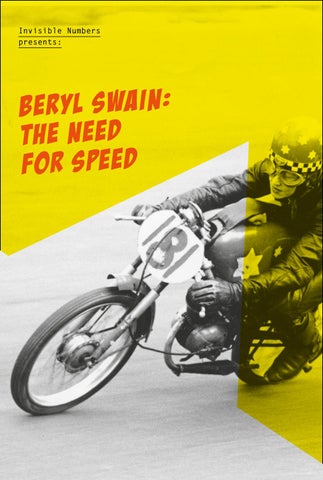
Invisible Numbers presents:
Beryl Swain: The Need for Speed
Beryl Swain, from Walthamstow, was the first woman to ride solo in the treacherous Isle of Man TT motorcycle races in 1962. Despite her talent and achievements, the sport’s governing body did all it could to try and stop her from competing. They revoked her international racing licence and announced a ban on women solo riders competing in international road races. The ban remained in place until 1978. The exhibition ‘Beryl Swain: The Need for Speed’ (1 June – 26 July 2019) was curated and written by Kirstin Sibley, designed by Rachel Gomes and produced by Hannah Ford. In addition, Amber Cowan edited copy, Rebecca Booker created a replica helmet and Joana Niemeyer designed the flyer and newspaper. Beryl’s brother, George Tolman, kindly provided original materials, including a helmet, and Derek Harris from Lewis Leathers lent an original 1960s racing suit and boots. 1B Window Gallery in Coppermill Lane, Walthamstow hosted the exhibition. The space was founded in 2019 by Rebecca Booker, Joana Niemeyer and Hannah Ford from the art collective Invisible Numbers. The show was launched with a ride-out of 40 motorbikes organised by Rachel Gomes from VC London, an all women’s motorcycle group. There were also talks by Gemma Harrison from VC and Kirstin Sibley. The exhibition coincided with the hanging of a Waltham Forest blue plaque at 18 Grosvenor Park Road, where Beryl lived at the time of the TT. A mural by Helen Bur, curated by Mark Clack from Wood Street Walls, was unveiled on the corner of Wood Street and Marlowe Road near her family home. This newspaper is dedicated to George Tolman, Beryl’s brother, for keeping the memories of her alive.
– STOW SI STER – Beryl Jean Tolman was born on 22 January 1936 in Walthamstow. Her family home was at 54 Marlowe Road, and Beryl lived here from 1936 until 1962. The house was demolished in the mid 1960s to make way for the Marlowe Road Estate. Beryl was the youngest of four children born to George and Amy Tolman. After attending school in the Wood Street area, Beryl trained to become a shorthand typist, working as a senior secretary at P&O in the City. Corner of Marlowe Road and Wood Street, 1960s/ early 1970s, © Vestry House Museum
Beryl met Edwin Swain, from Bethnal Green, around 1952 and they married at St Mary’s Church in Walthamstow in 1958. Eddie owned a car and motorcycle garage in Stoke Newington and while he occasionally raced, preferred to provide a supportive role to other drivers. After living with Beryl’s widowed mother, they moved to the ground floor flat at 18 Grosvenor Park Road in 1962. Eddie, Beryl and her mother all feature in the Beryl and Eddie Swain on their wedding day, 1958
British Pathé film ‘Girl Racer’ from that year (Beryl shopping with her mother and Eddie, wearing brown trousers and a donkey jacket, attending to her bike). Eddie and Beryl parted ways, probably in early 1964, and she moved back to the Wood Street area.
Beryl Swain, 1962
– GOD D ESS OF THE GAS P EDALS –
Eddie bought Beryl her first motorcycle, a 98cc Moto Guzzi Zigolo, and she took off from there, literally. Her next bike was a Maserati 50cc Tipo 50/T2/ SS, also known as a ‘Rospo’ or ‘Toad’. She kept this and her racing machine, an Itom 50cc, in the hallway under the stairs at 18 Grosvenor Park Road. She purchased a one-piece leather suit from Lewis Leathers1, which she teamed with a distinctive helmet she painted to match her bike: red with white stars for Brands Hatch and then blue with yellow for the TT. Bob Summerill, her brother George’s best friend, became her mechanic – he was known for working wonders with the somewhat temperamental Itom. He noted that,
Beryl became a member of the Racing 50 Motor Cycle Club, which had regular meets at various tracks across the UK. At her first race at Snetterton, the 1960 Chiltern Enduro, she won a trophy for being the first woman across the finish line. Later that year, she was awarded the club trophy for best lady rider of the season. However, things didn’t always go according to plan. At her first appearance at Crystal Palace, she hit an obstacle on a practice run and was catapulted off her bike, ending up with concussion. Despite the blood streaming from beneath her helmet, she insisted she was well enough to race, but someone sabotaged her chances by removing the chain off her bike.
“as a racer she was aggressive, really aggressive and she wouldn’t give way to anyone.” 2
1.Thank you to Derek Harris from Lewis Leathers for identifying the leathers held by the Manx Museum which are unlabeled 2.Bob Summerill interviewed on ‘Goddess of the Gas Pedals’ by Ariane Barua, Woman’s Hour, BBC Radio 4, 3 Dec 2008
Beryl Swain, Brands Hatch, 1962/3, by Len Thorpe
Beryl’s International Racing Licence, 1962.
Beryl also appeared at Silverstone,
Beryl, who usually came in with
where she won a trophy for the
the first 10 riders of a race
‘Endura’ in August 1960, and
at Brands Hatch, should have
further afield at Cadwell Park in
been placed in the second row at
Lincolnshire. Her club travelled to
the start, but despite this the
the Curragh Racecourse in Ireland
organisers insisted on confining
in September 1960, where Beryl was
her to the back row. She retorted,
the sole female rider in a field of
“I presume that because I am a
around 50. She made it to the final
woman I must be lucky that I am
and was awarded a medal for her
allowed to race at all.”3 With a
efforts. In April 1962, when 50cc
run of successful races under her
racing made its debut at Gosling
belt, she then set her sights on
Stadium, Beryl was once again the
the most dangerous road racing
only woman competing.
event: the Isle of Man TT.
3. Beryl Swain, newspaper article, 1962: http://www.classic50racingclub.co.uk/berylswain-main.html
Racing circuits in England and Wales, 1962
Beryl Swain, 1962,
– T H E RUN UP TO T HE TT – The Isle of Man TT (Tourist Trophy) is an annual motorcycle event which has been held on the island since 1907. The event, a time-trial format on the Mountain Course circuit, is 37.73 miles long. It is often referred to as the most dangerous racing event in the world, with some 250 corners to negotiate. There have been 150 fatalities during official practices and races since it started. In 1962, a 50cc race was introduced for the first time. This gave Beryl the perfect opportunity to test her skill on an international level. However in April 1962, the International Motorcycling Federation (FIM) was concerned that a woman had entered, and announced a minimum weight requirement of 9st 6lb for the race. While the weight requirement was officially invoked for safety reasons, it had no real technical justification and was only applied to Beryl’s chosen class. It was clearly aimed at keeping out Beryl, who weighed 7st 10lb. In an effort to meet the requirements she put herself on a diet of cakes, chocolates, bread, potatoes and malt extract with
Beryl Swain at home, 18 Grosvenor Park Road, 1962
cod liver oil. She succeeded in putting on most of the weight and was permitted to carry ‘ballast’ to make up the difference (a diver’s belt with lead weights).
Walthamstow Guardian, 1962. Beryl Swain, practice week prior to the TT races, Isle of Man, 1962, © Ian Huntly, BBHMG.
– F IRST L ADY OF T HE TT –
As the first woman to ride solo
By the day of the event, Saturday
in the TT, Beryl caught the
8 June 1962, there were 33 riders
imagination of the media. The
in the running. Around half the
press focused primarily on her
entries were ‘works’ bikes:
appearance and weight, and her
Japanese and German machines
role as a housewife, when in fact
that been specifically built for
she worked full time and paid
racing. Unfortunately, Beryl’s
her own entry fees and insurance
Italian Itom didn’t stand a chance
premiums.
against this superior engineering.
Beryl was filmed by British Pathé
The race was won by Ernst Degner
racing at Brands Hatch and also
on a Suzuki, followed by Luigi
out shopping with her mother.
Taveri and Tommy Robb for Honda.
The commentary ends in a manner
Beryl’s bike, which had lost
typical of its time: “Slowly but
top gear for the whole of the
surely, women, the weaker sex,
second lap, came in 22nd out of
are muscling in on man’s domain.
25 riders who finished the race.
Practically no sport is sacred.”4
She was duly presented with a finisher’s medal, an incredible achievement. Beryl was happy with the result. She had set her sights on completing the course and showing that women were capable
Beryl Swain, 1962, by Max Le Grand, courtesy of Manx National Heritage
of competing in the TT. Beryl was determined to come back the following year with a faster bike.
Beryl Swain’s TT finisher’s medal, 1962, courtesy of Manx National Heritage
4. ‘Girl Racer’, British Pathé, 1962
– BA N T H E BLON DE –
Motor Cycling, 1962
She also put forward her argument eloquently to the press: “There has never been a racing fatality involving a woman solo rider, although two have been killed riding as sidecar passengers with men driving ... It’s a matter After the TT, Beryl continued her
of female prejudice under a thin
success, coming second in a race
veneer of safety first.”5
at Gosling Stadium in July and at the Snetterton Enduro in August.
Beryl wasn’t going to give up
However, the FIM wasn’t going to
racing easily. She approached the
let things rest.
organisers of the Manx Grand Prix, an amateur race on the Isle of Man,
In October 1962, it announced that
and proposed a special 250cc race
women solo riders were banned
for women, promising 50 riders.
from competing in international
Unfortunately, the chairman refused
road races. The reasoning was
to budge on the men-only rule.
that an accident would create bad publicity. The FIM refused to let
In 1964 Beryl tried her hand at
Beryl present her case so she wrote
speedway, but finally admitted
a 2,000-word appeal in February
defeat and hung up her racing
1963.
leathers for good. 5. Beryl Swain, Daily Mirror, 19 February 1963, page 21.
Beryl Swain, Isle of Man TT practice week, 31 May 1962, © Hulton Archive/Getty Images.
Motor Cycle News, 1962
– BERYL’S LEGACY – After Beryl passed away in 2007,
Outside of the TT, we are only
the same year as the centenary of
just starting to see women compete
the TT, her brother George donated
on an equal footing in motorsport.
her racing kit to the Manx Museum
Carolynn Sells made Manx Grand
on the Isle of Man.
Prix history in 2009 when she became the first female to win
The ban on women at the TT was
on the Mountain Course in the
lifted in 1978, when Hilary Musson
Ultra Lightweight. Ana Carrasco
competed in the 250cc class. The
won the 2018 World Supersport
Manx Grand Prix finally lifted
300 Championship, to become the
the ban in 1989, when Hilary
first female rider in history to
was finally allowed to enter the
win a World Championship in solo
amateur race.
motorcycle road racing.
Other notable female firsts in
Beryl Swain’s pioneering
solo racing at the TT include
racing career can be seen as
Maria Costello, who was the first
a trailblazing prelude to
woman to stand on a podium when
future female successes in the
she took third place in 2005, and
TT and further afield. She is
Jenny Tinmouth, the fastest lap
commemorated in Walthamstow in
record holder in 2009. Women’s
a mural on Wood Street, painted
achievements are now recognised
by Helen Bur and curated by Mark
with the Susan Jenness Trophy,
Clack from Wood Street Walls, and
which is given to the female
a blue Waltham Forest plaque on
rider who has the best performance
Grosvenor Park Road.
during the TT races.
VC (all women’s motorcyle club) London ride-out to launch the exhibition at 1B Coppermill Lane, 2019
Mural by Helen Bur for Wood Street Walls, 2019 Supported by Quattro Plant. © 2019
Credits for Newspaper
Image Credits
Copy and picture research:
Cover: Beryl Swain, Brands Hatch, 1962/3, by
Kirstin Sibley © 2019
Len Thorpe*
Design: Joana Niemeyer © 2019
Page 3: Wedding*. Marlowe Road 1963 and late
Production: Hannah Ford
1960/early 70s © Vestry House Museum.
Sponsored by Stow Brothers
Page 4: The Central Press Photos*
Special thank you to George
Page 5: Len Thorpe*
Tolman, Bob Summerill’s family
Page 6: FIM Licence*. Race Circuits of England
(Barbara Summerill and Anne
and Wales, Motor Cycling, 4 April 1962.
O’Sullivan) and VC London.
Page 7: Keystone Press Agency*
And to Jeep Elton-Payne (www.
Page 8: Keystone Press Agency photo and
classic50racingclub.co.uk),
Walthamstow Guardian article*
Helen Gibson, Ian Anthony-
Page 9: © Ian Huntly, BBHMG.
Huntly, Derek Harris from Lewis
Page 10: Max le Grand, courtesy of Manx
Leathers, Matthew Richardson and
National Heritage (PG/8325/12)
Jude Dicken from Manx National
Page 11: Medal courtesy of Manx National
Heritage, Jo Parker from Waltham
Heritage.
Forest Archives, Melanie Hough
Page 12: © Hulton Archive/Getty Images
from Hulton Archive, Mark Clack
Page 13: Motor Cycling, 10 October 1962. Motor
from Wood Street Walls, Adrian
Cycle News, 13 June 1962.
Szczech and Rossella Ferrari.
Page 14/15: Hannah Ford, 1 June 2019. *Thanks to George Tolman for providing photos and original materials.
Invisible Numbers is an art collective founded by Rebecca Booker and Hannah Ford, with Joana Niemeyer, Kirstin Sibley, Eve Mulholland, Haberdashery London, Denise Ford and Amber Cowan. 1B Window Gallery is curated by Invisible Numbers to showcase local, national and international artists. We believe in collectivity and coproduction to enable ideas to blossom, grow and flourish. We couldn’t have done this without support from St James Big Local, The Stow Brothers and Waltham Forest Regeneration Team. www.invisiblenumbers.co.uk