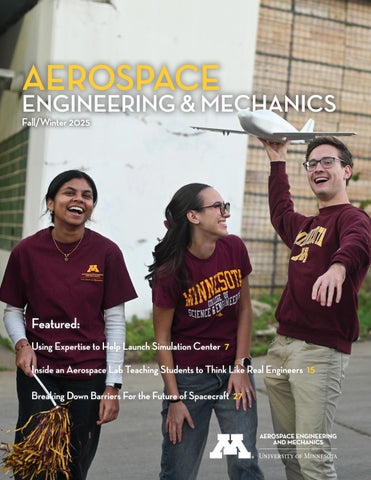
AEROSPACE
ENGINEERING & MECHANICS Fall/Winter 2025
Featured: Using Expertise to Help Launch Simulation Center 7 Inside an Aerospace Lab Teaching Students to Think Like Real Engineers 15 Breaking Down Barriers For the Future of Spacecraft 27
2
Department of Aerospace Engineering and Mechanics University of Minnesota 110 Union St SE Minneapolis, MN 55455 Email: aem-department@umn.edu Phone: 612-625-8000 cse.umn.edu/aem Department Head Perry Leo Associate Department Head Graham Candler Director of Graduate Studies Ryan S. Elliott
Welcome to the latest edition of the AEM Magazine. As we head into our next semester, I’m excited to share several updates that reflect the continued growth and impact of our department. First, we celebrate Professor Anabel del Val as she prepares to use her expertise in uncertainty quantification to help the University of Virginia launch their new center dedicated to hypersonic simulations. We welcomed Dr. Kshitiz Upadhyay to our faculty this fall and his work on the mechanics of soft materials will expand the department’s expertise in novel materials and structures, which you will learn more about in this issue.
Senior Administrative Director Hongna Byström
Our Student Achievement section highlights some of the many accomplishments that our undergraduate and graduate students have reached. For example, graduate student Mel Nightingale is the first recipient of the Michelle Brekke fellowship. Many of you know Michelle Brekke both as an alum of the Department and for her outstanding career at NASA. She has been a great friend to the department and we are so pleased that she is continuing to give back to our community. Our students continue to work with our faculty on important research projects, building their skills and addressing important issues in the aerospace world. In this issue, you will learn about the work of two of our PhD students, James Johnson and Carter Vu, and their research in aircraft systems and hypersonic fluid flow, respectively.
Editorial Staff Andrew Carman
The department has been fortunate enough to have hosted or participated in many events recently. From homecoming to our open house, our students, faculty, and staff have been there to represent our department.
Interim Director of Graduate Studies Tom Schwartzentruber Director of Undergraduate Studies Yohannes Ketema
Questions about the magazine? aem-comm@umn.edu
We continue to participate in collaborations that impact our community at the university and beyond. In this issue, you will learn about an interesting research partnership between AEM and the Department of Anthropology that Dr. Melissa Green and undergraduate student Kevin James have been working on. Finally, I want to thank all of you for being part of our community. We need your support more than ever as we continue to improve and grow our department. You are a vital part of the equation that enables us to support the work, people, and progress that makes AEM thrive.
Perry Leo, Department Head
CON TENTS 7
Faculty Updates
13
Student Achievement
19
Recent Events
25
Research Highlights
31
Community Impact
33
Scholarship Recipients
Faculty
Graham V. Candler
McKnight Presidential Endowed Chair, Associate Department Head
Demoz Gebre-Egziabher
Professor & Director of Minnesota Space Grant Consortium
Maziar S. Hemati
Associate Professor, Russell J. Penrose Faculty Fellow
4
Ryan Caverly
Assistant Professor, McKnight Land Grant Professor
Ryan S. Elliott
Professor & Director of Graduate Studies
Richard D. James
Distinguished McKnight University Professor
Department of Aerospace Engineering & Mechanics
Anabel del Val
Assistant Professor
Melissa Green
Associate Professor
Yohannes Ketema
Professor & Director of Undergraduate Studies
Perry H. Leo
Professor & Department Head
Suraj Ravindran
Ellen K. Longmire
Joseph W. Nichols
Tom Schwartzentruber
Kirsten Strandjord
Professor
Assistant Professor
Professor & Interim Director of Graduate Studies
Ellad B. Tadmor
Kshitiz Upadhyay
Professor, Russell J. Penrose Professor
Assistant Professor
Associate Professor
Assistant Professor
Yue Yu
Assistant Professor
Damennick Henry Assistant Professor
3
Teaching & Research Faculty
Travis W. Drayna Research Professor
Todd Helsa
Contract Assistant Professor
James A. Flaten
Associate Director of the MN Space Grant Consortium & Contract Professor
Anthony Knutson
Research Associate Professor
Everett Wenzel
Research Associate Professor
4
Department of Aerospace Engineering & Mechanics
Anubhav Dwivedi
Research Assistant Professor
Joseph Mueller
Industrial Professor of Design
Emeritus Faculty
Gordon S. Beavers Professor Emeritus
Roger L. Fosdick Professor Emeritus
William L. Garrard Professor Emeritus
Thomas W. Shield Professor Emeritus
Visit cse.umn.edu/aem for more AEM Faculty information. 5
Faculty Updates Using Expertise to Help Launch Simulation Center In the field of aerospace engineering, developing vehicles capable of traveling at hypersonic speeds is crucial for the future of space exploration. However, the challenge engineers face is ensuring that their designs can withstand the extreme conditions of hypersonic travel, with speeds exceeding 4,000 miles per hour.
Assistant Professor Anabel del Val from the University of Minnesota’s Department of Aerospace Engineering will use her expertise to co-lead the team responsible for uncertainty quantification, a scientific approach used to identify and minimize uncertainties in simulations, improving both their accuracy and reliability.
A new grant awarded by the U.S. National Nuclear Security Administration and Predictive Science Academic Alliance Program (PSAAP) seeks to meet this challenge by establishing the Stochastic Simulations of Ablative Geometries with ErrorLearning in Space and Time (SAGEST) Center.
“By the end of the five-year project, we hope to have the most advanced and accurate hypersonic simulation possible. To achieve this, we are pushing the limits of uncertainty quantification,” explains del Val.
Researchers from multiple universities will collaborate at the center, which is housed at the University of Virginia, to develop advanced simulation tools that will help scientists test designs under extreme conditions.
The team will work closely with the von Karman Institute for Fluid Dynamics in Belgium, where del Val earned her PhD.
“We are pushing the limits of uncertainty quantification.” 7
Department of Aerospace Engineering & Mechanics
Artist concept of a fully reusable, two-stage-to-orbit space access system. The concept shows the potential applications of hypersonic travel in space. NASA
The institute will provide high-quality experimental data used to inform and refine the team’s simulations. Although the primary focus of the SAGEST team is aerospace and hypersonic flight, the research conducted at the center will have broader applications in fields like energy, medicine, materials science, and manufacturing. A key innovation of this work is its ability to balance computational precision with efficiency, using layered approaches to improve accuracy while quantifying uncertainty.
As hypersonic flight becomes a reality, advancements like those made at the SAGEST Center will be vital in ensuring that these next-generation vehicles are both safe and efficient. By enhancing simulation accuracy and reliability, researchers are not only helping to propel space exploration forward but are also contributing to a range of industries where precision and innovation are key. The outcomes of this project could help define the future of both aerospace engineering and scientific research across multiple fields.
In addition to advancing scientific knowledge, the project will offer Professor del Val’s students valuable To learn more about Professor del Val and her hands-on experience working at one of three national research, visit: stochastichypersonics.github.io laboratories involved in the initiative.
8
Faculty Updates Welcome: Kshitiz Upadhyay We recently had the chance to speak with the latest faculty member to join the department, Assistant Professor Kshitiz Upadhyay. As he settles into the department, we spoke with Upadhyay to learn more about his background, research, and interests. After graduating I moved to Johns Hopkins University in Baltimore, where I did research on understanding brain injury using computational models that can predict the deformation in the brain in response to rapid movement of the head and how that can lead to injury. In 2022, I joined my first faculty position, which was at Louisiana State University in Baton Rouge. Then as well as now, the focus of my lab primarily has been to understand the mechanics of soft materials, which is the area that I've been studying since my PhD time. From LSU, I moved to Minnesota to join the department three months back and I've been enjoying my time here ever since." What about the institution excites you?
Can you tell us a little about your background and how you ended up here at the UMN AEM department? "I was born in India and I did all my schooling there as well as my undergraduate at the National Institute of Technology-Bhopal in Central India. After my undergrad, I worked for two years in the industry as a mechanical design engineer. I came to the United States in 2016 to study my master's at the University of Florida in mechanical engineering, but I quickly realized my love for research, so I switched to the PhD program in the solid mechanics area. 9
Department of Aerospace Engineering & Mechanics
"I think one of the things that excites me the most is how dynamic this community is, not just the AEM department, but the College of Science and Engineering has a very dynamic community working on some of the hardest problems in science and engineering, and also how interdisciplinary the different research projects here are. There are so many centers where people from different backgrounds collaborate with each other. It's a very tight-knit community and there are so many avenues to collaborate and build teams and chase difficult problems. At the same time, the department is very respected for working on fundamental problems, not just the problems that bring money or that are hot topics, but really working on traditional fundamental problems that can have long-lasting impact in the field. That's what I love very much."
What inspired you to pursue a career in academia, and more specifically in your field of study?
What do you hope to achieve with your research here at the University of Minnesota?
“I think from childhood I've been driven by curiosity to dig into scientific topics in a deep way, and academia gives me the freedom to do that. I think that's the thing that I love the most about academia, the freedom you have to study and investigate topics at your own pace and at the rigor that you can put into it.
" The whole focus of my lab is to develop approaches that can allow us to understand and predict the mechanics of soft materials. We take a holistic approach in the lab, developing these approaches from both the experimental perspective and the computational perspective. On the experimental side, we develop new mechanical tests that can probe the mechanical properties of soft materials under a variety of conditions, including a variety of loading rates from very slow loading to very fast impact loads and a wide range of temperatures from sub-zero temperatures all the way to very high temperatures.
I'm also really motivated because I love the field of solid mechanics. I'm also interested in giving back to the community, so I like the fact that being in academia I get the chance to inculcate the next generation of scientists and engineers. So that's something that also motivates me a lot.”
"IT’S REALLY IMPORTANT FOR US TO BE ABLE TO UNDERSTAND AND PREDICT THE MECHANICS OF THESE MATERIALS.” What are the main areas of research you’re currently focused on? “My research is in solid mechanics, more specifically my focus since my PhD days has been to understand the influence of forces and deformations on soft materials. Soft materials is a very broad term that includes things like tissues, foams, and polymers. These materials are very sensitive to large deformations, strain rates, loading rates, and temperature, so understanding their mechanics becomes very difficult. The primary area of my research has been to investigate the mechanical behavior of the soft materials with a variety of experimental and computational approaches. We investigate the mechanical behavior of the soft materials with a variety of experimental and computational approaches. Insights from this research open pathways to designing and discovering advanced soft materials for aerospace, defense, and medical technologies, and to developing deeper mechanistic understanding needed to prevent tissue trauma."
From the modeling side, our lab works on uniquely integrating theory with machine learning to develop what's called ‘constitutive models’. Constitutive models are equations that describe the properties or mechanical behavior of materials. Compared to what most labs do, our lab's work is different in that we uniquely integrate theory with machine learning. We develop these next generation constitutive models that are physically grounded, like theoretical models, but at the same time, they use machine learning, so they are more flexible and more efficient than traditional models. This is what I would call the 'X-factor' of my lab's research, the integration of theory with machine learning." How do you hope to contribute to the department and broader academic community here? “In the long run I want to become a leader in the field of soft materials mechanics, especially at the intersection of theory and machine learning, which is a very new area that I'm fortunate to be contributing to. I think that would contribute immensely to not only the department, but also to the university in general. Through this expertise, I want to build interdisciplinary teams that can go after bigger grants that can establish robust centers at the university to put it at the forefront in the area of not only soft materials, but advanced materials in general.
10
It is very motivating for me to see that the university already has a lot of expertise in the area of materials, not just in the AEM department, but in other departments around the College of Science and Engineering as well. There's a lot of expertise in the area of mechanical materials. I would love to continue working in my area to be a domain leader, but at the same time I would like to harness the collaborative and interdisciplinary environment at the University of Minnesota to put the whole university at the forefront of materials research.”
"IF YOU'RE NOT CURIOUS ENOUGH, YOU WON'T DIG DEEPER, AND YOU MIGHT JUST BE CONFINED TO A SET OF FORMULAE.” What types of collaborations or interdisciplinary work are you most excited to explore? “I'm very, very interested in that and I've been fortunate to do some collaborating already. I have been discussing collaborations in machine learningbased constitutive modeling and simulations
with the Biomedical Engineering Department. I have had talks with professors in the Mechanical Engineering Department, one of whom is a peer in a congressionally funded consortium called the Panther Consortium, which focuses on brain injuries. So there is definitely a possibility for collaboration here. Because of the wide portfolio of the AEM department, I think I definitely foresee collaborations with professors here as well. One example is Professor Suraj Ravindran's lab. He works on hard materials and I work on soft materials, so between the two of us, we cover a wide range of materials. We not only cover a wide range of materials, but we cover a wide range of loading rates as well. Another example is Professor Ellad Tadmor, who works on a molecular-scale behavior of materials and I work on a more continuum scale or a bigger macroscale behavior, so I could see some collaboration there as well. Overall, there is a lot of potential for collaboration in the area of mechanics and materials in the department."
An elastomer specimen undergoing uniaxial compression testing in Professor Upadhyay’s Soft Materials Mechanics Laboratory. LSU College of Engineering
11
Department of Aerospace Engineering & Mechanics
What do you see as the most important skills or qualities for students to develop while pursuing their education?
Looking ahead, how do you see your field evolving, and how can students prepare for these changes?
"I think there are two most important skills that students should have: curiosity and persistence. It's important for them to be curious because research is all about curiosity. Even at the undergrad level, I think education in general is all about curiosity. If you're not curious enough, you won't dig deeper, and you might just be confined to a set of formulae, which is not what we want to instill in our students.
"I think the field of solid mechanics in general is evolving very fast. One of the key areas in which it is evolving, which is the area where things are evolving very fast across the board, is the machine learning and AI area. It has happened very, very quickly in the solid mechanics area, so it is important for the community to ensure that, even as we embrace these new tools, we remain grounded in the fundamental principles and traditions of theoretical mechanics.
At the graduate level, persistence is extremely important. When you are new to investigating a research problem, you might not get results right away. It’s not a good idea to expect fast results, but what is important is for them to be persistent and curious while working on that problem, giving it their all, and if that happens, then soon enough they will see results coming automatically from that.”
One problem with blind use of machine learning is that machine learning doesn't understand physics automatically. If we use it without thinking of physics, we will get worthless results. I think it is really important for the mechanics community nowadays to develop ways to integrate theory with machine learning rather than using it to replace our theoretical models."
Professor Upadhyay with Yogesh, a member of his research team. LSU College of Engineering
12
Student Achievement Graduate Student Selected as First Recipient of AEM Alumni Fellowship
M
el Nightingale, a third-year PhD student in the AEM department, is the inaugural recipient of the Michele Brekke Fellowship. Nightingale and several faculty members from the department recently had the opportunity to join Michele Brekke for lunch on campus.
“I think the coolest part was hearing about her experience as a flight director and how it was something she worked really hard for and did well at,” recalls Nightingale. “Hearing about how she advanced her career within NASA and the challenges she faced before finding her niche spot where she could do what she wanted to do was inspirational.”
During their PhD, Nightingale has been primarily focused on position, navigation, and timing research in space past our moon, referred to as deep space. Modern navigation tools, like GPS, cannot be used in this environment. Instead, Nightingale’s research has looked to using stars called pulsars and the signal they produce as a navigation beacon to come up with a solution for deep space navigation. In order to reach this goal, there are two main steps. One is designing a sensor to better utilize these signals before launching a standalone mission that has an optimized detector and sensor package to look at the signal. The second part of the process is coming up with algorithms and simulations to find the navigation solution. “The exciting next phase will be exploring cooperating satellites, which is using multiple spacecraft to take joint measurements, share information, and produce even better solutions once the hardware testing is complete,” says Nightingale. Besides their research, Nightingale has also remained involved in the Small Satellite Research Laboratory (SSRL) and numerous other projects in the department. Nightingale’s multi-faceted work in the department was among one of many factors that led to them being selected as the very first recipient of the Michele Brekke Fellowship. Before the excitement of receiving the fellowship could wear off, Nightingale was informed that they would also have the opportunity to meet Brekke at a lunch organized on campus. The experience was one that Nightingale won’t soon forget. 13
Department of Aerospace Engineering & Mechanics
Michele Brekke received her Bachelor's of Science in 1975 and her Master's of Science in 1977 from the AEM department. She would go on to join NASA’s Mission Control Center shortly after graduation and eventually became the first woman flight director at NASA. Brekke would hold various roles throughout the agency for 37 years before retiring. Brekke also gave valuable advice and words of encouragement to Nightingale, guidance that has helped as they navigate their next steps. “I've been trying to learn as much about what professors do, what research-active positions are available outside universities, and get a better idea of where PhD's fit into companies. I’m still figuring that out," Nightingale said. "Hopefully afterward I’ll be solving challenging problems that are interesting and advancing technology, that’s the dream. Based on Michelle Brekke’s advice, as long as I keep my options open, I’ll find something.” With an open horizon ahead, Nightingale leaves the experience not with certainty about their destination, but with assurance that they’re on the right path.
with a longtime Honeywell manager, he applied online. When he finally connected, the manager invited him to interview the following week. Shortly after the interview, he had the chance to take a facility tour that doubled as a preview of real engineering in action. Evenden was offered the internship a few weeks after. Throughout the summer, Evenden worked on inertial reference units (IRU), critical systems that determine an aircraft’s position, orientation, and motion. This meant lots of hands-on experiments. “One thing that surprised me was how much real work I got to do,” he said. “I wasn’t given a side project. I was working on systems they rely on.” Nick credits his aerospace coursework for how quickly he felt prepared to contribute. “Instrumentation Lab probably helped me the most,” he said. “Eighty percent of what I did was built directly off that class.” Flight Dynamics and Control also played a major role, giving him much of the theoretical background he needed to understand the system’s behavior.
Undergraduate Puts the Classroom to Work at Honeywell Internship
F
or Nick Evenden, a senior aerospace engineering student at the University of Minnesota, the route into the field was always propelled by curiosity. He grew up fascinated by the sky first through astronomy, which sparked an early interest in space, physics, and the mechanics of how the universe works. Over time, that fascination shifted from observing things far away to understanding how we get there. Evenden eventually realized that aerospace engineering was the perfect intersection of the questions he cared about and the tools to answer them, bringing him to the Department of Aerospace Engineering and Mechanics.
He also had valuable experience from working as an AEM Student Lab Assistant for the past two years, paramount to new experiments introduced in several labs. The internship gave Evenden valuable experience and a path forward. He continues to work at Honeywell in a part-time capacity as he finishes the school year. As for the future, Evenden is eager to keep learning, keep building his skillset, and continue his trajectory upward. Aerospace started as a childhood curiosity and has now become a career he’s ready to pursue.
Evenden found the internship through the College of Science and Engineering Career Fair. After talking 14
From left to right: Sofia Gerasimchuk, Peyton Kramlich, and Monica Robles
Inside an Aerospace Lab Teaching Students to Think Like Real Engineers
W
hen aerospace engineering seniors at the University of Minnesota walked into their capstone laboratory course this fall, many expected another semester of step-by-step procedures and predictable experiments. What they got instead was a radically different model, centered on autonomy, uncertainty, and the kind of engineering problemsolving they’ll soon face beyond graduation. From start to finish, Aeromechanics Lab has been an exciting experience for group members Sofia Gerasimchuk, Peyton Kramlich, and Monica Robles. Designed Around Autonomy “It hasn’t been like a traditional class or a traditional laboratory,” said Kramlich. “You have to make your own decisions on the experiment; what you expect from aerodynamic theory, what you think would be interesting to observe. That level of personal interaction with the material has been unique.”
15
Department of Aerospace Engineering & Mechanics
The course is designed around three major aerospace modules: fluids, structures, and guidance, navigation, and control. Each of these important aspects of aerospace engineering is explored in detail by testing students to reach experimental goals using state-of-the-art research tools and the knowledge they’ve acquired throughout their undergraduate education. Students are expected to review past research, design their own procedures, and troubleshoot equipment failures when they occur. For students like Gerasimchuk, Kramlich, and Robles the shift to more independent lab work was a breath of fresh air. “In previous labs, everything was laid out: step one, do this; step two, do that,” Gerasimchuk said. “Here, you’re forced to truly understand what the experiment is about, what data you’re trying to collect and why. It’s active recall, it’s critical thinking, and it’s a lot closer to what engineers actually do.”
Importance of Teamwork Working within loosely defined boundaries pushed students to debate experimental parameters, justify their decisions, and take ownership of outcomes. The process not only reinforced theory but strengthened teamwork. “You never know who you’ll be paired with, so you have to put a lot of trust in your teammates,” Robles noted. “But it came easier than I expected. We held each other accountable, and that made the experience even better.” Challenges and Successes The course’s open-ended structure brought challenges too. Each group has only one threehour lab session every other week to design, run, and interpret experiments, while still preparing deliverables from the previous module. “Time management has been difficult because the class moves so fast,” Kramlich recalled.
“You walk in, and you have three hours to agree on your parameters, run the experiment, troubleshoot issues, and start your analysis.” Issues range from hot-wire probes jamming and wind tunnels drifting out of calibration to drone trajectories misbehaving and code breaking at critical moments. “That stress can impact your ability to think clearly,” Robles said. “But it’s also what people deal with in industry: deadlines, equipment failures, unexpected problems. So in a strange way, we’re glad we’ve had to deal with it.” Despite the pressure, students repeatedly described their surprise at how capable they felt. When something broke, they fixed it. When an experiment didn’t produce clean data, they found a way to interpret it.
16
“Every lab had issues, but it was always something we could figure out,” Kramlich said. “It’s been a real confidence boost. In other labs, if something goes wrong, it feels like you didn’t understand the coursework. In this lab, it’s about improving your problem-solving skills and when you succeed, it feels like proof you’re becoming a real engineer.” Students also discovered that operating professionalgrade equipment, from wind tunnels to drones, was more intuitive than expected. “It gave us perspective on how accessible this work really is at this stage in our studies,” Gerasimchuk said. Favorite Moments There was no single favorite among the group, but many memorable highlights.
17
Department of Aerospace Engineering & Mechanics
Designing control responses and watching drones execute them in real time felt exhilarating and deeply educational. Additionally, mapping an airfoil’s wake, quantifying flow behavior, and working hands-on with fluid dynamics equipment made the aerodynamics module a standout for the students. The group also appreciated the breadth of the course, covering the three major aerospace areas, each with two labs. This left enough time to learn, apply, and reflect before moving on. Moreover, this class required a level of engagement with professors unlike most courses. Whether presenting findings to Professor Melissa Green or troubleshooting code with Professor Ryan Caverly during drone labs, the mentorship was direct, personal, and impactful.
Looking Toward the Future Besides sharpening students' skills, the course also influenced their aspirations. Kramlich plans to enter the aerospace industry, particularly in hubs like Los Angeles and San Diego. Robles intends to pursue graduate studies to deepen her expertise, while Gerasimchuk is applying directly to PhD programs focused on solid mechanics and fracture research.
Regardless of the path they decide to take, the group is confident they will succeed now that they have the tools from courses like Aeromechanics Lab as they come to the end of their undergraduate education in the Department of Aerospace Engineering and Mechanics.
One component left a particularly strong impression: the module on Guidance, Navigation, and Control (GNC). These lectures and drone labs offered rare and invaluable exposure. “It’s something I bring up in interviews,” Kramlich said. “Not all universities provide this experience.”
18
Recent Events
HOMECOMING We celebrated another amazing University of Minnesota Homecoming in October. This year was the department's second year ever walking in the parade. Highlights included candy delivery via parachute, multiple rockets from our student groups, and a portable "solar sail". Professor Ryan Caverly and graduate student Erik Lehner constructed a "solar sail" that they could carry during the parade. Real solar sails are used to propel spacecraft using the pressure of sunlight, rather than rocket fuel.
Members from Rocket Team and Liquid Propellant Rocketry Development (LPRD) Rocketry brought many of their student-built rockets that have been used in competitions nationwide.
19
Department of Aerospace Engineering & Mechanics
Professor and Associate Director of the MN Space Grant Consortium James Flaten and his students used large tubes to launch candy carried by parachutes made of napkins into the crowd.
Students and faculty showcased several builds from Senior Design, a class where AEM students develop advanced engineering projects working with a faculty instructor and professional mentors from the industry.
20
Leo and Nightingale helped cut the ribbon at the ceremony alongside CSE Dean Alleyne and faculty members from the Department of Computer Science.
AEM Professor Demoz-Gebre Egziabher and Lindsay Glesener of the Minnesota Institute for Astrophysics showcased the new Small Satellite Research Lab.
SHEPHERD LABS OPEN Department Head Perry H. Leo and graduate student Mel Nightingale joined UMN College of Science and Engineering leadership to celebrate the completion of the Shepherd Labs renovation. The new labs that opened this fall focus on learning and research in emerging technologies.
21
Department of Aerospace Engineering & Mechanics
AEM OPEN HOUSE The Department of Aerospace Engineering and Mechanics recently hosted its annual Open House for incoming freshmen in the College of Science and Engineering. The event gave students an overview of the AEM major, highlighting opportunities for research, advanced labs, and student groups.
Undergraduate student Henry Mahnke demonstrated the cable-driven robot in the Aerospace, Robotics, Dynamics, and Control Laboratory.
Graduate student Raphael Ribiero guided students through the water channel used in the department's Laboratories for Turbulent and Complex Flows.
Graduate student Vladimir Kornev helped explain the research conducted in the Multiscale Mechanics and Extreme Materials Laboratory.
Members from across the AEM community attended the poster competition, including industry partners, professors, and students.
The program hosted several workshops to help participants learn more about research techniques, ranging from coding to proper writing etiquette.
23
Department of Aerospace Engineering & Mechanics
SRMP RECAP The Summer Research Mentorship Program (SRMP) finished up its first year with a poster competition. The new program gave undergraduate students an opportunity to dive into research that they worked on with faculty advisors and graduate student mentors. The poster competition showcased the skills and results they obtained during the program.
After much deliberation, the judges came to a consensus and selected their top three presentations of the day (from left to right): Michael States - CABLESSail Hardware Development, Isaac Nahmad - Development of a High Temperature Smallscale Split- Hopkinson Pressure Bar, and Henry Mahnke - Novel Cable-Driven Robot Position Estimation Algorithm.
The new program was organized by AEM professors (from left to right) Ryan Caverly, Tom Schwartzentruber and Melissa Green to support and train undergraduate students in advanced research.
24
Research Highlights
Driving Reliability In Aerospace PhD student James Johnson is using his research to help create more reliable aircraft systems.
“Well, I'd say I probably always had an obsession with planes. An obsession, right? I don't know if I can stress that enough.” James Johnson had dreams of being a pilot growing up, but his knack for mathematics and love for creating things led him down the path of building the aircraft he had once hoped to fly. Johnson is currently in his second year of his PhD in the Department of Aerospace Engineering and Mechanics at the University of Minnesota and has been working on research in conjunction with Collins Aerospace. The research is focused on improving pitot-static probes manufactured by Collins, making it much easier and faster to tell if the probes will perform correctly without lengthy testing procedures.
“These are really sensitive devices and they need to be super accurate to measure pressure within a very small range.”
be super accurate to measure pressure within a very small range,” says James. “The question is can we simply scan these and predict whether or not they're going to perform aerodynamically without all the testing?” Creating a system that can quickly scan the pitotstatic probes could help spot defects that a person may miss during the standard testing process. Johnson spent his summer at Collins testing models he created in a wind tunnel and has continued building more with the goal of figuring out what parameters are most important. Another key method that he’s been using in this research has been Computational Fluid Dynamics, or CFD, to see if he can follow a similar path in simulation and reproduce experimental results. “Simulation can be a very useful tool, especially when it gets expensive to make a ton of different models,” Johnson explained.
These pitot-static probes are used in aircraft systems to measure airspeed and altitude, making them an essential piece of equipment that manufacturers must put through rigorous testing to ensure their performance is up to par. Some of these probes end up not meeting the specifications for reasons unknown and need to be tuned to attempt to fix them, which isn’t always successful. At the end of the day, manufacturers don't want to spend valuable time and resources testing probes only to find out that they don’t work. This is where Johnson’s research hopes to make a difference. “These are really sensitive devices and they need to 25
Department of Aerospace Engineering & Mechanics
Johnson holds a cross section of a pitot-static probe used on Boeing 737s
“You don't know what's happening, but at some point you look back and you realize somehow you’re an expert." Over the next few years, Johnson hopes to gather as much data as he can while continuing the research. Preliminary findings have shown just how finicky these small probes can be. “It's been surprising how sensitive the models are to different manufacturing defects,” said Johnson. “We're looking at such small pressure differences, which has led to the observation that these really, really tiny defects can matter a lot.” Although the research process has been strenuous and challenging at times, Johnson is thankful for the opportunity it has provided to sharpen his skills and learn new ones in the process. A highlight of his work has been getting more comfortable designing experiments, which hasn’t been easy due to the sensitive nature of wind tunnels. In addition, the work has helped improve his focus, a skill that he has honed through "many hours of staring at a computer trying to get simulations to work correctly." Looking back to when he began the research, Johnson has seen how far he’s come.
A Cornerstone of the Department Aside from his research, Johnson has been an important contributer to the department. •
As an undergrad, Johnson and two other recent graduates built a tabletop wind tunnel that is still used for demonstrations and outreach events.
•
Johnson has become synonymous with drones around the department. During his last summer as an undergrad, he worked in a lab with a PhD student whose research revolved around a system to model launch vehicle dynamics with a quadcopter. Johnson and another undergrad in the lab created a physical model for the project.
•
In the first year of his master’s, Johnson worked on a navigation algorithm to help get a drone flying within a room for Aeromechanics Lab. Programming the flight controller and designing the lab helped teach Johnson the majority of his programming knowledge.
“You don't know what's happening, but at some point you look back and you realize somehow you’re an expert, and that you've just ended up learning and doing a lot.” Johnson’s continued efforts to understand and predict probe performance have the potential to significantly reduce testing time and improve manufacturing reliability. As he moves forward in his PhD, Johnson is not only pushing the boundaries of aerospace engineering research but also steadily realizing the passion for aviation that first inspired him.
26
At just nineteen years old Carter Vu started his PhD in the Department of Aerospace Engineering and Mechanics. Now in his fourth year, Vu hopes to use his research in computational hypersonics to make immense improvements to spacecraft.
FASTER & FURTHER BREAKING DOWN BARRIERS FOR THE FUTURE OF SPACECRAFT
A
s space vehicles reach hypersonic speeds, five times the speed of sound, how can we protect them from the extreme heat and instability they experience? The issue centers around the boundary layer of these vehicles, a thin layer of fluid like air or water that forms around a moving object. When a boundary layer transitions from a laminar, or smooth, predictable flow to a turbulent and chaotic flow, heat and drag increase at an extremely high rate. The problem is so difficult to solve that most engineers opt to design around it. Even major programs at NASA and other agencies use an empirical correlation to
27
Department of Aerospace Engineering & Mechanics
guess where the transition is going to occur. They then apply a factor of safety, a "fudge factor" to make sure each part is stronger than it needs to be in order to ensure mission success. PhD student Carter Vu’s research could help solve the complicated problem. “I'm hoping to build cheaper boundary layer transition models that can capture 80% of the physics at 20% of the cost, which would hopefully make this something that even entry-level engineers can simulate, rather than just designing around it,” says Vu.
“
If we can build something that’s better than what’s out there already, we can make this problem much more accessible and much easier for everyone to solve.”
28
Vu has been able to tap invaluable data regarding boundary layer transition through the Boundary Layer Transition (BOLT) program, a series of experiments that researchers from John Hopkins University have been conducting to learn more about the problem. The flight data from BOLT I and BOLT II has helped inform Vu's research. The research that Vu is focused on is using high-fidelity methods in computational fluid dynamics to simulate all the length scales involved in the problem of these complex flight vehicles. He aims to compare his findings against flight data to show that these simulations are capable of handling these tough problems and bring these academic techniques to the aerospace industry. “The key obstacle is the expense of these simulations. They're very complicated and they require a lot of computing resources to run. Computing resources are becoming more widely available, and these high performance supercomputers continue to get faster and faster,” explained Vu. “It makes doing my type of simulations much easier and more affordable, not just for academics, but for everyone in the aerospace world to be able to contribute to these complicated problems.” On the other hand, Vu is also hoping that he can start using less expensive models instead of using complicated direct numerical simulations, which resolve every single tiny
feature in the flow field. Vu and the rest of his research team are looking at equations to capture the bulk of the problem at a substantially reduced cost. Beyond that, Vu wants to build better empirical correlations that are more straightforward, allowing engineers to take a very simple boundary layer profile inside of a wind tunnel and find characteristics that inform where the flow is transitioning. In short, making the problem easier to approach. “If we can build something that's better than what's out there already, we can make this problem much more accessible and much easier for everyone to solve,” says Vu. So far, Vu has found that they can reproduce flight results using these methods and computing capabilities. Although it still requires a lot of expenses, time, and expertise, Vu and his research group are one step closer to solving the puzzle. Upon completion of his PhD, Vu has his mind set on working at a national laboratory. “I would love to go somewhere where I can still do research and solve hard problems, but at a more applied level,” said Vu. Whatever he decides to pursue, Vu is sure to bring with him the skills he’s learned from dealing with one of the most complicated problems in modern aerospace history.
Background: The original BOLT flight vehicle before testing. Air Force Office of Scientific Research/Johns Hopkins APL
29
Department of Aerospace Engineering & Mechanics
Wall pressure perturbation on the BOLT II geometry, showing the amplification of noise over the geometry
Wall heat fluxes on BOLT II, showing both centerline and outboard boundary layer transition
30
COMMUNITY IMPACT
TESTING ANCIENT ARTIFACTS WITH MODERN TECHNOLOGY ind tunnels are often used to test models of W aircraft, wings, and even parachutes, but what about prehistoric arrowheads? The Department of Anthropology at the University of Minnesota has been studying various arrowheads, spearheads, and weapon points. In order to draw certain conclusions about the purposes of these artifacts, the department partnered with the AEM department to collaborate on this research by using a wind tunnel to test 3D models of ancient arrowheads. The objective was to study the aerodynamic performance of these models and use it to draw some broader conclusions about the arrowheads. “Wind tunnels have been used for, you know, measuring forces and moments for a long time. But doing it on models that are so non-standard is pretty interesting. It's not an airfoil, it's not any sort of airplane or rocket shape. It's a much more crude design,” said Kevin Smith, an undergraduate student in the AEM department that took on the research project.
Under the supervision of Professor Melissa Green, Smith took 3D scans of the ancient weapon points and printed versions of them at a larger scale to account for the lack of sensitivity that the wind tunnel measurement devices have when it comes to objects that are that small. Each arrowhead was tested with five speeds in the wind tunnel as well as eleven angles of attack, ranging from negative five degrees to five degrees with a one degree increment. After the initial testing concluded, Smith analyzed the raw data and worked backward to determine the non-dimensional aerodynamic coefficients. Initial results suggest that the arrowheads had relatively similar lift and drag behavior, but more testing is needed to draw any conclusions about the arrowhead's purpose or effectiveness. The collaboration was an interesting showcase of the range that aerospace research can be applied to, and for Smith, it was the perfect opportunity to get experience developing and running an experiment.
Due to the relatively small size of the weapon points, Smith scaled the 3D prints five to eight times their actual size to be able to test them accurately.
31
Department of Aerospace Engineering & Mechanics
“When you're working on a lab in class, you’re usually given some sort of procedure to complete the experiment. For this project, I had an idea of what I was doing, but that was it. I had to really think about what parameters were most important and how to work forwards from that to make the best choices,” said Smith. “Not knowing that someone else knows the right answer is very different and that was pretty cool. Overall, the experiment went well.”
The collaboration between the two departments highlights how interdisciplinary research can uncover new perspectives on ancient technologies. By applying modern aerodynamic testing methods to prehistoric weapon points, the team opened the door for continued research to get a deeper understanding of how these tools may have been designed and used.
32
2025-2026 AEM Undergraduate Scholarships Chester Gaskell Aeronautical Engineering Scholarship James Kellick
Robert H & Marjorie F Jewett Fund Lahari Hosur John Kronkvist
CSE Oswald Award Elias McCool The Eric W. Harslem Scholarship for Aerospace Engineering Spenser Chinn Glenn E. Bowie Educational Fund Emma Nahr Daniel Tereshko James M. Urnes Senior AEM Scholarship Keenan Raby Monica Robles Isaac Hoyt
Richard D. and Wyona R. Bartsch AEM Scholarship Daniel Dimitrov Isa Shaikh Tyler Zenz Joseph Shin Shashwat Anand Jack Gagamov Kale Brattin Alexander Kim Richard G. Brasket AEM Scholarship Lars Erickson Nicholas Lawrynk Jocelyn Prewett
John and Robert McCollom Memorial Scholarship Franklin Woolley Benjamin Stiyer Madhurima Das Luke Sosalla Lawrence E. Goodman Scholarship/Fellowship Devin Schutt Louis R. and Dona S. Wagner Aerospace Engineering and Mechanics Scholarship Maya Nalezny Brooke Menne
Richard and Shirley DeLeo Scholarship and Engineering Fund Nazdana Ahmadi Radhakrishna Vojjala Benjamin Fox Kevin Smith Munkhnaran Munkhsukh Andrew Schmit Noah Nieman Rose Minkin Aerospace Engineering Scholarship Dylan Hulke
"My name is Emma Nahr, and I'm a fourth year Aerospace Engineering student. This scholarship means a great deal to me, and I am absolutely honored to receive it. After completing a co-op at Collins Aerospace, I have to take a fifth year of school, and this scholarship will help make that possible. In the future, I hope to work in the space industry with a focus in spacecraft attitude and orbital mechanics." Learn more about the recipients by visiting: z.umn.edu/aem-scholarship-recipients
Emma Nahr 33
Department of Aerospace Engineering & Mechanics
Thank you to the many alumni and friends in our community who provide support for our students, faculty, research, and programs. Gifts of all kinds, from benefactors like you, allow us to attract and retain world-renowned faculty, invest in groundbreaking research, enhance our academic programs, and ensure that our deserving students receive scholarships and fellowships. To learn more about giving opportunities and the powerful impact your support can make, please contact Sarah Averkamp at (612)626-0515 or averkamp@umn.edu. Adam T. Konicek Ahmad A. Alslaeh Ahmet A. Ozdemir Ali A. Rexford Amy & David Fliger Andrea M. Johnson Anna Yetzer Anthony D. Ludwig Aruna A. Davis Aryaveer A. Agrawal Axel A. Johnson Axel J. Olson-Brady Barbara Lundgren Benjamin M. Koch Benjamin M. Soyka Blake Wales Brian B. Wang Brianna N. Koepke Broc Vierzba Bryant B. Voke Saah Saloe Carl Anderson Carson C. Hinsverk Chethan M. Prabhu Christopher A. & Lara C. Waters Christopher Fix Clinton V. Eckstrom Colton D. Davies Daniel Baseman Daniel D. Park Daniel J. Crocker Daniel P. & Rani A. Melby Dave N. Domingo David D. Deavours David D. Gensmer David D. Lindeman David J. & Joan Selvig David K. & Willa R. Holger David M. & Linda B. Anderson Dean L. Lenort Declan J. Tibble Doug Smith Elizabeth Kerr Elsa K. Forberger Erick A. Olave Erik B. Tylczak Erika Bowe Ewa E. Kotula Felicia Kedrowski Gabriel G. Adams Gannon M. Mohr Gary D. & Paulette G. Malecek Gary Speier Gary T. Chapman Gaven D. House Gerald J. LeBeau Glenn H. Dalman Grant G. Camp Greg G. & Jackie J. Jakus
Gregory D. Happ Halima H. Abdullahi Ian I. Hauer Ian Prinzing Ieva O. Hartwell Isaac A. van Oosterom Jakob Enders Jakub J. Kedzior James D. Froyum James G. Malone James H. Clark* Janet L. Fransen Jayde A. Hallman Jenna K. Guse Joanne J. Lavin Jocelyn S. Paulson Joel Nikula Joey J. Balsanek John C. Virnig John I. & Nancy A. Erdos John J. McSherry John M. & Tamela J. Clemens John M. Girard Jonathan A. Kosiborod Jong Y. Shin Jordan J. Freidel Jordan J. Koke Joseph Arcand Joseph D. Bryntesen Kalyana K. Poliboina Kamlyn C. Arboe Karl H. Thompson Kathy Smith Keith E. Hogie Kenyon D. Tess Kevin J. Salitros Kim Rexford Koga K. Tierney Kristen J. Riley Kristen L. Gerzina Kristofor Normand Ksanet M. Ghebregziabiher Larry E. Wittig Larry G. Fuentes Gonzales Laurie O. Wyatt Liam P. Normand Luke T. Roettger Melat S. Mezgebe Melissa A. Cajamarca-Munoz Micah D. Bennett Michael J. Hommerding Michele A. Brekke Morgan Rentz Muneer Odowa Nathan A. Gall Nathan N. Nelson Nathaniel E. Lucas Nicholas Volkov Nikki N. Som
Noah W. Sachs Nolan N. Sawallich Olga Gerasimchuk Opal O. Tyagi Oscar D. Rowe Paul M. Freeman Peter J. & Patricia A. Torvik Prahladh S. Iyer Pranava T. Kidambi Preston D. Vaughn Pritha P. Singh Quentin P. Saylor Quinn Q. Shur Rachel R. & Vincent V. Cannistraro Ramya R. Ramesh Raven R. Hedges Rory D. Conway Rosemary R. Cannistraro Rowan Huh Sai S. Meesala Sally J. Wagner & Kent Severson Samantha G. Betts Sanjana Raveendra Nath Santosh S. Shanmugam Sarah L. Hegman Scott E. Grabow Shreya S. Rajiv Shridula Arun Sruti Saravanan Steven D. Anschutz Stuart S. Antman Sudeep S. Sandhu Sudha S. Saxena Susan M. Green & Roger A. Engdahl Thomas & Antje Enders Thomas R. Horbinski Thomas V. Kimbrel Vaishnavi Pradhan Vaishnavi V. Kandikonda Van A. Jessup-Dascher Vibhor L. Bageshwar & Hina Bennett Weston J. Holmes Xiaofeng Yang Zion Z. Mitchell Zoe R. Krona
AEM Donors 2025
Individual Donors
Corporate & Foundation Gifts
Boeing Company Donaldson Foundation Honeywell International Charity Matching Intel Fdn Linde Off We Go Rocketry Raytheon Technologies (RTX) Roger Engdahl & Susan Green Fund Valimet, Inc.
34
University of Minnesota 110 Union St SE Minneapolis, MN 55455
linkedin.com/company/umn-aem umn_aem
HELP LAUNCH THE NEXT GENERATION. 34
Your gift, along with those from our community, provides the essential work of inspiring and educating our students to address the complex challenges of tomorrow. To make a gift, please visit: cse.umn.edu/aem/support-aem
SCAN TO
SUPPORT