WINTER 2025-26
Inventing A MAGAZINE FROM THE COLLEGE OF SCIENCE AND ENGINEERING
From seed to startup– Minnesota builds From see seed to startup– what’s next Minnesota builds b what's next
INDUSTRY AND ACADEMIC
CONNECTIONS
Photo credit: Medtronic
Photo by Liv Hultgren
When leaders come together, everyone wins—especially our students.
Medtronic cohosted the National Academy of Engineering regional meeting with the University of Minnesota. Visionary leaders and experts from both institutions united to engage a full house of 200 experts across fields on new opportunities for research and discovery in medical device technology.
Stéphane Bancel (chemical engineering M.S. ’95), Moderna CEO, and wife Brenda established the Wei-Shou Hu Fellowship—an unprecedented five-year support for five Ph.D. candidates in interdisciplinary human health and sustainability research. The gift honors Bancel’s former professor, who retired this fall after a 40-year career.
Photo by Rich Ryan
Photo by Pauline Oo
Read more: z.umn.edu/BancelFellows
Jeff Dean (computer science ’90), Google chief scientist, met with alumni and current students prior to his spring commencement address. They included recipients of the Hopper-Dean Scholarship Honoring Dr. Vipin Kumar that he and wife Heidi Hopper established in 2014. Read more: z.umn.edu/CSEnews-JD
2
3M, Dow, Sanofi, Toyota, General Mills, KPMG, Citrine Informatics, and others met to leverage AI in advancing chemicals and materials at our third annual Peter O. Stahl Advanced Design Forum—launched with a gift from Cynthia Arnold (left), pictured with CSE donor and 3M Corporate Scientist Jayshree Seth.
I N V E N T I N G TO M O R R O W
Photo by Rebecca Slater
DEAN ANDREW ALLEYNE
5 | TECH DIGEST
WORKFORCE DEVELOPMENT 10 | New chemistry labs in Fraser Hall 14 | CSE graduates meet industry demands
16 | R&D skills for Ph.D. students
STARTUPS & INNOVATION
Where ingenuity meets impact Every day as dean, I’m reminded how fortunate I am to be part of the University of Minnesota—a place where people and ideas come together to make the world better. That impact extends far beyond our campus boundaries. For every dollar invested in the University of Minnesota, the state sees a return of $16.75. In 2024, the University generated $11.5 billion in economic activity and supported more than 89,000 jobs across the state. These aren’t just numbers— they represent new industries, thriving communities, and real opportunities for Minnesotans. A legacy of innovation is at the heart of this impact. Since 2006, the University has launched close to 300 startup companies, placing us fourth in the nation as a generator of new ventures. The College of Science and Engineering plays an outsized role in this entrepreneurial success. In the past decade, our college has produced 121 startups, and last year, nearly half of the University’s 25 new companies originated from CSE faculty, students, and alumni. In this issue of Inventing Tomorrow, you’ll meet some of the innovators turning their discoveries into real-world solutions. You’ll see how our students are gaining the problem-solving skills that will drive the next generation of technological advancement. And you’ll get a look inside new facilities designed to prepare them for the future. Thank you for supporting a college—and a University—that is shaping the future for all of us.
18 | Ten years of spinoff companies 20 | A robot guard dog for the field 22 | Wearable treatment for tremors
25 | Making better magnets
RESEARCH & DISCOVERY 26 | New labs for immersive innovation
28 | Clean water and a cold brew 30 | Printing a bionic body 32 | Taking science to the public
CSE BUILDS LEADERS 34 | Alumni leading global companies
On the cover
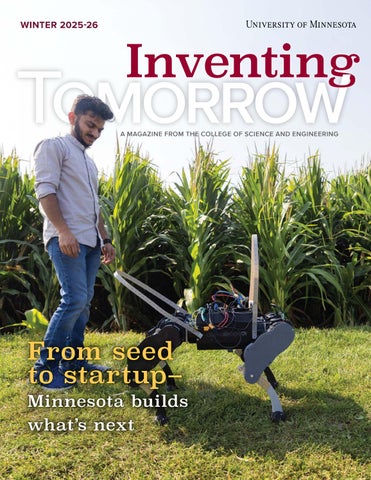
Recent graduate Abhishek Chaudhari field-tests Omni AgRobot, a robotic dog developed in Associate Professor Ce Yang’s lab to track problematic plant disease. Photo by Jeffrey Thompson/CFANS
This publication is available in alternative formats upon request. You may also contact us for an address change: 612-624-8257 or csemagazine@umn.edu MISSED AN ISSUE? z.umn.edu/inventingtomorrowarchive © 2025 Regents of the University of Minnesota. All rights reserved.
W I N T E R 2025 -2 6
3
Photo by Rebecca Slater
“Economic strength comes from innovation.” —Neel Kashkari, President & CEO, Federal Reserve Bank of Minneapolis
University of Minnesota Science and Engineering Dean Andrew Alleyne enjoyed a wide-ranging conversation this spring with Neel Kashkari, his former student—who leads the Federal Reserve Bank of Minneapolis. Here are edited excerpts. Dean Alleyne (DA): How did you go from mechanical engineer to where you are today?
Neel Kashkari (NK): I was working for a NASA contractor in California, running basement experiments of these little latches for what became part of the James Webb Space Telescope. It was very exciting for a young engineer—and my managers were encouraging me to get a Ph.D. I decided to explore the business world instead. I got my MBA, then went into banking and government. There are a lot of parallels between public policy and engineering. DA: How do you see science and engineering contributing to macroscale economic growth?
Inventing TOMORROW
Winter 2025-26 • cse.umn.edu
105 Walter Library, 117 Pleasant Street SE Minneapolis, MN 55455
4
NK: Economic growth comes from two things: population growth—more people producing things and more people consuming things—and productivity growth—we can do more with the same resources that we have. If you just add more people, the pie will get bigger but the pie per capita won’t necessarily get any bigger. But if you have productivity growth—that’s science and engineering, and knowledge development—then we become more productive and the pie gets bigger, and each of our share of the pie, hopefully, gets bigger, too. Economic strength comes from innovation. If you think about it over the course of world history—which economies have been the most competitive, which countries have been strongest—it’s those that have the biggest sources of innovation.
COLLEGE ADMINISTRATION Dean
David Blank
Beth Stadler
Victor Barocas
Associate Dean, Research
Joseph Konstan
DA: What’s your perspective on the value of higher education, particularly in the STEM fields? NK: It has never been higher, especially in technical-related fields. I think the challenge from a public policy perspective is how do we give that world-class education to more of our young people without just saying, “well, the answer is more debt.” That is not a scalable solution. Watch the full conversation: z.umn.edu/fedtalk25
Associate Dean, Undergraduate Programs
Andrew Alleyne
Associate Dean, Academic Affairs
When they were looking for a replacement for whale oil, electricity was not on anybody’s list, right? That’s just the nature of scientific breakthroughs. You need to plant a thousand flowers and hope that a few of them bloom. You can’t predict which one’s going to bloom.
Associate Dean, Graduate Programs
EDITORIAL STAFF
Communications and Marketing Director Rhonda Zurn
Managing Editor
Pauline Oo
Designer
Sara Specht
TECH DIGEST
TechDIGEST Read full stories: z.umn.edu/techdigest
MINIMIZING IMPACTS OF POWERBOATS A new study by researchers at the University’s St. Anthony Falls Lab shows that beneath the water’s surface, factors such as boat propeller thrust and size of waves can impact delicate lakebed ecosystems. The researchers tested seven recreational powerboats commonly used in Minnesota’s lakes and rivers based on their two most-used settings.
The study found that all powerboats produce water currents and turbulence that can disturb the lakebed. This can indirectly lead to the release of nutrients like phosphorus from sediment, which can stimulate excessive algae growth and adversely impact lakes. They recommend that all powerboats operate in 10 feet of water or greater when cruising or planing. During surfing, wakeboats should operate in depths of 20 feet or greater to minimize negative impacts.
W I N T E R 2025 -2 6
“
For all motorized boats, simply being careful about where you steer your boat and avoiding shallow spots can make a huge difference. —Jeff Marr
study co-author
5
Photo credit: NASA
Physics and astronomy researchers have made a groundbreaking discovery by observing and analyzing the first new type of plasma wave in Jupiter’s aurora. This research helps us understand “alien aurora” on other planets, which in turn teaches us more about how Earth’s magnetic field protects us from the sun’s harmful radiation.
Photo credit: Roberts Group/UMN
PROTECTING THE EARTH FROM HARMFUL SOLAR RADIATION
PIONEERING NEW METHOD FOR DRUG AND AGROCHEMICAL DISCOVERY A team of chemists has created a modern tool to make the process of creating pharmaceuticals and agrochemicals faster, more cost-effective, and more energy-efficient. Previously, researchers would have to add chemical additives to their reactions for activation, leading to a lot of waste. The new method eliminates these additives by using low-energy blue light, the kind found in everyday aquarium lights, as the activator. A patent is pending for this technique.
IMPROVING INDOOR AIR QUALITY University of Minnesota engineers are partnering with Mayo Clinic on groundbreaking research focused on improving indoor air quality and safety in healthcare settings. University researchers will be involved in designing biosensors to monitor emergency room air for aerosols such as viruses, bacteria, mold, and allergens. Once validated, the system will undergo realworld testing and could lay the foundation for future indoor air quality standards and public health policies.
6
TECH DIGEST
TechDIGEST z.umn.edu/techdigest
WARNING ABOUT REPLACING THERAPISTS WITH AI CHATBOTS Don’t replace your therapist with artificial intelligence (AI) quite yet. A first-of-its-kind study involving computer science researchers exposes the dangerous flaws in using AI chatbots for mental health support. The researchers evaluated these AI systems against clinical standards for therapists. Their findings included dangerous responses by AI to crisis situations, widespread discrimination, a clear human-AI gap, and inappropriate clinical responses.
BRINGING REALISM TO MEDICAL TRAINING THROUGH 3D PRINTING
Photo credit: CREST Lab
Mechanical engineering researchers have successfully 3D printed lifelike human skin and organs that even have the ability to “bleed.” The tissue structures can be used to improve medical training for surgeons and doctors. The researchers will now focus on expanding the new technology to create a variety of shapes for mimicking other organs, developing bionic organs, and incorporating more advanced materials that respond to common surgical tools.
W I N T E R 2025 -2 6
7
Photo credit: FarmGuard
PREVENTING CROP LOSS A team of computer science and mechanical engineering students has developed an autonomous drone system, called FarmGuard, that helps farmers detect deer and deters them from eating the crops. This crop-loss prevention strategy specifically targets the needs of small, sustainable farms. The student team won the 2025 Excellence in Small Farm Technology award at the Farm Robotics Challenge, a national competition for college-level students.
DISCOVERING NEW THERAPIES FOR DUCHENNE MUSCULAR DYSTROPHY
8
Image credit: University of Minnesota Medical School
University of Minnesota researchers have identified a new approach that could change the way Duchenne Muscular Dystrophy (DMD) is treated. Globally, about 20,000 children are diagnosed with DMD each year. Currently, there is no cure. The researchers developed a new type of therapy using a “bottlebrush polymer,” a highly branched synthetic molecule designed to protect muscle cell membranes from damage. This method was shown to be about 150,000 times more effective than existing treatments at restoring muscle function.
TECH DIGEST
TechDIGEST
Image credit: Center for Programmable Energy Catalysis
z.umn.edu/techdigest
LOWERING PRODUCTION COSTS FOR FUELS, CHEMICALS, AND MATERIALS Identifying faster and more controllable catalysts is a core goal of the multi-trillion-dollar fuels, chemicals, and materials industries. Now, a team of researchers from the University of Minnesota has discovered and measured the fraction of an electron that makes catalytic manufacturing possible. This discovery provides insight for designing new breakthrough catalytic materials.
USING AI TO TRACK AND MODEL WILDFIRE SMOKE Using a swarm of autonomous drones equipped with AI, engineering researchers are able to create a 3D reconstruction of wildfire smoke plumes and improve the analysis of flow patterns. Unlike traditional drones, these aerial robots can identify smoke and navigate through it to collect data. The cost-effective technology has potential beyond wildfires. It could be adapted for sandstorms, volcanic eruptions, and other airborne hazards. The team’s next goal is to translate the research into practical tools for early fire detection and mitigation.
W I N T E R 2025 -2 6
9
Photo credit: Mortenson Company/UMN Capital Project Management
New space
for all students
Photo by Eric Miller
The 21st century Fraser Hall—now the Chemistry Undergraduate Teaching Laboratories—serves more than 5,000 students annually. That includes not just chemistry majors, but first- and second-year students from 120 majors across the University of Minnesota Twin Cities campus.
8 panels
in the south stairwell, by artist Dyani White Hawk, pair indigenous art forms and chemistry symbolism
10
117,000 square feet
of learning space includes modern labs, a tutoring center, and collaboration zones W O R K F O R C E D E V E LO P M E N T
Photo by Pauline Oo
270°
view of campus and downtown Minneapolis from the fourth floor study space
18 teaching labs offer hands-on experience with real-world applications in research and industry
1928
was the year the original Fraser Hall was built. New stonework and replica windows have been added.
Join us to finish the work. Two-thirds of the building—$92.6 million—was funded by the State of Minnesota. The rest will come from the college and private donors. z.umn.edu/SupportChemLabs W I N T E R 2025 -2 6
11
Photo by Pauline Oo
5,300+ Number of students who enroll in chemistry each fall and spring
12
95
Age of Fraser Hall when renovation began in 2023
120
Academic majors served in new chemistry labs
W O R K F O R C E D E V E LO P M E N T
WORKFORCE DEVELOPMENT
Setting up students
for success
Innovative approaches to classroom design and learning are redefining how students get ready for what comes next. It’s not business as usual. The higher education landscape in the United States is changing. Yet world-class education is still happening—dare we say, thriving—on the Twin Cities campus. The recently opened Chemistry Undergraduate Teaching Laboratories at Fraser Hall is one example. “This space is built for how students actually learn today,” said Tucker Besel, a Ph.D. candidate in chemical physics and a chemistry teaching assistant. “The new design encourages teamwork and critical thinking, not just memorizing steps.” Talia Glinberg, a Wayland E. Noland Scholarship recipient, is seeing the benefits firsthand. Glinberg didn’t intend to major in chemistry. But an inspiring physical chemistry course, a professor who encouraged her curiosity, and the
“
I want to help students discover what they love, just like my professors did for me. —Talia Glinberg student
opportunity to join a research lab changed her path. The class sparked her interest in how molecules move and interact—and she wanted to dig deeper. Glinberg started going to office hours, asking questions, and looking for ways to explore science beyond the classroom. Her dedication led her to 3M Alumni Professor Aaron Massari, who invited her to join his research lab. “I loved applying what I was learning in the lab,” she said. “That’s where I started to connect the dots.”
Watch the two-year construction at Fraser Hall in one minute. z.umn.edu/ChemTimeLapse
W I N T E R 2025 -2 6
Today, Glinberg hopes to become a professor and run her own collaborative research lab. “I’m really passionate about environmental sustainability,” she said. “With physical chemistry, there’s so much potential to help develop cleaner energy. I want to do something that makes the world better.” That’s why receiving a scholarship named for Professor Noland means so much to her. Noland, who was 95 when he died in 2022, believed in doing good—specifically, “creating something useful for the future,” he would say. He was also known for giving undergraduates meaningful research opportunities, even paying out of pocket when funding was scarce. “I’ve been lucky to learn from people who really care,” Glinberg said. Now, she’s excited to do the same for others, with knowledge she gains in the new chemistry building. —by Kristin Kelker
Support undergrad students like Talia: z.umn.edu/CSEScholarship
13
PROVIDING THE
by Pauline Oo
WORKFORCE OF THE FUTURE
Employers want the best scientists, technologists, engineers, and mathematicians to meet high-tech workforce demands—we deliver.
#1
OUR STUDENTS
6,529
worldwide Interdisciplinary science ranking in 2025 for a public university
total undergrads
year 1,695 First (largest ever)
20% First-gen students 60% Receive scholarships 53
15
National ranking for undergraduate engineering programs among public universities
“
20
National ranking for all our grad programs among public universities
—Kent Howe (EE ’88, M.S. ’91)
senior manager, process development, Boston Scientific
states 40 U.S. represented
27 Countries represented
67
2,710
New faculty hired over three years for growing student population
20%
Undergraduate growth over five years to meet workforce demand
$80,000 Average overall starting salary of graduating CSE undergrads
Photo by Rich Ryan
total grad students
65% Ph.D.
top
CSE students are well rounded, excelling as interns and new hires. They are the future leaders in industry.
MN counties represented
34% Master's
top
1% Certificate 27% From Minnesota states 49 U.S. represented
79 Countries represented
14
W O R K F O R C E D E V E LO P M E N T
Photo by Rich Ryan
WORKFORCE DEVELOPMENT
Employers tap top talent in first-of-its-kind program The University of Minnesota’s M.S. in Data Science for Chemical Engineering and Materials Science is backed by three global companies—Sherwin Williams, Seagate, and 3M—with others curious to learn more.
95%
Job or grad school placement rate for undergrads in 2024
“
450
companies hosted student internships and co-ops
At The Toro Company, we benefit greatly from UMN’s proximity and the caliber of CSE graduates who are ready to innovate. —Judy Park
employer brand & early career program lead
525 companies hire our graduates each year
Fall 2025 CSE Career Fair More than 219 employers—including 17 corporate sponsors— connected with 3,600+ students over two days. Leading up to the fair, CSE Career Services hosted more than a dozen workshops and employer events. Since then, 400+ students have participated in on-campus interviews with employers.
“We’re approaching a new era where chemical and materials manufacturing industries are becoming increasingly automated and digital,” said Prodromos Daoutidis, program director. “Our first-of-its-kind program sits at the crossroads of chemical engineering, materials science, and data science. We’re the bridge that industry needs between these worlds.” Chemical engineering alumnus Bob Hermes (Ph.D. ’65) and his wife, Carol, jump-started the program three years ago with a gift that supports student cohorts through fall 2026. The program, which can be completed in one academic year, equips students with expertise in AI, machine learning, and statistics while grounding them in chemical and materials applications. Students also gain direct connections to employers eager for engineers who can merge data with innovation. For the corporate partners—who fund fellowships, mentor projects, and engage as guest speakers—the benefit is a pipeline of talent ready to meet the digital future of manufacturing. Learn more: z.umn.edu/cems-ds
Become an industry partner Contact: Gabrielle Bunten-Spoth bunt0051@umn.edu or 651-329-2234 W I N T E R 2025 -2 6
15
TODAY’S RESEARCHERS,
by Liv Hultgren
TOMORROW’S LEADERS
With the help of a CSE alumnus, the college brings practical skills and industry wisdom to graduate students. Communication. Project management. Budgeting. These are all words you might find in the “soft skills” section of a résumé. They’re competencies developed and refined after a few years on the job, but not necessarily in the classroom. That’s what CSE alumnus David Knapp (Chemical Engineering Ph.D. ’99) is working to change. Knapp is teaching a new course for doctoral students from majors across the college in their third year and above. It focuses on two main tenets: practical skills and leadership competencies.
“Grad students are often really intently focused on research and education, and sometimes they can lose sight of these other aspects,” said Knapp, who previously served as vice president of research and development (R&D) at Boston Scientific and has since co-founded a medical device startup. “Most are 100 percent focused on science and engineering when they’re in school, but the reality is that nothing happens without project management and organization.”
“
It’s incredibly important to make sure students have all the tools that they need to be successful. —David Knapp alumnus
Photo by Patrick O'Leary
Topics range from the aforementioned soft skills to broader ideas like emotional
intelligence, entrepreneurship, and how to deal with failure. Whether Ph.D. students are transitioning into industry or staying in academia after graduation, according to Knapp, these skills are absolutely crucial.
16
W O R K F O R C E D E V E LO P M E N T
Photo by Patrick O'Leary
WORKFORCE DEVELOPMENT
David Knapp (ChE Ph.D. ’99) is leading a new class for doctoral students across majors.
Knapp’s class, dubbed “Practical Skills for Future R&D Leaders,” is part of a larger effort driven by CSE Dean Andrew Alleyne and Associate Dean for Graduate Programs Victor Barocas to better prepare graduate students for the world ahead. The spring 2025 pilot course brought together 30 interdisciplinary Ph.D. students once per week for lectures led by academic and industry veterans across Minnesota. Speakers included 3M Chief Science Advocate Jayshree Seth, Medtronic VP Kim Chaffin,
CSE Professor Paul Dauenhauer, and even Dean Alleyne himself. Knapp said the class isn’t just about teaching practical skills but exposing students to core competencies that will help them become changemakers in their fields. One of those future leaders is Rashida Doctor, who recently earned her geophysics degree. Doctor’s favorite part about the class, held on the Twin Cities campus, was hearing about real people’s experiences and diverse paths to success.
“We’ve all been part of teams where the person in charge does not know how to lead a team, and that’s when it becomes obvious that learning how to be a leader is very important,” she said. “Developing the skills needed to make yourself ready for opportunities or even create those opportunities for yourself—I think what I learned in this class will help me do that.” After completing postdoctoral work at the University of Oxford in England, Doctor hopes to work in industry, potentially as an environmental consultant or pollution researcher. As for Knapp, he’s teaching “Practical Skills” again this fall. The college plans to make it a regular offering at the University of Minnesota. “I think it’s incredibly important to make sure students have all the tools that they need to be successful,” he said. “I feel like my success is not so much measured by what I have accomplished, but really by the people I have developed along the way to be the future leaders in the world that is coming up.” Demi Radeva, Akros Advisory Services founder, presents a case study to students.
W I N T E R 2025 -2 6
17
Where ideas take off Find the full list at z.umn.edu/CSEstartups
Since 2006, the University of Minnesota has launched nearly 300 startups based on faculty and student discoveries—three out of four of them right here in Minnesota. On the following pages, meet a few standouts that began in our college—Evia Bio, Convergent Bioscience, Fasikl, Innotronics, Niron Magnetics, and Q-rounds—that are fueling the state’s innovation economy.
MERTR
James
BGK LLC
GLIOSTIM MEDICAL SYSTEMS
Matthew Kudek
HIFI IMAGING
Doug Devens • Shannon Williamson • Kevin Goodwin
Aerospace Engineering & Mechanics Biomedical Engineering/ Medical Devices Center Bioproducts & Biosystems Engineering Chemical Engineering & Materials Science Chemistry Computer Science & Engineering
Mechanical Engineering CSE unit: • Minnesota Nano Center • St. Anthony Falls Lab • Technological Leadership Institute Data source: University of Minnesota Technology Commercialization. Names denote CSE inventors/founders.
18
ALBRENT ENGINEERING
Ahmed Selim
Chun Wang • Wenshou Wang
VASCUDYNE INC.
Danielle Maeser
Robert Tranquillo • Timothy Girton • Michael Neidert • Lee Meier • Zeeshan Syedain
Emad Ebbini • Abhishek Sahoo • Nayef Alshamlan • Parker O’Brien • Dalong Liu • Andrew Casper • Hasan Aldiabat
Jonathon Gallaher
YONDER LLC
Courtney Hill • Christie Traczyk • Adam Choe
INVISIAN MEDICAL LLC
Alan Johnson • Christopher Rolfes • Laura-Lee Brown
GENERAL PROBIOTICS INC.
Feng Liu • Akshay Kulkarni
NORTHSTAR GENOMICS Raj Aravalli
Software & IT
GLOME HEALTH INC.
NOVOCLADE
NANITE BIO
EVIA BIO
(see pg. 23)
Arthur Erdman
GRANITE MOUNTAIN MEDICAL LLC
Anthony Itambo • Andrew Wloch • Bita Rajablou • Austin Andrews
STIMDIA
James Krocak • John Ballard • Saurav Paul • Jesus Cabrera
APERIOS TECHNOLOGIES INC.
Zhi Yang • Diu Luu • Jian Xu • Anh Nguyen
Hubert Lim • Sarah Offutt • Craig Markovitz • Yezihalem Mesfin • Mark Hamilton • Hongsun Guo • Cory Gloeckner
IMACULAR REGENERATION LLC
James Parker
Allison Hubel • Rui Li • Kathryn Pollock
NEOACOUSTICS INC.
A
David •Q
Ibrahim Yekinni • Aaron MAGTECTION LLC Tucker • Amy Hoelscher • Kieran Leong Jian-Ping Wang • Bin Ma • Thomas Viker • Jinming Liu • Liang Tu • Vinit Chugh • Kai Wu
(FORMERLY BLUECUBE BIO)
Yiannis Kaznessis • Kathryn Kruziki • Brittany Forkus • Katherine Landuyt • Juan Del Pino
DAYNAMICA INC.
TURING MEDICAL
Theresa Reineke • Ramya Kumar • Ngoc Le • Zhe Tan
Abdennour Abbas • Akli Zarouri
6D BIOSYSTEMS INC. Siddhant Yelwande
Daniel Broberg • Christian Angelopoulos
Tay Netoff
OPTIMAL MOBILITY LLC
FRONTLINE BIOTECHNOLOGIES INC.
FABERGE FERTILITY LLC
CELLARARX
MOTIONMEDIX LLC
(see pg. 24)
TREKKA THERAPEUTICS
VITRISTOR
John Bischof • Anirudh Sharma
Ning Ye • Susan Mantell
Emad Ebbini • Parker O’Brien • Hasan Aldiabat • John Ballard • Dalong Liu • Andrew Casper
John Sartori
Earth & Environmental Sciences Electrical and Computer Engineering
(see pg. 22)
AXONBIO INC.
Q-ROUNDS
Zhi Yang • Qi Zhao • Ming Jiang • Diu Luu • Anh Nguyen
Peter Christenson • Dong Lee • Sang-Hyun Oh
John Bischof • Zhenpeng Qin • Li Zhan • Taner Akkin
Daniel Abate Pella
FASIKL INC.
PRIOGEN BIOSCIENCES CORP.
VIGILANT DIAGNOSTICS LLC
APOGEN BIOTECHNOLOGIES
ALEXANDRIA BIOTECH LLC
Primary Research Department
John Bischof • Qi Shao • Nikhil Sethia • Zonghu Han • Cari Dutcher • Navid Manuchehrabadi • Srivasupradha Ramesh • Li Zhan • Zongqi Guo • Nikolas Zuchowicz • Michael Etheridge
Hubert Lim • Mark Hamilton • Hongsun Guo • Yezihalem Mesfin • Cory Gloeckner • Sarah Offutt • Craig Markovitz
Mehmet Akçakaya • Yaşar Alçalar • Chi Zhang
AURORA CONCUSSION THERAPY SYSTEMS INC.
NORTHSTAR CRYO
ULTRAHEARING TECHNOLOGIES LLC
Sanjay Dhawan
FLORA THERAPEUTICS INC. Dan Knights
Biotech & Pharmaceuticals
PHYSIAR
Beth Groenk Weber • Jess Wolf • John
HYBRIDGE MEDICAL
Michael Greminger • Anastasia Zink • Brian Krohn • Amit Goyal
ZEPTO LIFE TECHNOLOGY LLC
Jian-Ping Wang • Ziou Wang • Yi Wang • Todd Klein
STRATIX
Joshua Erickson
Medical Devices S TA R T U P S & I N N OVAT I O N
Felicity Pino • James Krocak • Ashish Singal • Nicole Pardo • John Ferguson • David Amor
RON INC.
es Marti
VISTA BIOMEDICAL INC.
Joe Weber • Sandy Liu • Beth Groenke
Marc Hillmyer • Kechun Zhang • Jay Wang • Marie Vanderlaan • Tessie Panthani • Alexander Mannion • Chris Macosko • Derek Batiste • Debbie Schneiderman • Frank Bates • Mingyong Xiong
PARTICLE4X
INTERVENTIONAL PULMONARY SOLUTIONS LLC
Jiarong Hong • Ruichen He • Zilong He
Felix Landaeta • Doug Devens
INTERNATIONAL CARDIO CORPORATION
INTERMIX PERFORMANCE MATERIALS
Brian Taylor • Peter Seiler Jr • Demoz Gebre Egziabher
(FORMERLY SNOREX)
Uwe Kortshagen • Lorenzo Mangolini • Ameya Bapat • Elijah Thimsen
NIRON MAGNETICS INC.
FLYOVER COUNTRY LLC
Alex Stone • Brian Grivna • Amy Myrbo • Shane Loeffler
Jian-Ping Wang • Yanfeng Jiang • Xiaowei Zhang (see pg. 25)
Pui • Qisheng Ou Qingfeng Cao
NUSONEX LLC
TERRACOVER
Emad Ebbini • Abhishek Sahoo • Nayef Alshamlan • John Ballard • Dalong Liu • Andrew Casper
Vipin Kumar • Ankush Khandelwal • Anuj Karpatne
COBI INC.
Chris H. Kim • Hao Lo • William Moy
WHIRRLENERGY LLC Richard James • Huan Liu
CARP SOLUTIONS, LLC
nke • Joe sica Holstn Sartori
James Parker
Nikolaos Papanikolopoulos
Daniel Frisbie • Timothy Lodge
MIROMR LTD Woo Jang
R. Ruan • Yun Li • YuHuan Liu • Xiangyang Lin • Qinglong Xie • Yiqin Wan • Zhenyi Du • Yanling Cheng • Paul Chen
VIRTUSAERO LLC
Jimmy Randolph • Martin Saar • Scott Alexander
BSTM LLC
Rajesh Rajamani • Yan Wang • Heng Wang • Garrett Nelson MINNEPURA TECHNOLOGIES SBC • Ryan Madson • Michael Gust Eduardo Reátegui • Lisa Kasinkas • Alptekin Aksan • Lee Alexander • Saber UNIQOMP Taghvaeeyan ADIALANTE LLC (see pg. 23)
Parker Jenkins • Efraín Torres
Engineering & Physical Sciences W I N T E R 2025 -2 6
David Pui • Charles Lo • Sheng-Chieh Chen • Thomas Kuehn
Kia Bazargan • Sayed Abdolrasoul Faraji • Zhiheng Wang • Soheil Mohajer • Alireza Khataei
BATTERY ELECTRODE FABRICATION
Martin Saar • Jimmy Randolph • Thomas Kuehn
ASPIRE AIR
Chris Hogan • Yensil Park • Ian Marabella • Bernard Olson • Austin Andrews
Suhasa Kodandaramaiah • Jacob O’Brien • Andrew Alegria • Amey Joshi • Daniel Schulman • Preston Donaldson • Sarah Swisher • Michael McAlpine • Leila Ghanbari • Gabriella Shull
STIM SHERPA
CLEANAIR CARE LLP
Lockwood Carlson
LOOPCO2
Ian Tonks • Rachel Rapagnani
Tay Netoff • Andrew Lamperski • Logan Grado
LEAP PHOTONICS INC. Mo Li • Qiyu Liu • Huan Li
AMMONIA FUEL
(FORMERLY AZA POWER)
William Northrop
Energy & Environment
OWL NAVIGATION
Chris H. Kim • Jongyeon Kim • Muqing Liu • Minsu Kim
Guillermo Sapiro
EXERGI PREDICTIVE
William Northrop • Andrew Kotz • Pengyue Wang
OBJECTIVE BIOTECHNOLOGY INC.
George Karypis • Graham Candler • Kirk Schloegel • Travis Drayna • Pramod Subbareddy • Ioannis Nompelis • Heath Johnson
MR ACCESS INC.
Emad Ebbini • Sung Sohn • Angela Styczynski Snyder • Xiaoping Wu • Heather Orser • Christopher Olson • Anand Gopinath • William Voje
ANAFLASH INC.
Christopher Ellison • Han Xiao
HYPERION
Sang-Hyun Oh • Steven Koester
TERRACOH INC.
Guillermo Sapiro
CELL THERAPY SOLUTIONS LLC
Timothy Johnson
DARCY SOLUTIONS
SURGICAL INFORMATION SCIENCES
LÅKRIL TECHNOLOGIES INC. Paul Dauenhauer • Yutong Pang
GRIP MOLECULAR TECHNOLOGIES
STA SISTEMAS DE INFORMACAO DO BRAZIL
Shyam Boriah • Xi Chen • Pang Tan • Michael Steinbach • Karsten Steinhaeuser • Varun Mithal • Vipin Kumar • Ankush Khandelwal
Abdennour Abbas • Fatemeh Heidari • John Brockgreitens • Snober Ahmed
Siddharth Raju • Ned Mohan
Allison Hubel • Jacob Hanna
CARPE DIEM TECHNOLOGIES INC.
RESYNERGI
INNOTRONICS LLC
SCIAMBLE CORP.
EMET SURGICAL INC.
• Panagiotis Stanitsas • Vassilios Morellas • Xinyan Li • Anoop Cherian • Arindam Banerjee
AEREM LLC
ROMA
CLAROS TECHNOLOGIES INC.
Euna Khan • Jaideep Srivastava
Jonathan Tigner
Arthur Erdman • Phil Bühlmann • Steven Koester • Blair Troudt • Qun Su • Justin Nelson • Xue Zhen • Yao Zhang
Amrit Supriya
Thomas Viker
PHOS LLC
VOCXI HEALTH
ZERO-TABS LLC
CEROVATIONS LLC
SOCIAL VALUE INC.
Marc Hillmyer • David Goldfeld • Devin Dykes • Philip Dirlam
Lanny Schmidt • James Salge • David Rennard • Bradon Dreyer • Nick Degenstein • Joshua Colby • Paul Dauenhauer
SIRONIX RENEWABLES LLC
Frank Bates
PHOAM LABS INC.
ENVERDE LLC
UPTERN INC.
Brian Taylor • Peter Seiler Jr • Demoz Gebre Egziabher
Paul Dauenhauer • Dae Sung Park • Christoph Krumm • Kristeen Esther Joseph
Uwe Kortshagen • Rebecca Anthony • Lorenzo Mangolini • Ameya Bapat • Elijah Thimsen
Emad Ebbini • John Ballard • Dalong Liu • Andrew Casper
DRIDAM CONSULTING LLC
Graham Candler • George Karypis • Travis Drayna • Pramod Subbareddy • Ioannis Nompelis • Heath Johnson • Kirk Schloegel
David Pui • Sheng-Chieh Chen • Thomas Kuehn
Adam Black • Bradley Slaker • Ahmed Selim • Steven Reinitz • Brian Krohn
SILI-ION
Dharma Kodali • Mrinal Bhattacharya • Lucas Stolp
NEOS DISCOVERY CAPITAL
SOUNDLY
ENSOR INC.
(FORMERLY DUTCH CARDIO)
BOLDER FLIGHT SYSTEMS INC.
Michael Winek • Astrini Sie
Vinod Srinivasan • Paul Strykowski
VALERIAN MATERIALS INC.
GLENMORE CONSULTING LLC
SIMAGINE HEALTH INC.
COUNTERFLOW TECHNOLOGIES INC.
NEUROLOGIA DIAGNOSTICS LLC
CONVERGENT BIOSCIENCE
Christy Haynes • Kaitlin Landy • Joseph Buchman (see pg. 23) LEVIOSA TECHNOLOGIES LLC
VERILYTIX
Ce Yang • Colin Jones • Jaafar Abdulridha • An Min • Thomas Michaels
Chris H. Kim • Hao Lo • William Moy
BEAVER INNOVATIONS LLC Andrew Riesgraf
PRESCIX MEDICAL
Doug Devens
Food & Agriculture
19
Photo by Eric Miller
Associate Professor Ce Yang and her team are building an all-terrain Omni AgRobot that could revolutionize the way farmers track crop health and treat plant disease.
$50M
Amount eight UMN startups collectively secured in Seed to Series B funding rounds in 2024
20
25
Number of UMN startups launched in FY24— 12 from our college
121
Total UMN startups with CSE roots over 10 years (FY15-FY25)
S TA R T U P S & I N N OVAT I O N
STARTUPS & INNOVATION
When brilliant people get an idea, by Pauline Oo
big things happen
The best startup creators in the United States are here in Minnesota. This past year, the University launched 25 new startups—12 from our college alone—and invested seed funding in bold ideas with the power to grow far beyond campus. One such idea is Omni AgRobot, better known as the “robot dog.” Its mission: transform how farmers detect and respond to crop stress.
Yang has long explored drone remote sensing and hyperspectral imaging to spot early signs of disease. “My lab is a playground for agricultural engineers,” she said. But in 2021, her team began tackling a thornier challenge—how to traverse rough, uneven fields for real-time wheat phenotyping. A four-legged design offered the solution.
Developed by Associate Professor of Bioproducts and Biosystems Engineering Ce Yang with three M.S. in Robotics students Abhishek Chaudhari, David Aviles Hinostroza, and Swapnil Puranik, the robot recently won competitive funding from both the UMN Technology Commercialization Office and Minnesota Innovation Corps.
Equipped with cameras and sensors, robot dog can patrol rows of crops and collect vital data to detect disease and stress early. Yang envisions affordable, scaled-up versions giving farmers tools to act quickly. The team is already refining it to navigate fields autonomously and developing “manipulators” that could pluck weeds or deliver targeted doses of nitrogen directly where plants need it.
Yang, whose earlier invention was licensed by a startup, is aiming to form a company around this invention too. It’s just a matter of time—and the right people to run it, she said.
“This work has not only pushed the boundaries of what’s possible in agricultural robotics,” Yang said. “It is a testament to the creativity, technical expertise, and dedication of our robotics students.”
Watch the Omni AgRobot in action. z.umn.edu/RobotDogCSE
W I N T E R 2025 -2 6
“
My lab is a playground for agricultural engineers.” —Ce Yang
associate professor
#4
Startup generator The University of Minnesota is a national leader when it comes to creating startups, ranking among the top four universities in the U.S. for the fourth consecutive year. Last year alone, the University launched 25 new startups— reinforcing its position as a powerhouse in innovation and entrepreneurship.
21
Photo credits: Fasikl
RESTORING STEADINESS TO THOSE LIVING WITH ESSENTIAL TREMOR
#1
The world’s only FDA-approved AI therapeutic for essential tremor relief without drugs or surgery
“
This is the beginning of AI therapeutics in healthcare. —Zhi Yang
associate professor
1
st
Free-will brain-machine interface allowing amputees to control prosthetics with life-like dexterity and independent finger control
22
Imagine struggling to lift a glass of water or button a shirt because your hands won’t stop shaking. For millions living with movement disorders such as essential tremor, this is daily life. Now, a University of Minnesota spinoff company, Fasikl, has received clearance from the U.S. Food and Drug Administration for a simple yet high-tech wristband—the world’s first and only approved AI therapeutic—providing relief without drugs or surgery. Fasikl was founded on the multidisciplinary research of Biomedical Engineering Associate Professor Zhi Yang and his lifelong passion for video games. What began as curiosity and imagination grew into an entrepreneurial vision. He often reminds his team of a simple principle: science must serve people and make their lives better. The Felix™ NeuroAI™ Wristband integrates cutting-edge artificial intelligence with a smart-watch-looking neuromedical device to treat essential tremor. It has undergone three stages of clinical studies, including a pivotal, double-blind, randomized, sham-
controlled multi-site trial, in which the treatment group showed clear superiority over placebo. Few medical devices are tested to such rigorous standards. “This is the beginning of AI therapeutics in healthcare,” said Yang. “Felix offers patients a new choice that is safer, more effective, and easier to access.” Based in Bloomington, Minn., Fasikl has licensed a total of five University of Minnesota inventions and sponsored multiple campus research projects. These include Yang’s breakthrough that enables people to play video games without a keyboard or mouse—a natural passion for a lifelong StarCraft fan. Fasikl has raised more than $60 million to accelerate its research and commercialization efforts. Its ongoing Phase I rollout over the first six months is centered in Minnesota. The company’s mission is to advance “Type II artificial intelligence,” in which the brain and machine co-adapt to create therapies that are more effective, safe, and reliable. Fasikl is introducing AI to heal and to improve people’s lives.
S TA R T U P S & I N N OVAT I O N
TRANSFORMING CELL THERAPY
30,000+
STARTUPS & INNOVATION
University of Minnesota startup Evia Bio, once known as BlueCube Bio, grew out of research by Mechanical Engineering Professor Allison Hubel. She pioneered the use of Raman spectroscopy to see ice forming inside cells and pinpoint the threshold at which freezing turns lethal.
RESHAPING HOW MACHINES MOVE
Her decades of studying natural molecules called osmolytes—that trees use to survive Minnesota winters— led to patented, non-toxic methods for preserving living cells.
Innotronics began almost by accident—when Mike Gust overheard a student describe Professor Rajesh Rajamani’s new magnetic sensor that could determine an engine’s piston position.
Evia Bio is tackling one of regenerative medicine’s biggest bottlenecks—cryopreservation. For decades, the industry has relied on dimethyl sulfoxide (DMSO), a solvent that shields cells during freezing but can later poison them, causing side effects from nausea to heart failure. The startup is preparing to launch its first DMSO-free preservation medium that promises safer treatments for patients and cheaper, more reliable manufacturing.
“As he started to move on, I said, ‘Hey, wait a minute. I’ve been looking for this my whole life,’” recalled Gust, thendirector of industrial relations at University of Minnesota’s Center for Compact and Efficient Fluid Power.
Hubel, who leads the international Society for Cryobiology, isn’t done chasing answers. Her lab still preserves cells to -50 Celsius—imaging them molecule by molecule—in search of that sweet spot between life and death. “Nature isn’t finished teaching us,” she said.
~10,000
sensors sold and sublicensed to Parker Hannifin
Traditional sensors press against actuators—components that trigger motion—causing wear and tear over time. “Non-contacting sensors like ours last much longer,” said Rajamani, the Benjamin Y.H. Liu/TSI Applied Technology Chair in Mechanical Engineering. “They don’t have moving parts, and that makes them much more reliable.” In 2016, Innotronics was named among “Best University Startups” in the United States for good reason. Today, it has sold 30,000+ units. Plus, one of the world’s largest companies in motion control technologies, Parker Hannifin, uses the sensors on its wake boats. Next up for Rajamani: adapting the tech to machines in agriculture, construction, and manufacturing.
people a year undergo cell therapy for cancer and other ailments
BATTLING FOOD INSECURITY Convergent Bioscience is transforming years of nanomaterials research into scalable solutions for global food security. The startup sprang from several studies by Chemistry Professor Christy Haynes and her frequent collaborator Jason White, who leads the Connecticut Agricultural Experiment Station, to explore the impact of engineered nanoparticles on plants. In 2019, Haynes and two students—Joseph Buchman (M.S. ’15, Ph.D. ’19), now a senior chemist at Medtronic, and Kaitlin Landy (B.S. ’18), a postdoc in Chicago—found that silica nanoparticles coated with chitosan, W I N T E R 2025 -2 6
a naturally occurring polysaccharide, suppressed fusarium wilt disease when applied to the leaves of watermelon plants. The more startling discovery: it enhanced the fruit yield of healthy watermelon by more than 70 percent. “Plants contain silicic acid, which they use to construct their cell walls,” Haynes noted. “We want to deliver an extra boost of it, so the plants will build stronger cell walls and gain an elevated immune response.” Since that initial work, her lab has shown a similar impact on soybeans, wheat, and barley.
“
You can think of silicic acid for plants like the multivitamin you take. —Christy Haynes
professor
23
CREATING GAME-DAY JOBS Their mission was clear: Simplify the $10.5 billion referee management industry. When Wyatt Gustafson started Refr Sports with fellow hockey player Huck Sorock, Gustafson was finishing up his computer science major at the University of Minnesota. They won the 2022 MN Cup student division with their original idea—an app that connected sports organizers to available referees and vice versa. Today, their company has evolved into a full-service platform for scheduling and paying sports officials. Recently, a referee coordinator used the platform to manage one of the largest youth sports tournaments in the United States—the Amateur Athletic Union (A AU) World Basketball Tournament at ESPN Wide World of Sports Complex in Florida with nearly 10,000 athletes Total referee and more than 700 teams from assignments handled around the world. at the 2025 AAU World
8,987
Basketball Tournament
60%
of referees quit after their first year, for many reasons including outdated tech
The founders are driven to stabilize the referee industry. Roughly 60 percent of new referees quit after the first year. Outdated tech is one of many reasons. “Leveraging mobile-first tools,” Gustafson added, “appeals to the next generation of sports officials.”
9-1-1
Fire departments track a variety of metrics, including response times & medication administered in transit
SAVING LIVES WITH AN ONLINE DASHBOARD Echo Data Analytics LLC, co-founded by computer science alumnus Tariq Bashir, turns routine incident reports into dynamic dashboards that help fire departments and emergency medical services (EMS) make smarter, faster decisions. “My passion for the fire service grew when my wife and I volunteered as part-time firefighters in Golden Valley,” said Bashir, who spent nearly 20 years as a software engineer. “I saw the need for data analytics in the fire service when I eventually pursued the role full time, and that’s where my two passions really fused together." Every time a fire or EMS team files a report, Echo’s software collects the data and turns it into clear, actionable insights—tracking incidents, response times, and operational trends. Administrators can see what’s working, identify bottlenecks, and communicate results to city leaders. Already in use in several Twin Cities metro-area cities—including St. Paul, Brooklyn Park, Edina, and Minnetonka—Echo Data Analytics has expanded to five states and more EMS services.
OPTIMIZING HEALTHCARE PROCESSES A startup company developed by University of Minnesota faculty, called Q-rounds, is transforming one of the toughest challenges in healthcare—coordinating daily visits of healthcare professionals with hospital patients. When doctors and nurses miss connecting on rounds, communication gaps with patients and families can lead to errors, which raises the risk of serious medical mistakes by more than a third. John Sartori, who holds the endowed Robert and Sydney Anderson Professorship of Electrical and Computer Engineering, built Q-rounds with Medical School colleague Michael Pitt.
24
Launched in 2021, Q-rounds quickly showed impact. In a pilot at the M Health Fairview Masonic Children’s Hospital neonatal intensive care unit, family attendance more than doubled, nurse participation tripled, and more than 1,000 family members joined rounds remotely. “Q-rounds not only improves patient experience but also enhances care, supports best practices, and streamlines the rounding process for doctors and nurses,” Sartori said. “Because of overwhelming demand, we continue to expand its use at more clinical sites and refine it based on user feedback.”
215% increase in nurse presence for the entirety of rounds
38%
Reduction in harmful errors when nurse is present for rounds
S TA R T U P S & I N N OVAT I O N
Photo credit: Niron Magnetics
STARTUPS & INNOVATION
MAKING BETTER MAGNETS Niron Magnetics, a University of Minnesota spinoff company founded by Electrical and Computer Engineering Professor Jian-Ping Wang, is building its second plant in Sartell, Minn. near St. Cloud. Opening in 2027, the full-scale manufacturing facility will create 175 jobs and produce 1,500 tons—3 million pounds—of the world’s first high-powered permanent magnet made without rare-earth materials, eliminating the environmental and supply-chain challenges tied to traditional magnets.
Digital, Peerless Audio, Stellantis, and Allison Transmission. “I’m happy with what the Niron team has achieved,” said Wang, who holds the college’s Robert F. Hartmann endowed chair. “It simply started from curiosity-driven research on unknown physics and materials science when I joined the U in 2002, but I’m also focused on what’s next.”
Among Niron’s accolades are Fast Company magazine’s 2025 World Changing Ideas, TIME magazine’s 2024 Top Greentech Companies, and TIME's Best Inventions of 2023.
Wang is leading efforts to revolutionize soft magnetic materials, which play an important role in power electronic devices and the electric motors used in generators and household appliances. His recent discovery: a new alloy— which he named after Minnesota as “Minnealloy”—that could reinvent that space and help reduce the carbon footprint, too.
Niron has secured more than $100 million in funding from global manufacturers for its magnets— made from two abundant materials, iron and nitrogen. These companies include Volvo Cars, General Motors, Samsung, Harman Audio, Western
Additionally, Wang is directing the development of energy-efficient AI hardware by using magnetic and spintronic technologies. Its success could eliminate or at least reduce the number of nuclear reactors being built for the AI boom.
W I N T E R 2025 -2 6
#1
Jian-Ping Wang has filed 99 disclosures and 118 patents with UMN’s Research and Innovation Office—the most of any current University of Minnesota faculty member
$100M+ Funding from multiple sources
Fe16N2 Alpha double prime phase iron nitride—the world’s first permanent magnet without any critical elements
Giving back
In addition to sponsoring research on campus, Niron has hired many UMN graduates over the years. Nearly 30 are employed now. Want to support CSE faculty like Wang? Email jmiedema@umn.edu
25
Human-centered computing and natural language processing (NLP) are two main topics studied here. The Minnesota NLP group is collaborating with Grammarly to improve AI-based text editing and refine it for more complex tasks. Researchers in the GroupLens Lab—a global leader in personalization systems across various platforms for 30+ years—is leading a $2 million NSF project to build shared infrastructure for a news recommender system. This work will help scientists nationwide experiment with AI-personalized news and study its effect on user reading patterns.
4th Floor
Fun fact: Shepherd Labs was once the UMN Science Space Center, where we studied rocks from the moon.
A learning hub for Department of Aerospace Engineering and Mechanics students interested in high-altitude ballooning, highpower rocketry, and more. In the Small Satellite Research Lab, equipped with a cleanroom, undergrads are building and testing CubeSats headed to the International Space Station. Our History of Science, Technology, and Medicine program is also located here.
5th Floor
Renovated top floors of Shepherd Labs are now open.
New labs for Photo by Rich Ryan Photo by Rich Ryan
26
R E S E A R C H & D I S C OV E R Y
Photo by Bruce Silcox Photo Credit: BWBR/UMN Capital Project Management Photo by Eric Miller
W I N T E R 2025 -2 6
27
A hub for robotics innovation, this level sees a mix of researchers working on topics ranging from autism in children to marine debris. A two-story Drone Lab enables year-round flight testing, while the Patrick J. Starr Solar Vehicle Project Laboratory supports one of the world’s top undergraduate solar racing teams. The Minnesota Robotics Institute anchors the space—connecting students, faculty, and industry partners through education, collaboration, and experiential learning.
1st Floor
There’s a honeycomb of glass-walled labs, conference rooms, and open areas for spontaneous brainstorming on this floor and the one below—both completed in 2018 and collectively called the Gemini-Huntley Robotics Research Laboratory. Studies include a solar-powered “transformer” drone that can both fly like an airplane and hover like a helicopter—to better survey agricultural lands—in the Center for Distributed Robotics.
2nd Floor
You’ll find the Robotics: Perception and Manipulation Lab here, too. Faculty and students are studying how machines can perceive objects and reason like humans.
The flagship space for visual computing— researchers are creating multisensory experiences in virtual, augmented, and mixed reality to tackle challenges ranging from loneliness to climate change. In the Interactive Visualization Lab, projections onto three walls and the floor uniquely pair art and computing to expand the limits of experimentation.
3rd Floor
Photo by Erin Benner
Professor Paige Novak (right) is encapsulating active bacteria in polymer beads to treat wastewater. Ph.D. student Kendall Johnson ran a pilot study with Fulton brewery.
300+ <0.1nm $11.5B
UMN centers and institutes with interdisciplinary research
28
Spatial characterization of UMN CharFac suite of microscopes and scattering instruments
Total annual economic impact of the University of Minnesota
R E S E A R C H & D I S C OV E R Y
RESEARCH & DISCOVERY
What’s in it
for you?
Engineering breakthroughs and basic scientific principles matter. These five stories show how discoveries—like pollution-eating bacteria—shape life.
If you like clean water, raise a glass to environmental engineering professor Paige Novak the next time you drink beer. Her ongoing effort to use encapsulated bacteria to treat wastewater is helping one Minneapolis brewery reduce its waste streams—and the concept could someday be applied to candy-making and dairy-processing facilities, as well as other breweries. Wastewater is a huge byproduct of brewing, generating four to 10 pints of wastewater for every pint that’s produced. Large operations often opt to treat that wastewater onsite, but most smaller breweries must pay a fee to have the dregs processed at the local sewage-treatment plant, where air and microorganisms are pumped through the wastewater to clean it. That process requires massive amounts of energy, with roughly two percent of all U.S. electricity consumption devoted to wastewater treatment. Novak has long been interested in finding ways to use bacteria to treat environmental problems. “When I was a kid, I remember hearing a story on the radio about scientists
W I N T E R 2025 -2 6
using bacteria to clean up an oil spill in the Gulf of Mexico,” she said. “I thought that sounded so cool.” In 2013, Novak and UMN chemist and environmental engineer Bill Arnold approached Fulton Beer, a Minneapolis microbrewery, with a novel idea. They had been experimenting with encapsulating active bacteria in polymer beads that would degrade contaminants in wastewater. The bacteria would effectively treat the wastewater onsite, reducing the amount of discharge sent to the wastewater processing plant as well as the associated costs.
“
If your company’s utility bill is a million bucks, and you can cut that in half, why not? —Paige Novak professor
Photo credit: Novak Group/UMN
Across the University of Minnesota College of Science and Engineering, curiosity results in fresh ideas that can solve problems.
Discovering a new energy source is one unanticipated benefit of this pilot project. Methane, a greenhouse gas produced as bacteria break down wastewater, can be captured and burned to heat space or potentially even power operations. “Our collaborative work with Fulton has shown that if this process was scaled up, it would result in energy cost savings,” said Novak. Her team is working to further test this finding. The researchers are also thinking of ways to manipulate the bacteria’s lifecycle. If they can control when the bacteria dies, they can begin to target other pollutants for resource recovery. —by Joel Hoekstra
These bacteriafilled pellets can turn contaminated water from breweries into methane—to potentially fuel those businesses—and reduce the load on municipal water treatment systems.
29
COULD CUSTOM 3D PRINTING SAVE YOUR LIFE? Professor Michael McAlpine is pushing the boundaries with 3D-printed bionics. Ear
Inventors have long sought ways to fuse human biology and mechanical engineering to improve the human condition. Devices ranging from hearing aids to cardiac pacemakers have benefited thousands, if not millions of people. But such implants fall somewhat short of the cyborg-like integration depicted in shows like “The Six Million Dollar Man.”
Eye
Spinal scaffold Organs and organ sensors
Heart valves
Skin sensors and tech
Gastrointestinal motility sensors
Nerves
Cells
Skin and tissue
True bionics blend both biology and technology—and Mechanical Engineering Professor Mike McAlpine has found a way to do just that, overcoming one of the biggest challenges in bionics: interweaving electronics with three-dimensional bioengineered structures into human tissue. In 2013, he used a custom 3D printer to create a human ear. “We cultured cells and then printed on necessary electronics as one integrated object, with the technology embedded in the cartilage tissue,” he said. “Tests showed that it can match normal human hearing.” Since then, McAlpine and his research team have experimented with 3D-printed bionic eyes and 3D-printed scaffolding that supports the growth of spinal cord cells—a collaboration with UMN spinal cord injury expert Ann Parr. McAlpine’s work has potential implications for a broad range of biomedical devices, wearable electronics, bioelectronics, smart prosthetics, regenerative medicine, and human-machine interfaces. “Things that would typically be produced in a cleanroom can be done entirely with a 3D printer,” McAlpine noted, greatly simplifying their creation. The biggest challenge, he said, is achieving seamless integration of the nanotechnology and biological materials used to create bionic devices. Most of the materials that comprise conventional electronics are two-dimensional, hard and brittle, and require high temperatures to crystallize. Typically, these traits are incompatible with tissues and other biological materials, which are threedimensional, soft, stretchable, and temperature-sensitive. McAlpine’s work has drawn interest from a wide range of organizations, including for-profit companies, nonprofits, the National Institutes of Health, and the U.S. Army. The seemingly limitless applications are exciting to the researcher. “Helping people and expanding human knowledge and capabilities should be the end goal of any scientific project,” McAlpine said.
30
—by Joel Hoekstra R E S E A R C H & D I S C OV E R Y
WHAT DO JUGGLING AND FAIRNESS HAVE IN COMMON? For Nick Arnosti, it’s all about patterns—how data can help us share public goods more equitably.
Nick Arnosti wants to help you win the lottery—but some caveats apply. For starters, the lotteries that this University of Minnesota industrial and systems engineering associate professor studies don’t award money, but rather housing and public school opportunities, immigration visas, as well as hunting licenses, hiking permits, and discounted event tickets. And by win he means helping as many people as possible get their preferred outcome. “Lotteries for public resources are interesting to me because they’re a really nice combination of elegant math and its application to real-world problems,” Arnosti said.
Arnosti’s work shows that the end result is no better than using a waiting list: users have little say in where they are placed, and many are assigned to housing that may not meet their criteria. “One reason that inefficient systems persist is that we don’t have a way to measure whether a system is working,” Arnosti said. “To know if you’re doing well, you have to have the right metric.” Arnosti is currently working with NYU’s Furman Center to advise city housing officials on ways to offer successful lottery applicants more choice of where to live. —by Joel Hoekstra
Photo by Patrick O'Leary
But the lotteries don’t always work as intended. In New York City, where affordable housing is hard to find, developers list upcoming affordable housing opportunities on a cityrun website. Potential renters can create profiles on the site and indicate their interest in various properties in the hopes that they will eventually be matched with a top choice.
Such lotteries may seem preferable to traditional waiting lists, where applicants are given only one offer (and move to the back of the line if they reject it). But in New York’s lottery system, desperate users are likely to apply for any building better than their current situation.
W I N T E R 2025 -2 6
31
Photo by Melanie Lex
ROCK MUSIC, GUMMY BEARS, AND THE RIO GRANDE Warning: loud music, bright lights, and plenty of screaming (and dancing!) children
~30
When three University of Minnesota chemistry professors invited a grade school to a live science demo, they didn’t expect “Energy and U” to evolve into a twice-yearly stage production and film adaptation drawing thousands. Since 2006, more than 100,000 third-, fourth-, and fifthgraders in the Twin Cities have witnessed fireballs, exploding balloons, and flaming gummy bears. Thousands more watch online in Texas. “Energy is an important topic kids connect with,” said Aaron Massari, 3M Alumni Professor and show director. “They use it every day. Our goal is to infuse fun so they appreciate science and see how they can invent new ways to convert energy in their lives.” The program also inspired “Energía Y TÚ,” a Spanish version at the University of Texas Rio Grande Valley. After COVID hit in 2020, that show premiered as a film instead of a live show. In 2022, Massari, along with the three Energy and U founders—Frank Bates, David Blank, and Marc Hillmyer— won a Lone Star Emmy Award for collaborating with their Texas colleagues.
“
Dropping Bearrison [the gummy bear] into the hot, oxidizing bath and hearing an auditorium filled with young kids scream at the top of their lungs was incredible! —MaKenna Koble, Ph.D. candidate and Demaster Fellowship recipient
Invest in kids Your support ensures STEM education is accessible for K-6th graders.
32
R E S E A R C H & D I S C OV E R Y
Photo by Eric Miller
CSE grad students are firesafety volunteers and ushers in 30 shows each year
Grad student Nirshal Chandra Sekar guides a fairgoer in teaching a robot household tasks.
STATE FAIR IMPACT ON RESEARCH STUDIES Each year, about two million people stream through the Minnesota State Fair—and thousands pause to do more than eat cheese curds. They step into the University’s research building on Cosgrove Street, where fairgoers help advance science in real time. “Show-and-Tell for Robots: Learning Object Interactions from Humans” was among this year’s College of Science and Engineering studies. Faculty Karthik Desingh and Stephen Guy, with students Nirshal Chandra Sekar and Pearl Jain, aim to create robot models that can handle chores we’d rather skip. The University’s building is the first facility of its kind in the nation, and it gives researchers fast access to a diverse sample of participants. For graduate students, the experience doubles as field training in participant recruitment and data collection. “Our team interviewed almost 50 teenagers about how they use generative AI to navigate social interactions,” said Ph.D. candidate Seraphina Yong, who spent two days on site for the study she’s conducting with her faculty advisor Lana Yarosh. “A sample this size would otherwise have taken over half a year to collect.” In all, more than 52,000 fairgoers joined 55 studies during the 12-day run. Give to the next generation: z.umn.edu/stemkids W I N T E R 2025 -2 6
33
Our leaders in gl Meet five alumni who are shaping industries, economies, JIM ANDERSON
Coherent | Chief Executive Officer Electrical Engineering ’95
“
CSE taught me to turn knowledge into results— through internships and co-ops, the undergraduate research program, and its emphasis on humble leadership and innovation.
ASHISH KHANDPUR
Avient Corporation | Chairman & Chief Executive Officer Chemical Engineering ’95
“
I learned the importance of having curiosity and courage to tread into brand new areas— and how to prioritize problems and use analytical and scientific reasoning to solve them. These lessons continue to guide my decision-making process.
20+
COUNTRIES WHERE COHERENT OPERATES
$5.81B REVENUE FOR FY25
9,000+ EMPLOYEES AT 100 FACILITIES
15,000+ CUSTOMERS WORLDWIDE
JULIE MARQUARDT
Ecolab, Inc. | Vice President of Research, Development & Engineering, Corporate Technologies Chemical Engineering ’99
“
University of Minnesota taught me the value of working together to tackle technical challenges. That’s been essential to my career at Ecolab, where we’re developing innovation that helps millions of customers globally.
34
CSE LEADERS
lobal companies and the products we use with lessons from Minnesota.
35
YAO MORIN
JLL | Chief Technology Officer Electrical Engineering MS ’08, Ph.D. ’09
AI INNOVATIONS IN PRODUCTION & 55+ IN DEVELOPMENT SINCE 2024
100,000+ EMPLOYEES WO R L DW I D E
>75% OF THE WORLD’S TOP 500 SUPERCOMPUTERS ARE POWERED BY NVIDIA
6M
DEVELOPERS GLOBALLY USE NVIDIA’S PLATFORM AS OF FY25
226B
“
University of Minnesota taught me that engineering is about solving human problems. This training laid the foundation for pairing technical expertise with diverse perspectives in my leadership today.
JAY PURI
NVIDIA | Executive Vice President, Worldwide Field Operations Electrical Engineering ’76
“
University of Minnesota welcomed me, nurtured my growth, and inspired confidence. Its academic rigor and leadership opportunities gave me the springboard to build a successful career in the U.S.
GALLONS OF WATER SAVED LAST YEAR WITH ECOLAB TECHNOLOGY
36%
OF THE WORLD’S PROCESSED FOOD PROTECTED WITH ECOLAB FOOD SAFETY SOLUTIONS W I N T E R 2025 -2 6
The survey says… According to our recent CSE Alumni Engagement Survey, alumni love hearing about each other’s successes. Learn more: z.umn.edu/alumnisurvey25
35
Nonprofit Org. U.S. Postage P A I D Twin Cities, MN Permit No. 90155
University of Minnesota 105 Walter Library 117 Pleasant Street SE Minneapolis, MN 55455
cse.umn.edu/linkedin UMNCSE facebook.com/umn.cse @UMNCSE youtube.com/umncse
Photo by Rich Ryan
cse.umn.edu/flickr
NEW AI MAKERSPACE Where anyone—students, faculty, staff, even alumni—can explore what’s possible with artificial intelligence. • Access powerful computing, edge devices, robotics, and GPU workstations. • Build projects, grow skills, and get support.
• Attend workshops and earn AI certifications. • Create with confidence—whether you’re starting out or pushing the limits.
SCAN TO
LEARN MORE.
z.umn.edu/CSEAIMakerspace