FISH FARMING TECHNOLOGY
ALGAL OIL
Norwegian salmon farmer starts commercial production of salmon fed on algal oil
- The future of feed innovation
International Aquafeed - Volume 22 - Issue 03 - March 2019
- An introduction to extrusion - Selecting optimal mixer options in feed milling - New AI feeding assistant from AKVA and Observe - The next generation of RAS aquaculture
See our archive and language editions on your mobile!
- Expert topic - Eels Proud supporter of Aquaculture without Frontiers UK CIO
March 2019
www.aquafeed.co.uk
AMINONIR® Advanced – Discover the next generation of NIR
Feeling ground down by NIR? Free up your time with AMINONIR® Advanced, the new service that analyzes unground samples – at the point of delivery. Determine raw material and finished feed content in minutes, to optimize your inventory management and feed specification, and control costs. It’s fast, accurate and covers the largest number of feed ingredients used by the industry. Get started now! animal-nutrition@evonik.com www.aminonir.com
s at u t i Vis sia in A VIV gkok Ban
INGREDIENT ANALYSIS
FINISHED FEED ANALYSIS
ALL PARAMETERS FROM ONE SCAN
BEST NUTRITIONAL MATRIX
WELCOME The 2019 trade show season is just getting up to speed. Already one of our editors, Rebecca Sherratt, attended the Aquafarm 2019 exhibition in Pordenone, Italy, which was well-attended by many European aquaculture companies. My first trade show of the year is one that I’m really looking forward to: The Aquaculture America 2019 event (7-11th of March) in New Orleans, Louisiana, which is sponsored the World Aquaculture Society (WAS).
Why do we travel?
Vaughn Entwistle
Managing Editor, International Aquafeed
For our magazine, travelling internationally to trade shows and exhibitions represents a significant expenditure of time and money. So why do we travel so often? Because our travels allow us to meet face to face with industry leaders, as well as the marketing managers, engineers and CEOs of the companies we write about every month. At shows we get to see up close the latest hardware, software, and other innovations new to the industry. When possible, we make site visits to fish farms, RAS installations, and the factories of aquaculture hardware manufacturers. Attending shows allows us to keep a finger on the pulse of the industry, and through conferences, meetings and often through after-hours discussions over dinner we sometimes get the best sense of trends and directions the industry will be taking in the near future. And of course, trade shows are great opportunities to make new friends and visit with old friends. This supplies some continuity in an aquaculture industry that can sometimes be volatile with companies merging, or acquiring other companies, or with the emergence of new start up companies. Because our magazine is published internationally, we travel globally, from North America to the Far East and across Europe and Africa, which allows us to follow regional differences in how aquaculture is practiced. And on a personal level, it is a wonderful opportunity to visit some of the major cities around the world, visit some of the
sights, and enjoy the culture and the cuisine. As I write this my suitcase is packed and I’m looking forward to attending Aquaculture America in New Orleans, Louisiana where I plan to sample my first po’ boy sandwich. Later in the year I will be attending two more major aquaculture shows: Aqua Nor in Trondheim, Norway on August 20- 23rd. (I am super excited to attend this major show.) And another great show, Aquaculture Europe October 7-10th in Berlin, Germany.
Connecting digitally
International Aquafeed has been published for more than twenty years. While the print magazine will be familiar to our many subscribers, we have added a number of digital assets that many readers might not be aware of. First of all, we have an Aquafeed app for your tablet or smart phone. The app can be downloaded free from the App Store or by scanning the convenient QR code on the bottom right cover of the print magazine, or on the Mobile page of our Aquaculturalists blog: http://theaquaculturists.blogspot.com/p/aquaculture-mobile. html The app allows readers to access up to two years of back issues of our magazine. (A convenient search engine also allows you to search by subject/company). Next, we also have our Aquaculturists Blog that is refreshed with new material weekly. You can find topical articles and breaking news stories from the industry here: http://theaquaculturists. blogspot.com/ Lastly, there is our weekly newsletter for those who want the Blog articles delivered to their email inbox every Friday. You can subscribe to the weekly newsletter by signing up on the Mobile page on the Aquaculturists blog. And as always, we are always looking for news and items of interest in the world of aquaculture, so if you have a story you’d like to share, please contact me at vaughne@perendale.co.uk. Thank you and I hope you enjoy this month’s magazine.
Correction: In our November issue of International Aquafeed, we published an article that suggested rendered animal byproducts, such as feather and blood meal, could be interpreted as low-grade alternatives. We wish to clarify International Aquafeed did not intend to suggest that rendered by-products are any form of low-grade alternative, and instead we believe they are nutritious, professional and wholly beneficial sources of feed. These alternatives contribute well as attractants and palatability enhancers in feed, and have also been connected with decreasing mortality rates and increasing immunity in shrimps, as well as a variety of other species. ALGAL OIL: Norwegian salmon farmer starts commercial production of salmon fed on algal oil - page 22
FISH FARMING TECHNOLOGY RAS: The next generation of RAS aquaculture - page 38
SPECIES
Aquaculture round-up
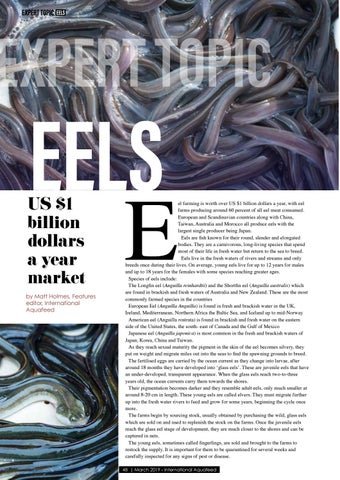
EXPERT TOPIC: Eels - page 48
ANTIBIOTICS: The global antibiotic challenge - page 32
www.aquafeed.co.uk
FISH FARMING TECHNOLOGY allows us to rapidly transfer information For the past three decades gathered from the different markets we aquaculture has been one of supply and try to best adapt the knowhow the fastest growing sources of we gather about the behavior of various human food supply. From a global raw materials and types of netting in the production of around 11 million different uses and conditions. tonnes in 1988 to over 80 million One example of this transfer of know-how tonnes produced in 2016. With this we can identify from the past few years rapid growth has come a learning and will probably take a greater importance curve and technological jump in the in the near future is that we have from our aquaculture production process. Elihai Radzinski FISA years of experience supplying the purse This includes an increase in seine and trawl fishing industries. the number of species that are These industries each face various different challenges farmed in fully integrated cycles from hatchery stage, a great across different parts of the world and have been tackling technological advance in feeding and health systems and more. these challenges together with FISA for over 50 years. This When looking at cage culture, we at Fibras Industriales SA experience and need for constant change have contributed (FISA) have been a part of the development of this industry to the innovative mentality that has been brought about at from the very beginning and have grown with the industry via FISA. participation in innumerable projects relating to sea farming, Unlike with aquaculture, you will see these markets having lake and reservoir farming and offshore farming. We have been matured a few decades ago as can be seen in the made sure to both contribute with innovations and transfer of example of fishing that had a total catch of approximately 88 knowhow from the associated industries we deal with such as million tones in 2016, a number very similar to that of 1988. the fishing industry, the sports industry and the security and As traditional aquaculture sites continue to overflow with safety netting industries. These projects have included salmon production, the natural expansion will be to more open areas farming, Ttlapia farming, sea bass farming, sea bream farming and eventually to open sea. This expansion will lead to more sturgeon farming and many other species. threatening and hazardous waters that will require cages The great advantage we have over most other supplies is that capable of adapting to the stronger currents, waves and other we are both netting manufacturers from raw material stages forces that require not just a good breaking load but also such as polyethylene extrusion or polyester and nylon twisting greater elongation of the netting, greater abrasion resistance stages, at the same time as being a large net loft to the various and better solutions for predator control. industries mentioned above. We at FISA commit to constantly innovate, transfer In addition, the fact that we manufacture various types of information and know how to our customers and develop new netting such as knotless raschel, twisted and braided knotted products to help with these challenges brought along with the netting, twisted knotless netting and other variants of these rapid expansion of the industry. in all materials including polyethylene, nylon and polyester
The International Aquafeed and Fish Farming Technology team attending World Aquaculture Society’s Aquaculture 2019 in New Orleans in early March. From left Vaughn Entwistle with visitor Robert Serwata of Huvepharma. Tuti Tan, Darren Parris of our UK office, Fred Norwood of our USA office, Roger Gilbert publisher and Ivan Marquetti and Pablo Porcelain of our Latin American office in Argentina See our report on the show in the next edition of the magazine
NUTRITION & HEALTH cold January in England and to have a 2019 has already proven a busy period week in the sun at mid-summer in the with visits overseas and, in particular, a southern hemisphere. long-distance trip to Chile where I was a On the nutrition front, it has to be said guest of my colleagues at the University that we are fortunate to have at our of Los Lagos in Puerto Montt in January. disposal some very good ingredients Dr’s Edison Serrano and Robert Walter for effective feed formulations for fish Simpfendorfer were excellent hosts and and shrimp diets. Feed ingredients vary my visit was funded by a grant from the in quality and even the gold standard Ministry of Education, CONICYT, and Professor Simon Davies fishmeal can have differences in protein The National Commission for Scientific Nutrition Editor, International Aquafeed level and amino acid availability due to and Technological Research in Chile processing and seasonality or region and supporting a two-year joint Chile-UK programme for work developing a microalgae product for use in species. However, the highest quality fishmeal provides a robust salmon and rainbow trout diets. protein for carnivorous fish species and is used wisely in a It will also assist in future planning of collaborative projects for complementary manner with other good quality materials. aquaculture and a potential advisory role in the Higher Education As such, I have always been a keen fan of animal derived Sector in Chile with further exchange visits to Los Lagos University. ingredients such as poultry by-product meals (PMM), On my travels to the heart of salmon production industry, I hydrolysed feathermeals and blood meals and haem protein called at the DSM Headquarters (meeting Larrain Claudio concentrates or what is termed processed animal proteins Technical Director with DSM (Chile) as well as having (PAP’s) with excellent nutritional properties. meetings by kind invitation to discuss a range of topics with These materials are very supportive of very good growth and Franscisco Valdes, Commercial Director of BioMar Chile, SA feed conversion in marine fish and also in shrimp as described based at Parque San Andres, in Puerto Montt, and also with in many studies. Some of the specialised animal protein Salmofood (Chile), a Vitapro brand, Peru. hydrolysates also confer functional properties by their immune My very full itinerary allowed me to have a very useful discussion with the Director of Salmones Antarctica in Chonchi, modulation capacity and are active in priming macrophage Los Lagos Region who specialise in the farming of Pacific Coho activity and also haemocyte levels in finfish and shrimp. I will be adding my voice on the benefits of PAP’s in the VIV salmon and rearing of large ocean grown trout with interests Aquatic Asia 2019 meeting in Bangkok this month where also extending to New Zealand. I make a key-note presentation. I will be reporting on this On the penultimate day, I gave a presentation at a workshop meeting in our April issue. In the meantime, please enjoy our sponsored by Alltech and organised by the University of Los International Aquaculture section within our new magazine Lagos where it was good to meet up with the Alltech Chilean format and keep articles and news items flowing as we keep group and discuss the growing business and opportunities in abreast of the industry momentum. Chile for aquaculture in general. It was indeed a relief from the
Perendale Publishers Ltd 7 St George’s Terrace St James’ Square, Cheltenham, Glos, GL50 3PT, United Kingdom Tel: +44 1242 267700 Publisher Roger Gilbert rogerg@perendale.co.uk Managing Editor Vaughn Entwistle vaughne@perendale.co.uk
March 2019 Volume 22 Issue 03
IN THIS ISSUE
FISH FARMING TECHNOLOGY
International Editors Dr Kangsen Mai (Chinese edition) mai@perendale.co.uk Prof Antonio Garza (Spanish edition) antoniog@perendale.co.uk Erik Hempel (Norwegian edition) erik@perendale.co.uk Editorial Advisory Panel • Prof Dr Abdel-Fattah M. El-Sayed • Prof António Gouveia • Prof Charles Bai • Dr Colin Mair • Dr Daniel Merrifield • Dr Dominique Bureau • Dr Elizabeth Sweetman • Dr Kim Jauncey • Dr Eric De Muylder • Dr Pedro Encarnação • Dr Mohammad R Hasan Editorial team Prof Simon Davies sjdaquafeed@gmail.com Rebecca Sherratt rebeccas@perendale.co.uk Matt Holmes matth@perendale.co.uk International Marketing Team Darren Parris darrenp@perendale.co.uk William Dowds williamd@perendale.co.uk Latin America Marketing Team Iván Marquetti Tel: +54 2352 427376 ivanm@perendale.co.uk Oceania Marketing Team Peter Parker peterp@perendale.co.uk Egyptian Marketing Team Mohamed Baromh Tel: +20 100 358 3839 mohamedb@perendale.com Nigeria Marketing Team Nathan Nwosu Tel: +234 8132 478092 nathann@perendale.co.uk Design Manager James Taylor jamest@perendale.co.uk Production Manager Maryna Nobis martynan@perendale.co.uk Circulation & Events Manager Tuti Tan tutit@perendale.co.uk Development Manager Antoine Tanguy antoinet@perendale.co.uk Communication Manager Pablo Porcel antoinet@perendale.co.uk ©Copyright 2019 Perendale Publishers Ltd. All rights reserved. No part of this publication may be reproduced in any form or by any means without prior permission of the copyright owner. More information can be found at www.perendale.com Perendale Publishers Ltd also publish ‘The International Milling Directory’ and ‘The Global Miller’ news service
REGULAR ITEMS 6 Industry News
48 Expert Topic - Eels 46 Technology showcase 50 Industry Events
60 The Market Place 62 The Aquafeed Interview 64
Industry Faces
COLUMNS 8 Antonio Garza de Yta 10 Dr Neil Auchterlonie
FEATURES 22 Algal oil 24 The future of feed innovation 26 An introduction to extrusion 28 Selecting optimal mixer options in feed milling 32 The global antibiotic challenge
THE BIG PICTURE The increasing number of aquaculture facilities based on Recirculating Aquaculture Systems (RAS) technology, both already operating and under construction, is testament to the fact that this technology is proving to be highly advantageous. Neder Snir, CTO of AquaMaof Aquaculture Technologies, explores the advanced RAS techniques and technologies that will be employed in the next generation of land-based aquaculture installations, discussing the company’s unique, multidisciplinary approach to indoor fish production. See more on page 38
FISH FARMING TECHNOLOGY 36 New AI feeding assistant from AKVA and Observe 38 The next generation of RAS aquaculture 42 Here comes the sun: Les Poissons du soleil, French RAS farm
i i i i i i i i i
i i i i i i i i i i i i i i i i i i
i i i i i i i i i
i i i i i i i i i i
i i i i i i i i i
i i i i i i i i i
News
i i i i i i i i i i
IVS Dosing Technology and Triott Group join forces
A
s of January 1, 2019, IVS Dosing Technology is affiliated with the Triott Group. The aim of the collaboration with the Triott Group is to create maximum synergy. This should ultimately result in a larger and broader range of products and services for compound feed and other industries. Technical director Hans den Otter commented, “IVS Dosing Technology has grown as an organisation in recent years. Although steam and liquid dosing is the core business of our company, in recent years we have also distinguished ourselves with smart and innovative solutions that enable compound feed factories to make the production process more efficient and profitable.” The Triott Group is the parent company of Ottevanger Milling Engineers, Wynveen International, Inteqnion, TSC, Almex, PCE and PTN, and has set up a joint venture called Anderson Feed Technology in the USA. The activities of the Triott Group are aimed at designing, supplying and commissioning complete
factories and installations for the compound feed, aqua feed and pet food industry; this makes for an excellent match with the long-term strategy of IVS. Frank Dielissen and Hans den Otter, the board of IVS, expect this collaboration to enable them to further develop their business activities in the coming years. “The Triott Group has a widespread distribution network in countries where we are hardly, or not at all, active. We will be making intensive use of this opportunity. Our sales market will grow, both nationally and internationally.” Managing Director Frank Dielissen commented, “We see many advantages in our collaboration with all the Triott Group companies. Where possible, we will intensify our collaboration in the areas of innovation, purchasing, production and, in particular, sales. “Although we will complement each other where necessary, we will remain fully responsible for our own business activities. In addition to geographic expansion, there are also many growth opportunities in market segments where IVS is not yet strongly represented. This cooperation is the next step towards a bright future for all parties involved.”
FISH FARMING TECHNOLOGY
aquafeed.co.uk
Progress Pellet Mill Low maintenance pelleting PTN’s Pellet Mills enable you to press every type of feed in every desired capacity. A long lifespan on the die and rollers, a long lifespan of the main shaft bearings and crucial parts that are easily cleanable are just a small summary of all the maintenance advantages of the PTN Pellet Mills.
Specialist in Pelleting Equipment info@ptn.nl - www.ptn.nl 6 | March 2019 - International Aquafeed
i i i i i i i i i
i i i i i i i i i i i i i i i i i i
i i i i i i i i i
i i i i i i i i i i
i i i i i i i i i
i i i i i i i i i
News
i i i i i i i i i i
Aquaculture genetics consortium set to tackle industry challenges
F
Antonio Garza de Yta WAS 2.0
irst of all, I would like to start this column by welcoming Patricio Augusto Garza Ribera, who has arrived weighing 3.820 kg and measuring 54 cm. Both the mother and he are wonderful and have made us the happiest parents in the world. As all of you who have been parents know, there is nothing in this world that gives you such a clear perspective of the true priorities in life that seeing your child born. Seldom can you put your whole life on a scale and experience such a lucid moment. Within this journey of introspection, a friend in the industry came to visit me and asked me what I wanted for the World Aquaculture Society (WAS), or what I expected in the event that the membership distinguished me with the honour of being elected as president. What do I expect? Very simple ... evolve. I know you may have heard this word from my lips on countless occasions, but I think that is what best summarises my goals: Let’s go for the WAS 2.0 But what do I mean? The WAS, today, is formed by around 3,000 members of the more than 18 million dedicated to aquaculture worldwide. I do not believe that 0.017 percent is a number that actually represents the sector. Nor is it possible that more than 50 percent of the members are from the United States of America. It’s like having a “World Series” in a league where only two countries play. Does this sound familiar? The WAS cannot continue to revolve around the United States; if it really wants to be global, most of its members must be in Asia. In addition, the board should be better distributed and should look for ways to have greater representation of the areas. Also, anyone should be able to agree to lead it and not go through a pedigree verification process. It is true, Latin America is also overrepresented, but I believe that in many countries, including Mexico and Brazil, we have already seen the advantages of having a global platform and exchange of science and technology. Because the WAS will not be many things, but it is the best platform that currently exists worldwide for the exchange of experiences and ideas, and for the formation of a network of contacts that allows all aquaculture professionals to advance more quickly and clearly about the goals of their careers. This platform should serve as the foundation to build a true World Society. In addition to finding ways to include the largest number of possible aquaculturists in the world, perhaps not through direct membership, but of partnerships with groups worldwide where they are represented in the existing annual meetings and discuss the issues. The most relevant global ones that impact aquaculture and from there the topics from which the thematic papers on pro and defence of aquaculture could be published. The WAS has to be a tireless promoter of aquaculture and for this you also need a different way of seeing things. We have to take the step and separate the organisation from the Conferences of the Management of the Society. We must continue along the good path we have established, with respect to world events, but we also have to be represented at a world level by some professional with the ability to expose, defend and negotiate for society and its members at the highest level. These are some of the many actions that must be carried out in order for the WAS to evolve. Obviously, all of them imply change, and as we know, some sectors of American societies are reluctant to do so and would do whatever was necessary to prevent this from happening. But do not worry ... we will continue in the fight.
Antonio Garza de Yta, Ph.D in Aquaculture from Auburn University, President of Aquaculture Global Consulting, Director World Aquaculture Society and creator of the Certification for Aquaculture Professional (CAP) Program. He is currently Rector, Universidad Tecnológica del Mar de Tamaulipas Bicentenario. 8 | March 2019 - International Aquafeed
A
major research collaboration between academic and industry scientists aims to boost selective breeding of stocks of vital UK aquaculture species. The £1.7 million AquaLeap initiative will focus on four key species that have substantial economic and environmental importance for the UK - the European lobster, European flat oyster, lumpfish and Atlantic salmon. University researchers will work closely with industry partners to identify sustainable solutions to current challenges facing aquaculture production, including significant diseases. The interdisciplinary consortium is led by the University of Edinburgh’s Roslin Institute in partnership with the Universities of Aberdeen, Exeter and Stirling, and the Centre for Environment, Fisheries and Aquaculture Science (Cefas). The commercial partners are Hendrix Genetics BV, Xelect Ltd, The National Lobster Hatchery, Tethys Oysters Ltd, and Otter Ferry SeaFish Ltd. Teams will use cutting-edge genetic sequencing technologies to identify DNA markers that are linked to economically important traits, such as disease resistance or growth rate. This information will help develop and apply new tools to improve breeding programmes for these valuable species. Experts will also develop geneediting techniques to understand genes controlling resistance to diseases and explore possibilities of using this technology to speed up stock improvement. Professor Ross Houston of The Roslin Institute, said: “Well-managed programmes of domestication and breeding have a large and mostly untapped potential for improvement in aquaculture production. AquaLeap will focus on developing and applying genomic tools to selective breeding of several important aquaculture species.” AquaLeap is funded by the Biotechnology and Biological Sciences Research Council and the Natural Environment Research Council under their targeted UK Aquaculture Initiative, with additional co-funding from the Scottish Aquaculture Innovation Centre.
Australia aquaFUTURE AUSTRALIA PTY LTD placed in Australia Contact:
Adrian McIntyre
Mobil: Email: Skype: Internet:
+61 417 666 311 adrian@aquafuture.com.au adrian.mcintyre1
www.aquafuture.com.au
Turn-Key Fish Farms inclusive Innovative products - best quality *made for everyday use
Beluga-Caviar
*affordable prices
Examples of products from a proven overall
- Robust Optical Oxygen Sensor
aquaFUTURE e.K. founded 1983
- Complete Measuring and Control Systems - Drum Filter made in Germany
Hans-Böckler-Str. 5
- Oxygen Generator 40 years experience
D-57223 Kreuztal
- Ceramic Oxygen Diffuser
Germany
- Ceramic Ozone Diffuser
Dietmar Firzlaff
- Feeding Systems with controller
Phone:
+49 (0) 2732 / 65 35
Fax:
+49 (0) 2732 / 65 71
Mobil:
+49 (0) 171 / 2 60 50 60
Email:
rzlaff@aquafuture.de
- Hatchery Equipment - Counter the original 30 years experience - and much more
Skype:
aquafuture-d
Internet: www.aquafuture.de
i i i i i i i i i
i i i i i i i i i i i i i i i i i i
i i i i i i i i i
i i i i i i i i i i
i i i i i i i i i
i i i i i i i i i
News
i i i i i i i i i i
Dr Neil Auchterlonie Efficient production of protein
Apply now for the NorFishing Foundation’s Innovation Award
n last month’s column I explored the use of Fishery Improvement Projects (FIPs) as a mechanism for improving fishery performance over time. This month, at a more esoteric level, I want to explore the concept of using whole fish as a raw material for marine ingredients, the idea of “feeding fish to fish”. The whole principle is something which seems to attract a disproportionate amount of criticism from some quarters, but there are several very valid reasons why it happens, and why it is an important factor in global food security. In this time of burgeoning global population, we need to be very clear that humanity requires access to as many resources as possible for the efficient production of protein. Some of those resources may have little, if any, interest shown to them for direct consumption (ie as food), and this is certainly true for a number of different small pelagic fish species that are used in fishmeal and fish oil production. It seems to be this fact that is least understandable to the critics, as their argument revolves around why not just eat these fish, rather than use them as a raw material to make fishmeal and fish oil, which is then incorporated into fish feed? That view betrays a lack of understanding of the market dynamics, and the fact that the food market would have first access to these fish if it was interested, the reason being that the food market will pay more for the raw material, than the fishmeal industry. The species that are used in fishmeal and fish oil production are not readily accepted into the food market because they are unappetising, and often difficult to process in volume (small pelagic species are usually soft-bodied and deteriorate rapidly). An interesting case in point is the Peruvian anchovy, which tops the volumes of the small pelagic fish species annual tonnages as raw material for fishmeal and fish oil. Successive Peruvian authorities have invested heavily (many USD millions) since the 1960s into providing incentives for the local population to consume the fish, recognising of course the excellent nutritional qualities (those same qualities that make excellent fishmeal and fish oil products). Despite that level of investment over several decades and many projects, the uptake domestically is still extremely low, for the simple reason that people are reluctant to consume the fish directly. It is worth mentioning that another misconception is that capture of these fish deprives local populations of a food source, but as we see this is not actually the case. Using the fish as raw material for marine ingredient production provides many more tonnes of protein than it uses, and that is protein that people want to eat. We should remember that communities naturally exert choice over the food they eat. Where any fishery may provide stock surplus to direct human consumption needs, it is perfectly acceptable to convert this through use in animal feed, into other more popular types of protein.
ompanies or individuals from all over the world that supply equipment or services to the aquaculture industry, or are in the aquaculture industry, are invited to apply for the Award. The Award is given to the winner of the best product or service for the industry at Aqua Nor 2019. The application for the 2019 Award must be related to the aquaculture industry. The Nor-Fishing Foundation wishes to stimulate R&D activities in companies and among individuals. Consequently, research institutions are not considered to be eligible for this innovation Award. The R&D activity related to the aquaculture industry must be affiliated with company(s) or individuals. The project that forms the basis of the application must be owned by the applicant, but can be carried out in collaboration with the research environment. The deadline for applying for the Innovation Award is May 1 2019, but an early application is preferred. The application must include: 1. Applicant’s name/company name, address, e-mail address, web address, telephone and contact person 2. A brief description of the activities of the applicant or company 3. A description and best possible documentation of project, product, process or service. Please highlight the innovation aspects of the project 4. Documentation of expected effect/ result and market for applied project or service.
I
Dr Neil Auchterlonie is the Technical Director at IFFO. He has managed aquaculture and fisheries science programmes in both public and private sectors. Academically he holds a BSc in Marine and Freshwater Biology from Stirling University, a MSc in Applied Fish Biology from the University of Plymouth, and a PhD in Aquaculture (halibut physiology) from Stirling University. 10 | March 2019 - International Aquafeed
C
Feedback from previous winners shows that the Innovation Award has been an important motivator for innovation as well as inspirator for marketing towards the international aquaculture industry. The winner of the Innovation Award will receive NOK 100,000, and will be announced August 20, at the opening of Aqua Nor 2019.
i i i i i i i i i
i i i i i i i i i i i i i i i i i i
i i i i i i i i i
i i i i i i i i i i
i i i i i i i i i
i i i i i i i i i
i i i i i i i i i i
Your partner in top-quality ring dies for all pellet press brands
WWW.PCE.EU
Maximize capacity, conditioning, and control. WENGER’S AQUAFLEX XT HIGH CAPACITY EXTRUDER When maximum volume matters, the Wenger AQUAFLEX XT High Capacity Aquafeed Extruder is the choice, processing up to 12,000 kg/hour. Equipped with either our High Shear Conditioner (HSC) or High Intensity Preconditioner (HIP), the AQUAFLEX XT is ideal for aquatic feeds as small as 0.5 mm. Precise control of finished product density delivers either high capacity floating or sinking feeds. Know more about the industry-changing designs and customized options of AQUAFLEX. Email us at info@wenger.com today.
PHONE: 785.284.2133 | EMAIL: INFO@WENGER.COM | WENGER.COM USA
|
BELGIUM
|
TAIWAN
|
BRASIL
International Aquafeed - March 2019 | 11
|
CHINA
News
i i i i i i i i i
i i i i i i i i i i i i i i i i i i
i i i i i i i i i
i i i i i i i i i
i i i i i i i i i
News
i i i i i i i i i i
S i i i i i i i i i i
Protective netting reducing ‘last resort’ seal culls cottish Sea Farms has seen a reduction in the number of seals culled to protect farmed salmon stocks, latest figures show, following ongoing investment in rigid new pen netting. The previously unpublished figures show that the company, which has 45 salmon farms around Scotland’s west coast and islands, culled 11 seals under licence at nine farms to protect its salmon stocks during the reporting period 01 February 2018to-31 January 2019. This is down 31 percent and 35 percent on 2017 (16 seal culls) and 2016 (17 seal culls) respectively. At the company’s seven farms in Orkney, where the new protective Sapphire Seal Pro nets were first trialled in 2016 before being rolled-out, there have been no seal culls in almost three years. Seal culling is the last resort option taken by farmers to protect the salmon in their care and is carried out under licence only when seals persist beyond all other preventative measures currently being invested in. Scottish Sea Farms’ Head of Fish Health, Ralph Bickerdike commented, “Our priority has been to install Seal Pro nets at those farms with a historic seal challenge. The speed with which we can do this, however, is dictated in large part by nature as there are limited opportunities in the growing cycle where we can install the new nets without risking stress to our salmon. The ideal time is ahead of each new crop.” To date, Seal Pro netting has been installed at 21 farms at a cost in excess of UK £4.2m, with plans for a further nine farms – specifically those facing a seal challenge – to be
equipped in 2019 and 2020 at the start of each new crop cycle. Ralph Bickerdike said, “On occasion, we have installed Seal Pro netting at one farm only to see seals relocate to another farm where there had been no prior seal challenge. This, we believe, accounted for five of the 11 seals culled in the last reporting period and is further reason why we will continue to roll-out the new netting until each and every farm is protected.” With traditional nylon nets, a hungry seal will push its snout against the soft twine in the hope that salmon will swim close enough for it to grab. In contrast, Seal Pro netting has an altogether tougher, more rigid surface which helps deter seals and, in turn, improve fish welfare. Securing the nets in place is an intricate system of individual weights placed at five-metre intervals or a circular sinker tube at the net base, which increases tension, prevents the netting from flexing and reduces potential entry points for seals. Now being widely adopted across the sector, protective netting such as Seal Pro nets, along with the use of acoustic deterrent devices, has contributed to an 81 percent drop in the number of seals culled by salmon farmers since 2011 – with the ambition being zero culls.
Image courtesy of ©Scottish Sea Farms
THE NEW KAHL EXTRUDER TYPE OEE 25 NG
NEW
Fast knife and die change Knife distance to the die adjustable during operation Up to 450 kW drive power Sinking fish feed up to 10 t/h Floating fish feed up to 8 t/h
AMANDUS KAHL GmbH & Co. KG Dieselstrasse 5–9 · 21465 Reinbek Hamburg, Germany +49 (0) 40 72 77 10 info@akahl.de · akahl.de
12 | March 2019 - International Aquafeed
i i i i i i i i i
i i i i i i i i i i
i i i i i i i i i i
STORE SMART, STORE SQUARE
i i i i i i i i i i i i i i i i i i
i i i i i i i i i
i i i i i i i i i
i i i i i i i i i
News
20 years of TSC Silos an interview with Gerrit Koops “The most important innovation occurs in our daily work, from the questions our clients ask us”
http://bit.ly/20yrTSC
www.tsc-silos.com
International Aquafeed - March 2019 | 13
i i i i i i i i i
i i i i i i i i i i i i i i i i i i
i i i i i i i i i
i i i i i i i i i i
i i i i i i i i i
i i i i i i i i i
News
i i i i i i i i i i
N
Nutreco and Skretting win edie Sustainability Leaders Award utreco and Skretting have been presented with the edie award in the category of Sustainability Product Innovation of the Year for an innovative concept developed by Skretting, Nutreco’s aqua division. The award was presented at an event in London on the 6th February, 2018. This year’s shortlist included 131 people, projects, products and organisations that are together redefining what it means to be a sustainable, ethical and responsible business. MicroBalance FL The winning product, Skretting’s MicroBalance FLX, is a feed for salmon containing zero fishmeal. The product is a result of three decades of research conducted by the Skretting Aquaculture Research Centre (ARC) exploring the potential for alternative raw materials to replace traditional, finite, marine-based feed components, while ensuring the growth, health and final nutritional qualities that consumers expect from their seafood. “Marine ingredients like fishmeal are great ingredients for aquaculture feed, and it took a long time to fine-tune our understanding of the complexities in order to replace them,” says Alex Obach, Skretting R&D Director. “We have considered, among other qualities of fishmeal, the nutritional profile, digestibility and content of functional micro-ingredients. Our research was carried
out in a number of phases, first looking explicitly at the nutrient requirements of the fish, then evaluating alternative raw materials, undertaking digestive and metabolic research, before finally proving that by clever selection and formulation, we can optimise the feed for the fish with no fishmeal, without any compromise on growth, health or quality.” Aligned with this ambition, one of Skretting’s most significant sustainability objectives has been to develop the capability to become independent of fishmeal. Launched in 2016, MicroBalance FLX is the biggest breakthrough in this work to date, when Skretting became the first commercial company to offer grower diets for salmon containing zero fishmeal. In addition to the Sustainable Product Innovation Award, Nutreco was also a finalist in two other categories in 2019, Sustainability Leader of the Year (Jose Villalon) and Sustainability Reporting and Communications. The edie awards The edie awards are organised by specialist sustainability publishing house Faversham House and began in 2007. The awards are open to businesses and organisations of all sizes across the public and private sectors. As a winner, Nutreco joins an illustrious group of former winners, such as IKEA, Unilever, Heineken, Tesco and Marks & Spencer.
When it Comes to Aquafeed Production Carefully Choose Who You Partner With for Equipment Solutions MAX.
393.31 [9990]
MAX.
391.31 [9939]
15.00 [381]
Ă12.00 [305]
MIN.
29.19 [741] F085 SHIMPO
36.91 [937]
31.19 [792]
MIN.
67.28 [1709] 39.00 [991] 101.44 [2577]
30.38 [772] BIN Inlet
DCC Inlet
1.93 [49]
In the aquafeed business, you either 18.00 [457] sink or swim. 1.00 Contact Extru-Tech NPT today at 785-284-2153 or visit us online at www.extru-techinc.com
Extru-Tech Offers Smooth Sailing [6855] 3 Purpose Built Aquafeed Equipment Solutions _ 3 Floating or Sinking Feeds from a _ Single System 3 Advanced Densification _ Technology 199.38 3 Consistent Sub[5064]1.0mm Feed with No Waste _ 3 Team of Professional Aquafeed _ 12.56 [319] Equipment Specialists 15.88 [404] 24.59 [625]
03 54
51
06
0
15.00 [381]
256T
108.28 [2750]
P.O. Box 8 1.00 NPT [STEAM] 100 Airport Road Sabetha, KS 66534, USA 57.69 Phone: 785-284-215366.50 [1465] [1689] Fax: 53.25 785-284-3143
2.00 NPT [WATER]
2.00 NPT [STEAM]
3/4 NPT
2.00 NPT 80 NORGREN
0
88.00 [2236]
160
extru-techinc@extru-techinc.com www.extru-techinc.com 48.00
MAXUM SIZE 10
[1219]
ET-302.indd 1
14 | March 2019 52.19 - International Aquafeed 102.13 [2594]
[1325]
2
278.03 [7062]
End of Head
CYL. Disch.
269.88
What the Competition Offers
3 _ High Maintenance 3 _ Many Promises 3 _ Limited Capacity
19.16 [487]
64.83 [1647]
108.59 [2759]
30.00 [762]
[1353]
2/2/18 10:01 AM
284.00 [7214]
i i i i i i i i i
i i i i i i i i i i i i i i i i i i
i i i i i i i i i
i i i i i i i i i i
i i i i i i i i i
i i i i i i i i i
News
i i i i i i i i i i
LET’S GROW TOGETHER
ALLER POWERRAS The concept meets the high demands towards feed for RAS in terms of feed efficiency, optimal water quality and subsequent fish growth: • • • • •
Highly digestible raw materials and high feed intake Shaped and compact faeces with fast sinking rate Reduced ammonia and nitrite levels High pellet stability and density Low water turbidity
Aller Aqua A/S · Allervej 130 · DK-6070 Christiansfeld · Denmark · Tel. +45 70 22 19 10 · info@aller-aqua.com WWW.ALLER-AQUA.COM Anuncio ICC - HLY - Tilapias - EN - 19x13.2cm.pdf 1 11/01/2019 14:53:10
THE BIONIC PREBIOTIC
PROTECT YOUR
TILAPIA FARMING
COMPLETELY!
C
M
Y
CM
MY
CY
CMY
K
In a study conducted at Cairo University *, Hilyses® demonstrated its efficiency on zootechnical indexes, showing a drastic reduction of the mortality rate of Nile tilapia (O. nicoticus) challenged with Aeromonas hydrophila.
TILAPIA MORTALITY RATE 120%
Hilyses guaranteed ®
100% survival
100%
Scientifically proven
80% 60% 40% 20% 0% Control
0.2% Hilyses®
0.4% Hilyses®
* Fish Diseases and Management, Faculty of Veterinary Medicine, Cairo University, Egypt, 2017
For more information: +55 11 3093-0747 | isabela@iccbrazil.com.br | www.iccbrazil.com
International Aquafeed - March 2019 | 15
i i i i i i i i i
i i i i i i i i i i i i i i i i i i
i i i i i i i i i
i i i i i i i i i
i i i i i i i i i
News
T i i i i i i i i i i
i i i i i i i i i i
Aller Aqua launches PowerRAS he PowerRAS concept meets the high demands towards feed for RAS in terms of feed efficiency, optimal water quality and subsequent fish growth. The concept is the result of continuous research and trial work at Aller Aqua research in combination with field trials. Farming fish in Recirculating Aquaculture Systems (RAS) has gained popularity across the globe, and fish produced in RAS represent a steadily growing volume of total aquaculture production. The control measures in RAS technology allow for fish production under constant environmental conditions. This accurate optimisation between water parameters and fish biomass requires external factors to seamlessly integrate into this equilibrium. In this respect, feed is the most influential external factor in RAS. Therefore, feeds for RAS need to fulfil the requirements of this highly sophisticated and complex production technology by taking the following aspects to a new level; nutrient digestibility and palatability, faeces quality, fish metabolism, technical quality of the feed and feed functionality. Dr Robert Tillner, Product Manager for Aller Aqua, explains, “At Aller Aqua we believe that constantly challenging the status quo is key to staying at the forefront of fish feed development. Together with our customers and research partners, we develop innovative feed concepts that address the demands from the market. The PowerRAS concept has been developed based on many years of research. We
have kept up with the increasing sophistication of RAS, whilst focusing on the benefits for the RAS farmers. This is what will separate our feed from the competition.” The findings are now commercialised and represent the latest addition of RAS-optimised feed technology by Aller Aqua.
The University of Limerick (UL) is a rapidly growing, modern university. UL is a young, energetic and enterprising university with a proud record of innovation in education, and excellence in research and scholarship. We take great pride in attracting students who are seeking a supportive learning environment to help nurture and achieve their personal and professional dreams. UL is highly regarded for conducting leading-edge research in key areas such as biological sciences, information and communication technologies, materials and surface science, environment & bioengineering and humanities & social sciences. Limerick is in western Ireland, an ideal starting point to explore the Wild Atlantic Way. Shannon International airport is only 24km away with frequent bus connections. Limerick, with an urban and hinterland population of over 200,000, has something to offer everybody thanks to its many cultural, historical, architectural, sporting, shopping and business activities. With almost 50 per cent of Limerick’s population under the age of 30, it is a vibrant, living, cosmopolitan city.
www.ul.ie 16 | March 2019 - International Aquafeed
We have the largest work placement programme of any university in Ireland, with a network of over 1700 employers Amazing academic and sporting facilities on a stunning campus Graduate employment rates that are 18% above the Irish average
Bßhler – gentle processing at its best. From raw material handling, cooking and shaping through extrusion to drying and coating of finished products. With an extensive know-how and a passion for quality we ensure product uniformity, production efficiency, and maximum sanitation and safety.
Visit us at the VICTAM 2019 Hall 6 Booth D041
www.buhlergroup.com/aquafeed extrusion@buhlergroup.com
Complete solutions from a single source. Aqua Feed.
Innovations for a better world.
i i i i i i i i i
i i i i i i i i i i i i i i i i i i
i i i i i i i i i
i i i i i i i i i i
i i i i i i i i i
i i i i i i i i i
News
i i i i i i i i i i
STRONG ENOUGH TO FACE EVERYTHING! World mycotoxin report: Impact 2019
F
umonisins are still abundant at high concentrations in raw commodities in recent years, according to results from the latest annual Biomin Mycotoxin Survey. “In recent years, fumonisins proved to be the most prevalent mycotoxins globally among the major agriculturally relevant mycotoxins, which also include aflatoxins, zearalenone, deoxynivalenol, T-2 and ochratoxin A,” observed Alexandro Marchioro, Product Manager for Mycotoxin Risk Management at Biomin. In 2018, 68 percent of samples analysed tested positive for fumonisins; corn (maize) in particular has been subjected to effects from these mycotoxins. Fumonisins, which are produced by Fusarium proliferatum and F. verticilloides, predominantly contaminate corn and corn by-products. These moulds are also responsible for producing the second most commonly found mycotoxin, deoxynivalenol, also known as vomitoxin. “The shift in the composition of the mycotoxin threat is noticeable when comparing data sets over the years. Additionally, the co-contamination of mycotoxins is a considerable point we should bear in mind,” stated Mr Marchioro. In North America, deoxynivalenol is the most prevalent toxin, reaching 67 percent of total samples with an average of 735 parts per billion (ppb). 96 percent of corn samples in Asia tested positive for fumonisins with maximum concentrations of 47,485 ppb. Aflatoxins remain a topic in Asia with 44 percent of prevalence in finished feed. In Argentina, the average concentration of fumonisins rose from 2800 ppb in 2017 to 4762 ppb in 2018. In Europe, the most prevalent mycotoxin is deoxynivalenol. “These data underscore the importance of monitoring mycotoxin contamination, as mycotoxin occurrence varies in different regions,” he explained. On 26 February 2019, Biomin and Romer Labs hosted a live webinar on the World Mycotoxin Report with special attention to the possible impact of these mycotoxins on animals and feed producers in 2019, the potential of multi-mycotoxin analysis and innovative technologies for mycotoxin deactivation. Two online sessions were offered in order to facilitate participation from various time zones, and the webinar was free to attend. The annual Biomin Mycotoxin Survey constitutes the longest running and most comprehensive survey of its kind. The survey results provide insights into the incidence of the six major mycotoxins in the chief agricultural commodities used for livestock feed in order to identify the potential risk posed to livestock animal production.
Leiber® Beta-S – β-glucans for: Improvement of the cellular & humoral defence mechanisms Support of immunological competence in larval & juvenile stages Improvement of feed conversion
leibergmbh.de
International Aquafeed - March 2019 | 19
Dr Thierry Chopin Putting seaweeds in your feed formulations
F
Four studies dealt with grey mullets. Growth parameters were either not negatively affected or improved at substitution rates of 9-18 percent (with Ulva sp., Palmaria palmata). Three studies involved Atlantic salmon: substitution rates up to 15 percent (with P. palmata) showed no negative effects on growth parameters, lipid oxidation or eating quality (texture, colour and flavour). Substitution rates as low as five percent had a positive effect on body lipid content. One study on Atlantic cod showed no negative effects on growth parameters or survival at a substitution rate up to 30 percent (with Porphyra sp.). One study on meagre found a five percent substitution rate (with Gracilaria sp., Alaria sp.) not only did not negatively affect growth parameters, but it was advantageous for coping with biotic stressors and modulated metabolism. One study on yellow croaker showed that substitution rates up to 15 percent (with U. prolifera) did not negatively affect growth parameters or survival.
Seaweed substitutions in freshwater fish formulations
ishmeal is a main component of the feed used in many types of aquaculture. It is in high demand and can represent a major cost of an aquaculture operation. Moreover, there are some controversies about the efficiency and the environmental impacts of using smaller fish to feed larger fish. Consequently, substitution of fishmeal by other protein sources has been investigated in recent years, mostly considering land-plant proteins. As not many studies have considered using seaweeds as protein sources, we undertook a literature review and found 107 papers, in which a portion of the feed was replaced with seaweeds: 61 involved the culture of fish (40 of marine fish and 21 of freshwater fish), 24 the culture of crustaceans (shrimp, prawn, lobster), 11 the culture of mollusks (various species of abalone), 10 the culture of echinoderms (sea urchins) and one paper the culture of holothurians (sea cucumbers).
Seaweed substitutions in marine fish formulations
Twenty papers centered on various species of seabream (red, black, gilthead and silver). There were, generally, no negative effects on growth parameters such as growth rate, weight gain, feeding efficiency, or muscle protein at a substitution rate up to five percent seaweeds (Ulva pertusa, Ascophyllum nodosum), and in some cases at rates as high as 10-15 percent (U. pertusa, A. nodosum, wakame). In some studies, the growth parameters improved at a substitution rate as low as one percent (with Ulva extract). Other effects included improved lipid metabolism, increased red blood cell numbers, and increased disease resistance without impairing overall growth. Five papers focused on Asian and European seabass. For Asian seabass, growth parameters were not negatively affected at a substitution rate up to six percent (with Kappaphycus alvarezii), while European seabass tolerated substitution rates up to 10 percent (with U. rigida, Gracilaria cornea). One study showed a five percent substitution rate enhanced stress resistance in European seabass (with U. lactuca, Pterocladia capillacea). Five studies involved tropical fish (rabbitfish and white spotted snapper). They indicated that the substitution rates should be kept at 5-15 percent (with U. prolifera), as rates at 20 percent showed decreased body weight and specific growth rate (with G. lemaneiformis). A substitution rate as low as five percent increased antioxidant capacity in rabbitfish (with U. lactuca).
Nine papers focused on Nile tilapia. In most cases, substitution levels of 5-15 percent (with U. clathrata; U. intestinalis, Porphyra dioica) did not negatively affect, or improved, growth parameters including feed efficiency, nutrient utilisation, lipid levels, growth performance and body composition. In some cases, additional benefits, such as improvements of immune responses and a decrease in oxygen consumption, were noted (with U. rigida, Porphyra yezoensis). Levels of substitution above 20 percent (with Porphyra sp., G. vermiculophylla), generally, had negative effects on growth parameters. In the seven studies involving rainbow trout, the growth parameters mentioned above were not negatively affected at substitution rates of 5-6 percent (with G. pygmaea) and, in some cases, up to 10 percent (with G. vermiculophylla). In one study, the inclusion of Porphyra dioica at a level of 10 percent had no negative effects on growth and it enhanced the colour of the flesh at the end of the experiment. Other freshwater species, such as catfish and carp, tolerated 5-10 percent substitution rates (with G. arcuata) before negative growth effects were noted.
Seaweed substitutions in crustacean formulations
Inclusion of seaweeds (Ulva, Gracilaria, Porphyra, Saccharina) up to 20 percent substitution rate did not negatively affect the final product. In some cases, the inclusion of seaweeds (U. lactuca, G. vermiculophylla) increased growth, survival, immunity, feed conversion ratios, antioxidant activity and final weight. There were also examples of increased antioxidant levels, enhanced stress responses and improved enzyme activity (U. lactuca, G. vermiculophylla). Some visual differences were also noticed, such as a darker, more appealing, colour of the meat after cooking (with U. clathrata). However, inclusion of seaweeds (U. lactuca) at higher amounts (more than 50%) can negatively affect the final product in terms of decreases in survival, weight gain, growth and lipid levels. One exception was lobster, which tolerated inclusion at a rate of 50 percent (with Chondrus crispus, A. nodosum, kelp, and eelgrass) without a significant difference in growth.
Seaweed substitutions in mollusk formulations
The studies on mollusks focused on various abalone species, which rely mostly on diets of fresh seaweeds (Laminaria digitata, U. lactuca, P. palmata, Gracilaria sp.). In some cases, where the supply of fresh seaweeds is not reliable, this is supplemented or replaced with
20 | March 2019 - International Aquafeed
artificial feeds. However, these artificial diets generally include expensive, not economically sustainable, fishmeal. In general, the main growth parameters were best when abalone were fed a diet of fresh kelp rather than dry kelp or formulated feeds. These parameters include improved growth rate, condition, dietary protein utilisation, feeding activity, health and marketability. Some studies showed it is best to feed a diet of fresh mixed species (U. lactuca, G. gracilis and kelp) since some kelp only diets resulted in poor growth. Even if the abalone diet was not 100 percent seaweeds, benefits were observed when including seaweeds as a dietary component replacing fishmeal at a substitution rate of less than five percent. One study showed that some enzyme activity was more stable on a formulated feed supplemented with Ecklonia maxima, indicating seaweeds can modulate gut bacteria and nutrient exchange. Another study investigated the potential for an artificial diet of mixed seaweed meal (with L. digitata, U. lactuca, P. palmata) as fishmeal replacement: no significant differences in body weight to shell length ratios and percentage survival were recorded.
Seaweed substitutions in echinoderm formulations
The studies investigated the replacement of prepared sea urchin diets containing animal-based proteins with seaweed-based proteins (with U. linza, U. obscura, U. lactuca, P. palmata,
Porphyra purpurea, S. latissima), in varying amounts. In general, replacement at 100 percent seaweeds resulted in decreased diameter, wet weight, growth and gonad yield. One study showed that it also decreased the immune response (with L. digitata). However, seaweed feeds resulted in a better, richer colour of the gonads. In studies using a prepared feed including 20 percent seaweeds (U. armoricana), or a rotational diet alternating between a prepared feed at 20 percent seaweeds, then 100 percent seaweeds, and back to 20 percent seaweeds, gonad growth and yield were enhanced, and the final product was visually more appealing.
Seaweed substitutions in holothurian formulations
Only one paper was found for sea cucumbers. Test feeds with animal-based proteins were more digestible than test feeds with seaweed-based proteins. In conclusion, the substitution of fishmeal by various seaweeds (29 species from 13 genera), generally not in excess of 5-15 percent (but with exceptions up to 20, 30 and even 50% in some species), has potential in manufacturing new formulations triggering better growth and other benefits in diverse organisms already aquacultured, or whose cultivation is being developed. Further studies are required to determine the best mix of seaweeds species and ratios.
Dr. Thierry Chopin is Professor of Marine Biology, and Director of the Seaweed and Integrated Multi-Trophic Aquaculture Research Laboratory, at the University of New Brunswick in Canada. He is also the owner and President of Chopin Coastal Health Solutions Inc., since 2016.
Your global technology process supplier for the aqua feed industry ANDRITZ is one of the world’s leading suppliers of techno logies, systems, and services relating to advanced indus trial equipment for the aqua feed industry. With an in-depth knowledge of each key process, we can supply a compatible and homogeneous solution from raw material intake to finished feed bagging.
ANDRITZ Feed & Biofuel A/S Europe, Asia, and South America: andritz-fb@andritz.com USA and Canada: andritz-fb.us@andritz.com
International Aquafeed - March 2019 | 21
www.andritz.com/ft
Algal oil
Norwegian salmon farmer starts commercial production of salmon fed on algal oil by Veramaris, The Netherlands
T
Image courtesy of ©Veramaris
he Norwegian salmon producer Lingalaks is replacing fish oil in its production with omega-3 EPA + DHA fatty acids from natural marine algae for increased sustainability and product differentiation. Beginning in October 2018, Lingalaks has been feeding 50 percent of their salmon production a diet produced by Skretting, which includes omega-3 EPA + DHA algal oil, produced by Veramaris. Feeding salmon with natural marine algal oil resonates strongly with the sustainability efforts of numerous retailers worldwide. German retail chain Kaufland is now the first to put the new salmon on the shelf. Kaufland and Lidl are part of the German Schwarz Group. Image courtesy of ©Veramaris
“Omega-3 EPA + DHA, from natural marine algae, allows us to produce healthier and better salmon. It also gives us the unique opportunity to differentiate our company within a competitive market. Our courage to pioneer a new and more sustainable production method using algal oil resonated well with our philosophy”, says Lingalaks owner Erlend Haugarvoll. “By being the early adopter of this new technology, we found partners along the seafood value chain who supported us in realising our vision of superior, sustainable salmon quality and finding new outlets for it.” Veramaris, a Dutch-based joint venture of DSM and Evonik, orchestrated the stakeholder dialogue of players along the value chain over the past few years, from feed producers, farmers, retailers to NGOs. “Our omega-3 algal oil rich in both fatty acids EPA and DHA Karim Kurmaly (CEO at Veramaris), Mads Martinsen (Skretting), Erlend Haugarvoll (Owner of Lingalaks)
Image courtesy of ©Veramaris
22 | March 2019 - International Aquafeed
Image courtesy of ©Veramaris
is a novel ingredient for better and more sustainable salmon farming, but sometimes it takes a lot of courage and the right mindset to take the first step to adopt a breakthrough innovation. We quickly realised that traditional marketing and sales approaches would likely be to no avail and we had to bring key stakeholders around one table. Only by collaborating were we able to make this change to current practice”, Veramaris CEO Karim Kurmaly says. Consumer demand for healthy and sustainablyfed salmon is rapidly increasing. German retailer Kaufland sees great potential in the collaboration with Lingalaks and Veramaris. The company is pursuing a comprehensive corporate responsibility strategy of which the seafood portfolio, particularly salmon, is an integral element reflecting consumer demands.
Image courtesy of ©Veramaris
“Our customers have high demands on quality and competence of the assortment. The algal oil-fed salmon is an innovative and high-quality product that lives up to our customers’ high demands for good taste and healthy nutrition, and that meets the increasing sense of responsibility for conscious consumption of resources. We are convinced that this cooperation is a forwardlooking decision”, says Andreas Schopper, Head of Purchasing at Kaufland. The Veramaris algal oil is the only commercial nonfish source of omega-3 fatty acids that is rich in both EPA and DHA. Produced on land by fermentation of natural marine algae, the algal oil is of a high purity, free from sea-born contaminants, stabilised with natural antioxidants, excluding Ethoxyquin.
International Aquafeed - March 2019 | 23
The
future
feed innovation of
I
by New Generation Nutrition, the Netherlands
NvertebrateIT is a European project aiming to stimulate innovation and development in the aquaculture sector, through the use of invertebrates. The two-year project has identified three promising small-to-medium enterprises (SMEs), who have developed innovative ideas that have high potential in solving some of the key challenges facing the aquaculture industry today, related to alternative feed sources and valorisation of side streams. Invertebrates offer such potential, due to their ability to convert substrates into high quality nutrients, particularly protein, that can be used in diverse applications, including that of aquaculture. These animals, which include insects and marine animals, such as worms, crustaceans and mollusks, are therefore extremely resource efficient, as well as space efficient. To explore applications for invertebrates in aquaculture, the INvertebrateIT project conducted an open call for SMEs that have developed innovative solutions, three of which are now establishing Public Private Partnerships (PPP) to bring the solutions to market through technical and commercial
collaboration. Such support is key at a time when the EU aquaculture market requires innovation and growth to remain competitive, with invertebrates offering opportunities to close the loop and stimulate sustainable food chains for aquaculture. The three SMEs, as selected through the open contest, are Entogreen, Innovafeed and Musflour, all offering sustainable aquaculture feed solutions;
Innovafeed, France
Innovafeed is also diving into the world of aquafeed based on black soldier fly, rearing larvae on agricultural residues to produce high quality proteins and oils. Using a circular business model, Innovafeed intends to scale up to a production of 10,000 tonnes/year in 2019. Recognising the need for competitive pricing, especially with fishmeal, Innovafeed is maximising their processing efficiency to produce high quality, sustainable feed for the aquaculture market.
Entogreen, Portugal
Developing sustainable feed sources for aquaculture is one of the key challenges that must be addressed to create a sustainable future for the industry, whereby, feed both serves its purpose effectively, whilst being ecologically and economically efficient. One such possibility for aquaculture feed is the black soldier fly. Entogreen has developed a production system based on the use of agri-food residues to grow black soldier fly larvae, that offer an alternative feed source to fishmeal, with impressive feed conversion rates and potential for upscaling. Entogreen is aiming to have a 3,000m2 facility up and running, making use of 3,000 tonnes of agri-food residues per month for conversion into high quality fish feed.
Musflour, Spain
With over 3,000 mussel processing facilities, the Spanish mussel industry provides a unique opportunity for the valorisation of biomass that is separated during mussel processing. These biomass residues contain up to 71 percent protein that can be 24 | March 2019 - International Aquafeed
processed into highly nutritious flours for use as an aquafeed ingredient. Currently, such residues are unused, providing a key opportunity for building a circular economy and minimising waste in the food chain, and providing an alternative protein source for aquaculture.
The future of fish feed
These SMEs are pioneering in the use of invertebrates for aquaculture solutions, which, when considering the current sustainability climate in the sector, can prove invaluable for the development of a circular economy that adds value both economically and environmentally. Nonetheless, the introduction of such innovations into an already established market, largely dominated by inputs such as fishmeal, does not come without challenges. One of the main points of concern in these cases is often cost price, and whether feed innovations, in particular, will be competitive on the market. For invertebrates, that are extremely feed and resource-efficient themselves, creating economies of scale will be key in reducing costs and facilitating large scale production at a competitive price. Additionally, more awareness and support are needed from consumers and industry. In the meantime, premium markets offer a viable sales outlet for sustainable innovations, showcasing the quality and potential of invertebrates in aquaculture. As for the availability and security of the feed sources used for rearing of invertebrates, for example insect larvae, developing long-term supplier contracts with agricultural and food processors has been identified as a key strategy to secure supply of highquality substrates. Additionally, the cost of these substrates, and the possibility of the cost rising as demand rises, has also been raised as a concern, however, this has been factored in by the SME and still proves a viable and competitive business model for aquaculture. In the case of marine invertebrates, there is great scope for synergies with algae and integrated multi-trophic aquaculture. When considering the aquaculture market, product performance and quality are also highly consolidated. As an essential attribute, innovators and first movers in niche segments, including invertebrates in this case, must ensure that the quality of the output is acceptable on the market. This has been highlighted among the SMEs that are developing feed solutions that meet industry needs, in terms of nutritional composition and homogeneity, as well as considering options for organic certifications in some cases to meet demand. These innovations, supported through PPP, as facilitated by INvertebrateIT, offer high impact solutions for the aquaculture industry that can accelerate sector transition to a sustainable, closed-loop model that produces high quality, affordable aquaculture products with minimal environmental impact. INvertebrateIT is supported by the European Union Maritime and Fisheries Fund. As INvertebrateIT comes to a close, the project calls on interested investors and industry actors for further collaboration to embed these invertebrate innovations in the market. For this purpose, a thematic event will be held in Wageningen, NL, on the 26th March 2019. For more information, please visit the project website. The project is coordinated by Innogate-to-Europe, a Madrid-based SME. The consortium is formed of six other partners: AquaTT (Ireland), Cluster de la Acuicultura de Galicia (Spain), Fórum Oceano (Portugal), Marine Institute (Ireland), NGN Pro-Active (Netherlands) and Pole Mer Bretagne Atlantique – Technolpole Quimper Cornouaille (France). https://invertebrateitproject.eu/ International Aquafeed - March 2019 | 25
FEED EQUIPMENT
OPTIMISING An introduction to extrusion FEED MILL OUTPUT
T
by Mian N Riaz, Director of Process Engineering R&D Center at Texas A&M University
he extruder is an ideal machine that can be designed for processing floating or sinking aquatic feed by adjusting the formula. Extrusion requires moisture, heat, and pressure to process the aqua feed. Temperature higher than 100℃ are needed in order to achieve expansion of the aqua feed as it leaves the die. In extrusion, the temperature is achieved through preconditioning and steam injection. At the same time the material also undergoes relatively high pressure. The pressure difference in the interior of extruder and the external environment will cause the extrusion of the aquatic feed. As the material is squeezed through die holes at the end of the extruder barrel, part of the water in the superheated dough immediately vaporises and causes expansion. During extrusion, high quality aqua feed pellets are made by the denaturing of proteins and gelatinisation of starches. The aqua feed manufacturing industry is widely recognised as one of the fastest expanding feed industries in the world. Extrusion is not a new technology. Since extrusion technology began in 1948, the equipment to produce aquatic feeds may look different, but the principles of processing remain the same; we cook feed at high temperatures. When a company commits to extrusion technology, it can be assured that an extruder will last for more than 20-30 years if maintained properly. The decision on which extruder to buy is based on costs, support and commitment of the company. A typical aqua feed extruder consists of feeding devices, preconditioner, extruder barrel, die and cutter.
Feeding devices (Feed delivery system)
Essential to any extrusion operation are the feed delivery systems. Hoppers or bins are an integral part of a feeding device and are used to hold the dry ingredients above the feeders. These systems must be able to uniformly feed both a dry and/or liquid ingredient and blend of ingredients.
process results in the raw material particles being hydrated and heated by the steam and water in the environment.
Extruder barrel
The extruder barrel assembly consists of a rotating extruder shaft and elements (segmented screws and shear locks), a stationary barrel housing (comprised of segmented sections), and a die and knife assembly. The length to diameter ratio of the extruder barrel can be varied as well as the actual geometrical design of each individual component. The available screw elements vary depending upon the manufacturer and the application. In addition to simply transporting the material from the inlet to the die, screw geometry can influence mixing, kneading, heating and pressure development. Extruder rotating screw and shear lock elements sequentially convey and heat the material through mechanical energy dissipation. Movement and transformation of material within the extruder can be described as a three-unit operation; feeding, kneading or transition, and the final cooking zones. There are three types of extruders most commonly used in the aqua feed industry. These are the single screw, co-rotating parallel shaft twin screw and conical co-rotating twin screw extruders.
Die/knife design
Die and knife technology is similar for all cooking extruders. The extrusion chamber is capped with a final die which serves two major functions. It provides restriction to product flow causing the extruder to develop the required pressure and shear. In addition, the final die shapes the extrudate as the product exits the extruder. The amount of expansion desired in the final product can be controlled by formula manipulation and open area in the die. Unexpanded, but fully cooked, feeds generally require 550 to 600 square millimeters of open area per metric ton of throughput. Highly expanded feeds require 200 to 250 square millimeters of open area per metric ton throughput.
Preconditioner
The preconditioning step initiates the heating process by the addition of steam and water into the dry mash. Uniform and complete moisture penetration of the raw ingredients significantly improves the stability of the extruder and enhances the final product quality. The objectives of a preconditioning step are to continuously hydrate, heat, and uniformly mix all of the additive streams together with the dry recipe. The preconditioning process is simple. Raw material particles are held in a warm, moist, mixing environment for a given time and then are continuously discharged into the extruder. This
CONFERENCE Dr Mian Riaz, in association with VIV Asia and International Aquafeed magazine, is also organising the one-day Aqua Feed Extrusion Conference on March 13th. The conference encompasses all things extrusion, and features speakers from Wenger, CPM, Amandus Kahl, Andritz and more. Registration for the conference is available online. www.bit.ly/ extrusionasia19
26 | March 2019 - International Aquafeed
Modular solutions
Wynveen Vacuum Coaters Due to the unique “Tulip body” the Wynveen Vacuum Coater is very hygienic, no residue build-up to the sides walls will occur. The double shaft principle ensures an ideal fluid zone for optimum addition of liquids to the main product.
No build-up
Fluid-zone
2100 dm3 = 100%
Download the factsheed at: http://bit.ly/VacuumCoater
info@wynveen.com www.wynveen.com
outputs 3 - 45 ton/h
Type: C30-15-15
» Compound feed production » Pet food » Aqua feed » Cereal processing plants » Soybean processing » Premix / concentrates plants
www.ottevanger.com
International Aquafeed - March 2019 | 27
Selecting optimal mixer options in feed milling by Detlef Bunzel, Evonik, Germany
D
osing and mixing are two of the major procedures in feed milling. Getting them right can have a significant impact on feed quality and the cost effectiveness of the process. The design of this process depends on the number and properties of ingredients, dose rates and required output. Feed production ingredients are usually mixed in a batch, due to the amount of ingredients and frequent changes in feed formulation. Even though the number of ingredients may vary, different groups can be classified: • Main ingredients (soy, corn and wheat etc., typically > five percent of the formulation) • Minerals and major additives (limestone, salt, phosphorus etc., one-to-five percent of the formulation) • Micro ingredients (amino acids, vitamins, < one percent of the formulation) • Medication (<< 0.1 percent) Most of these ingredients (typically > 95 percent) are added as dry bulk. Dry bulk ingredients are weighed on scales per batch and the accuracy of scales depends on their weighing ranges. Therefore, individual scales with corresponding and appropriate weighing ranges are needed to weigh main, minor and micro ingredients (Regulation (EC) No 183/2005 of the European Parliament, Annex II). Dry bulk ingredients are loaded into the mixer after dosing and weighing at the beginning of the mixing cycle. Certain ingredients are added as liquid (oil, fat, molasses, water, acids and other additives, usually < five percent. These are dosed via flow meters or on scales and sprayed onto the dry mash during the mixing cycle.
In order to ensure continuous operation of the pellet mills, the capacity of the batch mixing line will be defined based on the design capacity of the pelletising line.
Mixing line capacity
Production capacity of the feed mill is defined based on continuous processes in tonnes per hour. For the mixing line equipment, this must be transferred into batches per hour as mixing is a batch process. Each given output can be met by varying batch size and batch frequency. Batch size is defined in weight units as bulk batches are assembled on scales. Nevertheless, equipment for transport, storage, dosing and mixing of these bulk batches is primarily defined by batch volume: • Dosing equipment must be designed to dose the volume of bulk ingredients in the assigned dosing time • Scale hoppers must be designed to accommodate batch volume according to their weighing capacities • Hoppers before and after the mixer and the mixer itself must be designed to accommodate the total batch volume • Mixers must be designed to allow for an appropriate filling rate at full batch volume, in order to get optimal mix homogeneity within the assigned mixing time • Conveying equipment after the mixer must be designed to convey the total batch volume within the cycle time While mixer sizes in feed mills range from less than one tonne (2,000 litres) to 10 tonnes (20,000 litres), mixing time may vary from around 60 seconds to four-to-five minutes (or even longer) depending on mixer design and on quality expectations.
28 | March 2019 - International Aquafeed
A paddle mixer may achieve a comparable level of homogeneity in less than 60 seconds, while it takes more than 200 seconds to achieve a good Coefficient of Variation in a double ribbon mixer. Considering time requirements for mixer filling and discharging, total cycle times of two-to-six minutes may result. Consequently, approximately 10-30 batches may be produced per hour.
Time sequence of batch process
The time sequence of the batch mixing process can roughly be structured in four blocks: 1 - Dosing time 2 - Mixer fill and discharge times 3 - Mixing time 4 - Discharge time of bin after mixer A close look at the time sequence improves the understanding of the batch process: • Dosing time is shorter than mixing time; so, the subsequent batch will be ready to be filled into the mixer as soon as the mixer is discharged • The liquid addition system is designed to allow for sufficient mixing of dry components before spraying of liquids begins and provides for a final mixing time after spraying stops • The conveying line after the mixer is designed to discharge the batch from the surge hopper after the mixer within the mixing time of the following batch.
Process parameters and batch size
Changing the batch size affects the size of the equipment involved:
• Mixer size increases proportionally with the batch size, just as the output per hour will increase, assuming constant number of batches per hour • Dosing time increases proportionally with batch size and dosing equipment remaining unchanged • If mixing time is shortened, in order to increase output (rather than increasing batch size), this will result in shortened dosing time. To dose the same amounts in a shorter time, dosing equipment must be upsized, and dosing accuracy will decrease relative to batch size. Doubling the diameter of a screw feeder would increase output and dosing error approximately by the factor four • Weighing accuracy is related directly to batch size. E.g., for a scale with 3,000 digits resolution and with a weighing range of three tonnes, the smallest read out will be 1kg. With a weighing range of six tonnes the according read out will be 2kg • Mixing time is much more influenced by mixer design (besides product related parameters) than by batch size. With the same basic mixer design shortening mixing time may have a negative effect on mix homogeneity. • Spraying time – just as dosing time – increases proportionally with batch size with the same spraying equipment. Liquid addition has its restrictions as liquids can only be sprayed onto the surface of the mash inside the mixer, while batch size increases with mixer volume. With batch size spraying time will increase relative to mixing time with negative effects on mix quality. Such effects are stronger with a modern mixer design and shorter mixing time • Fill and discharge time is relatively short and isn’t greatly affected by batch cycle time. Generally, with an increasing
N.1 INTERNATIONAL TRADE SHOW FROM FEED TO FOOD FOR ASIA
VIV ASIA 2019 BANGKOK, THAILAND MARCH 13-15
ENGINEERING
supported by organised by
WWW.VIV.NET International Aquafeed - March 2019 | 29
PROCESSING OF POULTRY AND EGGS, RED MEAT, FISH AND DAIRY PRODUCTS Completing the total Food Chain
number of batches per hour time losses by changing batches will increase in relation to total production time. Another quality related aspect is the ‘product carry-over’. Depending on equipment design and maintenance, whenever changing batches, product from the one being discharged will remain and be carried over into the following batch. While keeping output-per-hour constant, there is a tendency for increased carry-over when batch size decreases and the number of batches per hour increases. A further consideration is that, with an increasing number of batches per hour, wear and tear will increase on parts that are used when changing batches. These include slide gates, pneumatic pistons, and drives and electric drives.
Batch size and cycle time
The most critical consequence of increasing the number of batches per hour is the shortened mixing time, relative to batch cycle time. If the fill and discharge time of the mixer is 30 seconds in total, then increasing the number of batch cycles would have a negative impact on net-mixing time. With 10 batches per hour, 300 seconds, or five minutes per hour, would be needed to fill and discharge the mixer. 55 minutes would be net mixing time to produce good mix homogeneity. With 30 batches per hour, 15 minutes each hour would be needed to change batches, meaning only 45 minutes would remain to produce a good quality mixture. Increasing batch frequency above 15 batches per hour causes excessive downtime for changing batches at the expense of productive dosing, spraying and mixing time.
Segmentation of mixing time
In order to get good mix homogeneity with a balanced batch cycle segmentation, it is important to consider the order and timing in which ingredients are added. Mixing time starts after all dry ingredients have been added. When filling the mixer, macro ingredients should be added first. This ensures a good distribution in the mash. In some mixers there are dead zones that don’t mix close to the bottom. These would fill up with micros if those were added first. Losses of micros per batch, due to mixer gates not being 100 percent tight when closed, will also be reduced if they are added on top of macro ingredients. For micro ingredients, like amino acids and vitamins, a good distribution, as well as exact dosing and avoidance of carryover, is critical for high feed quality, to ensure good growth performance and the health status of animals. Adding liquids too early within the mixing cycle will affect the homogeneity of all the ingredients. Once liquids are sprayed into the mixer particle size increases, due to adhesion between liquid droplets and dry particles. When adding fluids, water-soluble liquids should be sprayed before fat-soluble liquids. The fat-soluble liquids will coat the surface of dry mash granules and, thus, prevent the absorption of further liquids. This means liquids will stay on the surface and form lumps and caking on the mixer surface and mixing tools (paddles and ribbons).
Mixer filling rate
Mixer manufacturers generally recommend a filling rate of 70-to-85 percent. Specifically, with double ribbon mixers, it is important to note that the inner ribbon must always be
FISH FARMING TECHNOLOGY
Latin American & Caribbean Aquaculture 19
Sustainable Aquaculture = for Social and Economic Development
November 20-22, 2019 HERRADURA CONVENTION CENTER (Wyndham) San José, Costa Rica Get our meeting mobile app
The annual meeting of
AM
E R ICA N &
C
For info on TRADESHOW & SPONSORSHIP:
mario@marevent.com - www.marevent.com
Download the App using this QR code
RI
N
A
LA
TI
BB
E A N CHA PT
ER
Hosted by
For more info on the CONFERENCE:
www.was.org - worldaqua@was.org
30 | March 2019 - International Aquafeed
covered with mash. If the filling rate falls below this level, the mixing dynamics of the inner ribbon is negatively affected, and product will accumulate to one side of the mixer by the outer ribbon. If mixers are overfilled, the distance from the spraying nozzles to the mash is diminished and the liquids will cover a smaller surface. Lumping will occur because the volume of liquids will exceed the specific absorption capacity of the mash. With a low filling rate, liquids sprayed onto mixer tools and side walls will cause caking that will eventually be carried over into following batches. Therefore, it is recommended a minimum filling rate of over 60 percent is used, even though manufacturers may claim that such mixers perform well below 50 percent. The mash will only absorb the liquids and keep mixer tools clean, if mixer tools are well covered beneath the spraying array.
Working precision test of the feed production
Compound feed ensures animals are supplied with adequate levels of energy and nutrients. In modern animal production, compound feed is also used to apply prophylactic medical treatments to maintain animal health. Consumers give food safety a lot of attention and, as part of the food chain, feed production has to live up to certain standards and comply with basic rules and best practices. Many countries have issued specific regulations with additional guidelines for the feed industry, to safeguard this compliance. Traceability, hygiene and working precision are the key words addressed by these guidelines. Different concepts have evolved to meet customers’ needs and to cope with regulatory requirements to not only produce an adequate quality but also verify it on a regular basis. The focus of such concepts is to evaluate mix homogeneity of the batch mixer by measuring the ‘coefficient of variation’ of a tracer added into the mash. For example, our AMINOBatch® Working Precision Test uses supplemental amino acids as tracers to evaluate the coefficient of variation in the batch mixing process.
Conclusions
Dosing and mixing are core processes in the feed mill with high impact on output and feed quality. Conflicting aspects of equipment and process design must be reconciled to find an acceptable balance between cost effectiveness and good quality production. With batch cycle times below four minutes, the ratio between time needed for changing batches and net mixing time gets out of balance at the expense of dosing accuracy, mix homogeneity and process stability, causing higher risks for feed quality. The industry trend of speeding up the batching process requires special attention regarding the segmentation of the dosing and mixing cycle. Namely liquid addition systems may become a bottleneck: shorter batch time results in shorter mixing and spraying time. The limiting factor for liquid spraying is the capability of the mash to absorb liquids added at high dose rates. With liquid addition, it is very important to check and maintain a good filling rate of the mixer. Otherwise, lumping and caking on mixer walls and tools will result. In feed production it is important to check working precision of the dosing and mixing process to ensure quality production. If well executed, such tests give opportunities to identify optimisation potential in the process and equipment operation as well as in maintenance. www.corporate.evonik.com International Aquafeed - March 2019 | 31
Aquaculture round-up
The global antibiotic challenge Nutreco partners to solve the global antibiotic challenge through integrated cooperation across the feed-to-food chain
T
by Nutreco, the Netherlands
he feed-to-food chain is currently facing a serious issue as the overuse of antibiotics in farming comes ever closer to a causing a global health crisis. Their improper use is leading to the growth of antibiotic-resistant bacteria that is becoming a major threat to human health. “It’s an issue that every player in the food chain needs to take seriously — and we need to work together to solve,” said Rob Koremans, CEO of Nutreco, a global animal nutrition and aqua feed company. “As a company, Nutreco is committed to finding new methods to grow healthy animals without the use of antibiotics, in partnership with our customers and others in the industry, and we are making strides every day.” “If we don’t change our farming methods, the problem of antimicrobial resistance (AMR) is set to become a major human health crisis,” says Nutreco Corporate Sustainability Director José Villalón. “The World Health Organisation (WHO) is predicting that if no action is taken today, by the year 2050, more people are estimated to die of bacterial infections due to resistant bacteria than of cancer. “The WHO anticipates that up to 10 million people will die each year because of AMR compared to eight million, due to cancer. This is the principle health risk that our children and grandchildren will be facing in their lifetimes”, Mr Villalón says. Mr Villalón stressed that there is an urgent need for all players in the food chain to play their part in solving this issue — and it can be done if we work together. “The problem with antibiotic use on the farm is not one of use,
it’s one of abuse,” said Otto Seijler, General Manager at Nutreco company Trouw Nutrition Hifeed. “Antibiotics are useful tools for treating sick animals, but the problem comes in when they’re used prophylactically, something that is unfortunately still a common protocol in animal husbandry. “When we see antibiotics used prophylactically on a farm, it’s often covering up poor farm management, that leads to increased stress and disease in farmed animals,” says Mr Seijler. Antibiotics are also used to address poor nutrition and stimulate improved growth performance. “All of this misuse can be significantly reduced or eliminated by a holistic approach to farm management combined with functional health diets and better animal nutrition.”
Solving the problem
Nutreco and its divisions, Trouw Nutrition and Skretting, are putting a major focus on addressing this problem by helping customers improve how they manage their farms. Mr Seijler said that a focus on early life nutrition can have a significant impact on reducing the need for antibiotics. Nutreco is working with customers all over the world, to educate them on the dangers of antibiotics and how to manage their farms better and improve animal health. The first step is to build awareness. “There is still a widespread lack of knowledge about the severity of the problem,” said Mr Seijler. It’s also about creating a sense of responsibility among the top leadership of professional farms and integrators. “We need to educate customers about the urgency to act and how it can even be a differentiator for them. Animal production is an extremely competitive business and producers need to be able to see the advantage for their business. So, we work
32 | March 2019 - International Aquafeed
Aquaculture round-up
with them to create a new value proposition and communicate to their customers why it’s worth paying extra for products raised without antibiotics.” Once the producer is on board, Nutreco sends a team to the farm to analyse the situation and determine where positive changes can be made. “First, we study the environment, auditing the general bio security and looking at things, like whether the proper ventilation is in place,” said Mr Seijler. “We check the water quality, because gut health is very important in creating stronger animals that are resistant to disease, so we need to prevent infections from coming in via the water system. And finally, we analyse the feeding systems to make sure the animals are getting optimal nutrition.” Mr Seijler described a customer in the Middle East that recently went through this process. The customer had already been looking to differentiate better in their market, and the team from Trouw Nutrition Hifeed helped them to see that they could produce a product that was perceived as healthier for families. Trouw Nutrition Hifeed even went to talk to local retailers and fast food chains, to educate them about the problem and help build a market for the product. “Ultimately, the customer boosted market share by six percent, and even more importantly, achieved a 12 percent rise in fresh market share. Our teams cooperate on the farms consistently throughout the year, to ensure that the farmer or integrator is receiving the support they need,” he said. “We believe this is the future – we do not accept that antibiotics will be the next cancer and want to do everything we can to prevent that.”
To succeed, however, will require partnering across the food chain. “The issue of AMR is a significantly important and complex one,” says Mr Villalón. “It cannot be resolved by one entity alone. There needs to be global alignment across the industry and the geographies.” He said there have been successes already in certain national industries, such as Norway, which has nearly eliminated antibiotic use in farmed salmon in the last decade and the Netherlands, where governmental regulation and multi-stakeholder commitments between 2006 and 2009 led to a 63 percent drop in its usage in poultry. “But, eliminating the health threat to the global population at large can only be done if the entire global industry abides by reform and adopting the animal nutrition and best practices technologies to reduce use and eliminate abuse.” Nutreco contributes to the global effort by aligning with the WHO One Health programme, collaborating with the UN Food and Agriculture Organisation (FAO) — which works to raise awareness on AMR and advise nations on building biosecurity protocols — and leading the discussion on this topic in the International Feed Industry Federation (IFIF). “Animal nutrition is our expertise. It’s what we live and breathe every day, and as a major company we feel we have a significant contribution to make,” says Mr Koremans. “You cannot be a serious industry player and look the other way on such a critical issue as the AMR challenge. The ‘call to action’ has been raised, so as a responsible industry we need to work together to address the issue with practical and effective solutions.” www.nutreco.com
TA S T E F O R P E R F O R M A N C E
TRY EXPLAINING IT TO SHRIMP AND FISH. PRO632-A-MS-AP-18080E1-en
Animals need to eat well to grow. But they will not eat what they do not like, no matter how much you try. That is why Phileo created Prosaf®, a highly palatable source of bioactive peptides, free amino acids and nucleotides to boost growth, performance and resistance, especially in young animals, and better value plant-based diets. Save your explanations and give them a balanced diet they will really love.
International Aquafeed - March 2019 | 33
phileo-lesaffre.com
FISH FARMING TECHNOLOGY
Tech update Mørenot’s NetRobot
Due to be released soon, Mørenot’s NetRobot is an innovative new device deigned to keep nets free from biological and other kinds of fouling. The NetRobot brushes and systematically cleans nets, whilst causing minimal interference with the fish inside customer fish farms, ensuring that fish remain healthy and nets remain clean and longer-lasting. The NetRobot comes with a 25-metre cable, and internal brushes for a deep-clean. The device is a handy portable size, at only 75x75x15cm long and a light 15kg. The device has been proven to improve fish life and health, minimising the organisms grown on aquaculture netting. www.morenot.com
International Aquafeed - March 2019 | 35
FISH FARMING TECHNOLOGY
New AI feeding assistant from AKVA and Observe
“The AKVA Observe software solution is easily integrated with existing hardware on the site”
by AKVA Group, Norway AKVA group and Observe technologies have partnered to bring a new, intelligent feeding assistant with pellet recognition to the market. AKVA and Observe are committed to giving farmers actionable insights to optimise their largest site cost, namely feeding. The result is a new software solution that uses artificial intelligence (AI) to analyse in real time the onsite data and video streams on the site. The software not only counts visible pellets, but also completes a detailed analysis of the fish behavior that when used together identify risk situations and assist the operator in the optimisation of the feeding.
The Observe software uses machine vision to count pellets and determine the fish activity in the pen. The results are combined with sensor and external data to reveal contexts and provide the most complete picture of each pen’s feeding behavior
36 | March 2019 - International Aquafeed
FISH FARMING TECHNOLOGY Keeps improving
The AKVA Observe software solution is easily integrated with existing hardware on the site. All alerts from the system are uploaded to the cloud for further machine learning and are used to update the site AI to further optimise the real time assistance specific to the pens on that particular site. The optimal growth rate for each pen is learned by comparing sensor, video, feed and external data feeds over time. “This is a revolutionary breakthrough for the fish farming industry,” says Andrew Campbell, AKVA Group’s Regional President for the Americas and Australasia. “The AI feeding assistant supports the moment to moment decision making process of the most critical and cost sensitive process of farming fish. It is always learning and providing the site staff with new insights to understand each pen’s feeding behavior, something that as an industry we have simply not had the ability to do before,” Campbell adds.
Gathering momentum
The solution was first installed on farms during 2017 and is currently in full commercial operation on farms in Scotland and Chile. During the course of 2019, AKVA Group is also planning on introducing the solution to the Nordic market. The results from the pens and sites in operation are being collated and reported back through a separate web-based management tool, making it easy to monitor and benchmark sites and learn on a larger scale how different factors link into each other. “Customer feedback has been very positive. The system is
operating well at a number of sites and the development of the remote management tool and reporting has been very well received,” says Jason Cleaversmith, the General Manager for AKVA Group Scotland. “This is a very promising solution that we are also looking forward to introducing to our Nordic clients. Simultaneously, we’re also working on establishing a new open-platform cloud solution which will enable easy integration between our AKVA connect process control software and related software like AKVA Observe,” says SVP Sales and Marketing Nordic, Hans Øyvind Sagen.
A fruitful cooperation
AKVA group and Observe Technologies share the vision of transforming the way the aquaculture sector works through their groundbreaking new technology. “True Artificial Intelligence (AI) based solutions have the potential to transform the way in which many sectors operate. The opportunity to set the emerging standard for fish farming feeding software is a very exciting endeavor which we believe will benefit farmers globally. This partnership allows us to combine Observe Technologies’ technical expertise with AKVA Group’s aquaculture ecosystem and global network. With our aligned philosophies we are confident that we will provide a complete integrated service to the market,” says Hemang Rishi, the CEO of Observe Technologies. www.akvagroup.com https://observe.ai/
KOMPRESSOREN
Reliable & efficient compressed air & blower solutions
Aquaculture applications: • Cages
• Feeding systems
• Fish processing
• Barges
• Wellboats
• Feed manufacturing
• RAS
• Aeration
• Fish packing
KAESER KOMPRESSOREN – AgraMe, Stand Z4:E18. 5th – 7th of MARCH 2019, Dubai World Trade Centre, UAE International Aquafeed - March 2019 | 37
www.kaeser.com
FISH FARMING TECHNOLOGY
The next generation of RAS aquaculture by Neder Snir, CTO, AquaMaof Aquaculture Technologies The increasing number of aquaculture facilities based on Recirculating Aquaculture Systems (RAS) technology, both already operating and under construction, is testament to the fact that this technology is proving to be highly advantageous. Neder Snir, CTO of AquaMaof Aquaculture Technologies, explores the advanced RAS techniques and technologies that will be employed in the next generation of land-based aquaculture installations, discussing the company’s unique, multidisciplinary approach to indoor fish production. Much has been written about the rapid increase in the number of onshore aquaculture facilities. This is due to several factors, among them increased demand for seafood due to population growth and a greater understanding of the nutritional benefits of eating fish; increased pollution of seas and oceans and overfishing, resulting in a decline in fish populations around the globe; and a growing awareness of the significant environmental advantages of closed-containment, RAS-based aquaculture technology. It is this last element that is the key to securing a sustainable future for aquaculture.
Advantages of RAS technology
RAS technology offers several significant advantages over other existing aquaculture methods. Growing fish in a land-based, closed and controlled environment reduces the risk of disease contamination; no antibiotics or disease treatments are involved in a normal production process, so the fish produced are healthier; and water motion in the rearing tanks allows the growers to
exercise the fish, which in some fish species results in a more natural fat and tissue composition. Since RAS technology is not entirely dependent on proximity to a specific water source, the facility can be built close to market, resulting in a shorter time from water to plate, and reduced transportation costs. Another advantage is that the advanced filtering capabilities of RAS significantly reduce water pollution from feed, faeces and chemical waste, making it a much more sustainable alternative to other aquaculture methods. In terms of efficiency and productivity, RAS enables continuous harvest all year round, and fish grow to commercial size faster when compared with other methods. Faster growth usually means better conversion of feed to fish mass, overall lower impact on the entire production chain and lower cost of production, thanks to the complete control of water temperature, and the ability of RAS to maintain optimum oxygen and carbon dioxide levels.
Leading the way to advanced RAS-based installations
Dozens of RAS-based installations are successfully operating around the world, and as seafood industry stakeholders and financial investors increasingly recognise the many significant advantages of RAS technology, we are seeing greater demand for these facilities. AquaMaof is a unique coming-together of aquaculture veterans and professionals, each competent in a broad array of sub-disciplines of aquaculture. Gary Myers, for example, is an aquaculture veteran with 40 years’ experience,
38 | March 2019 - International Aquafeed
FISH FARMING TECHNOLOGY multiple patents issued and a pioneer of new-age aquaculture. AquaMaof professionals have been developing tailored RAS-based projects worldwide for well over a decade, using experience and knowledge gained in ichthyology, biosecurity, physics, chemistry, biology, process engineering, mechanical and electrical engineering, health safety and environmental engineering, civil engineering, and more. The following are some of the advantages of our RAS-based aquaculture solution: • 100 percent of the recirculated water from the fish tanks is processed through the main filtering complex • Proprietary technology and Oxygen-Dissolving System – delivering more oxygen for less energy, with oxygen generated on site; recovering waste heat; and regulating the oxygen level in each tank, capable of delivering large quantities of dissolved oxygen during peak demand • Low Feed Conversion Ratio (FCR) – achieved through optimised feeding modes, an advanced feed management system and optimal water conditions • Fish channel for fish transfer through water – an economical, simple and safe way to move large numbers of fish through the production chain, from stocking to grading, to market • Minimal maintenance – smart selection and allocation of system components result in a robust facility • Minimal Liquid Discharge (MLD) – achieved through the implementation of proprietary water-reuse technologies.
A technological revolution
So, what will the next generation of RAS-based aquaculture facilities look like? As in almost any other industrial field, nextgen aquaculture will harness existing advanced technologies,
using them to refine professional techniques to further streamline operations and improve facility performance in a variety of ways. Here are some examples of how this will be achieved.
Automation
The next generation of land-based aquaculture installations will make much more extensive use of automation, in two main areas: • Computerisation systems, used for information gathering, analysis, troubleshooting, raising alerts, and inventory management – these will automatically provide crucial, realtime data for operators and management • In technical activities such as scheduled maintenance, harvesting, grading and counting, dissolved-gas control, temperature control and more, which in the nextgen facilities will not involve human handling, enhancing bio-security and reducing human error This automation and data insight will result in key advantages: it will allow us to increase the level of quality assurance; it will enable the successful operation of much larger installations; and it will allow for better utilisation of environmental conditions and enhanced understanding of the intricate dynamics between fish performance and RAS components.
Tailored design
By carrying out a process of site-specific optimisation, we aim to tailor each fish-farm facility to the specific site, resulting in a reduction in the space required and the streamlining of all stages of the work process.
Artificial Intelligence (AI)
AI technologies will be used in the very near future. AquaMaof
HardRIB The single most important factor for a boat is its seakeeping abilities. That is why we have put enormous effort into the design of the hull of the HardRIB. Full control even at high speed, low fuel consumption, near indestructibility and fantastic seakeeping ability is a benefit for all users. The various equipment options ensure that you can customize the boat for your use without compromising any of the above attributes. The hull is developed in collaboration with Ola Lilloe Olsen and tested in Stadt Towing tank. So, whether you are a fish farmer, a diver or simply a boat enthusiast, this is the right choice for you.
MINIMAL MAINTENANCE PRACTICALLY UNSINKABLE LONGEVITY
STABILITY DURABLE RECYCLABLE
steinsvik.no International Aquafeed - March 2019 | 39
www.ras-tec.com BOOK NOW AND SAVE! EARLY BIRD ENDS MARCH 8
MAY 13-14 WASHINGTON,DC
FOUNDING SPONSOR
@ The Capitol Hilton
(RAStech 2019 is formerly the ICRA Conference hosted by Virginia Tech)
PLATINUM SPONSORS
The premier conference on recirculating aquaculture systems is back and it’s bigger! Formerly the International Conference on Recirculating Aquaculture (ICRA), RAStech 2019 is the venue for learning, networking and knowledge sharing on RAS technologies, design and implementations across the world.
GOLD SPONSORS
WHY AT TEND? •
• • •
Hear from leading experts in the global aquaculture industry about the latest developments in RAS technology and design Network and share best practices on RAS and sustainable production Learn from case studies and success stories Access to leading providers of products and services in the global RAS market
TOPICS INCLUDE: •
RAS Engineering
•
Marine Species in RAS
Innovations
•
RAS Feeds Management
•
Aquaponics
•
Shrimp Culture in RAS
•
RAS Energy Management
•
Fish Health in RAS
FIND MORE INFORMATION AT RAS-TEC.COM
SILVER SPONSORS
FISH FARMING TECHNOLOGY has begun to develop AI, using data mining and analytics in three stages: Stage One - The facility’s main data processor collects vast amounts of information that will be fed into a centralised AI system for analysis, to produce indicators on which future decision can be based; Stage Two - The system will be ‘taught’ to recognise and predict patterns, using machine learning techniques to identify problematic processes. This knowledge will allow the system to generate predictions and early warnings of imminent malfunction; Stage Three - The system will become ‘independent’, with a certain degree of control that will enable it to deal independently or request permission to deal with any problems that are detected, and prevent them before a malfunction occurs.
Advanced monitoring
Advanced technologies will be employed to monitor criteria such as water and environmental conditions, to enable more accurate control of all relevant parameters for the system and for the fish themselves, resulting in lower production costs and improved quality of the final product.
Process improvements and enhancements
Almost every stage of the process will be updated and improved, including feeding, lighting and colour, microbiological biome control, tank-flow dynamics, and interaction of biological and chemical processes in the water. This will enhance overall production efficiency and allow upscaling of the facilities, resulting in reduced costs of production. Since 2016, AquaMaof has owned a RAS-based facility designed and built by the company in Poland, of which
private equity fund 8F has recently become joint-owner. Located near Warsaw, Poland, this facility serves as our R&D and training centre, giving us the unique capability to continue to rapidly develop our landbased indoor aquaculture solutions. We are currently conducting trials with a whole range of advanced technologies, with the aim of creating a complete ecosystem that incorporates a variety of different technologies into RAS technology, to further streamline the process, reduce operating costs and reduce the carbon footprint of each future installation. We are already growing Atlantic salmon to market size (of between five-to-six kilogrammes) there. These are exciting times in the field of aquaculture, with new technologies increasingly being deployed to enhance the whole process, from A to Z. By leveraging cutting-edge technologies and tailoring them to the needs of the industry, we ensure that aquaculture installations of the future will be more sustainable, deliver improved efficiency and productivity, and reduced costs while enhancing fish quality. http://aquamaof.com
International Aquafeed - March 2019 | 41
FISH FARMING TECHNOLOGY
Here comes the sun: Les Poissons du soleil, French RAS farm by Vaughn Entwistle, Managing Editor, International Aquafeed Recycled Aquaculture Systems (RAS) have been around for more than twenty years. Mostly they are used in hatcheries, although the economics are changing and now many RAS systems are used in mainstream fish farms. In 2018, our magazine visited Les Poissons du Soleil (fish of the sun) located at Balaruc Les Bains, France to see their state of the art RAS fish farm facility. We were given a thorough tour of the impressive facility by Mr Dolé Martin, the Production and Logistics Manager for Wellboat Expeditions.
Sur la mer
Upon arriving, one of the first things that struck us about Les Poissons du Soleil was its coastal, “sur la mer” location, as the two main RAS tank buildings are located right on the shore of the Mediterranean. Being located so close to the sea offers a fish farm facility a number of important advantages. “We pump water directly from the Mediterranean,” Martin explained. “All the water is treated. We pump and treat approximately 100 cubic meters of water an hour. Each of our two buildings has its own filter system. The water is first run over the primary sand filters. It is also run through biofilters. “UV filters, supplied by the Marseille company BioUV, and drum filters are supplied by Faivre. The biological filter takes the ammonia out of the water which is recycled and returned to the tanks. The big particles are taken out by the Faivre drum filters.” The ability to have a free supply of water is invaluable, but there are complications, as Martin explained: “The water pumped from the Mediterranean varies in temperature according to the season. In the winter, the water must be heated to at least 18°C to ensure a good growth rate in the fish. We try to maintain a temperature of between 18°C and 25°C throughout the year.”
Martin explained that fish are more active in the warmer summer water, and consequently consume more fish feed. “We have to manage all these parameters in our growth predictions,” Martin added.
Two hall facility
The Poisson du Soleil facility is divided into two buildings, which mirror one another in their layout. Each building houses 12 tanks for a total of 24. Each tank holds 40 cubic metres of water. Martin explained, “Because we are so close to sea level here the tanks are tall, but not very wide. As the water circulating through the tanks passes the pump it is injected with oxygen to around 500ppi.” The Poisson du Soleil facility grows mainly Sea Bass and Sea Bream. They receive stock from their two hatcheries in France and then grow the fish until they reach a specific size/weight. “We receive the sea bass at 1.5 grams,” Martin said, “we grow them to 5-10 grams, and then sell them to fish farms all over Europe. These fish farmers then grow them to around 300 grams—it depends on the market they serve. We send a lot of fish to Tunisia where the fish might be grown to 200 to 250 grams, because the customers there like to buy five fish per kilo to feed the family.”
Money in the tank
“In a tank like this, we put in between 100,000 to 500,000 fishes. Usually we work 20 to 30 kilos per cubic metre. We have the capacity to have 70 kilos per cubic metres with good feeding, good oxygenation, and good water quality, but we don’t reach this biomass by security.” A tankful of fish represents a large capital outlay, so Poisson du
42 | March 2019 - International Aquafeed
FISH FARMING TECHNOLOGY Soleil takes precautions to safeguard each tank using a system that alarms in the event of an emergency. “The pump is alarmed,” Martin said. “The temperature of the water is alarmed. And we have a sensor inside that measures the oxygen content of the water.”
Automated feeding
The Balaruc Les Bains facility relies upon a computercontrolled feeding system. Martin explained that the company is having great success feeding the sea bass a new feed formulation: Introplus NT 15 manufactured by Biomar. “With our computer-controlled feeding system, we can feed at the rate we want. Our technicians check the fish’s average weight, to make sure the computer is growing the fish at a good rate.”
Fish and ships
When the fish reach the correct weight for shipping, they are loaded either into a ship or onto a truck. Because of its proximity to the Mediterranean, ships are able to dock directly alongside the facility, which greatly simplifies things. “We are very close to the sea,” Martin said. “So, our boats can dock here and do the transfer using gravity from the RAS tanks to the boat. What is important in our process is that we do not touch the fish with a net. “The fish, from the bottom of each tank, are pumped through a fish pump to the sorting machine and come back through gravity using a tube that runs through the centre of the room. The boats are loaded directly from the RAS tanks”, he continues. Loading the trucks is carried out in a similar fashion. “Using tubes, we fill each chamber in the transport truck. The trucks
go to Spain, Croatia, Greece, and Italy. After the truck has been loaded with fish, we add cold water at 10°C because the colder the water the more docile the fish are. The tanks are loaded to a 70 kilos maximum density. The truck can then be sent all over
International Aquafeed - March 2019 | 43
FISH FARMING TECHNOLOGY
Europe with good water quality and docile fish.” Martin then added that Poisson du Soleil’s location in central France makes it easy to ship the fish all over Europe. “We are located at the crossroads of East and West highways so we can send the fish to Southern Italy or Southern Spain. Likewise, we are located at the crossroads of North/South highways which allows us to send the fish to Northern Europe.” The company ships about 30 million fish per boat per year. Of the remaining fish, about 25 percent is sent by truck. The majority go to Tunisia or Algiers. Fish from other farms are also sent to Poisson du Soleil to be sent by boat. “On one boat,” Martin said, “we can load about 1-1.5 million fish with a biomass of 10-to-15 tonnes and we do approximately 30 trips per year.”
Difficulties transporting fish by truck
By truck, you can have many problems transporting live fish. It is best to send the fish by boat. You can pump the water and change the water all the time, plus the fish are in the midst of being acclimatised, and when the fish arrive you can unload the fish directly into the farmer’s cages. Just one transfer from the
boat to the cage, is much better for the fish. The fish are then pumped into a tank. They pass through the sort machine and are counted into three different sizes. After, they can go back into the tank according to their size. “The growth rate is different for each fish, so we grade them in order to provide the customer with a batch of fish that grow at the same rate. We guarantee size and we take out all deformities. We have to sort the fish every two-to-three weeks. At the moment we have 3.5 million fish and approximately 30 tonnes of fingerlings.
Efficient staffing needs
Compared to cage net fish farms, RAS facilities can often get away with far fewer staff. “We have about six staff, although we usually have two people on the rented boat used to transport the fish to Tunisia. Two days there, two days back and half a day to unload. 250 cubic meters. We always need some empty tanks, because we are always cleaning tanks.”
44 | March 2019 - International Aquafeed
TECHNOLOGY SH Top aquaculture technology MARCH International Aquafeed and Fish Farming Technology magazine recently attended Aquafarm in Pordenone, Italy, which showcased a variety of technological innovations and brilliant machinery for the aquaculture industry. Here are some of our top picks from the event.
Tecnos Web Farm Patrol Due to be released soon, Mørenot’s NetRobot is an innovative Italian company Tecnos have created the ideal system for monitoring and managing your fish farms though a web-based interface that is accessible from any internet-connected device. Using advanced motion detection, the video/radar system collects information on a remote server machine, with the ability to log, set alarms and provide rapid information to all your connected devices, so users can be comfortable with the safety of their farms. The device set comes with cameras, a radar, one self-powered system, comprising of photo electric solar panels, wind generator and accumulator, self-powered lighting and one acoustic and vision signal system. www.tecnosnet.it
BC 6587 B&C Electronics BC 6587 is a transmitter that works for a variety of industries, from chemical, pharmaceutical and especially the aquaculture industry. This machine has an automatic measurement control function as well as manual and auto clean functions. The BC 6587 has a programmable dual analogue output for recording and acquisition of the measurement values or PID regulation, as well as a measuring display in the range of -9999 to +9999. The device is 256x230x89mm. www.bc-electronics.it
FFF3625 Central Feeder FishFarmFeeder create a wide variety of central feeders, and the FFF3625 proves to be an especially powerful model. All of FFF’s feeders can be customised to suit each individual client’s specifications and needs and can be fitted with up to 180 outlets. Integrated and customised software are also available to help tailor your central feeder to your needs. The 3625 comes in a variety of sizes and can be adjusted depending on the size of pellet used, as well as hose diameter and blower power. www.fishfarmfeeder.com
Faivre Fish Pump Pescamotion 8 Faivre’s latest product showcased at AquaFarm in Italy last month, is the Pescamotion 8, a fish pump that boasts light weight, ease of use and enhanced performance. With a new fully-automatic priming system, the Pescamotion 8 can process up to 2,500g of trout or salmon, as well as up to 1,500g sea bass and sea bream. The device has pump housing made of stainless steel 316L, so it can be used in sea water and is also light and handy, weighing only 502kg. Additional devices can also be added to improve user experience with the machine, including the TD0802 hopper with water separators for loading tanks. www.faivre.fr
Ratio Computer’s Nuovo iX3M Ratio Computers, creators of premier diving equipment for the aquaculture industry, have refined the ideal diving computer for those who want to safely monitor a variety of features, whilst managing their fish farms. The iX3M monitors your depth levels and sets alarms that help ensure your divers are safe and secure. Suitable for both salt and freshwater, the device has four levels of protection for divers, and can be customised for every unique need. The 2.8-inch screen is easy to view and simple to use and can be used at depths up to 984ft. www.ratio-computers.com
46 | March 2019 - International Aquafeed
HOWCASE Deep Trekker DTPod Deep Trekker showcased the DTPod at AquaFarm, an underwater surveillance camera for monitoring aquaculture infrastructure and stock. This submersible camera is designed for both permanent installations and camera inspections, providing instant video to the surface from underwater. The DTPod is built with 316 stainless steel, able to manage depths of 1,000ft deep. The device is equipped with a HD low-light camera and powerful LED floodlights. Fish farmers are able, through the use of this device, to easily manage their netting and other areas of interest. Additional features are also available with the DTPod, including zoom camera upgrades, wipers and thrusters. www.deeptrekker.com
Rotaflex Mill Spout Cleaning System The Rotaflex™ system consists of the main Rotaflex™ unit, a crush resistant steel spout flexible drive equipped with food grade coating, and a wide range of brushes and attachments to combat the variety of challenges presented in mill maintenance. The Rotaflex™ system is designed for simple, one-man operation use by in-house milling staff, the operator feeds the flexible drive through the pipe, uses the foot switch to rotate the brush and slowly withdraws the flexible drive back up the spout. www.rotaflex.com
Do you have a product that you would like to see in our pages? Send products for consideration to rebeccas@perendale.co.uk
AsIAN PACIfIC AquACulTure 2019 Chennai - Tamil Nadu - India June 19 -21, 2019 Empowering the Self Sufficiency in Food Security
All info: www.was.org Conference management: worldaqua@was.org Trade show & sponsorship: mario@marevent.com
JUNE 19 - 21
International Aquafeed - March 2019 | 47
EXPERT TOPIC
EELS
EXPERT TOPIC
EELS
US $1 billion dollars a year market
by Matt Holmes, Features editor, International Aquafeed
E
el farming is worth over US $1 billion dollars a year, with eel farms producing around 60 percent of all eel meat consumed. European and Scandinavian countries along with China, Taiwan, Australia and Morocco all produce eels with the largest single producer being Japan. Eels are fish known for their round, slender and elongated bodies. They are a carnivorous, long-living species that spend most of their life in fresh water but return to the sea to breed. Eels live in the fresh waters of rivers and streams and only breeds once during their lives. On average, young eels live for up to 12 years for males and up to 18 years for the females with some species reaching greater ages. Species of eels include: The Longfin eel (Anguilla reinhardtii) and the Shortfin eel (Anguilla australis) which are found in brackish and fresh waters of Australia and New Zealand. These are the most commonly farmed species in the countries European Eel (Anguilla Anguilla) is found in fresh and brackish water in the UK, Ireland, Mediterranean, Northern Africa the Baltic Sea, and Iceland up to mid-Norway American eel (Anguilla rostrata) is found in brackish and fresh water on the eastern side of the United States, the south- east of Canada and the Gulf of Mexico Japanese eel (Anguilla japonica) is most common in the fresh and brackish waters of Japan, Korea, China and Taiwan. As they reach sexual maturity the pigment in the skin of the eel becomes silvery, they put on weight and migrate miles out into the seas to find the spawning grounds to breed. The fertilised eggs are carried by the ocean current as they change into larvae, after around 18 months they have developed into ‘glass eels’. These are juvenile eels that have an under-developed, transparent appearance. When the glass eels reach two-to-three years old, the ocean currents carry them towards the shores. Their pigmentation becomes darker and they resemble adult eels, only much smaller at around 8-20 cm in length. These young eels are called elvers. They must migrate further up into the fresh water rivers to feed and grow for some years, beginning the cycle once more. The farms begin by sourcing stock, usually obtained by purchasing the wild, glass eels which are sold on and used to replenish the stock on the farms. Once the juvenile eels reach the glass eel stage of development, they are much closer to the shores and can be captured in nets. The young eels, sometimes called fingerlings, are sold and brought to the farms to restock the supply. It is important for them to be quarantined for several weeks and carefully inspected for any signs of pest or disease.
48 | March 2019 - International Aquafeed
EXPERT TOPIC After the fingerlings have been in quarantine, they can then be grown-on in ponds or in specialised tanks that recirculate the water. The temperature of the water must be kept between 23°C and 28°C to ensure optimal growth and health of the fish. This means that in hotter climates, growing eels in pond set-ups may be more suitable as the water will naturally be at a warmer temperature. For the most intensively farmed eels, tanks that incorporate recirculation systems are mostly used. The tank system requires access to a large amount of clean water, needed to recirculate around the tanks to keep them aerated and clean. An electricity supply is also required to heat the water to the optimal temperature and to pump the water around the system. Another way of cultivating eels is by a method called valliculture. Rather than using ponds or tanks, farmers use the natural areas of the coast to grow the eels. This might be from making use of natural lagoons and by setting up a weir to keep the eels from escaping into the open waters, keeping them contained so that the can be harvested once they reach the desired size. Harvesting the eels is done by grading the sizes to make sure each eel is large enough to reach market value. It is important to keep stress to a minimum while grading, so as not to affect the health of the eel. The large eels that are ready for harvesting are put into tanks with clean water to flush out any possible impurities in their systems that could affect the taste. Eels that are to be freshly consumed are chilled and put into bags that are filled with oxygen. There should also be enough water in the bag to keep their skin moist. They are then ready for transportation to market.
Common Ailments and Treatment
The young glass eels most commonly come from the wild, so they are more prone to carry parasites or diseases. It is important to quarantine the glass eels before introducing them to tanks with other fish. The change from salt to fresh water also helps to eliminate many parasites naturally. However, here are some parasites and diseases that need further attention. • Fungal Infections – Symptoms include swellings on the body, gills or fins. There can also be white or brown fibrous patches on the skin, which can cause the eel to die when on the gill area. Treatments include salt water solutions or the removal of the infected eel, so the fungus does not spread to other eels • Parasites – Symptoms of a parasitic infection include an increase in mucus, frayed fins, lethargy, respiratory distress and white patches on skin. The eel may display changes in behaviour such as attempting to rub off parasites on the surface of the enclosure. Treatments for parasites include formaldehyde or salt solutions • Red Fin – This is a bacterial disease that affects the fins. The symptoms are a rotting of the tail and fin areas. Treatment is with a salt solution • Red Eel Pest – This bacterial disease causes symptoms of swelling, red spots and ulcerated lesions on skin. Treatment is with antibiotics During times of stress, such as when being handled, graded or if the water becomes poor quality, eels can also become more susceptible to infections. Care must be taken to keep the stress levels to a minimum at all times in order to produce healthy fish. Prevention is always better than cure, so regular maintenance and cleaning of equipment are recommended, and also routine inspections of eel stock.
Extruders and Expanders Almex extruders are used for : » Pet Food extrusion » (floating) Aquafeed extrusion » Animal Feed extrusion » Oil seed extraction » Cereal processing extrusion » Compacting » Pre-conditioning prior to other processes
info@almex.nl
EELS
www.almex.nl International Aquafeed - March 2019 | 49
Industry Events Events listing APRIL 8-12/04/19 - 12th Asian Fisheries & Aquaculture Forum Iloilio City, Philippines http://12afaf.net 10-11/04/19 - Fish Waste for Profit 2019 Reykjavik, Iceland www.icefishconference.com 28/04/19 – 03/04/19 - 23rd International Seaweed Symposium Jeju, Korea www.iss2019.org 29-30/04/19 - 13th World Congress on Aquaculture & Fisheries Seoul, Korea https://aqua.conferenceseries.com 30/04/19 – 02/05/19 - SIAL Canada 2019 Montréal, Canada https://sialcanada.com/en
MAY 13-16/05/19 - AFIA Purchasing and Ingredient Suppliers Conference 2019 Orlando, Florida, USA www.cvent.com
JUNE 2 – 5/06/19 - IFT Annual Event and Food Expo 2019 New Orleans, Louisiana, USA www.ift.org 10-14/06/19 - SeaWeb Seafood Summit 2019 Bangkok, Thailand www.seafoodsummit.org
Aquafeed Extrusion Technology short courseNorway Presented by FiE in conjunction with FoodStream and the Centre for Feed Technology in Norway, the Aquafeed Extrusion Technology short course taking place in Norway will serve as an innovative experience for researchers, students and members of the aquaculture industry to learn more about feed and extrusion. This three-day course covers a variety of topics, including the design of the extrusion process, extrusion principles, formulations and more. The course covers both single-screw and twinscrew extrusion technology. Principles that are taught will also be demonstrated for attendees to see in a practical context. This programme runs from 15-17th April at the Norwegian University of Life Sciences (NMBU) near Oslo, Norway. The course will run from 8:30-16:30 each day. Registration is 12,600 NOK per person (approximately US $1,540), with a five percent discount available for those who give three or more course registrations from the same company, as well as reduced rates for PhD students. Registration closes March 27th.
For more industry event information - visit our events register www.aquafeed.co.uk
Third Icelandic Fisheries Conference Taking place in Reykjavik, Iceland on April 10-11th 2019, this conference specialises in discussing the sustainability of the aquaculture industry, with the theme ‘Fish Waste for Profit 2019’. The event theme was decided after the organisers discovered that an astounding 43 percent of fish and shellfish resources end up as wastage, which represents a startling amount of potential profit for the aquaculture industry, instead unfortunately discarded. The conference proves especially international, 2017’s rendition hosting a large percentage of attendees from Iceland, Canada, the US, Norway, Denmark, the Netherlands and Ireland. It is also aimed primarily at CEOs, managers, consultants, fishery professionals and project managers. Speakers confirmed include Dr Thor Sigfusson, Founder and Chairman of the Iceland Ocean Cluster, Stella Sigurdardóttir, Director of Lipid Pharmaceuticals, Maria Hayes, Research Officer of the Teagasc Food Research Centre and many more. In 2020, the organisation will also play host to the Icelandic Fisheries Exhibition and Awards, on September 22-25th, recognising the excellence of the Icelandic aquaculture industry.
FISH FARMING TECHNOLOGY
AQUACULTURE WITHOUT FRONTIERS (UK) Aquaculture Without Frontiers (AwF) is a Charitable Incorporated Organisation (CIO) that promotes and supports responsible and sustainable aquaculture and the alleviation of poverty by improving livelihoods in developing countries.
Registered charity No. 1165727
50 | March 2019 - International Aquafeed
aquaculturewithoutfrontiers.org.uk
BERLIN, GERMANY
OCTOBER 7-10
for more info on the TrADesHOW : mario@marevent.com
www.marevent.com
Gold Sponsor
for more info on the CONfereNCe : www.aquaeas.eu
THE INTERNATIONAL EXHIBITION FOR ANIMAL PRODUCTION More than 1.400 exhibitors in 11 halls and 250 booths outdoors.
More than 100.000 trade visitors, including 14.000 international from 121 countries.
An exhibit area of 16 Ha.
100 conferences over 4 days.
Free farm visits program.
Obtain your free pass on : www.space.fr
10 - 13 SEPT. 2019 RENNES - FRANCE +33 2 23 48 28 90 international@space.fr
@SPACERennes
#SPACE2019
Industry Events
D
by Rebecca Sherratt, Production editor, International Aquafeed eep in the heart of Pordenone, Italy, the third rendition of the Aquafarm exhibition was held at Pordenone Exhibition Centre. Spanning two exhibition halls, alongside two conference rooms, the event has significantly grown compared to its 2018 edition. President of Pordenone Fiere, Renato Pujatti tells us that this third rendition of the event has seen a 58 percent increase in attendees compared to the previous edition, and the growth is clear, with their broadening focus on all things aquaculture including sea food, fish farming technology, fish feed, boats, recirculating aquaculture systems, aquaponics and much more. Aquafarm 2019 saw a record number of 2500 visitors coming from 41 countries across the world, including a significant number of attendees from Croatia, France, Bosnia-Herzegovina, Albania, Spain, Germany, the UK, Poland, Slovenia and Belgium,
a clear sign that the event is becoming only more international. The number of exhibitors also increased by 13 percent, with a total of 124 exhibitors, 65 percent of which were Italian and 35 percent non-Italian companies, a 17 percent increase in international companies participating. The two-day event played host to a variety of exhibitors, as well as hosting conferences throughout the day in the Del Pesce room and the Della Regione Room. Conferences ran from 10:00-18:00 on February 13th, and from 9:30-17:00 on February 14th, covering a variety of exciting topics such as ‘Innovative technologies for farming equipment’, ‘Fish health and wellness’ and ‘Italian research into aquaculture’.
Plentiful exhibitions
One of Aquafarm’s many strengths is their remarkable variety of exhibitors- from fish farming technology, to the intricacies of fish feed, to regulatory organisations and societies; Aquafarm was brimming with variety. Exhibitors include a variety of feed companies, such as Aller Aqua, Alltech Coppens, Biomar and Veronesi as well as innovators of the fish farming technology sector such as Xylem, Dive Systems, Fisa Nets, Mørenot and many more.
54 | March 2019 - International Aquafeed
Industry Events
Conference sessions: Fish feed and fish quality
Aquafarm boasted a very easy set-up for both attendees and exhibitors, with conferences easy to attend and listen to, depending on the attendees own preferences. International speakers also presented informative and intriguing talks, from a variety of organisations and companies such as the University of Bologna, Nutriad becomes Adisseo, Veronesi, NaturAlleva, University of Padova and much more. I also had the pleasure of moderating the conference session entitled ‘Fishfeed and fish quality’ on February 13th, which played host to a variety of exciting speakers. Among those esteemed speakers was our valued columnist, Neil Aucherlonie, Technical Director of the Marine Ingredients Organisation (IFFO), who gave a very informative presentation on the benefits of fishmeal and fish oil, and how they serve as essential components for aquafeeds. Joining us for our roundtable session was Dr Robert Tillner, Production Manager of Aller Aqua, Dr Fabio Bambilla, Fish Nutritionist at NaturAlleva, Umberto Luzzana,
Hipra
International company Hipra were also present, providing information about their own vaccines for animal health. Their products primarily serve rainbow trout, arctic trout and salmon farmers, but their presence is only continuing to expand, and their product variety also continues to broaden. They also offer tailor-made vaccines for companies, in order to help offer the ideal solution for farmers with unique needs and requirements. One of their products that they were specifically promoting at Aquafarm was the IcthioCheck Kit. This sampling kit can be used on a batch of fish to test if they are currently susceptible to bacteria and diseases. The device is used by examining your fish for lesions, then by using a sterile scalpel to cut into the lesion area, inserting a swab into the incision, rotating the swab accordingly, and then labelling the plate with the specimen on and leaving it to rest, avoiding condensation. The plates are sealed with Parafilm® and sent to Hipra for analysis. Using software called HipraLink Diagnos, users will then be sent their results and discover if their fish are susceptible to certain diseases. Should fish prove infected, then certain vaccines can be supplied to users, such as the Icthiovac with Aquamun. The Icthiovac helps cure fish with vibriosis and pasteurellosis, with administration by intraperitoneal injection at a dose of 0.1 ml/fish of varied, depending on the fish’s weight.
International Aquafeed was also very proud to host the conference session entitled 'Fish Feed and Fish Quality' at AquaFarm. Production editor Rebecca Sherratt led the session, with presentations and a rountable featuring members of the IFFO, Veramaris, NaturAlleva, Aller Aqua and Skretting.
International Aquafeed - March 2019 | 55
Industry Events
Faivre
French machinery company Faivre were also present at Aquafarm, showcasing their latest product, the Faivre Fish Pump Pescamotion 8. This fish pump features a new fully-automatic priming system, as well as enhanced performance for a lighter weight. The Pescamotion 8 can process up to 2,500g of trout or salmon and up to 1,500g of sea bass and sea bream. Faivre’s Pescamotion 8 is also a complete line of products, including the Fish Pump Pescavac 8, which boasts the ability to transfer live fish up to 25kg. The Pescavac 8 has a high capacity of six-to-eight tonnes per hour and has a discharge height of five metres and suction height of four metres. Flourishing in the industry since 1958, Faivre are clearly continuing to prosper in aquaculture and Commercial Director Aubert Faivre expressed his utmost pleasure to attend Aquafarm once more as a returning exhibitor. He stated that he confidently believes Aquafarm will prosper and transform into one of the crucial and key events for the aquaculture industry.
FishFarmFeeder
Other new products being showcased at the event include Spanish company FishFarmFeeder’s LFH2004 for hatcheries with a 20mm diameter hose and enhanced performance compared with their previous models. The model was on show at the exhibition and generated a great deal of interest, with its sleek and professional visuals. Also being promoted at the exhibition was their automated hatchery feeding systems and software for feeding, which helps users manage production control, Scada status, handle reports, traceability and much more. This software is integratable with many aquaculture management softwares and all with all oxygen and temperature probes. Managing Director, Miguel Aróstegui expressed his pleasure to attend Aquafarm again, as returning exhibitors, and said that it was clear the event had garnered significant growth, compared with the 2018 rendition.
SOON STRONG MACHINE RY
DESIGN AND PLANNING ON CUSTOMER NEEDS Aqua feed equipment projects
Your partner for process automation solutions
FLOATING DRYER
Our Solutions: Design and engineering Build and installation MCC and PLC panels Software engineering PLC/SDADA MES application Batch Explorer Integration to other software packages Turn Key installations incl. training, service & support
> HIGH TEMPERATURE OF 40℃~130℃ FOR ADJUSTABLE. >IT HAS COMPACT SIZE,WHICH REQUIRES MINIMUM SPACE.
info@inteqnion.com www.inteqnion.com
>GOOD DRYING SYSTEM FOR FISH,EEL AND OTHER AQUA FEEDS. >THE INSULATION OF DRYER KEEP THE HEATAND SAVE THE POWER.
Industry Events
Green Vet Fitoterapia Veterniaria
Green Vet Fitoterapia Veterniaria also proved very popular at Aquafarm, and they voiced how happy they were to be exhibiting at the event for the first time. Green Vet create complimentary supplements for aquafeeds, which are all completely natural. With their products and ingredients on display, their booth proved especially eye-catching and popular. Their supplements also are primarily for freshwater fish, minimising the risk of parasites and infection. Their products are produced in a lab in Bologna and have a special emphasis on natural products and the utilisation of essential oils, free from antibiotics. Whilst Green Vet currently only produce and sell in Italy, they have hopes to expand and enter the international market. Green Vet is run by Dr Enea Tentoni, along with the assistance of his younger brother, Romano Milandri. Dr Enea expressed his interest to expand and commit to supplying products for more animals and specific needs in the industry- they also create supplements for the swine and poultry industry.
Biomark
In the realm of fish farming technology, Biomark also showcased their remarkable technology for tagging fish so they are easier to monitor and account for. Their tags, antennae’s, implanters and readers deliver precise results for those studying and working with fish or crustaceans. Their 25 years of business were showcased in their expert products being showcased. For fish, Biomark have their own 12.5mm tags, as well as a variety of smaller tags for those not carrying out research but instead remote monitoring, that can suit every need. Their MK25 implant gun is especially suitable, alongside the Biomark Preloaded Trays. They also offer custom solutions for those who need something slightly specialised and different.
Nutriad becomes Adisseo
Marketing Director of Skretting and Dr Andrea di Biase, Product Manager of Veronesi. The roundtable debate proved especially popular, and many interesting questions were raised regarding the future of the aquaculture industry, as well as issues of environmental sustainability, recent company developments and protein sources. After a full-day of conferences and exhibitions, Aquafarm played host to a pleasant exhibitor’s dinner in the show cooking area, for participants of the exhibition to network and discuss further their own thoughts on the event.
What is next to come?
When I sat down and spoke with Pordenone Fiere- Aquafarm’s hosts- it is clear that they have big plans for the next Aquafarm in 2020. The exhibition is only continuing to expand and proves to be gaining a crucial presence in the world of aquaculture exhibitions and tradeshows. The organisers would certainly like to expand the reach of Aquafarm, and whilst the focus on Italian aquaculture is prevalent in the event, President Renato Pujatti voices his aspirations that Aquafarm will soon serve as the must-attend venue for aquaculture in the entirety of the Mediterranean, including areas such as Spain and France. The event certainly holds a great deal of promise and will only continue to expand in the coming years.
One of the many notable exhibitors was Dr Waldo Nuez, Lead Scientist of Aquaculture at Nutriad becomes Adisseo. During the conference sessions, Dr Nuez gave a fascinating talk on the benefits of organic selenium in the form of hydroxy-selenomethionine (which Nutriad call Selisseo®). This new way to formulate feed is especially safe and stable, which also enhances antioxidant status when compared to other selenium-based sources. In their 50 years of feed manufacturing, Nutriad becomes Adisseo have created a broad variety of products for feed in the aquaculture sector and are working on some thrilling new projects.
Advanced Aquaculture (AdAq)
Advanced Aquaculture SRL (AdAq) were also prominent members of the exhibition, showcasing their varieties of technology for the industry. Their 30-inch Feeder PEHD Boat and different netting proved very innovative and impressive, as well as their other accessories, such as mooring utilities and floats. As a local Italian company, they are also intending to branch out internationally and expressed their gratitude to Aquafarm and Pordenone Fiere to help them reach international markets and clients. In their 20 years of serving the aquaculture industry, they hve developed innovative solutions for fish farmers in Italy and Croatia.
AAT19_Intl Aquafeed Ad-W200xH148mm_Mar.pdf 1 2019/2/15 上午 10:36:20
C
M
Y
CM
MY
CY
CMY
K
Future proofing your aqua feed production starts with co-creating the perfect fit.
VISIT US
AT
VIV As2ia .2450
10 Stand HMarch 2019 13-15
B an g ko
k
Let’s build or upgrade your aqua feed mill
All great ideas start with a dialogue. What’s your ambition? We at van Aarsen believe that sharing know-how and co-creation are essential in finding the perfect fit. Whether you are looking to modernize or expand your aqua feed production, want to replace aging machinery with future-proof innovations, or need advice in the planning and setup of a completely new aqua feed mill, Van Aarsen is the knowledge partner for you.
www.aarsen.com/process/aqua-feed
2019-02, Adv. Aqua feed Mill_VIV ASIA 190x132 .indd 1
International Aquafeed - March 2019 | 59
7-2-2019 17:11:36
Elevator buckets Alapala +90 212 465 60 40 www.alapala.com Tapco Inc +1 314 739 9191 www.tapcoinc.com
Welcome to the market place, where you will find suppliers of products and services to the industry - with help from our friends at The International Aquafeed Directory (published by Turret Group) Air products Kaeser Kompressoren +49 9561 6400 www.kaeser.com
Westeel +1 204 233 7133 www.westeel.com
Evonik +49 618 1596785 www.evonik.com Liptosa +34 902 157711 www.liptosa.com Nutriad +32 52 409596 www.nutriad.com Sonac +31 499 364800 www.sonac.biz
Analysis Laboratorio Avi-Mex S.A. de C.V +55 54450460 Ext. 1105 www.avimex.com.mx R-Biopharm +44 141 945 2924 www.r-biopharm.com Romer Labs +43 2272 6153310 www.romerlabs.com
Amino acids Evonik +49 618 1596785 www.evonik.com
Bags Mondi Group +43 1 79013 4917 www.mondigroup.com
Bag closing Cetec Industrie +33 5 53 02 85 00 www.cetec.net
Bulk storage Bentall Rowlands +44 1724 282828 www.bentallrowlands.com Chief Industries UK Ltd +44 1621 868944 www.chief.co.uk Croston Engineering +44 1829 741119 www.croston-engineering.co.uk Silo Construction Engineers +32 51723128 www.sce.be Silos Cordoba +34 957 325 165 www.siloscordoba.com Symaga +34 91 726 43 04 www.symaga.com TSC Silos +31 543 473979 www.tsc-silos.com
VAV +31 71 4023701 www.vav.nl
Certification
Additives Chemoforma +41 61 8113355 www.chemoforma.com
STIF +33 2 41 72 16 80 www.stifnet.com
GMP+ International +31703074120 www.gmpplus.org
Elevator & conveyor components 4B Braime +44 113 246 1800 www.go4b.com
Conveyors Vigan Enginnering +32 67 89 50 41 www.vigan.com
Enzymes Ab Vista +44 1672 517 650 www.abvista.com
Colour sorters A-MECS Corp. +822 20512651 www.a-mecs.kr Bühler AG +41 71 955 11 11 www.buhlergroup.com
JEFO +1 450 799 2000 www.jefo.com
Equipment for sale ExtruTech Inc +1 785 284 2153 www.extru-techinc.com
Satake +81 82 420 8560 www.satake-group.com
Computer software
Extruders
Adifo NV +32 50 303 211 www.adifo.com
Almex +31 575 572666 www.almex.nl
Format International Ltd +44 1483 726081 www.formatinternational.com
Amandus Kahl +49 40 727 710 www.akahl.de
Inteqnion +31 543 49 44 66 www.inteqnion.com
Andritz +45 72 160300 www.andritz.com
Coolers & driers Amandus Kahl +49 40 727 710 www.akahl.de Bühler AG +41 71 955 11 11 www.buhlergroup.com Clextral +33 4 77 40 31 31 www.clextral.com Consergra s.l +34 938 772207 www.consergra.com FrigorTec GmbH +49 7520 91482-0 www.frigortec.com Geelen Counterflow +31 475 592315 www.geelencounterflow.com Muyang Group +86 514 87848880 www.muyang.com Soon Strong Machinery +886 3 990 1815 www.soonstrong.com.tw
Brabender +49 203 7788 0 www.brabender.com Buhler AG +41 71 955 11 11 www.buhlergroup.com Clextral +33 4 77 40 31 31 www.clextral.com Ferraz Maquinas e Engenharia +55 16 3615 0055 www.ferrazmaquinas.com.br IDAH +866 39 902701 www.idah.com Insta-Pro International +1 515 254 1260 www.insta-pro.com Manzoni Industrial Ltda. +55 (19) 3765 9330 www.manzoni.com.br Ottevanger +31 79 593 22 21 www.ottevanger.com Wenger Manufacturing +1 785-284-2133 www.wenger.com
Wenger Manufacturing +1 785-284-2133 www.wenger.com
Yemmak +90 266 733 83 63 www.yemmak.com
Yemmak +90 266 733 83 63 www.yemmak.com
Zheng Chang +86 2164184200 www.zhengchang.com/eng
60 | March 2019 - International Aquafeed
Feed and ingredients
Palletisers
Aliphos +32 478 210008 www.aliphos.com
Cetec Industrie +33 5 53 02 85 00 www.cetec.net
Aller Aqua +45 70 22 19 10 www.aller-aqua.com
Ehcolo A/S +45 75 398411 www.ehcolo.com
APC +34 938 615 060 www.functionalproteins.com Jefo +1 450 799 2000 www.jefo.com SPAROS Tel.: +351 249 435 145 Website: www.sparos.pt
Hammermills Dinnissen BV +31 77 467 3555 www.dinnissen.nl Manzoni Industrial Ltda. +55 (19) 3765 9330 www.manzoni.com.br Yemmak +90 266 733 83 63 www.yemmak.com Yemtar +90 266 733 8550 www.yemtar.com
Safety equipment A-MECS Corp. +822 20512651 www.a-mecs.kr
PAYPER, S.A. +34 973 21 60 40 www.payper.com
Pipe systems
Used around
Jacob Sohne +49 571 9580 www.jacob-pipesystems.eu
Fr. Jacob Sรถhne GmbH & Co. KG, Germany Tel. + 49 (0) 571 95580 | www. jacob-pipesystems.eu
Visit us! www.pipe-systems.eu
Amandus Kahl +49 40 727 710 www.akahl.de Andritz +45 72 160300 www.andritz.com Buhler AG +41 71 955 11 11 www.buhlergroup.com
FineTek Co., Ltd +886 2226 96789 www.fine-tek.com
Dinnissen BV +31 77 467 3555 www.dinnissen.nl FAMSUN +86 514 87848880 www.muyang.com
Moisture analysers CHOPIN Technologies +33 14 1475045 www.chopin.fr
Ottevanger +31 79 593 22 21 www.ottevanger.com
Doescher & Doescher GmbH +49 4087976770 www.doescher.com
Wynveen +31 26 47 90 699 www.wynveen.com
Hydronix +44 1483 468900 www.hydronix.com
Yemmak +90 266 733 83 63 www.yemmak.com
Seedburo +1 312 738 3700 www.seedburo.com
Yemtar +90 266 733 8550 www.yemtar.com
Nets & Cages
Cetec Industrie +33 5 53 02 85 00 www.cetec.net Mondi Group +43 1 79013 4917 www.mondigroup.com
Muyang +86 514 87848880 www.muyang.com Tornum AB +46 512 29100 www.tornum.com TSC Silos +31 543 473979 www.tsc-silos.com
Sensors Aqualabo +33 2 97 89 25 30 www.aqualabo.fr
all industrial Plants sectors.
Clextral +33 4 77 40 31 31 www.clextral.com
CB Packaging +44 7805 092067 www.cbpackaging.com
Denis +33 2 37 97 66 11 www.denis.fr
Soon Strong Machinery +886 3 990 1815 www.soonstrong.com.tw
BinMaster Level Controls +1 402 434 9102 www.binmaster.com
Packaging
Silos
Pellet mill
Level measurement
NIR-Online +49 6227 732668 www.nir-online.de
Sanderson Weatherall +44 161 259 7054 www.sw.co.uk
Akzo Nobel +46 303 850 00 www.bredol.com
Reed Mariculture +1 877 732 3276 www.reed-mariculture.com
NIR systems
Second hand equipment
Pellet binders
Hatchery products
FISA +51 1 6196500 www.fisa.com.pe
Rembe +49 2961 740 50 www.rembe.com
Zheng Chang +86 2164184200 www.zhengchang.com/eng
Probiotics Biomin +43 2782 803 0 www.biomin.net Lallemand + 33 562 745 555 www.lallemandanimalnutrition.com
Pulverizer (Large Fine) Soon Strong Machinery +886 3 990 1815 www.soonstrong.com.tw
Roller Mill - Vertical Soon Strong Machinery +886 3 990 1815 www.soonstrong.com.tw
International Aquafeed - March 2019 | 61
Agromatic +41 55 2562100 www.agromatic.com
Training Aqua TT +353 1 644 9008 www.aquatt.ie/aquatt-services
Vaccines Ridgeway Biologicals +44 1635 579516 www.ridgewaybiologicals.co.uk
Vacuum Dinnissen BV +31 77 467 3555 www.dinnissen.nl Wynveen International B.V. +31 26 47 90 699 www.wynveen.com Yemmak +90 266 733 83 63 www.yemmak.com
Weighing equipment Parkerfarm Weighing Systems +44 1246 456729 www.parkerfarm.com Ottevanger +31 79 593 22 21 www.ottevanger.com Wynveen +31 26 47 90 699 www.wynveen.com Yemmak +90 266 733 83 63 www.yemmak.com
Wet expansion machine Soon Strong Machinery +886 3 990 1815 www.soonstrong.com.tw
Yeast products ICC, Adding Value to Nutrition +55 11 3093 0753 www.iccbrazil.com
the interview Renato Pujatti, President of Pordenone Fiere Renato Pujatti is President of Pordenone Fiere S.p.a., the organiser of AquaFarm, the exhibition on aquaculture, algaculture, shellfish farming and the fishing industry which took place in February in Pordenone. He coordinates “FIERE IN RETE” of AEFI – the Italian Association of Expos and Exhibitions, a project where he promotes the networking of exhibition centers. As entrepreneur, he is former President of the local Industrial Association and former President of Finest SPA, a company that supports international projects of firms based in North-East Italy towards the neighboring emerging markets. He was part of the Technical Committee of EXPO MILAN 2015 as Internationalisation specialist.
This year’s event, we are sure you can confidently say, has been a resounding success. Are you happy with how AquaFarm has performed this year?
This event has been a great success in such a short amount of time – just three years. We have been deepening our interest within aquaculture, as well as the world of farmers, free water, technologies, research and trends and are studying constantly what is happening in the sector to predict and unroll the near future.
Do you know the statistics for this year’s event?
We have registered a 22 percent increase compared to our last year edition, and we can surely say that in coming years this trend is going to be even more important and great.
What are your plans for next years event? Is there anything in addition that you would like AquaFarm to carry out or cover?
We have been presenting here fishing and fish farming of the best quality available so far, but our aim is to present this quality further to the market by introducing a finished product section within AquaFarm: this is what sharing knowledge means to us.
We would love to find out more about you as well. What got you involved, personally, with the aquaculture industry, and made you want to help create such a unique event?
Aquaculture sometimes suffers from quite a negative image, due to pollution and sustainability issues. What do you think we can do to prove to the consumer that aquaculture is, in fact, a very sustainable and positive industry?
Well aquaculture is a peculiar type of food production, which has the least impacts on CO2 emissions, meaning that it is already one of the most caring way to think of food production for the future. We have also here exhibiting the Food and Agriculture Organisation of the United Nations, (FAO) and during the presentation of AquaFarm one of their representatives within the European Ministry of Agriculture has stated that aquaculture products are going to be one of the greatest quality products that future generations will be consuming with very low environmental impact.
Do you think aquaculture will continue to focus on a small spectrum of profitable species, such as salmon, fin fish, crustaceans such as shrimp and molluscs or do you see a need for growing diversity in the coming years?
Universities are studying the life cycles of a variety of species, so they will research further and understand which the best way is to improve and protect each and every species and guarantee the best quality within each of them.
In terms of my love for water, I am a scuba diver hence I love and respect the sea, but I am also a businessperson. What I love most about this exhibition is that it brings together the love for animals and the future – here the breeders and producers love their animals, preserve and take care of them while guaranteeing the sustainability of food production in the future and its quality.
How important do you believe networking at events such as these are for the future of the industry?
Italy, thanks to a favourable law, pays great attention on animals’ feed, which certifies a high quality finished product and I firmly consider aquaculture and sustainable fishing as one of the most important way to guarantee food in future years.
We have also this great calendar of conferences and seminars, where all the best speakers, professors and researchers give their opinions, discuss their results and showcase their knowledge on future trends, challenges and opportunities all together in the same place.
What we are trying to do, as Pordenone Fiere, is trying to elevate consciousness on challenges ahead and how to improve and solve them by giving space and time to discuss these topics. We have chosen our best staff to create an event that satisfies these needs.
What do you think is the biggest issue that the aquaculture industry will face in the next five years, and what can we do to combat and resolve these issues?
The main challenge for us is to keep taking care of aquaculture, and our role is to make this event more and more important in the future to increase awareness both in Italy and in foreign countries.
Here shareholders are in the right place to share their knowledge and studies: this is the place where farmers and industries meet. Farmers know their fishes, so they know what quality needs to be achieved and guaranteed, whereas the industry sector has the best solutions to guarantee their health.
There is certainly an opportunity to expand this exhibition throughout the Mediterranean, where currently there are not many events like this. Will you expand into areas like Spain and France, within this Mediterranean area?
Since last year, we have started creating basis for cooperation with countries facing the Mediterranean. We hold a partnership with Finest S.p.a. - a company that supports international projects of firms based in North-East Italy towards emerging markets. We have partnered AquaFarm with Finest S.p.a. to help it expand towards the Mediterranean area. We joined this partnership to make sure that we gather all the best producers and figures in the market and involving the members and the councils of these countries, where our mission is to ensure they visit us in the coming years and grow together in this collaboration. Last year we hosted a delegation from South Africa and this year a delegation of Ivory Coast. Our event is surely not stopping from becoming more and more international every year.
62 | March 2019 - International Aquafeed
THE INDUSTRY FACES Erik de Graaff joins Van Aarsen International as new Sales Director
E Erik de Graaff
rik de Graaf is the new Sales Director for Van Aarsen International. De Graaf developed from Salesman to General Manager and Sales Director, with both national and international responsibilities. During his career, he worked in different industry fields, both national and international, but the majority of his working years he has been active in the area of solids handling and processing in several industries like (pet-)food, plastics and the chemical industry. For the last decade, he has been in the industry of pelleting, grinding and conditioning in, amongst others, the animal feed industry. This specific knowledge and his broad experience has given the Van Aarsen management team enough confidence to appoint him as the new Sales Director.
BioMar announces new Managing Director for Norway
H
åvard Jørgensen has recently been promoted to new Managing Director for BioMar’s Norwegian branch, previously serving as their Global R&D Director. Jørgensen has been heading the global R&D organisation since 2015 and has a very solid insight into the Norwegian industry, through his R&D work within salmon, as well as through his work heading the Norwegian industry organisation Sjømatbedriftene.
Håvard Jørgensen
“The Salmon Division comprises a very important part of our business and we consider the division a vital driver of our innovation and sustainability efforts. I look very much forward to continuing the positive development of our products and services within the world of salmon”, comments Carlos Diaz, CEO in BioMar Group.
Patrick Campbell new VP of BioMar’s Salmon Division
B
ioMar Group have recently announced Patrick Campbell is their new Vice-President of the Salmon Division. Previously, Campbell was the Managing Director of the Scottish Business Unit and has also previously headed the global R&D function within the BioMar Group. He has worked for BioMar since 1998, where he began as a Product Developer.
Patrick Campbell
Per Grieg Jr named Norway’s Entrepreneur of the Year
A
ccountancy firm Ernst and Young announced that their Norway Entrepreneur of the Year is Per Grieg Jr, the CEO of Grieg Seafood ASA. Grieg Seafood, based in Bergen, is now the eighth-largest aquaculture company in the world.
The independent jury commended Grieg Jr on his hard work, “through good strategic decisions, risk willingness and endurance, the winner has managed to create a significant player in an international market.”
Per Grieg Jr
As Norway’s winner, Grieg Jr now will serve as Norway’s representative in the finals. Other entrepreneurs of the year will meet to compete with him, this summer in Monaco.
David Peach joins AKVA in Inverness
A
KVA Group Scotland has appointed David Peach as its new Commercial Director, replacing Douglas Johnson, who is retiring after a lengthy career within the aquaculture sector. Peach has more than 25 years’ experience in the marine industry and arrives at AKVA from a senior position as Group Sales Director at 3Si, Safety and Survival Systems International.
David Peach
Prior to joining 3Si he was the International Market Director with Henri Lloyd, charting out the international growth strategy and identifying new distributors globally. He successfully developed the network to over 42 markets, rapidly accelerating the brand profile. Jason Cleaversmith said: “David’s strong sales background will bring great value to AKVA Group Scotland as it continues to develop and thrive within the UK Industry, as well as allowing us to develop our international business”.
64 | March 2019 - International Aquafeed
Biotronic Top3 ÂŽ
the
breakthrough in
pathogen control!
The Permeabilizing ComplexTM blend in BiotronicÂŽ Top3 weakens the outer membrane of Gram-negative bacteria, thus boosting the synergistic effect of its components, the organic acids and the phytochemical.
biotronictop3.biomin.net
Naturally ahead
Naturally ahead