FISH FARMING TECHNOLOGY
THE THERMOLICER
Effectively and efficiently removing lice on a commercial scale
International Aquafeed - Volume 22 - Issue 01 - January 2019
- Multizone automatic feeding system - Smart control and monitoring of aquaculture systems - Optimising feed mill output - Pathogens in aquaculture - Cryo-preservation: The future of feed
See our archive and language editions on your mobile!
- Expert topic - Carpet shell
Proud supporter of Aquaculture without Frontiers UK CIO
January 2019
www.aquafeed.co.uk
One small trial. One giant leap for your methionine savings. Evonik PROXYMet
at s u it Vis booth E IPP 2525 A
Scan the QR code to watch the PROXYMet video
Seeing is believing. We know that. Which is why we’ve engineered PROXYMet™, a product designed to confirm the superior nutritional value of MetAMINO® versus methionine hydroxy analog. In addition to published studies and trials: With PROXYMet™ you can easily verify the facts yourself in your own facility. To set up a free trial contact your local Evonik representative today! www.evonik.com/animal-nutrition
WELCOME Hello and welcome to the new-look Should we switch? International Aquafeed. It is now There is currently a debate raging in International Aquafeed with a the popular media about food and the dedicated section called Fish Farming urgent need to switch to sustainable Technology. food sources to feed the world’s That’s quite a name but one that growing population. Many experts explains what will be on the inside are stressing the need to switch from from now on. As we have previewed a meat-based diet to a vegetarian diet over recent issues, we at Perendale for both ecological, sustainability, and Publishers have slightly reorganised the health-related reasons. magazine. While we will always be the Providing an adequate supply of aquaculture industry’s first and foremost protein has never been more important, Vaughn Entwistle ‘aquafeed’ magazine (to copy is the and this is precisely where aquaculture Managing Editor, International Aquafeed finest form of flattery), we are adding shines, being both sustainable and additional technology coverage from capable of providing one of the 2019 onwards. healthiest foods available: fish, shrimp and other forms of seafood That said, with the dizzying amount of innovation in fish high in protein, low in fat and rich in essential omega acids. feed currently taking place, the “technology” moniker equally The importance of aquaculture is finally being recognised applies to feed as much as it does to aquaculture hardware. worldwide with many nations - even those without access to the As usual, Perendale will be attending and reporting on all sea - looking to adopt aquaculture to feed their own populations. the major shows, such as Aquaculture 2019 in New Orleans; Luckily, our industry is robust and forward-thinking, with VICTAM International in Cologne; Aquaculture Berlin 2019; advances and innovations coming daily - and our new-look and Ildex, Indonesia. magazine layout will reflect that change. However, this year we’re adding a number of technologyIn the Nutrition Section of the magazine we report on focused shows to our travel itinerary, including RASTech in optimising feedmill output, pathogens in aquaculture and Washington DC and Aqua-Nor in Trondheim, Norway to name advances in cryo-preservation of feed. As part of our remit just two which will see expanded coverage. While feed costs are to cover the full spectrum of fish farming, one of our editors a substantial proportion of the running costs of a commercial recently attended the Ninth Annual International Sturgeon fish farm, we recognise that farmers cannot gain the most Conference in Poland and files a report in this issue. efficient return from that investment without considering the In our Technology Section you’ll find articles about technologies that support the operation of a farm. In fact, we environmental control systems for use in applications such feel that it is so important to have the right technologies in place as RAS (Recirculating Aquaculture Systems). We also report prior to feeding, that we have set up a specifically highlighted on a clever new multizone feeding system, designed for large section on Fish Farming Technology that will follow a more conventional inland fish farms. clearly defined Nutrition Section linked by our Technology Unlike other publications that focus on one or two species, Showcase section. Our long-standing editor Professor Simon we are committed to providing a multi-species magazine that Davies will lead our Aquafeed (Nutrition) Section. The overall covers every major aspect of aquaculture. magazine will start with news and our columnists and conclude So now I am reaching out to you, our readers. If you have with our Market Place and show reports. suggestions for topics you think are underreported, or if you We are confident you won’t find another magazine offering have a personal aquaculture story you would like to share, such in-depth yet diverse monthly content that support fish please contact me. We’re looking forward to sharing an exciting farming and feed production in all their operational aspects. and prosperous 2019 with you all.
FISH FARMING TECHNOLOGY FEEDING: Multizone automatic feeding system - page 40
NUTRITION: Matching fish feed to fish physiology - page 18
RAS: Aquacare controlled environment aquaculture systems - page 36
ADDITIVES: Pathogens in aquaculture - page 22
SPECIES
FEED EQUIPMENT
EXPERT TOPIC: Carpet shell - page 52
MIXING: Optimising feed mill output - page 30
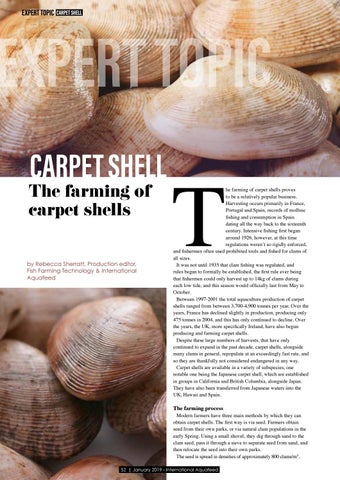
The farming of carpet shells proves to be a relatively popular business.
www.aquafeed.co.uk
FISH FARMING TECHNOLOGY feeding, one of the highest in Scotland. Often, we hear statements about fast As we watched our 85th barge being progress in aquaculture. It is just towed off to site and revelled in a a young industry and time moves moment of pride, I did cast my own mind so fast, however, in the relatively back to when I started in aquaculture, short period of 30 – 40 years we although some years ago, when feeding have had a commercial aquaculture fish was primarily done with a bucket industry that has evolved so much, and scoop. particularly with regard to fish The tools that a modern farmer can have farming technology. Jamie Young access to today are vastly different, such The industry still has a lot of the Group Sales Director, Gael Force Group, UK as computer-controlled feed systems same people - once you’re in that ensure feed is always fed accurately. aquaculture, it is hard to leave- and Monitoring by state-of-the-art SeaSight cameras and SeaFeed so, along with this fast track progress in technology, people pellet detection software offers the farmer a real view of the are learning in a fast track way – they have to! feeding below the surface. Modern low energy LED lights, Recently, here at Gael Force, we have spent a lot of time acoustic seal deterrents, all monitored 24/7 and fed back to developing our products with a strategic focus on innovation. the farmer, on-site, on the shore or even in the comfort of his It is an exciting time for the industry, and while it is a lot of own home are all pioneering technologies. Farms today are fun coming up with a range of ideas and thoughts on where truly innovative and connected. we go next, a lot of hard graft is required to ensure we strive The real excitement is in the question - where to next? With to be at the leading edge, while offering our customers what innovation on a fast track here at Gael Force, I am filled with they need to improve efficiencies in farming routines. These confidence that 2019 will see lots more innovation coming times, spent brainstorming and sharing, are always a time forward and existing collaborative solutions developed for reflection too - so much has changed and so much has further. I look forward with great excitement, and great pride, progressed. that each day that technology on farms improve, we can make In September 2018, we dispatched our latest SeaMate Feed Barge, complete with our own SeaFeed Feeding System. This life easier for farmers, more profitable for producers and more sustainable for the environment. barge has eight lines, which means it has a high capacity in Happy new year to you all, many of you may know myself. And, as is the way of things, change happens. After all if Marine harvest can rebrand to MOWI, well then so can I, to fish farming technology. Within the wing of International Aquafeed, we will, over the coming months and indeed years, look in-depth William into the technology behind international aquaculture. We have restructured the magazine to extend its focus on farming technology. The industry has developed significantly within my life time, starting here in Europe a little over 50 years ago with salmon, and many years prior, around the world, with a wide range of species. Within the little under 15 years I have been involved with aquaculture, the technological advancements are boundless. From cages, netting, ropes, moorings to workboats and wellboats, 90m cages to 200m-round cages. Hydro licers/ flushers etc, we will delve further over the coming month and years into everything technological! Still the top recommended fish to eat are salmon, closely followed by Arctic char, mackerel, black cod, sardines and halibut. Mussels and, my favourite, oysters, will always be on my list. The recent publication, a 146-page report from The Rural
Economy and Connectivity Committee on salmon farming in Scotland, has given the scottish salmon farmers a penalty to consider. The committee started the report back in March of 2018 and it has now been published. The members included Convener Edward Mountain, Scottish Conservative and Unionist Party Deputy, Convener Dowds Gail Ross, Scottish National Party Peter Chapman, alongside other individuals such as Mike Rumbles, Maureen Watt, John Finnie, Richard Lyle, John Mason, Stewart Stevenson, Party Colin Smyth and Jamie Greene. The Scottish Environment Protection Agency (SEPA) also published a report on the evaluation of a new seabed monitoring approach to investigate the impact of marine cage fish farming, calling for the industry to move further offshore. This will all lead to a government debate, likely to take place in February, which may or may not lead to new legislation. It proves to be a very interesting time for us all in 2019, For myself, MOWI, and not least of all for the magazine, and the future of farming technology. The findings of the debate and the report will lead to new developments for the industry, to which we will report them all. Happy new year to all, to new beginnings and a bright future!
NUTRITION & HEALTH We now see major developments in Welcome to January 2019, and this first feed additives and supplements from specialist editorial covering our Aquafeed natural ingredients, and the inclusion interests within our new magazine format. of prebiotics and probiotics making I have just returned from Mexico where I significant headway. Indeed, the quality was the guest of Jefo, Canada to attend the and range available is quite impressive CONACUA 18 venue held in Los Mochis. and we see a surge of research activity Sinaloa at the heart of the shrimp industry. on their applications, covering a There was a very large attendance, as wide range of aquaculture production it was a mix of trade show and invited scenarios. lectures, with shrimp production at the Professor Simon Davies Nutrition Editor, International Aquafeed Clearly, we must articulate fish core of the event. nutrition and optimise gastrointestinal I presented an overview of the strategy mediated immune response towards to produce ‘The robust shrimp’ to meet promoting better disease resistance, without the scourge of the challenges of producing healthy and vibrant shrimp for antibiotic reliance, and the threat of resistance to established and the 21st Century. My focus was, of course, on nutrition and emerging pathogens that this can bring. The effects of climate feeding, with an emphasis on novel supplements and additives change, mycotoxin spread and new engineering strategies for to empower the immune system, improve gut health and intensive farming such as RAS will inevitably influence the promote the microbiome, using suitable prebiotic and probiotic aquafeed agenda. applications. Fish nutrition has now been advanced, by major developments At the conference, I was able to engage with numerous in the use of techniques at the molecular level such as gene stakeholders representing shrimp feed production. These expression, next generation sequencing, as well as sophisticated included a very interesting meeting with the Neovia Group, in digital imaging methods, giving histology much more capacity particular, who are diverse in the animal feed sector, but with and helping us to understand the effects of nutrition at tissue and sound involvement in aquafeed developments. I encountered subcellular levels, from both optical and electron microscopy many more companies such as Vitapro, Vimifos, Biomin perspectives. Mexico, Skretting, Mexico and Zeigler Bros, from the USA, We must all embrace these new technologies and utilise these with their bespoke range of high-performance shrimp feeds and modern tools to enable us to acquire opportunities to take the their specialist post-larval and hatchery diets. industry into ‘new waters.’ Collaboration and integration of This shrimp forum would not be complete with the vast resources is the major key to progression. The days of the ‘lone’ expertise of the legendary George Chamberlain of the Global researcher in fish nutrition may well be over, given the technical Aquaculture Alliance. It is clear that there is much going on in demands of conducting feed trials and gaining the sophisticated Mexico, in terms of aquaculture, and especially the aquafeed laboratory support. area. Finally, I was impressed by its educational platform to This is reflected in the large consortia and interdisciplinary support the growing demands for trained personnel for the groups being the platform for aquaculture nutrition research future. grants as we see in the UK, EU and North America. Turning to the general topic of fish nutrition and feed You can be assured that our nutrition and feed technology technology in general, it is obvious how much has changed in the last decade, in respect of advances in the related biosciences. section of the magazine will continue to feature articles, reports and news in all these areas, and the next 10 years will no The ‘father’ of fish nutrition, the eminent scientist Dr John E doubt provide ever increasing advances in this key area of the Halver, was a personal friend who gave me much inspiration aquaculture industry, feeding a growing world population. and encouragement in my career.
Perendale Publishers Ltd 7 St George’s Terrace St James’ Square, Cheltenham, Glos, GL50 3PT, United Kingdom Tel: +44 1242 267700 Publisher Roger Gilbert rogerg@perendale.co.uk Managing Editor Vaughn Entwistle vaughne@perendale.co.uk
January 2019 Volume 22 Issue 01
IN THIS ISSUE
FISH FARMING TECHNOLOGY
International Editors Dr Kangsen Mai (Chinese edition) mai@perendale.co.uk Prof Antonio Garza (Spanish edition) antoniog@perendale.co.uk Erik Hempel (Norwegian edition) erik@perendale.co.uk Editorial Advisory Panel • Prof Dr Abdel-Fattah M. El-Sayed • Prof António Gouveia • Prof Charles Bai • Dr Colin Mair • Dr Daniel Merrifield • Dr Dominique Bureau • Dr Elizabeth Sweetman • Dr Kim Jauncey • Dr Eric De Muylder • Dr Pedro Encarnação • Dr Mohammad R Hasan Editorial team Prof Simon Davies sjdaquafeed@gmail.com Rebecca Sherratt rebeccas@perendale.co.uk Matt Holmes matth@perendale.co.uk International Marketing Team Darren Parris darrenp@perendale.co.uk William Dowds williamd@perendale.co.uk Latin America Marketing Team Iván Marquetti Tel: +54 2352 427376 ivanm@perendale.co.uk Oceania Marketing Team Peter Parker peterp@perendale.co.uk Nigeria Marketing Team Nathan Nwosu Tel: +234 8132 478092 nathann@perendale.co.uk Design Manager James Taylor jamest@perendale.co.uk Circulation & Events Manager Tuti Tan tutit@perendale.co.uk Development Manager Antoine Tanguy antoinet@perendale.co.uk
REGULAR ITEMS 6 Industry News
52 Expert Topic - Carpet shell 50 Technology showcase 54 Industry Events
64 The Market Place 66 The Aquafeed Interview 68
Industry Faces
COLUMNS 9 Ioannis Zabetakis 10 Antonio Garza de Yta
©Copyright 2018 Perendale Publishers Ltd. All rights reserved. No part of this publication may be reproduced in any form or by any means without prior permission of the copyright owner. More information can be found at www.perendale.com Perendale Publishers Ltd also publish ‘The International Milling Directory’ and ‘The Global Miller’ news service
12 Dr Neil Auchterlonie
16 Sven-Olof Malmqvist
FEATURES 18 Seasonal nutrition: Matching fish feed to fish physiology 22 Pathogens in aquaculture 26 Cryo-preservation: The future of feed 30 Optimising feed mill output 32 Innovation and aquaculture
FISH FARMING TECHNOLOGY 36 Aquacare controlled environment aquaculture systems
THE BIG PICTURE Multizone Automatic Feeding System Why make things complex when they can be simple? That’s the question French engineer SÊbastien Termet asked himself, when he was approached by a fish farmer to come up with a feeding system. See more on page 40
40 Multizone automatic feeding system 46 Smart control and monitoring of aquaculture systems
i i i i i i i i i
i i i i i i i i i i i i i i i i i i
i i i i i i i i i
i i i i i i i i i i
i i i i i i i i i
i i i i i i i i i
News
i i i i i i i i i i
More funding announced for Antarctic Wildlife Research Fund
T
he Antarctic Wildlife Research Fund (AWR) announces the winners of the call for proposals, 2018. The selected projects are focusing on the role of fish in the Scotia Sea food web and on the estimation of krill biomass using new acoustic modelling. “The funding is vital to continue with scientific research and to ensure the long-term health of the ecosystem. Only through a better understanding of the role of Antarctic krill in the Southern Ocean, can we fully protect the animals that feed on krill, and ensure precautionary fishery management,” says Claire Christian, the Chair of AWR. The two granted research projects will focus on the following scientific research areas: Accurate krill biomass estimation using spatiotemporal acoustic target strength modelling. This project aims at improving the accuracy of krill biomass estimates, using observations of the material properties of krill, coupled with numerical models that describe how individual krill and krill swarms scatter sound. This project will reduce bias and improve accuracy in krill biomass estimates. Using a combination of field observations and modelling, the project will improve our understanding of the internal and acoustic properties of krill, under different spatiotemporal conditions, and frame these in terms of implications for krill biomass estimates, and the role of fish in the Scotia Sea food web. The analysis will address important uncertainties, such as the degree of myctophid predation on early life stages of krill. Improved understanding of temporal and spatial variability in krill consumption by fish is key information, required for The Commission for the Conservation of Antarctic Marine Living Resources (CCAMLR) and their risk assessment and interpretation of CEMP data. This analysis will provide a significant step forward in our understanding of the trophic roles of fish in Antarctic ecosystems and the potential for interactions with krill predators and the krill fishery. “After four years, AWR has become a great and respected initiative by CCAMLR Members, making important scientific contributions for the management of the Antarctic krill fishery,” says Dr Rodolfo Werner, AWR Scientific Advisor, and Board member.
CO-LOCATED:
3rd
edition
13-14 FEBRUARY 2019 INTERNATIONAL CONFERENCE & TRADE SHOW ON AQUACULTURE, ALGACULTURE AND FISHING INDUSTRY
PORDENONE EXHIBITION CENTER - (VENICE AREA - ITALY)
WWW.AQUAFARMEXPO.IT ORGANIZERS:
MAIN SPONSOR:
SPONSOR: Logo Biorigin.pdf
1
1/18/11
PARTNERS:
MEDIA PARTNERS:
2:53 PM
C
M
Y
CM
MY
CY
CMY
K
6 | January 2019 - International Aquafeed
IL PESCE
i i i i i i i i i
i i i i i i i i i i i i i i i i i i
i i i i i i i i i
i i i i i i i i i i
i i i i i i i i i
i i i i i i i i i
News
i i i i i i i i i i
A
Antarctic krill industry conservation in motion ker BioMarine and the krill industry under the Association of Responsible Krill Harvesting companies (ARK), are starting a fishing season with a joint commitment to keep the krill fishery operations away from Antarctic Peninsula penguin colonies, during the breeding season. This precautionary action is in line with the voluntary industry commitment, announced by ARK, in July 2018. “We have decided to voluntarily close off these areas for fishing because we believe it’s the right thing to do. Krill is abundant in Antarctica, but we know that global climate change may create unpredictable impacts for predators dependent on krill”, says Pål Skogrand, Sustainability Manager at Aker BioMarine. “The only way to reinforce a sustainable krill management for the future, that allows for increased yield and much-needed marine proteins and nutrients to the world, is for the industry to adapt to the needs of the ecosystem.” New rules, that will be established as part of the ART commitment, include the Antarctic Peninsula being closed to krill fishing (40 km buffer) up to February 1st, 2019. Gerlache Strait will be closed to krill fishing (30 km buffer) up to February 15th, and South Shetland Islands will be closed to krill fishing (40 km buffer) up to March 1st. The seasonal closure will pave the way for an all-year closure from 2020, of which size and limits are to be
decided after a review. “Our vessel captains and crew are excited about being part of this,” says Frank Grebstad, Senior Vice President of Vessel Operations at Aker BioMarine, explaining how the coordinates of the buffer zones have been put into the navigation systems of the vessels and are ready to go for the season. “This is an effort from all parts of the company to make this work, and the desire to take care of our workplace is very strong – and especially for the vessel crew who lives and breathes the Antarctic nature and wildlife,” Grebstad continues. “This is a major commitment with the sustainability not just of the krill population, but the ecosystem depending on it,” adds Dr Javier Arata, Executive Officer of ARK. Sustainability has been a top priority for Aker BioMarine since day one. The company’s operations are certified by the Marine Stewardship Council (MSC) and 100 percent traceable and acknowledged as one of the most sustainable reduction fisheries in the world for the fourth year in a row by Sustainable Fisheries Partnership (SFP). Aker BioMarine and ARK-companies will also put money on the table to support the big international scientific synoptic survey of the krill biomass in Antarctica: this will give a new benchmark for krill data and contribute to a more solid foundation for future krill harvesting.
8 | January 2019 - International Aquafeed
Ioannis Zabetakis Nutriad showcase aqua additives in Turkey
N
utriad, a pioneer in species-specific additive solutions for fish and shrimp, participated in the ninth Future Fish Eurasia exhibition, which was organised at the Izmir International Fair Centre in Turkey. The event gathered suppliers of fish feed, fish additives, farming equipment, veterinary services and vaccines, and fish processing equipment with a strong focus on the Turkish aquaculture market. It provided a great opportunity for Nutriad to further engage with the aqua industry in a dynamic and rapidly growing market. Despite the challenging current economic climate in Turkey, the fair was well attended by fish producers from Turkey and surrounding countries. Turkey continues to be a strong fish producer, totalling over 250,000 million tonnes of seabass, seabream and trout. Diversification of marine aquaculture is starting to take off too, with industry sources confirming the stocking of 4-5 million fry of an emerging species of marine fish, meagre (Argyrosomus regius). Nutriad, together with its aquaculture partners in Turkey, Nutriad Yem and Avet, were present with a booth. “Turkey is a focus market for Nutriad. We have a strong position in this market, thanks to our specialised product portfolio for marine fish and trout, our aquaculture partners and our broad offer of services to support the mostly vertically integrated industry in Turkey”, says Peter Coutteau, Business Unit Director Aquaculture for Nutriad.
FISH FARMING TECHNOLOGY
O
Fish vs statins- Part two ne of the most interesting ‘wars’ today is the ‘war’ against cholesterol and cardiovascular diseases (CVDs). We are trying our very best to lower cholesterol in our bodies and blood stream, in order to minimise the risk to develop CVDs. Alas, this is not the right
battle to fight… Let me explain myself. The regular readers of this column may remember that, in our views, it is not cholesterol that causes strokes and heart attacks, but inflammation. However, making cholesterol (LDL and HDL) the main enemy to battle, we tend to focus on the plasma levels of cholesterol, without looking into the wider picture. Following the seven countries study that took place in the 50’s and 60’s last century, the medical focus has been placed to cholesterol and its plasma levels. According to contemporary medicine, we need to lower cholesterol, in order to avoid CVDs, but stories like the one of Stamatis Moraitis are mysteries…for contemporary medicine. However, a lot of people, even today in 2019, believe the powers of omega-3 supplements and statins against CVDs, although there is a lot of scientific evidence that omega-3 and CVDs are not linked. Medical doctors today tend to recommend omega-3 pills and prescribe statins, a medicine that stops our body biosynthesising cholesterol to fight CVDs. Statins however, have so many side effects. But, also, there are many different aspects around statins. Recently, the TV-programme ‘Full Measure with Sheryl Attkisson’ (in the US) aired a piece describing some of the financial ties between experts, who set the cholesterol clinical guidelines and the pharmaceutical industry. This has been reported in the website Statin Nation, way back in 2012, but it is very rewarding to see larger parts of the media slowly catching up. The debate goes on, but in the meantime, it is so much more healthy eating fish twice a week rather than taking statins. This is a message that aquaculture companies could promote more openly. So, the challenge is yours. e: ioannis.zabetakis@ul.ie
@yanzabet
Currently working on Food Lipids at the University of Limerick, Ireland, focusing on feeds, food and nutraceuticals against inflammation, Ioannis is a co-inventor in two patents, has edited a book on marine oils, and has published more than 60 peer-reviewed articles (h-index 19). He is currently writing a book on "The Impact of Nutrition and Statins on Cardiovascular Diseases" for Elsevier. International Aquafeed - January 2019 | 9
Hawaii Sea Grant awarded nearly $1 million for aquaculture research
Antonio Garza de Yta
W
Where are the whale hunters? e have all heard the passionate and heartfelt story of Moby Dick, and we have imagined those legendary trips in a battleship. In fact, regardless of the romanticism, the whale oil industry was essential to light the houses of the population during the eighteenth and nineteenth centuries, and it was until the appearance of the kerosene that it began
to be replaced by. Finally, in 1986, the Whaling Commission established a moratorium on commercial hunting of cetaceans, since whale populations were at alarmingly low levels. Today, only Japan and Norway are engaged very controlled in hunting. Whale oil and kerosene have already been replaced by electric power; both only live in memory and romanticism. The bottom line is that one product was replaced by another that offered the same result, but in a more sustainable way in all aspects. Many examples of business advancements of this type exist. Who does not remember videocenters, or blockbusters? Who did not play Atari? Who did not collect LPs? Who did not spend nights listening to the radio or watching television in black and white? All these products and/or services were replaced. The secret is Darwinian: evolve or die. Well, fishing, or rather the production of fish and seafood, realised it was time to evolve. Aquaculture is a much more efficient and sustainable production method. Let it be clear, that I am not saying that fishing will disappear tomorrow, or that all fishing will do it. I am aware that there are many fisheries that will survive, because they are highly efficient and produce species that are now virtually impossible to replace by aquaculture. For example, tuna and sardine fisheries are those that will surely prevail, due to the extensive quantities of those specific breeds of fish, and our great-great-great-grandchildren (who I hope will also be dedicated to aquaculture) will enjoy these delicacies as we do today, from fishing. However, there are other species whose fishery is not sustainable; some consume a lot of energy, others have a negative impact on the environment, some ceased to be profitable and in other cases, all of the above. The transformation we are talking about will last 100 years, but the sooner we start and do it more orderly, the better for our country. Also, it is important is not to demonise fishing as unsustainable. Of course it can be! They are simple mathematics: If there are 200 fish and 10 fishermen in the sea, each of them will have 20 fish. If we do an analysis, and for a fisherman to live with dignity, eight fish are needed, then everything is fine. What’s more, we could add 15 more fishermen (for a total of 25) and everyone would have a good quality of life. The problem is that we do not add 15, but 40 and now we have 200 fish and 50 fishermen getting four fish per fisherman, with which none live with dignity! It has to be clear to us, that the number of fish in the sea will not increase. We have to make sure that the number of permits and people engaged in the fishing activity allow it to remain sustainable; otherwise the only thing we will do is perpetuate poverty; and the country and the fishing sector are no longer there for that. Aquaculture is just another option for the fishing sector. This may generate a number of important jobs, but will also have to promote other economic activities in the various regions, while ultimately ordering fishing. Gone are the whalers, today is the time that unsustainable fishing also disappears ... Evolve or die.
Antonio Garza de Yta, Ph.D in Aquaculture from Auburn University, President of Aquaculture Global Consulting, Director World Aquaculture Society and creator of the Certification for Aquaculture Professional (CAP) Program. He is currently Rector, Universidad Tecnológica del Mar de Tamaulipas Bicentenario.
N
early US $1 million have been given to the University of Hawai’i’s Sea Grant College Programme, for aquaculture research in support of food security research, education and outreach in the state. Maria Haws, Director of Hawaiʻi Sea Grant’s Centre of Excellence in Sustainable Aquaculture and Coastal Resources and Director of UH Hilo‘s Pacific Aquaculture and Coastal Resources Centre, received $182,955 for her project, ‘Increasing Opportunities for Aquaculture of High Value Marine Fish in Hawaiʻi’. It will develop improved culture methods for the native marine fish species pacific threadfin, known locally as ‘moi’, in land-based systems. “Moi is a popular fish in Hawaiʻi and has cultural value as well,” says Professor Dr Haws. “Our hope is to make moi fingerlings, and extension support, available to local stakeholders to help overcome some of the barriers that have impeded mariculture for decades, which will help create a local supply of fresh, sustainable seafood and create jobs.” Andre P Seale, Assistant Professor in the Department of Human Nutrition, Food and Animal Sciences at the College of Tropical Agriculture and Human Resources (CTAHR), received $749,815 for his project, ‘Integrating Land and Sea Grant Aquaculture Research, Extension and Education at the University of Hawaiʻi.’ It aims to establish an aquaculture programme at UH Mānoa that leverages and integrates land and sea grant research, extension and education resources. CTAHR‘s Seale and Rajesh Jhaare, partnering with Darren T Lerner and Darren K Okimoto of Hawaiʻi Sea Grant. “We intend to leverage a state-of-the-art recirculating aquaculture facility to address research, education and extension capacity needs of university students, industry producers and the public,” says Dr Seale. “We also plan to develop a research programme related to the aquaculture production of finfish, and an outreach programme that will disseminate industry driven research information to producers and end-users.” Hawaiʻi Sea Grant is among several national Sea Grant programmes to receive funding from the National Oceanic and Atmospheric Administration (NOAA) to address specific priorities of the 2018 Sea Grant National Aquaculture Initiative. The 22 funded projects total $11 million in federal grants, and will help spur development of a sustainable marine and coastal aquaculture industry in the US.
10 | January 2019 - International Aquafeed
i i i i i i i i i
i i i i i i i i i i i i i i i i i i
i i i i i i i i i
i i i i i i i i i i
i i i i i i i i i
i i i i i i i i i
News
i i i i i i i i i i
Australia aquaFUTURE AUSTRALIA PTY LTD placed in Australia
The perfect partner for process automation
Adrian McIntyre
Mobil: Email: Skype: Internet:
+61 417 666 311 adrian@aquafuture.com.au adrian.mcintyre1
www.aquafuture.com.au
Turn-Key Fish Farms inclusive Innovative products - best quality *made for everyday use
- Robust Optical Oxygen Sensor
Design and engineering Build and installation MCC and PLC panels Software engineering PLC/SDADA MES application Batch Explorer Integration to other software packages Turn Key installations incl. training, service & support
More information? www.inteqnion.com info@inteqnion.com www.inteqnion.com
Beluga-Caviar
*affordable prices
Examples of products from a proven overall
Our Solutions: › › › › › ›
Contact:
aquaFUTURE e.K. founded 1983
- Complete Measuring and Control Systems - Drum Filter made in Germany
Hans-Böckler-Str. 5
- Oxygen Generator 40 years experience
D-57223 Kreuztal
- Ceramic Oxygen Diffuser
Germany
- Ceramic Ozone Diffuser
Dietmar Firzlaff
- Feeding Systems with controller
Phone:
+49 (0) 2732 / 65 35
Fax:
+49 (0) 2732 / 65 71
Mobil:
+49 (0) 171 / 2 60 50 60
- Hatchery Equipment - Counter the original 30 years experience - and much more
Email: Skype:
rzlaff@aquafuture.de aquafuture-d
Internet: www.aquafuture.de
International Aquafeed - January 2019 | 11
i i i i i i i i i
i i i i i i i i i i i i i i i i i i
i i i i i i i i i
i i i i i i i i i i
i i i i i i i i i
i i i i i i i i i
News
i i i i i i i i i i
Aqua Feed Extrusion Conference: VIV Bangkok, March 13, 2019
A
Dr Neil Auchterlonie Essential nutrients
t IFFO we talk often, and extensively, about the nutritional contribution that is provided via marine ingredients, and the way that they are the foundations for aquafeed and fed aquatic species in general. Within the trade press, and even the mainstream media, there is a lot of interest in novel ingredients for aquafeed, and that is, of course, understandable, given the pressures on providing more volume of supply to maintain growth in aquaculture. Whilst we cannot say, in a technical sense, that fishmeal is essential in the formulation of a nutritionally complete aqua feed for any particular species, we can at least say that it is indispensable in a practical sense. The reason for that is because the provision of essential nutrients in one material package, such as fishmeal, removes the need for feed producers to supplement individual nutrients, such as specific amino acids, a deficiency of which may carry the risk of restricting growth performance. Fishmeal is practically essential, in this sense. One aspect of the use of concepts such as Fish In : Fish Out ratio (FIFO), and Forage Fish Dependency Ratio (FFDR) that aspire to reduce the level of fishmeal and fish oil in aqua feeds that we have been looking at this year, is the nutritional relationship to the end product and the health of the farmed fish. In no other species is this more contentious than in farmed Atlantic salmon. Our argument in IFFO is that these concepts are not relevant, providing the marine ingredients that are being used are responsibly produced and sourced. There really is no rational argument for setting limits on fishmeal and fish oil in salmon feed, on a preconception that the link will improve the management of the fisheries. In many instances, these are the best performing fisheries anyway, as the biology and life history of many of the small pelagic species makes management relatively more straightforward (in general), so this really is a non-sequitir. Certification schemes, such as the IFFO Responsible Supply scheme, are the best way to achieve those kinds of improvements. Of particular interest here is the relationship between nutrition, end product quality, and provenance. When we compare premium products in other proteins, such as grass-fed beef, or free-range chicken, to something approaching or perceived to be the wild-type diet for these animals (despite thousands of years of selective breeding), we see a distinct difference between these sectors and aquaculture. Taking a look at fish, we can ask the same question, what do wild Atlantic salmon eat in the marine phase of their life-cycle? A Google search will pick up at least one scientific paper that refers to blue whiting, sandeel and herring as primary prey items in Atlantic salmon post-smolt feeding in the North-East Atlantic. It is no surprise, then, that these species have been so important, historically, for the production of fishmeal and fish oil and incorporation into salmon feeds. We can expect more information to come through, over time, on the relation between marine ingredients and fish health, but even in the context of product quality and the perception of the product there is much more to look at here from the consumer’s perspective. “Sandeel-fed salmon” perhaps?
Dr Neil Auchterlonie is the Technical Director at IFFO. He has managed aquaculture and fisheries science programmes in both public and private sectors. Academically he holds a BSc in Marine and Freshwater Biology from Stirling University, a MSc in Applied Fish Biology from the University of Plymouth, and a PhD in Aquaculture (halibut physiology) from Stirling University. 12 | January 2019 - International Aquafeed
I
nternational Aquafeed magazine and Dr Mian N Riaz, Head of Extrusion Technology, Texas A&M University System will be hosting a one-day Aqua Feed Conference at the VIV Asia, Bangkok on March 13, 2019. This conference will focus on extrusion principles, raw material, grinding, aqua feed extrusion, different types of extruders and their application, drying of aqua feed, how to improve the aqua feed quality, managing the aqua feed facility and several other related topics. Pre-registration is required for this event, and tickets cost US $199 each. Participants will receive certificates for completing the conference. VIV are now calling for both speakers and sponsors that can participate in the event. Only the best extrusiontechnology specialists and companies will be participating, so the opportunity serves as a brilliant chance for companies and individuals to get their names recognised at the forefront of extrusion technology. Various sponsorship opportunities are also available, and it is recommended companies get in quick to assure their space. Several sponsors are already confirmed, including Wenger, DSM, Clextral, CPS and Amandus Kahl. For more information, please contact Tuti Tan (tutit@perendale.co.uk) or Mian Riaz (mnriaz@tamu. edu).
i i i i i i i i i
i i i i i i i i i i i i i i i i i i
i i i i i i i i i
i i i i i i i i i i
i i i i i i i i i
i i i i i i i i i
News
i i i i i i i i i i
CUSTOM AQUATIC FEED SOLUTIONS ARE WAITING Surround Yourself with Unparalleled Resources for Extrusion and Drying Systems Do you know what aquatic feed you need to produce – but unsure of the next steps? Wenger will put unsurpassed technology and process expertise to work, developing flexible solutions specific to your operation. We expertly evaluate and guide the development and processing applications for floating, sinking, shrimp and micro aquatic feeds. Every one of our systems is customized, serving you best by going beyond a standardized approach. Let us help you solve production challenges now. Email us at info@wenger.com today.
FLOATING
SINKING
SHRIMP
SALMON
PHONE: 785.284.2133 | EMAIL: INFO@WENGER.COM | WENGER.COM USA
|
BELGIUM
|
TAIWAN
|
BRASIL
|
CHINA
International Aquafeed - January 2019 | 13
MICRO
i i i i i i i i i
i i i i i i i i i i i i i i i i i i
i i i i i i i i i
i i i i i i i i i i
i i i i i i i i i
i i i i i i i i i
News
i i i i i i i i i i
Alltech cuts the ribbon on new UK office
A
newly built office in Lincolnshire, England, was opened by Dr Mark Lyons, Alltech President and CEO, and Mrs Deirdre Lyons, Alltech Co-founder and Director of Corporate Image and Design, at an official ribbon-cutting ceremony on Thursday, December 6, 2018. The 70,000-square-foot innovative design was initiated by Deirdre Lyons in late 2015 to accommodate Alltech’s growth in an office-only site. It features an open reception area, five meeting rooms, including a purpose-built training room, offices and dedicated creative spaces.
A building that cultivates collaboration was the vision for the new Alltech office in Stamford. While the initial design work started three years ago, ground was broken on the new building in November of 2016. The office now reflects the nature of Alltech’s late founder, Dr Pearse Lyons, with open spaces designed to nurture creativity and innovation. “Our new building, designed by Mrs Lyons, brings together many of our Alltech teams for greater collaboration and improved service to our customers in animal and crop nutrition,” said Alric Blake, Chief Operating Officer of Alltech. “We look forward to welcoming customers, colleagues and friends, old and new, to Alltech Stamford.” In conjunction with the new building, manufacturing operations were relocated to a larger, more suitable site 12 miles outside of Stamford. Stamford has been home to Alltech’s UK offices since 1988. Today, the team includes 120 highly skilled specialists who work hand in hand with feed, farming and food businesses to achieve performance targets through nutritional innovation. In addition to serving as the primary base for Alltech’s Chief Operating Officer and the global leaders of Alltech’s core animal nutrition platforms, Alltech Stamford is also home to Alltech’s UK team and Alltech E-CO2, which provides tools and services to improve the sustainability and efficiency of farming operations. “Dr Pearse Lyons established a culture of creativity and innovation at Alltech,” said Mr Blake. “Our new UK office reflects that spirit as the company continues to grow and carry the mission forward.”
14 | January 2019 - International Aquafeed
i i i i i i i i i
i i i i i i i i i i
A
ller Aqua have proudly announced that they are sponsoring the African Chapter of the World Aquaculture Society (WAS). In recent years, Aller Aqua has grown significantly in the African markets. This has happened based on the company’s “Let’s grow together approach”, paired with the quality of the feed, the results the feed creates for customers and, not least, dedicated staffs and knowledge sharing. “It is important for us to continue to have a positive impact on aquaculture globally. Aquaculture is experiencing significant growth, particularly in Africa, and it is vital to support initiatives which help ensure that growth of aquaculture is facilitated all over Africa,” Niels Lundgaard, Commercial Director for Africa, explains. “This is done through research, as well as sharing knowledge. Besides our own activities, we can help achieve this through our support of the WAS African Chapter and their efforts. I am pleased that the WAS have chosen to focus on aquaculture in Africa and, through the African Chapter, recognise the large diversity on the continent. We experience it when meeting with customers from the various African countries.” On the African continent, Aller Aqua have factories in both Egypt and Zambia. CEO of Aller Aqua Egypt, Hussien Mansour, is also positive about the cooperation. “It is good to see the focus African aquaculture is
i i i i i i i i i i
Aller Aqua are gold sponsors of the WAS African Chapter
i i i i i i i i i i i i i i i i i i
i i i i i i i i i
i i i i i i i i i
i i i i i i i i i
News
experiencing. We see the growth first hand when talking to customers and we experience a great interest in our feeds. This has enabled us to double our production facilities. The African Chapter of the WAS will increase focus and capabilities within the sector, as well as ensure further spread of an environmentally friendly method of producing protein for our growing population.” In 2017, Aller Aqua inaugurated it’s second factory on the African continent, namely Aller Aqua Zambia. Lewis Ngwenya, CEO of Aller Aqua Zambia, is happy about the cooperation with WAS and the upstart of an African Chapter. “I truly believe that the African chapter will make a positive difference for increased knowledge and research in aquaculture in Africa. We see many fish farmers who are eager to increase their businesses and thereby make a positive contribution to the local society as well as their own earnings”, he says.
STORE SMART STORE SQUARE
w w w. t s c - s i l o s . c o m
International Aquafeed - January 2019 | 15
Port of Corpus Christi secures $59 million for the Channel Improvement Project
Sven-Olof Malmqvist
I
A Happy New Year
t now feels as if we are sprinting through time, and it is 2019 already! Up in the northern hemisphere and, in particular Scandinavia, the darkness calls for artificial lighting in form of decorations, fireworks and celebrations. Although Christmas is important for us, the crucial day here in Scandinavia is the 24th of December, when Father Christmas pays a visit and places numerous parcels through the chimney and everyone is happy and excited. For others, the 25th is the real day of celebrations. Yet, this is different worldwide: Christmas starts on January fifth in the Netherlands (Sankt Nickolaus) and in Russia it starts on January the eighth, as they follow another calendar. I guess that the list of festive differences is very long, and it just tells us how different we all are, but yet not. Back to Scandinavia and our traditions, in particular Sweden, we eat a lot and after that we eat again. The menu is ham, marinated herrings in 100 ways, red cabbage, brown cabbage, green cabbage, potatoes and some nice puddings as dessert. In the pudding one should hide an almond, and the person who gets it will be married in the coming year. In some cases, one might discover a bitter almond instead, and that meant, unfortunately, the opposite. Another dish which you normally find on the table is smoked eel, but that one is under debate as it an endangered species, and those who know the full lifecycle of an eel should maybe think twice. I am personally very fond of this dish, so I am running into compunctions. Maybe it´s time to change for a more sustainable fish dish or something totally different, like smoked char (a cold-water fish in the Salmonidae family) which is delicious and is grown up in the north of Sweden? Swedish fish farming, in total, produces 15,000 million tonnes of fish per year, about 0.2 per million of these being exported for global consumers, so not so many can have luxury to have smoked char at their festive dinner. Fish farming – aquaculture has been practiced for hundreds of years, starting with fish traps in the Amazon and carp in ancient China. Today, we grow a numerous of species and, as the stocks of wild fish diminish, fish farming is seen as a way to serve the growing population and spare the natural resources. But it must be done in a way so minimal environmental impact will take place, and a I think that both the industry itself, as well as the local and global authorities, must work together for a future sustainable aquaculture production, wherever it occurs. More research on best practice in terms of sustainability and sharing information is the way forward. Aquaculture is very global with lot of international fairs, seminars etc, so it is not an unachievable goal. So instead of having a New Year resolution, I will do a Christmas one: “no more smoked eel at my Christmas table”.
Sven Olof is an experienced export manager with a demonstrated history of working in the chemicals industry. He is skilled in marketing management, market planning, business planning, international business and sales management. He is a strong sales profession who graduated from the Swedish University of Agricultural Sciences, Malmoe.
T
he US Army Corps of Engineers (USACE) announced its Fiscal Year (FY) 2019 Work Plan, which includes an additional US $59 million in funding for the Corpus Christi Ship Channel Improvement Project (CIP). This funding brings the total Federal appropriations for the CIP to $95 million. The estimated CIP cost is $360 million, of which the federal government is responsible for $230 million, while the Port of Corpus Christi is responsible for the remaining $130 million. To date, the Port of Corpus Christi has transferred $78 million of its own funds to the USACE, bringing the total CIP funding level to $173 million. “The inclusion of additional Work Plan funds is yet another significant milestone toward the United States becoming a net exporter of its energy production,” said Sean Strawbridge, Chief Executive Officer for the Port of Corpus Christi. “Widening and deepening the Corpus Christi Ship Channel is a mathematical certainty. Energy markets are taking notice as the majority of incremental US energy production is coming to Corpus Christi and ultimately to the global markets. We expect over two to three million barrels per day of new crude production coming our way, and our energy producing, and marketing customers know we are building out all the necessary infrastructure to handle these new volumes, safely and responsibly.” Charles W Zahn, Chairman for the Port of Corpus Christi Commission, said, “this news is extremely exciting, and we owe a great deal of gratitude to our supportive congressional delegation, including Texas Senators Cornyn and Cruz, US Representative Michael Cloud of our Congressional District 27, and of course, the Administration for its endless support.” The FY ’19 President’s Budget already included $13 million of funding for the CIP, which was appropriated by Congress in September. “This $71+ million in combined Army Corps Work Plan and Budget funding will be a huge benefit, not only to jobs across our part of Texas, but to the security of America and our allies, and I am thrilled we were able to make this happen,” said Congressman Michael Cloud. “I was honoured to make the case for the Port of Corpus Christi and thankfully President Trump recognised the importance of the Port’s Channel Improvement Project. I commend the Port Commissioners under the leadership of Chairman Charles Zahn, and the Port staff under the direction of CEO Sean Strawbridge and Executive Director John LaRue, for their tireless efforts on this project.”
16 | January 2019 - International Aquafeed
i i i i i i i i i
i i i i i i i i i i i i i i i i i i
i i i i i i i i i
i i i i i i i i i i
i i i i i i i i i
i i i i i i i i i
News
i i i i i i i i i i
STRONG ENOUGH TO FACE EVERYTHING!
Farm Africa aims for profitable Kenyan aquaculture sector
T
o mark the opening of the Sustainable Blue Economy Conference in Nairobi, Kenya, Farm Africa’s Kenya Market-led Aquaculture Programme has launched a policy brief that maps out how the Kenyan National Government can build a sustainable and inclusive aquaculture sector. The international NGO’s report, titled “Aquaculture for jobs, incomes and food security”, uses credible statistics to reveal alarmingly low levels of fish production in Kenya. The country’s annual supply gap of 50,000 million tonnes (mt) of fish is projected to increase to 75,000mt by 2030, if annual per capita fish consumption remains constant at 4.3 kg. If Kenya’s annual per person fish consumption grows to 9.7kg, in line with other African countries’ consumption, the supply gap will grow to 436,000mt. These projections spotlight the need to boost private sector aquaculture investment and small-scale fish farmers’ production. To stimulate Kenya’s aquaculture industry to meet growing demand, Farm Africa recommends lowering the cost of raw materials, honing the skills of farmers and extension officers, and supporting Kenyan feed millers to produce affordable high-quality feed. Reviewing the East African Community Common External Tariff (EAC CET) on imported Chinese fish in the country features prominently as one of the measures needed to make local fish products competitive and attract domestic and foreign investment in the Kenyan aquaculture sector. This is reinforced by a proposal to eliminate the existing EAC import duty of 10 percent, and fisheries levy of five percent, on imported feed and aquaculture equipment. “Increasing the East African Community Common External Tariff for imported tilapia is necessary to boost the production of Kenyan farmers, as they are currently unable to compete with the subsidised cheap imports that have flooded the market. This will also attract domestic and foreign investment, to provide the expertise and capital needed to develop the sector,” said Arnoud Meijberg, Farm Africa, Team Leader KMAP. Results of a study conducted by Farm Africa and WorldFish showed that to increase production in colder areas, strains suitable for such conditions should be developed through selective breeding. The brief underscores the need to support the development of high-quality Kenyan tilapia strains that are suitable to both cold and warm regions.
Leiber® Beta-S – β-glucans for: Improvement of the cellular & humoral defence mechanisms Support of immunological competence in larval & juvenile stages Improvement of feed conversion
leibergmbh.de
International Aquafeed - January 2019 | 17
Seasonal nutrition:
I
Matching fish feed to fish physiology by Dr Robert Tillner, Product Manager, Aller Aqua Research, Germany n most areas in the world, nature follows seasonality in one way or another. This affects both physiology and behaviour of animals, across different genera. As many fish species are poikilothermic, their internal temperature varies considerably, as a result of fluctuations in the ambient environmental temperature. In a changing climate, this dependency can have a severe impact on natural and captive fish populations, when rapid drops or rises in environmental temperatures occur, occasionally over a short period of time.
change in water temperature occurs on many fish farms. This is considered the most delicate period in fish farming. The drastic temperature increase affects the metabolism of fish and challenges its immune system. Often, the difficulties fish experience in adjusting to a changing environment become noticeable as poor appetite, apathy and skin lesions. Consequently, fish having problems with changing environmental conditions show reduced growth performance, which results in less profit for farmers. This contrasts with changing farm operations in the transition from winter to spring as feeding intensity increases.
The temperature/metabolism connection
Warming temperatures boost metabolism
The variations in body temperature have a pronounced impact on both the speed and efficiency of fish metabolism. In this respect, fish metabolism is increased in higher temperatures and vice versa. Consequently, the feed intake, as well as nutrient digestibility and nutrient utilisation of fish, vary with temperature. When the seasons change from winter to spring, a rapid
When water temperature rises, fish show a reduced capacity to resorb oxygen from the warmer water, as oxygen solubility in water decreases with rising water temperature. This is especially true for juvenile fish, as they are more susceptible to oxygen deficiencies, compared to adult fish. To cope with these conditions fish, by nature, have a generally
18 | January 2019 - International Aquafeed
high ability to exploit oxygen from the water. Therefore, sudden increases in water temperature might become a stressful factor, especially under more intensive farm conditions when extra oxygen supply is limited, or its application is too costly. Physiologically, fish adapt to sudden changes in temperature by increased respiration and higher levels of stress hormones in their blood. It is therefore paramount to support the fish organism in this potentially stressful period, by using specific nutrients in the feed. Most animals can synthesise vitamin C, but many fish cannot. Physiologically, vitamin C is the precursor of collagen and is, therefore, necessary for the formation of connective tissue, scar tissue in wound repair and bone matrix. It also facilitates the absorption of iron and protects tissue from oxidative damage. An increased immune response, due to high concentrations of vitamin C supplementation, has been documented in many fish species. The Spring Edition feeds from Aller Aqua contain an extra dose of vitamin C, which contributes to the formation of red blood cells and promotes the production of collagen, thus facilitating the intake of oxygen and promoting the healing of the skin and the healing of wounds. Ultimately, it supports the fish during the challenging transition period from winter to spring.
Countering stress from high temperatures
The summer period is characterised by high temperatures and the highest fish metabolism. Heat waves, and subsequent highwater temperatures during summer, challenge the fish when it comes close to the physiological boundaries of the animals. Consequently, the summer season can lead to oxidative stress
in the fish caused by a combination of high temperature and an intensified fish metabolism. Oxidative stress is an imbalance between oxidising substances and antioxidants, in favour of those oxidising, resulting in damaged body cells. To maintain homeostasis, the body cells take up more energy to counteract oxidative stress. Symptoms in fish include heat stress, reduced appetite, weakened immune defence and a low quality of fish meat. To counteract these symptoms the Summer Edition feeds from Aller Aqua are supplemented with natural antioxidant substances to restore oxidative balance. Antioxidants have several positive effects including reduction of heat stress, stimulation of the immune system, increased feed intake and consequently increased body weight. With dropping water temperatures in autumn, fish metabolism slows down and the fish reduce their feed intake. Warm water
International Aquafeed - January 2019 | 19
fish species stop feed ingestion and prepare for a wintering period without feeding. It is therefore paramount to equip the organism with necessary energy stores and to support cellular functionality at low temperatures.
Preconditioning for winter
The membranes of all animal and plant cells are formed by membrane lipids of the main groups glycolipids, cholesterin and phospholipids, which build the typical membrane layer necessary for all life. In low temperatures, the fluidity of cell membranes is reduced if not supplied with phospholipids high in highly unsaturated fatty acids, leading to reduced exchange of water, gases and proteins. The Autumn Edition feeds from Aller Aqua are equipped with high levels of phospholipids, which promote high digestibility of the feeds and secure the preconditioning for the wintering period. The supply of phospholipids supports the fluidity of the cell membranes and avoids solidification at low temperatures, which ensures optimal cell functionality.
Efficient nutrient uptake during the coldest season
At low temperatures, during winter, the feed intake is reduced and so is the metabolism of the fish. As a result, nutrients from the feed are poorly utilised and might be wasted, which is an inefficient use of precious feed ingredients. During the winter season, feed digestibility can be increased by using emulsifiers which improve the digestion and nutrient uptake of dietary lipids. This is what Aller Aqua have done in their Winter Edition feeds. The lipids in the feeds are efficiently used and not excreted into the environment. This can easily be observed by less or no fat films on the water
surface, and on equipment on a fish farm. Consequently, the increased and faster availability of energy favours the growth of fish even at low water temperatures. Another challenge is the reduction in protein digestibility, due to low metabolism. This challenge is met with the addition of highly-available peptides. In the feeds, the peptides increase the digestibility of the protein fraction and the availability of amino acids. Coming from the other end, the absorption of nutrients, by epithelial cells in the intestine, is an energy consuming process. The addition of highly available energy sources activates the epithelial cells which increase the reaction surface in the intestine and ultimately improves nutrient absorption. In conclusion, adapting fish feeds to seasonal temperature differences on a fish farm creates a great potential for growth, vitality and health of fish and has become a core principle in Aller Aqua’s feed formulation. Therefore, Aller Aqua introduced the Temperature Adapted Feeds concept (TAF), ensuring a higher feed intake and nutrient digestibility throughout all seasons. This is achieved by adapting nutrient contents in the feeds, to allow different fish species to better face the challenges of changing environmental temperatures, during the year. At the same time, it keeps nutrient excretion to the environment at a minimum. The Temperature Adapted Feeds concept covers the four seasons of the year and a great variety of fish species, as new species are continually included in this principle. Temperature Adapted Feeds for different species and seasons are developed in collaboration with international research institutes, fish farms and Aller Aqua Research. It is the result of Aller Aqua’s more than 50 years of experience in the fish feed industry, covering feeds for more than 30 species. www.alleraqua.com
PEGASUS® VACUUM COATER VACUUM COATING: DEVELOPED BY DINNISSEN PROCESS TECHNOLOGY MULTIFLEXIBLE ADDITION OF ADDITIVES HOMOGENEOUS COATING MULTIPLE LAYER COATING HYGIENIC COATING
RS
O F I N N OV A
19
48-2018
TI ON
EA
www.dinnissen.nl
70 Y
More information
20 | January 2019 - International Aquafeed
PERFECTION RIGHT DOWN TO THE CORE OF THE PRODUCT The Wynveen vacuumcoater can be used for the addition of extra fats, oils and liquid enzymes to pellets and extrudates. This technology
A Triott Company
ensures even absorption of the liquids into the pellet core, after completion of all mechanical and thermal processes.
WWW.WYNVEEN.COM
Future proofing your aqua feed production starts with co-creating the perfect fit. Let’s build or upgrade your aqua feed mill
All great ideas start with a dialogue. What’s your ambition? We at van Aarsen believe that sharing know-how and co-creation are essential in finding the perfect fit. Whether you are looking to modernize or expand your aqua feed production, want to replace aging machinery with future-proof innovations, or need advice in the planning and setup of a completely new aqua feed mill, Van Aarsen is the knowledge partner for you. Take a look at our website.
www.aarsen.com/process/aqua-feed
2018-10-05, Adv. Aqua feed Mill 190x132 .indd 1
International Aquafeed - January 2019 | 21
5-10-2018 16:53:07
Pathogens in aquaculture Ubiquitous antimicrobial activity of a new feed additive against several pathogens in aquaculture farming systems
A
by Maxime Hugonin and StĂŠphane Frouel, MiXscience, France
s a potential protein source of tomorrow, for a population always growing, the aquaculture industry is facing several challenges. To reach the demand, the yield production must be maximised. In this way, farmers always increase their stocking densities, going from intensive culture to super-intensive ones, leading to new pathogens appearances and propagations with a multiplication of disease outbreaks. The first people impacted by these issues are the farmers. This pathogenic pressure significantly impacts the economics of farming. The main solution to this issue remains the use of antibiotics, thanks to their easy use in curative treatment and their visible and rapid effects. Unfortunately, the use and abuse of chemicals raises public health concerns, because of antibiotic
resistance, and adverse effects on the environment. Then, this remedy participates to the bad image associated to aquaculture production and produces shifts in the public opinion. Active researches are ongoing in their hard work to explore alternatives. This article reports on the use of a natural phytogenic, based on specifically selected plant extracts, to control a broad spectrum of pathogens in aquaculture systems. The story of the product started from a laboratory, associated with RID trials, and ended in-field at larger and commercial scale. Thus, the antimicrobial effects of this phytogenic have been investigated both in vitro and in vivo, which provides a robust and pragmatic feedback on its benefits.
Mechanisms of actionÂ
The large spectrum of the antimicrobial activity of this feed additive is based on particular mechanisms of action with common targets among pathogens: the proteins. The anti-
Figure 1: (Below) Nature of potential ways of penetration of SOCs into cell Figure 2: (Top right) Denaturation of microbial proteins by fixation of SOCs on disulfide bridges Figure 3: (Bottom right) Functional metabolic alterations by SOCs contained in the phytogenic
22 | January 2019 - International Aquafeed
Table 1: Minimal inhibitory concentration (MIC, ppm) of the experimental phytogenic against aquatic pathogens and compared with in kind products Aquatic pathogen
Figure 4: Preventive product application protocol for In vivo laboratory trials for three tested aquaculture species
microbial properties of this phytogenic are provided by Sulfur Organic Compounds (SOCs) from Alliaceae extracts. The Alliaceae family includes 13 genera and 600 species. Main representatives are onion, garlic, leek, shallots and chives. Some research studies raise the possibility that, in biological systems, SOCs can penetrate very rapidly into different compartments of the cells where they exert their biological effects. Depending on the pathogen, there are several ways for SOCs to penetrate cells (See figure 1) Due to their low molecular weight, SOCs can easily diffuse by different processes into the internal volume of vesicles, in the cytoplasm of bacteria, (Gram – or Gram +), or into viruses. That is the case in Gram – where the peptidoglycan layer is small. SOCs give the phytogenic antibacterial properties, due to
Phytogenic Carvacrol
Citral
Eugenol 250
Aeromonas salmonicida
64
250
250
Edwardsiella tarda
125
250
1000
500
Photobacterium damsela
32
125
500
1000
Streptococcus iniae
25
64
500
1000
Tenacibaculum maritimum
16
32
64
64
Tenacibaculum discolor
16
64
64
125
Vibrio alginolyticus
125
250
1000
2000
Vibrio anguillarum
16
64
500
1000
Vibrio harveyi
64
250
1000
1000
Yersinia ruckeri
125
250
1000
500
different interactions with cell compounds. Once in the cell, SOCs combine with certain proteins to alter fixation and to dislocate thiol functions, contained in disulfide bridges involved in the structure of proteins and enzymes. Without their 3D conformation, the denatured proteins are not functionable anymore, (see figure 2). Among the altered functions, gene expression, energetic metabolism and protein synthesis are some associated functions, whose alteration leads to a global malfunctioning of the cell, to its final apoptosis and then the death of the pathogen, (see figure 3). For bacteria, SOCs appear to target multiple pathways including the modulation of enzyme activities (e.g. glutathione S-transferase, involved in several vital pathways), the inhibition of DNA enzymes (gyrase, polymerase), the affection of
Your global technology process supplier for the aqua feed industry ANDRITZ is one of the world’s leading suppliers of techno logies, systems, and services relating to advanced indus trial equipment for the aqua feed industry. With an in-depth knowledge of each key process, we can supply a compatible and homogeneous solution from raw material intake to finished feed bagging.
ANDRITZ Feed & Biofuel A/S Europe, Asia, and South America: andritz-fb@andritz.com USA and Canada: andritz-fb.us@andritz.com
International Aquafeed - January 2019 | 23
www.andritz.com/ft
the intrinsic pathway for apoptotic cell death and cell cycle machinery. SOCs can also block the synthesis of polyamines, as well as disrupt cellular microtubules (that form the cytoskeleton and the mitotic spindle in cells), requested for cell division. The antiproliferative and antimicrobial effects of SOC compounds appears to be related to the induction of cell apoptosis, resulting from the alteration of pathogenic cells. For viruses, SOC’s will alter the protein of their capsid. Without the genome protection provided by this protein envelop, the viruses will die on the same model as microbial cell apoptosis.
Figure 5: Overall effect of the phytogenic on the final survival (control vs preventive dosage application)
Product potential: A three scales’ evaluation
In vitro, the product’s efficacy has been evaluated through minimal inhibitory concentration (MIC) and minimal bactericidal concentration (MBC) tests. Using microdilution methods, the growth inhibition effect of the phytogenic against a wide range of pathogens, from seawater and freshwater aquaculture systems, has been compared to MIC of natural extracts known to have high antimicrobial potential such as carvacrol, from oregano and thyme oils, citral, isolated from citrus oil and eugenol, from clove oil. Moreover, in order to evaluate the real potential of this product as an antibiotic alternative, MIC and MBC were compared to common antibiotics used in aquaculture (oxytetracycline, erythromycin and enrofloxacin). In vitro results indicated that this feed additive showed a wide bactericidal action, since it exhibited high efficiency against both gram-positive and gram-negative bacteria. In addition, it showed the strongest antimicrobial activity, compared to in-kind products. The experimental phytogenic presented the lowest MIC from 16 to 125 ppm versus 32 to 250 ppm for carvacrol, 64 to 1,000 ppm for citral and 64 to 2000 ppm for eugenol (see Table 1). It also demonstrated a minimal inhibitory and bactericidal concentration in the same order of magnitude (less than one log unit of difference) than tested antibiotics (Table 2). Based on these promising studies, the product was then applied in challenge trials. The in vivo laboratory trials have been conducted on different species: fresh water fish (Seabass), warm water fish (Tilapia) and marine shrimp (White Leg Shrimp) which have been challenged for different pathogens in a preventive use protocol of the product. To start with, animals have been acclimated to experimental condition (from between one to four weeks), before being fed continuously with the experimental feed, containing the Table 3: Summary of farming conditions trials run in Turkey : Species vs pathogens Trial number #
Species
Disease diagnosis
1
Seabass
Vibriosis
2
Seabream
Parasitism - Sparicotyle Chrysophrii
3
Seabream
Vibriosis
4
Seabass
Vibriosis + Flexibacteriosis
5
Seabass and Seabream
Flexibacteriosis
Figure 6: Curative effect of phytogenic on tilapia after streptococcal challenge
Figure 7: Curative effect of phytogenic on shrimp after Vibriosis challenge
phytogenic, at a concentration of 1-2Kg/ton of feed (See figure 4). After a period of three or four weeks, according to the species, the fish and the shrimps have been challenged with the selected pathogen and fed with the product for at least two more weeks post-challenge. Survival was then observed (see figure 5). The results presented in figure 5 clearly show a significative survival improvement (ANOVA p<0.05), regardless of farmed species and associated pathogens (bacteria or virus). The use of the phytogenic increased the shrimp survival rate of 54 percent against Vibrio Parahaemolyticus, and 52 percent against the white spot syndrome, the two main diseases encountered by the industry. In fish, even if the results are a little bit less impressive (due to existing Immune System for fish then lower mortality rate for control), they are still significative, and the mortality reduction can also represent a reliable economic gain with a survival increase of 18 percent for seabass against Pasteurella and 19 to 12 percent for tilapia against Streptococcus and Francissella, respectively. During research trials, the significant results confirmed the antimicrobial effect of the phytogenic observed at laboratory scale. To definitely validate these benefits, a last but no least step has been undertaken: under farming real conditions trials.
Commercial field scale
The effect of the phytogenic was tested under commercial
24 | January 2019 - International Aquafeed
farming conditions for two species Table 2: Minimal inhibitory concentration (MIC, ppm) and minimal bactericidal concentration (MBC, ppm) of the in Vietnam, (shrimp and tilapia), and phytogenic & antibiotics vs aquatic pathogens in Turkey for seabream and seabass. Aquatic pathogen Phytogenic Oxytetracyclin Erythromycin Enrofloxacin For these last fishes, five trials have MIC MBC MIC MBC MIC MBC MIC been carried out to evaluate the Aeromonas salmonicida 75 75 >300 >300 9 12 9 effects of the phytogenic on disease Streptococcus iniae 19 19 12 12 3 3 5 control, randomly met under natural Vibrio anguillarum 25 25 19 19 50 50 6 conditions, and compare them to Vibrio harveyi 100 100 37 37 50 50 6 antibiotics’ ones. Fish have faced Vibrio parahaemolyticus 50 50 12 12 19 25 3 either Vibriosis, Flexibacteriosis or parasitic infections (see table 3). Interestingly, the use of the product Moreover, this new phytogenic can be applied in a wide range at 5Kg/tons of feed, during 20 days after the first symptoms of conditions, either continuously as a prophylactic agent, or appearance, lead to a complete control of the disease (at least as during certain critical periods as a curative agent. The optimal efficient as antibiotics) and a total recovery with a comeback to duration of application is at least 14 days before any known initial metabolic state of the animals. For tilapia in cages, the phytogenic was applied temporarily at a critical period, or after the first appearance of disease symptoms. Recently, the product efficiency was extended to new species disease control dosage of 4kg/ton of feed during 14 days after the emergence of a streptococcal infection. It was applied at the same against new pathogen: Rickettsia (Salmonid Rickettsial Septicaemia) in Chile. Great scale use of the product has shown amount, for a duration of 35 days, in shrimp farmed in outdoor benefits, in terms of survival rate, and then economics return of ponds after the appearance of Vibriosis. Antimicrobial effect of the phytogenic was confirmed, under farming conditions, where it investment. New trials have also been conducted against the devastating significantly supported resistance of tilapia and shrimp (ANOVA and emergent Tilapia lake Virus (TiLV) and have shown positive p <0.05) when challenged with Streptococcus spp. and Vibrio results to be confirmed under field conditions. In Vietnam, out of spp. respectively (see figures 6 and 7). 219 shrimp ponds of 219 ponds using the phytogenic, 75 percent We concluded that this new feed additive provides efficient didn’t show any mortality and only 15 percent have shown control against a variety of pathogens and could be considered as mortality due to EMS, 4 percent due to WSSD and only 2 percent a holistic and natural approach of reducing the use of antibiotics white feces syndrome. in aquaculture systems. Trial data also showed the efficacy of the The success story is ongoing, we need to keep the momentum functional additive to counterbalance disease outbreaks and to going! maintain a reliable growth performance and farm profit.
TA S T E F O R P E R F O R M A N C E
TRY EXPLAINING IT TO SHRIMP AND FISH. PRO632-A-MS-AP-18080E1-en
Animals need to eat well to grow. But they will not eat what they do not like, no matter how much you try. That is why Phileo created Prosaf®, a highly palatable source of bioactive peptides, free amino acids and nucleotides to boost growth, performance and resistance, especially in young animals, and better value plant-based diets. Save your explanations and give them a balanced diet they will really love.
International Aquafeed - January 2019 | 25
phileo-lesaffre.com
MBC 12 5 6 6 3
I
Cryo-preservation: The future of feed by Rebecca Sherratt, Production editor, Fish Farming Technology & International Aquafeed
nnovative live feed distributors Planktonic revealed at the 2018 Aquaculture Innovation Europe conference in London, UK, their secret source of live feed for larval shrimp and finfish. The hatchery feed production sector has been left wondering what exactly is Norway-based Planktonic’s secret behind their marine feeds, and Planktonic CEO, Rune Husby, finally confirmed it to be barnacle nauplii. This miraculous innovation has proven especially popular in Norway, Planktonic already having 30 percent of the starter feed market for cleaner fish produced in Norway alone. Husby went on to state that barnacle nauplii is an excellent alternative to artemia and rotifiers, with an “optimal nutritional profile, unparalleled biosecurity and an unparalleled stability in product quality.” Planktonic’s commercial success, CryoPlankton, uses liquid
nitrogen to cryo-preserve the barnacle nauplii, to allow hatchery managers to “revive them again” when needed.
What does this mean for hatcheries?
Several years ago the fish sector in Norway were given some samples of the new barnacle nauplii feed, and results had only been positive. Lumpfish and wrasse, Husby notes, displayed “improved growth and higher stress tolerance” compared to those fed on artemia and rotifiers. Trials were also successful in Greece, Portugal, where the fish fed this specific live feed had improved rates of survival, growth and a lower presence of vibrio, which commonly causes foodborne infections in humans upon exposure. Ecuador fish farms also noted similarly successful effects from the innovative feed when given to shrimps. These endless successes only further accelerated the growth of CryoPlankton, into its now hugely successful commercial
26 | January 2019 - International Aquafeed
venture, with sales and production only continuing to increase and expand. Other benefits of the barnacle nauplii cryo-preserve feed include its ease of use. The feed need not be kept and cultivated as live stock, it is always ready when the fish need to eat. Planktonic also state that the time spent cleaning tanks for bacteria growth reduces to almost zero, with the use of the new fish feed. The feed takes up minimal storage, making hatcheries increasingly more space efficient, alongside being a much more low-maintenance option. Mr Marco Schaer, CEO of SalMar at Langstein, stated at the 2017 Cleanerfish Conference, that through his use of Planktonic feed, the mortality rates of his cleanerfish have been reduced from 18 percent to three percent. For farmers who want to be supplied with barnacle nauplii fish feed, the process is remarkably simple. Planktonic deliver the frozen feed in what they define as ‘user-friendly quantities’, in pellets what can easily be stored and frozen, at -196 degrees Celsius. The end-user need only take a desired amount of CryoPlankton pellets, thaw, wash and revitalise them, ready to feed their fish. Salmon do not, incidentally, require live feed, but can feed on inert feed from birth. Due to their status as being cryo-preserved, this feed is also readily available for farmers all year round. The simplification of the process means that the feed is more accessible to a wider range of farms, with a competitive cost. Planktonic recommend barnacle nauplii feed as an alternative both to dry feed and artemia. “When we have tests and demonstrations for fish farmers, we have to spend the first few hours explaining the simplicity of our product. They are so used to spending a lot of time and labour on live feeds that they do not believe that we can supply a product as simple as we do,” says Husby. Biosecurity also no longer need be an issue for farmers who choose barnacle nauplii live feed. Traditional feed cultures often display readings up to 50 percent opportunistic bacteria present, such as vibrio and pasteurella, a dangerous possible source of infection for consumers. Barnacle nauplii live feed, when analysed for various viruses and parasites, has repeatedly proven to show no detection of multiple parasites, also including nodavirus, VHS-virus, salmonella, furunculosis and amoebic gill disease (AGD). The minimal bacteria quantities are achievable thanks to Planktonic’s innovative microbe-suppression technologies. Furthermore, the cryoprotectant agent, as well as the freezing process, also kills microbes.
A sustainable step forward
Currently the primary source of live feed has been artemia, an aquatic crustacean commonly known as brine shrimp. The use of artemia, however, is far from a sustainable solution. Artemia is not found in the ocean, rather instead they are present in inland salt lakes. It is an especially expensive process to gather them as fish feed. International Aquafeed - January 2019 | 27
Plankton must be hatched and cultivated in tanks on fish farm premises, where they eat vast quantities of algae. Juvenile fish then eat the artemia, and through them gain nutrition from the algae. This multi-layered process costs a significant amount of money, as well as time, that many fish farmers are not satisfied with as a reliable and sustainable source of feed. Alongside this, artemia also breeds a variety of the aforementioned bacteria that can cause unpleasant illnesses and even death, an issue barnacle nauplii doesn’t have. Unlike artemia, barnacle nauplii is also accessible worldwide, not limiting Planktonic simply to Norway. “There are enormous amounts of this species in many ocean areas across the globe. That means that we can establish factories several places in the world – depending on where the demand is,” notes Husby. “There is a lot of evolution in aquaculture, – a constant flow of incremental improvements” Husby continues. “But this, on the other hand, is a revolution. “To deliver live feed, rich in marine fatty acids, directly from the sea in a way that is simple to use for the fish farmer, changes all the premises for those who want to farm species like cod, halibut, shrimp and other marine species.”
Planktonic’s role
Planktonic are currently processing barnacles at a grow-out site in Norway and have voiced their plans to produce a wide variety of production techniques for consumers, all of which use the substrate they have developed to assist in growing the larvae. Commercial sales on large scales are also proving very successful and effective, with nine tonnes of CryoPlankton being produced in 2018 alone, and Chief Technology Officer Mr Nils Egil Tokle noting that most of this stock has rapidly been sold. Production
and sales are only expected to further increase into 2019. Husby says Planktonic’s next aim is to enter into the Mediterranean marine finfish feed market, a test he believes is easily achievable, given that it took merely two years for Planktonic fish feed to capture 30 percent of the Norwegian fish feed market. Planktonic’s miraculous cryo-preservation technology has established them as a key business in the feed industry, despite their still relative youth. It took Planktonic approximately a decade to refine their preservation technology, starting in 2009 and beginning industrial tests in 2016, and since then the company has soared to new heights, now a global success who only continue to expand. Planktonic began their studies into cryo-preservation on simple zooplankton, adapting their knowledge of the needs of commercial aquaculture with the latest in scientific innovation. Upon harvesting the feed they require, Planktonic freeze the feed in liquid nitrogen within one hour of it being caught, enabling the preservation of the feed for an indefinite amount of time. Planktonic aim to completely replace the use of rotifier and artemia as feed, propelling cryo-preserved fish feed into the future. Businesses clearly seem to expect big things from Planktonic and how they are challenging the aquaculture industry’s limits. In the past few mponths, Planktonic's Cryoplankton has proven to be a brilliant substitute for artemia, increasing survival rates of ballan wrasse by 20 percent. At the Government Conference on Future Aquaculture, Norwegian Prime Minister Erna Solberg commended Planktonic, citing them as an example of a company that can develop the future of aquaculture in a new way which may prove to be as big and successful as the salmon industry.
N.1 INTERNATIONAL TRADE SHOW FROM FEED TO FOOD FOR ASIA
VIV ASIA 2019 BANGKOK, THAILAND MARCH 13-15
ENGINEERING
supported by organised by
WWW.VIV.NET 28 | January 2019 - International Aquafeed
PROCESSING OF POULTRY AND EGGS, RED MEAT, FISH AND DAIRY PRODUCTS Completing the total Food Chain
Bßhler – gentle processing at its best. From raw material handling, cooking and shaping through extrusion to drying and coating of finished products. With an extensive know-how and a passion for quality we ensure product uniformity, production efficiency, and maximum sanitation and safety.
www.buhlergroup.com/aquafeed
Complete solutions from a single source. Aquafeed.
Innovations for a better world.
FEED EQUIPMENT
“What is the optimum mixer size for the feed mill?” and “How many batches per hour should be produced?”
A
by Detlef Bunzel, Evonik, Germany
n efficient feed production line is one that has been designed to handle the types and amounts of feed that need to be produced. Optimising the balance between batch size and batch frequency plays a pivotal role. Two critical questions need to be addressed when designing the feed production line - “What is the optimum mixer size for the feed mill?” and “How many batches per hour should be produced?” It is important in every case to find a balance between batch size and batch cycle time. For example, if the aim is to produce 30 tonnes of feed per hour, the production line and equipment could be designed to produce 30 batches of one ton each per hour, 15 batches of two tons each per hour, or 10 batches of three tons each per hour.
Optimum mixer size
Typical mixer sizes in feed mills range from less than one ton to six-eight tons per batch. Most feed ingredients, about 95 percent, are usually added to the mixer as dry bulk. Process steps before and after the weighing and mixing line are virtually continuous and, therefore, the mixer must be able to keep pace with the pellet mills. The capacity of the mixing line is calculated as batch size multiplied by the number of batches per hour. For example, output (ton / hour) = batch size (ton) x number of batches/hours. Each given output can be met by varying the batch size and frequency.
Mix time
Depending on mixer design and quality expectations, mix time may vary from around 60 seconds to four-five minutes, or even longer. While in a double ribbon mixer it takes more than 200 seconds to achieve a good coefficient of variation, a paddle mixer may achieve a comparable level of homogeneity in less than 60 seconds. Considering the time requirements for mixer filling and discharging, total cycle times of two-six minutes might result, which corresponds to 10-30 batches per hour.
Sequence of the batch mixing process
The time sequence of the batch mixing process is illustrated in Figure 1 (below) and can be structured in four blocks: 1. Dosing time 2. Mixer fill and discharge time 3. Mix time 4. Discharge time of bin after mixer The batch cycle time is the shortest time span in the diagram, after which the mixer may be re-filled. Figure 1 represents a best-case scenario. The batch cycle time in this example is three minutes and 15 seconds, while time for filling and discharging the mixer is 15 seconds each. The total mix time is two minutes and 45 seconds. Half of the mix time is reserved for mixing dry ingredients before liquids are sprayed into the mixer, while the spraying time is one minute with 30 seconds final mix time to incorporate the liquids into the dry mash. Assuming all batches take the same time, more than 18 batches would be produced per hour.
30 | January 2019 - International Aquafeed
Attention to equipment and processes
Increasing batch sizes obviously has an influence on the size of the equipment involved. For example, the mixer size will increase proportionally with the batch size, just as the output per hour will increase, assuming constant number of batches per hour. There is also an influence of batch size on dosing time, weighing accuracy, as well as mix and spraying time. Special attention should be given to the spraying time when liquid products are used. With increasing batch sizes, spraying time may increase relative to mix time with negative effects on mix quality. This effect is felt stronger with a modern mixer design and shorter mix times. One last aspect is related to wear and tear of the equipment; with an increasing number of batches per hour, wear and tear will be increased on all those parts that are activated when changing batches such as: slide gates, pneumatic pistons and drives, and electric drives.
Balance between batch size and cycle time
Here are three options to achieve a mixing line output of 30 ton/ hour: With 30 batches per hour and 90 seconds total mix time, the percentage of fill and discharge time of 30 seconds would amount
to 25 percent of the total batch cycle and mix time would be 75 percent. This timing would imply that liquids are sprayed within less than 30 seconds with a dry mix time of 60 seconds. With 15 batches per hour and the same 30 seconds to fill and discharge the mixer, mix time is increased to three minutes and 30 seconds, an increase of 233 percent, even though the number of batches is reduced by just 50 percent. Consequently, the output of dosing equipment might be reduced as well, with positive effects on dosing accuracy and mix homogeneity. With 10 batches per hour, mix time would increase to five minutes and 30 seconds which is 366 percent of the 90 seconds in the case of 30 batches per hour. Again, there is a relative gain of productive dosing, spraying and mix time with positive effects on process quality. All the options are technically possible, and the final choice will need to consider and evaluate factors such as dosing accuracy and homogeneity of the feed, suitability of spraying systems and, ultimately, the capital costs needed for the equipment.
COMPLETE FISH FEED PLANTS KAHL fish feed plants are equipped with the latest process technology, the core of which is the extrusion system with the extruder OEE and the process control system ESEP. In the production process, the raw materials undergo the process steps of weighing, fine grinding, mixing, extrusion, drying, vacuum coating, cooling and packaging. AMANDUS KAHL GmbH & Co. KG Dieselstrasse 5–9 · 21465 Reinbek Hamburg, Germany FEED EQUIPMENT +49 (0) 40 72 77 10 info@akahl.de · akahl.de
International Aquafeed - January 2019 | 31
Aquaculture round-up
Innovation and aquaculture by Ioannis Zabetakis, Alexandros Tsoupras and Ronan Lordan, University of Limerick, Ireland
“Last November, the Round Table on Responsible Soy Association (RTRS) held a workshop, outlining how feed producers can produce Aquaculture Stewardship Council (ASC)-certified feed. The event, organised with Salmofood, brought together 50 leaders, interested in incorporating the RTRS principles and criteria into their value chains to promote sustainable soy. From an environmental perspective, the ASC has recognised the RTRS certification standard for soy as the most comprehensive standard available, especially with regard to the environment.” This piece of news highlights that there is an increasing need in the aquaculture sector for affordable and sustainable fish feeds. The dimension of sustainability is a crucial one. If we think that up to 50 percent of aquafeeds consist of fish oil and that fish oil, being originated from wild fish (sardines) isn’t a sustainable component, there is an ever increasing demand for plant/ vegetable oils to replace, at least, partially, fish oil in fish feeds.
flesh has been enriched with the beneficial polar lipids of olive pomace. The combination of the lipid biological activity of fish and olive by-products resulted in a functional food that can provide the appropriate nutrients (bioactive polar lipids) that can reduce the risk for cardiovascular diseases (CVDs) and other inflammationrelated chronic disorders, in the context of a balanced diet. In addition, such valorisation of olive by-products in fish feed can also provide beneficial environmental and economic impact and increase the sustainability of aquaculture by decreasing our dependence on fish oils.
Marine nutraceuticals
Organic farmed salmon is also another sustainable source of high nutritional value against atherosclerosis and CVDs. Organic farmed salmon is produced, using a diet containing only organically-approved natural ingredients from sustainable A fresh Irish organic salmon – our raw material in our research
Our research
Since 2004, at the University of Limerick, we have been working on how to increase the sustainability of aquaculture and the nutritional value of sea bream, sea bass and salmon. We focus on how to produce sustainable fish feed for the production of sea bass and sea bream (Sparidae and Moronidae) and we have developed a novel (European-patented) fish feed for the families of Sparidae and Moronidae, enriched with polar lipids originated from the by-product of the olive oil industry, called olive pomace. Olive pomace is a rather cheap, but excellent, source of polar lipids with strong anti-thrombotic activities. This innovative fish feed containing olive pomace (in a range from 3.1% to 7.7% of the weight of the fish feed) is rich in polar lipids with strong anti-Platelet Activating Factor bioactivities. Platelet Activating Factor (PAF) is a potent inflammation mediator in our bodies; if we consume, in our diets, foods rich in anti-PAF bioactivities, inflammation and the onset of atherosclerosis in our body is reduced. The novel fish feeds that we have patented includes between three-to-seven percent of olive pomace per 100 grams of fish feed, depending on the fish species. This novel fish feed has been studied in the aquaculture production of sea bass and sea bream and it was found that the polar lipids with strong anti-PAF actions have been incorporated in the flesh of the final fish produced (sea bass and sea bream)! In the patent, all the feeding information is given on how the fish
Extraction of polar lipids using a flash rotary evaporator
32 | January 2019 - International Aquafeed
Aquaculture round-up
A graphical abstract of our experimental approach, starting with fresh salmon (fillets) and how we study its cardioprotective properties.
sources. All ingredients are GMO free. Fish are reared in large pens, which allow them to follow their natural shoaling behaviour, pens contain less than 10kg/m3 cubic metre – less than half of that of conventional farms. The organic production sites of such farming are continuously flushed with clean water, preventing any build-up of parasites or pollutants. This natural, healthy environment and low population density allows the fish to develop good muscle tone and body shape. Recently, we have shown that Irish organically-farmed salmon is an excellent, rich source of highly bioactive polar lipids, with strong antithrombotic activities and, thus, cardio-protective properties. Incorporation of such a sustainable and functional fish, to a healthy dietary pattern, can reduce the risk of chronic disorders. In addition, Atlantic organically-farmed oily fish species, such
as salmon, seem to be sustainable sources of functional bioactive compounds (i.e. anti-thrombotic polar lipids) and we study them into developing novel food supplements, nutraceuticals and drugs, aiming to reduce the risk of inflammation-related disorders, such as atherosclerosis and CVDs, cancer, renal disorders and neurodegenerative disorders.
Further reading
• The Island Where People Forget to Die - https://www.nytimes.com/2012/10/28/magazine /the-island-where-people-forget-to-die.html • Statin Nations website - http://www.statinnation.net • Ioannis’ blog posts- https://funfood16.blogspot.com /search/label/statins
When it Comes to Aquafeed Production Carefully Choose Who You Partner With for Equipment Solutions MAX.
393.31 [9990]
MAX.
391.31 [9939]
15.00 [381]
Ă12.00 [305]
MIN.
29.19 [741] F085 SHIMPO
36.91 [937]
31.19 [792]
MIN.
67.28 [1709] 39.00 [991] 101.44 [2577]
30.38 [772] BIN Inlet
DCC Inlet
1.93 [49]
In the aquafeed business, you either 18.00 [457] sink or swim. 1.00 Contact Extru-Tech NPT today at 785-284-2153 or visit us online at www.extru-techinc.com
Extru-Tech Offers Smooth Sailing [6855] 3 Purpose Built Aquafeed Equipment Solutions _ 3 Floating or Sinking Feeds from a _ Single System 3 Advanced Densification _ Technology 199.38 3 Consistent Sub[5064]1.0mm Feed with No Waste _ 3 Team of Professional Aquafeed _ 12.56 [319] Equipment Specialists 15.88 [404] 24.59 [625]
03 54
51
06
0
15.00 [381]
256T
108.28 [2750]
P.O. Box 8 1.00 NPT [STEAM] 100 Airport Road Sabetha, KS 66534, USA 57.69 Phone: 785-284-215366.50 [1465] [1689] Fax: 53.25 785-284-3143
2.00 NPT [WATER]
2.00 NPT [STEAM]
3/4 NPT
2.00 NPT 80 NORGREN
0
88.00 [2236]
160
extru-techinc@extru-techinc.com www.extru-techinc.com 48.00
MAXUM SIZE 10
[1219]
ET-302.indd 1
International Aquafeed - January 2019 | 33 52.19 102.13 [2594]
[1325]
2
278.03 [7062]
End of Head
CYL. Disch.
269.88
What the Competition Offers
3 _ High Maintenance 3 _ Many Promises 3 _ Limited Capacity
19.16 [487]
64.83 [1647]
108.59 [2759]
30.00 [762]
[1353]
2/2/18 10:01 AM
284.00 [7214]
FISH FARMING TECHNOLOGY
Tech update Steinsvik’s Thermolicer
Fish Farming Technology for 2019 is of Steinsvik’s Thermolicer, a brilliant bit of technology that effectively and efficiently kills lice on a commercial scale. Now available for consumer purchase, this machine briefly bathes lice in warm water, which kills lice, leading for them to fall off the fish, after which they are collected and destroyed. The Thermolicer can easily fit on-board boats or barges, and each machine can even treat up to an astonishing 80 tonnes per hour. Utilising this nifty bit of technology, the hygiene of your fish farm is easily improved, and helps you produce the best fish. Technology for aquaculture is ever-evolving, and we are certainly excited to see what new kinds of technology will be released and announced in the upcoming year! This industry is advancing remarkably fast, and IAF magazine are excited to report all the latest in fish farming technology.
International Aquafeed - January 2019 | 35
FISH FARMING FARMING TECHNOLOGY TECHNOLOGY FISH Mainstream aquaculture in Werribee, Australia. 600 cubic meter Barramundi grow-out tanks (2017)
Aquacare controlled environment aquaculture systems “AQUACARE ENVIRONMENT INC WAS ESTABLISHED WITH THE PURPOSE OF SUPPLYING COST EFFECTIVE EQUIPMENT TO THE GROWING AQUACULTURE INDUSTRY WORLDWIDE�
Henning Gatz BS Agriculture Science, Aquacare, USA Aquacare Environment Inc was established in 1987 with the purpose of supplying cost effective industrial scale equipment to the growing aquaculture industry worldwide. The company began by marketing glass-fused-to-steel bolt together tank kits to the emerging aquaculture industry and has since grown into an integrator of complete systems. Working closely with JLH Consulting Inc to provide leading edge bio-plans and system designs, Aquacare is growing along with the industry. Aquacare has partnered with JLH Consulting with the goal of reducing capital costs, improving the growing environment and controlling operating costs of farms. The use of pre-engineered and pre-fabricated system components helps to standardise farm designs and lower the installed cost of fish farm equipment. Equally important is the operating cost of the farm. To that end, Aquacare and JLH have worked to reduce pumping heads and oxygenation cost to help their clients operate as cost effectively as possible. Distribution and OEM arrangements and relationships with specialised world-class manufacturers allow Aquacare to specify and ship the best value in components available to build and operate a successful fish farm. Adapting equipment manufactured for a larger market to the specific needs of aquaculture provides an economy of scale unique to this industry.
Tanks
Circular tanks are becoming standard in aquaculture because of their cost effectiveness per cubic meter of volume and inherent selfcleaning nature and long life-cycle. Tanks are also becoming larger and thus cost-effective construction methods are needed. For tanks 100 cubic meters and larger, it is hard to find a more cost-effective and long-lasting tank system than the glass-fused-to-steel bolted together tank which was developed over seventy years ago for use as animal feed and manure storage tanks and silos. Today, this tank system is in use in thousands of applications worldwide, ranging from water treatment and storage,
Mainstream aquaculture. Vertical shaft turbine pumps: low head, high flow, energy efficient
36 | January 2019 - International Aquafeed
FISH FARMING TECHNOLOGY
Blue Horizon Coho Farm, Dongying China. Moving Bed Bio Reactor biofilters
Mainstream Aquaculture. Oxyflow® oxygenators in lower level of grow-out tank building
to aquaculture tanks. In addition to circular tanks, Aquacare also supplies MxCell Raceway® tanks. These are plug-flow raceways that are divided into a series of hydraulically separated cells that act like circular tanks, providing the self-cleaning environment that traditional raceways cannot.
Solids removal
Self-cleaning drum microscreen filters, with fine mesh screens, are the first line solids removal mechanism used in modern fish farms. It is important to remove these solids in a gentle way, using gravity flow, rather than pumped flow, would macerate the
Blue Horizon Coho Farm, Dongying China. Pneumatic feeding system with MxCell® Raceways
solids and make them more difficult to remove.
Biofiltration
Dissolved nutrients in recirculating aquaculture systems are most effectively removed using fixed film biofilters. A variety of fixed-film biofilter media are used in aquaculture, of varying efficiency. Low cost sand media provide a huge surface area but come with an ongoing energy cost to keep the sand fluidised. Structured polyethelene, or PVC media, provide good surface area, however they need to be fluidised using blower air. Newer media are on the market offering higher specific surface area, stable performance and reasonable energy efficiency.
KOMPRESSOREN
Reliable & efficient compressed air & blower solutions
Aquaculture applications: • Cages
• Feeding systems
• Fish processing
• Barges
• Wellboats
• Feed manufacturing
• RAS
• Aeration
• Fish packing
www.kaeser.com International Aquafeed - January 2019 | 37
FISH FARMING TECHNOLOGY
Hudson Valley Fish Farms Inc, Hudson, NY. CO2 stripping Above: Hudson Valley Fish Farms, Nursery SCADA control screen.
Waterfield Farms Inc, Amherst MA USA. Integrated aquaculture and hydroponics. 900 cubic meter tanks, fluidised sand biofilters (1991)
Micmac Fish Farm in Presque Isle Maine USA. MxCell® Raceway tanks
CO2 removal
Fish metabolism produces CO2 which must be removed in recirculating systems. A variety of stripping systems are in use. Aquacare prefers to supply industrial grade floating aerators combined with good ventilation, which cost efficiently removes the produced CO2 from the system.
Redundancy
All critical components are supplied in multiple units, so in the event of one component failure, the life support system will still work.
Feeding
Intensive aquaculture, with high feeding rates, requires supplemental oxygenation in order to allow commercial fish densities and good feed conversion. In order for the added O2 to be available to the fish, it must be dissolved into the water. The Oxyflow® oxygenator does exactly that with relatively low operating pressure and very high efficiency.
Precision feeding, controlled by computer, is essential for profitable aquaculture. One of the best ways to distribute the correct feed to the individual tanks at the correct time is to use pneumatic feeders. These deliver precise doses of feed frequently to each tank population. Frequent smaller feedings also help to maintain a balanced load on the biofilters and help to assure optimum feed conversion ratios. Modern pneumatic feeders also track feed usage and inventory.
Pumping
Controls
Oxygenation
Moving water is the heart of an intensive aquaculture system. In Aquacare’s modern system the water is pumped only once, after solids removal and biofiltration, just before oxygen enrichment through the Oxyflow® and back to the fish tanks with sufficient head to create a healthy current in the rearing tank.
While it is not realistic to expect computers to operate the fish farm, it does make sense to use widely available computing power to assist the operators in monitoring the aquatic environment, and to know exactly what critical equipment components need attention to help avoid expensive failures. Human operator observation of the fish cannot be replaced by machines, however, knowing what the critical water parameters are in real time is a significant management tool. This is where customised monitoring alarm and control systems, as supplied by Aquacare, provide a significant return on investment to the farm owners. As the growth of the market for controlled environment aquaculture production systems continues to outpace other food producing systems, Aquacare is ready to engage with clients to design and build efficient, scalable and manageable fish farming systems worldwide. www.aquacare.com
38 | January 2019 - International Aquafeed
FISH FARMING TECHNOLOGY
SOON STR ONG MACHINERY
Let Us Build and Supply your plan for aqua feed industry. We provide turnkey projects and offer excellent after sales service. CREATING MICRO-FLOATING FEEDS TO MEET THE DIVERSE NEEDS We developed ø 0.5 mm (dies) floating fish feeds extruder , it can do production in continuous without dies blocking and running for 8 hours. The most powerful thing is the Extruder parts are made in precision casting and hard-wearing alloy steel. It can be fitted with user various products requirement and machine durable using. If you want to know more, let's discuss with us.
NO.2 LUNG SHIANG 1 RD. LUNGTEH INDUSTRIAL AREA,SUAO CHEN,I-LAN HSIEN TAIWAN R.O.C Tel : +886-3-990-1815 Fax : +886-3-990-5677 Web : http://www.soonstrong.com.tw E-mail : soon.strong@msa.hinet.net
SPECIALIST IN BUILDING FEED MILLS. Containerised feedmills are a unique concept developed by Ottevanger Milling Engineers. The complete unit is pre-assembled in the factory, this reducing the installation time on site by 80%. The containerised mills can be supplied in the range of 1 to 45 tonnes per hour. The equipment is installed 20-foot container which can be handled as separate modules. www.ottevanger.com
International Aquafeed - January 2019 | 39
FISH FARMING TECHNOLOGY
MULTIZONE AUTOMATIC FEEDING SYSTEM by Westair, France Why make things complex when they can be simple? That’s the question French engineer Sébastien Termet asked himself, when he was approached by a fish farmer to come up with a feeding system. The first Westair product was built in his garage, and the unique solution he came up with was delivered to the customer, who was delighted with the results. That was in 2017, and now Westair’s workshop in Brittany designs and builds systems for the transfer of a variety of substances via pipes, along with equipment for dosing, cleaning and pipe inspection, as well as providing aftersales service. The Multizone® automatic feeding system for aquaculture is a direct development of that very first system, built in Sébastien’s garage, the key to which is the unique Multiway® three-way valve that makes it possible to route a variety of powders and liquids through a network to deliver feed in precise quantities as required, based around the concept of real-time feeding. Feed passes from storage silos to the DosAir® dosing management system, which routes all feed along a single pipe way, fitted with Multiway® valves, leading to each cage or tank in the farm, with options for one or more feeders for each tank. ‘To keep the system clean, we came up with the CleanPipe®”, Henri Herledan, CEO, says. ‘This is a mechanical crawler that passes through the pipes in between feed deliveries, and it automatically removes condensation, or any sludge left in the pipes, making sure that they remain clean all the time.” The smart ideas that go into Westair’s systems don’t end there, as the package includes a control and management system, based around a single PC coupled to a pocket controller, that can be used to stop and start feeding processes. ‘The touchscreen PC is loaded with all the software needed to manage the whole site, while the pocket controller is also ideal for remote locations,” Henri Herledan says. ‘There are also remote control options and site managers can
control, monitor and check systems and equipment status via remote PC, tablet or smartphone,’ he says and explains that the Multizone® system collates data from a variety of sensors throughout an aquaculture installation, measuring oxygen and NH4 levels, temperature and water turbidity, and it communicates constantly with the feeder software, interrupting the feed process and flagging up an alert if parameters are exceeded.
40 | January 2019 - International Aquafeed
FISH FARMING TECHNOLOGY ‘The intention is to replicate natural feeding patterns as far as possible, and to minimise losses of both feed and fish, and we aim to minimise power consumption, while also being able to offer consultation with our partners to provide options for utilising renewables, such as solar, wind and hydro-electric power sources,’ he says. ‘We design our equipment, so it takes the best possible care of your fish.’ Today, Westair continues to develop under the management of Henri Herledan, who initially joined the company as its Sales Director. A few months ago, Sébastien Termet stepped down from managing the company, passing the role over to Henri, and leaving Sébastien free to concentrate on his real passion, focusing on the technical side of the business and developing further innovations. Henri Herledan has been overseeing the company’s robust growth, since he took over the helm as Westair’s CEO. In fact, a number of Multizone® installations are currently underway, or under consideration by fish farmers in several countries, with some of them expecting to receive European funding within the coming weeks. Behind each of these is a project, aimed at building a new installation or extending an existing one, upgrading production facilities with the goals of improving hygiene, protecting both animal and human health, and raising the quality of each farm’s production. Alexis Cleret’s fish farm, based in Monchel sur Canches in northern France, was the first to be fitted out with a Multizone® system last summer, and the results made an immediate impression on him. “Sébastien Termet came to see me last winter to show me diagrams of the Multiway® valve. I was impressed with the 3D presentation. I thought the valve looked reliable, and as there is only one straight pipe, the pellet will not degrade,” Alexis says. “I liked Sebastien’s approach. He clearly didn’t come to see me to sell his valve. He came to find out what he could do to adapt his ideas. He wanted to make a system for us fish farmers and was
International Aquafeed - January 2019 | 41
FISH FARMING TECHNOLOGY
making a big effort to meet a real need. My feeling at the time was that this could turn out to be a good system, and Sébastien explained about a new generation system with a flow of information, with the sensors gathering data and feeding it to the software. Any fault is detected and can be managed, which makes this system unique.” Sébastien started testing his prototype in a fish farm in Brittany but the trials were restricted by a water shortage, so Alexis Cleret offered to do the trials at his farm. “It was very impressive that Sébastien was determined to come up with a machine that was as simple as possible and which required a minimum of maintenance,” Alexis comments. “He was determined to make a market-friendly system that worked well. ‘Between us, we’ll find the right solution,’ was what Sébastien Termet told me,” Alexis Cleret says, adding that bringing the fish farmers and engineers together was the way to develop the new-generation automatic feeding system that Sébastien Termet had envisaged right from the outset.
Multizone® was born
This feeding system has many advantages. According to Alexis Cleret, his location is a busy one, with numerous regular deliveries taking place and a constant flow of leisure fishermen making their way through the site, particularly during the summer months. Installing the Multizone® system has simplified working practises significantly, and prior to this, feeding had been highly time-consuming. “It reduces our manual workload,” he explained. “We spent a lot of time handling and transporting food in small vehicles or in wheelbarrows, depending on the location on the farm, while the Multizone® system transports the granulate very quickly, and without degrading it. “Generally, the fish farmer has the time to feed the fish only two-to-three times per day, whereas the Multizone® feeds three, four or five times per day, if necessary, spread over time and in a precisely defined sequence. This means that the oxygen consumption in each basin is optimised.”
42 | January 2019 - International Aquafeed
The cornerstone of Alltech’s global aquaculture business.
Check out the video!
FISH FARMING TECHNOLOGY In fact, the Multizone® system spends more time distributing food than carrying it. The system takes the time to feed the fish. “We do not stuff the fish with food,” says Alexis. “But feeding has become more regular, so we have a better oxygen consumption, and the wellbeing of the fish and their digestion are improved. The transformation ratio should therefore also be better!” Another important point is that the system feeds every day of the week. Previously, we did not feed on Sunday, which was to give ourselves a break, but this wasn’t ideal for the fish,” Alexis added. “But now the machine feeds automatically and we can also take it easy on Sundays.”
An innovative technological advancement
Philippe Jorgensen, one of the owners of Abbeville-based Jorgensen Piscicultures in northern France, one of the largest producers of its kind, has been taking a very close look at the Multizone® system. “The valve and the single pipe are what interest me. This is a true three-way valve, and it’s a genuine technological innovation. It’s compact and easy to change if any problems occur,” Philippe Jorgensen said. “I can see that there are many advantages to this system. Feed distribution is simultaneous across the site and standardised. It provides the capability to feed more frequently, and the system as a whole is modest in size.” Jorgensen’s interest is in optimising its conversion ratio, and in freeing up time that could instead be devoted to maintenance and management. “I’m convinced that Multizone® has the potential to help achieve these goals,” he said.
Further projects are being examined by Westair’s team for farms in other countries, both in Europe and elsewhere. The aquaculture sector has seen a strong growth since the 1950s. A shortage of resources, growing populations and steadily rising demand have led to a production boom. Nevertheless, this growth has to take place in compliance with increasingly stringent regulations and standards in terms of human health and animal welfare. This is where the Multiway® valve brings a real added value. The Multizone® system optimises the entire feeding process, by routing the correct amount of feed, at the optimal rate, at the right time, under optimum hygienic conditions. The feed is spread evenly across each basin, which leads to better fish growth, as this feeding pattern means there are no longer dominant and dominated fish. The Multizone® system helps fish farms to improve their profitability as it feeds the fish more efficiently. The loss of feed is less, and the fish grows faster, consequently reducing its time in the tank. This automatic feeding system reduces labour associated with manual infeed. The Multizone® system provides significant opportunities to optimise production, and enables the development of a sustainable, cost-efficient and safe aquaculture industry. “We are currently working on a micro-dose feeding process for hatcheries, rearing, laboratories from 150µ à 1000µ pellets,” says Henri Herledan. At the end of last summer, for the first time at the International AQUA 2018 Congress in Montpellier, Westair introduced the Multizone®, automatic feeding system. We welcomed a large number of visitors from all over the world on our stand, including fish farmers, potential distributors, scientists, feed manufacturers, and other interested parties. “We envisage that the Multiway® system will be used in a variety of industry sectors, including food, alcohol, cosmetic, pharmaceutical industries, oil and gas, and others. It makes it possible to streamline industrial processes, by reducing the amount of pipework needed. The system is also extremely easy to clean, and so it meets even the strictest hygiene requirements. Anywhere there’s a pipe, Multiway® can be installed,” Henri Herledan says. With patented innovations, that can deliver many substances with precision dosing, and a perfectly hygienic result, Westair offers its customers progressive transfer solutions. Westair and its growing team of experts have numerous ambitious projects in progress. www.westair.fr
44 | January 2019 - International Aquafeed
FISH FARMING TECHNOLOGY
Smart control and monitoring of aquaculture systems From ponds, raceways and net pens up to recirculation systems by Dr Andreas Mäck, Senect, Germany In these days, and presumably much more in the future, fish farming faces changing environmental conditions. Among them, varying water supply, due to different rainfall patterns or elevated temperatures during the summer months, are the most critical ones for fish farms. That´s why environmental monitoring or, even better, the control of environmental parameters, becomes more and more important for future fish farming methods. On the other hand, due to new biosecurity challenges like parasites or disease spreading, closed systems become more interesting for producers. Within this scenario, the monitoring
and control technology of the German manufacturer SENECT comes into play. The name SENECT originates from SEnsors, conNEct and aCT, which describes the idea behind the control system: With sensors, many parameters, like the oxygen concentration or the state of pumps, are measured This information is collected and combined, ensuring step three can take place
The control system is able to act automatically.
In most cases the SENECT technology will control the system completely on its own, but if something goes wrong, e.g. Below: Typical example of how the AQUACULTURE|CONTROL Pro can be used to control oxygen because of mechanical problems, and feeding in four tanks. The system has full remote access and alarms on smartphones and email, but also additionally at the farm with the alarm buzzer the user will be alarmed. So, in general, the SENECT control system automatises processes, but also stays in touch with the user, who is able to see all the measurement data, graphs, states and statistics on his smartphone, tablet or PC / Mac. The hardware of the system consists of sensors, actuators and controllers. For the sensors, SENECT aims to deliver precise sensors with the lowest maintenance required as possible. Examples, therefore, are the optical oxygen sensor O2S or the hydrostatic water level probe PS. The user-friendly “plug-and-play” system of the sensors makes it easy to install and has the advantage that any 46 | January 2019 - International Aquafeed
FISH FARMING TECHNOLOGY SENECT sensor can be connected to any SENECT controller. The second category of devices are actuators – by definition, these are the ones which act. This could be, for example, a solenoid valve for the oxygen supply, an automatic fish feeder or a drum filter. SENECT offers a variety of actuators, but also third-party devices can be connected and controlled. Both parts, the sensors and actuators, are connected to the control units, which are the heart of the control system. Every control unit can stand on its own, it just needs a power plug, but also several controllers can be combined via Wi-Fi to build up entire systems. All control units are equipped with a display and a keypad, so that the user can always see the measurement values directly, e.g. when standing at the fish tanks. He can use the control unit and set all settings at the location -even with wet hands. This is, for example, useful if feeders should be manually paused during tank works, like fish sorting or cleaning. But, of course, the controllers can also be operated remotely by using smartphones, tablets or PCs/Mac. Due to its modular architecture, the SENECT control technology can be used in small, medium or large farms – even on trucks. Just the number of control units differs. This brings the advantage that also replacement of third-party old systems is easy and can be done step-by-step. It´s “plug and play” compatibility makes the installation quick, easy and avoids mistakes, which, in total, reduces the installation costs significantly. This makes it also possible to reuse the components also for other tasks, e.g. in case the aquaculture system will be modified or re-build. Its robust, splash- and water-proof housing makes the technology suitable for outdoor applications like ponds, flow-
Controlling fish farm technology via smartphone, tablet or PC
The small Senect|Two with two sensor inputs and two actuator output ports is used here to control the oxygen in two trout ponds. Oxygen is switched with two solenoid valves, but also 380V AC aerators are activated simultaneously
AQUACULTURE WITHOUT FRONTIERS (UK) Aquaculture Without Frontiers (AwF) is a Charitable Incorporated Organisation (CIO) that promotes and supports responsible and sustainable aquaculture and the alleviation of poverty by improving livelihoods in developing countries.
Registered charity No. 1165727
aquaculturewithoutfrontiers.org.uk International Aquafeed - January 2019 | 47
FISH FARMING TECHNOLOGY through farms or net cages. From a functionality view, the controllers can not only be used for ‘simple’ tasks like oxygen control, they can control entire aquaculture systems. They unwrap their full potential when they are used in recirculating aquaculture systems (RAS). There, many processes depend on each other, e.g. the drum filter operation, the pumps and the hydraulics. That´s why the SENECT AQUACULTURE|CONTROL combines all these functions in one unit, and connects the information from the individual devices, to facilitate the robust and reliable operation of the entire RAS. A simple example can illustrate this functionality: if there is a problem with any part of the filter, e.g. the spray pump is defected, the controller detects this by its water level measurements and tries to solve this problem by using its emergency algorithm. However, the controller cannot repair the pump and, therefore, the water level gets more and more problematic for the pumps. If all emergency actions show no positive effect, the pumps are deactivated before they run dry. Of course, the user is alarmed in this process, e.g. when the filter cleans significantly more often compared to the average operation. Though the SENECT technology can be installed by the fish farmers themselves, SENECT offers, together with its local partners, the full line of service – starting right from the planning, over the selection of the required technology components up to the installation, training and service. This makes SENECT to a reliable partner, taking over the responsibility of the control of aquaculture systems. www.senect.de
Above: The SENECT AQUACULTURE|CONTROL Pro: WiFi control of up to six sensors, six low voltage (or signal) outputs and three individually-fused 230V AC output ports
Control of oxygen, automatic feeding and alarming in a salmon hatchery
Progress Pellet Mill
Expander AL300 + TCS 500 x 3000
Extruders and Expanders Almex extruders are used for : » Pet Food extrusion » (floating) Aquafeed extrusion » Animal Feed extrusion » Oil seed extraction » Cereal processing extrusion » Compacting » Pre-conditioning prior to other processes
info@almex.nl
Advantages » Very stable, vibration-free and near-silent » Variable die speed » Minimal maintenance costs
www.almex.nl 48 | January 2019 - International Aquafeed
info@ptn.nl - www.ptn.nl
A Triott Company
PTN’s pellet mill, a highly stable, robust and sophisticated pellet mill. More than 40 years of experience in development, engineering, and production ensures quality and continuity.
FISH FARMING TECHNOLOGY
The University of Limerick (UL) is a rapidly growing, modern university. UL is a young, energetic and enterprising university with a proud record of innovation in education, and excellence in research and scholarship. We take great pride in attracting students who are seeking a supportive learning environment to help nurture and achieve their personal and professional dreams. UL is highly regarded for conducting leading-edge research in key areas such as biological sciences, information and communication technologies, materials and surface science, environment & bioengineering and humanities & social sciences. Limerick is in western Ireland, an ideal starting point to explore the Wild Atlantic Way. Shannon International airport is only 24km away with frequent bus connections. Limerick, with an urban and hinterland population of over 200,000, has something to oer everybody thanks to its many cultural, historical, architectural, sporting, shopping and business activities. With almost 50 per cent of Limerick’s population under the age of 30, it is a vibrant, living, cosmopolitan city.
www.ul.ie
International Aquafeed - January 2019 | 49
We have the largest work placement programme of any university in Ireland, with a network of over 1700 employers Amazing academic and sporting facilities on a stunning campus Graduate employment rates that are 18% above the Irish average
TECHNOLOGY SH Top aquaculture technology JANUARY
JW Fisher’s CT-1 Cable Tracker This advanced tracking system comes complete with everything needed to effectively track subsea cable. The CT-1 package consists of a shore-based signal injector box and the cable tracker probe itself. If the cable being tracked is “dead,” then a signal will have to be induced into the cable. The signal injector is connected to the shore end of the target cable and, after the signal has been sent, the cable tracker probe is used to locate the electromagnetic signal along the length of the cable. www.jwfishers.com
In 2019, aquaculture technology is only getting bigger and better. To reflect this, we have some of the best innovations for aquaculture on show this month, ranging from vacuum coaters and extruders, for all your feed needs, to temperature monitors and sensors, for helping you catch fish on the move.
Arenco VMK32 The Arenco VMK32 is an automatic feeder for small fish, what uses its vibrating chutes, supported by rotating discs, to feed fish into pockets for separation and later skinning and slicing up for sale. The VMK32 orientates the fish head-first and belly down in rows-offour for easy transport and categorisation. Pneumatically-operated gates ensure ease of use and efficiency, and extra nozzles for water spray are an optional addition. The machine is made of stainless steel and is suitable for sardines. The VMK32 can feed up to 300 fish per minute. www.arenco.com
Hexie Group Single Screw Fish Feed Extruder The Hexie Group single screw fish feed extruder has a capacity of 100-120kg/h and is suitable for the extrusion of pellets for a variety of purposes, ranging from feed, rice, corn, soy flour, cornflakes and other raw materials. The screw sleeve is supported by an adjustable suspension system which allows the machine to be opened and reassembled without loss of alignment. Two models are available, the 9PK-60 (with a motor power of 15kW) and the 9PK-135 for harsher processes, with a 75kW motor. www.hxfeedmill.com
Pegasus Vacuum Coater The Dinnissen Pegasus Vacuum Coater is the perfect tool for creating extruded pellets for feed. As the name suggests, the Vacuum Coater allows users to create a vacuum space for the production process, which can also be adjusted, to alter the amount of liquid that can permeate the pellet. A robust, protective layer is also applied to each pellet, minimising the risk of crumbling and breaking. Several layers can also be added to each pellet, so if users want to add multiple components to their feed, then it is easily achievable. www.dinnissen.nl
50 | January 2019 - International Aquafeed
HOWCASE
BAADER 101 Manual Feed System BAADER’s 101 Manual Feed System is a professional product, suitable for a variety of fish, such as salmon, rainbow trout, cobia and arctic char. There is also an option to have BAADER customise the product, so it suits the needs of alternative fish types upon request. The BAADER 101 Manual Feed System achieves throughputs, starting from 30 fish per minute, up to 240 fish per minute, with eight operators available. www.baader.com
Notus Echo Experts in aquaculture electronics, Notus, have recently released their new Notus Echo, a device for monitoring shrimp captures. Capable of monitoring and informing users when you are catching shrimp on a tow, the nifty bit of equipment listens to the sound of shrimp hitting the grate on the trawler, and a sensor transmits this information back to the vessel wirelessly. Grid angle and temperature can also be adjusted and monitored. Users can see exactly where their shrimp volume is, and therefore find it easier to know which areas to return to. www.notus.ca
Wesmar TCS785 Trawl Sonar Wesmar’s TCS785 Trawl Sonar is three sonars in one: forward scan, downsounder and net profile. The trawl sonar is available in two frequencies, 180kHz and 300kHz. The lower the frequency, the longer the range. The TCS785-300 kHz model, in orange, is designed for small aquaculture nets, whilst the green 180 kHz model is for larger fishing nets. The data output connects to compatible video sounders to view depth line and net position on a screen. Audio signals are also emitted when catch sensors are triggered and set off a timer. Fish can easily be monitored, as they move through the netting. Sensors also grant users a reading of the temperatures underwater. www.wesmar.com
Shell Quip 16A Reel Washer Shell Quip’s 16A Reel Washer has an elevator and spray tunnel, for an efficient, impressive cleaning performance. Designed primarily for washing of oysters, there are two steps for of the cleaning process. Firstly, the 16A Reel Washer carries out a preliminary wash, as the oysters travel up the elevator conveyor, then, during the tumbling action, a pressure wash takes place. The 16A Reel Washer is made of 304 stainless steel and can be modified and altered to work in line with all varities of oyster processing equipment. www.shellquip.com.au
Aquascan CSW5500 Fish Counter Aquascan’s CSW5500 Fish Counter enables fish to be spread out over a wide, flat surface for easy use, and can manage carrying a high-capacity of fish. The unit compromises of between one-to-four registration units and come with special-fit racks. This specific model has a 550mm-wide measuring area, and can count up to 100,000 smolts per channel, per hour. A built-in surveillance camera is also available, to allow optimal fish flow and extreme control and counting. www.aquascan.com
Do you have a product that you would like to see in our pages? Send products for consideration to rebeccas@perendale.co.uk
International Aquafeed - January 2019 | 51
EXPERT TOPIC
CARPET SHELL
EXPERT TOPIC CARPET SHELL
The farming of carpet shells by Rebecca Sherratt, Production editor, Fish Farming Technology & International Aquafeed
T
he farming of carpet shells proves to be a relatively popular business. Harvesting occurs primarily in France, Portugal and Spain, records of mollusc fishing and consumption in Spain dating all the way back to the sixteenth century. Intensive fishing first began around 1926, however, at this time regulations weren’t so rigidly enforced, and fishermen often used prohibited tools and fished for clams of all sizes. It was not until 1935 that clam fishing was regulated, and rules began to formally be established, the first rule ever being that fishermen could only harvest up to 14kg of clams during each low tide, and this season would officially last from May to October. Between 1997-2001 the total aquaculture production of carpet shells ranged from between 3,700-4,900 tonnes per year. Over the years, France has declined slightly in production, producing only 475 tonnes in 2004, and this has only continued to decline. Over the years, the UK, more specifically Ireland, have also begun producing and farming carpet shells. Despite these large numbers of harvests, that have only continued to expand in the past decade, carpet shells, alongside many clams in general, repopulate at an exceedingly fast rate, and so they are thankfully not considered endangered in any way. Carpet shells are available in a variety of subspecies, one notable one being the Japanese carpet shell, which are established in groups in California and British Columbia, alongside Japan. They have also been transferred from Japanese waters into the UK, Hawaii and Spain.
The farming process
Modern farmers have three main methods by which they can obtain carpet shells. The first way is via seed. Farmers obtain seed from their own parks, or via natural clam populations in the early Spring. Using a small shovel, they dig through sand to the clam seed, pass it through a sieve to separate seed from sand, and then relocate the seed into their own parks. The seed is spread in densities of approximately 800 clams/m2. 52 | January 2019 - International Aquafeed
EXPERT TOPIC Adult carpet shells can also be dug up, usually from seaport areas, and spread into farmers parks. This is a relatively easy and low-maintenance process, although farmers must take care to periodically clean their parks of predators and mud. Hatcheries are an alternative source for seed. Breeders, not exceeding 40mm, are maintained at 20°C for 30-40 days. They are fed with unicellular algae until the induction of the liberation of gametes takes place. A cycle of temperature changes is made to induce this shift. Raising temperatures from 10-to-26°C, and maintaining this temperature for approximately 10 minutes, before reducing it to 15°C for several minutes in a cycle, is the most effective method to cause this change in carpet shells. Following this, the selected molluscs are isolated from other carpet shells in their own tanks, and eggs are filtered through a 40 µm mesh. They are then transferred to a 10-litre tank, where veliger larvae appear after 48 hours. These larvae are reared at densities of 3,000 larvae per litre and fed until metamorphosis occurs. The third method is obtaining carpet shells from a nursery, where the clams are reared in greenhouses. Similar to hatcheries, they are fed on unicellular algae, or alternatively reared in meshed containers over culture tables. Another method is to pump environmentally-controlled water to inland tanks, where the clams are placed into tanks of roughly 50cm in diameter and 20cm long, with a bottom consisting of rigid mesh.
Harvesting time
The actual harvesting process doesn’t require the same advanced tools and machinery that harvesting most aquaculture species involves, to most farmers’ relief. In the Galician region, most fishermen harvest molluscs and clams by walking along the intertidal areas and gathering carpet shells with specialised hand shovels. Boats are often also used to harvest carpet shells. Collections and harvests may range from between one tonne in size to even 12 tonnes. No specialised form of boat is needed for this type of harvesting, as fishermen use both oar-propelled boats and outboard engine boats. Once harvested, the fishermen place the clams in specialised depurtation stations, where they are kept in tanks for a minimum of 42 hours. After this, the clams are packed in net bags of 0.5-1 and two kg, to be sent off to be packaged and eaten. Refrigerated trucks transport the goods, which remain at between 3-10°C, and clams typically have a shelf life of five days. Japanese carpet shells are left longer than other forms of carpet shell, so they grow bigger and, therefore, can be sold at a higher price. In China, these clams are harvested after 10-16 months, once they reach 30mm in size. Mechanical harvesting can also be used, wherein suction or elevator dredges dig up clams electronically from the sand, with a lateral conveyor belt equipped to a tractor.
Risks and difficulties
Whilst carpet shells might be easy to harvest, they can be particularly susceptible to a variety of diseases, and so, therefore, correct maintenance and checking of your harvests is essential. Some diseases prevalent in carpet shells include: Perkinsosis – Visible white cysts appear on clam gills, foot, guts and digestive gland, Brown ring disease – Bacteria builds up around the clam’s periostracal lamina, causing a secretion of brown material, named conchiolin. Growth of clams will also be stunted, and their normal calcification process is disrupted,
CARPET SHELL
Haplosporidiosis – Can cause lesions in clam digestive glands and gills, Larval mycosis – This affects early veliger to post-metamorphic juveniles, typically up to 40 µm in diameter. This disease causes the disintegration of soft-tissue and clams release motile zoospores. Up to 90 percent of larvae infected can die within two days of infection. Other difficulties with harvesting carpet shells is ensuring that they are sustainable. Whilst they do repopulate quickly, and their numbers remain healthy, areas in the past have been completely wiped clean of clams and molluscs due to over fishing. Pollution is another factor which can negatively impact carpet shells, alongside urbanisation and the lack of available environments for them to flourish in.
A sumptuous meal
Carpet shells are usually sold in markets, hotels and restaurants, especially in Madrid and Barcelona. Their prices vary greatly, depending on their availability in the market. Due to their status as non-threatened environmentally, it is estimated that they will remain relatively stable in price and shouldn’t increase in price due to any sustainability reasons. Carpet shells are popular with vinegar, alongside a variety of sauces. In the Galician region, ‘ameixas a marineira’ (or ‘mariner clams’), is a popular dish, what involves placing the clams in salted water and cooking them with special sauces, such as onion, garlic, parsley, bread grind and white wine. They also go great in spaghetti alle vongole and bilbao fish stew, so there is plenty to enjoy about the carpet shell!
aQuaTIC aSIa 2019 Bangkok, Thailand March 14, 2019
2019 THEME SHRIMP FaRMInG Presenting a one-day conference program featuring international experts in fish-farming nutrition and technology addressing quality, safety, the environment and new technologies - taking place on the second day of VIV Asia 2019
FISH FARMING TECHNOLOGY
International Aquafeed - January 2019 | 53
http://bit.ly/aquatic2019
Industry Events Events listing JANUARY
17 – 19/01/19 (rescheduled, new date to come) - Lanka Livestock 2019 Sri Lanka WEB: http://www.lankalivestock. com/ 31/01/19 – 02/02/19 - AquaEx India 2019 India WEB: https://www.aquaexindia.com/
FEBRUARY
13-14/02/19 - AquaFarm 2019 Italy WEB: http://www.aquafarm.show/ en/ 25-27/02/19 - Oceanology International Americas USA WEB: https://www. oceanologyinternationalamericas. com/
MARCH
7-11/03/19 - Aquaculture 2019 USA WEB: https://www.was.org/ meetings/default.aspx?code=AQ2019 13-15/03/19 - VIV Asia Thailand WEB: https://www.viv.net/events/ viv-asia-2019-bangkok
Costa Rica will be the headquarters of LACQUA19 The annual meeting of the Latin American and Caribbean Chapter of the World Aquaculture Society, LACQUA19, will take place in San Jose, Costa Rica, at the Wyndham Herradura Convention Center, from November 19 to 22, 2019. The organisers of this event are the National Technical University (UTN), the National University (UNA) of Costa Rica and the Latin America and Caribbean Chapter of the World Aquaculture Society (LAAC/WAS). This is the first time that this meeting will be held in a Central American country. This is a region rich in natural resources, in which several of its countries are currently in a process of political and social changes, aimed at improving the quality of life of its inhabitants. For this reason, the central theme of this meeting will be: ‘Sustainable aquaculture for social and economic development’, since the promotion of this activity, carried out in a responsible manner with the environment and with the communities, will contribute to the development and wellbeing of the countries of the region. The LACQUA19 will be a great opportunity to meet and discuss the most recent advances in the production of aquatic organisms in Latin America and the Caribbean. The Wyndham Herradura Convention Center will be the ideal place for this meeting, as it is located just a few minutes from Juan Santamaría International Airport, in the outskirts of San José, and has spacious and comfortable conference rooms.
For more industry event information - visit our events register www.aquafeed.co.uk
Expo Pesca and AcuiPeru The biannual event, Expo Pesca and AcuiPeru, is the largest Latin America tradeshow for aquaculture equipment. In its ninth rendition, the event will be taking place at the Centro de Exposiciones Jockey in Lima, Perù. Expo Pesca and AcuiPeru hosts tradesmen and exhibitors from international businesses, all selling technical equipment for fish farming, feeding, harvesting, processing, refrigeration, distribution and boats for aquaculture. The show is anticipated to open with over 425 booths present. The three-day event will also be expected to host over 9,500 attendees, ranging from directors, managers, business owners, specialised personnel and technicians. Current companies confirmed to be exhibiting include Aquahoy, American Vulkan Corporation, Fibras Marinas, Spena Group, Zhoushan Xinzhou Fishmeal Machinery and many more. The tradeshow is supported by several national agencies, including the Peruvian Fair Trade Association (AFEP), the Municipality of Lima, the National Society for Fisheries (SNP) and the Peruvian Ministry of Foreign Trade and Tourism (MINCETUR). The event is also organised by Thais Corporation SAC. Expo Pesca and AcuiPeru is taking place from November 6-8, 2019. Admission is free if attendees register online before November 5, 2019. 54 | January 2019 - International Aquafeed
Aquaculture 2019 Aquaculture – The Big Easy Choice! ow New Sh Dates 1 7-1 March
March 7 - 11, 2019 New Orleans Marriott New Orleans, Louisiana
CO-SPONSORS
ASSOCIATE SPONSORS American Veterinary Medical Association America's Tilapia Alliance Aquacultural Engineering Society Aquaculture Association of Canada Aquaculture Feed Industry Association California Aquaculture Association Catfish Farmers of America Global Aquaculture Alliance
International Association of Aquaculture Economics and Management Latin America & Caribbean Chapter WAS US Shrimp Farming Association US Trout Farmers Association World Aquatic Veterinary Medical Association Zebrafish Husbandry Association
For More Information Contact:
Conference Manager P.O. Box 2302 | Valley Center, CA 92082 USA Tel: +1.760.751.5005 | Fax: +1.760.751.5003 Email: worldaqua@was.org | www.was.org
Industry Events
I
Breizh Algae Tour 2018 by Matt Holmes , Features Editor, Fish Farming Technology & International Aquafeed nnovative company Olmix held its Breizh Algae Tour 2018 in Berlin, with experts from around the globe in animal nutrition present and speaking. Brittany-based Olmix Group’s annual symposium shed light on the company’s algaebased biosolutions to produce more and better in a changing world. Delegates included 400 customers and partners from 51 different countries at the tour, which took place between November 11-14th, 2018. The 2018 edition focused on how to boost the natural defences of animals, plants and humans through natural, innovative and environmentally friendly solutions, and on how to move towards a low carbon agri-food chain by reducing the use of food chemicals, chemical fertilisers, pesticides and antibiotics. After a warm opening speech by Mr Hervé Balusson, Olmix Group’s CEO & Founder, the conference programme counted on the participation of several international speakers to discuss some of the major concerning issues and challenges for sustainable agriculture and sustainable husbandry. “There is a need to go from linear agriculture to circular economy and that is only reachable if we reduce the carbon footprint. For instance, we can produce top level fertilisers, not only in terms of agronomy, but also in terms of carbon production. These could be based on natural resources such as algae”, Mr Marc Le Mercier, from Liger, France, said at the first lecture of the morning. However, even with the best fertiliser in the world, humanity might not be able to face issues such as climate change. Indeed, according to Mr Le Mercier, there is a clear necessity to use a new crypto-currency that creates value while respecting the earth, as well as ensuring a low-carbon economy. “Decarbonating our life is the key for an alternative economy. We have to bet on energy that is renewable, bio-friendly, and to produce from local resources. Nowadays, producers agree with that approach and they are committed to that integrated
production that creates local wealth. “To achieve this, they will be using a transparent and digital currency known as ‘clean coin’. This will guarantee products origin while stimulating low-carbon economy”, Mr Le Mercier says. The long way that producers have to face to move towards economical sustainability requires new respectful strategies, natural alternatives and a clear communication flow between producer, consumer and society. When it comes to sustainable farming and plant care growth, there is no way that would be ever possible without placing soil fertility in the centre of the industry. “Sustainability can only exist when there is economical sustainability and sustainable farming can only exist with a sustainable soil. “Nowadays we are using more chemicals for the same production, we are dealing with many environmental and climate issues, there is less biodiversity and a clear resilience of the soil... We have to feed the plant in the centre! Let’s move from linear thinking to circular thinking”, Mr Henk Westerhof of the Skylark Foundation in the Netherlands, advised during the second presentation of the Breizh Algae Tour. And the same rule can be applied to livestock: reducing the use of antibiotics via natural alternatives is the way to be followed, thus opening the path to circular economy. Dr Ho Hoang Dung, from Viphavet, Vietnam, was clear on this matter: “In Vietnam, antibiotic resistance is an issue of major concern. It is very easy for us to get antibiotics. In Vietnam there are from 50-70 percent of backyard farms. “Farmers just go to the pharmacy and get the medicines they think they need. However, people are now more worried about food safety and they are literally looking for a clean label when they go to the supermarket. Antibiotic-free production is not an option, but a must”.
Using animal protein
And talking about sustainability, that was also the main topic that Mr Wagner Macedo, from the Brazil Central Negócios
56 | January 2019 - International Aquafeed
Industry Events
Agropecuários, Brazil, the last speaker of the morning, introduced to the audience. Mr Macedo’s presentation was entitled, ‘How can we use animal protein to feed people with responsibility?’: “We have to be responsible with consumers and use the feed to grow animals with responsibility. “We are responsible for the consumer and we have to make a good and honest appointment between both sides. Healthy environment means healthy animals and healthy animals means healthy humans; it is all about one health.” On the day where Olmix Group aimed to present its latest innovation of its Immunity range, Algimun, the Breizh Algae Tour offered several high-quality speeches within the afternoon’s technical programme on the complexity of the immune system, from theory to practical consequences. First, it was Dr Bernd Kaspers, from the University of Munich, Germany, scheduled to shed light on the two arms of the immune system –innate and adaptive immune systems– and how to develop its efficient response against pathogens. “The immune system has to be faster than pathogens. That’s why the innate response is so quick. Adaptive will take more time to build but has a memory to act quickly the following time.” Following this, Dr Maarten de Gussem discussed impaired immunity and its practical implication in the field, by highlighting the necessity to always quantify the cost of activating the immune system. “To have a good performance we need to quantify what the cost of activation is. Immune organs are known to be important and their functioning too, and now we are more interested in the cost of immunity and in how to grow animal faster. “So, the rating of the important organs is changing and the gut and its health is more and more looked at”, he said.
After a presentation on extraction technology to get the biologically active sulfated polysaccharides from algae (Olmix’s MSP®) by Ms Pi Nyvall Collen, Olmix Scientific Director and a short reminder on the first product for immunity to be used in drinking water (Searup, launched in 2013) by Mr Matthieu Le Goff (Olmix Group), Algimun® was officially launched. Recent research between Olmix Group and French National Public Institute for Agronomic Research (INRA) led to the demonstration of MSP® effect on immune mediator modulation in cellular models, including the identification of the metabolic pathways involved in this activation. (Berri et al. 2016 and 2017). This specific extract originated from green algae was then named MSP® IMMUNITY. Then, another research study conducted at the Intestinal Biotech Development, France (IBD) allowed to identify a red alga extract able to improve gut epithelium integrity by triggering the production of mucins and reinforcing tight junctions. The extract, now named MSP®Barrier strengthens the first line of defence of animals against pathogens. These two MSP® extracts are included in Algimun. “Algimun has a long-term protection, supports the shift between innate and adaptive immunity and its efficacy has been demonstrated in several scientific trials made in broilers. “Its aim is to boost animal defences during the whole cycle and it is to be used for home-mixers, feed millers, integrators and premixers”, Ms García said. The delegation enjoyed an exclusive tour of Berlin and a lunch at the impressive Reichstag building which is home to the German Parliament.
CONFERENCE A one day short course for aquafeed processing professionals
DISCOVER THE LATEST INNOVATIONS UNMANNED VEHICLES, VESSELS AND ROBOTICS ACOUSTICS, SONAR & SYSTEMS MARINE SURVEYS
March 13th, 2019
NAVIGATION AND POSITIONING OCEAN INSTRUMENTATION & SENSOR TECHNOLOGY
Bangkok, Thailand Taking place as part of VIV Asia 2019
BIG DATA, DATA AQUISITION AND MANAGEMENT
www.bit.ly/extrusionasia19
LIVE IN-ACTION WATER DEMONSTRATIONS
The exhibition is FREE to attend, register at:
oiaevent.com
Organised by
In association with
Technical Program in association with
Catch The Next Wave in association with:
International Aquafeed - January 2019 | 57
FISH FARMING TECHNOLOGY
Industry Events
The ninth International Sturgeon Conference
F
by Matt Holmes, Features Editor, Fish Farming Technology & International Aquafeed ish farmers and scientists came together for the ninth International Sturgeon Conference in Warsaw, Poland on November 21st, 2018. The one-day conference, at the Airport Hotel Okechie, saw more than 100 people from over 20 countries gather to discuss the plight of one of the world’s oldest fish, sturgeon, and its valuable by-product, caviar. The conference began with an introduction from Jacek Juchniewicz, CEO of Aller Aqua Poland, who said the conference, now in its ninth year, had evolved over the years, from a gathering of dedicated sturgeon farmers, to a meeting encompassing many other areas and topics, like species protection and scientific achievement. Genetics, feed, clean water and additives to help extend the shelf life of caviar, as well as IT to help run fish farms, were all on the agenda at this year’s conference. “There is also an ambition to take sturgeon out on the silk road,” said Mr Juchniewicz. The conference also heard from Harold Rosenthal, President of the World Sturgeon Conservation Society, who said the conference enabled close cooperation at an international level for people involved with sturgeon. Mr Rosenthal said, “there are some opportunities for specific discussions and close cooperation at an international level.”
The Vienna Declaration
He spoke about the Vienna Declaration which has been signed up to by 17 nations already. The Vienna Declaration has four aims: To protect and preserve sturgeon species as emblematic flagship or umbrella species on biodiversity conservation for future generations To account for the need for long-term and adequately-resourced sturgeon conservation measures, supported by improved governance frameworks
To protect and restore rivers as dynamic disturbance driven systems. Their hydro-morphology and ecosystems services depend upon intact functionality, as well as longitudinal/lateral connectivity To ensure that attempts to restore and protect sturgeon populations to effective control and combat fraud and illegal, unrelated and unrecorded catch and trade, while at the same time supporting sustainable aquaculture as an alternative mode of production of sturgeon commodities. Mr Rosenthal spoke of the need to restore river connectivity and to adjust fisheries management to ensure the survival of the species. Sturgeon is one of the most endangered fish on the planet, he said. Communities need to find new ways of making an alternative income to sturgeon farming and to have a coordinated management structure for restocking the fish. “The illegal fishing of sturgeon and the trade in caviar must be a focal area of enforcement actions,” he said. “Farms cultivating sturgeon for consumer markets may be partners in conservation programmes.” The conference also heard from Paolo Bronzi, a board member with the WSCS, about recent moves in the sturgeon meat and caviar market. He spoke about the rapid growth in sturgeon and caviar production in China. There are now 2,314 plants producing sturgeon – including three in the UK. “China is the driver of global production,” said Mr Bronzi. He also spoke about the five “p’s” of marketing: products, place, price, promotion and perception.
Saving the sturgeon
Professor Leonardo Congiu, of Padua University, went into some detail about the genetics of sturgeon and the importance of getting the broodstock mix right in aquaculture farms. Jutta Jahrl, of the Worldwide Fund for Nature, spoke about the importance of improved traceability of caviar to fight illegal trade. “Seizures of illegal caviar have decreased but poaching continues,” she said.
58 | January 2019 - International Aquafeed
Industry Events
The WWF has recently bought 100 samples of caviar and found 17 of them contained caviar from illegally fished wild sturgeon. Correct labelling of caviar was vital, she said. Labels should all have a CITES (a multilateral treaty to protect endangered plants and animals) code and seal the container so they cannot be tampered with. She explained about how the WWF is working on Sturgeon 2020, a flagship program of the EU Strategy for the Danube
Region - Priority Area Six (Biodiversity) devoted to sturgeon conservation in the Danube River Basin and the adjacent Black Sea. Elisa Boscari, of the University of Padova, explained how the population of wild sturgeon was decreasing. The industry was using DNA and Mitochondrial DNA to identify wild sturgeon. Przemysław Cieślik from Contimax, one of the biggest producers of processed fish products in Poland challenged the audience about the limited promotion and marketing of caviar, as a product for the broad public. He identifies with Steve Jobs’ famous quote: “People don’t know what they want until you show it to them”. Robert Tillner, Product Manager at Aller Aqua, spoke about innovative feed concepts to promote growth and healthy fish. He explained that short chain monoglycerides can be used in feed to reduce the probability of disease outbreak among sturgeon population. He cited some impressive research which showed SCM were effective in this area. Igor Gromov spoke about the shift from the use of Boron to extend the shelf life of caviar to a new product called Liv One and Liv Two and Diogo Thomas spoke about how IT could help with aquaculture farms. His company, Aquanetix, performs a whole host of functions to help with the smooth running of aquaculture farms. Sicuro spoke about the marketing of caviar. He said the real challenge was to find a way to give the little pearls of delight an appeal to the middle classes. He said the proliferation of caviar substitutes could actually help with the sale of real caviar. “The future of caviar consumption will be related to the conquest of the middle classes,” he said.
International Aquafeed - January 2019 | 59
Industry Events
THE TAIWAN INTERNATIONAL FISHERIES AND SEAFOOD SHOW 2018
SETTING THE DIRECTION FOR SEAFOOD PRODUCTION AND PROCESSING IN ASIA
T
aiwan is a major fishery nation within the Asian region and ranks 12th in the value for fish catch and has the 17th largest aquaculture industry globally. It remains the world leader with the most foreign fishing vessels based at its port and Kaohsiung is the dominate port. The Taiwan International Fisheries and Seafood Show 2018 was jointly organised by the Taiwan External Trade Department Council TAITRA and My Exhibition and held in the attractive facilities of the Kaohsiung Exhibition Centre in late November 2018. It was the fourth annual exhibition attracting more than 161 exhibitors from 18 countries and featuring over 327 booths. It aimed to attract some 7000 visitors and achieved that with 594 overseas visitors together with 6284 local visitors over the full three days. It was co-hosted alongside the ‘Cross-Strait Fisheries and Seafood Show’. Kaohsiung is an important international fisheries harbour at the southern end of Taiwan’s principle island and plays a significant role in the country’s high-yielding fish production and industrial chain. The show - a combination of both fisheries and aquaculture highlights the shift from capture fisheries to farmed fish while acknowledging that both are important industries relying on the development of new technologies to survive and grow economically. “The exhibition integrates the entire upstream and downstream industry chain, including the areas of fishing equipment and technology, aquaculture, seafood including value-added seafood, fish processing
equipment and all areas involved in the fishery industry chain,” says Lrene Liu, General Manager of MyExhibition. “We can see not only the leading manufacturers such as King Chou Marine technology, Genius Electronic Optical, Anyong Biotechnology, Blutech and Chihful Fishery Enterprise but also for the first time the \ Youth of Taiwan’ to bring in the new kinetic energy of the younger generations innovation at this year’s exhibition.” Over 100 major young breeders led by Taiwan’s ‘Queen of Milkfish’ Lu Jingying, shared their experiences and showed the diversification in current developments throughout the industry. “The World Aquaculture Techniques and Marketing Outlook seminars attracted some 200 businesses and covered a selection of hot topics from breeding, water recycling, aquatic marketing to virus solutions.” Like many specialist exhibitions, TIFSS hosted one-to-one ‘’procurement meetings’ and invited 19 domestic and 65 international buyers from a range of Asia countries to interact with exhibitions to establish an ‘international market expansion pipeline’ to effectively increase bilateral transactions values generated by the event. The top 10 overseas buyers were: Vietnam, Hong Kong, Japan, China, Singapore, Malaysia, South Korea, Philippines, USA and India. Another feature of the 2018 event was the novel display of Taiwan’s marine culture and art zone. Visitors saw displays of ‘Lost Atlantis an underwater city and grouper lanterns along with ‘Blue Dancer’ by Art Fish that showed the uniqueness and charm of Taiwan’s islands. Next year’s event will be held almost two months earlier that has been the chosen dates up until now. In 2019 the TFSS will be held from Thursday-Saturday, September 26-28, 2019.
60 | January 2019 - International Aquafeed
Industry Events
Grobest Grobest has ambitions to become a global leader in specialists aquatic feeds. With that in mind it has been joined by a private fund investor to provide the management to take the business more international. While the company is a widely respected supplier within the Asian region - the company is already active in countries such as China, Thailand, India, Vietnam, Malaysia, Philippines and Indonesia - its products have wider appeal in the aquaculture sector and there are new strategy plans to develop those opportunities over the coming years. Grobest feed products focus on balancing nutritional requirements while addressing disease control and improved efficiencies from functional feeds. Since its establishment in 1974 the company has developed products based on its own research and development that not only meet farmers’ needs to be more profitable, but to address the use of resources, their environmental impact and that feeds should be considered part of the complete food production chain. To expand globally the company recognised a need for outside assistance and engaged with the UK-based private investment fund - which also has other aquaculture interests - in mid-2018. It will maintain its head-office in Taiwan with a new management team in place. Within Asia the shrimp industry still offers the best opportunity for growth, says the General Manager of Grobest Holdings Jennifer Kuo. “But there are other high-value species we are focused on as well,” says Ms Kuo.
Awareocean
Quadlink
Dr Hsiang-Chih Chan of Awareocean explained to FFT the company’s new Scorpion Mini ROV which it had on display at its stand at TIFSS. This new ROV provides images in real-time and has been designed for off-shore wind farms and fish cages. Besides underwater views, it also measures currents and water temperatures and can operate in 100-500 metre depths but is capable of defending to one km.
Taiwan has the best software and hardware integration of any country, particularly when it comes to artificial intelligence, says Otto Tsai of Quadlink. “It’s a very good opportunity in Taiwan to help farmers to mitigate risk and improve production efficiency based on the CBA model where ‘C’ is for crop or infrastructure, ‘B’ is for big data and A is for artificial intelligence,” says Mr Tsai. Using AI in risk control can give a farmer two days notice of anything that is going wrong and that helps him to reduce his exposure to risk. It also reminds him of issues as well such as reducing shrimp mortality with real-time temperature, pH and oxidisation reductions to change the water quality in time. Farmers will come to rely on these types of inputs,” he adds. The company says the system can save up to 50 percent, sends alarms, protects mechanisms and allows remote monitoring and control of the various machines in operation inlacing aerators, blowers, feeding machines, etc with a friendly interface and various reports and graphs.
The unit is 575cm by 369cm by 325cm and has three thrusters (two horizontal and one vertical) running off 110-220VAC. The camera is the colour HD (1920x1200) and other sensors include a compass, depth and GPS. “It requires training in order to operate,” says Mr Hsiang-Chih Chan. “We provide that training through the Marine Investigation Training Centre (MITC) which is offering courses for off-shore wind farms. Operators must understand how to use the equipment safely and the new technologies onboard in offshore cages or wind-farm environments,” he says. “Training will help farmers understand how they can change their jobs in offshore environments and help operators to deploy our equipment.” The new ROV meets European standards, can be controlled remotely, has a custom-designed and inventive shape. The company is also gathering information on underwater noise pollution which is gaining interest in Taiwan as it’s a byproduct of increased activity in the oceans. “I believe we will see new regulations controlling underwater noise pollution in future one we have a strategy defined. Our ROVs as passive sonar monitors, can provide data to help scientists understand the seriousness of the problem,” adds Dr Chan. The MITC’s courses are open to anyone with standard educational qualifications. Courses offered include: site condition survey, wind-energy survey, pollution monitoring, underwater noise monitoring, marine biological monitoring, water quality monitoring, hydrological monitoring and safety monitoring. The MITC partners with six companies and a university along with ship owners. Short course run for three to five days in a class room and outdoor environment. Courses usually start in September. The MITC is a private initiative by industry and requires industry support.
International Aquafeed - January 2019 | 61
Industry Events
Sun Rise
iFish
GLAC Biotech
Sun Rise E&T Corporation are long-standing manufacturers of fish cages. Joshua Tung, Sun Rise company chairman told Fish Farming Technology that his company which moving into larger cage sizes is also developing a new system of solar panels for still water lagoons, lakes and for some fish ponds.
One of the smallest stands on the show was the iFish 4.0 of FuChen Auto Technology Corporation stand owned by the GISA company which is a joint-stock company listed on the Taiwanese Stack Market. with an NT$11 million value.
GLAC is another Taiwanese-listed company with a value of just under NT$1 billion. Formed in 2008 and listed in 2015, this company is achieving a growth rate of 30 percent/ annum and is operating in China and Taiwan to produce anti-bacterials that micro encapsulate live bacteria to provide functional probiotic ingredients as an animal feed additive. The bacteria in use have been isolated from 1000 strains down to just 15 stains for its probiotic seed back. It has fur production nits - two in China and two in Taiwan with an annual capacity to produce 50 tonnes/year.
“The Taiwan government policy is to encourage the industry to install power systems above fish ponds for either own use or for sale,” he says. In 2018 the Taiwanese government adopted a new policy to try and develop feeding systems for Bluefin Tuna. To do that we have a jointventure set up to design and build 70-metre diameter and 70-metre deep cages that can withstand typhoon impact, he adds. “Since 1999 we have not had one failure. We now have a joint-venture with the government to sell into 55 countries and we are the only company to be selling into Norway. Ninetynine percent of our production is exported and our major markets are Norway, Japan and Europe but also into the Philippines where we sold our first cage six years ago. We sold almost 100 cages there this year, he adds. While the company achieves top prices for its cages based on HDPE100, they can last for over 50 years in tough conditions. “Markets in Asia and India re the most likely to develop fastest, but India is looking for very low prices but it only takes a few damaged cages to encourage buyers to consider the higher-priced HDPE100 product,” he adds.
If you’re looking to engage with many of the Pacific Island countries involved in aquaculture at one event, then look no further than Taiwan’s International Fisheries and Seafood Show in Kaohsiung. Not only does this show attract representatives from the leading aquaculture and fisheries nations across Asia - such as Vietnam, Hong Kong, Japan, China, Singapore, Malaysia, South Korea, Philippines, USA and India -but also the ambassadors, together with their pavilions, from a wide range of smaller nations including for example Republic of Nicaragua, St Christopher and Nevis, Solomon Islands, Republic of Palau, Kiribati, Belize Republic of Guatemala, Republic of Honduras, Tuvalu and Cambodia to name a few.
According to the company it is a small sized business providing engineering and machine innovations for high-tech companies in Taiwan. Mr Auto Hsu’s family farming background encouraged him to explore the possibility of bring high-tech innovations to aqua industries. As a result he has developed an AI system for fish farmers that implants autocontrols in both fish farms and pig farming operations. iFish 4.0 has been evolving over three or four years, says Joanne Ho on behalf of Mr Hsu. From installed sensors in ponds he can monitor the status of water quality in realtime. “Farmers can read and control their water quality from their mobile devices.” The weather can be monitored from various equipment including rain drops and lights and machines can be switched on and off and water maintained. “In future farmers might be able to see problems arising and do something about them earlier than is now the case. Rather than respond to a problem they can avoid a problem. “This is a big shift that will improve a farmer’s life quality and make work more efficient,” she says. There are three reasons why this will happen he says. One, instant information will be available, two, data calculations are automatic and three, remote controlling via your smart phone. “We can increase or decrease the number of sensors in place to suit each situation. In future we will go online with the weather bureau for weather forecasts and help to minimise the impact of typhoons for example.” While Mr Hsu’s iFish 4.0 might not be the “finest rocket” on the market it does provide what people need.
62 | January 2019 - International Aquafeed
It’s main features are its micro-encapsulation and freeze-drying technologies along with a new generation of spray-drying technology. For aquaculture is a blended lactic acid fermentation powder produced using the advanced drying technology which contain peptides, organic acids, minerals and antibacterial proteins. “This helps aquaculture species efficiently absorb nutrients and promote resistance to pathogens,” says company manager Michael Hsiao. As a result the product boosts growth no matter in weight or length of aquaculture species, he adds. “Intestinal health is the key to profitable farming,” he says.
Industry Events
Hai-Yu Enterprise
Blutech
Finally, we spoke to Hai-Yu Enterprise of Kaohsiung who’s objective is to provide a on-stop solution for farmers and to: “Make aquaculture easy.” The focus of the company is on its NINS product, a negative ion nozzle system. This new technology produces negatively-charges oxygen ions that provides the highest quality water that r-energise fish, says the company.
Connecting to the ‘cloud’ is not new technology. In fact, most equipment providers today offer a cloud service to maintain and monitor equipment. However, Taiwan’s aquaculture has embraced this technology like nowhere else. Almost every stand at the TFSS 2018 displayed a cloud function.
Each nozzle can produce the smallest bubbles to provide the highest levels of dissolved oxygen at 5ppm-8ppm per hour.
But it is Bluetech that has taken it a step further and linked up with Intel, WPi, Microsoft and others to form unmanned farming service or ‘Intelligent aquafarming’.
“This speeds up the decomposition of organic matter including ammonia, nitrite and hydrogen sulphide. It purifies the water and stabilises pH. It also removes ‘layering’ in the water column and prevents different temperature zones occurring. It also reduces bacteria, harmful plankton and algae. “The savings include cutting electricity consumption by oneto two-thirds when compared with conventional aeration systems. Saving is the use of antibiotics and water treatment, shortening the time to harvest, saving feed costs and is easy to install and maintain,” adds the company. This company is also adopting the IoT to link its water quality control system to the cloud and to offer farmers remote realtime control of their operations. Hai-Yu Enterprise was the first manufacturer to introduce shrimp feeds for hatcheries in 1978, some 50 years ago. “Prior to this there was not fish feed hatchery in the world,” says general manager Jeffery Liu who was celebrating this anniversary on his stand at the TIFSS 2018. “Taiwan began its research into shrimp after World War II. At that point there were no feeds for shrimp lava, only bio-feeds. The industry needed a hatchery feed and after 10 years and a gradual start our feeds became very successful.” In 1978 it introduced the IY Miao Pro ‘black granule’ which was launched onto the Taiwan fish hatchery market a year later for P. monsoon which elevated Taiwan to ‘First Kingdom of Shrimp’ in the world. Within two years the feed was exported to South East Asia which resulted in Taiwan becoming Taiwan and this region in particular became the biggest shrimp hatchery region in the world with 1300 hatcheries. “Taiwan exported shrimp shared a 33 percent world market share and IY Miao Pay shared 90 percent of the Taiwan shrimp hatchery feed market,” he added. Following the arrival of the MBB virus, Thailand became the leading provider, “That was five decades ago, but the technology was here first,” he adds. Hai-Yu has been developing bottom-orientated oxygen producing systems since 1990 in an effort to increase shrimp densities on a sustainable basis. Mr Liu believes that IoT offering real-time control of farming operations is likely to be the next big advance for the aquaculture industry and hatcheries in particular. “This technology was expensive but we are now able to drive down the price and provide commercial products that can predict water quality changes in real time with up to 12 sensors that can also be used to monitor and control air quality, the PO enhancer, water flow exchange, NINS, the probiotic tanks and its water quality enhancer. “Hatcheries need this system, but it can be used in all fish farms and has a pay-back of less than half-a-year.
“Global aquaculture is growing so fast and is now surpassing wild capture fisheries. There is strong demand for fish and all countries are facing the same problem and that is why we can see many venture companies acquiring land to raise fish and this technology - using a lot of the data generated - can do many things for these new operations,” says Deral Chen, CEO of Blutech. Intelligent aqua-farming monitors water quality from the pH and saline values to dissolved oxygen levels and a multitude of other parameters, including paddle-wheel operation for example - to draw together to determine any operation or necessary treatment, he adds. “Heating, pumping and applying food for the fish is all controlled, including smart meters that can monitor energy consumption of machines in operation and even tell governments where and how much power is being consumed by the industry nationally,” he says. Based on an existing industrial protocol which he moved to aquaculture, each new ’gateway’ launched can contain up to 150 ‘hubs’ or devices for multiple ponds can work over a wireless transmission radius of 10-km. It is suitable for both land-based aquaculture and marine aquaculture, he adds. Again this company sees international markets as future income streams and has already expanded into South-East Asia with a office in Singapore to help promote Taiwanese companies. “It will take one or two years to develop fully and our goal is to forecast fair pollution, water quality, temperature changes and real-time treatments all based on big data and the Internet of Things.” Mr Chen says that by managing to reduce the mortality levels in some species such as the Giant Grouper, the return on investment can be quite significant. This is a company that sees the cross-over between other industrial operations being based on IoT solutions and is now promoting it to farmers
International Aquafeed - January 2019 | 63
Tapco Inc +1 314 739 9191 www.tapcoinc.com STIF +33 2 41 72 16 80 www.stifnet.com
Welcome to the market place, where you will find suppliers of products and services to the industry - with help from our friends at The International Aquafeed Directory (published by Turret Group) Air products Kaeser Kompressoren +49 9561 6400 www.kaeser.com
Evonik +49 618 1596785 www.evonik.com Liptosa +34 902 157711 www.liptosa.com Nutriad +32 52 409596 www.nutriad.com Sonac +31 499 364800 www.sonac.biz
Analysis Laboratorio Avi-Mex S.A. de C.V +55 54450460 Ext. 1105 www.avimex.com.mx R-Biopharm +44 141 945 2924 www.r-biopharm.com Romer Labs +43 2272 6153310 www.romerlabs.com
Amino acids Evonik +49 618 1596785 www.evonik.com
Bags Mondi Group +43 1 79013 4917 www.mondigroup.com
Bag closing Cetec Industrie +33 5 53 02 85 00 www.cetec.net
Bulk storage Bentall Rowlands +44 1724 282828 www.bentallrowlands.com Chief Industries UK Ltd +44 1621 868944 www.chief.co.uk Croston Engineering +44 1829 741119 www.croston-engineering.co.uk Silo Construction Engineers +32 51723128 www.sce.be Silos Cordoba +34 957 325 165 www.siloscordoba.com Symaga +34 91 726 43 04 www.symaga.com TSC Silos +31 543 473979 www.tsc-silos.com
Westeel +1 204 233 7133 www.westeel.com
Elevator & conveyor components
GMP+ International +31703074120 www.gmpplus.org
Enzymes
4B Braime +44 113 246 1800 www.go4b.com
Certification
Additives Chemoforma +41 61 8113355 www.chemoforma.com
VAV +31 71 4023701 www.vav.nl
Ab Vista +44 1672 517 650 www.abvista.com
Conveyors Vigan Enginnering +32 67 89 50 41 www.vigan.com
Colour sorters A-MECS Corp. +822 20512651 www.a-mecs.kr Bühler AG +41 71 955 11 11 www.buhlergroup.com Satake +81 82 420 8560 www.satake-group.com
Computer software Adifo NV +32 50 303 211 www.adifo.com Format International Ltd +44 1483 726081 www.formatinternational.com Inteqnion +31 543 49 44 66 www.inteqnion.com
Coolers & driers
JEFO +1 450 799 2000 www.jefo.com
Equipment for sale ExtruTech Inc +1 785 284 2153 www.extru-techinc.com
Extruders Almex +31 575 572666 www.almex.nl Amandus Kahl +49 40 727 710 www.akahl.de Andritz +45 72 160300 www.andritz.com Brabender +49 203 7788 0 www.brabender.com Buhler AG +41 71 955 11 11 www.buhlergroup.com
Amandus Kahl +49 40 727 710 www.akahl.de
Clextral +33 4 77 40 31 31 www.clextral.com
Bühler AG +41 71 955 11 11 www.buhlergroup.com
Ferraz Maquinas e Engenharia +55 16 3615 0055 www.ferrazmaquinas.com.br
Clextral +33 4 77 40 31 31 www.clextral.com
IDAH +866 39 902701 www.idah.com
Consergra s.l +34 938 772207 www.consergra.com
Insta-Pro International +1 515 254 1260 www.insta-pro.com
FrigorTec GmbH +49 7520 91482-0 www.frigortec.com
Manzoni Industrial Ltda. +55 (19) 3765 9330 www.manzoni.com.br
Geelen Counterflow +31 475 592315 www.geelencounterflow.com
Ottevanger +31 79 593 22 21 www.ottevanger.com
Muyang Group +86 514 87848880 www.muyang.com
Wenger Manufacturing +1 785-284-2133 www.wenger.com
Wenger Manufacturing +1 785-284-2133 www.wenger.com
Yemmak +90 266 733 83 63 www.yemmak.com
Yemmak +90 266 733 83 63 www.yemmak.com
Zheng Chang +86 2164184200 www.zhengchang.com/eng
Elevator buckets Alapala +90 212 465 60 40 www.alapala.com
64 | January 2019 - International Aquafeed
Feed and ingredients Aliphos +32 478 210008 www.aliphos.com
Aller Aqua +45 70 22 19 10 www.aller-aqua.com
Cetec Industrie +33 5 53 02 85 00 www.cetec.net
APC +34 938 615 060 www.functionalproteins.com
Ehcolo A/S +45 75 398411 www.ehcolo.com
Jefo +1 450 799 2000 www.jefo.com
PAYPER, S.A. +34 973 21 60 40 www.payper.com
SPAROS Tel.: +351 249 435 145 Website: www.sparos.pt
Pellet binders
Dinnissen BV +31 77 467 3555 www.dinnissen.nl
Pipe systems
Akzo Nobel +46 303 850 00 www.bredol.com
Hammermills
Manzoni Industrial Ltda. +55 (19) 3765 9330 www.manzoni.com.br Yemmak +90 266 733 83 63 www.yemmak.com
Used around
Fr. Jacob Sรถhne GmbH & Co. KG, Germany Tel. + 49 (0) 571 95580 | www. jacob-pipesystems.eu
Visit us! www.pipe-systems.eu
Amandus Kahl +49 40 727 710 www.akahl.de
Buhler AG +41 71 955 11 11 www.buhlergroup.com
Reed Mariculture +1 877 732 3276 www.reed-mariculture.com
BinMaster Level Controls +1 402 434 9102 www.binmaster.com
Dinnissen BV +31 77 467 3555 www.dinnissen.nl
FineTek Co., Ltd +886 2226 96789 www.fine-tek.com
FAMSUN +86 514 87848880 www.muyang.com
Moisture analysers
Ottevanger +31 79 593 22 21 www.ottevanger.com
CHOPIN Technologies +33 14 1475045 www.chopin.fr Doescher & Doescher GmbH +49 4087976770 www.doescher.com
Wynveen +31 26 47 90 699 www.wynveen.com
Hydronix +44 1483 468900 www.hydronix.com
Yemmak +90 266 733 83 63 www.yemmak.com
Seedburo +1 312 738 3700 www.seedburo.com
Yemtar +90 266 733 8550 www.yemtar.com
Nets & Cages
Zheng Chang +86 2164184200 www.zhengchang.com/eng
Probiotics
NIR systems
Biomin +43 2782 803 0 www.biomin.net
NIR-Online +49 6227 732668 www.nir-online.de
Lallemand + 33 562 745 555 www.lallemandanimalnutrition.com
Packaging
Mondi Group +43 1 79013 4917 www.mondigroup.com
Palletisers
Research Imaqua +32 92 64 73 38 www.imaqua.eu
Safety equipment Rembe +49 2961 740 50 www.rembe.com
Second hand equipment A-MECS Corp. +822 20512651 www.a-mecs.kr
Tornum AB +46 512 29100 www.tornum.com TSC Silos +31 543 473979 www.tsc-silos.com
Sensors Aqualabo +33 2 97 89 25 30 www.aqualabo.fr Agromatic +41 55 2562100 www.agromatic.com
Training Aqua TT +353 1 644 9008 www.aquatt.ie/aquatt-services
Vaccines Ridgeway Biologicals +44 1635 579516 www.ridgewaybiologicals.co.uk
Clextral +33 4 77 40 31 31 www.clextral.com
Level measurement
Cetec Industrie +33 5 53 02 85 00 www.cetec.net
Muyang +86 514 87848880 www.muyang.com
Jacob Sohne +49 571 9580 www.jacob-pipesystems.eu
Andritz +45 72 160300 www.andritz.com
Hatchery products
CB Packaging +44 7805 092067 www.cbpackaging.com
Denis +33 2 37 97 66 11 www.denis.fr
all industrial Plants sectors.
Yemtar +90 266 733 8550 www.yemtar.com
FISA +51 1 6196500 www.fisa.com.pe
Silos
Sanderson Weatherall +44 161 259 7054 www.sw.co.uk
International Aquafeed - January 2019 | 65
Vacuum Dinnissen BV +31 77 467 3555 www.dinnissen.nl Wynveen International B.V. +31 26 47 90 699 www.wynveen.com Yemmak +90 266 733 83 63 www.yemmak.com
Weighing equipment Parkerfarm Weighing Systems +44 1246 456729 www.parkerfarm.com Ottevanger +31 79 593 22 21 www.ottevanger.com Wynveen +31 26 47 90 699 www.wynveen.com Yemmak +90 266 733 83 63 www.yemmak.com
Yeast products ICC, Adding Value to Nutrition +55 11 3093 0753 www.iccbrazil.com Lallemand + 33 562 745 555 www.lallemandanimalnutrition.com Leiber GmbH +49 5461 93030 www.leibergmbh.de Phileo (Lesaffre animal care) +33 3 20 81 61 00 www.lesaffre.fr
the interview Markus Dedl, CEO, Delacon
IAF spoke to Markus Dedl, CEO of phytogenic feed-additive company Delacon, at EuroTier in Hanover. Since its beginning in 1988, Delacon has followed the vision of founder Helmut Dedl to pioneer a natural way to keep animals performing and healthy. With investment in research and development of plant-based feed additives, Delacon started to replace belief with fundamental knowledge. For this new category of feed additives, Delacon created its own market and coined the term ‘phytogenic feed additives.’ Today Helmut’s vision is being continued by his son, Markus has been now CEO of Delacon since 2010.
What is Delacon’s ultimate goal and vision, for the industry? How have Delacon helped shape the industry into what it is today?
That said, there is a great potential to interact with consumers and educate them about the way we cater to their protein needs. We have to be honest, agriculture has a dilemma to some extent when it comes to consumer trust and communication. We want to be transparent, in order to do that we have to communicate and above all, have an honest story to tell.
Going in the direction of phytogenic feed additives hadn’t been done before. The sheer fact that we are dealing with natural ingredients has its charm and a good feeling. Also, it is extra motivating because it has a positive impact in the world. It is essential to continue to follow the vision to pioneer a natural way to keep animals healthy and performing because it has carried us to where we are today. The vision has become a reality, but we are still not done working to replace antibiotic growth promoters in animal nutrition in the whole world.
Delacon have grown incredibly quickly in the past few decades. Has this been challenging for the company, in any way?
Growth is, of course, a double-edged sword. In the last 10 to 15 years, we have had annual growth of 20 percent on average. We know 20 percent is a figure where we can grow comfortably without compromising our integrity. When you grow much faster than that, we think it gets difficult to maintain the culture and level of service for our customers.
What is your personal approach with getting young people interested and involved in the food industry? Do Delacon offer opportunities for young people to get involved and learn more about additives?
What do you see as a possible challenge that the industry may face over the next five years and how will your company play a part in prevention or solving it?
I can remember smelling the garlic and onion and pepper in our hallway at home – my father had been an industrial chemist working for a local company and he had a strong vision to reduce the use of antibiotics. It was a scientific product and it needed a scientific name – phytogenics.
Consumers have the power to change every aspect of the animal industry. Their concerns, their acceptance of production methods, should be critical in how our customers and how we ourselves organise our businesses. Millenials outnumber Generation X and are far more influential than the baby boom generation. Millennials, born between the early 80s and mid 90s, are the most highly educated and culturally diverse group of all generations, closely connected to their social and environmental surroundings they are expected to make up approximately half the workforce by 2020. They are the consumers of today and will be the big spenders of tomorrow. It is this group of people, highly involved with what they eat and how it is produced, we need and want to communicate with. We think there is a tremendous opportunity to connect with millennials with a story about animal wellness, good management practices and natural plant-based feed ingredients.
One of the major challenges will be that we shape animal nutrition sustainably in the future. We are absolutely convinced that phytogenic feed additives represent a key solution for this challenge, due to their holistic and broad-spectrum efficacy. It is our responsibility, in the speciality feed additives sector, to provide sustainable solutions. We have a lot of animals to feed with our phytogenic ingredients, and we want to help producers do this in a sustainable way.
Would you say that networking at events such as these is more or less as important as the science and engineering that goes behind the technology within the additives and feed industry? Would you say they facilitate each other?
Of course, both is necessary, and I would agree that they facilitate each other. Science was, and will always be, the basis for our business activities, but you never can replace the personal contact with people, especially when it comes to explaining our products in detail.
Do these connections with your consumers also reflect Delacon’s own personal philosophy of transparency and honesty?
It’s essential to know what makes the world go around on a consumer’s level. Yes, we develop and manufacture additives, our customers make feed and their customers produce animal protein.
66 | January 2019 - International Aquafeed
THE INDUSTRY FACES Andrea Nagata new Product Manager for Biorigin
A
ndrea Nagata has recently been hired as Biorigin’s new Product Manager. A graduate in Veterinary Medicine, and Postgraduate in Administration and Marketing, Ms Nagata has more than 15 years of experience in the animal nutrition industry and product development.
Andrea Nagata
According to Alessandro Rocha, the Feed Business Global Manager, Biorigin “are challenged with a bold growth. Our strategy is to add value to our client’s products by offering innovative solutions. Having Andrea in the Feed team, as a link between the commercial and technical area and the market needs, reinforces our commitment to always provide the best to our clients.”
New CEO joins Nordic Aquafarms
A
s Nordic Aquafarms CEO and founder, Erik Heim, moves to Maine, the latest CEO to take over his role in the company is Bernt Olav Røttingsnes. Røttingsnes joins Nordic Aquafarms, following five years’ experience in the Seagarden Group as CEO. He has also previously worked as CFO in PCI Biotech Holding ASA, CEO of Navamedic ASA and much more. He holds a Master of Business and Economics from Norwegian Business School BI.
Bernt Olav Røttingsnes
“I am looking forward to start working with the highly competent team in Nordic Aquafarms, to fulfil the company’s strategy and to position Nordic Aquafarms as a leading player in the development of land-based salmon farming”, says Røttingsnes.
Whole Oceans hires Jason Mitchell
W
hole Oceans recently announced that Jason Mitchell has joined the company as Chief Operating Officer for their recirculating aquaculture system (RAS) technology.
Jason Mitchell
Mitchell is a seasoned leader in operations and manufacturing, with more than 15 years of experience in shipbuilding operations management. He has held a variety of positions at General Dynamics, most recently as Director of Ground Assembly at Bath Iron Works in Bath, Maine. Mitchell is experienced at leading production and operations management and strategic planning. Mitchell received a Bachelor of Science in Marine Engineering and Shipyard Management from the United States Merchant Marine Academy at Kings Point, and a Master of Science in Business and Operations Management from San Diego State University.
Keith Kandt joins Regal Springs AG
K
eith Kandt has joined US tilapia farm, Regal Springs AG, as its new Director of Marketing, the company recently announced. Over the course of his career so far, Kandt has built an impressive portfolio of iconic consumer brands, including NatureSweet Tomatoes, Blue Bunny Ice Cream, Pinnacle Foods, and RB.
Keith Kandt
“Keith’s experience in building brands by creating value in the retail consumer and foodservice sectors will be a great asset to us as we continue to grow our great company,” says Dennis Roberts, Regal Springs AG’s Executive Vice President for North America. Having served on several industry committees, Kandt continues to volunteer with many local service organisations in Florida. He will be based out of Regal Springs’ Trading offices in Miramar, Florida.
Cermaq Group hires new Business Development Manager
N
orway-based salmon farmers, Cermaq Group, have hired Patty Mann to their everexpanding company. Mann previously worked at Regal Springs Tilapia, as well as Icicle Seafoods, Tampa Bay Fisheries and Marine Harvest. “Patty has great experience and we think her approach is very much in line with how we want to work with our customers”, says Arild Aakre, Head of Global Sales and Marketing for Cermaq Group.
Patty Mann
“I am truly looking forward to this great and challenging opportunity and working with a company as distinguished as Cermaq. I hope to be an integral part of their future growth and help the company achieve its goals and strategies”, says Mann.
68 | January 2019 - International Aquafeed
Biotronic Top3 ÂŽ
the
breakthrough in
pathogen control!
The Permeabilizing ComplexTM blend in BiotronicÂŽ Top3 weakens the outer membrane of Gram-negative bacteria, thus boosting the synergistic effect of its components, the organic acids and the phytochemical.
biotronictop3.biomin.net
Naturally ahead
Naturally ahead