FISH FARMING TECHNOLOGY
Air transportation of 1.2 million live fish
2017 editions
International Aquafeed - Volume 20 - Issue 12 - December 2017
- Is flymeal the new fishmeal? - Algotherapy in aquaculture production - Innovative aspects in drum filter design - Engineering shrimp aquaculture - Expert topic - Atlantic salmon Proud supporter of Aquaculture without Frontiers UK CIO
December 2017
www.aquafeed.co.uk
CONTENTS December 2017 Volume 20 Issue 12
Perendale Publishers Ltd 7 St George’s Terrace St James’ Square, Cheltenham, Glos, GL50 3PT, United Kingdom Tel: +44 1242 267700 Publisher Roger Gilbert rogerg@perendale.co.uk Editor Prof Simon Davies simond@aquafeed.co.uk Associate Editor Dr Albert Tacon albertt@perendale.co.uk International Editors Dr Kangsen Mai (Chinese edition) mai@perendale.co.uk Prof Antonio Garza (Spanish edition) antoniog@perendale.co.uk Editorial Advisory Panel • Prof Dr Abdel-Fattah M. El-Sayed • Prof António Gouveia • Prof Charles Bai • Dr Colin Mair • Dr Daniel Merrifield • Dr Dominique Bureau • Dr Elizabeth Sweetman • Dr Kim Jauncey • Dr Eric De Muylder • Dr Pedro Encarnação • Dr Mohammad R Hasan Editorial team Rhiannon White rhiannonw@perendale.co.uk Zasha Whiteway-Wilkinson zashaw@perendale.co.uk Laura Clark laurac@perendale.co.uk Alex Whitebrook alexw@perendale.co.uk International Marketing Team Darren Parris darrenp@perendale.co.uk Tom Blacker tomb@perendale.co.uk Latin America Marketing Team Iván Marquetti Tel: +54 2352 427376 ivanm@perendale.co.uk
Expanding aquaculture
Aquaculture is expanding almost everywhere. While high-quality and balanced feed rations are an essential component in the successful growing of fish in captivity, there are other aspects of fish farming that need to be considered if we are to provide consumers with a product they value and wish to buy. Therefore, IAF has, over recent months, expanded its editorial coverage to embrace more activities involved in fish farming. As a result we have updated our cover this month to reflect that development and introduced a ‘reference panel’ on the Editor’s page to identify the four areas our magazine now covers: aquafeeds, feed equipment, fish farming technology and species.
New Zealand Marketing Team Peter Parker peterp@perendale.co.uk Nigeria Marketing Team Nathan Nwosu nathann@perendale.co.uk
Development Manager Antoine Tanguy antoinet@perendale.co.uk ©Copyright 2017 Perendale Publishers Ltd. All rights reserved. No part of this publication may be reproduced in any form or by any means without prior permission of the copyright owner. More information can be found at www.perendale.com Perendale Publishers Ltd also publish ‘The International Milling Directory’ and ‘The Global Miller’ news service
12 Is flymeal the new fishmeal? 3
Industry News
30 Photoshoot
32 Expert Topic - Atlantic Salmon
44 Industry Events
52 The Market Place
16 Insect-based meal
18 Algotherapy in aquaculture production
22 Reducing dependence of hatcheries on on-site production of microalgae
26 Investing in food safety
54 The Aquafeed Interview
Design Manager James Taylor jamest@perendale.co.uk Circulation & Events Manager Tuti Tan tutit@perendale.co.uk
FEATURES
REGULAR ITEMS
56
Industry Faces
FISH FARMING TECHNOLOGY COLUMNS
4 Ioannis Zabetakis 10 Clifford Spencer
36 Innovative aspects in drum filter design and filter control technology 38 Engineering shrimp aquaculture 40 What is 'The Water Cleanser'?
Croeso - welcome
I am writing this letter on the official start of winter in the Northern hemisphere, and with much shorter days and with a low sun casting long shadows here in England. I spare a thought for friends and colleagues in Norway, working out at the salmon pens under artificial light, feeding International Aquafeed Editor the salmon in rather harsher Professor Simon Davies conditions compared to rural Shropshire where I am academically based, and in South West England, where I live. How things may change in the future as RAS operations develop and AI type technologies advance, allowing us to function indoors in all weathers, with complete control over the environment and the complete fish production cycle. At my university here in Harper Adams we are pioneers of precision agriculture and our prestigious engineering group receive much acclaim for driverless tractors and robotics that will aid in achieving a sustainable future for arable farming and livestock production. Last month I guest lectured to a large cohort of agricultural engineering second year students, introducing them to the wonders of aquaculture and the great potential for engineering projects and jobs. They were, I believe, very impressed by the new technologies in deep offshore fish farms and the RAS systems being promoted together with the concept of aquaponics. The application of robotics, drones and control/monitoring systems is endless, and I of course am particularly interested in automatic feeders and the use of robots to feed fish more precisely, providing an intelligent machine vision approach to the observation of fish behaviour and condition. I believe we are on the verge of a revolution in such technologies, allowing even more expansion of land based aquaculture ensuring quality of product and more efficiency and lower carbon footprints. The expansion of aquaculture continues with the salmon sector expected to achieve a seven percent growth – continuing the upward trends experienced in Chile and Norway during 2017. These countries managed to overcome problems caused by algal blooms and lice levels the previous year. It has been reported
that global growth reached five percent better than 2016, which saw productions fall by around seven percent. Hopefully this will continue in 2018 leading to more demand for aqua-feed to meet such demands in the future. There are interesting opportunities for the salmon feed industry but more pressure no doubt on resources. Research on novel ingredients will therefore be even more important and for other species in line for expansion. With reasonable growth in 2017, the shrimp industry is also expected to increase production with India, Ecuador and Indonesia, leading other countries in this sector placing further demands on feedstock and hatcheries. My colleague, Kurt Servin is in Mexico, keeping me well up to date on technologies to support the health and quality of farmed shrimp both as a PhD research student and his position with Jefo. Products such as exogenous enzymes will undoubtedly revolutionise the potential of many plant based protein concentrates for both shrimp and finfish. I also noted that, Europe’s insect producers, including those who are culturing species such as black soldier fly larvae for aquafeeds, held their annual conference in Brussels recently. This event was organised by the International Platform of Insects for Food and Feed (IPIFF) and the meeting emphasised the role insects for food and feed could play in answering global societal challenges. There were many opportunities discussed and the EU policy and legislative framework to maximise this potential. I am constantly being approached by companies in the UK for advice in this area and conducting some trials in Africa to evaluate their potential in several warm water fish species. There are also new developments in GMO technologies for enhancing the expression of long chain omega-3 fatty acids (EPA and DHA) in various terrestrial plants including canola. This will I’m sure make a positive contribution if we can persuade the consumer on the safety and efficacy of such materials and contemporary molecular based technology. It is not just Atlantic salmon that’s having the GMO ‘make-over’. All that remains is for me to wish our readers whether you read our hard magazine copy, or on- line a very seasonal greetings as we close on 2017 from all at Perendale Publishers. A very Happy Christmas and New Year to all! We will return in 2018 when I commence my 10th year as Editor in Chief of International Aquafeed.
IN THIS ISSUE FISH FARMING TECHNOLOGY
AQUAFEED INSECT MEAL: Is flymeal the new fishmeal? - page 12
Filtration: Innovative aspects in drum filter design and filter control technology - page 36
MICROALGAE: Reducing dependence of hatcheries on on-site production of microalgae - page 22
SHRIMP: Engineering shrimp aquaculture - page 38
FEED EQUIPMENT
SPECIES EXPERT TOPIC: Atlantic Salmon - page 34
FOOD SAFETY: Investing in food safety - page 26
Beta-glucans are part of a group of physiologically active compounds generally called as “biological response modifiers”, and have a long history as natural immunomodulators (Vetvicka et al., 2017).
www.aquafeed.co.uk
Deputy Chief Executive, Kılıç Deniz Ürünleri commented, “Fish juvenile were taken to İzmir Adnan Menderes Airport from land hatchery in Milas. Here all tanks were taken one by one and carried to 4’ PMP palettes in order to load the same to the plane. Then, they were loaded on the plane with a transportation capacity of 100 tons, which was sent for us from Saudi airways. After a five-hour flight, the products arrived at Oman, Muscat Airport. We arrived Qriat port following three hours of travel in the Desert and the whole travel took 40 hours in total.”
International Aquafeed - December 2017 | 3
i i i i i i i i i
i i i i i i i i i i
T
here has been a second delivery from Kılıç Deniz to Oman where more than 1.2 million alive fish were delivered from Turkey to Oman by air. The biggest fry breeder in Europe thanks to its annual production capacity of 413.5 million, Kılıç Deniz performed the second living fish juvenile delivery to Oman following Dominic. Intending to maintain its dominant position in Middle Eastern markets, Kılıç Deniz performed exportation of six million living fish juvenile in total to Saudi Arabia, Dominic, America and Oman this year upon second transfer of fish juvenile by plane in the last week of October this year.
i i i i i i i i i i
Second successful air transportation of live 1.2 million fish
i i i i i i i i i i i i i i i i i i
i i i i i i i i i
i i i i i i i i i
i i i i i i i i i
News
Nutriad acquires partners’ interest in China
F
Ioannis Zabetakis
We are the world – We are the children
rom November 12-19, 2017, we celebrated what we call “Science Week” in Ireland, when hundreds of different workshops, tutorials, talks and experiments took place all around the country. During that week, I was invited to visit schools and talk to the students – Scientists of Tomorrow about Science, Food, Diet and Nutrition. Tuesday November 14, was an exceptional day: a day to remember! I was invited to go to the secondary school of one of my boys where I had (the honour and) the chance to talk and interact with Year One boys (i.e. 13 year old) on diet, nutrition, Science and “How to Live Well?”. Because at the end of the day, we need to remember that we are Scientists in order to improve our lives, to help people live with fewer diseases, less pain and live more happily. At St Munchins College, the boys were interactive, inquisitive and happy! Talking to them, teaching them about Diet and Food Pyramids (and some endemic mistakes there...) was one of the most enjoyable experiences of my teaching career so far. We compared the Mediterranean diet pyramid and the Irish food pyramids, we tried to identify what mistakes the Irish pyramid has and how we can correct them so we can pass to the Public correct dietary advice, we talked about Science, Health and Diet and so many other things that affect our Lives in a positive or a negative way. We discussed food, cooking, exercise, happiness, love, addictions. But above all, we had FUN! Boys were buzzing non-stop and through this collaborative experience, we all learned some useful things. From now on, it is up to us to start implementing them. By making small changes in the way we eat and live, we can improve our Lives. By thinking (Food) Science when we choose and prepare our food, the quality of our life can be improved and then we can more easily reach further out like the song “We are the World” suggests... A special “Thank you” to all the Teachers and the Boys in St Munchins for this beautiful day!
P.s.
N
utriad has announced their acquirement of the 45 percent share stake of its local partner into FFI. Upon completion of the share purchase Nutriad will own 100 percent of the Nantong based company, which produces and markets a palatability portfolio in China. The company reconfirmed its ambition to achieve accelerated growth in the Chinese feed market and increase its market share across all species. Terms of the deal were not disclosed. China, home to the world’s largest population in the world, is the leading producer of livestock products and animal feed. Over the past decades the country has continously increased commercial feed production, reaching an estimated volume of around 200 million metric tonnes. The market trend of consilidation and innovation is backed up by a growing protein demand. Dominant in pork production and with strong developments across other species, the market provides opportunities for product offering targeting feed & food safety, gut health, preservation and feed intake. Erik Visser, Nutriad CEO commented, “Feed Flavour International is a leading local producer that recently moved to a new state of the art facility in Nantong. The supply chain capacity, quality of back office and sales/technical support complements the existing Nutriad business in China. We aim to integrate our Mycotoxin Management, Digestive Performance and Preservation portfolios with the Palatability offering of FFI, creating a company that will be able to address nutritional and veterinary challenges of Chinese producers.” He concluded, “The strong product and species expertise of local management, coupled with technical support from Nutriad headquarters, will allow our staff, customers and business partners to benefit from our global experience and scientific knowledge. We feel confident that our continuous commitment to the Chinese market will lead to a growing presence in coming years.”
THE INTERNATIONAL AQUAFEED APP
We are the world, we are the children We are the ones who make a brighter day So let’s start giving!
Download the App using this QR code
Related video
https://www.youtube.com/watch?v=Zi0RpNSELas
Currently working on Food Lipids at the University of Limerick, Ireland, focusing on feeds, food and nutraceuticals against inflammation, Ioannis is a co-inventor in two patents, has edited a book on marine oils, and has published more than 60 peer-reviewed articles (h-index 19). He is currently writing a book on "The Impact of Nutrition and Statins on Cardiovascular Diseases" for Elsevier. 4 | December 2017 - International Aquafeed
i i i i i i i i i
i i i i i i i i i i
i i i i i i i i i i
Celebrating 30 Years in aquaculture
i i i i i i i i i i i i i i i i i i
i i i i i i i i i
i i i i i i i i i
i i i i i i i i i
News
of Alimentsa. The speakers talked about aquaculture innovations, such as the ATC research center in Ecuador (Aquaculture Technology Center or Aquaculture Technology Center), the next-generation centre to be built he anniversary of Alimentsa was a ceremony in Ecuador in 2018. attended by more than 400 people - including Carlos Díaz, CEO of Grupo BioMar commented, “We customers, suppliers, opinion leaders in strive to ensure that all customers and stakeholders can the industry, including the Vice Minister of take advantage of this evening, to Aquaculture in Ecuador. gain a solid understanding of how the In an atmosphere of celebration, the recent partnership between BioMar stories of BioMar and Alimentsa were and Alimentsa will benefit shrimp woven together, in an alliance towards farmers in Ecuador, through access a shared future that represents the new to new products and development chapter for Alimentsa. opportunities and strengthening local The guests passed through a tunnel agility by having access to global when they arrived at the event in resources within innovation.” which they played a video about the At the event, the BioMar Group was development of Alimentsa from its also present with expert leaders such beginning in the young shrimp industry as the global product manager for of Ecuador to its alliance with the BioMar Group. In the main area of the hatchery, the Technical Director of event, the stories of these companies Central America, the General Director were linked, representing the shared of BioMar Costa Rica, and shrimp dedication to shrimp farming in Latin specialists. In addition, regional and America. global functions were represented in the event. All the guests attended a formal Danny Velez, General Manager dinner with various speeches including: Danny Vélez, Gerente General of Alimentsa concluded, “It was an Javier Cardoso, Vice Minister of Alimentsa, Alex Olsen, Ex Presidente de Alimentsa, Henrik Aarestrup, VP incredible night, I am excited by the Aquaculture of Ecuador, Carlos Diaz, Mercados Emergentes, Grupo BioMar, interest of the customers when talking CEO of the BioMar Group, Alex Christian Olsen, Presidente Corp. Lanec, Carlos Díaz, CEO Grupo BioMar y Javier about the new partnership between Olsen, Former President of Alimentsa Cardoso, Vice Ministro de acuicultura. Alimentsa and BioMar.” and Danny Vélez, General Manager
T
The perfect partner for process automation We deliver: Design and engineering Build and installation MCC and PLC panels Software engineering PLC/SDADA MES application Batch Explorer Integration to other software packages Turn Key installations incl. training, service & support
info@inteqnion.com www.inteqnion.com
International Aquafeed - December 2017 | 5
i i i i i i i i i
i i i i i i i i i i i i i i i i i i
i i i i i i i i i
i i i i i i i i i i
i i i i i i i i i
i i i i i i i i i
News
i i i i i i i i i i
Prospects for land-based fish farming
A
quaculture has been a key focus at fish international for some years. Once again, from February 25-27, 2018, Germany’s only fish trade fair devotes a lot of attention to this topic. However, the SCOPE workshop is a new departure. Sabine Wedell, Project Manager commented, “For the first time, we’re offering a complete module so that we can work intensively on four specially selected topics. We believe this is a better way of catering to the participants’ interests.” One of the greatest challenges of aquaculture is achieving ever more effective and sustainable production. The four modules on the Monday tackle best-practice examples of farming in recirculating systems, salmonid farming, shrimp farming in Europe and animal welfare. On the Tuesday, the participants will get to know interesting exhibitors and experience a variety of aquaculture products in the Smoke House, where the delicacies will be explained and exclusively prepared for them. Ohad Maiman, CEO of Kingfish Zeeland, will talk about standout systems. The Dutch company has been producing yellowtail amberjacks (Seriola lalandi) as highend products since last year. He sees great potential for the product on the European market. According to Mr Maiman, gourmets value the excellent sashimi quality of the tropical predatory fish with its firm, oily flesh. A further advantage for the company is the freshness that results from the comparatively short transport distances in Europe compared to imports from Asia or Australia. Currently, the company is convincing above all top chefs of the qualities of its product. fish international will boost awareness of the fish in Germany and open up new sales channels. German aquaculture currently focuses mainly on salmonids. Production is mostly in the hands of small and very small companies. However, a few large companies, mainly in Baden-Württemberg, are highly profitable and demonstrate that it is possible to succeed in international competition. Despite this, the sector is stagnating. Two producers, Stephan Hofer of Hofer-Forellen in BadenWürttemberg and trout farmer Marcin Juchniewicz of Fishfarm K2, one of Poland’s most innovative fish farms, will lead a discussion on how to improve production efficiency. A comparatively new topic in Germany and Europe is shrimp farming, which has been noteworthy above all for a string of business failures. Förde Garnelen in Kiel has so far been one of only a few successful ventures. Up to now, the company has only been producing in a pilot project. Dr Bert Wecker, Managing Director explained, “We plan
to increase production next year from five to 50 tons.” Dr Wecker will be one of the contributors to the Shrimp Workshop. There is a vast market for shrimps in Germany, which imports 40,000 tons per year. He sees good sales opportunities in the luxury segment for high-priced goods made in Germany. So why do many companies fail in this sector? He names possible reasons as: “poor technology, inexpert management and systems that are too small to produce economically”. A great many skills are required, leading to an in-built possibility of failure. Today, farmers are advised not to invest in shrimp farming. Even apart from the problems already mentioned, the animals are sensitive – they need a lot of space to thrive. That does not apply to many other types of farmed fish. Aquaculture usually cultivates juvenile fish, which have natural swarm behaviour. That is why the fish density in farming is not the most important parameter for animal welfare. The basic requirements for animal-friendly fish farming are above all other environmental conditions such as water quality. These are among the findings of research by a team under Dr Helmut Wedekind of the Fisheries Institute of the Bavarian State Research Centre for Agriculture. In a study, they measured the release of the stress hormone cortisol in rainbow trout in relation to factors including stock density. Just recently, Dr Wedekind and his team conducted trials with a new method of slaughtering catfish, which avoids stressful catching of individual fish out of a group. Instead, the fish swim independently into the slaughtering system. All the details of the workshop are available on the trade fair website. Participation costs EUR 330 plus VAT. Online registration is possible from January 8, 2018. fish international is Germany’s only fish trade fair and an established meeting point for the industry. It is where producers, wholesale and retail customers, restaurateurs and canteen operators get together to swap experiences and discover new products. In 2018, the fair is celebrating its 30th anniversary.
6 | December 2017 - International Aquafeed
Don’t water down your efforts. Best results with MetAMINO®
Enhance nutritional value – and reduce costs. Liquid methionine sources add unnecessary mass to your feed mix. MetAMINO® in dry crystalline form adds nothing but pure quality. To make the very most of MetAMINO®, you can take advantage of our analytical services for feed components. MetAMINO®: not just better – best results. www.evonik.com/metamino
i i i i i i i i i
i i i i i i i i i i i i i i i i i i
i i i i i i i i i
i i i i i i i i i i
i i i i i i i i i
i i i i i i i i i
News
i i i i i i i i i i
Entrepreneur of the year in Denmark
A
n independent jury has awarded Aller Aqua ‘Entrepreneur of the Year’ and the ‘Globalisation Award’. The awards were presented during an award ceremony held at a forum in Copenhagen in front of 800 business leaders from all over Denmark. The award was given out by Ernst and Young as part of the world’s largest competition for growth companies. The jury placed emphasis on three key areas for awarding Aller Aqua the national Entrepreneur of the
Year prize. Firstly, the company’s long history as a family owned business and the fact that the fourth generation is in place were deemed important. Secondly, the recent and fast expansion of the company along with many locations around the globe played a major part. Finally, the fact that the business supports many of UN’s 17 sustainable development goals and the fact that fish farming is a sustainable way of producing protein-rich food to the growing world population was deemed important. Hans Erik Bylling is the third generation of the Bylling family in the business, which is still based in Aller just outside Christiansfeld. In November he inaugurated the
8 | December 2017 - International Aquafeed
company’s Chinese factory, Aller Aqua Qingdao, together with his son, Anders Bylling. Anders is the managing director of Aller Aqua Qingdao and fourth generation of the Bylling family involved in the business. Aller Aqua is now through to the EY World Entrepreneur of the Year finals, which take place in Monaco in 2018. All in all the award is given out in more than 60 countries. This year 1361 Danish businesses met the requirements for participation in EOTY. An independent jury selected six regional finalists, and the winners met at the national finals. 2017 is the 32nd year the award is handed out internationally.
i i i i i i i i i
i i i i i i i i i i i i i i i i i i
i i i i i i i i i
i i i i i i i i i i
i i i i i i i i i
i i i i i i i i i
News
i i i i i i i i i i
Scientist awarded grant to increase aquaculture production in the US
U
niversity of Miami Rosenstiel School of Marine and Atmospheric Science (UM) Professor Daniel Benetti has been awarded US$967,000 by Florida Sea Grant from the National Oceanic and Atmospheric Administration (NOAA). The funding is just a portion of US$9.3 million NOAA has slated for 32 projects around the country to help spur the development and growth of shellfish, finfish and seaweed aquaculture businesses. All projects include public private partnerships and will be led by Sea Grant programmes across the nation. With each project, every two dollars of federal funding is matched by one dollar of non-federal funds, bringing the total investment to US$13.9 million. UM successfully leveraged with matching funds from an ongoing research agreement with Aqquua, LLC, a US company investing in advanced technologies to further aquaculture development in the nation. The projects include basic and applied research to improve efficient production of seafood, permitting of new businesses, management of environmental health issues, and economic success of aquaculture businesses. ulture, Inc. | The 2017 Hatchery Ad Campaign | Theme: All-in-One Landing Page –10% off | Design: C | Version: 1 project led by Professor Benetti and his team will advance technology for| captive spawning production190mm of nternational hatchery Aquafeed magazine Size: Half Page | and Dimensions: X 132mm three economically important marine fish species – red snapper, Nassau grouper and hogfish. Over the next three years the funding will be used to create an Image courtesy of ©Ron Hoenig affordable supply for at least one of the species.
DANIEL C
INSTANT ALGAE ®– ALGAE WHEN YOU NEED IT ™
All-in-One Rotifer Feeds: Marine Microalgae Concentrates No one enrichment is effective for all fish!
That’s why we developed a family of All-in-One feeds that provide the right combination and levels of nutritional components to produce the most healthy and vigorous rotifers for your larvae—in one easy step.
RotiGrow® OneStep
with highest DHA, ARA and Carotenoids for fish such as Cobia, Seriola, Red Snapper & Red Drum
RotiGrow® Plus
with moderate DHA, ARA and Carotenoids for fish such as Barramundi & Sea Bream
RotiGrow® Nanno
% FAT T Y A C I D S IN ROTIFERS
DHA
26
EPA
8
ARA
5
% FAT T Y A C I D S IN ROTIFERS
DHA
EPA
17 12
ARA
2
% FAT T Y A C I D S IN ROTIFERS
with no DHA for fish that don’t require DHA
DHA
0
EPA
20
ARA
3
O R D E R R O T I G R O W F E E D S A N D E N S U R E R E P E A T A B L E S U C C E S S. © 2017 R EED M AR I CU LT U R E , I N C . ALL R I G H T S R E SER V ED. I N S TAN T ALG AE , R OT I G R OW, ALG AE W H EN YO U N EED I T, AN D EN SU R I N G HATCH ERY SU CCE SS AR E T R AD EM AR K S O R R EG IS T ER ED T R AD EM AR K S O F R EED M AR I CU LT U R E I N C .
Reed Mariculture
10% OFF on your order of All-in-One rotifer feeds after completing a short survey. Limited time offer. Go to:
International Aquafeed - December 2017 | 9
bit.ly/iaf-aio2
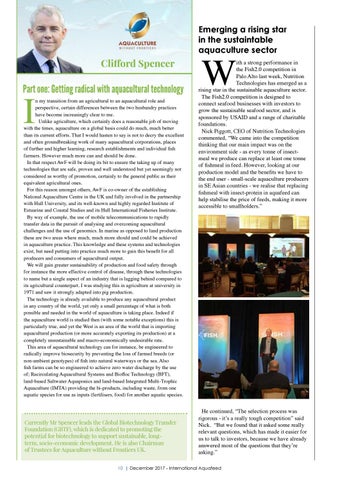
Emerging a rising star in the sustaintable aquaculture sector
Clifford Spencer
I
Part one: Getting radical with aquacultural technology n my transition from an agricultural to an aquacultural role and perspective, certain differences between the two husbandry practices have become increasingly clear to me. Unlike agriculture, which certainly does a reasonable job of moving with the times, aquaculture on a global basis could do much, much better than its current efforts. That I would hasten to say is not to decry the excellent and often groundbreaking work of many aquacultural corporations, places of further and higher learning, research establishments and individual fish farmers. However much more can and should be done. In that respect AwF will be doing its bit to ensure the taking up of many technologies that are safe, proven and well understood but yet seemingly not considered as worthy of promotion, certainly to the general public as their equivalent agricultural ones. For this reason amongst others, AwF is co-owner of the establishing National Aquaculture Centre in the UK and fully involved in the partnership with Hull University, and its well-known and highly regarded Institute of Estuarine and Coastal Studies and its Hull International Fisheries Institute. By way of example, the use of mobile telecommunications to rapidly transfer data in the pursuit of analysing and overcoming aquacultural challenges and the use of genomics. In marine as opposed to land production these are two areas where much, much more should and could be achieved in aquaculture practice. This knowledge and these systems and technologies exist, but need putting into practice much more to gain this benefit for all producers and consumers of aquacultural output. We will gain greater sustainability of production and food safety through for instance the more effective control of disease, through these technologies to name but a single aspect of an industry that is lagging behind compared to its agricultural counterpart. I was studying this in agriculture at university in 1971 and saw it strongly adapted into pig production. The technology is already available to produce any aquacultural product in any country of the world, yet only a small percentage of what is both possible and needed in the world of aquaculture is taking place. Indeed if the aquaculture world is studied then (with some notable exceptions) this is particularly true, and yet the West is an area of the world that is importing aquacultural production (or more accurately exporting its production) at a completely unsustainable and macro-economically undesirable rate. This area of aquacultural technology can for instance, be engineered to radically improve biosecurity by preventing the loss of farmed breeds (or non-ambient genotypes) of fish into natural waterways or the sea. Also fish farms can be so engineered to achieve zero water discharge by the use of; Recirculating Aquacultural Systems and Biofloc Technology (BFT), land-based Saltwater Aquaponics and land-based Integrated Multi-Trophic Aquaculture (IMTA) providing the bi-products, including waste, from one aquatic species for use as inputs (fertilisers, food) for another aquatic species.
Currently Mr Spencer leads the Global Biotechnology Transfer Foundation (GBTF), which is dedicated to promoting the potential for biotechnology to support sustainable, longterm, socio-economic development. He is also Chairman of Trustees for Aquaculture without Frontiers UK.
W
ith a strong performance in the Fish2.0 competition in Palo Alto last week, Nutrition Technologies has emerged as a rising star in the sustainable aquaculture sector. The Fish2.0 competition is designed to connect seafood businesses with investors to grow the sustainable seafood sector, and is sponsored by USAID and a range of charitable foundations. Nick Piggott, CEO of Nutrition Technologies commented, “We came into the competition thinking that our main impact was on the environment side - as every tonne of insectmeal we produce can replace at least one tonne of fishmeal in feed. However, looking at our production model and the benefits we have to the end user - small-scale aquaculture producers in SE Asian countries - we realise that replacing fishmeal with insect-protein in aquafeed can help stabilise the price of feeds, making it more accessible to smallholders.”
He continued, “The selection process was rigorous - it’s a really tough competition” said Nick. “But we found that it asked some really relevant questions, which has made it easier for us to talk to investors, because we have already answered most of the questions that they’re asking.”
10 | December 2017 - International Aquafeed
Bßhler – gentle processing at its best. From raw material handling, cooking and shaping through extrusion to drying and coating of finished products. With an extensive know-how and a passion for quality we ensure product uniformity, production efficiency, and maximum sanitation and safety.
www.buhlergroup.com/aquafeed
Complete solutions from a single source. Aquafeed
Innovations for a better world.
FEATURE
Is flymeal the new fishmeal?
I
by Nick Piggott, CEO & Co-Founder, Nutrition Technologies
Oil and powder
of options in the alternative protein sector, such as micro-algae, t’s no secret that the global population is growing single-celled organisms and insects, which all have significant rapidly, with recent predictions that we will reach advantages over traditional ingredients. 9.1bn people as soon as 2050. It is also well Of the three, insect products have shown the most promise, and documented that much of this population growth is gained the most traction, with extensive research taking place happening in less developed countries - countries at both academic and strategic industry levels. Companies like which are also becoming wealthier (see chart). Nutrition Technologies in Asia, and others in Europe & America, As incomes and levels of education increase, the are working with a global manufacturers, dedicating burgeoning middle classes in these resources to finding, testing and supporting countries are spending more money Nutrition Technologies analysis of BSF amino insect-based protein products. But the real proof on food, and in particular, meat & fish. According acids of the pudding is in the investment – and with to the FAO, annual production is projected to Amino acid mg/g over US$117m USD flowing into insects-as-feed increase from 218 million tonnes in 1997 to 376 Methionine 5 businesses since 2014, the investors have clearly million tonnes by 2030. Lysine 29 picked their horse. This presents a huge opportunity for both Leucine 36.2 aquaculture producers and feed manufacturers, but it’s not going to be easy. 70 percent of the world’s A world of insect potential Isoleucine 27.8 annual agricultural production (including 348 There are over 900,000 distinct insect species, Histidine 13.7 million tonnes of soybeans) is already dedicated to and at any point in time it is estimated that there are Phenylalanine 17.5 feed production, and we are quickly running out of some 10 quintillion (10-18) individual insects alive. Valine 38.7 land to cultivate it. But not all insects are created equal, and there are L-Arginine 31.1 Equally, the supply of marine fishmeal, the clear advantages in producing certain species over Threonine 17 mainstay protein ingredient of many aquafeeds, has others. Nutritionally, crickets, mealworms and fly Tyrosine 26.6 stagnated in recent years, and as a result the price larvae offer the best value. Aspartic Acid 33.2 per tonne has skyrocketed, with little expectation of For example, farmed Black Soldier Fly Larvae Serine 17.3 recovery (see chart). So what next? (Hermetia illucens) typically consist of >50 percent The solution is not simply to find ways to Glutamic Acid 47.4 crude protein (dry matter), with a well-balanced produce more, but instead we need to use resources amino acid profile (see table). Black soldier fly Glycine 22.6 more efficiently, and more effectively. For one, we larvae have been cultivated on a small-scale for pet Alanine 20 can start seriously considering the growing number reptiles and amphibians for years, thanks to their 12 | December 2017 - International Aquafeed
FEATURE
high calcium and phosphorous content, a fact that hasn’t been missed by researchers and animal nutritionists. Unprocessed Black soldier fly larvae typically have a 25 – 35 percent fat content depending on their feedstock – generally too high for direct feed applications. However, after partial de-fatting this reduces down to around eight percent, bringing the protein content of the Black soldier fly larvae press-cake up to 65-68 percent crude protein, so when dried and powdered, its physical properties and nutrient profile are comparable to prime fishmeal. Researchers and nutritionists are excited by the similarities, with fishmeal replacement studies taking place on a whole range of species including; turbot, salmon, seabass, shrimp, and tilapia. Adult flies on leaves Research generally indicates that modest fishmeal replacement rates (under 50%) can deliver equal or improved growth performance, and in some instances low inclusion rates (2-5%) may significantly improve growth improve performance, due to the added functional benefits of the insect protein and minerals.
The thinking behind this is that insects - and flies in particular make-up a small but significant part of fish diets in the wild. For exactly that reason flymeal represents more than just a simple fishmeal substitute, a job that is being done by poultry-meal and
A warm welcome to
Aquaculture America 2018 Las Vegas - Nevada, US February 19 - 22 Bringing all Players to the Table
S P E C I A L I S T I N S Q U A R E S I L O S All info: www.was.org For tradeshow and sponsorship: mario@marevent.com International Aquafeed - December 2017 | 13
www.ts c -s i l os .c om
FEATURE
other meat by-products. Yes, the protein-replacement opportunity is attractive, as is the amino acid profile, but it’s the research currently ongoing around functional benefits which could enable flymeal products to command a premium over fishmeal.
A solution to food waste
An FAO study estimates that one third of all food produced is wasted– a staggering 1.3bn MT every year. This occurs right along the supply chain, from spoilage getting to market, in processing, shelf-life expiry and from food left on plates. Not only is this expensive – costing around US$100bn annually, but it can be hugely damaging to the environment if not dealt with responsibly – with nutrient runoff from landfills frequently blamed for eutrophication of water sources, and subsequent damage to aquaculture businesses. Black Soldier Fly larvae have been touted as a possible solution – recycling nutrients from food-grade, ex-factory sources into high quality ingredients for aquafeed. Physiologically, BSFL grow faster than either mealworms or crickets, reaching pre-pupal stage (harvesting stage) 12 days after hatching, so the physical footprint and infrastructure required for commercial production of BSFL is much smaller than for crickets or mealworm. As a survival strategy, BSF consume their entire lifetime supply of energy and nutrients in the larval stage, eating continuously, so at the time of harvesting (before they pupate into flies) they are chock-full of proteins and oils. This quirk of evolution means they can be farmed very efficiently, allowing commercial producers to deliver a costeffective protein product. The nutrient profile of the larvae also reflects the profile of the feedstock, meaning that by carefully controlling the feed in different production lines, BSFL producers can produce highly targeted species-specific products.
Nutrition Technologies, a South East Asian BSFL producer and recent finalist in the global Fish2.0 competition, is currently engaged in research on the potential to enrich fish feed with bioactive compounds from plant material by feeding it to the larvae. If the results are positive, there is huge potential for using larvae to deliver other compounds, such as vaccines and other health promoting substances. Recent efforts to reduce the amount of fishmeal in diets, including the HeroX Fish Free Feed Challenge (which ended in September 2017) have made significant improvements in FIFO ratios and reduced production costs. However, this has sometimes been to the detriment of fish health. Recent outbreaks of disease in tilapia in Thailand have been blamed on higher inclusion of soybean meal in feed, replacing animal proteins. There is also a concern over the palatability of feeds which contain lower levels of fishmeal, with many carnivorous fish simply failing to recognise it as food, leading to lower FCR, reduced water quality, and poor health outcomes. It has been suggested that the non-essential amino acid glutamic acid may be the key to fishmeal’s palatability, so identifying alternative sources could be a quick way to reduce this dependency. The strong, rich smelling BSFL protein contains high levels of glutamic acid, and this suggestion is supported in recent trials with BSFL. One of Nutrition Technologies’ current research projects is testing the hypothesis that low levels of BSFL inclusion will enable nutritionists to further reduce the level of fishmeal in the formulation. So is flymeal a silver bullet for aquaculture? Not yet, as there is still a lot of work to do, but it is a huge step in the right direction. And as the demand for sustainability, quality and traceability is growing globally, the businesses that will benefit are those that can provide quality products at a competitive price. The current crop of flymeal producers are promising to do just that.
14 | December 2017 - International Aquafeed
You invest, they digest.
FORMULATE MORE WITH LESS Nutriad’s aqua team designed a unique range of functional feed additives to enhance digestive and metabolic processes. Species-specific solutions such as AQUAGEST® as well as a complete range of natural emulsifiers like LIPOGEST and AQUALYSO. They offer more options on ingredient choice, improving protein efficiency and creating a more sustainable aquafeed with less environmental impact. We would like to share our in-depth knowledge and hands-on experience with you. It’s good for you, and great for your fish and shrimp.
Interested? Find your local contact at nutriad.com
FEATURE
Insect-based meal
B
success for Barramundi and White leg shrimp by Anne Deguerry, Entofood, Malaysia
y 2050, the worldwide population will rise from 7.2 billion of today, to 9.6 billion people. There will be at least 30 percent more mouths to feed. The question is, how will we feed them? The answer is, new sources of protein are needed. Insects for animal nutrition, especially Hermetia illucens species, known as ‘Black Soldier Fly’ have been studied since the 70s. But optimal economic conditions to use insect meal as an alternative protein have just arisen. The macroeconomic data shows an increase of animal protein production and consumption: World Bank forecasted aquaculture production to double by 2050. At the same time, an opposite trend shows a decrease of the global marine fish stocks, which underpinned a steady growth in commodity prices, especially fishmeal. To keep up with the rising demand, new sources of alternative and sustainable proteins are needed. The global aquafeed market is the fastest-growing segment
of the agriculture and animal feed industry. There are multiple factors, but wealthier economies imply significant dietary changes with nutrition transition showing a higher consumption in animal-source food. On the other hand, some countries show a very high foreign trade dependence on commodities such as soybean or fishmeal. Insect biotechnology provides a very interesting model of circular economy and allows local or regional protein production, closer to the users, enabling a proximity approach.
How does it work?
Insects are farmed in a controlled environment using traceable raw materials, which are not in competition with livestock/ human nutrition. Adult flies are meant to mate, to spawn and to die. The larvae do the bioconversion, fed with co-products from the agro-industry. Within 10 days, the hatched eggs will turn into adult larvae that can be harvested and processed into insect-based products. Once the larvae have digested all the bio waste, the leftover is an organic fertiliser for plant nutrition. Everything is valorised in the process, along with low land and water footprints. The company Entofood was set up in Malaysia in 2012 to farm the Black Soldier Fly species; a tropical insect, in a tropical country. Whole and defatted meals produced by Entofood have been included in test diets for various species, such as chicken (broilers and layer hens), fish (barramundi, salmon, tilapia, grouper) and shrimp (white leg shrimp, Penaeus vannamei and the blue shrimp, Penaeus stylirostris).
Recent tests conducted on aquatic species: White leg shrimps - White leg shrimps (P. vannamei) farmed in semi-intensive conditions (12 individuals/m2) were successfully fed diets containing up to five percent whole Black Soldier Fly 16 | December 2017 - International Aquafeed
FEATURE
meal and up to 7.5 percent defatted meal (substitution of 50 percent and 75 percent fishmeal, respectively). The tests, conducted in earthen ponds (1.8 hectares) during 73 and 92 days, respectively, indicated that the performance (growth, FCR and survival) of the shrimps fed the test diets were not significantly different from those fed the commercial control diet (28 percent crude protein). These results suggest that higher inclusions of BSF meal can be achieved and further trials will be looking at replacing fishmeal completely in order to contribute to more sustainable farming practices. Carnivorous marine fish - Carnivorous marine fish are highly dependent on animal proteins. A trial was therefore conducted on barramundis (Lates calcarifer) farmed in cages for 56 days. Up to 33 percent fishmeal was successfully substituted with defatted BSF meal (15% inclusion), as the results indicated no significant
differences in growth, FCR and survival between the fish fed the commercial control diet and the test diets. The nutritional profile (in particular the amino acid profile) of the Black Soldier Fly meal is highly similar to fishmeal, and it is certain that this alternative feed ingredient is a great source of nutrients that will contribute to more sustainable farming practices. The need in alternative protein is proved. Insect biotechnology is not the only answer. Some interesting solutions emerged such as algae or bacteria culture. The sector cannot compete with vegetal protein in terms of volume of production. A medium term view of insect-based product is forecasted at 1.4 million metric tonnes a year, whereas annual soybean production is more than 300 million metric tonnes. Nevertheless, as the need for alternative and sustainable protein sources becomes more acute, the insect protein sector will keep momentum for its development.
Maximize capacity, conditioning, and control. WENGER’S AQUAFLEX XT HIGH CAPACITY EXTRUDER When maximum volume matters, the Wenger AQUAFLEX XT High Capacity Aquafeed Extruder is the choice, processing up to 12,000 kg/hour. Equipped with either our High Shear Conditioner (HSC) or High Intensity Preconditioner (HIP), the AQUAFLEX XT is ideal for aquatic feeds as small as 0.5 mm. Precise control of finished product density delivers either high capacity floating or sinking feeds. Know more about the industry-changing designs and customized options of AQUAFLEX. Email us at info@wenger.com today.
PHONE: 785.284.2133 | EMAIL: INFO@WENGER.COM | WENGER.COM USA
|
BELGIUM
|
TAIWAN
International Aquafeed - December 2017 | 17
|
BRASIL
|
CHINA
FEATURE
Algotherapy in aquaculture production
T
by MJ van Schoonhoven, Olmix, France
here are many beauties to be found in the world, but one of the true treasures is provided by the seas in the form of algae. Algae can be divided in microalgae and macroalgae, the later more commonly known as seaweeds. Seaweeds are a very diverse group of aquatic plants, which can be divided into three main categories: green, red and brown seaweeds, each of them with their own distinguishing set of polysaccharides. When looking at the composition of seaweeds, they contain a variable part of carbohydrates (mainly polysaccharides), proteins, minerals, lipids and vitamins. Nutritional studies on marine algae indicate that green, brown and red seaweeds possess good nutritional characteristics and could be used as an alternative
source of dietary fibre, protein, vitamins and minerals (Chojnacka et al., 2012; Raposo et al., 2013). In addition, detailed screening of macroalgae functions revealed new ranges of biological activities including anticoagulant, antiviral and antibacterial, anti-tumoral, antiproliferative and immuno-modulatory activities. All of them could be of relevance in nutraceutical functional food (Wijesekara et al., 2011a). Green, brown and red macroalgae cell walls contain large amounts of sulphated polysaccharides, named ulvans, fucoidans and carrageenans respectively, making up from four to 76 percent of seaweed dry weight (Holdt et al., 2011). The high content of these sulphated polysaccharides, their unusual structure, and their biological properties shed a new light on these compounds as promising natural products for medicinal and dietary applications (Rioux et al., 2007; Laurienzo et al., 2010).
Figure 1: Mode of action of MSPIMMUNITY
18 | December 2017 - International Aquafeed
FEATURE
BALANCE IS EVERYTHING!
Above: Figure 2. Mortality rates of PLs submitted to three stress challenge tests
The specificity of these algal sulphated polysaccharides stands in the complexity of their structure. Algal sulphated polysaccharides are branched, in contrast with linear polysaccharides like cellulose, which contains only one type of linkage between sugars. Also, algal sulphated polysaccharides are composed of various, including rare, sugar units (xylose, rhamnose), unlike homopolysaccharides, like starch, which are exclusively composed of glucose units. Finally, these sugars can be sulphated, conferring them a special reactivity. The whole of these parameters show a phylogenic similarity with polysaccharides from the animal kingdom such as heparin, known for its numerous biological properties, thus explaining algal sulphated polysaccharide unique activities. Algal sulphated polysaccharides reactivity, hence their biological properties, varies a lot according to the type of sugars and linkages they contain, their level of sulfation and also their molecular weight. Therefore, several sulphated polysaccharide groups, with distinct biological activities, can be found in algae. Their specific extraction is a key to ensure a targeted effect on animals. Olmix has been studying marine biotechnologies for more than 20 years and has focused in the past 10 years on the extraction and use of specific algal polysaccharides to the service of animal production challenges. One of the polysaccharides isolated from marine macroalgae has been found to have applications supporting animal health.
BiolexŽ MB40 – effective MOS for: Active support and relief of the immune system High bonding power & inactivation of pathogens/toxins in the intestinal lumen Prebiotic effects on the microflora in the intestine
leibergmbh.de
International Aquafeed - December 2017 | 19
FEATURE
Figure 4. Cummulative mortality of PLs submitted to a challenge test with EMS causing Vibrio parahaemolyticus bacteria
Figure 3. Survival rates of tilapia juvenile submitted to a transport stress test
Algae extracts to support natural defences
Olmix has extracted identified, and patented an algal polysaccharide with immunomodulating properties, named MSPIMMUNITY. It has been the subject of several studies conducted by the French National Institute of Agronomic Research (INRA). Tested in vitro, using an intestinal epithelial cell line (IPEC-1), MSPIMMUNITY stimulated the expression of many immune mediators (Berri et al., 2016), via the activation of Toll-like Receptors (TLR) (Figure 1). The diversity of cytokines and chemokines that were up regulated by MSPIMMUNITY suggests that the algae extract is able to stimulate both cellular-mediated and humoral immune pathways, involved either in innate (macrophages, neutrophils) or adaptive (T and B cells) immunity. Searup, a liquid commercial product was formulated with MSPIMMUNITY as its main ingredient and tested in vivo through field trials, by coating onto feed pellets prior to feeding fish and shrimp. Feedback from the field included positive results against pathogenic pressures in common carp, trout and white leg shrimp production. Farms from various parts of the world, reported improved survival and growth. This feedback from the field is now being confirmed under controlled conditions through stress tests and pathogenic challenge tests.
Stress challenge in tilapia and white leg shrimp
A transport stress test was conducted on Nile tilapia. An earthen pond was installed with 40 x 1m2 hapas. Half of the hapas were stocked with 1,200 0.25g (1 inch) Nile tilapia for pre-packing. The other 20 hapas were not stocked until after transport stress test. During pre-transport nursery, the fish were fed for a period of five days at a rate of three times per day. After five days, 800 fish from each treatment were packed in plastic bags and left for a period of 16 hours overnight in order to give the fry significant stress to the point that the onset of mortality was imminent. The following day the bags were opened, the fish counted and divided into two hapas for a sevenday nursery period. Total numbers of live fish were recorded in each hapa, after opening the bags and seven days after nursery. Searup, including the MSPIMMUNITY, was fed at a rate of 0.2 percent on the feed for a duration of five days prior to packing. Surviving fish after transport were divided into post-transport hapas. Results show (Figure 3) that immediately after the transport stress there is no difference in survival rates, however seven days later there is a 7.7 percent increase in survival for the
MSPIMMUNITY treated fish. These results suggest MSPIMMUNITY can help fish deal with the stressful period of handling at the hatchery, transport and release in grow out ponds, giving tilapia a stronger start to the grow out period. Follow up trials are on their way testing fish performance in challenge conditions. In a different trial, shrimp PLs were reared in four different tanks and received three different application treatments, of three, five and seven consecutive days of Searup (containing MSPIMMUNITY) coated feeds prior to the different stress tests. From each tank one, two, three and four were distributed in to four separate 30L tanks (stocking density 500PLs/tank) and submitted to an anti-stress test (at stage PL12) by being shocked with different levels of salinity (10ppt and 30ppt) and formalin (100ppm). Mortalities of PLs were recorded after 3h, 6h, 9h and 24h exposure to salinity and formalin stress. Results (Figure 2) show that PLs in the control groups have a faster and higher mortality rate when submitted to any of the three stress challenges, when compared to the treatment groups. Also, there is a dose dependent increase in tolerance to the stress challenges. In a follow up trial, shrimp were reared in four tanks: control group and three different treatments consisting of three, five and seven days of 0.1 percent Searup (containing MSPIMMUNITY) coated feeds prior to the challenge test. PLs from each tank one, two, three and four were distributed in to four separate 30L tanks (stocking density 500PLs/tank) at stage PL25 and submitted to an immersion challenge with EMS bacteria (Vibrio parahaemolyticus). Mortalities were recorded daily for a period of 15 days. Results (Figure 4) show that the positive control, where PLs did not receive MSPIMMUNITY prior to the challenge test, had a cumulative mortality of 50 percent. MSPIMMUNITY treated groups showed a dose dependent improvement of survival where seven consecutive days of application increased survival rates to 70 percent. In both shrimp and fish, MSPIMMUNITY is showing improved survival rates when the animals are subjected to stress and pathogen challenges. MSPIMMUNITY, a specific extract from naturally harvested seaweeds, plays a significant role in strengthening animal health. These results are encouraging in the further development of other extracts, which play a role in lipid metabolism and mucine production in epithelial cells.
20 | December 2017 - International Aquafeed
FEATURE
Photo 2: Micrographs of Thalapure cells in concentrated paste (left), dried (central) and rehydrated (right) powder. Note: chloroplasts (principal nutritional components of diatom cells) are evenly distributed inside live cells (left); chloroplasts are densely aggregated inside dried cells (central); the content is evenly redistributed inside rehydrated cells (right).
Reducing dependence of hatcheries on on-site production of microalgae
T
by Victor Chepurnov, PhD, William van der Riet & Marc Temmerman “Since most artificial substitutes are inferior to live microalgae as feed for the critical stages in the life cycles of several aquacultural species, a growing demand for microalgae will go hand in hand with the expected growth of aquaculture throughout the world.” (Richmond 2007)
halapure Shrimp is a microalgaebased product recently developed by Tomalgae CVBA (Belgium, a Benchmark company). Our development is based on decades of experience in experimental studies of microalgae and their mass cultivation, with special emphasis on diatoms (Bacillariophyceae). Rigorous analysis of the history and current state-of-the-art in the practical field identified as “microalgae for aquaculture”, have allowed us to conclude that despite the fact that “microalgae cultivation has been integral to modern forms of aquaculture for more than 40 years” (Shields & Lupatsch 2012), the experience accumulated is largely empirical rather than science-based leaving a lot of opportunities for improvement. Our approach is focused, and the focus is on diatoms. At shrimp hatcheries, diatom cultures have become the principal (sometimes, the only) live feed to supply the earliest stages of larval development (zoeae). More precisely, these are a very limited number of species belonging to genera Thalassisosira and Chaetoceros. “Algae are at the base of the entire aquatic food chain… Therefore, it is not surprising that the microalgae which compose the phytoplankton play a vital role in the rearing of aquatic
animals like molluscs, shrimp, and fish, and have a strategic interest for aquaculture” (Muller-Feuga 2000). Diatoms are the most productive and taxonomically diverse group of marine phytoplankton. They are the principal food source for zooplankton including early planktonic filter-feeding stages of shrimp. ‘Trophic compatibility’ (ingestion, digestibility and sufficiently balanced nutritional quality) of shrimp larvae and diatoms can be explained by millions of years of their coevolution where diatoms have been serving as principal food for shrimp larvae in nature. “Presently, most aquacultural enterprises produce (albeit with only limited success in many cases) their own supply of microalgae. Since the algal cultures can be often fed directly to the feeding animals, eliminating thereby the necessity for harvesting and processing, such rather small scale on-site production makes economic sense” (Richmond 2007). However, “mass production of micro-algae has been recognised as a major bottle-neck to many forms of marine hatchery and nursery production… The problem of high costs of individual hatcheries producing their own algae is compounded by the need of scarce expertise, without which crashes of algae at critical periods occur quite commonly” (Heasman et al. 2001). Theoretically, stability and productivity of microalgae cultures grown on-site could be improved (but still not drastically; see for example Benemann 2013, for more detailed explanations).
22 | December 2017 - International Aquafeed
FEATURE
These would require much better control of abiotic and biotic environments. However, simultaneously this would imply essentially more investment in microalgae. Nowadays, for most shrimp hatcheries, this is an unrealistic scenario.
What are the solutions?
Photo 4: Microscopic examination of larvae fed exclusively with Thalapure. Note: long uninterrupted faecal strings (upper) illustrating efficient ingestion of the product; hepatopancreas (lower, left) and midgut (lower, right) contain numerous digestive vacuoles indicating active digestion and healthy condition of larvae.
Inevitably, all these algae-related challenges have permanently been inducing a search for alternatives to on-site microalgae cultivation. One of the most obvious solutions would be production of desirable microalgae at specialised facilities. This idea is not new. However, “centralised microalgal facilities which sell (for a high price) frozen pastes or highly concentrated refrigerated stock cultures cover at present only a small part of the aquacultural demand for live microalgae” (Richmond 2007). Also, even if preserved microalgae are available, there is still no guarantee their quality will satisfy the customer. It is a very common situation: “Commercial marine hatchery operators throughout the world have tried and discarded substitutes for live micro-algae” (Heasman et al. 2001). Here, modest achievements and slow progress could be explained through various reasons, among which the most essential are: selection of ‘wrong’ species (easy to grow but insufficient nutritional composition), loss of quality during the processing (cell integrity, PUFAs, carotenoid pigments), inappropriate methods of conservation, short shelf life and expensive storage (if refrigerating or freezing). Planktonic diatoms are among microalgae that are difficult to cultivate sustainably in large scale, concentrate (cell integrity issue) and preserve (richness with PUFAs which are highly unstable biological compounds). To develop a diatom-based nutritional product, Thalapure Shrimp, the Tomalgae team have
Your partner in top-quality ring dies for all pellet press brands
Extruders and Expanders
info@almex.nl
A Triott Company
Almex extruders are used for : » Pet Food extrusion » (floating) Aquafeed extrusion » Animal Feed extrusion » Oil seed extraction » Cereal processing extrusion » Compacting » Pre-conditioning prior to other processes
www.almex.nl International Aquafeed - December 2017 | 23
WWW.PCE.EU
FEATURE
found and employed a series of innovative solutions at various stages of cultivation and manufacturing processes.
Step 1: Selecting a suitable microalgal ‘cultivar’
The cultivar chosen was a ‘thalassiosiroid’ planktonic diatom (our original strain isolates) taxonomically closely related to Thalassiosira weissflogii and morphologically (cell size and shape) almost identical to it. The choice was not accidental since nowadays Th. weissflogii is apparently the most common and ‘popular’ diatom species cultivated at shrimp hatcheries worldwide to feed shrimp larvae. The precise species name of our diatom cultivar is not publicly available, and the reason for this is to avoid ‘terminological’ confusion, however they can be provided to our customers on request. The results of recent molecular phylogenetic analysis have shown the species requires rigorous taxonomic revision, with possible description of several new species that are now identified as a single species. Currently we specify our strains as ‘Thalapure diatom cultivar’. Previously there was no experience of its sustainable mass production. Key attributes of the diatom to be suitable for shrimp larvae feeding (the zoea stage) are ‘in place’: an appropriate size for ingestion (less than 10 µm in valvar size), readily digestible, high nutritional profile (including omega-3 polyunsaturated fatty acids (PUFAs), EPA and DHA) and absence of toxins. Accuracy in control of cell size and cell morphology, constant generation of well-performing strains originating from the initial isolates became possible after a cultivar-specific breeding program (via controlled intra- and interclonal sexual crosses) was established (for more insights and understanding the principles, see Chepurnov et al. 2004, 2012).
Step 2: Establishing sustainable, cost-efficient largescale cultivation
The cultivation is carried out in paddle wheel mixed raceway ponds inside a greenhouse (photo 1). Sustainability in production is possible due to control and optimisation of key environmental parameters as light (automatic screening to avoid light inhibition effect, artificial light for smaller propagation ponds), temperature (heating during winter season), CO2 supply and pH stabilisation. However, a truly crucial and positive impact upon stability of our mass production was provided by profound understanding of biotic problems (unwanted algae, microscopic grazers and parasites) and development of efficient methods of their elimination. “The first requirement, the stability of the algal cultures, means that they must withstand invasion by all types of pests and diseases. Without the management of such biotic challenges, all other issues become moot” (Benemann 2013).
Step 3: Downstream processing
It includes harvesting, pre-concentration, centrifugation, freeze-drying, milling the powder and packaging. Since the very beginning, we clearly realised that, from hatchery perspectives, key desired attributes for microalgal concentrates (freeze-dried algal powder in our particular case) are as follows. The cells keep their integrity (photo 2), preserve their original nutritional quality, can be easily and uniformly re-suspended in water, possess neutral buoyancy, remain free from pathogens, have acceptable shelf life, appropriate packaging, simple storage conditions and shipping methods (e.g. Heasman et al. 2001, Shields & Lupatsch 2012). Thalapure complies with these criteria. The most challenging task was to find a method to avoid damaging the cells during
Photo 1: Microalgae cultivation using paddle wheel mixed raceway pond systems at Tomalgae CVBA.
centrifugation (photo 2). Diatom cells are enclosed in siliceous exoskeleton (called a frustule), which is very fragile. In addition, the application of the freeze-drying method has an impact on efficient preservation of PUFAs (which Thalapure is rich with). There is no need to use chemical protectants. Shelf life is prolonged (years), without special requirements to storage conditions (roomtemperature (20-25°C) appears to be the most appropriate). Thalapure powder is packed in sachets, 20g each (photo 3). This is c. 60 billion of preserved intact cells (photo 2) per sachet that is equivalent to 300–600L of Th. weissflogii cultures (in the range 100 000 – 200 000 cells per ml, usual densities of cultures ready for adding into larval rearing tanks). Thalapure is produced under GMP+ feed safety standards (Good Manufacturing Practices + HACCP) secured in Tomalgae’s ISO 9001 quality management system.
Step 4: Preparation of the product for usage (direct feeding of larvae in rearing tanks)
The process of preparation, i.e. reintroduction of powder into the water, implies formation of high cell density suspension in 1-1.5L of water. To keep the cells intact (photo 3) and to achieve uniform distribution of cells in suspension, the use of a blender is obligatory. It is very important to add the powder already into turbulent (not calm!) water, i.e. first put the blender ‘on’ and then gradually add the powder into the container. The method comprises two principal stages. In the first few seconds of blending, the cells are rehydrated (photo 2) and the water quickly enters the cells and simultaneously air escapes out of these. Then, the next two minutes are required to achieve uniform re-suspension of the particles in the concentrate. If the powder is added in the water
24 | December 2017 - International Aquafeed
FEATURE
before the blender is ‘on’, i.e. in calm water, rehydration occurs differently and may result in loss of integrity by many cells.
Step 5: Regimes of feeding
After blending, the suspension is ready to be added directly to larval rearing tanks. A decision on how much rehydrated material should be used is based on the same principles for live algae, on establishing and maintenance of suitable cell densities. Typically, for live microalgae, the density is adjusted by adding the culture one to two times per day. Considering that Thalapure is a ‘non-live’ microalgal product, it would be recommended to feed larvae with Thalapure more frequently, four to six times per day, to keep supplying the larvae with freshly prepared material. We have accumulated extensive experience in usage of our product in various countries. Efficient ingestion and ready digestibility of Thalapure cells by larvae are shown on Photo 4. Outcomes were always positive when the users undertook a careful approach applying Thalapure in combination with live algae gradually replacing up to 50 percent of these. Available experimental data has also illustrated that substitution of live algae with Thalapure is not impossible but here further research is still required to develop a reliable protocol.
Future perspectives
While the practical experience was accumulated, we have started to receive a feedback from ‘long-term’ users of Thalapure who independently discovered further applications of the product (not only as feed for the zoea stage), in accordance with specific conditions and requirements of their hatcheries. With slight modifications, Thalapure was recently applied successfully as feed for larvae at shellfish hatcheries. Finally, an obvious opportunity exists to manipulate biochemical profile of the product via loading the cells with various biologically active molecules during rehydration (largely predetermined by specific properties of the siliceous exoskeleton of cells of our cultivar). This is a patented technology, which we believe will soon diversify essential applications of Thalapure at hatcheries of shrimp and other economically important aquatic animals. References available upon request Photo 3: A unit of Thalapure Shrimp containing 20 sachets, each with 20g of the product.
Optimizing ingredient flexibility starts with innovative thinking. C-community AARSEN7003
Precision feed production. Healthy business.
Optimized flexibility, accuracy and efficiency in fine dosing There is a rapidly increasing demand for tailor-made feed. This challenges feed manufacturers and integrators to successfully deal with the dosing of an increasing number of different ingredients in small quantities. Van Aarsen offers a combination of Small, Micro, and Precision Ingredient Dosing Systems as a solution for achieving optimum accuracy for many different and often expensive ingredients. The combination of several individual dosing units allows producers to simultaneously weigh out several micro-ingredients, thereby not only ensuring the required accuracy but also speeding up the entire weighing and dosing process.
www.aarsen.com/machines/dosing-units
2017-10-31, Adv. DOSING_Miling and Grain 190x132mm.inddInternational 1
Aquafeed - December 2017 | 25
31-10-17 15:18
FEATURE
INVESTING IN FOOD SAFETY Anyong Biotechnology, which was invested in by Topco Scientific in response to food safety crises, aims to build a comprehensive food safety system incorporating production and sales.
by Zasha Whiteway-Wilkinson, International Aquafeed, in collaboration with Anyong Biotechnology
26 | December 2017 - International Aquafeed
A
FEATURE
nyong Biotechnology has spent NTD600 million (US$19.88 million) to ensure that its food safety system abides by the high standards of the technology industry. Production lines in Anyong’s world-class seafood processing plants in Mituo, Kaohsiung, are certified by ISO22000 and HACCP as high quality. Each batch of products is strictly examined by the AnyongFresh food safety center, imposing stringent management from farm to table. In order to duly preserve the freshness and rich flavors of Taiwanese products, Anyong Biotechnology introduced CAS, Cells Alive System, from Japan.
Fully preserving nutrition and freshness
The technology, awarded as one of the three major innovations in Japan in 2008, can fully preserve the nutrition and freshness of ingredients and has no parallel in the market. Giant groupers supplied by Anyong, won the Excellent Aquatic Award presented by the Fisheries Agency for two consecutive years based on its outstanding quality. The New Mituo Plant is expected to be completed by Q1 2018. This plant will provide a more meticulous production environment, advanced production facilities, professionally trained staff and aquatic food processing technology of the highest standard to customers at home and abroad. The three-story new plant, built by Anyong Biotechnology, covers an area of 1000 ping (3306 square meters) with floor areas totalling 1800 ping (5950 square meters). It will have monthly capacity of over 100 tons in both scaled, gilled and gutted whole fish and sliced frozen products, contributing to the stability and prosperity of the fishing industry in Southern Taiwan. By contracting with quality farmers, the company can impose quality control throughout the production line, including hatching, feeding and breeding, to reassure the consumers of product quality. In addition to complying with ISO22000 and HACCP standards, the New Mituo Plant also introduces frozen food processing technology that incorporates the specification of a clean room. The process is maintained in a constant temperature and controlled by micro-computers, and exclusively applies the CAS from Japan. Compared with ordinary flash freezing technology, the New Mituo Plant’s process can guarantee 100 percent preservation of freshness and nutrition, so that food materials or meat can be tender, lustrous and juicy after being unfrozen. To ensure the safety of products, a food safety center is established in the plant to perform aerobic plate counts and test residues of antibiotics and other drugs. The New Mituo Plant automates its production process completely. It applies RO filtered water to process the food materials, acidic water for cleansing and alkaline water for production processes. Water temperature in working areas is kept between 4°C and 7°C to ensure freshness and inhibit bacterial growth, and natural seawater is drawn and applied during processing. The sterilisation process operates mainly based on an ozone system instead of chemical methods,
lowering the chance of chemical elements remaining in the food materials. The acidic water kills bacteria 80 times more efficiently than ordinary sterilisation liquids, does not harm human bodies or the environment and does not remain in the food. It is safe and causes zero pollution.
CAS: Preservation technology
The CAS ultralow temperature storage warehouse at the New Mituo Plant is the 3rd large-scale CAS storage warehouse in the world after those in France and Germany, and the 1st in Asia. It is embedded with 680 CAS oscillation alignment components. -25°C freezing warehouses can preserve around 500 pallets (450 tons) of aquatic products and -50°C freezing warehouses can preserve around 80 pallets (60 tons).
International Aquafeed - December 2017 | 27
FEATURE
"The New Mituo Plant contains the Anyong Food Safety Lab and implements a production and quality control system that incorporates production and sales, covering the whole process from farm to table"
CAS is a revolutionary Japanese invention. In 2008, the technology was awarded a Japanese grand prix in innovation, and many other honors by other countries. By applying this preservation technology to food without any chemical additives, Anyong Biotechnology can retain 100 percent freshness, nutrition and flavor of the food materials so that they taste freshly prepared after being unfrozen. The freezing center keeps the temperature under -50°C. When the water in the food materials is passing through the zone of ice crystal formation, the molecules are stilling vibrating because of the magnetic fields and low-frequency technology, so to avoid diminishing flavor due to damage of cell membranes by ice crystals.
Covering the whole process from farm to table
The New Mituo Plant contains the Anyong Food Safety Lab and implements a production and quality control system that incorporates production and sales, covering the whole process from farm to table. Since the initiation of the lab, aerobic plate
count, Escherichia coli, Staphylococcus aureus and VBN tests are performed everyday, along with a rapid screening of drug residues, specifically for malachite green, nitrofurans and a variety of antibiotics. In addition, a neutral third party institute is commissioned to conduct periodic examinations, such as SGS. Currently, the lab possesses testing ability for over 60 food related items, and continues to actively develop test items. Anyong Biotechnology now provides services in contracted aquatic product processing, such as freezing and preservations; retailing and wholesale of aquatic products, contracted procurement of raw materials, trade and exporting. In the future, the company will continue to develop businesses in agricultural and animal product processing, and gradually acquire world food certificates, such as the Halal certificate. At the same time, the company will actively explore overseas markets and export Taiwanese local flavors to Japan, the European Union, and the Middle East to promote Taiwan’s delicious “food” power.
28 | December 2017 - International Aquafeed
FEATURE
We have the largest work placement programme of any university in Ireland, with a network of over 1700 employers
The University of Limerick (UL) is a rapidly growing, modern university. UL is a young, energetic and enterprising university with a proud record of innovation in education, and excellence in research and scholarship. We take great pride in attracting students who are seeking a supportive learning environment to help nurture and achieve their personal and professional dreams. UL is highly regarded for conducting leading-edge research in key areas such as biological sciences, information and communication technologies, materials and surface science, environment & bioengineering and humanities & social sciences. Limerick is in western Ireland, an ideal starting point to explore the Wild Atlantic Way. Shannon International airport is only 24km away with frequent bus connections. Limerick, with an urban and hinterland population of over 200,000, has something to offer everybody thanks to its many cultural, historical, architectural, sporting, shopping and business activities. With almost 50 per cent of Limerick’s population under the age of 30, it is a vibrant, living, cosmopolitan city.
Amazing academic and sporting facilities on a stunning campus Graduate employment rates that are 18% above the Irish average
www.ul.ie
Containerised Mills outputs 3 - 45 ton/h
All components reliable and tested Assembled and checked in factory before dispatch Container sized support frame included All electric components included Low freight costs and easy handling Saving on civil & building cost Minimum installation time on site Proved concept with many outstanding references
Modular solutions for: › Compound feed production › Pet food › Aqua feed › Cereal processing plants › Soybean processing › Premix / concentrates plants Type: C30-15-15
www.ottevanger.com
International Aquafeed - December 2017 | 29
A Triott Company
» » » » » » » »
PHOTOSHOOT THE BIG PICTURE - GERMANY
A SENECT filter drum from inside. Microscreen drum filters are regarded as the state-of-the-art particle filtration technology in aquaculture applications. The main advantages of this technology are the fully automatised removal of solid waste - not only capturing the particles with manual backwashing - and the well-proven mechanical base design which makes drum filters ideal for applications with high flow rates. See more on page 38 Remember, this year photographers everywhere are invited to submit digital photographic work on the theme of ‘Create, Nurture and Grow Aquaculture’ to the International Aquafeed photo competition. Submissions are still being accepted for the foreseeable future, and some great prizes are on offer, including a Ipad Pro. For full detials visit: www.aquafeed.co.uk/photocomp17
EXPERT TOPIC ATLANTIC SALMON
1
Introduction by Zasha Whiteway-Wilkinson
ATLANTIC SALMON
EXPERT TOPIC
Wild Atlantic salmon only make up 0.5 percent of the Atlantic salmon available on the world fish markets due to extensive habitat damage and overfishing. Because and in spite of this, the fish is also the species most often chosen for farming. It is described as “easy to handle”, “grows well in cages”, “commands a high market value” and “adapts well to being farmed away from its native habitats. In 2007, 1,433,708 tonnes of Atlantic salmon were harvested worldwide with a value of US$7.58 billion. First, the adult male and female fish are anesthetised, then the eggs and sperm are “stripped”, when the fish are cleaned and cloth dried. The sperm and eggs are mixed, washed and placed into fresh water. The adults recover in flowing, clean, well-aerated water. The fry are generally reared in large freshwater tanks for 1220 months. Once the fish have reached the smolt phase, they are usually taken out to sea where they are held for up to two years. During this time the fish grow and mature in large cages. Generally, cages are made of two nets; inner nets which wrap around the cages, hold the salmon while outer nets, which are held by floats, keep predators out. According to the FAO, Atlantic salmon culture began in the 19th century in the UK in freshwater, as a means of stocking waters with parr in order to enhance wild returns for anglers. Sea cage culture was first used in the 1960s in Norway to raise Atlantic salmon to a marketable size. The early successes in Norway prompted the development of salmon culture in Scotland, and latterly Ireland, the Faroe Islands, Canada, the North Eastern
seaboard of the USA, Chile and Australia (Tasmania). Minor production also occurs in New Zealand, France and Spain. All of the major production areas lie within latitudes 40-70º in the Northern Hemisphere, and 40-50º in the Southern Hemisphere. Rapid increases in production has consequently led to falling prices, which in turn have put increasing pressures on producers to limit costs. Significant future expansion of the industry may rely on the development of offshore sites, according to the FAO, since most of the available suitable inshore sites are already in use, and because of increasing antagonism towards, and regulation over, further expansion in sheltered areas. In the news, Atlantic salmon farming has hit rough waters in Washington after the 19th District Representative Jim Walsh, along with Representative Drew MacEwen of Union, has introduced a bill to ban the practice Washington waters. This decision was reported by KXRO News who say that the legislation follows an incident in August, when a Cooke Aquaculture pen containing 305,000 Atlantic salmon collapsed, releasing an undetermined amount of fish into Puget Sound. They reported that according to a release from Mr Walsh, this was the fourth incident since 1996. After the occurrence, the Washington Department of Fish and Wildlife approved a permit for the company to handle one million more of the salmon at a different facility in Puget Sound.
32 | December 2017 - International Aquafeed
EXPERT TOPIC
ATLANTIC SALMON
COMPLETE FISH FEED PLANTS Up to 10t/h — Contrary to conventional extruders, the KAHL extruder OEE is equiped with a hydraulically adjustable die.
AMANDUS KAHL GmbH & Co. KG Dieselstrasse 5–9 · 21465 Reinbek Hamburg, Germany +49 (0) 40 72 77 10 info@akahl.de · akahl.de
WORLDWIDE CALENDAR 2017-2018 VIV MEA 2018
FEBRUARY 5-7, ABU DHABI, U. A. E.
VIV Europe 2018
JUNE 20-22, UTRECHT, THE NETHERLANDS
VIV Turkey 2017
VIV China 2018
JULY 6-8, ISTANBUL, TURKEY
SEPTEMBER 17-19, NANJING, CHINA
WWW.VIV.NET International Aquafeed - December 2017 | 33
POULTRY Africa 2017 OCTOBER 4-5, KIGALI, RWANDA
EXPERT TOPIC ATLANTIC SALMON
2
B
ATLANTIC SALMON
Beta-glucans reinforce the animals’ natural defences: What about over stimulation? by Fernando Roberti, Biorigin, fernando.roberti@biorigin.net
eta-glucans are part of a group of physiologically active compounds generally called as “biological response modifiers�, and have a long history as natural immunomodulators (Vetvicka et al., 2017). After their ingestion, beta-glucans pass intact by the mouth and stomach; once in the gut, these molecules are recognised by the surface receptors of leukocytes (Kiron et al., 2016) that produce cytokines, which will activate other immune cells. Some of the beta-glucan particles are phagocytosed by the leukocytes, broken in smaller and bioactive fractions, which will interact with other leukocytes in a systemic way. The balance between pro and anti-inflammatory cytokines, which is modulated by the beta-glucans, is responsible for adapting the immune system of the animals according to the biological condition. The capacity of balancing the immunological response is what characterises the beta-glucans as smart modulators of the immune system.
Evidences in terrestrial monogastrics
Since beta-glucans act primarily on immunity, questions on possible (over) stimulatory effects started to rise, especially because a constantly stimulated immune system could lead to an unnecessary waste of energy and chronic inflammation within the organism. In a study performed in piglets (Li et al., 2006), the animals of both control and supplemented (beta-glucans) groups were injected or not with LPS (4 treatments in total). The results show that upon the LPS challenge, beta-glucans led to a lower concentration of IL-6 (pro-inflammatory) and a higher concentration of IL-10 (anti-inflammatory) in comparison with the control group, showing a trend on the reduction of the inflammatory response. Moreover, in the piglets that were not injected with the LPS, beta-glucans led to a slightly higher concentration of IL-10 in comparison with the control group, while the IL-6
levels remained unchanged for both supplemented and not supplemented groups. In a further study performed with bitches (Zaine et al., 2014), the animals started to be fed with beta-glucans 14 days before a surgical procedure (ovary hysterectomy). Results show that, 14 days after the surgery, the supplementation led to higher leukocytes counts and lower levels of C-reactive protein (compound associated to inflammation). These evidences show mainly a modulatory effect of the betaglucans, and evidences in fish will be presented in the next topic.
Confirmation in salmonids
Beta-glucans have been applied since several years in aquaculture, and its benefits are related to higher survival rates, improved vaccine response, improved response to challenges, among others. How beta-glucans act on the immune system of fish, this is a question to be discussed. A trial performed with Atlantic salmon (Rodriguez et al., 2016) showed that, with a supplementation with beta-glucans, immune genes of the fish remained immutable after 30 days of supplementation. After a stress challenge (hypoxia during 90 minutes), beta-glucans avoided the lower expression of some gases evaluated that occurred in the control group. Thus, it is possible to conclude that upon this stressing condition, the betaglucans were mainly protectors and acted as modulators of the
34 | December 2017 - International Aquafeed
EXPERT TOPIC
ATLANTIC SALMON
CROSS-CONTAMINATION SALMONELLA
INCONSISTENCY REGULATIONS
PATHOGENS
DOWNTIME
PROTECT YOURSELF FROM THE ELEMENTS immune system, since upon homeostasis a continuous stimulation was not observed. In a further trial performed with rainbow trout (Douxfils et al., 2017), fish were fed a diet containing beta-glucans during 15 and 30 days and, similarly in what happened in the trial with salmon, no effects were observed over the expression of immune genes with the usage of the standard dosage for aquaculture (0.1%). However, after a bacterial challenge, the immune mechanisms were triggered, turning fish more prepared to fight the infection. Together, these results reinforce the evidences in other species: instead of a stimulant compound, beta-glucans are modulators of the immune system. With the remission of the challenge, the immune response will return to its basal levels. Moreover, it is possible to speculate that this return to basal levels may occur in a faster way with the usage of beta-glucans, due to their modulatory properties.
PRODUCT CONSISTENCY PROCESS FLEXIBILTY VALIDATED KILL-STEP FOOD SAFETY VERIFIED EXTRUSION CERTIFICATION SANITATION CONTROL PLANT CERTIFICATION MANAGEMENT SYSTEMS
Conclusion
Beta-glucans are a suitable and safe solution for modulating the immune mechanisms of fish and other animals. When supplementation is done according to the validated recommendations (especially dosage), they will be better prepared to cope with stressful situations or challenges with pathogens. References available upon request
P.O. Box 8 100 Airport Road Sabetha, KS 66534, USA Phone: 785-284-2153 Fax: 785-284-3143 extru-techinc@extru-techinc.com www.extru-techinc.com
35 | December 2017 - International Aquafeed ET-275C.indd 1
12/22/15 3:33 PM
FISH FARMING TECHNOLOGY by Dr Andreas Mäck, SENECT, Germany
Microscreen drum filters are regarded as the state-ofthe-art particle filtration technology in aquaculture applications.
Centre image: SENECT filter drum from inside
Innovative aspects in drum filter design and filter control technology The main advantages of drum filters are the fully automatised removal of solid waste - not only capturing the particles with manual backwashing - and the well-proven mechanical base design which makes drum filters ideal for applications with high flow rates. In this field, the engineers from SENECT – a company specialised in aquaculture control technology from Germany, in combination with a German metal manufacturer – with more than 10 years of experience in tank and filter production, bring fresh ideas to set the drum filter scene in motion. Together, they developed a new series of drum filters that challenge the filters of the well-known companies.
What make these filters so special?
To answer this question, we need to have a deeper look at several aspects of the drum filter technology. If someone wants to use a drum filter, the surrounding technical framework must be known. Here, the flow rate, particle load of the water and the possible dimensions for the filter are the most important parameters. SENECT designed the filters in a way that the flow rate is maximised by simultaneously minimising the physical dimensions of the filter. This means that there is – at the same flow rate - less space for the filter required. To achieve this, the drum is deeper submerged than in many other filters. The compact size of the filter brings another important advantage: while the filter mesh of normal filters is just partially used for filtration but backwashed completely, the SENECT filters used mesh area is much larger and therefore only the clogged mesh parts are backwashed. This saves energy and water. Additionally, since the intelligent control algorithms of the SENECT technology are used, the special operation programme EcoMode enhances the resource efficiency further for minimum water consumption. The EcoMode works by measuring the water level as an indicator for the clogginess of the filter mesh, analysing this data in real-time and using this information to trigger partial rotations of the drum without backwashing. This programme saves up to 30 percent of the water consumption. Beside the aim of a resource-efficient filtration, the engineers focused strongly on minimising maintenance. On the mechanical side, the use of a special cogwheel drive in combination with longlasting industrial motors leads to a nearly abrasion free drive unit. This means for the user that no belt or plastic gearwheel has to be changed regularly. On top of this, the use of specialised oil-free bearings frees the user from lubricating bearings. A further maintenance reduction is created by the control technology: the possibility to control the rotation speed of the drum brings advantages in several ways. A soft start and end of the drum rotation reduces the forces on all drive-related components and elongate therefore the total lifetime. On the other hand, the special intensive cleaning programme reduces the need for a manual cleaning procedures, e.g. with a highpressure cleaner. 36 | December 2017 - International Aquafeed
FISH FARMING TECHNOLOGY Additionally, the control unit counts the numbers of flushings and reminds the user to do a regular check. However, if the filtration is not working correctly, the control unit´s water level sensor can detect problems also when they are not caused by the filter and alarms the user, e.g. on the smartphone, tablet or PC. Difficulties in drum filter operation can also be created by changes in the hydraulic properties of your aquaculture system, e.g. when there is less water in the system. Since the SENECT control unit measures – not only detects – the water level, its intelligent real-time data-analysing DynamicMode automatically compensates for changes in the hydraulic system. This leads to a much more stable operation without worrying when changes in the system occur. A large technological lead comes to the filter with its control unit. Beside its intelligent filter control algorithms and its handy filter maintenance functions, the control unit supports the online connectivity via WLAN. This enables the user to control the filter operation - also externally via Internet and to receive alarm messages directly on the users smartphone. The remote access to the actual and saved data and actions allows the user to get a direct insight, what was and what is going on in the aquaculture system.
The control unit
The control unit AQUACULTURE|CONTROL Pro can be upgraded by adding more sensors or actuators and therefore the controller is powerful enough for managing all relevant technical processes in aquaculture. For example, automatic water refilling, oxygen surveillance and dosing, fish feeder control or the control over circulation pumps – combined with online access - are just examples of what is possible. Since SENECTs filter are designed so that they can be scaled, filters for flow rates ranging from 18 to 1.800 m3 per hour (5 to 500 litres per second) are standard. Both versions – open frame filters for the integration in existing structures like raceways and boxed filters with pipe connections – are available for any flow-rate and desired mesh sizes. For its application in aquaculture, the SENECT filters are available in two different material versions for freshand saltwater applications. Additionally, SENECT offers the customisation of filter, e.g. when special requirements are to be considered or for retrofitting in already existing aquaculture systems. Finally, not only the technology makes this filter interesting, also the service behind it. The direct communication with the engineers of SENECT provides a good service – from the excellent advice in selecting the best fitting filter type, support during the planning and installation phase up to the personal after-sale service. The filters can be delivered worldwide. The advantageous technical design in combination with the good personal service makes the SENECT drum filters to a good choice in aquaculture applications and the drum filter to a very enjoyable system component. www.senect.de
Above: SENECT Aquaculture drum filter open channel
Below: 1. SENECT Aquaculturedrum filter openchannel for a large application 2. SENECT_ Aquaculturedrum filter open channel for a small application
1 2
37 | December 2017 - International Aquafeed
FISH FARMING TECHNOLOGY
FISH FARMING TECHNOLOGY #2 Engineering shrimp aquaculture by Didier Leclercq, General Manager, Acui-T SAS Thomas Raynaud, Marketing and Technical Aquaculture Director, NEOVIA, Vietnam Ricardo Melloo, Global Aquaculture Marketing Manager, NEOVIA, Talhouet-France
Taking advantage of its knowledge on aquaculture pond dynamics, shrimp biology and engineering, Acui-T is able to propose and engineer the most adapted and innovative solutions for water quality management
Below: NEOVIA’s “Biosipec” facilities in Nha Bé. South Vietnam.
According to World Bank, aquaculture output in 2015 was around 106 million tons of several fish species, crustaceans, mollusks and aquatic plants. Among them, shrimp is one of the most valuable groups of species. Consolidated data from FAO show that in 2015 shrimp farming produced almost five million tons. Looking at the data recently released at GOAL 2017, growth rate from 2006 to 2012 was of 4.8 percent and 4.2 percent from 2015 over 2014. Global figures may lead to the conclusion that the industry is flourishing everywhere, but that is not completely true. The scenario is quite heterogeneous. Steady growth rate in the last five years is only observed in few countries like India and Ecuador. In some other countries we have seen erratic growth curves or stable production volumes like in Vietnam, Indonesia, Malaysia, Philippines and Mexico or even declining production volumes like in China, Thailand, Bangladesh, Myanmar and Brazil. One of the main reasons for this unstable performance on the shrimp industry in many countries is related to diseases, which have been causing strong outbreaks and devastating several ponds and, extremely, affecting the economy of entire regions or nations. Taking into account the diversity of causative agents and the way diseases can be spread, there is no another way for farmers than learning how to live with the pathogens as close neighbors and being able to avoid the diseases to express. Several measures have been taken by farmers in order to mitigate the risk of diseases. Traditional farms (large ponds, with no aeration, high water exchange and direct PL seeding) have been adapted to more intensive farms provided with water treatment systems, with low water exchange, in order to enable better control of water quality parameters, pond management and to ensure the quality of inlet water. Additionally, using nursery facilities to stock bigger and more resistant shrimps in grow out ponds, seeding SPF larvae and utilisation of probiotics to ensure a good environment are becoming more and more usual. Understanding the full picture of a shrimp pond and how the main factors interact is key to master aquaculture systems in order to optimise shrimp output. Therefore, the French based NEOVIA group, a global leading player in animal nutrition and health, stakes its aquaculture strategy on a comprehensive view of the value chain. As so, Neovia solutions are as wide as hatchery, nursery and grow-out nutritional products, probiotics, laboratory analysis and technical services for farmers. To complete its offer, NEOVIA acquired Acui-T, a 20 years experienced Company on water quality management for aquaculture systems. “Mastering water quality management in intensive systems was a missing skill on our holistic approach and that is why the acquisition of Acui-T completely fits with our strategy”, stated Ricardo Mello, Global Aquaculture Marketing Manager of NEOVIA. Taking advantage of its knowledge on aquaculture pond dynamics, shrimp biology and engineering, Acui-T is able to propose and engineer the most adapted and innovative solutions for water quality management that will help farmers to keep a high level of bio-security, rationalise the usage of water and electricity and maximise zoo technical and economical yields. In order to promote the efficiency of intensive shrimp farming and to show how its combined solutions can help farmers to optimise yields, NEOVIA’s subsidiary in Vietnam, with the full support of NEOVIA Group, decided to build a showroom named Biosipec (Biosecurity Intensive Production Environment Control) in NEOVIA’s R&D farm in Southern Vietnam. Biosipec was inaugurated last September. Biosipec is a three stage (nursery 1, nursery 2 and grow-out) module RAS shrimp system with pumping station, water treatment systems,
38 | December 2017 - International Aquafeed
FISH FARMING TECHNOLOGY Table 1: Set goals for shrimp farming intensification Survival
Water exchange FCR
%
%/day
Pond productivity
Kg/m3/cycle
Initial body weight
g
Water efficiency
Final body weight
Duration of cycle
m3/Kg g
days
Stage 1
Stage 2
Stage 3
0-5
0-10
0-20
3
3-6
5-10
>95
0,88 1-3
>85 1
1,2
0,5-1
0,5-1
3-6
15-25
0,003
0,25-0,3
28
42
0,25-0,3
>85
3-6 42
including ozone, automatic feeding and aeration carefully engineered by Acui-T. As inlet water quality in the site is very challenging, just like in many other parts of Asia, ozone treatment is playing a major role on the success of Biosipec, which uses ozone at nursery stages 1 (biofloc), 2 and 3 (semi-biofloc). Ozone is one of the best water disinfectants and still not widely used for aquaculture. Ozone “by-product” is oxygen and besides higher bio-security, ozone treated systems have shown much higher yields not only due to disinfected water but also due to higher DO level. Acui-T perfectly masters the engineering of water treatment by ozone for shrimp systems, whether for hatchery, nursery or grow out operations. Large operations like in Madagascar or Saudi Arabia already beneficiate from its know-how. Biosipec also shows that aeration system can be efficient and not costly at the same time. Acui-T has designed energy efficient large tubular airlifts placed at specific locations in the raceways. “The energy cost is very low as it is much cheaper to pump air than water”, says Thomas Raynaud, Aquaculture Manager of Neovia Vietnam and Head of Biosipec. The success of intensive farming systems also depends on the way feeds are broadcasted and that is why Acui-T proposes different automatic feeding systems. Biosipec pioneers on trying automatic sound feeding systems for nursery stages. Identifying the feeding behavior of shrimps will enable higher feed efficiency, better FCR and lower pollution. This innovative process will also enable NEOVIA to optimise its shrimp feed range in relation to shrimp farming intensification. Good feed engineering becomes a must when intensification takes place. Biosipec has just been inaugurated but it is under constant evolution. The achievements so far are more than encouraging: harvesting five crops per year of 15-g shrimp, with survival rates around 80 percent, FCR not higher than 1.2 and producing 150 ton/ ha/year on a more sustainable way. “The tough context is leading to a changing of mindset. We strongly believe that shrimp industry is going through a revolution in terms of farming model and Acui-T, as part of NEOVIA Group, can play a major role in this transformation,” concludes Didier Leclercq, General Manager of Acui-T.
Above: Stage 1 shrimp nursery. Acui-T provided for an ozone treatment on inlet water at this large shrimp hatchery.
Ozone application to on-growing shrimp
International Aquafeed - December 2017 | 39
FISH FARMING TECHNOLOGY
FISH FARMING TECHNOLOGY #3 What is 'The Water Cleanser'? by Eco Librium LLC
The Water Cleanser (TWC) is an exciting new product that is restoring quality and health to water systems around the world. TWC is a probiotic wax block that can best be described as a microbiological culture pad.
While TWC does not contain any microbes or bacteria, it is loaded with the essential trace elements required for probiotic species such as Bacillus spp to reproduce at an accelerated rate and to continue to thrive and function at their optimal levels. Additionally, The Water Cleanser has been specifically manufactured with millions of microscopic capillaries that progress throughout the product that serve as the ultimate protective home from which these naturally-occurring beneficial bacteria can colonise.
Why is 'The Water Cleanser' needed?
Water scarcity worldwide is becoming an increasingly critical issue, as the usable sources of water are being depleted from overuse or pollution. As agriculture and aquaculture continue to expand in order to provide for increasing global demand, these industries are facing increased government scrutiny and regulation to protect drinking water sources. Agricultural contributions to the nutrient overload from overfeeding, fish detritus, and fertiliser and effluent run-off are overwhelming the nitrogen-cycle bacteria responsible for transforming the waste from toxic ammonium into nitrite and then into relatively non-toxic nitrate. This interrupted cycle leads to a buildup of ammonium and encourages the rapid growth of toxic cyanobacteria (bluegreen algae) due to its ability to affix nitrogen directly from the atmosphere. E. coli and C. Botulinum also attempt to deal with a nutrient overload by increasing in number and contributing to outbreaks of disease throughout the system. Additionally, the slowing of the nitrogen cycle from eutrophication is also believed to contribute to yield differences between ponds as the nutrient overload can affect the digestive ability of the aquatic stock to process food.
How does 'The Water Cleanser' work?
TWC reinstates the microbiological balance of water systems by stimulating the naturally occurring beneficial bacteria such as the probiotic Bacillus species. As part of their function in the waste breakdown process, Bacillus produce enzymes, which break apart nutrients into a molecular size that nitrogen cycle bacteria can quickly process. The essential trace elements for breeding infused into the block, along with the huge surface area of The Water Cleanser, enable the accelerated increase of the beneficial bacteria required to reset the nitrogen cycle. In the presence of TWC, Bacillus spp can double their concentrations in only 26 minutes, compared to 45 minutes without. This means that over a period of 10 hours, a single Bacillus bacterium would produce 8,000,000 doubles, versus only 8,000 doubles in a system without The Water Cleanser. Scientists at Santa Ursula University (Rio de Janeiro, Brazil) discovered while testing for new solutions to combat pollution in Rio de Janeiro lagoons that not only did the use of The Water Cleanser result in nutrient levels that reached values close to zero, but they 40 | December 2017 - International Aquafeed
Use of TWC provides
• Reduced Nutrient levels (Ammonium, Nitrite, Nitrate, Phosphorus) • Improved Biochemical Oxygen Demand (BOD) • Reduced counts of pathogenic bacteria • Accelerated organic waste breakdown and processing • Removal of odors • Increased efficiency of effluent systems As a result, tests performed by Curtin University (Perth, Australia) using The Water Cleanser in marine and freshwater aquaria yielded: • Increased stocking density by 31 percent • Increased fish biomass by 25 percent • Reduced biological start-up deaths from 30 percent to three percent
FISH FARMING TECHNOLOGY
Figure 1: Means and standard deviations of nutrients in TWCcontaining tanks
also provided an environment conducive to the health and growth of native organisms. During testing, meroplankton larvae of barnacles and mussels developed until the adult phase in tanks with TWC in more significant numbers than those in the control tanks.
How is TWC different from other products?
Chemical treatment methods, which can provide quick results, can potentially have unintended, long-term impacts on the water ecology. Besides directly harming fish and plant life, chemicals designed to fix only one symptom often leave behind another toxic waste product, enabling a cycle that will continue to damage the water source. Although bacterial supplementation provides additional number of lacking beneficial microbes, the lack of breeding trace elements in the water and suitable protective surfaces from which to colonise makes it
Figure 2: Means and standard deviations of barnacles and mussels
difficult for the beneficial bacteria to become established and thrive in that system. This often leads to continual supplementation of bacteria into the water source, which makes it an impractical and expensive solution. The Water Cleanser has been specifically developed to provide all the necessary elements for beneficial bacteria such as Bacillus spp to colonise, exponentially multiply, and establish a breeding cycle that can perpetually perform the organic waste breakdown crucial to a healthy, organic, and sustainable water source. Bio-stimulation methods, such as The Water Cleanser, are the only way to truly restore the natural balance in water by re-establishing the appropriate numbers across all bacterial groups. Use of TWC as a bio-stimulation technique can offer lower costs compared to traditional remediation and can be implemented on a large scale as an efficient solution for improving long term water quality and fish health.
Double Shaft Paddle Mixers (DPMA) The Wynveen double shaft paddle mixers, realizes high mixing capacity with a relative small mixer content. The mixer has a mixing time, depending on the product type and quantity, from 30 to 60 seconds. Features • Capacities available from 500 to 20.000 liters • Mixing accuracy of 1:100.000/C.V. < 5% • Short mixing time of approximately 30-60 seconds • Minimum filling degree will be 25% of the nominal content • Extra wide bomb doors.
www.wynveen.com International Aquafeed - December 2017 | 41
FISH FARMING TECHNOLOGY
FISH FARMING TECHNOLOGY #4 Fit for fish farms - Adsorptech EcoGenTM by Adsorptech
One of the most crucial elements for achieving a successful RAS fish farm financing business case and operation is a cost effective and reliable oxygen supply. Adsorptech Principals have been designing and operating oxygen production equipment for decades. However in 2012 we barely knew how to spell “Aquaculture” let alone understand the farmers oxygen needs. As the size of RAS systems increase, the need for onsite produced oxygen increases because the cost and availability of relatively large amounts of a liquid oxygen (LOX) alternative becomes RAS business case and reality prohibitive.
As a designer of production equipment, it is crucially important to understand the needs of the end use customer – not just in the sense of economics but what else keeps them awake at night. At Jim Flaherty’s, Adsorptech President & CEO, first introduction to aquaculture at the Aquaculture America 2012 tradeshow in Las Vegas, Nevada, considerable time was spent listening to a plethora of technical presentations. Ironically the best understanding came by a chance meeting at one evening’s cocktail hour. While munching on excellent shrimp (RAS farm raised I am sure) and drinking an excellent complementary red wine, two gentlemen joined Jim’s table – a RAS farm design engineer and an insurance agent dedicated to RAS coverages. After typical introductions and pleasantries, Jim asked the designer what was important about oxygen to a RAS complex. The two major responses were 1) total operating cost and 2) reliability. Cost importance is a given. For RAS farms, power is a major operating cost, mostly related to pumping the water. Loss of oxygen results in fish mortality. The reliable supply issue led to the question at what point does mortality come into play. It was identified that down to 50 percent of maximum need, the fish will survive, but not grow. Below 50 percent mortality becomes a certainty. The insurance agent chipped in that if a 50 percent redundancy was available, he would be able to lower the RAS insurance premium costs.
Design second
Since Adsorptech was just then on the cusp of creating a new onsite oxygen production technology, the RAS needs were incorporated into the design philosophy. First and foremost, the product needed to achieve very low power consumption. Second, the product needed to achieve cost effective redundancy for 50 percent of the design capacity even during maintenance periods. An innovative way was needed to achieve this 50 percent redundancy for a lower cost than supplying two half-sized units because as the unit sizes get smaller the unit capital costs get higher. In 2013 Adsorptech created and patented its EcoGenTM Oxygen VPSA Generator. Everyone asks what does EcoGenTM stand for? Take your pick – Economic Generation or Ecological Generation – both apply.
Major EcoGenTM differentiation
Adsorptech’s EcoGenTM Oxygen VPSA has the lowest power consumption than any other source of oxygen in the world. At one barg product delivery pressure, the EcoGenTM requires only 0.22 kw/kg oxygen product and 0.24 kw/kg at three barg delivery pressure. The EcoGenTM has a unique operating capability as well. Because the process incorporates a two-bed system, when one of the front end components, such as the blower, motor, VFD or silencer, is shut down for planned or unplanned maintenance, the EcoGenTM is able to run at 50 percent of its rated capacity simply by hitting a single “button”. The button is an electronic signal either input locally at the EcoGenTM HMI or remotely from any computer with authorised access.
Fit for today, fit for tomorrow
As RAS technology has evolved, many realised that lower water pressures mean better business cases. So several RAS design innovators and oxygen dilution equipment suppliers have come up with lower pressure solutions – below three barg and in some cases below one barg. Onsite oxygen production technologies such as PSA deliver six to seven barg, which was adequate for the traditional cone dissolution equipment. However, the power to pump water to such a high pressure and the fact that oxygen PSA requires at least twice the power of EcoGenTM oxygen VPSA means the higher pressure simply results in a serious and now avoidable penalty.
Low life cycle cost perspective
Because the Adsorptech Principals have operated as well as designed oxygen production equipment for more than two decades, the design philosophy is lowest life cycle cost. 42 | December 2017 - International Aquafeed
FISH FARMING TECHNOLOGY John Ambriano, Vice President managing mechanical design and projects, notes “Sometimes inexpensive parts result in high life cycle costs. For example, Adsorptech uses only proven high-cycle duty valves. While they may cost more up front, their rebuild cycle is twice in 15 years compared to our competitors’ valves every two to three years.” Another significant example is that the EcoGenTM sieve life is the entire useful life of the EcoGenTM equipment – 15 or more years. For PSA air compression systems, even the best oil removal equipment allows a small amount of oil breakthrough that over a relatively short period of time destroys the molecular sieve. For even the best PSA and competitors’ VPSA systems, sieve change out is frequently – every four to five years.
Simple to install
Many onsite oxygen solutions require the end user purchase and install many additional components and their foundations - air compression, dryers, oil removal systems, product compression, interconnecting piping, controls, electrical wiring and switchgear. In addition to these components purchase costs, considerable effort is required to install and interconnect them all. With EcoGenTM all these systems are pre-connected and shop tested before shipment in one skid assembly. All the
end user need do is connect the oxygen and instrument air pipes to/from the farm and one power supply resulting in not only lower install cost but also lower risks and time to do so. EcoGenTM installation has been reported to cost 4060 percent less than alternative onsite oxygen production equipment. The EcoGenTM is packaged to be installed either indoors or outdoors in any ambient environment. In cases where outdoor installation is preferred, the farm owner completely avoids the expensive costs and permitting of an additional or larger building.
Simple to operate
The EcoGenTM has simple single “button” stop and restart ability –either locally or remotely. The EcoGenTM can turn down by as much as 75 percent of the rated capacity, saving considerable power when the fish are small or just after a tank harvest. Because the EcoGenTM incorporates a two-bed design, the oxygen product is more pressure and purity stable than alternative onsite sources thereby controlling dissolution easier. Every EcoGenTM can be run at any operating purity between 85-95 percent oxygen. When the purity selected is lower, there are actually more oxygen molecules available. Roughly a 90 percent purity selection will produce nine percent more oxygen “molecules” in the product versus when 93 percent is selected. Again, purity selection is the push of that “button”. A restart takes very little time; from a few minutes to less than a half hour depending on the interval off line.
Simple to maintain
Because there are no high-pressure compressors, coolers, or oil removal equipment required, the cost and complexity to maintain an EcoGenTM is very low compared to alternative oxygen onsite products. The EcoGenTM requires no cooling or seal water which lowers installation cost and more importantly totally avoids the maintenance costs and risks associated with poor water quality. The EcoGenTM does not require any drains to operate avoiding costs related to discharge permitting and maintaining water and/or oily condensate recovery systems. No special tools are required to operate or maintain the EcoGenTM. EcoGenTM also improves the reliability and maintenance of other farm components. Because the composition of the EcoGenTM oxygen product has the lowest hydrocarbon concentration than any other oxygen source, the maintenance of an ozone system is substantially reduced and its useful life much prolonged.
Closing
The timing of Adsorptech’s aquaculture learning was fortuitous to achieve inclusion in the creation of Adsorptech’s EcoGenTM product. In all oxygen applications the cost of the oxygen is dwarfed by the cost of not having oxygen. In the RAS farm, no oxygen translates to dead fish; in a refinery no oxygen means a total shutdown of diesel production; in a glass factory no oxygen means the furnace will quickly become one large brick of glass. So Adsorptech is particularly pleased that the EcoGenTM design is specifically and uniquely fit for fish farms. www.adsorptech.com. International Aquafeed - December 2017 | 43
Top image: The first EcoGenTM (E120) shipment to a RAS Farm in October 2014
Bottom image: An E210 Italian Oil Refinery installation
Industry Events Events listing n 5 – 7/02/18 - VIV MEA 2018 UAE WEB: www.vivmea.nl n 8 – 10/02/18 - Feed Tech Expo India WEB: www.feedtechexpo.com n 15-16/02/18 - Aquafarm Italy WEB: www.aquafarm.show n 18 – 22/02/18 - Gulfood UAE WEB: www.gulfood.com n 19-22/02/18 - Aquaculture America 2018 USA WEB: www.was.org n 6 – 8/03/18 - AgraME 2018 UAE WEB: www.agramiddleeast.com n 11-13/03/18 - Seafood Processing North America USA WEB: www.seafoodexpo.com/northamerica n 13-15/03/18 - Oceanology International 2018 UK WEB: www.oceanologyinternational. com n 14-16/03/18 - ILDEX Vietnam 2018 Vietnam WEB: www.ildex-vietnam.com
APP Download the App using this QR code
World Aquaculture 2020 The World Aquaculture Society (WAS) has announced the World Aquaculture 2020 (WA2020) international conference and exhibitions from June 8-12, 2020. The conference will be organised in collaboration with industry associations, tertiary institutions, Singapore Tourism Board, and the Singaporean government and will be held at the Singapore EXPO Convention and Exhibition Centre in Singapore. The signing Ceremony was held on October 2, 2017 in Singapore with attendance of Mr John Cooksey, WAS Director of Conference, Mr Aloysius Arlando, CEO, SingEx Venues Pte Ltd, Dr Farshad Shishehchian, Co-chair of WA2020 Steering Committee and WASAsian Pacific Chapter Past President, and Dr Guillaume Drillet, WAS-Asian Pacific Chapter, President. The first WA2020 steering committee coincided on the same day. Many stakeholders including international academic experts, industry and government representatives, as well as the organisers participated in the meeting, sharing their expertise, and working together to organise the conference. This meeting and the signing ceremony mark a significant step forward for this international mega event in Singapore.
For more industry event information - visit our events register www.aquafeed.co.uk
A complete success for the 5th Sustainable Ocean Summit The fifth edition of the Sustainable Ocean Summit just ended in Halifax, Canada. During these three days, the Marriott Harbourfront Hotel welcomed 230 participants of 230 participants of 28 different nationalities. Among them, decision makers and high-level representatives from all the sectors of the ocean business community gathered to discuss and decided the future of the sustainable ocean economy. Some of this year topics developed around the theme “The Ocean Sustainable Development Goal: Business Leadership and Business Opportunities”: Arctic, ocean energy, shipping, marine sounds, digital ocean and law of the sea etc. Marc-André Blanchard, Canadian Ambassador to the United Nations, Ken Paul, Director of Fisheries and Integrated Resources, Atlantic Policy Congress of First Nations Chiefs Secretariat, Ian Smith, CEO, Clearwater Seafoods, Mike Utsler, Chief Operating Officer, Woodside Energy, Karen Oldfield, President and CEO, Halifax Port Authority, Minister Geoff MacLellan, Minister of Business, Minister of Energy, Minister of Trade, and Minister of Service Nova Scotia, and Kathy Metcalf, President and CEO, Chamber of Shipping of America attended the event among the high-ranking executives, senior environment and sustainability officers. Christine Valentin, COO, World Ocean Council commented, “World Ocean Council wants to link the existing coordination initiatives towards a joint workforce between the maritime shareholder to build a Sustainable Ocean Economy.” Marc-André Blanchard, Canada Ambassador to the United Nations explained, “We need more information about risk and opportunities of ocean sustainable development. We need to raise awareness about the costs of not doing anything.” Minister MacLellan, Minister of Business, Minister of Energy, Minister of Trade, and Minister of Service Nova Scotia concluded, “Our ocean has an enormous impact on our lives; its predicted that ocean economy will double in the next 15 years.” The Sustainable Ocean Summit is a climate neutral event thanks to RightShip. Event emissions during 29th November to 1st December 2017, have been offset by investing in South Pole emission reduction projects, based on the reforestation of the Tasmanian native forest. The sixth edition will be held in Hong-Kong end of 2018. 44 | December 2017 - International Aquafeed
DON’T MISS THE UK’S LARGEST AQUACULTURE EXHIBITION AND CONFERENCE
Industry Events
I
A one day short course for aquafeed processing professionals
n association with International Aquafeed, Aquaculture without Frontiers CIO, TAMU and VIV, a one day short course for aqua feed processing professionals A one-day short course for aqua feed processing professionals will be held on February 5, 2018 as part of VIV MEA 2018. The course will cost US$199 and be held at ADNEC, Khaleej Al Arabi Street, Abu Dhabi, U.A.E., there are 50 delegate places. Aquaculture is the fastest developing sector in the world, accounting for nearly 50 percent of the world’s fish supply. Currently 100 percent of floating feed and about 60 percent of sinking feed is made by extrusion technology. Traditionally, single-screw extruders are widely used for producing the feeds for low protein adult fishes such as tilapia, catfish, grass carp, etc. Basic extrusion technology has been around for a long time. It has been used in one form or another in the food and feed industries. There has been no revolutionary or significant development in extruder design. As the aquaculture sector grows, there is increasing aqua feed demand in the market. There are hundreds of species of fish, which require a wide range of feeds. Some species need floating feed (catfish,
carp), some of them need slow sinking feed (salmon, trout) and some of them need fast sinking feed (shrimp). The quality of the feed has a direct effect on fish reproduction, maturation, growth rate, uniformity of growth, and resistance to stress and diseases, mortality and water quality. The feed industry experiences constant change to meet the needs of an evolving market. New processing technologies provide this industry the flexibility and efficiently to process a wide spectrum of foods that are trending toward increased complexity. Due to the rising demands of food production and necessary food per person, the consumption of fish increases dramatically. In this one day course participants will learn about current status of aqua feed globally, principles and introduction to extrusion technology, selection of raw material and their properties for making aqua feed, grinding of raw material for making good quality pellet, extrusion of aqua feed, drying and cooling of aqua feed, optimizing aqua feed quality, and latest technology for the ingredients and finished product analysis. This course is organised by the International aqua feed magazine and Dr Mian Riaz, world leader in extrusion technology from Texas A&M University.
http://bit.ly/extrusionmea
In association with:
15-16 FEBRUARY 2018 INTERNATIONAL CONFERENCE & TRADESHOW ON AQUACULTURE, FISHING INDUSTRY, VERTICAL FARMING AND ALGACULTURE
PORDENONE EXHIBITION CENTER - (VENICE AREA - ITALY)
WWW.AQUAFARM.SHOW ORGANIZERS:
MAIN SPOSNOR:
SPOSNOR: Logo Biorigin.pdf
1
1/18/11
PARTNERS:
MEDIA PARTNERS:
2:53 PM
C
M
Y
CM
MY
CY
CMY
K
2017_Pubb_AQF_190X58.indd 1
46 | December 2017 - International Aquafeed
14/06/17 12.39
Predictable performance
May the force be with you! SMn-A-AP-15.07-EN • Avalone The information provided in this document is at the best of our knowledge, true and accurate. However, products must only be used in compliance with local laws and regulations and we cannot guarantee freedom of use for every intended application or country.
Safmannan® is an exclusive premium yeast fraction rich in natural active ingredients such as mannans and betaglucans. Manufactured using a unique approach in our state of the art factory, Safmannan® delivers outstanding consistency and quality, for performance you can rely on every time. Based on published research and field investigation Safmannan® helps to: • Support natural defences • Reduce pathogen pressure • Promote gut function
phileo-lesaffre.com
LESAFFR E ANIMAL CARE
Industry Events
The ‘Kingdom of Aquaculture’ hosts its annual exhibition in Taiwan The 2017 Taiwan International Fisheries and Seafood Show took place early in November in the Kaohsiung Exhibition Centre, in southern Taiwan alongside Taiwan Agriculture Week 2017. This is the fisheries annual event and in its third year. It draws together all the sectors of fisheries, aquaculture and the seafood industry, as well as government reprsentatives, academia and research institutions. This year saw 185 exhibitors in 354 booths and included 21 major fisheries nations worldwide. The shows, over three days, attracted over 7000 visitors, up 10 percent on 2016. The show was divided into eight exhibition areas ranging from fishing equipment and technology to aquaculture, seafood and processing equipment, marine biotechnology and feed producers besides a range of other interests. Major domestic and international technology companies, including An Chang and Awareocean were invited to showcase their technology integration and use of IoT, which brings together fisheries IT and industrialisation. “In Taiwan we are working hard to create a new paradigm for fisheries and aquaculture,” says Mr Huang Chin-Cheng the Deputy Minister of Council of Agriculture during the opening ceremony. “We are hoping to improve the promotion and marketing abilities of both aquaculture and fisheries. We are working hard to strengthen the sustainability of fisheries and aquaculture and to enhance food security and safety. In fisheries, we are working to curb ‘Illegal, Unreported and Unregulated’ (IUU) fishing; the consul of agriculture is ready to make more efforts in curbing IUU fishing and we also want to increase the staffing in our foreign offices in other countries. We hope that we can support our fisheries and to eliminate destructive fishing methodologies,” he told his audience. The Deputy Secretary General of Kaohsiung Government, Mr Lin Ying-Pin, says, “We know that Taiwan, particularly southern Taiwan, plays an important role in Taiwan’s fisheries and aquaculture sectors. Our city is known for both its fisheries and hatcheries worldwide; particularly our milkfish, razor fish and tilapia. Sustainable fisheries and aquaculture are important goals for both the city as well as the central government. “Over the past few years we have seen some dramatic changes; one we are now seeing is more of the younger generation returning home to engage in farming and also fish farming, they are playing a greater role in these sectors,” he says. Taiwan believes it must be fully committed to the most crucial issues facing the industry today, as a result of limited ocean resources, particularly by upgrading the aquaculture industry. This TAITRA-supported event, operated by myExhibitions, is one way to address the issues the industry faces.
An export-driven feed producer
A stabilising population is thought to be one factor in the overproduction and hence declining prices for farmed fish in Taiwan. That’s a simple answer to a situation that has developed and whereby 50 percent of the country’s fish production today is being exported. Danty Lin of Shye Yih Feeding Co Ltd was on his stand at Taiwan International Fishing and Seafood Show, when a group of journalists stopped by to ask about the company and their focus on the manufacturer of fish feeds. Milkfish and Tilapia are the main fish species catered for by Shye Yih Feeding Co, with it’s annual turnover of TWD$1.4 billion produces 50,000 tonnes annually from its factory nearby to Kaohsiung. This company produces only extruded and pelleted - both floating and sinking - for fish farmers. Another 10 species are provided for include Seabass, Grouper and Eel. The most unusual species it makes feeds for is the freshwater fish called ’Sweetfish’ and for which the company has achieved an 80 percent market share in feed supplies. With fish prices depressed in the local Taiwanese market the company’s focus is on sales of finished feeds abroad; mainly into Malaysia and Korean markets. However, at present, the local market is still the company’s largest. “Asia is the biggest growth area for aquaculture with Vietnam being a leader,” says Mr Lin. India is also a potential market that Danty Lin of Shye Yih Feeding Co Ltd talks to journalists
48 | December 2017 - International Aquafeed
Industry Events
could import more complete fish feeds, he adds. While his company does not produce shrimp feeds per se, it does indirectly feed a substantial amount of shrimp though the Taiwanese practice whereby fish farmers co-locate shrimp with their milkfish to reduce the risk of disease. However, given depressed local market prices and farmers often producing fish at a loss, it is a surprise to learn that Tilapia prices are now beginning to improve. Much of Taiwan’s aquaculture is grown in ponds rather than in cages due to the risk of hurricanes. The Shye Yih Feeding Co mill has a capacity of 10,000 tonnes per month or 120,000 tonnes per year. It says certification and traceability play a big part in being able to secure overseas orders for its fish feeds.
Understanding underwater noise
fishing industry and providing services for those who need it whether that’s the government, the fishing industry or aquaculture. “We are going to develop offshore turbine windfarms and based on our 16 years of underwater data gathering there is an opportunity to provide fish cage operators with the understand of high frequency and industrial noise that will impact their operations,” he adds.
One-stop disease prevention strategy
Disease is a major issue for fish and shrimp with “several threatening us now,’” say researchers at the National Taiwan Ocean University. However, the collaboration of seven Taiwanese and foreign Universities has led to the commercialisation of a lipid that combats two of the most critical virus in Grouper and shrimp. Grouper is a major species produced in Taiwan, but suffers from
IAF magazine next visited the stand of AwareOcean Technology, a research and ocean engineering company that produces hardware and software solution in the area of underwater noise and its impact on fish stocks, the environment and the future of cage farming. The company which also offers marine consultancy deploys sensors to collect data from which it analyses the impact of loud marine noise on fish populations. Dr Hsian-Chen Chan told IAF the his company uses IoT to detect and monitor migrations, to increase fish harvests both from marine and aquaculture operations and to advise government, all of which he says will eventually improve the marine status and environments round the Taiwanese coastline. “Underwater noise is a big factor and Taiwan is one of the only countries focusing on this problem.” He says the company has 16 years experience in assessing and advising on the implementation of guidelines for the Taiwanese
Your global technology process supplier for the aqua feed industry ANDRITZ is one of the world’s leading suppliers of techno logies, systems, and services relating to advanced indus trial equipment for the aqua feed industry. With an in-depth knowledge of each key process, we can supply a compatible and homogeneous solution from raw material intake to finished feed bagging.
ANDRITZ Feed & Biofuel A/S Europe, Asia, and South America: andritz-fb@andritz.com USA and Canada: andritz-fb.us@andritz.com
International Aquafeed - December 2017 | 49
www.andritz.com/ft
Industry Events
two viral diseases - one being Nervous Necrosis (NNV) at the fry stage and the other Iridovirus of Taiwan which follows on, back-toback. “In our team we have developed a special approach to provide protection and then when the fish is big enough we follow with a second strategy. These fish, due to their size, cannot be vaccinated but we can introduce an ‘RNA Interference Reagent’ that the fish are exposed to and which interrupts the virus and stops it from completing its lifecycle. If left unchecked these viruses can result in 90-100 percent mortality. Packaged in a lipid so that it can be delivered orally means it can be easily mixed in with feeds. “We have been able to perform in field trials with survival rates ranging from 45-95 percent and it works exceptionally well in fry that don’t have fully functioning immune systems,” they say. The University says the lipid is commercially available to farmers in feeds produced by the company EverVast. No GMO is involved in the production of this product nor does the active ingredient get into the host cells. The university is also looking at nucleic acids as an immune stimulant plus proteins associated with anti-bacterial functions that are already human specific but might not be as effective in fish. The work is also around oral delivery systems for fish with a one-stop treatment from first hatch to growout with other vaccinations to give protection. Work on White Spot shows that a recumbent protein can protect the shrimp from this virus, which is a unique development underway at the University, they say.
Pump developments
Removing scum and oil and detritus from the surface of aqua
THE WORLD’S LEADING EVENT FOR MARINE SCIENCE AND OCEAN TECHNOLOGY
ponds might have been made simpler by Sonho Pump Manufacturing (www.sonho.com.tw) which has introduced a floating scum pump that has obtained a certificate of accreditation from the pump test laboratory in Taiwan, the TAF, this year. Patents for the pump are being applied for. Suspended below three buoys the intake for the pump itself is slightly below the surface and removes any floating materials. The company which was formed in 1995, markets some 16 different pumps in 200 models sold throughout South East Asia and North East Asia, Europe, America and China. The company’s vision is to assist the expansion of aquaculture and maintain continuous innovation in market value.
Copper will repay itself within one year
The YHM Company was founded 65 years ago, says director Mr Chang. “We started doing a copper rod and a copper wire because copper is very suitable for aquaculture so we worked with the International Copper Association and they helped a lot with our business development.
Progress Pellet Press
Register to attend for FREE at: oceanologyinternational.com
SOURCE the latest products and innovative services from 520+ worldwide suppliers, contractors and end-users in the offshore and subsea industries
LEARN about near and far market export opportunities hosted by international trade groups
BUILD your knowledge with 90+ hours of free content with key industry experts on the latest developments and technology opportunities from the offshore, marine and subsea sectors
NETWORK with 8,000+ fellow industry professionals during the exhibition and structured networking events
CONNECT with attendees from the oil & gas, engineering, renewables, maritime security and marine science industries all under one roof
DISCOVER the latest equipment and products in action with our live vessel and dockside demonstration programme
Organised by:
Endorsing associations:
A Triott Company
BE A PART OF THE LEADING MARINE SCIENCE AND OCEAN TECHNOLOGY EVENT
In partnership with:
Specialist in Pelleting Equipment info@ptn.nl - www.ptn.nl 50 | December 2017 - International Aquafeed
Industry Events
“We started this product about two years ago based here and during these two years we have done a lot of testing and some trials with local fishermen farmers and we found very satisfying results. Now they are coming back for more cooperation. We had a discussion with local fish farmers and they found that even with higher investment they can recover the cost within one year.” The top ring is made by HTBE, it’s a very strong plastic material and proven being used in aquaculture offshore farming for over twenty years already so it’s an appropriate material. On the lower side you can see it’s the copper net compared to nylon and nickel net, which is commonly used by the fish farmer, the copper net is much stronger and longer-lasting and has very good anti-fouling and anticorrosion properties, which makes it a good material for aquaculture. Currently, in Taiwan, the government is promoting offshore wind farms and a lot of European companies come to Taiwan to discuss with us about using the sea to begin the aquaculture zone and using copper netting in that area.
Asia Pacific Aquaculture
APA
April 24-26 Taipei - Taiwan
All info: www.was.org Trade show & Sponsorship: mario@marevent.com
International Aquafeed - December 2017 | 51
Elevator & conveyor components 4B Braime +44 113 246 1800 www.go4b.com
Welcome to the market place, where you will find suppliers of products and services to the industry - with help from our friends at The International Aquafeed Directory (published by Turret Group) Additives
Enzymes Ab Vista +44 1672 517 650 www.abvista.com
Certification Chemoforma +41 61 8113355 www.chemoforma.com Evonik +49 618 1596785 www.evonik.com Liptosa +34 902 157711 www.liptosa.com Nutriad +32 52 409596 www.nutriad.com Sonac +31 499 364800 www.sonac.biz
Analysis Laboratorio Avi-Mex S.A. de C.V +55 54450460 Ext. 1105 www.avimex.com.mx R-Biopharm +44 141 945 2924 www.r-biopharm.com Romer Labs +43 2272 6153310 www.romerlabs.com
Amino acids Evonik +49 618 1596785 www.evonik.com
Bags Mondi Group +43 1 79013 4917 www.mondigroup.com
Bag closing Cetec Industrie +33 5 53 02 85 00 www.cetec.net
Bulk storage Bentall Rowlands +44 1724 282828 www.bentallrowlands.com Chief Industries UK Ltd +44 1621 868944 www.chief.co.uk Croston Engineering +44 1829 741119 www.croston-engineering.co.uk Silo Construction Engineers +32 51723128 www.sce.be Silos Cordoba +34 957 325 165 www.siloscordoba.com Symaga +34 91 726 43 04 www.symaga.com TSC Silos +31 543 473979 www.tsc-silos.com Westeel +1 204 233 7133 www.westeel.com
GMP+ International +31703074120 www.gmpplus.org
JEFO +1 450 799 2000 www.jefo.com
Equipment for sale
Conveyors Vigan Enginnering +32 67 89 50 41 www.vigan.com
Colour sorters
ExtruTech Inc +1 785 284 2153 www.extru-techinc.com
Event organisers
Bühler AG +41 71 955 11 11 www.buhlergroup.com Satake +81 82 420 8560 www.satake-group.com
Computer software Adifo NV +32 50 303 211 www.adifo.com Format International Ltd +44 1483 726081 www.formatinternational.com Inteqnion +31 543 49 44 66 www.inteqnion.com
Coolers & driers Amandus Kahl +49 40 727 710 www.akahl.de Bühler AG +41 71 955 11 11 www.buhlergroup.com Consergra s.l +34 938 772207 www.consergra.com FrigorTec GmbH +49 7520 91482-0 www.frigortec.com Geelen Counterflow +31 475 592315 www.geelencounterflow.com Muyang Group +86 514 87848880 www.muyang.com Wenger Manufacturing +1 785-284-2133 www.wenger.com
Elevator buckets Alapala +90 212 465 60 40 www.alapala.com Tapco Inc +1 314 739 9191 www.tapcoinc.com
VIV +31 30 295 2772 www.viv.net
Extruders Almex +31 575 572666 www.almex.nl Amandus Kahl +49 40 727 710 www.akahl.de Andritz +45 72 160300 www.andritz.com Brabender +49 203 7788 0 www.brabender.com Buhler AG +41 71 955 11 11 www.buhlergroup.com Dinnissen BV +31 77 467 3555 www.dinnissen.nl Ferraz Maquinas e Engenharia +55 16 3615 0055 www.ferrazmaquinas.com.br IDAH +866 39 902701 www.idah.com Insta-Pro International +1 515 254 1260 www.insta-pro.com Ottevanger +31 79 593 22 21 www.ottevanger.com Wenger Manufacturing +1 785-284-2133 www.wenger.com Zheng Chang +86 2164184200 www.zhengchang.com/eng
Feed and ingredients
STIF +33 2 41 72 16 80 www.stifnet.com
Aliphos +32 478 210008 www.aliphos.com
VAV +31 71 4023701 www.vav.nl
Aller Aqua +45 70 22 19 10 www.aller-aqua.com
52 | December 2017 - International Aquafeed
Jefo +1 450 799 2000 www.jefo.com SPAROS Tel.: +351 249 435 145 Website: www.sparos.pt
Pest control
Level measurement BinMaster Level Controls +1 402 434 9102 www.binmaster.com
TSC Silos +31 543 473979 www.tsc-silos.com
Pipe systems
Hatchery products Reed Mariculture +1 877 732 3276 www.reed-mariculture.com
Tornum AB +46 512 29100 www.tornum.com
Rentokil Pest Control +44 0800 917 1987 www.rentokil.co.uk
Jacob Sohne +49 571 9580 www.jacob-pipesystems.eu
Sensors
Used around
Aqualabo +33 2 97 89 25 30 www.aqualabo.fr
all industrial Plants sectors.
Fr. Jacob Sรถhne GmbH & Co. KG, Germany Tel. + 49 (0) 571 95580 | www. jacob-pipesystems.eu
Amandus Kahl 40 727 710 www.akahl.de
Visit us! www.pipe-systems.eu+49
Agromatic +41 55 2562100 www.agromatic.com
Andritz +45 72 160300 www.andritz.com
FineTek Co., Ltd +886 2226 96789 www.fine-tek.com
Moisture analysers
Buhler AG +41 71 955 11 11 www.buhlergroup.com
CHOPIN Technologies +33 14 1475045 www.chopin.fr
FAMSUN +86 514 87848880 www.muyang.com
Doescher & Doescher GmbH +49 4087976770 www.doescher.com
Ottevanger
Dol Sensors +45 721 755 55 www.dol-sensors.com
Shrimp feed additives Dishman +31 318 545 754 www.dishman-netherlands.com
Training Aqua TT +353 1 644 9008 www.aquatt.ie/aquatt-services
+31 79 593 22 21 www.ottevanger.com
Hydronix +44 1483 468900 www.hydronix.com
Wynveen +31 26 47 90 699
Vaccines
www.wynveen.com Seedburo +1 312 738 3700 www.seedburo.com
NIR systems
+86 2164184200 www.zhengchang.com/eng
Probiotics
NIR-Online +49 6227 732668 www.nir-online.de
Biomin +43 2782 803 0 www.biomin.net
Packaging CB Packaging +44 7805 092067 www.cbpackaging.com
Lallemand + 33 562 745 555 www.lallemandanimalnutrition.com
Research
Cetec Industrie
Imaqua +32 92 64 73 38 www.imaqua.eu
+33 5 53 02 85 00 www.cetec.net Mondi Group +43 1 79013 4917 www.mondigroup.com
Safety equipment Rembe +49 2961 740 50 www.rembe.com
Palletisers Cetec Industrie
Second hand equipment
+33 5 53 02 85 00
Sanderson Weatherall +44 161 259 7054 www.sw.co.uk
www.cetec.net Ehcolo A/S +45 75 398411 www.ehcolo.com PAYPER, S.A. +34 973 21 60 40 www.payper.com
Pellet binders Akzo Nobel +46 303 850 00 www.bredol.com Borregaard LignoTech +47 69 11 80 00 www.lignotechfeed.com
Ridgeway Biologicals +44 1635 579516 www.ridgewaybiologicals.co.uk
Zheng Chang
Silos Denis +33 2 37 97 66 11 www.denis.fr Kepler Weber Group +55 11 4873-0300 www.kepler.com.br Obial +90 382 2662120 www.obial.com.tr MYSILO +90 382 266 2245 www.mysilo.com Muyang +86 514 87848880 www.muyang.com
International Aquafeed - December 2017 | 53
Vacuum Wynveen International B.V. +31 26 47 90 699 www.wynveen.com
Weighing equipment Parkerfarm Weighing Systems +44 1246 456729 www.parkerfarm.com Ottevanger +31 79 593 22 21 www.ottevanger.com Wynveen +31 26 47 90 699 www.wynveen.com
Yeast products ICC, Adding Value to Nutrition +55 11 3093 0753 www.iccbrazil.com Lallemand + 33 562 745 555 www.lallemandanimalnutrition.com Leiber GmbH +49 5461 93030 www.leibergmbh.de Phileo (Lesaffre animal care) +33 3 20 81 61 00 www.lesaffre.fr
To include your company in the International Aquafeed market place in print, and a company page on our website contact Tom Blacker. +44 1242 267700 โ ข tomb@perendale.co.uk
the interview Dr Guillaume Drillet is the President of WAS APC. He has 15 years of experience working within marine sciences in the public and private sectors. Dr Drillet holds a Master degree on coastal resources’ management from France and a PhD from Denmark on the use of copepods as live feeds Dr Drillet is the President of the World Aquaculture Society for the Asia Pacific Chapter (2016-2019). In addition to this work, he has also been teaching as an adjunct lecturer at Temasek Polytechnic (Singapore) and occasionally supports the International Maritime Organization in regional technical training programs on invasive species. After APA17, he took over the role of President and will keep that role until next conference in Taipei. He and his collaborators are working on the concept of same risk area for carrying out risk assessments of invasive species. It is expected that the results could be partially transposed to the development of risk management tools for aquaculture.
How have you seen attitudes change towards aquaculture over the past two decades?
In my early days, I had my hands in the cold waters of Brittany and Normandy (France) where I took a master degree in Aquaculture. I moved first to Florida State University (USA) and then Roskilde University (Denmark) to work on live feed for first feeding. On this topic, I have seen a growing interest in the use of copepods and in general an improvement of first feeding protocols. The rates of survival of many species raised in aquaculture have gone up in the last two decades. Aside from this, I have always advocated for environmental management and worked towards sustainability in our industry, because we cannot escape from this if we want to avoid disastrous results in the near future.
I believe that this approach will form a part of the future training of the masses.
What area in aquaculture do you think will be at the forefront of creating a sustainable food future?
Aside from Education, I would say that nutrition and feed formulation are probably forming one of the top pillars necessary for our industry to develop. We are already using fully our traditional resources (fish meals) and globally, we use more resources that earth can produce in a year, therefore we need to produce more with less. We will succeed with a good understanding of fish nutrition and feed formulation, and we will use more and more exiting biomass that would normally be wasted or misused.
Risk management comes after proper risk assessments.
Yet, the efficient use of well-formulated feed to grow marketable fish will come hand in hand with technological improvements all along the supply chain, from production to transformation.
Apart from a few very advanced production areas, our industry has been very traditional in managing the risk from so many potential hazards out there.
What can be done through aquaculture to help protect our natural resources?
How could your research impact the way we use risk management in aquaculture?
I would say that we tend to be waiting for problems to occur before planning contingency measures. This is primarily due to that our production is supported by many small holders who have difficulties to coordinate and channel their investments toward future challenges.
Thinking long term, developing a vision on how we want to live 10, 20, 30 years from now. This is a challenge for everyone, across all industries. Yet, our industry as a whole has to take a series of measures to get this right if we want to be at the forefront of sustainable development.
If our industry is to support the increase of food production by 70 percent globally in the next 30 years, we should seriously evaluate potential hazards and the risks they will pose when we intensify productions and transfer them to offshore areas.
I will keep advocating for this: Create the vision for future generation and support its implementation.
How important do you think conferences such as APA are?
Regulations must be science based, as global as possible and as enforced as possible. Developing aquaculture zone management programmes and sustainable initiatives with low credit funding will help efforts to meet sustainable objectives. It is not only a good option it is a necessity.
I really enjoy looking at new opportunities and innovative approaches spinning off from these events. I am confident that WAS conferences will maintain their leading position in Asia.
The APC region is the largest producer of aquaculture in the world; what sets it apart?
Without a single doubt, I would say that the APA conferences are excellent. WAS is offering a unique platform of opportunities for both the academics and the industrial players. It is a very fine mixture of science, technology and business.
What space do you think there is for training available in our industry?
Enormous! Education and training is the cornerstone of our sustainable growth. Within WAS-APC, I have committed to increase the number of workshops and events we are supporting because I do not see how WAS could support our industry without being present on the ground with expert sharing experience and knowledge. Together with my colleagues, we decided to work on the development of serious games that can be used to transfer knowledge virtually anywhere and at a very limited cost. Education through video games is a great opportunity for our industry. It is not new, some years ago UNEP supported the development of Aqua Republica to learn about water management.
The questions is ‘how to support small holders in rendering their farm practices sustainable?’. I believe that this must come from strong governance.
We are living in the Asian Century in that Asia’s growth and development potential is enormous, yet we are living in a global world more than ever and security has to be thought of globally. I believe that Asian governments will adjust their policies where necessary to ensure security for all in a sustainable future. The aquaculture sector, like other sectors will adjust to the needs we have globally; this will secure the long term positioning of Asian Aquaculture. I am strong supporter of sustainability and I am not afraid of change. I can see that some global leaders are still skeptical about what sustainable development requires in term of mind set changes, leadership style, and lifestyle changes. I believe that we will succeed in ensuring a safe planet for the generations to come by taking these steps; we will adjust our behaviour faster than any generations before simply because we do not have a choice, if we want a safe world for future generations.
54 | December 2017 - International Aquafeed
PEOPLE
THE INDUSTRY FACES
Laura Clark joins International Aquafeed
L
aura Clark has joined International Aquafeed as Features Editor.
Laura has experience working as a freelance journalist for 'Musical Opinion magazine' and various online publications.
She completed a placement at BBC Music Magazine after graduating from the University of Birmingham and has had a varied career in music and arts administration, working for Glyndebourne Productions Ltd, the Royal Albert Hall and Cheltenham Festivals.
Laura Clark
She explained, “I am looking forward to embarking on a new and exciting chapter with International Aquafeed Magazine. As Features Editor I will be learning more about the industry, an interesting and pivotal one for the future of our world and meeting the people who are making leaps and bounds in aquaculture.”
Expanding in the Middle East
D
r Ahmed Elmaazoun has been announced as Sales Manager Middle East for Nutriad.
The company is actively driving the introduction of feed additive solutions for livestock and aquaculture in the region via direct accounts and a distributor network.
Dr Elmaazoun has been involved in the animal feed industry for more than ten years and couples a strong technical background with a broad network in the region. He will be responsible for key account management and support the Nutriad distribution partners in the region.
Dr Ahmed Elmaazoun
He commented, “I am delighted to join Nutriad and see great opportunities for the portfolio in the Middle East. The Nutriad additives address challenges producers face in relation to feed and food safety requirements as well as optimising production. I will work to strengthen existing relationships and strive to grow Nutriad’s market penetration in coming years.”
New Feed Applications Engineer at AB Vista
J
oel McAtee has joined AB Vista as Feed Applications Engineer for the Americas, having spent several years working in Operation and Regulatory roles in commercial feed facilities and premix plants.
In his new role as a Feed Applications Engineer his role will be providing feed engineering support and advice to customers in the Americas region.
Dr Ahmed Elmaazoun
Mr McAtee graduated from Kansas State University in Feed Science and Management and subsequently managed the KSU Research feed mill, helping build and commission the new feed mill for animal science research.
New General Manager in Ecuador
D Danny Velez
anny Velez has been appointed as General Manager in Alimentsa for the BioMar Group.
This decision comes after his predecessor Roberto Boloña has chosen to step down after almost 25 years in the role.
Mr Velez has for more than 25 years been one of the driving forces positioning the company as a leading provider of high-performance diets and best-in-class technical services and training. Up to now Danny Velez has been heading the daily operations being in close contact with customers as well as suppliers. He commented, “Personally, I am very honoured to be chosen to lead this important step forward for Alimentsa. At the AquaExpo in Guayaquil our customers were truly excited about the new opportunities ahead and I am sure that together we will make leaps and bounds towards contributing to the innovation of the aquaculture industry in Ecuador.”
56 | December 2017 - International Aquafeed
Mycofix
X
T
M YC OF I
EN
M
AN
X I N RI S K
MYCO
TO
M AG E
®
Absolute Protection Mycotoxins decrease performance and interfere with the health status of your animals. Mycofix is the solution for mycotoxin risk management. ®
mycofix.biomin.net
Naturally ahead