Dependingontheprobabilitydistributiongoverningthereproductionofsomeindividuals,onemayobtain differenttypesoftrees.Specifically,weaimtoprovethatifweconditionaBienaym´e–Galton–Watsontree tohave n verticesandfixcertainknowndistributions,weobtainvarioustypesofuniformrandomtrees. ThefirstdescriptionofrandomtreesfromconditioningaBGWprocessbyitstotalprogenycanbetraced backtoKolchin[3]andAldous[2].
Lemma2.1. LetZbeanonnegativeinteger-valuedrandomvariableandletXbea BGW(Z ) process. Let Tn denotetheclassoftreeswithnverticeswhichcanbegeneratedbytheprocessandletT ∈Tn be atreeintheclass.IftheprobabilitythatTisgeneratedbytheprocessdependsonlyonthenumberof verticesn,then
Proof. Letusdenote P(X = T )by f (n),where n isthenumberofverticesof T .Then,
(|X | = n)= |T
|f (n), sincethelastprobabilityisthesumoftheprobabilitiesofobtainingeachofthetreeswith n vertices.Now, whenconditionedonhaving n vertices,allpossibletreesareequallylikelytooccur:
Theclassoflabeledtreeswith n nodesisalsocalledtheclassofCayleytrees,duetotheCayleyformula enumeratingthem,itsnumberbeing nn 2.WhileBienaym´e–Galton–Watsontreesarenaturallyrooted, Cayleytreesarenot;inthiscontextweconsiderCayleytreestoberootedbyfixingonedistinguishedvertex astheroot.
Theorem2.2. ConditioningaBienaym´e–Galton–Watsontreewithoffspringdistribution Poisson(1) on havingnverticesresultsinaCayleytreewithnverticesgenerateduniformlyatrandom.
Proof. EveryrootedCayleytreecanbegeneratedfromaPoisson(1)BGWprocessbyalabelingofits vertices.Let T beaspecificCayleytreewith n vertices.Toprovethateachtreecanbeobtaineduniformly, wefirstneedtoorderallsiblingsetsin T byincreasingvertexlabels.Let χ1,..., χn representthenumber ofchildrenofeachnode,wheretheverticesareindexedstartingfromtherootandthenrecursivelyvisiting thechildrenfromlefttoright.Thefirstrequirementforgenerating T isensuringthecorrectnumberof descendantsforeachvertex.Sincetheserandomvariablesaremutuallyindependent,theprobabilityof obtainingaspecificnumberofchildrenforallverticesistheproductoftheirindividualprobabilities.
Thesecondrequirementisassigningthecorrectlabeling,asweareconsideringlabeledtrees.With n vertices,thereare n!possiblewaystolabelthem.Moreover,thechildrenofthe i -thvertexcanbe permutedin χi !distinctwaysforeach i =1,..., n,resultinginthesametree.Thus,thefinalcalculation canbeexpressedclearlyasfollows:
Sincethelastprobabilitydependsonlyonthenumberofvertices,anditisknownthatthereexist nn 2 labeledtrees,byLemma 2.1 thetheoremisproved.
Theclass Bn offullbinarytreesof n verticesisthefamilyofunlabelledrootedplanetreeswhereevery nodehastwoorzerochildren.Beingplanemeansthattreeshavedistinguishedleftandrightsubtrees.The treesdepictedinFigure 1 areconsideredtobedistinct.
Afullbinarytreewith n nodeshasanoddnumber n ofverticesand m =(n +1)/2leaves.Thenumber ofsuchtreesisgivenbytheCatalannumber Cm 1
Proof. Itisclearthatonecanobtaineverybinarytreefroma2Be(1/2)BGWtreeandviceversa.Let T be aparticularbinarytreewith n vertices.Itisknownthatinabinarytreethereare(n 1)/2internalnodes, and(n +1)/2leafs.ToapplyLemma 2.1,weneedtocalculate P(X = T ).Let χ ∼ 2Be(1/2).
Proof. ItcanbeobservedthateveryorderedplanetreecanbeobtainedfromaGeom(1/2)BGWtree,and conversely,everyGeom(1/2)BGWtreecorrespondstoanorderedplanetree.Let T beaspecificordered planetreewith n vertices.Togeneratesuchatree,itisnecessarytoaccountforbothinternalnodesand leaves.
Theprobabilityofaninternalnodehavingexactly k childrenis(1/2)k (1/2),wherethefirstfactor representstheprobabilityofsuccessfullyhaving k children,andthesecondfactoraccountsfortheprobability ofnoadditionalchildren.Foraleaf,therequirementissimplytohavenochildren,whichoccurswith probability1/2.
Consequently,theprobabilityofachievingthecorrectnumberofchildrenforeachvertexisindependent ofwhetherthevertexisaninternalnodeoraleaf.Thisprobabilityisgivenby(1/2)χi +1,where χi denotes thenumberofchildrenofvertex i .Thus,thefollowingconclusionnaturallyarises:
Furthermore,itisusuallyknownthatthenumberoforderedplanetreeswith n verticesis Cn 1,where Cn isthe n-thCatalannumber.Hence,byLemma 2.1,thetheoremhasbeenproved.
TheBreadth-FirstSearch(BFS)onaBGWtreeisanalgorithmusedtoexplorethetreelevelbylevel, startingfromtheroot.BFSexploresthetreebyvisitingallnodesatonelevelbeforemovingtothenext one,ensuringthatnodesareprocessedinincreasingdistancefromtheroot.Hence,thissearchkeepsa queue Q with Qi nodesatthe i -thstep,with Q0 =1.Duringtheexplorationofavertex,itsoffspringare addedtothebackofthequeue.Then,onecaneasilyobtainthefollowingrecursion:
i = Qi 1 1+ χ
, where χi areindependentandidenticallydistributedcopiesoftheoffspringdistribution χ.Hence,bythis recursion, Qj =1+ ˜ Sj ,where ˜ Sj := j i =1(χi 1)= Sj j.Thetreeiscompletelyexploredwhen Qj =0. Inthiscase, ˜ Sn = 1.
Definition3.1. Let Tn bearandomtreewith n nodes.Thewidthofatree Tn,denotedby W (Tn),is themaximumnumberofnodesatanydepthlevel.Generally,let d (v )denotethedepthofanode v ina rootedtree T .Then width(Tn)=max k≥0 |{v ∈ V (Tn): d (v )= k}|
Lemma3.2 (Raney’sLemma) Leta1, a2,..., an beasequenceofintegerssuchthat n i =1 ai = 1
ThenthereexistsauniqueindexssuchthatthecyclicpartialsumsSk = k 1 j =0 a(s+j )mod n fork = 1,2,..., n, satisfy:
(i)Sk > 0 for 1 ≤ k < n.
(ii)Sn = 1
Lemma3.3. SupposethattheindividualsinaBGWprocessreproduceaccordingtoarandomvariable χ, with E[χ]=1 and Var(χ) < ∞.Then,thereisaconstantc1 ∈ R suchthat,forallnsufficientlylarge, P( ˜ Sn = 1) ≥ c1n 1/2
Lemma3.4. Supposethat χi arei.i.d.,non-negativeandinteger-valuedrandomvariables,with E[χi ]=1 and Var[χi ] < ∞,andletSn = n i =1 χi .Then,foralln ≥ 1 andm ≥ 0, P(Sn = n m) ≤ c2 √n e c3m2/n , wherec2 > 0 andc3 > 0 arerealconstants.
Lemma3.5. Let χ beadiscreterandomvariabletakingvaluesinnonnegativeintegers.Supposethat E(χ)=1 and 0 < Var(χ) < ∞.Let T bea BGW(χ) tree.Then, P(|T| = n) ≥ n 3/2
Lemma3.6 (Bernsteininequality). LetX1, X2,..., Xn beindependentrandomvariablessuchthatXi E[Xi ] ≤ bforeveryi,whereb ∈ R.LetV := n i =1 Var(Xi ).Then, P n i =1 (Xi EXi ) ≥ t ≤ exp t 2 2V + 2bt 3
Thelastinequalityisduetothefactthat,if y z ≥ 2x +1,theneither y ≥ x or z ≤−x 1,where x, y , z arerealnumbers.Furthermore,thereflection χi ↔ χn+1 i ,whichswaps Sj ↔−Sn Sn j ,shows thatthelastprobabilitiesarethesame.Hence, P(max j Qj ≥ 2x +2) ≤ 2 P(max j ≤n ˜ Sj ≥ x | ˜ Sn = 1).
P(max j Qj ≥ 2x +2) ≤ 2 P(τ< n | ˜ Sn = 1) =2 P( ˜ Sn = 1 | τ< n) P(τ< n) P( ˜ Sn = 1) , https://revistes.iec.cat/index.php/reports
wherethelastequalityisduetothedefinitionofconditionedprobability.Bydefinitionof τ , Sτ ≥ x.Then, ifwefixsome t < n and y ≥ x,byLemma 3.4 wehavethefollowing:
wherewehaveused Sn St = Sn t duetothefactthatthese n t randomvariablesarei.i.d.Then, by(1)andLemma 3.3 itisclearthatwecannowprovewhatweseek:
Theorem3.8. Let χ beadiscreterandomvariabletakingvaluesinnonnegativeintegers.Supposethat E[χ]=1 and 0 < Var(χ) < ∞.LetTn bea BGW(χ) treewithnnodes.Then,
Thesum ∞ w =1 e c5w 2/n resemblesaRiemannsumandcanbeapproximatedbyanintegralforlarge n Wehave
Tocomputethisintegral,weusethesubstitution
du.Substitutingintotheintegralgives
Therefore,
Thus,thesumcanbeapproximatedas
Substitutingthisbackintotheboundfor
[W (Tn)],wefind
Thisshowsthat
3.3.Theheight
[W (Tn)]= O(√n).
Definition3.9. Theheightofatree T ,denotedby H(T ),isthemaximumdepthofanynodeinthetree. H(T )=max v ∈V (T ) d (v ).
Alexicographicdepth-firstsearch(DFS)isalineartimealgorithmfororderingtheverticesofalabelled graph.Ateachnode,itschildrenarevisitedinlexicographicalorder.Thechildrenofthefirstchildrenare exploredbeforegoingtoitssiblings.Thisideaisappliedrecursivelyforeachvertex.Let Q d i bethenumber ofnodesinthestackoftheDFSatthe i -thstep.Wedefine Q d 0 =1.Ateachstep,wegetridofavertex fromthequeueandadditschildren,whichwereadinthelexicographicalorder.Hence,sinceallindividuals reproducewiththesameprobabilitydistribution,thefollowingrecursionisclear: Q d i = Q d i 1 1+ χi
Thereverse-lexicographicdepth-firstsearchisavariationofthestandarddepth-firstsearch(DFS) where,insteadofvisitingthechildrenofanodeinlexicographicalorder(smallestfirst),wevisitthe childreninreverselexicographicalorder(largestfirst).Wewilldenoteby Q r i thenumberofnodesinthe queueofthealgorithmatthe i -thstep.
Itisclearthatthisisaprobabilitydistributionsince m P(˜ χ = m)= E[χ]=1,andthatˆ χ ≥ 1.
Let,for k ≥ 1, T (k) bethemodifiedBGWdefinedasfollows.Ithastwodifferenttypesofnodes: normalandmutant.Normalconstitutetheoffspringof χ,whilemutantnodeshaveoffspringaccordingto independentcopiesofˆ χ.Allchildrenofnormalnodesarealsonormal.Exactlyonechildofeachmutant nodeischosenatrandomanditiscalleditsheir.Ifthisheirhasdepthlessthan k,itismutant.Ifnot, itisnormal.Hence,thereareexactly k mutantnodes,whichtogetherwiththeheir v ∗ ofthelastmutant node,formapathfromtherootto v ∗ atdepth k.Thispathiswhatwecallthespine γ of ˆ T (k)
Now,weaimtostudytheprobabilityofobtainingaparticulartree T fromamodifiedBGWtree ˆ T (k) Tostartwithit,itisnotdifficulttofindtheprobabilitythatagivenmutantnodehas m childrenandone ofthemisselectedasheir.Thisis:
Hence,sinceeverynormalnodehasdistribution χ andtheprocessconsistingoftakingamutantnodewith m childrenandselectingoneofthemtobemutantalsodistributesas χ,thefollowingisclear:
Then,theprobabilityofgettingaparticulartree T fromamodifiedBGWwithafixedspineisthe sameofobtainingthis T fromtheBGWtree.Sinceforeverynode v atdepth k,thereexistsoneunique pathfrom v totheroot,thereisabijectionbetweennodesatdepth k andspines.Therefore,summingfor allnodesatdepth k:
Inconclusion, ˆ T (k) hasthedistributionof T biasedby Zk ,whichisthesizeofthe k-thgeneration. Returningtothebroaderdiscussion,withthesepreliminariesinplace,wenowhavethenecessarytools toprovethefollowing.
Theorem3.11. Let χ beadiscreterandomvariabletakingvaluesinnonnegativeintegers.Supposethat E[χ]=1 and 0 < Var(χ) < ∞.LetTn bea BGW(χ) treeconditionalonhavingnnodes.Then,for alln ≥ 1 andh ≥ √n,
whereC2 > 0 andc2 > 0.
Proof. Wewillfollowtheproofapproachprovidedin[1].Let h betheheightof Tn.Wemayassume that h ∈ Z.Wewillbasetheproofonthenextobservation.Sincewehaveprovedthatthewidthis expectedtobe √n,wecansupposethereisavertex v ∈ V (Tn)with“large”height.Hence,therearetwo possiblecasesofobtainingatreewithheight h:eithertherearemanyedgesleavingtheuniquepath P from v totheroot,where v isavertexfromthe h-thlevel,ortherearemanyoftheancestorsof v with justonechild.
Inthefirstcase,theobjectiveistoboundmax(Q d j , Q r k )andconnectthisboundwiththeprobabilistic structureofthetree.Thequantities Q d j and Q r k measurehowmanyverticesaresimultaneouslyactive duringthelexicographicandreverse-lexicographicdepth-firstexplorations,respectively.Wheneveranode onthepathfromavertexatheight h totheroothasmorethanonechild,allofitsextrachildrenare addedtotheexplorationdatastructureandremainthereuntiltheyareprocessed.Thiscauses Q d j or Q r k to increase,andtheirmaximumsizethusreflectsthecumulativeeffectofbranchingalongthepath.Therefore, theheight h ofthetreecanbedirectlyrelatedtomax(Q d j , Q r k ):ifthetreehasheight h,thentheremust existanindex j with Q d j = h oranindex k with Q r k = h
Let p1 = P(χ =1)andlet q1 =1 p1.Let v ∈ V (Tn)suchthat h(v )= h.Let j (resp. k)betheindex of v inlexicographic(resp.reverse-lexicographic)order.Let X bethenumberofnodeswhichhavemore thanonechildin P.Eachancestorof v withmorethanonechildcontributestoatleastoneunitto Q d j or
https://revistes.iec.cat/index.php/reports
to Q r k .Wedistinguishtwocases,eithermax(Q d j , Q r k ) ≥ q1 3 h ormax(Q d j , Q r k ) < q1 3 h.Inthesecondcase,by theaboveremark,thenumberofancestorsof v withexactlyonechildisatleast(1
/3)h
Now,itisnotusefultothinkaboutthequeuesbecausewhenthealgorithmprocessesanodewhichhas justonechild,thesizeofthequeuedoesnotincrease,soitisnotagoodrepresentationfortheheightof thetree.Let S(h)bethesetoftrees T with |T | = n andcontaininganode v suchthat h(v )= h thathas atleast(p1 + q1/3)h ancestorsin P withexactlyonechild.Then,let
Tojustifythelastinequality,recalltheconstructionof ˆ T (h):thespine γ consistsofthe h mutantnodes fromtheroottodepth h,andforeach i =0,..., h 1thenumberofoffspringofthe i -thmutantis distributedasˆ χi (thesize-biaseddistribution),oneofwhosechildrenisthenchosenuniformlytocontinue thespine.
Thereisaone-to-onecorrespondencebetweentheproperty“the i -thvertexonthespinehasexactly onechildintherealisedtree T ”andtheevent“ˆ χi =1intheconstructionof ˆ T (h)”:ifthe i -thmutant hasexactlyonechild,thennecessarilythatchildistheheir(soˆ χi =1),andconversely,ifˆ χi =1,thenthe i -thspinevertexhasexactlyonechildintherealisedtree.
Consequently,whenever ˆ T (h) equalssome T ∈ S withspine γT ,thenumberofspineverticeshaving exactlyonechildisatleast(p1 + q1/3)h bythedefinitionof S.Thereforetheevent T ∈S { ˆ T (h) = T with γT asspine}
iscontainedintheevent h 1 i =0 1{ ˆ χi =1} ≥ (p1 + q1/3)h , whichyieldsthedisplayedinequality.
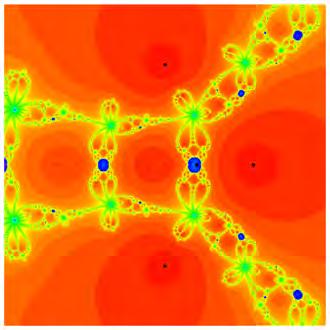
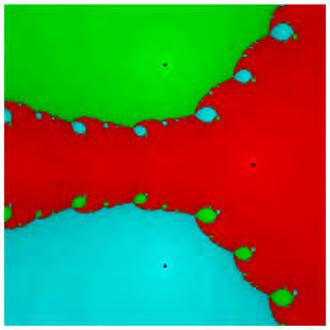
Solvingnon-linearequationsoftheform f (x )=0isacommonchallengeinvariousscientificfields, spanningfrombiologytoengineering.Whenalgebraicmanipulationisnotfeasible,iterativemethods becomenecessarytodeterminesolutions.Amongthese,Newton’smethodstandsoutasawidelyused approach,relyingonthelinearizationof f (x ).Itsiterativeschemeisgivenby:
0, where yn = xn f (xn ) f ′ (xn ) representsaNewtonstep,and δ isthedampingparameter.Notably,setting δ =0 recoversNewton’smethod,while δ =1correspondstoTraub’smethod.Itisimportanttomentionthateach iterationofTraub’smethodinvolvesadditionalcomputationscomparedtoNewton’smethod.Althoughthe questioncanbeexploredinothersettings,herewewillfocusonthecasewhere p(z )=0, z ∈ C
Moreover,weanalyzethebehaviorofTraub’smethodforthepolynomialfamily pd (z )= z (z d 1). Notably,forHalley’sroot-findingalgorithm,thebasinofattractionof z =0isboundedwhen d =5,but weestablishthefollowingresult:
TheoremB. Letpd (z )= z (z d 1).Then, A∗ Tpd ,1 (0) isanunboundedsetforeveryintegerd > 0
2.Anintroductiontoholomorphicdynamics
Letusdenote ˆ C = C ∪{∞} the extendedcomplexplane or RiemannSphere
Definition2.1. Let R : ˆ C → ˆ C bearationalmap.Apoint z = z0 isa fixedpoint if R(z0)= z0 (resp. periodicofperiodp if R p (z0)= z0 forsome p ≥ 1and R n(z0) = z0 forall n < p).The multiplier of z0 is λ = R ′(z0)(resp. λ =(R p )′(z0)).
Thecharacterofthefixedorperiodicpointscanbedeterminedbyusingthemultiplier.Infact,the fixedorperiodicpoint z0 is attracting if |λ| < 1(superattracting if λ =0), repelling if |λ| > 1and indifferent if |λ| =1.
Definition2.2. Let R : ˆ C → ˆ C bearationalmapand z0 ∈ ˆ C beanattractingfixedpointof R.Wedefine the basinofattraction of z0 as
Proof. (i) and (ii) arestraightforwardcomputations.For (iii),observethat Np (∞)=limz→∞ Np (z )= ∞, so z = ∞ isafixedpoint.Toseeitsnature,considerthetransformation ϕ : U → V suchthat ϕ(z )=1/z , where U isaneighbourhoodof z = ∞ and V isaneighbourhoodof z =0.Theconjugatemapis then Np (z )= ϕ(Np (ϕ 1(z )))= 1 Np (1/z ) ,sostudyingthebehaviourof Np at z =0revealsthecharacter of z = ∞ intheoriginalsystem.
Hence,sinceNewton’smapiscontinuousin K (inparticularitisalsoin K ′),thereexists ρ> 0suchthat if |z1 z2| <ρ,then |Np (z1) Np (z2)| < r /2.Setting δ = r 2CR,ε′ ,weobtainthedesiredbound.
Now,let z ∈ K .Toprovetheresult,weproceedasfollows:
1.Usingtheclaimwith z1 := N M 1 p (z )and z2 := T M 1 p,δ (z ),thereexists ηM > 0and δM > 0suchthat if |N M 1 p (z ) T M 1 p,δ (z )| <ηM ,then |N M p (z ) T M p,δM (z )| <ε/2.
2.Iteratingthealgorithm,weobtainsequences {ηM i }M 3 i =0 , {δM i }M 3 i =0 satisfyingthatif |N M i 1 p (z ) T M i 1 p,δ (z )| <ηM i ,then |N M i p (z ) T M i p,δi (z )| <ηM i +1
3.Weconcludethealgorithmwiththeexistenceof η2 > 0and δ2 > 0suchthatif |Np (z ) Tp,δ2 (z )| < η2,then |N 2 p (z ) T 2 p,δ2 (z )| <η3
Finally,toensurethat |Np (z ) Tp,δ (z )| <η2,wejustneedtotake δ1 = η2 CR,ε′ .Therefore,taking δ = min{δ1,..., δM },weobtainthatforevery z ∈ K : |T M p,δ (z ) N M p (z )| <ε/2.
Proof. First,observethatfor δ closeenoughtozero(indeedforevery δ ∈ [0,1]), z = ∞ isarepelling fixedpointfor Tp,δ .ByKoenigslinearizationTheorem,inaneighborhoodof z = ∞,say D(∞, ε), Tp,δ is locallyconjugatedto g (ζ)= λζ,where λ isthemultiplierof z = ∞.Noticethat,if λ ∈ C,since |λ| > 1,
https://revistes.iec.cat/index.php/reports
DavidRosadoRodr´ıguez
pointsnear z = ∞ tendtomoveawayinaspiralshape,andif λ ∈ R,since |λ| > 1,pointsnear z = ∞ tendtomoveoutwardinaradialmanner.
Letusdefine R := 1 ε andconsiderthecompact K := D(0, R) \∪j D(qj , ε′)where qj arethepoles of Tp,δ ,i.e.,thezerosof p′(z )=0,and ε′ > 0isapositivefixedconstant.Wecanassumethat α ∈ K . Ifnot,wecanchooseasmallervaluefor ε (increasingthevalueof R)toensurethat α ∈ K ,makingthe neighborhoodwheretheKoenigscoordinatesapplysmaller.Since z = α isanattractingfixedpointfor both Np and Tp,δ ,thereexists η1, η2 > 0suchthat D(α, η1) ⊂A∗ Np (α)and D(α, η2) ⊂A∗ Tp δ (α).Setting η =min{η1, η2},wehavethat D(α, η) ⊂A∗ Np (α) ∩A∗ Tp δ (α).AccordingtoLemma 4.2(i),thereexistsa compact K ′ ⊂ K suchthat K ′ ⊂A∗ NP (α), α ∈ K ′ and ∂K ′ ∩ ∂K = ∅,satisfyingthatforevery z ∈ K ′ , thereisaunique M ∈ N suchthat,forevery z ∈ K ′ , N M p (z ) ∈ D(α, η/2) ⊂ D(α, η).Moreover,since thebasinsofattractionofNewton’smethodareunboundedandsimplyconnected,thereexistsaray τ connectingthefixedpoint z = α and z = ∞,includedin A∗ Np (α).Thisraycanbechosensuchthat itsrestrictionto K isincludedin K ′.Fromnowown,anyreferenceto τ willindicatetherayextending fromthepoint z = α totheboundaryoftheset K .Then,accordingtoLemma 4.2(ii),for δ small enoughand z ∈ K ′ , T M p,δ (z ) ∈ D(α, η),indicatingthat z ∈A∗ Tp δ (α).Then,either τ ⊂ K ′ ⊂A∗ Tp δ (α) orthereexists w ∈J (Tp,δ ) ∩ K ′.Inthelastcase,since w ∈ K ′ , T M p,δ (w ) ∈ D(α, η),incontradiction with w ∈J (Tp,δ ).Therefore, τ ⊂ K ′ ⊂A∗ Tp,δ (α).
Byconstruction,observethat ∂D(0, R)= ∂D(∞, ε),hence,theray τ ,whichendsat ∂D(0, R), connectswiththespiral(orthelineincase λ ∈ R)thatextendstowards z = ∞.Thus,wefoundaray thatconnectsthefixedpoint z = α to z = ∞,whichiscontainedwithin A∗ Tp δ (α).Thisprovesthatthe immediatebasinofattractionforthedampedTraub’smethodisunboundedwhen δ ≈ 0.
5.Traub’smethodappliedto
z z z(z d 1) (z 1) (z d 1)
Now,weaimtoexamineTraub’smethodappliedtothefamily pd (z )= z (z d 1).Thisfamilyisparticularly interestingbecause,forHalley’sroot-findingalgorithm,itwasfoundthatfor d =5,theimmediatebasin ofattractionof z =0isbounded.Therefore,provingthatthisisnotthecaseforTraub’smethodwould supporttheconjecturethattheimmediatebasinsofattractionofTraub’smethodareunbounded.Wehave beenabletoprovethattheimmediatebasinofattractionof z =0isunboundedforevery d .Toestablish theresult,wewillfirstpresentanauxiliaryresult.
Lemma5.1. Thesemi-linesz = re (2k +1)πi d ,r > 0 andk =0,1,..., d 1,areforwardinvariantunderTpd ,1
Firstofall,observethat
Hence,since e (2k +1)πi = 1,astraightforwardcomputationrevealsthat T
), where Rd (r ):= d (d +1)r 2d +1[(d +1)r d +1]d d d +1r (d +1)2 [(d +1)r d +1]d +2 .
, 10 (2025),13–21;DOI:10.2436/20.2002.02.46.
Onthebasinsofattractionofroot-findingalgorithms
TheoremB. Letpd (z )= z (z d 1).Then, A∗ Tpd ,1 (0) isanunboundedsetforeveryintegerd > 0
Proof. Consideronlythesemi-linesthatdonotcrossthe d throotsofunity,i.e., z = re (2k +1)πi d , r > 0and k =0,1,..., d 1.ByLemma 5.1,thesemi-linesareforwardinvariantunder Tpd ,1.Infact,wehavethat Tpd ,1(re (2k +1)πi d )= e (2k +1)πi d Rd (r ),where Rd (r ):= d (
Then,ifwecanprovethatforevery r > 0wehave0 < Rd (r ) < r ,wecanconcludethat A∗ Tpd ,1 (0)isan unboundedsetforevery d .Inthatcase,wecanalsostatethat A∗ Tpd ,1 (0)hasatleast d accessestoinfinity. Sincethedenominatorof Rd isalwayspositiveforevery r > 0,theinequality0 < Rd (r )isequivalentto
Hence,allthecoefficientsofthepolynomial Sd arenegative.Therefore,wecanconcludethatfor r > 0, Sd (r ) < r ,whichcompletestheproof.
https://revistes.iec.cat/index.php/reports
DavidRosadoRodr´ıguez
Itstillneedstobeproventhattheimmediatebasinsofattractionofthe d throotsofunityare unbounded.Thisisamorechallengingpartoftheproof,asattemptingtoapplythesameargumentsused earlierleadstodifficultiesinestablishingboundsfortheexpressions.However,arecentstudyconfirmsthat thisholdsforallintegers d ≥ 2.Infact,thecaseofTraub’smethodappliedtothefamily p(z )= z (z d 1) hasalreadybeenfullyresolved[4].
6.Conclusions
Withthispaper,wearecontributingtowardsdemonstratingthattheimmediatebasinsofattractionof thedampedTraub’smethodareunboundedandsimplyconnectedsets.Wehavebeenabletoprovewith completegeneralitytheunboundednessofthemethodwhen δ ≈ 0andweanalyzeaparticularcase,the family pd (z )= z (z d 1).Ourfindingsindicatethatanalyzingthetopologicalpropertiesofthismethodis notastraightforwardandthatacomprehensiveproofrequiresdifferentapproachesfromthoseusedin[3].
Forthesakeofnotation,inthesequelweshalldenote H 1(Ω) ⊗ C4 as H 1(Ω)4,andsimilarly L2(Ω) ⊗ C4 as L2(Ω)4 .
Motivatedbysomephysicalconsiderations,in[1]itwasstudiedthefamilyofDiracoperatorswith confiningboundaryconditionsdefinedfor τ ∈ R by Dom(Hτ ):= {φ ∈ H 1(Ω)4 : φ = i (sinh τ cosh τβ)(α ν)φ on ∂Ω}, H
NoticethattheMITbagmodelcorrespondsto τ =0—thiswasthemainreasonin[1]tocallthe operators Hτ in(2) generalizedMITbagmodels.For τ ∈ R,theoperator Hτ isself-adjointin L2(Ω)4 by[2,Proposition5.15].Moreover,from[1,Lemma1.2]weknowthatitsspectrum σ(Hτ )iscontained in R \ [ m, m]andispurelydiscrete.Inparticular,theessentialspectrum σess(Hτ )isemptyforall τ ∈ R Furthermore, λ ∈ σ(Hτ )ifandonlyif λ ∈ σ(H τ ).Thankstothisoddsymmetry,onecanreducethe studyofthespectralpropertiesofthegeneralizedMITbagmodelstothestudyof σ(Hτ ) ∩ (m,+∞) for τ ∈ R
ThisresultestablishesaclearconnectionbetweenthespectrumoftheDiracoperator Hτ as τ →±∞ andthespectrumoftheDirichletLaplacian ∆D .In[1,Remark4.4]itwasleftasanopenquestionto investigatewhichshouldbethelimitingoperatorsof Hτ as τ →±∞,andinwhichsensetheconvergence holdstrue.Theanswerwasdevelopedinthemaster’sthesis[3]andthenpublishedin[4].Inthepresent work,wereviewtheresultsobtained.
3.Convergenceas τ τ τ movesin R
Inordertoguesswhothelimitingoperatorsmightbe,wefirstmakeanobservation.Writing φ ∈ Dom(Hτ ) incomponents1 as φ =(u, v )⊺ ,theboundarycondition
= i (sinh τ cosh
rewritesas u = ie τ (σ · ν)v .Formally,thisequationforces u and v tovanishon ∂Ωinthelimits τ ↑ +∞ and τ ↓−∞,respectively.Thisleadstoconsidertheso-called Diracoperatorswithzigzagtypeboundary conditions studiedin[6],whicharedefinedby
Dom(H+∞):= {φ =(u, v )⊺ : u ∈ H 1 0 (Ω)2 , v ∈ L2(Ω)
—here H 1 0 (Ω)2 isthesubspaceoffunctionsin H 1(Ω)2 withzerotrace—,and
Itisveryremarkabletosaythatthelargeenough τΩ ∈ R ensuringtheoptimalityoftheballforthe firstpositiveeigenvalue λΩ(τ )intheregime τ ≥ τΩ dependsitselfonΩ.Hence,fromProposition 4.1 one can not ensurethatthereexistsalargeenough τ⋆ ∈ R forwhich λΩ(τ ) >λB (τ )forall τ ≥ τ⋆ and every bounded C 2 domainΩdifferentfromaball B withthesamevolume.Toproveordisprovetheexistence ofsuch τ⋆ alsoremainsasanopenandchallengingproblem.
Thecomplexzetafunction,forapolynomial f andatestfunction ϕ (meaningacomplexfunction C∞ withcompactsupport),isdefinedas Z (s)= Z (f , ϕ; s) := Rn |f (x )|s ϕ
wheretechnicallywemustunderstandthisadistributioninthespaceoftestfunctions.Itcanbechecked that Z (s)convergesandisholomorphicinthesemiplane ℜ(s) > 0.Itsmeromorphiccontinuationandthe distributionofthepossiblepoleswasposedasaproblembyI.Gelfand[11, §3.I],andsolvedintwodifferent manners.
Ononehand,wecanusearesolutionofsingularities(guaranteedincharacteristic0byHironaka[12]). Recallthatanembeddedresolutionofapolynomial f isapropermorphism π : Y → X suchthat Y is smooth,therestrictionof π outsidethesingularlocusisanisomorphism,andthataroundeachpointin thepreimagewehaveaneighborhoodandachartoverwhich π∗f = u(y )y N1 i1 ··· y Nr ir with u(0) =0aunit and Ni ≥ 0integers.Fromthelocalexpression,wecanwritethepullbackdivisorgloballyas div(π ∗f )= j ∈J Nj Ej , https://revistes.iec.cat/index.php/reports
Ontheotherhand,wecanintroducetheBernstein–Satopolynomial,whichisananalyticalinvariant(and notatopologicalone)ofthesingularity.First,consider R := C[x1,..., xn ](ormoregenerallytheringof holomorphicfunctionsorevenformalpowerseries)anddenote D := R⟨∂1,..., ∂n ⟩ theWeylalgebra.All elementscommuteexceptfortherelations ∂i xi xi ∂i =1,andsoitiseasytoshowthatanyelement(a priorionlyalineardifferentialoperator)canbewrittenasafinitesum P = α,β aα,β x α∂β .Foramore gentleintroductionandmoredetailsonthepropertiesoftheWeylalgebra,wereferto[5].Next,consider thepolynomialring D [s] := D ⊗C C[s]withnewvariable s,andnotethatthefreemodule Rf [s] f s hasa naturalstructureofleft D [s]-modulegivenbytheproductrule.Indeed,everyelementofthemodulecan bewrittenas g f k f s forsome g (x , s) ∈ R[s],andtheactionofthepartialderivativesis
Theorem2.1 ([2]). Letf ∈ Rbeapolynomial.Then,thereexistsapolynomialP (s) ∈ D [s] anda polynomialbf ,P (s) ∈ C[s] suchthattherelation
holdsformallyinthe D -moduleRf [s] f s
Thesetofpolynomials bf ,P satisfyingsuchadifferentialequationasaboveformanidealin C[s],so wecanconsideritsmonicgenerator:the Bernstein–Satopolynomial of f denotedby bf (s).
Example2.2. For f = x 2 1 + ··· + x 2 n wehave bf (s)=(s +1)(s + n/2),astaking P(s)tobetheLaplacian operator(thoughtasaconstantpolynomialin D [s]),wehavetherelation ∂2 ∂x 2 1 + ··· + ∂2 ∂x 2 n f s +1 =4(s +1) s + n 2 f s 33
Example2.3. For f = x 2 + y 3 in C[x , y ]wehavethefollowingrelation
anditcanbeprovedthat
Now,havingintroducedthefunctionalequation(1),theideaistouseittointegratebypartsand obtainameromorphiccontinuationof Z (s)tothewholecomplexplane,asforany r ∈ N wehave Z (s)= 1
Inthiscase,itcanbeseenthatthepolesofthezetafunctionareoftheform λ ν for λ arootof bf (s) and ν anon-negativeinteger.Bycomparingthiswiththepreviouscandidatequantitiesforthepoles,one arrivesatthefollowingresult.
Definition2.5 (Topologicalzetafunction). Let f ∈ C[x1,..., xn ]beanon-constantpolynomial,andchoose aresolution π : Y → An C of {f =0}.The(global) topologicalzetafunction of f is
Weconsiderapolynomial f (x1,..., xn )= p∈Nn ap x p 1 x p n suchthat f (0)=0.Forbrevity,we willusemulti-indexnotationwhenconvenient f (x )= p∈Nn ap x p ,andwedefineitssupporttobe supp(f )= {p ∈ Nn | ap =0}
Definition3.1 (Newtonpolyhedron). Let f = p∈Nn ap x p ∈ C[x ]with f (0)=0.Wedefinethe global Newtonpolyhedron Γgl (f )of f astheconvexhullofsupp(f ).Also,wedefinethe localNewtonpolyhedron Γ(f )astheconvexhulloftheset p∈supp(f ) p +(R≥0)n
Wewillusetheterm face ofΓ(f )torefertoanyconvexsubset τ thatcanbeobtainedbyintersecting theNewtondiagramwithahyperplane H of Rn suchthatΓ(f )iscontainedinoneofthehalf-spaces definedby H.Notethatwealsoconsiderthetotalpolyhedronasaface.
Definition3.2 (Non-degenerate). Wesaythat f isNewtonnon-degenerateat0ifforanyface τ ⊂ Γ(f ), thehypersurfacedefinedbythetruncation f τ := p∈τ ∩supp(f ) ap x p satisfiesthatthepolynomials xi
xi for i =1,..., n donotvanishatthesametimein(C \ 0)n
Definition3.3 (N, k, F ) Foravector a ∈ (R+)n ,wedefinethequantities N(a) :=inf x ∈Γ(f ){⟨a, x ⟩} and k(a) := n i =1 ai .Also,definethefirstmeetlocus F (a) := {x ∈ Γ(f ) |⟨a, x ⟩ = N(a)},whichisaproper faceofΓ(f )if a =0,and F (0)recoversthewholediagram.
Definition3.4 (Dualfan). For τ afaceofΓ(f ),wedefinethe coneassociated to τ as ∆τ := {a ∈ (R>0)n | F (a)= τ }/ ∼ , a ∼ a ′ iff F (a)= F (a ′).
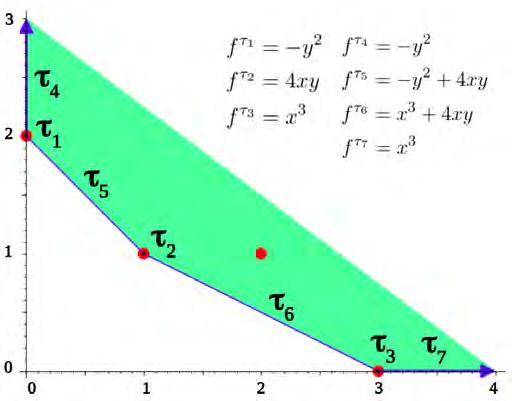
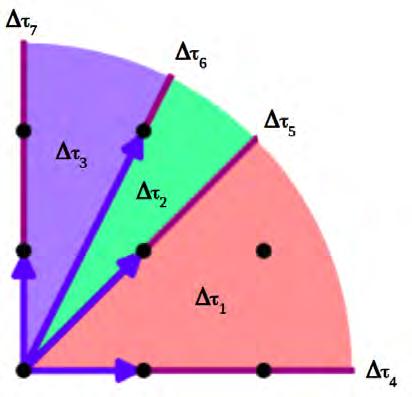
ThecollectionoftheseconesforallfacesoftheNewtonpolytopeasthe dualfan. Asanexample,seethefollowingFigure 1,whereweconsidertheplanecurvedefinedby f = x 3 y 2 + 4xy +3x 2y ,andconstructtheNewtonpolyhedronwithlabeledfacesandcorrespondingtruncations(left), andtheassociateddualfan(right).
Figure1:Γ(f )anddualfanofthepolynomial f = x 3 y 2 +4xy +3x 2y
Next,werecallthefollowingpropertiesofcones.
Definition3.5 (Cone) A convexpolyhedralcone,or cone forshort,isaset
where V isan n-dimensionalvectorspaceover R,andthevectors {vi } arecalledthe generators ofthe cone.Thedimensionof C isdefinedtobethedimensionofthesmallestvectorspacecontainingit. Wesaythattheconeis simplicial ifitsgeneratingvectorsarelinearlyindependentover R.Moreover, wewillsayitis simplicialrational ifontopofthattheentriesofthevectorsareintegers.Wesaythatthe coneis regular (or simple)ifthesetofgeneratingvectorscanbeextendedtoabaseofthe Z-module Zn
Definition3.12. Let τ beafaceinΓ(f ),andconsideradecompositionoftheassociatedcone∆τ = r i =1 ∆i insimplicialconesofdimensiondim∆τ = l suchthatdim(∆i ∩ ∆j ) < l ,forall i = j .Then,define
Z (s)= τ vertex of Γ(f ) J(τ , s)+ s s +1 τ faceof Γ(f ) dim τ ≥1 ( 1)dim τ (dim τ )!Vol(τ )J(τ , s).
Asthepolesof Z (s)arisefromthepolesoftheterms J(τ , s)inthesum,weseethattheyarestill either 1oroftheform k(a)/N(a)(seealso[16,Th´eor`eme5.3.1]),whichjustifiesthechoiceofnotation.
Remark 3.17 Loeseralreadypointsoutin[16,Remarque5.5.2.1]thatifonereplacesthecondition k (τ0) N (τ0) < 1with k (τ0) N (τ0) / ∈ N,thisisenoughtoprovetheweakversionoftheconjecture.
Tobegin,itshouldbementionedthatallexamplesstudiedhavebeencheckedtosatisfythetopological strongmonodromyconjecture(andthustheweakversiontoo).Nonetheless,therelevantfindingsare exampleswherethesecondconditiononthe(toric)residuenumbersisnotmet,andevenmore,where ε is apositiveinteger.
Evenmoreinterestingly,theseexampleshavebeenmotivatedgeometricallyfromtheNewtonpolyhedron.Moreprecisely, f isfirstconstructedbyintroducingmonomials x p + y q + z r for p, q, r largeenough integers.Then,addingsmallmixedmonomialsofthetype x s y t z u forsmallenoughintegers s, t, u,we obtainsmallcompactfacesclosetotheorigin.Bychoosingtheexponentsappropriately,wecanconstruct apolyhedronwhosefaceshavenormalvectorsasdesired.Inparticular,wecanfindpairsofadjacentfaces forwhichthecorrespondingdivisorsoftheresolutiongiveriseto(toric)residuenumbersthatareintegers.
Asanillustrativeexample,weconsider f = x 5 + y 6 + z 7 + x 2yz + xyz 2 + xy 2z ,whoseNewtondiagram isdepictedintheaboveFigure 2.Theoriginalraysinthedualfanare: [(0,0,1),(0,1,0),(1,0,0),(1,1,1),(1,1,2),(1,2,1),(3,1,1),(6,5,14),(7,18,5),(23,7,6)], andaregularsubdivisionrequiresalmost400newrays.Also,theBernstein–Satopolynomialis
Theoreticalprogressfollowed,withBurbea[1]andHmidi,Mateu,andVerdera[6]provingtheexistence oflocalbifurcationbranchesfromthediskforeveryintegersymmetry m ≥ 3.Morerecently,global bifurcationcurveswereconstructedbyHassainia,Masmoudi,andWheeler[5].However,thesepowerful theoreticaltoolsprovideexistencebutlackquantitativeinformationaboutthesolutionsfarfromtheinitial bifurcationpoint.Thisisacriticallimitationbecauseprovingpropertieslikenon-convexityrequiresprecise knowledgeofthesolution’sshape.Ageneralargumentforallm-foldbrancheswillfail,asthebranch for m =2isknowntobeconvexandfor m =3itisexpected.
with N0 =30.Thecoefficients ck andtheangularvelocityΩarechosentomaketheerrorofthis approximation, E [0](x )= R ′ 0(x)R0(x) F [R0](x),assmallaspossible.Weseekatruesolution R(x)asa perturbationof R0(x):
Here, u isafunctionin L2([0, π/m])and˜ u isitsodd,2π/m periodicextension.Thisformulationisdesigned tofixthescalingandrotationsymmetriesoftheproblemwhilepreservingthem-foldsymmetry.
TakingtheFr´echetderivativeoftheequation(1),wecanwritetheequationfortheperturbationas Lv = E [0]+ NL[v ],where L isalinearoperatorand NL[v ]= O(v 2)isnonlinear.Usingtheexpression(2) andthesymmetriesof˜ u,wewritethisequationintermsof u inthefollowingway:
[0, π/m].
• L isalinearoperatordefinedas Lu := u + π/m 0 K (x, y )u(y ) dy ,where K isa L2 0, π m 2 function thatdependsontheapproximatesolution R0 inanontrivialway.
• NL isanonlinearoperatorthatcontainshigher-ordertermsoftheperturbation u
Ifweprovethat L isinvertible,theproblemisnowreducedtoshowingthattheoperator Gu := L 1(E [0]+ NL[u])hasafixedpointinasmallballaroundtheorigininanappropriatefunctionspace.We choosethespace L2([0, π/m])andseekasolution u withinaballofradius ϵ =3 · 10 5
2.2.Invertingthelinearoperator
Adirectinversionoftheoperator L isnotfeasible,sinceitdependsverynonlinearly(andnon-locally) on R0.Instead,weuseacomputerassistedapproach.Themainideatoprovetheinvertibilityof L isto firstapproximate L by LF =Identity+FiniteRank,thenprovetheinvertibilityof LF andfinallyprovethat theapproximationerror L LF issmallenough,making L invertibleviaaNeumannseries.
Definition2.1. Let {en(x)}n bethenormalizedFourierbasisof Xm = L2 0, π m .Alsolet N =201,and EN =span{en}N n=1 bethesubspacegeneratedbythefirst N vectors.Similarly,let E ⊥ N beitsorthogonal subspace.Wewillalsodefine LF = I + KF : Xm → Xm where KF : EN → EN isgivenby KF [u]= π m 0 KF (x, y )u(y ) dy with KF (x, y ):= N k ,l =1 Ak ,l ek (x)el (y ), where Ak ,l isfiniteexplicitmatrixveryclosetotheprojectionoftheoperator K (x, y )tothe EN subspace.
Wecantheninvert I + L 1 F (L LF )usingaNeumannseriesbecauseduetoLemmas 2.3, 2.4 wehavethat
isalsoinvertible,wecanconcludethat L isinvertibleand
2.3.Solvingthefixedpointequation
ThegoalistouseBanachFixedPointtheoremtoprovetheexistenceofsolutions.Forthisweneedcontrol overtheLipschitznormof G .Wearegoingtostateapropositionthattogetherwiththeestimateson L 1 isgoingtoallowustoprovetheexistenceofafixedpoint.
Weinitiallyprovedthat R isan H 1 function.However,wecanshowthatitismuchsmoother.
https://revistes.iec.cat/index.php/reports
1. C ∞ Regularity:Weuseabootstrappingargument.ByrewritingtheV-stateequation,weshowthat ifthe k-thderivative ∂k R isbounded,then ∂k +1R isalsobounded,andbyinduction, R is C ∞.The argumentinvolvescarefullydifferentiatingthenon-localequationandcontrollingthesingularitiesin theintegralkernelstoobtainthefollowinginequality:
Unaestrat`egiaperestudiarvarietatsalgebraiques´esconstruirinvariantsalgebraics quemesurinlessevessingularitats.Sobreelsnombrescomplexos,destaquenels idealsmultiplicadorsielsnombresdesalt.Encaracter´ısticapositiva,lesseves contrapartss´onelsidealsdetestiels F -nombresdesalt.Enaquestprojecte, calculemelsidealsdetesti F -nombresdesaltdecorbesplanesquasi-homog`enies, aix´ıcomdelessevesdeformacionsanombredeMilnorconstant,perunaquantitat infinitadecaracter´ıstiques p > 0.Enaquestscasos,veiemqueelsidealsdetest s´onlareducci´om`odul p delsidealsmultiplicadors.
Abstract (ENG)
Acommonapproachtostudyingalgebraicvarietiesisthroughalgebraicinvariants thatmeasuretheirsingularities.Overthecomplexnumbers,acelebratedexample ofsuchinvariantsincludethemultiplieridealsandthejumpingnumbers.Inpositive characteristic,theircounterpartsarethetestidealsand F -jumpingnumbers.Inthis work,wecomputethetestidealsand F -jumpingnumbersofquasi-homogeneous planecurves,aswellastheirone-monomialconstantMilnornumberdeformations, forinfinitelymanycharacteristics p > 0.Inthesecases,weseethatthetestideals arethemodulo p reductionofthemultiplierideals.
Themultiplieridealsandjumpingnumbersencodethesingularitiesofthehypersurfacedetermined by f insubtleways.Suppose,forinstance,thatthevanishinglocusof f isacurve C inthecomplex planewithasingularityattheorigin.Ifonedeforms C intoanewcurve C ′ whilepreservingtheanalytic typeofthesingularity,thentheentirefamilyofmultiplieridealsremainsunchanged.Onthecontrary,if thedeformationonlypreservesthetopologicaltype,thenthejumpingnumbersstillagree,althoughthe multiplieridealsmay,ingeneral,differ.
Overfieldsofpositivecharacteristic p > 0,thereisnoresolutionofsingularitiesavailableforvarieties ofarbitraryfinitedimension.Inthissetting,theFrobeniusendomorphism,or p-thpowermap,servesasa substitutetool.Thetestideals,whichplaytheroleofthemultiplierideals,wereintroducedbyHochster andHunekeasanauxiliarytoolintightclosuretheory[5],andwerelaterrefinedbyHaraandYoshida[4]. WeshalladopttheconstructionofBlickle,Mustat¸˘a,andSmith(seeDefinition 2.9),whichgeneralizes earlierdefinitions[3].Inbrief,thetestideals τ (f λ)ofapolynomial f areanested,right-semicontinuous familyofidealsindexedoverthenonnegativerealnumbers λ ∈ R≥0.Thespotswherethechainoftest ideals“jumps”arethe F -jumpingnumbersof f ,thesmallestofwhichisthe F -purethreshold.
Itisawell-establishedfactduetoMustat¸˘a,Takagi,andWatanabe,thatif f isapolynomialdefined overtheintegers,thelog-canonicalthresholdof f canberecorveredfromthe F -purethresholdsofthe reductions fp of f moduloaprime p,as p →∞ [9].Aprofoundconjectureinarithmeticgeometry,the weakordinarityconjecture,proposesafurtherconnection,namely,thatthetestidealsofthereductions fp canbecalculatedbyreducingthemultiplieridealsmodulo p,forallprimesinaZariski-denseset[8].In thissense,thetheoriesofmultiplieridealsincharacteristiczeroandtestidealsinpositivecharacteristic arecloselyanalogous.
Testidealsand F -jumpingnumbersarenotoriouslydifficulttocompute.Inthefewcaseswhereexplicit descriptionsareknown—suchasellipticcurves,diagonalhypersurfaces,determinantalidealsofmaximal minors,oridealsinvariantundertheactionofasubgroupofalineargroup,thecalculationsrelyonthe arithmeticorcombinatorialpropertiesofthevariety.Anaiveyeteffectiveapproachtoobtain τ (f λ)isto calculatetheideals pe -throotsof f ,denoted Ce R · f n (seeDefinition 2.5),forafixedinteger e ≥ 0.As n ≥ 0rangesoverthenaturalnumbersintegers,oneobtainsdescendingchainofideals
e R · f 0 ⊇Ce R · f ⊇Ce R · f 2 ⊇···⊇C e R · f n ⊇Ce R · f n+1 ⊇··· which,inessence,containsallthetestidealsof f ,andcodifiesthe F -jumpingnumbers.
https://revistes.iec.cat/index.php/reports
PedroL´opezSancha
Inthiswork,webeginbystudyingquasi-homogeneousplanecurves C overaperfectfield K ofcharacteristic p > 0,thatis,curvesin K 2 givenasthevanishinglocusofapolynomialoftheform f = x a + y b , with a, b ≥ 2.Forthese,weobservetheidealsof pe -throots,andconsequentlythetestidealsaremonomial idealsforsufficientlybigcharacteristics p ≫ 0.Todeterminethe F -jumpingnumbers,weposealinear integerprogrammingproblem,andprovideitssolution.
Wethenturntodeformations C ′ oftheoriginalcurve C ,whicharecurvesgivenasthezerosof polynomials g = f + i ti x αi y βi .Werestrictourselves,however,toone-monomialdeformations g = f +tx αy β .Fromthealgebro-geometricstandpoint,itismostnaturaltoconsiderdeformationsthatpreserve thesingularitytypeof C attheorigin,namely,constantMilnornumberdeformations.Inthissetting,we againfindthatthe pe -throotsandtestidealsaremonomial.
Forallsufficientlylargeprimessuchthat p ≡ 1(mod ab),wedescribeexplicitlythechainsof pe -th roots,testideals,and F -jumpingnumbers,andobservethattheycoincidefor f and g .Finally,wenote thatthetestidealsinthissettingariseasreductionsmodulo p ofthecorrespondingmultiplierideals.
2.Invariantsofsingularitiesincharacteristic p > 0
Throughout,let R denotearingofcharacteristic p > 0,andlet F : R → R, f → f p ,betheFrobeniusendomorphismof R.Foranonnegativeinteger e ≥ 0,the e-thiteratedFrobeniusistheendomorphism F e : R → R, f → f pe .Inthissectionweintroduceinvariantsofsingularitiesinpositivecharacteristic ofinteresttous.Often,thesearereferredtoas F -invariantsfortheyoriginatefromtheactionoftheFrobeniuson R
Restrictionofscalarsalong F e endows R withanexotic R-modulestructuredenoted F e ∗ R.Itselements arewrittenas F e ∗ x for x ∈ R.Asanabeliangroupwithrespecttoaddition, F e ∗ R isisomorphicto R
Theactionof R on F e ∗ R isgivenbyrestrictionofscalars: r F e ∗ x := F
(
ANoetherianring R ofcharacteristic p > 0issaidtobe F -finiteprovided F
x),for
R
∗ R isafinite R-modulefor some e ≥ 1(equiv.all e ≥ 1).
Example2.1. Let R = K [x1,..., xn]beapolynomialringoverafield K ofcharacteristic p > 0.If K is perfect,i.e.theFrobenius F : K ≃ −→ K isanautomorphismof K ,then F e ∗ R splitsas
R ≃
therefore R isan F -finitering,and F e ∗ R isafinitefreemodulewithbasis
Inthesequel,wewillrefertothisasthestandardbasisof F e ∗ R
2.1.Frobeniuspowersand pe epe -throotsofideals
Let R bearegular F -finiteringofcharacteristic p > 0.
Definition2.2. Let I beanidealof R.Foraninteger e ≥ 0,the e-thFrobeniuspowerof I istheideal I [pe ] = F e (I )R =(f pe | f ∈ I ).
, 10 (2025),51–61;DOI:10.2436/20.2002.02.50.
Idealsof pe -throotsofplanecurvesinpositivecharacteristic
Remark 2.3 Onechecksthatif I =(fλ | λ ∈ Λ)isageneratingsetfor I ,then I [pe ] =(f pe λ | λ ∈ Λ), hence I [pe ] ⊆ I pe .Thereversecontainmentholdswhen I =(f )isprincipal,thatis,(f )[pe ] =(f )pe ,thus Frobeniuspowersandregularpowerscoincideforprincipalideals.
Asortof“converse”operationtotheFrobeniuspoweristheidealof pe -throotsofanideal I .These wereintroducedin[1]intheprincipalcaseunderthenotation Ie (f ),andlateronexploitedin[3]togive analternativedefinitionofthetestideals(seeSection 2.2),usingthenotation I [1/p
]
Definition2.4. ACartieroperatoroflevel e ≥ 0isan R-linearmap F e ∗ R → R.ThesetofCartieroperators oflevel e ≥ 0hasanatural R-modulestructure,whichwedenoteby Ce R :=HomR (F e ∗ R, R).
Definition2.5. Let I beanidealof R.Foraninteger e ≥ 0,theidealof pe -throotsof I istheideal Ce R · I =(φ
Remark 2.6 If R isaregularand F -finite, Ce R · I ischaracterizedasthesmallestidealof R inthesenseof inclusionsuchthat I ⊆ (Ce R · I )[pe ]
Proposition2.7 ([1],[3,Proposition2.5]). SupposethatF e ∗ RisafreeR-modulewithbasisF e ∗ x1,..., F e ∗ xn.
ForanidealI =(f1,..., fm) ofR,let
betheexpressioninthebasisoffi ,i =1,..., m.Then Ce R · I =(fij | 1 ≤ i ≤ m,1 ≤ j ≤ n)
Wecollectbelowafewfactsabout pe -throotsthatwillbeusefullateron;foraproof,wereferthe readerto[3,Lemma2.4].
Lemma2.8. LetI,JbeidealsofR,andd , e ≥ 0 benonnegativeintegers.
(i)IfI ⊆ J,then Ce R · I ⊆Ce R · J.
(ii)OnehasthatJ · (Ce R · I )= Ce R · (I · J [pe ])
(iii)Onehasthat Ce R · I = Cd +e R · I [pd ].Inparticular,ifI =(f ) isprincipal,then
2.2.Testideals,
F F F -jumpingnumbers,and ν ν ν-invariants
Let R denoteregular F -finiteringofcharacteristic p > 0.Wenowintroducethegeneralizedtestidealsof anidealin R,asdefinedin[3],alongwiththeirassociatedinvariants.Throughout,wedenoteby ⌈x⌉ the ceilingofarealnumber.
Definition2.9. Fixanideal I of R.Thetestidealof I withexponent λ ∈ R≥0 is
Remark 2.10 Itcanbeshownthatthe pe -throotsappearingontheright-handsidegiveanascending chainofideals,whicheventuallystabilizesbecause R isNoetherian,therefore
PedroL´opezSancha
Since pe -throotspreserveinclusions(Lemma 2.8),sodotestideals,thatis, τ (I λ) ⊇ τ (I µ)whenever λ ≤ µ.Itfollowsthetestidealsgiveadescendingfamilyofidealsobtainedas λ rangesoverthenonnegative realnumbers.Thischainisrightsemi-continuousinthefollowingsense:
Itisconjecturedthatthestatementabovegeneralizes,inasense,tomultiplierandtestideals.Before announcingit,letusremarkthatif s isaZariski-closedpointinthespectrumofafinitelygenerated Z-algebra A,thatis, s isamaximalidealof A,thenthequotient A/sA haspositivecharacteristic.
Conjecture2.15 (Weakordinarityconjecture,[8,Conjecture1.2]) LetIbeanidealinthepolynomial ring C[x1,..., xn].SupposethatIcanbegeneratedbyelementsinafinitelygenerated Z-subalgebraA of C[x1,..., xn].ThenthereexistsaZariski-densesubsetSof Spec Aconsistingofclosedpointssuchthat J (I λ)s = τ (I λ s ), forall λ ≥ 0, foreverys ∈ S,whereI λ s , J (I λ)s denotetheimageunderA → A/sAofI λ,and J (I λ),respectively.
Closelyrelatedtothe F -jumpingnumbersarethe F -thresholdsintroducedin[9].Theirdefinitionis basedonadifferentfamilyofinvariants,namely,the ν-invariants,whichareofinterestbythemselves.
Definition2.16. Let I , J beidealsof R suchthat I ⊆ √J,where √J denotestheradicalof J.The ν-invariantoflevel e ≥ 0of I withrespectto J is
ν J I (pe )=max {n ≥ 0 | I n ⊆ J [pe ]}
Letusdenoteby ν• I (pe )thesetof ν-invariantsoflevel e ≥ 0of I
Incomputing F -thresholds,differentideals J, J ′ containing I intheirradicalmaygiveraisetothesame F -threshold.Instead,however,onecanlookatthespotswherethechainofidealsbelowjumps:
Definition2.19 ([10,Proposition4.2]) Thesetof ν-invariantsoflevel e ≥ 0ofanideal I of R is
2.3.Chainsof pepepe -throotsand rr -invariants
Throughthissection,let R = K [x1,..., xd ]denoteapolynomialringoverafield K ofcharacteristic p > 0.We areinterestedinobtainingthetestideals τ (f λ)ofapolynomial f ∈ R.Skoda’stheorem(seeTheorem 2.13) showsthat τ (f λ)=(f ) τ (f λ 1)foreveryrealnumber λ ≥ 1,henceitsufficestolookattestideals with0 <λ< 1.Inthiscase,byRemark 2.10,onehasthat τ (f λ)= Ce R · f r forsomeinteger r ≤ pe .Aside fromtestideals,wearekeenon pe -throots Ce R · f n.Bywriting n uniquelyas n = spe + r ,with s ≥ 0, 0 ≤ r < pe ,itfollowsfromLemma 2.8 that Ce R · f n =(f )s ·Ce R · f r .Altogether,thisshowsitisenoughto considertheidealsinchainsoftheform
Definition2.20. Wereferto(1)asthechainofidealsof pe -throotsof f
Lemma2.21. Forapolynomialf ∈ R,onehasthat ν• f (pe )=(ν• f (pe ) ∩ [0, pe ))+ pe Z≥0
Notation2.22. Ifu =(u1,..., ud ) ∈ Zd ≥0 isamulti-index,weletx u bethemonomialx u = x u1 1 x ud d .
Perhaps,themoststraightforwardwaytodetectajump Ce R · f r ⊋ Ce R · f r +1 inchain(1)istotest ifamonomial x u in Ce R · f r dropsfrom Ce R · f r +1,whichmeans r isa ν-invariantattachedto f andthe monomial x u .Whilethistechniqueisstandardinthefield,tothebestofourknowledge,theinvariant“r ” hasnotbeenassignedanameintheliterature.Wethereforeintroducethefollowingdefinition:
Definition2.23. Wedefinethe r -invariantoflevel e ≥ 0of f withrespecttoamonomial x u by r e R (f ; x u )=sup {n ∈ Z | x u ∈Ce R · f n}
(i)Forallmonomialsx u inR, 0 ≤ r e R (f , x u ) ≤ pe 1
(ii)Everyr-invariantoffisa ν-invariant.
https://revistes.iec.cat/index.php/reports
PedroL´opezSancha
Wheneveryidealinthechainof pe -throotsof f ismonomial,theconversetoLemma 2.24 holds.In spiteofhowrestrictivethislatterconditionmayseem,wewillcomeacrossitinSection 3
(i)Onehasthat ν• f (pe ) ∩ [0, pe )= {r e R (f ; x u ) | x u }
(ii)Foraninteger 0 ≤ n < pe ,onehasthat Ce R · f n =(x u | r e R (f ; x u ) ≤ n)
3.Idealsof p ep ep e -throotsofplanecurves
Inthissection,wedescribetheinvariantspreviouslyintroduced,forquasi-homogeneousplanecurvesdefined overperfectfieldsofcharacteristic p > 0,forinfinitelymanyprimes,andtheirone-monomialconstant Milnornumberdeformations.Throughout,let ⌊x⌋ and ⌈x⌉ bethefloorandceilfunctions,respectively.
Remark 3.1 Let R = K [x1,..., xd ]beapolynomialringoveraperfectfield K ofcharacteristic p > 0, so F e ∗ R isafree R-modulewithstandardbasis {F e ∗ x i1 1 x id d | 0 ≤ i1,..., id < pe } (Example 2.1).Given amonomial x u1 1 x ud d ,writeeachexponentuniquelyas ui = si pe + ri ,with si ≥ 0,0 ≤ ri < pe ,for i =1,..., d.Then
e ∗ (x u1 1 x ud n )= x s1 1 x sd n F e ∗ (x r1 1 x rd n )
isthebasisexpressionof x u1 1 ··· x ud d .Notethat si = ⌊ui /pe ⌋,and ri istheonlyinteger0 ≤ ri < pe with ui ≡ ri (mod pe ).Thiscalculationextendslinearlytopolynomialsof R
Definition3.2. Inthesettingabove,wesaythemonomials x u1 1 x ud d , x v1 1 x vd d appearwiththesame basiselementif F e ∗ x u1 1 ··· x ud d , F e ∗ x v1 1 ··· x vd d lieinthesamerank-onefree R-submoduleof F e ∗ R spannedby anelementofthestandardbasisof F e ∗ R.Thisisequivalentto ui ≡ vi (mod pe ),for i =1,..., d
3.1.Idealsof
pe epe -throotsofquasi-homogeneousplanecurves
Definition3.3. Let K beafield.Aquasi-homogeneousplanecurvedefinedover K isthevanishinglocus in K 2 ofapolynomialoftheform f = x a + y b ,where a, b ≥ 2.Forsimplicity,wewillrefertothe binomial f = x a + y b asthequasi-homogeneousplanecurve.
Fromnowon,weworkoverthepolynomialring R = K [x, y ],with K perfectofcharacteristic p > 0. Weremark,however,thatallresultsremainvaliduponrelaxingtheassumptionon K tomerelybeing F -finite,i.e.that K /K pe beafiniteextensionforsome e > 0(equiv.all e > 0).
Proposition3.4. Letf = x a + y b beaquasi-homogeneousplanecurve.Supposethatpdoesnotdividea orb.Foreveryinteger 0 ≤ n < pe ,onehasthat
Ce R · f n = x ⌊ai /pe ⌋y ⌊bj /pe ⌋ i + j = nand n i, j ̸≡ 0(mod p)
Idealsof pe -throotsofplanecurvesinpositivecharacteristic
Remark 3.5 InviewofProposition 3.4, Ce R · f n containsthemonomial x u y v ,ifandonlyifthereexistsa pair(i , j)ofnonnegativeintegerssuchthat:
,and
Thefirsttwoconditionsareequivalentto ai ≤ (u +1)pe 1,and bj ≤ (v +1)pe 1,respectively.Asa result,the r -invariant r e R (f ; x u y v )isthesolutiontothefollowinglinearintegerprogrammingproblem:
Asolution ≥ pe hasnomeaningbyLemma 2.24,henceitshouldbethoughtofas x u y v ∈Ce R ·
Onecangivegeneralboundsfortheoptimumof(P1).Toobtainasolution,however,itishelpfulto makeassumptionsonthecongruenceclassof p modulo ab.Inwhatfollows,weprovidethesolutionunder suchadditionalassumption.Lateron,inSection 3.3,westudytheconsequencesonthe F -invariants.
Lemma3.6. Letf = x a + y b beaquasi-homogeneousplanecurve.Supposethatp ≡ 1(mod ab).The r-invariantr e R (f ; x u y v ) ofamonomialx u y v is
Let C ⊆ K 2 beaplanecurvegivenasthezerolocusofapolynomial h ∈ K [x, y ].Suppose C passesthrough theorigin.ThentheMilnornumberof C isdefinedas µ =dimK K [x, y ]/(∂x h, ∂y h).When K = C,and h isaquasi-homogeneousplanecurve x a + y b ,theMilnornumberdeterminesthetopologicaltypeofthe singularityof C attheoriginunderdeformations,inthefollowingsense:
Theorem3.7 ([7]). Letf = x a + y b beaquasi-homogeneousplanecurvedefinedover C,andga deformationg = x a + y b + t1x α1 y β1 + + tnx αn y βn ,witht1,..., tn ∈ C.Supposeeverydeformation monomialx αi y βi onwhichgissupported(i.e.ti =0)satisfies 0 ≤ αi < a 1, 0 ≤ βi < b 1,and aβi + bαi > ab.ThenfandghavethesameMilnornumber.
Definition3.8. AconstantMilnornumberdeformation,or µ-constantdeformationofaquasi-homogeneous planecurve f = x a + y b definedover K ,isthevanishinglocusin K 2 ofapolynomialoftheform g = x a + y b + n i =1 ti x αi y βi ,where ti ∈ K , with0 ≤ αi < a 1,0 ≤ βi < b 1,and aβi + bαi > ab,for i =1,..., n
https://revistes.iec.cat/index.php/reports
(P1)
PedroL´opezSancha
Hereinafter,weconsiderone-monomial µ-constantdeformationsofquasi-homogeneousplanecurves definedoveraperfectfield K ofcharacteristic p > 0,thusweworkoverthepolynomialring R = K [x, y ].
Proposition3.9. Letg = x a + y b + tx αy β bea µ-constantdeformationoff = x a + y b .Supposethat pdoesnotdivideaorb,andp > aβ + bα ab.Foreveryinteger 0 ≤ n < pe ,onehasthat Ce R · g n = x ⌊(ai +α
/pe ⌋ i + j + k = nand n i, j, k ̸≡ 0(mod p)
Proposition3.10. Letg = x a + y b + tx αy β bea µ-constantdeformationofthequasi-homogeneous planecurvef = x a + y b .Supposethatpdoesnotdivideaorb,andp > aβ + bα ab.Onehasthat Ce R · f n ⊆Ce R · g n foreveryinteger 0 ≤ n < pe
Remark 3.11 ByProposition 3.9,givenaninteger0 ≤ n < pe ,amonomial x u y v isin Ce R · g n ifandonly ifthereexistsatriple(i, j, k)ofnonnegativeintegerssuchthat: ai + αk pe ≤ u,and bj + βk pe ≤ v ,and n i, j, k ̸≡ 0(mod p),and i + j + k = n
Oneseesthefirsttwoconditionsareequivalentto ai + αk ≤ (u +1)pe 1,and bj + βk ≤ (v +1)pe 1. Itfollowsthat r e R (g ; x u y v )isthesolutiontothefollowinglinearintegerprogrammingproblem:
maximize: i + j + k, subjectto: ai + αk ≤ (u +1)pe 1, bj + βk ≤ (v +1)pe 1, i +j +k i ,j ,k ̸≡ 0(mod p), i, j, k ∈ Z≥0
ByProposition 3.10,asolutionof(P2)isboundedbelowbyasolutionof(P1).AsinRemark 3.5,a solution ≥ pe mustbethoughtofas x u y v ∈Ce R · g pe 1
Lemma3.12. Letg = x a + y b + tx αy β bea µ-constantdeformationofaquasi-homogeneousplane curvef = x a + y b .Supposethatp ≡ 1(mod ab).Foramonomialx u y v ,onehasthat r e R (f ; x u y v )= r e R (g ; x u y v ).
3.3. F F F -invariantsofquasi-homogeneousplanecurvesanddeformations
Toconclude,weusethe r -invariantsofquasi-homogeneousplanecurvesandtheirone-monomial µ-constant deformationstocomputetheir F -invariantswhen p ≡ 1(mod ab).
Proposition3.13. Lethbeeitherthequasi-homogeneousplanecurvef = x a + y b ,orthe µ-constant deformationg = x a + y b + tx αy β .Supposethatp ≡ 1(mod ab)
, 10 (2025),51–61;DOI:10.2436/20.2002.02.50.
(P2)
Idealsof pe -throotsofplanecurvesinpositivecharacteristic
(i)Thepe -throotofhn,with 0 ≤ n < pe ,is
e R · hn = x u y v u +1 a + v +1 b ≤ n pe 1
(ii)The ν-invariantsofhofleveleare
Theorem3.14. Lethbeeitherthequasi-homogeneousplanecurvef = x a + y b ,orthe µ-constant deformationg = x a + y b + tx αy β .Supposethatp ≡ 1(mod ab),andp > aβ + bα ab.
(i)TheF-jumpingnumbersofhare
(ii)Thetestidealofhwithexponent λ ∈ (0,1) is
Remark 3.15 Foraprimenumber p sufficientlylargewith p ≡ 1(mod ab),Proposition 3.13 andTheorem 3.14 showthataquasi-homogenousplanecurveandaone-monomial µ-constantdeformationhavethe samechainsof pe -throots, ν-invariants,and F -jumpingnumbers.Furthermore,theirtestidealscoincide for λ ∈ (0,1).
Remark 3.16 Let f = x a + y b beaquasi-homogeneousplanecurve,oraone-monomial µ-constantdeformation g = x a +y b +tx αy β , t ∈ Z,definedover C.Considerthesets Xf = {p | p ≡ 1(mod ab), p prime}, Xg = {p | p ≡ 1(mod ab), p > aβ + bα ab, p prime} assubspacesofSpec Z,whichareinfiniteby Dirichlet’stheoremonarithmeticprogressions.IntheZariskitopologyon Z,anonemptyopensubsetis thecomplementoftheunionoffinitelymanypoints,andhencemustintersectsboth Xf and Xg .Itfollows thatthesesetsaredenseinSpec Z
Chooseaprime p ∈Xf ,anddenoteby fp thereductionmodulo p of f along Z[x, y ] → Fp [x, y ]. Similarly,let gp bethereductionof g ,with p ∈Xg .Themultiplierideals J (f λ), J (g λ)aregeneratedby polynomialsover Z,andcanbeobtainedwithanalgorithmproposedbyBlancoandDachs-Cadefau[2]. Aftercomputingtheirreductions J (f λ)p , J (g λ)p ,oneseestheycoincidewiththetestideals,namely J (f λ)p = τ (f λ p ),and J (g λ)p = τ (g λ p ),forall λ.Inconsequence,theweakordinarityconjecture(Conjecture 2.15)holdsforquasi-homogeneousplanecurvesandtheirone-monomial µ-constantdeformations.
Given(X , g )acompactRiemannianmanifold,forfurthercalculationswewillassume
aparameterizationwithadenseimage, Φ(U)= X
Definition2.1. GiventhepriormanifoldwedefinetheHilbertspace L2(X )= {f : X −→ R, f integrablesquare} withthescalarproductfor f , h ∈ C ∞(X ), ⟨
where dVg isthedifferentialinducedbythemetric.
TobuildtheLaplacianwewillworkwiththedensesubset C ∞(X ) ⊂ L2(X ).
Definition2.2. LetΩ0(X )= C ∞(X )bethespaceofdifferential0-formsof X .Wedefine Ω1(X )= {ω = f1 dx1 + + fn dxn | fi ∈ Ω0(X )} thespaceofdifferential1-formsof X https://revistes.iec.cat/index.php/reports
Definition2.3. Wedefinethedifferentialoperator d as d :Ω0(X ) −→ Ω1(X )
WeintendtousethedifferentialoperatortobuildtheLaplacianasaself-adjointoperator,∆= d ∗ ◦ d ThereforeweneedtoalsobuildaHilbertspacewithawelldefinedscalarproductonΩ1(X ).
Definition2.4. Let L2(X )= A0(X ),thenwedefine A1(X )= {ω = f1 dx1 + + fn dxn | fi ∈ A0(X )}
thesetof L2 1-formsof X ,andwesee Ω1(X )= A1(X ).
Nowwewanttobuildthetensor g ∗ : T ∗X ⊕ T ∗X → R
Let e1,..., en ∈ Tx X beanorthonormalbasisfor g ,thenthedualbasisofthe1-forms ω1,..., ωn ∈ T ∗ x X sothat ωi (ej )= δij willbeanorthonormalbasisfor g ∗ of T ∗X .Throughthisbasis g ∗ iswelldefined.
Definition2.5. Withwhatwehaveseensofarwecanintroducethenthescalarproductin A1(X )with thistensor.Given ω, η ∈ Ω1(X ),
(x ), η(x
ThisscalarproductsatisfiesthepropertiesofaHilbertspace.Therefore,wehaveanotherHilbertspace in A1(X ).
ThenweevaluatetheLaplacianofthesphericalharmonics.Tosimplifytheexpressionweusethe substitution v =cos θ,where v ′ = sin θ = √1 v 2;withsomerearrangementwecanuse(4)to getridofoneofthederivatives,allowingustosimplifytheexpressionandwithsomealgebraweobtain ∆Y m ℓ = ℓ(ℓ +1)Y m ℓ ,whichprovesthatthesphericalharmonicsareeigenvectorsoftheLaplacianwith eigenvalues λℓ = ℓ(ℓ +1).
InthissectionwewillexplaintheformulasimplementedintheprogramtocalculatetheFourierseries forthecase L2(S2).Forourparticularcasewewillsupposethatwehaveatriangulation {Ti }N i =0 ofa star-shapedsurface S ofstrictlypositiveradius.Wewillexpressthissurfacebyitsradius r : S2 → R+ given anypointofthesphere.TocomputetheFouriercoefficientsforthisfunctionwewillneedtoapply(2), andtheexpressionwillbeasfollows,
where T p i ⊂ S2 isthetriangle Ti projectedontotheunitsphere.Ifthetriangulationisfineenough,wecan approximatethat Y m ℓ isconstantovertheentiresurfaceofthetriangle,andsincethemeanradiusofthe triangleistheradiusinthebarycenter,wewillrewritethepriorexpressionas
where T i isthebarycenterofthetriangle Ti ,and A(T p i )istheareaofthesphericaltriangle T p i Nowwewilllookathowtoevaluateeverytermofthisformula.Startingwith ||T ||,thisisjustthe normofthemeanofthethree v0, v1, v2 ∈ R3 pointsthatmakethetriangle, ||T || = || v0 +v1 +v2 3 ||
Thentocalculatetheareaofthesphericaltriangle A(T p )wewillusetheformula A = α0 + α1 + α2 π, where αi aretheanglesofthesphericaltriangle.Tofindtheseangleswecanusethetangentlinestothe sphere u = (vi ×vj )×vi ||(vi ×vj )×vi || ,andfindtheanglesthroughthescalarproductbetweenthem.
Finallywehavetocomputethesphericalharmonicatthebarycenteroftheprojectedtriangle.Inthis casewewillexplainhowtheprogramcomputes(3)foranygivenpoint(x , y , z ) ∈ S2 ⊂ R3.Tocompute thetrigonometricfunctionscos(mφ)andsin(mφ)wewillusethefactthatweknowcos φ = x √1 z 2 and sin φ = y √1 z 2 andtheChebyshevpolynomial,thatgiveus
Let {vi }V i =1 bethesetofvertexofourtriangulation,wedenote {pi }V i =1 theirprojectionsontheunit spheresothat pi = v p i .Foreveryvertex pi with n neighbors,wedenote N(i )= i1,..., in thesetofindex oftheneighborvertexof pi .Wewillassumetheyareorderedcounterclockwiseasseenfromoutsidethe sphereabove pi .ThenwecanapproximatetheLaplacianinthisspotas
where αij and βij aretheanglesoftheadjacenttrianglestothesegment
Oneofthemainconceptsofgeometricmeasuretheoryisthatof m-rectifiablesubsetsof Rn,givenintegers0 < m ≤ n.Theyappearasageneralizationofthenotionof“nice” m-dimensionalsurfaces,suchas C 1 submanifolds,orLipschitzgraphs.Theyaresetswhich,uptoasetofzero Hm-measure,arecontainedin acountableunionofimagesofLipschitzmapswithdomainin Rm (where Hm denotesthe m-dimensional Hausdorffmeasure).Forexample,for m =1,the1-rectifiablesetsarethosewhicharecontainedina countableunionofrectifiablecurves,againuptoasetofzero H1-measure.Ontheothersideofthecoin, wehavethepurely m-unrectifiablesets,whicharethosethatcontainno m-rectifiablesubsetofpositive Hm-measure.Oneofthegoalsofgeometricmeasuretheoryistocharacterizerectifiabilityintermsofother geometricoranalyticalproperties.
Tothatend,oneofthebasictoolsisthatofthedensitiesfortheHausdorffmeasure.Considera set E ⊂ Rn suchthat0 < Hs (E ) < ∞ forsome0 ≤ s ≤ n,whichwecallan s-set.Onedefinesthe upperandlower s-densitiesof E atapoint x ∈ Rn,denotedasΘ∗s (E , x )andΘs ∗(E , x )respectively,as thelimsupandliminfas r → 0of
Hs (E ∩ Br (x )) (2r )s
When bothquantitiescoincide,thelimitiscalledthe s-densityof E at x ThedensitiesfortheHausdorffmeasureandthenotionofrectifiabilityareintimatelyconnected.Oneof themostimportanttheoremsinthisdirectionstatesthatan m-set E ⊂ Rn is m-rectifiableifandonlyifthe m-densityof E existsandisequalto1at Hm-almostallpointsof E .Thisisknownasthecharacterizationof
rectifiabilityintermsofdensities.ThislineofstudywasinitiatedinthepioneeringworkofBesicovitch[1] in1938,whereheestablishedtheresultfor1-setsintheplane,i.e.,thecase m =1and n =2.It wasextendedtoarbitrarydimensionindifferentstages,withtheworkofMoore[6],Marstrand[4]and Mattila[5].
Anotherpointofconnectionbetweenthetwotopicsinvolvesthelowerdensityalone.Itwasprovenby BesicovitchinthesamearticlethatifΘ1 ∗(E , x ) > 3/4for H1-almostallpointsofa1-set E ,then E is automatically1-rectifiable.Followingthisidea,wedefinethefollowingcoefficient:
m(Rn):=min{σ> 0:forany m-set E ⊂ R
ThepreviouslystatedresultofBesicovitchtranslatestothebound σ1(R2) ≤ 3/4.Moreover,inthesame articlein1938heprovidedanexampleofapurely1-unrectifiableset P whichsatisfiesΘ1 ∗(P, x )=1/2 at H1-almostall x ∈ P;aformalproofofthisfactappearedlaterinapaperbyDickinson[3]in1939. Thisway,theyprovedthelowerbound σ1(R2) ≥ 1 2 .Withthisinmind,Besicovitchconjecturedthatthe exactvalueof σ1(R2)is1/2,whichisnowknownas Besicovitch’s 1/2-conjecture
Desde1983,ambeltreballdeBroughton,s’hanintrodu¨ıtdiversescondicionsde regularitatal’infinitperaunpolinomicomplex f quegaranteixenl’abs`enciade valorscr´ıticsal’infinit,´esadir,devalorsat´ıpicsde f quenos´onvalorscr´ıtics.En aquesttreballrecollimlescondicionsderegularitatm´esrellevantsiestudiemles relacionsquehihaentreelles.Enparticular,responemaduespreguntesobertes proposadesperD˜ungTr´angLˆeiJ.J.Nu˜no-Ballesterosa[3].
Thetopologyofcomplexpolynomialfunctions f : Cn −→ C hasbeenobjectofconsiderablestudyin recentdecades.Inparticular,acentralgoalistounderstandhowthetopologyofthefibers f 1(c), c ∈ C, changes.Inthiscontext,theconceptof locallytrivialfibrations playsakeyrole.Specifically,if f islocally atrivialfibrationat c ∈ C,thenthetopologyofthefibersnear c remainsunchanged.Thepoints c ∈ C where f failstobelocallyatrivialfibrationarecalledatypicalvaluesof f .Thesetofallatypicalvaluesof f isdenotedbyAtyp f .In[4],Thomprovedthefinitenessofthesetofatypicalvalues.However,determining preciselythissetisamajoropenproblem.
Amongtheatypicalvalues,onehasthecriticalvalues, i.e., f (Σf ) ⊂ Atyp f ,whereΣf isthesetof points x ∈ Cn wheredfx =0.Ingeneral,thisinclusionisstrict.Overthepastdecades,several regularity conditionsatinfinity for f havebeenintroducedinordertoguaranteetheequality f (Σf )=Atyp f
Weusethereplicatorequationasatheoreticalframework[4],whichoriginatedingametheorybuthas beenwidelyappliedtobiologyandepidemiology[2].Givenasystemwith N species, S = {1,2,..., N}, considerthepairwiseinvasionfitness λj i fromspecies i to j ,with i , j ∈ S and λi i =0,andtheinvasion fitnessmatrixΛ=(λj i )i ,j ∈S .Then,thereplicatorequationmodelsthetimeevolutionofthespecies frequencies z =(z1, z2,..., zN ),with i ∈S zi =1and0
wheretheconstantΘ ≥ 0isthespeedofdynamicsand Q(z)istheglobalmeanfitnessorsystemresistance toexternalinvasion.Inparticular,wefocusoninvader-drivensystems,inwhichpairwiseinteractionsare determinedbytheinvadingspeciesregardlessoftheinvadedone,i.e., λj i = λi (1 δj i ) ∀ i , j ∈ S ,soeach species i ischaracterizedbyitsactivetrait λi .Westudytheequilibriumstates z∗ tounderstandhow fitnessesinthecase λi > 0 ∀ i ∈ S relatetothesetofsurvivingorcoexistingspeciesatequilibrium, S ∗ = {i ∈ S | z ∗ i > 0}⊆ S ,findingthat Q∗ = Q(z∗)playsacrucialroleinthespeciesselectionprocess.
Weprovethatlocallyasymptoticallystableequilibriaarealwayscomposedofthetop n = |S ∗| species withoutgaps,withfitnesses λN ≤···≤ λn ≤···≤ λ2 ≤ λ1 and2 ≤ n ≤ N,and,furthermore,wefind numericalevidencethateachsystemcontainsjustoneoftheseequilibria,whichinturnisaglobalattractor (anyinitialconditionwithallspeciespresenttendsasymptoticallytowardsit).Therefore,foreach S there isaunique S ∗ thatcanbeasymptoticallyreachedbythedynamicsand,hence,auniquesetofspecies characterizedby n thatendupcoexisting.Wediscoverthemechanismrulingthespeciesselection(see Figure 1),whichstartingwithtwospeciesiterativelyaddsaspecies i ∈ S if Q∗ i 1 <λi ,thatis,ifit caninvadetheprevious i 1,untilsomespecies n meetsthecondition λn+1 < Q∗ n <λn.Moreover,we provethatineachstep Q∗ increases, Q∗ i 1 < Q∗ i ,sothisbiologicalprocesstendstomaximizethesystem resistancetoinvasion.
Lastly,usingthismechanismwecreateanalgorithmthatallowstofind n forseveralinvader-driven systemsgeneratedrandomlywith λi ∼U [0,1],from N =5to N =500.Fittingthedatawefindthatthe meannumberofcoexistingspeciesincreasesaccordingto¯ n =1.381√N,suggestingthatinvader-driven interactionscouldbeapotentialmechanismthroughwhichecosystemsstabilizeandmaintainbiodiversity.
A predual ofaBanachspace X isaBanachspace Y suchthatthereexistsanisomorphism Y ∗ → X .When X admitsonlyonesuchspace Y uptoisometricisomorphism,wesaythat X hasa uniquepredual.The problemofdeterminingwhenaBanachspacehasauniquepredualisacentraloneinfunctionalanalysis, startingintheworksofDixmier(1948)andNg[5]andstudiedbySakai,Ando,Godefroy,Pfitzner,and others.ClassicalexamplesofspaceswithuniquepredualsincludevonNeumannalgebrasbySakai(1971), thespaceofboundedholomorphicfunctionsonthecomplexdisk H ∞(D)byAndo[1],andseparable L-embeddedBanachspacesbyPfitzner[6].Godefroy’ssurvey[3]remainsakeyreferencesummarizing thesedevelopmentsandlistingopenproblems.
Thisprojectrevisitstheuniquenessproblemwithemphasisonthespaceofboundedholomorphic functions, H ∞(U),definedonanopensubset U ⊂ Cn.WereviewAndo’soriginalproofoftheuniqueness ofthepredualof H ∞(D),whichidentifiesthespace L1(T)/H 1 0 (T)asitsuniquepredual.Wepresenta detailedprooffollowingbothAndo’soriginalformulation[1]andalateronefromGarnett[2],fillingseveral gapsleftunprovedintheliterature.
WeextendAndo’sresulttothecasewhere U isadisjointunionofsimplyconnectedopensubsets ofthecomplexplane.UsingMujica’snotionoftheholomorphicfreeBanachspace G ∞(U)givenin[4], characterizedbytheuniversalproperty
where U = α∈A Uα.Thisallowsustoprovethat H ∞(U)hasauniquepredualwhenever U issucha disjointunion,thusgeneralizingAndo’sresult.
Wethenattempttoextendtheresulttoseveralcomplexvariables,considering H ∞(Tn)and H ∞(Bn). Followingadifferentpathofprovinguniquenessintheone-dimensionalcase,wereducetheproblemof provingthat H ∞(B n)hasauniquepredualtoshowingthat BH 1 0 (Sn ) is ∥·∥p -closedforsome p ∈ (0,1). However,thishigher-dimensionalsettingpresentsseveralchallenges.Whenpassingfromonevariableto several,thespace H 1 0 (Sn)isnolongercontainedintheHardyspace H 1(Bn),sopre-compactnessarguments fromHardyspacetheorycannotbeapplied.Consequently,noconclusiveresultswereobtainedinthis direction.
Thisworkalsoreviewstechniquesguaranteeinguniquenessofpredualsinbroadersettings.Twosufficientconditionsarerevisited: Property(X) (Godefroy–Talagrand,1980),whichensuresthat X isthe uniquepredualof X ∗,andthenotionof L-embeddedspaces,forwhichseparablecasesweresolvedby Pfitzner[6].Finally,weexploretheBanachlatticesetting,introducingthe freeBanachlattice FBL[E ] (Avil´es–Rodr´ıguez–Tradacete,2015).Althoughweexplorepossibledefinitionsforpredualequivalencein thissetting,wefinddifficulties,particularlybecausethespaceoflatticehomomorphismsisnotavector space,thusleavingthisproblemforfutureresearch.
Withingrouptheory,thelocalstudyofnilpotencyor p-nilpotencyassociatedwithaprime p has undergonesubstantialdevelopmentfollowingtheseminalworksofHallandHigman(cf.[4]).Akeyconcept inthiscontextisthe p-Fittingsubgroupofafinitegroup,thelargestnormal p-nilpotentsubgroupofthe group.
A rationalmap isaholomorphicanalyticfunction f : C → C ontheRiemannspherethatcanbewrittenas thequotientoftwocoprimepolynomials;equivalently, f (z )= P(z ) Q(z ) , where P, Q arecomplexpolynomials ofsomedegree.Thedegreeof f isdefinedas d =max(deg P,deg Q),andweassumethat d ≥ 2.In theparticularcasewhere Q isaconstant, f isjustapolynomial.Rationalmapsofdegree d ≥ 2forma finite-dimensionalspace,soexploringthisparameterspaceisfeasible.Everyrationalmapofdegree d ≥ 2 has2d 2criticalpoints(countingmultiplicity),andnearthesepoints,themapbehaveslike z → z k ,soit ishighlycontractingandfailstobeinjective.Awayfromthecriticalpoints, f isalocalhomeomorphism.