MEETING PM’S SUSTAINABILITY GOALS WORLD PM2022: GLOBAL PM TRENDS VOL. 11 NO. 4 WINTER 2022 www.pm-review.com Published by Inovar Communications Ltd
METALLURGY REVIEW
POWDER


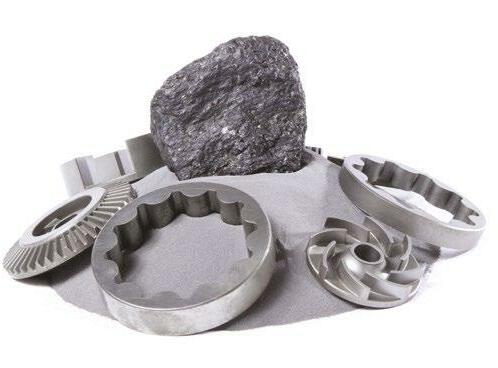
In the world of metal powders, Höganäs is always at the forefront of innovation. From more sustainable production processes to new and patented powder compositions, we are dedicated to offering you the optimal solutions while reducing environmental impact. With our range of metal powders designed for efficient press and sinter processes, we can offer powders designed for any application.
Combining optimal powder performance with improved sustainability is a priority for Höganäs, as we are on a journey to becoming the first green metal powder producer. In addition to our material innovations, we have also committed to Science Based Targets and are founding members of the Additive Manufacturing Green Trade Association, demonstrating our ongoing commitment to leading sustainable transformation in our industry.
Inovar Communications Ltd
11 Park Plaza
Battlefield Enterprise Park
Shrewsbury SY1 3AF
United Kingdom
Tel: +44 1743 469909 www.pm-review.com
Managing Director
Nick Williams nick@inovar-communications.com
Group News Editor
Paul Whittaker paul@inovar-communications.com
Features Editor
Emily-Jo Hopson-VandenBos emily-jo@inovar-communications.com
Deputy News Editor
Kim Hayes kim@inovar-communications.com
Assistant Editor
Charlie Hopson-VandenBos charlie@inovar-communications.com
Consulting Editor
Dr David Whittaker
Consultant, Wolverhampton, UK
Advertising Sales Director
Jon Craxford
Tel: +44 (0) 207 1939 749 jon@inovar-communications.com
Digital Marketer
Swetha Akshita swetha@inovar-communications.com
Production Manager Hugo Ribeiro hugo@inovar-communications.com
Subscriptions
Jo Sheffield jo@inovar-communications.com
Whilst every effort has been made to ensure the accuracy of the information in this publication, the publisher accepts no responsibility for errors or omissions or for any consequences arising there from. Inovar Communications Ltd cannot be held responsible for views or claims expressed by contributors or advertisers, which are not necessarily those of the publisher.
Reproduction,
Single photocopies of articles may be made for personal use in accordance with national copyright laws. Permission of the publisher and payment of fees may be required for all other photocopying.
All rights reserved. Except as outlined above, no part of this publication may be reproduced, stored in a retrieval system, or transmitted in any form or by any means, electronic, photocopying or otherwise, without prior permission of the publisher and copyright owner.

We welcome contributions from both industry and academia and are always interested to hear about company news, innovative applications for PM, research and more.
Powder Metallurgy Review is published on a quarterly basis. It is available as a free electronic publication or as a paid print subscription. The annual subscription charge is £150.00 including shipping.
Inovar Communications Ltd.

ISSN 2050-9693 (Print edition)
ISSN 2050-9707 (Online edition)
© 2022 Inovar Communications Ltd.
This magazine is also available for free download from www.pm-review.com
As 2022 draws to a close, it is clear that the increasing speed of vehicle electrification remains at the forefront of the industry’s mind. In 2021, the EU market share for hybrid and full electric vehicles reached 37.6% in 2021, compared to 22.4% in 2020; there is no longer any doubt about the fact that electrification is coming, the ICE vehicle is in decline, and the PM industry must adapt to retain its market value in the coming years.
At PowderMet in June, and at World PM in October, this subject loomed large in a significant number of presentations and discussions. But even if the atmosphere in the PM industry is uncertain, it is not negative. In common across all of these discussions is a focus on innovation and opportunities, and a hesitant optimism – the feeling that PM has the capability and versatility to identify solutions to the challenges it faces, and that the oft talked of opportunities offered by vehicle electrification (and, tangentially, new energy) could be near at hand.
In this issue’s lead feature, Bernard North reports on a visit to Amsted Automotive Group’s Burgess-Norton MFG headquarters in Geneva, Illinois, USA. This is a PM automotive parts supplier determined to make the most of the opportunities offered by the rising EV industry and position itself as a key parts provider to a new generation of vehicles. Notable in our news section, and throughout our 2022 news coverage, are the large number of powder producers expanding into the production of metal powders for Additive Manufacturing and other applications outside press and sinter PM, as they prepare for a continued reduction in traditional press and sinter product volumes for ICE vehicles – this is not a new trend, but one which has significantly gained pace in 2022.
As innovation is, by necessity, ramped up across the industry, it is an exciting time to be part of the world of metal powder-based manufacturing. All of us at PM Review look forward to seeing what 2023 brings, and wish all of our readers the best success in the coming year.
Emily-Jo Hopson-VandenBos Features Editor, Powder Metallurgy ReviewCover image
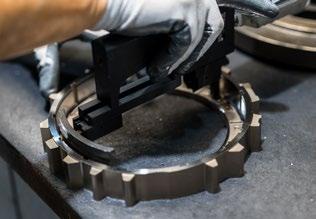
Inspection of a PM clutch component at Burgess-Norton (Courtesy Amsted Automotive)


The world is getting smaller. The pandemic has made it painfully clear how globally interconnected we truly are. We share one planet and we all need to ensure that our actions today support the generations of tomorrow. At Rio Tinto, the safety of our people is the Number One Priority. We also apply our core values to the communities in which we operate, to reduce the impact of our operations on our neighbors.
Rio Tinto is committed to sustainable development in metals processing. This pledge has been recently demonstrated through investments in the world’s first low carbon Aluminum processing technology, Elysis, and in exploring low carbon steel processing technologies. Rio Tinto will invest $1 billion over the next 5 years to help achieve its Net Zero Emissions goal by 2050.
Powder metallurgy is a Green Technology, a near net-shape process that allows for efficient use of raw materials. Rio Tinto Metal Powders (RTMP) produces iron and steel powders for the industry using carbon-free hydroelectric power generated in the Province of Quebec, Canada. The primary market for our powder products is the automotive industry, which is moving increasingly to electrification and away from internal combustion engines. RTMP is contributing to the development of new powder materials for electric components, from pump assemblies to small electric motors in e-bikes and EV’s to create a Greener Future Together.
At Rio Tinto, we produce materials essential to human progress. For more information about Rio Tinto’s polices, programs, and commitment to sustainable development please visit the Rio Tinto home page at www.riotinto.com
Metal Powders www.qmp-powders.com
43 Burgess-Norton and Amsted Automotive: How a legacy automotive supplier is growing with, not despite, electrification
In early 2021, in response to the rapid rate of change in its automotive customer base, Amsted Industries brought two of its Tier 1 automotive supply business units, Means Industries and Burgess-Norton, together. Combined, they formed a new technology team: Amsted Automotive Group (AAG), combining expertise in advanced metal forming, Powder Metallurgy, and electro mechanical torque transfer and propulsion system design, and positioning Amsted as a key participant in vehicle electrification.
Bernard North visited Burgess-Norton MFG in Geneva, Illinois, USA, and here reports on the company’s history, facilities and ongoing response to a changing market. >>>
53
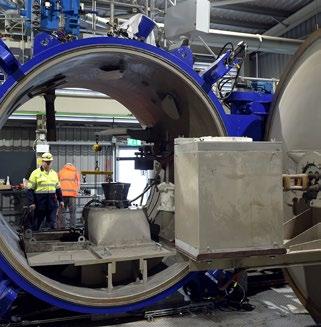
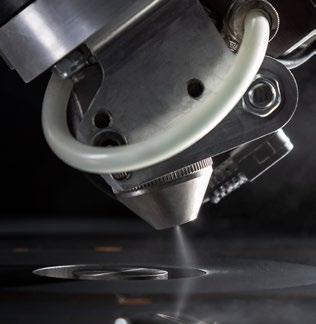
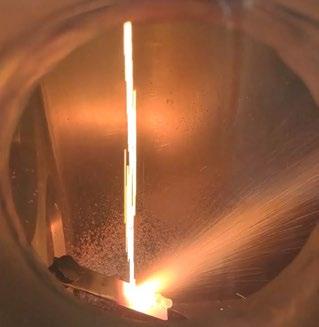
sustainability demands in PM: Improved processing of nickeland copper-free powder mixtures for low alloyed PM parts
In recent years, all industries have been challenged by increasingly tough regula tions aimed at combatting climate change, fast-moving developments in vehicle elec trification, fluctuations in the status and supply of raw materials, and more.
The need to increase process sustainability applies even to already-efficient indus tries like press and sinter PM, where the production of low alloyed parts faces pres sure to increase process efficiency and decrease its reliance on the now-critical alloying materials nickel and copper.
In this article, Dr Vladislav Kruzhanov and Dr Volker Arnhold explore some of the best options to achieve this. >>>


65 World PM2022: An overview of the status and trends in the global PM industry
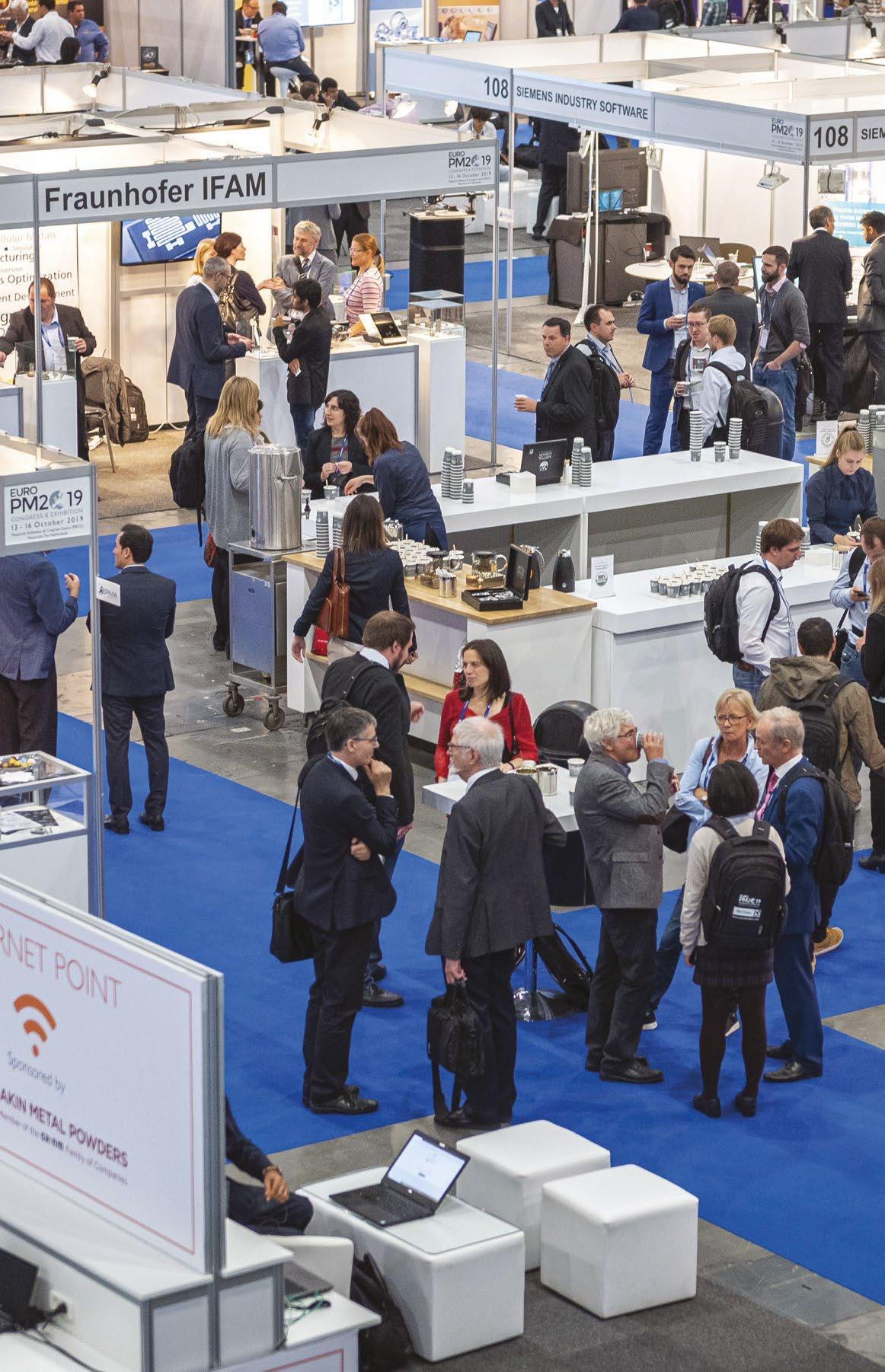
The 2022 World PM Congress and Exhibition brought over 1,000 visitors from the industry to Lyon, France, in October. During the event’s Plenary Session, attendees were given the vital facts and figures on industry trends in Europe, North America and Asia. As the PM market faces unprecedented challenges, these statistics are valuable way to take the pulse of the market during a time of unprec edented challenge.
Here, we present the market statistics given during the session, as well as the recipients of the 2022 EPMA Keynote Paper, PM Thesis, Peter Brewin Poster and Fellowship Awards. >>>
79 A novel approach for the production of metal powders with tailored chemical compositions: AMAZEMET ’s rePowder
Establishing new technologies to produce small quantities of high-quality metal powders with tailored, AM-suitable chemical compositions can accelerate the development of new materials for the AM process.
These advances not only benefit the AM industry, but its end-users and metal powder producers that are looking for sustainable materials and atomisation methods. One such powder produc tion technology is ultrasonic atomisation. In this article, Warsaw University of Technology spinoff AMAZEMET shares how its state-of-the-art rePowder device enables the low-cost, eco-friendly recycling and ultrasonic atomisation of metal mate rials at the laboratory scale. >>>
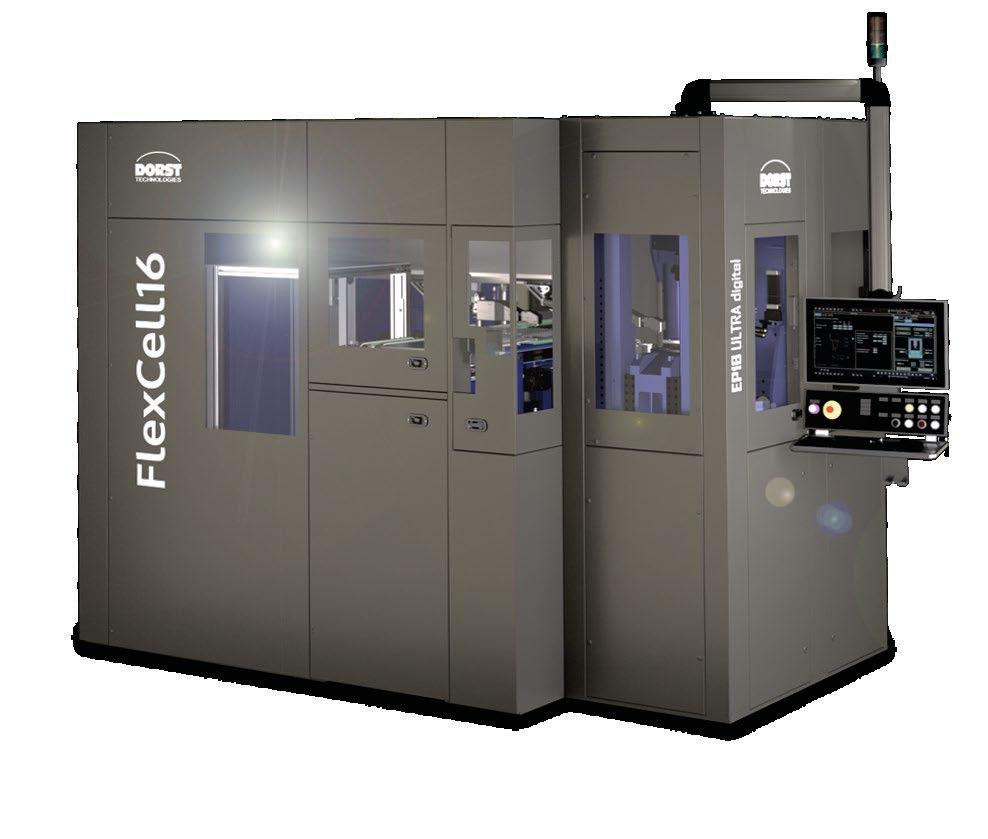
89 Productivity, flexibility, reliability: SACMI’s new press technologies for the changing PM industry
In the last sixty years, Italian press powerhouse SACMI has installed over 15,000 presses for a varied list of applications worldwide and achieved a prominent role as a go-to equipment supplier for the Powder Metallurgy industry. Its MPH line of metal powder presses is a mainstay of the PM market. Now, as PM faces challenges from vehicle electrification, the urgent need to reduce energy consumption, and the growing digitalisation of manufacturing, SACMI shares with PM Review how it continues to innovate and bring new solutions to the evolving market. >>>
95
The thermal properties of metal powders strongly influence the sintering, final density, and quality of PM parts.
Properties such as thermal conduc tivity and specific heat capacity can be used for quality evaluation of PM components, simulations/modelling, process parameter optimisation and more.
Here, Dr Artem A Trofimov, Orton Ceramic Foundation, evaluates the relatively new Hot Disk Transient Plane Source (TPS) technique for measuring the thermal properties of loose powders and compressed tablets, and discusses its poten tial for quality control via quick differentiation between powders of different metals and/or particle sizes using thermal property calibration curves. >>>
105 World PM2022:
A technical session at the 2022 World PM Congress, organised by the Euro pean Powder Metallurgy Association (EPMA) and held in Lyon, France, October 9-13, 2022, addressed the use of Field Assisted Sintering tech nology (FAST) for the processing of a range of advanced materials.
FAST or Spark Plasma Sintering (SPS) uses a direct current to directly heat the green part through Joule heating, allowing high heating rates and low processing cycle times, thus offering the possibility to manufacture materials with novel and advanced characteristics.
In this article, Dr David Whittaker reviews the four papers presented on the topic at World PM. >>>












To submit news for inclusion in Powder Metallurgy Review contact, Paul Whittaker, paul@inovar-communications.com
Melrose Industries PLC, UK, has announced plans to separate the GKN Powder Metallurgy and GKN Automotive businesses from the Melrose Group by way of a demerger of shares in a new holding company (DemergerCo) to Melrose share holders. The move will result in two separately listed companies, DemergerCo and Melrose Industries, with Melrose retaining ownership of GKN Aerospace. Subject to share holder approval, the demerger is planned to take place in the first half of 2023.
DemergerCo is expected to become an independent automotive platform, owning both GKN Automo tive and GKN Powder Metallurgy,
and will act as an independent group with its headquarters in London. The company will seek admission to listing on the premium segment of the Official List and to trading on the Main Market of the London Stock Exchange. It will have a dual strategy of profitable organic growth, as well as targeted M&A in the automotive sector.
The internal work under Melrose ownership to position the businesses to achieve stated margin targets for GKN Automotive and GKN Powder Metallurgy are expected to be completed this year. Simon Peckham and Geoffrey Martin will be execu tive directors of DemergerCo, as well as the remaining Chief Execu
Gasbarre Products Inc is reported to be expanding its facility in St Marys, Pennsylvania, USA, with an investment of some $5.8 million.
The company has leased a 14,000 m 2 facility in St Marys, which will triple the size of its current location and create sixteen new jobs, while retaining a further 156 employees across four locations statewide.
Gasbarre also plans to relocate oper
ations from Plymouth, Michigan, to the expanded facility.
Gasbarre received a funding proposal from the Donor Committee for Enterprise Devel opment (DCED) for a $64,000 Pennsylvania First grant. As part of its expansion project, the company has committed to creating new jobs at its St Marys facility within three years.
tive and Group Finance Director of Melrose. The current Chief Executive and Finance Director of GKN Automo tive, Liam Butterworth and Roberto Fioroni, will take up equivalent roles for DemergerCo.
“Since acquiring GKN in 2018, we have reinvigorated each business to achieve its potential,” stated Justin Dowley, chairman of Melrose Indus tries PLC. “The proposed demerger now gives each an exciting opportu nity to individually grow shareholder value through organic growth and acquisition in both platforms. Mean while, we remain on track to meet our full year 2022 expectations with full inflation recovery and providing good momentum for the intended demerger in the new year.”
www.melroseplc.net www.gknautomotive.com www.gknpm.com
“Our investment in the new facility in St Marys provides an opportunity for Gasbarre to continue to grow and flourish where we have manufac tured for nearly fifty years,” stated Alex Gasbarre, CEO. “The work ethic and skills provided by past, current, and future Gasbarre team members provide a strong base for this move. We look forward to adding new team members in the coming months when the move process is completed. The people of Elk County and St Marys will be key to our success.” www.gasbarre.com
Rio Tinto, Sorel-Tracy, Québec, Canada, has partnered with the government of Canada to invest up to US$537 million over the next eight years in an effort to decarbonise its Rio Tinto Fer et Titane (RTFT) opera tions and to position the business as a centre of excellence for critical minerals processing. The partnership is intended to support technological innovations that represent a first step towards reducing greenhouse gas emissions from RTFT’s titanium dioxide, steel and metal powders business by up to 70%. It is also expected to progress initiatives to diversify RTFT’s product portfolio.
The Government of Canada will invest up to $162 million to support these initiatives through its Strate gic Innovation Fund (SIF), which supports large-scale, transformative, and collaborative projects that will help position Canada to prosper in the global knowledge-based economy. The partnership will support projects including BlueSmelting, increasing scandium production and adding titanium metal to Rio Tinto’s portfolio.
The BlueSmelting project is an ilmen ite smelting technology that could generate 95% less greenhouse gas emissions than RTFT’s current reduction process, enabling the production of high-grade titanium dioxide feedstock, steel and metal powders with a reduced carbon footprint. A demonstration plant is currently under construction at the RTFT metallurgical complex in Sorel-Tracy to test and validate this technology developed by scientists from Rio Tinto’s Critical Minerals and Technology Centre. Construction of the demonstration plant – which is expected to have the capacity to process up to 40,000 tonnes of ilmen ite ore per year – is expected to be completed in the first half of 2023.
If fully implemented, the BlueS melting project will reportedly have the potential to deliver a reduction of up to 70% in RTFT’s overall green house gas emissions, a decrease of approximately 670,000 tCO 2e compared to 2021 – the equivalent of removing 145,000 cars from the road.
Increasing scandium production
Rio Tinto also announced plans to quadruple its production capacity to reach up to 12 tonnes of scandium oxide per year. New modules will be added to the existing plant, which uses a new process to extract high purity scandium oxide from the waste streams of titanium dioxide production, without the need for any additional mining. The $22-26 million project is expected to start producing scandium oxide in 2024.
Adding titanium metal Rio Tinto is partnering with other titanium industry participants to advance the development of a new process for extracting and refining titanium. The company is setting up a pilot plant at the RTFT metallurgi cal complex to validate this low-cost process, which reputedly requires no harmful chemicals and does not generate direct greenhouse gas emissions. The plant is expected to be completed by the end of 2023.
This project has the potential to increase the production of raw titanium metal in North America, while strengthening the security of supply for this critical mineral for Canadian and US manufacturers. www.riotinto.com
Aubert & Duval, a subsidiary of the High Performance Alloys Division of the Eramet Group based in Paris, France, has launched Stellar®, a new metal powder brand dedicated to Additive Manufacturing and announced the relocation project of its Irun, Spain, production site.
“These two announcements reflect our belief in the growth potential of the metal Additive Manufacturing market,” stated Eric Caridroit, presi dent of Aubert & Duval Irun.
The Stellar brand is intended to embody all of Aubert & Duval’s ambi
tions in the AM field, boosting its offer in a fast-growing market, with the rise of space applications and challenges of decarbonisation. The new range of high-temperature alloys Stellar ABD®-900AM, Stellar MHA3300®, Stellar AD730® are intended to repre sent a solution to enable the space, aeronautics and energy industries to develop new generations of turbines offering better energy and environ mental performance.
Aubert & Duval is also moving to a new stage of its growth with a relocation project of its metal
powder production factory, sched uled for summer 2023. The new industrial site, with a planned 50% capacity increase, will be located in Oiartzun, Spain, 6 km away from its Irun factory. With this new indus trial base, Aubert & Duval plans to increase its metal powder production to develop and produce customised AM alloys.
Adeline RIOU, Global Sales Manager for metal powders at Aubert & Duval, concluded, “Through the combination of freedom of design and innovative materials, this technology offers great opportuni ties for weight reduction and high temperature performance. This value proposition is at the heart of our new Stellar brand.”
www.aubertduval.com




Pometon S.p.A., headquartered in Maerne, Venice, Italy, reports that it is participating in IRON+, a joint venture established by Pometon, EMGroup and Metalot, that intends to build what it states is the first fully operational commercial Mega Watt size energy plant operating on iron powder-based fuel technology.
IRON+ recently signed a letter of intent with Swinkels Family Brewers that will see the tech nology used to supply sustainable heat for the company’s brewing process over the next twenty years.
This iron powder-based fuel technology has been under devel opment through the Metal Power Consortium, with participants including TU Eindhoven, Metalot, Studentteam SOLID, EMGroup, HeatPower and Romico Hold. A successful first demonstration of the iron powder-based fuel tech nology reportedly took place at one of the breweries of Swinkels Family Brewers, and resulted in the CO 2-free production of beer for the first time.
“During a two-year improve ment and testing phase since that time, the technology has matured
and the system efficiency has been enhanced,” stated Guy Willems from EMGroup. “The combustion is not only CO 2 free, but it promises also to have very low NOx and particle emissions, which is also of key importance. As far as we know, this would be the first commercial iron power system in the world.”
For the iron powder-based fuel technology process, iron powder is burnt to an iron oxide powder in a boiler to produce steam. After combustion, the iron oxide powder is converted back to iron powder using hydrogen, ultimately derived from solar and wind energy. Iron powder can store energy in a very compact, cheap, safe, environmen tally friendly and CO 2-free way. This combination is what is said to make it an important solution for the heatintensive industry.
“Production of iron powder and the industrial reduction is in our genes for decades,” added Rudi Clayton, CEO of Pometon, “This offthe-shelf technology is currently improved within the IRON+ company for green energy applications.”
Over the next twelve to eighteen months, the final testing phase
Alvier Mechatronics, a subsidiary of Sweden’s Höganäs AB, is reported to be relocating to Oceanhamnen, Helsingborg, Sweden. The company currently operates out of Höganäs, but plans to move to the iconic Prisma building in spring 2023.
“With its exciting start-up environ ment, Prisma is the right fit for our organisation and our high ambitions,” stated Daniel Hervén, CEO of Alvier Mechatronics. “We’re now recruiting at full capacity and plan to have more employees at the new premises.”
Alvier Mechatronics provides electrical drive systems and associated components based on high-performance powder mate rials. Its four focus areas include high-speed motors, transmission, axial flux motors and passive components.
The company’s new premises at Prisma will scale approximately 300 m 2 and are designed to stimu late collaboration and knowledge exchange. The premises include office space as well as a lab to
of the boiler system for the iron powder-based fuel technology will be completed, the conversion technology will be finalised in the Metalot Future Energy Lab, the contracts between companies will be formalised and a final short demonstration will be organised at one of the Swinkels Family Brewers sites, before the building phase of the commercial plant begins.
“We already had a lot of confi dence in the potential of the Iron Power technology and the iron power consortium, but it is very important for us that the complete process is fully circular, so more research was needed,” stated Peer Swinkels, CEO of Swinkels Family Brewers. “Now we know that regeneration is possible in a green way, we can go forward. As the new company, IRON+ has been established now, we are extremely proud and happy to be the first in the world to be able to adapt this technology for our future brewing process. This is one of the corner stones of the master plan we are carrying through currently to be fully circular in the years to come. We need more than one solution for our energy transition, in the end we need several solutions and this could be an important one.”
www.pometon.com www.metalot.nl www.ironfuel.nl
develop prototypes and test ideas, such as electric motors. Addi tionally, the ground floor houses HETCH, Helsingborg’s tech hub, which enables entrepreneurs and innovators to work side by side and form networks.
David Nilsson-Sträng, CEO of HETCH, commented, “When we founded HETCH, it was exactly this effect we wanted to create, that a strong community attracts and establishes exciting growth companies. We are very happy that Alvier Mechatronics becomes part of HETCH.”
www.alviermechatronics.com

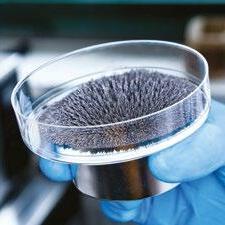
Gränges Powder Metallurgy (GPM), Velbert, Germany, a division of Sweden’s Gränges AB, has launched its second aluminium alloy aimed at the Additive Manufacturing sector. The high-performance aluminium alloy, S260 AM, is part of the compa ny’s Dispal® range and is said to be characterised by high wear resistance and excellent tribology properties.
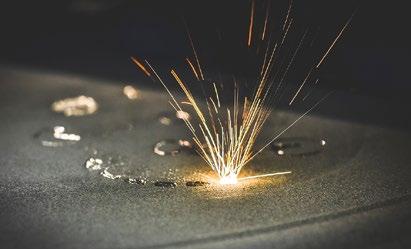
The fine matrix structure of silicon particles coupled with Cu and Mg elements is intended to allow users to manufacture components that are natively highly wear resistant. Because the silicon is evenly distrib uted across the part, the material’s performance is said to be long-lasting and permanent without the need for additional coating.
Another key characteristic of this material compared to other Dispal materials is a low coefficient of
thermal expansion, also due to the high silicon content. This makes S260 AM well suited to components that need to be machined on very tight tolerances and need to perform in challenging environments where they are subjected to temperature fluctua tions (e.g., oil pump gears). Spool valves can be manufactured directly with matching CTE to their manifolds and without additional manufacturing steps. Valves made of S260 AM can reportedly perform millions of cycles, outperforming steel valves.
“We saw a big need, especially in the automotive industry, for an alloy that is lightweight, wear resistant and at the same time has a low CTE,” stated Greta D’Angelo, Director of AM, GPM. “For many of our customers weight reduction is a big driver, and Additive Manufacturing allows them to go even further, without compro
Gränges Powder Metallurgy has launched S260 AM aluminium alloy (Courtesy Gränges)
mising on performance. Thanks to S260AM, our customers can break records and to do that more costeffectively and with a shorter lead time.”
While S260 AM is another step for GPM into Additive Manufacturing, there are said to be plans for more material releases soon. Together with the development of new materials, GPM is working to address some of the main challenges that AM is still facing, such as serial production and high productivity.
www.granges.com
Tailor made solutions with superior consistency with respect to: purity, crystallinity, particle size distribution and oversize control Imerys grades are ideally suited to powder metallurgy applications for electrical and hybrid vehicles
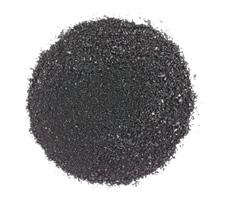
Equispheres, Inc, Ottawa, Ontario, Canada, has announced its develop ment of a non-explosible aluminium alloy feedstock for Additive Manu facturing that reduces the hazards associated with the day-to-day handling of metal powders. Known as NExP-1, the material is designed for the production of additively manufactured aluminium parts.
The company explains that NExP-1 maintains the ability to produce highquality builds at high throughput rates, but, unlike other metal powders for Additive Manufacturing, it is dust-free and characterised as non-explosible as per ASTM E1226, Standard Test Method for Explosi bility of Dust Clouds. The material is also non-combustible as per the UN Manual of Tests and Criteria, Part 3, Subsection 33.2.1. for flammable solids.
“We have achieved these key safety properties without altering the quality of our material nor the chemical composition. In printing, this material performs just as well as our other aluminium powders, but it has the added benefit of being non-explosible and non-combustible,” stated Evan Butler-Jones, vice president – Product & Strategy for Equispheres. “It would almost be inaccurate to even call this a powder,” Butler-Jones continued. “It is almost totally free of dust; it flows like water and it is easy to clean off of equipment surfaces. It is a completely unique printing media for production Additive Manufacturing.”
The NExP-1 material is currently available in AlSi10Mg and the company has developed recommended parameters for additively manufac turing the new material, targeting several end-use applications.
Kevin Nicholds, CEO of Equi spheres, commented, “We are applying our technology to empower innovation in Additive Manufac turing. We anticipate this new safer aluminium material will be embraced by companies using AM in a produc
tion setting. This new breakthrough is a result of our ongoing efforts to make 3D printing more accessible and competitive with other manufac turing methods.”


Equispheres has a core team of metallurgists actively engaged in R&D and continues to develop
processes and products to advance the technology of AM. The company’s Performance and Precision lines of aluminium powder demonstrate marked improvement in build speed and part quality, resulting in lower per-part costs. NExP-1, an addition to Equispheres’ Production product line relies on a technological break through to address the handling properties of AM powders. www.equispheres.com

Meeting the highest standards for drying and powder quality.
As world-leading specialist in powder engineering, we have developed exceptional Spray Drying Solutions that define and deliver superior quality powders to your exact specifications in the most energy-and-costefficient way.
Be it a powder, a granulate or an aglomerated product. GEA offers compact, single-line spray drying plants of any desired capacity. Our very own Nozzle or Rotary Atomizer technology allow us to cover a very wide size range.
Get in touch today gea.com/contact
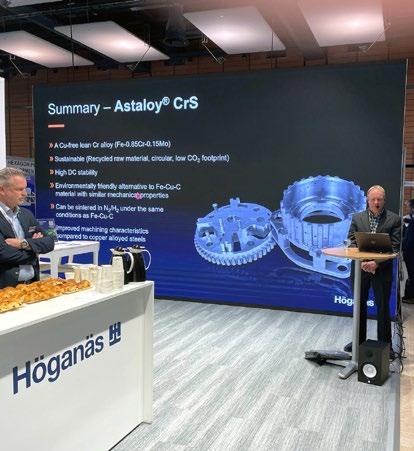
At this year’s World PM Congress & Exhibition, organised by the European Powder Metallurgy Asso ciation (EPMA), Sweden’s Höganäs AB announced its new sustain able Cr pre-alloyed metal powder. The powder – Astaloy® CrS – is functionally recyclable and, by intention, can be used as a raw material for the same product after the first iteration has reached its end of life.
The company states that Astaloy CrS is produced via water atomisation from 98% recycled raw material, with 100% of its Fe content recycled.
In this alloyed powder, Höganäs reports it has responded to demands for Cu-free alternatives to FeCuC, as Cu can reduce steel’s mechanical properties and cannot
be removed from steel scrap. Previ ously, to overcome this issue, scrap infused with Cu might be diluted with virgin steel, rendering FeCuC a non-circular powder.
DC scatter, segregation, hetero geneity and variations in builds can be avoided with Astaloy CrS as there is no liquid phase sintering, no metal segregation, and low vari ations in C content. A higher DC stability translated to a more stable production process. The full poten tial of the metal powder is said to be obtained in combination with Höganäs’ Starmix premix, enabling higher filling properties.
At its World PM2022 booth, Höganäs also outlined its road map to net zero as follows:
• Scope 1: Direct Emissions –Net zero by 2030
Roboworker, Weingarten, Germany, has showcased its latest powder compacting cell, RPC, at two leading industry events in Germany. The company exhibited at both Ceramitec, in Munich, and AMB International Exhibition for Metal Working 2022, in Stuttgart, reporting significant interest in its latest compaction technology.
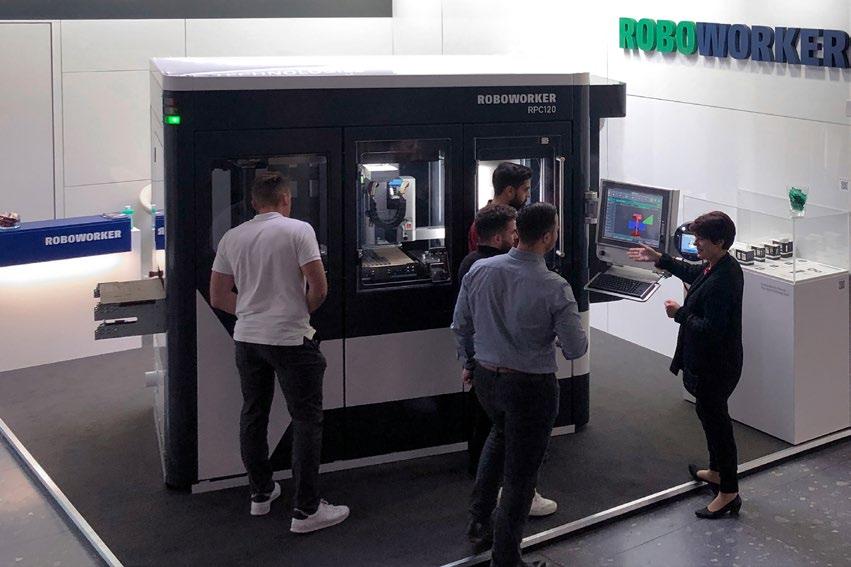
The RPC consists of a fully electric-servo driven axial powder compaction press that works based on the ejection principle. All Roboworker press automation platforms can be fully integrated into the system with one control architecture. It offers features such as updated process control and programming technologies, in-process inspection with image processing and more.
Technology developed for the press room includes a magazine trolley integrated into the new press automation system PAG 80.
This can be either used for unloading the RPC press cell or for loading and unloading the RDS automated drilling station for the net-shape manufacturing of tangential milling
Höganäs introduced its new Astaloy® CrS metal powder at World PM2022 (Image PM Review)
• Scope 2: Indirect emissions (owned) – Fossil-free electricity 2024
• Scope 3: Indirect emissions (not owned) – 30% reduction by 2030 | Net zero by 2037
www.hoganas.com
inserts, as well as the RBS auto mated brushing station for the preparation of highly consistent and defined cutting edge geome tries. The PAG 80 is not only suited for Roboworker powder compaction presses, it also offers interfaces to all common press types. www.roboworker.com
Ceratizit Group, headquartered in Mamer, Luxembourg, has presented a strategy that aims to bring the company to the forefront in sustain ability for the hardmetal and cutting tool industry by 2025.
In order to become truly sustain able throughout the company, Ceratizit plans to look at the entire value chain with regard to environ mental, social and governance (ESG) issues, and also include its coopera tion with partners. In the first phase, the focus will be on those aspects that have the greatest leverage effect.
“Climate change is one of the greatest challenges of our time and requires the industry to rethink in many areas as well,” stated Thierry Wolter, Ceratizit board member. “For Ceratizit customers to also be able to produce more sustainably, the company has set itself ambi tious targets for its own products and services. Our vision is to be the leader in sustainability in the hard metal and cutting tool industry by 2025.”
In an effort to drastically reduce its own carbon footprint quickly, Ceratizit is initially focusing on three major levers; one decisive factor is the increase in the use of secondary
raw materials to over 95%. Compared to primary raw materials from ore, their processing requires 70% less energy and reduces CO 2 emissions by 40%. A positive side effect is the safe guarding of the supply chain for raw materials, so that both the customers and Ceratizit are said to benefit twice.
Another focus is on the power supply. Ceratizit plans to switch the power supply of all sites to green electricity from wind, solar and water power in the next few years. Closely related to this change in power supply is the issue of hydrogen supply. It is needed as a production medium in the hard metal industry, especially for the production of tungsten powder. Up to now, this hydrogen has mainly been obtained from natural gas by steam reforming, so-called ‘grey’ hydrogen. Going forward, Ceratizit plans to use ‘blue’ hydrogen, which is produced from water by electrolysis with green elec tricity. For this purpose, the company will cooperate with its existing suppliers and also build its own elec trolysis plants.
The first milestone in the imple mentation of the new strategy is 2025, by which time Ceratizit plans not only to be CO 2 neutral, but to reduce the actual emissions by 35%
Quickparts, Seattle, Washington, USA, and portfolio company Trilantic North America, have announced the acquisition of digital manufacturer Xcentric Mold & Engineering, Clinton Township, Michigan, USA.
Founded in 1996, Xcentric provides a range of quick-turn digital injection moulding and CNC solutions, from rapid prototyping to scaled production. With nearly 100 employees and 5,574 m 2 of manufac turing space, Xcentric will expand Quickparts’ capabilities to deliver injection moulding, CNC machining and other critical services. This
acquisition is said to complement the company’s current manufacturing offerings and is expected to support the company’s growth and efficiency via US-based production.
“We are very pleased to welcome the Xcentric team to the Quickparts family,” stated Ziad Abou, Chief Executive Officer of Quickparts. “As a combined company, we will offer an in-house, end-to-end solution from first prototype to short-run produc tion. This acquisition is an important step as we continuously strive to advance Quickparts’ capabilities. With Xcentric, we will be able to offer
compared to the reference year 2020. The second stage, 2030, envisages a reduction of 60% compared to 2020 with the help of further measures.
The most ambitious goal, however, is to achieve ‘net zero’ by 2040 – a target envisaged by the Paris Climate Agreement only for 2050.
Wolter concluded, “Reducing CO 2 emissions along the entire value chain by at least 75% by 2040 is, without question, a challenge. However, with a view to future generations, we see no alternative to this path and are pleased to also let our customers participate in this through products such as our ‘GreenCarbide’ rods, our awardwinning SilverLine milling cutter with sustainability formula, as well as a wide range of services.”

www.ceratizit.com
a complete lifecycle solution that will be executed with even greater speed and certainty.”
“We are thrilled to combine Xcen tric’s leading digital manufacturing capabilities and injection moulding expertise with Quickparts’ offer ings to continue to bring speed and scale to the market,” added Matt McIntosh, CEO, Xcentric. “Trusted by industry leaders, Xcentric prides itself on a terrific culture of excel lence and customer service, and we believe the Quickparts team is the right partner to support the continued growth of Xcentric’s capa bilities.”
www.quickparts.com www.xcentricmold.com

Rare earth metals company Pensana Plc, headquartered in London, UK, has partnered with automotive company Polestar to assist in its Polestar 0 project which aims to create a climateneutral car by 2030.
This project aims to identify and eliminate all greenhouse gas emissions, from the extraction of raw materials to when the car is delivered to the customer and onwards to the end of vehicle life.
To achieve this goal, Polestar is collaborating with sixteen partners, including Pensana, across the value chain.
Pensana recently broke ground on the establishment of an inde pendent and sustainable supply chain for ultra-low carbon magnet metal rare earths powered by offshore wind at the Saltend Chem
From 80 kN up to 5000 kN
ical Park in the Humber Freeport UK with high-value raw materials supplied from the hydro-electric powered state-of-the-art mine at Longonjo in Angola.
“We are absolutely delighted to collaborate with Polestar and its partners on the Polestar 0 project, which is aiming to unlock the full potential of electric vehi cles by creating the world’s first climate-neutral car,” commented Paul Atherley, Pensana chairman. “Polestar is majority owned by Volvo which has a proud history of pioneering safety in cars in the 1970s setting the standard for all cars manufactured worldwide. We believe that the Polestar 0 will set the standard for the electric vehicle industry.”
“This is a truly innovative project which needs an inde
pendent and sustainable supply of rare earths,” he continued. “We are incredibly excited to be working with Polestar and its partners and are very much looking forward to Pensana playing its part in rede fining the future of electric vehicle manufacture.”
Hans Pehrson, leader of the Polestar 0 project, stated, “A project of this ambition requires partners at the cutting-edge of their industries and which are fully engaged in our bold vision. That’s why I’m looking forward to Pensana becoming a crucial part of our team as we find solutions for developing an entirely climate-neutral supply chain. Pensana’s expertise in Rare Earth supply, including mining, will be invaluable in our mission and will play an integral role in pioneering new and innovative technologies to achieve what has so far been impossible.”
www.pensana.co.uk www.polestar.com
Topic:
Date:
Electrical powder presses from your solution partner

Eco-friendly
Low operational costs
High precision
Maximum productivity
www.osterwalder.com
Pioneer. Partnership. Performance.
Ceratizit SA, part of the Plansee Group, has acquired all shares of agricultural wear parts manufacturer AgriCarb SAS, Meyzieu, France, and intends to fold the company into its Hard Material Solutions Division. This acquisition is said to be an important part of Ceratizit’s growth and sustain ability strategy.
“We want to become the leader in sustainability for the hardmetal and cutting tool industry by 2025. The acquisi tion of AgriCarb helps us to reach this goal,” stated Dr Andreas Lackner, speaker of Ceratizit’s executive board.
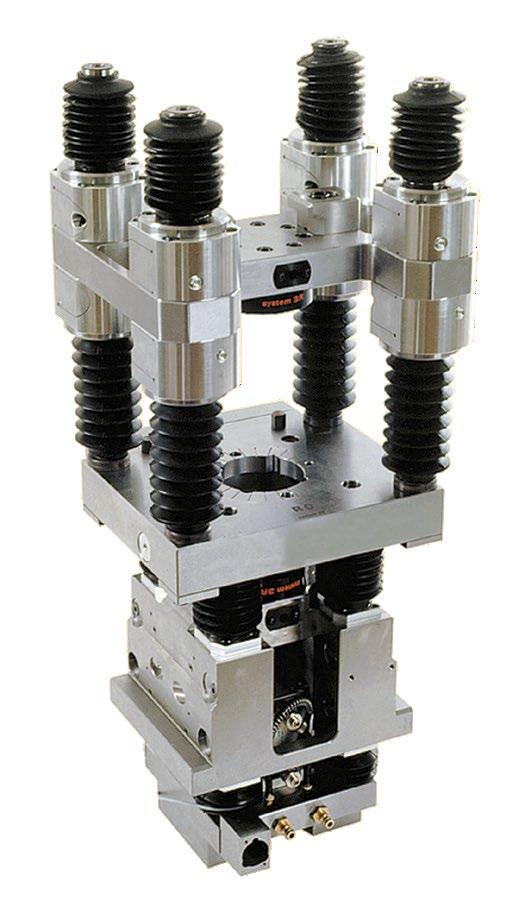
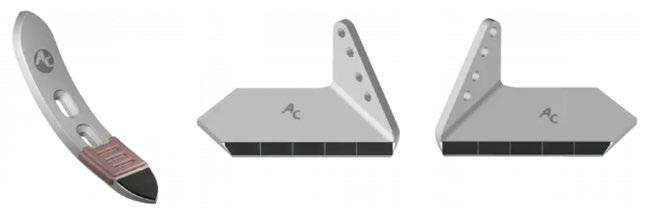
Founded in 1985, AgriCarb manufactures carbide-rein forced steel agricultural wear parts for soil and vineyard tillage. Its products are said to have a service life of 3-7 times longer than conventional steel counterparts. The company employs around sixty and offers a range of over 1,600 tillage products.
Lionel Curtat, AgriCarb’s previous Managing Director and co-owner, will accompany the integration into the Hard Material Solutions Division. He commented, “I am very pleased to have found a buyer in Ceratizit, whose world wide distribution network and unique know-how in the manufacturing of hardmetals can help AgriCarb to achieve higher market penetration and further growth.”
www.ceratizit.com www.agricarb.com
Rosswag Engineering, Pfinztal, Germany, a supplier of metal powders, components and qualification services in the metal Additive Manufacturing industry, has extended its Additive Manufacturer certificate for the upcoming year through TÜV SÜD.
The ‘Additive Manufacturer’ certificate expands Ross wag’s certification within metal powder production which, alongside ISO 9001 and ISO 14001 certifications, is intended to ensure the high-quality production of serial components in metal Additive Manufacturing.
www.rosswag-engineering.de
MolyWorks Materials Corpora tion, Los Gatos, California, USA, is expanding its global footprint with the establishment of a new metal foundry in Singapore to support the production of low-carbon metal powders and the development of new alloys, reports Singapore Times
Founded in 2015, MolyWorks Materials has developed a patented, compact recycling foundry and tech nology that recycles waste metals into raw materials for high-purity, sustainable powders suitable for Additive Manufacturing. To date, the company has successfully upcycled over twenty-five alloys.
The Singapore-based facility will
serve as the company’s Asia-Pacific R&D and production hub, offering a wide range of metal powders, including small batches for custom alloys and R&D, and high-volume production for large-scale industrial applications. The facility is equipped with laboratories to support powder characterisation and testing services.
“MolyWorks is very pleased to have found its own metal upcycled foundry in Singapore to provide a first source of sustainable metal powders for local businesses and the entire region,” stated Phil Ward, CEO of MolyWorks. “With strong interest and support from industry and the Singapore government, this new
Daido Steel Co., Ltd., headquar tered in Nagoya, Japan, has announced the availability of DAPTM-AM LTX die steel-based metal powder for Additive Manu facturing, the second product in its DAPTM-AM (Daido Alloy Powder – for Additive Manufacturing) series of metal AM powders. The gas atomised powder offers low oxygen content and high flowa bility, and is particularly suitable for large sized products.
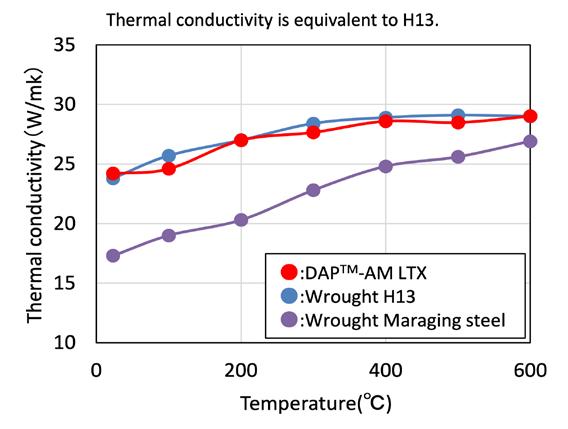
Developed specifically for Laser Beam Powder Bed Fusion (PBF-LB) Additive Manufacturing, DAPTM-AM LTX is based on SKD61 (JIS steel), which is widely used for dies and moulds. The new alloy enables the production of components which have been historically difficult with conven tional die steel-based powders. Unlike maraging steel powders, DAPTM-AM LTX does not contain cobalt, and tests show that once additively manufac tured, the material has the same
local capability will help reduce metal waste while reducing carbon and improving the sustainability of the country’s metal parts production over time. We expect it to play an increas ingly important role over time.”
Lionel Lim, VP of Technical Hard ware and Equipment at the Singapore Economic Development Board (EDB), added, “MolyWorks’ move to use Singapore as a location to enhance its sustainable metal powder production for the region shows how a company can combine growth and environ mental protection goals. Molyworks is excited about the new foundry’s role in partnering with the local Additive Manufacturing ecosystem to develop raw metal alloys for industrial use. This is timely, as we have a lot of work to do.”
www.molyworks.co
performance as moulds made from traditional SKD61 steel.
In April 2021, Daido launched DAPTM-AM HTC, a high thermal conductivity metal powder and the first product in the DAPTM-AM range. DAPTM-AM HTC is a cobalt-free die steel-based powder that suppresses cracking and enables high-perfor mance moulds to be additively manufactured. However, DAPTTM-AM HTC is only suitable for additively manufacturing moulds up to 150 mm square, any larger than this is more suited to DAPTM-AM LTX, being ideal for parts exceeding 150 x 150 mm. www.daido.co.jp
Fig.1 Tempering Hardness of DAPTM-AM LTX compared to H13 (Courtesy Daido Steel)
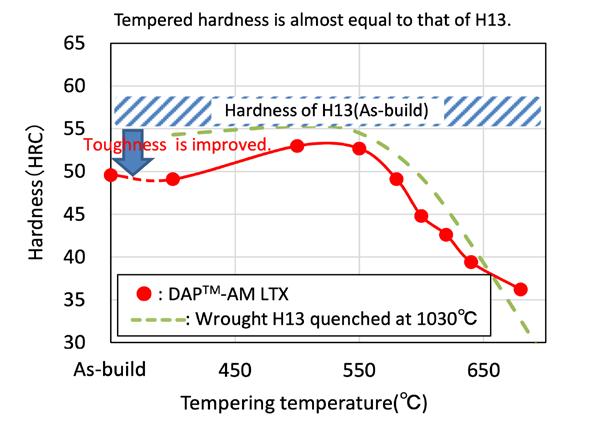
Fig.2 Thermal conductivity of DAPTM-AM LTX compared to H13 and maraging steel (Courtesy Daido Steel)
Since 1945, NSL Analytical has been trusted to verify the highest standards of quality, performance, and safety. NSL supports innovation by testing powder metal, feedstock, prototype designs and final products for the Powder Metallurgy Industry. Our capabilities include:
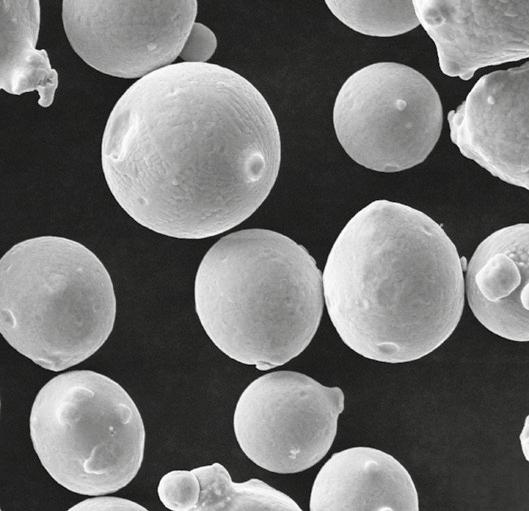
Powder Characterization — static and dynamic flow, density, particle size distribution, particle shape and moisture content

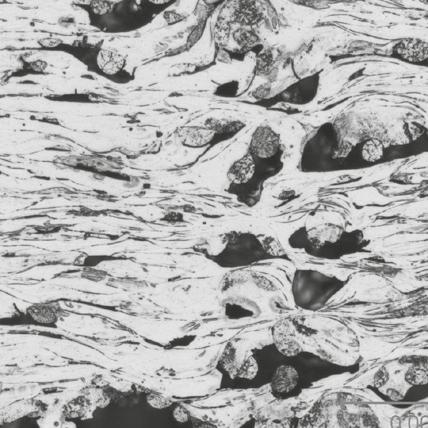
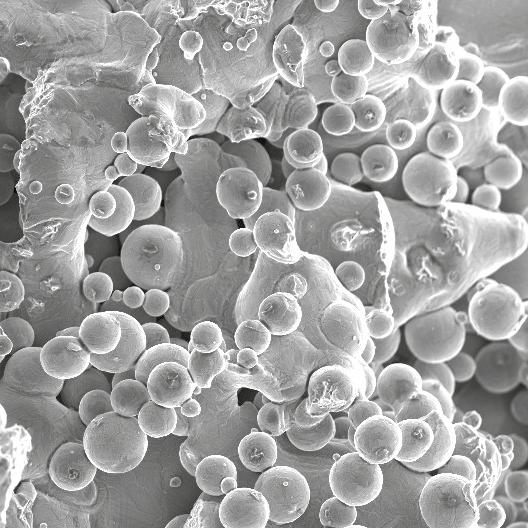
Surface Area — particle size, shape, roughness and porosity
Material Composition
chemical analysis of major and trace level elements for R&D and specification conformance
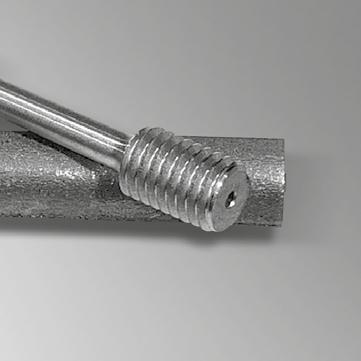
Validate Metal Printed Parts
metallurgical evaluations, mechanical testing, microstructure and failure analysis
Powder Studies — alloy development and powder re-use
NSLPowder360.com
or call 877.560.3875
IperionX, Charlotte, North Carolina, USA, has selected a 4,600 m 2 site in Southern Virginia Technology Park in Halifax County, Virginia, as the location for the company’s $82.1 million titanium demonstration facility. The threeyear project will be in two phases, with the first $12.5 million investment in construction and production-related machinery and tools, and the second a $69.6 million expansion. The facility will mark the USA’s first titanium powder producer using 100% recycled scrap metal.
IperionX undertook a site selection process across the US to secure the ideal site for the development of the titanium demonstration facility. Over 250 sites in over thirty states were evaluated for cost, site readiness, expansion capability, access to infrastructure and potential financial incentives. The chosen site at the Southern Virginia Technology Park is said to provide IperionX with a good location to scale up its titanium metal production, with direct access to major highways, a large talent pool, high-quality infrastructure and 100% renewable power. The state, county and local authorities have also provided an incentive package.
The titanium demonstration facility is said to be a critical step in advancing IperionX’s ambition to re-shore an all-American source of low carbon titanium. Phase 1 of the project is expected to have an initial production capacity of 125 tonnes per annum of titanium metal powder in spherical or angular form. It is anticipated to generate significant employment opportunities, with a Phase 1 headcount estimate of thirty-one employees, estimated to scale to over 100 employees.
“We are delighted to have chosen South Boston and Halifax County as the site for our inaugural titanium demonstration facility, which is a critical step in advancing IperionX’s ambition to re-shore an all-American source of titanium metal,” stated Anastasios ‘Taso’ Arima, founder and CEO of IperionX. “We are highly appreciative of the support and welcome that we have received from our partners and stakeholders in Virginia and look forward to establishing IperionX as a leader in advanced manufacturing in our new home.”
IperionX also reported it has successfully commissioned Stage 2 of its Mineral Demonstration Facility (MDF) at the Titan Project in Tennessee to produce a critical mineral concentrate rich in titanium and rare earth minerals. Stage 1 of the processing facility involved fine particle removal (< 45 µm) via water, utilising hydro-cyclones, to produce a product-ready heavy mineral wet concentration. The Stage 2 processing upgrade consists of a series of water gravity spirals which separate valuable heavy minerals into titanium, zircon and rare earth concentrate. A final upgrade, Stage 3, is expected to be commissioned later this year and will employ flotation and magnetic separation to produce separated rare earth mineral, zircon and titanium products. These products will be used in an effort to accelerate customer offtake negotiations and a feedstock for IperionX’s R&D projects across low-carbon synthetic rutile and titanium metal production.
Due to the efficiency of our cuttingedge technology we can offer the lowest priced powder on the market with no compromise in quality.
IperionX is said to have significantly advanced the Titan Project feasibility study metallurgical test work, including optimisation flotation test work for rare earth minerals, which is expected to be complete by the end of 2022. The company is also evaluating a low-capital, phased development approach for the Titan project that is hoped to reduce upfront capex, lower execution risk and potentially accelerate the permit application timeline.
“We are committed to developing a world class critical minerals operation in Tennessee that will play an important role in sustainably re-shoring American jobs and supply chains,” added Arima. “The successful commissioning of the second stage of our Mineral Demonstration Facility is an important milestone to this commitment and provides a new platform to accelerate our customer engagement as well as educating our stakeholders and the broader community of the low impact, sustainable nature of potential operations in the region.”
www.iperionx.com
Rare Element Resources Ltd., based in Littleton, Colorado, USA, has announced plans for a rare earth processing and separation demon stration project in Upton, Wyoming, USA. The project is led by General Atomics, an affiliate of the Compa ny’s largest shareholder Synchron, and has completed the 60% plant design milestone and is advancing toward final detailed engineering, due for completion later this year.
Early expenditures for acquisi tion of long lead-time equipment and services are being made in an effort to minimise the effect of inflation and supply chain bottlenecks. “We are very pleased that our rare earth demonstra tion plant project is progressing toward planned construction next summer. Permitting and licensing are now underway with several
permits already received and others under agency review,” stated Randall Scott, president and CEO of the Rare Element Resources. “The General Atomics-led team recently completed a key design milestone with the Department of Energy (DOE), which is funding approximately one-half of the $44 million project budget. We under stand the importance of this project for the establishment of a domestic rare earth supply, which is of vital important to our nation.”
The demonstration plant will make use of the company’s proprietary processing and separation technology, which is a closed-cycle process with fewer steps, said to result in environmental benefits and lower costs compared with current technologies. The plant is expected
to produce a commercial-grade neodymium/praseodymium (Nd/Pr) rare earth high-purity oxide, used in producing high-strength permanent magnets. The demonstration plant will process already stockpiled sample material from the company’s Bear Lodge Project located in northeastern Wyoming.
The design of the plant is expected to be completed by the end of 2022, followed by the completion of permit ting activities in the second quarter of 2023. Completion of the plant’s construction will follow within a period of twelve months.
Scott concluded, “We continue to work diligently with the State of Wyoming, the University of Wyoming, and the town of Upton to ensure our demonstration project becomes a cornerstone for the rare earth industry in Wyoming and America, while providing a venue for worker training in rare earth processing and separation.”
www.rareelementresources.com
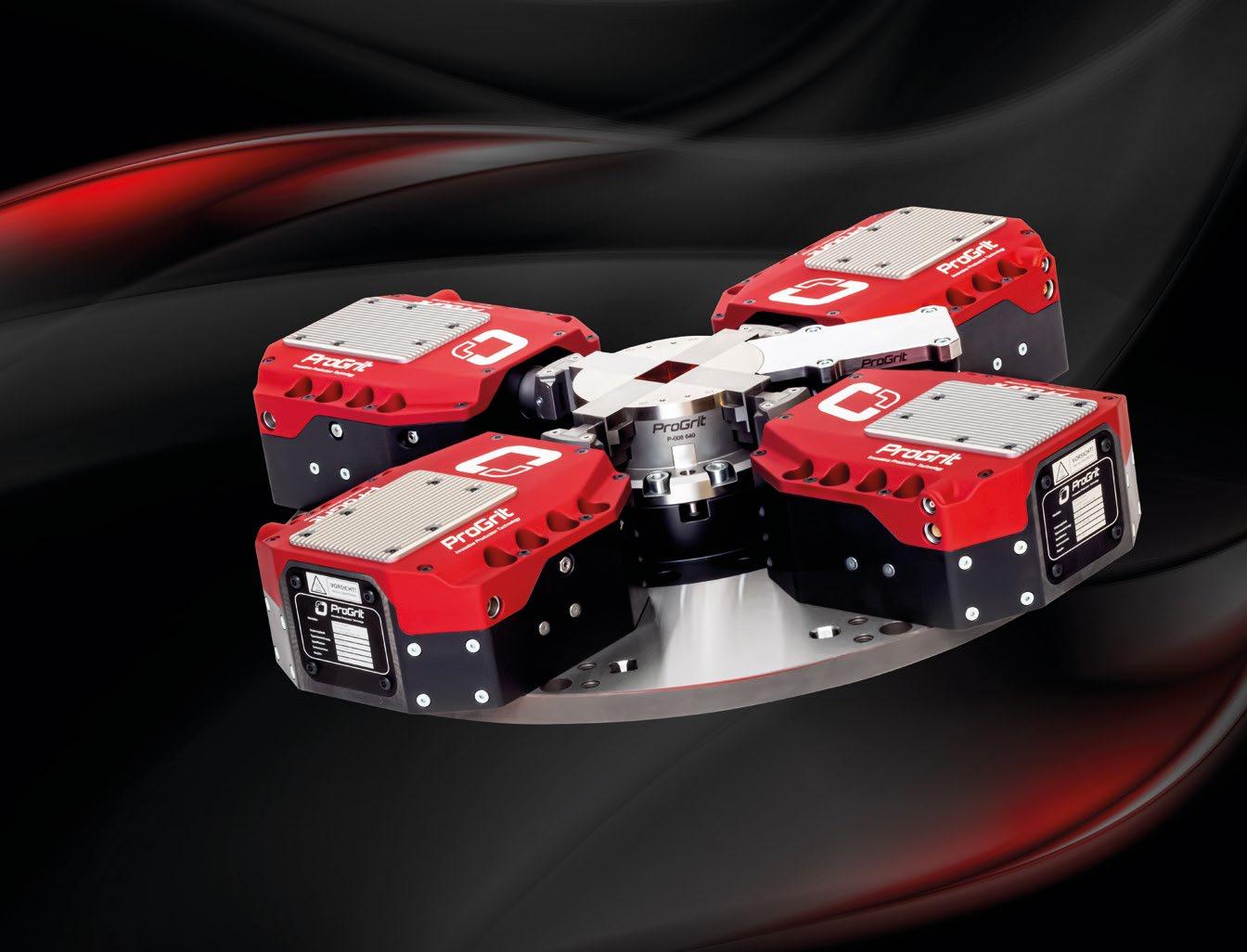
Liberty Powder Metals (LPM), part of GFG Alliance’s Liberty Steel Group, has identified a process configura tion which increases the yield for atomised Additive Manufacturing powders.
The DANDY 2 project, funded by Innovate UK, successfully linked the modelling of the atomisation process via computation fluid dynamics (CFD) and experimental modelling (EM) with the plant operations to increase the yield of Additive Manufacturing powders, with a particle size distri bution of 15-45 µ m, by over 40% via an iterative design optimisation of the step change liquid atom iser nozzle and powder production process changes. This involved collaborative R&D with the Materials Processing Institute, Middlesbor ough, North Yorkshire, UK.
During the year-long project, the CFD simulated gas flows, orifice plate, new nozzle designs, gas input temperature link to atomisa tion velocity, gas input pressure link to aspiration pressure (crossvalidated by plant measurement), gasket thickness changed both atomisation velocity and aspiration pressure. EM provided confidence in machine security, enabled further modelling on gasket thickness and changes in nozzle design. CFD combined with the EM on nozzle design development, including high-speed videoing at 115,000 frames per second, providing cross-validation between model flows and against nozzle performance.
LPM completed 193 atomiser melts of 316L and Alloy718, with
individual trials on nozzle design and material, orifice plate, gasket thickness, gas input temperature, gas input pressure (both dynamic and steady state). Each parameter has influenced Additive Manufac turing, which, when combined, have produced a cumulative AM yield increase to 57%. Machine learning tools were applied to this dataset by Swansea University and Materials Processing Institute inde pendently and whilst the dataset was small in terms of ‘big data’, these tools have confirmed the findings from the plant trials and identified various parameters to investigate further.
Powder from twenty-four melts were fully characterised to assess flowability and morphological characteristics. These powders were also used to build mechanical test specimens by Additive Manu facturing. It was found that the powder from the high-yield trials was good quality, easy to manu facture with and provided good mechanical properties.
From the modelling, plant trials, machine learning and powder characterisation, a new configura tion was identified to increase the yield for LPM AM powder produc tion.
The project, funded by Innovate UK, also examined the use of audi ometry and vibration monitoring tools on the atomiser to give realtime feedback and control. LPM intends to continue development of this technology.
www.libertysteelgroup.com www.mpiuk.com
Sintex a/s, headquartered in Hobro, Denmark, recently presented its new corrosion-resistant PM duplex stain less steel component at the Stainless Steel World Duplex in Rotterdam, the Netherlands.
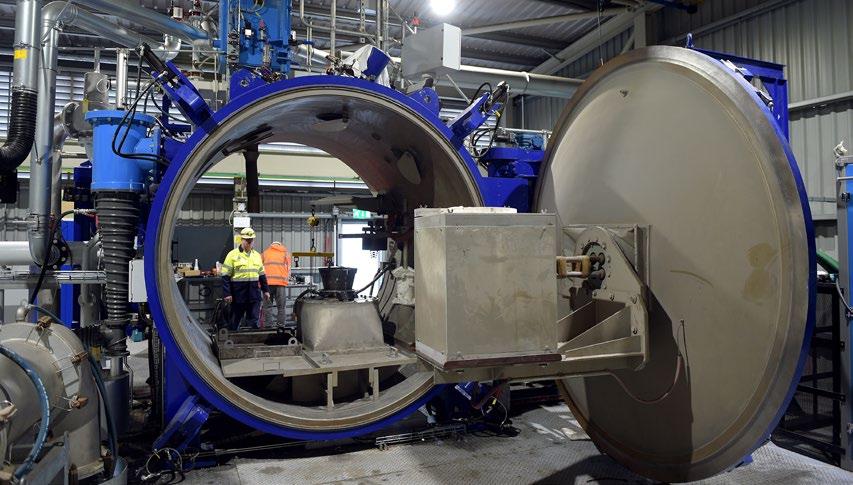
Sintex has stated that its duplex stainless steels are suitable for use within severe environments and can be processed via Metal Injection Moulding, Binder Jetting and Material Extrusion. The company supplies to a wide variety of industries across the world, including energy, automotive, medical, electronics.
At the Stainless Steel World Duplex conference, Peter Kjeldsteen, Chief of Marketing &
Innovation, gave an introduction to the company’s duplex stainless steels, discussing its applicability and future potential. The company also covered the corrosion resistance and mechanical properties, the possibility of reducing the need for welded and bolted assemblies, and whether complex geometries are needed in stainless steels.
www.sintex.com
Sintex introduces high-corrosion resistant stainless steel products
We’ve got one mission, to support as many metal part makers in the MIM and Metal AM industry as possible. Our team of processing experts utilize 20+ years of experience to share all our knowledge and help you overcome challenges, develop better processes and become successful part makers. We help develop real world, practical solutions based on many lessons learned along our journey. Being the ONLY debind and sinter service provider with full sized production equipment, we are honored that we have been able to support every industry currently utilizing MIM and Metal AM. DSH is the only source for the best process support, toll processing and educational resource for your MIM and Metal AM applications.



Researchers from the Sheffield Tita nium Alloy Research (STAR) group, part of the UK’s University of Shef field, have partnered with ECKART GmbH, Schluechtern, Germany, to convert surplus aluminium alloy powders from atomisation into sheet material in two solid-state steps for use in aerospace applications.
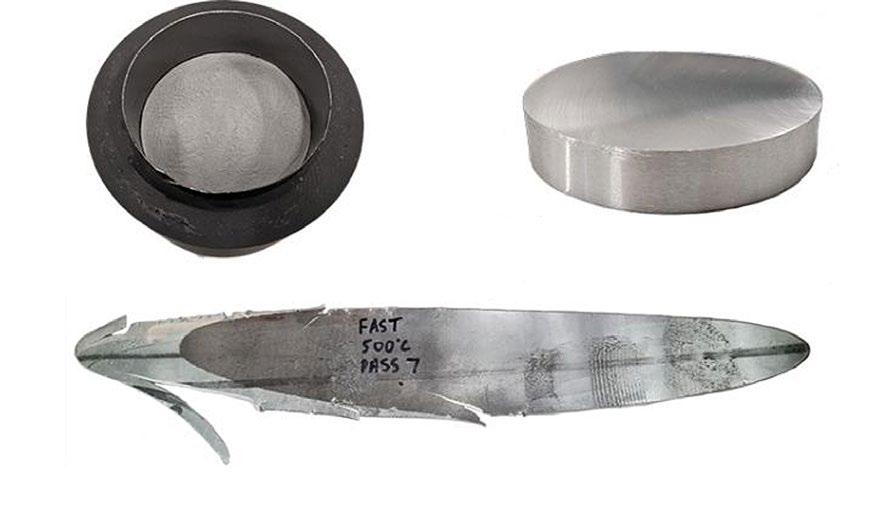
The project combined field assisted sintering technology (FAST) with hot rolling to convert surplus aluminium alloy powders from atomisation into sheet material in two solid-state steps. Eckart provided the A20X alloy powder used by the researchers.
Additive Manufacturing techniques are generally promoted as having reduced material wastage compared to conventional metallurgy, but the as-atomised particle size range is often overlooked as an issue. Business economics requires that alternative processes are utilised to convert these surplus powders into useful products, to ensure that the AM market is cost effective and meets sustainability targets. This key factor informs the foundation of this research.
Field Assisted Sintering Tech nology can provide an alternative solid-state processing route to consolidate these surplus powders into billets for subsequent
processing. This enables the produc tion of useful products from this feedstock, whilst also improving sustainability within the Additive Manufacturing supply chain.
This project goes a step further and combines FAST with hot rolling to convert surplus aluminium alloy powders from atomisation into sheet material in two solid-state steps. FAST can effectively consolidate the powder into fully dense billets, which are then hot rolled into sheets.
Through tensile testing, this project’s results revealed that the properties’ output from this process was comparable to conventional material which is used in aerospace applications.
Pre-existing research focused on FAST of metal powders assisted in the development of this project. This reportedly spurred a final year student project – designed by Dr Simon Graham, Research Asso ciate MAPP – Future Manufacturing Hub and led by Alicia Patel, BEng Aerospace Engineering student –following the completion of this early-stage research, the project has been built upon in an effort led by Dr Graham.
The research has also been informed by works carried out in Sheffield relating to the processing
of titanium powders which are oversized for Laser Beam Powder Bed Fusion (PBF-LB) Additive Manufacturing, where methods of crossover were identified to be of relevance. When reviewing existing literature, only one paper is thought to have been published which specialises in hot rolled, FAST produced, pure aluminium. Previously published research on A20X alloy has only considered AM or cast material.
The research is said to have shown that FAST can rapidly consolidate aluminium alloy powders, including A20X, with a large particle size range into fully dense materials. The resulting 80 mm diameter A20X FAST were also successfully hot rolled from their initial 15 mm thick ness down to 2 mm sheet, although some later optimisation is required to prevent edge defects within the sheet. Some conventional cast A20X material – with the same starting dimensions – were also hot rolled under the same conditions. Tensile testing showed that – before and after the heat treatment – the FAST material exhibited similar properties to the cast and were comparable to other aluminium sheet used in aero space applications.
These findings were presented by Dr Simon Graham in a keynote at World PM2022 titled ‘Solid-State Processing of Surplus Aluminium Alloy Powders through a Combina tion of Field Assisted Sintering Technology and Hot Rolling’ The outcome of this project has demon strated that there is a viable processing route to convert surplus alloy powders into sheet material with good mechanical properties. Although the long-term, positive impacts cannot be quantified at this stage, there are clear economic impacts. These economic benefits relate to new revenue streams for atomisers, as well as a potential cost reduction of powders for Additive Manufacturing.
www.sheffield.ac.uk www.eckart-hydraulics.com

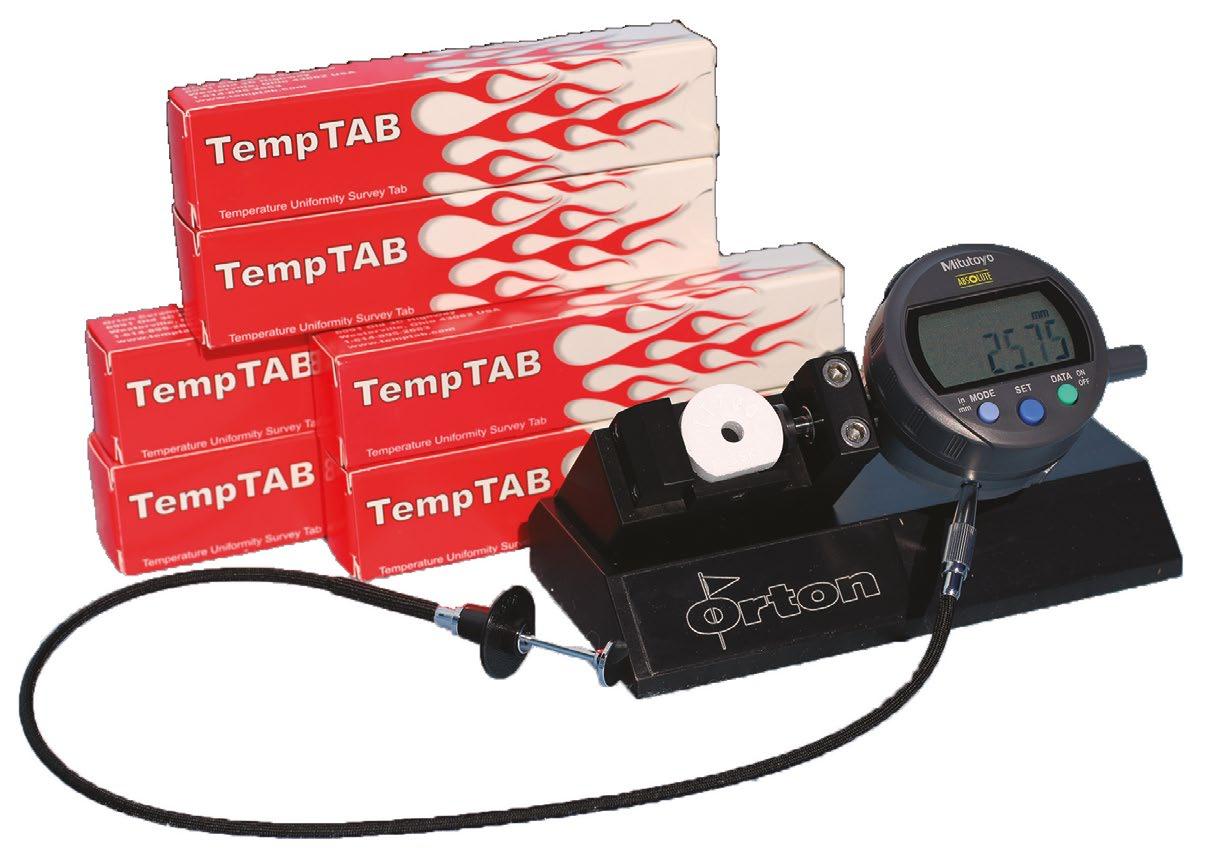
X-ray CT technology developer Lumafield, Cambridge, Massachusetts, USA, announced that it has closed a $35 million Series B funding round from new and existing investors, achieved a major new AI-driven performance breakthrough, and appointed two execu tives to its board of directors. To date, the company has raised a total of $67.5 million.
When Lumafield emerged in April 2022, it offered what it called the world’s first accessible industrial X-ray CT platform for a more affordable price than legacy systems. Now, the company has reputedly made its Neptune scanner over 300 X faster, enabling scaling from one-off scans to serial inspection in high-volume manufacturing operations.
Behind the speed increase is a development in arti ficial intelligence. CT scanners work by capturing a series of two-dimensional X-ray images from different angles, then reconstructing them into a 3D model using software. Lumafield’s AI allows the company’s recon struction process to achieve the same results with fewer two-dimensional X-ray images, reducing the time required to run a scan.
Lumafield technology can be used to see within threads and channels (top) or the details of lattice structures (bottom) of additively manufactured parts. The above parts are from a case study between Lumafield and rms Company (Courtesy Lumafield)
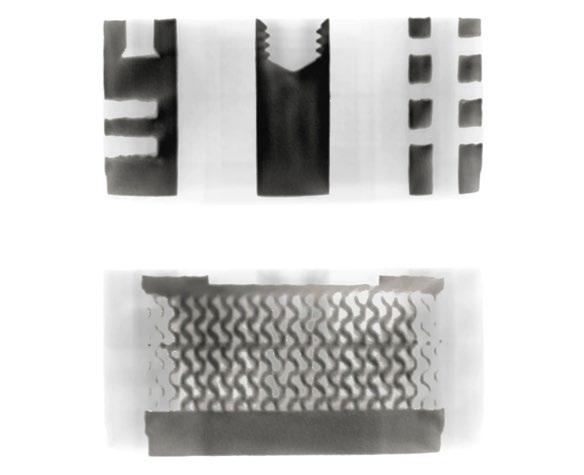
New improvements in Lumafield’s software also make it possible to skip certain steps in the reconstruction process before performing automated analysis, thus reducing process time. As a result, scans that previ ously took several hours are said to now run in a minute or less, making industrial CT a practical technology for quality assurance on factory floors. Combined with factory automation systems, Lumafield’s scanner and software can inspect products at high volume, automati cally flagging problems such as dimensional inaccuracies and the presence of pores and cracks.
“Industrial CT has been out of reach for most produc tion lines – until now,” stated Eduardo Torrealba, co-founder and CEO, Lumafield. “With these speed improvements and Lumafield’s low price point, it’s now possible to implement 100% inspection with CT, catching invisible issues before they become costly problems.”
Lumafield also announced the appointment of Victoria Holt and Santo Politi to the company’s board of directors. Holt was previously CEO of Protolabs and is a member of the boards of directors of Waste Management, A O Smith, and Piper Sandler. Politi is the founder and General Partner of Series B funding leader Spark Capital, where his investments have also included Oculus, Twitter, Wayfair, and Plaid.
“The manufacturing world is changing dramatically,” added Holt. “Manufacturers are confronted with an increasingly competitive marketplace, radical shifts in supply chains, and ever-higher customer expectations. My experience leading Protolabs gives me an appre ciation for the positive impact technology can have on manufacturing. Lumafield offers a technology, a team, and a perspective that promise to reshape the way prod ucts are made. I’m very excited to work with Lumafield to realise its vision.”
www.lumafield.com
Hitachi Metals, Ltd., Japan, has released its ADMUSTER® C21P nickel-base alloy powder for metal Additive Manufacturing, enabling the production of complex shapes with high corrosion resistance and high strength. The alloy, one of the powders in Hitachi Metals’ ADMUSTER series, is reported to additively manufacture products with around 100 times or more the corrosion resistance of typical 316L stainless steel.
Hitachi Metals has been devel oping AM-specific materials at its Global Research & Innovative Tech nology centre (GRIT) in Kumagaya. Having rolled out the ADMUSTER series of metal Additive Manufac turing materials, which includes a range of metals with high corro
sion resistance and high strength, the company is keen to highlight its potential in numerous applications. ADMUSTER C21P is a powder based on MAT21®, a nickel-base alloy for wrought products devel oped at Hitachi Metals’ Okegawa Works. It currently has one of the highest Pitting Resistance Equiva lent (PRE) numbers of all of the company’s metal AM materials. Components additively manufactured from ADMUSTER C21P are reported to have the same corrosion resist ance as wrought MAT21, along with excellent strength and hardness. Test results show that, compared to stainless steel 316L, a material with relatively high corrosion resistance, as-built C21P test specimens have superior corrosion resistance.
Many chemical plants and semi conductor manufacturing plants, for example, use highly corrosive fluid and the corrosion resistance of parts used in this environment is important. Using parts with higher corrosion resistance makes it possible to improve reliability.
The higher reliability of compo nents built with such materials as ADMUSTER C21P can lead to a reduction in operational downtime and lowers the frequency of compo nent replacement. The Additive Manufacturing process also enables shorter part production lead times and helps reduce CO 2
Hitachi Metals confirmed it plans to further strengthen and expand the lineup of its ADMUSTER series, meeting the needs of those applica tions requiring heat resistance, wear resistance, corrosion resistance, and high functionality.
www.hitachi-metals.co.jp
At NLB, we know a reliable pump is critical to keep your atomization system in operation. With 50 years of experience engineering reliable pumps up to 2,760 bar (40,000 psi). Our pumps can easily integrate into your control center using your current system and produce your ideal particle size. To further diminish down-time, NLB has parts and service nearby, ready when you are. Call us today to learn more!
NLBCORP.COM US (800) 441-5059 Europe +44 7391 745 119

6K Additive, a division of 6K, North Andover, Massachusetts, USA, has announced its intention to significantly increase metal powder production capacity at its Burgetts town, Pensylvania, facility. The expansion includes adding four new UniMelt microwave plasma systems for powder production, as well as the addition of a new material feed stock preparation building. 6K also announced a powder supply agree ment and recycling partnership with Incodema3D, Freeville, New York.
The capacity increase is in response to a reported growth in demand for the company’s nickel, titanium and refractory powders. The additions are expected to help 6K meet its customers’ needs for the coming twelve to thirty-six months.
“Global unrest has shed a major spotlight on our nation’s supply chain vulnerability for critical materials,” stated Frank Roberts, 6K Additive’s president. “This, in combination with our consistent product quality, sustainability benefits, and the fact that we are a domestic supplier, have contributed to increased commercial activity with key strategic customers. This expan sion will help us meet customer demands in the coming years and ensure efficiencies in current and future operations.”
The addition of the feedstock preparation facility is expected to provide the company with vertical integration of feedstock sizing for nickel and titanium in the same location. This will help to stream line operations and provide faster delivery, and ultimate control and quality of the powder produced.
The Burgettstown plant currently produces a full range of powders including nickel 718 & 625, tita nium-64, stainless steel and copper, as well as capabilities to produce aluminium alloys. 6K Additive also runs two dedicated UniMelt produc tion systems co-located in the company’s parent headquarters in North Andover producing tungsten, rhenium and niobium-based alloys for hypersonic, defence, and rocket applications.
Eric Martin, Chief Operating Officer for 6K Additive, commented, “The ability to meet the demands of our customers in both quality and delivery is paramount for our organi sation. The addition of a feedstock preparation facility and the added UniMelt production capacity will help to create a consistent operational flow to meet this demand. However, I am equally excited to be able to bring on more talent to the organi sation with as many as thirty-five additional employees planned. It’s
great for our organisation as well as the tri-state area.”
6K Additive’s mission is to provide a solution for global decarbonisation in producing performance materials that are critical to production in markets such as aerospace, defence, medical and industrial applications. The company recently released results from a life cycle assessment conducted by Foresight Management comparing the environmental impact of 6K’s UniMelt microwave plasma technology to current atomisation technologies in the production of metal powders. The results showed upwards of a 91% reduction in energy use and a 91.5% reduction in carbon emissions when using the 6K UniMelt process.
A strategic AM powder supply agree ment and recycling partnership with Incodema3D has also been announced.
Following increased demand and larger volume orders, predomi nantly from aerospace and defence customers, Incodema3D sought to secure a domestic metal powder supply that met strict quality standards, as well as a solution for recycling its used powder and parts. 6K Additive, through its UniMelt plasma microwave powder produc tion system, is able to provide high volumes of domestically manu factured powder and a route to sustainably recycle Incodema3D’s used metals through its Powder Buy Back programme.
“We are talking to clients now about projects for 2023 that will require ten tons of metal powder per month,” stated Kevin Engel, Incodema3D director of Additive Manufacturing and metrology opera tions. “When you’re going through that volume of powder, recycling becomes imperative, and sustain ability is key to our business. By recycling our used powder with 6K Additive we have been able to drive down our contribution costs for material by 15% already.”
www.6kinc.com/6k-additive/ www.incodema3d.com








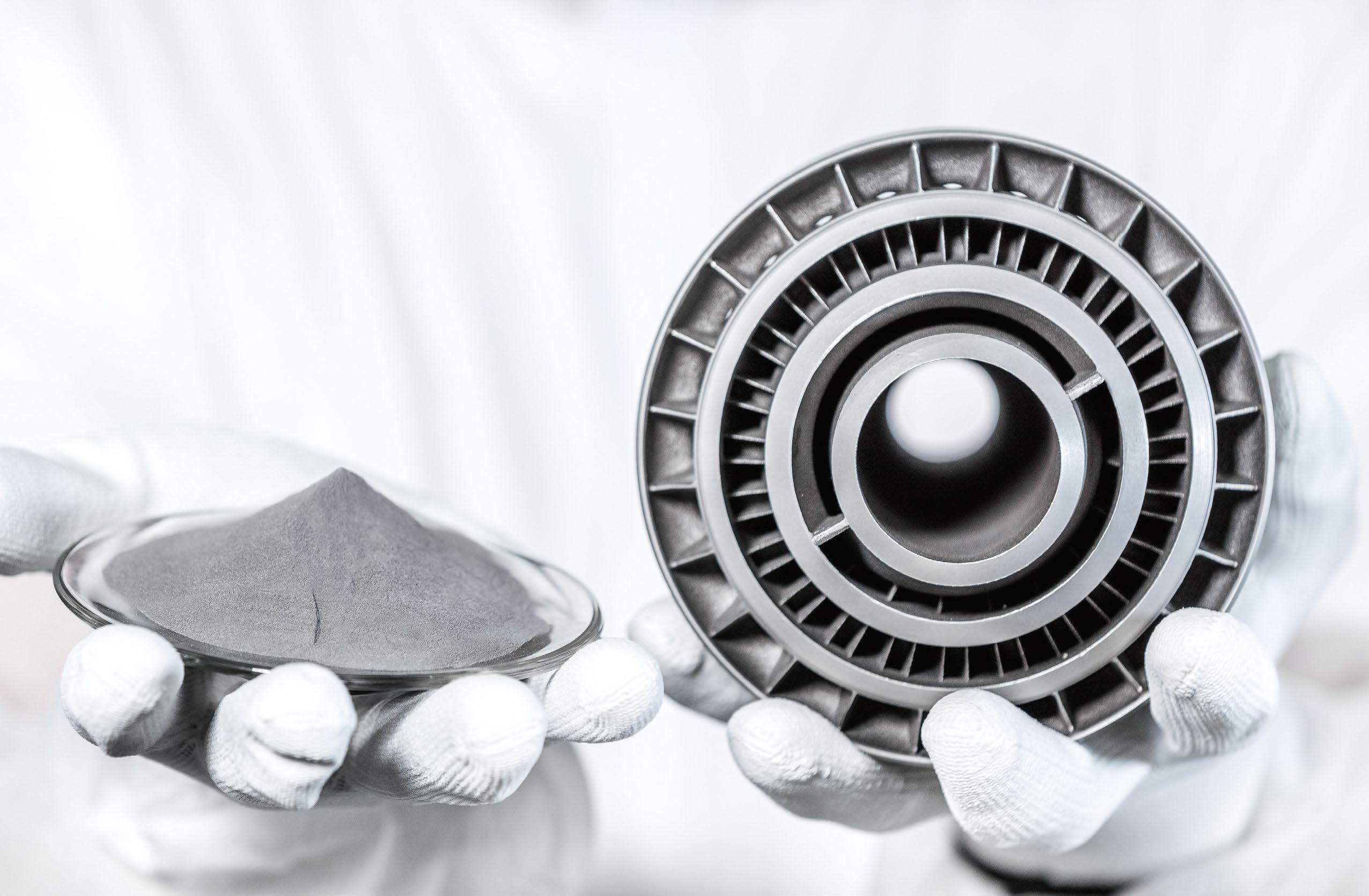
Cost-effective and at the same time high-quality metal powders are the drivers for additive manufacturing evolving into a sustainable key industrial technology. With our innovative powder atomization plants, you can produce high-quality metal powder for various powder technologies. And thanks to our digital solutions and financing models, this is particularly efficient, flexible and cost-effective.

LIFT, the US Department of Defense (DoD) manufac turing innovation institute based in Detroit, Michigan, USA, and the US Department of Defense have announced the launch of two projects led by Boeing as part of the ongoing Hypersonics Challenge led by the institute.
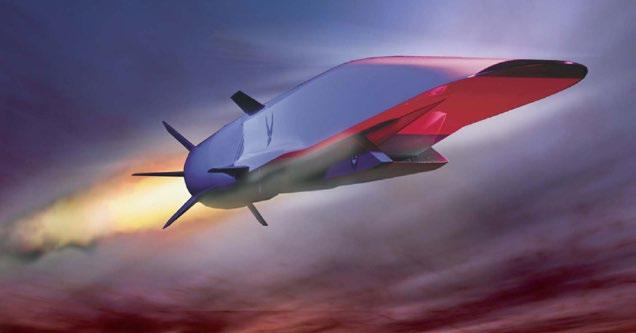
The first project, with partner Powdermet, Inc., Euclid, Ohio, aims to demonstrate near-net shape manufacturing of metal matrix composite components for hypersonic vehicle demonstrators. These high-performance, hightemperature alloys are expected to drastically boost the capability of components in hypersonic flight envi ronments, which, when combined with near-net shape manufacturing approaches such as Powder Metallurgy, can provide quality mission-critical components that are durable, reliable and rapidly manufacturable.
The second project proposes, with partners RPM Innovations, Inc., Rapid City, South Dakota, and Intel ligent Optical Systems, Inc., Torrance, California, to develop and verify a suite of in-situ build process moni toring sensors and non-destructive evaluation (NDE)
Two
Arcast Atomizers are custom built and competitively priced to meet the growing demand to produce high quality, low cost, technically advanced metal powders fulfilling the requirements of today’s pioneering manufacturing processes.
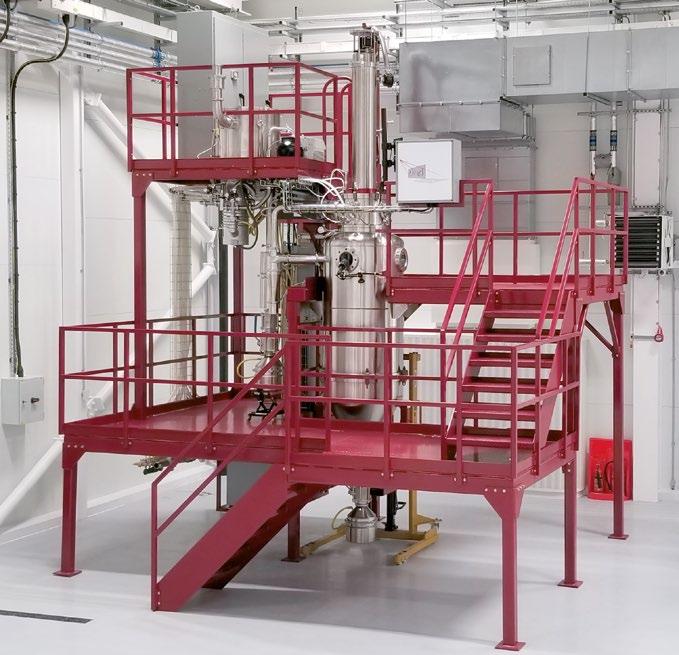
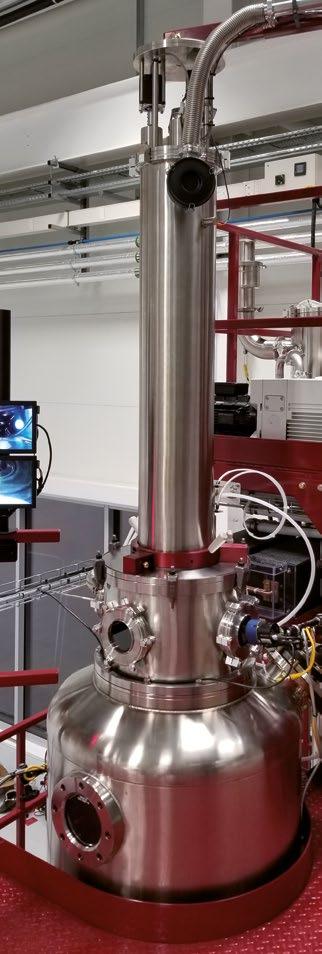
We can supply machines to atomize titanium alloys, super alloys, refractory and reactive metals, and ferrous and non-ferrous alloys in high vacuum purged vessels with inert gas replacement atmospheres.
We have installed machines all over the world, from 1 kg research furnaces to 1000 kg production units.
www.arcastinc.com
approaches applicable to laser-based Directed Energy Deposition (DED) Additive Manufacturing for hypersonic applications. Current post-process quality verification is time-consuming and expensive; in-process monitoring is expected to help inform the quality of the build during the process, saving time and expensive metal powders.
“These projects will benefit the entire American manu facturing base, helping spur technology development from material producers all the way up to original equipment manufacturers (OEMs),” stated Austin Mann, Metallurgist/ Materials Engineer, Boeing Research & Technology and lead on the first project.
The Hypersonics Challenge was kicked off in 2021 by LIFT and the DoD Manufacturing Technology Program, overseen by the Office of the Under Secretary of Defense for Research and Engineering. The challenge sought proposals on three specific topics critical to the materials science and manufacturing process of hypersonic vehicles.
“Cost-effective approaches to developing hypersonic components that are reliable and rapidly producible are critical to our national security, and these projects will lead us down that path,” added Taisia Lou, Boeing Additive Manufacturing Senior Engineer, and lead on the second project.
Nigel Francis, Chief Executive Officer and Executive Director, LIFT, concluded, “Understanding the materials and how they react to processing so components are near-net shape will help make the development and manufacture of hypersonic components faster, better, and cheaper for the US industrial base, therefore advancing our position in this key technology area, relative to our adversaries.”
The Boeing projects are the final projects awarded through the challenge. Project awards were determined by a team consisting of LIFT and the Department of Defense. Decision criteria include technological merit, technology readiness level (TRL), manufacturing readiness level (MRL), funding requirements, cost-share commitment, ITAR compliance, and LIFT member engagement.
www.lift.technology | www.boeing.com www.powdermetinc.com | www.rpm-innovations.com www.intopsys.com
Pfeiffer Vacuum Components & Solutions GmbH, based in Göttingen, Germany, is celebrating its 25 th anniversary by recognising its achievements to date. The vacuum technology solutions provider is a wholly-owned subsidiary of Pfeiffer Vacuum Technology AG, headquartered in Asslar.
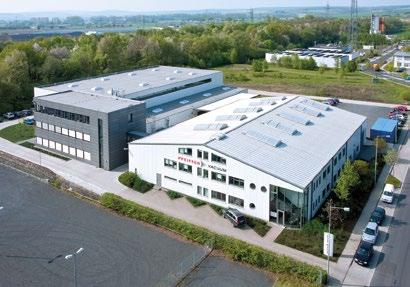
Pfeiffer Vacuum Components & Solutions states that it has one of the largest storage facilities for vacuum components in Europe. Its portfolio includes standard vacuum chambers as well as customised vacuum chambers and solutions with wide-ranging functions. The company’s site totals 12,660 m 2 and operates with a workforce of 140. As a whole, Pfeiffer Vacuum Technology AG employs more than
3,500 people globally throughout its ten production sites and more than twenty sales & service companies.
Pfeiffer Vacuum Components & Solutions GmbH was founded in 1997 under the name Trinos Vacuum-Systeme GmbH as a trading company for vacuum components. In 2010, Trinos Vakuum-Systeme was acquired by the Pfeiffer Vacuum Group and fully integrated. The company was renamed Pfeiffer Vacuum Components & Solutions GmbH in 2017.


Guido Hamacher, Managing Director of Pfeiffer Vacuum Components & Solutions, commented, “We are proud that our company has developed steadily over recent years and has invested in new technologies. In
the past two years, in particular, we were able to attract many sizeable projects from customers in Germany and internationally. Our products are used in a range of exciting applications. These include semiconductor chip manufacture, space simulation systems, energy storage, hydrogen tanks and forensic systems for detecting fingerprints.” www.pfeiffer-vacuum.com
A group of organisations led by Metal Powder Emergence Ltd (MPE), headquartered in London, UK, have been awarded funding from the National Aerospace Technology Exploitation Programme (NATEP) to develop targeted high-entropy alloy (HEA) powders for Additive Manufac turing. An Aerospace Growth Partnership initiative, NATEP is an industry-led programme supporting UK companies in the development of innovative technologies.
High-entropy alloys are novel multi-principal elemen tals (equimolar) that are alloyed together which have seen increased global interest due to promising material properties. HEAs are said to characterise the cutting edge of high-performance materials. Their high configuration entropy mixing is more stable at elevated temperatures; this allows suitable alloying elements to increase the properties of the materials based on four core effects, which opens up possibilities (e.g., potential structural and high temperature materials in jet engine applications).
As part of the High Entropy Alloys Targeted for Additive Manufacture (HEAT-AM) project, MPE and partners LSN Diffusion Ltd, headquartered in Llandybie, Wales, and the University of Leicester (ULEIC) will use a high-throughput screening method for exploring optimal HEA compositions toward industrial applications, such as aerospace sectors.
“To develop promising HEA at an industrial scale, optimal compositions should be explored and tuned for real-world applications,” stated Prof Hongbai Dong from ULEIC. “Due to the large number of possible HEA composi tions, alloy design methods need to rely on an efficient screening method, replacing the traditional trial-and-error method. In this project CALPHAD- based (CALculation of PHAse Diagrams) will be used as an efficient selection tool. This will enable rapid screening of potential compo sitions based on AM conditions”.
Dr Gordon Kerr, CEO of MPE, added: “We are very pleased to have been awarded NATEP funding for this innovative project. By working with our partners, we hope to further develop powder technology and create novel materials which provide improved performance over existing additive manufactured as well as cast parts. NATEP is a great way for innovative companies to come together to develop cutting edge technologies”.
The project has the support of GKN Aerospace. Bradley Hughes, Senior Research Engineer for AM, commented, “The proposed project explores a technology topic that GKN Aerospace recognises as having significant poten tial opportunity. Such technology could create new capabilities for a number of additive processes. We are enthusiastic to work with you to provide an insight into future industrial needs within the aerospace sector.”
Prof Iain Todd, Director of MAPP EPSRC Future Manufacturing Hub, added, “This is an exciting initiative. High-entropy alloys (HEA) offer the potential to provide in-service performance improvements over current generation materials for applications in space and aero space, leading to potential reductions in cost, energy use and waste generation and is therefore complementary to MAPP. Our two activities working together could enable breakthroughs in future high-value manufacturing”.
Philip Allnatt, LSN Diffusion’s Managing Director, added, “LSN is very pleased to be a part of this project and for the innovative HEA powder compositions to be developed using our gas atomisation technology. LSN already produces a range of powders for the AM market and we welcome the opportunity to add this alloy family to our existing range.”
Dr Shiladitya Paul, ULEIC summarised: “HEAT-AM aims to develop novel computer-assisted targeted alloy design approaches, manufacture novel HEA materials for AM. Evaluate material performance against established alloys and develop a road map for industrial scale up. This approach aims to reduce costs and lead-times for new alloy development for aerospace applications, creating possibilities for the use and deployment of higher-perfor mance materials.”
www.metalpowderemergence.com www.lsndiffusion.com | www.le.ac.uk


Drive System Design (DSD) Inc, Farmington Hills, Michigan, USA, which specialises in the rapid engineering and development of electrified propulsion systems, has signed a joint operating agree ment with Alvier Mechatronics, a subsidiary of Sweden’s Höganäs AB, to provide the mobility industry with engineering services to support sustainable electrified propul sion solutions across automotive, commercial vehicle, off-highway, marine and aerospace applications.
Alvier Mechatronics provides electrical drive systems and associated components based on high-performance powder materials. Its four focus areas include highspeed motors, transmission, axial flux motors and passive components.
Under the joint operating agree ment, DSD will combine its expertise in full electrified propulsion system design encompassing simulation, prototyping and validation, with Alvier’s capabilities in Powder Metal lurgy and electromagnetic design. It is hoped that this collaboration will unlock significant improvements in the development of electrified systems, and deliver innovative turnkey solutions to the industry which will include:
• Speed-to-market increase by combining metallurgical and electromagnetic phases of devel opment and reduced prototype lead-time Sustainability improvements in the use of CO 2, resulting in an overall reduction during the

development process, to comple ment both companies’ ability to reduce CO 2 production during system operation
• Expertise from the combined experience and resources of Höganäs AB, DSD and Alvier Mechatronics
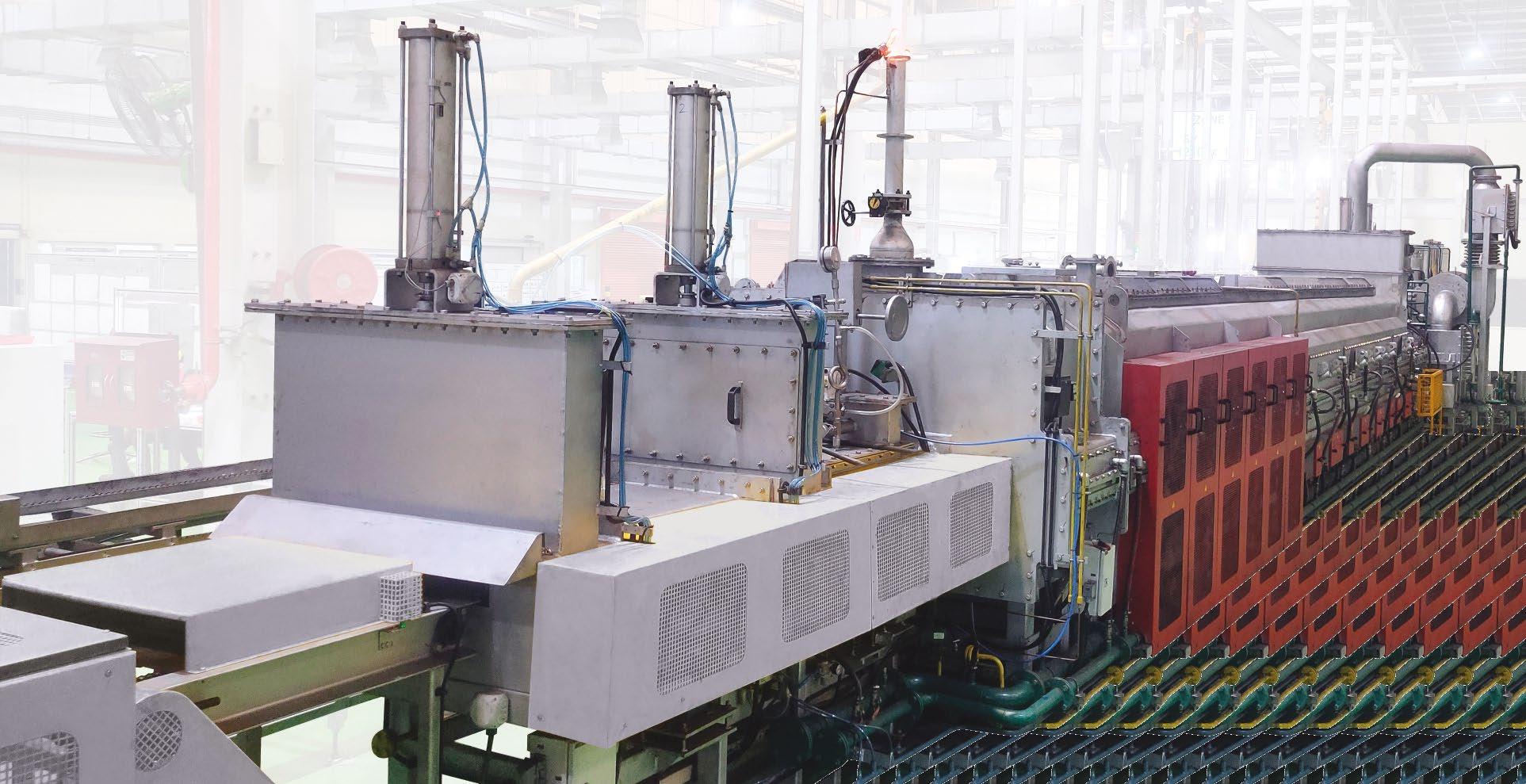
“This collaboration will capitalise on the combined skills and capa bilities of each company to serve our new and existing customers in exciting ways,” stated Daniel Hervén, CEO, Alvier Mechatronics.
Mark Findlay, managing director, DSD, commented, “Working with Alvier Mechatronics is a great opportunity for DSD to diversify its contribution to the advancement of sustainable electrified propulsion across an array of critical industries. It is a company with trusted capability in the industry, and we look forward to pushing the boundaries of sustain able electrification.” www.alviermechatronics.com www.drivesystemdesign.us
MTC Powder Solutions (MTC PS), Surahammar, Sweden, has announced the expansion of its Swedish facility, which includes the installation of a 1.6 x 3.5 m Hot Isostatic Pressing (HIP) unit, said to be the second largest HIP autoclave in the MTC family. The new HIP, installed under the company’s Project Shin expan sion plans, will increase the size envelope of near-net-shape HIP
components that the group can produce in Europe.
“Looking back at 2020 when our journey started with acquiring Sandvik Powder Solutions, I’m pleased to see that we are now entering into the next phase of Project Shin; continuing our drive in establishing MTCs footprint globally as planned,” stated Tetsuhito Hirayama, chairman of the board.
YASA Ltd, a wholly owned subsidiary of Mercedes-Benz AG, headquartered in Oxford, UK, has announced that Juergen Banken will be its new CEO, succeeding Dr Chris Harris.

YASA’s proprietary axial-flux elec tric motors are reported to deliver the greatest efficiencies and highest power densities in their class, for the smallest possible size and weight. The axial-flux motors contain a number of pressed stator cores, manufactured from soft magnetic composite iron powder, and are suit able for both hybrid and pure electric vehicle applications.
VBN Components, Uppsala, Sweden, has appointed Magnus Bergman as its new CEO. Bergman has a master’s degree in Materials Science from KTH Royal Institute of Technology, Stockholm, and has held several roles within the Sandvik Group with a focus on R&D, international sales and management. He is also said to have broad experience in the heat treatment and machinery industries.
Since 2016, Banken has been responsible for delivering MercedesBenz electric propulsion systems, including the EQS from concept to delivery of its electric drive unit. He is said to join YASA at a time of accelerated growth and will focus on delivering electric-drive solutions for AMG & Mercedes’ electric-only plat forms and the subsidiary’s supercar OEM customers.
“I’m excited to relocate to Oxford, a city with a great heritage in academia and automotive engi neering, and to lead the innovative and dynamic YASA team. YASA’s
“It is a fantastic opportunity to work with VBN Components which is truly at the forefront of advanced materials development and Additive Manufacturing for a global market,” stated Bergman. “Being able to combine world-leading material technology with international sales and management of VBN Compo nents’ motivated team is a dream assignment for a market-driven leader with a material science back ground.”
VBN Components’ additively manufactured Vibenite® alloys are developed for components in demanding industrial applications,
From the commencement of the acquisition, multiple investments have been implemented, each increasing the efficiency and capa bilities of the Swedish production sites.
Magnus Nyström, Managing Director, MTC PS, added, “I have been waiting for years to fulfil the potential we have at our fingertips here in Sweden, and the amazing support and collaboration with MTC has enabled us to make strides above and beyond all expectations, and it’s exciting to see the future.”
www.mtcpowdersolutions.com
next-generation electric motor tech nology is pivotal to Mercedes-Benz’s transition to all-electric models by 2030,” stated Banken. “YASA’s distinctive culture of innovation and commitment to engineering excellence is directly aligned with my own and I look forward to helping the team deliver on their ground-breaking roadmap. I’d like to thank Dr Chris Harris for his support during the CEO transition and for his stellar contribu tion to YASA’s success.”
YASA also announced plans to open an R&D centre in Welshpool, Wales, UK. With a £1.98 million investment from the Welsh government, the company will expand its current loca tion at Offa’s Dyke Business Park and create up to forty new jobs.
www.yasa.com
so Bergman’s experience in mate rials and business development is noted as fitting well with the compa ny’s international progress. www.vbncomponents.se




Elmet Technologies Inc, Lewiston, Maine, USA, reports it has recently supplied tungsten Powder Metal lurgy parts for use in the Space Launch System (SLS) Rocket programme in the Orion Space Capsule. The SLS is said to be the most powerful rocket built thus far, with its first mission being to power Artemis I to the moon and back expected to be launched in the coming months.
Specific to the Artemis programme, Elmet manufactured aerospace-grade tungsten heavy alloy ballast weights (seven different parts, weighing from 3.2–15 kg) used for the heatshield in the Orion capsule. The tungsten metal powder parts were pressed, sintered and machined onsite in Lewiston, with all lab testing for powder and final part mechanical properties performed by Elmet’s A3LA-accredited lab. Each component was ultrasonically tested for internal quality.
“The team at Elmet is proud of their accomplishments, meeting the requirements of the customer, and rising to the challenge for such a unique project,” the company posted. “We are also honoured to have participated in the SLS project,
and we look forward to providing ongoing support for tungsten manufacturing and testing needs for the aerospace market. As we look forward to the SLS launch, we take pride in knowing Elmet Tech nologies ballast weights are in the Orion capsule. Our team is excited to follow the Artemis launch news, with an expected launch date of midNovember.”

Other programmes involving Elmet Technologies components include Dragonfly. This programme is set to launch in 2026 and land on Jupiter’s moon Titan in 2034, with molybdenum parts provided by Elmet expected to play a key role.
The company concluded, “Elmet Technologies is proud of its team in supporting some of the aero space industry’s most extraordinary programs to date. Through strict quality control procedures, our team ensured that all products meet the most stringent of specifications. The delivery of parts to this program is a significant achievement and demonstrates Elmet’s expertise in manufacturing tungsten heavy alloy products with mission-critical preci sion and accuracy.”
www.elmettechnologies.com
The European Powder Metallurgy Association (EPMA) has announced a call for papers for its Euro PM2023 Congress & Exhibition, scheduled to take place in Lisbon, Portugal, from October 1–4, 2023, at the Lisbon Congress Centre (CCL). The accepted topics for papers include:
• Powder production (water & gas atomisation, solid state reduction, electrolysis, etc)
• Consolidation technologies (Press & Sinter, MIM, HIP, metal AM, etc)
• Materials (ferrous & non-ferrous materials, lightweight alloys, high temperature, functional materials, hard materials, etc)
• Applications (aerospace, automo tive, energy, tooling, etc)
• Tools for improving Powder Metallurgy (testing, secondary operations, design & modelling, digitisation, etc)
Elmet has supplied parts for the Orion capsule heatshield which is expected to launch in the coming months (Courtesy Elmet Technologies)
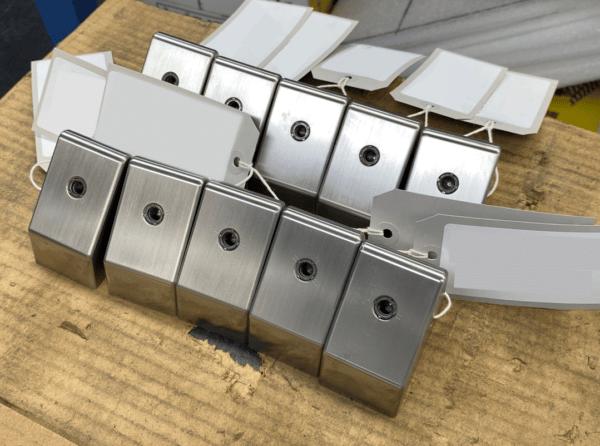
Tungsten ballast weights produced for the Space Launch System (Cour tesy Elmet Technologies)
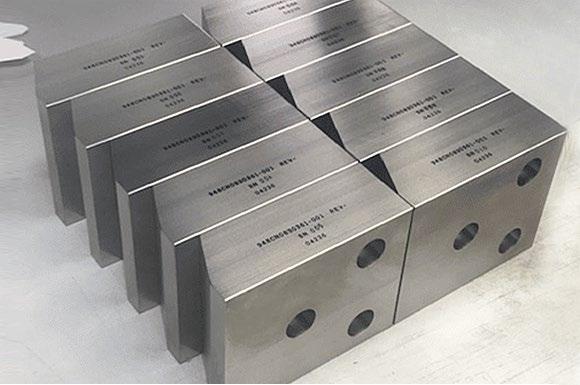
Euro PM2023 will once again provide an ideal opportunity for authors to present their work and exchange ideas on recent develop ments and technologies. It will provide a chance to meet and network with colleagues and fellow researchers from throughout the world.
Full information – including a more detailed breakdown of the topics covered in the conference –is available via the event website, with more information being released in due course.
www.europm2023.com

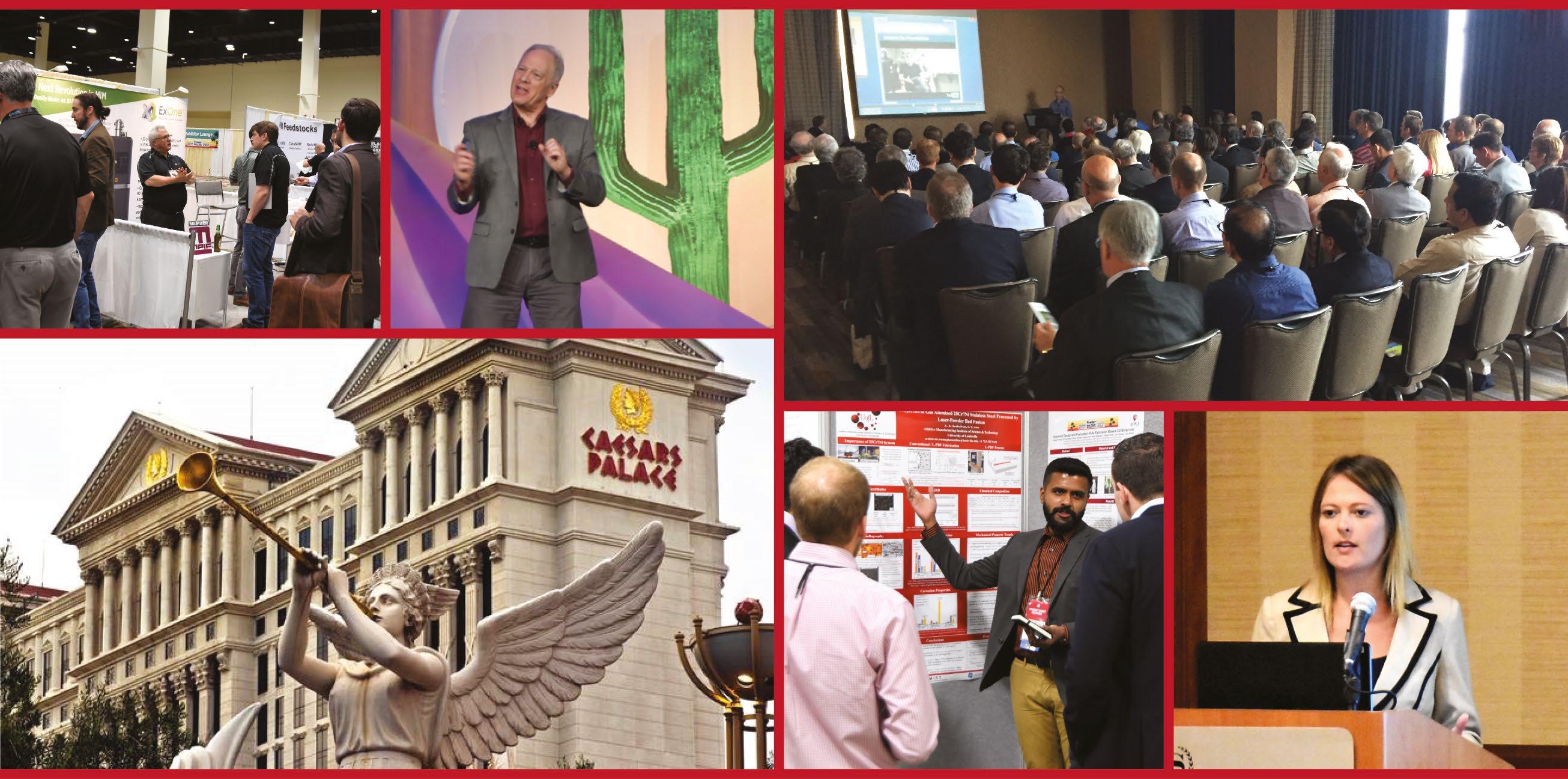

In early 2021, in response to the rapid rate of change in its automotive customer base, Amsted Industries brought two of its Tier 1 automotive supply business units, Means Industries and Burgess-Norton, together. Combined, they formed a new technology team: Amsted Automotive Group (AAG), combining expertise in advanced metal forming, Powder Metallurgy, and electromechanical torque transfer and propulsion system design, and positioning Amsted as a key participant in vehicle electrification. Bernard North visited Burgess-Norton MFG in Geneva, Illinois, USA, and here reports on the company’s history, facilities and ongoing response to a changing market.
On a beautiful mid-October day, this author travelled to the Chicago suburb of Geneva, Illinois, USA, to tour Burgess-Norton’s PM manu facturing facility, and spent a fascinating afternoon meeting with four key staff members: Matt Bowman (VP of Operations, Powder Metal and Propulsion), Jaroslaw Krepa (PM Research and Develop ment Manager), and Nick Tripathi (Senior Product Manager). The purpose of this visit was to learn about the company’s history, manu facturing processes, product range, development directions, and how this major automotive PM parts manufacturer was responding to the rapid electrification of transportation.
Burgess-Norton MFG was founded by Frank Burgess and Henry Norton in 1903 in Geneva, Illinois, initially employing twenty-five people. From the outset, its core products
were piston pins (which provide the precision, oscillating/rotating joint between connecting rods and pistons in internal combus tion engines), but, in 1954, the company diversified into PM parts manufacturing to grow its range of products. In 1968, the company
was purchased by Amsted Indus tries. Since then, both the piston pin and PM parts portions of Burgess-Norton’s operations, and its Amsted Industries’ parent, have grown – the latter both organi cally and by acquisition of other businesses.

In 1902, eight US-based steel found ries combined to form American Steel Foundries. Initially, the prod ucts provided by the group were primarily cast steel parts for rail roads, but over time – through both organic developments and acquisi tions – the product range grew to also cover automotive, commercial vehicle and construction equipment.
In 1962, the company’s name was changed to Amsted Industries; nearly twenty-five years later the business went private through an employee
stock ownership buyout. By the end of 1998, it had become 100% employee owned. A critical acquisi tion was that of Varlen (including Means Industries) in 1999, a large corporation serving the automotive, truck, and rail markets.
In 2021, Amsted – structured as industry-specific units serving the rail, construction and vehic ular markets – formed Amsted Automotive Group (AAG) through a combination of Means Industries and Burgess-Norton. This group was created to serve the market as a provider of net shape manufac
turing, with capabilities including press and sinter PM, flow-forming, stamping, roller die drawing, cold forming, hot forming, machining, and laser welding, as well as a highly automated assembly line.
Amsted Automotive Group recently added SMW Manufacturing (predominantly steel cold forgings for automotive and other applica tions), and now has about 1,900 employees in seven countries in North America, Europe and Asia.
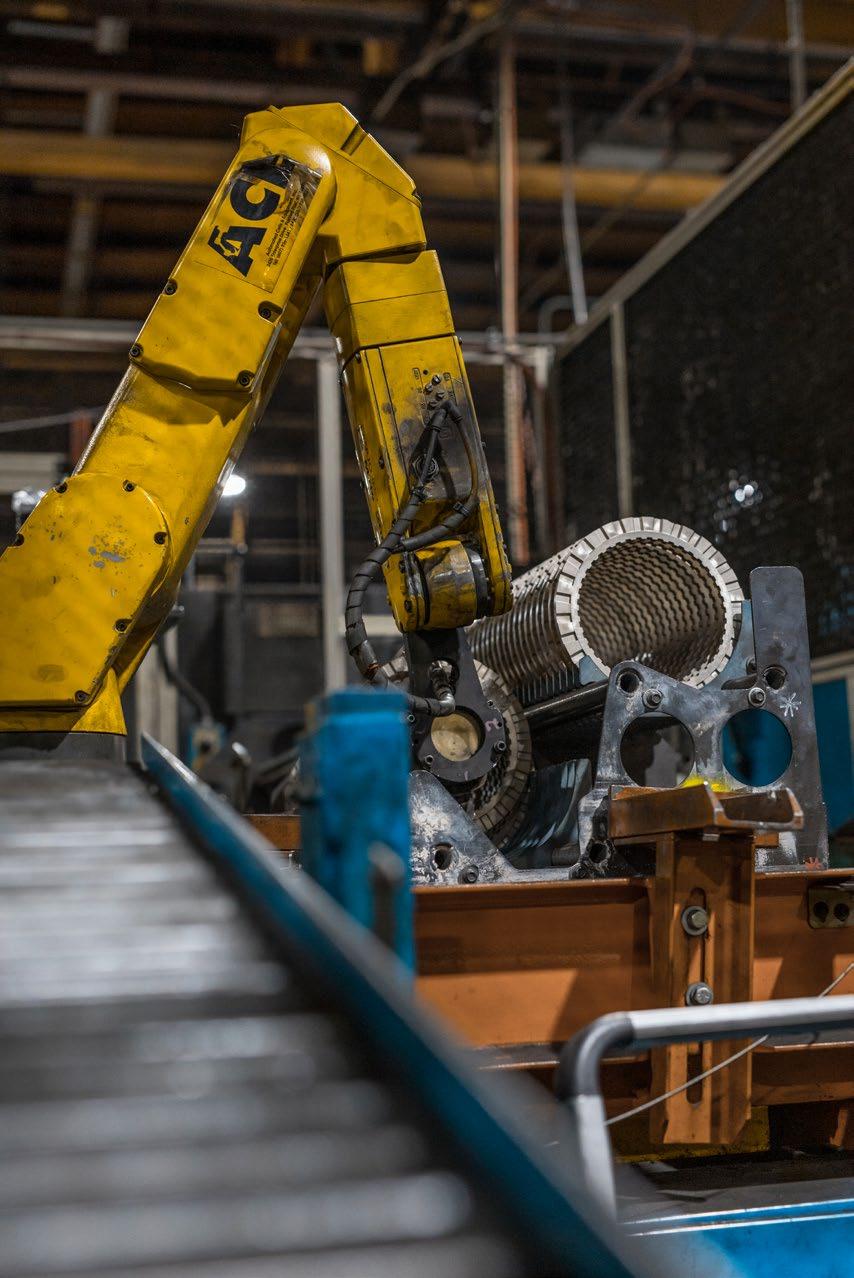
Burgess-Norton Piston Pin is the market leader in piston pins, with manufacturing and commercial operations worldwide. BurgessNorton Powder Metal employs approximately 300 at three facili ties, one in Geneva, Illinois, one in Beaver Dam, Wisconsin, and a joint venture in China.
Bowman explained that, up until about the year 2000, BurgessNorton Powder Metal predominantly manufactured parts for the lawn and garden, agriculture, construc tion, and other businesses, with not many automotive applications. Its relationship with its then-new Means Industries sister company changed that, however, both directly and indirectly; as of 2022, its end markets are primarily in automo tive/trucks. Geographically, the company delivers parts to North America, Europe and Asia.
The company’s material offering is 100% ferrous, with no stainless steel. Besides conventional ferrous PM, Burgess-Norton also produces Soft Magnetic Composites (SMCs), an important material for modern, electrified vehicle parts. Part sizes vary greatly (albeit weighted towards the large end of the range), from a minimum size around 1.2 cm (0.5 in) in dimension up to a maximum sintered diameter of
about 28 cm (11 in) and height about 6.4 cm (2.5 in). Maximum crosssection thickness is about 5.6 cm (2.2 in). By weight, the largest part currently in production is a sprocket weighing 3 kg (6.5 lb); in the past, though, the company produced a hydraulic manifold weighing about 11 kg (25 lb).
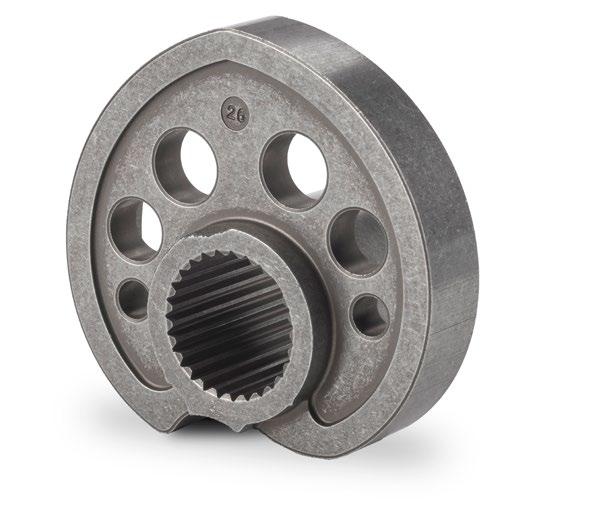
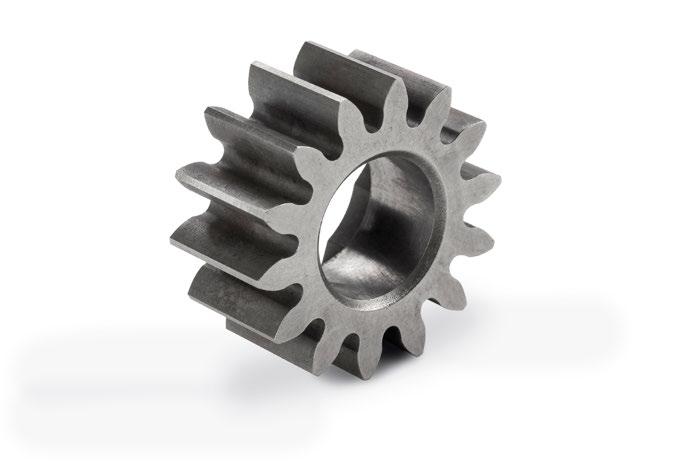
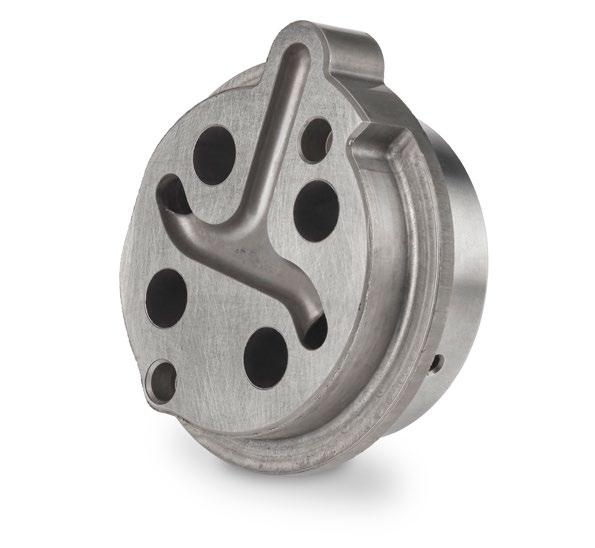
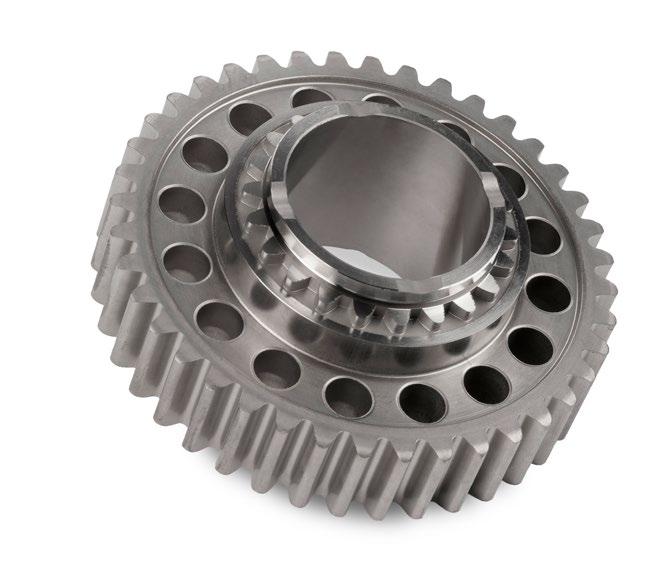
To understand a major portion of Burgess-Norton’s PM business, it is helpful to first understand the product line of its sister company, Means Industries. Means Industries has developed and manufactures a variety of proprietary mechan ical diodes (also known as one-way clutches), selectable one-way
clutches, and controllable clutches – individual systems are used in different types of vehicle driv etrain, but the key point is that the product range, as a whole, runs the gamut from ICE engine/ automatic transmission, ICE engine/hybrid/transmission, and battery (or H 2/fuel cell) electric vehicle drivetrains, in every case reducing weight and complexity and improving efficiency and drivability.
So where does PM fit in? In brief, the geometries of the major components of these mechanical and electromechanical devices are a very good fit with PM’s geometric capabilities, and, indeed, with the uniaxial pressing of parts. In turn, this has led to the signifi cant growth of Means Industries
system components in BurgessNorton PM’s product range, and the business unit now includes an assembly operation in Michigan.
Throughout the plant tour, and on display in the conference room, a large number of automotive and truck transmission and drivetrain components were apparent; to the non-automotive-expert, it can seem a bewildering mix, but the compa ny’s website lists the major products offered as being one way clutch components, sprockets, hydraulic manifolds, cam plates, crankshaft timing wheels, differential gears, fuel pump gears, and hydraulic pump gears.
In the MPIF’s Automotive—Trans mission Category for Conventional PM components, Awards of Distinc tion were given to Burgess-Norton
MFG in 2022 for drive and driven sprockets, a pressure plate, and a sector gear, made for BorgWarner and used in an automotive transfer case. The sprockets were warm-die compacted from pre-alloyed steel FL-4405 (a material normally used in medium to high density applications) with admixed nickel.

Soft Magnetic Composites (SMCs) are a significant part of BurgessNorton’s product range, and Tripathi explained that, since the company’s first SMC product was introduced in 2006/7, over 50 million SMC compo nents have been shipped, making the company a world leader in this area. SMCs are made from Fe powder coated in resin, which is pressed into the desired component shapes and then cured. The magnetic proper ties of these materials make them ideal for use as stators in electric motors or as actuators in solenoids, and the increasing use of motors and solenoid devices in the automotive market has driven growth in SMC demand.
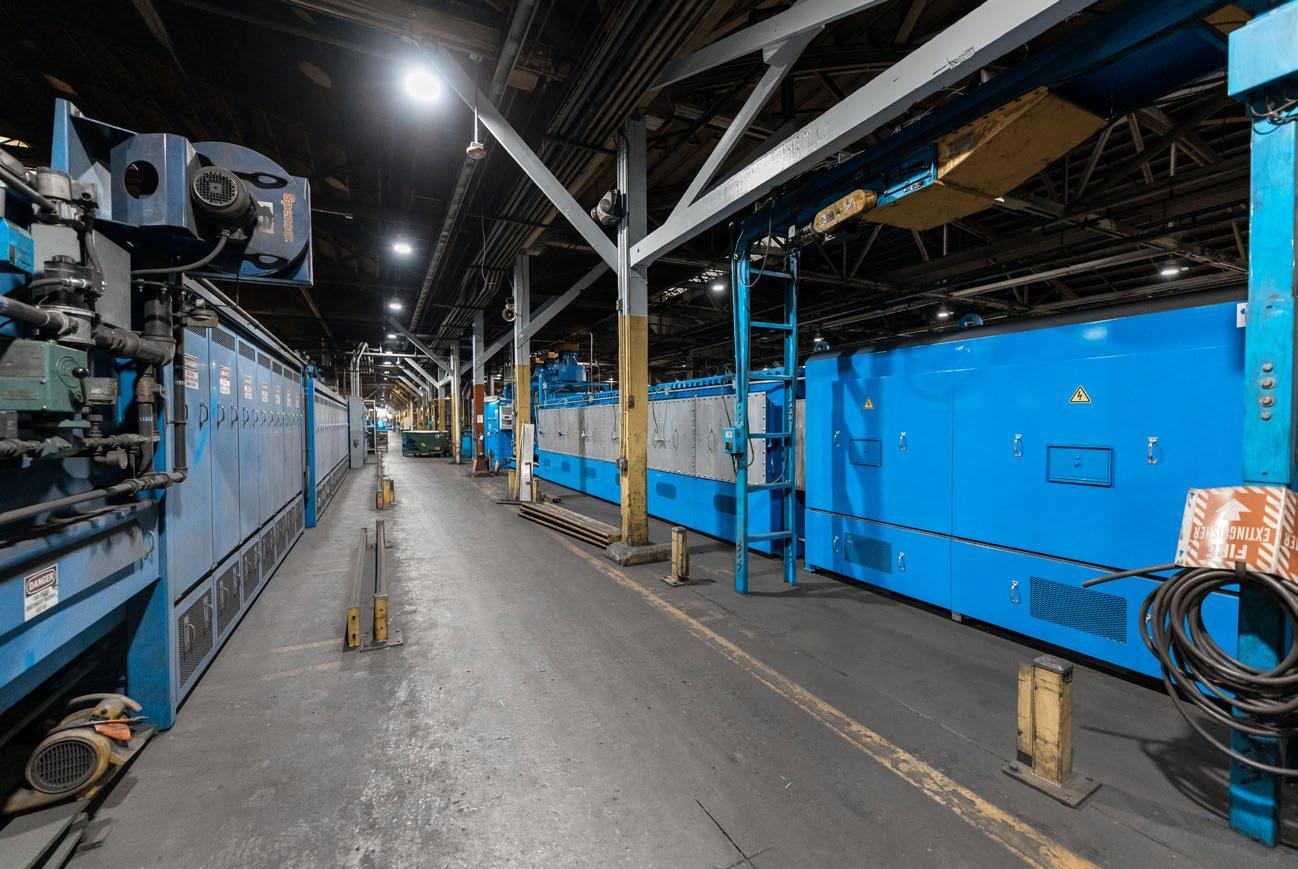
It is worth noting that, while the opportunity for SMC application in electric vehicles is especially large due to the potential for their use in the main motors themselves (and – having no drive belt – the need for additional, separate motors to drive cooling pumps for batteries as well as other systems), the drive to improve fuel economy in ICE vehicles and ICE hybrids has also been beneficial to SMC demand due to the need to reduce ‘parasitic’ loads on the drivetrain, leading to further small electric motors.
The combined manufacturing floor area of the Geneva and Beaver Dam plants is about 23,000 m 2 (250,000 ft 2). Krepa and Trip athi gave this author a tour of the Geneva plant, and the sheer phys ical size of both the equipment and many of the Powder Metallurgy parts being manufactured was very impressive. The plants are IATF 16949 certified, reflecting the mostly automotive nature of their product mix.
The two plants combined process 9,000 tonnes (~20 million lb) of steel powder a year, mostly received in 2.2 tonnes (5,000 lb) containers. That’s a lot of powder! Mostly, the powder used by Burgess-Norton is received in ready-blended condition, but a small proportion is blended on-site for special applications.
Each powder supplier’s quality assurance (QA) system is linked to Burgess-Norton’s, and the latter accepts powder batches based on the supplier’s quality data; indeed, by assessing this data in real time, batches are released for use in Burgess-Norton’s system before their actual physical receipt on site. This system is backed up by a further quality audit done with the help of an independent laboratory.
Between them, the Geneva and Beaver Dam plants have about thirty presses, a mixture of mechanical and hydraulic, ranging in size from 50 to 1600 tonnes, and with a preponder ance of large presses, as befits the product mix. This author questioned the team about electric presses,
and they responded that, electric presses are not yet advantageous over the older technologies for the very large presses which are their main concentration, as they are not available with the higher pressing forces the company requires.
Both plants have in-house tool design capabilities and wellequipped tool and die shops, but, due to the sheer volume of very large dies, most of the dies used are purchased from external vendors; the tooling is owned by the customer for the corresponding PM parts. However, repair and refur bishment of dies is undertaken in-house, which helps with lead times and control of the overall production flow. The dies are made from tool steel, cemented carbide, or a combination thereof, according to specific geometries and/or expected production volumes.
Many of the die sets are multilevel ones, and Krepa was proud to show the author an especially complex part that exemplifies this technology: a transfer case sprocket with four levels on the bottom and two on the top of the component. Krepa also pointed out a helical
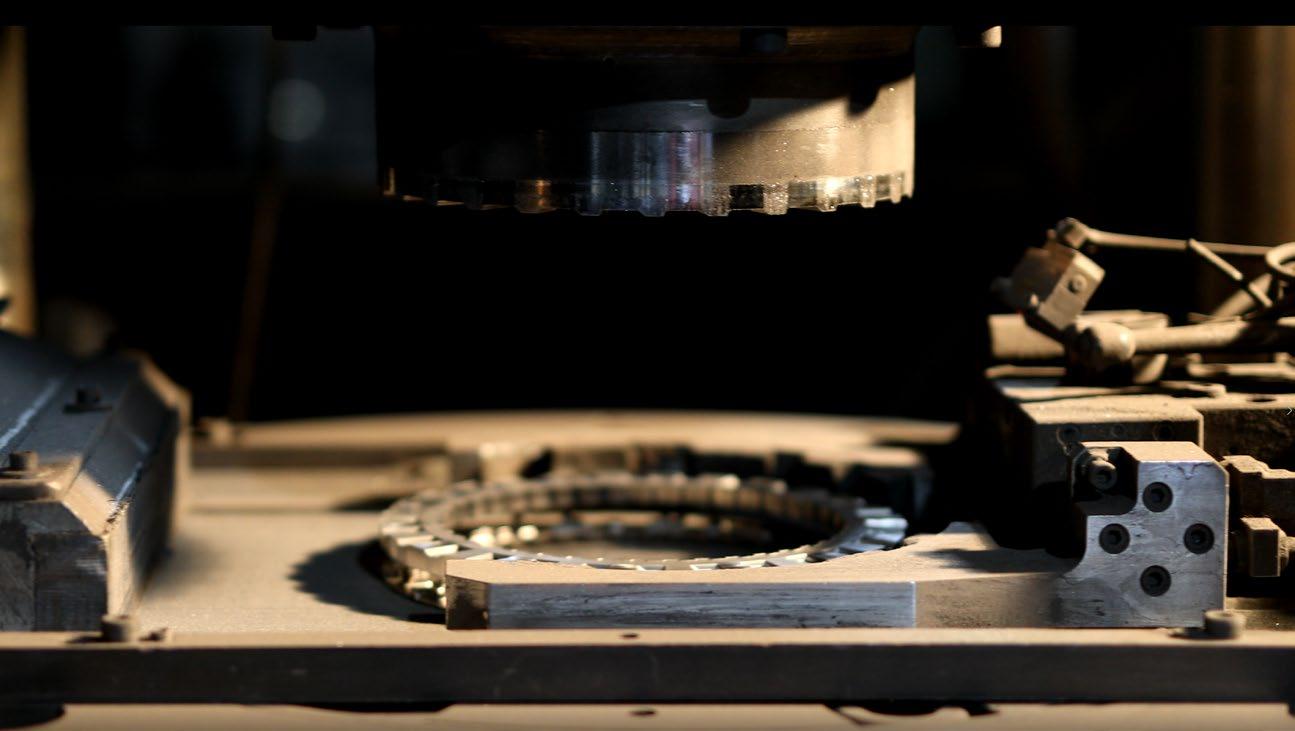
gear which requires very sophis ticated tooling and press motion control to produce.
Pressed part volumes typically range from 10,000 to 1,500,000, often exceeding the practical life of a die before refurbishment or replacement. To reduce press downtime, dies are pre-set off-line.
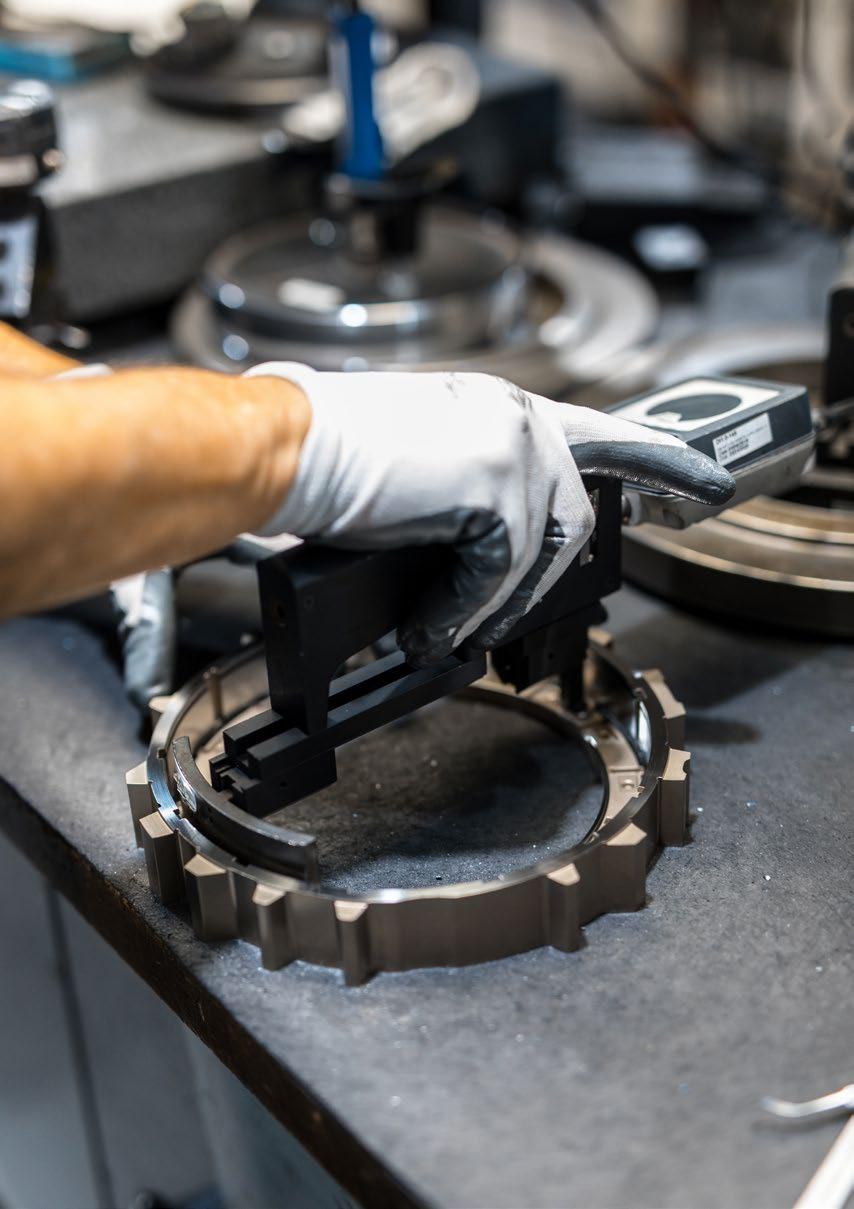
Debinding and sintering is done conventionally in ‘normal’ temper ature belt furnaces, but the size of the furnaces was impressive. Many parts are sintered on customdesigned ceramic sintering fixtures for a flat, smooth surface. A very high percentage of parts experience a sinter-hardening cycle for increased wear resistance and strength, and indeed the Burgess-Norton staff claim their company has one of the biggest sinter-hardening operations in the world.
Burgess-Norton is highly forwardintegrated and the vast majority of finishing operations are conducted in-house. They include sizing, machining, grinding, and impregna tion. Given the high percentage of sinter-hardened products, a lot of hard turning is carried out, and this is undertaken dry, without coolant, which is particularly advantageous for PM parts due to their porosity.
Materials handling and inspection
Burgess-Norton’s staff are rightly proud of the very high level of mate rials handling and in-process (vision and otherwise) inspection automation in their facilities. It was noteworthy during the plant tour to see extensive use of robots and other mechan ical devices picking green parts off presses, loading them via in-process inspection stations to sintering furnace belts – in many cases onto sintering fixtures, which were them selves positioned using automated handling systems – and moving parts from the sintering furnace to subse quent operations (e.g., machining).
All parts are marked with unique
“It was noteworthy during the plant tour to see extensive use of robots and other mechanical devices picking green parts off presses, loading them via in-process inspection stations to sintering furnace belts – in many cases onto sintering fixtures, which were themselves positioned using automated handling systems...”
codes to aid tracking, with many using laser marking. Most parts are untouched by human hands until final inspection, assembly or pack aging. All manufacturing cells are equipped with video recording equip ment to assist with troubleshooting and containment of suspected production issues.
Additive Manufacturing operations
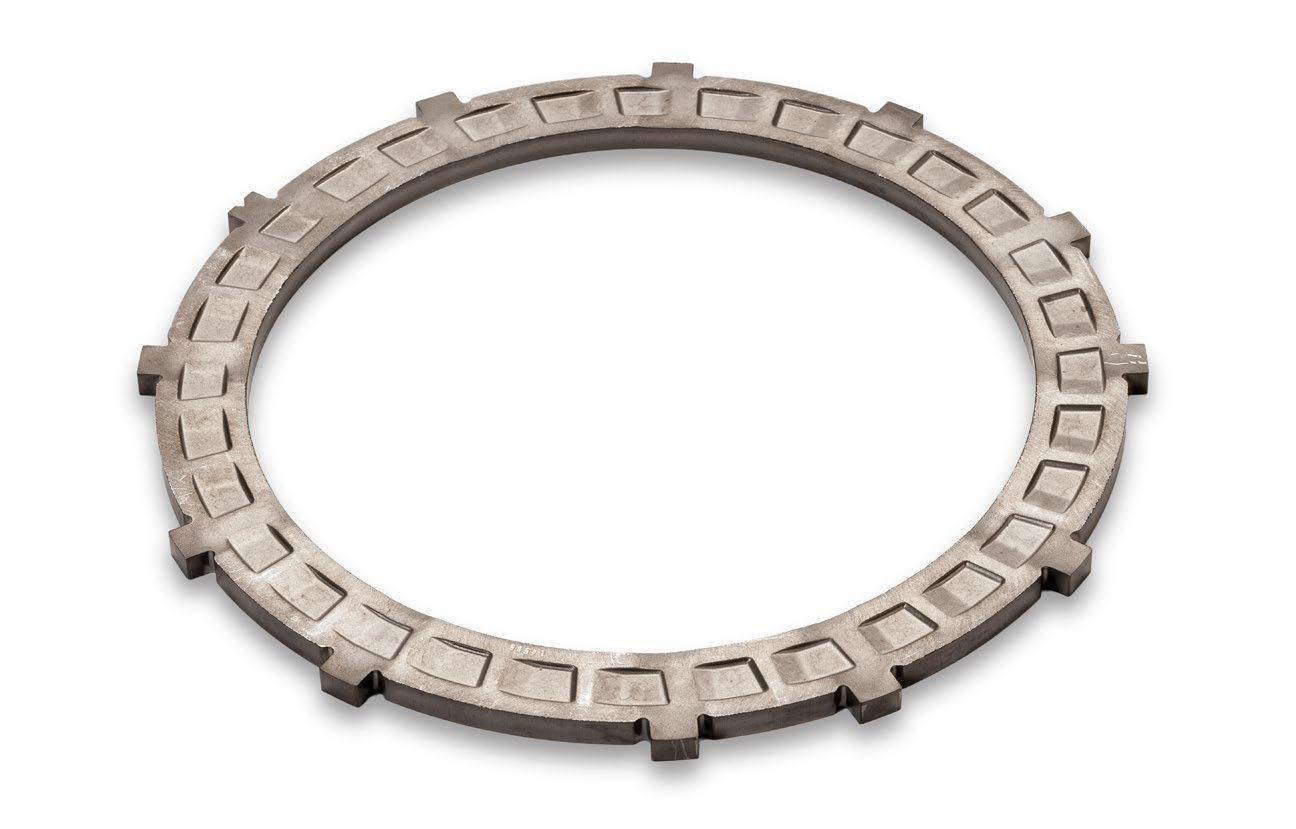
Krepa is actively investigating the use of AM, with the main driving factor being the opportunity to supply customers with component prototypes quickly, with the poten tial to grow to at least small-volume production lot sizes produced by metal AM. Currently, the favoured technology is Laser Beam Powder Bed Fusion (PBF-LB).
The management staff this author met with discussed several factors which they believe give their
company the competitive edge in the dynamic, rapidly changing automo tive market.
Assisted by competitive staff retention rates (average employee seniority is about fifteen years) and motivation (fostered, in part, by an employee stock ownership programme), Burgess-Norton has a lot of staff who have moved from the manufacturing floor into design, marketing and sales, and/or mana gerial positions. Detailed, practical knowledge is very strong, and this helps to reduce lead times and avoid problems in bringing new products,
equipment, and/or process upgrades on-stream.
Many of these staff interact directly with customers, both external ones and internally at Means Industries. In either case, the knowledge and openness of the staff aids in developing trust and detailed communication, thus assists with design optimisation for PM parts, and subsequently leads to a supe rior performance and cost position – a true ‘win-win.’ In many cases, this leads to Burgess-Norton being the specified part manufacturer on the ‘part print’ – a coveted position
“All parts are marked with unique codes to aid tracking, with many using laser marking. Most parts are untouched by human hands until final inspection, assembly or packaging.”
for any supplier. Burgess-Norton refers to this process as PMfirst™, breaking the process down into four steps: Visit and Concept Discussion, Engineering and Education, Testing, and Reality.
The company also boasts a culture of innovation: it was an early adopter or developer of new tech
nologies, and examples given during the plant visit include the adoption of very large presses, enabling large parts with high green densities (thus helping to enable higher-than-typical sintered PM part densities), sinter-hard ening raising wear resistance and strength, and SMCs.
The quality of its products is aided by extensive materials handling automation, in-process inspection, and process control, and 99–100% deliveries are made on time to the promised delivery date.
When asked what the biggest threat and opportunity was for the PM industry in general, and BurgessNorton in particular, Bowman gave the same response to all four: vehicle powertrain electrification. The author also asked the BurgessNorton staff if they agreed with the forecast by IHS Markit at the plenary session of Powdermet 2021 [1] that by 2030, the North American car and light truck market would be about 16% BEV and 25% ICE hybrid, while the global market would be about 25% BEV and 40% hybrid. Their consensus was that in the last eighteen months, the trend had shifted towards BEVs, and that they thought 16% BEVs an overly conserv ative estimate. To their minds, 25% was a better estimate.
While for the PM industry in general this is not, in itself, a favour able situation, Burgess-Norton’s market position as a provider of clutches and mechanical diodes, as well as SMCs, puts it in a positive place to manage this challenge. In particular, the company expects the use of multispeed electric drivetrains to increase, especially as larger vehi cles become electrified to allow for improvements in both performance and battery range, which is syner gistic with its product range.
Other significant trends noted by Krepa, all of which are expected to be helpful in enabling PM parts to substitute cast or forged ones, include the very high torque levels of the electric motors used in BEVs, driving the need for higher strength levels in PM components, of the order 1300–1400 MPa ultimate tensile stress; continuously tightening tolerance levels (for example, +/- 100 µm tolerances are shifting to, say, +/- 10 µm);
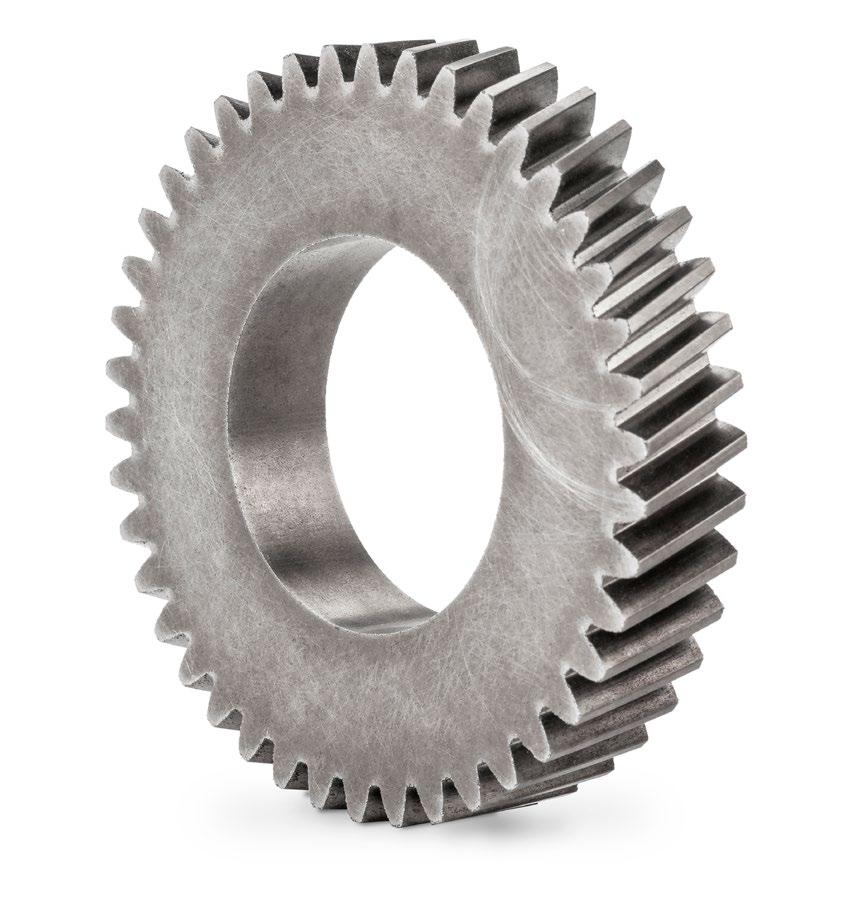
“...the company expects the use of multispeed electric drivetrains to increase, especially as larger vehicles become electrified to allow for improvements in both performance and battery range, which is synergistic with its product range.”
increasingly complex geometric capabilities, allowing single parts to replace assemblies; and increased green part density, as well as developments in the sinter and heat treatment cycle, enabling greater dimensional consistency, flatness and strength. In addition, as automatic transmissions replace manual ones (a process largely complete in North America) in other parts of the world, Krepa stated that this should help expand use of PM parts.
For this author, the visit to Burgess-Norton Powder Metal Manufacturing was very enlight ening and positive. The enthusiasm, ability, pragmatism and skill of the staff was very evident, and the sheer scale of the operation espe cially impressive.

Nobody knows for sure the exact speed and direction of the electri fication of vehicle drivetrains, but it is clear that Burgess-Norton is well-positioned to tackle the coming challenges, regardless of the exact trajectory of change.
Contact
Burgess-Norton Mfg. Co. 500 Western Avenue, Geneva, IL 60134 USA www.burgessnorton.com


Author Bernard North North Technical Management, LLC Greater Pittsburgh Area Pennsylvania, USA bnorth524@msn.com




In recent years, all industries have been challenged by increasingly tough regulations aimed at combatting climate change, fast-moving developments in vehicle electrification, fluctuations in the status and supply of raw materials, and more. The need to increase process sustainability applies even to already-efficient industries like press and sinter PM, where the production of low alloyed parts faces pressure to increase process efficiency and decrease its reliance on the now-critical alloying materials nickel and copper. In this article, Dr Vladislav Kruzhanov and Dr Volker Arnhold explore some of the best options to achieve this.
Powder Metallurgy is generally applied to three categories of products: components difficult to produce in other ways (e.g., refrac tory metals, ceramics); unique alloys, composites or structures (hardmetals, bearings, etc.); and applications where the process can provide significant economic benefits. The latter case relates primarily to conventional PM parts made via pressing and sintering of low alloyed steel powders, which is the focus of this publication.
The main market for traditional PM products is the automotive industry, making up approximately 80% of all PM components. The largest portion of those parts are made for combustion engines and transmissions. For decades, the PM industry has expanded parallel to the global growth of automotive industries, due to the continuous demand for high-quality, complex products combined with the tough pricing expectations of the auto
motive industry. These targets were the prime drivers for the contin uous innovation of materials and processes, combined with the reali sation of continuous improvements in the quality and economy of the products. Obviously, PM parts
are always challenged by parts made from other forming process (e.g., casting, forging, machining), but this only further drives innovation. Parallel to growing customer expectations, all industries have been confronted over the last years by
increasingly tough laws/regulations aimed at combatting climate change, and fast-moving situations such as:
• CO 2-reduction/energy improve ment via introduction of electric technologies in transportation via batteries and/or fuel cells: changes in the traditional PM markets
• Demands for CO 2-reduction/ energy improvement in all manufacturing processes throughout the supply chain
• Application and expansion of green energy sources and processes
• Increasing environmental and sustainability regulations for industry and society
• Traditional PM raw materials have suddenly become critical/ strategic minerals (e.g., Ni and
Cu), which may have impact on pricing or availability
Because of these changes, every industry must constantly reconsider its manufacturing processes and the availability and cost situation of all the mate rials applied in its technology. This article explores several aspects of this analysis for the field of press and sinter PM.
One of the key economic figures in most industries (aside from manpower) is energy consump tion. While Powder Metallurgy is the most efficient metalworking technology (Fig. 1), reducing the
energy consumption is obviously becoming increasingly relevant.
Most iron-based PM components use water atomised powder. The water atomisation process flow is shown in Fig. 2, and comprises the following processing steps:
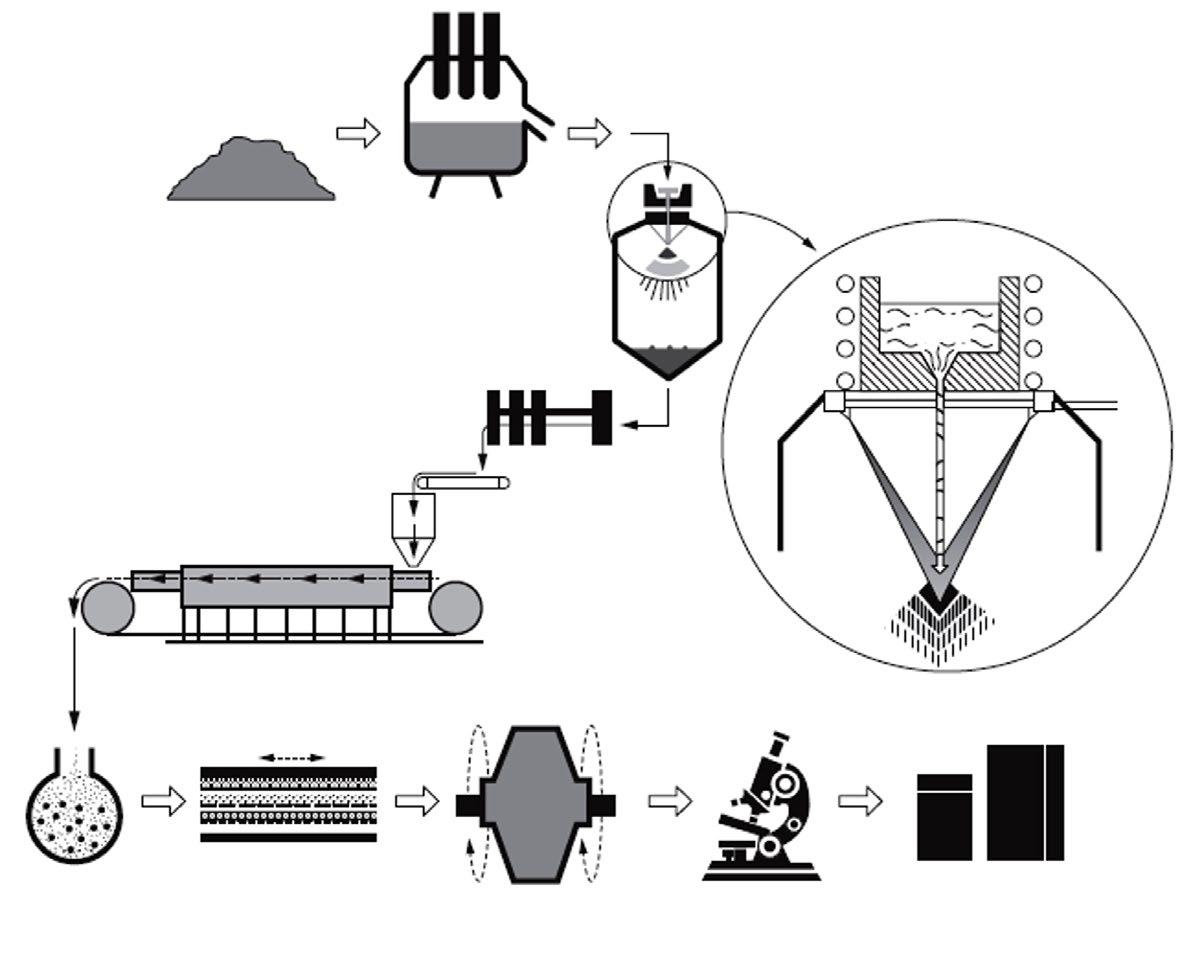
• Melting scrap in an electric arc furnace
• Atomising the flowing melt by a high-pressure water jet at about 1700°C
• Drainage of the powder-water suspension
• Drying and sieving the powder
• Reduction treatment via annealing at about 1000°C
• Classifying and conditioning (e.g., mixing, packaging, etc)
The analysis of the whole processing route, from the melting of scrap iron (recycling!) to the preci sion machining of nearly finished components, shows that, even during powder production, there is the potential for substantial energy saving.
Currently, the average energy consumption for iron powder production via water atomisation is ~2 kWh/ kg, and for component manufacturing ~5 kWh/kg: 7 kWh/ kg in total [1]. Energy consumption in powder production was examined and reported on at the beginning of the 1980s [4]. The breakdown for the feedstock material (crude steel or powder) is considered in Fig. 3.
The breakdown among the processing steps presented in Fig. 3 shows that the reduction annealing of the atomised powder accounts for nearly half of the consumed energy for the total process.
Water atomised and dried powder (‘black powder’) has a typical content of 1.5% oxygen and 0.5% carbon. During further processing, it is heat treated in a continuous furnace as a ‘cake’ on a belt (metal sheet) or in boxes. The thickness of the layer is about 4 cm. The annealing runs under pure hydrogen at tempera tures between 900 and 1200°C. A typical set of annealing parameters [5] is as follows:
• Temperature: 1060°C
• Time: 1 h
• Throughput: 2 t/h
• H 2-consumption: 160 m 3/h (80 m 3/t)
In addition to its energy consump tion, annealing requires a high amount of hydrogen. If we simplify H 2 = Energy, the numbers for total energy consumption will be consider ably higher. In the case of hydrogen consumption (80 m 3/t for powder annealing), an additional energy portion of about 0.5 kWh/kg must be added to the balance sheet.
The reduction annealing of water atomised iron powder is carried out mainly in furnaces applying a tradi
Annealing
43%
Other
0.2 kWh/kg 0.9 kWh/kg 0.4 kWh/kg
8% 29% 20%
Melting 0.6 kWh/kg
Atomising
Fig. 3 Breakdown of energy consumption (kWh/kg) in the water atomisation process [4]
tional concept with a high hydrogen consumption, low productivity, low life time of belts and muffles. The detailed analysis of the process [6] showed several possibilities to improve the annealing process:
1. The heating time of the cake is a critical parameter for the process. It should be calcu lated and measured for the optimisation of the cake thick ness. Another method of heating (e.g. additional microwave heating) can be considered
2. The whole capacity of carbon should be used for the internal
reduction of oxides before the external reduction. Internal reduction can be carried out in an inert atmosphere (e.g., nitrogen), followed by an external reduction in hydrogen – this will lead to a reduction of hydrogen consumption
3. The internal reduction of carbon and oxygen in iron particles begins at approximately 600°C and finishes at 1050°C. This means that the process can be carried out at lower tempera tures than those typically used today
“The analysis of the whole processing route, from the melting of scrap iron (recycling!) to the precision machining of nearly finished components, shows that, even during powder production, there is the potential for substantial energy saving.”
4. Only a thin layer of flowing hydrogen is involved in the diffusion into the cake. Another shape of powder cake and muffle with a lower height should be considered
Another large proportion of the energy used in powder production is the second heat treatment, often used for the production of diffu sion alloyed powders. Premixes produced by mixing elemental alloying powders such as nickel, copper, and molybdenum with atom ised iron powders can achieve high green densities, but admixed alloying powders are likely to segre gate and not completely alloy during sintering. The resultant mechanical properties of the parts from these premixes are insufficient for some requirements. In contrast, steel powders prealloyed with alloying elements ensure a homogeneous structure, but are less compressible than the premixed powders.

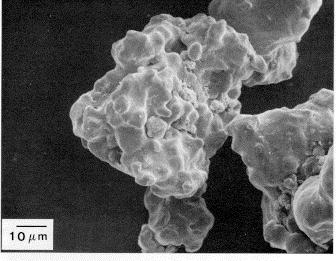
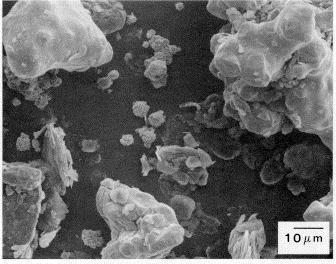
The limitations of both premixed and prealloyed powders had been overcome by diffusion alloyed steel powders, which combine the compressibility of a pure iron powder with the homogeneity of a prealloyed powder. To produce diffu sion alloyed powders, the powder mixture undergoes additional diffu sion annealing in a continuous belt furnace under a hydrogen atmosphere similar to the reduc tion treatment. After annealing, the powder is partially sintered into a cake, which is crushed and screened. The main drawbacks of diffusion alloying technology are the additional processing steps of re-heating the powder and crushing the annealed cake, as well as its screening associated with substan tial energy and cost increase.
The alternative to diffusion bonding is organic bonding – this is often the better way. In this process, the binder (oils, epoxies or poly mers) wets the iron particles and bonds the additives. This technology was developed to chemically bond smaller-sized or lighter premix additives to base iron powder to achieve premix uniformity
US$/t
the natural tendency of segre gation during transportation and following processing of the powder. The binder is introduced during premixing and serves as a glue to hold the additive particles to the surface of the larger iron particles. Therefore, the final mix contains less free fine particles of metal additives, graphite and lubri cants (Fig. 4).
In many cases, this technology avoids energy and cost intensive additional processing steps in the production of the powders for press-sinter technology.
25.000
Nickel, US$/t
10.000
20.000
8.000
15.000
6.000
May 20 May 21 Nov 20 Nov 21 10.000
Copper, US$/t
May 4.000
The breakdown of the energy required to produce compo nents out of metal powders is given in Fig. 5. The diagram shows the distribution of energy (about 5 kWh/kg) required for PM production at the ‘average’ PM plant, applying many processes and producing the ‘average’ PM component. The calculation and measurement consider a continu ously operated and always fully loaded furnace – however, produc tion furnaces are not always fully loaded and can sometimes be empty. The efficient loading of sintering and heat treatment furnaces is very important to economical energy consumption; obviously, perfect logistics and an extensive standardisation of mate rials, processes and equipment are the key.
Half of the energy used to produce PM parts goes to sintering in continuous (mostly belt) furnaces, the generation of protective gas atmospheres and heat treatment of sintered compo nents. This can be improved by optimisation of conventional equipment (mesh belt furnaces) and by the use of more effective processes (e.g., high-temperature sintering) and furnaces of another type (e.g., roller hearth furnaces).
8.000
6.000
10.000 May 21 Nov 20 Nov 21
May 20 May 21 Nov 21 Nov 20 4.000
Fig. 6 The price dynamics of nickel and copper on the world market [8]
The traditional alloying elements in press and sinter PM are copper and nickel. These elements used to be relatively cheap, have always been easily available and can also work in ‘poor’ (i.e., high-dew point) atmos pheres. However, the usage of these alloying elements becomes increas ingly critical; copper is associated with recycling problems, while nickel powders have very tight operational limits (REACH regulations) because the element is critical in general, and the inhalation of the fine nickel powder type 123 – typical in Powder Metallurgy – can cause problems. Total avoidance of nickel results in an easier process flow and much simpler handling during powder processing, leading to lower operational cost and
better workplace conditions.
The prices of the two metals are rising continuously. The price dynamics of the last two years, before the politically and economi cally turbulent time of Russia’s invasion of Ukraine, are shown in Fig. 6. This seems to be the start of a longer period of price increase.
The rapid deployment of clean energy technologies is significantly increasing the demand on these metals for new energy applications. Fig. 7 (top) shows the propor tion of materials for electrically powered vehicles and for vehicles with combustion engines. In addi tion, the material requirement per megawatt (MW) of energy produc tion for various technologies is shown (bottom). The switch to elec tric motors leads to a significant increase in the material usage of
copper and nickel and other strategic minerals per vehicle; new methods of generating electricity also require a large additional amount of copper compared to fossil or nuclear methods. The availability/reliability of supply/shipment of nickel and copper could soon become a risk.
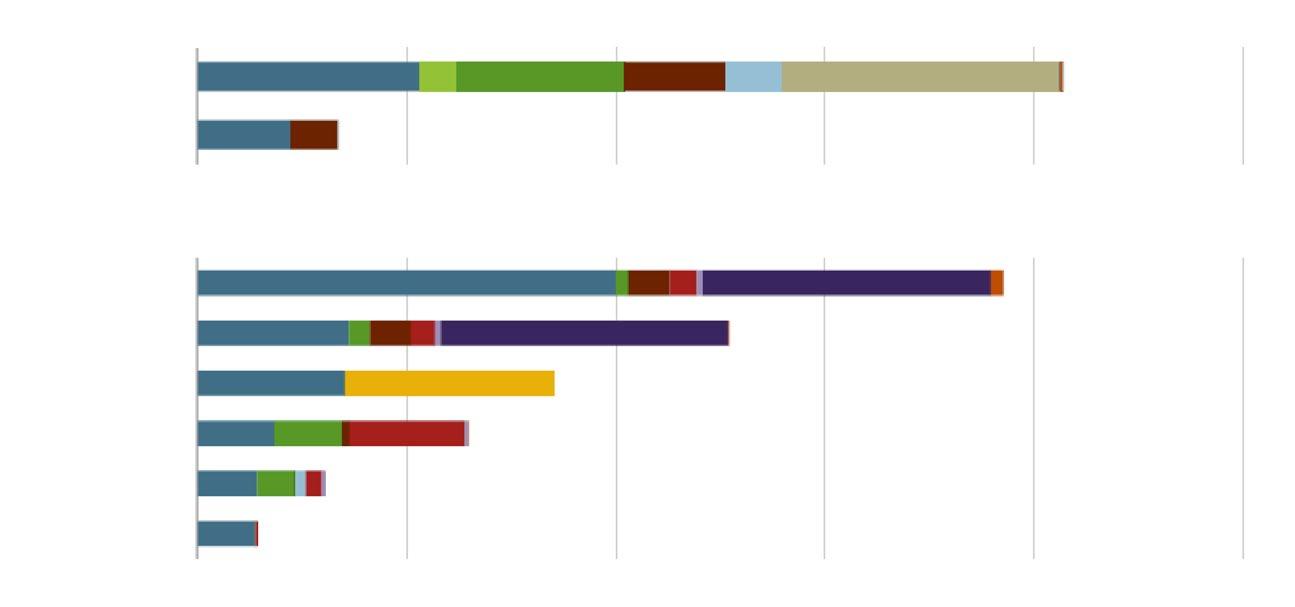






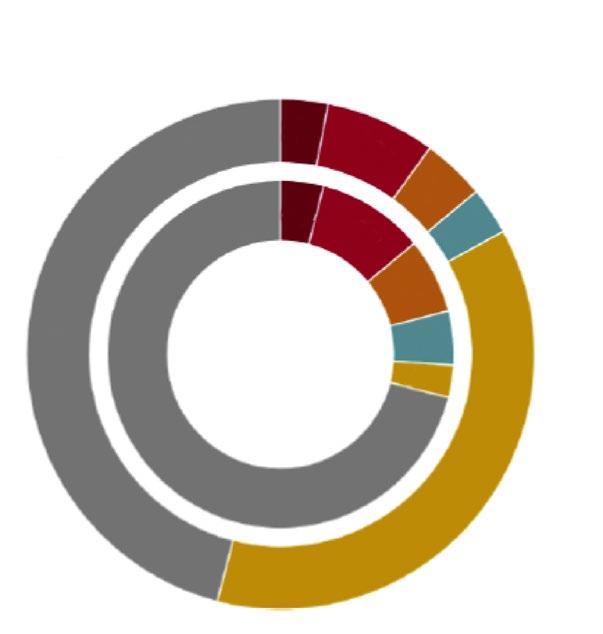
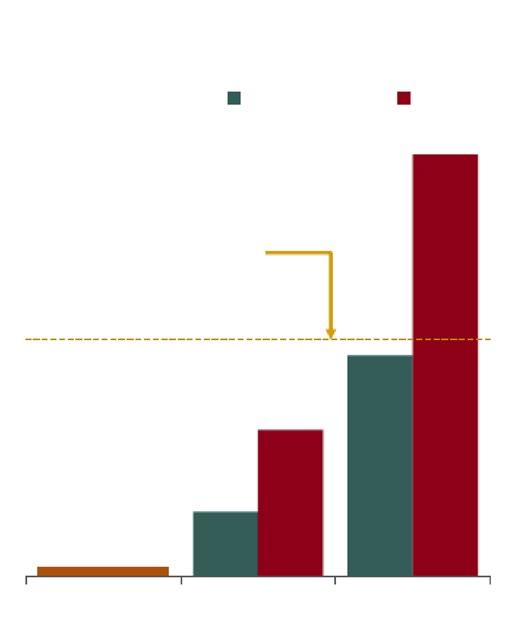
Fig. 8 shows a forecast [10] for the nickel demand for batteries for
the years 2025 and 2030. Even based on a conservative assump tion for 2030, this is already significantly higher than the total market of 2018. Accord ingly, by 2030, the nickel content in batteries alone will be 37% (i.e., nickel will change from an alloying element to a functional material).
These developments could result in sharply increased prices, at least for a limited period until further mining sites have been realised, or lead to strong price fluctuations combined with supply bottlenecks because of rapid market fluctuations. Copper is in a comparable situation. Necessary investments for the nickel production industry in
near future are estimated to be about $70 billion, and for copper production about $40 billion. The nickel producer Vale points out that there is a considerable need for investment to supply larger demand, which will obviously lead to price increases at least for a certain period [10]. Fluctuations in the cost of the alloying elements are usually covered by the OEM, but this may change if alloy costs get ‘out of hand.’
Competing processes (casting/ forging) usually use much cheaper alloying elements, such as Cr, Mn, V, Si, compared to Cu and Ni. However, the oxides of these metals are difficult to reduce at the sintering temperature of 1120°C (Fig. 9). Increasing temperature makes the processing of alloys with such elements much easier. The example of chromium shows that processing at 1120°C requires about 1000 times lower oxygen content in the sintering atmosphere compared to sintering at 1250°C.
Increasing the temperature from 1120 to 1250°C results in a ten-fold acceleration of the solid-state diffu sion responsible for the sintering processes (Fig. 10). This allows either the process time to be short ened or the material properties to be increased at the same time (e.g., by improving the microstructure or influencing the pore geometry).
There is a preconceived opinion in PM manufacturing that higher sintering temperature leads to lower dimensional stability and geometrical precision because of higher sintering shrinkage. Inves tigations by the EPMA HTS1 Club Project [14] have clearly demon strated that this is not correct. The behaviour of five powder mate rials (Table 1) of different chemical compositions and types of alloying was compared in compaction and
1E-5
1E-10
Meeting sustainability demands in PM
Oxidising
1E-15
1E-20
1E-25
200 400 1E-30
CuO Cu 2O MnO
WO 3 MoO 2
SiO 2
Cr 2O 3 TiO 2
1 Ag 2O 600 800 1000 1200 1400 1600 Temperature, °C
Fe 3O 4 V 2O 3 Nb 2O 5
FeO Al 2O 3
Ta 2O 5
Fig. 9 Reduction of metal oxides depending on temperature and atmosphere [11,12]
2.0
1.5
D*10 11 , cm 2 /s NiO CoO
Material
1.0
0.5
2.5 Self-diffusion in γ -Fe 1100 1150 1200 1250 1300 Temperature, °C CaO
Fig. 10 Temperature dependence of the diffusion coefficient of iron [13]
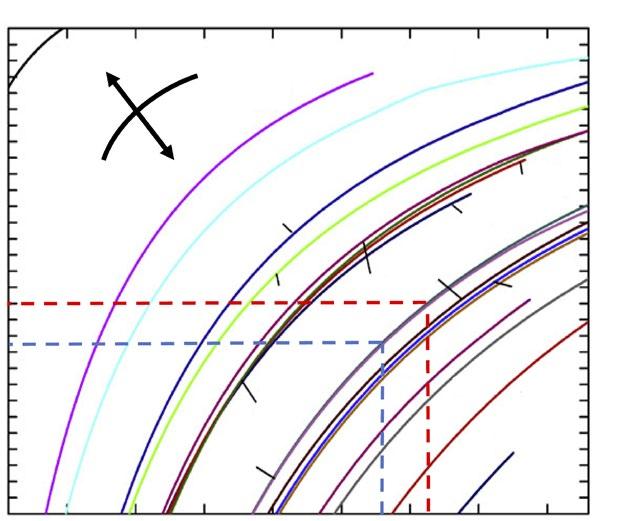

Chemical composition (wt.%) Cr Mo Ni Si V Cu
(A) Ni-free 3.01 0.50 (B) Low-Ni 0.92 0.87 1.01 0.65 (C) Low-Ni 1.76 2.03 (D) Ni-free 0.74 0.18 (E) Reference 0.49 3.71 1.39
Table 1 Chemical composition of in HTS project used powders [14]
sintering process at conventional sintering temperature of 1120°C and in High Temperature Sintering (HTS) at 1250°C. For all investi gated materials, it was concluded that the sintering temperature
may be increased up to 1250°C without impairing dimensional and geometrical precision. The investigations of EPMA HTS2 Club Project confirmed the results on real parts [15].
The results of these investiga tions in two EPMA Club Projects showed the positive effect of higher sintering temperatures (1250°C compared to 1120°C) on the proper ties of low alloyed sintered steels:
• Increases in temperature and the type of alloying (diffusion, hybrid or pre-alloyed) have a significant influence on the microstructure. Pre-alloyed steels show a more homo geneous structure, while the increased temperature creates rounder pores. The micro
structure of the chromiumcontaining materials sintered at 1250°C shows almost exclu sively martensite and bainite
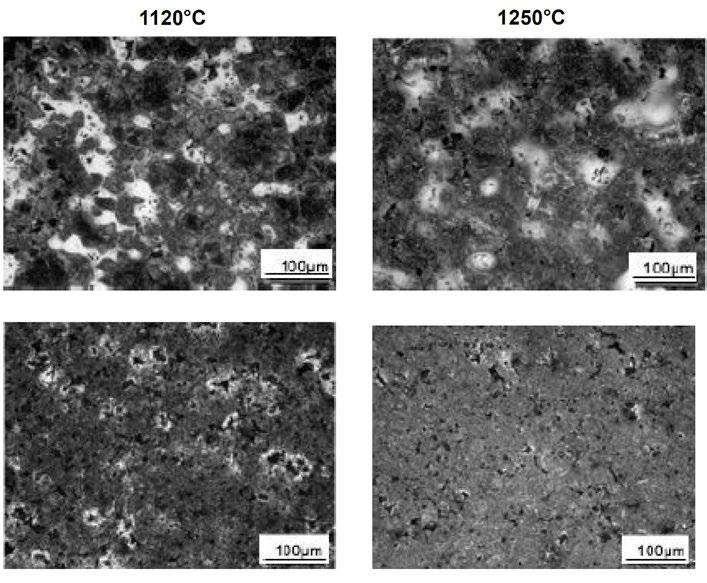
• In addition to a slight increase in density due to shrinkage, HTS causes a slight, but significant, improvement in pore morphology, which leads to a noticeable increase in mechanical properties. The increase of sintering tempera ture for diffusion alloyed Fe-Ni-Cu-Mo and pre-alloyed Fe-Cr-Mo powder from 1120°C
to 1250°C results in increase of the yield point σ y, tensile strength UTS, modulus of elas ticity E and tensile elongation ε (Table 2)
• The tensile strength of three alternative steels examined in the HTS2 Club Project is signifi cantly higher than that of the reference material with the high Cu and Ni alloy proportions. On the other hand, the elongations at break are lower, while the impact energy is slightly lower or comparable
• Similar results, but not at the same magnitude, were observed applying sintering at 1180°C
In addition to the technical advantages, high-temperature sintering allows the avoidance of Ni and Cu additives, resulting in a strong reduction of the calculated material costs (Table 3) and saving on additional costs for diffusion alloying.
Despite of the essential improve ment in mechanical properties and reduction of material cost, sintering above 1150°C cannot be carried out in the ‘work-horse’ of press and sinter technology: the conventional belt furnace. This is because the limited lifetime of the belts at higher temperatures. The alternative solu tion is a roller hearth furnace. The two furnaces are presented sche matically and compared in Table 4.
Among other things, an impor tant advantage of the roller furnace compared to the belt furnace is
Simple transport system
Maximum temperature 1150°C
Conventional mesh-belt furnace up to 1120°C
Belt
Simple automation of loading and unloading
Lower investment costs ~ 400 k€
Processing temperature up to 1300°C
Maximum width 1500 mm Robust operation
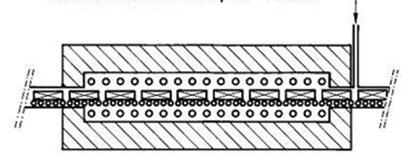
Life of the belt about 6 months
Width up to 1000 mm Higher consumption of protective gas
Roller hearth furnace up to ∼ 1250°C
Roller
Stable atmosphere because of gates (in and out or between furnace sections)
Easy integration of rapid cooling system
Higher investment costs
750 k€ for Tmax= 1300°C
• 550 k€ for Tmax= 1180°C
More elaborate transport system (but robust)
18]
its lower energy consumption. According to [19], the total elec trical power required to sinter components in a belt furnace (width 600 mm and a throughput of about 300 kg/h) is around 100 kW at 1120°C. The corresponding total electrical power for a roller hearth furnace of the same width of 600 mm and a throughput of about 460 kg/h at 1250°C is around 125 kW. This means the energy consump tion are 0.33 kWh/kg at 1120°C in a belt furnace compared to 0.27 kWh/kg at 1250°C in a roller hearth furnace. In addition to the possibility of using cheaper alloying elements at higher sintering temperature, a roller furnace enables energy savings of about 20% for sintering. A direct comparison of energy consump tion and processing costs was carried out in furnaces of both types manufactured by Fluidtherm Technology Co. at the same temperature of 1130°C [18]. The components were transported in the belt furnace with a belt of 600 mm and through the roller furnace on 600 x 600 mm trays. Sintering capacity was 206 kg/hour in the belt furnace and 235 kg/hour in the roller furnace.
It is necessary to point out that the roller furnace used in this investigation allowed the sintering of parts at a temperature of 1180°C max., which, as mentioned above, also gives additional advantages compared to conventional sintering temperature in the belt furnace. This furnace is cheaper compared to a roller furnace for sintering up to 1300°C, because lower cost materials can be used. Obviously, all other advantages of the roller furnace still apply.
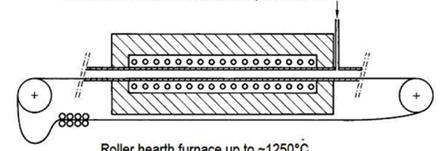
The measured and calculated energy consumption for sintering at 1130°C was:
• 0.56 kWh/kg in the belt furnace and
• 0.40 kWh/kg in the roller hearth furnace
The total sintering cost (including investment) was:
• 0.17 €/kg in belt furnace and
• 0.12 €/kg in roller hearth furnace
The use of a roller hearth furnace saves about 30% of energy costs and of the total cost of sintering. The difference in results published in [18] and [19] can be explained by differ ences in the loading of the furnaces.
“In addition to the possibility of using cheaper alloying elements at higher sintering temperature, a roller furnace enables energy savings of about 20% for sintering.”
One of the first implementations of high-temperature sintering in indus trial Powder Metallurgy has been published by GKN Sinter Metals [19]. Fig. 12 shows, as an example, the production of highly stressed and high-precision components, pressed from Cr-alloyed powder and sintered in a roller hearth furnace with direct


rapid cooling. Parts for vehicle trans missions manufactured using this process have excellent flatness combined with high strength and hardness.
A clear confirmation of the statement that there are no valid arguments against High Temperature Sintering as a production process for the manufacture of sintered parts from a technical and mate rial point of view is also presented by Sumitomo Electric Industries (SEI) [20]. The roller hearth furnace used at SEI includes all functions
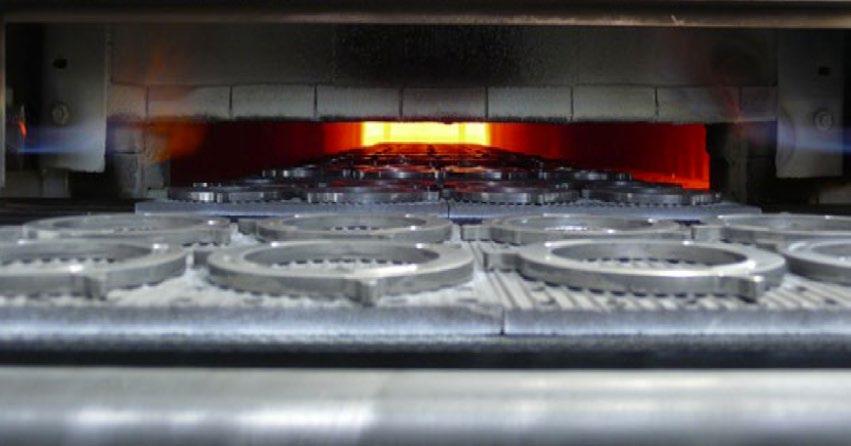
for HTS, including heat treat ment: doors between the burnout zone, preheating zone, sintering zone, slow cooling to 850°C before rapid cooling, rapid cooling plus a tempering zone before the end of the furnace.
The material used is the preal loyed powder Astaloy CrM. which replaced the diffusion alloyed powder Distaloy AE. By applying the new material with the HTS process (including sinter hardening), the complex process route was drasti cally shortened. The new process, including the alternative powder, resulted in a cost reduction of about 30% compared to the previous process, with post-compacting, machining and external heat treatment. In 2014, 500,000 synchro nisers per month were produced using this method.
Even as the lowest-energy manu facturing process, the Powder Metallurgy industry still sees the same pressure to reduce emissions as other industries. Thankfully, the PM process lends itself to optimisation. The following exem plify the potential application of optimisation to lower CO 2 emissions:
1. Improvement/modification of the annealing process of ‘black powder’ after atomi sation (furnace design and process)
2. Replacement of the diffusion alloying process by organic bonding of alloying elements and additives
3. Using roller furnaces where appropriate; about 50% of the energy consumption for press and sintered parts is in the sintering, heat treat ment and production of the gas atmospheres in conven tional belt furnaces. Roller furnaces are more efficient, even at higher temperatures
4. The avoidance of Cu and Ni as alloying elements:
“By applying the new material with the HTS process (including sinter hardening), the complex process route was drastically shortened. The new process, including the alternative powder, resulted in a cost reduction of about 30%...”
a) avoidance of Cu reduces contamination of steel scrap, thereby minimising recycling problems. By avoiding Ni as an alloying element, many strict requirements are no longer necessary b) Cr, Mn, V, and Si offer technical advantages and reduced costs compared to alloying elements Cu and Ni c) Risk of Cu and Ni short ages or bottlenecks could be avoided
The introduction of the alterna tive alloying additives above leads to the best results when applying HTS at 1250°C (or above), but even sintering at 1180°C should show some smaller improvements. In all cases, an increase of sintering temperature leads to slight density increases without impairing the dimensional and geometrical preci sion. The higher the sintering temperature, the better the main mechanical properties of the sintered components.
But sintering above 1150°C cannot be carried out in conven tional mesh belt furnaces, and needs an alternative furnace type – the roller hearth furnace – which allows sintering at temperatures up to 1300°C or 1180°C in lowercost roller furnaces constructed from less heat-resistant mate rials. The main advantage of the roller furnace compared to the belt furnace is its lower energy consumption per kilogram of product. This allows 20% energy reduction when sintering at a temperature of 1250°C, compared to sintering in a belt furnace at 1120°C, and about 30% energy for sintering at the same tempera ture of 1130°C in roller furnace compared to mesh belt furnace.
Successful implementations of high-temperature sintering in roller hearth furnaces using copper and nickel-free powder mixtures have been made and published by GKN Sinter Metals and Sumitomo Elec tric Industries.
Dr Vladislav Kruzhanov Powder Metallurgy Consulting Remscheid, Germany kruzhanov@pm-mim-consulting.com www.pm-mim-consulting.com
Dr Volker Arnhold PM Solutions Wuppertal, Germany volker@arnhold-pm.de
[1] V Kruzhanov, V Arnhold, Energy Consumption in PM Manufacturing, Powder Metallurgy, vol. 55(1), p. 14-21, 2012
[2] R M German, Powder Metallurgy and Particulate Materials Processing, MPIF, Princeton, New Jersey, 2005 [3] M Marucci, J A Catanese, Produc tion of Powder Metallurgy Carbon and Low-Alloy Steels. ASM Handbook Vol. 7, 2015, p. 312
[4] N Dautzenberg, VDI Bildung swerk, BW5084, 1981
[5] R Lummer, Verfahren zur Glühung von Eisenpulver, Patent DE3722956C1, 1988
[6] V Kruzhanov, V Arnhold, Energy Consumption in Iron Powder Produc tion: Annealing of Water Atomized Powder, World PM2016, Hamburg, 2016
[7] Ch Schade et al., MPIF Conf. PowderMet 2011, San Francisco, 2011
[8] https://www.finanzen.net/rohst offe/nickelpreis, https://www. finanzen.net/rohstoffe/kupferpreis
[9] The Role of Critical Minerals in Clean Energy Transitions, Interna tional Energy Agency, May 2021, www.iea.org
[10] R Morris (Vale Base Metals), Bank of Amerika Merrill Lynch Metals, Mining and Steel Conference 2018
[11] R M German, Powder Metallurgy Science, MPIF, Princeton, NJ, 1984
[12] E Hryha, E Dudrova, L Nyborg, On-line control of processing atmospheres for proper sintering of oxidation-sensitive PM steels, Journal of Materials Processing Technology, 212, pp. 977– 987, 2012
[13] Seith W, Diffusion in Metallen, Springer Verlag, Berlin, 1955
[14] D Toledo et al.: High temper ature sintering and its effect on dimensional and geometrical preci sion and on microstructure of low alloyed steels, Powder Metallurgy, vol. 63(2), pp. 80-93, 2020
[15] D Toledo et al., High tempera ture sintering of low alloyed steels: effect on mechanical properties and on the dimensional and geometrical precision, EUROPM2021
[16] Preismonitor Dezember 2021, Deutsche Rohstoffagentur (DERA)
[17] P Beiss, I Cremer, D Geldner et al., Schutzgassinteröfen in der Formteilfertigung, Pulvermetallurgie in Wissenschaft und Praxis, Bd. 27, Hagen, 2011
[18] Gopinath N, Kruzhanov V, Arnhold V, Roller Hearth Furnace: Operating Economics, PM2022, Lyon
[19] L Wimbert, High Temperature Sintering, EPMA PM Sintering Short Course, 2013, Wien
[20] Akayama, Y: A new hardening process for transmission synchro nizing hubs. In: Abstracts of Autumn Meeting of Japan Society of Powder and Powder Metallurgy, 2014
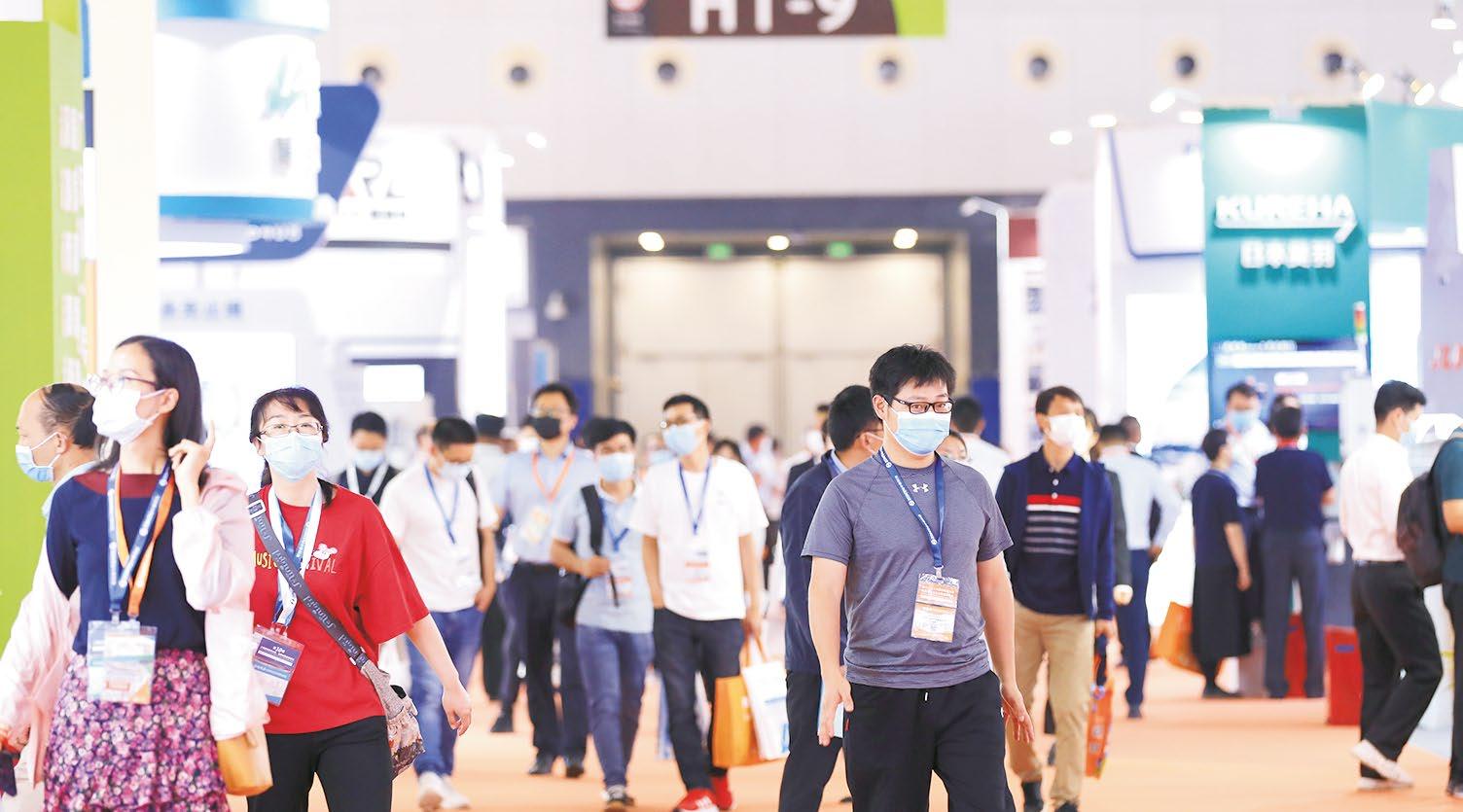

The 2022 World PM Congress and Exhibition brought over 1,000 visitors from the industry to Lyon, France, in October. During the event’s Plenary Session, attendees were given the vital facts and figures on industry trends in Europe, North America and Asia. As the PM market faces unprecedented challenges, these statistics are valuable way to take the pulse of the market during a time of unprecedented challenge. Here, we present the market statistics given during the session, as well as the recipients of the 2022 EPMA Keynote Paper, PM Thesis, Peter Brewin Poster and Fellowship Awards.
The 2022 World PM Congress & Exhibition, organised by the European Powder Metallurgy Asso ciation (EPMA), brought over 1,000 visitors from the Powder Metal lurgy industry to Lyon, France, from October 9-13. Held once every two years, and in Europe once every six years, the World Congress is an essential desti nation for the international PM community to gather and discover the latest technology innova tions, as well as meet suppliers, producers and end-users.
Attendees from fifty-six coun tries across six continents attended the 2022 event, with the majority attending from within Europe, and a smaller proportion attending from Asia, Australia, the Americas, Africa and the Middle East. Women made up 20% of participants; a growth compared to prior events, though there is clearly still room for improvement in PM’s gender balance.
The Plenary Session on October 9 featured an overview of the global PM industry from Ralf Carlström, EPMA president; Rodney Brennen, Metal Powder Industries (MPIF) president; and Chiu-Lung Chu, Asian
Powder Metallurgy Association (APMA) president, all of whom provided updates on the status of and trends in the industry in Europe, North America and Asia, respectively.
Fig. 1 The plenary session at World PM2022 in Lyon, October 2022 (Image PM Review)
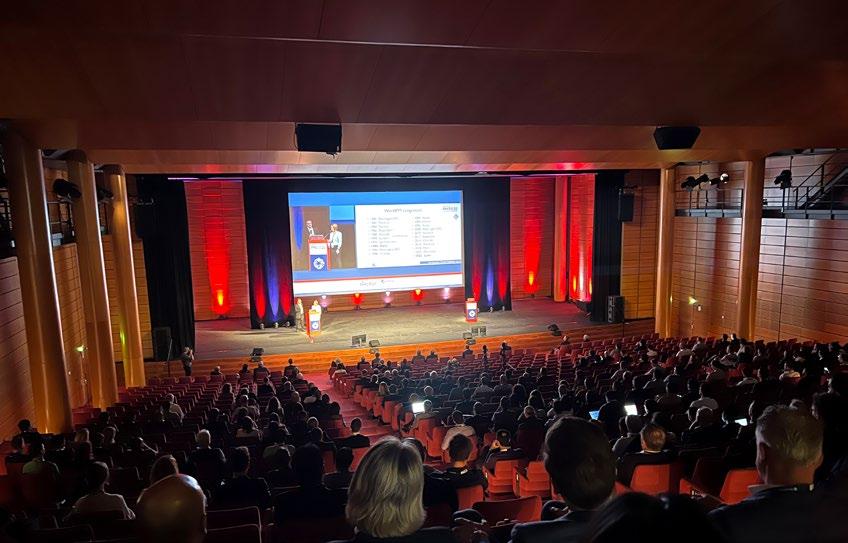
In his overview, Carlström began by acknowledging the overall recovery in gross domestic product (GDP) in important global regions, following the slowdown in 2020 (Fig. 2). World GDP grew by 5.7% in 2021, EU GDP by 5.4% and China GDP by 8.1%. However, due to a variety of factors, most notably Russia’s invasion of Ukraine, China’s ongoing COVID-19 crisis, and high inflation rates, the world GDP growth rate is expected to fall to 2.9% in 2022.
EU metal powder produc tion rebounded in 2021 compared to 2020, with overall powder production increasing by 19.6% to 229 kt in 2021, iron and steel powder production by 16.2%, and non-ferrous powder production by 52.9% (Table 1). The production of powder for PM part production also increased by 19.6% to 229 kt in 2021 compared to 2020, with a total European PM parts produc tion of 240 kt of parts reported by the industry. Of this total, 62% was in ferrous press and sinter PM, 20% in non-ferrous press and sinter PM, 8% in Hot Isostatic Pressing (HIP), 7% in hard mate rials, 2% Metal Injection Moulding (MIM), and 1% Additive Manufac turing (AM) (Fig. 3). Table 1 shows the percentage growth rates for each of these technologies.
Percent change 2021 World GDP EU GDP China GDP
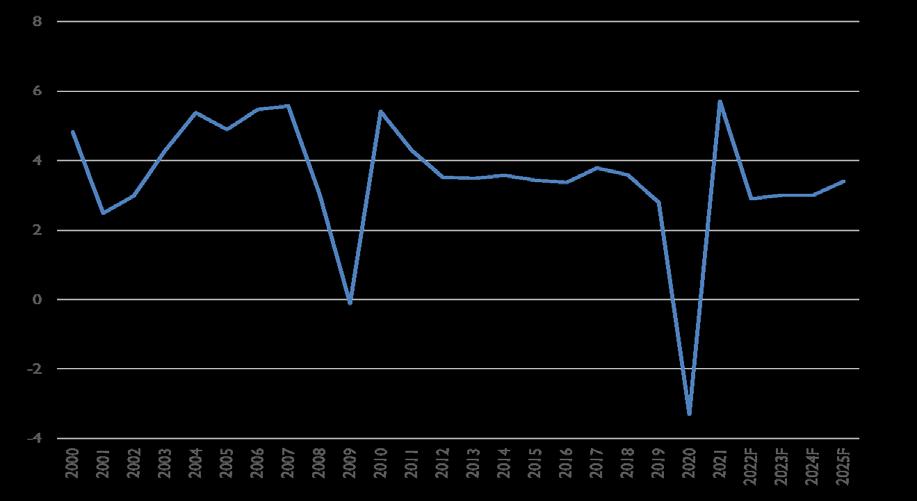
According to Carlström’s pres entation, the value of PM parts production increased by 16.8% in 2021, to a total value of €12.44 billion. The most valuable product segment was hard materials, accounting for 30% of the total market value of PM parts due to the high price of raw materials, followed by PM structural parts/ bearings at 25%, diamond tools at 16%, sintered magnets (12%), PM semi parts (8%), MIM parts (4%), HIP parts (3%) and AM parts (2%) (Fig. 4). However, the growth in value of PM structural parts production in 2021 (11.4%)
European PM parts production 2021
Total growth rate +19.6%
Iron & steel powders +16.2% Non-ferrous powders +52.9%
Total growth rate +19.6%
P&S ferrous parts +18.7% P&S non-ferrous parts +22.8%
HIP/PM semis +20%
MIM parts +22% AM parts +15%
Fig. 3 European PM parts production by technology type, totalling 229 kt (Courtesy EPMA)
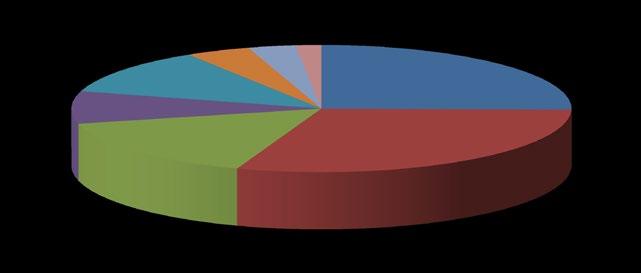
Table 1 Percentage growth rates by material type (top) and technology type (bottom), 2020–21 (Courtesy EPMA)
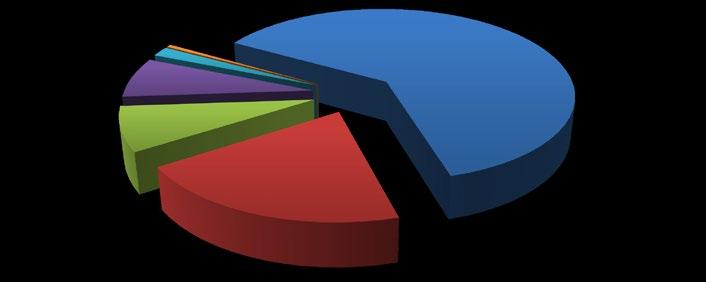
Fig. 4 European PM parts production 2021 by value, totalling €12.44 billion (Courtesy EPMA)
outstripped by the value growth of MIM parts (22%), HIP (20%), and AM (15%) (Table 2).
Looking more closely at the performance of press and sinter PM, Carlström reported that this sector, consisting of ferrous and non-ferrous parts and serving mainly the automotive industry, reached 189 kt in 2021, an increase of 19.7% on 2020 (Fig. 5). There was good recovery in ferrous PM but an even stronger recovery in non-ferrous PM. This was, he said, in spite of the global slowdown in car production, with overall EU car production down 6% in 2021, combined with the after effects of COVID.
Total growth rate +16.8%
PM structural parts +11.4% MIM +22% HIP +20% AM +15%
Table 2 Percentage value growth by PM product type, 2020–21 (Courtesy EPMA) 189 kton
Fig. 5 Production of European press and sinter parts from 2018–2021 (Cour tesy EPMA)
World PM2022: Industry status
Petrol

58.9%
tonnes
16,000
Fig. 10,000
14,000
of 2,000
current and 4,000
The market for internal combustion engines (ICEs) continues to collapse, Carlström stated, with diesel’s share of the market falling from 27.9% to 19.6% in 2021, and petrol from 47.6% to 40% (Fig. 6). The Euro pean Commission’s new proposed CO 2 reduction targets for cars and vans continue to have a major impact on the market for ICE vehi cles; the new targets, which would eliminate ICE vehicles by 2035, are shown in Table 3.
HEV HEV BEV
ECV ECV
3% 10.5%
5.9% 19.6% 9.1%
Alternative fuels Alternative fuels
2019 2020 2021
Petrol Petrol
47.5% 40%


Others PHEV
2.3% 8.9%
HEV Diesel Diesel Diesel NGV
11.9% 30.5% 28% 19.6% 0.4%
1.7% 2.1%
Passenger car registrations in 2021 reflected the impact of new regulations and targets, with battery electric (BEV), plug-in hybrid electric (PHEV) and hybrid electric (HEV) vehicles holding a combined market share of 37.6%. As Carlström noted, this share has been gained much faster than expected, and automotive market forecasts made twelve months ago are rapidly becoming outdated. Fig. 6 shows the dramatic change in the passenger car market from 2019–2021.
/ source www.acea.auto) 8,000
Estimated Hard Materials Production in Europe 2013 2021
Table 3 Overview Current targets Proposed targets Current targets Proposed targets 2025 -15% -15% -15% -15% 2030 -37.5% -55% -31% -50% 2035 -100% -100% 0
(Courtesy EPMA / source: www.acea.auto) 12,000
CO 2 targets for cars and vans, compared to 1990 levels (Courtesy EPMA 6,000
18,000 2013 2014 2015 2016 2017 2018 2019 2020 2021
Reflecting the direction of the market, seventeen automotive battery manufacturing projects have secured full funding in the EU, with another ten having secured partial funding, and eleven further still announced, including one from Volkswagen Group. EU projects are expected to have a combined capacity of 460 GWh battery production in 2025, and 1140 GWh by 2030, accounting for 30% of forecast global production.
The hard materials sector showed a strong recovery in 2021, with hard materials production in Europe estimated to be up 20%, to a level well above that of 2019 (Fig. 7). The hardmetal carbide tool sector saw an increase of 20%, while the diamond tool sector gained 15%.
for 2020’s 9% market shrinkage (Fig. 8). Despite the uncertain ties in the automotive market, MIM performed well in the medical market, which also provides prom ising opportunities for the future. The industry’s expectations for 2022 are good.
Likewise, HIP has shown very positive development in 2021 after a drop in 2020, growing 20% and more than recovering what was lost the previous year. 41% of all HIPed parts went into energy appli cations (except oil and gas), while 16% were for consumer goods applications, 12% oil and gas, 5% tooling, 4% medical, 1% aero space, and 21% used in ‘other’ applications.
The same survey showed that HIP near-net shape manufac ture is used in many sectors, and that there is a positive outlook for this technology. It is believed that the turmoil in the fuel market may stimulate HIP applications in energy. Growth is also forecast in the tooling and medical markets.
Sales of metal powders for Additive Manufacturing in Europe showed growth in 2021, rising by 15% after a slowdown in 2020. A rise was also seen in global sales of metal AM machines and services (Figs. 9, 10).
Highlighting one significant opportunity for the Powder Metal lurgy’s future, Carlström presented a forecast of hydrogen produc tion and electrolyser capacity in Europe. PM has a number of oppor tunities in hydrogen production; it could be used to produce electrode material in the water electrolysis process, in the production of gas diffusion layers in fuel cells, or for the storage of hydrogen using metal hydrides. By 2026, Navigant Research predicts that the annual installed P2G capacity and cumu lative hydrogen production by region, worldwide, will have risen to roughly 400,000 metric tons of hydrogen per year (Fig. 11).
The GRHYD project in France, which began blending 6% hydrogen into the natural gas grid in 2018,
Fig. 8 MIM sales in Europe, 1991–2021 (Courtesy EPMA)
Metal AM materials (powders) Sales in Europe (Source: EPMA Statistics)
Metal AM materials (powders) sales in Europe (Source: EPMA Statistics)
Fig. 9 Metal AM powder sales in Europe (Courtesy EPMA)
(Source: Wohlers Associates)
Total sales of metal AM machines (Source: Wohlers Associates)
Fig. 10 Total sales of metal AM machines (Courtesy EPMA / source: Wohlers Associates)
Electrolyzer capacity (MW)
2,000
Asia-Pacific Europe North America 1,500 1,000 500
Latin America, Middle East & Africa
Cumulative hydrogen production
2017 2018 2019 2020 2021 2022 2023 2026
400,000
300,000
200,000
100,000
500,000 2025 2024
Hydrogen production (metric tons)
Fig. 11 Annual installed P2G capacity and cumulative hydrogen production by region, world markets: 2017–2026 (Courtesy Navigant Research)
MPIF President Rodney Brennen gave delegates a detailed overview of the state of the North Amer ican Powder Metallurgy industry. The North American Powder Metal lurgy industry, he reported, had not been immune from the challenges facing the global supply‐chain, and continues to feel the negative effects of the COVID‐19 pandemic.
had already reached 20% on a volu metric basis in 2019, demonstrating the technical feasibility of this approach for domestic use. In fact, hydrogen can replace 30% of the natural gas used in the DRI steel making progress, Carlström stated.
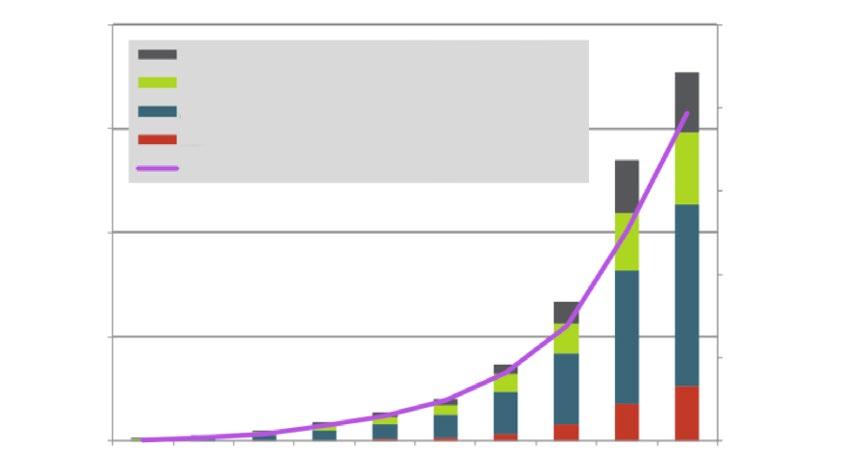
The HYBRIT pilot plant currently being built in North Sweden will produce 1 million tons of fossilfree steel by 2026; in 2021, it began delivering milled steel produced with the HYBRIT process to an end-user in the automotive sector.
The H2 Green Steel project will produce 2.5 million tons of steel
in 2024 in Boden, Sweden, and 5 million tons of tin by 2030. SALCOS, by Salzgitter AG, Germany, will replace carbon with hydrogen in its steel, producing it in a similar way to the Nordic initiative; this project is focused on hydrogen production via windpower or high-temperature electrolysis.
Daimler and Volvo Truck recently signed a joint develop ment agreement on hydrogen fuel cell technology for transportation. Daimler also has a cooperation with Rolls-Royce on stationary fuel cell generators.
Semiconductor microchip processor shortages are having a major impact on the PM sector, and continue to cause delays in auto motive production. According to Brennen, most automotive compa nies, whose vehicles use an estimated 20–100 processors each, depending on the vehicle’s features, agree that recovery will begin in the second half of 2022, but a normal supply won’t be met until well into 2023. Volkswagen doesn’t expect demands to be met until 2024.
Further global events nega tively impacting the PM industry were highlighted, though Brennen stated that many of these major disruptions should be viewed as opportunities, in that they have forced companies to work smarter and be more efficient, and inno vative. New production output levels are being achieved thanks to changes and innovations made because of the pandemic, and many companies report reductions in energy consumption, furnace atmos phere gases, scrap, and waste that is sent to landfills as a direct result of operating more efficiently.
Some companies have also replaced older equipment with the latest computer controlled Industry 4.0 technology. This ‘Internet of Things’ approach allows equip ment to ‘talk’ to each other and learn the best parameters for the process, and automation within the PM industry continues to grow as a solution to the overall shortage of workers resulting from ‘the great resignation.’ From pick‐and‐place robots at the compacting presses and furnaces, to 100% vision system
“New production output levels are being achieved thanks to changes and innovations made because of the pandemic, and many companies report reductions in energy consumption, furnace atmosphere gases, scrap, and waste that is sent to landfills as a direct result of operating more efficiently...”
inspections, automation is expected to continue to increase.
Total estimated 2021 North American metal powder shipments increased by 8.1% to 359,928 mt. Iron powder shipments increased 7.8% to 307,105 mt. Stainless steel, copper, nickel, and aluminium powder ship ments all increased by an estimated 3% to 11%. Estimated shipments for 2021 include stainless steel powder, 6,349 mt; copper and copper base powder, 13,605 mt; nickel powder, 4,263 mt; and aluminium powder, 19,591 mt (Table 4).
Refractory powder had a strong showing in 2021 after decreased shipments over the past few years. Molybdenum shipments increased an estimated 33.5% to 563 mt. Tung sten powder shipments increased by an estimated 106% to 3,115 mt, and tungsten carbide powder ship ments increased an estimated 13.7% to 5,338 mt.
Historically, iron powder ship ments have been the best barometer of the health of the PM industry, explained the MPIF, but there will likely be a correction as the auto industry downsizes engines from 8 to 4 cylinders, and with the growing acceptance of hybrid electric (HEV) and electric (EV) vehicles.
PM and friction‐grade iron powder shipments were up 6.6% to 275,309 mt. Welding applications increased by 30.2% to 14,309 mt. Cutting, scarfing, and lancing applications increased by 21% to 822 mt. Miscel laneous uses increased 11.5% to 16,665 mt (Table 5).
Brennen stated that powder producers continue to respond to the needs of the industry by devel oping new and improved materials and additives for conventional press and sinter, MIM, and metal AM. Over the past two years, dry lubricants have been in limited supply and high demand, forcing companies to seek alternatives. The demand to improve ‘value‐added’ machining has resulted in new high green strength mate rials that are suitable for green machining.
With automotive electrifica tion increasing, soft magnetic and
Type
2020 2021
Short tons Metric tones Short tons Metric tones
Iron & steel 314,052 284,845 338,594 307,105
Stainless steel 6,300 5,714 E 7,000 6,349 E Copper & copper base/tin* 13,800 12,517 E 15,000 13,605 E Aluminium 21,000 19,047 E 21,600 19,591 E Molybdenum 465 422 E 621 563 E
Tungsten 1,665 1,510 E 3,434 3,115 E Tungsten carbide 5,178 4,696 E 5,885 5,338 E Nickel 4,500 4,082 E 4,700 4,263 E
Total 366,960 332,833 396,834 359,928 * PM parts only (E) estimate
soft magnetic composites are being researched by all major iron powder producers, most of whom Brennen stated have ongoing collaborative efforts with their customers and academia to iden tify higher permeability, lower core loss, and increased part strength materials and processes.
MIM and AM powder producers were reported to be seeing strong demands for materials. Generally, the materials of choice are stain less steels and low-alloy steels, but there is considerable develop mental work being performed on aluminium, titanium, and an array of other metal powders and alloys. Total 2021 North American metal powder shipments to the MIM and AM industries increased by an estimated 5–10% to 3,934,767–
4,202,178 kg. Of this amount, an estimated 360,000 kg is dedicated to AM.
PM parts makers were said to be seeing a continued surge from the industrial sector, which requires value‐added, near‐net shape parts in cost‐effective lean‐alloy mate rials, with high material utilisation rates. Most PM companies reporting to the MPIF said that they have real ised increased backlogs, month after month. Disrupted supply chains have also resulted in the reshoring of some PM parts, but not to the extent that most had hoped.
Conventional press & sinter parts makers expect high single‐digit to low double-digit growth for non‐auto motive applications, but the current outlook for automotive applications is not as good due to supply chain
disruptions. The MPIF estimates over 70% of the iron powder shipped is used for PM parts in internal combustion engine (ICE) passenger vehicles. Unfortunately, it appears HEVs have limited use for, or are not using, powder-forged connecting rods and PM main bearing caps. EVs simply do not have connecting rods and main bearing caps. As HEVs and EVs gain greater acceptance, the industry can expect iron powder shipments to decline until other applications pick up the volume.
In 2021, there were roughly 15 million vehicles sold in North America; this is about 500 thousand more than in 2020, but 2 million less than in 2019. Brennan stated that semiconductor shortages had a ‘devastating effect’ on vehicle sales, with many car lots standing empty.
In the course of the shortage, automotive manufacturers reportedly diverted the semiconductors they could obtain to the higher‐margin large pick‐up trucks and SUVs over the lower‐margin sedans. This was beneficial to the PM industry, as large passenger vehicles consume an average 27.2 kg of PM parts per vehicle, followed by the midsize crossover vehicles at 18.1 kg and sedans at 9.1 kg. Taking this into consideration, the estimated average weight in a 2021 North American passenger vehicle remained at 16.8 kg.
As the semiconductor shortage improves, and HEVs and EVs gain greater acceptance, the PM part
weight in passenger vehicles will likely decrease 2–3% annually if new applications in HEVs and EVs are not identified, Brennen stated. However, there are opportunities to introduce the use of powder-forged connecting rods and PM main bearing caps in HEVs, and new applications in EVs.
It was reported that in 2021, the tungsten market significantly increased on an overall basis, with continued strong growth in the semi conductor market driving demand for high-purity tungsten powder due to the demand for newer-gener ation chips used in 5G, personal computers, super computers, smart phones, electric vehicles, smart TVs, and other ‘Internet of Things’ devices. Tungsten powder for the defence industry also remained strong. Another positive trend that boosted tungsten powder shipments was North American customers buying from domestic producers instead of Asian producers whose supply chains represented significant delays and risk.
The tungsten carbide market moderately improved but was still impacted by a reduced North Amer ican oil and gas exploration and a depressed coal mining market. There was a moderate increase in demand for tungsten carbide for cutting tools and wear parts due to a resur gence in manufacturing, but the demand was impacted by shortages in raw materials and labour, as well as transportation issues and rising costs.
North American oil and gas rig counts finished the year up 65% over 2020, which had the lowest levels since 1949. At the end of 2021, the North American rig count was 676 compared to a twenty-year average of 1,514 and the most recent five‐year average of 842. In 2021, coal production in the US was up 8% over 2020 according to the US Energy Information Agency, but 2020 was one of the worst years on record. Reduced automotive production resulted in inconsistent demand for cutting tools. Other manufacturing sectors picked up in 2021, but, again, shipping backlogs and COVID‐19 lockdowns in China disrupted raw materials.
Longer transportation timeframes have had a significant impact on international shipments of tung sten concentrates and other raw materials. The uncertainty has led manufacturers to increase inven tories to avoid the possibility of running low on raw materials. For the most part, increased prices did not have a discernible impact on demand from many industrial manu facturers in the North American market, Brennen explained.
North American molybdenum powder demand was estimated to be up by 33%. Molybdenum is used in PM applications for such industries as aerospace, automotive, medical, defence, industrial, and electronics. Demand for these applications surged in 2021, increasing the need for molybdenum powders for the diverse PM parts that service these markets, reported the MPIF.
Chiu-Lung Chu, APMA president, began his overview by introducing the member associations that make up the APMA. The organisation is made up of the Japan Powder Metal lurgy Association (JPMA), Japan Society of Powder and Powder Metallurgy (JSPM), Korean Powder Metallurgy Association (KPMA), Korean Powder Metallurgy & Mate
“... automotive manufacturers reportedly diverted the semiconductors they could obtain to the higher‐margin large pick‐up trucks and SUVs over the lower‐margin sedans. This was beneficial to the PM industry...”
rials Institute (KPMI), Taiwan Powder Metallurgy Association (TPMA), China Powder Metallurgy Alliance (CPMA), China Powder Metallurgy Society, Powder Metallurgy Association of India (PMAI), and Thailand Powder Metallurgy Association (ThaiPMA).
The statistics presented in Chu’s overview were provided, sepa rately, by these associations. In 2021, Japan’s iron-base powder produc tion increased by 13.5% to 81,137 mt and copper-base powders increased by 15.4% to 2,453 mt. Total metal powder production was up 13.6%, to an annual figure of 83,590 mt.
In China, iron-base powder production increased 14.6%, reaching 188,236 mt, while copper-base powders grew by 20.2%, total ling 13,539 mt. The total powder production for 2021 was reported at 191,600, identical to the total amount produced in 2020.
Korean iron-base powder produc tion rose 7.2% to 62,900 mt, while the country’s relatively small copperbase powder production rose by 35.1% to 1,510 mt. Total powder production for 2021 was up 7.7% at 64,410 mt.
Taiwan’s iron-base powder production was up 1% at 31,000 mt, while copper-base powder produc tion fell slightly by 9.1% to 1,800 mt. Total powder production for 2021 was 32,800 mt, a slight increase of 0.4% from 2020.
In India, iron-base powder production rose 12.5% to 36,000 mt, and copper-base powder production by 15.3% to 9,800 mt. Total powder production for the year was up 13.1% at 45,800 mt.
Malaysia saw an iron-base powder production increase of 9.5% to 3,354 mt, while the country’s small copper-base powder produc tion increased by 18.9% to 132 mt, bringing total metal powder produc tion for the nation to 3,486 mt, up 9.8% on the prior year.
In Singapore, iron-base powder production was up by 21% to 1,337 mt, and copper-base powder production up 18.2% to 370 mt, making the island nation’s total powder production 1,707 mt, up 20.4% from 2020.
Thailand saw its iron-base powder production rise by 18.7% to 16,036, and its copper-base powders rose 9.1% to 60 mt. Total metal powder production for the country was 16,096 mt, up 18.6%.
Indonesia’s iron-base powder production was 5,433 mt, up 19.6% from the prior year. However, the
country ceased copper-base powder production in 2021.
Taking these statistics into account, the APMA reported a total Asian iron-base powder produc tion figure of 425,433 mt in 2021, up 12.2% from 2020. Copper-base powder production for the region was 29,664 mt, up 16.2%. The total powder production for the region was 444,922 mt, up 5.7% from the prior year.
By market, the majority of PM production in Asia was for the trans portation sector, accounting for up to 92.8% of production in Japan, 53% in China, 92% in Korea, 38% in Taiwan, 80% in India, 60% in Malaysia, 47.7% in Singapore, 65% in Thai land, and 100% of PM production in Indonesia. In China (37%), Japan (5%), and Korea (5%), the indus trial sector followed transportation as the biggest application field for PM, while in Taiwan, industrial was tied with transportation at 38%. In Malaysia (36.7%), Singapore (48.3%), India (8%) and Thailand (15%), the electrical sector was the second largest application field (Fig. 12).
“... the APMA reported a total Asian iron-base powder production figure of 425,433 mt in 2021, up 12.2% from 2020.”
MIM application in China 2021
Table 6 Application fields for MIM parts produced in Asia in 2021 (Courtesy APMA) Fig.
More than half of global MIM production, about $1.5 billion, comes from China, reported Chu. In 2021, the vast majority of China’s MIM parts went to the electrical sector (78%), with the remainder delivered to transportation (7%), industrial (6%), and other indus tries (9%). For Korea, the majority of MIM parts went to the trans portation sector (80%), and the remainder to industrial (15%) and electrical (5%).
Taiwan also reported the majority of MIM parts were consumed by the electrical sector (60%), while 17% went to trans portation, 16% to industrial and 7% to other sectors. India saw a fairly even split across the various MIM application fields, with elec trical holding a slight majority at 30% followed by transportation and other industries at 25% each, and industrial at 20%. In Thailand, the majority of MIM use was in indus trial applications (60%), 20% in electrical, and 20% in other fields. Japan did not report any MIM appli cation data for 2021 (Table 6).
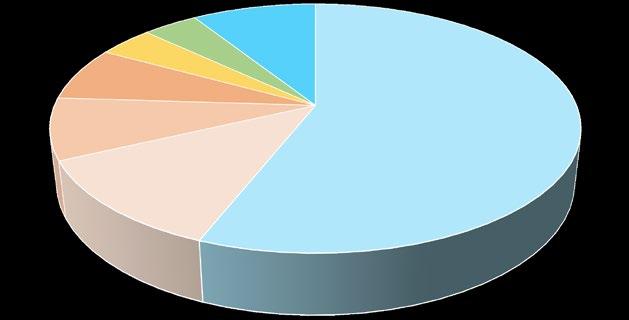
A more detailed breakdown of MIM applications in China was shared, showing that mobile/ cellular phone parts made up the majority of applications at
2022 Forecast Australia 1,062,867 916,968 -14% 1,005,000 10% 1,100,000 China 26,796,931 25,311,069 -6% 25,700,000 2% 27,000,000 India 3,816,858 2,938,023 -23% 3,800,000 29% 4,100,000 Indonesia 1,032,907 532,027 -48% 880,000 65% 920,000 Japan 5,195,216 4,598,615 -11% 4,550,000 -1% 5,100,000 Korea 1,780,088 1,878,104 6% 1,700,000 -9% 1,650,000 Malaysia 604,281 529,434 -12% 500,000 -6% 590,000 Philippines 416,628 248,171 -40% 305,000 23% 360,000 Taiwan 439,835 457,453 4% 455,000 -1% 430,000 Thailand 1,007,552 792,146 -21% 759,119 -4% 820,000 Vietnam 306,452 284,279 -7% 275,000 -3% 300,000 Total 42,153,163 38,486,289 -9% 39,929,119 4% 42,370,000
Country 2019 2020 Year on year
Table 7 Car sales in Asia and Australia from 2019–2022 (forecast) (Courtesy APMA)
56%, followed by wearable elec tronics at 12%, other applications at 9%, computer applications at 8%, hardware at 7%, and medical and automotive at 4% market share each. 76% of all MIM applications were in the 3C industries (Fig. 13).
In 2021, car sales for Asia and Australia rose by 4% following a 9% drop in 2020 (Table 7). Total car sales for the region were 39,929,119 vehicles, with the large majority of these sold in China and the fewest in Vietnam. Sales have not yet recov ered to the level of 2019, but the APMA forecast that car sales for the region would rise above the 2019 level in 2022.
Also during the Plenary Session of World PM, Lionel Aboussouan, the EPMA’s Executive Director, announced the 2022 Keynote Paper Award Winners (Fig. 14). The award, sponsored by Taylor & Francis Group, recognises papers of signifi cant technical or scientific merit.
The selected papers received an extended presentation slot in the conference programme and publi cation in the journal Powder Metallurgy. The 2022 winners were:
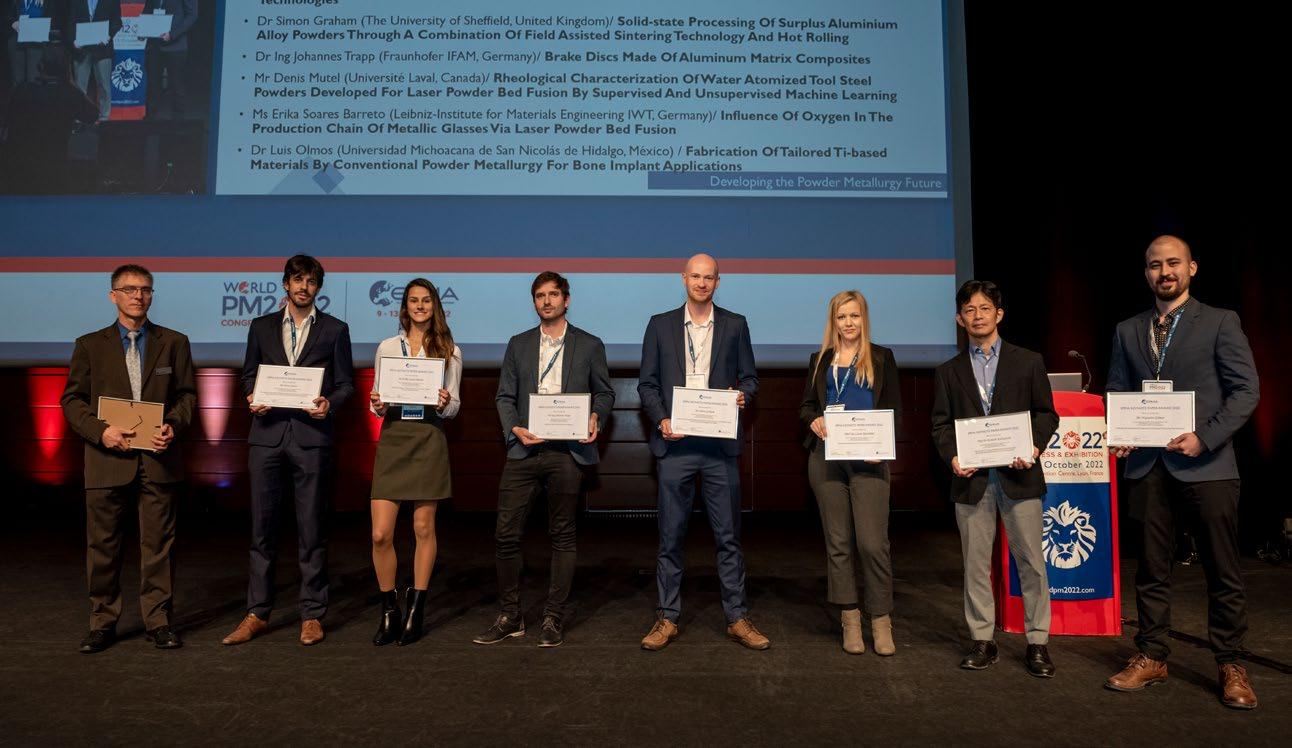
• ‘Using Discrete Simulations of Compaction snd Sintering To Predict Final Part Geometry,’ by Gilmar Nogueira (Université Grenoble Alpes, France)
• ‘High Strength Ti-Zr Alloys with Balanced Ductility Fabri cated by Powder Metallurgy And Additive,’ Prof Dr Katsuy oshi Kondoh (Osaka University, Japan)/
‘Constitutive Modelling of Solid State Sintering of Cemented Carbides,’ by Dipl-Ing Louise Rosenblad (KTH, Sweden)
• ‘Development of X40CrMoV5-1 (H13) on Binder Jetting Tech nologies,’ by Dr Ing Christophe Reynaud (CETIM, France)
• ‘Solid-state Processing of Surplus Aluminium Alloy Powders Through s Combina tion of Field Assisted Sintering Technology and Hot Rolling,’
by Dr Simon Graham (The University of Sheffield, United Kingdom)
• ‘Brake Discs Made Of Aluminum Matrix Compos ites’ by Dr Ing Johannes Trapp (Fraunhofer IFAM, Germany)
• ‘Rheological Characteriza tion of Water Atomized Tool Steel Powders Developed For Laser Powder Bed Fusion by Supervised snd Unsuper vised Machine Learning,’ by Denis Mutel (Université Laval, Canada)
• ‘Influence of Oxygen in the Production Chain of Metallic Glasses via Laser Powder Bed Fusion,’ by Erika Soares Barreto (Leibniz-Institute for Materials Engineering IWT, Germany)
• ‘Fabrication of Tailored Ti-based Materials by Conven tional Powder Metallurgy hor Bone Implant Applications,’ by Dr Luis Olmos (Univ. Grenoble Alpes, France)
The annual Thesis Competition was also announced during the Plenary Session. This competition is designed to stimulate and encourage young researchers in PM, and is open to any students studying within the EU at PhD or Masters level.
Thesis Competition winners received a financial prize, as well as the opportunity to present their work at the EPMA’s PM congress, and a plaque from the EPMA President.
The winner of the 2022 Thesis Competition was Dr techn Lukas Kaserer, BSc, MSc, for his thesis on ‘Laser Powder Bed Fusion of the Refractory Metal Molybdenum Material and Process Development’ (Fig. 15).
The Peter Brewin Poster Award was presented during a special poster reception at World PM. Introduced in 2014, this award aims to publicly recognise the important contribu tion made by poster authors to the EPMA’s annual congress. Award winners received a plaque and an honorarium of €250.
The Peter Brewin Poster Award for 2022 was presented to Lang Roman of Leibniz Univer sität Hannover, Germany, for his poster entitled ‘Grinding Behav iour Of Metal-bonded Diamond Grinding Wheels With An Additive Of Chromium As A Carbide-forming Element.’
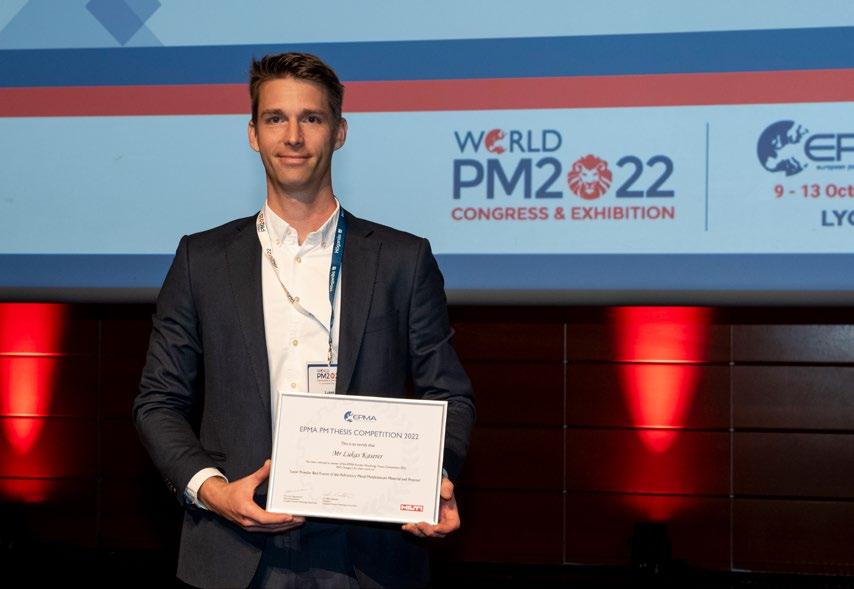
The annual Fellowship Award was also announced during the poster reception. This award recognises individuals in the scientific and/or academic community for significant contributions to the development of the PM industry. The 2022 winners were Prof Luis M Llanes Pitarch and Prof Dr-ing Thomas Weissgärber.
Prof Luis M Llanes Pitarch
Born in 1965, Prof Llanes Pitarch holds bachelor’s and master’s degrees from Universidad Simón Bolívar, Venezuela, as well as a PhD degree from University of Pennsyl vania, USA. Since 1992 he has been affiliated with Universitat Politèc nica de Catalunya (UPC), where he became a Full Professor in the Department of Materials Science and Engineering in 2003.
He has been chairman of his department, Dean of the BarcelonaEast School of Engineering (EEBE) and Director of Fundació Politèc nica de Catalunya (UPC School).
Prof Llanes Pitarch has concen trated on the field of mechanical behaviour of metallic, ceramic and composite materials, especially addressing structural integ rity (fracture, fatigue and contact load response), micromechanics and reliability under service-like conditions.
In the last two decades, his efforts have focused on microstruc tural design optimisation of hard materials (hardmetals, cermets, PCD and PcBN), through mechan ical integrity assessment along a wide range of length scales. Prof Llanes Pitarch is co-author of more than 150 papers published in top journals in these fields. In addition, he has a track-record of technology transfer and consultancy with hard materials industries. He is co-chair of EPMA’s European Hard Materials Group, Associated Editor of the International Journal of Refractory Metals and Hard Materials, and a member of the Editorial Board of Ceramics International. Prof Llanes Pitarch has been co-chairman of the last five International Confer ences on the Science of Hard Materials (ICSHM).
Prof Thomas Weissgärber is one of the directors of Fraunhofer IFAM and heads the Dresden facility. He also holds a professorship in Powder Metallurgy at Technische Universität Dresden. Born in 1969, Prof Weissgärber studied materials science at the Technical University Dresden and received his PhD in Powder Metallurgy in 1997.
For twenty-five years, Prof Weissgärber has been working in the field of applied research in Powder Metallurgy. His research focus lies on metallic lightweight materials, composite materials, high-temperature materials, functional materials as well as materials for the energy sector.
A main topic of his work is the development of highly thermally conductive and expansion-matched composites for applications in electronics.
In addition to concepts for new high-temperature materials, he is also involved in the development of aluminium sintering in particular. The development of highly porous materials for chemical processes and energy storage is a further part of the research activities. In the future, the topics will be specif ically expanded to include soft magnetic materials and complex concentrated alloys. In addition to classic Powder Metallurgy technol ogies, Prof Weissgärber is active in the field of Additive Manufacturing.
The Euro PM2023 Congress & Exhi bition, organised and sponsored by the European Powder Metallurgy Association, will be taking place in Lisbon, Portugal, October 1–4, 2023. www.europm2023.com
The World PM2024 International Powder Metallurgy Congress & Exhibition, organised by the Japan Powder Metallurgy Association and Japan Society of Powder and Powder Metallurgy, will be held in Yokohama, Japan, from October 13–17, 2024. www.worldpm2024.com


Based at the Powder Metallurgy Industrial Park of Taizhou City, Jiangsu Province, JiangSu JinWu (JSJW) New Materials Co., Ltd. has leveraged thirty years of research at Beijing University of Science and Technology to produce industrial volumes of highquality spherical titanium, nickel superalloy and aluminium powders, as well as high-entropy powders, for applications including MIM, AM and PM. Dr Chiou Yau Hung (Dr Q) visited the company on behalf of PM Review and here offers an overview of how the management at JSJW has used its research expertise to advance the production and processing of challenging PM materials.






Register here PM23
48th ANNUAL TECHNICAL MEETING OF PMAI (13th 15th March 2023)
Powder Metallurgy (PM) is a technique in which particulate materials are blended, compacted and sintered to the desired end use product. Few of the advantages the PM offers over other metal forming technologies such as forging and metal casting are advantages in material utilization, shape complexity, near net shape dimensional control, etc Over the past few years, PM has been widely recognized as a preferred process for producing high quality parts for diversified applications. The development of lifestyle & health devices, VVT, hybrid vehicles, electric vehicles, fuel cells, catalytic converters, composite electrical contacts, advanced sensors, light weight components and thermoelectric devices have been made possible by the use of several technologies that comprise the science & practice of PM. This conference addresses these and related developments by way of presentations made by experts in each field The conference attendees will have access to more than 100 technical presentations from worldwide experts presenting the latest technology developments in this fast growing field Also, they will have a golden opportunity to get their research published in renowned international journals The concurrent 48th Annual Technical Meet of PMAI provides a platform for industrialists, researchers and students from scientific establishments & academia to present their work
Establishing new technologies to produce small quantities of high-quality metal powders with tailored, AM-suitable chemical compositions can accelerate the development of new materials for the AM process. These advances not only benefit the AM industry, but its end-users and metal powder producers that are looking for sustainable materials and atomisation methods. One such powder production technology is ultrasonic atomisation. In this article, Warsaw University of Technology spin-off AMAZEMET shares how its state-of-the-art rePowder device enables the low-cost, eco-friendly recycling and ultrasonic atomisation of metal materials at the laboratory scale.
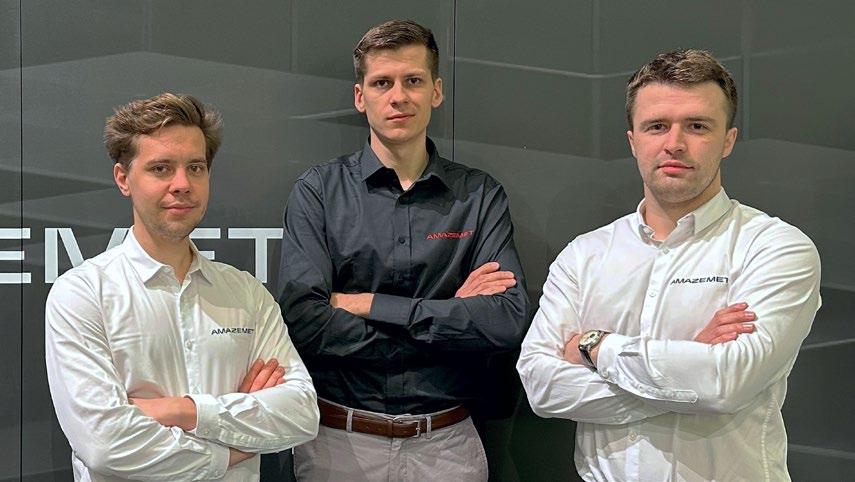
mance of AM. Novel alloys require further optimisation of processing parameters to obtain the desired microstructure and mechanical prop erties. Owing to the low availability of high-quality metallic powders with the necessary chemical compo sition for each new material, the optimisation process typically comes with prohibitive costs.
One technique for obtaining powders with novel chemical composition is in-situ alloying. However, the obtained powder may have impurities and/or low sphe ricity, which impact key powder parameters for Powder Bed Fusion (PBF) processes (e.g., reducing flowability). Moreover, in-situ alloying induces significant inho
mogeneities in the product material. Establishing new technologies for producing small quantities of highquality AM powders with tailored chemical compositions will accel erate the development of new materials for use in ever-evolving AM technologies. One such technology – with demonstrated industrial appli cability – is ultrasonic atomisation.
AMAZEMET (founded in 2019) is a spin-out from Warsaw Univer sity of Technology, Poland, that has successfully transferred ultrasonic atomisation, along with exper tise in automated support removal, into state-of-the-art devices that are part of its portfolio. The focus of the company is to provide labo ratory-scale units for the in-house manufacturing of powders with a tailored chemical composition that is suitable for various applications, including Additive Manufacturing.
The company also develops post-processing solutions such as affordable high-vacuum laboratory furnaces and devices for auto mated support removal and surface finishing. In line with the company’s origins and the seven PhD students on its board, AMAZEMET maintains
a strong connection with academic researchers by participating in collaborative research activities focused on developing new materials for AM, and partnering in projects, such as EIC Pathfinder, M-ERA.net, Horizon 2020 and ESA.
The ultrasonic atomisation process was first described in 1927, with the earliest implemen tation of this method for producing metal powders reported in 1964 by Stamm, et al. This team studied the atomisation of metals with melting points up to 700°C using vibra tional frequencies as high as 0.8 MHz. However, fatigue strength issues with the sonotrode material ((the active vibrating part) greatly limited the use of this method in favour of plasma or gas atomisation. The most used methods for metal powder production use plasma or high-velocity gas (i.e., gas atomisa tion), which can generate high-purity spherical powders of appropriate sizes, but require large amounts of material and specialised facilities.
In an industrial setting that enables high-volume production, this is an advantage; however, modern unit manufacturing processes dedi cated to specific implementations or prototyping and material devel opment with AM technology require much smaller quantities of powder.
In this area, ultrasonic atomisa tion has significant advantages over
other methods for manufacturing alloy powders: (i) it enables small batches of materials, (ii) it requires typical laboratory conditions, and (iii) it allows rapid validation of the chemical composition and phase structure of newly designed alloys with specific performance properties.
The ability to control particle size distribution based on ultrasonic frequency renders the manufactured powders adaptable to most addi tive technologies, including Directed Energy Deposition (DED), Electron Beam Powder Bed Fusion (PBF-EB), and Laser Beam Powder Bed Fusion (PBF-LB). As a result, ultrasonic atomisation is suitable for designing and manufacturing a wide range of alloys and composite powders for use in AM technology.

Principles governing ultrasonic atomisation of molten metals
Ultrasonic atomisation is a liquidto-solid process, but, in contrast to the gas atomisation techniques that rely on high-velocity gas, ultra sonic vibrations are used to create the powders. In this approach, the velocity of sprayed particles is much lower than in a gas-driven process, meaning ultrasonic atomisers are much smaller and do not require the construction of large atomisation towers. An illustration of the ultra sonic atomisation principle is shown in Fig. 2.
The main principle of ultrasonic atomisation is based on amplitude and surface wettability. When the threshold vibration amplitude in the liquid layer wetted to the sonotrode is exceeded, standing capillary waves are generated (Lierke, et al., 1967). Further increasing the amplitude breaks the intermolecular forces of the liquid, thus forming small drop lets that are then ejected from the melt. This phenomenon occurs within the thin film of liquid spread on the surface of the sonotrode.
In the case of thicker films of liquid material, there is an additional cavitation effect, where collapsing voids eject material from the surface of the liquid. The size of the particles produced depends primarily on the
frequency, but also on the physical properties of the liquid material. In 1962, Lang expanded upon Rayleigh’s equation reported in 1945 to more accurately predict the droplet size ejected from standing capillary waves using the equation:
���������������� =0.34 �8���������������� ����������������2 �1/3 (1)
where D p is the droplet size (µm), σ is the surface tension (N/m), ρ is the liquid density (kg/m 3), and f is the frequency (kHz).
���������������� =0.34 �8���������������� ����������������2 �1/3 (1)
Peskin, et al. (1963) continued researching this topic and noticed that the vibrational amplitude and thickness of the liquid layer also influenced the droplet sizes. An equation to predict the droplet size was proposed later (Rajan, et al., 2001), with the incorporation of additional factors – including liquid viscosity, liquid flow rate, and ampli tude of ultrasonics – as shown in:
���������������� = � ���������������� ����������������2�1/3 [1+ ��������(����������������)0 22 (����������)0 166 (���������������� )−0 0277 ] (2)
���������������� = � ���������������� ����������������2�1/3 [1+ ��������(����������������)0 22 (����������)0 166 (���������������� )−0 0277 ] (2)
where We is the Weber number, which is modified to include the effects of the flow rate and ultra sonic frequency; Oh is the Ohnesorge number, which reflects the effect of viscosity; and I N is the intensity number, which includes the effect of energy intensity.
Ultrasonic atomisation at an industrial scale (i.e., > 50 kg/day) is still poorly developed because the effects of process parame ters on performance have not been elucidated. Additionally, extreme conditions are present during the process, including contact with liquid metal (especially for medium- and high-melting point metals and reac tive materials) and gigacycle fatigue at elevated temperatures.
Unlike conventional gas atomi sation, the narrow particle size distribution (PSD) of ultrasonic atomisation allows the use of up to 80% of the manufactured powder in the desired process. The ultra sonic frequency and amplitude are
the main factors influencing the PSD of the obtained powder. Considering these relationships, the following conditions have been established:
• 20 kHz is most suitable for PBF-EB and Directed Energy Deposition (DED). The PSD of powders manufactured using this frequency has a d50 of 60–100 µm, depending on the atomised material 40 kHz is most suitable for PBF-LB. The PSD of powders manufactured using this frequency has a d50 of 45–60 µm, depending on the atomised material
• 60 kHz is most suitable for Binder Jetting (BJT) and PBF-LB (giving a narrower PSD than 40 kHz). The PSD of powders manu factured using this frequency had a d50 of 32–38 µm for silver alloys (AMAZEMET)
Ultrasonic atomisation can accelerate the development of new materials. Facile implemen tation due to the small size of the required processing chambers allows many research teams to work with a single device. Thus, different teams working with distinct technologies and materials can easily switch from manufac turing powders for PBF-LB to DED or PBF-EB, or even incorporate thermal spraying steps for coating technologies.
Depending on the material processed, it is either melted in a crucible and poured into the vibrating element (i.e., induc tion melting) or melted directly at the sonotrode (i.e., arc or plasma melting) (Fig. 3). The lack of pres surised gas allows for system miniaturisation, which makes the
distribution
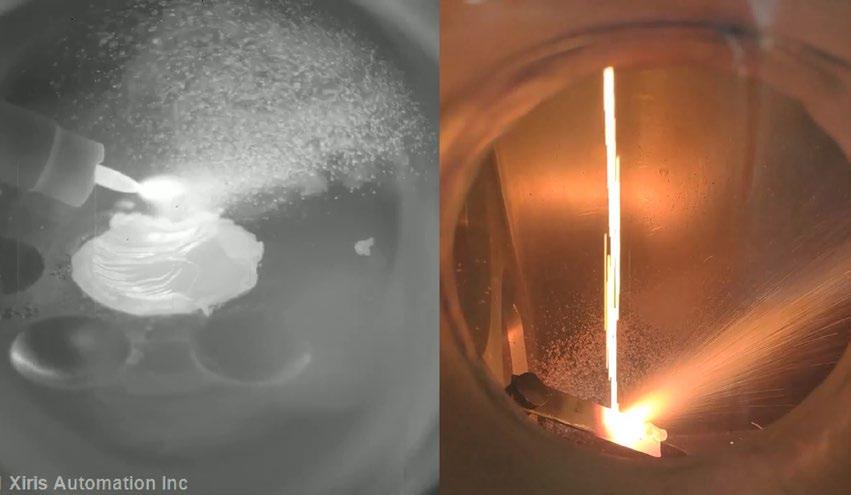
“Unlike conventional gas atomisation, the narrow particle size
(PSD) of ultrasonic atomisation allows the use of up to 80% of the manufactured powder in the desired process.”Fig. 3 Metal ultrasonic atomisation with different types of melting
process easier, faster, inexpensive, and energy efficient. As a result, new materials can be developed for various manufacturing processes that require powder material as a feedstock. The induction method is preferred for volatile materials because it prevents the evapora tion of such elements (e.g., Zn-, Al-, Cu-base alloys). In contrast, the plasma melting approach is designed for materials with medium to high melting temperatures (e.g., Fe-, Ti, Nb, W-base alloys).
Ultrasonic atomisation with arc or plasma melting
This type of atomisation can be carried out under an inert gas or reactive gas atmosphere using an electric arc (TIG generator, shown in Fig. 4) or focused plasma. This type of system is suitable for working with medium- and high-melting point materials, from Fe-based alloys through Ti-, Ni-, Pt-, and Ir-base

alloys, up to refractory materials, such as W, Ta, V, Mo, Nb, and Re, including high-entropy alloys and metal matrix composite powders. During the process, the material is fed and melted directly on the top of the sonotrode and then heated in a molten state using an arc to wet the sonotrode surface.

A key aspect of this process is the adaptation of the appropriate sonotrode material to the work piece to increase the wettability to the substrate; this facilitates the transfer of the mechanical wave to the workpiece and minimises foreign contamination.
Ultrasonic atomisation with induc tion melting
The induction unit is used to process volatile materials with relatively low melting points, which tend to evapo rate in plasma (e.g., Sn, Zn, Mg, Pb, and Al alloys), and materials with high thermal capacities and conduc
tivities at temperatures up to 1300°C (e.g., precious metals like Cu, Ag, and Au alloys). In the induction-based process, shown in Fig. 5, materials with any shape and form can be placed into the crucible, including a final alloy, master alloy, or pure elements.
Alloying is carried out under constant stirring conditions, which are maintained by a pulsing induc tion generator. Melting can be performed under a vacuum or an inert gas atmosphere, and atomisa tion is conducted under an inert gas atmosphere.
As mentioned above, ultrasonic atomisation can be adopted to process almost any alloying system, from low-melting point and reactive materials to refractory high-entropy alloys and metal matrix composites.
A lightweight construction alloy (Mg-7.5Li-3Al-Zn) was atomised via ultrasonic atomisation using 40 kHz frequency and an induction melting method. The powder characterisation is presented in Fig. 6. The powder material was then further used in PBF-LB and plasma sintering processes to evaluate its process ability compared with conventionally extruded samples. The results indi cate that such materials (i.e., with low formability) can be used to manufacture parts with complex shapes.
Materials based on rare earth elements and precious metals have also attracted attention in the field of Powder Metallurgy. However, because of the prohibitive costs of these raw materials, it would be nearly impossible for researchers to use conventional gas atomisation for such alloy development; as an example, the ultrasonically atomised (with arc melting) Pt 84-Al 11-Cr 3-Ru 2 superalloy is presented in Fig. 7. In
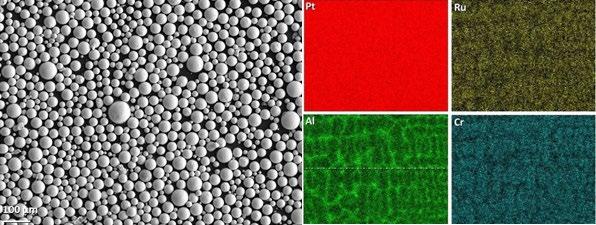
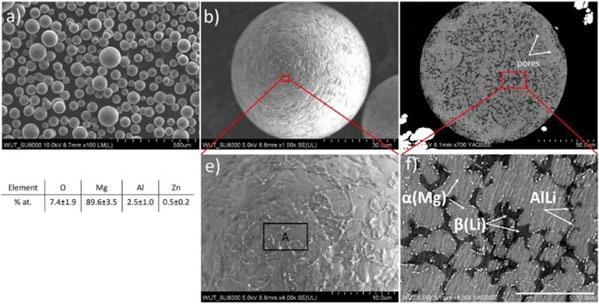
this case, the powder homogeneity and characteristics were analysed using only 10 g of feedstock material.
The compatibility of ultrasonic atomisation with both induction and plasma heat sources enables its use in the manufacture of powders with nearly all alloying systems. Thus, the technology can accelerate research regarding new materials for AM applications. The ability to produce powder from any material in any
form, even in quantities as small as a few grams, makes this technology ideal for research teams and R&D centres involved in the development of new metallic materials. Several experimental alloys that have already been processed with this technology are shown in Fig. 8.
The powder obtained using this method has high sphericity and negligible satellites, which increase the flowability of the resulting
material and enhance its feeding properties that are crucial for Addi tive Manufacturing. This leads to a very low level of contamination (e.g., from oxidation), a narrow PSD, and an overall high-quality product.
The small size of ultrasonic atomisers allows for significant freedom in terms of their design. A great example of this is the rePowder system (Fig. 9), which is an ultrasonic atomiser and alloy prototyping platform created by AMAZEMET company. This system can recycle materials, parts, failed builds, samples obtained after mechanical testing, and leftover powders, among other materials, which is highly beneficial, especially in the case of expensive materials that contain high volumes of rare earth elements.
Considering all the advantages of ultrasonic atomisation, rePowder is focused on the low-cost, ecofriendly pulverisation of metallic materials with tailored chemical
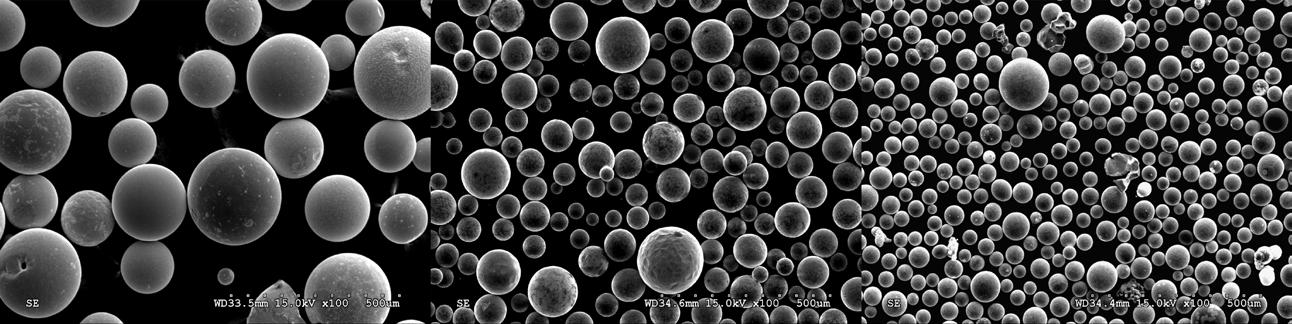
composition for the purpose of developing new materials that are suitable for AM, plasma spraying, and Powder Metallurgy. rePowder can atomise nearly any alloying system, and, owing to its narrow PSD, approximately 80% of the output material is typically suitable for the desired application. More over, the device can be equipped with both arc/plasma and induc tion melting modules.
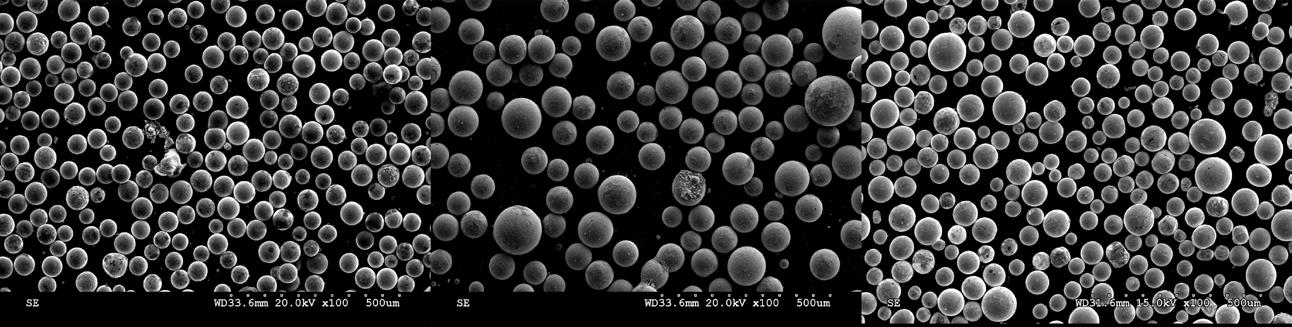
The arc/plasma melting unit itself can be equipped with 20 or 40 kHz capabilities, and a 60 kHz unit is being developed for this particular purpose. Additionally, the technology is not only designed for atomisation. The rePowder plat form can also be used for alloying, homogenising, and casting metallic materials of any composition. Thanks to its modular design and a range of developed feeders, the feedstock can be in any form (e.g., wires, rods, powders, failed builds, or production waste) to be recy cled. Working together with other metal Additive Manufacturing equipment, this device allows for a closed production loop.
rePowder is a research and development platform for the development of new materials using patented ultrasonic tech nology to create AM-grade powder. The machine is designed to alloy, cast, and atomise metallic mate rials within a single device, starting with an arbitrary material form.
The gas recirculation system enables closed loop inert gas atmosphere flow that significantly reduces the consumption of carrier gas. This unit is equipped with a set of filters to collect condensed and nanosized particles that are created during plasma processing. Before returning to the processing chamber, the gas is cooled to ensure faster cooling rates and sphericity of the powder, which solidifies before colliding with chamber walls. The integrated cleaning module uses high-pres sure gas for filter cleaning to
prolong the lifetime of each filter while maximising the collection of nano fractions from the process. Both the produced powder and nano fractions from the filter are collected in air-lock containers, which can be sealed with the inert gas atmosphere for safe handling of the material. This is especially important for materials that are prone to oxidation when in contact with atmospheric gases.
The continuous wire feeding unit helps increase productivity by auto mating the process. This device can work with wires having diameters in the range of 0.5–2.4 mm. The feeder unit is particularly beneficial for small in-house powder production of precious, and high melting point materials. This upgrade feature can be connected to the main processing chamber.
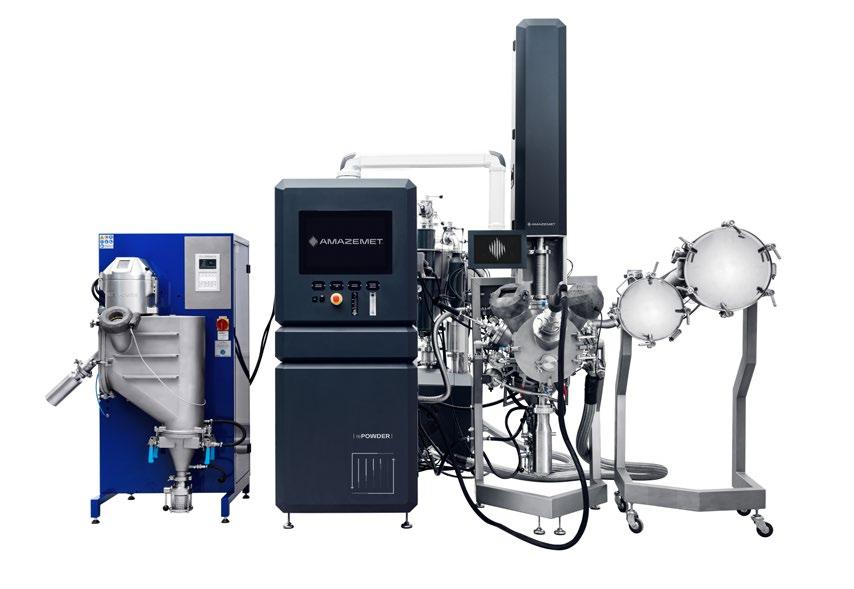
The multifrequency generator is the heart of the ultrasonic modules. The generator can function in the wide range of 17–70 kHz and makes it easy to work with several frequen cies, thereby enabling powder production with various PSDs. The system is equipped with software that facilitates the configuration and control of the process in real-time (using a chart that displays all rele vant measured values), as well as the analysis of the results.
A hygrometer is used to measure the humidity in the chamber. The sensor measurements are displayed on the HMI controller for simple operation and control of the process.
A high-accuracy oxygen level sensor is used to measure the oxygen content in the processing chamber within the range of 0-1000 ppm. Oxygen level measurements are crucial for ensuring a nonoxidising atmosphere during the process, especially when working with materials prone to oxidation at elevated temperatures.
Fig. 9 Fully equipped rePowder system
An ‘extension of the hand’ (the ‘grabber’ or manipulator) is a unique multipurpose tool that can help feed materials with irreg ular shapes or rotate samples during the arc melting process to ensure homogenisation. This tool is equipped with a vacuumtight ISO-KF connector that can be attached at various ports in the main equipment.
Ultrasonic suction casting system
Ultrasonic suction casting enables vacuum casting processes that are used to manufacture rods with diameters up to 10 mm and
lengths of up to 100 mm. Such processes can be performed with or without ultrasonic agitation, which can induce grain refine ment. The copper mould acts as a vibrating medium to transfer the vibrations to the molten material, thereby cleaving the dendrites and allowing access to additional nucleation sites.
A welding camera permits realtime observation and recording of the process being carried out in the chamber. This tool is particu larly useful in terms of optimising the process for each material.
“rePowder is focused on the low-cost, eco-friendly pulverisation of metallic materials with tailored chemical composition for the purpose of developing new materials that are suitable for AM, plasma spraying, and Powder Metallurgy.”
R&D activities are the core of AMAZEMET. The company is open for collaborations aimed at the development of new materials, AM, ultrasonic technologies, or custom devices, both as an industrial and/ or academic partner.
The company’s laboratory is equipped with three independent atomisers (including two arc/ plasma units and one induc tion unit), an AconityMIDI AM machine, a Hot Isostatic Pressing (HIP) machine, and a metallog raphy laboratory. Due to ongoing collaborations with educational institutions, the company also has access to various testing capabili ties, such as XRD, SEM with EDX, DSC, and TEM.
In addition to an AconityMIDI PBF-LB machine, the company

employs experts in the field of metal AM, especially in PBF-LB. The team is thus capable of helping companies to manufacture their desired powders and optimise the build parameters according to their needs.

The company’s highly skilled and interdisciplinary research team is experienced in the design of customised equipment, ultrasonic technology, sample prepara tion (including degassing of liquid metals), vacuum systems, elec tron beam processes, and welding techniques.
The team of materials and process engineers is eager to atomise exotic materials that are not commercially available. The compa ny’s portfolio includes materials, such as MgLi, various High Entropy Alloys (HEAs), and numerous alloys based on Zn, Al, Cu, Ag, Au, Fe, Gd, Ti, Ni, Pt, Ir, Ta, Mo, Re, and W.

AMAZEMET is open for collaborations in various EU countries and with worldwide partners. If you represent a university or commercial company and would like more information, please feel free to submit a collab oration request, or request more information about ultrasonic atomi sation and rePowder, from: Tomasz Choma tomasz.choma@amazemet.com +48 573 407 405
www.amazemet.com


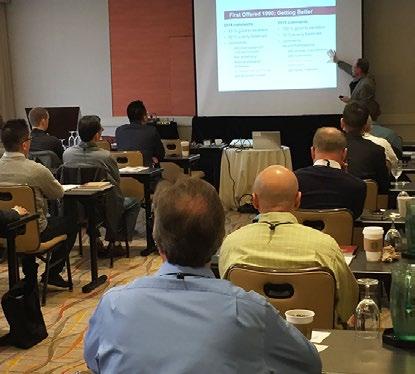
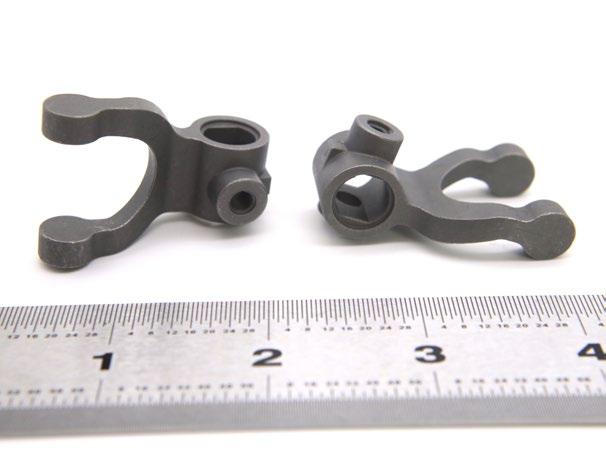

In the last sixty years, Italian press powerhouse SACMI has installed over 15,000 presses for a varied list of applications worldwide and achieved a prominent role as a go-to equipment supplier for the Powder Metallurgy industry. Its MPH line of metal powder presses is a mainstay of the PM market. Now, as PM faces challenges from vehicle electrification, the urgent need to reduce energy consumption, and the growing digitalisation of manufacturing, SACMI shares with PM Review how it continues to innovate and bring new solutions to the evolving market.
SACMI is a leading international designer, producer and marketer of manufacturing plants and industrial technology for several indus tries such as Powder Metallurgy, ceramics, beverage & packaging, food processing, and inspec tion systems. Based in Imola, Italy, SACMI has enjoyed market success for a century and is now a major enterprise in terms of size, sales, areas covered, and services provided.
Founded in 1919, the group consists of over eighty produc tion plants, distribution companies and service centres in about thirty countries worldwide. With over 4,500 employees all over the world and a turnover close to €1.54 billion, SACMI stands for innovative technologies, strong positioning on the world market, continuous quality-oriented research and outstanding customer service.
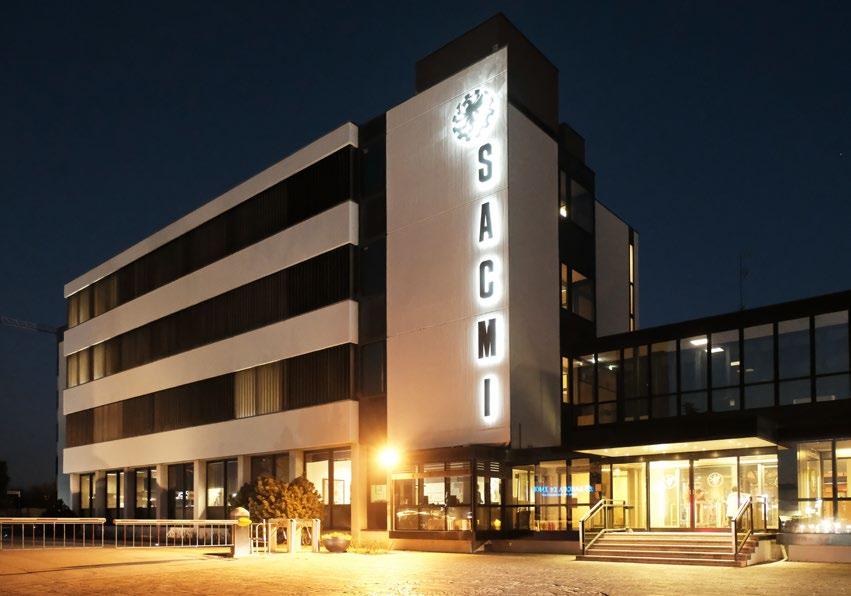
In the last sixty years, we have installed more than 15,000 presses for many different appli
cations, ranging from 10–25,000 tons of compaction force. With this background, and thanks to global support and its focus on innovation, SACMI has achieved a prominent role as an equipment supplier for the Powder Metallurgy industry. In
fact, thanks to the collaboration and trust of its customers and partners, there has been rapid development in a new range of metal powder presses – a line called MPH – which have been widely adopted by the PM market.
Productivity, flexibility, reliability and customers’ satisfaction have become the pillars of SACMI’s Powder Metallurgy solutions. By observing and responding to the needs of the PM industry, the range of products related to this sector has been expanded with further auxil iary machinery, enabling customers to purchase an integrated line from a single supplier. Until recently, the company’s core products included not only hydraulic presses, but also electrical presses, high-temperature furnaces and advanced automation solutions.
During recent years, however, the global market picture has been rapidly evolving, and this has given rise to new needs within PM processing. For example, a need to reduce energy consumption and the growing digitalisation of the industrial process are key themes, and SACMI is putting a great deal of effort into the development of products that enable companies to achieve these aims. The need to be flexible, while keeping in line with the latest developments, has become essential. SACMI is constantly stud
ying effective solutions to achieve greener, fully digitally integrated production workflows.
The automotive industry – and, consequently, PM itself – has under gone significant changes in recent years. The final products required by the industry, as well as the vehi cles they are installed in, have changed significantly, meaning PM producers now have significantly different needs than before. After observing the market carefully, the clear need to produce more compli cated and specific parts, in order to maintain PM’s standing as a key supplier technology to the auto motive industry, has led SACMI to invest in the development of new solutions to improve Powder Metal lurgy’s potential.
This effort includes the adoption of new concepts in SACMI presses to allow PM producers to compact parts in geometries that would previously have been too compli cated to produce in a PM press, and SACMI also maintains a constant presence alongside its customers to assist them with the research of new components for use in electric vehicles (EVs). This new approach is designed to meet the needs of an innovative and dynamic market.
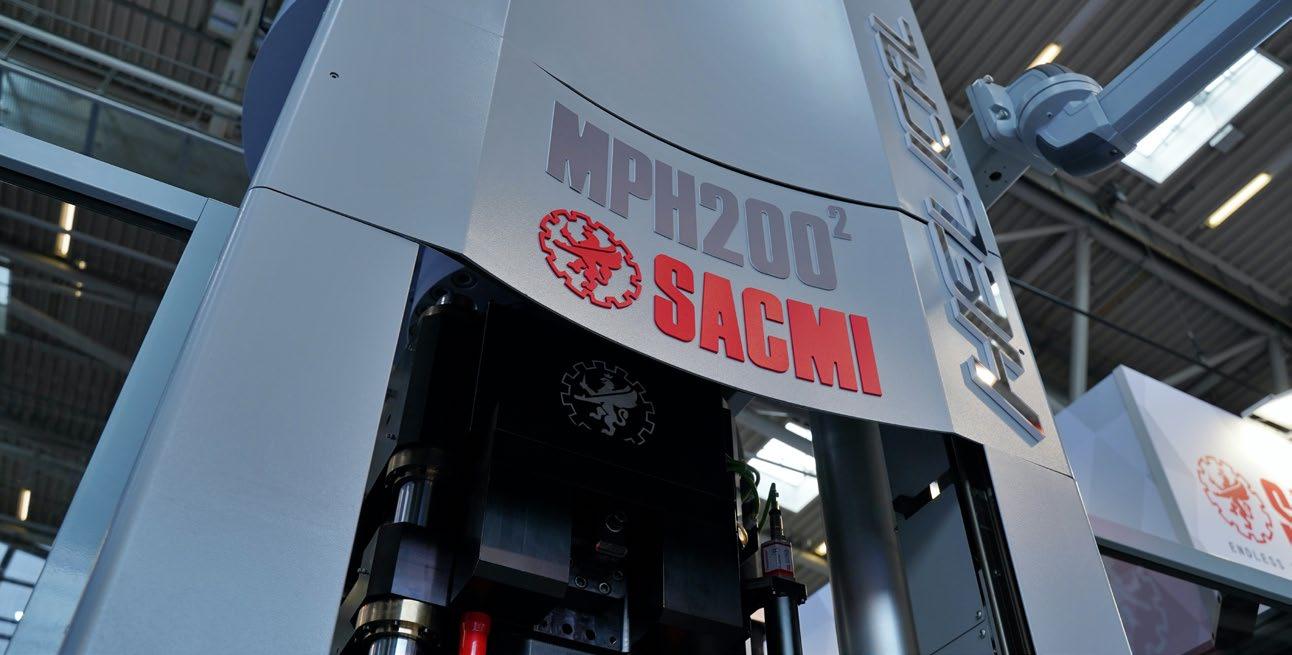
The first results of this new approach can be found in SACMI’s Helical Gear System (HGS). This system can be implemented in all MPH hydraulic presses, and permits the user to press all possible helical gear geometries in a single system, without the need for tool-to-tool systems. The system enables the compaction of components with angles of 30° or more, with achievable part densi ties of 7.5 g/cm 3
Programming of a new helical part can be undertaken easily from the control panel of the machine via the software integrated in the press; this means that, using the HGS, the tool set-up of helical parts is as simple as it is for standard parts. Only the replacement of active tool parts is required, in contrast to different systems which require time-consuming and complicated preparation. This also translates to financial savings for press users, as they will no longer require different mechanical parts dedicated to each component design to be pressed.
The HGS software is SACMI’s own, developed in house, and, therefore, is perfectly integrated
into the API, the programming soft ware available throughout the whole MPH series. The Helical Gear System is also highly flexible: in fact, the system allows for the compaction of inner and outer helical profiles using a combination of rotating movements in the upper axes, lower axes and die plate.
SACMI has designed its Helical Gear System so that, to install it, the user need not change the orig inal press movements, but can simply move up the press so that it is slightly taller than the average model, making space for the extra movements needed for HG rotation. In presses up to 250 tons and with the HG system installed, the adjusted press will still not need a pit.
Compaction can be carried out with a cold or warm die, thanks to the ability to heat or cool the die according to the final part require ments. MPH presses with the HG system installed maintain their very high production rate as well as the finest tolerances and extreme precision, without any reduction of maximum pressing force.
Helical gear tools developed for SACMI machines now have a longer lifespan than some other tools avail able on the market, because of the reduced friction possible with the new HG system compared to cylin drical tools. This further increases the economic advantages of this system.
In order to facilitate the switch from cylindrical to helical compo nents, the presses can be equipped with a semi-automatic system to exchange two adaptors in order to produce cylindrical and helical parts with a single machine.
Developed on the MPH202, the company plans to extend the system to the complete range of SACMI MPH presses, beginning with the low tonnages and moving up to the higher ones.
In this way, customers will soon have a solution that allows the production of new, geometrically complex parts, thus creating new business opportunities for press and sinter PM.
Fig. 3 A helical gear produced using SACMI’s Helical Gear System
SACMI’s new Die Wall Lubrication System offers customers the ability to produce high-density components to meet market needs, which have changed throughout the years due to factors such as the electrification of cars and the continuous demand for cost reduction.
For example, to produce hightorque transmission gears, traditional machining technology has been the preferred process to date because of the high demands of this application in terms of mechan ical properties and dimensional stability. The possibility of using Powder Metallurgy to produce these components makes it possible for PM
players to widen their product range.
To better enable the production of demanding automotive parts like these via press and sinter PM, SACMI has developed and successfully implemented the Die Wall Lubri cation system on its presses. This system allows for the production of high-strength and high-density sintered components by conven tional PM, while allowing press and sinter PM to remain competitive in all its target markets, thanks to the following advantages.
First, the same press equipped with the Die Wall Lubrication system in order to produce high-/fulldensity parts can also be used to produce standard PM parts. Second,
green density can be achieved up to 7.70 g/cm 3, and green strength over 60 MPa, a characteristic that enables mechanical processing before sintering. In addition, the necessary ejection force is reduced by up to 50%, resulting in lower wear of the tool, thanks to the lubricant being sprayed directly on the mould. The dimensional and geometrical stability of the parts during the sintering process is highly increased. Finally, the mechanical properties of the final product – such as yield strength and tensile strength – are signifi cantly higher.
SACMI is able to adapt this solu tion for its customers’ specific case studies and needs.
One MPH202 compaction press with the Die Wall Lubrication System and one with the Helical Gear System are installed at SACMI’s premises in Imola, and are available to view and trial, allowing customers to better understand the way these systems work and the possibilities they offer.
Both of these new additions to the MPH equipment line feature user-friendly API press software that lets the operator program the cycle in a quick and reliable way, without the possibility of mistakes that could damage the press. The operator has also the oppor tunity to simulate the pressing cycle in advance, in order to view and examine the axes’ movement. The operator can then fine-tune the axes’ control according to the results obtained; in this way, any defects in the pressed part can be promptly corrected. Our API soft ware also provides the option for automatic regulation of the process parameters during normal machine running, ensuring that the parts’ parameters are kept within the target range. These characteristics are core elements of the API soft ware that is supplied with all our presses in ‘Software press’ and ‘Software office’ versions.
SACMI applies its Smart Factory concept at every stage, from product development to aftersales assistance. In the aftersales sphere, an online portal called ‘SPACE’ is available for all customers. Using SPACE, advanced online services and tools help the final customers to manage and maintain their machinery for lifelong performance.
SPACE is an integrated online ecosystem designed to enable the efficient management and perfor mance optimisation of SACMI
equipment; via the portal, machine manuals are always available and up to date, and every customer may use the portal to access dedicated folders with the complete technical documentation, anywhere, anytime.
Using the manual’s tables and figures, customers can identify the right parts for maximising line effi ciency and select and order them directly via the portal. SPACE also offers a live chat support service, where customers may talk with a Sacmi technician for assistance with their machinery and/or on the compaction process. Complete access to an invoice database is also available, making administration procedures easier and helping the final user to better plan offers and orders.
Developments carried out by SACMI regarding its press and sinter PM offerings are based on customers’ real case studies and feedback. This is because we strongly believe that close collaboration with its customers is fundamental to fulfilling its desired role as a leading provider of press and compaction equipment to the Powder Metallurgy industry. We are always available to partner with customers new and old in order to develop detailed evalu ations of the customers’ needs to develop customised solutions.
Stefano Cappitelli Sales Manager
Advanced Technologies / Metals
SACMI Imola S.C.
www.sacmi.com Tel: +39 346 1764104 stefano.cappitelli@sacmi.it



The thermal properties of metal powders strongly influence the sintering, final density, and quality of PM parts. Properties such as thermal conductivity and specific heat capacity can be used for quality evaluation of PM components, simulations/ modelling, process parameter optimisation and more. Here, Dr Artem A Trofimov, Orton Ceramic Foundation, evaluates the relatively new Hot Disk Transient Plane Source (TPS) technique for measuring the thermal properties of loose powders and compressed tablets, and discusses its potential for quality control via quick differentiation between powders of different metals and/or particle sizes using thermal property calibration curves.
Powder is, naturally, a fundamental building block of the Powder Metal lurgy industry, for which it must be precisely formulated and opti mised for specific applications. Metal powder is notoriously different from its end-part equivalent, and, regard less of the nature of a material, from metal to ceramic, the parameters of powder particles directly impact each manufacturing stage. Particle size, shape, distribution, compaction, morphology; all can have a profound effect on the resulting product.
Among the material character istics that are rather sensitive to these parameters are thermal prop erties – namely, thermal conductivity and heat capacity. Both properties play a defining role in heat conduc tion, which is crucial not just for the burnout of lubricant/binder, but for the critical sintering stage (the latter directly affects the mechanical prop erties of the final part).
The thermal conductivity of a powder can be used to differen tiate between powders of the same material with different particle char acteristics, since conductivity is
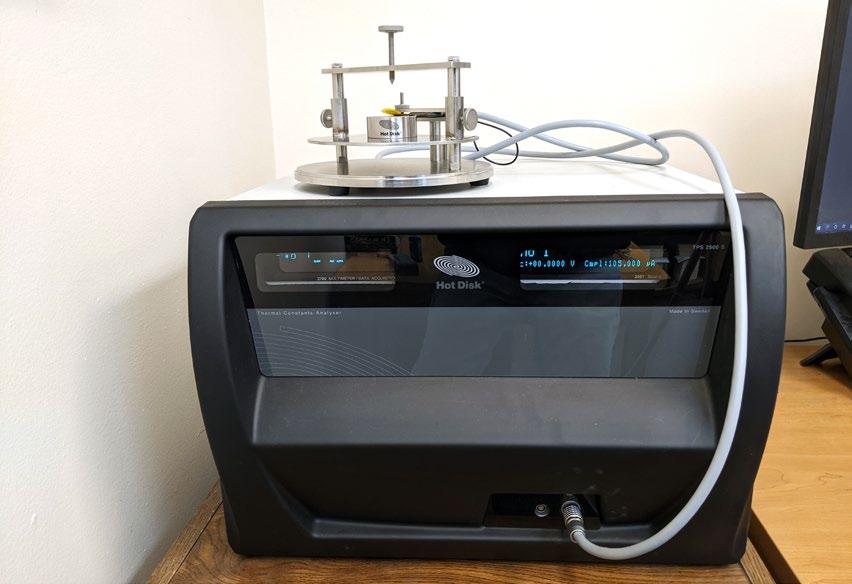
affected by the packing, particle size, efficiency of contacts, and type of gas in the voids. On the other hand, heat capacity is primarily affected by the nature of the material, and can be used to distinguish materials of different types even when the particle parame ters are similar.
In this article, we present a case study using the Hot Disk Transient Plane Source (TPS), a relatively new and rapid thermal analysis technique for measuring the thermal properties of both loose and compressed powders in green compacts.
Average particle size: 30-50 µm
Average particle size: 10-18 µm
Average particle size: 6-10 µm
Average particle size: 1-1.4 µm
Looking at the variety of the tech niques that different industries use for the measurements of thermal transport properties, it is rather interesting to note that only a limited number of instruments are available to assess the thermal conductivity of loose powders or feedstocks (powder and binder, such as those used in Metal Injection Moulding [MIM]), and an even smaller number of instru ments are suitable for measuring the thermal conductivity of both powders and solid samples (e.g., green compacts, sintered parts).
The Hot Disk TPS device (Fig. 1) was initially aimed at the eval uation of bulk solid samples, like sintered parts, but it has since been shown to be equally capable of testing both powders and solids. Moreover, one of the beauties of the Hot Disk method is that it directly measures both thermal conductivity and thermal diffusivity. As a result, you can automatically obtain a volumetric heat capacity as an additional parameter to make a judgement about the material’s quality and performance. In this investigation, we will look at the use of a Hot Disk instrument to better under stand the fundamental differences in thermal properties between
powders with different particle parameters, and discuss the potential for the technique in the quality control of such powders.
Production of a good metal powder for the PM industry is a very detailed, specialised process. Many manufacturing param eters (temperature, pressure, purity of raw materials, to name but a few) can change the prop erties of the powder particles. If the resulting powder param eters are off, the end parts will not meet the necessary specifi cations – but troubleshooting at this stage is very difficult, and it will not be immediately known at what production step things went wrong.
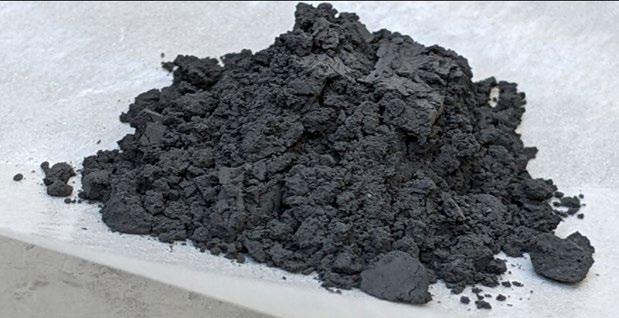
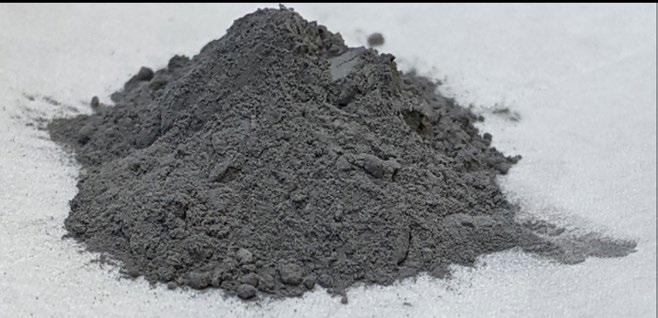
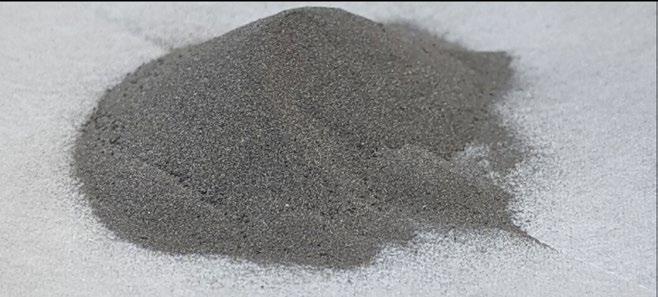
Meanwhile, changes in the powder particles will be reflected in the thermal properties, which can be checked quickly using the Hot Disk device. If the thermal conductivity or a heat capacity calibration curve is established (this only needs to be done once for the optimal powder), Hot Disk testing can be used for a rapid and easy evaluation of the supplied powder before the start of a production process.
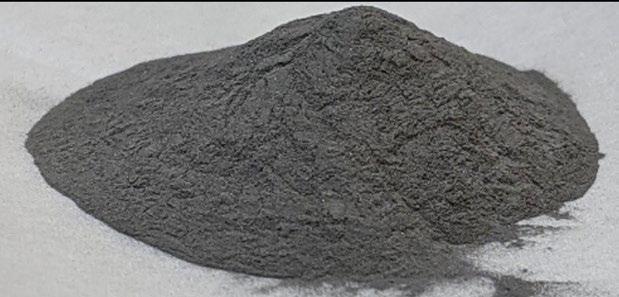
How can Hot Disk powder assessment benefit the PM industry?Fig. 2 Tungsten powders with different particle sizes
“... one of the beauties of the Hot Disk method is that it directly measures both thermal conductivity and thermal diffusivity. As a result, you can automatically obtain a volumetric heat capacity...”
Fig. Wt.% Wt.% Wt.%
Avg. size = 30-50 µm Avg. size = 6-10 µm Avg. size = 1-1.4 µm Avg. size = 10-18 µm


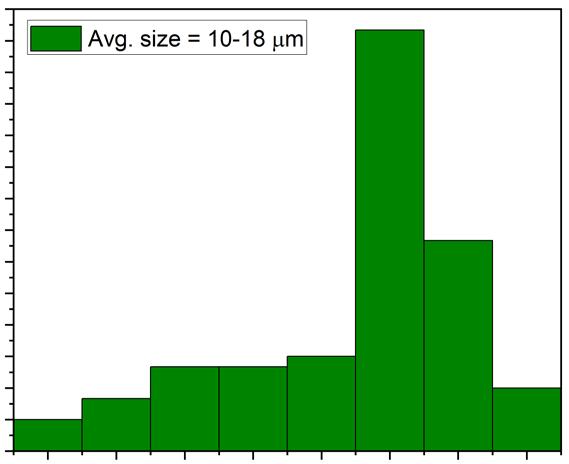
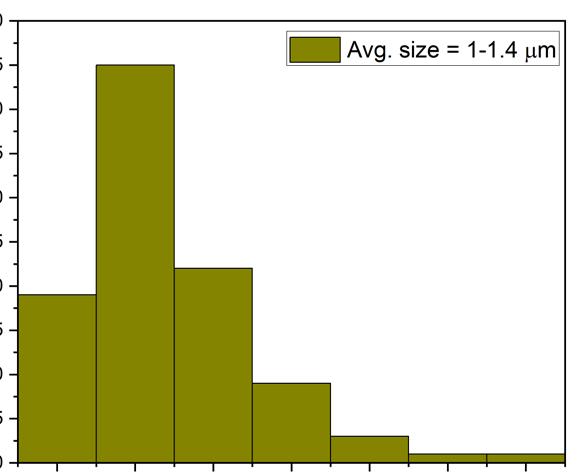
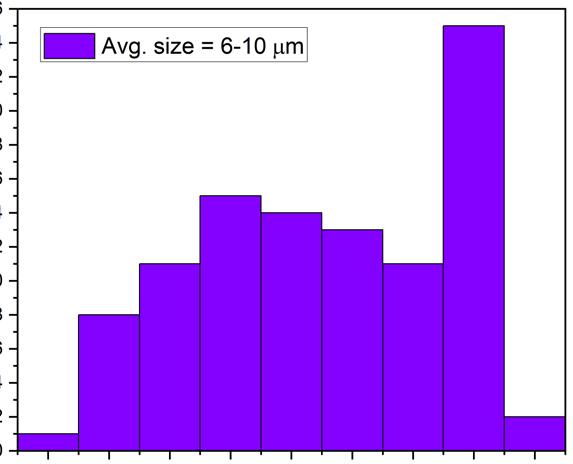
3 Particle size distribution of the investigated tungsten powders Wt.% Size range (µm) Size range (µm) Size range (µm) Size range (µm)
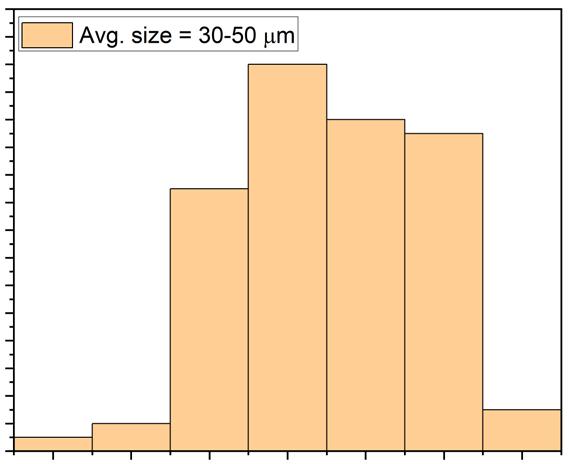
In this investigation, three mate rials were tested for their thermal properties: tungsten, 17-4PH stain less steel, and 316L stainless steel. The study compared the thermal properties between varying grades of loose powder, compressed powder, and a literature value for the fully dense material.
The tungsten powder tested was 99.99% pure (according to the supplier), and four different particle size distributions were tested. The visual appearance of the loose powders and their particle size distributions are shown in Figs. 2 and 3, respec
tively. The average particle sizes were 1.2 µm, 7.5 µm, 11.4 µm, and 38 µm. The powder with 7.5 µm average particles was also pressed into green pellets for comparison.
Two 316L steel powders were investigated, with an average particle size of 8.9 µm (D10 = 2.8 µm, D50 = 7 µm, D90 = 17.8 µm) and 4.4 µm (D10 = 2.1 µm, D50 = 4.1 µm, D90 = 7.1 µm). The two 17-4PH steel powders investigated had an average size of 9.2 µm (D10 = 2.9 µm, D50 = 7.1 µm, D90 = 18.6 µm) and 7.5 µm (D10 = 2.7 µm, D50 = 6.1 µm, D90 = 14.5 µm).
These stainless steel powders were only tested in their loose form, but the powders were selected in such a way that (i) there was one
316L and one 17-4PH powder with almost identical particle size distri bution, in order to evaluate the Hot Disk method’s ability to differen tiate between two similar materials from the same material group, and (ii) two 17-4PH powders with only a slight difference in mean particle diameter were used, in order to evaluate the method’s sensitivity to changes in the particle size.
in temperature. The recorded temperature increase as a func tion of time (transient curve) will depend on the thermal properties (thermal conductivity and thermal diffusivity) of the surrounding test material. As such, the thermal properties of the material can be deduced by fitting the experi mental transient curve to the theoretical model that describes the behaviour of a Hot Disk sensor during the experiment [1, 2]:
4
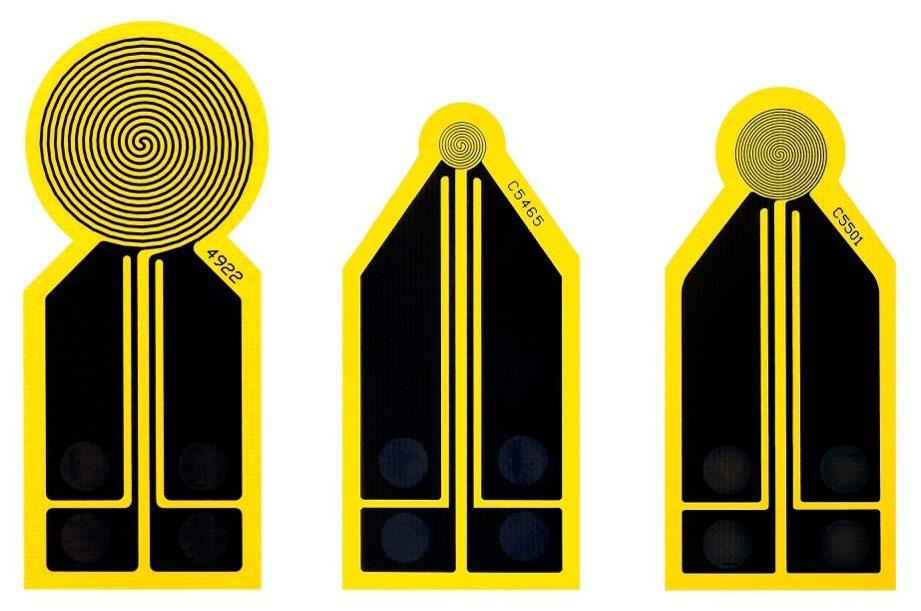
mm, 3.2 mm, and 6.4 mm; sensors with smaller and bigger radii are also available
between two thin polyimide or mica sheets for electrical insu lation (examples of Hot Disk sensors are shown in Fig. 4).
During testing, the spiral is surrounded by the tested mate rial; in the case of bulk solid samples, the double spiral is sandwiched between two pieces of the same test material, and
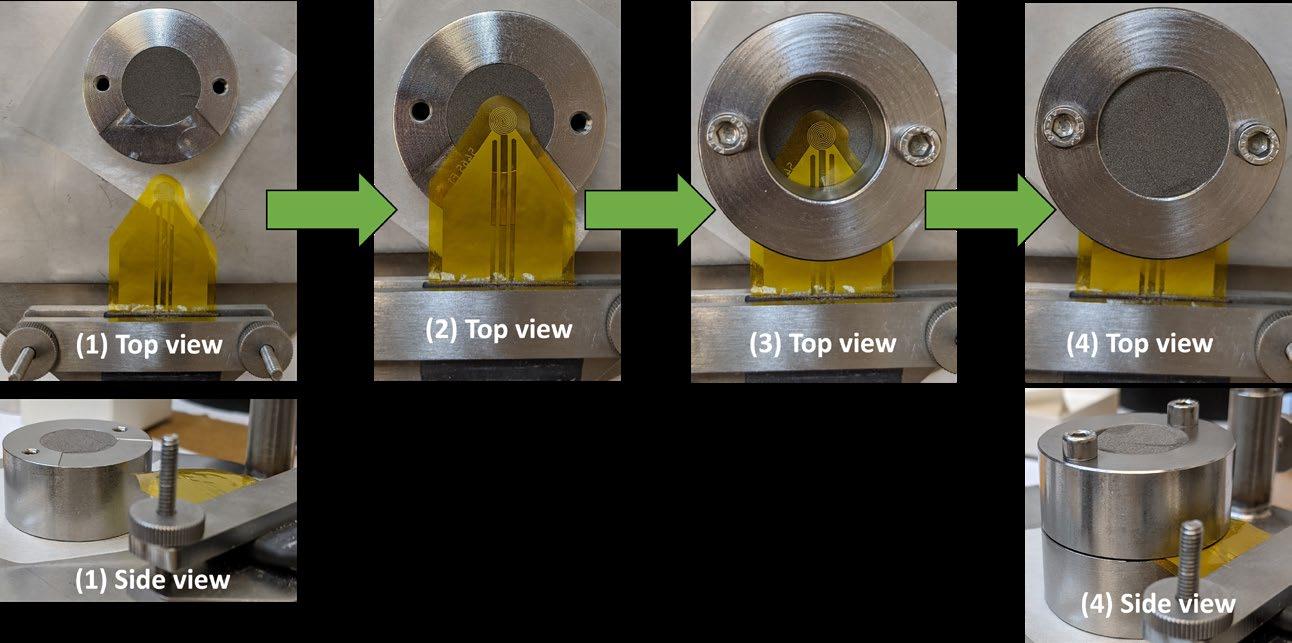
in the case of powders or liquids, the double spiral can simply be inserted/immersed into the mate rial. The Hot Disk sensor acts both as a heater and a temperature sensor.
The typical procedure is to pass a constant current – with a power P0 – through a sensor while simul taneously recording the change
= ��������0 (π3/2 ����������������)−1 ��������(��������) �������� = (��������/��������)1/2 �������� = �������� 2 /��������
where Δ T( τ) is the time-dependent temperature increase of the sensor, t is the time that has passed since the beginning of the transient recording, θ is the char acteristic time, r is the radius of the Hot Disk sensor, and k and α are the thermal conduc tivity and thermal diffusivity of the tested material, respectively. D( τ) is a dimensionless time func tion that takes into account the conducting pattern of the doublespiral sensor, made of m number of concentric rings; D( τ) is defined elsewhere [1, 2].
Once thermal conductivity, k, and thermal diffusivity, α, are known, the volumetric heat capacity, ρCp, can be immediately calculated from:
k = α ρCp, where ρ is a density and Cp is a specific heat capacity.
The thermal properties of inves tigated materials were measured by a Hot Disk Thermal Constants Analyzer, produced by Hot Disk AB, Sweden, and distributed by The Edward Orton Jr Ceramic Foundation, USA. A commercial TPS 2500S Hot Disk system was used. A Hot Disk Kapton sensor with the radius of 3.2 mm was used to test both loose powders and compressed pellets. A powder sample holder was employed to test the loose powders.
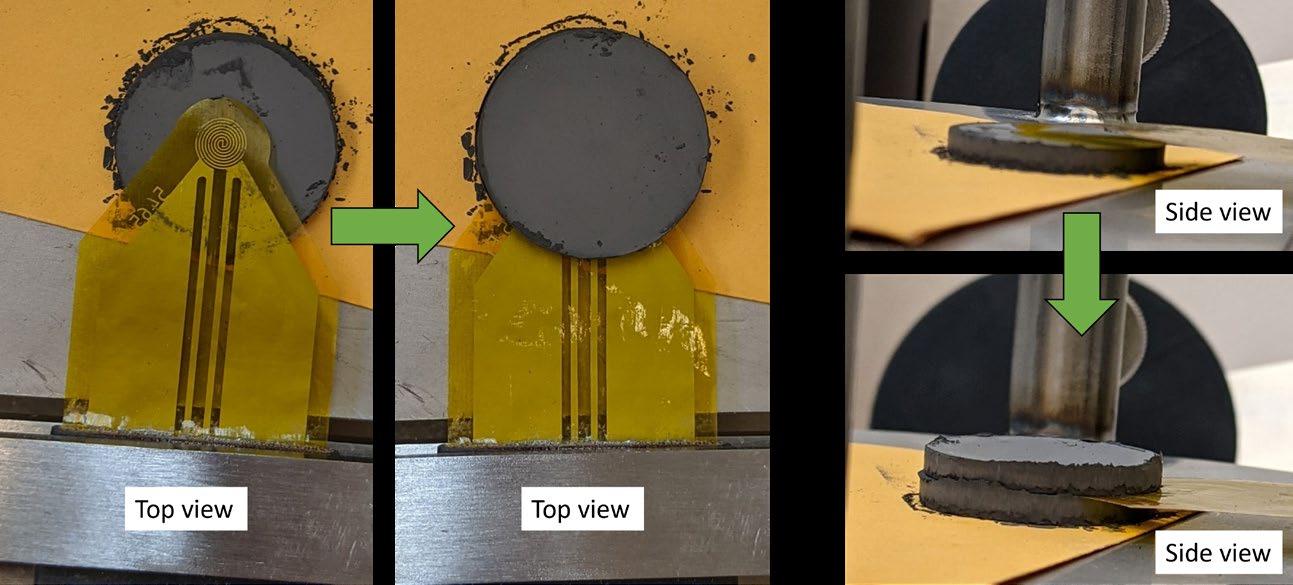
The test steps, as shown in Fig. 5, are:
1. Powder is added to the bottom compartment of the two-part hollow cylinder
2. The sensor is placed in the centre of the cylinder
3. The second hollow compart ment of the two-part cylinder is placed on top
4. Additional powder is added on the topside of the sensor. Mechanical pressure can be applied using the pistons if the testing under different pressures is of interest.
(In the case of compressed pellets, the sensor was simply sandwiched between the flat surfaces of the pellets, as shown in Fig. 6)
The initial part of the discussion on tungsten powder is focused on loose powder. This means that the apparent density variation shown in Fig. 7 comes entirely from the different particle sizes of investi gated powders. No compression or tapping was applied because the
goal was to look specifically at the influence of the particle size and its distribution. Fig. 7 (left) shows an overall increasing thermal conductivity trend as the particle size increases. The value for the bulk tungsten is ~170 W/m/K, almost three orders of magnitude higher than the loose powder; as such, it is not shown due to scale. The thermal conductivity increases with the particle diameter due to the conductive heat transfer mech anism between powder particles. Larger particles have less specific surface, which means less friction between the particles (i.e., parti cles flow easier). Thus, the powder with larger particles becomes more compact as it is poured into the sample holder, naturally (without external compression or tapping) allowing it to achieve higher apparent density, which
“No compression or tapping was applied because the goal was to look specifically at the influence of the particle size and its distribution.”Top view Top view Side view Side view Thermal properties of metal powders
Thermal properties of metal powders
Thermal conductivity (W/m/k)
translates into higher thermal conductivity.
Similar thermal conductivity values between the powder with average particle size of 7.5 µm and the one with 11.4 µm might be understood by looking at the particle size distribution in Fig. 3 (purple and green columns). The presence of a large number of particles with a diameter between 10–15 µm in the finer powder likely creates a good balance with the smaller particles, where small particles can occupy the voids between large particles. As a result, additional heat paths are created, allowing this powder to have a thermal conductivity compa
Volumetric heat capacity (MJ/m 3 /K) Specific heat capacity (J/g/K)
Volumetric heat capacity Specific heat capacity
Apparent density (g/cm 3)


Fig. 7 (Left) Thermal conductivity and (right) heat capacity of loose tungsten powder with different particle size distributions
rable to a coarser powder with an average size of 11.4 µm.
In terms of heat capacity, as shown in Fig. 7 (right), the volu metric heat capacity still shows a linear trend, which can be extrap olated to the bulk tungsten value within 6%. The specific heat capacity rapidly decreases to the value of the bulk tungsten as the particle size increases.
Loose vs compressed powders Now, we will compare the thermal conductivity of a loose coarse powder (30–50 µm particle size, and loose and compressed versions of a fine powder (6–10 µm particle size). The fine powder was compressed
Thermal conductivity (W/m/K) Specific heat capacity (J/g/K)
Apparent density (g/cm 3) Apparent density (g/cm 3) Apparent density (g/cm 3)
Fig. 8 (Left) Thermal conductivity and (right)
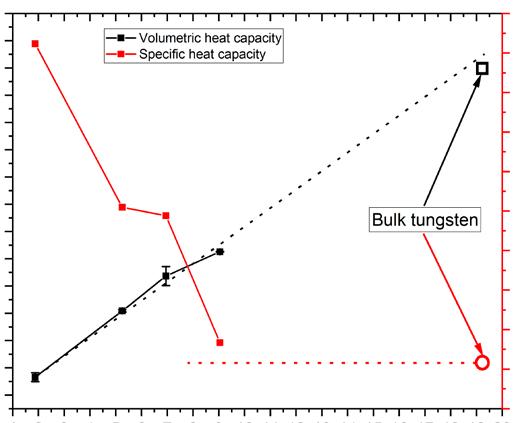
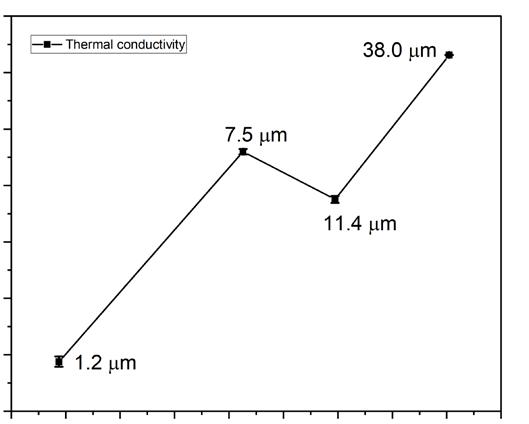
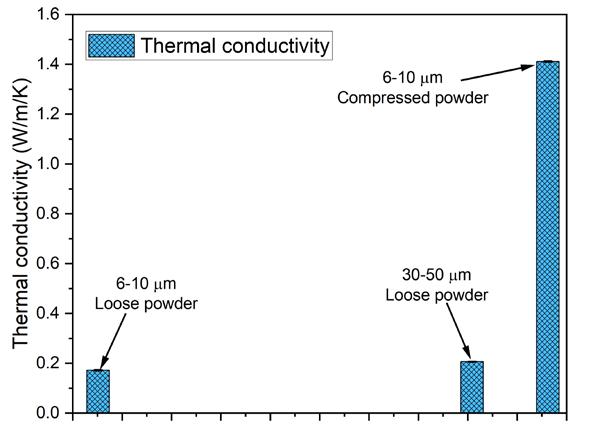
heat
into the pellets in such a way that its apparent density was similar to the apparent density of a loose coarse powder. Despite similar apparent density between the loose coarse powder and the pellets of fine powder, Fig. 8 (left) indi cates that the conductivity of the compressed fine powder is notice ably higher. This demonstrates that, while thermal conductivity is sensi tive to the change in density, density is not the only parameter that can be probed via measurements of thermal properties. Clearly, other parameters of the powder should be considered, such as particle size, particle size distribution, particle shape, etc.
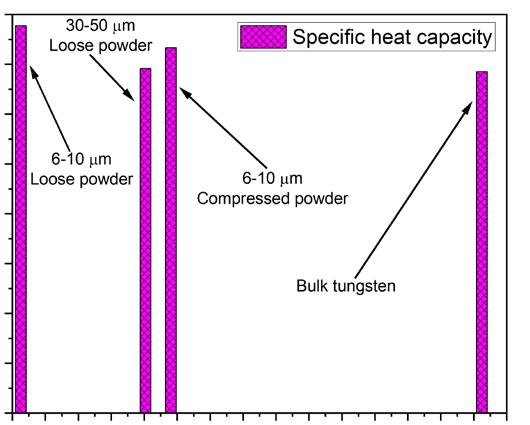
Specific heat capacity
powder
Meanwhile, Fig. 8 (right) demon strates that all the powders (regardless of the particles size and whether it is loose or compressed powder) have a specific heat capacity value similar to the one of a bulk tungsten. This emphasises that, unlike thermal conductivity (and diffusivity), a specific heat capacity is minimally affected by the powder parameters. The dominant role defining C p value is played by the nature/composition of the material, indicating the possibility one could use the C p value to check the type of a material received from a supplier, without the need for complicated and time-consuming chemical analysis.
Stainless steel
First, let us compare 17-4PH_mv = 9.2 µm and 316L_mv = 8.9 µm (‘mv’ indicates the mean diameter of the volume distribution). Both powders not only have the same average particle size, but they essentially have an identical particle size distri bution: D10 = 2.9 µm, D50 = 7.1 µm, D90 = 18.6 µm for 17-4PH_mv=9.2 µm, and D10 = 2.8 µm, D50 = 7.0 µm, D90 = 17.8 µm for 316L_mv = 8.9 µm. In other words, the only differ ence between these two powders is the material that these particles are made of. As a result, in Fig. 9 we can see a difference of about 9% in the thermal conductivity of these two powders, which actually has an excellent correlation with the differ ence in density of a bulk 17-4PH vs bulk 316L (the density of bulk 316L is about 12% higher than that of bulk 17-4PH). This is a very impor tant result because it indicates that, even if two powders have completely identical particle parameters and are made of a similar material (both 17-4PH and 316L are types of stainless steel), they can still be distinguished using Hot Disk due to fundamental differences in the composition.
Next, a comparison between 316L_mv=8.9 µm and 316L_ mv=4.4 µm in Fig. 9 indicates the same conclusion that we already discussed in the case of tung sten powder: if the powder is made
conductivity
of the same material, but it has different particle parameters, it can be distinguished using Hot Disk technique.
Fig. 9 Thermal conductivity of loose stainless steel powders of different types and with different particle size distributions. ‘mv’ indicates the mean diameter of the volume distribution and metal powders, to demon strate and understand the effect of different materials and different powder specifications on these properties, and most importantly, to demonstrate the possibility of using the thermal properties gleaned from Hot Disk testing as a quick and easy quality check of the raw powder.
The more interesting comparison is between 17-4PH_mv = 9.2 µm and 17-4PH_mv = 7.5 µm. The idea is the same: to compare two identical materials with different particle sizes; however, in this case, these two powders are a lot closer in particle size and particle size distribution than the aforemen tioned 316L steel powders. This gives us an opportunity to see the sensitivity of the Hot Disk when differentiating particle size. Fig. 9 demonstrates that a difference still can be seen between these two powders.
Powders are a central component of the Powder Metallurgy industry, but they can be notably difficult materials to handle. The quality and properties of the initial powders are essential to the resulting product. This work has focused on the inves tigation of the Hot Disk technique to test thermal properties of ceramic
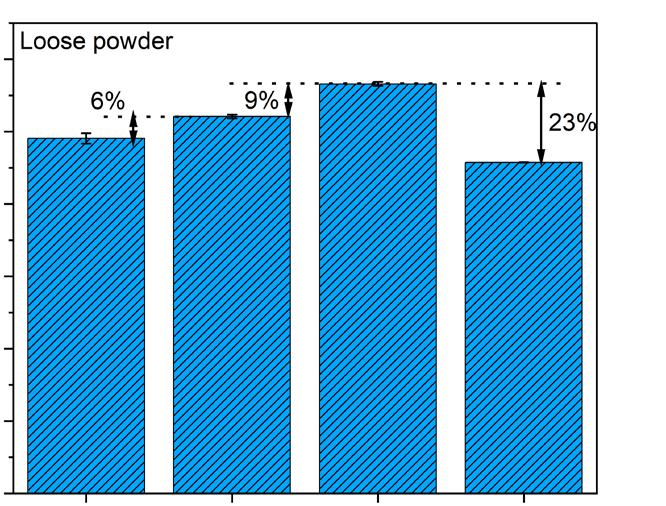
Fig. 10 shows a summary of selected thermal conductivity results discussed throughout this work, and it leads us to several important conclusions. The conclu sions are thus:
Firstly, that the Hot Disk tech nique is fully suitable for testing powders, and the experiment and sample preparation are short and straightforward. Secondly, we can deduce that thermal conductivity is sensitive to both materials’ nature (e.g., tungsten vs steel) and powder parameters (e.g., particle size). Therefore, the thermal conductivity measured with the Hot Disk technique can be used to differentiate between powders with similar parameters but made of different materials, or those made of the same/similar material but with different powder parame
Thermal conductivity (W/m/K)
ters.
If a calibration curve of thermal conductivity as a func tion of particle size (similar to the presented results with tungsten powder) is established, thermal conductivity can also be used to check whether the powder has the correct particle size before starting a production process, instead of discovering a potential issue in the middle – or even at the end – of the production cycle. Similar calibration curves can be made for the thermal conductivity as a function of various other parameters (in the case of both powders and solids). Since such curves need to be established only once, this opens the potential of the Hot Disk as a convenient tool for quality checks.
The nature or composition of a powder material (as opposed to the particle parameters) plays a dominant role in its specific heat capacity. Therefore, the C p substan tially complements the thermal conductivity when several powders are compared. It is possible to have a situation where two completely different powders have similar thermal conductivity (compare W_1.2 µm and 316L_4.4 µm in Fig. 10). However, since Hot Disk
measurements also provide thermal diffusivity and heat capacity, the specific heat capacity will clearly indicate the difference between two dissimilar materials ( C p of W_1.2 µm was measured to be ca. 175 J/kg/K (Fig. 7), while C p of 316L_4.4 µm was ca. 540 J/ kg/K (not shown)).
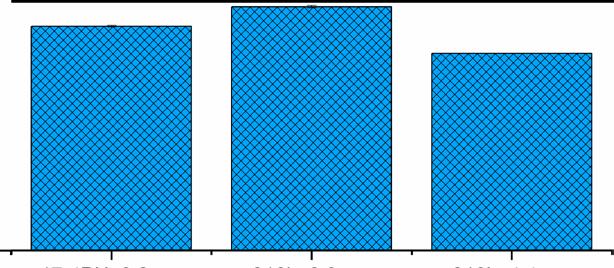
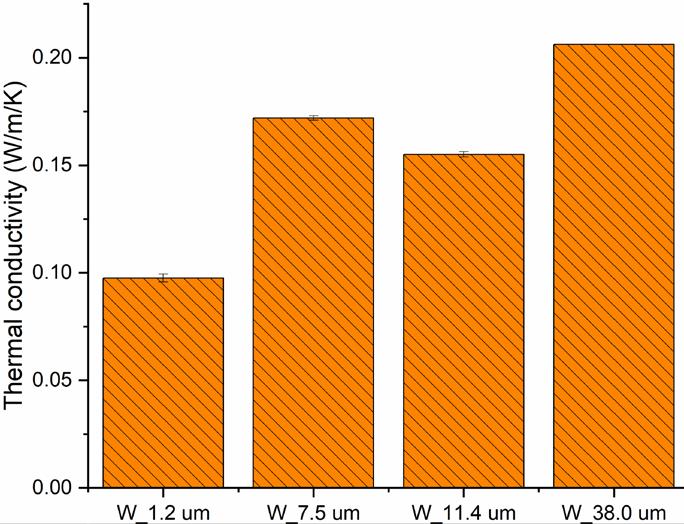
This investigation has demon strated that the Hot Disk device is sensitive and can clearly distin guish between different powders. Combining our understanding of the relationship between the thermal properties and powder parameters with the easy and rapid Hot Disk characterisation, we envision that the Hot Disk tool could greatly benefit Powder Metallurgy in the future.
Artem A Trofimov, PhD Material Scientist and Product Specialist
Orton Ceramic Foundation Westerville, Ohio, USA
trofimov@ortonceramic.com
www.ortonceramic.com
The author would like to thank Mike Stucky from Northwood Medical, Tyler Showalter from Buffalo Tungsten Inc, and Ron Peterson from Ryer Inc for generously providing the metal powders for this investigation.
[1] S E Gustafsson, ‘Transient plane source techniques for thermal conductivity and thermal diffusivity measurements of solid materials,’ Review of Scientific Instruments, vol. 62, no. 3, pp. 797-804, 1991, doi: 10.1063/1.1142087
[2] Y He, ‘Rapid thermal conduc tivity measurement with a hot disk sensor: Part 1. Theoretical consid erations,’ Thermochimica Acta, vol. 436, no. 1, pp. 122-129, 2005/10/01/ 2005, doi: https://doi.org/10.1016/j. tca.2005.06.026


Cutting tools for metal processing applications represent one of the primary markets for the Powder Metallurgy industry. Here, PM technology makes it possible to produce cutting tools with complex geometries to near-net shape, a feat not possible using conventional manufacturing methods. Despite the basic technologies of metalcutting tools having existed for several decades, tool manufacturers continue to introduce new products which can provide substantial benefits. In this article, Bernard North, North Technical Management, LLC, overviews developments in materials, design and software that are driving innovation in this important sector of PM.

A technical session at the 2022 World PM Congress, organised by the European Powder Metallurgy Association (EPMA) and held in Lyon, France, October 9-13, 2022, addressed the use of Field Assisted Sintering technology (FAST) for the processing of a range of advanced materials. FAST or Spark Plasma Sintering (SPS) uses a direct current to directly heat the green part through Joule heating, allowing high heating rates and low processing cycle times, thus offering the possibility to manufacture materials with novel and advanced characteristics. In this article, Dr David Whittaker reviews the four papers presented on the topic at World PM.

Field Assisted Sintering Technique/Spark Plasma Sintering (FAST/SPS) of self-passivating tungsten alloys for future fusion power plants
The session on Field Assisted Sintering technology (FAST) at World PM2022 opened with a report by Martin Bram, Christian Linsmeier, Jan Coenen and Andrey Litnovsky (Forschungszetrum Juelich GmbH, Germany) and Jesus Gonzalez-Julian (RWTH Aachen University, Germany) on a study related to the processing of self-passivating tungsten alloys for future nuclear fusion power plants. [1]
Plasma-facing materials for the first wall of fusion reactors have to withstand extreme conditions. On the one hand, during regular operation, they must show an acceptable longterm performance in contact with the plasma at temperatures in the range of 570 – 650°C. Plasma exposure is coupled with extremely high ion flux,
neutron radiation and heat loads. On the other hand, in the case of a loss-of-coolant accident (LOCA), the first wall material has to withstand a temperature increase beyond 1000°C, perhaps for several weeks.
This increase is caused by the release of nuclear decay heat of tungsten activated by neutron radia
tion during operation. In a worst case scenario, this temperature increase can be accompanied by failure of the vacuum chamber, coupled with air ingress leading to severe oxidising conditions. Pure tungsten is the preferred material for plasma-facing applications, but it rapidly fails in the case of a LOCA, due to formation and
sublimation of a volatile, non-protec tive WO 3 scale, releasing radioactive substances.
To overcome this inherent risk, the concept of self-passivating tung sten alloys has emerged as the best compromise for combining reliable plasma performance and suppressed oxidation in the case of a LOCA. This class of materials has been named self-passivating metal alloys with reduced thermo-oxidation (SMART). Similar to the concept of self-passi vating superalloys, tungsten-based SMART alloys have been devel oped, which contain chromium as the passivating element and silicon, tita nium, zirconium or yttrium as active elements.
During regular plasma operation of SMART alloys, the lighter alloying elements are preferentially sputtered by plasma ions, leaving an nm-scaled pure tungsten layer on the surface, which acts as a shield against progressive sputtering of the lighter elements. In the case of a LOCA with air ingress, the thin tungsten layer immediately sublimates enabling the underlying bulk material to passivate by formation of chromia scale. Fundamental studies have shown that W-Cr-Y alloys outper form W-Cr-Ti and W-Cr-Si alloys. At the current stage of development, the alloy composition W-11.6Cr-0.6Y (wt.%) has shown the best property profile and was therefore the focus of the presented study.
To ensure long-term stability under operation conditions and suffi cient oxidation resistance in the case of an accident, there is a need to manufacture bulk materials with a thickness of several millimetres.
Due to the expected inhomoge neous heat loads in fusion power plants, it is foreseen that the first wall armour should be split into a number of smaller-scale segments with lateral dimensions in the range of 50 x 50 mm 2 to 100 x 100 mm 2. Due to the high melting point of tungsten, SMART bulk materials are preferably made by powder metallurgy starting from elemental powder blends.
Mechanical alloying is usually applied for homogeneous mixing of the alloying elements down to the atomic level. Due to the limited sintering activity of tungsten-based alloys, pressure-assisted sintering technologies, such as hot isostatic pressing (HIP) or field assisted sintering technology/spark plasma sintering (FAST/SPS), are the most promising for manufacturing SMART alloys. FAST/SPS is exceptionally adept at tuning the microstructure while maintaining submicron grain sizes.
In the presented work, the main requirements for manufacturing W-11.6Cr-0.6Y parts via FAST/ SPS with well-defined microstruc tures were summarised. The main processing steps, i.e. mechanical alloying and FAST/SPS consolida tion, were introduced and possible ways for scaling up the technology to industrial scale were discussed. To demonstrate the application poten tial of SMART bulk materials, plasma performance and oxidation resist ance were investigated.
For the studies of mechanical alloying (MA), elemental W, Cr and Y powders were used as starting materials. Powders were balanced to achieve the desired W-11.6Cr-
0.6Y (wt.%) composition. Systematic MA studies were conducted on a lab scale planetary ball mill equipped with a 250 ml tungsten carbide milling jar. The rotation ratio of this mill was 1:-2. In this ratio, the first number is the normalised rotation speed of the base plate of the plan etary system. The second number is the normalised rotation speed of the milling jar with respect to the base plate. The powders were poured in the jar and tungsten carbide balls with a diameter of 10 mm were added. The ball-to-powder ratio (BPR) was 5:1. After filling of the jar, a free volume of 192 ml remained. The jar was then closed, evacuated and filled with argon to protect the powder from severe oxidation. MA was conducted at room temperature for up to 60 h with a constant rota tion speed of 250 rpm.
At regular intervals, powder samples were taken to determine the degree of MA by X-ray diffrac tion (XRD). Complete alloying was attained as indicated by complete disappearance of W and Cr peaks in the XRD spectra. In addition, homo geneous distribution of alloying elements was confirmed by FIB (focussed ion beam) cross sections of selected powder particles analysed by SEM and EDX.
In more recent work, the ball mill was replaced by an alternative planetary ball mill, which enabled a higher energy transfer to the powder due to higher rotational speed of the jar with respect to the base plate (Ratio 1:-3). In this recent work, the BPR ratio was varied, the free volume in the jar was reduced by increasing the amount of powder and the ball diameter was varied between 5 and 10 mm. Complete alloying was already achieved after 30 h, when the free volume in the jar was decreased to 172 ml by increasing the amount of powder from 110 to 156 g. In this trial, the BPR ratio of 5:1 was kept constant.
In a further step, MA was trans ferred to an industrial scale by the help of an industrial partner There fore, the results of the fundamental MA studies were carefully analysed
“To ensure long-term stability under operation conditions and sufficient oxidation resistance in the case of an accident, there is a need to manufacture bulk materials with a thickness of several millimetres.”
and served as the basis for the parameter selection for operating the industrial mill. In this type of mill, energy is mainly transferred by collisions of the milling balls. In contrast, energy transfer in the planetary ball mill is characterised by a combination of collision and friction to a smaller energy transfer when compared to the industrial device.
In the first experimental series, the inner wall of the industrial mill was lined with stainless steel. 4 kg W powder and 0.5 kg Cr were balanced and poured in the milling chamber. Then 10 mm steel balls were added using a BPR of 5:1. Milling was then conducted for up to 21.5 h and samples were taken after 0.5, 1.5, 6.5, 9.5, 12.5, 18.5, and 21.5 h. XRD analysis revealed complete alloying after 18.5 h, but contamination of the MA powder with about 2 wt.% Fe was found.
To decrease the amount of powder contamination, yttria-stabilised zirconia will be used for lining of the mixing chamber and milling balls in future trials.
Optimisation of FAST/SPS param eters for the consolidation of the mechanically alloyed W-11.6Cr0.6Y powder was carried out on a lab scale device with a maximum heating power of 35 kW. In this device, heat is generated by a pulsed DC current. The tool was made of graphite and consisted of two punches with a diameter of 20 mm and an adapted die.
To avoid direct contact between tool and powder and to improve electrical contact and heat transfer, a graphite foil with a thickness of around 0.35 mm was placed on the die wall and the punch faces. W-11.6Cr-0.6Y powder was poured in the die and a constant load of 50 MPa was applied and this was retained until the end of the sintering cycle. A systematic sintering study was conducted by varying the main FAST/SPS param eters i) heating rate, ii) maximum temperature, and iii) dwell time at maximum temperature, as summa rised in Table 1. For all FAST/SPS
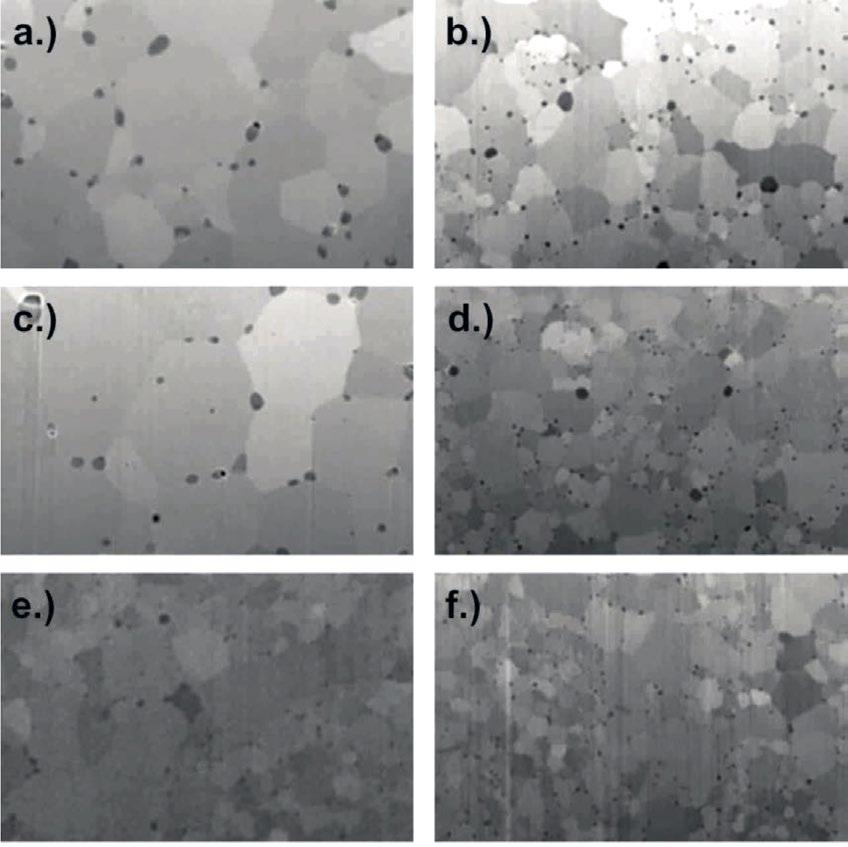
Sample code Heating rate [°C/min] Maximum temperature [°C] Holding time [min]
FAST 1 200 1550 1
FAST 2 100 1550 1
FAST 3 100 1460 1
FAST 4 200 1460 1
FAST 5 200 1460 0.5
FAST 6 200 1460 0
Table 1 Parameters used for the optimisation of the FAST/SPS process in the lab scale HP-D5 device. In all cases, the pressure was 50 MPa
parameter sets, relative densities of all samples were above 98%.
W-11.6Cr-0.6Y samples made by FAST/SPS using the six parameter sets given in Table 1 were cut into small pieces using a diamond saw. After metallographic preparation, all samples were characterised with regard to their elemental compo sition, homogeneity and grain size
using a combined SEM-FIB system, equipped with energy dispersive x-ray analysis system (EDX) and electron backscattering diffraction (EBSD).
Fig. 2 shows the microstruc tures of the W-11.6Cr-0.6Y samples manufactured by the six parameter sets given in Table 1. It becomes clear that an increase of the heating
rate combined with a decrease of sintering temperature and omission of a dwell time at this tempera ture enables the achievement of almost fully dense microstructures with grain size below 200 nm and homogeneous distribution of fine yttria phases on the grain bounda ries (Sample FAST 6). Sintering at higher temperature (1550°C) and the use of a dwell time caused grain coarsening, in some cases accompa nied by formation of inhomogeneous microstructures, as can be seen, for instance, in sample FAST 2.
Oxidation behaviour was investi gated in a thermographic analyser, which enabled the measurement of the in-situ mass change of oxida tion samples in a temperature range from room temperature up to 1700°C. Isothermal oxidation studies were carried out at 1000°C, using a dry Ar-20% O 2 (vol.%) atmosphere with a pressure of 1 bar. To determine the mass increase caused by oxida
tion, the sample was placed in an alumina crucible, which was attached to the balance by a platinum wire. Then, the mass increase was meas ured as a function of time for up to 25 h. Fig. 3 shows the mass change of selected samples depending on the exposure time, demonstrating the clearly improved oxidation resistance of SMART alloys compared to pure tungsten.
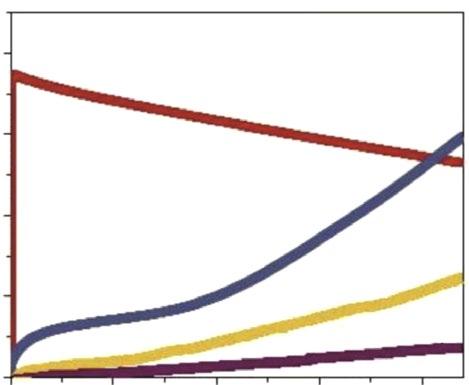
In the case of pure tungsten, breakaway oxidation occurred in less than 1 h. Generally, oxidation resist ance of SMART alloys produced by FAST/SPS is better than those from magnetron-sputtered thin films. Furthermore, a further increase of oxidation resistance is observed when the grain size of the bulk mate rial was reduced to a minimum by adapting the FAST/SPS parameters accordingly. These results make the strong influence of the microstruc ture on the oxidation resistance obvious.
These effects can be explained through a mechanism involving diffu sion of chromium required to form the chromia scale on the surface mainly at grain boundaries due to the high vacancy concentration at such sites. In the case of larger grain sizes, the amount of diffusion paths is limited and chromium diffusion becomes retarded, leading to chro mium depletion near to the chromia scale. This depletion might trigger formation of tungsten-containing, less protective oxide scales in the vicinity of the protective chromia scale.
Formation of tungsten-containing oxides is coupled with a large volume expansion, which might lead to local cracking of the chromia scale. These cracks ease oxygen access and locally faster oxidation, thus porosity forms. In a worst case scenario, occurrence of breakaway oxidation might destroy the sample rapidly. With a decrease of grain size, chromium diffusion from the bulk becomes faster and therefore suffi cient chromium supply to form the protective chromia scale is main tained longer.
To investigate the plasma perfor mance of W-11.6Cr-0.6Y and pure W samples, plasma facing surfaces of the samples were ground with diamond paper to a roughness of 20–30 nm. Samples were mounted on a multiple sample holder in the linear plasma device of Forschung szentrum Juelich and exposed to a steady-state deuterium plasma . The plasma-exposed area of all samples was 1 cm 2. Plasma parameters were evaluated applying a moveable Lang muir probe. Depending on the radial position, electron temperature varied between 6 and 8 eV. Active biasing was applied on the sample holder.
a) f)
b) g)
c) h)
d) i)
Powder size (standard deviation) 105.17 (27.95) 20.65 (31.60) 41.64 (48.36) 31.37 (51.37) 7.51 (13.56)
Aspect ratio (d1/d2) 0.35 ± 0.23 0.50 ± 0.21 0.56 ± 0.17 0.47 ± 0.16 0.92 ± 0.13
e) j)
Fig. 4 Commercial purity Mg powders, grinding time ranges 4 h (a), 8 h (b), 12 h (c), 16 h (d), 20 h (e); Grinding time and powder size relationship; Optical micrographs of samples sintered at 300°C for 15 minutes at 30 MPa pressure, grinding times range 4 h (f), 8 h (g), 12 h (h), 16 h (i), 20 h (j)
The energy of the ions impinging on the sample surface was around 220 eV.
During the measurement, the sample holder was actively heated to a temperature in the range of 620–650°C, which was controlled by a thermocouple. Ion energy and temperature used in the plasma experiments was a conservative estimation of the plasma condi tions provided in the DEMOnstration fusion power plant (DEMO). The total exposure time was 4.5 h and the accumulated flux was 1.10 22 ions. cm -2
Table 2 summarises mass loss, change of surface roughness and erosion depth of the plasma treated samples. As a first approximation, both materials performed quite simi larly, as indicated by almost identical mass loss and surface rough ness after plasma treatment. The erosion depth was almost doubled for W-11.6Cr-0.6Y, but still remained below 1 µ m. Even at this early stage of development, the results indicate a promising plasma performance for the SMART alloys, which can compete with pure tungsten.
To estimate the influence of plasma treatment on oxidation behaviour, one of W-11.6Cr-0.6Y samples from Table 2 was oxidised using the same oxidation conditions as mentioned previously and showed a slightly decreased oxidation
resistance after plasma exposure. Nevertheless, the resistance was still significantly better than in the case of pure tungsten, indicating the potential of SMART alloys as suitable materials for the first wall of fusion reactors. Even though these results are promising, the authors suggested that more detailed studies of plasma performance, amongst others with more severe conditions and longer dwell times up to several weeks, are required to finally conclude on the reliability of SMART alloys.
For application of SMART alloys in DEMOnstration (DEMO) fusion plant, larger dimensions are needed. A first approach to scaling up the FAST/ SPS technology was carried out on an industrial scale device, in which heating of the tool is conducted at constant DC. A maximum load of 555 kN, maximum heating power of 170 kW and electrode size of 180 x 180 mm 2 enabled the production of 100 x 100 mm 2 tiles by directly adapting the best parameter set from the systematic study presented earlier.
In this work, a tile with a size of 100 x 100 x 7 mm 3 was produced using parameter set FAST 6 from Table 1. Even if the same param eter set was used for sintering as for the 20 mm diameter samples, the sintered density did not exceed 70%. At present, the reason for this large difference in residual porosity

is not clear, but experimental series to further improve the densifica tion behaviour of large samples are currently underway. In addition to optimising the FAST/SPS param eters, further improvement of tool design, including suitable thermal insulation, remain open tasks.
A presentation from Şöhret Melde Aydin, Tuge Tekin, Semih Recep Ferik and Rasim Ipek (Ege University, Izmir, Turkey) discussed the FAST sintering of magnesium powders and, in particular, the relationship between powder geometry and pore ratio [2].

In the reported study, commercial purity Mg powders were ground for 4, 8, 12, 16 and 20 hours in a plan etary ball mill under a controlled argon atmosphere. 10mm diameter stainless steel balls were loaded with Mg powders at a ratio of 10:1.
To reduce the possibility of cold welding with the grinding surface and balls, a 1% zinc stearate agent was added. The grinding process was programmed with a change in grinding direction and a pause in grinding at selected intervals.
Cylindrical specimens with a diameter of 20mm were produced using graphite punches and die in a FAST device operated with alter nating current. The sintering process was carried out for 15 minutes under a pressure of 30 MPa, 300°C temperature and a vacuum or argon atmosphere. Mould surfaces were insulated, and electric current passed to the sample through the upper and lower graphite punches. Material microstructures were exam ined by optical microscopy and SEM. Brinell hardness values were meas ured and compression tests were performed to determine mechanical properties.
The effects of changing the grinding times of Mg powders on powder geometry and dimensions can be seen in Fig. 4. It was observed that the Mg powders became platelike with the engagement of the balls in the first 4 h (Fig. 4a). It can
be seen, in Fig.4b, that the powders that have been ground for 8 h remain plate-like in shape, but the plates are reduced in size. These observations indicate strain hardening and brittle ness of the material in the first 4 h of deformation, followed by the break down of the plate-like powders in the continuation of the grinding.
Micrographs (Fig. 4c–d) of powders milled for 12 and 16 h, when examined together with powder sizes and standard deviation values, suggest that plate formation and powder fracture continue randomly during milling. A striking difference in the 16 h milled powders seems to be that the crumbling and shrinking of powders overlap each other and the plate-like appearance begins to change.
The size of the 20 h milled powders (Fig. 4e) is much finer and the shapes are irregular and spher ical, suggesting that embrittlement
reaches a maximum after 16 h and the grinding minimises surface area by breaking the sharp corners of the powders. Thus, with the increase of powder grinding time, powder geometries transform from a more plate-like structure to a more spher ical structure in the 4–20 h range for which the study was performed.
Optical micrographs of the samples sintered at 300°C for 15 min under 30 MPa pressure are given in Fig. 4(f-j). The authors believed that the parts that appear layered in Fig. 4f are the places where the plate-like powders can contact each other over their large surfaces. Even if bond formation starts at the moment of contact in plate-like powders, due to the narrow crosssectional area, the powders are deformed under temperature and pressure and the bond that begins to be formed may fracture.
With the temperature and pres sure, each plate-like powder particle in the mould may be deformed or moved, changing the bond points. While this situation continues until there is no space left for the powders to move, the large surfaces of particles will be facing each other and the pore amount will be mini mised. The pores at the joints of the plate-like powders cannot be clearly distinguished in photographs. The conclusion to be drawn from this is that pores become flattened in conformity with the powders or, more likely, the pores become almost completely closed between the platelike powders.
As the grinding time progresses, the size ratios of the plate-like powders begin to decrease as the powder particles fracture. In addi tion to the increase in the number of pores, pore geometries have also reached more visible sizes. It is thought that the areas with plate-like powders are denser and the areas where the powders begin to become round are more porous. It is thought that the deformation ability of the powders whose hardness increases with the hardening during the progressive grinding period may also decrease. Therefore, it may be the
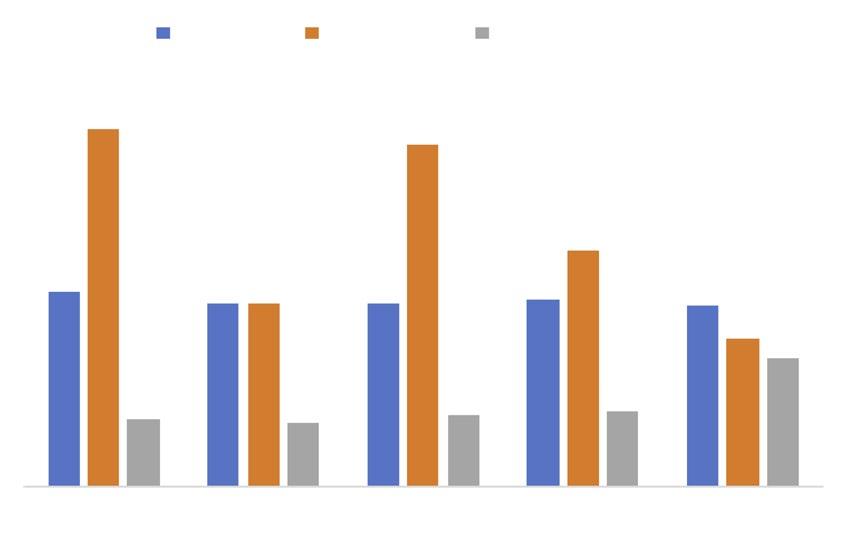
case that the pores cannot be closed with the decreased compressibility. For the samples (marked with red arrows in Fig. 4) at the milling time where the aspect ratios are fifty per cent and above, the pore shapes are seen as a result of the neck forma tion mechanism. Both the hardness of the powders (compressibility) and the geometry of the powder (neck formation) are effective in closing the pores.
Both the difference in the internal structure photograph (Fig. 4j) and the high hardness value of the mate rial with 20 h grinding time (Fig. 5) suggest that different mechanisms may have occurred in sintering. It is predicted that the strain-hardening of the Mg powders will increase as the grinding time progresses. Despite the increase in pore numbers, the increase in hardness values can be attributed to strainhardening (8–20 h). The micrograph of the 20 h milled sample shows different structures than those expected from powder size and shape.
In addition to the increase in material hardness with a long grinding time, the strain energy of the material will also increase. Due to this mechanical energy gained by the powders, the authors concluded that bond formation will occur with faster induction at the powder contact points with less current passing through the powders during sintering. It is believed that the phase that appears monochromatic and large, compared to the powder sizes, in the microstructure may be the path followed by the electric current, in which the metal-metal bond is established more effectively.
XRD analyses of the 4 h and 20 h milled powders and the samples produced by sintering from these powders, whose characteristics show the greatest difference from each other, were carried out (Fig. 6). Anal ysis of the initial powder was also included to observe the difference arising from grinding. The first point to note in the graphs is the displace ment of the two peaks showing maximum intensity at 4 h grinding,
Intensity
25
World PM2022: Field
[100] [002] [101] [102] MgO [110] [103] [200] [201] [104] [202] 30 35 40
45 50 55 60 65 70 75 2 Θ

20h MM-Sintered 4h MM-Sintered 20h MM Powder 4h MM Powder Initial Powder
Fig. 6 XRD plots of initial powder, 4h and 20h milled powders and sintered samples
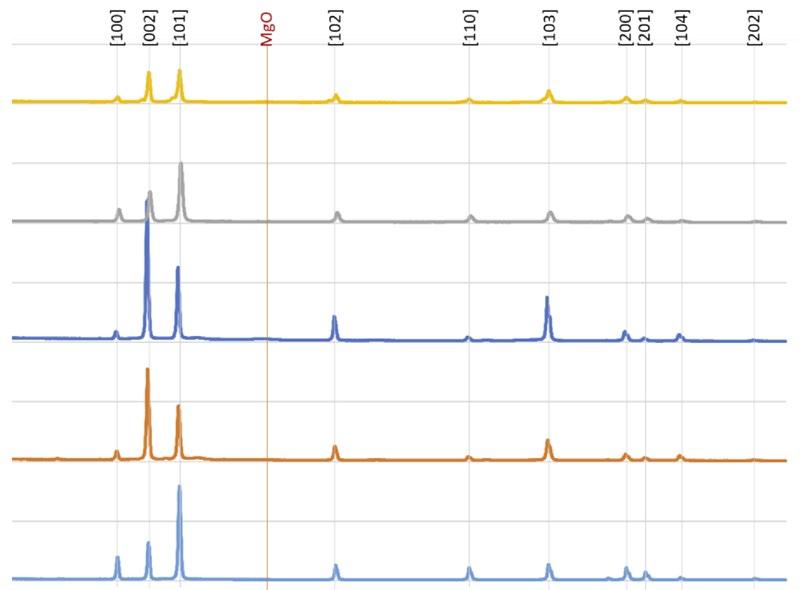
i.e. the plane with the maximum atomic density has changed from the [110] to the [002] plane. The XRD plot of the sample sintered from 4 h milled powder does not have large differences with its powder. Accordingly, it can be deduced that, with this low energy input AC-FAST process, the deformation created in the powder and the changes in the crystal lattice parameters are preserved.
High affinity for oxygen and flammability of Mg powder is a wellknown feature. The measures taken to prevent this – a controlled atmos phere during grinding, sintering and storage– are considered to have worked to an acceptable level in this study. In the XRD analyses, no MgO peaks were obtained in the library screening; the possible peak theta angle for MgO is indicated with a red line.
When the mechanical values are examined (Fig. 5), the observed higher maximum stress in plate-like powders was as expected, due to the mechanisms already discussed. The
unexpected low value of maximum stress at 8 h grinding time may have been caused by a problem due to the experimental conditions. Assuming that there is a situation that needs to be explained with more experi ments; it was decided to neglect the grinding time-strength relationship.
Next, Bernard Frederic, Bussiere Florian and Moser Mathias (Univer sity of Bourgogne, France) Boisonella Arnaud (SINTERMAT, France) and Couque Herve (Nexter Munitions, France) presented a broader-based assessment of mechanical activa tion and SPS sintering as a ‘pertinent combination’ for the production of advanced materials [3].
(a) (b)
mechanical properties. The relative lack of experimental data on mechan ical properties of nanostructured materials has been attributed to the difficulty in preparing dense parts. One of the most efficient processes, in terms of chemical homogeneity and fine grain size, is a powder metallurgy process involving the consolidation of nanostructured agglomerate powders prepared by ball milling. Such an approach has been optimised through the use of the Spark Plasma Sintering technique, allowing the manufacture of dense nanostructured materials.
Past work carried out by these groups has clearly shown the advan tages of combining a high-energy mechanical milling stage of metallic powders followed by a sintering stage of these Mechanically Activated (MA) agglomerates by SPS to obtain dense materials with a controlled microstructure.
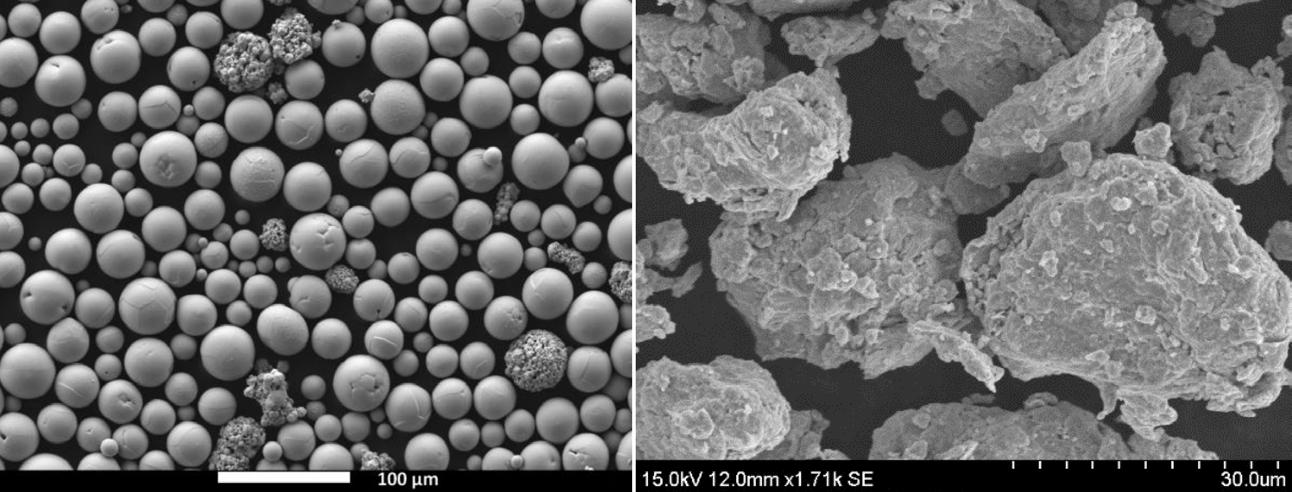
These so-called MA agglomerates allow:
• a reduction in the activation energy of the sintering for a molybdenum powder and, there fore, densification at a lower temperature avoiding the forma tion of molybdenum carbides while limiting grain growth,
• the generation of a ‘controlled’ bimodal microstructure obtained during the sintering of MA nickel
powders prepared under different milling conditions,
• the stabilisation of the marten sitic phase of a 300 ksi maraging steel powder and a reduction in sintering tempera ture, thus avoiding the solution stage usually applied for forged products.
For these three examples, the microstructures induced by a combination of a mechanical activa tion and an SPS sintering made it possible to achieve improved tensile properties, compared to the same materials produced by traditional processes.
In the presented experimental programme, metallic milled powders were prepared from commercial powders using a high-energy plan etary mill. 100C6 type steel balls (diameter = 15 mm) were mixed with 130 g of powder, to achieve a ball to powder mass ratio (BPR) of 6.5. Such a planetary ball mill is charac terised by two rotations, a rotation of the plate, on which are fixed the bowls to obtain a centrifugal acceleration and a rotation in the opposite direction of the bowls.
In order to reduce the contam ination of milling tools and simultaneously to increase the yield of MA powders, three ball-millings without the cleaning of milling tools
have been performed. In fact, under these conditions, the ductile char acter of the powders induced the formation of a protective coating against the abrasion on the tool surfaces.
The powders were consolidated by the SPS technique, in vacuum, using an apparatus with conven tional graphite tools. Dies with an inner diameter of 60 mm were used to produce disc-shaped samples 60 mm in diameter and 10 mm thick. These SPS tools permit the adjust ment of the sintering temperature, the heating rate and the axial charge. The temperature was controlled by using an optical pyrometer through the upper piston at 10 mm from the sample surface. In all experiments, a graphite felt of 2.5 cm thickness was deposited at the flat ends and along the cylindrical surface of the sample. In addition, a graphite foil was used to ensure good mechanical and elec trical contacts between the inner part of the die and powder and also to facilitate sample removal after sintering.
The presented work then focused on the three case study examples cited earlier. For the molybdenum powder case study, high purity ( ∼ 99.9%) plasma atomised molyb denum micrometric powder with a particle size of 45 µ m was used (Fig. 7a). After milling, MA agglomer
Colour coded map type: inverse pole plane normal (pole)
Nickel
Colour coded map type: inverse pole plane normal (pole)


Nickel
111 101 001 111 101 001
Unmilled powder
SPS of unmilled, 99.0%
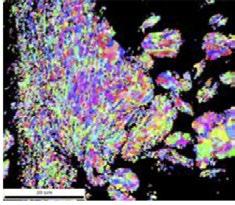
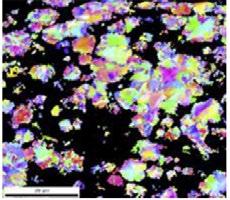
ates of Mo were obtained (Fig. 7b). As shown in previously reported work, a sintering temperature below 1500°C is needed to limit grain growth and carbide forma tion. However, a lower temperature implies lower density and usually poorer mechanical properties.
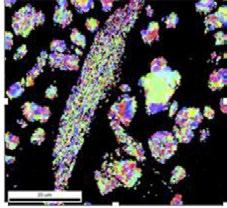

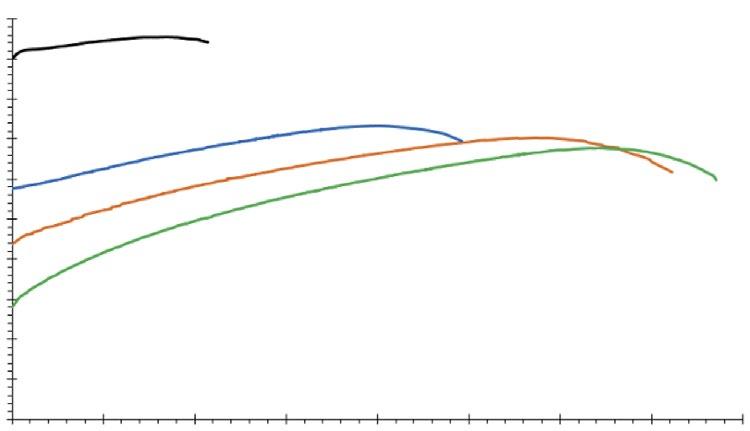
Mechanical activation is a means of lowering sintering temperature by reducing sintering activation energy. This mechanical activation of Mo powders led to the formation of a dense molybdenum (98.7%) with a fine microstructure without carbides or oxides.
Tensile testing highlights the improvement of ductility after ball milling from brittle molybdenum, which reaches 13% ductility. The fracture surface of sintered milled powder shows a fine microstruc ture with transgranular failure, characteristic of a ductile material. These results show the efficiency of the ball milling, since it reduces sintering temperature, thus avoiding carbide formation.
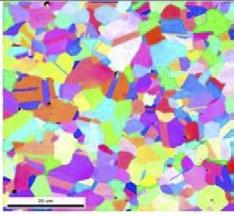
The case study on nickel powder used high purity ( ∼ 99.9%) nickel micrometric powder, APS 3–7 µ m in particle size. Different milling conditions were selected in order to obtain several mechanically acti vated microstructures composed of different grain populations (Fig. 8a). EBSD analyses allowed the determi nation of the grain size distribution
MA Condition A
MA Condition B

SPS of MA powder A, 98.3%
1000 900 800 700 600 500 400 300 200 100 0 0 0.05
SPS of MA powder B, 98.0%
SPS of MA powder C, 97.4%
MA Condition C σ (MPa) ε p
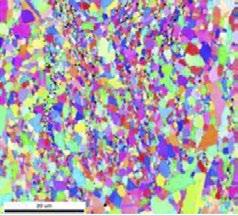
MA condition A ( Ω =200rpm, ω =50rpm, 8h Unmilled powder MA condition B ( Ω =250rpm, ω =50rpm, 8h MA condition C ( Ω =250rpm, ω =250rpm, 8h
0.1 0.15 0.2 0.25 0.3 0.35 0.4 c)
Fig. 8 a) EBSD observations on MA powders according different milling condi tions in comparison with unmilled powder using the same magnification (20 μm), (b) EBSD observations at the similar scale (20 μm) on dense samples sintered by SPS from the powders described above, c) True tensile stress strain curves of nickel samples sintered from unmilled (green) and different milled powders
and texture quantification, with grain boundaries identified when the misorientation between grains was greater than 5°. The local texture was characterized on an area of 60 x 60 µ m 2 with an acquisi tion step of 100 nm.
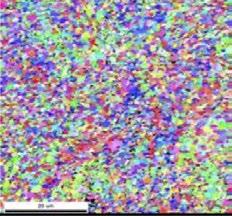
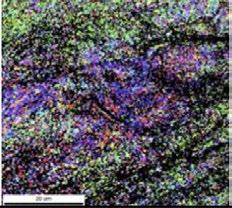
In this work, WC-Co tools, composed of 91.5% tungsten carbide and 8.5% cobalt, allowed the appli cation of an axial stress up to 155 MPa. These SPS tools permit the adjustment of the sintering
temperature, the heating rate and the axial stress. The sintering tempera ture was varied from 600°C to 560°C, for unmilled powders to milled powders, respectively. The heating rate and the axial stress were 25°C. min -1 and 155 MPa respectively. The holding time at the maximum temper ature was fixed at 10 minutes to ensure thermal homogeneity. The microstructure and the density of sintered parts are summarised in Fig. 8b, confirming the ability of SPS
technology to partially maintain the initial microstructure of the powders.
The tensile test results for sintered samples are provided in Fig. 8c. By modifying the ball milling conditions, it is possible to cover a large range of ductility/yield strength. Ductility varies from 11 to 37% and yield strength varies from 372 to 823 MPa. Samples sintered
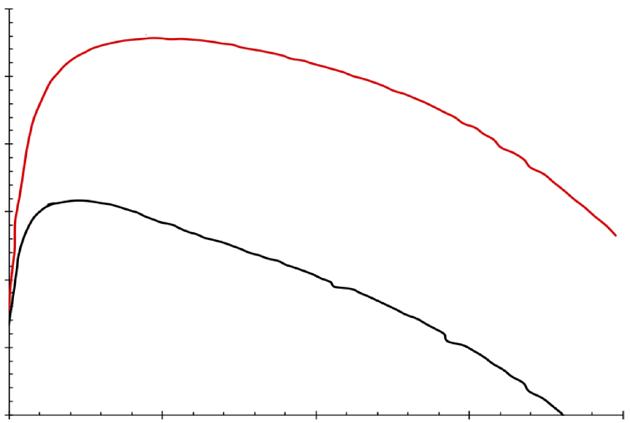
from milled powders exhibit better mechanical properties (RP0.2% ranging from 440 MPa to 910MPa vs milling conditions) in comparison with the reference nickel prepared by an electrodeposition method (280 MPa). Moreover, SPS sintered samples do not require a post heat treat ment, whereas, for nickel prepared according to the electrolytic method,
a recrystallisation treatment must be applied to achieve a sufficient ductility.

Finally, in the case study on 300 ksi maraging steel powder, the analyses of the powders with SEM in the secondary electron mode made it possible to observe the morphological modifica tions induced by the high-energy ball milling as shown by the SEM images of the powders before (Fig. 9a) and after milling (Figs. 9b and 9c). As expected, the highenergy milling made it possible to modify the morphology of the powders by forming large MA agglomerates (> 100 um) and possessing very irregular and disturbed shapes (Fig. 9c). Fig. 10 compares the XRD patterns and confirms the ability of milling to stabilise a phase, since, after milling, only the martensitic phase is observed, whereas, in the case of the commercial powder, austenitic phase is still present.
Using the high-energy plane tary mill, it is possible to control the microstructure of the milled powders. The severe plastic defor mation undergone by the powders during high-energy mechanical milling favours the phase transfor mation (austenite → martensite) leading to a 100% martensitic structure. In addition, the shocks and/or friction led to the formation of numerous structural defects and to the reduction of the crystallite sizes within the powder particles.
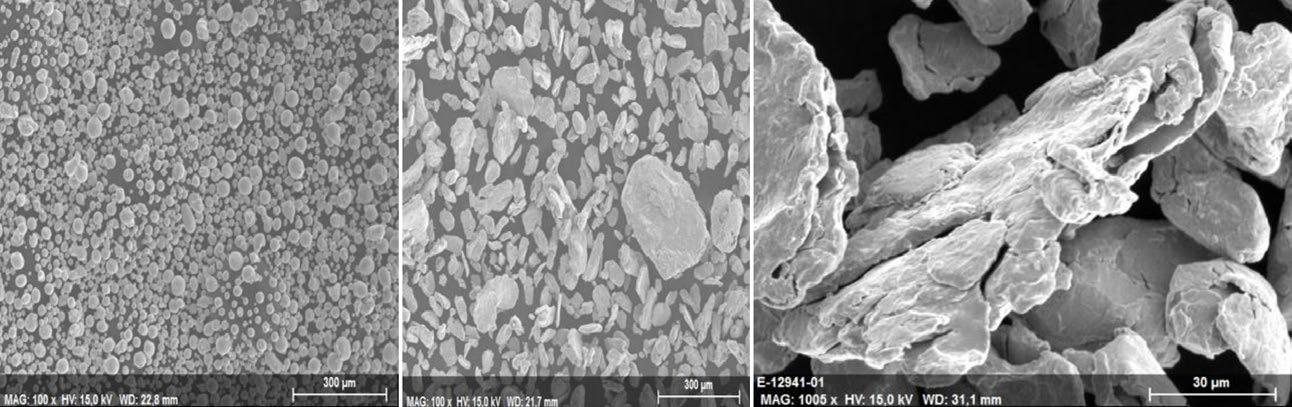
These modifications cause a lowering of the sintering temperature to 950°C, compared to 1050°C for the unmilled powders, and without further heat treatment.
These MA agglomerates prepared from 300 ksi maraging steel powder were then sintered by SPS using the sintering conditions 950°C/10 min/75 MPa. Optical microscopy shows that the induced microstructure by the milling is maintained after sintering. This microstructure is complex, since it is composed of grains of different sizes with a ‘vein’ type morphology resulting from high-energy mechan ical milling. This microstructure is totally different to those obtained when starting from an unmilled powder in which the spherical shape is maintained. Moreover, the Vickers hardness is also higher (366 HV rather than 320 HV).
This ‘non-equilibrium’ micro structure, induced during the milling, is totally different from that obtained when an unmilled powder is sintered, partly explaining the modi fications observed during tensile tests (Fig. 11).
Finally, the samples sintered from MA powders have superior mechanical characteristics (tensile strength and hardness) than those of the SPS samples made from the commercial powder. The pres ence of sub-micronic grains within the samples sintered from milled powders is at the origin of the increase in the mechanical charac teristics. Regarding the ability to plastically deform under uniaxial tensile loading, the extent for which the plastic deformation is stable is greater with samples sintered from milled powders (Fig. 11).
The presence of a bi-structure, composed of sub-micronic crys tals (> 40 vol.%) and micron-sized crystals seems to be the cause of a better stability of the plastic defor mation in tension for the 300 ksi maraging steel. In addition to a reinforcement of the material, the multiplication of grain boundaries seems to be beneficial in improving the ability to deform plastically. These characteristics are obtained
thanks to the SPS technology, which makes it possible to preserve the ‘specific microstructure’ of the mechanically activated agglomerates induced by ball milling.
The session concluded with a pres entation from Miguel Angel Lagos, Asier Lores, Inigo Agote and Inaki Leizaola (TECNALIA, Spain), Erich Neubauer, Zuzana Kovacova and Christopher Wallis (RHP-Technology GmbH, Austria) and Charlotte Bringer (ESA-ESTEC, The Netherlands) on the SPS co-sintering of metal-ceramic composites for high performance electronic applications. [4]
Electronic packages and sensors for special purpose applications, such as aerospace for instance, usually require a high electrical resistivity ceramic for a proper insulation from conductive mate rial tracks. Also, very low CTEs are usually required in order to ensure the correct performance in space conditions, where there is a huge range of operating temperatures.
For packaging insulation substrate materials, Si 3N 4, AlN, Al 2O 3 and BeO have been widely used. Among these options, alumina substrates are usually a preferred choice as this is an effective cost/performance mate rial. However, these materials can present some drawbacks, as their CTE and sintering temperatures are quite high, thus implying the use of expensive metallic alloys with
SiO 2 73–77
Al 2O 3 12.5–15.5
Fe 2O 3 < 0.2
TiO 2 < 0.06
CaO < 1.1
MgO < 0.12
K 2O 1–2.5
Na 2O 6.25–7.75
Residuals < 0.7
high melting temperatures, such as tungsten or molybdenum, if a conductive material is required for co-sintering purposes.
Ceramic and metal materials, which have very low CTE and can be co-sintered, are promising for certain electronic market niches. Therefore, Invar36, recognised as one of the metallic alloys with the lowest CTE below its Curie temperature, is a potential candi date. The sintering temperatures of the Invar36 can range between 1100°C and 1400°C, depending on the powder particle sizes used. A mixture of SiC and albite class feld spar has been chosen as a ceramic composite candidate for the nonconductive substrate. SiC and the albite have similar CTEs to Invar36 and the glass transition tempera ture of the albite is in the range of the Invar36 sintering window. The SiC is intended to act as the rein forcement material, while the Albite
will act as a matrix or binder for the SiC particles.
The SPS process has been chosen as an appropriate sintering tech nique, due to its processing speed and the possibility to co-sinter metal-ceramic composites, although the manufacturing of complex shaped parts is still a challenge. Therefore, the reported study was aimed at shedding some light on the possibility of FAST manufacturing low CTE metal-ceramic composites for future electronic applications.
A mixture of 50/50 wt.% α -SiC and feldspar powder was prepared for the manufacturing of the non-


conductive ceramic composite. The sodium feldspar grade had a compo sition as summarised in Table 3 and was a plagioclase mineral group known as albite. The average particle size was 4.5 µ m and the D90 was 20 µ m.
As demonstrated in Table 4, the CTE value of the feldspar grade is close to that of SiC (near 2.2 x 10 -6/K) and it has a lower density. One of the main drawbacks is that the Young’s modulus is an order of magnitude lower than the SiC modulus. Additionally, the low sintering temperature compared with the SiC sintering temperatures
(1300°C compared to temperatures above 2000°C), permits the use of lower cost and easily processable commercial grade conductive mate rials for co-sintering purposes.
A binder jet Additive Manu facturing machine was used to manufacture disc and rectangular shaped samples. These samples were then pressureless presintered in air atmosphere under different temperature conditions with holding times of 30 minutes. These pre-sintered samples give the strength and closed surface porosity needed to ensure a good application of the conductive mate rial, without internal leakages that may cause short circuits.
SPS sintering trials on the discs (30 mm diameter x 3 mm thickness) were then performed at different temperatures, between 1050°C and 1200°C, under 50 MPa of axial pres sure for 5 minutes holding time. Micro water jet machining was then used to extract smaller samples for the characterisation of the thermal properties, such as the CTE, thermal diffusivity, specific heat and electrical volume resistivity.
The relative density of the addi tively manufactured green samples was 33%, meaning that 67% of the sample consisted of open porosity. Therefore, a full densification of the AM samples would involve very large shrinkages in the samples that must be controlled to ensure good dimensional control. Prior to the full SPS densification of the material, the samples were presintered, both to help with the handling of the parts (as the green strength of the additively manu factured samples is very low) and with the deposition of the conduc tive tracks over the sample surface, avoiding leakages into the nonconductive material that may cause circuit-breaks.
Fig. 12 shows the relative density results for the pre-sintered (blue) and SPS sintered (orange) samples, calculated with the rule of mixtures considering the theoret ical densities provided by the raw material suppliers. As can be seen,
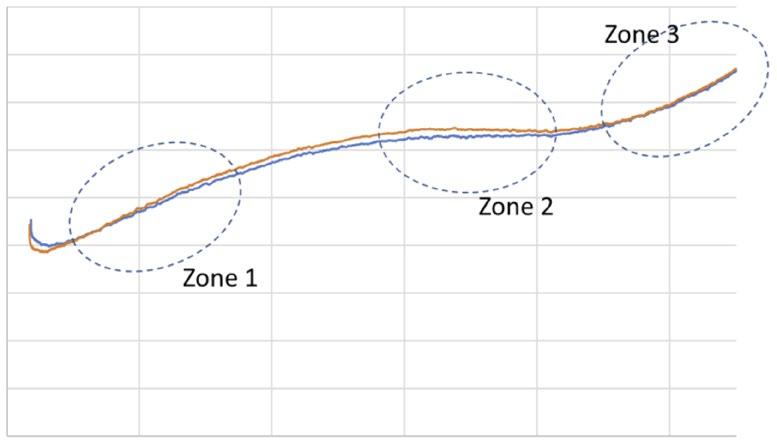
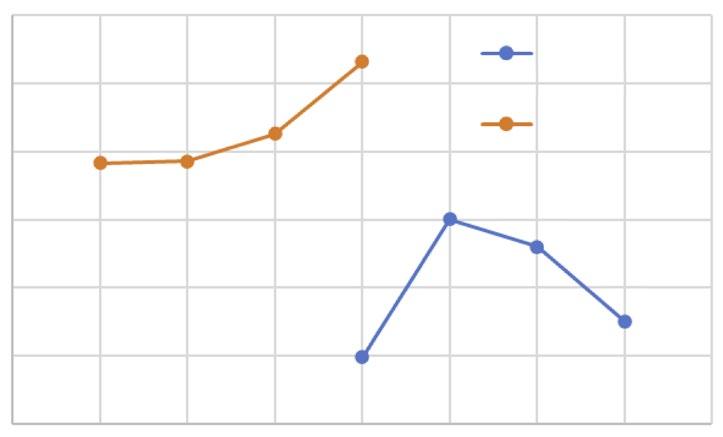
the pre-sintering of the samples achieved a maximum relative density of 70% at 1250ºC. A further temperature increase resulted in pore enlargement that decreased the density of the samples.
It should be noted that the open porosity of the samples, pre-sintered with the optimum conditions, resulted in a limited open porosity of 4%. As can be seen in Fig. 12, the SPS sintering of the samples resulted in a maximum of 93% relative density at 1200ºC/50 MPa, calculated using Archimedes principle. On closer examination of the microstructure of the SPS samples, it was found that the mate rial appeared to be fully dense (> 99% relative density), as opposed to the measured 93%.
The authors explained this differ ence as being due to the amorphous state of the feldspar after the fast cooling of the SPS process and the low degree of accuracy of the given theoretical densities. The density of the amorphous state of some inor ganic glasses is usually 10–15% below that of the same material in the crystalline state.
Fig. 13 shows CTE measure ments in three different dilatometric zones as a function of temperature. Theoretically, both the albite-feld spar and the SiC do not present any transitions at these temperatures. However, the amorphous state of the feldspar, possible composition changes during the thermal treat ments, the precipitation of albite crystals in the amorphous matrix and possible interactions of the SiC and the feldspar could have affected the dilatation behaviour of the material in the studied temper ature ranges. Zone 1 has a CTE of 4.5 ppm/K, Zone 2 has a CTE of 0.6 ppm/K and the last zone 3 has a CTE of 6.55 ppm/K. These obtained CTE values are slightly higher than those expected considering the composition of the material, probably due to a combination of influencing factors.
Table 5 shows the measured properties of the non-conductive SiC/feldspar composite. The elec
Binder Jetting example
> 99 70 10^ 9 10 100 µ m
Fig. 14 Section of the co-sintered Invar36 and SiC/Feldspar composite at 1200ºC/50 MPa

trical volume resistivity obtained is quite high, in the order of 10E9 Ω cm. On the other hand, the low thermal conductivity and elastic modulus obtained are a result of the high feldspar content.
After the characterisation of the non-conductive material, SPS co-sintering trials were performed with Invar36 alloy powder. Fig. 14 shows the cross-section of the sintered material at 1200°C under 50 MPa pressure. The sample did not show any cracks and the mate rial interface showed a solid joint between the ceramic and metallic materials. On the basis of image analysis, the relative density of the Invar 36 phase was around 95%. The authors concluded that these results showed the possibility of co-sintering both materials, obtaining a high density composite without CTE mismatch cracks.
Dr David Whittaker
Tel: +44 1902 338498 whittakerd4@gmail.com
[1] Martin Bram, Forschungsze ntrum Jülich GmbH, Institut für Energie- und Klimaforschung, Germany m.bram@fz-juelich.de
[2] Şöhret Melda Aydin, Ege Univer sity, Mech. Eng. Dept., Turkey sohret.melda.aydin@ege.edu.tr
[3] Bernard Frédéric, Lab. ICB –UMR 6303 CNRS / UBFC – BP 47870 21078 Dijon, France fbernard@u-bourgogne.fr
[4] Miguel Angel Lagos Gomez, TECNALIA, Basque Research and Technology Alliance (BRTA), Spain miguel.lagos@tecnalia.com
[1] Field Assisted Sintering Tech nique/Spark Plasma Sintering (FAST/SPS) of self-passivating tungsten alloys for future fusion power plants, Martin Bram et al. As presented at the World PM2022 Congress, October 9–13, 2022, and published in the proceedings by the European Powder Metallurgy Asso ciation (EPMA).
[2] Experimental investigation of the relationship between powder geometry and pore ratio in Mg powders sintered by FAST, Şöhret Melda Aydin et al. As presented at the World PM2022 Congress, October 9–13, 2022, and published in the proceedings by the Euro
pean Powder Metallurgy Association (EPMA).
[3] Mechanical activation and SPS sintering, a pertinent combination to produce advanced materials, Bernard Frédéric et al. As presented at the World PM2022 Congress, October 9–13, 2022, and published in the proceedings by the Euro pean Powder Metallurgy Association (EPMA).
[4] SPS co-sintering of metalceramic composites for high performance electronic applications, Miguel Angel Lagos Gomez et al. As presented at the World PM2022 Congress, October 9–13, 2022, and published in the proceedings by the European Powder Metallurgy Asso ciation (EPMA).
The full proceedings of the World PM2022 Congress are available to purchase from the European Powder Metallurgy Association. www.epma.com

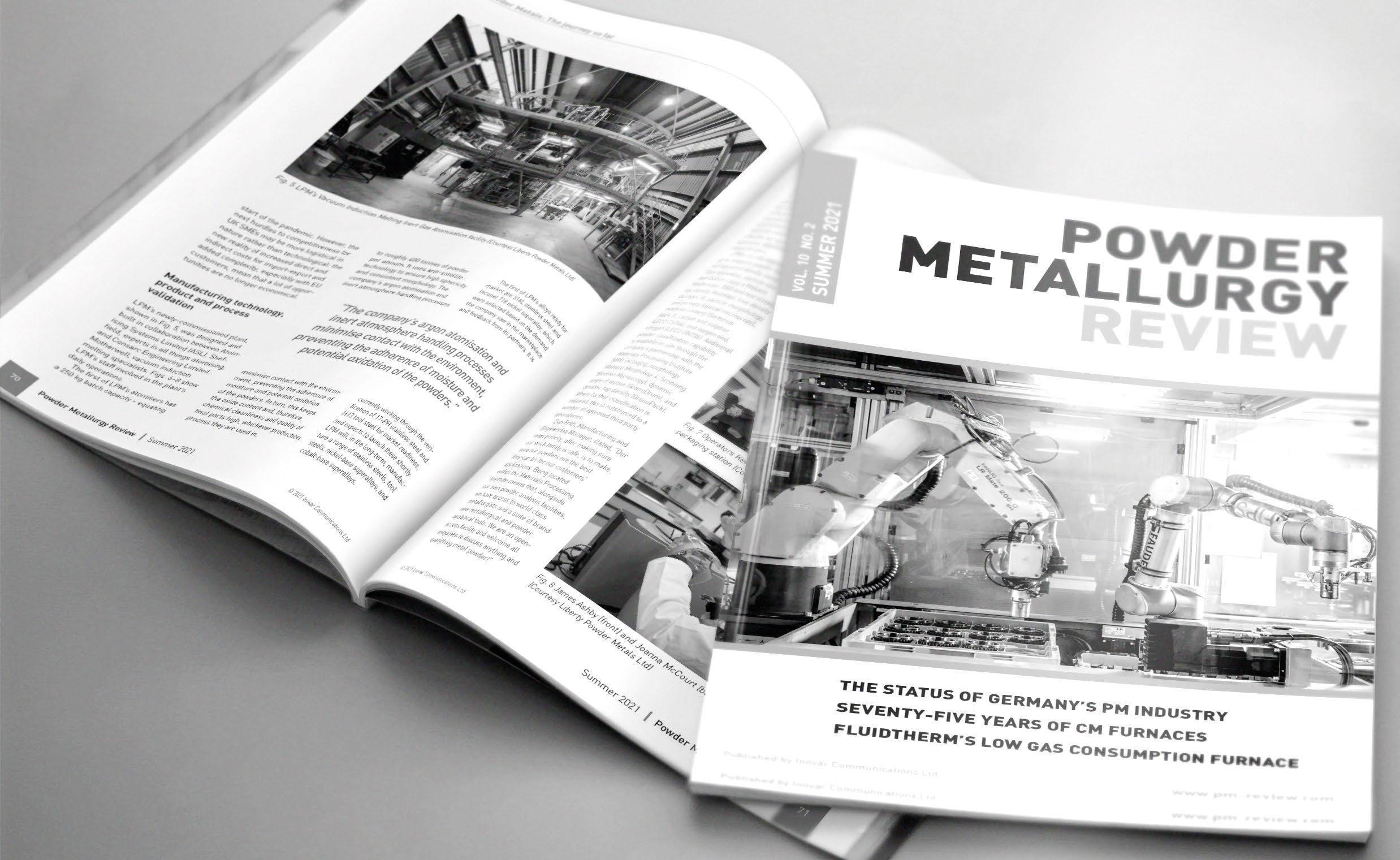
As a spin-out of Liberty Steel UK, Liberty Powder Metals has grown from the combination of its parent company’s deep steelmaking experience, and the technological innovations developed through the £18 million CASCADE project, which sought to develop a supply chain for advanced metal powder-based manufacturing technologies within the UK. Now, the company has entered the market as a producer of in-demand powders for the domestic and global markets. James Ashby, LPM’s Technical Manager, reflects on the company’s journey to date – including the challenges of establishing a startup during a global pandemic.
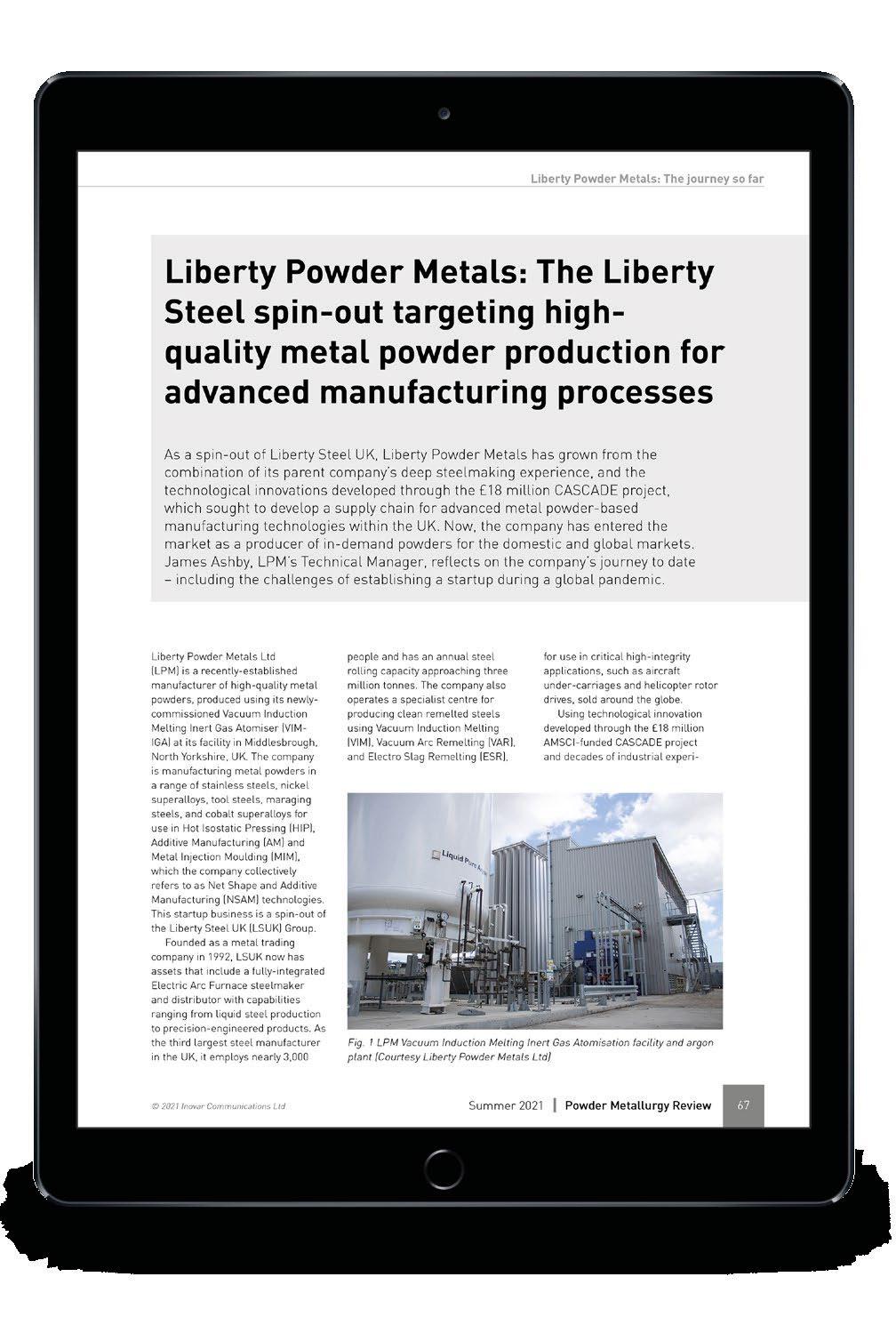
POWDER METALS: THE LIBERTY STEEL SPINOUT TARGETING HIGHQUALITY METAL POWDER PRODUCTION FOR ADVANCED MANUFACTURING PROCESSES
Our advertisers’ index and buyer’s guide serves as a convenient guide to suppliers across the PM supply chain. In the digital edition of PM Review magazine, available at www.pm-review.com, simply click on a company name to view its advert, or on the company’s weblink to go directly to its website.
Arcast Inc. 24 www.arcastmaterials.com
Höganäs AB IFC www.hoganas.com
Imerys Graphite & Carbon 14 www.imerys-graphite-and-carbon.com
Kymera International 13 www.kymerainternational.com
Mimete S.r.l. 19 www.mimete.com
Rio Tinto QMP 04 www.riotinto.com
Tekna 11 www.tekna.com
POST-PROCESSING
NLB Corporation 31 www.nlbcorp.com
NSL Analytical Services, Inc. 23 www.nslanalytical.com
Arcast Inc. 34 www.arcastinc.com
GEA Group AG 16 www.gea.com
Hexagon Product Development Pvt. Ltd. 36 www.alphiemixer.com Tekna 11 www.tekna.com
Topcast SRL 08 www.topcast.it
Reach out to our rapidly expanding international audience that includes component manufacturers, end-users, industry suppliers, analysts, researchers and more.
For more information contact Jon Craxford, Advertising Sales Director Tel: +44 207 1939 749 jon@inovar-communications.com
Dorst Technologies 06 www.dorst.de
Osterwalder AG 20 www.osterwalder.com
Progrit GmbH 25 www.progrit.ch
SMS group GmbH 33 www.sms-group.com/plants/powder-atomization-plant
System 3R International AG 21 www.system3r.com
DSH Technologies, LLC 27 www.dshtech.com
Edward Orton Jr. Ceramic Foundation 29 www.ortonceramic.com
Fluidtherm Technology Pvt. Ltd. 35/37 www.fluidtherm.com
Ultra Infiltrant 15 www.ultra-infiltrant.com
Arcast Inc. 24 /34
Dorst Technologies 06
DSH Technologies, LLC 27 Ecomatech 30
Edward Orton Jr. Ceramic Foundation 29 Euro PM2023 OBC
Fluidtherm Technology Pvt. Ltd. 35 /37
GEA Group AG 16
Hexagon Product Development Pvt. Ltd. . 36
Höganäs AB IFC
Imerys Graphite & Carbon 14
Kymera International 13
MIM2023 88
Mimete S.r.l. 19
NLB Corporation 31
DSH Technologies, LLC 27 www.dshtech.com
Ecomatech 30 www.ecomatech.com
Wohlers Associates, Inc. 39 www.wohlersassociates.com
Euro PM2023 OBC www.europm2023.com
MIM2023 88 www.mim2023.org
PM China 2023 64 www.pmexchina.com
PMAI PM23 78 www.pmai.in
PowderMet2023 / AMPM2023 42 www.powdermet2022.org / www.ampm2022.org
RAPID + TCT 52 www.rapid3devent.com
World PM2024 41 www.worldpm2024.com
NSL Analytical Services, Inc. 23 Osterwalder AG 20
PM China 2023 64 PMAI PM23 78
PowderMet2023 / AMPM2023 42
ProGrit GmbH 25
RAPID + TCT 52
Rio Tinto QMP 04
SMS group GmbH 33
System 3R International AG 21 Tekna 11
Topcast SRL 08 Ultra Infiltrant 15 Wohlers Associates, Inc. 39 World PM2024 41
Powder Metallurgy Review is dedicated to driving awareness and development of Powder Metallurgy and its related technologies. Key to this aim is our support of a range of international partner conferences. View our complete events listing on www.pm-review.com
WINTEREV 2022
December 13–14, 2022 Aachen, Germany www.seminars.epma.com
Formnext + PM South China
December 20–22, 2022 Shenzhen, China www.formnext-pm.com
MIM2023
February 27–March 1, 2023 Costa Mesa, CA, USA www.mim2023.org
PM23 International Conference on Powder Metallurgy & Particulate Materials March 13–15, 2023 Mumbai, India www.pmai.in
EPMA Press&Sinter Seminar March 28–29, 2023 Barcelona, Spain www.seminars.epma.com
Hannover Messe 2023 April 17–21, 2023 Hannover, Germany www.hannovermesse.de
RAPID + TCT 2023 May 2–4, 2023 Chicago, IL, USA www.rapid3devent.com
PM China 2023 May 31–June 2, 2023 Shanghai, China www.pmexchina.com
World Titanium Conference 2023 (Ti-2023) June 12–16, 2023 Edinburgh, Scotland, UK www.iom3.org/events-awards/world-titaniumconference-2023.html
PowderMet2023 / AMPM2023 June 18–21, 2023 Las Vegas, NV, USA www.powdermet2023.org / www.ampm2023.org
MAPP Second International Conference June 28–29, 2023 Sheffield, UK www.mapp.ac.uk/events/mapp-2nd-internationalconference
Dritev 2023 July 5–6, 2023 Baden, Germany www.vdiconference.com/dritev/
EPMA Powder Metallurgy Summer School July 17–21, 2023 Dresden, Germany www.summerschool.epma.com
EMO Hannover 2023 September 18–23, 2023 Hannover, Germany www.deutschemesse.co.uk/emo
Euro PM2023 October 1–4, 2023 Lisbon, Portugal www.europm2023.com
World PM2024
October 13–14, 2022 Yokohama, Japan www.worldpm2024.com
If you would like to see your Powder Metallurgy related event listed in this magazine and on our websites, please contact Jo Sheffield, jo@inovar-communications.com
Subscribe to the Powder Metallurgy Review e-newsletter, sent weekly to key PM professionals and end-users worldwide, to make sure you benefit from timely access to the latest industry news and technology trends.

E-newsletter subscribers also benefit from a free digital subscription to Powder Metallurgy Review magazine.
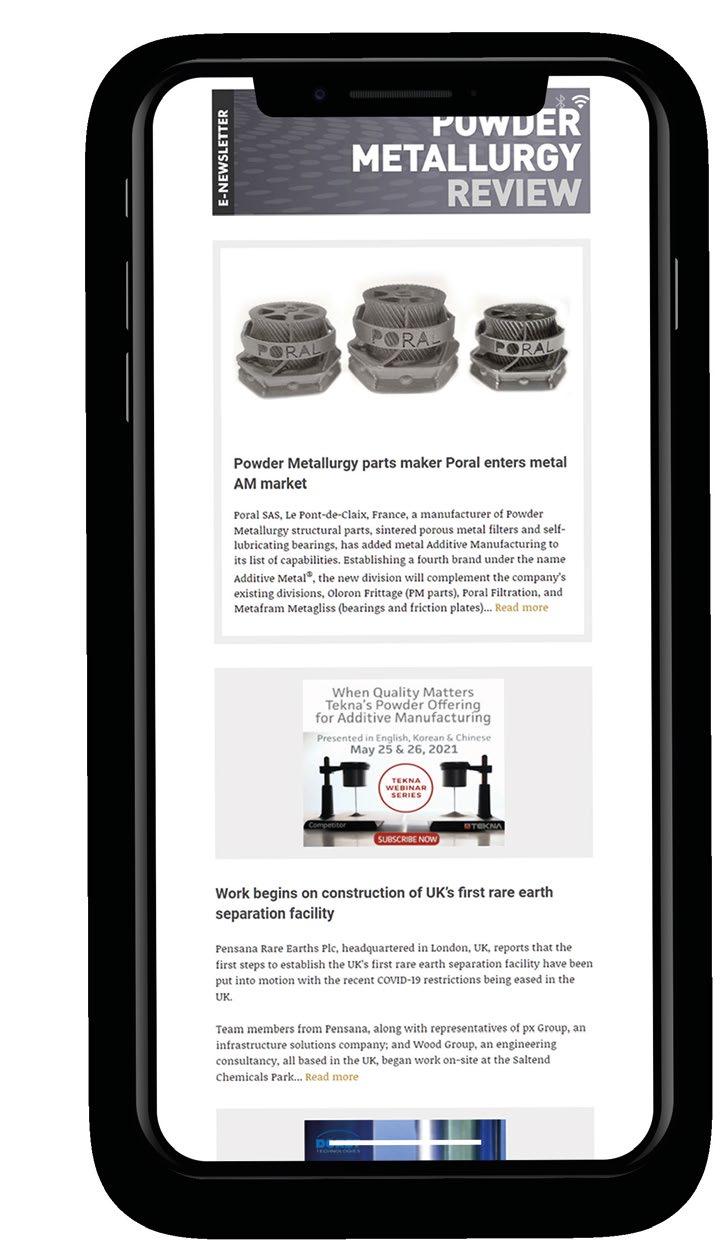

https://www.pm-review.com/ subscribe-pm-review-e-newsletter/
www.pm-review.com