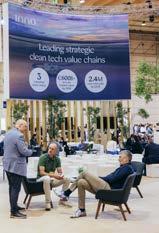
InnoEnergy is industrialising clean tech innovation to enable and grow a global net zero economy. We invest in early-stage companies and the current and future workforce, building resilient clean tech value chains that drive sustainable economic growth. Through the collective power of our ecosystem - with partners spanning industry, finance, public policy, and academia - we scale the energy transition at speed.

Clean industrial electrification: Powering our planet, our economy and our security
The Business Booster (TBB) is the world’s leading event in clean energy innovation. You hear from expert speakers, witness live panel debates, join interactive sessions, and discover cutting edge clean energy technologies. This year’s TBB took place in Lisbon, Portugal, on 22-23 October. This document is a transcribed selection of the presentations that took place during those two days. Each presentation is written as it was spoken at TBB. To watch the full presentations, you can click the link for each session.
Here is an explanation of this year’s theme and why it took center stage at TBB2025:
Clean industrial electrification: Powering our planet, our economy, and our security
DECADES OF GROWTH
Over the past decades, the power we use to make, move, and heat has shifted from fossil fuels to electricity – resulting in electrification becoming the backbone of the energy transition. This was made possible through the rapid deployment of clean technologies like solar, hydro, wind, batteries, and electric vehicles, alongside the transformation of the grid.
THE FIRST WAVE HAS CHANGED EVERYTHING
These advances have scaled at a pace faster than anyone predicted – with 40% of global electricity powered from low carbon sources in 2024 alone. That was the first wave. And it has changed everything.
ELECTRIFICATION 2.0
But to reach net zero, protect our economies, and strengthen global resilience, we now need to tackle the next phase: Electrification 2.0.
This time, it is on an industrial scale.
To succeed, we need:
• Novel funding mechanisms for First-of-a-kind (FOAK) plants and technologies
• Strategic partnerships between established industry and new frontrunners to de-risk and scale faster
• Securing off-take, through regulation to shape early demand and secure long-term investment decisions
• Smarter, faster permitting and infrastructure planning to cut delays
• Cross-border collaboration to share industrial know-how and best practices to industrialise clean technologies faster
This is not just about climate. It is about competitiveness, sovereignty, and shared security. For the planet. For profit. For people. For real.
LEARN MORE ABOUT TBB
“It was an honour to address the TBB audience - always one of the most important events in the energy innovation calendar globally. I was struck by the fine balance among participants and around the stands between enthusiasm and realism. Too much of one and it’s just puff, and too much of the other and it’s just a grind. But you and your crowd found the sweet spot, well done!”
- Michael Liebreich, Managing Partner, EcoPragma Capital & CEO, Liebreich Associates
”This conference and this association are really relevant to put us all on the same level of understanding to move forward, because we can talk about problems, but problems do not solve themselves. We need to decide. Not deciding is also a decision, and that is many times what we need to start doing; take decisions and make things happen.”
- Luis Marçal, Smart Infrastructure Business Head at Siemens
”When I look at what InnoEnergy does, it is not just about investing. What is really important is helping businesses scale up and industrialise, because it is what we are looking for, not only in Portugal, but across Europe. You will see more than 100 pioneering technologies developed by European startups and industrial scale-ups, showcasing how they produce, store, and consume energy in new ways. Together, they form the foundations for a new era of industrialisation in Europe.”
- Joao Rui Ferreira, Secretary of State for Economy, Portugal
Clean industrial electrification: Powering our planet, our economy and our security
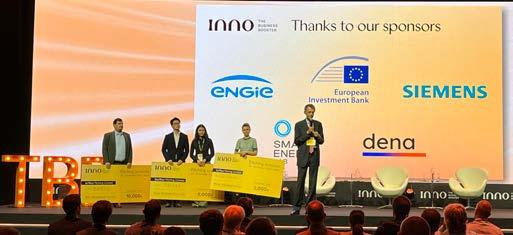
Our sponsors provided the foundation for us all to come together in Lisbon and advance the energy transition by connecting, finding new opportunities, and getting deals done.
At ENGIE, innovation is not just about technology—it’s about mindset. By embracing constraints and responding with agility, ENGIE transforms challenges into opportunities. Whether through new business models or resourceful use of local materials, the company demonstrates that creativity flourishes when guided by purpose and urgency. In times of crisis, innovation becomes not only a lever for survival but a driver of meaningful change and growth.
The European Investment Bank Group is the largest provider of Venture Debt to the continent’s fastest growing and most innovative companies.
We can provide quasi-equity in the form of Venture Debt in amounts from 15 to 50 million euros. If your business is involved in sustainable transport, future mobility, clean energy, decarbonisation technologies, digital solutions, or fostering a circular economy more generally, we would love to hear from you.
Today, being sustainable and purpose-driven is not only a competitive advantage; it’s an imperative. Siemens Financial Services helps companies of all sizes, in any industry, lead in sustainability by combining unique financing solutions with innovative Siemens technology.
Power all your energy management solutions with one platform.
At the heart of these solutions is the SEL Platform, an edge–cloud energy management platform that brings together cloud capabilities and local controllers into one seamless system.
Launching new energy services has never been faster.

dena is a project enterprise and a public company. We combine a wide range of expertise in all relevant areas for the energy transition and climate protection. Our basic organisational structure consists of five departments, two multidisciplinary departments and two staff units. Our teams work continuously on around 100 ongoing projects worldwide.
Clean industrial electrification: Powering our planet, our economy and our security
The challenges ahead are profound. We have made great progress in deploying renewable energy, from solar to wind, and in electric mobility, but we still face critical gaps in decarbonising key sectors and in attracting the green industries that will define the next industrial wave. That is why the government, including myself and the Secretary of State for Energy, is working closely on what we call the green reindustrialisation of Portugal—an ambitious effort to strengthen our industrial base through affordable, secure, and renewable energy.
Just as access to cheap fossil fuels once defined global economic advantage, access to abundant and competitive renewable energy will define it in the future. The difference is that now industry will need to be located closer to its energy sources, creating new regional opportunities and strengths in Europe’s strategic autonomy. We see this transformation as a historic opportunity to revitalise our industrial base, building on what makes us unique: abundant natural resources, resilient and skilled
workforce, reliable industrial infrastructure and leadership in renewable energy. The vision is clear: to produce clean, affordable, and secure energy and utilise it to power the industries of the future.
We need to be conscious that the window for action is closing fast. Portugal stands today at an inflexion point, and the choices we make in the coming years will determine whether we seize that opportunity. To prepare for the future, we are reinforcing the link between research, innovation, and industry. With the recently established agency for research and innovation, AI Square, we will bridge scientific knowledge and industrial applications, turning research into marketready solutions. At the same time, we are providing concrete financial support to accelerate this transition.
Over the next two days, you will explore some of the most pressing questions before us. What investments and infrastructures are required
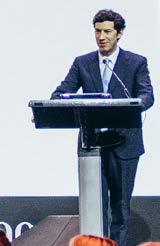
to scale clean electrification across industry? How can Europe design policy frameworks that enable industrial decarbonization while safeguarding energy security and competitiveness? Let me assure you of one thing: the Portuguese government will be paying close attention. The insights and ideas emerging from this forum will help shape national and European policies that support innovation, ensure fair competition, and accelerate the energy transition. So, ladies and gentlemen, the future is being shaped here and now in how we work together, how we innovate, and how we align growth with sustainability.
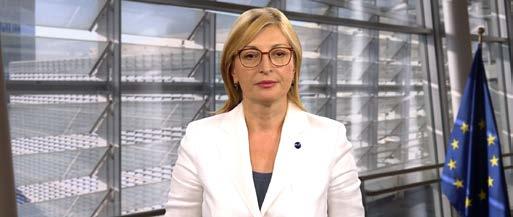
The Business Booster (TBB) is the flagship event that celebrates Europe’s leadership in clean tech and sustainable energy innovation. This gathering shows the European Union’s vision for a green, secure, and competitive future. In today’s geopolitical reality, clean energy and industrial transformation stand at the heart of the EU agenda. Our Clean Industrial Deal brings together climate ambition and industrial policy.
It supports the green transition of energy-intensive industries and helps scale up clean technologies across Europe. Supported by the European Institute of Innovation and Technology, InnoEnergy reflects this ambition. It is a true energy of transformation for Europe’s energy sectors. Over the past decade, it has built the largest energy innovation ecosystem in Europe. By 2030, the InnoEnergy portfolio is expected to save more than two gigatons of CO2 emissions. These results are essential for achieving the EU’s net zero goals for energy security and for the success of key sectors such as batteries, green hydrogen, and solar photovoltaics.
InnoEnergy’s impact goes beyond technology. It helps build skills and develop talent. Over 2,000 graduates have completed its education programs, and more than 100,000 professionals have been trained in critical technology fields.
TBB keeps the momentum alive. It shows that when we work together, Europe can lead in clean industrial electrification. By joining forces, we can turn clean tech ambition into reality.
Clean industrial electrification: Powering our planet, our economy and our security
Over the past 12 months, Europe voted for a new parliament and a new commission, and the message is that we stick to our guns. The compass in terms of clean evolution, both in energy and industry, remains, but it will be slower. That is the first good news.
The second piece of good news is that the commission is now also addressing the supply side. We have been cautious in implementing these measures to ensure that the supply for this demand will be at least 40% from EU sources, but we are making progress, which is a powerful message. We not only create a market, but we will also reap the benefits of growth and jobs that come with creating that market. So that is the first message of the
last 12 months. We Europeans stick to the compass, only at a lower speed.
The Trump administration has decided to halt the clean evolution for four years.
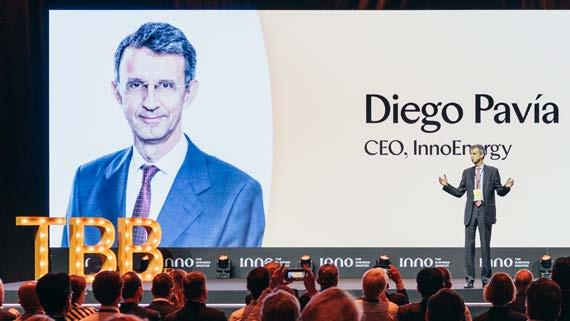
That presents a tremendous opportunity for us Europeans. Although we may go a bit slower, we remain on the same path. We have a fouryear opportunity to be ahead of the game.
The second thing the US has done is start a trade war. This is also contributing to changing the frame. China is responding to the US market’s closure by dumping excess capacity into Europe. This means that Europe must be agile to capture that as an opportunity, rather than a threat. The third aspect is whether China is part of the problem or the solution. With the recent changes, China has become part of the solutions toolbox strategy.
In terms of the financial world and its investors, public finances are stretched. There is no more public money. We must consider the next few years with guarantees, subsidies, and CFDs, but without new capital. This means adapting to a world with limited and
changing public finances, and where private investors are reevaluating their investment theses. So, all things considered, do we have an opportunity or a challenge? That is an opportunity to grab.
All Europeans work 72 days, from 1 January to 12 March, to pay for gas and oil imports. The day we reduce those 72 days to, say, 20, all this wealth remains in our pockets. That is our wealth, our jobs and our own autonomy.
Today, Europeans use 13,000 TWh of energy, 4,000 electric and 9,000 non-electric. In 2040-ish, the 13,000 TWh will be 11,000 TWh because we will be more efficient. The 4,000 electric TWh will be 9,000 electric TWh. That is a tremendous opportunity because those electrified demand sources will, for example, be mobility, heating,
and hard-to-abate industries. We are masters of our destiny, and that wealth will stay in our pockets. One data to show the size of this opportunity: in the room here today, many of InnoEnergy’s 39 shareholders are present. Their aggregated market capitalisation is $1 trillion; a year ago, it was $800 billion. Over just one year, their market capitalisation has increased by $200 billion by operating in the same field as we are all doing business in. So, the fundamentals remain: there is still a tremendous business opportunity to capture.
Walking into TBB, we had 2,800 pre-booked meetings to facilitate transactions and advance the clean industrial deal.
Let’s hit the road!
Clean industrial electrification: Powering our planet, our economy and our security
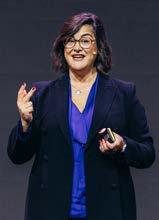
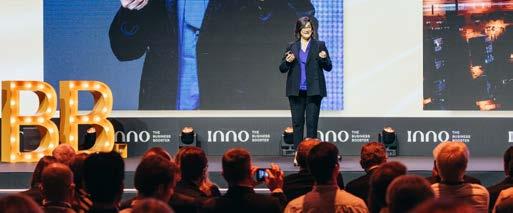
Opening address | Elena Bou, Co-Founder and Innovation Director at InnoEnergy
The theme of this TBB is electrification, and it is interesting because two weeks ago, I was in Paris at the International Energy Agency, and Fatih Birol, Executive Director, said, “We have gone from the age of coal to the age of oil, and now it is the age of electricity.”
From hunting scarce fossils to farming inexhaustible renewables. From just consuming resources to borrowing them. At the core of this change lies the electron. How we generate, use, and connect those electrons has genuinely been a transformation. At its core is renewable energy. Approximately 50% of Europe’s electricity comes from renewable energy sources. 3,000 TWh of electricity consumption in the EU today is projected to grow by 50-60% by 2030. And that has to do not only with new
demands, such as data centres, but also with the electrification of mobility, EVs, the industry, and how we connect supply and demand. It is related to grid tech, digitalisation, and especially batteries. If you read the Financial Times two weeks ago, you would have learnt that Battery Energy Storage Systems, BESS, will increase in capacity significantly, with a 67% increase expected this year.
Aside from the climate change ideology, three other drivers bring about the Age of Electricity:
1. Efficiency. Two-thirds of the energy in a fossil fuel system is lost during production, transportation, and use. This represents $4.6 trillion. So each of you is paying $600 every year because of these losses. Electrotech is three times more efficient.
2. Economics. Electrotech is based on technology. Technology is based on innovation. Innovation is based on learning curves. With the learnings, costs fall and adoption increases. We need to scale—we need more volume to keep costs decreasing. It is a virtuous cycle. This is not happening with fossil fuels.
3. Geopolitics. Talking about clean tech means we are talking about energy security. 74% of fossil fuelimporting countries are facing increasing energy security risks. At the same time, 92% of the world’s population could use renewables to multiply their energy demand by 10.
Climate change requires urgency, and clean technology is ready. Research suggests that existing technologies could electrify 78% of energy demand. But at the same time, even if we are going in a very good direction globally, it will be a hard change locally. For example, China is the first electrostate, and this is very good. They are creating, manufacturing, and deploying clean technologies. At the same time, this concentration of value chains provokes vulnerabilities. Three weeks ago, China announced that it plans to restrict high-density lithium-ion battery exports to Europe. We must take this into account.
Will Europe wait and see what happens? No. Growth in Europe means that our climate ambition and industrial
Research suggests that, with the technologies already established, we could electrify 78% of all energy demand. ❞
competitiveness go hand in hand. Clean manufacturing is at the core of meeting Europe’s 2030, 2040, and 2050 climate goals. This means a long-term commitment. And this longterm commitment means stability, which is a condition for investors to deploy large amounts of capital.
Europe is not only focused on this growth, but also on a resilient economy, which is why the EU has launched initiatives such as the Net Zero Industrial Act, the Industrial Decarbonisation Accelerator Act, and Made in Europe. Made in Europe is an incentive for European companies to source transactions, contracts, and offtake agreements from other European companies. And this
is not about closing the market; it is giving the opportunity to European companies to scale.
Being pragmatic, if we want to achieve our climate ambition, industrial competitiveness, and a resilient economy, Europe cannot go alone. Decoupling from China is impossible. We cannot close our market. In Europe, trade accounts for 50% of our GDP; in China, 31%; and in the US, 26%. So they need to be part of the equation, and we need to find new ways to collaborate, but in a European style. It is good that this industrial expertise is coming to Europe, but we want the value to stay here in terms of jobs, GDP, and growth. Yes, the time is now, but the change will be challenging, and it will impact countries, geopolitics, and companies.
Clean industrial electrification: Powering our planet, our economy and our security
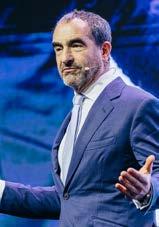
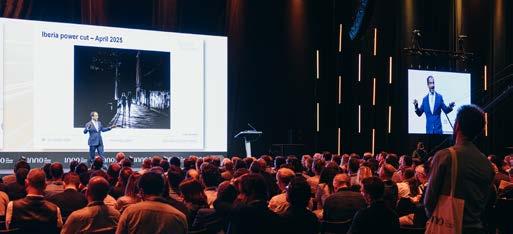
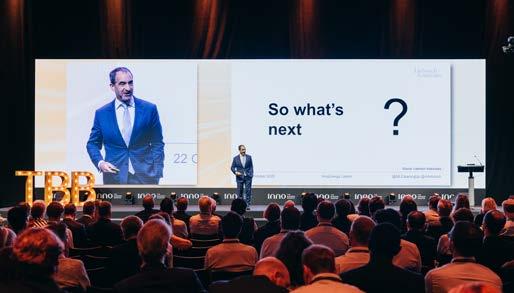
Keynote | Michael Liebreich, Managing Partner at EcoPragma Capital and CEO at Liebreich Associates
The best way to forecast the future is actually to create it. I am not going to stand up here and say I am going to forecast. I am going to tell you what will happen next. To the extent that I can shed light on what happens next, as I reflect the innovators.
The big question we cannot dance around is: are we facing the end of the transition? This is not 2015 in Paris or 2021 in Glasgow, where everybody stood up and said that they were going to do net zero. That is not where we are now. President Trump is back in the White House, and that’s having an impact around the world. We are seeing it in the UK, Europe, Canada, and Australia. Interestingly, we are not seeing it so much in Asia.
Non-hydro renewables— wind, solar, biomass, and geothermal—contributed to 1% of electricity in terms of the global share of power generation between 1985 and 2000. Ten years later, we saw an incremental increase. By 2020, there had been a larger increase. After that, ”the Great Clean Energy Acceleration” happened, an S-curve. Every single forecaster who has forecasted the saturation of wind and solar has been wrong. Some of them have been wrong 15 times in a row.
I started New Energy Finance, counting the money. It is very simple: what we invest in is what we will get. What we do not invest in, we will not get. So I started counting the money. Investments grew from $250 billion in 2004 to over $2 trillion per year today. When I started, the renewables were
only $36 billion. And that is “the Great Clean Energy Acceleration.”
The first time a crisis hit the clean energy transition was during COVID-19 and Russia’s
invasion of Ukraine. Did the world rush back to fossil fuels? No. It accelerated the investment and rollout of clean alternatives because, for the first time, it became clear that fossil fuels are the problem—the cause of instability, the cause of a lack of resilience. They are not the solution. That is a massive change in mentality. 88% of everything added to the grid in 2024 was wind and solar.
Ukraine by Russia, was from people buying electric cars. In China, vehicles with plugs are now outselling fossil fuel vehicles. Internal combustion car production peaked in 2016.
Comparing the Nissan Leaf in 2011 and the Nissan Leaf in 2026, there are: four times the range, three times the charging speed, twice the power, and 2/3 the cost. Cheaper and better. And here’s the question. A lot of people still say, “Oh,
❝
[Renewables] grew from $250 billion in 2004 to over $2 trillion per year today. When I started, the renewables were only $36 billion. And that is the great clean energy acceleration. ❞
The electric vehicle uptake is part of the great clean energy acceleration. Suddenly, the uptake during COVID, after COVID, and the invasion of
but a 300-mile range is not enough.” That is the reality. But what do you think is going to happen in the next 15 years? What do you think a Nissan Leaf in 2040 is going to look like? It will be cheaper, and it will be better.
As emissions have continued to grow for the last few decades, what you have to do to get to one and a half degrees has become improbably extreme. As soon as the Paris Agreement mentioned 1.5 degrees and kicked off the IPCC research into what that meant, it would have meant destroying half of our energy infrastructure. The marginal carbon price to do that for two degrees, you need a marginal carbon price of a couple of hundred. For that, you need $6,050. It was never going to happen. It was a very good exercise to explore what it would have taken because net zero means you look at every industry and every investment as opposed to an 80% reduction, where everybody says, “I love it. Knock yourselves out. I am in the 20%.”
So, we did the exercise, but it was never going to happen. And we now need the pragmatic climate reset. How do we rewind from insistence on one and a half degrees and demonising people who refuse to adopt one and a half degrees and net zero
industrial electrification: Powering our planet, our economy and our security
2050 globally, not just in our economies, but globally? We need to move on. How do we do it? That is part of the debate.
The other problem is primary energy, and 65% of it is wasted. What society needs is the energy services. Cold beers, MRI scanners in the global south, warm homes, and mobility. So we need to focus on energy services. That demand-side focus is critical. How do we do what society needs? Society does not need lumps of coal or millions of BTUs of gas. It needs a cold beer, or it needs to go and visit its grandparents. That is what we need to focus on: electrification.
We must grow clean energy faster than the global energy demand. Visualising it, nothing much is visible for their first decade. But because of the miracles of compound growth,
The virtuous circle that we need to see: More volume, spread the cost under a larger umbrella, and add flexibility. ❞
fossil fuels are eventually forced out of the system. That is what is happening.
Transition like a tortoise, which is what we are doing, is working. And I am not saying slow down. I am saying that to move the system of systems of systems, which includes the political system and society, as fast as possible, we have to be pragmatic and stop talking about stuff that, frankly, is not going to work. So that is what we are going to get for the second part of this decade and out into the future: The pragmatic climate reset.
What happens in an industry when you increase volume? The learning curve, but also the fixed costs, are spread over a larger number. The grid gets spread over a larger number. So volume growth is lower grid costs. This is not in the debate, and it needs to be. And because of the nature of what we are going to add, it is also more flexibility. This is the virtuous circle that we need to see. More volume, spread the cost under a larger umbrella, and add flexibility.
Clean industrial electrification: Powering our planet, our economy and our security
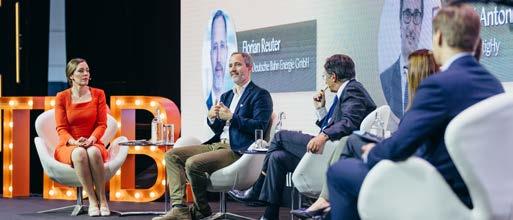
María Ramos, TBB2025 Host and Moderator
Florian Reuter, CEO at Deutsche Bahn Energie GmbH
José Antonio de las Heras, CEO at FertigHy
Natalia Turón, Global Head of Corporate Strategy at Seat
Philippe Tibi, Chairman of the Executive Committee and Technical Committees of the “Scale-UP Financing” project at the Ministry of the Economy, Finance and Recovery, France
Miika Korja, Industrial Partnerships at Fortum
[María Ramos] Why is electrification so important, and what are its biggest challenges?
Florian Reuter
Rail has been electrified for over 100 years. Our oldest power plants date back to hydro power plants in southern Germany, located in the Alps. It remains a challenge to electrify every part of it. Decarbonising the transportation sector, including rail, is crucial
to decarbonising physical products, which is why it is essential to start with rail.
We operate 8,000 kilometres of electricity grid dedicated to Deutsche Bahn. We procure more than 15 TWh of electricity every year. More than 5 TWh of gas and 350 million litres of diesel. So you can already tell by the amount of gas and diesel that we buy that there is still some ways to go.
We have had a significant portion of electricity in our mix for a long time, but we are not just trying to buy any type of
electricity; we are specifically seeking renewable electricity. This transformation has taken a long time because we have had very long-term power purchase agreements (PPAs). We have now reached a renewable share in our electricity mix of approximately 72% across the entire portfolio. In the highspeed railway network between cities, we have been 100% renewable since 2018, and our customers expect that. Our aim is to be 100% renewable by 2038.
The automotive industry is facing its biggest challenge to date in our history. We are transforming our entire business model as, in the coming decade, we will face a lot of different challenges, such as the regulatory environment, increasing costs, gaps in the charging infrastructure, increasing global competition, and, of course, the need to reskill our capabilities and the know-how of our workforce.
We are certain we will successfully manage this transformation. Together with Volkswagen Group, the Future: Fast Forward project aims to transform Spain into an electric mobility hub. This project encompasses the entire automotive ecosystem in Spain, from OEMs across the whole ecosystem, including component suppliers, partners and so on. As a group, we are investing €10 billion— the largest amount to date invested in our country for an industrial scope. The focus is on transforming to electric vehicles.
It is essential for us to face this challenge and to make the electric vehicle a success in Spain. We want to maintain our position in Europe, and therefore, we need to transition towards electrification.
Why is electrification so important, and what are its biggest challenges? ❞
José Antonio de las Heras
Today, fertilisers are produced with natural gas. As a hard-toabate sector, we are focusing on sovereignty and not depend on fossil fuels. To give you a sense of the size, in our case, we required a facility with a 250-megawatt grid connection. One of the challenges of electrifying is the huge competition for grid access, and the planning of the grid. There are many projects, and there is some uncertainty in the market about which projects will connect first. So, the first thing about electricity is having access to a grid, which something you cannot take for granted.
The second thing to consider is the amount of electricity you need. In our case, we need about two terawatt hours a year, which could be over 100 million euros every year just for electricity. When we talk about having access to affordable electricity in the chemical industry, it is not just renewable energy because the problem is that we require a base load. The cost of a base load is not necessarily the cost of just solar or wind.
[María Ramos] From a producer’s perspective, set the scene for us. Can Europe realistically deliver the volumes of clean electricity needed to power the industry?
Miika Korja
Fortum is one of the largest Nordic clean power companies, generating approximately 46 TWh of electricity annually. We build more as needed because we are demand-driven, meaning that as we see new
demand emerging, we will build accordingly. That is sort of the way to think about it going forward. We have quite ample opportunities to build new wind power, for example, in the Nordic region. We primarily operate in Finland and Sweden, where most of our assets are located. We can then supplement those projects with our base load generation capacity, including nuclear and hydro fleets. We focus on truly understanding the client’s needs: what type of electricity do they require, do they need it 100% of the time, 24/7, or can they be flexible to some extent? Reducing 5% somewhere may suddenly mean they avoid the most expensive hours of the day.
[María Ramos] What demand are you seeing for your fertilisers?
José Antonio de las Heras
We are targeting food and beverages companies that have declared voluntary targets to reduce specifically scope 3 emissions related to the raw materials they acquire. Some of these companies have publicly committed to the emissions reductions, and after analysing several paths, they understand that one of the paths is to source lowcarbon mineral fertilisers. They look at the long-term costs for fertilisers as they must factor in that the European emissions trading system will start charging for CO2. By not having to pay for CO2, they are hedging their future prices also for the fertiliser. Longterm, it could be the case that
also stimulate the charging infrastructure, which also needs to scale.
Some of the most exciting projects that we have seen are actually locking in their electricity PPAs, the power purchase agreements, for decades. ❞
José Antonio de las Heras
low-carbon fertilisers come without a premium or that this premium is affordable because of their benefits.
[María Ramos] What are the investments that you are seeing in your sector?
Natalia Turón
The decision to go ahead with this project is based on the end result of a completely new family of urban electric vehicles, fully produced in Spain. The support of the government and the administration of the country has also played a crucial role. They supported this initiative in terms of using certain funding methodologies, including pension funds. From the governmental point of view, supporting the industry and pushing this to happen was to support the evolution of the automotive industry and turn it into an electric mobility hub. The support by the government helped a lot for Volkswagen Group to take the decision and make this project happen.
[María Ramos] Are you seeing long-term commitment from customers?
Miika Korja
Some of the most exciting projects that we have seen are actually locking in their electricity PPAs, the power purchase agreements, for decades. Some of these projects are scaleups. For example, one of our industrial partnerships in Finland, still in the feasibility study phase, is with Rio Tinto Mitsubishi, Siemens, and Tesi where we all are bringing our individual industrial expertise into the project. Fortum is the energy partner in this project, trying to build the first greenfield primary clean aluminum site built in Europe in over 30 years and that will be there for decades to come if the project manifests. Certainly, it would require some very long-term commitments from the PPA side as well.
[María Ramos] How do you scale?
Natalia Turón
We are not where we are supposed to be to fulfil the decarbonisation targets defined by the Commission. To achieve that, scaling up is essential; we need to increase volume and adoption. This will
When electrifying the industry, you have different types of profiles. On one side, you have corporations with brownfield operations, and they must prioritise profitability. We are a greenfield developer, a scaleup founded two years ago. We do not foresee any difficulty in accessing equity at the time of construction. There is considerable interest from large infrastructure funds to deploy hundreds of millions of euros once everything is in place. The challenge is to get funding for these development expenses. In many cases, it also takes us at least three to four years from an idea to having something ready to be built. During that time, we are not the preferred bride for the dance because there are many risks associated with a scale-up. For example, it is likely easier to sign a PPA with Deutsche Bahn, as it is an established company rather than a scale-up. There is a need for derisking not only for equity, but also to derisk the counterparts about the grid connection PPAs we are trying to sign, as we really need to confirm and start paying them to order critical equipment. Here is an opportunity for public entities to, in addition to the direct funding they already provide, help determine how to derisk certain commitments these scaleups need.
Florian Reuter
In our case, signing a PPA is easy because we are 100% state-owned, so the project developer has its offtaker secured and can go to its bank, and the bank will be happy to finance cheap debt for the
construction of this plant. The project developer can approach us before building the first PV module or applying for grid connection, because with a demand-side commitment, the project can get financing.
José Antonio de las Heras
Some companies have not signed the grant agreements for the public funding they received due to market uncertainty. You can have a very solid project, but still face uncertainty about the willingness to pay for offtake agreements. There needs to be market certainty.
Miika Korja
How to derisk these projects to help them get to the FID level and scaling up comes down to a few factors from our perspective. First, having electricity that you can rely on, whether that is a PPA, baseload, or some flexibility elements.
Second, there is the need for a commercial site with a grid connection, which is surprisingly difficult in many areas of Europe. At Fortum, we have a team that looks at commercial site development and helps to
link them to the grid to shorten the time to market by up to a couple of years.
Third, the technology has to be proven. Investors are increasingly looking at how certain the project is to fly. We see these three things on a daily basis that companies are trying to get right, and areas we help in as much as we can.
Philippe Tibi
In China, public money allocated to venture capital funds is virtually unlimited, provided it aligns with the country’s direction. If they want something done, they will go for it. They may fail, like in the case of semiconductors, but if you look at PV, electric cars, and fast trains, they have delivered. It is quite straightforward. It is not only a question of money, but it is a question of execution. In the US, the Inflation Reduction Act was a big bazooka with a lot of money in subsidies, grants, and coinvestment.
In Europe, we have local regulations that add complexity and some uncertainty, which the Draghi report is alluding to. The situation in Europe today is that we have very strong
competitors, and we need to come together more for the long term and remove uncertainties.
[María Ramos] Is Europe providing you with the framework and regulations necessary for success?
José Antonio de las Heras
Yes. It is moving a bit slowly, but it is on the right path. The European Parliament recently approved import duties on certain fertilisers to avoid price dumping because, even though in the short-term, it is very interesting to have access to these fertilisers, the long-term result will be that the industry will disappear, and you do not know what you will have to pay once you have no industry. The food industry in general is very strategic, and each country has its own food industry. Not all countries manufacture cars, but it is very rare for a country to lack a food industry or agriculture. So, fertilisers are just as strategic as energy is for Europe.
Europe is on the right path to protect this industry and allow it to evolve. In the long term, the future of the fertiliser industry lies in electrification and decarbonisation, as the industry will not remain competitive in the long run if it continues to rely on sourcing
Clean industrial electrification: Powering our planet, our economy and our security
natural gas. The only path for incumbents and future newcomers is to decarbonise and electrify fertilisers.
Miika Korja
Florian Reuter
Electrotech is the way to go. We need to be determined to walk that path as fast as possible. The key challenge is how we do it while staying competitive from an industrial perspective, and that is a global question.
What other way is there than to completely push the innovation agenda in the direction of electrotech? We must continue
Electrotech is the way to go. We need to be determined to walk that path as fast as possible. The key challenge is how we do it while staying competitive from an industrial perspective, and that is a global question. ❞
We also have counterparty risk associated with those to whom we sell electricity. So we want to understand how the business of those we are locked into operates, especially when it comes to new projects. We examine companies and products based on regulatory demand and those driven by market demand. It helps to entangle products that are more likely to fly if regulation changes.
Business cases that rely on a green premium are quite difficult to sell. We have seen some business cases with a fairly large assumption to charge for a green premium, and that is being challenged at the moment.
[María Ramos] What is that one thing in the next three years that you think could really catapult and make a difference to speed up clean industrial electrification?
to push in the most determined way possible. Continuing to build internal combustion engines will not benefit our cost competitiveness in the long run. We need to stay the course and continue pushing the boundaries.
track, but we have a lot to do also in the upcoming 2-4 years. In the near future, we need to review and align a lot of things to first decarbonise and achieve the targets, but also do it sustainably for all the industries.
José Antonio de las Heras
Keep access to affordable electricity, including electric-intensive industries. Certain industries are heavily dependent on the cost of electricity. Certain incentives for the industry need to continue. We also need stable regulation that ensures the clean market develops. Ultimately, we need consumers who want decarbonised products, and stable regulation fosters those markets.
Philippe Tibi
I want the EU public agency to develop a plan for energy with clear funding, milestones, and strong governance, so that all countries can accept it.
Natalia Turón
Electrification is for sure the future. We have to make it happen. We are on a good
Miika Korja
We need real partnerships between end-users, energy producers, and offtakers. They need to get together into the same room and discuss how to build these new projects. We do not do anything with just our power plants, we need to send it to someone who needs electricity, we find opportunities for flexibility, etc.
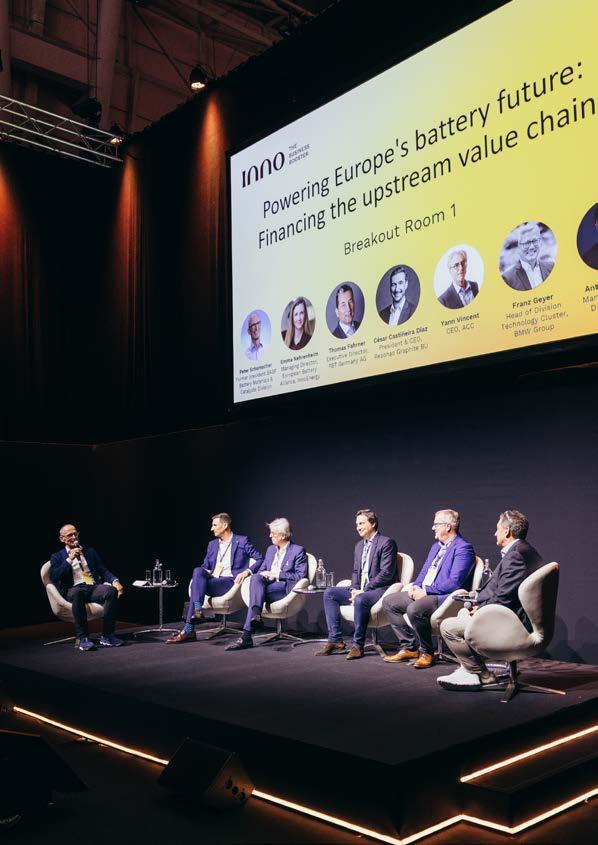
Peter Schuhmacher, Former President at BASF Battery Materials and Catalysts Division
Emma Nehrenheim, Managing Director at the European Battery Alliance (EBA)
Thomas Fahrner, Executive Director at PBT Germany
Franz Geyer, Head of Division Technology Cluster at BMW Group
Yann Vincent, CEO at ACC
Antoine Troesch, Managing Partner at DEMEA Invest
César Castiñeira Díaz, President & CEO at Resonac Graphite
[Peter Schuhmacher] This topic has garnered attention in global boardrooms and among governments because it pertains to resilience in Europe’s battery value chain. We cannot only discuss cell manufacturing, which is essential, but eventually the dependency we have on China extends across the entire chain and up to the mine.
Emma Nehrenheim
The main difference between a combustion engine car and an electrical vehicle and the sustainability of those cars lies in the raw materials. Why? Because they are elements, and fundamentally, they cannot be transformed into carbon dioxide, which, of course, hydrocarbons can. This means that the way we use these elements and the fact that they can be recycled means that there is minimal limitation to how much we can slash the impact on the environment.
This also means that if we do not do it right, if we use mining in the same way as we have for combustible fuels in the past, we will face the same challenges. We will build ourselves into an ecosystem that is unsustainable, creating a legacy for future generations that we will have to clean up. At Northvolt, I developed its recycling capabilities, and I was also responsible for the raw material value chains. I visited mines in northern Siberia, the DRC, and Indonesia. There is a significant difference between
Clean industrial electrification: Powering our planet, our economy and our security
the good mines and the less desirable ones. It affects carbon dioxide, but also has a social impact and implications for human rights and labour rights.
Europe has a strong and long tradition in the process industry, including chemical engineering, process engineering, and methods for making mines productive. The most productive mine in the world is a Swedish mine. So it is not about low salaries or slashing the environmental footprint. It is about making sure that we do it right and productively produce materials with high yields and optimisation. We are capable of manufacturing cells, raw materials, and cathodes in the most profitable industry on this planet once we have reached the base industry, because we do this well in Europe.
Franz Geyer
BMW is committed to electromobility and really strives for the best solution on the market. Driving pleasure is at the heart of our brand, and we see electromobility as an option for driving pleasure. We have been striving for years to establish a European battery supply chain, and we are not stopping. There are many ingredients that in the end will lead to success, but financing
It is about making sure that we do it right and productively produce materials with high yields and optimisation. ❞
❝
is definitely one of them, and we are happy that SPM is coming and will contribute.
The reason we were created five years ago was to build a European champion for engineering and production of automotive batteries. This starting point meant that the European car manufacturers had understood that if they were not developing with European suppliers, they would, at some point, be left in the sole hands of Chinese suppliers, which would pose a major threat. Being sovereign has implications for the entire value chain, not only cell manufacturing but also the raw materials and the mines. It is absolutely paramount that we can rely on a European supply chain for innovation, because if we do not have raw material suppliers close to us, we will have significant difficulties
We need the battery value chain, so we decided, together with InnoEnergy, to launch the Strategic Battery Materials fund ... dedicated to both upstream and to recycling. ❞
innovating and bringing new solutions to the market. And, almost 100% of the graphite is refined in China.
So, from those perspectives, the environmental and social footprint and the contribution to R&D mitigation of the geopolitical risk, we need a European-based supply chain.
Antoine Troesch
25-30 years ago, if you wanted to take a company to IPO, you had different drivers, and thankfully, they still exist for financing R&D. Large corporates still continue to invest into R&D, which is good, but today, there is less money coming into innovation from private equity. There are plenty of reasons for that, but we need to collectively help that money continue to flow directly into the companies that you represent or into funds like Demeter’s. Investments in clean tech have shrunk to half their size, which puts us at the levels we saw in 2021.
Another important number is that less than 10% of assets under management are allocated to the green transition. Now it goes into AI, healthcare, and biotech, which is also good for the economy. We need to act collectively: we need the support of large corporations and of the supply chain.
We need the battery value chain, so we decided, together with InnoEnergy, to launch
To have a resilient European supply chain, we must set objectives in terms of local content. ❞
Yann Vincent
the Strategic Battery Materials fund. It is a fund dedicated to both upstream (the raw materials to the active materials) and to recycling (the metals to be used in batteries). We are in the process of raising money, and we see that a lot of public money is coming in despite the adverse environment for the government. However, we need the support of private financial institutions such as pension funds, banks, and insurers. We need to convince them that this is an asset class that is world-class.
Thomas Fahrner
We take the ore from the mines and refine it into Precursor Cathode Active Material (pCAM). That is what is used in the cathode material for batteries. We do it, we do it in a way that is competitive and clean. We reduce the CO2 footprint by almost 80% without water issues. Foremost, we are competitive. Our process is so good that we can actually produce at import prices, which puts us in a position in the value chain where we can compete with the Chinese.
The value chain, all the way to the midstream, is controlled by the Chinese indirectly. There are barriers to entry, and there are also the OEMs. To be successful, we need
a strategic willingness to do that. The players along the value chain need to be willing to take some risks with those startups. We also need a level playing field where we compare apples to apples. An imported product from China is not the same as a product produced in Europe. We need to be clear on that. Emma mentioned everything related to environmental and social compliance. The third part, where we need to be competitive, is the financing. When you are a growing small company, you burn cash, but you also need the means for it. We need something flexible, fast, and quickly applicable. The Chinese go to their bank and take out 100 million.
The Americans are currently leveraging their new $250 billion fund with Wall Street. A lot of money will flow into it. So we have to look at how we will stay competitive.
[Peter Schuhmacher] One of the business models of a cell manufacturer in China is to squeeze the supply chain. The bill of materials is extremely meaningful for a cell manufacturer, next to getting the operations right. What else is missing, and how do you look at it?
We want the safety of a European supply chain at the prices of Chinese suppliers. How are we going to turn that dilemma? We cannot escape protecting Europe by increasing local content. Without it, we are dead. The European car manufacturers are under such tremendous pressure, and they cannot afford European prices. To have a resilient European supply chain, we must set objectives in term of local content. That is true for cells, raw materials, and cars.
[Peter Schuhmacher] What other ideas would you have other than local content, or how can we stimulate to accelerate the situation?
César Castiñeira Díaz
We need to start comparing apples with apples and pears with pears. If we innovate and set up a factory in Spain to produce a graphite with 90% lower CO2 emissions and that actually does not use half of those materials, we expect the value chain to value this material differently than the material from China. When I ask for money for my future steps, it will be under regional regulations for a global market, which will not work. Regional regulations must also secure regional supply and demand for the same product and not mix apples with pears.
We are not really concerned about competing with China because we have the technology to be competitive and even in cost. The question is whether we are comparing apples with pears. If Europe values lower CO2 emissions, we have to put it into the equation and to some extent, CBAM is a solution, but graphite is not included.
Clean industrial electrification: Powering our planet, our economy and our security
Jacob Ruiter, Director Newco Business Line at InnoEnergy
Dr. Philipp Matthes, Director at Siemens Financial Services
Emma Nehrenheim, Managing Director at the European Battery Alliance (EBA)
Francois Gaudet, Head of Unit, Cleantech Equity & Growth Capital Division at EIB at The European Investment Bank (EIB)
Alice Vieillefosse, Managing Director at GravitHy
Florent Andrillon, Executive Vice President and Group Head Climate Tech at Capgemini
Enablers of industrialising clean tech
[Jacob Ruiter] What is the most significant enabler for successfully scaling a clean tech project from pilot to industrial scale?
Philipp Matthes
Regulatory predictability and timely policy implementation, not only in direct subsidies but to enable long-term offtake, which is key for bankability.
Emma Nehrenheim
You need a pull in the market, so there needs to be a true offtake, preferably more than one customer. But there needs to be a desire for the product.
Francois Gaudet
To add to the previous speakers, scaling requires the right team and a massive dose of resilience, because the scaling part is very different from the initial demonstration and commercialisation part, and then you have this other valley of death to climb. It takes a certain skill set and resilience.
Alice Vieillefosse
Courage and sweat. Courage, because to some extent, you have to make the right decision at every step. It is not just for the company but the financing parties, the public policies: everyone needs to have the courage to scale.
Sweat is necessary because you need a lot of effort to succeed in scaling up.
Florent Andrillon
I would add end-to-end integration. Often, we see companies that have great tech, but without proof that, besides having one component that works and another component network that works, they can integrate that into a successful technology network that works at the plant level. Scaling makes it even harder, and integrating it for their customers is really the challenging part.
[Jacob Ruiter] How do you envision the role of EIB and public financing in creating the conditions for a company to become investable and later also bankable, particularly during the high-risk scale-up phase that bridges innovation and scaling?
Francois Gaudet
When scaling technology, the European Investment Bank’s venture program is designed to support the integration of technologies in the market with risk-bearing capacity, and it is taking a longer-term approach at a pre-bankable stage. That is a significant intervention.
Structured project finance picks up at the point where the technology is derisked and the market is tracking, or they take measures on offtakes to derisk. These are tools to help
companies scale. In terms of venture debt, the EIB is rolling out a scale-up program for companies that are not yet bankable on a large commercial scale, thereby increasing the quasi-equity type of risk appetite. This is a shorter-term focus to help them achieve full commercial bankability.
Clean tech and deep tech companies have a very long sales cycle, and their business model requires them to place orders and request prepayments from clients, followed by a lengthy integration process. Then, the acceptance of their large installations makes their working capital days very long, which requires a significant amount of capital. At that stage, the only viable option is to finance it with equity, which is extremely expensive. We see several companies in this phase, and we review their business plans. When tweaking the model, it sometimes becomes clear that they cannot afford the growth. They will crash because the working capital is insufficient. So, on a pilot basis, we are rolling out a work guarantee for the working capital facility. The pilot is €250 million to co-finance with our venture debt as a facility for companies to have their commercial bank issue a working capital facility, and we will quadruple that. If they get €2 million from the bank, we will issue guarantees for €8 million to help them scale.
[Jacob Ruiter] What convinced investors to cross all hurdles and together invest €60 million in GravitHy?
Alice Vieillefosse
Key for business is, of course, offtake, the type of business you are in, having the right team on board, and achievements so far. For offtake, it is essential to show progress. We had a sales agent agreement with Rio Tinto, which brought significant credibility. We also had Marcegaglia, a steel maker, on board, and this was really important to explain that we had secured most of our intakes. The quality of our cap table helped bring a lot of expertise and strong partnerships. Project finance is not the most flexible element, and when you build something in a very moving world, you will require a lot of flexibility. Therefore, you need strong partnerships with offtakers and throughout the value chain to make it happen.
[Jacob Ruiter] What do corporations look for at the different stages when evaluating a considerable equity or debt investment?
Besides offtake, there are a few other key aspects.
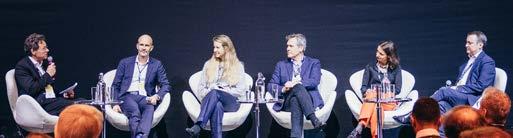
Ideally, strategic investors can provide additional value, such as offtake or technology know-how. We also need financial investors who often balance the investor perspective and bring more professionalism into the governance, the long-term credibility, and prepare the venture for the FID large project financing.
1. Project readiness. The project needs to have moved beyond a conceptual stage. We would not invest in a concept on paper, but ideally, there needs to be a pre-visibility study finished with successful results. Things such as site selection, the first LOIs in place, grid access, etc., must be secured to move the project from a conceptual, early development stage into something more.
2. A credible investor group . GravitHy is an excellent example, as are other ventures such as FertigHy, and a large aluminium development project in Finland, where we have substantial and credible partners. Ideally, strategic investors can provide additional value, such as offtake or technology know-how. We also need financial investors who often balance the investor perspective and bring more professionalism
into the governance, the long-term credibility, and prepare the venture for the FID large project financing.
3. The reinvestment capacity of offtakers . Offtakers must be equipped to handle potential cost overruns.
4. The team. Both in company buildings and regular startups on the technology side, the team is critical.
[Jacob Ruiter] What pitfalls should companies avoid when scaling?
Florent Andrillon
We see two recurring challenges in particular:
1. Operational readiness: moving from concept to the scale-up phase. Many companies are not ready for this phase because they have not anticipated what it means to operate at an industrial scale. For example, in the US, we work with a very innovative company that has a great
product and significant offtake. However, now they need to deliver the product, but they have not prepared their product for industrialisation. We are working with them to miniaturise it down to the instruction level for the operator to assemble the product. They are losing time because they have not yet prepared at this level. It is already very challenging to deliver the project on time and on budget, and this is not a clean tech problem; all industrial projects face this challenge. Even a project like the Berlin airport is known for exceeding time and budget. Many innovators think they need to reach this milestone, but often, what they do not anticipate is the operational readiness. They focus on ramping up quickly to achieve targets, and that is when you burn a lot of cash that sometimes is not part of the business case. That is one of the first common pitfalls, and it is very challenging, but investors are increasingly looking into it.
2. Building first, and digitalising after. This goes against the trend of being digital first, but since many of these companies are building First of a Kind (FOAK), there is not much history to learn from, anticipate failures, and accelerate learning loops to improve your process. That is why we believe it is essential to start by collecting the data and using it to ramp up. This way, the task force preparing the project and optimising processes has the data to learn from and accelerate in solving all those issues. Some companies delve too deeply into AI and data, whereas others should stabilise their processes first and then proceed. We often work with
companies that must pay more because they suddenly realise they need the data for their operations.
Emma Nehrenheim
1. Isolate your project financing. When you move into manufacturing and the scaling rounds, you reevaluate and re-emphasise the project that needs the team’s focus.
2. First, there is the startup phase, then the build-buyonboard type of phase, and then you have your sale and delivery phase. The
❝
the team that is supposed to take us out of Death Valley focuses on managing this, and another investor team trying to pressure management for something else. The phase when you build, deliver, and sell is like a marriage: you have to stay together through it.
[Jacob Ruiter] Is there sometimes a mismatch between the expectations of a financier and what a company can actually promise to deliver on?
A positive mindset fueled our energy. This is a key takeaway: if we want to reindustrialise Europe, we also need to change everyone’s mindset about it. ❞
second and third phases are like a marriage. There are shareholders, the management team, and the lenders. This is not the time to question things. You are in there for better and for worse, to collaborate in hard times. In this phase, team focus is essential. You need to be proactive and address the upcoming complexity, preparing to be agile. Whatever happens, you must return to the initial plan and refine it together, then determine the solution. It cannot be one team focusing on one thing, where
Alice Vieillefosse
Fundraising is a long journey with ups and downs. To some extent, I was really struck during the fundraising process about the problem in Europe is not really the money, but the mindset. During the fundraising process, European financiers focused on the 30 reasons why our project would fail. In these meetings, we were in a defensive mode. On the contrary, when speaking with US investors, they expressed how wonderful it was what we were building. A positive mindset fueled our energy. This
is a key takeaway: if we want to reindustrialise Europe, we also need to change everyone’s mindset about it.
Emma Nehrenheim
We must remember that when the US car industry was on the verge of collapse, including Tesla, $85 billion was put on the table to save it. Today, we are struggling to secure $1.8 billion for the battery industry. Compare $85 billion with $1.8 billion. There is no question that we have to make sure we do it. We have a robust and long tradition in Europe with an excellent industry. It is based on strong processes, with a thorough understanding of every step and every paper. Any established industry would say that all of these startups are sloppy, not yet there, not doing it right, and immature. That the founders do not have the right mindset, and so on. Of course, management must change as the company grows. However, what we do know is that it is one thing to know how it should be in the end, 50 years after it began. It is another thing to have somebody willing to take the personal risk to stick their nose out to do all the selling in this. And if they are not doing it, Europe will not have a strong base industry in any of these fields and will be consumed by other continents that have a tradition of going big and going fast.
[Jacob Ruiter] How do you advise when you see it is time for new skills and leadership approaches?
Florent Andrillon
We often have intimate conversations with the company, and yes, if we see that they lack skills, we help reinforce and accelerate the need for more seniority in a particular function. So that’s where either we help
Clean industrial electrification: Powering our planet, our economy and our security
them provide something or put them in contact and, yes, give this feedback because at different phases companies need different types of profiles. Innovators are good at hunting; a developer spirit is not the same as implementing processes. Sometimes, a company fails to adapt in time. It can be challenging, especially for founders, to hand over to someone else. This is where governance and investors play a key role.
Dr. Philipp Matthes
Discussions concerning personnel can be a delicate matter, but avoiding them does not help. We aim to foster an open discussion and consult with our co-shareholders. The analysis must be done right; what is the position, the risk at stake at the moment, do you have an excellent substitute, or is it only a bet that a successor will be better?
Alice Vieillefosse
The first problem is scale. You have a team that is evolving, and you do not need the same process that we had when we were five people two years ago or 15 last year or 43 today. This
means that the information does not flow the same way. You must reinvent internal processes to ensure that they align with the company’s needs and that employees have the necessary information to perform their jobs effectively. When it comes to people, we do not necessarily need the same skill set at each step, but it is not only on an individual level, but also in how we build a team. The problem in projects like GravitHy is not just how we have built the project, how the financing will work, and the legal side; it is that everyone must work together. So we have not just to find the best person, but we have to build the best team that is able to work together. We must be able to say, ”Okay, I might be a bit late on my stream because you need my help to make your stream work.”
Over the past few months, we have focused on scaling the team; setting the right leadership team and the right team below them. We have focused on this because we know we will need this to evolve in our next step, and we will also need to evolve our mindset. We are still a scaleup. At some point, we will construct a company and then operate. This means that, for example, we are
also starting our safety focus because we have not just to convince everyone of our vision, but we also need to start to have very clear rules that safety is a key priority as an industrial company. Scaling the team is one of the big challenges for leadership. The help from our shareholders is very valuable because they can share their own experiences to ensure that we put the right elements in place at the right moment.
Francois Gaudet
When we talk to CEOs, it is about investing in people. We are investing in the capacity of people to grow. The companies are at a transformational stage. You have all these PhDs that are moving technology. When are you building in the actual production capacity? What are you going to do with all those PhDs? How are you going to transition? Very quickly, you know when a leader can project themselves and the organisation. The first stage is whether they will be able to recognise that they must stop moonlighting in the finance function and that they need to grow. We dig deeper, and it is more complex than just that, but for us on the finance side, that is the first sign we see of leadership.
Marcin Lewenstein, Thematic Field Leader – Energy for Circular Economy at InnoEnergy
Bengt Steinbrecher, Startup Partner at Holcim
Andreas Leitner, Senior Vice President Innovation and Technology at OMV
Marcin Koziorowski, CEO at EcoBean
Ulf Arnesson, Director Strategy and Sales at Stena Recycling Group
Dr. Yun Luo, Co-founder and CEO at ROSI
[Marcin Lewenstein] Where do you see the biggest pull for circular solutions?
Andreas Leitner
OMV is a classical energy company that is now transforming into a chemicals and circular economy company. In the broader OMV group, we also belong to the mechanical and chemical recycling of plastics. Circular economy and recycling of plastics are important, as littering is a massive issue that we need to take care of. This is certainly a
driver and motivation beyond all legislation to tackle this significant challenge.
15 years ago, we developed a process to make oil to replace crude oil with oil based on plastic waste. It turns out this fits very well with the circularity concept. An innovation originally intended for a completely different purpose is now scaled up to a 16,000-tonne plant, operational in Vienna.
Had you asked four or five years ago, customers said we absolutely need this. The role innovation in circularity plays, also over time, is how the economy is developing. The plastics market in Europe
is long, prices are low, and customers prefer virgin materials over circularity. Therefore, the willingness to pay is lower than it was in the past, when every brand owner essentially stated, ”We provide circularity content X% in our products” on their homepage.
Legislation is the make-orbreak for chemical recycling at the moment. The plastic waste regulation will be defined at the end of 2026. First, this will determine the amount of circularity in new plastic products. Second, it also concerns the mass balancing regime. This will determine whether a chemical recycling process yields around 90% or 50%. This means that,
Clean industrial electrification: Powering our planet, our economy and our security
as a company that relies on revenue, this has a huge impact. When you make a 50% yield out of such a project, product, or process, it is clearly very difficult to make it economically feasible.
Ulf Arnesson
The Circular Economy Act, set to take effect in 2026, is particularly interesting. It must be written from a holistic perspective to stimulate circularity in Europe. Legislation needs to support a circular system to create an industry, not only projects.
Bengt Steinbrecher
Construction demolition waste is responsible for up to 40% of global waste volumes. Half of this is demolished concrete, bricks, and rubble—materials that can be reused, repurposed for the same use again. Concrete can be broken up into aggregates and fine materials to make new concrete. From a venture capital perspective, how scalable is such a potential startup opportunity? How scalable is a technology? Is it defensible? From a more strategic perspective, as a construction materials producer and supplier, Holcim has a strong ambition to push that market. We have set ourselves the goal of utilising up to 20 million tonnes of
construction and demolition materials and repurposing them into new materials by 2030. We are currently at about 10 million tonnes. One key challenge to solve is sourcing, as the waste streams are highly decentralised.
[Marcin Lewenstein] In terms of the wealth that you can create out of this type of waste, is this a real money-making opportunity, or does it come more from the conscience and the need to apply circular materials?
Bengt Steinbrecher
There are two levers. First, the avoidance of virgin material used in construction and the CO2 footprint and cost associated with virgin materials. If you can replace fresh cement with something recycled, this can significantly help reduce costs and footprint.
The second lever concerns the handling of the waste. Tipping fees are very high and apply to sizable volumes. Therefore, if the material can be rerouted and reused, that represents a significant cost savings.
[Marcin Lewenstein] What does it take to convince partners to engage and enter into long-term agreements, and how easy or difficult is it to navigate those markets for a startup?
Dr. Yun Luo
We are integrating our innovations in disruptive technologies smoothly into the industry’s development. Today, the high-purity recycling of all raw materials from used solar panels is possible. The key is industrial integration throughout the entire value chain. We start upstream with solar module providers; power plant owners, EPC companies, and PV manufacturers.
Then, we align their mindset downstream; the users of all these high-purity raw materials. The two biggest challenges in recycling are the purity of recycled materials and the fact that they are not exactly like virgin materials. The purer you get, the higher value you can sell to the market. Even the shape can have an impact on the reuse. This means that all of our offtakers must adapt their process to reuse our materials slightly. Our engineering R&D team works closely with our offtakers to achieve a mutual understanding and reintegrate these materials back into their industry.
The mid-stream industrial production is the most challenging to realise our technology in an ecosystem environment. On the industrial operational side, it is not only about the technology, but also the equipment that realises the new technology and integrates
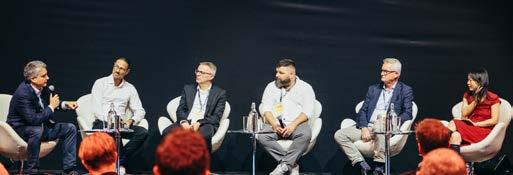
new functions. A large part relates to the facility utility providers, whether their quality and cost reliability can match what we expect as output of the site.
Marcin Koziorowski
Two main drivers are attractive to our customers: the new revenue stream and safety. Upstream, many players want to sell us the coffee grounds at around €200 per tonne. Downstream, players are seeking new natural ingredients, and for them, scale is attractive. We put both sides at the table and explain the huge opportunity. We are the missing piece of the puzzle.
[Marcin Lewenstein] What are the types of triggers that attract you to circular technologies and circular solutions?
Andreas Leitner
We completely underestimated the access to, sorting of, and upgrading of waste to initiate the circular economy. Ownership of waste varies by country. Waste begins with our household bins and the sorting of waste. Significant progress has been made, but there is still a long way to go. New companies need to contribute to accelerating the circular economy. As an established industry player, we can help new companies industrialise, but the rapid development of innovative ideas to truly drive yield in the circular economy must come from small companies. We scale because we want to industrialise and get to the sweet spot of economics.
[Marcin Lewenstein] Looking at the entire landscape of circularity, carbon dioxide, and its utilisation
Two main drivers are attractive to our customers: the new revenue stream and safety. ❞
in particular, is it a feedstock and material, or is it still a nuisance that we are getting rid of or dismissing?
Andreas Leitner
CO2 is a very good feedstock. The question is how you want to get access to CO2. For example, biogenic CO2 is considered green CO2. The CO2 that comes out of the hard-to-abate industry chimney cannot be converted directly to, for example, sustainable fuel, as it is not RFNBO qualified. Direct CO2 air capture is relatively energyintensive. In general, CO2 is an excellent feedstock, and there are available technologies to convert it. What we are actively looking into is bringing CO2 to an intermediate, methanol, and then pushing it downstream until we have sustainable aviation fuel. This closes the bigger circular economy, not only plastic to plastic.
Bengt Steinbrecher
Emissions are a super interesting discussion. There are significant grey emissions from cement plants because they often operate at 99-100% capacity, using alternative fuels or biomass. This component is then a green CO2 when we are capturing it, which comes
with a different price or value tag. Holcim is pushing this very heavily in Europe now. We have seven carbon capture projects underway for seven cement plants in Europe, which means after 2030-ish, we will have captured around 5 million tonnes of CO2.
Where do you go with that material? Storing it somewhere on the ground in the North Sea is not always the best way. It is also not the most cost-efficient. There are ways to convert it into construction materials, for example, with olivine rock that stores a lot of CO2, and we can make a cement replacement from it. Another example is a technology that uses construction demolition materials which also works as a sponge to absorb CO2.
We potentially can even upcycle a little bit in the sense that we are reusing demolished concrete as a sponge for CO2 and use it again for fresh concrete. This is not disruptive in terms of absorbing millions of tonnes of CO2, but it is disruptive in that we play all the levers to decarbonise and drive circularity.
If we are building for construction design today, the waste stream will only happen in 30, 50, or 70 years, the
Clean industrial electrification: Powering our planet, our economy and our security
lifespan of buildings. During this time, we will still have construction demolition waste from traditional construction, and we need to find ways to use that.
[Marcin Lewenstein] As a First of a Kind (FOAK), what type of learnings have you gained from establishing ROSIE and rolling out factories across Europe?
Dr. Yun Luo
Rosie is a technology company. The core personnel all come from the world of technology and industry. Initially, we believed that everything originated from technology. We still believe that, but with a bit more realistic view of the ecosystem around it. The first plant is an operational factory in France and an industrial demonstrator, showing the quality of the process and the quality of the recycled
❝
Therefore, often the preference is given to a proven technology that has been successfully implemented on a large scale. It is not easy to convince pure financial investors about a technology that, although it has already demonstrated the first scale industrialisation, still needs to demonstrate full bigline integration and operational stability. This is why we have blended financing, with the European Investment Bank, grants, and a lot comes from the industrial partners that understand deeply where the risk really sits and how to derisk per industry.
Rosie’s strength lies in processes and the machines. We do not reinvent the wheel for process integration, supervision, and MES. For these areas, we work with big European companies. We have a lot of support from our industrial partners and the European Commission, different countries, and our investors. I am very grateful for their patience.
The transparency of availability and composition of construction demolition materials, the ecosystem and value chain can redirect it to repurpose it in the best value-adding way. ❞
materials to secure offtakers and the supply chain.
The lesson learned from expanding is that it is all about risk appetite. To expand, we need fresh capital. Capital injection is based on the current market situation, which is all linked to risk. In Europe, CVCs or VCs often concentrate on risk related to technology readiness and industrial readiness.
[Marcin Lewenstein] What is one thing that you would ask for in terms of change in your market environment or in the policy that affects you?
Dr. Yun Luo
To accelerate this new industry, the manufacturing of highquality raw materials from waste, we need shared commitment
and shared risk for all the stakeholders involved; upstream, downstream, users, technology providers, the European industry—especially the industry already operational on a big scale. Experience, information, commitment, investment, and risks must be shared.
Ulf Arnesson
The ability to see the entire value chain is key. In Europe, we compete with subsidised markets both in Asia and in the West. What we really need to do is look more at market creation and then maybe subsidise some of that.
Marcin Koziorowski
It is a good time for Ecobean now because the coffee industry prices are booming, margins are shrinking, and Trump’s tariffs makes the coffee industry searching for new revenue streams. So this is the moment for us. Also, a lot of companies in the chemical, food, and cosmetic industries are setting their 2030 goals to switch to natural ingredients.
Andreas Leitner
We want to build an economy, and that requires profitability. Standardising and aligning along the value network for efficiency and scale in the circular economy would enable us to do this without subsidies.
Bengt Steinbrecher
The transparency of availability and composition of construction demolition materials, the ecosystem and value chain can redirect it to repurpose it in the best value-adding way.
Deputy Director General of the Operations Directorate at EIB
It is really an honour to be here today, and I am very excited to stand before this crowd. Not just as a representative of the European Investment Bank (EIB), but also a passionate believer in Europe’s power to lead the clean and climate transition. Today, I want to do more than just inform you. I want to deliver a call for action. We are the global climate champion. So why not also claim the top spot as a global clean tech leader? With that goal in mind, let’s be clear about the point of departure.
Europe is the powerhouse of scientific excellence, worldclass. We have world-class universities and a vibrant startup ecosystem. Our researchers, entrepreneurs, and visionaries have been shaping industries and changing lives in the past decades. But, as we all know, past performance is not a guarantee for future success. Draghi and the Letta reports have made it clear: Europe
is lagging in scaling up innovations and investing in breakthrough technologies. We match the United States in the number of startups. But too many of our brightest stars and ventures leave, especially for the American shores. Why is that? Access to finance and capital is one of the reasons and a persistent barrier to our unicorns staying in Europe. The numbers are stark. €120 billion annual venture investment gap between the US and the EU, with 80 billion of that gap in scale-up and late funding. That should be a wake-up call for all of us.
Europe’s clean transition is increasingly dependent on Asian, and notably Chinese, technologies. The case in point is solar and batteries, critical components for our low-carbon future. We must invest in our own clean tech value chain Made-in-Europe, not just for competitiveness, but also for economic security and resilience. That brings me to what Professor Nicholas Stern called “the Double A Challenge”—

investment and innovation. We must innovate relentlessly and invest boldly all at once and at the same time. It is not enough to invent. We must scale. Technology development is not linear; it is exponential. As Hemingway said of bankruptcy, it happens gradually and then suddenly. The same is true for innovation. The process can be slow, and then, if we are ready, a breakthrough happens, and whole industries can pivot. Case in point is the European offshore wind industry.
We must be ready for that breakthrough moment. When it comes, we need to have tools available for that change. That leads me to ”the Triple A of Finance,” as I call it. Innovation and test technology scale-up do not happen without the right kind of finance. Companies need to tap the right funding
EIB Group just launched the second phase of our Climate Bank Roadmap. We are holding firm on our ambition. We will continue to channel at least 50% of our annual lending to green and climate initiatives, and we are endeavouring to mobilise one trillion in green investment by 2030.
❝
We are investing where it matters most for climate and European competitiveness, including energy systems, clean technology value chains, and a wider clean tech ecosystem. ❞
instruments at the right time and at the right price to build the capital stack for growth. We need funding that is accessible, available and affordable; the triple A. What is needed today is patient risk capital. Yet, there is a dilemma. Risk capital is rarely patient, and patient capital is oftentimes riskaverse. In particular, it seems to be so in Europe. This is where public finance can step in, not just to fill the gaps, but to catalyse, to crowd in private investment. Public banks like EIB can leverage scarce public resources by providing liquidity and offering critical de-risking solutions, absorbing some of the technology as well as market risks that private investors may still shy away from in the early stage of technology development.
We are investing where it matters most for climate and European competitiveness, including energy systems, clean technology value chains, and a wider clean tech ecosystem.
Secondly, under our new €70 billion Tech EU program, we are targeting to catalyse €250 billion in investment by 2027 through equity, quasi-equity, and guarantees. This means solutions for the whole capital stack. The focus here is very clear: support European innovators and tech champions to scale up and grow from idea to IPO, from lab to leadership.
The latest financing initiatives under this program include a €6.5 billion guarantee facility for the European wind tech value chain, and a similar de-risking product is now offered to grid technology companies and manufacturers
to ease their access to funding. To help clean tech companies scale up access to vital working capital, we are launching a €250 million pilot guarantee scheme supported by the European Commission’s InvestEU program. Under this scheme, EIB will again provide a de-risking instrument to commercial banks to free up their lending capacity and improve tech companies’ access to OPEX funding. As we add new tools, we continue, to accelerate our support to the European venture capital ecosystem through the EIF. In addition, we continue to deploy our successful venture debt and investment loan products for innovators and tech champions for growth.
Apart from improving the financing toolkit at our disposal, we are simplifying the rules. We are building typical digital tools, making it easier for innovators, especially smaller companies, to access the finance they need. Accessibility, one of the A’s in the Triple A.
In summary, Europe must do better in creating fertile grounds for tech to grow and stay. We need regulatory simplification: clear, smarter partnerships between public and private and true capital market integration. We need courage, collaboration, and commitment. We have a foundation to build on a vibrant innovation ecosystem and world-class talent. That’s clear.
Policy makers, innovators, investors. Let’s stay courageous. Let’s build a future-proof, competitive, and resilient Europe powered by innovation, talent, and true leadership and agency. The
Clean industrial electrification: Powering our planet, our economy and our security
platform is burning; the time for incremental change is over. We need to jump high.
The proof is in the pudding, and I’m very proud to announce our latest venture debt agreement with Meva Energy!
We can produce our own biogas, and this method could be one way to do so. All in all, we have low costs, decarbonisation and sustainability, and security of supply, addressing all three parts of the energy trilemma. In terms of maturity, we have built our first plant.
Being here at this historical moment for us, this important agreement with the EIB will have a significant impact on our future. It is an agreement that will create financial security for the continued
development of the company, and, more specifically, it enables us to look ahead to five plants already having part of their financing in place, thanks to this deal.
I would like to thank our dear colleagues at the EIB. We are very much looking forward to the partnership now. I also want to thank our friends at InnoEnergy who facilitated this.
- Niclas Davidsson, CEO at Meva Energy
Thank you and congratulations. We said yesterday that TBB is the place where our ecosystem connects, meets, and makes things happen. And this is an example. I am super proud to be here because this investment deal started at the TBB with a first meeting between the EIB team and Meva. This is a great moment that shows the EIB is also adapting to the challenges and walking the talk. It is not only about supporting large-
scale projects, but also about supporting those in the valley of death —a very long, capitalintensive period. Thanks a lot to the EIB and to Elina, for continuing to support clean tech to reach industrial scale here in Europe.
- Elena Bou, Co-founder and Innovation Director at InnoEnergy
Chairman of the Executive Committee and Technical Committees of the “Scale-UP Financing” project at the Ministry of the Economy, Finance and Recovery, France
I guess that most of you have read the 400-page-long Draghi report, right? If you did not, I can summarise it in one sentence: Europe must invest €800 billion per year over the next five years in innovationdriven, high-risk projects. That is a lot of money for many, which is probably why it has so little follow-up. We know what must be done. But the real question is, as always, can we do it at scale and fast enough?
I want to share five ideas drawn from the French experience known as the“TB
Initiative,” and explain why I believe Europe can build on it. To explain what the TB Initiative is: in France, we thought that, because of budget constraints, public money could not fill all the gaps, so we needed to mobilise private capital. We also thought that we needed to focus on equity, which is really the scarce part of the balance sheet. We started seven years ago and convinced 37 institutional long-term investors to commit €13 billion to tech funds, venture growth and listed tech. Most of these investors were insurance companies, family offices, and even a few pension funds that had never invested in venture capital or had direct exposure to technology stocks.
We spent a year explaining the financial opportunity and the logic of diversification. We looked at global benchmarks; the US but also China and smaller countries like Sweden and Israel. Eventually, 21 LPs pledged €6 billion in the first phase of the plan, and 16 other LPs joined three years later, expanding both commitments and confidence. I want to stress that there were no incentives, no carrots or sticks, no obligations. We worked on aligning interests and developing a clear financial story. It was a lot of legwork, and it worked.
The first idea is that Europe has to operate at scale. It is not a choice, it is an obligation. The reason is that our competitors, the US and China, are very aggressive industrial countries. Their industrial policies will weaken us if we stay fragmented. This is also the purpose of their industrial policies. Scaling up means we must allocate access to all European capital pools—not just national ones—to our best project. This is essential for global technology, and this is even more essential for energy tech, which depends on industrial infrastructure and cross-border transnational networks that precisely deliver that scale. So if you want European champions, we must give them European scale financing.
The second idea stems from the fact that, while Europe has the money, it lacks a fully fledged mechanism. We have the money because households’ private savings amount to €35 trillion. Allocating 10% of that would change the game. The question is not the existence
Clean industrial electrification: Powering our planet, our economy and our security
of money, it is the availability. We need to turn savings into capital. This means creating the conditions for investors to take risks, fund innovation, and feel confident that they are protected by sound governance and clear policy.
The third idea is to reinforce our ecosystem of longterm investors and VCs. We need long-term investors who see risk not as danger but as diversification, and competent fund managers who can deploy capital wisely. In Europe, we have a foundation, a relatively small but capable base of funds that can evaluate projects, analyse their leadership and technology, and design structures that match the risk-return profiles of each investor. The real bottleneck is institutional investors’ reluctance to allocate capital to these funds. There are three main reasons for this:
1. The shortage of pension funds in Europe. Despite this, the UK has 3 trillion in its pension funds, and the Netherlands has 1.5
trillion. The challenge is that pension funds are very reluctant to allocate funds to risk and technology.
2. A behavioural inertia. Bonds have been very profitable in the last 40 years of the decrease in interest rates, which few saw reason to move. When LPS do not know an asset class, they do not invest, and then when they do not invest, they do not know the asset class. The cycle repeats.
3. Career risk. You may say that it is very vulgar to look at the incentives of individual people, but you know, individual people make the decision. In the LP community, no one likes taking risks alone. If an investment fails, their career ends. So the environment becomes mimetic. In France, we broke that cycle with a simple recipe and strong political leadership. The president of the republic wanted results and said it explicitly. Then, a collective project under LP governance, with no government control. And third, transparent exposure
of funds to and projects to investors. The keyword is governance. Once the structure is trusted, LPs played the game, and actually, invested more than they initially promised. That is an important lesson for Europe. We need to build trust, not mandates. We must encourage desire, not compulsion.
Strong political capital is indispensable to attract private capital. LPs operate in regulated sectors and listen to signals from the top. Do we have that at the European level? The muted reception of the treaty report gives us part of the answer. Europe’s fragmentation is not only geographic, it is institutional. Within the Commission, our topics are spread across multiple Commissioners, Directorates General, and schemes, each with its own agenda. I do not criticise this in its elevation, but the common picture is a bit blurred. That is
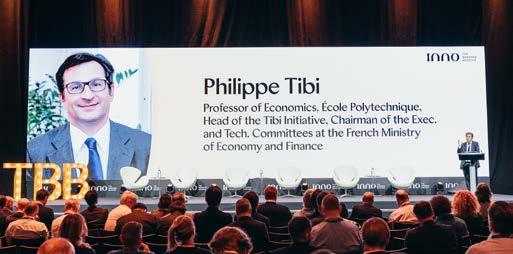
not how you project a unified critical political message that inspires investors.
In addition to strengthening the leadership and making it more visible, we need a clear industrial policy. In Europe, industrial policy is a dirty word because it evokes chronic capitalism, governments favouring the best-connected players regardless of competition. We can do better. The United States is a very liberal country and has a very tough industrial policy. Obviously, China has an
The US system shows a way. I do not say it is perfect, but it is a very good example. A legal framework that supports industrial policies, agencies that select the best projects and sectors, and a predictable environment that allows investors to act with confidence. I am not talking about President Trump. I am talking about the system. We need something equivalent, a European version of DARPA focused on high-impact innovation.
The five ideas need to be
❝... in conjunction with what exists, build fully fledged solutions from the bottom up. Form coalitions, propose operating models to governments, and ask them to connect across borders to move not only at the EU level but also at the intergovernmental level, because this can work much faster. ❞
Public capital must play its role in derisking projects so that private capital can follow. That can mean subsidies, guarantees, co-investments, or long-term offtake agreements. It is very legitimate when projects serve the public interest, as is the case with energy, defence, and deep tech in general. Yet fiscal constraints are very real.
The market, the financial market, the bond market reacts very differently when debt finances a value-created project rather than current expenditure. Borrowing to invest in growth is not the same as borrowing to invest in consumption or pensions. Some of the ideas that we tested in France on a small scale can work in Europe, provided that bold political initiatives match them. And frankly, we have no choice.
industrial policy that has been very effective. There is much talk about strategic autonomy in Europe. Now, it is time to walk the talk. There is no European sovereignty without an explicit plan to focus on future sectors and to protect European operators. To avoid cronyism, we must have strong and respected governance.
private because public money is too small in the current context. However, public money is indispensable. We cannot expect private investors to do what they cannot do by rule. Finance project with distant returns beyond 10 or 12 years, or prototypes and tested technologies or first-of-a-kind (FOAK) industrial prototypes.
My message to industrial leaders is: Do not wait for a perfectly designed public program. It did not work fully before; it will not work now or in the future. Instead, or in conjunction with what exists, build fully fledged solutions from the bottom up. Form coalitions, propose operating models to governments, and ask them to connect across borders to move not only at the EU level but also at the intergovernmental level, because this can work much faster. You do not need to align 27 countries. It is hard, it takes persistence, but what else? Europe has the capital, the talent, and the technology. What we need is confidence, coordination, and courage. If we align political will, public funding, and private ambition, we can close the growth financing gap and turn Europe’s savings into Europe’s future.
Clean industrial electrification: Powering our planet, our economy and our security
María Ramos, TBB2025 Host and Moderator
Tetsuya Shinohara, Executive Vice President, Chief Regional Officer EMEA at Mitsubishi Corporation
Elina Roine, Deputy Director General of the Operations Directorate at EIB
André Borouchaki, Chief Technology Officer & Senior Advisor Strategy & Technology at GE Vernova, Electrification Segment
Luis Marçal, Smart Infrastructure Business Head at Siemens
Taavi Madiberk, CEO & Co-Founder at Skeleton Technologies
[María Ramos] What is the one thing that you believe Europe must get right to make its grid clean, secure, and stable?
Luis Marçal
A couple of key things:
1. Complexity. The energy transition requires many things that did not exist in the energy system in the past. Different technologies, different speeds of decision-making, and the
sense of urgency is growing and accelerating, but at the same time, we need to live with what exists. In energy systems, there are no technological disruptions. We need to live with the systems as they are and develop them in addition. We live with technologies for 60-70 years that every year have small jumps. To decarbonise and electrify by creating these greener alternatives, you need the proper technologies on top. When doing that, the grid becomes more complex and difficult to balance,
for which you need new technologies, such as Skeleton’s products.
2. More and new types of power. More electrointensive industries are consuming more and new types of power. How do we adapt fast in a journey that seems long, but the speed of making that happen is really fast?
The challenge is how to bring together all these different needs and balance innovation investments without increasing prices for consumers.
Japan and Europe are facing the same challenge in terms of pursuing decarbonisation and energy security. ❞
Tetsuya Shinohara
As the Japanese saying goes: Europe needs ”three arrows,” 1. Policy, 2. Market, and 3. Technology to fly in the same direction.
Japan and Europe are facing the same challenge in terms of pursuing decarbonisation and energy security. Japan’s experience in balancing both challenges may provide several insights for Europe.
First, in March 2011, a massive earthquake in the eastern part of Japan revealed the limitations of Japan’s power system. While there was sufficient electricity nationwide, the power transmission infrastructure between regions was limiting the region’s ability to supply electricity to the eastern part of Japan, where it was needed. Power companies are divided by region, and there was no nationwide organisation in charge.
The Organization for Crossregional Coordination of Transmission Operators (OCCTO) was established as a public organisation responsible for nationwide supply and demand balancing, as well as grid development planning. This broad coordination framework has enabled Japan to achieve both stable supply and efficiency.
Second, Japan has also developed an institutional mechanism to encourage longterm investment. In addition to wholesale electricity markets, Japan has introduced capacity markets, adjustment markets, and no-fossil-value trading schemes to support investments in flexible and low-carbon power sources. This multi-layered market design is also attracting interest in Europe.
Third, the policy, industry, and technological development have been promoted in a
consistent manner under the Seventh Basic Energy Plan by the Japanese government. This consistency has supported long-term investment decisions by private companies.
Mitsubishi Corporation seeks to deepen our future cooperation, particularly from the perspective of balancing the centralisation and stable energy supply, and promoting long-term investment through public-private collaboration.
Elina Roine
I could talk about investment mobilisation, financing, regulation, simplification, but I am going to say that we need to think big and out of the box. By that, I mean to think beyond national borders. We will need an integrated, interconnected grid to enable electrification and improve our energy security. We must invest in interconnecting the European grid to enhance its resilience and ultimately enable electrification. There is no low-carbon transition without a Europe-wide transmission system, and ultimately, energy security is key to European competitiveness as well.
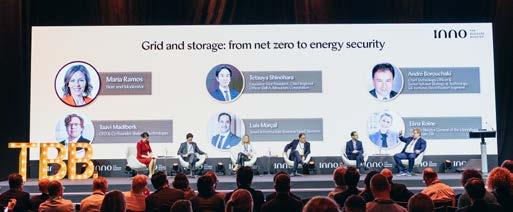
industrial electrification: Powering our planet, our economy and our security
André Borouchaki
Without a modernised grid, there will be no energy transition. The grid is already 67 years old. It has been built to bring central generation to usage through transmission distribution. Today, with renewable energy, you need a two-way direction. The user could become a producer as well, and today, almost 50% of the electricity in Europe is already renewable. If you add nuclear on top, it would be 75%. What happens when 1.7 TWh of renewable energy is queuing to connect to the grid? Why? The grid is not ready because there is no capacity. We need all of us united at European level to bring this modernised grid a reality for tomorrow.
Taavi Madiberk
When it comes to energy security, we are not just talking about the laws of physics, the loads of renewables, or data centres; we need to ensure that we understand this is also a security matter. We also have more interconnectedness,
❝
second of power to maintain stable inertia. This is what avoids issues similar to those during the Spanish blackout. We need to change the mentality to think about what winning looks like. Not only defending European security. If you want to win, you need technologies that differentiate globally. These investments are not just about defending and saving Europe. It is also about creating export potential.
[María Ramos] What makes Europe’s grids so unique, and what are the biggest challenges that they are facing?
Taavi Madiberk
We need to go for renewable energy on the grid. However, this takes away the stability that comes with coal or nuclear. Solar panels create no inertia. To solve it, we
We need flexibility and security, and it cannot be done at the country level, it must be done at the European level. ❞
but we might not focus as much on the fact that we do not fuel the grid with coal or gas, which helps maintain inertia. From renewables, you have constant fluctuations, and you need a safety belt. This is what Skeleton offers to German transmission system operators: we have 200 megawatt units for one
need direct investments. We are not talking about €50 billion, but across Europe, investments of around €6 to 8 billion are needed to secure that frequency with the transmission system operators and solve the entire issue. We need to address the grid topic in more detail, not as a general policy.
The topic of cybersecurity is important. What would you do if you were without electricity for 72 hours? The modern society collapses without electricity. This is not a topic just for power grid people or renewables people, but a question of European security, and we need to go on with the investments.
André Borouchaki
We have invested in the grid capacity through renewable, but we have forgotten to invest in the grid. However, we must do it and cyber security is part of it. We need flexibility and security, and it cannot be done at the country level, it must be done at the European level. We need more interconnectivity between the grids in different countries, and technologies are available. Subsidies are also available at the European level. Now we need the willingness to take action.
The investment needs are massive and multifaceted. It is not only about capacity expansion, but also about resilience, cybersecurity, and smart grids. Not to be forgotten is the value chain, as technology producers and Taavi mentioned the need for investment in the entire grid value chain in Europe. Financing is one lever that can mobilise investments. Last year, the EIB financed a total of €8.5 billion in grid investment in Europe. That accounted for 40% of the total investments made. As you can see, we are lagging far behind the investment needs compared to our annual investment.
We need smart incentives and a toolkit for funding. It is not only about the patient, long-term capital. It is also equity and blended finance
derisking instruments. That is what EIB is there for. We also need capital markets to integrate. TSOs could benefit from better access to capital markets through bond markets. At the same time, it is really important to consider that currently the European grids are very fragmented and that also poses a financing challenge. How we fund TSOs and DSOs in different markets depends on the market structure and the capacity of these entities to implement investments and borrow.
My message is that financing is an important piece of the puzzle, but we also need to think big and innovate in terms of financing, as we need Europe-wide solutions.
of Skeleton in the US, focusing on AI infrastructure. To make AI cheaper and more energy efficient.
What is the difference between Europe and the US? In the US, nobody cares as much about energy efficiency because the focus is on speed to market and computing power. In their cost structure, energy is maybe 10% of the cost. In Europe, we do not have low energy prices. If we do not have smart regulations on energy efficiency in AI, we will drive up the prices for consumers, and the industry will become even less competitive.
The same principle applies from the power grid side. US hyperscalers have the capital
❝
... financing is an important piece of the puzzle, but we also need to think big and innovate in terms of financing. ❞
Taavi Madiberk
In Europe, our energy prices are already very high for both consumers and industry. Adding AI to the mix will further raise the prices. 40% of the energy in AI is wasted. From the power capacity perspective, because AI peak shaving is not implemented, we are overinvesting in the power grid by a factor of two. AI peak shaving has become the core business
and are less concerned about the cost of power connections. However, European taxpayers will need to pay for this in the grid, and when we do not have the funding for the right investment in the interconnectedness of cybersecurity, as well as addressing the renewables and stability issues.
[María Ramos] What technologies work best for short versus long duration needs?
André Borouchaki
We have to make the grids connectable. The way we help our customer is first designing what exactly their needs are through a consulting approach.
Then we bring all the solutions from the generation to battery storage, transportation and distribution, and finally, we provide the services needed. Technologies are available, and we are not the only ones; we must all come together for this. What does modernising the grid mean? We need flexibility from all the new electrointensive industries, including data centres. Old data centres with a predictable load through a standard IT system are gone. Now it is about AI factories with a high variation in peak load, and we need to ask the new data centre to bring flexibility back to the grid. That is the only way to become self-sufficient at the European level for the future data centre we want to offer.
[María Ramos] What deserves more focus right now?
Elina Roine
The technologies needed for the clean energy transition are available, but approximately one-third are still at the innovation or demonstration stage. Therefore, we need to continue innovating, investing in, and scaling up existing technologies. The scaleup challenge is big, but at
Clean industrial electrification: Powering our planet, our economy and our security
the same time, we need to continue innovating, and for that, EIB is technology-neutral. We need both short- and longduration batteries. People and businesses that have installed renewable capacities are now also investing in storage to maximise the benefits of their investment. Those technologies are already relatively mature. Long-duration batteries are necessary for grid stability and industries. These technologies are not yet as mature.
[María Ramos] What deserves more focus right now?
Luis Marçal
The strength of Europe is that there is so much creativity and diversity, people with different challenges all coming together. That is what makes the difference, and that is the power factor of Europe.
[María Ramos] What is that one thing we need to get right immediately to future-proof the grid in Europe?
Tetsuya Shinohara
It is important to build institutional confidence and trust, which allows for long-
term investment for private companies to invest with confidence. Policy consistency, institutional transparency, and long-term stability are essential. A clear direction creates trust, drives investment that, in turn, builds the next great technology. Maintaining this cycle is a key to energy security in this decarbonised era.
Elina Roine
We need to think big, systemwide: interconnected Europe-wide systems. Incremental change is no longer an option; we need a step change, which is about regulations, incentives, market integration, and various financial instruments.
André Borouchaki
The International Energy Agency projects that we need almost €600 billion in investments by 2030. And we need to do it at the system-level, interconnecting all the countries grids.
Luis Marçal
We have a crucial role to play; to collaborate among ourselves, sharing investments,
innovations, and staying close to the entities that create incentives, subsidies, and regulations to understand what can be done faster.
This conference and this association are really relevant to put us all on the same level of understanding to move forward, because we can talk about problems, but problems do not solve themselves. We need to decide. Not deciding is also a decision, and that is many times what we need to start doing; take decisions and make things happen.
Taavi Madiberk
We need a winning mentality. We are playing catch-up when we are thinking about what the US and China are doing, and that maybe we can do something similar. We need to shift to what winning looks like. Out of the top 20 tech companies globally, we need at least five from Europe.
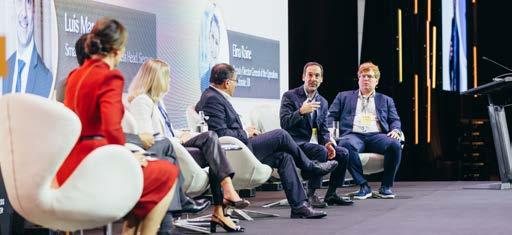
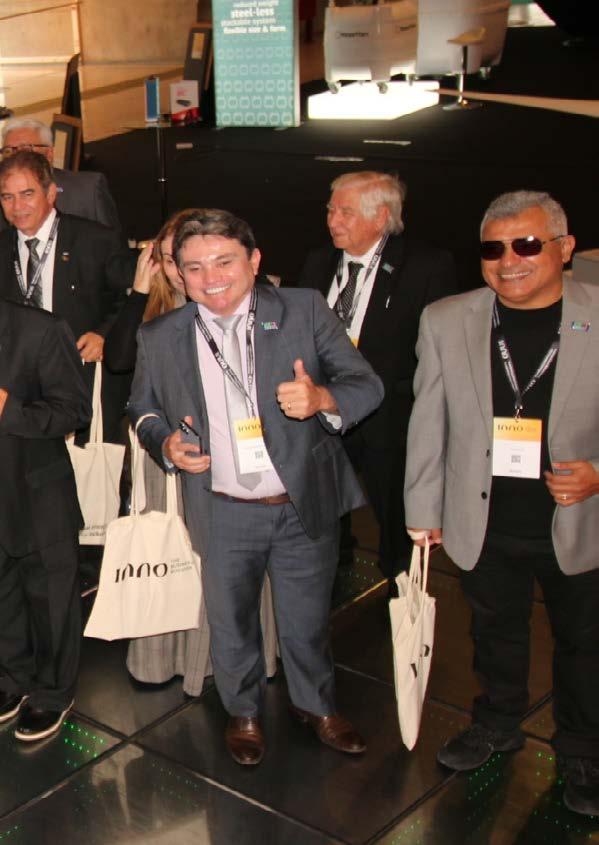
Clean industrial electrification: Powering our planet, our economy and our security
Jeremiah Dutton, CCUS Venture Builder at InnoEnergy
Olivier Sala, Group Vice President Research and Innovation at ENGIE
Marco Ferraz, Head of Upstream and Industrial Innovation Center at Galp
Raphaël Vaquer, Director - Energy Advisory and Project Finance at Societe Generale
Eduardo Martinez Granados, Director at Energy and Infrastructure Finance at ING
Nicolas Jensen, Director of Business Development S. Europe & N. America/Public Affairs Director at Enosis
[Jeremiah Dutton] Looking ahead to 2030, and I’ll even open it up a little bit further, 2035-2040. What would success look like for you for the bioCCUS in Europe?
Olivier Sala
Among our assets, two types generate biogenic CO2: anaerobic digestors, which produce biomethane, and biomass plants, which generate heat and/or electricity.
We valorise this CO2 from digesters to use, for example, in greenhouses to boost plant production. The market size of CO2 in France is 700-1 million tonnes of CO2, out of which 70% is food and beverage, and 30% is industrial, such as cryogenic cleaning, water treatment, and greenhouse agriculture.
When there is regional proximity, biogenic CO2 is really cost-competitive, around €100 per tonne. It provides an additional revenue stream for biomethane production, and it is also good news for market opportunities for biogenic CO2.
Engie, we are also working on the infrastructure needed to support this emerging CO2 value chain, leveraging our expertise in gas infrastructure for storage, transport, etc.
Beyond what can be done now, there is a huge potential over the next decade and beyond, as demand for biogenic CO2 will grow a lot due to two major drivers. First, the production of e-fuels to decarbonise aviation and maritime transport, because there is no alternative way to decarbonise. Second, CO2 can serve as a renewable feedstock for the chemical industry. Today, two-
... carbon removal technologies must contribute to the volume needed. ❞
thirds of the carbon footprint is embedded in products within the chemical industry, which means it is not about decarbonising but defossilizing the carbon in these products.
The emerging e-fuel market is on a large scale, with projects underway in Chile, Morocco, and Saudi Arabia. The project in Morocco needs around 900,000 tonnes of CO2 to produce E-methanol. In Saudi Arabia, a project that is scheduled to be commissioned by 2030 will require 6 million tonnes of CO2.
This means the biomass feedstock will not be sufficient. In addition, carbon removal technologies must contribute to the volume needed. In the long run, biogenic CO2 will remain more competitive than direct air capture. Biogenic CO2 will be a strategic lever.
Marco Ferraz
What we have on CO2 is a mass balance problem. Galp is a producer and refiner of fossil fuels, where we extract
something that was stored for millions of years and release the associated CO2 into the atmosphere. Biogenic CO2 is a short-term cycle that is related to biomass and other products. We tell our engineers to focus on solving the issue of the lifecycle, the mass balance between these two.
Today, we produce a lot of carbon—including CO2—but carbon is essential for us to produce hydrocarbons. We are using those natural hydrocarbons every day. We need to produce a synthetic hydrocarbon, it is a natural space to occupy to continue the production of fossil fuels and slowly start scaling it down to begin the production of biouels, which we are doing as we speak. At the same time, to turn that carbon from a liability into an asset you need to put it on a product that someone is willing to pay for. At the same time we will solve the mass balance issue. This is where biogenic CO2 comes in; we can use industrial CO2
until 2040 and then, regulation limits us to use biogenic CO2 instead of industrial.
A normal fuel project needs at least 1 million tonnes to be economically viable. There needs to be a market for selling or trading green carbon that enables the production of high valuable products. For this, companies need incentives to sell
And if you produce 1 million tons of grey and someone produces 1 million tons of green, you need to offset. There must also be permanent storage to compensate for the amount of CO2. This impacts the economic aspect of the project; transporting molecules from one side to the other incurs additional costs. Another consideration is the social acceptance because putting a pipeline of CO2 might not be accepted, so it might be easier to convince people of this trade-off in the end.
The UK is a good example of how to start things and bring capital. Looking long-term to 2050, the UK’s ambition is to create a CCUS market. Once created, the UK will transition to a more sustainable market because the UK cluster has a lot of government support to mitigate a number of risks in terms of storage and the price of CO2.
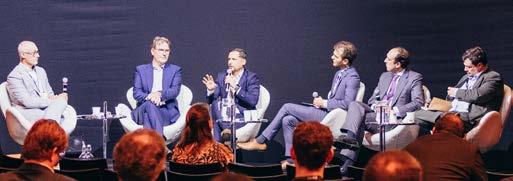
Clean industrial electrification: Powering our planet, our economy and our security
Eduardo Martinez Granados
In Iberia, the biogas and biomethane market is just starting. There is a very high potential from the region, ranking as number three after Germany and France. Now, we need to create the market, and we can learn from the UK. In 2030-2040, projects will start to come ahead, much thanks to the sustainable fuels and the development of that industry.
Nicolas Jensen
At Enosis, we are active in France and expanding our activities to southern Europe, as well as in Denmark, through our recently established subsidiary. We are looking at biomethanation as a technology, and we are a technology manufacturer. We can provide as an OEM, and we also develop projects
together with partners where we take hydrogen CO2, looking at biogenic CO2, and through a methanation process, we transform it into a different product, E-methane, which is very fungible and easy to consume. Similar to biomethane, it can be injected into the grid and consumed.
Success in the short term means getting projects off the ground between now and 2030. We currently have a demonstration plant in northern France producing 1 GWh annually. It converts CO2 100% in the process, and we get 99% CH4. So, E-methane purity at the exit means that the technology works.
❝
In 2030-2040, projects will start to come ahead, much thanks to the sustainable fuels and the development of that industry. ❞
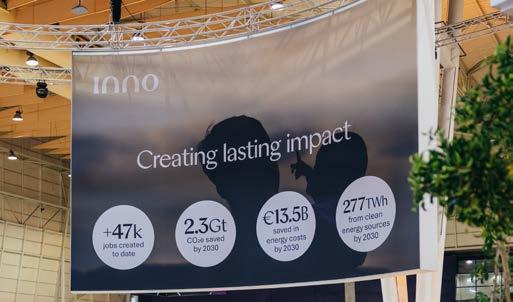
Alexander Goos, Head of Asset Management at InnoEnergy
Francois Koppenol, Partner Corporate/M&A and PE (advocaat) at Meijburg Legal
Francisco Prata, Energy Security Officer at Nato HQ
Johan Söderbom, Thematic Leader in Smart Grids and Energy Storage at InnoEnergy
Rita Sousa, Partner at Faber VC
Rob Anstey, CEO at GDI
Elviss Straupenieks, Chief Growth Officer at Hepta Insights
Patrik Möller, CEO and co-founder at CorPower Ocean
Johan Karlsson, Business Developer & Asset Manager at REPONO
Manuel Lemos, Co-Founder and CEO at Enline
Johan Söderbom
Europe has an electricity market that generates approximately 3,000 TWh of electricity annually within the system. Outside, there are approximately 10,000 TWh of
energy, comprised of fossil fuels. Europe has decided to double the electricity market in a few years. Decarbonising means we are increasing the stability of the system. To do this, the grid is extremely important.
According to Wikipedia, resilience is the ability to recover from the shock of some disturbance. For us, it means maintaining sufficient energy distribution in a disturbed situation. The
primary fuel supply to Europe is 60%, sourced from relatively unstable sources, which means we are highly exposed to political risk and logistical problems. The future situation with double the electricity capacity in the system, added from distributed generation by renewable sources, over which we have more control. In distributed generation, we get a more self-organising system with fewer centralised nodes. Today, the centralised nodes are part of the problem.
In terms of flexibility, there is a slow pace of technology development in the incumbent system, and it is very challenging to change the established big players. In the new system, we need to add new technologies, and we need rapid deployment. In one instance, 15% of the gas supply to Europe was wiped out. This had an enormous impact and still has an effect on infrastructure cost and electricity cost in Europe.
Johan Söderbom
Considering the defensive aspect of this, where the threat is of a military kind, we must examine what else could be done by a future system. Well, such a system can actually even help defence. For example, we have massive offshore wind installations that can serve as a platform for both above-ground and underwater surveillance systems. A startup called
Elevated Launch is already underway and making this happen.
Another example is transport electrification, which provides us with several new refuelling options for the system, eliminating the need to transport liquid fuels and tankers. From that perspective, electrification also enhances the system’s resilience. The development of battery technology for military drones has immensely improved battery performance, and civilian society is benefiting from this advancement.
We need to deploy technologies that fit into this new system quickly—which means permitting things of that nature must be fast—and we need to increase the capacity of the grid. CorPower is here in the room today, and you can talk to them outside. They provide a new form of renewable energy source that, for example, can be deployed offshore in conjunction with offshore wind. This immediately increases the system’s resilience.
Maintaining the stability of the electricity system is also super important. For that, long-
duration energy storage (LDES), short-term stability measures, microgrid, islanding capabilities, and an efficient way of re-routing and increasing transmission capacity are required. Repono, for example, deploys battery storage and also provides something called grid-forming capacity to the system, which actually builds the system, not just stabilises it. Enline is here with their digital twin, which allows for a better understanding of what the grid looks like and increases the capacity of the existing infrastructure.
We must also understand the existing hardware infrastructure and the status of the grid. When something goes wrong, we must also have mediation. For that, Hepta Insights here offers a very interesting way of surveilling the system from a maintenance perspective and gives an excellent, quick overview of what the grid looks like. And, GDI’s technology increases battery capacity.
A big congratulations to Enosis, Taisan, and Ecobean!
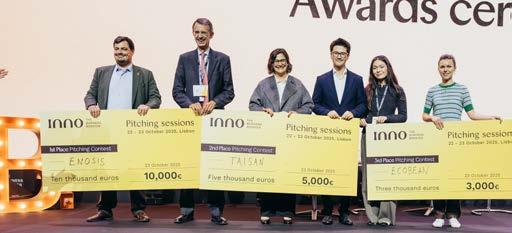

Clean industrial electrification: Powering our planet, our economy and our security