S
teven LaBroi knew that he was going into a challenging field when he got involved in life insurance, but he quickly ran into issues that were hundreds of years in the making. “There was a gap in really understanding why this industry seems to work for some and why there are so many stereotypes, so many clichés and so many misnomers in the other communities,” LaBroi said. LIMRA data on why consumers buy life insurance shows that some of those clichés Steven LaBroi still exist in some communities. Among African Americans, for example, 31% buy life insurance to cover burial expenses, a far higher percent than other groups. As an African American, LaBroi sees the legacy that led to that perspective. “That’s what was offered in the African American community,” LaBroi said. “You have to remember there were 60-some African American insurance companies in this country in the early 1900s.” Those companies focused on the concept of burial insurance because wealth was only starting to build in African American communities. As those companies died off, larger insurance companies were slow to move into that market. LaBroi wanted to shift that thinking in his Washington, D.C., home base. He saw that people in his community needed to think of generational wealth-building. He conveys that to clients directly as well as in articles and his book, Build Your Human Equity Line of Credit. “In a lot of my writings, I tell people that, ‘You are the legacy change. You’re the person who begins this process in the family. Maybe other cultures began it three generations ago, but now is your turn for your grandkids and great-grandkids to understand it,’” LaBroi said. “And I’ve been able to get people to pay attention to it.” During this Life Insurance Awareness Month, the industry finds itself being pulled in a few directions. » Underserved markets. Life insurance
2019 LIFE INSURANCE STATUS REPORT COVER STORY sellers have been moving upmarket for decades, selling fewer policies but at higher premium. To expand policy count, sellers will need to move into unfamiliar markets that have not been well-served. » Complex products. The areas of growth often involve multipliers, bonuses, proprietary indexes and riders that add value to life insurance, but also add complexity that can confuse clients and catch the attention of regulators. » High-net-worth market. Even though sales have moved upmarket, they are not hitting households with more than $1 million in assets. » Product reboots. Jan. 1 is the effective date for a few requirements, such as the newest commissioners standard ordinary, or CSO, mortality table and switching to principle-based reserving. All products will have to be restructured.
In fact, cash accumulation products such as IUL increased from 45% of all universal life products in 2016 to 57% in 2018. While IUL has been booming, the stalwart whole life product segment has also been climbing — but in a slow, steady march. “We’ve seen pretty strong growth after the recession a decade ago,” Tumicki said. “It’s leveled out a little bit, but we’re still seeing fairly steady whole life sales, and we are also predicting modest increases in whole life over the next couple of years.” The typical whole life sellers, mutual companies, have been able to market their steadiness in the post-crash years (as opposed to stock companies) and make good use of its field force. The only cloud Tumicki saw on the whole life horizon was in the form of low interest rates, which are likely to drop further after the Federal Reserve cut its fund rate a quarter point in July. The Fed may cut the rate again in September, particu-
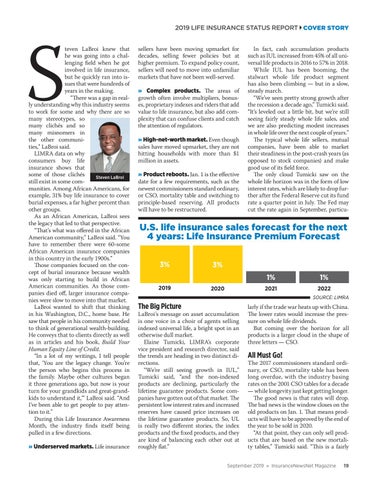
U.S. life insurance sales forecast for the next 4 years: Life Insurance Premium Forecast 3%
3% 1%
2019
2020
2021
1% 2022 SOURCE: LIMRA
The Big Picture
LaBroi’s message on asset accumulation is one voice in a choir of agents selling indexed universal life, a bright spot in an otherwise dull market. Elaine Tumicki, LIMRA’s corporate vice president and research director, said the trends are heading in two distinct directions. “We’re still seeing growth in IUL,” Tumicki said, “and the non-indexed products are declining, particularly the lifetime guarantee products. Some companies have gotten out of that market. The persistent low interest rates and increased reserves have caused price increases on the lifetime guarantee products. So, UL is really two different stories, the index products and the fixed products, and they are kind of balancing each other out at roughly flat.”
larly if the trade war heats up with China. The lower rates would increase the pressure on whole life dividends. But coming over the horizon for all products is a larger cloud in the shape of three letters — CSO.
All Must Go!
The 2017 commissioners standard ordinary, or CSO, mortality table has been long overdue, with the industry basing rates on the 2001 CSO tables for a decade — while longevity just kept getting longer. The good news is that rates will drop. The bad news is the window closes on the old products on Jan. 1. That means products will have to be approved by the end of the year to be sold in 2020. “At that point, they can only sell products that are based on the new mortality tables,” Tumicki said. “This is a fairly
September 2019 » InsuranceNewsNet Magazine
19