INDIA NEWS
Oct 1-15, 2021 - Vol 2, Issue 7
SPECIAL FEATURE
The hocus pocus about Quad and AUKUS By Saeed Naqvi
R
obert Blackwill, US ambassador at the time of anti-terror fireworks over Afghanistan, had established a tradition of seating guests at lunch around a circular table, where he grandly held forth, initiating a discussion. "Imagine I am Henry Kissinger" would be one of his opening gambits. An idea was tossed up. A discussion followed. The one who spoke the most, ate the least, because all plates were removed in one swoop.
"Musharraf has joined us in our global war on terror. What you are talking about is your old regional quarrel." Juxtapose this with the Quad-AUKUS equation. Atal Bihari Vajpayee, as Prime Minister, had hosted President Bill Clinton for five full days in January 2000, just the previous year. Clinton spent just five hours in Islamabad, mostly chastising Musharraf for disrupting regional peace since Kargil. New Delhi was in seventh heaven. Terms of endearment with Washington had radically altered.
On one such occasion, before soup was served, the ambassador announced with considerable satisfaction that Pakistan's President Musharraf had decided to join the global war on terror as the frontline state.
In a little over a year, had George W Bush reversed that equation? Pakistan was incorporated into the global war on terror even as New Delhi cried foul. Pakistan was in the 'A' team against terror; we were not.
Seated to my right the late Pranab Mukherjee, was agitated. He whispered his anger to me. It was uncanny. What he whispered was exactly the question shaping up in my mind. I raised my hand: "You are aware that New Delhi had complained consistently about cross-border terrorism from Pakistan particularly since 1989." Pranab Da (as Mukherjee was affectionately addressed) completed my question in his typical arrangement of words: "It is most worrying no doubt -- you now have Pakistan as the frontline state in your war against terror?" pause. "They perpetrate terror against this country."
Likewise, there is this idea of Quad in which New Delhi is such an enthusiastic participant. Australians and the Japanese did, frequently, vent their scepticism, invested as they were in the Chinese economy. After the American debacle in Kabul, however, Tokyo's misgivings on Quad were all over the Japanese media. The haemorrhage had to be forestalled.
Blackwill spoke volumes in two brief sentences:
With the suddenness of revelation came the announcement of AUKUS (Australia, UK, US), the powerful military alliance in the Indo-Pacific of which India alas, is not a partner. So, New Delhi is trying to pack content into an abruptly devalued Quad. Did Prime Minister Narendra Modi's
photograph with Australian Prime Minister Scott Morrison on the margins of the UNGA, flatter New Delhi? Pardon my complexes, does not a leader wearing AUKUS plus Quad badges dwarf the one with a frayed Quad pinned to the lapel? I would not go as far as the wag who takes the uncharitable view that the US takes India for granted exactly as secular political parties regard the Muslim vote: where else can they go? AUKUS must have been in the works for some time but it was sprung upon the world when the US felt the earth move from beneath its feet in Kabul. The furious response from France only disguises anger in the EU which is talking of security outside NATO. That AUKUS is a purely Anglophone grouping should not be a surprise. Games have been played before to keep some clubs racially segregated. For instance, when the collapse of the Soviet Union in 1991 placed a question mark on the need for NATO, Margaret Thatcher, then on a trip to Helsinki, was asked by a reporter: Now that the Soviet threat has gone, what was the justification for Britain's nuclear deterrent?
Thatcher shot back, "We still have a problem in the Middle East." Thereafter, along with George Bush the senior, she began to put together "a coalition of the willing" ostensibly to oust Saddam Hussain from Kuwait. Saddamin-Kuwait was the ignition point,
not the larger perspective against which Operation Desert Storm of 1991 was designed.
Anglophone dominance of the world order since World War II, faced a challenge. Soviet collapse had brought about a reunification of Germany. This at a time when the Japanese economy was booming. It was easy to raise the spectre of AXIS, without actually mentioning the 'A' word. France, always ready with its own compass to navigate world affairs, initially dragged its feet on the coalition led by US and UK. President Francoise Mitterrand was among the last to join the "coalition of the willing". It was the biggest military coalition since 1945 -- a grouping of 39 countries. Given their obsession, Pundits may be interested to know that Pakistan was part of that coalition. As one who covered the story from Baghdad, I am possibly the only Indian witness who can confirm that the show was run exclusively by the US and Britain. There were two separate press briefings, for the US and British media by their respective spokesmen. French journalists, like the lonesome me, were on the outside. It may be added in parenthesis, that the British media on this occasion were the poor cousins. From the terrace of the Al Rashied hotel, Peter Arnett of CNN inaugurated what came to be known as the global media. The war was brought live into the world's drawing rooms.
John Simpson of the BBC, by comparison, cut a sorry figure, walking around with a satellite telephone. It was only after being beaten by CNN during Operation Desert Storm that the BBC World Service TV was launched. To revert to AUKUS, yes, the French fury is understandable. Not only was a $90 billion submarine order being stolen, but an Anglophone dominated world order was being perpetuated. This is what infuriated President Emmanuel Macron. It just so happens that the turn of events has also provided Macron with an occasion to fall back on a de Gaulle style nationalism just when his ratings are plummeting and all manner of candidates are tossing their hats in the ring for the next elections. (Saeed Naqvi is a senior commentator on political and diplomatic issues. The views expressed are personal. He can be reached on saeednaqvi@hotmail. com)
The Indian Feminist Staple: Remembering Kamla Bhasin By Priyam Sinha She candidly remarked: “My honor is not in my vagina.” An outburst of laughter filled the sets of Satyameva Jayate with Kamlaji’s explanation of patriarchy, which was catchy, witty, and insightful at the same time. In life seldom do we meet people who mark their place in our conscience. Kamla ji was one such brave soul who battled patriarchy with a smile. Her demise on 24th September 2021 induced in me a sense of void and I reminisced my journey of theorising feminism where her contribution had been immense. In 2012 she recited Kyunki main ladki hoon, mujhe padhna hai in an auditorium packed with women. I was sitting in awe, cheering in astonishment, and absolute disbelief in how confidently she spoke about being gazed at and discussed sexual performance pressure. The gathering lauded the ease with which she broke down how feminists were not “anti-men” and “man haters.” Instead, she explained that feminism merely challenges gendered ideological constructs. I was 18, just a few days into college, conflicted and disturbed by the increasing
www.indianews.com.au
cases of violence against women, questioning why women are accused and shamed for being harassed. Her speech coincided with the troubled period when the Delhi Gang Rape Case led to public uproar on how Delhi was unsafe for young women. The brutality and relatability of the case in middle class households essentialised the need for every parent to warn their daughters to suppress anger and not retort to eve teasing. I remember how my parents could relate with the agony of her mourning parents and I remained infuriated and helpless thinking about men’s entitlement to target women. I acknowledge Kamla ji’s words which reiterated how victim shaming formed the most explicit form of targeted violence of the abused. One may wonder if men were to be blamed, she clarified by advocating that it was not the case as feminism is not ingrained in “biology” but strongly rooted in “ideology”. I remember asking her what held women back from lodging a complaint. She smiled and said, “To battle with one’s own family which is the hardest.” A few years after, while pursuing my Master’s in Women’s Studies, I learnt the value of each word
she said. And now I articulate that an anomaly from the Indian womanhood construct instantly labels you as threatening as it challenges the social fabric of a family. Kamla ji spoke about how masculinity is constructed to legitimise men’s power, authority and control over women, her body and eventually strips off her agency. She drew pages from her life of being subjected to domestic violence in a public gathering while cautioning young women to never remain silent. I was unable to fathom her courage to redefine Indian womanhood by arguing that feminism is not about men versus women as it oppresses men and women differently. She always asserted how smashing patriarchy would not deny men their rights but delegitimise the normalised expression of power by men on women to make it a levelling ground. Her contribution stands out in establishing Sangat: A Feminist Network and Jagori to support women in distress and eventually publicised a global movement through One Billion Rising with the message of ending violence against women. She was one of the first arguing against linguistic hierarchies, historical and socio-cultural connotations
facebook.com/indianewsaustralia
of ‘pati’ and how it puts husbands on a pedestal of being the owner. Her ability to simplistically articulate about misogyny in everyday lives within abusive relationships, subtle and explicit forms of gendered violence was remarkable. Similarly, her books stood out as texts to empower women across rural, urban, and diasporic India. Borders & Boundaries: Women in India’s Partition provided a historical lens of viewing women who were vehemently targeted, harassed and abused under the purview of nation-state politics. Quite contrastingly Understanding Masculinity advocated how regional, communal, linguistic, and elitist politics hierarchised men differently who are also troubled by gendered hypocrisies. Being a breadwinner of the family, the male patriarch limits his own desires and ambitions which dehumanises them the most, often leaving them crippled. Lastly, she put forth a different cultural connotation of “azaadi” by asserting women’s vigilance to reflect on how patriarchy curtails freedom to live with dignity. The essence of which holds contemporary relevance
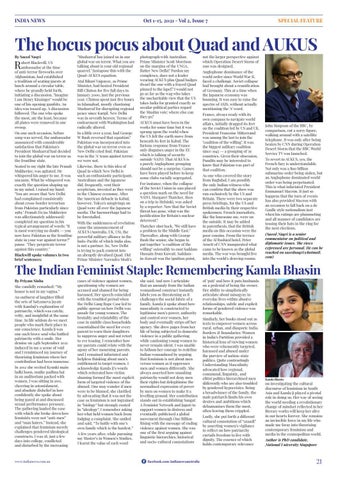
Kamla Bhasin
on investigating the cultural discourse of feminism in South Asia and Kamla ji played a pivotal role in doing so. Her way of seeing the world needing a revolutionary change of mindset reflected in her literary works will keep her alive in our hearts forever. She remains an invincible force in my life who made me foray into theorising contemporary feminism and media in the cosmopolitan world. Author is PhD candidate, National University Singapore
21