IC Newsletter
SPRING/SUMMER 2022
SPRING/SUMMER 2022 INTERNATIONAL COLLEGE Board of Trustees Don J. Selinger, Chairman Imad Taher, Vice Chairman William H. Turner, Treasurer Anthony Jones, Assistant Treasurer Richard S. Ward, Secretary Gerritt Keator, Assistant Secretary Elizabeth (Lizzie) Adelman Anwar Al Mulla ‘63 Mona Bawarshi ‘67 Selim Bassoul Wael O. Bayazid Jonathon (Jon) A. Conner Frederick O. Crawford Walid Daouk ‘76 T.M (Mac) Deford Bayard Dodge Amal A. Ghandour Yusuf A. Kan’an ‘71 John Khabbaz Marwan A. Marshi ‘79 Dr. Safwan Masri Theodore May John G. McCarthy Jr. Maher Mikati ‘98 Karim Noueihed ‘98 (Ex Officio) Mirna B. Noujaim Ian Reed Matthew A. Reynolds Mu’taz Sawaf ‘69 Talal K. Shair ‘83 Issam Shammas ‘63 Dr. Rabih Shibli Ahmad Tayeb Maya Tohme (Nassar)
Contents FEATURES Letter from the Vice President ..................................................................................4 Ain Aar Dispatch: Checking in with IC’s ‘Parents’ Up The Hill .....................5 The Green Guardian: The IC parent on a mission to restore Lebanon’s ecosystems ......................................................................................................................9 Power and Persistence: Ward Salman’s journey to the top of the Taekwondo world.......................................................................................................... 16 Dining with Dignity: How IC’s Mobile Community Kitchen Came to Be...................................................................................................................................21 Impact and Innovation: Amr Salahieh on the business of biomedics ..... 23 Young Alumni Spotlight: The Humble Heroes, William and Tanya Azar .....................................................................................................................25
Trustees Emeriti Makram N. Alamuddin ‘61 Raymond W. Audi Said S. Darwazah ‘76 Peter H. Gerard Aida Reed (Luce) Mohammed S. H. Soleiman ‘59 Khalid Al-Turki ‘61
Administration Joel Peinado- President Paula Mufarrij - Vice President for Academic Affairs Moufid Beydoun- Vice President Major Gifts & Interim Director Alumni & Advancement Talal Jundi - Vice President & Chief Financial Officer Zeina Abou Khalil - Director, Preschool/ Lower Elementary, Ain Aar Jean Christophe Breillad - Director, Upper Elementary/Middle School, Ain Aar Tania Hayek - Director, Human Resources Wadad Hoss - Director, Middle School Kathy Khayatt - Director, Elementary School Megan Khairallah, Ph.D - Director, Secondary School Ghada Madloun, Ph.D - Director, Preschool Mahmoud Shihab, Ph.D- Director, Educational Resources Center & IT
CAMPUS NEWS Fun at IC.......................................................................................................................... 27 Leaders of Tomorrow: The Ali Ghandour Center graduates its first cohort!.............................................................................................................................. 28 ALUMNI NEWS
EDITORIAL TEAM: Editor/writer: Isabelle Houghton Layout: Tala Tabbara Contributing Photographer: Dory Khayatt
Tour de USA................................................................................................................... 34 Alumni Updates ...........................................................................................................35 Letters to the Editor ................................................................................................... 38 IN MEMORIAM........................................................................................................39
3
4
SPRING/SUMMER 2022
SPRING/SUMMER 2022
Letter from the Vice President Dear parents, alumni and friends, A friend of mine visited me and he was proudly talking about his daughter graduating from IC. He told me she is crying because she is leaving IC. I told him: ‘Of course, this is normal. But, tell her, there is no need to cry. Now, she will be a part of the best alumni network, which reaches from the East Coast of Saudi Arabia, to the West Coast of America. This is just the continuation of her IC journey.’ It is you, our wonderful alumni, who have enabled us to close this 2021-2022 school year with such success. And what a successful year it has been! Despite the challenges of re-opening amidst both the pandemic and Lebanon’s unprecedented crisis, IC maintains its reputation as the top school in Lebanon, a beacon of hope and symbol of academic excellence. Our students finished with top results, and our graduating class has been accepted to leading global universities across the US, UK, Europe, and Lebanon. IC’s excellence precedes itself - just look at our 350-student-long waiting list! We have been able to support our faculty through the Teachers Solidarity Fund and recently surpassed our $1.2 million goal, thanks to the immense generosity of our community. A bonus was matched in pro rata for IC staff. Because of this, all teachers have received several fresh dollar bonuses. Furthermore, we have raised a significant amount for IC’s tuition assistance program, steadfast in our commitment to provide a high caliber education to every qualified child. I would like to thank the board for their ardent support for IC’s faculty and staff. They continue to advocate for our amazing teachers and are doing everything in their power to make them feel as valued and appreciated as they truly are. The highlight of my spring was my visit to the US. From Washington DC, to New York, to Nashville, to Houston, to Dallas, to Amarillo, to Los Angeles, and finally, the Bay Area - it was a busy month to say the least. But what a joy it was to connect with our supportive alumni abroad - especially after two years of no travel! I made many personal calls, wrote letters, and met many wonderful members of the IC community along the way. We raised over $700,000 on this trip. What moves me, however, is not simply people’s tremendous generosity. It is how deeply alums are connected to IC, even 50 or 60 years after their own graduation. Despite all the time and space that separates them from their alma mater, it is clear that many alumni still feel a strong sense of belonging to the school and, moreover, understand the importance of supporting education in Lebanon. This is the IC Spirit. It is our future. You are our future. Continuity and sustainability are what make IC so special. These words ring true in every way. In our ability to provide an unparalleled education and remaining a haven of peace and normalcy in the most challenging of times. In our constant evolution to ensure sustainable development and success in future. In our Alumni, and their strong relationship to the school, which continues to grow and thrive long after they leave the tree-lined campus. So thank you, for your continued support of our young agents of change, and for those guiding them along the way. Thank you for investing in the future.
Best regards, Moufid Beydoun ‘64 Vice President for Major Gifts and Interim Director of Alumni & Advancement
5
Ain Aar Dispatch: Checking in with IC’s ‘Parents’ Up The Hill
‘Hello Mother!’ - Ain Aar Upper Elementary & Middle School Director Mr. Jean-Christophe Breillad waves jokingly to Mrs. Zeina Abou Khalil, Ain Aar Preschool & Lower Elementary Director across the screen. Undoubtedly a busy past few years, the (very fun and cool) ‘parents’ of IC’s suburban sister kindly sat down with the Newsletter to fill us in on all that is happening up at Ain Aar, and discuss the importance of fostering community spirit within, and across, both schools.
Q: What brought you to Ain Aar? What was your journey to education and IC?
prior to that, I was in France. Before that, it was Prehistoric times! I have been with IC for 4 years now.
Zeina Abou Khalil (ZK): This is my first year at Ain Aar as a director. I actually used to teach at the Ain Aar campus, working with all the French sections from Petite Section up to CM2. In 2018, I joined Ras Beirut as the Preschool Director where I was for the past 3 years. This year, I was promoted to Preschool & Lower Elementary Director at Ain Aar. Jean-Christophe Breillad (JCB): I am currently the director of the Upper Elementary & Middle School at Ain Aar. Before joining IC, I was working in Lebanon, but with L’Enseignement Français à L’Étranger (AEFE), the French school accreditation organization. I traveled all around the country visiting schools, leading training, and supporting directors in implementing the French curriculum. Before that, I was in Madagascar with the same organization, and
Q: You both have had experience with both Ras Beirut and Ain Aar. Though we know they are “two campuses, one school,” what, if anything, makes Ain Aar unique? JCB: We are one family, one spirit - that is fundamental. But, like any ‘brother’ and ‘sister’ there are some differences - the location, the social life, the culture. There is a stronger tradition of the French language here, for example. And we are much smaller. Zeina and I are like the ‘parents of Ain Aar,’ so it is easier for us to create this ‘family’ spirit. We know all the parents and teachers, and our relationship is more organic because it is a bit cozier. ZK: There is a certain dynamic here that is different from Ras Beirut. When I first left Ain Aar to join Ras Beirut as the
6
SPRING/SUMMER 2022
SPRING/SUMMER 2022
last time your son came to school, he was in KG2. They are at the same level because he needs to remember all the letters, all the numbers and words.’ We have different levels - kids who were following along every day, doing their work on time, and were more prepared to re-enter school, and those who were not. We had to fill this gap. We negotiated different types of preparation and added more Co-teachers. It was not easy, but we really did see an evolution. As we say in French, ‘Once we have L’engrenage, la machine tourne.’ So once the rules and the routines began to stick, the kids slowly got back into it. Now, they can actually spend 6 hours in the classroom!
Preschool director, I did feel a difference, especially in the scale of the Ras Beirut community - its size, generational ties, and spirit. I was exposed to this mentality that once you join the IC community, you belong to it for life. There are 5 generations of IC families at Ras Beirut. It is something to be proud of and to be an active participant in. This is what I am trying to build back at Ain Aar now - this community spirit and sense of attachment and belonging to the Ain Aar campus. After 33 years of Ain Aar, we are now starting to see second-generation Ain Aar students. On Founder’s Day, we held a virtual Ain Aar Alumni gathering. People called in from all over the world - the US, France, London.... We want to bridge our vision and our community, showing our kids how they are connected to the world as students, global citizens, and leaders of tomorrow. JCB: The story of IC is often the story of Ras Beirut. But one third of the parents have an IC story that begins in Ain Aar. That’s why it is important to remind the community of Ain Aar’s history. It is important for the students to understand that the history is here, and it is still young! ZK: We did a powerpoint with the kids in preparation for Founders Day to talk about IC’s history from Smyrna to Beirut. We want to build the connectivity in the student’s mind and make them feel that they are a part of the Beirut campus, but at the same time, show them that Ain Aar is an essential part of IC history.
7
JCB: I think it’s good for IC. Excellence is not only about reaching the elitisme. It’s great that we now have a better understanding of how to address student differentiation and that we now have a more robust learning support department. We have to show the IC community that there are a lot of different approaches to student differentiation, and that learning is not necessarily about the result, but rather the process. Q: What have the past 2 years been like at Ain Aar? Were there any unique challenges you faced? ZK: Being at both Ras Beirut and Ain Aar during this time, I can say the experience was very similar. I was so glad that communication was so strong between the two schools, and that all teachers follow the same professional practices and use the same platforms and technologies. When the government decided to close the schools for Corona, it was a Friday afternoon and on that Monday, school was online. It was the same on both campuses. We are keeping the best practices from this era and we are continuing to build on them. If we are not able to sit in one room and have a big meeting, we can do it virtually. If the roads are closed and we have a snow day - we can go online. We are not losing any opportunity to continue teaching. We are moving forward and perfecting our strategy. JCB: It was a chance to show real spirit and real professional attitude for the whole community. Aside from all the bad, there were these positive practices that emerged as well. The ‘face-to-face,’ learning if we cannot be in person … we have to keep it. Now it’s a good ‘mezze’ of practices!
Q: How does it feel to have students back on campus? How has the ‘re-entry’ been? ZK: At the preschool level, I had kids who never left home. They were born, COVID happened, and then they were thrown into KG2. They never had the chance to gain social
skills and integrate in larger groups. At the beginning of the year, kids would look at the teacher as if she was on a TV screen. Now, at the end of the year, there is a big difference. It shows just how important in-person learning is - for both academics and developing social skills. JCB: It was a big adjustment in the Middle School, too. We needed to re-establish this notion that the rules apply respect for others, the routine of learning. The co-teachers were the parents before - not the teachers. It was so difficult to teach the parents as well, and show them what the best approach to teaching is. The good thing is that now, we know how to better communicate with parents to help them support their child’s education. We really had to teach the whole community. There were also challenges with skills like reading and writing, especially on paper. If those skills are developed at the beginning of primary school, it’s easy to build on them and easy to fix problems. But, if you miss two years and you start at a higher level - Grade 4, 5, or 6 - it is much harder to address these gaps. The gap has grown between high level and lower level students, and teachers have to spend a lot more time and energy to address these differences.
Q: Have you noticed significant improvements throughout the year - both academically and socially? ZK: I had a parent with a daughter in KG2 and a son in Grade 3, both studying Arabic. She told me, ‘My daughter in KG2 is learning more than the one in Grade 3 - why is she learning at a higher level?’ I told her, ‘Because the
Q: What have been the highlights of this past year? ZK: There are so many highlights! I really enjoyed Founder’s Day and I want to make it an annual event. I also loved our Christmas Event. Because it was so expensive to decorate the region, not all municipalities in the area were able to cover holiday expenses. So, we went out and sang Christmas Carols! Everyone in the community participated - it was really nice. During the UOI unit about Lebanon, we organized a walking excursion where students got to see, study, and draw the architecture of traditional Lebanese houses around Ain Aar. Leading up to Independence Day, we had a 7-day challenge where the students picked a city or town around Lebanon, researched the area, and decorated their classroom door to represent it. They visited the other classrooms and ultimately voted on the ‘best door,’ which won a prize. The kids had so much fun - parents called us saying: “What is happening with Independence Day? My child is counting down to it like Christmas!” JCB: I love it when the students engage their peers. It’s good for both those who give, and those who receive. I appreciate the day-to-day efforts, where students are acting as role models for other students - whether regarding sustainability initiatives or even just at recess. In terms of events - we had an project where the Grade 9 students and the Preschoolers made christmas cards together. We had the “Different but Not Less” initiative, where people with Down Syndrome, or who were
8
SPRING/SUMMER 2022
SPRING/SUMMER 2022
9
THE GR EEN G UA R D I A N The IC parent on a mission to restore Lebanon’s ecosystems Adib Dada’s favorite tree is the Strawberry Tree. Native to Lebanon and other Mediterranean climates, the Arbutus Andrachne is a small tree known for its vibrant red-brown bark, nimble flowers and bright red fruits that taste like (but are not!) strawberries. The plant is remarkably easy to cultivate. It is highly adaptable to many climates, drought-resistant, frost-resistant, shade-tolerant, and salt-tolerant. otherwise neurodivergent, came to speak and educate our students. The day before Spring Vacation, we made la meilleur Maamoul with students and teachers to distribute to an organization. It was an amazing example of collective action, friendship, and communialitie. It wasn’t just about cooking the Maamoul but about taking the time to make it for others, especially after school technically finished. To see all the teachers and staff participating… Wow! It’s important to me for students and parents to participate in events, rather than just send money. For me, that’s not enough. I want people to participate for an hour - to take actionable steps and engage in the community.
Q: Is there anything else you would like to share with IC Alumni? ZK: After 25 years at IC, I really understand the backbone of the school… It’s the alumni. In Lebanon we have a strong sense of attachment to our families and I think it’s similar for IC and its alumni. It’s essential to keep these ‘family ties’ strong because we count on our alumni. I want to make sure that this sentiment exists at Ain Aar, as I know it does at Ras Beirut.
So thank you, alumni. We count on you because your support is how we face any challenges and barriers to delivering quality education. It’s essential that we foster this community. JCB: I have seen and visited many, many schools in Lebanon and abroad. I am not the father of an IC student or a graduate myself, but I know that this sense of community is hugely important. In France, we don’t have the same Alumni connection. We leave school and that is the end. Working at IC, I now understand that graduating is not the end of the journey, but is the beginning.
Perhaps it is a stretch to compare Adib’s dedication and long-time campaign to restore biodiversity, mitigate climate change, and catalyze ecological and psychological healing in Lebanon through planting tiny forests, to the lifespan of the strawberry tree. But, there is something to be said about the shared adaptability, resilience, and color both bring to their respective fields. A respected architect, designer, and landscaper in his own right, Dada has carved a niche in Beirut’s oversaturated architecture scene. His firm, theOtherDada [tOD], is light years ahead of the architectural canon - employing a holistic and biomimetic design approach that places nature and people at its core. It is Dada’s river restoration campaign and related forestmaking project, however, that has garnered him global recognition and acclaim in recent years. theOtherForest, which began as an extension of his passion project to raise awareness around preserving Beirut’s River, has become a much larger quest to combat Beirut’s, and the region’s, “man made’’ environmental crisis through the planting of native forests. Adib is also a new IC parent and an active member of the school community, participating in the strategic planning Community Cafes, and the Playground Committee. Attending school outside of the city, Dada recalls his childhood at his school’s wooded campus fondly: “Recess time for me was climbing trees and making forts. When you are in the forest, you are completely unsupervised, that kind of level of freedom, it was so important.” When it came time to choose a school for their daughter, IC’s holistic education approach won the young parents over. It was a compromise of course, especially given Dada’s own passion for nature. “That’s why I joined the playground committee, to see how we can bring more nature in, how we can soften the concrete and bring in natural materials, to try and attract more life into it.” Bringing play and nature into design has never been far from Dada’s mind.
10
SPRING/SUMMER 2022
SPRING/SUMMER 2022 His father is an architect and he was inspired to follow in his footsteps. At the same time, he recalls, “Nature has always been an escape. During the war when we were confined to the house, my mom used to fill our little balcony with plants. For my brother and I, it was this huge outdoor space… So, my interest has always been about reconnecting to the natural environment, and blending sustainability into it. Nature is the ultimate mentor. The question is, how can we learn from her to live more
Beirut RiverLESS Forest Before (2019)
sustainably and beyond that, regenerate and restore these degraded ecosystems.” Fresh out of his NYU Design Technology graduate program, Dada happened to attend a conference on design and sustainability. There, he was introduced to Biomimicry - a design approach that seeks sustainable solutions by emulating nature’s patterns, engineering, architecture and design strategies to solve man-made challenges. (Today this is his firm’s guiding principle) The conference took place at one of the
most sustainable buildings at the time. The building itself was a waste-water treatment facility, incorporating plants to mimic natural processes and filter waste naturally. ‘Waste,’ in our modern consumer era, is not something typically associated with aesthetic, functional, and fresh design. However, Dada asserts, “It was so fresh and clean inside, absent of chemicals or machinery, that they actually held yoga sessions there! ‘Waste’ is not waste. It is a resource that humans have mismanaged.”
Saint George slew the dragon at the mouth of the river. Just decades ago, the Armenian community in Bourj Hammoud celebrated the water festival Varvardar on its banks. Eid festivities were held there. Older generations still recall people from all backgrounds gathering at the river in the summer months, picnicking, boating, and fishing.
Upon returning to Lebanon in 2012, Dada began to think more critically about how to better care for, and leverage Lebanon’s natural ecosystems, as a solution to some of the country’s most pressing man-made environmental problems like the Beirut River.
temperatures and are bio-diverse hotspots for a variety of species and organisms. The Beirut River Valley is a passage for migratory birds. In fact, Lebanon is on the second most important migratory route worldwide. It also happens to be one of the most polluted cities in the Middle East and has the highest death rate due to air pollution in the region.
Moreover, the river is a really important ecosystem. Healthy rivers play an important role in regulating
11
But in 1968, the government decided to encase the river in concrete in a misguided attempt to mitigate flooding. As Dada relays, out of sight and out of mind, the river became a sort of ‘no man’s land,’ a “site of all abuses.” With high walls to hide behind and a lack of accountability, municipalities, industries and people alike began using the river as their personal trash can expelling everything from unwanted goods, to sewage, to chemical waste.
Beirut RiverLESS Forest After (2022)
What is now little more than a concreteencased sewage system, the river was once a rich natural ecosystem and site of community gathering. During Roman times, it was the main source of freshwater. Popular lore contends
Objectively, not great for the birds. Or humans. Or our planet, for that matter.
The river flows into the Mediterranean, by the way, polluting Lebanon’s sparkling blue coast line and harming ocean life, reaching neighboring countries. Today, roughly 30-50 municipalities channel their raw, untreated sewage into the river. “When I came back, I began looking at this poor river that had been transformed from a natural ecosystem into a sewage structure, funneling waste directly into the sea. I thought, “better solutions exist, so why is no one talking about them?”
12
SPRING/SUMMER 2022
SPRING/SUMMER 2022 Ironically, it was the implementation of solar panels that spurred Dada into action. “The Ministry of Energy and the Ministry of Water decided to put solar panels on the river. I’m all about renewable energy, but it was the totally
list - an annual list of 100 extraordinary individuals tackling global issues in creative ways), it was a long, and largely thankless process. Though, over the years, local municipalities, the Ministry, and INGOs, like UN Habitat, expressed interest, their support was fleeting and ultimately hollow. Understandably, he began to lose steam. “I grew very disillusioned, especially when they dumped all the trash in the sea. I burnt out and stopped my advocacy work for about a year.” But when his wife became pregnant in 2018, he was re-invigorated and picked the project up again. Then, forestmaking entered the picture. As fate would have it, an old friend reached out with a potential solution to some of Dada’s woes. “She told me, ‘I think the problem with the project is that it’s intangible - people are not connecting to it. I think you need a very tangible action, and I’d like to introduce you to Shubhendu Sharma.’
Volunteers hard at work
wrong location! They were further artificializing the river, already encased in concrete. You can’t talk about ‘sustainable cities of the future’ if you kill natural assets for artificial ones. That really started my research on the River, and ultimately the project,” he recalls. For the next six years, Dada pursued his campaign to rehabilitate Beirut’s river as a side project. Though they slowly gained traction and recognition (In 2016, he was featured on the GOOD 100
Sharma is the founder of Afforestt, an organization promoting and creating natural, wild, maintenance free native forests. Since 2011, Afforest has created hundreds of self-sustaining forests around the world, using the Miyawaki method of afforestation. The method was developed by the pioneering biologist Dr. Akira Miyawaki in Tokyo, the densest city in the world, to help mitigate air pollution and reintroduce native species in urban areas. Planting trees has long been understood as a cheap and impactful way to combat climate change. Trees remove carbon dioxide emissions that drive global heating, and release oxygen back into the air. But, trees can take a long time to grow. And, not all trees are conducive to all environments. The Eucalyptus trees that dot Beirut’s cityscape, for example, were ‘introduced’ by the French during the mandate and wreaked havoc on local ecosystems, drying out the water
and releasing chemicals that actually destroyed native flora and fauna. They also destroy concrete infrastructure, attract invasive insects and birds, and since no organism can degrade their highly flammable leaves, these pose a substantial fire risk Dr. Miyawaki was able to bring back ancient forests as fast as reasonably possible by planting the mature forest ecosystem on day one, instead of waiting for it to regenerate naturally in 300 years. Increased density means these forests sequester 30x more CO2, and reduce 30x more air pollution from the surrounding air. Hyper-localized and native to specific ecosystems, the forests are ultimately self-sufficient after 3 years, needing zero water and zero maintenance after that time.
three year anniversary this June). Signing petitions and calling up local officials to demand they do something about the river is one thing. Spending an hour or two reconnecting with nature and fulfilling your good-will quota by planting a tree or doing maintenance work, is quite another. As opposed to Dada’s previous, more fervent campaign, there is nothing overtly political or aggressive about gardening. On the surface, it is an inclusive, fun, and even “trendy” activity.
Beyond tangible environmental impact, forests can promote psychological healing for humans as well. Spending time in nature has been proven to help lower blood pressure, reduce stress hormones and anxiety, enhance immune function and improve mood. In a city with less than 1 square meter of green space per person (abysmally below the World Health Organization’s recommended 9 square meters per capita), people should not have to “escape the city” to reap its benefits. As Dada relays: “By bringing nature back to the city, you are reconnecting people with nature from the comfort of their homes, of their neighborhood. You don’t have to travel far to nature - it should be right there.” Two months after the initial suggestion, Sharma was in Beirut. A team assembled to survey the area, study the ecosystem, and analyze the best approach to planting a forest that mimicked the area’s natural habitat. And just one month later, in May 2019, they were planting the pilot project with the help of family, friends, and volunteers (the original RiverLESS Forest celebrated its
13
At the same-time, establishing the river as a site of communal gathering also forces people to face the issue head on. “By bringing the forest back to the river, we are bringing people back to the area. They are seeing it. They are smelling it and noticing a concrete wall, so they start asking questions. Hopefully this will trigger someone to do something” In just 3 years, the 800 saplings of 20 different native species on that original 200 square meter plot by the river have grown 2-3 meters tall. It is completely self sufficient. Wildlife has returned, from birds, insects, lizards, and even (harmless) snakes. The soil is more alive, filled with earthworms, fungus, and microbial activity. This is significant - healthy soil actually absorbs more
Forest today
14
SPRING/SUMMER 2022
SPRING/SUMMER 2022 to Revolution Square, to Basta, to school courtyards, to a rotary in Zouk Mosbeh (offsetting the pollution of Jounieh’s infamous power plant) - tiny forests have popped up.
have a tangible impact - not only on the ecosystem and environment but also, on people’s attitudes and and awareness of the river and climate related issues.
The scale of the forest has expanded, too. “We started with a 200 square meter forest by the river. Now, at the same location along the river, we have completed 4 phases, with 2,200 square meters planted. We’ve gotten approval to take an additional 10,000 square meters… Our vision is to create a ‘green corridor’ alongside the river, connecting the natural forest in the mountain, all the way to the coast in Karantina.”
With growth and success comes added responsibility and challenges. The ultimate goal still remains removing the concrete and re-naturalizing the river, enabling this natural ecosystem to thrive. There are a lot of other issues to tackle before that goal can be attained: from private water bottling companies pumping most of the freshwater at source, inefficient agricultural irrigation utilizing the remaining water, to villages, towns, cities and factories upstream dumping their raw, untreated sewage in the natural riverbed, there is a lot to tackle.
As the project has gained media attention and traction at the local level, it has attracted a “diverse community of people, from tree huggers to hardcore capitalists,” Dada exclaims. It has changed people’s attitudes towards nature, service, and environmentalism.
Today, 3 years since the project began, theOtherForest team has planted 11 tiny forests around Lebanon. From Chiyah, to Faqra, to a cemetery to Horsh Beirut,
However long it may take, theOtherForest team is committed. And despite the long road ahead, it is incredibly gratifying for those involved to see the forest project
carbon than trees. Healthy soil also allows for storm water to infiltrate the ground (rather than flow into ditches and canals or flood streets), which is purified by plants and enters the underground aquifers and ultimately helps bring fresh water into the city. It also helps ‘cool’ the city - as plants evapotranspire and essentially cool down the atmosphere.
“Planting a forest is also a way of healing the land, healing people’s relationship to the land, showing a generosity towards nature and giving back to these ecosystems that we’ve degraded. This mentality is passed on to people when they join us. Even if they came in for a corporate event that their company is forcing on them, in just five minutes they will be in the dirt, planting, digging, playing.
The energy flows. Just holding that space and inviting people in, rather than aggressively advocating for it, has triggered change to happen.” Though the project began before the crisis’ climax, the forests have grown alongside, and in spite of, it all. These native species that are themselves conditioned to withstand the tests of time, are symbolic of steadfastness, renewal, and growth, even in the most challenging and heartbreaking moments. In the wake of the blast, theOtherForest team planted a memorial forest in Basta for the victims. Participants wrote the names of those lost on small pieces of paper, and planted them alongside each new tree. “The idea is that it becomes a celebration of life. It is not one of those very heavy, sad memorials that crystalize a very dark period. For us it was about regeneration, renewal, regrowth, and life. It was informal but important for us.” In a similar vein, theOtherForest recently collaborated with IC alumna Sandra Rishani’s Let’s Play initiative to implement pockets of green space in newly restored playgrounds in schools damaged by the blast, planting small forests with the help of students from the schools. “It’s a way to heal trauma through play and nature therapy,” Dada relays. Whether you are seeking a therapeutic release or are keen to engage in climate activism, Dada encourages all those in the IC community - near or far - to get involved. Whether simply showing more care for the environment by modeling and encouraging sustainable behaviors in your daily life - reducing your meat consumption, picking up trash, recycling, bringing reusable shopping bags - or by getting more involved with Dada’s forestmaking project, there is ample opportunity.
15
Stepping into the enclosed area by the river, the young forest really does feel a world away. Especially when submerged in the oldest section, sheltered in the serene, shaded area, it is nearly impossible to imagine the concrete jungle beyond. Birds are chirping, insects humming, a light breeze rustles the leaves. Colorful flowers are dotted throughout. The small strawberry trees are particularly vibrant. If the forest is a utopian ideal, a mirage of what Beirut could be, the river, still sluggish and malodorous, is a sobering reminder of our present climate emergency. It is this contrast, however, that serves as a call to action. The disparity is not depressing. On the contrary, it is empowering to see that tangible change is, well, very tangible. “Going from an urban landfill to a thriving forest, seeing all the life that has returned to it, and seeing how people, especially children, loosen up when they spend time there - that is the most gratifying aspect,” Dada asserts. It is an ode to perseverance, the power of good, actionable ideas, and a humbling reminder to embrace natural solutions that have withstood the test of time. If what was little more than an abandoned wasteland just three years earlier can be transformed into a catalyst of ecological and psychological healing, then it is quite exciting to think what the future will hold.
[for more information about theOtherForest, or ways to get involved, visit: https://theotherdada. com/en/theotherforest, or follow @ theOtherDada on instagram]
16
SPRING/SUMMER 2022
SPRING/SUMMER 2022
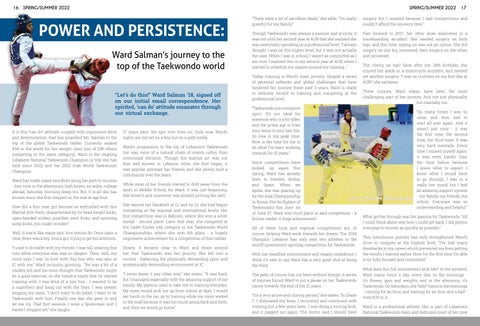
POWER AND PERSISTENCE: Ward Salman’s journey to the top of the Taekwondo world “Let’s do this!” Ward Salman ‘18, signed off on our initial email correspondence. Her spirited, ‘can do’ attitude emanates through our virtual exchange. It is this “can do” attitude, coupled with impressive drive and determination, that has propelled Ms. Salman to the top of the global Taekwondo ladder. Currently ranked #34 in the world for her weight class (out of 238 others competing in the same category), Ward is the reigning Lebanese National Taekwondo Champion (a title she has held since 2012) and the 2020 Arab World Taekwondo Champion. Ward has made many sacrifices along her path to success - free time in the afternoons, both knees, an ankle, college abroad, Saturday morning sleep-ins. But, it is all she has known since she first stepped on the mat at age four. How did a four year girl become so enthralled with this Martial Arts form, characterized by its head-height kicks, open-handed strikes, punches, joint locks, and spinning jump kicks, you might wonder? Well, it starts like many epic love stories do: Once upon a time, there was a boy. And a girl, trying to get his attention. “I used to do ballet with my friends. I was tall, wearing this tutu while everyone else was so elegant. Then, well, my mom says I was ‘in love’ with this boy who was also at IC with me.” Ward recounts, grinning. “He was a bit of a chubby kid and his mom thought that Taekwondo might be a good exercise, so she found a coach that he started training with. I was kind of a tom boy - I wanted to be a superhero and hang out with the boys. I was always begging my mom, ‘I don’t want to do ballet, I want to do Taekwondo with him. Finally one day she gave in and let me try. That first session, I wore a Spiderman suit! I haven’t stopped yet,” she laughs.
17 years later, the epic love lives on. Only now, Ward’s sights are not set on a boy, but on a gold medal. Ward’s progression to the top of Lebanon’s Taekwondo tier was more of a natural chain of events rather than intentional decision. Though the martial art was not that well known in Lebanon when she first began, it was popular amongst her friends, and she slowly built a community over the years. While most of her friends started to drift away from the sport in Middle School, for Ward, it was just beginning. She loved it and, moreover, was already proving her skill. She earned her blackbelt at 11, and by 12, she had begun competing at the regional and international levels. Her first competition was in Bahrain, where she won a silver medal - second place. Later that year, she competed at the Cadet (Under 14s) category in the Taekwondo World Championships, where she won 5th place - a hugely impressive achievement for a competition of that caliber. Slowly, it became clear to Ward and those around her that Taekwondo was her priority. She fell into a routine - balancing the physically demanding sport and academically demanding environment at IC. “I never knew it any other way,” she states. “It was hard, but I managed, especially with the amazing support of my family. My parents used to take me to training everyday. My mom would pick me up from school at 4pm. I would eat lunch in the car, go to training while my mom waited in the mall because it was too much going back and forth, and then we would go home.”
17
“There were a lot of sacrifices made,” she adds. “I’m really grateful for my family.”
surgery but I resisted because I had competitions and couldn’t afford the recovery time.”
Though Taekwondo was always a passion and priority, it was not until her second year at AUB that she realized she was essentially operating on a professional level. “I always thought I was on this higher level, but it was not actually the case. When I was in school, I wasn’t as committed as I am now. I realized this in my second year at AUB, when I started to schedule my classes around my training…”
Fast forward to 2017, her other knee dislocated in a snowboarding accident. She needed surgery on both legs, and this time, saying no was not an option. She did surgery on one leg, recovered, then surgery on the other, and recovered.
Today, training is Ward’s main priority. Despite a series of personal setbacks and global challenges that have hindered her journey these past 3 years, Ward is ready to dedicate herself to training and competing at the professional level. “Taekwondo is a combative sport. It’s not ideal for someone who is a bit older, and the prime age is from your teens to your late 20s. So now is my peak time. Now is the time for me to do what I’ve been working towards for 16 years.” Since competitions have picked up again this spring, Ward has already been to Sweden, Serbia, and Spain. When we spoke, she was gearing up for the Asia Championship in Korea, (the birthplace of Taekwondo) this June. As of June 27, Ward won third place in said competition - a bronze medal. A huge achievement. All of these local and regional competitions are, of course, helping Ward work towards her dream: The 2024 Olympics. Lebanon has only sent two athletes to the world’s preeminent sporting competition for Taekwondo. With her steadfast commitment and steady confidence, I think it’s safe to say Ward has a very good shot at being the third. The path, of course, has not been without bumps. A series of injuries forced Ward to put a pause on her Taekwondo career towards the end of her IC years. “I’m a very active and clumsy person,” she states. “In Grade 7, I dislocated my knee. I recovered and continued with training, but a few years later, I was doing a turning kick, and it popped out again. The doctor said I should have
The cherry on top? Soon after her 18th birthday, she injured her ankle in a motorcycle accident, and needed yet another surgery. “I was on crutches on my first day at AUB!” she exclaims. These injuries, Ward relays, have been the most challenging part of her journey. And not just physically, but mentally, too. “So many times I was so close, and then had to start all over again. And it wasn’t just once - it was the first time, the second time, the third time. It was very hard mentally. Every time I injured myself again, it was even harder than the time before because I knew what to expect. I knew what I would have to go through. I was in a really low mood, but I had an amazing support system - my family, my friends, my school. Everyone was so understanding and helpful.” What got her through was her passion for Taekwondo. “All I could think about was how I could get back. I did physio everyday to recover as quickly as possible.” This tumultuous journey has only strengthened Ward’s drive to compete at the highest level. “I’ve had many drawbacks in my career which prevented me from getting the results I wanted earlier. Now, for the first time I’m able to be fully focused and committed.” What does this full commitment look like? At the moment, Ward trains twice a day, every day. In the mornings it’s fitness, gym and weights, and in the afternoon, it’s Taekowndo. On Saturdays, she “only” trains in the mornings - running for an hour, and training for an hour and a half from 8:30 to 11. Ward is a professional athlete. She is part of Lebanon’s National Taekwondo team and dedicates most of her time
18
SPRING/SUMMER 2022
SPRING/SUMMER 2022
19
a break from coaching at the moment to prioritize her training, she loves teaching and is grateful to be a role model to Taekwondo practitioners, especially young girls. “As a woman in Lebanon, I’m a bit unique in the path that I’ve chosen. I find it really cool that now, I can be an example to other little girls. When I was young, I didn’t have that example. I did everything on my own. I didn’t even have any teammates, It was just my coach and I. For me to be a role model for others now is something I really appreciate.” After 17 years of balancing sport, school, extracurricular activities, and social life, Ward has mastered not only the art of Taekwondo, but also that of time management. In fact, she relays, it’s probably one of the biggest lessons Taekwondo has taught her.
to training and other Taekwondo related activities. In most other countries, being a professional athlete is seen as a full-time job - it’s what you dedicate all of your time to, and it’s a sustainable career. Despite the fact that the Federation of Taekwondo is one of Lebanon’s more supportive athletic organizations, it is still difficult for them to support their athletes monetarily. Travel and related expenses come out of the competitors own pocket. This means tight travel times, often arriving the day before a competition and leaving immediately after, without adequate time to adjust to different time zones and environments. It also means many athletes have to balance a full time job, on top of a rigorous training agenda. Though Lebanon might not have the resources to support her financially, Ward is still incredibly proud to represent her country. If anything, the absence of a cushy support system makes her all the more deserving of her achievements. “At the end of the day, I am doing this for my country. It makes me very proud when I see someone from Lebanon, who is participating in tournaments at their own expense and making the time to train in between work or school, hold their own in a competition against someone who dedicates their life to training, eating lettuce, sleeping
early. It’s an incredible achievement on its own. It makes me proud because I come from a background that is much harder than my competitors. When I win something, I feel that I deserve it more, in a way.” Ward deserves every bit of success she’s earned. And recently, there has been a lot to celebrate. This spring, she competed at tournaments in Sweden and Spain, and participated in a training camp in Serbia, with one of the world’s top Taekwondo coaches. “Serbia was crazy cool… The coach trains two girls, one who won a gold medal in the Olympics and another who won a bronze. I was so happy because I realized that I’m not that far off from their level.” She beams. Spain too, was similarly gratifying. “I lost in the quarter-finals against this girl, and I was so sad because it was such a close fight. Then, I learned she won a bronze in the Olympics. It made me realize that my hard work is really paying off and that I’m getting there. Slowly, but I’m getting there.” To support her career, Ward helps manage her Taekwondo club alongside her coach, Noel Moukheiber (who has been by her side since she was four). They began expanding the club a few years ago and currently have 300 students across 8 locations in Lebanon. Ward is also an instructor and has been teaching young students since her last year at IC. Though she is taking
“Now, I can always find time to do everything I want to do - I do have a life outside Taekwondo!” She jokes, “I go out on weekends and spend time with friends after training. I like other sports activities, like hiking, snowboarding, and going to the beach. I love music as well, and even taught myself how to play guitar when I was injured.” Taekwondo has also helped with her confidence, on and off the mat. “As a kid, I used to be very shy, quiet, and reserved,” Ward recalls. “I don’t know who that person is anymore. I’m so confident. I believe that I can defend myself in any situation. Even if I couldn’t, I am confident that I can and that is enough to make me feel safe, which is needed as a woman in this country. That’s really cool.”
[It’s not just Ward who feels safe with herself, by the way. She was always the ‘strong girl,’ and her friends’ parents used to ask her to look out for their children when they would go out. “I totally played the role,” she laughs.] Sure, she seems like Superwoman. But Ward is human too. Taekwondo is as much a mental practice as a physical one and Ward has gained some tools along the way to help her on the mat, and off. “I have good days and bad days like everyone. I think at some point, you have to understand yourself and know how to turn the trigger on. The anxious feeling and the excitement feeling are really close to each other, so whenever I feel anxious before a competition, I turn that into excitement instead of stress. I’ve developed mental health tools for training, for before competitions, for after them - whether I win or lose.” Ward’s epic story is still being written; however, the moral is clear: “I really hope that this inspires people to pursue what they want and to prioritize their passion over everything. There is nothing more important than doing what you are passionate about. You do it 50,000x better than something that you don’t care a lot about. It’s definitely a sacrifice, and it’s a more challenging route, but the results are so much more meaningful.”
20
SPRING/SUMMER 2022
SPRING/SUMMER 2022
Dining with Dignity: How IC’s Mobile Community Kitchen Came to Be
The idea was born during Thawra. “I used to take my kids, to raise the flag, and show them change is coming,” Karim recalls. “Everyday there were some tents distributing food, and I couldn’t help but notice that many were people who had very recently experienced misfortune and who were in this position for the first time in their lives. Despite their pride, they were hungry and they were queuing to eat. And people don’t queue in Lebanon!”
This is exactly what IC alum and parent, Karim Farsoun ‘91 envisioned when he came up with the idea of the mobile kitchen two years ago, to combat Lebanon’s growing hunger crisis and spark community engagement. Not simply a handout or food bank (though these types of initiatives are important), but a way to serve those in need a freshly prepared, hot meal to enjoy with dignity and joy.
Step one, of course, was securing the van. Karim reached out to DHL, who had a surplus of vans that were left behind by businesses exiting the country. The manager of DHL was happy to help and sold him the van - a brand new 2020 model - at a very discounted rate.
“One thing was clear to me,” he states. “People were hungry, bottom line.”
Karim contacted a kitchen appliance company to outsource the equipment from, and another company, ACID, that specializes in transforming regular vans into Food Trucks. They embraced the project and completed the transformation at a fraction of the cost.
This observation quickly turned into action. Karim wanted to do something. Not just to help people (though this was his number one priority), but also, to inspire his children and remind them that there is a world beyond the comfortable bubble they live within. “They need to
“Once the van was ready, then came the question of, who is going to run it? Who is going to reach out to these NGOs and municipalities and connect with people? Who is going to cook? It’s a huge job, and I just didn’t have the time or the resources to run it on my own.”
look outside,” he states firmly. “And to look outside, they first need to look inside. They should be loving, giving, and full of compassion - they should actually want to help those who are not as fortunate.”
Achrafieh’s Saint Basile Stairs, usually quiet and listless, were buzzing with activity on the sunny, April Saturday. Tables and chairs lined the staircase - with cutlery and fresh flowers dotting each surface. Crowds gathered around the bright yellow van parked at the top of the steps. Young waiters shuffled around - clearing empty plates and offering up freshly baked desserts to follow the main meal. Some sat and joined their patrons, engaging in conversations or playing cards. Music filled the air and people were dancing. Despite the steady bustle, everyone seemed content and relaxed with full bellies - and hearts too.
21
He started to think about different ways to help, surveying pre-existing initiatives like food banks, packaged food boxes, and NGOs collecting and redistributing restaurant leftovers. He realized, however, that these projects did not always engage people or make them feel genuinely cared for. “I wanted to reach those areas where people were in need of food, but at the same time, I wanted people to see that food is being prepared for them with care and consideration - not just restaurant leftovers delivered in a car. I wanted them to see that people are cooking for them and serving them. This is where the idea of the Food Van emerged.” It took about a year and a half to realize the vision. With little-to-no experience in the food truck industry or NGO world, the project came to life with (more than a little) help from some friends.
Luckily, IC’s own Rindala Abdel Baki, head of the Ali Ghandour Center for Leadership, Diversity, and Civic Engagement and an old friend of Karim’s, entered the picture. She had the experience, connections and resources to facilitate the initiative. And, what better way, he thought, to give back to the people of Beirut than to involve his own IC community by having students run the van!? “I told Rindala that, in giving the van to IC, my aims were 3 fold,” he relays. 1) For the students of IC to understand that life is about giving, sharing, and helping. 2) For students to actually learn how to cook and take care of themselves and others (especially as many are going to leave for college, he figured they should at least learn how to hold a knife!) 3) To contribute to IC’s commitment to civic learning and engagement. They brought the concept to Mr. Peinado - who welcomed the project with open arms. He further suggested the students should engage the community through dancing, music, and other forms of entertainment in addition to serving food. From there, the remaining pieces began to
22
SPRING/SUMMER 2022
fall into place. Another IC alum, Mahmoud Sidani ’87,who runs a gas distribution company, offered to supply the van with cooking gas, not just for one or two events, but for life. Chef Reem Azouri, the local culinary legend behind Meat the Fish and Maryool, has also been instrumental. Despite her busy, busy schedule, she has dedicated her time to teaching multiple cohorts of IC students to prepare, cook, and serve delicious meals for the van.
SPRING/SUMMER 2022 responsible for raising funds for food and other necessary expenses. He stresses, however, that there is ample opportunity for fellow alums, parents, or anyone really, who wants to get involved in this initiative. Feeding 200 people, including drinks, a main dish, salad, and bread, costs an average of $250-$300 - a little more than $1.00 per person. If one has the resources to contribute, a small amount can have a very big impact.
Karim also asked Rindala to make an inter-student competition to create and vote on a name and logo for the project. The name Akle waw Basme, written in bubbly white font and highlighted by a cheerful yellow, came out on top. Mr. Salim Haddad, from MCAA Advertising, generously volunteered his time to work with the students to develop the name and logo, and wrapped the van for free.
“The idea,” he relays, “is to further engage our community. If there is an alum from Tripoli, for example, he can donate the lunch, and they could bring the van to Tripoli.”
They have held five successful events since the project launch in early April. The first, in collaboration with the NGO Basma in Nahr, where they served 152 people, and four with Caritas. Their second event, at the Saint Basile stairs was particularly festive - and stressful - as streams of people flocked to the truck.
Karim asserts “ There is a lot of potential for community engagement. Let’s say we visit Hasbaya - we can cook using local produce, invite people to make their local specialties, or even organize a sort of de-facto market where villagers can sell their goods. It’s really about bringing people together. We want to entertain people as well, and show them that this is not a charity. We want people to dance, laugh, and play cards together.”
“There is a church there, so they had a network of people that we fed, and then Caritas came in so we served them, followed by 30 children from the Baabda Blind and Deaf Institute. So these IC students were interacting with people from all walks of life and it was very touching. They saw that this is the reality for many.” The project is, in theory, self-financed and self-sustaining. The van is now out of Karim’s hands, and the students are
Beyond fulfilling a (very salient) need by providing a free hot meal, the project is also about engaging the community, creating a safe and positive environment, and restoring a sense of pride and dignity.
It’s an admirable effort that demonstrates the power of good intentions with a few helping hands. “Really, each and every one should try and make a difference, no matter how small,” Mr. Farsoun concludes. “You can’t just pass through life and say I will care for myself and those close to me and that’s it. You have to look around.”
23
IMPACT AND INNOVATION: Amr Salahieh on the business of biomedics
“I am an entrepreneur, and I’m an engineer,” Amr Salahieh ‘84 states, reflecting on his 30 year career in biomedical engineering. Driven by a desire to build a world where people are able to live longer, healthier lives with fewer medical interventions through innovative health technology, Salahieh has dedicated his life to finding solutions to the world’s toughest healthcare challenges. His creative, driven, rational approach to biomedical engineering has propelled him and his company, Shifamed, to the upper echelons of the biomedical engineering space. Since its inception in 2012, the company has closed deal after deal with global pharma giants to secure their cutting edge technology. California-based Salahieh’s impressive career has spanned from one sparkling blue coast to the next. Born in Beirut, he joined IC’s French program in 6th grade. “I was always interested in math and physics,” he recalls. “But, I was also interested in healthcare. I initially thought I wanted to be a physician.” He spent his formative years at IC. Unfortunately, during the 1982 invasion, the Salahieh family was forced to leave Lebanon. He finished school in the south of France and from there, went to the US to pursue his undergraduate degree at Case Western Reserve University in Ohio. “I entered university planning to double major in Pre Med and biomedical engineering. Very quickly however, I realized that my interests and my personality did not align with what it takes to become a physician.” He stopped the physician part and just focused on biomedical engineering. “It was still healthcare, which I liked, but it was engineering oriented.” After graduating, Salahieh joined the Silicon Valley based American Cardiovascular Systems (ACS) - a subsidiary of Eli Lilly. The company was one of the most innovative medical device companies in the industry at the time. There, he honed his expertise in early stage Research & Development (R&D) and was at the forefront of engineering minimally invasive, life-saving products. Notably, he led development for two different, cutting edge, catheters. While at ACS, Salahieh was exposed to the transient nature of healthcare technology and the sector’s emerging start-up culture. The innovative, collaborative, and fastpaced work environment - alongside the success that these emerging companies enjoyed - intrigued the young engineer. After six years with ACS, he decided to join a startup himself.
24
SPRING/SUMMER 2022
“I was one of the first engineers at the startup called CardioThoracic Systems. We were working on beating heart surgery,” Salahieh states nonchalantly, as if he was commenting on the weather, not his life-saving technology. The company went public in a very short period of time - 6 months to be exact. “It was a really fascinating experience for me,” he reflects. With solid experience at the nexus of engineering and business, after two years, he decided to start his own company. Over seven years, he developed a number of innovative products - which ultimately sold to leading medical device organization, Boston Scientific. Perhaps one of his most notable developments during that period was Sadra Medical, which was responsible for engineering the first fully repositionable device for percutaneous aortic valve replacements to treat severe aortic stenosis - one of the most common, and most serious, heart disease problems. After Sadra was sold to Boston Scientific in 2007, Salahieh decided to think beyond the single-product startup model he had grown accustomed to. Inspired by the hands-on, multidisciplinary, and team-centric approach of some of his past mentors, he began to think more critically about how to foster, and capitalize on, this kind of work environment. The result: Shifamed. Shifamed is an incubator and medical device innovation hub. Essentially, rather than just working with one company to develop a single product, Salahieh acquires multiple, small medical device companies, helps them develop their product with all the resources at their disposal, then sells them to large medical corporations which ultimately commercialize those products. Today, the organization is 220 people strong, with 7 companies in their portfolio. They raise roughly $90 million per year for product development, which mainly focuses on cardiovascular and ophthalmology technology - huge success, to say the least. While Shifamed is not the only incubator-style corporation that exists, there are a few factors that set it apart from its competitors. Salahieh explains, “There are these group companies that start one company, then another - but there’s not many others that have all these companies operating simultaneously. What also makes us stand out is that we have one management team that is responsible for the human resources, financials, etc.. for all individual companies. The product research and development teams, the facilities and equipment, are independent because
SPRING/SUMMER 2022
Young Alumni Spotlight:
they will ultimately be acquired by a larger organization.” It’s an efficient model that helps cut unnecessary costs, mitigates miscommunication, and also fosters a more cohesive environment.
The Humble Heroes, William and Tanya Azar
Collaboration breeds innovation - in part why his model is so successful. The creative, problem solving startup culture characteristic of Silicon Valley runs deep at Shifamed. “Because we are all part of one larger entity, people tend to be friendly and not too competitive. Moreover, there’s the fact that, at the end of the day, everyone is trying to make life better for patients. Collaboration is voluntary, but people tend to like to help and learn from each other.”
Say what you will about Generation Z… IC’s youngest graduates, at least, are the most dynamic and dedicated leaders who are deeply committed to building a better world. Just look at the sibling/doctor duo William ‘16 and Tanya ‘17 Azar, who recently founded the Humblebee Clinic, an innovative, student-led initiative providing high quality, free medical care to children in Lebanon. With a passion for medicine and, ultimately, helping others, fostered at home and at IC, these two doctors-to-be are transforming pediatric healthcare in Lebanon, one smile at a time.
Salahieh is a good engineer. And a good businessman. “I still work a lot with technology, and with people,” he comments. “A big part of what we do is innovation, but innovation, without a contextual understanding or appreciation of business, is void.” In a sector where market demand goes hand-in-hand with healthcare demands, Salahieh’s knowledge, innovation, and entrepreneurial spirit, almost guarantee the success of his products. “We are fortunate in our business - if it is really a life altering product and something that will make a significant difference in patient’s lives, it does have a higher market value. We tend to orient ourselves around businesses that will have a huge impact on patients, and that serves us well on the business side as well. We seek out areas where we can expect acquisition to take place.” The most impactful products Mr. Salahieh has made throughout his career include the number of heart valves he has helped devise, engineer, and put out into the world. “We had Sadra, and now we have another called Tioga Cardiovascular Inc. that has different valves on catheters. Right now, we are also working on a heart pump with a company, Supira Medical Inc.” Though perhaps less detail-oriented than his early days in R&D, Salahieh is still involved in the developing new products every step of the way and is never too far from the technical process - his original passion. It seems that, even after thirty years in the field, he will never tire of it. “My advice to those young IC students and alumni? Pursue your passion and be persistent with that pursuit.” Clearly, Ms. Salahieh’s passion and perseverance has paid off. And most importantly, has changed countless lives along the way.
25
Q: What is the Humblebee Clinic? A: We are all aware of how dire the healthcare situation in Lebanon has been over the past couple of years. Humblebee was born at a time when pediatric healthcare services in Lebanon were at their weakest. Both of us, along with our friend from AUB, Pamela Moukarzel, saw a need and decided to act upon it. We came up with the idea in October 2020, but it took about 4 months of preparations for it to come to life in February 2021. Humblebee is a nonprofit, non-sectarian, nonreligious, non-political, noneverything initiative whose only goal is to provide free medical care to children in need in Lebanon. After receiving initial approval for our proposal from AUBMC, we worked to raise funds, collect donations, and secure medication. William worked from Washington DC to secure funds from private donors. He also shipped 3 million dollars worth of medications to Lebanon as part of a separate campaign that Humblebee was able to benefit from. Tanya worked on the ground in Beirut to secure a space, recruit physician volunteers, and build a team. More than 120 volunteers applied and were subsequently divided into several teams in charge of Patient Affairs, Follow Up, Entertainment, Pharmacy, Health Education, Social Media, Fundraising and Volunteer Recruitment. Along the way, many people offered their help and encouragement, which kept us going despite many hardships. The team grew quickly,
and the efforts of each member of Humblebee can be clearly seen today. Q: How did you both become interested in healthcare? A: Many members of our family work at the hospital. However, despite our early exposure to medicine at home, this was not the primary reason behind our career path. We chose medicine because we were determined to live a life of empathy, of caring and of giving without expecting anything in return. It might sound cliché, but we truly believe that the greatest honor we will ever have is for someone to ask us for help. Q: Did your time at IC help foster this passion? A: IC grew in us the spirit of love, of caring for one another, of feeling for one another and of helping those in need. IC has therefore fostered in every one of its students, regardless of their career preference, the values of a true physician. We have also been active in the community from a young age, strongly encouraged by peers and faculty at IC. Tanya received IC’s community engagement award in recognition of her commitment to service. IC ingrained in us its vision of building global citizens and leaders of tomorrow. IC taught us to fight for what we believe is right and to be altruistic, generous and assiduous. These values allowed us to build Humblebee, a strong team of selfless volunteers that are offering care to hundreds of children in need, without expecting anything in return.
26
SPRING/SUMMER 2022
SPRING/SUMMER 2022 Q: What makes Humblebee stand out from similar initiatives? A: What is unique about Humblebee is that it is completely free of charge. Every aspect of the visit is covered by us, from blood draws and genetic testing to X-rays, CT scans, vaccines and medications. Humblebee is also completely student led. With 15 different teams, 30 student leaders, and more than 120 volunteers, including residents and physicians, Humblebee is set to grow and expand to different territories in Lebanon. Humblebee volunteers show great professionalism and attention to detail. Patients really enjoy their time at the clinic; they are distracted with the toys and games prepared by our Entertainment team and receive books as gifts. They are even sent home with their favorite fruit to encourage healthy eating habits. Our patients and their parents receive mental health screening and are referred to specialists as needed. Parents are also offered educational health tips from our well-informed Health Education team. All in all, we can say with certainty that Humblebee is not just another pediatric clinic. Humblebee is a whole new experience not only for the patients and their families, but also for the students, the residents and the physicians. Q: What was the most challenging aspect? A: The main challenge we faced was accommodating as many patients as possible. On the opening day, we had above 200 patients on our waiting list, but could only accommodate around 20. We hope to be able to see more patients as we grow and expand, so that no child in Lebanon is deprived of healthcare. Q: And the most gratifying part of the experience? A: Nothing is more gratifying than seeing our children dance, sing, laugh and smile, and their parents relieved from the burden we have lifted off their shoulders. Being part of Humblebee has combined our passion for science and our urge to give back to the world, one smile at a time. Q: What advice would you give to young IC students interested in healthcare or community engagement? A: Connect with your community, engage in service and help those who need it most. Do good for the sake of doing good, and the world will reward you in so many different ways. Medicine is a beautiful field. If you love science, if you are patient, if you enjoy talking to people, and if you are empathetic, medicine is a great fit for you.
Fun at IC
27
28
SPRING/SUMMER 2022
SPRING/SUMMER 2022
Leaders of Tomorrow: The Ali Ghandour Center graduates its first cohort!
Ossasna: Preserving generational knowledge (and good food) one story at a time Village elders welcomed the young IC students with open arms. They taught them how to make Sharab Al Toot, a delicious mulberry juice, and told them to put hot water on your stomach to help cure a fever. They emphasized the importance of respecting nature and living sustainably.
Three years since its inauguration, IC’s Ali Ghandour Center for Leadership, Diversity, and Civic Engagement (AGC) has graduated its first class! Founded in the honor of Ali Ghandour ‘50, beloved businessman, philanthropist, and staunch believer in social activism, the program offers an intensive three-year training in leadership, citizenship and community engagement. The first program of its kind in the country, half of the students enrolled are academically outstanding, highly motivated, yet financially disadvantaged students who seek to access quality education from the greater Beirut area. After undergoing a rigorous application process, selected scholars gain a scholarship to IC. Non-scholarship students undergo a similar selection process and, together, the students embark on a three-year journey of community-based learning, critical thinking, problem solving, innovation, social entrepreneurship, and activism. It is a melange of personal and professional development that positions these young scholars to become agents of change and forces of good in both their local and global communities. Starting in Grade 10, the first year of the program aims to develop student’s soft skills through a series of training sessions (or “therapy sessions, as the students jokingly call them) and introduces them to a number of service initiatives which they have the opportunity to volunteer with. In their second year, students continue to develop their soft and civic skills, and begin to conceptualize their capstone Community Service Projects (CSPs), in concert with a number of workshops on assessing community needs, sustainable development goals, information gathering, project planning and proposal writing. In their third and final year, students finalize and implement their projects. Though these first three years have been anything but straightforward given the circumstances in the country, the AGC’s first cohort has exceeded expectations, leaving a significant mark on the IC, and greater Beirut, community. Grade 12 AGC students successfully created and launched three different, impactful CSPs that offer creative and sustainable solutions to very salient issues in the Lebanese context: electricity, pollution and the environment, and cultural heritage. Reflecting on his experience, AGC scholar Christian Tawil movingly states “Joining IC in 10th grade, the AGC was a support system. This small family of 16 was a safe space for me to share the challenges I was facing at the time, moving from my family home to a new city and new school. Beyond the incredible education and opportunity to have a real impact on the community, it is the focus on emotional intelligence and leadership skills that I will take with me in future endeavors.” Kristin Kharrat adds “The AGC created an environment that was extremely uplifting and enhanced so many important skills - from team building, to leadership, to project management. The experience has really opened our eyes to struggles that surround us, especially in the midst of crisis. It gave us an outlet to apply what we were learning and to use these skills to impact those who don’t have the same opportunities as we do. It gave us a different perspective on the world.”
29
“The most beautiful thing was the delicious food!” Karim Nasrallah exclaims.
What began as a simple mission to provide company to lonely elders has turned into a rich and ever expanding cultural heritage project. Led by Rozan Wehbe, Karim Nasrallah, Ryan Mitri, and Lea Cortas, Ossasna aims to honor the elderly’s traditional knowledge and revive the relationship between the old and young to foster sustainable development. The idea stemmed from the students’ sympathy for elderly communities who have been particularly isolated and lonely during COVID. They thought it would be nice to simply visit elders, talk to them about their lives and experiences, and cheer them up a bit.
Karim, a more recent implant to the AGC, developed a website for the project to help document the journey. Thinking critically about how to make this project last beyond their time at IC, the team decided to use this new tool to set up a volunteer network. They now have a sizable group of 10th and 11th grade students who will visit new villages to document more stories and traditions. Ultimately the Ossasna team hopes to create and publish a book with all of these stories, recipes, remedies and advice. They are lucky to have the guidance of Ms. Barbara Massaad, cookbook author, food historian, and founder of Slow Food Lebanon, to help them along the way. They hope that their collection of stories will continue to grow alongside the project, as younger volunteers follow in their footsteps while the current leaders transition to the next chapters of their lives.
Rozan, an AGC scholar, is well connected to her village community, Bennay, and was able to work with the municipality and local organizations to connect with the elderly people and take notes of their shared stories and knowledge about different topics such as recipes and natural remedies. “They were all so accepting and welcoming,” she states. “It was really amazing to speak to these elderly people. They told us about their childhood and the challenges they faced during the Civil War, but also about how they were still able to enjoy daily life. They give you hope that, no matter how difficult things are, there are still good times, and there is still potential for things to get better.” They realized, after these initial conversations, that there was a much larger potential for their project. “We changed the concept of the project,” Rozan relays. “We realized how much knowledge of history and traditions that elders have, and we wanted to learn from them.” After establishing a connection with the elders in the community, the team returned to start learning, and documenting, treasured traditions, practices, recipes, and remedies. Though they were slightly nervous at first, conversation flowed with ease.
The lesson is twofold. “It really taught me the importance of bringing the elderly community back into society. Age is a segregating factor and the older you get, often the more isolated you are. The world is moving so fast around them, so we can help them slowly accept these changes and acclimate.” Karim states. Rozan adds, “For our new generation, we often forget that we have these roots, deep cultural traditions and values. There is so much we can learn from the elderly community and their practices. It’s important to be reminded of this and to work to preserve our heritage!”
30
SPRING/SUMMER 2022
SPRING/SUMMER 2022
Climinds: Climate Education for a Greener Future Though it took some time for the Climinds team (Linda Maalouf, Christian Tawil, and Jad Abou Ali) to narrow its scope and scale, rooting the project in environment, climate change, and education was a given from the onset. The three all have a deep appreciation for nature but were keenly aware of how poorly Lebanon’s natural ecosystems are often treated. “Growing up, whenever we went to the sea, or on hikes, all we would see is plastic … When we had the opportunity to design our own projects, I didn’t think of anything other than the environment - I felt like I had to do something,” Linda relays. The young activists didn’t want to simply organize a beach or trail cleanup, however. “The beach would just get ruined again,” Linda explains. “If people aren’t educated on climate change and the importance of taking care of our environment, it won’t make a difference in the long run. We need to educate
people when they are young.” The project, which they began developing at the start of grade 11, began as a series of webinars for the IC community with local climate activists, experts and scientists, like Dr. Najat Saliba, Professor of Analytical Chemistry and an atmospheric chemist at the American University of Beirut. It was a great opportunity for the Climinds teams to learn alongside other students; however, the project felt too broad. “We didn’t really have a concrete goal. We decided we wanted to focus more on interactive learning, not interviews, so we designed a lesson plan on climate change that teachers could easily implement in their classes.” Christian states. With the help of (incoming) Middle School Director, Ms. Nawal Haddad and Technology Integration Coordinator, Ms. Maya Chebaro, the team created several plans that could be adapted into science, homeroom, and math units. They did a “test-run” with 200 IC middle school students, through a 2-hour virtual session - including their lessons and related activities. In Grade 12, they started to think about expanding their project beyond IC. Rather than simply circulating the lesson plan, they wanted to work more closely with another school to help them implement the unit and introduce environmental activism to students in a fun and engaging way. They ultimately decided to partner with Ajyal School in Bchamoun, Jad’s hometown. The school is underfunded and, due to forest fires impacting the area, and there is no greenery on campus. “Especially because we are in a village, it’s really important to have a green space. I’m very proud to be doing something in my own community - it feels more impactful than implementing the project in a different city in Lebanon or abroad,” Jad reflects. To raise money for their project, the students got creative. They decided to
31
sell “green kits,” symbolic of regrowth and regeneration - something to plant in light of the deforestation. And what better plant than Lebanon’s beloved olive tree? “They are our heritage,” Christian relays. “It is not only about planting trees, but reinforcing our heritage as well.” Working with small, local family businesses, they assembled 50 kits - each filled with a small tree, dirt, a ceramic pot, and paint to decorate. Popping up at various markets and events around the city, the team has sold 34 kits thus far. They have raised $500 - a combination of kits sold and additional donations. When they initially visited Ajyal School, the team noticed that students did not really have an area to hang out, sit, or play during break. “When the bell rang for recess, the students just stayed on the staircase because they didn’t really have anywhere to go sit outside,” Linda recalls. To address this, the Climinds team purchased three recycled plastic benches from Lebanon’s zero-waste czar, Mr. Ziad Abi Chaker, and environmentally friendly paint. Working with the students from grades 6, 7, and 8, they transformed the school’s play area from a dull concrete slab, to a colorful, welcoming space.
based environmental education program that the team brought to Ajyal. The team held multiple sessions with grade 6 and 7 students to teach them about the environment, which included activities like planting trees and playground renovation. These workshops were hugely successful. “At the beginning and end, we had them fill in a short questionnaire about what they knew about climate change. Before, they really didn’t know anything, but now they really get it!” Linda exclaims.
The playground renovation, however, was just a small part of the project-
They also worked with grade 8 students to start an Environment Club
which all students enthusiastically joined. “We went to the grade 8 classroom and talked about the environment club, what a club is, how you structure it, and gave them a booklet of preplanned activities. We explained that the club is not at all mandatory, but they all wanted to join!” Christian states. The secret to their success? Jad reflects, “Rather than lecturing students about climate change, we went there, they painted their playground with eco-friendly paint, recycled with us, and explained how the recycled benches were made. When they actually see the process and its impact, young students are more engaged and encouraged.” Ultimately, the team hopes to scale the project, sharing their lesson plan and activities with more schools across the country. Luckily, they are leaving behind a team of younger AGC scholars, as well as IC’s own environmental club, which is excited to continue what this inaugural team has begun.
32
SPRING/SUMMER 2022
SPRING/SUMMER 2022
Pedal4Power: Lighting up Lebanon cost renewable energy generator in the Lebanese context. Soon, after presenting the rough idea to their fellow cohort members, a number of others - Michel Hawa, Reem Youssef, Hana Ballout, and Tony Yamin - wanted in. Whatever the model, the team knew it had to be low-cost, sustainable, and effective, so it could be easily replicated in disenfranchised communities for whom electricity is particularly scarce. Quickly, they discovered a bike was their best option! “The bike is the most underrated, and flexible, human invention,” Leen, an AGC scholar who helped lead the project’s physics team, asserts. “You can get a bike anywhere… Tony and I were in the same physics class, studying something related to centripetal motion and realized there was a similar force in the bike. We wanted to see if we could transform it into something that could produce energy.” Ex-Secondary School director, Mr. Bruce Knox, was also a huge proponent both of cycling, and the team’s idea. In fact, he donated the bike that the team ultimately used for their first prototype
As the largest project of the cohort, all hands were needed on deck as this team of seven worked tirelessly to conceptualize, construct, and launch their CSProject, Pedal4Power. In the midst of the pandemic, original team members Lana Al Ashkar, Kristin Kharrat, and Leen Bou Alia were on a Zoom call discussing potential project ideas when the power cut - a common occurrence. What could they do to help mitigate this in a sustainable way, they wondered? After some research, they came across the movie, “The Boy Who Harnessed the Wind,” - the story of a boy from Malawi who saves his town from famine by constructing a windmill to provide water and electricity. They wondered how they could similarly construct a low-
Working alongside IC’s Physical Plant staff,whom the Pedal4Power team is eternally grateful for, the team slowly but surely constructed a functioning, powergenerating bike. Essentially, kinetic energy is created by pedaling the bike. The bike is connected to an adjustable setup that allows the kinetic energy to be converted into electrical energy which is stored in connected batteries. The batteries can, in turn, be used to light classrooms, charge electronic devices, and run other important electric equipment. The process was not without challenges, however. Beyond the frustrations of trying to coordinate and communicate over Zoom, once they were finally able to return in person, the team had to search far and wide to find relevant equipment that was cheap and accessible. “We ultimately wanted to create a prototype that was super efficient, cheap,
33
and easy to construct, so anyone we gave instructions to could recreate it. Though the AGC is generous in funding our vision, because we had to think about other schools, we needed to keep it simple and local. Because of the crisis and supply chain shortages, it was really difficult to find cheap parts - for some parts, I had to go to Bekaa to get them for a decent price,” Lana states. Kristin adds, “It’s all about scalability. We recognize our privilege in that the AGC has the resources to help us make this project a reality. But we want to make sure our model is widespread and accessible.” To do so, after finalizing their first prototype, the Pedal4Power team connected with UNRWA’s Sebline vocational training school. Combining their theoretical knowledge with the Sebline students’ technical skills, they developed yet another prototype that will be used at another UNRWA affiliated school, Beit Jala high school. “It showed us how complementary our theoretical knowledge is with their vocational training,” Reem says of working with the UNRWA students. “Their technical knowledge of how to build and put things together … we would not be able to do any of it on our own. The collaboration was essential and helped us make the project a lot more sustainable!” On a sunny June afternoon, both bike prototypes were revealed to the greater IC community. It was a festive, joyous occasion and both the Pedal4Power teams and UNRWA cohort were welcomed with open arms. Many took turns riding the bike, including elementary students who were very interested in knowing more about the project and try the prototype. Just as the team hoped! Since the bike’s launch, many members of the IC community have taken a turn riding on
it, generating clean, green energy, and spreading the word. Lana states, “Even after all your work, you don’t know if the project will actually be sustainable. The engagement from the IC community is very reassuring and shows us that if we implement bikes in other schools, those students will be equally excited and curious to join in.” Like Climinds, younger AGC members are also interested in taking over the project and will continue to work with UNRWA to build and implement bikes at a number of schools around the country. Ultimately, the team is working on a detailed manual, so schools could easily build these bikes on their own. It is an impressive and effective solution that tackles multiple woes - from electricity scarcity, to climate change, to physical and mental health - all in a few gentle pedals. If these young students are the leaders of tomorrow, I think it’s safe to say we are in very capable hands.
34
SPRING/SUMMER 2022
Updates
Tour de USA A few highlights from Mr. Beydoun’s trip (not all places visited are pictured)
SPRING/SUMMER 2022
35
‘65
‘87
Marwan Stambuli shared the following message and images: Our Ic1965.com website is growing with events and updates. Please visit it and share your news if you have not joined the group yet. My Contact: www. marwanstambuli.com or WhatsApp +41 79 259 88 11/ + 9613 620885
The Honorable David-Imad Ramadan earned a Doctorate of Education degree in Leadership and Learning in Organizations from Vanderbilt University on May 13, 2022. Dr. Ramadan is the Vice President of an innovative EdTech leader, Noodle, the world’s fastest-growing online and lifelong knowledge network of universities, corporations, and learners. Dr. Ramadan is an adjunct professor at George Mason University, his alma mater. He is also a resident scholar at the Center of Politics at the University of Virginia. He is a former member of the Virginia House of Delegates; he was elected and served two terms.
Moufid Beydoun ‘64 and our IC Board Member & CEO of Six Flags, Selim Bassoul
Henri Abou Arraj ‘75 and Gilbert Khoury ‘76, our IC Ambassadors in Dallas!
Moufid Beydoun ‘64 with Selim Bassoul and family in Dallas, TX
‘90 Moufid Beydoun ‘64 with Hani Bekdash ‘75 in Dallas, TX
Assaad Mazloum shared the following message: “My school years at IC were wonderful, enriching, and unforgetful. I would like to send a warm hi to all my classmates and teachers. I currently reside in Broummana where I practice Internal Medicine at my private clinic. I wish IC continuous and ever lasting success.”
‘70 Errol Makzume is an Istanbul based Art Historian. More information regarding himself and his work can be found on his website: www.erolmakzume.com
Moufid Beydoun ‘64 with Nizar Zakka ‘85 in Washington D.C Moufid Beydoun ‘64 with Gill and Hassan Dana ‘67 in Amarillo, TX
Nesrine Yaghi Harb shared the following message: “Moving to Athens after the Beirut blast was not an easy thing to do. Like so many compatriots who had to leave their beloved Lebanon, our decision was mainly based on our kids’ best interest. A new career path opened as well, with the creation of my company in 2020, The Travel Designer Greece (TTDG). Moving to Greece only brought me closer to the many islands and extraordinary places I could discover off the beaten tracks.
36
SPRING/SUMMER 2022
Updates
Being so keen on details and picky on what is needed to make a vacation a memory, TTDG has given me the tools to make this a reality. Over these past two years, I have enjoyed planning unforgettable, tailor made trips for many guests and friends. So, to all my IC family, whenever you plan to come to Greece, reach out!” Visit her website: www.thetraveldesignergreece.com
Idriss holds a double Bachelor’s in Fine Arts and Graphic design from the Lebanese American University (LAU). Mastering the fundamentals in college, Idriss went on to work at Prof. Chawki Chamoun’s Art Gallery and built a breadth of experience through freelance work, ranging from corporate identity projects to product design and packaging.
Updates ‘15 Rola Itani shared the following pictures of her and fellow IC classmates at AUB Medicine Class of 2022 graduation. “We will always remember IC, our Alma Mater!” she says.
She enjoys various art forms, from conventional design techniques to digital design tools, which she successfully converged when she joined Sarah’s Bag in 2006 as one of the first team members. She helped establish and develop the company’s Design Department. Idriss has accompanied Sarah’s Bag founder, Sarah Beydoun, to women’s fashion trade shows, such as Tranoi in Paris, and has worked with her to translate her creative, socially conscious vision into innovative designs that are sewn by female prisoners and underprivileged local handworkers, reviving the dying crafts. This successful collaboration has resulted in a number of popular and well-recognized collections. Contact Mays at: maysidriss@gmail.com
‘92 Razan El Moghrabi is a successful actress, TV presenter and singer. She has presented many notable programs, including the Arabic “Top of the Pops” “Album” and “Deal or No Deal,” She has also covered a number of other international artistic events.
‘98 Mays Idriss is the Art Director of Sarah’s Bag, leading the creative design department at the celebrated Beirut-based fashion accessories label. Today, her collaborative designs are some of the brand’s most recognized, and have graced the pages of top magazines such as Le Monde, Harper’s Bazaar and Vogue.
Pictured Above: Lebanese Program Life sciences class of 2015, Ramzi Kibbi, Abed Tannir, Saad Sabbagh, Rola Itani, May Abiad
‘11 After graduating IC, Tala Sabri went on to study architecture at ALBA and Universidad Politécnica de Cataluña (UPC) (In addition to French and English, she is now fluent in Spanish). After graduating from UPC in 2019, she joined Ferres Arquitectos Y Consultores SL as a facade designer/ engineer. Her innovative work was recently featured in Spanish magazine Arquitectura en Fachadas Ligeras y Ventanas. She currently resides in London, where she is working as a facade engineer with the prestigious firm, Wintech.
Pictured Above: Ahmad Anouti ‘14, Abed Tannir, Jamal Obeid ‘14, Elissa Khalil, Mutaz Kassas, Rola Itani, Dana Houalla, Saad Sabbagh, May Abiad
SPRING/SUMMER 2022
37
38
SPRING/SUMMER 2022
SPRING/SUMMER 2022
In Loving Memory I graduated from IC’s English Section in June 1968 (I also did the summer school in 1967). All the students in my class were non Lebanese. My experience at IC was very rich. I benefited a lot, both academically and culturally. I was a boarding student at Sage Hall, and Mr. Weaver was our boarding headmaster. He used to horseback ride and swim every morning before he attended to his duties. He always had a typical American breakfast. He was very gentle and kind. I had five courses: Arabic with Mr. Mousa Suleiman, English with Mr. Alan Miller, History with Mr. Edmund Tomeh, Math with Mr. Atef Karam, and Chemistry with Mr. Slade, if I remember correctly! All of our teachers were very good and knew their subject matter very well. Moreover, they could easily relay the material to us. The college’s headmaster was Mr. Sadek Omar.
field. At AUB, there were students from Saudi Arabia, like Mohammad Dugaither, the son of the Saudi Ambassador to Lebanon. There were Iranian students, who were very smart. Nabil Zaben was also from Jordan. There was a student from Syria too! I graduated from AUB with a B.A. in Public Administration & Political Science (PSPA) in June 1973. I returned to Jordan and joined the family business, Film Distribution and Cinema Circuit. In September 1976, I was awarded a scholarship to pursue a 2-year MBA Degree at Santa Clara University in California. I got married in July 1977 to Lilian Gildeh, who was also from Jordan. We returned to Jordan in July 1978 and I rejoined the family business. We have three girls and a boy. They’re all married with children - seven boys and two girls.
My roommate at Sage Hall was Suheil Mousher, who was from Jordan, too. Souheil held the 1st rank in class throughout the year. Both of us entered AUB through the entrance exam, like many of our colleagues. Suheil later went to the US and specialized in obstetrics. He did creative research as well, and became a pioneer in his
I wish IC, and its teachers, students, alumni and board members, all the best.
Cafeteria food doesn’t usually stir up the best memories for people. Especially where I live in the US. People think of stale or bland food, usually some fried chicken or grilled fish, macaroni and stale bread. For dessert maybe jello or some prepackaged ice cream. For British folks it may include gravy and chips, which, granted, may be a good snack every now and then.
and fluffy, the cheese is slightly salty but even better - it’s melty. Combine the two and press them in a sandwich press and you have a masterpiece. This sandwich will always bring back memories of IC, recess with friends, studying for exams, rainy days in Ras Beirut and so much more. Of course there were other treats in the cafeteria and right around the corner from the school gate. You were either a Masters or a Fantastia fan when it came to chips. Or you were a Faysal or Le Saj fan when it came to mne2esh. And if you’re old enough to remember, there were also the foul, termos and kaak vendors in front of the school.
But nothing competes with the cafeteria food we had at IC. And that is because of one particular item: the Bulghari. Growing up we just called it that, we didn’t know what was in it. It was a toasted cheese sandwich. Oh, but it was so much more than a grilled cheese. It took me years living in the US asking for Bulgarian cheese and never finding it, before I asked back at IC ‘what is Bulghari?” Well the Bulghari is a toasted cheese sandwich made of the following, a Lebanese version of French Bread and Kashkaval Cheese, toasted on a SEB grill. The bread is light
With my regards & good wishes, Ihsan Seikaly ‘68
For me, these foods from these places will always bring back the most vivid memories of my times at IC. Mohamad Tassabehji ‘04
Dr. Amer Sleiman Haidar joined IC on a scholarship and had very fond memories of his school days there. He graduated in 1962 (with distinction) and went on to attend the American University of Beirut’s medical school, where he specialized in Psychiatry. In 1978, Dr. Haidar became the first Lebanese doctor to be American Board certified. In 2010, Dr. Haidar completed his career in Psychiatry. Practicing in Saudi Arabia, Lebanon and the USA, Dr.Haidar’s career was mainly spent in clinical practice. However, he also held academic positions at Brown University, University of Pittsburgh and the American University of Beirut . By the time he retired, his own private clinic at the Gefinor Center in Beirut had been successfully running for 40 years. Sadly Dr. Haidar passed away on November 19th 2021.
Mrs. Hana Alamuddin
We regret to inform you that Mr. Walid Kanaan ‘88 passed away in May 2022. IC faculty and staff send their deepest condolences to the Kanaan family.
We regret to inform you that Mrs. Alia Choucair Hassouna ‘68 passed away in May 2022. IC faculty and staff send their deepest condolences to the Choucair and Hassouna families.
We regret to inform you that beloved teacher, Mrs. Iman Bitar Naal, passed away in June 2022. IC faculty and staff send their deepest condolences to the Bitar Naal family.
In Memoriam
Letters to the Editor
39
“I AM IC” is a touching story of a school looking for a place it could finally call home.
Sold at Antoine Bookstores, IC Advancement Office and online at: www.antoineonline.com All proceeds go towards the IC Scholarship Fund International College P.O. Box 113-5373, Beirut, Lebanon. Tel. 961 1 367420/33, Email: alumni@ic.edu.lb 305 East 47th Street, 10th Floor, New York, NY 10017 Tel. : 212 529 3005, Fax: 212 529 8525. Email: icny@intlcollegeny.com www.ic.edu.lb
@IC_Lebanon
@InternationalCollegeLB
@internationalcollegelb
@international-college