Photo: Joshua Cogan
cont’d from p. 21 we signed on to several letters calling on Congress to enact sweeping policing and criminal justice legislative policies in order to combat a history of anti-Black racism. We successfully challenged a bill pushed by the Republican leadership in the Senate that effectively undermined the movement for transforming policing and instead sought to simply continue to fund the current operational construct. The bill was ultimately rejected. We also drafted a strong policy document on transforming policing and secured more than 350 LGBTQ organizations to join in support. For the first time, this letter developed, for the first time, an organizational framework to advocate for divestment of police resources and reinvestment in communities and outlined other key policy issues that result in over-policing in minority communities. It has also been used as a reference for other non-LGBTQ organizations seeking to inform and advance the public discourse on this issue. In addition, we released a letter, joined by more than 100 prominent faith leaders, condemning the Trump-Pence administration for failing to denounce racism and the epidemic of violence against Black people, as well as their use of religious symbols as props. Under Cooper’s leadership, the Transgender Justice Initiative, has
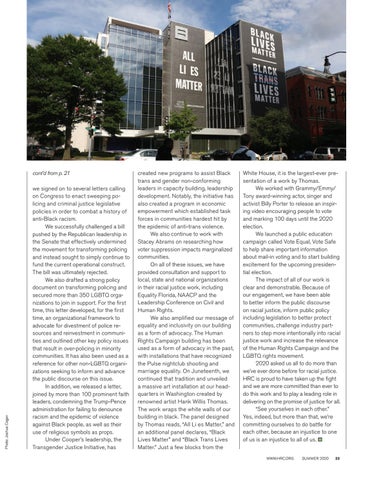
created new programs to assist Black trans and gender non-conforming leaders in capacity building, leadership development. Notably, the initiative has also created a program in economic empowerment which established task forces in communities hardest hit by the epidemic of anti-trans violence. We also continue to work with Stacey Abrams on researching how voter suppression impacts marginalized communities. On all of these issues, we have provided consultation and support to local, state and national organizations in their racial justice work, including Equality Florida, NAACP and the Leadership Conference on Civil and Human Rights. We also amplified our message of equality and inclusivity on our building as a form of advocacy. The Human Rights Campaign building has been used as a form of advocacy in the past, with installations that have recognized the Pulse nightclub shooting and marriage equality. On Juneteenth, we continued that tradition and unveiled a massive art installation at our headquarters in Washington created by renowned artist Hank Willis Thomas. The work wraps the white walls of our building in black. The panel designed by Thomas reads, “All Li es Matter,” and an additional panel declares, “Black Lives Matter” and “Black Trans Lives Matter.” Just a few blocks from the
White House, it is the largest-ever presentation of a work by Thomas. We worked with Grammy/Emmy/ Tony award-winning actor, singer and activist Billy Porter to release an inspiring video encouraging people to vote and marking 100 days until the 2020 election. We launched a public education campaign called Vote Equal, Vote Safe to help share important information about mail-in voting and to start building excitement for the upcoming presidential election. The impact of all of our work is clear and demonstrable. Because of our engagement, we have been able to better inform the public discourse on racial justice, inform public policy including legislation to better protect communities, challenge industry partners to step more intentionally into racial justice work and increase the relevance of the Human Rights Campaign and the LGBTQ rights movement. 2020 asked us all to do more than we’ve ever done before for racial justice. HRC is proud to have taken up the fight and we are more committed than ever to do this work and to play a leading role in delivering on the promise of justice for all. “See yourselves in each other.” Yes, indeed, but more than that, we’re committing ourselves to do battle for each other, because an injustice to one of us is an injustice to all of us. WWW.HRC.ORG
SUMMER 2020
23