Lt. Governor Hails Veterans’ Commitment
Department Commander James Delaney recently received a letter from Indiana Lieutenant Governor Rebecca S. Skillman, expressing appreciation and admiration for Hoosier veterans and their continued service to the state of Indiana.
Surprise Visit By President Delights Legionnaires
Bush Condemns Limits on War, Raps Walter Reed Treatment; Hoosiers Descend on Legislators
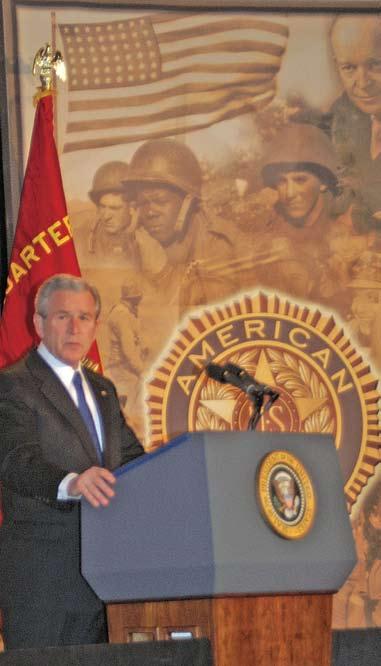
Hundreds of Legion leaders from around the nation, including a group of Hoosier Legionnaires led by Indiana Department Commander James Delaney, gathered in Washington DC for the annual Washington Conference, and were surprised by the unanticipated appearance of the President George Bush at the legislative rally held each year as a send-off for visits to Capitol Hill.
Although conference planners were well aware of the visit, most conferees expressed both surprise and delight at the appearance of the Commander in Chief.
“We had no idea President Bush was going to be here until late last night,” said Kathleen Dagley, who managed to find a near-front row seat, from which she pressed forward to shake hands with the President after his remarks.
“I don’t think I’ll wash this hand any time soon,” she said.
In his own remarks, the President advised Legionnaires heading to the Hill to make it clear that “we are at a critical juncture in the War on Terror, and our enemies are watching us very closely.”
terrorists have been waiting for.”
The President also praised The American Legion’s Resolution 169, which puts the Legion on record in support of America’s war effort and its troops, as well as providing a blueprint for demonstrating that support.
“Your Resolution 169 is a clear and unqualified message of support of our forces’ efforts to dismantle the terrorist network,” he said.
“Vietnam veterans understand that if you support the troops, you support the mission. You cannot separate the two. That is the lesson we learned from the war in Vietnam.”
The President took particular aim at the then-emerging non-binding resolutions which presaged efforts by congress to tie withdrawal to war funding – a bill he vetoed May 2.
“Non-binding resolutions led to the killing fields” of Southeast Asia,” Bush said. “It makes no sense.”
at Walter Reed Army Hospital. Care of veterans, he said, “is an important commitment. Money is one thing. Delivery of care is another. What happened at Walter Reed is unacceptable and is not going to continue.” To assure that it does not, Bush promised “a comprehensive review of care from the time a soldier leaves the battlefield to his return to civilian life.”
Following the rally and President’s speech, the audience fanned out to visit members of their respective Congressional Delegations.
Indiana Commander Delaney led a group to Senator Richard Lugar’s office for a rare meeting with the Senator himself. Senator Evan Bayh was unavailable to meet with the Hoosiers, but most of the Members of the House of Representatives did make time for small groups carrying the Legion’s message.
Among the legislative priorities presented to the legislators were:
• Flag Protection Amendment
• Support For The War On Terror
• The FY08 VA Budget
Becky Skillman
 Indiana Lt.
Governor
In remarks transmitting the letter, Skillman’s office wrote Commander Delaney that “while Lt. Governor Skillman wishes she could be present at the many Memorial Day services commemorating servicemen and women, she would like to let our Hoosier veterans know that she (will be) thinking of them on that special day.”
In her letter, the complete text of which follows, Lt. Governor Skillman wrote:
“Dear Honored American Legion Members:
“In honor of Memorial Day, a day to celebrate our fallen armed servicemen and women, I would like to take this opportunity to share a few thoughts with you, our esteemed Hoosier veterans.
“These days, our men and women in uniform are among our most precious resources. Indiana is part of a nation at war. We have daily reminders of the effects of war both on our troops of today and those of past wars and conflicts. For this reason, we have an obligation to commemorate the sacrifices of our armed servicemen and women, and thank their families not only on Memorial Day, but on each and every day.
“As veterans, you have a unique perspective and Governor Daniels and I welcome your thoughts, concerns, and advocacy. We are truly grateful
Continued on page 2
2007 Joint Spring Conference
He indicated that America’s enemies are watching the Congress closely, also, and by its efforts to curtail funding or set a definite time-table for withdrawal, “the Congress is sending the message that the
Candidate Urges Legion To Rely On Its Reputation
The leading candidate for National Commander of The American Legion has called on Hoosier Legion, Auxiliary and SAL members to build on the organization’s hard-won reputation for determined support of America’s troops and foreign policy.

Martin V. Conatser’s (Ill.) remarks came as he addressed the 2007 Joint Spring Conference in Indianapolis, where more than 1,000 members of the Legion Family gathered for joint sessions, commission and committee meetings, and a variety of special events.
“Just yesterday,” Conatser told those attending the conference’s general session, “I participated in a conference call with our National Commander, Paul Morin, and the Secretary of Defense, Robert Gates. Let me tell you: Gates did not have to call The American Legion. He did, though, because he knows our position on the War on Terror. He knows of our support of the troops. And he knows of our influence among members of Congress.”
Gates also placed the call, Conatser said, to “explain first hand to our National Commander the reasons behind the just announced decision to extend Iraqi tours of duty to 15 months.” That decision, according to Conatser, was made to relieve the pressure on troops experiencing repeated deployments and to stabilize troop levels in the wake of the so-called troop surge; it was conveyed to The American Legion first-hand because of “our firm support of the President’s conduct of the war and our ability to influence public opinion,” Conatser said.
The candidate was firm in his assessment of The American Legion’s traditional reluctance to call attention to its accomplishments. “It is time to let people know who we are and what we stand for,” he said, adding that membership inevitably will follow.
During his two-day visit to the conference, Conatser attended a number of commis-
sion and committee meetings and was the guest of honor at a pair of special receptions and the commander’s traditional Conference Party.
He also spent several hours in discussions concerning the Department’s newly introduced District Headquarters Posts transfer program, which was the subject of a lengthy and detailed review led by the program committee’s chairmen, PDC Bill Firkins and John Michalski.
The candidate had been briefed on the transfer program at National Headquarters, and came armed with several concerns, not the least of which was to clarify the intent of the program. Following the meeting, in which District Task Force Chairmen described their procedures and progress to date, Conatser declared his reservations eased, but added that he would continue to maintain a “wait and see” attitude. He conceded that the program, in which the eligibility of Post 777 members is verified by
Continued on page 3
In his wide-ranging speech, the President also repeated his promise to see that the country’s war veterans will receive the best possible care when they return from war.
“My decisions have put kids in harm’s way. I am concerned that they are not getting the care they deserve when they come back,” he said, referring to reports of substandard care
• Support For The Public Expression Of Religion Act
• Veterans Employment And Training Act Funding
• The Total Force GI Bill
• Total Repeal Of The ‘Dis-
Continued on page 2
Interested and Involved
Martin Conatser, leading candidate for National Commander, addresses the nearly 700 Legion, Auxiliary and SAL members gathered in Indianapolis in Mid-April for the annual Joint Spring Conference. In addition to his keynote address, Conatser’s three-day visit included receptions, dinners, visits to commission and committee meetings, and a lengthy discussion of the Department membership program.
Top VSO Commanders To Congress: ‘Fund The War’
In a joint letter to House and Senate leaders and delivered to every member of Congress, National Commander Paul A. Morin and VFW National Commander Gary Kurpius sent a simple message to Congress: pass a war-funding bill void of any extra legislation as soon as possible for the sake of U.S. troops serving in harm’s way.
“This critical funding request must be void of any language that directs the conduct of military operations or troop movements based on timelines established by Congress
rather than the commanders on the ground, the Joint Chiefs of Staff, or by the commander in chief,” the two chief executives wrote.
Morin and Kurpius told Congress it should consider and debate the president’s fiscal 2007 Defense Emergency Supplemental Appropriations request with only those amendments directly related to the ongoing cost of war, because “the men and women of the armed forces in the theater of operation are dependent on this emergency funding to sustain and achieve their mili-
tary missions.”
According to VFW Commander Kurpius, “Everyone wants the war to end, but how it ends is just as important, so with all due respect to the small majority in the new Congress who voted to withdraw most of our 140,000 troops from Iraq next year – you are wrong.”
“Congress’ failure to fund the troops sends a clear message to them,” Morin added.
“The commander in chief sent this bill to Congress over two months ago. I don’t understand how some in Congress
can play ‘chicken’ with troops’ lives, training, equipment and unit deployments that affect all our military families too. I just don’t get it, and I’m not alone.
“As leaders of our respective wartime veterans’ service organizations, we strongly encourage the removal of all restrictive language designed to influence the conduct of military operations and troop movements. Our knowledge about warfare and the evils of terrorism were learned in the hard school of experience. With all due respect to you and your colleagues – first things
first, take care of the troops. They are the ones placed in harm’s way.”
“You were wrong to force a showdown with a president who vowed beforehand to veto any measure that contained artificial troop withdrawal language,” both commanders told Congress. “And you were wrong to add almost $20 billion, for programs unrelated to the war, on top of the $103 billion requested by the Defense Department.
In a nutshell, not funding direct combat operations is the same as having your hands tied in a knife fight, they said.
“Unrealistic restrictions and troop withdrawal timelines will tie the hands of our battlefield commanders to maneuver their forces,” Kurpius said. “That will break the morale of our troops in the field – and to those of us who have been there and done that, morale means everything in a war zone.”
This is not a Democrat or Republican issue, the veteran leaders reiterated.
“This issue is about American men and women who we sent to war, and now some want to pull back before they finish their job,” the pair said.
April 2007 Call of The Convention / Page 2 Legionnaires in Action / Page 8 Commander: Indiana Held in High Esteem / Page 10
President George Bush was an unannounced, but welcome, visitor to the stage of the 2007 Washington Conference in March. Department Commander Jim Delaney and a contingent of Hoosier Legionnaires were in the audience, and later visited the Indiana Congressional Delegation on Capitol Hill.
Conference Photos – Page 8
Adjutant Issues Call For 2007 Convention
The Department Adjutant, Stephen W. Short, has issued the following call for the 2007 Department Convention:
In compliance with the Constitution of The American Legion, Department of Indiana, and the action of the Department Executive Committee, the 89th Annual Convention of The American Legion Department of Indiana, will be held in Merrillville, Indiana July 12, 13, 14 & 15, 2007.
PURPOSE
The Convention is called for the purpose of:
1. Electing Department Officers for the ensuing year.
2. Amending the Department Constitution & By-Laws, if necessary.
3. Transacting of such other business as may be brought before the Convention.
NOTE: District Commanders for 2007-2008 and Delegates to the 2007 National Convention must be elected by the duly accredited State Convention Delegates at least 15 days prior to the State Convention. THIS DATE IS JUNE 27, 2007.
REPRESENTATION
Representation at the Department convention shall be by Post. In explanation of the number of delegates, each Post shall be entitled to
• one (1) delegate and one (1) alternate for the first 15 members;
• two (2) delegates and two (2) alternates for 51 members;
• three (3) delegates and three (3) alternates for 151 members;
• four (4) delegates and four (4) alternates for 251 members; and
• one (1) delegate and one (1) alternate for each additional 100 members, whose Department and National dues have been paid as shown on the books of the Department Adjutant by 2:00 p.m. June 10, 2007.
Each Post shall have as many votes as it is entitled delegates. The votes shall be equal to the number of delegates who are properly certified to the Department Adjutant. Such certification must be received in Department headquarters by 4:30 p.m. June 10, 2007. A Post to be recognized as a Post shall have 15 members whose dues have been paid to Department Headquarters.
 Stephen W. Short James A. Delaney Department Adjutant Department Commander
chael Werner and Rich Richardson of the Third District.
abled Veterans Tax,’ and • FY07 Defense Supplemental Funding Bill
The group of Indiana Legionnaires who attended the 2007 Washington Conference included the commanders and membership chairmen
Continued from page 1 Lt. Governor
Continued from page 1
for your service and continuing commitment to veterans’ interests in Indiana. Together, we can ensure the highest quality of care and compassion towards our service men and women, now and in the future.”
The Lt. Governor’s letter arrived at Department Headquarters on the day Indiana Governor Mitch Daniels signed into law Senate Bill 480, a measure providing a variety of new benefits and protections to service personnel and veterans. Measures included in the bill will: Exempt active duty military pay earned by members of the National Guard and reserve components from the individual income tax;
of three of the Department’s top performing districts – each winners of one of several trips included among the 2007 membership incentive awards. They were Commander Ron Hangar and Randal Dooley of the Eighth District, Commander Pete Van Woerden of the First District, and Commander Mi-
increases the military pay income tax deduction from $2,000 to $5,000; expand the high school diploma program for eligible veterans to include veterans of the Korean and Vietnam conflicts; and specify that active duty military personnel stationed in Indiana and their dependents are eligible for resident tuition rates at state educational institutions.
Also, authorizes the Advisory Board of the Division of Professional Standards of the Department of Education, and various professional licensing boards to adopt rules to expedite the licensure of individuals whose spouses are stationed on active duty in Indiana; prevent a taxpayer from claiming both the new exemption and the existing deduction for military
SAL Detachment Commander Mike Sheets and American Legion Auxiliary President Vickie Koutz also participated in the conference, although the Auxiliary conducted its separate Awareness Assembly to prepare its members to visit Capitol Hill.
income; increase by $100,000 state matching funds up to $450,000 annually for Indiana Military Families Relief Fund; establish employment criteria for employees of the Indiana Department of Veterans’ Affairs and local service officer; and provides that a power of attorney for prosecution of veterans’ benefits runs to an agency or individual authorized by the department.
Also, provide for reimbursement of certain expenses of Medal of Honor recipients; establishes the veterans’ affairs trust fund and the military and veterans’ benefits board; and establish the National Guard scholarship extension fund to provide scholarships to certain former National Guard members.
Tour Hosts Report Seats Still Available
WWII veteran Dr. Brooks Ranney and his wife Vi, whose Europe tours were featured briefly in the previous issue of the Hoosier Legionnaire, report a large response to their scheduled tour of World War II
battlefields set for June 2007. They also have indicated that a few seats remain available for those interested in traveling with their group.
The Ranneys have, according to correspondence
On The Road
Convention Heads to Northwest Indiana For Business, Honors And Good Times
The 89th Annual Department Convention will convene outside Indianapolis for the first time since 2003 when it convenes July 12-15, 2007, in Northwest Indiana’s mecca for entertainment, shopping and casino hopping, Merrillville.
Located at the intersection of I-65 and Indiana Highway 30, Merrillville offers a variety of hotels and dining options, including the expansive Headquarters Hotel, the Radisson Hotel at Star Plaza. Room reservations for the convention will be accepted at the hotel beginning May 1, 2007. Delegate registration can be accomplished by using the Convention Registration Form printed above. For registration and information, call (219) 769-6311.
CONVENTION AWARDS
SPOTLIGHT DOERS
National Veterans Affairs and Rehabilitation Commission or by the Departments own Rehab Commission.
Popular post awards include:
• The Byron Waggoner Award, recognizing a District’s ceremonial efforts and accomplishments.
• The Four Chaplains Memorial Award, recognizing a Post’s efforts to promote the ideals of the Service to God and Country program.
• The Ralph V. “Curly” Cushman Award, recognizing a Post’s accomplishments in the field of rehabilitation and service to the veteran.
• The Col. Frank R. Kossa National Security Award, recognizing a Post’s activities to promote issues of National Security in its local area.
up at least 50 new members in the current membership year; the Silver Brigade is open to those who recruit 25-49 new members.
CONVENTION AREA
TOURS PLANNED
In addition to the general sessions and other activities traditionally associated with a Department Convention, the Lake County, Indiana, Convention and Visitors Bureau has scheduled a number of special tours for those attending the convention. Tours include transportation and are scheduled throughout the convention period. Advance registration is required, so those who wish to take advantage of these opportunities should contact Heather Becerra @ (219) 554-2224 or (800) 255-5253.
46204.
James A. Delaney Department Commander
Stephen Short Publisher
Hugh Dagley Editor
Official publication of and owned and conducted exclusively by The American Legion, Department of Indiana.
Member: National American Legion Press Association and Hoosier American Legion Press Association.
Advertising Sales Representative: The Herald-Times, Bloomington (800) 422-0070.
Subscription Rates: $0.85 of each members dues goes for publication of the Hoosier Legionnaire.
Volume AA, Number 2 April 2007
Circulation 120,000
Printed by the Herald-Times, Bloomington, IN
with the Hoosier Legionnaire, “dedicated their (retired) lives to escorting veterans, families and friends back to the great battlefields of Europe. There are a few seats left for each departure this summer.”
A scheduled June 4 departure is a twelve day four-star tour which will celebrate the 63rd anniversary of D-Day on all the Beaches of Normandy. Other places of interest in France are St. Mere Eglise, Pointe du Hoc, St. Lo, Rheims, and several cemeteries and museums.
Other tour highlights include the American Cemetery where General Patton is buried near Luxembourg City, two days to be spent in the area where the Battle of the Bulge was fought, and visits to the German cities of Heidelberg and Nurnburg.
According to Vi Ranney, the tour “also will visit the Buchenwald Concentration camp near Weimar.
A similar tour will depart August 25 on a 10-day jaunt with an itinerary similar to the June tour.
Interested legionnaires should contact the Ranney’s directly for more information on how veterans, family and friends can join the tour. 605665-3596 or e-mail them at: viranney@vyn.midco.net.
The highlight of any Department Convention is the presentation of Department awards to members of the public, distinguished Hoosiers, and deserving members, Posts and Districts of the Department of Indiana. The 2007 Convention will be no exception.
The Distinguished Public Service Award, initiated in 2003, will be presented to one or more members of the Indiana General Assembly for legislative work on behalf of veterans. Recipients traditionally have attended the convention and addressed to general session.
The Department of Indiana Distinguished Service Award, the organization’s highest honor, will be presented to members of the Department who have been nominated by their Districts and selected by the DSA committee. Nominations for the award are closed.
An important group of awards to be presented are those honoring the year’s best in a variety of categories. Selected from among the tops in each District and honored on the convention platform will be the Educator of the Year, Police, Fire and EMS Officer of the Year, Boy and Girl Scout of the Year, and Military Person of the Year.
A variety of awards will be presented to those who have rendered especially valuable service to veterans in the area of health care, employment and service. These awards are based on nominations received from members, Post or Districts, and are determined by criteria established by the
• The Gaylord N. Sheline Award, recognizing a Post for its overall activities during the Legion year. This entry requires a scrapbook be provided.
• The Wayne L. Talbert Award, recognizing a Post for its efforts in preparing a print publication. This entry requires examples to be submitted in a folder.
• The Fourth Estate Award, recognizing outstanding achievement by a professional news organization in the coverage of activities of interest to The American Legion.
• The Sons of The American Legion Achievement Award, recognizing the S.A.L. Squadron which distinguishes itself in all phases of the S.A.L. program.
The deadline for returning entry forms for these awards is June 1, 2007. All Post adjutants received a packet containing rules and applications. Additional award packets are available from Department Headquarters at (317) 6301300.
In addition to the convention awards, the Membership Committee presents several individual and group awards for outstanding membership achievement during the year. The Department Membership Guide contains the necessary forms and information concerning both the National and the Department Membership Awards..
Among the most prestigious membership awards for individual Legionnaires are the Gold Brigade and the Silver Brigade. Membership in the Gold Brigade is awarded to those recruiters who sign
Tours scheduled so far include:
• Horseshoe Casino -6:00 p.m. to 11:00 p.m., Thursday, July 12, 2007. Minimum of 40 Persons. Casino will provide bus transportation from Radisson. Participants must submit name, address, and date of birth to be added to a transportation manifest. No charge.
• Lighthouse Place Premium Outlets – 9:00 a.m. to 2:00 p.m. Friday, July 13, 2007. Includes one hour and 15 minutes of drive time, one hour for lunch, and two-and-onehalf hours of shopping among 120 designer and brand name outlet stores in charming outdoor village.
• Downtown Crown Point – 10:00 a.m. to 2:00 p.m. Friday, July 13, 2007. Visit Lake County Historical Museum, quaint shops and restaurants, and tour the city on Molley the Trolley operated by the City of Crown Point. Tours limited to 32 persons.
• Community Veterans Memorial Tour – 6:00 p.m. to 8:30 p.m. Friday, July 13, 2007. Visit memorials to veterans of WWI, WWII, Korea, Vietnam and Desert Storm, all set among landscapes of wartorn land linked by a brick pathway.
• Albanese Nut & Candy Factory Tour – 9:30 a.m. to 11:15 a.m. Saturday, July 14, 2007. Wonder at the world’s tallest chocolate waterfall in one of the largest candy stores in the world.
• Tee Times -- Golfing available on area links and courses. Standard fees apply, but tee times will be arranged in advance for interested Legionnaires.
2007
HOOSIER LEGIONNAIRE is published bi-monthly by the Indiana Headquarters of The American Legion, 777 North Meridian Street, Indianapolis, IN
Phone (317) 630-1391.
Postage Paid at Indianapolis, IN and at additional mailing offices.
April
The
46204
Periodicals
USPS 010-445 ISSN 0018-4772
changes to HOOSIER LEGIONNAIRE, 777 N.
POSTMASTER: Send address
Meridian St., Indianapolis, Indiana
Merrillville to Host 89th Conclave
President
Foundation Seeks Friends To Support War Memorials
The President of the Indiana War Memorial Foundation, an Indiana not-for-profit corporation, has issued a call for support of the newly formed ‘Friends of The Foundation,’ a group dedicated to, and established for, providing expanded services and activities in support of Indiana’s war memorials and statues.
The Friends will provide funds and assistance to the Indiana War Memorial Foundation, according to R.W. Sweeney, Colonel (Ret), USA, Foundation President. The Foundation’s aim is “to support the goals and objectives of the War Memorials Commission. Our primary purpose is to provide resources, both human and financial, for this purpose.”
Sweeney, who previously served at Executive Director of the Indiana War Memorials Commission, recently wrote an open letter to Hoosier Legionnaires “on behalf of all of the Hoosier veterans whose selfless service to God and Country is commemorated at the Indiana War Memorials.
“While Hoosier taxpayers support the daily operations and maintenance needs of the Commission, little to no funding is available to continue to develop and present museum exhibits, programs and public relations items to support the mission to com-
Ban Overturned
memorate Hoosier veterans. This is where our Foundation comes in.
“The Friends organization is one of the several ways we seek the support we need to continue provided resources to the Commission. While financial contributions are our lifeline, the time and talents of our membership is also a precious resource. If you desire additional information, please contact our Foundation offices by phone or email. Phone (317) 234-1579, email: iwmfoundation@iwm.in.gov.”
The War Memorials Commission is the state agency that manages and maintains the five city blocks in downtown Indianapolis that honor Hoosier heroes. Included in this real estate is Indiana’s World War Memorial & Museum, Soldiers & Sailors Monument containing the Colonel Eli Lilly Civil War Museum, as well as memorials to Hoosier veterans of all the Nation’s conflicts. Also included is American Legion Mall, the home for both the state and national headquarters.
Senior leaders of the Department of Indiana recently received a monthly newsletter from Adjutant Steve Short that urged them to encourage members to join our brand new Friends organization.
Legion Lauds Federal Court Decision To OK Boy Scout Jamboree
National Commander Paul Morin has hailed a decision by the U.S. Seventh Circuit Court of Appeals in Chicago that early last month dismissed the American Civil Liberty Union’s lawsuit against the Department of Defense for supporting the National Boy Scout Jamboree.
“This is a victory for not only the youth of our nation but also for the preservation of tradition and common sense,” said Morin.
“For more than 25 years, Boy Scouts have held the National Scout Jamboree every four years at Fort A.P. Hill near Fredericksburg, VA, for ten days of activities emphasizing physical fitness, appreciation of the outdoors, and patriotism. It is especially fitting that the Scouts will be able to go forward with the 2010 Jamboree as they celebrate the 100th Anniversary of the Boy Scouts of America.”
In 1999 the ACLU sued DoD over its support for the Jamboree. In 2005, a federal district court in Chicago concluded the Jamboree statute was unconstitutional under the Establishment Clause of the First Amendment ot the US Constitution because
Continued from page 2
district workers before they are voluntarily transferred to local posts, would require two to three years to demonstrate its effectiveness.
Membership Chairman Ed
Trice described the inspiration for the transfer program during his remarks to the general session, saying “literally thousands of members who signed up under the DMS program actually have asked to be transferred to local posts. We didn’t expect that, and we had no plan for dealing with it.
“That got us to thinking, and led to the establishment of a formal program for the transfer of members from our
Scouting has a nonsectarian “duty to God” requirement.
DoD appealed the district court’s injunction against military support under that statute for the 2010 Jamboree.
The American Legion filed a “friend of the court” brief supporting the Department of Defense in Winkler v. Gates.
Seven Presidents have attended the Jamboree since President Franklin D. Roosevelt in 1937. The Jamboree grounds at Fort A.P. Hill are open to the public and an estimated 300,000 visitors attended in 2005 along with 43,000 Scouts and their leaders.
The U.S. Congress called it an incomparable training opportunity for our armed forces; it requires the construction, maintenance, and disassembly of a “tent city” capable of supporting tens of thousands of people for a week or longer.
“Patriotism and mentoring youth are pillars of The American Legion,” Morin said. “When Scouts have the opportunity to interface with members of the finest military in the world, they acquire many of the leadership skills that will guide them throughout their lives.”
Headquarters Post 777 di-

rectly into the Districts. That program is underway: each District has formed a task force, and ultimately, more than 12,000 members will be transferred into the Districts; the total number per district ranges from a low of about 700 to a high of nearly 2,000. That is good news for the Posts and the Districts, but it underscores a point that needs to be made over and over again concerning our recruitment program,” he said.
“That point is this: every one of those 12,000 veterans answered ‘yes’ when they were asked to join but because they were asked by the National Organization, by mail, not a penny of their dues made its
Golf Entry Form
The entry form for the 2007 Department of Indiana annual Golf Tournament must be completed by the entrant and his or her current membership attested to by the Post Adjutant. Entries must be post-marked no later than May 31, 2007; late or incomplete entries will be returned. Players should return the completed form with payment to American Legion Post 331 in Brownsburg. Additional entry forms are available on the Legion website, www.legion.org.
Program Helps Hometowns Help Veterans
The Department of Defense and The American Legion have established a support program designed to pair Legion Posts with wounded veterans to ease the veterans’ transition back into the mainstream of their community.
Entitled “Heroes to Hometowns,” the program provides special assistance and support to service members or veterans, or family member of a service member or veteran, who have been severely injured. It is a transition program especially appropriate for severely injured service members returning home from Operation Enduring Freedom and Operation Iraqi Freedom.
The “Heroes to Hometowns” establishes a support network and coordinates resources such veterans.
Among the services available through the “Heroes to Hometowns” programs are:
• A Welcome Home celebration
• Temporary Financial
way into your post coffers and not one minute of their effort has been spent on behalf of your programs.
“Our District Headquarters Post Program is designed to change all that.
Trice also reported on the “Race to Reno,” a membership competition in which three Post Commanders who end this year with the largest increase in membership over last year can win trips to the 89th annual National Convention.
In other conference activities, Rehabilitation Chairman Mike Miller introduced the newest members of the Veterans Services Million-Dollar Club – county service officers whose efforts resulted in
Assistance
• Pro-Bono Financial Planning
• Housing Assistance
• Home and Vehicle
Adaptation
• Government Claims Assistance
• Transportation to hospital visits
• Entertainment options
• Childcare
• Counseling
• Family Support
• Assistance Request Form
Help in establishing a “Hero Transition Team” at a local Post is available by downloading “When They Come Home,”
A Post Guide to Establishing a Successful “Heroes to Hometown” Program in your Community” from the Legion’s national website, www.legion. org. Veterans who are not severely injured but nevertheless need general transition assistance or support, may also fill out a Request form by
at least $1 million in new VA benefits for veterans in their counties. They are:
George Jarboe, Howard County, $4.07 million; Jerry Sensing, Madison County, $3.2 million; Gary Whitehead, Elkhart County, $2.75 million; Donald Shultz, Lake County, $2.74 million; Larry Wilson, Grant County, $2.60 million; Mark Acker, Vanderburgh County, $2.10 million; Randall Fairchild, Tippecanoe County, $1.82 million; Shelby Shaffer, Clark County, $1.74 million; Jay Kendall, Miami County, $1.51 million; Kevin Kelsheimer, St. Joseph County, $1.47 million; W. Allen Polsgrove, Howard County, $1.32 million; Bruce Stanton, Huntington County, $1.21 million; James Koutz,
visiting their American Legion Department Service Officer or the American Legion post in their community.
Frequently Asked Questions
Q. What is Heroes to Hometown?
A. The Heroes to Hometown program is a transition assistance program for service members who were severely injured in the Global War on Terrorism.
Q. What is meant by severely injured?
A. Severely injured refers to service members who suffered blindness, total hearing loss, an amputation, severe body burns or a spinal cord injury.
Q. How can I help?
A. By forming a Hero Transition Team.
Q. What is a Hero Transition Team?
A. A Hero Transition Team is a community based support team to rally and coordinate assistance for a service member leaving the military
Warrick County, $1.17 million; Jerry Griffis, Delaware County, $1.12 million; and the late Jim Griffin, Bartholomew County, $1.15 million.
Bob Bach, Chairman of the Americanism and Government Committee presented the 2007 A&G Awards to six high school students from across the state who topped the competition in the patriotic essay program.
Each of the six state winners received a $500 scholarship and a certificate of appreciation from the Department.
The winners are: The 11th grade girl winner, Natasha Naylor from West Noble High School in Ligonier, sponsored by Post 243 in the 4th District; the 12th grade girl
and entering civilian life.
Q. How do I find an American Legion post in my community?
A. Through the Post Locator.
Q. Can I help if I am not a veteran?
A. Yes. The American Legion is willing to work with anyone for the benefit of our severely injured service members.
Q. Does The American Legion help veterans and service members who are not severely injured?
A. Yes. The American Legion is an advocate for all veterans. Please contact your Department Service Officer for assistance with non-severely injured veterans.
For more information, contact The American LegionHeroes To Hometown Military Severely Injured Center (Pentagon) Phone: 202 263-2983
heroestohometown@legion. org
winner, Amy Berkshire from Pioneer High School in Logansport, sponsored by Post 60 in the 2nd District; the 11th grade boy winner, Colby Shank from Hamilton High School in Hamilton, sponsored by Post 467 in the 4th District; and the 12th grade boy winner, Mohit Agrawal from West Lafayette High School in West Lafayette, sponsored by Post 38 in the 2nd District. The 10th grade girl winner, Ashley Ames from Griffith Senior High School in Griffith, sponsored by the 1st District’s Post 66, and the 10th grade boy winner, Joshua Kamman from Brownstown Central High School in Brownstown, sponsored by Post 112 in the 9th District, were unable to attend the conference.
Conference
robert newman chairman
The Children & Youth Commission met at 4:15 pm Saturday, April 14, 2007, in Salon C at the Marriott Hotel during the Spring Conference.
Chairman Robert Newman opened the meeting in proper form. Roll call disclosed the following members present: Vice Chairman Rodney Strong, Vice Chairman Al Pulido, National Liaison Representative James Delaney, and Committee Chairmen: Americanism and Government Robert Bach, American Legion Family Scholarship Charlie Wier, Boy Scouts Pete Brannon represented Stan Gatewood, Boys State Enrollment Jack Cook, Children & Youth Bob Ripley, Flag Education/Etiquette Ronald Taylor, Girl Scouts Gail Galich, Junior Shooting Sports Ida Jewell, and Knightstown Home Jerry Jordon.
Boy Scouts Chairman Stan Gatewood was absent. Oratorical & School Awards Chairman Fred Langley was absent due to the National Oratorical Contest on the same day.
American Legion Family Scholarship Committee
The committee reviewed donations received from August 1, 2006, to March 31, 2007. A motion was made and approved to allow students to only win once. Wording will be added to the application for next year. The selection committee met following the normal committee meeting and chose the three winners of the American Legion Family Scholarship. The winners are Justin Williams, Ashley Thomas, and Matthew Dobbertien. Each winner will receive a $900 scholarship.
Americanism & Government Committee
The committee discussed ways to increase post participation and knowledge of the program. Neither motions nor requests for money were made.
Boy Scouts Committee
Five candidates for Eagle Scout of the Year will be introduced at the Department Convention with the state winner being announced at the same time. Russ Chorpenning gave a report on a new pin design which he will have the pin and a picture before the end of April. An impromptu meeting will be held at the Department Convention between the Chairman and District Chairmen to approve the pin design. Troop 169 awarded their first Eagle Scout in February. The Zionsville Legion Post is now sponsoring a Boy Scout troop.
Boys State Enrollment Committee
Information was distributed concerning the Indiana State University Hoosier Boys State Scholarship. This scholarship can be worth up to $1,320 in college credit at Indiana State.
Approximately twenty colleges will be represented at the college fair during the week of Boys State.
The McHale scholarship is valued at $1700 and will be awarded to three applicants. The Kossa Scholarship is valued at $3625 and will be presented to the week’s outstanding citizen.
All chairmen were given a report of delegate applications received prior to conference. Post orientation sessions will be updated on the website following the conference.
Director Bill Jackson informed the group the National American Legion would be sending a film crew to Boys State to gather footage for a new DVD. Posts should not overlook alternative sources for funding such as Lions
Clubs, Kiwanis, Optimist clubs, banks and companies.
Children & Youth Committee
NEC Tom Henderson introduced National Commander Candidate Marty Conatser, who spoke on the programs of the American Legion and their importance to the Legion.
District chairmen were polled on their number of applicants for Educator of the Year, only half had applicants. Discussion centered on ideas to draw more interest for next year. District winners are due to the Department office by June 1, 2007.
Riley Hospital donation banners can be ordered online. Hendricks County Avon Post 145 led the community and other posts in a Blue Star Recognition Program last year and made over $10000. They will be sponsoring the program again this year.

Pen & Publish Publishing Co. should be contacted with regards to setting up veteran interviews for their book and documentary. Auxiliary Children & Youth Chairman Peggy Bishop spoke on the Ronald McDonald House aluminum tab program.
Flag Education/ Etiquette Committee
The flag education state winners were selected. Morgan Brown, from Redkey Elementary School, was sponsored by Post 227 in the 5th District. Zachary Buhler, from Lancaster Elementary School, was sponsored by Post 85 in the 5th District. They will be recognized at the Department Convention.
Girl Scouts Committee
A motion was made and approved to accept six applications from the Auxiliaries candidates for the National Auxiliary Gold Award and bypass the applications being sent to district chairmen in order to meet the May 1st deadline for this year only. All chairmen were given a copy of the scholarship application and encouraged to get applicants. The Gold Award Girl Scout of the Year will be recognized at the Department Convention. The committee accepted $248 in donations during its meeting.
Junior Shooting Sports Committee Chairman Ida Jewell will have a three-part article from the Civilian Marksmanship Program printed on how to conduct a tournament. The committee would like to have George Lacey appointed as a full time Range Officer to their committee and to honor George upon his retirement from the Indiana Soldiers’ and Sailors’ Children’s Home for his assistance with the state tournament over the past years.
Knightstown Home Committee
A motion was made and approved to give Ashley Lightfoot $600 to participate in the Business and Professionals of America National Convention on May 8-13 in New York City. A second motion was made and approved to give $6,000 for school yearbooks.
The Morton Memorial Boys Basketball team finished the season with a 12-9 record including a first round win in sectional play at Edinburgh. Graduation will be May 26, 2007 at 10:00 a.m. The prom will be April 21, 2007.
The slate of officers for the coming year was presented by Dale Kuhn and approved.
Adjournment
There being no further business to come before the Commission, the meeting was closed in proper manner.
ralph Tolan chairman
The Americanism Commission met at 4:00 p.m. Saturday, April 14, 2007, in Salon 3 of the Marriott Hotel during the Spring Conference.
Chairman Ralph Tolan opened the meeting in proper form. Roll call disclosed the following members present: Chairman, Ralph Tolan; Vice Chairmen, Bill Clark and Burt Tiemersma; Natl. Liaison Rep, John E. Hayes. Committee Chairmen: Joseph Rivich, Baseball; Phillip N. Deckard, Bowling; Gary Stiles, Golf; Gary Steinhardt, National Security/Foreign Affairs; John Bubala, POW/MIA; and Larry Horvath, SAL.
Minutes from the previous meeting were read and approved.
Baseball Executive
Saturday, June 16, at 1:00 p.m. a meeting will be held at Department Headquarters to discuss transfers and change of schools. July 10 is the deadline for forms 1 and 2 and proof of insurance to be turned in to Department Headquarters. The state final will be played August 10, 11 and 12. A motion was made by John Miles to hold three regionals and play a four team state final. Motion was seconded by Ron McWilliams and passed.
A motion was made by Jeff Moore to not allow any more entries in our tourney schedule. Motion was seconded by Ron McWilliams and passed.
Baseball Chairman Rivich announced that transfer forms 76 and 77 along with combination of schools, are to be received in Department headquarters no later than June 10. Any transfers received after that date will not be acted upon. Form 1s, form 2s and proof of insurance have to be in Department headquarters by July 10.
Forty six teams are entered for the 2007 season. There will be 12 sections, 3 regionals, and a four team state final. Regionals will be held August 3, 4, and 5 in Plymouth, Kokomo, and Terre Haute. State finals will be held in Madison on August 10, 11, and 12.
A motion was made by John Hayes to accept sectional placements, regional pairings and sites, and state final pairings. The motion was seconded by Ron McWilliams and passed. Sectional lineups along with regional pairings and state pairings will be mailed to managers by the end of April.
Junior team bids were submitted by Terre Haute Post 346 and Boonville Post 200. Both
Posts submitted the same bid of $600. A vote was taken and the committee awarded the state junior tourney to Boonville Post 200. The date will be determined later. John Hayes reported on his meeting with the IHSAA Commissioner Blake Ross. The IHSAA is standing its ground. John mentioned two possibilities for solving the problem: legislative action or lawsuit.
Bowling The tournament was a success with 166 teams participating. The Post did an excellent job on the entertainment and dinner. It was requested the fee for next year’s tournament increase by $10.
Golf Garrett Post 178 will host the 2008 tournament July 21 and 22. The tournament will be played at the Bridgewater Golf Course East and the Bridgewater Golf Cost West. The proposed entry fee is $70.
National Security/ Foreign Affairs
There was discussion regarding the Military Person of the Year awards. Col. Gary Spry of the 310th Sustainment Command gave a briefing on the Army Reserve. He spoke regarding what the Legion can do for reserves and what reserves can do for the Legion. A question and answer session followed.
POW/MIA
Don Chapman advised a certificate of appreciation will be sent to Newburg for flying the POW/MIA flag at the monument. Jose Gaitan talked about the 10th District’s support of the POW/MIA wall. The Run for the Wall will be May 22 in Corydon at the Harrison County Fairgrounds. Information can be found on their website: www.RFTW.
org.
S.A.L.
A motion was made and passed to add a $2,000 line item to cover the cost of the inflatable games for Knightstown Home Day. Starting next year the Detachment Convention must be held at a hotel. To cover the expense, a motion was made and passed to add a line item of $2,500.00 for expenses at the Detachment Convention. The Detachment Campout will be June 22-24 in Crawfordsville. The Detachment Golf outing will be June 2 in Kokomo.
Adjournment
There being no further business to come before the Commission, the meeting was adjourned in proper form.
reHaBiLiTaTiOn
michael
J. miller chairman
The Rehabilitation Commission met at 4:15 p.m. Saturday, April 14, 2007, in Salon E of the Marriott Hotel during the Spring Conference.
Chairman Michael Miller opened the meeting in proper form. Roll call disclosed the following members present: Chairman, Michael Miller; Vice Chairman, Rick Hudson; National Liaison Representative, Ted Stenger represented by Robert Sutherland; Committee Chairmen: Harold “Robbie” Robinson, Homeless Veterans, Gary Danekas, Indiana Veterans Home; Cecil Brummett, Nursing Home; David Heath, Veterans Assistance. Those absent included Vice Chairman Richard Jewell; Commander’s Representative James Koutz; Secretary Walter Bode; Committee Chairmen: James Piepenbrok, Employment; George Brattain.
Employment Committee
Need resolution for ES5 Award at National level. Dis-
cussed attempts by WorkOne Indiana to reorganize their local offices and utilize the Vet Reps to work with non-veterans as well as veterans in performing their job duties. This violates the provisions of Title 38 US Code and will dilute the services provided to veterans.
George Patrick, Department of Labor, spoke to the committee. The committee was opposed to this and presented and approved a resolution that The American Legion should oppose any effort to reduce the staff time that the Vet Reps have to devote to veterans. The resolution
RESOLVED that the Department Executive Committee oppose any effort by WorkOne Indiana, its regional operators and any other Indiana government officials to reduce the staff time that the veterans’ representatives have to devote to veterans;, and finally be it
RESOLVED, that the Ameri-
Continued on page 6
inTernaL aFFairs
Leland Baxter chairman
The Internal Affairs Commission met on April 14, 2007 Spring Conference at the Marriott Hotel East at 4:15 p.m. in Salon D.
Chairman Leland Baxter opened the meeting in proper form. Roll call disclosed the following members present:
Chairman Baxter, ALR Rep. Bill Menzel, Community Involvement Chairman Baggett, Firefighter/Law Chairman John Wrolen, Legislative Chairman Rice, Membership Chairman Trice and New Post Development Chairman Mason.
Roll call disclosed the following members absent:
Vice Chairman J. David Morrow, Natl. Liaison Rep. John Pipher, ALR Chairman Keith Jones, Convention Contest Chairman May, Public Relations Chairman Carroll, and Religious Emphasis Chairman Keirn.
American Legion Riders
A motion was made to consult with the Departments Assistant Adjutant, Hugh Dagley on creating an Indiana American Legion Riders Constitution and By-laws. The motion was seconded and passed unanimously. No requests were made for Department funds.
Community Involvement
The minutes from the Mid-Winter Conference were amended as such: The Zionsville Police attended Post 79 on Veteran’s Day. Scrapbooks are not yet finalized as announced during Mid-Winter meetings. Corrections made, the minutes were approved as corrected.
Chairman Baggett introduced Mrs. Judy Morris, Auxiliary Rep. to the Committee. She discussed the Auxiliary’s program for Community Involvement.
10th District Chairman Ed Healy discussed the GED Scholarship program at Richmond, as well as regular graduation.
Glen Strange of the Whitestown Post has Boy Scouts lined up to put flags out on grave sites for Memorial Day. He added that the Boy Scouts are building a memorial near Advance. Chairman Strange reported that Zionsville Auxiliary is holding a dinner for police officers and firefighters.
There was some discussion from Ed Healy regarding giving out Christmas Dinners to the homeless.
Chairman Baxter addressed the Committee regarding lack of committee representation; he stated that we need to make The American Legion high profile.
Liz Rabius discussed the Race for a Cure Auxiliary Program. Chairman Baggett reported that his Post golf outing supports the program. Chairman Anthony reported that post 296 in Fort Wayne holds a Blue Star Banner Program. Vice Chairman French reported on Avon’s Blue Star Banner Event.
Chairman Cunningham reported to the Committee that they held a Memorial Day Parade for years but now they use Riderless Horse and it is getting a lot of attention.
Chairman Gordon reminded everyone to attend all funerals. Chairman Baggett reiterated the need for community involvement. It was recommended that the Committee keeps an hour long meeting at these Conferences. There were no requests for Department funds made.
Convention Contest
A motion was made to approve the minutes from the Fall Conference. The motion was seconded and passed unanimously. There was some discussion regarding not having a wooden floor and not needing space at Convention if an entry is not submitted by May 15, 2007. There was some discussion regarding possibly forming a State Team for National Contest, for all Districts and all Indiana Posts. If Post 500 approves it, we will drill on classes of competition.
The Committee will ask the Department to fund some of the uniform expense if needed. If we have a State Convention team or teams, we will meet Friday evening at 6:30 p.m. in Merrillville. There was a recommendation to have Commander Dean Leshinski of Post 196 to be next year’s Chairman.
Firefighter/Law & Order/EMS
New Business: Districts were polled regarding candidates for 2007 judging in all three major categories. Chairman Wrolen explained the clarification of the Heroism category. He further advised the committee that he met with Department Adjutant Steve Short on the criteria for next year: Career & Family – 40 points, Community Service – 35 points, Heroism -15 points, Documentation/Letters & News Clippings – 10 points. Leading National Commander Candidate Marty Conaster was introduced. There was a brief question and answer session. There was a reminder that binders were to be turned in at Close of Books. There were no requests for Department funds.
Legislative The minutes from the Mid-Winter Conference were read and approved. Department Adjutant Steve Short discussed Senate Bill 480 could be passed any day and discussed Senate Bill 1538. Vice Chairman Jackson read the resolution from the Committee and explained the rationale for its need. A motion was made to approve the resolution as read. The motion was seconded and passed unanimously. The State of Indiana’s Family Relief Fund for veterans currently stands at $161,000 from outside donations; all money raised will be matched by the State of Indiana. Chairman Rice reported the D.C. trip to the Committee. Vice Chairman Jackson reported the recipients of Distinguished Service Awards to be announced at Department Convention: District 26, Joe Micon and District 19, Robert Daniel Kuzman. A motion was made to allow two recipients. The motion was seconded and passed unanimously. There was some discussion held regarding recognition for a Legislative staff member to be recognized at Department Convention. The motion was seconded and passed unanimously.
Membership Jane Hamby, Auxiliary Membership Chairman, reported to the Committee that the Auxiliary District 9 has reached 100 percent, and the 2nd and 3rd Districts are currently at 99 percent. She stressed the joint-family approach to membership.
Chairman Trice reported that at Mid-Winter Conference, 1,352 cards were turned in and so far this conference, 1115 have been submitted. Current standings are at 104,000 cards, we are about 3,046 behind last year.
Chairman Trice gave a brief explanation of the 777 Headquarters Program. They will meet at 3:00 in the Patriot Room for an extensive explanation of the program.
Chairman Trice explained the “Race to Reno” membership contest. The winner will receive an all expense paid trip to National Convention. He explained the three (3) categories; 1.) 15 to 100 2.) 101 to 300 3.) 300 plus.
Chairman Steffen would like tally sheets by the Close of Books. Post 492 in Lafayette will host a party the night before on the blacktop. Jane Hamby thanked Hugh Dagley for all his help with membership.
New Post Development/ Revitalization
Chairman Mason acknowledged the following dignitar-
Continued on page 5
Page 4 Hoosier Legionnaire April 2007
americanism
cHiLDren & YOUTH
April 2007
By Dennis Shults District Adjutant
If Democracy is worth fighting for, it is worth living up to those principles.
Place. Through his efforts, along with those of his membership team, he won a trip to Washington D.C. at the Winter Conference. To show his appreciation, at the February District meeting he presented each member of his team and his Membership Chairman, Ernie Komasinski, a $50.00 gas card for their efforts.
Commander Van Woerden said we are in the last quarter of the membership drive before Close of Books and this is the time to make the telephone calls and go out and knock on doors to see if any member is sick or indigent and if your post should pay their dues.
If you live in the First District and you intend to attend the state convention July 1315, 2007, without staying in the hotel, you must still register with your guest to be admitted on the floor. It is always a good thing to show support for the in-coming Department Commander, especially since Tom Somerville is from the First District. We should have a strong showing. The Saturday afternoon session starts at 1:00 p.m.
Congratulations to Ashley Ames from Griffith High School for winning the 10th grade Americanism & Government contest at the state level. She was sponsored by Post 66.
The money machine has started to gain speed for Walter Bode and the rehabilitation program. Walter said he would never turn down a donation or a fine (such as for eating with a cap on) that could help the program be a great success again this year.
On the subject of Post 701, Al Pulido stated the First District received 824 cards and is
preparing them for delivery to local Posts by zip code. This should be a shot in the arm for the District when they are transferred in to a local Post.
Terry Pierson says to clean off your golf clubs, its that time of the year again. There are good times ahead with numerous outings to attend and camaraderie to be shared in a setting that is filled with fresh air and sunshine.
Terry also reports the Boys State program is right on track again this year in the First District with a better turn out this year.
Tom Somerville announced the baseball season will be great in the First District this year with 11 teams starting. The raffle tickets are available, so contact Tom or check your local Post to enter.
Chaplain Stanley Nawleski has done an admiral job fulfilling the charge of his office this year, always giving us an inspirational message and willing to leave an open door policy to the Chaplain’s Office.
John Balczo has kept the Hines visitations up to par, and is encouraging more of the Legion family to attend. His efforts are tireless between Hines and the nursing home program.
Again Commander Pete Van Woerden has issued a challenge to the First District to work the 701 program and keep the cards rolling in.
Commander Pete took a delegation to the Lincoln Pilgrimage this year; everyone enjoyed the trip and returned with keep sakes.
Commander Pete wishes to thank all of the Bluecapperss as well as his membership team for winning him his trip to Washington DC. He made use of the time learning more about the American Legion and getting a little sightseeing in.
DisTricT 2
Joe alber commander
Greetings from the Second District!
Second District had a significant attendance during the Spring Conference, April 13-14 in Indianapolis. Our “Family of Three,” Legion, Auxiliary and SAL, had significant participation. This definitely showed all of us that being a “Family” will continue to ensure our future successes. Thank you to all that attended and received valuable information for our forward progress and improvements.
Congratulations to the following Posts for obtaining 100 percent or more in membership: Post 440, DeMotte; Post 415, Galveston; Post 492, West Lafayette; Post 228, Francesville; Post 413, Camden; Post 38, West Lafayette and Post 226, Milford. A true exhibition of communication with current members as well as new recruits! A special thanks to Second District Membership Chairman Bruce Steffen, our Vice Commanders and all participants in our membership drives and goals throughout the year.
I would like to thank the Department Officers who have attended so many of our District meetings. They were informative, organized, prepared, and very beneficial to all of us. Thank you!
I want to express my gratitude to our Green Machine Officers for the professional manner they display at every meeting. Setting up, controlling the doors and sound system and assisting on many facets are our Sergeant at Arms and Assistant Sergeant at Arms, Bill Pardee and Fred
Task Master
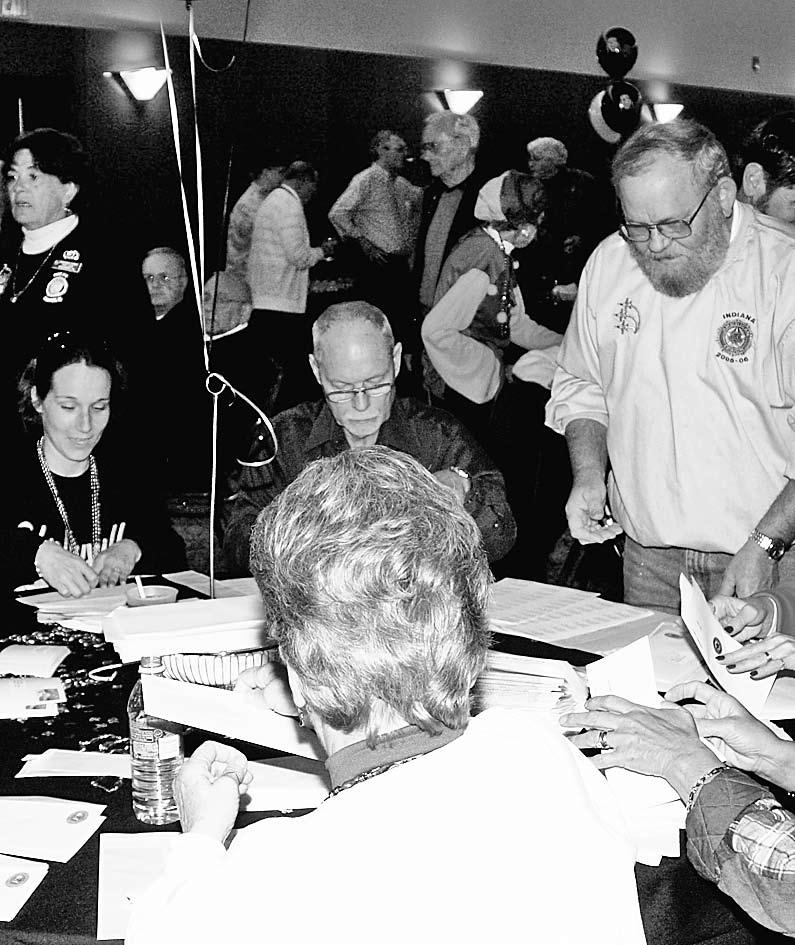
Dick Jewell, immediate Past Department Membership Chairman (standing, right) has members of the 10th District hard at work stuffing envelops during the 2007 Spring Conference Party last month. Jewell is the task force leader for the 10th District in the newly established Headquarters Post Transfer program. This group was one of two that agreed to work first and play later in support of the program.
Continued from column 2
to serve as your Commander this past year and I will never forget the great people, friendship, and dedicated
serve from the great people in the Second District.
God Bless each of you and our troops. Pray for their safe return.
DisTricT 3
mike Werner commander
Greetings from Third District Commander Mike Werner and all of the members of the Third District Legion family.
The Third District had a few posts that had activities reported since our last edition of the Hoosier Legionnaire. On March 10th, New Carlisle Post 297 hosted an American Legion Birthday Dinner. The Auxiliary prepared an outstanding meal (as usual) which was enjoyed by all in attendance. That was followed by remarks from the special guest speaker for the evening which was none other than our own Department Commander, Jim Delaney.
include the Third District “Night at the Races” fund raiser.
LaPorte Post 83 continued its generosity by donating $100 for the Third District Knightstown Home fund and $100 for the Third District Indiana Veteran’s Home recreation fund at each District meeting in January, February and March. These funds help with the Third District’s support of these very worthy programs.
Jerry stoner commander
There is a Legionnaire over at Peru Post 14 who has every Legion card issued to him since he joined in 1944.
When you get over around Peru Post 14, you may run into Legion Peru Post 14 Chaplin Weldon Reynolds. He has been a Legionnaire since 1944 and if you have any doubt about his service to the Legion, ask to see his card. Now then, when he shows you his card he will not only show you his latest dues card but can produce every single card that he has gotten since he joined back in 1944. He has saved every card and is proud of it.
And here in the 5th District we are proud of Legionnaire Reynolds for staying active in his local Post and The American Legion.
It has been said that the Legion is based on four pillars: Service to Veterans, Americanism, Child Welfare, and National Security. Perhaps it needs to be placed in perspective as a chair with four legs.

Take away one of the legs and the chair will fall. Interesting isn’t it? My point is that if a Legion Post doesn’t keep active in these four areas of Legion concerns, then the Post could fall. It has been said that to give advice to the idle would be like pouring water into a sieve. I would hope that all the Posts here in the 5th District will keep their focus on Legion business via the four pillars just talked about and don’t become idle.
cent or better: Laketon 402, Huntington 85, and Roanoke 160, with a couple other Posts knocking on the door for 100 percent. I want to thank these Posts for coming through on membership this year.
The year is not over so you other Posts keep getting out there to get our members to keep current and asking those who do not belong to join our great organization and getting those that dropped out to re-join. The work is not over. Keep at it. The American Legion needs members.
We are in the process of sitting up Post 705 to get those members of Post 777 out and into the Districts and into local Posts so they can be an active Legionnaire and enjoy the Legion’s programs. We have been around telling you about this bold new program and now I’m telling you that the wheels are turning and the program is getting underway.
Some Districts will realize hundreds of potential new local Post members. Dave Ritenour will be heading up this program for the 5th District, assisted by Jerry Stevens. They are determined to make this work and look forward to completing the mission.
Holder, who always maintain control for the floor. Several have earned a special thanks: to all the Past Officers who handled the introductions of dignitaries and guests during our meetings and our Adjutant, Larry Macy, for his dedication and professionalism in a most difficult position.
The Chairmen have done an excellent job this year. The two officers who have probably worked the hardest are our membership chairman, Bruce Steffen, and our Finance Officer, Richard Sexton. I am forever grateful to them.
Our Service Officer, Larry Lowry, in his civilian position of Cass County Veteran’s Service Office, has accomplished the procurement of a new van to drive veterans’ to receive treatment. Now he needs volunteers to help serve as drivers. You only need a regular driver’s license. Call Larry at 574-753-7860. Way to go, Larry!
It has recently come to my attention that the veterans at Logansport State Hospital need a more permanent representative for the individuals residing at this facility. We cannot and should not forget these veterans who have served. If interested in representing these veterans, contact me.
In closing, I want to thank the Green Machine and the Post officers for their hard work with membership and our Legion programs. I thank all of you who have participated in one or more of our programs. It has been an honor
Two awards were given following the Commander’s remarks. The first went to Post Commander Skip Parmley for his service and leadership for the past three years, and one to the 1st Vice Commander Randy Martens for ten years of active service.
Then, on a very cold and snowy April 7, the Post family held its annual Easter egg hunt. There were 41 girls and 21 boys in attendance, and they shared 204 dozen eggs appropriately colored for the holiday. Deb Tolman did a great job as the Easter Bunny.
Coming events at the Post
Auxiliary Unit 161 has been (and continues to be) working on a common project for Legion families with a not-socommon twist. They are assembling packages of essentials for our deployed troops but came up with a different way to accomplish the task. Rather than having members and visitors to the Post home during activities, bring the items into the Post. The items are there already. The items are then “purchased” and set aside for packing and shipping. The proceeds for the sale are used to replenish the stock and help pay the postage required for shipment to the troops. Great job ladies, keep up the good work!
So long for now from the Third District.
Internal Affairs Commission
Continued from page 4
ies in attendance, Internal Affairs Chairman Leland Baxter, Department Northern Vice Commander Walter Krohn, Department Southern Vice Commanders Bill Kocher and Owen Wells. Mason reminded everyone that the New Post/Revitalization Committee meetings are open to fresh ideas of starting new Posts, as well as revitalizing posts that may be struggling.
Chairman Mason thank-ed all the members of the Committee for their attendance and input said, “It has been an honor to serve as chair of this committee for the past four years. The Committee is vital to the start up of new posts, but just as importantly the members of the committee along with their districts need to continue to make every effort to assist struggling posts.”
There were no requests made for Department funds.
Public Relations
Chairman Jeff Carroll advised that all awards submissions are due at Department Headquarters by June 1, 2007. He urged all who were present to submit entries for the Fourth Estate and the Talbert Award in each category possible. He asked the committee and attendees to go back to their Districts and Posts and promote the submission of entries.
Religious Emphasis
There was discussion regarding the Four Chaplains programs in the Districts. There was some open discussion regarding Memorial Day, the placing of flags and methods used, and the National Day of Prayer.
Adjournment
There being no further business to come before the Commission, the meeting was adjourned in proper form.
I gave a veterans talk over at the town of Dunkirk several months ago. The colors were posted by Dunkirk American Legion Post 227’s Color Guard. Under the leadership of Past Post Commander Walter Rogers, they did an outstanding job. Everyone in the audience was impressed, including myself. If they decided to take a try at our American Legion Color Guard competition I think they would give any Post a run for their money without having to practice very much at all. They are really sharp looking and have everything they need to do down to a T. Dunkirk Post 227 won the State Color Guard competition in 1982 and won the State Firing Squad competition in 1984. I looked at their display case and they have around 200 trophies of which 90 percent of them are for first place in various parades throughout the state and also the state of Ohio.
Wayne told me that one day they performed in three parades and a flag retirement all in the same day. They went to Montpelier, then Roanoke, and then to Bluffton. After the parade in Bluffton they performed the flag retirement for them.
Walt has been in charge of the Color Guard for the last 35 to 40 years and does an outstanding job. He knows what should be done and the squad reacts to his each and every command. Very impressive.
Walt and Dunkirk Post 227 Commander and Past Northern Vice Commander John Hare both know the closing of the our Legion meeting by heart. When they close a meeting without reading from script it just makes the closing more interesting and professional. Dunkirk Post 227 has NASCAR races every last Saturday evening of the month starting around 6:30 there at the Post. They have made a track out of a sheet of wood for the cars to go around on. I’m going to the races one of these Saturdays.
I think it sounds like fun. As a matter of fact, let’s all try and make it over to Dunkirk for the races some Saturday night. It would be fun and while you are there you can check out all their trophies between races.
As of this writing, District 5 has three Posts at 100 per-
It was my sad duty to attend a couple funerals this past couple of weeks. I attended the funeral for Anderson Post 282 Commander George McCowan along with 5th District Vice Commander Chuck Cunningham. Let me tell you one thing: when I attended a Post 282 meeting right after Midwinter Conference this year, George only had a couple there at the meeting but he opened and closed his meeting in due form. Very impressive.
George knew the importance of a Legion Meeting and held his meetings with due respect for the American Legion. He was such a gentleman and was a credit to the American Legion. He will be missed. I wish I could have known him longer. We have lost another member of good standing who was a guiding light for the rest of us to follow. George, I salute you sir, and look forward to seeing you at Post Everlasting when my tour is over down here.
I also attended the funeral of an American Hero, Army SSG Bradley King. SSG King was killed over in Iraq and was a member of Marion American Legion Post 10. My wife Roxy attended his funeral with me. The Patriot Guard Riders were present in full force and looked sharp as they braved the cold. We are proud of these riders.
I have seen them at various Legion functions and at all the funerals for the fallen Heroes throughout the State. They are honoring and protecting the families of the fallen by their presence. Thank you Patriot Guard Riders. Keep up the good work you are doing.
Another Legion member, Robert Fletcher (Fletch), of Kokomo American Legion Post 177 died also. He always had a smile on his face and will be missed. Ed Trice and I were talking about Fletch’s passing and Ed remarked with a smile that “Fletch and Randy McCroskey are going at it right now as we speak.”
They always kidded each other and enjoyed being around each other while doing Legion work and now they are together once again and Fletch is bringing Randy up to speed on membership in the 5th. This is the problem with becoming involved in Legion business. A person meets and makes so many friends throughout the state that when one of our own passes it is like tearing your heart out.
At least that is the way it is for me.
DisTricT 5
Continued in column 3
DisTricT 6
Jack sears commander
We are two-thirds of the way through my year as District Commander. I want to thank all the posts for their hard work on membership. The district was in 2nd place for about two weeks going into the conference. As of the end of the conference we are in 3rd, but we are doing as well as we have in several years. Let’s keep it going. There are veterans out there who aren’t members and who will join if asked. We just need to visit them and ask.
Avon Post 145 is sponsoring a Blue Star program at the Hendricks County Fairgrounds May 19. The Post’s effort with the Blue Star program is a great example of what a Post can do to help in the community.
Congratulations to Darrell
Bowman of Avon Post 145.
Southern Vice Commander
Owen Wells presented a jacket to Darrell at the March District meeting. The award is for Darrell’s outstanding recruit-
ing/membership work and is Whitestown Post 410 presented an Americanism medal to an Eagle Scout from the troop at Dover, who built a flagpole. Another Eagle Scout in the Dover troop is building a war memorial in Boone County. Congratulations to the two young men and thanks to Post 410 for their recognition efforts. We are approaching summer (in spite of the late cold/ snow spell). There will be lots of activities and fun, but please keep safe. Hope to see you at the Department Convention in July
Again, we really need more input from posts with information for these articles in the Hoosier Legionnaire. If you have something for the 6th District articles please get the information to me or to the Adjutant Mike Patrick. E-mail to Mike at mike4024@smwc. edu is the best way to send the information.
DisTricT 9
c.T. “sugo” castner commander
In March, we completed a month long celebration of the 88th birthday of The American Legion. Just like most families, Legionnaires in District 9, across Indiana and throughout the nation gather to celebrate another year. Sometimes we come to the birthday celebration out of habit, sometimes we come for the fun, but still we are there.
We each have our unique style in the way we celebrate our Legion Birthday. Some Posts have speakers and programs, other Posts have chicken dinners or pitch-in, other Posts celebrate with birthday cakes, some Posts toast one another at the bar, and there are other Posts who celebrate in a very quiet way. Yet, we all celebrate together the bond of being Legionnaires and members of our family of three.
Our birthday was a time to celebrate and look back on what we have accomplished and what we hope to achieve, to mourn those we have lost, to celebrate together with members of this “Family of Three” and to invite new members to celebrate with us next year.
As you read this article, I will be near the end of my term as 9th District Commander. As I have traveled to birthday dinners, attended meetings, breakfasts, or just stopped by the 9th District Posts, you have made me feel that I am part of your celebration and part of your family this past year. Thanks to each of you!
Speaking of family, there is a family of five brothers, who are all World War II veterans
Some Call It ‘Bean Bag …’
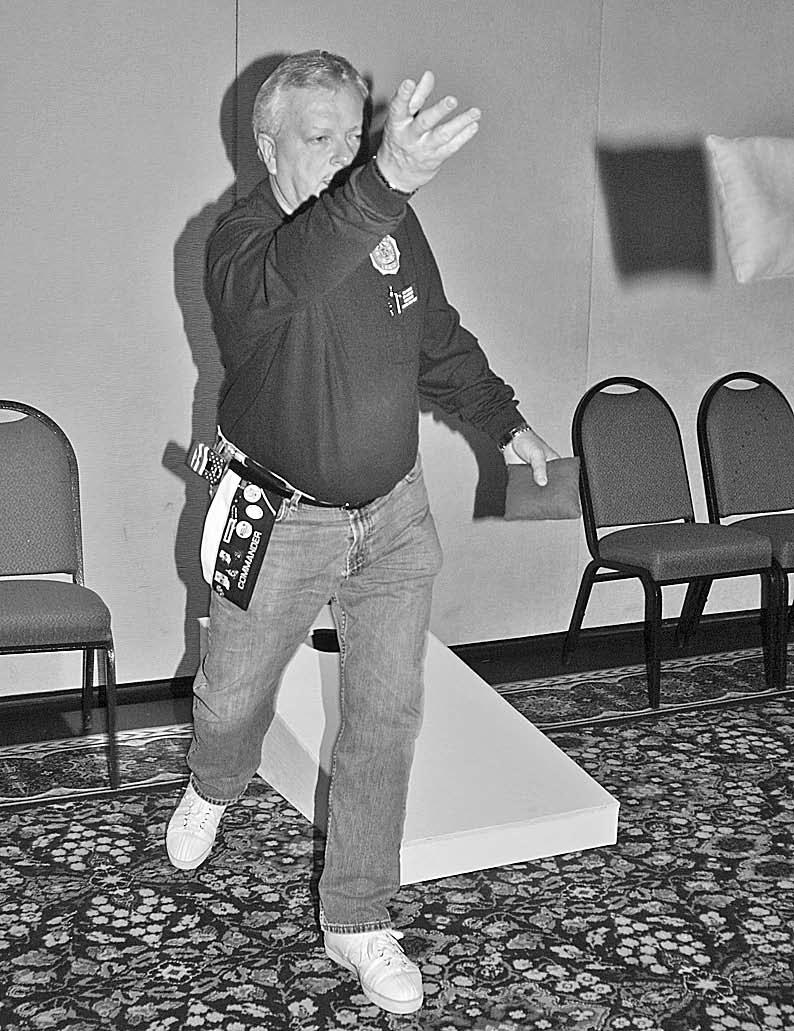
Ron Hangar, 8th District Commander, tosses out the first bag in the inaugural Bean Bag Competition conducted during the Department Commander’s opening reception at the 2007 Joint Spring Conference. Members of the 8th District, under the leadership of Hangar and Jeff Carroll, conducted the event to raise money for the Commander Jim Delaney’s project, and will continue to conduct the event over the next few years.
DisTricT 8
ron Hanger commander
We all had a great time at the Spring Conference!
The winner of the first “Bean Bag Tournament” was the 8th District. DJ & Doug from Charlestown Post 335 took the coveted title of first place while Denny & Dana took second place. We would like to thank all who participated and especially our winners as they donated their winnings to the Commander’s Project. Due to the response, we will be conducting these tournaments at all upcoming conferences. We look forward to even bigger and better participation this Fall.
On another note, we are extremely proud to have, once again, achieved the highest percentage of goal at the last Target Date, 89.3 percent. To all who have been working the American Legion Membership Program, thank you. With your continued assistance, we will lead the Department of Indiana at close of books in excess of 100 percent!
Beside our membership, Public Relations and Community Involvement are extremely vital to our success as an organization. All too frequently, we “abbreviate” the actual names of our programs when we speak to outsiders. I urge all American Legion
Family members to make a concerted effort to use the term “American Legion” when discussing our programs. For instance, we often say “Boys State” or “Girls State.” This is not only inaccurate, but it does not give credit where credit is due. Many outsiders are familiar with Boys or Girls State but most do not understand that these are American Legion programs. As an organization, we must start taking credit for our efforts.
Humility may be a virtue but as an organization, we have a responsibility to inform our membership and especially potential members of our good deeds.
Post Adjutants will be receiving “Consolidated Post Report Forms” for completion and submission to the Department. Please make sure your Adjutant completes this form accurately. It’s also a very good idea to post this form on the bulletin board in the Post as well as doing a press release to local media outlets in order to inform your local community of all the good things your local Post does for the community.
Don’t forget to include donated time and labor your members contribute to other organizations or events.
and members of the 9th District. If you know of other similar 9th District Legionnaire family members, let me know about them.
Our Legionnaire family gathered in Indianapolis for the Joint Spring Conference in April. The 9th District, as always, was well represented. Numerous Legionnaires from our District and members of our “Family of Three” have given their time and expertise and have represented the 9th District ably at both the Department and District, as well as at their home Posts. You are all shining examples of service at its finest. Thanks, once again to our 9th District hospitality hosts, Keith “Sandy” and Nancy Becker, who have wined us and dined us and delivered service with a smile. Come to Department Convention in July in Merrillville; you’ll learn a lot about The American Legion and be wined and dined, too.
“Join Us,” has also been our membership theme in the 9th District during this term. By the time you read this article, we will be nearing close of books. Currently, we are second in membership in the Department. Thank you for recognizing the importance of membership and for all of your help during this term.
The 9th District Posts and membership chairmen, Al Kerner and Ron Taylor, along with our District officers, have pulled out all of the stops and have worked hard to bring in membership, so that we once again might finish in first place in membership in the
Continued in column 5
Rehabilitation Commission
Continued from page 4
can Legion Department Executive Committee express the Department’s request that Title 38, U.S. Code be followed explicitly in the funding of job duties for veterans’ representatives this 15th Day of April, 2007.
Homeless Veterans Monies received: $250 from Post 102; $50 from Post 469 Auxiliary; $50 from Skip Burton Post 469; $53 from Post 6 SAL Department Commander. Motion made and passed to donate $1,000 towards the Stand Down late summer. Motion made and passed to donate $200 to the HVAF for the coffee cart at the Fall Conference. Funds requested: $200 for HVAF Coffee Cart; $1,000 for Indianapolis Stand Down. Both were approved.
Indiana Veterans Home Jerry Horn spoke and introduced Vicki Gregory, Home Marketing Director. Tom Henderson introduced the Leading Candidate for National Commander, Marty Conatser. A motion was made by Thomas Pett and seconded to purchase the following items from the Wish List at a cost of $16,050: two Sit & Stand Lifts, $11,600; two Prime Beds, $4,450. The motion passed. Additional department funds of $16,050 were requested. The latest consensus shows 251 residents in the Home.
Nursing Home Copies of the Nursing Home budget reports were passed out. Third District Chairman Cecil Brummett reported that he has passed out T-shirts. 5th District Chairman Robert Monin, represented by Pete Brannon, asked about leftover funds to be used in other districts. Eighth District Chairman Irvin Thomas reported that they distributed 92 Kleenex and socks on Veterans’ Day and 110 Kleenex and socks on Memorial Day. Irvin Thomas made a motion from the Eights District for $200 more to budget for the District. The motion was seconded and passed. Ninth
Continued from column 4
state. It’s great to finish first: finishing first for veterans and veterans issues is why membership is so important to The American Legion.
As we lose members of our Legion family who served during World War II, Korea and Viet Nam, the power of our Legion family is lessened and so is our ability to make a difference for future veterans and members of our Legion family. Not only are our numbers diminished, but so is our voice. To finish first was, for me, a way to strengthen the voice of veterans in not only the 9th District, but also throughout Department and nation, too. Ours is a voice that is heard by our legislators; a voice that is heard by administrators of government programs; a voice that is heard by veterans and members of our military and speaks out for them and for our Legionnaires and for members of our family of three; a voice that speaks on our behalf.
When you ask a current member of our military, a new veteran returning from duty in the Middle East, an older veteran who has never became a Legion member, or a former Legionnaire to “Join Us,” you are that first voice. Thank you for all you do and have done to make The American Legion and 9th
District first to so many. Legionnaires and members of the “Family of Three” have met throughout our District during this past term. We have met old friends and welcomed new ones and have experienced what it means to be part of this great family we call The American Legion. It has been an honor and a privilege to serve this term as 9th District Commander. My last District meeting as your Commander will be in Versailles Sunday, June 3. It will be held at the Versailles Post American Legion Park on U. S. 50, just east of Versailles, weather permitting. The meeting will be followed by a party to celebrate all that each of you did to make it a great year for the 9th District. Thanks to all of you who have given so generously on every level to The American Legion and to me personally during this term. Very special thanks to all of the members of the 9th District leadership team. When you see one of the team members, please stop and say “Thanks” for all of the time they give and all that they do to make the 9th District the brightest and the best. Plan to be in Versailles for the meeting and the party June 3 and join us for the celebration!
Remember: there is no rank among us, for we all serve as equals.
DisTricT 10
Jeff Jarmon commander
Greetings from the 10th District
This year is passing real fast, so we got to start getting our in membership, our Post Certification, and Post Delegate Forms in before close of books June 10.
District Chairman Lowell Sullivan distributed cards.
Shirley Firkins of the Auxiliary introduced Betty Gray who keeps account of volunteer hours. The committee made a motion to request unused funds from those districts that have money remaining at Spring Conference. The amount of funds currently budgeted to the committee was listed as $6,112.43. The amount of additional department funds requested by the committee was listed as $2073.31. The motion was seconded and passed.
Veterans Assistance
Special guest Linda Jeffrey, Chairman, 2005 Golden Age Games, presented a film on the Golden Age Games. 600700 veterans enrolled in the VA system will compete in a variety of sporting events. Doctors must fill out forms in order for veteran to participate. Registration will take place in January of 2008. Postsponsored events are needed. Post will receive recognition in articles in “Victory Lane” Newspaper. 1,000 volunteers are needed to do such jobs as greet people at the airport, bus station, etc. Volunteers will need to attend classes to learn rules.
General Hospital
Veteran Affairs quarterly report was given. Betty Thomas spoke about a 106-year-old veteran who volunteered for 21 years at the VA Hospital in Louisville, KY. Louisville VA had a Stand Down Dinner. They hosted the Creative Art Festival. John Hickey thanked the committee members for their work. Sheila Gunn spoke about Evansville VA, Marion State Hospital and the Vet Center in Marion. Evansville VA Clinic had the first Stand Down. Balance Sheets were passed out.
Adjournment
There being no further business to come before the commission, the meeting was adjourned in proper form.
Homeless Veterans is a very big cause and I would like to thank Morristown Post 102 for donating $250.00 to the Homeless Veterans.
In February I had the chance to go to Springfield Illinois for the Lincoln pilgrimage. it was a great visiting President Lincoln tomb.
In March Connersville had Commander Delaney to speak at their Post and the dinner was very good and they gave their American Legion Member of the Year for the Post. Congratulations to Butch Davis.
I went to Hagerstown for the Birthday Dinner and it
was also very good. Thank you for inviting me for this special occasion, Post 333 and Post 1. I would like to thank and congratulate McCordsville for starting a new Post. I attended the meeting with some of my officers and I think this Post has a great future.
I would like to thank Shelbyville Post 70 for giving Blue Star Banners to the parents and spouses of the Shelbyville National Guard members who are going to be deployed.
At our April meeting Union City wanted to post their Colors with Honor Guard. I would like to say “Job well done” to the Legion and auxiliary members who was in the Honor Guard. Our next meeting will be at Morristown Post 102 May 2 during which nominations will be accepted. Elections will be June 2 at Shelbyville Post 70.
DisTricT 11
Greetings from the Eleventh District.
The year is slowly coming to a close for those who stepped forward to help enhance the dealings of The American Legion here in Indiana. It has been a year filled with pride with what we have accomplished during our tenure of leading our respective districts.
The individuals who will be stepping forward to take our places will be embarking on a totally new and awesome adventure. I personally would like to wish them well in their new found endeavors within the legion.
The matter of membership is always foremost in our minds. It is through the dedication of the membership that we will continue to grow. We need to embrace our military comrades who are now in harm’s way protecting our land from the terrorists who would destroy us if we slacked of and allowed them to have their way. Thank God we are not going to allow that to happen. Please welcome our returning military and invite them to become a part of our
fine organization.
I want to personally thank everyone in my District for their fine support during my tenure as the Eleventh District commander for 20062007. We all should thank all of the Department personnel for their continued support. Whenever we asked for their assistance they were always ready to step forward to help.
We in the Eleventh District still have time to gain momentum to move up the department membership ladder. We will not allow ourselves to be called the cellar gang any more. All you other Districts had better watch out, because we are coming back.
It was with pride that I saw the article on the Legion website in regards to the dismissal of the ACLU’s lawsuit against the Dept. of Defense for supporting the National Boy Scout Jamboree.
May we say special prayers for our military and their families as well as all our members especially those who are sick or confined to their homes.
God bless all of you and God Bless our country.
Page 6
clyde Kerr commander
Assisted Living Expenses – Can The VA Help?
Aging and failing health brings about added concerns for all of us – veterans included. As we age or when serious chronic medical conditions arise, our lives change. We are not as strong as before. Our sight and hearing often deteriorate. We can no longer walk as far, stand as long, carry as much, or, sometimes, even remember things or think as well as we had done years before. We look back, and remember how we used to take care of our kids and even or grandkids, but now we need help – we can no longer drive a car, shovel snow, take care of the lawn, or even reach for something on a high shelf without risking added injury. As things get worse, we find it even hard to get to and from the bathroom, in and out of bed, or even protect ourselves from the hazards of a normal daily environment without regular assistance from someone else.
Million Dollar Service Officers
Fifteen County Service Officers were recognized at the 2007 Joint Spring Conference as members of the ‘Million Dollar Club -- service officers whose efforts resulted in at least $1 million in new federal benefits dollars flowing into their counties. Some of them are shown here with Commander Delaney (left). The 15 and their totals (in millions) are George Jarboe, $4.07; Jerry Sensing, $3.2; Gary Whitehead, $2.; Donald Shultz, $2.; Larry Wilson, $2.; Mark Acker, $2.10; Randall Fairchild, $1.82; Shelby Shaffer, $1.74; Jay Kendall, $1.51; Kevin Kelsheimer, $1.47; Allen Polsgrove, $1.32; Bruce Stanton, $1.21; James Koutz, $1.17; and Jerry Griffis, $1.12. The late Jim Griffin, $1.15 million, was also honored.
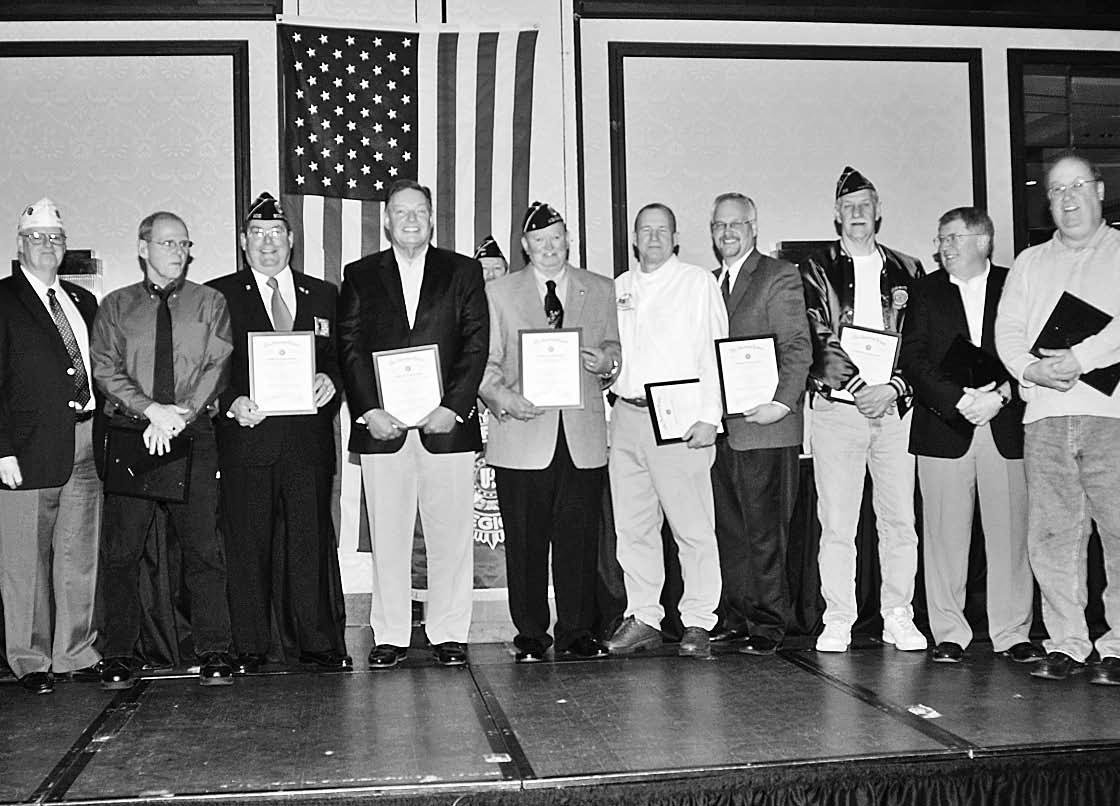 John Hickey Department Service Officer
We have saved all our lives to ensure a good retirement, or at least be able to leave something for our children at our passing. We see now, though, our savings will soon be gone: depleted by nursing home or assistant living costs.
Worse yet, we have no savings left and we wonder how we can receive the special care we need. Our adult children do what they can as long as they can. They kept us in their home, and cared for us as loving families do. But the burden has just become too much. We require the kind of help and time beyond what or
family members can provide. What do we do? Where do we go? What happens to this old vet and/or the veteran’s surviving spouse?
Many of us attempt to plan ahead for these types of things. We might have purchased extended care insurance, or our retirement plan might include this assistance. Life situations, however, often spoil man’s best-made plans.
In addition to Medicare and Medicaid and State public assistance programs, veterans might be eligible for help from VA. For instance, VA guarantees all honorably discharged wartime era veterans an annual income when they become totally disabled (unable to work due to disability) or 65 years of age or older. Currently, this VA non-service connected pension benefit guarantees a single veteran $10,929 and a married veteran $14,313 in total annual income.
Most all income the veteran and spouse receive from other sources, however, reduces the VA non-service connected pension benefit dollar-for-dollar before the benefit is paid. If the veteran and spouse have unusually high un-reimbursed medical expenses, those expenses they pay may be used to reduce their countable income for VA pension purposes.
A seriously impaired veteran – one needing regular aid and attendance from another person – is entitled to a higher level of non-service connected pension and the inclusion of additional services countable as medical expenses. VA’s Special Monthly Pension Aid and Attendance benefit currently guarantees the single veteran $18,234 and the married veteran $21,615 in annual income. The income offset after reduction by unusual high medical expenses works the same as the regular non-ser-
vice connected pension benefit. Those veterans entitled to the SMP-A&A benefit may, however, also have subtracted from countable income unreimbursed expenses they pay for assistant living facility costs if the assistant living facility provides “any” medical or nursing care, and “Home Care” or Nursing Home Care expenses. “Home Care” expenses include the cost of paying for home nursing or medical care, and the costs of paying another person for keeping the home clean if that person is providing at least some medical and/or nursing care. These same non-service connected pension benefits are also available and calculated in the same manner for the qualifying veteran’s surviving spouse, but at a lesser amount. The regular surviving spouse’s non-service connected pension benefit is $7,329, and the SMP A&A
Rehab at a Glance
benefit is $11,715.
Also, veterans should be aware that VA will pay the veteran’s entire cost of nursing home care if that care is needed for a service connected disability or the veteran is rated as 70 percent or more service connected disability. In addition, the Veterans Home in Lafayette, Indiana provides wartime era Hoosier veterans and their spouses residential and nursing home care either without charge or on a cost-sharing basis when necessary.
Hopefully, these benefits can help us receive care in a dignified manner if and when the time comes. For more information concerning this subject, free information and claims filing services are available by contacting your local county veterans’ service office or The American Legion Department of Indiana Veterans Service Office.
Understanding Increased VA Home Loan Benefits
Many veterans have misunderstood VA Home Loan Increased Entitlement since 2004. The Veterans Benefits Act of 2004 increased VA home loan eligibility. Veterans who qualify for the home loan benefit may obtain a no-down payment home loan of up to $417,000.
Editor’s Note: The Rehab at a Glance Column is compiled from a variety of shources, including the IDVA Update, The Department Service Officer’s Newsletter, and websites maintained by the National and State Organizations of The American Legion. The Hoosier Legionnaire gratefully acknowledges those sources.
Mental Health Issues of Elderly Veterans
Stresses Related To Aging Can Be A Form Of PTSD
By Steven M. Herman, Ph.D., HSPP Special to The Hoosier Legionnaire
This article examines the mental health issues most frequently faced by elderly veterans: depression, medication problems, substance abuse, dementia, mortality issues, and the re-emergence of PTSD. Each of these issues is examined, and recommendations are made for corrective action.
The veteran population of the United States is an aging one. The median age of veterans being treated in the VA system is 58.3, with an average age of 60 (Pfizer, 2003). As they age, the mental health needs of veterans change. The mental health issues and needs of the elderly have often been referred to as the “4 D’s”: depression, dementia, drugs and death. For the ageing veteran, there is also the potential problem of re-activation of symptoms of Posttraumatic Stress Disorder. In this last of four articles on the subject, the topic of PostTraumatic Stress Disorder will be discussed.
One of the key factors in the formation and development of Post-traumatic stress disorder (often also referred to as “combat stress,” “shellshock” or “battle fatigue”) is a sense of tremendous vulnerability, often experienced in the form of fear, helplessness or horror (American Psychiatric Association, 1994).
Some of the primary symptoms of Post-Traumatic Stress Disorder (PTSD) are nightmares, a sense that one is re-experiencing traumatic events, intrusive thoughts
Editor’s Note: Steven M. Herman, Ph.D., HSPP, is Director of the Psychiatry Ambulatory Care Clinic (116P) at the Richard L. Roudebush VAMC, and Clinical Associate Professor of Clinical Psychology at the Indiana University Medical Center. In this, the last of four articles, Dr. Herman examines one of the mental health issues most frequently faced by elderly veterans: depression, medication problems, substance abuse, dementia, mortality issues, and the re-emergence of PTSD.
about previous traumatic events, anxiety, sleep disturbances, an exaggerated startle response, irritability and anger problems, concentration problems, avoiding thoughts and feelings associated with the original trauma, and avoiding previously-enjoyed activities and people. It has been observed that incidences involving a heightened sense of vulnerability later in life can re-activate or exacerbate PTSD symptoms.
The later years of life are fraught with experiences involving vulnerability: loss of family members, loss of job, loss of financial stability, loss of health. The veteran may be able to handle each of these stressors well individually, but the combination of multiple stressors that frequently occurs with advancing age, may prove to be overwhelming. All of these significant stressors, at a time when an individual may be feeling vulnerable or weak to begin with, may cause the re-emergence of symptoms of PTSD.
Many individuals with PTSD use “excessive behaviors” to keep the symptoms at bay – excessive alcohol, drug use, working multiple jobs, moving from town to town. These are all activities that become increasingly difficult to do with advancing age (Schiraldi, 2000).
Unable to use these longtime strategies for managing and repressing their long-bur-
ied psychiatric symptoms, the signs of PTSD will thus, with increased age, begin to reappear. It is therefore not uncommon for elderly veterans to begin having symptoms of PTSD – sometimes for the first time in their lives (Ruzich, Looi, & Robertson, 2005).
The re-emergence of PTSD symptoms later in life has also been found to be associated with the increased incidence of memory problems later in life (Mittal, Torres, Abashidze & Jimerson, 2001). Many of the forms of dementia affect the establishment of new memories, leaving older memories much more intact and clearer.
PTSD, like any psychiatric disorder, also has its treatments (Cook & O’Donnell, 2005; Owens, Baker, Kasckow, Ciesla, & Mohamed, 2005).
The VA hospital system is perhaps the country’s authority on the treatment of PTSD, due to the prevalence of PTSD in the veteran population. There are many different forms of individual and group psychotherapy available at the VA to help veterans deal with the symptoms of PTSD.
It is not possible to “erase” the memories associated with the traumatic experience, but it is possible to come to a different understanding of them, so that they no longer create the same sense of horror and overwhelm (Schiraldi, 2000).
Although there are no medications specifically for the
treatment of PTSD, there are many medications that may help alleviate the symptoms, to make psychotherapy easier and more effective (Schiraldi, 2000).
References
American Psychiatric Association. (1994). Diagnostic and Statistical Manual of Mental Disorders – IV. Washington, DC: American Psychiatric Association.
Cook, J. & O’Donnell, C. (2005). Assessment and psychological treatment of posttraumatic stress disorder in older adults. Journal of Geriatric Psychiatry and Neurology, 13(5), 61-67.
Owens, G. P., Baker, D. G., Kasckow, J. W., Ciesla, J. A., & Mohamed, S. (2005). Review of assessment and treatment of PTSD among elderly American armed forces veterans. International Journal of Geriatric Psychiatry, 20(12), 11181130.
Mittal, D., Tores, R., Abashidze, A., & Jimerson, N. (2001). Worsening of posttraumatic stress disorder symptoms with cognitive decline: case series. Journal of Geriatric Psychiatry and Neurology. 14(1), 17-20.
Pfizer Corporation (2003).
Utilization of Veterans Affairs medical care services by United States veterans. New York: Pfizer, Corp.
Ruzich, M.J., Looi, J.C.L., & Robertson, M. D. (2005). Delayed onset of posttraumatic stress disorder among male combat veterans. American Journal of Geriatric Psychiatry, 13(5), 424-427. Schiraldi, G. R. (2000). The Post-traumatic stress disorder sourcebook. Los Angeles: Lowell House.
Qualified veterans purchasing a home in the high cost areas of Alaska, Guam, Hawaii and the U S. Virgin Islands may obtain a no down payment home loan of up to $625,590. The Five Easy Steps To a VA Loan are:
1. Apply for a Certificate of Eligibility (COF).
2. Decide on a home and sign a purchase agreement
3. Order an appraisal from VA. (This is done by the lender.) Ordering an appraisal can he done via the Internet using TAS (The Appraisal System).
4. Apply to a mortgage lender for the loan.
5. Close the loan and move in. We support all veterans in obtaining a home loan
Reaction to 5th Federal Circuit Ruling on USERRA
The U.S. Court of Appeals for the 5th Federal Circuit (Louisiana, Mississippi, Tennessee) ruled against a USERRA stipulation regarding arbitration in Garrett v. Circuit City Stores in May 2006.
The Court held that USERRA provisions protecting employment rights of members of armed forces did not preclude enforcement of individual contracts to arbitrate such disputes. This decision was not appealed to the Supreme Court and is determined final.
Staff of The American Legion Economics Division met with other VSOs, the National Employment Lawyers Association, and Public Citizen to coordinate a plan to ensure that the federal USERRA law supersedes this court decision. We ask that any Legion member that is currently in litigation regarding USERRA contact the Economics Division.
Wounded Service Members
Eligible for a Free Retreat
The National Military Family Association is now accepting applications for a free getaway vacation for wounded service members and their families. Working in partnership with The Blewitt Foundation, NMFA will select participants to embark en
Destination R&R. The Blewitt Foundation created Destination R&R to honor the sacrifice of wounded service members and their families and to provide them with the epp000nity for family rejuvenation and fun. The first Destination R&R retreat will he held this summer, from August 5 to 9, at the Turf Valley Resort, near Baltimore, MD. If will focus on fun for all ages and enable sharing, Connecting and healing for families. Applications are accepted only online at www.nmfa.orq/ destinationRR, and must be submitted by midnight May 4, 2007.
VA Provides Headstones and Markers
The VA furnishes upon request at no charge to the applicant, a government headstone or marker for the grave of any deceased eligible veteran in any cemetery around the world. For all deaths occurring before 11 September 2001, the VA may provide a headstone or marker only for graves that are not marked with a private headstone. For deaths after that date a headstone or marker will be provided regardless of whether the grave is already marked with a non-government marker.
Flat markers in granite, marble, and bronze, and upright headstones in granite and marble are available. The style chosen must be consistent with existing monuments at the place of burial. Emblems of belief for placement on Government Headstones and Markers are available can be viewed at www.cem.va.gov. Niche markers are also available to mark columbaria used for inurnment of cremated remains

When burial or memorialization is in a national cemetery, a headstone or marker will he ordered by cemetery officials based on inscription information provided by next of kin.
When burial is in a private cemetery, VA Form 40-1330, application for Standard Government Headstone or Marker, must be submitted by the next of kin or a representative, such as a funeral director, cemetery official, or veterans counselor, along with veteran’s military discharge documents.
Questions about a headstone or marker application can be directed to VA’s Memorial Programs Service applicant assistance unit at (800) 697-6947.
April 2007
Veterans Spotlight
All Work and No Play? Not In Indiana …
As the calendar turns in the Department of Indiana’s year of service, activities seem to crowd in on each other around the time of The American Legion Birthday, and for the officers and active members of the Department, Spring brings with it opportunities to make a difference in the lives of veterans, as well as moments that make up the memories of a lifetime. Here is a sampling of it all beginning with the Lincoln pilgrimage and ending with the annual Joint Spring Conference. Begin at the right and work down and across, then up the page for a description of the action.
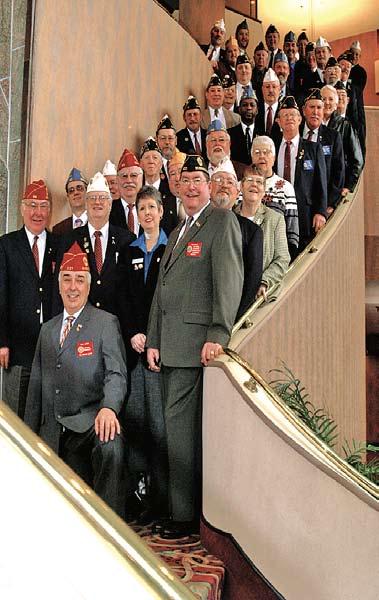
1.) Commander Delaney meets with a member of Indiana Senator Richard Lugar to discuss veterans concerns. 2.) Indiana’s finalist in the Department Oratorical Contest await word on the winner, who turned out to be Sarah Yeager (far right).
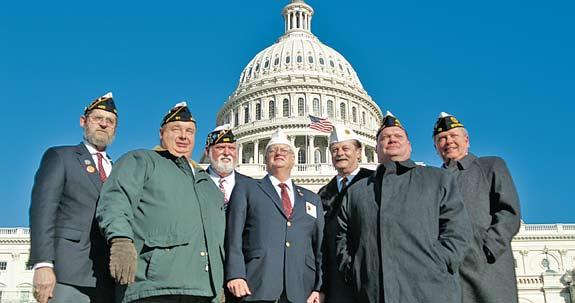
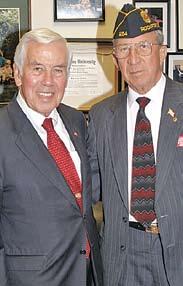
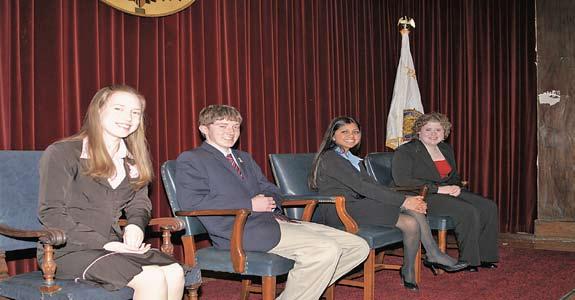
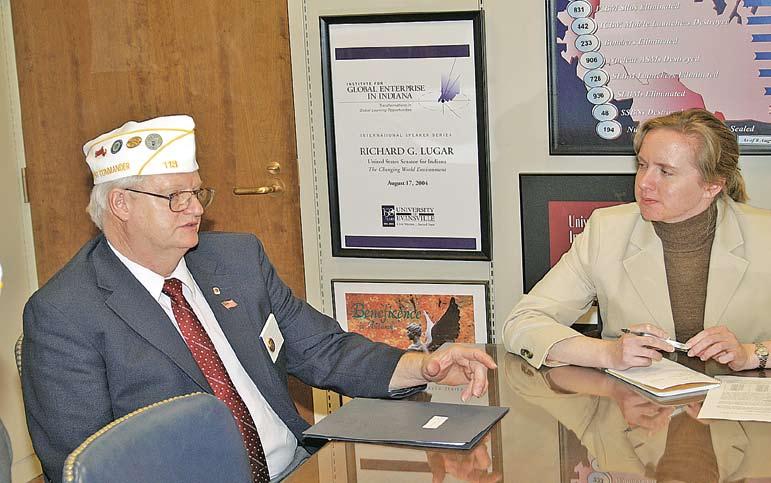
3.) Commander Delaney gets
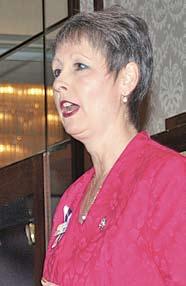
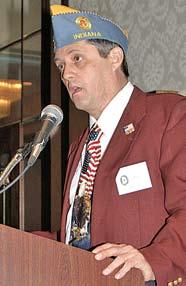


into the spirit of mardi Gras during the Spring Conference party when the work was all done. 4.) Senator Lugar and PNVC Allen Titus take a moment out for a quick photo in the Senator’s office. 5.) Sami Taylor and Madison Vasile got the look just right for the Mardi Gras party at the Spring Conference. 6.) Representatives of the 1st, 3rd and 8th District at the 2007 Washington Conference. 7.) Randy Dooley and Mrs. Bob Ripley. What are they laughing at?
8.) Shannon McCroskey and mom Katie take a break at the annual darts competition, sponsored by the 5th District.


9.) Randy and Debbie Beeler ready to party at the Commander’s Spring Conference Mardi Gras bash. 10.) Harvey of Harvey and the Bluetones entertained at the Conference Party. 11.) The traveling party who represented Indiana at the annual Lincoln Pilgrimage in Springfield, Ohio.




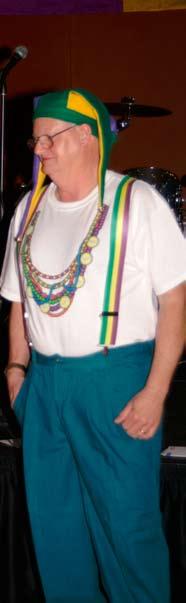
Page 8 Hoosier Legionnaire April 2007
Kenny Toll Took Home An Autographed Pacer Basketball
Ian Hicks Proves You’re Never Too Young To Party With The Legion Midge Robinson Just Hates To Have Her Picture Taken Susan Wells and Betty Bray Are Up To Something
Mike Sheets, SAL Commander Addresses The Conference Vickie Kouts, Auxiliary President, Talks About Her Father
Future Depends On Building On 2007’s Solid Foundation
The Department of Indiana is approaching the end of the 2006-2007 membership year, and we have much to be proud of. We have started to close the gap between current and prior year Close of Books membership totals. That was one of our goals. We have formed a partnership with outgoing, incumbent and incoming membership team members. That assures continuity in the program. And we have a plan to better manage our Headquarters Post members. That will increase our rate of retention, stabilize our membership, and provide new workers and additional dues dollars for the Posts. I am very proud of every one who has had a hand in our success this year, and I am looking forward to
Ed Trice Membership Chairman
more building on the foundations laid down this year.
Too Early To Quit
During the Joint Spring Conference, it became clear that some of our Posts already have given up on membership for this year. We know that because they are beginning to return their unused pre-printed cards and the cards of those who have not renewed for this year. It is too soon to do that. I encourage all of our Posts to hang onto their unused cards
until the Close of Books, which this year is Sunday, June 10. I also encourage them to put those cards to good use. The membership year is far from over. As a matter of fact, last year between the Spring Conference and Close of Books, Legionnaires transmitted more than 3,000 cards. It is important for us to do that again this year, if we are to maintain the momentum we have achieved this year.
The Problem With Renewal Notices
As you know, your members receive renewal notices from the National Organization encouraging them to renew their membership beginning in August of each year. What you may not know is that has not always been
Rebates Can Reward Early Bird Renewals
From “101 Ways To Keep Your Members”
Compiled by Mark Levin, CAE President, B.A.I., Inc.
1. Give rebate vouchers for early renewals. Instead of giving a discount for early renewals, try giving a rebate.
When you ask your members to pay the full amount at renewal time, tell them that the post will send them a rebate voucher as a reward if they renew early. The voucher would have a monetary value or be in the form of a certificate good for a certain amount of credit when the member participates in a post function or social activity.
2. Send a checklist entitled “What’s your reason for not renewing?” Send a survey that lists the most common reasons for dropping out to those people who have recently dropped their memberships and ask them to check off the reasons that apply to them. Be prepared to follow up and address each of the reasons. While a written form is not as effective as actually talking to these members, it does give the post one more chance to reinforce the value of membership and to personalize the next contact.
3. Have the Commander send a pre-renewal letter on his/her letterhead a few weeks BEFORE the renewal is sent. Tell of the great year you had, and how he/she is looking forward to working
How To Keep Your Members – 6th In A Series
with the member again next year. This is usually done to remind members of all of the value they received during the past year and to tell them what they can expect in the future. By sending the report or letter prior to the renewal notice, you alert members that the renewal is coming and raise their anticipation level and their need to respond. This usually raises the number of early renewals. Having the letter on your post stationery adds to the credibility of the message and increases the chances it will be opened promptly.
4. Have a retention committee – give it goals! There is a need for member involvement in the recruiting process and there should also be member involvement in the retention process. Your post should have either a separate retention committee or a retention subcommittee of your membership committee. The retention committee needs to have goals and a plan of action with very definite steps that can be taken to raise the post’s retention rate. The retention committee should be assigned to develop these steps and undertake them.
5. List names of non-renewals at leadership meetings. Have a “10 Most Wanted Renewals” list. Select 10 nonrenewed members for each
Second District Tops In 100 Percent Posts
Forty-one Posts in the Department of Indiana have achieved the 100 per cent mark so far in this membership year. With all Districts reporting at least one 100 percent Post, the Second District leads the pack with nine. The list below shows the 100 percent Posts along with their Post goal and current percentage of goal. The totals shown, and the Posts listed, are as of April 15, 2007. All Posts that attain the 100 percent mark by the Close of Books June 10, 2007, will be listed in the Hoosier Legionnaire and recognized at the Department Convention. The list:
meeting and assign members at that meeting to contact those lapsed members. This shows your lapsed members that the post still cares about them and it draws your current members into the membership retention process.
6. Reward renewal efforts as much as you do recruitment efforts. There is nothing wrong with building in an incentive or recognition program for retention efforts. Such a program can even be integrated into your recruitment incentives by giving the member who recruits a new member some form of appropriate recognition when the new member joins, and again when the new member renews.
7. After a couple of renewal notices, begin personal contacts. When members fail to respond to dues notices, it isn’t always because they intend to drop out for a particular reason or because they are generally disappointed with your post. Some members just want to know if your post cares that they are out there. A personal call to let members know they are missed can make a big difference.
8. Send non-renewals a newsletter with the front and back cover printed and the inside blank. Print a message inside about what the former member is missing by not renewing. Your post’s newsletters are among its most valuable membership benefits. When members drop out, they need to be reminded that they are losing these valuable benefits forever. By sending a newsletter with nothing in it except the table of contents listing all of the valuable information the former member isn’t getting, you graphically describe the lost benefit.
9. Dig beyond the “never did anything for me” answer. Try to find out exactly why they chose to not renew their membership. There’s always something more. Your post should prepare questions that probe beyond the surface and get to the heart of why members are leaving.
10. Pay special attention to those who renew last. They are the most likely to not renew next year. As your post begins identifying the nonactive members it needs to contact, add these late payers to the priority list.
11. Hold a retention contest, just like a recruitment contest. If your members respond well to incentives and competitions consider having a retention contest among your leaders. Divide the membership roster among the post officers, executive committee and the membership team and assign a certain number of current members to each leader. Give prizes to the leaders who renew the most members. Help them out by giving them suggestions on how they can get reluctant members to renew.
the case. For most of its history, renewal has been a major responsibility of the Posts, and I believe that it is time to go back to the principle of self-reliance that built this organization originally.
One of the unanticipated outcomes of the direct mail renewal program was the death of the local renewal program. Too often, Post officers will explain their shortfall or missed target in terms of the renewal notice – “it’s too late; it’s too confusing; a member didn’t get one.” The fact is, a member does not need ever to receive a notice from the National Organization.
Think of the cost that could be avoided – and the dues increases that would not be necessary -- if our dues dol-
lars did not go to produce and mail the nearly five million notices necessary to get our members renewed. All it takes is for the Post to form an active membership team and put it to work as soon as next year’s cards are received.
Form teams to call every member. Send workers out to pick up payments from those who are housebound. Have a special open house to accept renewals. Take out an ad in your weekly paper. Do all you can to make membership work personal again, and you will see a difference.
Race to Reno Tightens Up
Several Posts are in the running for three expense paid trips to the 2007 National Convention in Reno, Nevada, this August. We have divided the Posts into three
roughly equal size groups, and the Post in each group with the greatest numerical increase in membership over the 2006 Close of Books will win the trips.
The competition groups are Posts with 15-100 members, Posts with 101-300 members, and Posts with 301 and over members. Post and Districts can check their standings on the weekly membership reports posted on the website, and 2006 Close of Books figures will be printed on membership reports for the rest of the year.
The standings change from week to week, so I encourage all Posts to keep an eye on them. It won’t be over until the last minute at Close of Books June 10.
Ask Jessie
Post Everlasting Roster Depends On Post Reports
Dear Jessie: How can I make sure the members of my Post who passed away this year are listed in the convention’s “Post Everlasting” book?
Final Call
Mr. Woerden Goes To Washington
First District Commander Pete Van Woerden, one of the Department’s winning District Commanders whose membership efforts garnered them trips to the Washington, DC, strikes a majestic pose on the steps of the United States Capital following his visit to the offices of Indiana’s congressional delegation. Woerden credited his membership workers and fellow District officers with his win.
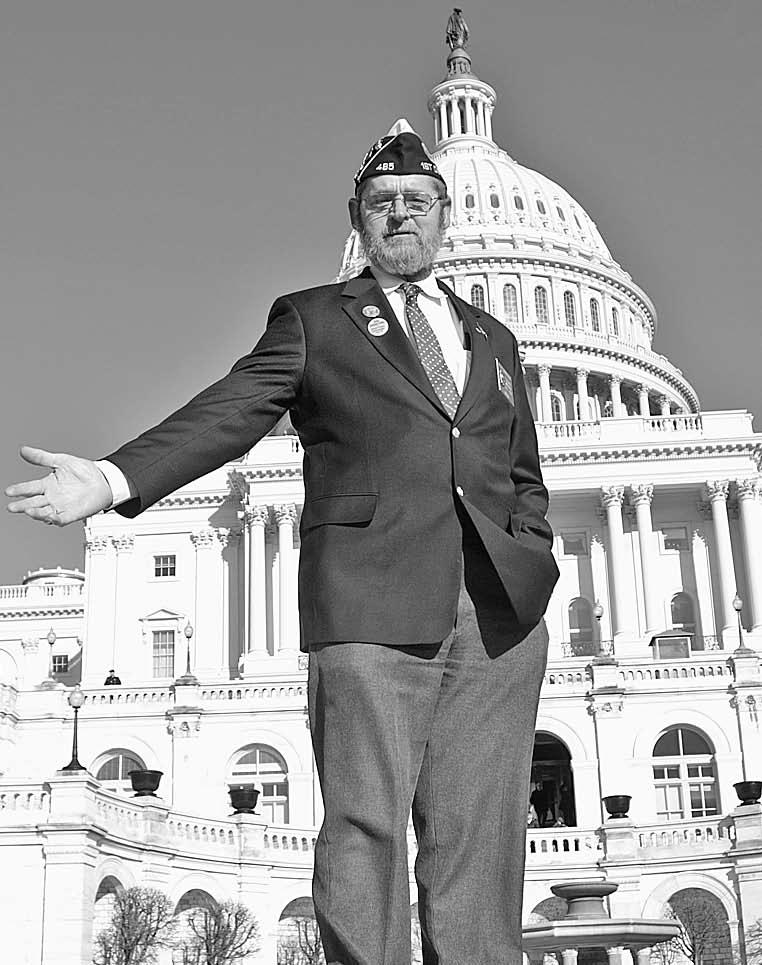
Wartime Veterans Ride to Reno For Fallen Comrades’ Children
By The National Public Relations Division
American Legion National Commander Paul A. Morin will lead the second annual “American Legion Legacy Run” from The American Legion National Headquarters in Indianapolis to the 89th Annual American Legion National Convention in Reno, NV, in August 2007.
The American Legion Legacy Run will assemble at Speedway Post 500 next to the Indianapolis Motor Speedway Saturday, August 18, 2007, and early on Sunday, August 19, the National Commander and the American Legion Riders will depart Indianapolis and head west, proceeding along Interstate 74 and Interstate 80 through Indiana, Illinois, Iowa, Nebraska, Wyoming, Utah, and Nevada.
According to Morin, the six-day journey, designed to raise funds for the American Legacy Scholarship program of The American Legion, is one way to show the American Legion’s deep appreciation for those who paid the ultimate price for freedom.
“As an unfortunate consequence of America’s war on terror, many children of our active-duty military personnel are now members of single-parent families,” Morin said. “In most cases, this also means their chances to attend college have greatly diminished. Children of military personnel who die on active duty are entitled to receive some money toward a college education, but it is not enough.”
The American Legion Riders’ goal is to raise $250,000 for the American Legacy Scholarship Fund.
“These funds will ensure that higher education will be a reality for these families,” Morin said. “Providing for the children our military personnel left behind is our civic duty, and an education is a powerful way to show our thanks.”
Morin encourages Riders from all points in the United States to join the Run either in Indianapolis or along the route to Reno.
“The ride will stop along the way for venues arranged by American Legion Posts,” Morin said. Tentative plans include visits to a VA medical facility in Iowa and another at a Native American reservation in Nevada.
Registration is open now at www.legion.org/legacyrun. Those who register will receive a special patch set and other registration materials. “We encourage all interested veterans and supporters to register in support of the Run,” said Morin, “to help us help the children of our fallen heroes.”
Groups of Rider Chapters may wish to register as a group to gain credit for a larger donation. For more information, contact Bill Sloan, Legacy Run Coordinator, at 317-630-1321, wsloan@legion.org, or write The American Legion Legacy Run, PO Box 1055, Indianapolis, IN 46206.
Dear Final: The Department Membership Office will extract from the membership files the names of all members reported to Headquarters as deceased. If a member of your post passed away and you did not report the death on a member data form, your member will not be listed in Post Everlasting book. You can make sure that all members who have transferred to the Post Everlasting are listed by checking your records and reporting all deaths to the Department not later than May 15.
Dear Jessie: Whose responsibility is it to be sure that a transferring member is eligible? Do we have to take the word of the Post the member is leaving if he is trying to transfer in?
Dear Suspicious:
Suspicious
Although the adjutant of the Post from which the member is transferring is required to provide, if asked, proof of the transferee’s membership in good standing or information on any pending charges, and a statement of the continuity of membership (Department Constitution, Article XIII, Sec. 1, Para. 3,4), it nevertheless remains the receiving Post’s responsibility and duty to verify the transferee’s eligibility. Article IV, Sec. 1. of the By-laws of the National Constitution holds that each Post is the judge of its own membership; that includes questions of eligibility.
Dear Jessie: I am a 50 continuous year member of The American Legion and my Post recently presented me with an Honorary Life membership. I am going to be moving to a different state but was told I cannot transfer to a Post there without losing my Honorary Life membership. Is this true and why can’t I take it with me to a new Post?
Dear Jack:
Jack
As an Honorary Life member, you are a life member only of the Post that conferred the membership, and as such, your dues are paid annually by the Post3. If you leave, you are no longer a member of that post, honorary or otherwise, and the Post is no longer responsible for paying your dues. However, if your Post conferred the Honorary Life membership and purchased a Paid Up For Life membership on your behalf, that membership goes with you wherever you go.
Chairman's Notes
April 2007 Hoosier Legionnaire Page 9
First
Riders
Fred Schmidt 20 Second District Demotte 440 Scott-Lambert 415 West Lafayette 492 Jesse Engle 228 Camden 413 1st United Methodist 38 Ancil Geiger 226 Third District Koselke Mayfield 403 Union Mills 295 Fourth District Franklin R. Fee 467 Charles C. Anderson 148 Cassel 257 Angola 31 Orland 423 Fifth District Sunset 402 Robert M. Mayne 160 Donald E. Converse 85 Sixth District Avon 145 Pittsboro 426 Fulton-Banta 291 Seventh District Owensville 51 Eighth District William Zeb Longest 42 Ralph E. Parr 133 Santa Claus 242 Dubois County 147 St. Meinrad 366 Warrick 200 Ninth District Kenneth L. Diver 337 Brown Township 247 St. Joseph 464 North Dearborn 452 Floyd Becker 209 Tenth District Meredith-Low 134 New Palestine 182 Yorktown 321 Gaston 387 Williamsburg 442 Eleventh District Atkins Saw 355 Beech Grove 276
District
Memorial 17
Benefits American Legacy Scholarship
Commander's Message
Conference Demonstrates Department’s Good Reputation
The Department recently concluded its annual Joint Spring Conference, a weekend of meetings and special activities that involve not only Legion members and officials, but also those of both The American Legion Auxiliary and the Sons of The American Legion. It is truly a time for “A Family of Three” to come together to share their common experiences.
Like any family, The American Legion’s Family of Three has accomplishments to be proud of, disappointments to deal with, and challenges to confront. We have done that this year, and one of the mea-
sures of our success is the esteem in which we are held by others departments and national officers. Many measures of that esteem were present during the Joint Spring Conference.
Among the most significant indicators was a surprise visit by the National Commander. In Indianapolis for the National High School Oratorical Contest Finals, Commander Morin could have spent his free afternoon resting and relaxing in his hotel room. Instead, he
James A. Delaney Department Commander
spent the afternoon visiting hospitality suites, conferring with our department leadership – and seeking out the Auxiliary’s Rose Ann “Granny” Waters, an outstanding membership kept the commander in line during his October 2006 bus tour of the Department. Hardly less significant was the amount of time the leading candidate for 2007-2008 National Commander devoted to his visit to Indiana and how he used his time. Not an event, not a
meeting, and not a hospitality room went unvisited during Illinois’ Marty Conatser’s three-day stay. As he said in his remarks to the general session, “I am not here so much for you to get to know me, but for me to get to know you.”
Conatser knew us before he got here – Indiana has been a regular and major participant in Illinois’s annual Lincoln Pilgrimage for decades – but he knows us even better now. He knows we are serious about our membership program. He knows we are active and involved in issues before the state legislature. And he knows that we are reliable supporters of the National
Organization.
Perhaps most significant in measuring the reputation and esteem in which your department is held is that one of our own is the leading candidate for election to the high office of National Commander of the Sons of The American Legion, and another has been touted around the country as one who would make a great National Commander.
Ray Ghiell will stand for election at the SAL’s National Convention this summer; Jim Kouts, a Past National Vice Commander, will continue to test the waters for his own run for the top office in the Legion some day down the road.
Both of these men have had the support and encouragement of Legionnaires and SAL members around the country; that Indiana produces men of such ability and reknown is part and parcel of our great reputation.
So, as this year winds to a close, I reflect on the fruit of our many labors this year. I am not ready to pack it in, and I am not ready to pen my farewell to you – that will come in the next issue of the Hoosier Legionnaire – but I will urge you now, as I did when I took the oath of office, to be proud of the Department of Indiana, and go public with your pride every chance you get.
This year, our members have joined together for “PEACE ON EARTH,” for our Troops, our Veterans, our Children and our Communities.
The Membership Team has worked effortlessly to make our goal of 100 percent. Our National President’s theme is “We Can Do It.” We’re out to prove we really can, by making this a reality. Keep collecting those renewals and asking new members to join. And when you do, sign up the whole family.
The year I was elected as President-Elect, I had the privilege of having my Dad escort me for the installation. When I asked if he would do this for me -- you know that old saying, “Daddy’s Little Girl” – I knew he wouldn’t turn me down.
My dad really didn’t understand why he was walking me down the aisle in front of a bunch of people he didn’t know. During my speech as I thanked him for escorting me the second time in my life, he sat up straighter in his seat, smiled real big and waved at me. Today, my Dad doesn’t even remember that day, but that’s okay, because I’ll always remember.
As you’ve guessed by now, my dad has Alzheimer’s Disease, so in his honor I chose a project for the Alzheimer’s Unit at Indiana Veterans Home. We originally asked for $10,000 to install a Code Alert System, and then learned we needed close to $3,000 more to purchase bracelets for the patients to wear. As I write this article, we have collected close to $20,000. And from what I understand, there is more money to come.
Thank You! Thank You!
Thank You!
At Knightstown Children’s Home, your contributions have purchased printers, toner and paper for all the divisions. The radio station, WKPW has also benefited from your kind donations. They have now upgraded from Analogue to Digital. Again, there is still money coming in for these projects, so we will continue to purchase what we can to help in those areas.
I thank you all from the bottom of my heart for all you’ve done to help our veterans and children here in Indiana.
As the 2006-2007 year winds down, I want to say “Thank You” Legionnaires and SAL members for giving me such great guys --Commander Jim and Detachment Commander Mike -- to share my Auxiliary year with. What a year it has been, one I will always cherish and never forget. God Bless You All!
Short Takes
Mission
Accomplished
The Superintendent of the Indiana Soldiers and Sailors Children’s Home at Knightstown, Paul Wilkinson, congratulates Department Commander Jim Delany on the successful conclusion of Delaney’s year-long quest to provide a multi-purpose van for extra-curricular activities at the residential facility. The commander criss-crossed the state raising the funds necessary to purchase and equip the vehicle – a success venture, he says, because of the generosity and concern of the “Family of Three” – Legion, Auxiliary and SAL members.
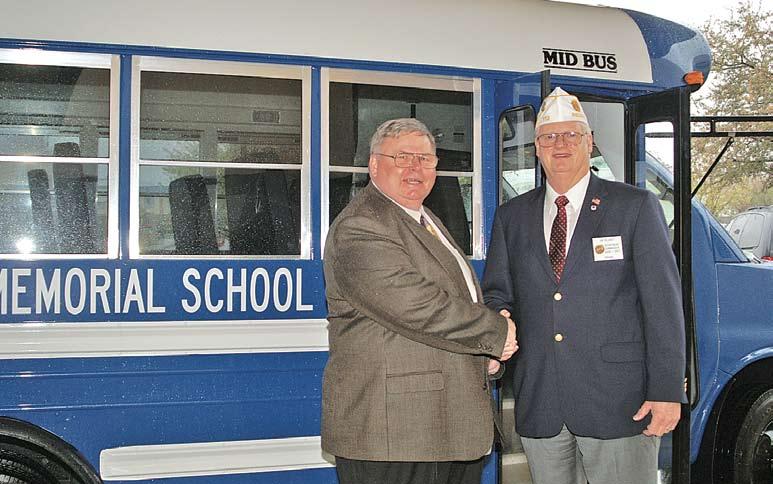
Program Participation Decline Is Cause For Concern

I want to switch gears from politics to youth activities for my column this issue. I address the issue of Indiana’s youth programs with both pride and concern. My pride stems from the continued outstanding quality of the young people who excel in our various youth programs. Again this year, we had a marvelous and stimulating Department Oratorical Final with four outstanding high school students
competing for the privilege of representing Indiana in the just concluded national finals. We are beginning a new American Legion baseball season coming on the heels of Indiana’s national runner-up team from Terre Haute 346. Our Americanism and Government test winners who spoke to you at our Spring Conference also represent the finest in Indiana’s youth. Our 4th grade
Chaplain’s Corner
Flag Education winners will greet us at our Department Convention in Merrillville later this summer. They will, no doubt, be a great example of Indiana’s youth as well.
While the quality of our youth participants continues at a wonderful level of excellence, our quantity continues to fall. Current enrollment figures for Hoosier Boys State are not what they should be. Our baseball committee has dropped the number of state regionals from four to three this year because of a drop in teams competing. Our ora-
torical applications continue a scary downward spiral. Only our Flag Education participants continue to increase.
While some of this can be attributed to outside influence (such as new enforcement of IHSAA rules regarding baseball), much of the shortfall lands on the doorstep of our Posts and local volunteers.
Certainly many individual Posts continue to shine but our overall involvement at the Post level is dropping. Many will compare this to our continuing drop in membership and I am certain there are
excellent explanations for decrease. We know that many of the excellent students we try to recruit for our programs are also involved in any number of other excellent offerings. Bottom line, though is that we need to take a hard look at ourselves at the Post level (myself included) and ask if we are communicating efficiently enough with our local schools. Indiana takes a back seat to no one in the nation as far as the quality of our youth programs, but if our numbers continue to fall, that quality will be in jeopardy.
Kindness Kindles Memories And Godliness
Have you ever thought about the way you would like to be remembered? I believe the Lord can really minister to us if we will spend time in reflection and prayer on this. Life is filled with comings and goings. Many places we shall only pass through once in our lives. Have you ever experienced a time or place in your life that you knew you would never pass by again? How would the people that were left behind remember you?
Stephan Grellet was the son to a counselor of King Louis XVI of France. Growing up as a Roman Catholic he received military education at the College of Lyons. At seventeen he became a bodyguard of the King. During the bloody French revolution he was sentenced to be executed, but escaped, ending up in the United States in 1795.
In the States he was greatly influenced by the teachings of William Penn and George Fox. A year later he joined the Society of Friends. Through this commitment he became greatly involved in missionary work across North America and much of Europe. His work was extensive in prisons and hospitals. Through these
remarkable efforts he was invited to meet with major heads of state and even Pope Pius VII. He was able to influence numerous reforms in education and hospital and prison reform.
Through the years, Grellet is most remembered for the following quote:
“I expect to pass through this world but once; any good thing therefore that I can do, or any kindness that I can show to any fellow-creature, let me do it now; let me not defer or neglect it, for I shall not pass this way again.”
What a wonderful way to be remembered: For your kindness.
The New Testament uses two words to describe kindness: “chrestotes” meaning goodness of the heart, and “philanthropia,” which is a reflection of God’s kindness towards mankind.
Therefore we find that kindness is Godly quality that the believer must possess. It is also listed as one of the fruits of the Spirit in Galatians 5:22. The fruits are the evidence of the Holy Spirit residence in
the believer’s heart.
In Matthew 7:16 Jesus says we will be known by our fruit.
When I look back in life to the people who have left and indelible impression on my life, it has been those who have shown me kindness especially when I really needed it. One giant in my life was Richard L. Roudebush. My uncle, a state senator, arraigned a meeting with Congressman Roudebush in his Washington D.C. office when I was home on leave after twenty months of combat in Viet Nam. I had never met a Congressman before, let alone have a private meeting in his office.
I had never met a man more gracious and caring. He offered me a seat along with my parents and sat close to me to talk personally with me. He asked my opinions of how the war was going. Being a Marine Sergeant, I was well trained in whose opinion really mattered and responded, “Sir, I am just a Sergeant; there are many people above me who should answer this question.” He assured me that he
needed to know the opinion of a Sergeant fresh from the war. He then proceeded to talk and listen to me for over an hour.
Congressman Roudebush later received a cabinet appointment to become the Secretary of the VA during the Nixon and Ford Administrations. The Indianapolis VA hospital now bears his name in respect of his service to his country and humanity.
When I look at the painting in the grand entrance hall, I am
deeply touched by his kindness. He cared about what was going on in my life and situation as well as all those under his care.
It is my hope that God will continue to hone us and grow our hearts that we will be known for our kindness. What a way to be remembered!
Therefore, as God’s chosen people, holy and dearly loved, clothe yourselves with compassion, kindness, humility, gentleness and patience.
Colossians 3:12 NIV
Morin Wants More CPR
National Commander Paul Morin has called for Legion-wide support of his effort to improve the rate of return on the Consolidated Post Report Form.
“The Consolidated Post Reports [in 2006] represented just 46 percent of the Posts in The American Legion. My goal is for every department to achieve 75 percent.”
Information reported in the CPR is an important component the Commander’s annual report to Congress. “It is an eye-opener
to members of Congress when they realize, some for the first time, what The American Legion is doing throughout our country.”
In order to encourage increased reporting, the commanders with the best return percentage in each of the six categories of Departments based on size will receive a plaque at National Convention. All 98 – 100 percent District Commanders will receive certificates. All achieving 95 percent and above will have their photos published in the Dispatch.
Norris Keirn Department Chaplain
Auxiliary News
Can Sometimes Become Personal
Service Projects
Vickie Koutz Auxiliary President
Stephen W. Short Department Adjutant
