Studies Prompt Executive Committee To A pprove $10 Per Capita Increase
The Department Executive Committee, meeting in its regularly scheduled session at the 2005 Mid-Winter Conference January 16, approved a resolution calling for a ten dollar increase in the annual per capita due from posts for each member.
Before the increase can take effect, the resolution must be considered and voted on by delegates to the 2005 Department Convention scheduled for July 7-10, 2005, at the Indianapolis Marriott Hotel East.
The move to hike the per capita rate comes after a detailed study of the Department’s budget over the past decade, and forecasts of future
revenue based on a continuing decline in department membership, anticipated low rates of return on investments, and declining revenue generated by voluntary contributions to card and label programs.
The resolution, presented to the Committee by Department Finance Officer Anthony Riley, contains two key provisions in addition to the per capita increase. The increase would not take effect until January 1, 2006, and the next per capita increase approved by the National Organization will not be passed on to the posts.
These provisions enable members to delay the immediate effect of
the increase until the 2007 membership year by renewing prior to the January 1 effective date, and to adjust only once to increases in the cost of membership.
In presenting the resolution, Riley cited certain assumptions underlying the per capita increase proposed.
“We looked at preliminary projections for the next five years under a few different scenarios,” he said. "All of them assume a national dues increase going into effect sometime in the next few years.”
The first scenario, no dues increase by the Department, projects the operating deficit will accu-
mulate to approximately $3 million by July 31, 2010.
The second scenario envisions a $6.50 per capita increase effective January 1, which staves off the deficit for two years.
The third scenario, which is the basis for the approved resolution, envisions the $10 per capita increase as of January 1, 2006, which would keep the budget in balance for at least seven years.
The Department, as described in an interview with the Webber LaGrange, Chairman of the Department Finance Committee in the November/December Hoosier Legionnaire, has trimmed expenses
in almost all areas of operation, and expanded income programs where possible. The alternative to a dues increase, LaGrange has said, “is to cut back programs, and we are not prepared to do that.”
Among the income and expense projections used to determine the need for a dues increase, Riley said, were
•A decline in Legion membership of 2,000 per year;
•A temporary loss of 3 percent of membership in the effective year of the increase, recoverable within three years;
Continued on page 2
Department Revamps Conference Housing Procedure:No Forms
The Department of Indiana has established new procedures for registration at the three major conferences conducted each year in the Department.
staff will continue to make reservations for those officers and others on the Department housing list. All other accommodations will be on a first come, first served basis.
Traveling in Style
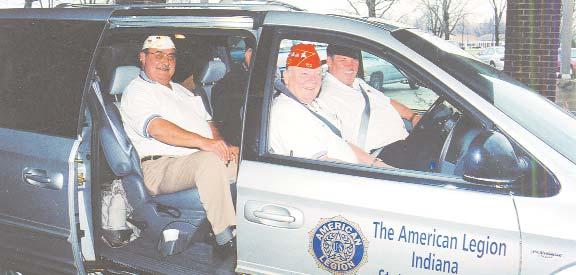
Department Commander Bill Firkins,in the rear seat,and National Commander Tom Cadmus prepare to buckle up for the short hop to the next stop on the Commanders’Tour ofIndiana last month.They left the driving to Past Southern Vice Commander Bill Clark,who survived four days ofheckling by drivers handling similar duties in the "chase vehicle," which followed the commanders,carrying other officers and dignitaries.The commanders visited more than 40 posts in four days and collected nearly 3,000 Legion cards in the process.
Commander’s Tour,Conference Give Membership A Big Boost
The final day of National Commander Tom Cadmus’s Tour of the Department coincided with the start of the annual Mid-Winter Conference last month, handing the Department a unique opportunity to combine diverse membership collection activities into a dramatic boost for the 2005 membership year.
“It was just outstanding,” said Department Commander Bill Firkins. “I knew that if we let the Posts know they could turn in their cards directly to the National Commander, we would have a flood of them.”
The four-day tour, which encompassed stops at 45 Posts around the state, accounted for
More on the Conference – Page 7,8
nearly 3,000 cards, in addition to nearly 4,000 cards the Posts and Districts delivered during the extended January Target Date turn-in. The target date drive included cards collected on the tour, turned in during office hours at the conference and at the special “Supergoal of Membership,” party, and received by mail on or before Martin Luther King Day.
The total count for the January membership drive was 7,700 cards, lifting the department to 85 percent of its 2005 membership goal.
The National Commander took advantage of the many stops on
the tour to express his appreciation to the men and women of the Legion for his election as commander, and vowed to continue to fight for adequate funding for veterans health care.
“I am just a regular guy, a bluecap Legionnaire,” he said, “but I can assure you I will represent you as best I can. I am determined to continue to see that there is no further cut in eligibility for VA health care, that is for sure. It is hard for me to imagine being in Washington and testifying before such powerful committees as the House and Senate Veterans Affairs Committees. But I did, and I am
sure they heard us.
“I know that the new House Veterans Affairs Committee Chairman (Congressman Steve Buyer) is one of your own, and I am sure that we can work with him. We do have a difference of opinion, I believe, over who ought to receive VA care and perhaps how it ought to be paid for, but he has been a member of the committee for quite a while, and I am sure we all have the same interests in mind.”
The commander also encouraged Posts to become involved in the Blue Star Banner program, reminding his audiences that not only does the Legion provide individual and corporate banners, but
Continued on page 2
Under the new procedures, conferees may now register by phone, fax, e-mail or directly at the hotel. No forms will be required, but registrants must specify that reservation is for The American Legion Department’s respective Spring, Fall or MidWinter Conference. The hotel will provide confirmation numbers immediately.
Registration for the Spring, Fall and Mid-Winter conference will be accepted only to a specific period commencing six weeks prior to the date of the conference. The precise starting date will be released in the Hoosier Legionnaire. For the 2005 Spring Conference, the registration period begins February 21.
The new procedures do not apply to the Department or National Convention. Because of the need to register delegates at both conventions, housing forms will be required as in the past and will be distributed in accordance with the existing policy.
The announcement of the registration acceptance date will replace the housing form previously published in the issue of the Hoosier Legionnaire immediately preceding the conference. The hotel has been instructed to take no reservations prior to the registration opening date, six weeks in advance.
Priority for housing will be based on first accommodating appropriate officers and officials and distinguished guests, then others included on the special needs housing list maintained by the Department. Department
The change in procedures is based on an evaluation of the previous process, comments and feedback from members, and an review of the Marriott Hotel’s upgraded reservation procedures. A major motivation for the change was the Department’s determination that the firstcome, first served basis for housing was not working, because housing forms would pile up at the hotel to be processed as time was available. The new procedures will eliminate such delays. Members are encouraged to maintain the following contact information in their personal files for quick reference.
•Phone: (317) 352-1231
•Toll Free: (888) 236-2427
•Fax: (317) 352-9775
•Internet: www.indianapolismarriotteast.com
2005 Spring Conference April 1-3
The 2005 Joint Spring Conference of The American Legion and American Legion Auxiliary of the Department of Indiana is scheduled for April 1-3, 2005, at the Indianapolis Marriott East, 7202 East 21st Street in Indianapolis.
A highlight of the conference is expected to be Commander Firkins’ specially designed Conference Party Saturday night beginning at 8:00 p.m. The party, recognizing the Commander’s more than thirty years in the automobile business, will take a lighthearted look at the used car lots of yesterday. Be sure not to miss
Continued on page 2
Uncertainty Clouds Future OfVA Health Care
The appointment of Congressman Steve Buyer (RIN) to the chairmanship of the House Veterans Affairs Committee, coupled with the confirmation of former US Ambassador to the Vatican Jim Nicholson as Secretary of Veterans Affairs and the appointment of Idaho Senator Larry Craig as head of the Senate panel, has cast a shadow of uncertainty over the future direction of the federal veterans benefits system.
Veteran’s advocates are concerned that such a complete turnover in the leadership of the committees and the Department of Veterans Affairs inevitably will result
in change and loss of progress made since reforms enacted nearly a decade ago.
Of particular concern is what some observers see as Congressman Buyer’s intent to restrict access to the VA health care system to a limited constituency of veterans, which has yet to be well defined.
"More and more, Americans are asked to believe that VA medical care is a service reserved only for a certain core constituency’ of service-connected disabled or impoverished veterans," wrote National Commander Tom Cadmus in response to news reports of Rep. Buyer’s comments at an
Indianapolis news conference
January 12, 2005.
"Congress passed the Veterans Health Care Eligibility Reform Act in 1996 without mention of a ‘core constituency’ as the focus of VA healthcare services. In fact, the term ‘core constituency’ could not be further from the spirit of the legislation that formally opened VA health care to all who fit the federal government’s legal definition of a veteran. That definition is found in Title 38, Section 101, of U.S. Code: ‘The term veteran means a person who served in the active military, naval, or air service, and who was discharged or released therefrom under condi-
tions other than dishonorable.’ "
Congressman Buyer, in his January 12 news conference, told reporters that much of the unnecessary cost and delay affecting veterans in the VA health care system was due to veterans who were neither needy nor disabled.
"Someone who is a 100 percent disabled veteran would go in and ask for an appointment. He would get pushed back. Non-disabled vets were pushing disabled vets out of the way to gain access to the medications. I want you to know some Veteran Service Organizations have a belief everyone should have open access to the VA system. When in
fact, I believe the VA system should follow its core constituency and the intent of Congress when we laid out the priorities...that is to take care of the disabled and indigent veterans first," Buyer said.
The American Legion, however, disagrees that treatment of category 7 and 8 veterans backlogged the system. Rather, according to National Commander Cadmus, the problem lies in the appropriation process.
"The Department of Veterans Affairs has seen the legitimate demand for health care by veterans double while the approved VA budget increased only by 50 percent. This caused hundreds of thousands
of veterans to wait for primary health care appointments up to 18 months or longer. The demand forced then-VA Secretary Anthony Principi to drop priority 8 veterans from the system just to stay within budget. In fact, just last month, Principi said he might still have to cut thousands more, priority 7 veterans, from the VA health care system.
"The current appropriations process is broken and not adequately funding VA medical care," Cadmus said. "President Bush’s Task Force to Improve Health Care Delivery for Our Nation’s Veterans on May 26, 2003, identified the mis-
Continued on page 7
C K
Tour de Force
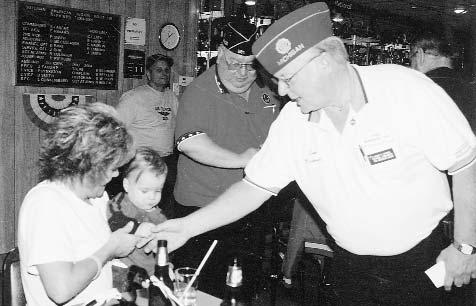
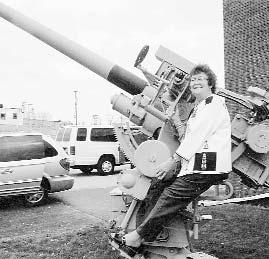
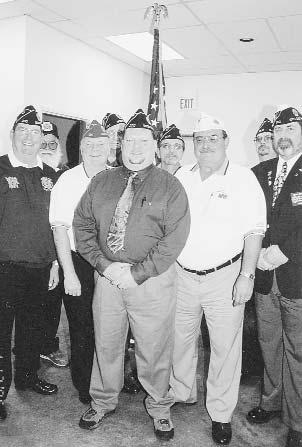
National Commander Tom Cadmus toured the Department ofIndiana in mid-January,stopping at more than 40 Posts and collecting nearly 3,000 membership cards.Along the way he addressed Legion audiences (top left),met with members ofthe Legion family – young and old (top) – and forged lasting comradeships with Department and Post officers,such as this group from Rockport’s Post 254 in the Eighth District.The Commander was accompanied by Department and District Officers,including Department President Phyllis Clark (above) who was up to her usual hijinks throughout the tour.
Department Revamps Conference Housing Procedure:No Forms
Continued from page 1
“Honest Billy’s Buy Here-Pay Here Hoedown.”
Party-goers should break out their best checkered suits, mechanics uniforms and financier’s green eye-shades for some old-time wheelin’ and dealin’. There will be special decorations, auctions, ‘repos,’ and prizes for the best costume, etc. No lemon laws apply at this party. In a change from tradition, there will be no Rehab raffle at this year’s conference.
The business schedule includes an opening reception in the atrium beginning at 7:30 p.m., featuring entertainment by J.D. Redmon and the Commander’s Trio, and the traditional Darts for Dollars competition, benefiting the Rehabilitation Fund.
The conference itself gets underway Saturday morning at 8:00 o’clock with a general session featuring Department Commander Bill Firkins, Auxiliary President Phyllis Clark, and SAL Commander Roland Baker, along with awards and presentations.
A distinguished guest at the conference will be the leading candidate for National Commander, Tom Bock of the Department of
Colorado. He will Saturday address the general session at approximately 9:00 a.m. and, accompanied by Ron Martin, the current leading candidate for Department Commander, will visit many of the committee meetings and special sessions. A reception for Bock Saturday evening will give Hoosier Legionnaires an opportunity to meet the candidate.
The Auxiliary will once again sponsor a Walk-a-Thon to benefit the Children’s Miracle Network, beginning at 10:00 a.m. Saturday in the Atrium and circuiting the main floor hallways of the Marriott.
A variety of vendors, business partners and Legion-related organizations are scheduled to operate display and sales booths in the Atrium all day Saturday. Space remains available for additional vendors, but prior approval must be obtained from the Department Adjutant’s office.
The Department Executive Committee will convene in the Liberty Ballroom at 9:00 a.m. Sunday. In addition to the usual business, members of the committee will be briefed on the per capita increase to be considered at the Department Convention in July.
Commanders Tour
Continued from page 1
also has developed a detailed planning outline for Posts to conduct recognition programs on Armed Forces Day.
Commander Cadmus clarified that “the Cavalry Sword renewal incentive program sort of got out ahead of us. We were looking for a way to correct the obvious shortfall we are experiencing in our renewal program. We lost sight of the many loyal Legionnaires who already have renewed, so we have decided to let all renewed members register for the drawing.”
Five genuine US Cavalry swords, honoring the commander’s service as a member of the air cavalry during the Vietnam War, will be awarded in a random
Department Considers Increase of$10 in Per Capita
Continued from page 1
•No change in the SAL per capita or the dues paid by 777 members;
•A one percent annual increase in gross income from the Legionnaires Insurance Trust;

•A one/half percent annual increase in the rate of return on investments;
•No change in other income, which encompasses the license plate program, pin sales, CVS Flag contributions, and other miscellaneous general income; and
•No change in current Bartonand Cotton Revenue Enhancement programs.
On the expense side of the ledger, Riley reported that increases already incurred or scheduled will have a
significant impact, including
•Hawaii Convention Delegate pay, increased by $100 per delegate;
•Future Convention Delegate pay increased by $50 per delegate;
•Increase of 3 percent annually in all general expense accounts;
•Increase of 10 percent in Health Insurance Costs; and
•No change in the Department’s contribution to the employee retirement account.
Efforts to control expenses have paid off over the past several years, LaGrange said, but uncontrollable factors have rendered spending discipline ineffective in avoiding future deficits.
“Despite our best efforts over the past few years to reverse the habit of operating with a deficit, the trend toward deficits appears to be
reasserting itself,” he said.
“Four years ago we ended the year with a $310,000 deficit. Three years ago the deficit was $201,000. With a lot of work, we were able to turn that around in 2003, ending the year with a $27,000 surplus, and one year ago, the surplus was $28,000. Unfortunately, for 2005, we are projecting a $118,000 deficit,” LaGrange said.
Both Riley and LaGrange believe the Department is operating as lean as possible, having made a number of reductions in expenses, including expense accounts, employee health care and retirement coverage, officer expenses, trips and travel, and department uniform and automobile policies. LaGrange noted that, even with the cuts in spending, “we
Legion-at-a-Glance
increased our expenses where fairness and effectiveness required it. For example, the District Commanders’ allowance has been increased from $.25 per member to $.35 per member, to reflect the reality of the cost of serving.”
Members of the Department Executive Committee, which includes all current District Commanders and the immediate Past District Commanders, will be further briefed on the proposed dues increase during the April meeting at the Spring Conference.
Among the questions expected to be answered, and which will be fully reported in the April/May issue of the Hoosier Legionnaire, are:
• How will the 2006 rate and contact information for the first and
second renewal notices, which go out in the fall, be handled, considering that the normal deadline is April 15?
•How does any future national dues increase get folded in?
• Why increase the per capita all at once, rather than phasing it in over time?
What other steps have been taken to increase income without raising the dues?
• Where did this come from?
Doesn’t it have to come from a Post? What is the normal process for resolutions such as this?
• What can we do to prevent loss of members?
•How will the Paid Up For Life Program be affected?
drawing among renewed members who submit a special form for the drawing.
(Information and forms are available by contacting the Department membership office.)
The National Commander carried his message to the public at many of the stops along the way, where newspaper reporters, television cameras, and a number of elected officials greeted his arrival.
As the National Commander departed Indianapolis, the Department got down to business with the Mid-Winter Conference. Termed an ‘Information and Training Conference,’ it lived up to its billing. The conference included a variety of special sessions and seminars, including those concerned with Rehabilitation and Veterans Service, charitable gaming presented by the Indiana Department of Revenue, Post Liability, Membership Development, and estate planning presented by Senior Resources.
In addition to training seminars, the conference also included displays and information provided by such organizations and activities as the American Red Cross, CVS Flags, Children’s Miracle Network, the World War II Museum in Auburn, Stepping Stones for Veterans, Inc., and the Legion’s own Homeless Veterans Committee and Legion Riders.
A highlight of the conference was the “Supergoal of Membership” which coincided with the traditional conference party – with a difference.
“Since we don’t have a general session at the Mid-Winter
Continued on page 6
National Convention Dates Incorrectly Listed
Hoosier Legionnaires who received the pocket calendar from the Department during last summer’s fund-raising program should note that the calendar contains incorrect dates for the 2005 National Convention in Hawaii.
The correct dates for the Hawaii convention are August 19-25, 2005. Those planning to attend the National Convention should confirm that their travel arrangements are for the correct dates.
The department regrets the error.
ALFS Applications Due April 1l
Applications for the American Legion Family Scholarship sponsored by the Department of Indiana are due in the Department not later than April 1, 2005.
Applications can be obtained by contacting Molly Alfeld, Americanism Programs Coordinator, at the Department of Indiana, 777 North Meridian Street,
Indianapolis, IN 46204, by phone, (317) 630-1264; or via email malfeld@indlegion.org.
The scholarships are available to sons, daughters, grandsons and granddaughters of Legion family members in good standing for the current membership year. Selection is based on information reported in the application. The amount of the scholarship varies from year to year, depending on the funds available in the scholarship’s restricted account.
Gilman to Lead Walter Reed
The son-in-law of Past Department Commander Robert “Bill” Sweet (1972-1973, of Shelburn Post 197) has taken command of the US Army’s Walter Reed Health Care System.
Col. James K. Gilman is married to the former Jeffri Lynn Sweet. He is a native of Hymera and a graduate of Rose-Hulman Institute of Technology and the Indiana
University School of Medicine.
The Army describes Walter Reed as “the clinical center of gravity of American Military Medicine.”
Flag Education Material Available
A multi-media flag education package produced by The American Legion is now available for use by teachers in the upper elementary, middle and junior high school grades.
The package includes a 20minute video feature on DVD focusing on a young man who learns about the significance and meaning of the flag through a series of incidents that occur in his life. The DVD also includes the Legion-produced animated feature “George Learns the Pledge,” as well as instructional material on flag etiquette and flag history.
The program is designed to help schools meet state education requirements in flag education and
is consistent with state education standards in civics education.
“For Which It Stands” and related materials can be purchased from National Emblem Sales, The American Legion, P.O. Box 1050, Indianapolis, IN 46206-1050 or online at emblem.legion.org. Cost is $7.95 plus shipping.
Traveling Marine Memorial Can Be Scheduled
A United States Marine Corps Memorial “Legend of Heroes,” dedicated at Kennesaw State University in December, will travel the country before being permanently emplaced. Founders, who have been swamped with requests for the memorial to make stops around the country, are asking groups and organizations that would like to host the memorial to contact them. The memorial will be accompanied by the designer and an Iwo Jima survivor.
The HOOSIER LEGIONNAIRE is published bi-monthly by the Indiana Headquarters of The American Legion, 777 North Meridian Street, Indianapolis, IN 46204 Phone (317) 630-1391. Periodicals Postage Paid at Indianapolis, IN and at additional mailing offices. USPS 010-445ISSN 0018-4772 POSTMASTER: Send address changes to HOOSIER LEGIONNAIRE, 777 N. Meridian St., Indianapolis, Indiana 46204. Bill Firkins . . . . . . . . . . . . . . . . . . . . . . . . . .Department Commander Stephen Short . . . . . . . . . . . . . . . . . . . . . . . . . . . . . . . . . . . . .Publisher Hugh Dagley . . . . . . . . . . . . . . . . . . . . . . . . . . . . . . . . . . . . . . . .Editor Official publication of and owned and conducted exclusively by The American Legion, Department of Indiana. Member: National American Legion Press Association and Hoosier American Legion Press Association. Advertising Sales Representative: The Herald-Times, Bloomington (800) 422-0070. Subscription Rates: $0.85 of each members dues goes for publication of the Hoosier Legionnaire. Volume Z, Number 4 January/February 2005 Circulation 125,000 Printed by the Herald-Times, Bloomington, IN Page2HoosierLegionnaireJanuary/February2005
AMERICANISM
Robert Newman CHAIRMAN
The Americanism Commission met at 4:30 p.m. Saturday, January 15, 2005, in Salon B of the Marriott Hotel during the Mid-Winter Conference.
Chairman Robert Newman opened the meeting in proper form. Roll call disclosed the following members present: Chairman Newman, Vice Chairman Burt Tiemersma; National Liaison
Representative Richard Quattrin; Joseph Rivich, Baseball, represented by Burt Tiemersma; Gary Stiles, Golf; Gary Steinhardt, National Security/Foreign Affairs; Marty Dzieglowicz, POW/MIA; and Larry Horvath, S.A.L.
Those absent included Vice Chairmen William Flaugher, Bill Hicks and Randy McCroskey (also representing the Bowling committee). Minutes from the previous meeting were read and approved.
Baseball
A motion was made, seconded and passed to approve Department Baseball Rules Committee report. Region 1 will be played at Plymouth Post 27, Region 2 at Lafayette Post 11, Region 3 at Terre Haute Post 346, and Region 4 at Rockport Post 254. The State Finals will be held in Evansville, for which a bid was made for $10,522.00.
Baseball Executive Committee
A motion was made to vote on and approve the Arlie Skelton Award. Motion was seconded and passed. There was a discussion of National and Department rules for 2005. The February entry forms were sent out to the posts and teams.
Golf
A motion was made to review and approve forms for “Rules Governing Play,” and "Rules for Governing Scoring and Prize Distribution," and mailing bid forms for state golf tournaments. Motion was seconded and passed. Jim Tracey read the current and
revised forms of the tourney. After discussion, the forms were approved by motion. There are several posts interested in submitting a bid for the 2006 tournament. The 2005 Golf Tournament will be June 18 and 19 in Bloomington, hosted by Post 18.
Larry Summit spoke on the upcoming tourney and had entry forms, hotel info, and golf course sheets. No committee funds were requested.
National Security/Foreign Affairs
A motion was made to prepare criteria for Indiana Guard/Reserve entry in addition to the Military Person of the Year. Motion was seconded and carried. A motion was made to add a category to the three existing categories for $100 for Indiana Guard/ Reserve. Motion was seconded and carried.
POW/MIA
A moment of silence was held in remembrance of Alva Smith who recently passed away. His family is in everyone’s prayers. A motion was made concerning the use of the POW/MIA budget in Indiana as opposed to nationally, as recommended by the Finance Committee.
Chairman Dzieglowicz read a detailed letter of minutes informing committee that the balance in the POW/MIA account is $1,566. These funds will be distributed for purchase of POW/MIA decals at the convention or other POW/MIA functions for the State of Indiana only. A motion was made to approve a Certificate of Appreciation created by Chairman Dzieglowicz for those who display the POW/MIA flag. A sample was passed around and read.
Discussion was held on the protocol for displaying the POW/MIA flag. Randy Gwynn stated a Kokomo plant still does not display the flag properly. The company
Continued on page 4
REHABILITATION
Leland Baxter CHAIRMAN
The Rehabilitation Commission met at 4:30 p.m. Saturday, January 15, 2005, in Salon E of the Marriott Hotel during the Mid-Winter Conference.
Chairman Leland Baxter opened the meeting in proper form. Roll call disclosed the following members present:
Chairman Leland Baxter; Vice Chairmen William Clark and Rodney Strong; Committee Chairmen James Piepenbrok, Employment; Russ Bensheimer, Homeless Veterans; Gary Danekas, Indiana Veterans Home; Cecil Brummett, Nursing Home. There were five guests present. Those absent included Vice Chairmen Ted Stenger, Walter Bode, Robert Ripley and Ted Wolf; National Liaison Representative Richard Jewell.
A motion was made and passed to dispense with reading the minutes from the previous meeting.
Employment Committee
A motion was made and passed to waive the December 31, 2004, deadline for accepting nominees for awards for this conference only. Instead, all nominations submitted up to the start of the meeting will be accepted.
A motion was made and passed to accept the following employment award winners:
• Large Size Employer, BP
Whiting Business Unit -- Whiting Refinery
•Medium Size Employer, Jasper Engines & Transmissions
• Local Employment Office Award, Workone -- Terre Haute
Local Veterans Employment Representative (LVER), Ronald Burnett – Richmond

•Disabled Veterans Outreach Program, Michael (Tony) Hale –Richmond
•Employment Specialist (ES5), Renee Smith -- Workone Fort Wayne Chairman Piepenbrok will have resolutions to present at the Spring Conference.
Homeless Veterans
The finance report was read and approved. Rex Ikemire has accepted appointment to the Committee from the 11th District. Chairman Bensheimer announced the status of the umbrella sales and Central Vice Chairman Lynn Zehr gave a full report and made a motion that was passed to purchase four more cases to sell at the Spring Conference.
The feasibility of the Committee setting up and getting involved with or operating a used clothing store in a southern area of the state was briefly discussed, as was requested by interested parties. It was thought that this might be a way for the Committee to raise needed funds since more shelters/residential programs are needed in the state. This matter was discussed by our Advisory Board in session Friday night at the Conference, and reported to Committee that we did not think this practical. The suggestion was forwarded that this might be an undertaking by a local Post family in their area in support of our Committee if they so desired. The Committee passed after discussion and no motion was offered.
HUB functions were reviewed as a tool to better reach and serve those veterans in need throughout the state. With regard to there being only two homeless veterans residential treatment programs in Indiana, it was determined that we should utilize the services of existing programs around the state as outreach projects (HUBS), and that taking advantage of the existing VA homeless coordinators and social workers throughout the state in various VA clinics is a viable opportunity for us.
The Legion Auxiliary has a Field Services/Homeless Veterans Chairman, Sheila Smith from the 6th District. Districts and their programs already utilize that sys-
James Delaney CHAIRMAN
The Children & Youth Commission met at 4:30 p.m. Saturday, January 15, 2005, in Salon C at the Marriott Hotel during the Mid Winter Conference.
Chairman James Delaney opened the meeting in proper form. Roll call disclosed the following members present: Chairman James Delaney, Vice Chairman Ed Trice, National Liaison Representative Ron Lowe, Committee Chairmen Americanism and Government Robert Bach, Boys Scouts David L. Berry, Boys State Enrollment Jack Cook, Children and Youth Larry Lowry, Flag Education/Etiquette Ronald Taylor, Junior Shooting Sports Ida M. Jewell, Oratorical and School Awards Rich Seto.
Those absent included: Vice Chairmen Alfonso Pulido, Joseph C Schuman, and John Rehfus, and Committee Chairman Knightstown Home James May.
Americanism and Government
There were 9,700 tests ordered this year. Don Beaty asked for a copy of the minutes for his District Chairman who couldn’t be there. District Chairmen thought everything went well, after the slow start. Chairman Robert Bach thought this as well.
Test Review committee consisted of Conrad Hoffman, Chuck Dale, Clyde Kerr, Jerry Gardner, Dewey Thomas, Larry Kupchik, Robert Back.
Winners were chosen as follows:
12th Grade
Boy- Marvin Woolwine, North Vermillion, Post #263, 6th District


Girl- Ashley Amerman, Riverton Parke, Post #48, 6th District
• 11th Grade
Boy- Andrew Akers, Riverton Parke, Post #48, 6th District
Girl- Kelsey Hiland, Riverton Parke, Post #48, 6th District
• 10th Grade
Boy- Zoran Kvrgie, Griffith, Post 66, 1st District
Girl- Trisha Brumley, Griffith, Post 66, 1st District
Boy Scouts
Chairman David Berry discussed eligibility changes for Eagle Scout of the Year award to included SAL squadrons. He explained what the District duties are to the Eagle Scout applicants. G uest Gail Guledge questioned why the Legion doesn’t sponsor Girl Scouts. Funds were requested but due to Department cutbacks, committee will do its own fundraiser by ordering scouting pins and having each district sell 100 pins at a minimum of $2.50 each. Department is to send a letter or flyer pertaining to their fundraiser.
Boys State Enrollment
Boys State packets were distributed. Chairman Jack Cook gave an explanation of the slip on the front of the packet that listed the posts and number of delegates from each post and their schools. The goals as indicated by Chairman Cook is to increase the number of posts and schools listed on the slip next year. District chairmen are encouraged to be ready to list the date and time of their orientation sessions at the Spring Conference.
Deadlines are as listed: March 1- Applications due at to District Chairman March 15- Application packets due to post chairman from schools April 1- Applications due at Department Headquarters Delegate packets will go to District Chairman for distribution. Chairmen’s responsibility is to insure all delegates have packets prior to arriving at Hoosier Boys State.
Children and Youth Chairman Larry Lowery spoke about materials for Educator of the Year not being available. Larry ran copies at his post to distribute to committee members. Past Department Commander Harold Epley spoke about getting money for the Educator of the Year. He provided a history of past requests for this to be an award for the Educator of the Year. Discussion centered on writing a new resolution.
Past Department Commander Epley will initiate the resolution through Newsburg Post. Also considered was a direct resolution for funding the award. Larry explained
procedure for selecting candidates. Discussion of new business was addressed by Chairman Larry Lowery asking members to support CWF & TFA, Family Support Network and Children’s Miracle Network. Fourth District is working with Children’s Miracle Network, 5th District is working with schools, and 9th District is sending cards to troops.
Flag Education/Etiquette
Packages of comic books and tests for each post were passed out and signed for. Discussion on what was to be mailed out to the posts immediately was as follows;
1. answer sheet for tests (One for each school)
2. post award (Two: One for the boy and one for the girl for each post)
3. district award (One, to district chairman only)
4. participation award (Two for each school)
5. evaluation sheets (One for each school)
All posts are to give tests the 2nd week of February. All posts to have post winners certified and to District chairman by March 1. All districts to have district winners to the Department by April 1. At the Spring Conference, the time, date, and place to grade the Department winner will be set.
Junior Shooting Sports
Discussion on current "stand down" of the JROTC shooting programs caused MSG Lacey to be unavailable for the conference, who was to provide a teaching session on the Junior Shooting Program.
Steve Short gave assistance from the Department on teaching the coaches, a future date is yet to be set for this training.
MSG Lacey needs recertified and the committee feels any assistance they can provide to him will be helpful and help get his program back on track.
Committee Chairman Ida E. Jewell expressed personal and Department thanks to District 4 Chairman Ed Nelson and District 9 Chairman Jerry Maune for their assistance with the Department JSSP tournament held in November at Knightstown Home. Interest has been expressed by the Culver Military Academy to participate in the American Legion Program.
Knightstown Home
Chairman James May presented class rings. $2,000 was presented by Hagerstown Post. Dale Kuhn gave the finance report. He made motion for $21,000 for fitness equipment. The motion was seconded and passed.
Mr. Gill and Mrs. Jordan gave a slide show of the seniors’ New York trip. Amy Rothman told us how much they enjoyed the trip and how much work went into the trip to be successful. Cross Country won 1st place, ROTC held a mock election, JROTC program will be reinstated, Boy Scout meeting area has been finished. Dates sets by the Committee for upcoming Department events; Military Ball on March 5, 2005, Prom set for April 23, 2005, and Graduation on May 21, 2005.
Oratorical/Schools Awards
National Oratorical Contest Director Mike Buss talked about needing volunteers for the National Contest. Information was distributed about a new product called multi media Flag Education Program, "For Which It Stands." It will stand alone on the web page.
Information on Zone contest is as follows:
•Zone 1 is hosted by 2nd District, tentatively scheduled for February 13 at 2:00 p.m.
•Zone 2 is hosted by 4th District, Post 43, February 13 at 12:00 or 1:00 p.m.
•Zone 3 is hosted by 10th District, Post 152, February 6 at 2:00 p.m.
•Zone 4 is hosted by 8th District, Post 28, at New Albany February 5
Zone packets are available
Jim Phipps passed out plaques for Zones 1, 2, 3, and 4 winners.
The Oratorical contest, scheduled for 1:00 p.m. March 13, 2005,
INTERNAL AFFAIRS
Thomas Somerville CHAIRMAN
The Internal Affairs Commission met January 15, 2005, at the Marriott Hotel during the MidWinter Conference.
Chairman Thomas Somerville opened the meeting in proper form. Roll call disclosed the following members present: Chairman Thomas Somerville, Vice Chairman Mary York, Committee Chairmen: Community Involvement Eric Baggett, Convention Contests James May represented by Dave Hubler, Firefighter/Law & Order Wilfred Kocher, Legislative William Jackson, Membership Paul Steward, New Post
Development/Revitalization Chuck Mason, and Public Relations David Rook.
Those absent included: Vice Chairman Walter Krohn, National Liaison Representative Lowell Sullivan, Religious Emphasis Norris Keirn. No guests were present.
Community Involvement
The Committee will award a trophy to the post with the best Community Involvement program. The resolution for the award needs to be written and approved by the Department.
The criteria needed for the award was discussed. The Committee will have each district choose a post for the award and have them send their vote into the Committee. There will be two groups that receive the award within the district, an award for a post with five hundred members and above and an award for a post that has fewer than 500 members. The Committee will have a Screening Committee of three members and will present the award in 2006. Guidelines are still yet to be decided. Posts in the running will have to make a scrapbook for judging. The public needs to know that the post is active and also, whenever possible, is making donations to the public.
The scrapbook will be divided in two parts, one for local community and one regarding the legion program. There were no district reports. Chairman Eric Bagget, will write the resolution and have the Department review it.
Convention Contests
The Committee decided to march on carpet instead of hardwood floors due to cost. The Flag "U" was passed out from the Nashville Convention. Post 502 performed the flag folding and funeral details. The Bloomfield post explained the parade maneuvers and the 2nd District filmed the presentation of all four color guard classes.
Firefighter/Law and Order Fire Fighter & Law Enforcement Officer booklets were passed out. Chairman Wilfred Kocher read a letter regarding the EMS program. The award for the program was discussed. Roll call for candidates was taken.
Legislative
Chairman William Jackson discussed the Legislative Directory. Legislative structure of the entire state has changed. Both the House and Senate are controlled by Republicans. The new Congress Veteran Chairman is Steve Buyer and the new congressman will be discussed at a later time. There was a discussion held about bills that have been introduced into the Committee so far including:
•SB 81 – National Guard supplemental grant for time served in active duty.
• SB 83 – Will lower resident requirements of the Veteran’s Home.
• HB 1022 – Base Protection Act protects Crane Naval Weapons Ammunition Depot from closure.
• SB 111 – Local funding for Memorial Day.
•SB 193 – Allows Indiana War Memorial Commission to accept funding.
•SB 183 – If there is money available, IDVA will transmit money to County Veteran Representatives for needy veterans. SB 201 – Deals with emergency management. A discussion followed on other bills being considered but not yet introduced. Some thoughts were given on hope that the Committee can be helpful to Congressman
Buyer, though help has not been asked for. A discussion was held on potential changes to VA system. Nothing is known for sure. A discussion was held on a new bill for Concurrent Receipt Funding. Chairman Jackson spoke on his resignation from the Indiana Department of Veterans Affairs and wished his successor well in the coming years.
Membership
Membership standings for the districts were given. Assistant Adjutant Hugh Dagley introduced Jessica Berggren as Senior Membership Specialist. The Committee held a question and answer session. Hugh Dagley presented charts showing membership trends for the last five years and reminded the members of the membership rally being held that night.
New Post Development/Revitalization
First District Chairman Bert Tiemersma reported that Hammond Posts 16 and 126 will probably merge sometime this summer. Ralph Tolan spoke on Post 17 and the possibility of revitalizing it by absorption of an American Legion Riders Chapter; 2nd District declared it has fifty posts alive and well; 3rd District had no report; 4th District had no report; 5th District reported on Mellwood Post; 6th District reported on Ross Post; 7th District reported that the Monrovia Post is closing but is retaining members through PUFLS and transfers; 8th District had no report; 9th District reported on the Medora Post; 10th District reported that paper work has been sent to members of Post 490 for the closure of the post; 11th District reported that Post 355 has moved into a new building and they recruited thirty new members. Post 50’s charter has been closed effectively and the charter has been turned in. There is a new post in the works for Pike Township. Past Department Commander Bill Brennan is recovering at home following surgery.
Hugh Dagley reported on Post 911 and Post 355. Plans are now in place to move 911 a little east in Perry Township. Fifty of the eighty members have renewed to date. He also reported on NEF. The grant will give $2,500 per member and $5,000 per post to help with flood victims.
Mike Bishop reported that there is a possibility of a new post in the north part of Evansville.
Public Relations
Randy McCrosky presented a letter he had submitted to the Marion newspaper editor, calling on funeral homes to use a car flag during a funeral procession for veterans. A request was made to have PR awards for posts who have established sites and/or who have posts that produced programs on local radio, tv, or cable channels.
Chairman Rook suggested the interested posts prepare a resolution requesting the additional awards be established.
Religious Emphasis
The 11th District Chaplain discussed the district’s plans for this year’s Chapel of the Four Chaplains. The 9th District Chaplin shared how the district is expanding its services by moving the service to a different church each year. The 1st District Chaplin shared that giving special guests a “chapel” pin will make the event more special.
Chaplain Keirn discussed the importance of focusing on the actions of The Four Chaplains. There was a discussion held regarding posts that are inside prisons. Veterans need to be looked upon wherever they are. They need service and help too. A letter was read from Bob Caudell and cards were passed out for info by mail. The cards are to be placed in funeral homes, etc.
The “American Legion Legacy Scholarship” for children of members of the armed forces who die on duty was discussed. May 5--6, 2005, will be the National Day of Prayer. Post 32 read about the National Legion recognition of The National Day of Prayer. The Legion will actively promote the NDP. The local clergy groups are a good forum to
CHILDREN
& YOUTH
January/February2005HoosierLegionnairePage3
Continued on page 4 Continued on page 4 Continued on page 4
Rehabilitation
Continued from page 3
tem. It is requested that the entire Legion family work better together on this project and coordinate their activities. Shelia will be getting a District listing of their homeless representatives to us and our list of Chairmen is being distributed to the Auxiliary representatives so they can work in unison. The Districts are then requested to adopt those programs in their areas to best serve the local need.
Ron Beeson and Donald Sales of the 1st District recently established a rapport with the State Street Center in Hammond, and Jerry Stoner of the 5th District has been in contact with administration from Genesis Place in Grant County. Robbie Robinson and friends in the 10th District have been talking to the folks at Hope House in Richmond about their program, needs and visitation.
Including the Lords Locker in Johnson County and the Horizon House in Marion County, the Committee now has seven programs to call on and assist in reaching our goals. Our association with these programs will be fine-tuned over time. Our need to assist them, and ways in which they assure that more veterans do not end up on the street is an important consideration to prevention.
Plans for the Spring Conference were discussed and a motion was made and approved for the Committee to purchase Fallen Hero’s patches to sell as a fund raiser during the Conference. We will also be holding a raffle from our table with the winner to be drawn during the Commander’s party on Saturday night.
Our three Vice Chairmen have determined how they will divide up and define territories to better serve their District counterparts.
Northern Vice Chairman Tom Corbat will serve 1st, 2nd, 3rd, and 4th Districts. Central Vice Chairman Lynn Zehr will serve the 5th, 6th, 10th and 11th Districts.

Southern Vice Chairman Mike Bishop has the 7th, 8th, and 9th Districts. We hope this will better serve our Legion families and their goals throughout the state.
Stepping Stones Director Harold Barkdull discussed dental care services available to homeless veterans from the VA. While some services are provided they are very limited in scope and availability and it is felt that they do not impact benefits received by military retirees and those utilizing the VA health care system. While all veterans do not receive dental care, it is felt that the loss of these services to the homeless could greatly impact their health and welfare. We believe that this service is not widely used or available and it would not be good to see it lost.
The Committee wishes to thank the Legion Riders of Greenwood Post 252 for their donation. We also thank those who brought in clothes, canned food, soap, shampoo and other personal toiletries. We collected three truckloads which were
Americanism
Continued from page 3
refuses to correct.
The question was asked if Chairman Dzieglowicz keeps in touch with POW/MIA issues on a national level. He stated he does keep in touch but has not in the last couple of months. Randy Gwynn presented information on the 30x60 POW/MIA flag.
Chairman Dzieglowicz will review the information for possibly getting the flag here for the State Convention. He will update the committee at the next meeting.
The flag may also be flown at the Super Bowl. Randy Gwynn also stated that there will be a POW/MIA Ride in South Bend on June 19, 2005, at the airport. Alan Myers stated there will be a Candlelight Ceremony in Avilla February 8, 2005 at 7:30 p.m.


S.A.L.
Three motions were made by Norman Hubler and seconded by Rodney Strong: •To increase the number of

hauled off by our friends from Stepping Stones and The Hoosier Veterans Assistance Foundation, with sincere thanks. They report that this is a very worthwhile project to them and that they hope it will continue.
Indiana Veterans Home Minutes from the previous meeting were read and approved with one correction. It should have been slings (ten each) were $2,700.00 and $3,000.00. A motion was made and passed to correct the minutes.
Col. Hawkins gave a report on the Home. Current residency is 347. There are six on the waiting list for the Alzheimer Ward. He reported that one is ready to come in now. There is virtually no waiting for the other areas of the Home.
The Home passed inspection in December with no major infractions found. They are still investigating the possibility of bringing Medicare/Medicaid into the Home without changes in cash to residents or treatment being jeopardized. Ron Martin stated the admission office will be open the first two Saturdays of each month.
Motion was made by Kenny Dowden, seconded by Fred Szuch and passed to purchase $20,400.00 worth of equipment. The equipment includes the following:
•Ten Hi-Low Beds (reduce injuries for residents/employees)
$12,500,
•Four Gaymar T Pumps (circulating warm water heat pads) $1,000,
•One EKG Machine (replace old machine in outpatient clinic)
$4,500, 30 RN+Sensor Bed Pads (for resident bed alarms) $1,560,
•Seven DVD/VCR Players (for resident lounges) $840.
Chairman Danekas thanked everyone for their help at the Home. Col. Hawkins was asked his opinion on the new Indiana Governor’s outlook on the Home. Col. Hawkins believes there will be no radical changes to the Home and/or its operations.
Nursing Home
Minutes from the previous meeting were read and approved. Copies of the Nursing Home budget were passed out.
Chairman Brummett reported that only nursing homes patients were allowed benefits. Lowell Sullivan announced that cards from casinos were available to members after the meeting. He also reported that all money should be used in the nursing home accounts. If not, more money might not be made available. Dave Hubler reported that all money has been spent. He is waiting to send in the receipts.
The 1st District is discussing getting funding for the Lakeside VAMC. John Balczo thanked everyone for their hard work on the programs.
Adjournment
There being no further business to come before the commission, the meeting was adjourned in proper form.
scholarships at Knightstown Home from two to four and increase the amount from $200 to $250, with the total dollar increase being $600.

•To approve the purchase of a Blue Star Banner to be displayed at the SAL Detachment meeting.
•To approve the Commander’s appointment of members to the National Commander’s Fund Raising Committee for candidates for National Commander. All motions were seconded and passed.
Endorsement resolutions for James Naylor and William Trambaugh for Southern Vice Commander, Gary Gregory for Northern Vice Commander, and Michael Pipher for Commander for the year 2005-2006 were received and made a matter of record.
Adjournment
There being no further business to come before the commission, the meeting was adjourned in proper form.
I would like to wish everyone a big winter greeting from the 2nd District, Department of Indiana.
I want to thank everyone in the 2nd District for the fine job you did at the Mid-Winter Conference Membership Turn-in.
The 2nd District came out of the conference in first place in the Department and maintained first place in the official turn-in on Tuesday January 18. GREAT JOB EVERYONE! We finished ahead of the 7th District by .16 of a percent. This is a very good example of why we continue to preach not to leave any paid membership cards in your Posts. We are in the middle of one and the beginning of another premier American Legion Children and Youth Programs. The 2nd District Oratorical Contest was held at Kouts Post 301 on Sunday, January 30, 2005. This contest was well attended and thanks to the experience of Membership Chairman Fred Langley and Kouts Post 301 our new Oratorical Chairman Robin Cole ran an excellent contest.
Congratulations to Erin Krantz from Milford, sponsored by John C. Peterson Post 49 for winning the contest. Erin will be representing the 2nd District at the zone contest at Kouts Post 301 on Sunday February 13, 2005 at 1:00 p.m. I highly recommend that everyone who can attend this zone contest do so. These young people who
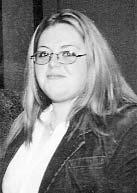
participate in The American Legion Oratorical Contest are something to witness.
The Department Oratorical Contest will be held at Department Headquarters on Sunday, March 13, 2005, at 1:00 p.m. and the National Oratorical Contest will be held at IUPUI on Saturday and Sunday April 9-10, 2005.
The other premier American Legion Children and Youth Program in the beginning stages for this year is Hoosier Boys State. Let’s all see what we can do to fill up the 1,000 available positions at Hoosier Boys State this summer.
The American Legion throughout the Department has signed up 2,793 new members so far this card year but we are still 2,388 members behind last year. Some of this can be attributed to Legionnaires moving out of the state and death but the majority is because we are not renewing our memberships as we could be doing. Please remember that your Post’s officers are volunteers and they only have so much time in their busy schedules to work on renewing your Post membership. So, please, give them some help. Talk to you fellow workers, neighbors, family members, and friends and ask them if they have paid their 2005 dues and if they have not, talk them into paying them. Have a great winter – but let’s all think spring. For God and Country.
Senior Moments
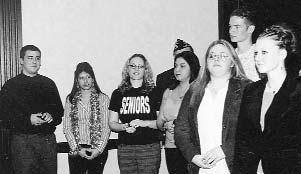
James B.May,Chairman ofthe Knightstown Home Committee, presents class rings to Amy Rothman,a member ofthe Knightstown Children’s Home’s 2005 graduating class (far left),as the entire class gathered for a final photo (above) and another member ofthe class beams after accepting her ring.Following the presentations,Mr.Gill and Mrs. Jordan gave a slide show ofthe seniors’New York class trip.
Continued from column 2
Knightstown Home Committee, $1,000 to Riley’s Hospital and $1,000 to the Laporte/Michigan City Salvation Army. Bristol Post 143 held its annual Americanism Program with Dept. Commander Bill Firkins as the guest speaker. Other speakers were
Department Membership
Chairman Paul Steward and Elkhart County Commander Jack Cook. Actors and Actresses of the Junior Auxiliary and SAL presented a play named "Lest You Forget."
To all members of the District I wish you a Happy Valentine’s Day and Happy Easter.
I’m writing this about a milestone in my life. January 20, 2005, I turned 80 years old. I am very fortunate to be in fairly good health. I have always tried to be active in veterans’ organizations. I think it keeps you young.
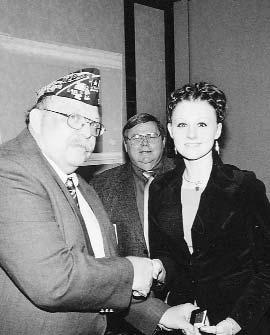
For those veterans who are half my age, get active in your Post, District and Community. Wasting your days sitting around watching football is one way to rush your way to the grave.
Everybody goofs up in his life. I sure did, but, I came back. I got out of the Navy and failed to go to college: Big mistake. I blew my chance
to become President of the United States. I did make it to District Commander. I can’t fail to do a good job, since I have great, hard working officers. My membership chairman has been on the ball with four membership rallies, keeping us in the top four. We are half way in the Legion year. We will continue to work hard on all facets of the Legion. The future looks good for Mid-Winter and Spring Conferences and Indiana Department Convention. I hope to make the National Convention in Hawaii.
DISTRICT 6
John French Commander
To all of the Sixth District members out there, I hope you had an enjoyable New Year.
I want to give a big thank you to all of those who worked so hard to make the National Commander’s Tour such a huge success. Once again the District showed that we can work together and get things done. We were able to turn in over 600 cards during that week. Thanks to the Posts that took time out to let the Commander visit.
The Third District was honored to have National Commander Thomas Cadmus, Department of Indiana Commander Bill Firkins, Department of Indiana Auxiliary President Phyllis Clark and many other Department Officers visit Middlebury 210, Plymouth 27, Union Mills 295 and Laporte 83.
During the visit at Post 210, Department Membership Chairman Paul Steward presented Third District Commander Charles Martin with the Ernie Miller distinguished “Pizza” Award. Union Mills and Laporte greeted the Commander’s group with Color Guards, and Union Mills provided lunch. Thanks to all of you for the outstanding hospitality to our visitors.
Commander Martin, St. Joe Vice Commander Randy Gwynn, and Chaplain Charles Wotring were invited to a Dining Out with the 766th Transportation Co. sponsored by Family Readiness Group of South Bend. The Dining Out was held at The Sacred Heart Parish Center at Notre Dame.
Marshall County Vice Commander Becky Stevens has been called to active duty and will be leaving for duty in Iraq. Our prayers will be with Becky and her family.
Twelve Boys from Division 18 at Knightstown Home were invited to Bourbon for the annual shopping day. There were 26 Auxiliary Units, 15 Legion Posts, and 10 SAL members in attendance to treat the boys to lunch and take them shopping. Each of the boys was given "ditty" bags and many other gifts.
Fourteen veterans at Country Side Nursing Home in Mishawaka were presented goody bags with personal items by Unit 161 President Joy Miller and Marge Rush. All 80 residents of the nursing home received at least one Christmas card from Unit 161. Thirty children attending the Christmas party at 161 did crafts, had snacks and were entertained by Santa bearing gifts.
Middlebury Post 210 sponsored a day with Santa and Unit 210 hosted a Christmas party for the youth. Some of the contributions from 210 to the community are $1,000 to Middlebury Historical Museum, $500 to Boys and Girls Club, $500 to Middlebury Food Pantry, and $500 to the Trost Family Children Fund. Staff Sgt. Marvin Lee Trost was killed while on active duty in Iraq.
Post 130 of Michigan City donated $1,000 to the 3rd District

Continued in column 5
I hope everyone got to come to the conference. Remember it is usually at the conferences that we learn about new programs and what is being done at the other
Districts so that we can all make the Legion better. We still need more than 1,600 cards to be turned in by close of books. So all Post Membership Chairmen and all of the Vice Chairmen need to get out there and help each other bring those cards in. I would like to be down to needing only 500 cards by the March turn-in. It sounds like a lot and it is, but I know we can do it. We’ve shown that we can do anything. And while we are out there, don’t forget to ask about having family members join the Auxiliary and Sons of The American Legion.
Children & Youth
Continued from page 3
will be held at Department Headquarters due to renovation at National.
A motion was made to get a $100.00 monetary reward for Zone Oratorical runner-ups. The motion was seconded and passed.
Internal Affairs
Continued from page 3
get involved with this. The 2nd District Chaplain commented on the federal judge who ruled that President Bush could have an inaugural prayer. There was much discussion about God being removed from all things public. Traditional beliefs are under attack. The 6th District Chaplain spoke about the honor of being a
Children and Youth Committee Chairman Delaney was present to observe the meeting.
Adjournment
There being no further business to come before the commission, the meeting was adjourned in proper form.
Chaplain and presented Chaplain Keirn with an engraved Bible. The 1st District (East) Chaplain presented a Chapel of the Four Chaplains pin.
Adjournment
There being no further business to come before the commission, the meeting was adjourned in proper form.
Page4HoosierLegionnaireJanuary//February2005
DISTRICT 3
Charles Martin Commander
DISTRICT 4
Don Beaty Commander
DISTRICT 2
Mike Davis Commander
DISTRICT
By Dave Rook Public Relations Chairman
Greetings from the Fighting Seventh.
I would like to thank all of our posts for a great turn-in of membership. We’ve gone up 11 percent since the first of the year and are now in second place. Special congratulations to Owensville Post 51, Mooresville Post 103 and Odon Post 293 for reaching 100 percent plus of their goal. Mooresville has also reached another All Time High and I’m sure will keep on recruiting.
We have another seven Posts that are at 90 percent or more: 141, 121, 205, 197, 106, 236 and 194.
I hope to see all these posts at 100 percent or better soon.
Also thank you to Sullivan Post 139, Worthington Post 106, and Bloomfield Post 196 for hosting National Commander Tom Cadmus during his recent tour of the Department. Every stop in the District had scores of Legionnaires, SAL and Auxiliary members waiting to greet Commander Cadmus. It was inspiring to hear his words of encouragement.
We had really good attendance at the recent Mid-winter Conference. The workshops were very informative, the hospitality room was always full and Commander Firkins’ party was one of the best. I really enjoyed the bear (whoever he was) as he made his rounds.
Franklin Post 205 provided food and gifts to 15 needy families in the Franklin area at Christmas. The Post has been providing this service for over 10 years under the able leadership of Bob Magers and Martha Reese. The program has grown from just a few families to its present size.
A team of 7th District Legionnaires from Johnson County
continue to greet all troops returning from deployment through Camp Atterbury. They are Russ Bensheimer and Dave Rook from Post 205 and Owen Stickles from Post 233. Bill Clark of Post 300 in the 11th District and a resident of Nineveh have also been a great help. The team hands out information about VA benefits and Legion programs and benefits to each man or woman that process out. It’s a great program that has resulted in a number of new Legionnaires from not only Indiana but many surrounding states.
In addition, the Edinburgh Post 233 Legion family recently hosted almost 40 Guardsmen from the state of Minnesota before they deployed. The Guardsmen and their State Adjutant General were given dinner and then celebrated St. Barbara Day. (If you want the recipe for the "libation" these guys from Minnesota prepared, contact Owen Stickles from Post 233. I hear it was really something.) This is the third deploying unit that the Post has hosted.
Unit 205 is also getting into the act of supporting our troops. They are sending goody boxes to all Franklin men and women who are deployed to Iraq or Afghanistan. And the Linton Post 22 Legion family is sending birthday boxes to all deployed Linton residents.
Bill Halliday, SAL Squadron 18 Commander, is deployed to Iraq. He asked if the Legion family would send a "few" toys for Iraqi children to him. They did … 20 cases so far. This project started in November of last year and is continuing.
In closing, I would like to remember all the Hoosier Legion members who are deployed with our Armed Forces. Wherever they are, they are serving their country once again. I wish them Godspeed and a safe return.
DISTRICT 9
Raymond (Al) Kerner Commander


Congratulations to our Ninth District Posts for their membership card turn in. All cards were counted January 15 at the Mid-Winter Conference and the top four districts all fell in the 86th percentile: First place, 2nd District with 86.78 percent; second place, 7th District at 86.72 percent; third place, 4th District at 86.45percent; and the Ninth District, fourth place at 86.39 percent. We are in a great position to have a 100 percent-plus year.
I encourage all posts to begin a membership drive of outstanding members. Please make some form of personal contact to collect dues and propel the Ninth District into first place in the state.
We held a card turn-in at our District meeting on Saturday January 29 at St. Leon Post 464 at 4:00 p.m. and we plan two more: Saturday, February 26 at Bedford Post 33 at 4:00 p.m., and Saturday, April 30 at Salem Post 41 at 7:00 p.m.
Congratulations are also in order to Post 234 at Scottsburg and Adjutant/Membership Chairman Barb Bowen for reaching the 100 percent goal. You are doing a great job. Also, to Post 337 at Sunman and First Vice/Membership Chairman Mike Blevins for your all time high award which was presented at the Mid-Winter Conference, and to Commander Milton Howard for receiving the Post Family Award for 100 percent by Knightstown. Keep up the good
work, Post 337.
More congratulations, to St. Leon Post 464 Commander Jerry Maune and Membership Chairman Ken Hylton for your all time high award for the 56th continuous year. Keep the record going.
Our Ninth District SAL Commander Mike Miller reported that he needs a big boost in membership cards turned in as soon as possible and requests each post to get involved in SAL membership renewal. SAL cards can be turned in at Ninth District meetings. Let’s help our Sons reach their goal.
One final thought on membership. For those who have not paid dues for 2005 and for next year, if your budget allows, consider a paid up for life membership, which will protect you from any future dues increases. It will pay off.
All members are encouraged to get involved in your post and district activities. There are many news subjects reported and discussed at district meetings that our posts should know about. It is important for all posts having non profit charitable contributions to maintain a record of these and report them to the Department on the appropriate forms.
Any post having awards or news items you would like reported in this column please let me know. Thank you again for your effort to make the Ninth District one of the best.


Thanks,Guys
Department Commander Bill Firkins takes a few minutes during the annual Department Officers’Christmas Party to congratulate the District Commanders for their good work and to recognize a number ofdepartment leaders who the commander credited with guiding his development and progress through increasing levels of responsibility in the Department.
The holidays are over and now we prepare for the remainder of this Legion year. I hope everyone had a joyful and safe Holiday Season.
history and functions of The American Legion.

 By Mel Vinson 8th District Public Relations Officer
OOHRAH” From the Eighth District!
Comments from Commander Jeff Carroll, Sr.:
“I hope everyone enjoyed the holidays and had a great time with family and friends. We are into the New Year and things are looking bright. We still have a lot of hard work ahead of us. Our membership is not where it needs to be and now is the time for the BIG PUSH.
Let’s put the Eighth District at the top of the state with a 100 percent or higher membership. WE CAN DO IT!
“I would like to say thank you to all the posts I have visited and the hospitality they have shown me. It has also been a pleasure and a privilege to speak at some of the posts and events within the Eighth District. I look forward to continuing to visit with the posts and their members. I would also like to say how proud I am of the work our members are doing with the Legion programs. Keep up the good job. I have seen the good you are doing.
“I really enjoyed playing Santa at Knightstown Home and Sellersburg Post 204 for the kids. We had a large group from the Eighth District go to Knightstown Home this year and we enjoyed the Christmas Program that the kids performed for everyone. Most of all we enjoyed being there with them.
Let us not forget those who are away from home or those that are in harms way. Keep them in your thoughts and in your prayers.” ***
Some important dates in the District for the next couple of months include: March 13, 2005 — the third meeting of 2005 for the District.

You will note that the location has been changed to Mount Vernon Post 5; Saturday, March 19, 2005, we will be having our final membership tour. We will be starting at
Charlestown Post 335 and visiting most of the Posts in the East end of our District. Mark your calendar for Saturday, March 19, 2005 and join in and visit the Posts in the East end of our District.
The Spring Conference will be April 1-3, 2005, and the April District meeting will be April 17, 2005 at Rockport Post 254.
Mark you calendar for these important dates and attend the District meetings and maybe attend the Spring Conference.
The Eighth District Oratorical Contest was held Saturday, January 8, 2005, at Rockport Post 254.
Congratulations go to Rebecca Yeager of Georgetown, who was sponsored by Post 28 of New Albany, for winning this year’s contest. Rebecca is home schooled.
Congratulations also go out to our second place contestant, Patrick Littleken of Mt. Vernon High School, and to Mt. Vernon Post 5 who sponsored him. The entire Oratorical Committee should be congratulated for a job well done, as should all the volunteers who helped with this contest.
Dave King, Boy Scout Chairman, said he has presented 19 Eagle Scout Achievement Awards so far this year and one Silver Venture Award, which is a first for the Eighth District. All these awards have been presented to Eagle Scouts in the Lincoln Heritage District of the Eighth District.
Dave said he will need the names of candidates for the District Eagle Scout of the Year to him by Tuesday, March 1, 2005.
We had a good turn out of Legionnaires, Auxiliary and Sons at the Mid-winter Conference. Lots of useful information and training was given out to all attending. The weather was COLD but all who visited and learned had a warm time.
The Eighth District was very proud to have the National Commander Thomas Cadmus visit us on January 12 & 13, 2005. We hope he had an enjoyable trip and hope he comes again.
I would like to say hello to all my fellow Legionnaires. The holidays are over and it is time to get to work on membership and all the Legion programs. Ihope everyone had a very Merry Christmas and that the New Year will be a great one for everyone.
We had a real good Mid-winter Conference in January. There was a good turn out of members who came to our hospitality room. In addition, the membership turn in for the 10th was very good. Thanks to all the posts for the great turn in. We moved up to ninth place at the end of the Conference. Also thank you to all my officers who were there to attend all the different meetings at the Conference.
I hope everyone enjoyed our hospitality room. I would like to thank everyone for their help with the hospitality room. The room takes a lot of work. Everyone does a great job at keeping up with everything, especially my girls who I call my "Harem." The girls are always there for Shirley and me. They do a great job at keeping everything filled up and bringing in money for the 10th District. Thank you, girls!
Our National Commander, Thomas Cadrnus, was here visiting in our state. He came to the 10th District to visit with a few of our Posts. He is a great person. He had a good time at each Post that he visited. We went to four different Posts, Shelbyville, Morristown, Greenfield and Hagerstown.
Thank you everyone who was in attendance and for being so hospitable with him. He enjoyed talking with all the members of each Post. Commander Cadmus talked about visiting Post 70 and some other posts close by in April, when he will be coming back to Indiana for meetings at the National Headquarters.
I would like to say thank you to all the teachers and staff who work at Knightstown Children’s Home. They work very hard and do an excellent job with those children. The children put on an excellent performance for everyone who attended the Christmas program. They did a great job singing and dancing, and everyone including myself enjoyed the performances.
We will be having a drive around in our District in February. I will report on the drive around in the next issue. Hope to pickup a lot of membership cards.
A big thanks to Department Commander Bill Firkins and the Department for a chance to see and visit Illinois for the Lincoln Pilgrimage. I am truly looking forward to this. I will be able to see all our friends from the other Districts and all our Department staff.
Again, thanks to the largest Post in the 10th District,. Shelbyville Post 70, for all your support of my wife and myself. Do not forget to let our troops know we support them in the great job they are doing over the world
God Bless you all.
Posts in Action
Post 202 donates $85,000
In a full front page display just before Christmas, the Butler, IN Bulletin newspaper acknowledged Charles Forster Blaker American Legion Post 202 for its unprecedented generosity to the community.
The Post gave $5,000 grants to 17 separate community organizations ranging from police and fire departments to organizations serving youth and senior citizens. The total of contributions was $85,000, bringing to nearly $150,000 the amount contributed by the Post during all of 2004 – almost all of which is generated by the Posts three weekly bingo games.
Post Commander Bill Miller told the Bulletin “it was really tough picking out what agencies to give to
Several of our Posts held Children’s Christmas parties and all were delighted by the arrival of old St. Nick.
Our fruit basket handout at Lafayette Home was a great success. Thanks to eight of our Posts –4, 64, 88, 249, 276, 300, 355, and 500 – which sent a combined total of 17 volunteers, and to the contingent from Second District which assisted. It's not just the baskets but the joy of having someone to visit them that makes this trip so meaningful to the residents.
Skip Nunweiler was the table host and seven members representing three of our Posts attended the Governor’s Lunch for the start of the Boy Scout Campaign.
Commander Firkins and First Lady Shirley were guests at one of Posts 500's famous tailgate parties, and American Legion Riders Director Rex Ikemire presented the Commander with an Associate Membership in the ALR.
Our District Oratorical Contest was won by Amy Bither, sister of last year's winner. Amy is a student at Ben Davis High School, and we wish her well at the zone competition. Congratulations to Skip and Post 3 for once again conducting a class act program.
Our speaking engagements this term was in the hands of very capable Tom Tsareff of Post 500. Tom spoke to two groups of ladies at a local Speedway Church about the
Editor’s Note:Briefitems ofgeneral interest to all Legionnaires are welcome for Posts In Action.Items should be brief,typewritten or emailed,or can be clippings from local newspapers.Items will be published only on a space available basis,and will be returned only on request.Send to Editor,Hoosier Legionnaire,777 North Meridian Street,Indianapolis,IN 46204,or email to hdagley@indlegion.org


since there are so many deserving. We tried to touch everybody from the seniors to the children to the veterans, everybody that we could reach.”
Post 16 Veterans Day Programs
Reach Hundreds Hammond Post 16 continued its tradition of presenting Veterans Day programs at public and parochial elementary schools in Munster, Hammond, Highland, and Griffith in November.
Eight teams consisting of 11 post members each made ten presenta-
tions at seven local elementary schools. The programs reached approximately 1,230 school children, who heard about the history of Veterans Day and why it is important to honor America's veterans, and had their questions about the military, the nation's wars and conflicts, and veterans answered.
The schools that hosted presentations were Morton (Hammond); Eads (Munster); St. John Bosco (Hammond); St. Catherine Sienna (Hammond); Our Lady of Grace (Highland); St. Casimir
During the Legion College Session, some of the students made contacts and surveys in Pike Township as to the possibility of establishing a new Post. We are currently following up on these recommendations and in the near future hope to be able to announce a new Post for our District.
I want to offer a big, big Thank You to four of our Posts that waited for the National Commander's Tour. Due to our Indiana weather, The tour was running very late, but Posts 497, 355, 276, and 495 stuck it out and made sure Commander Cadmus received a big District 11 welcome.
I recently received a letter from Dennis Lewandowski. Dennis was the Membership Chairman of Post 495, but went on active duty shortly after our fall conference and is now serving in Iraq. Along with the letter was a copy of the Stars and Stripes with an article about the many families now without a husband and father. Dennis asked me to relay to all of our members who have not renewed their membership how important it is to remain a member of the Legion, not only for strength in numbers but also for the funding our Programs.
He was especially concerned about these children who no longer had a father and the assistance our organization would be able to offer them. Dennis, if you receive a copy of this issue, we wish you well, safety, and hurry home. We need you back here with us
To all of our Posts, let’s pull out all the stops, and plan for a big turn in at our next Conference.
(Hammond); St. Mary (Griffith). Daniel Buksa, Past Post Commander, is the Veterans Day Presentation Coordinator. Hearse Flags Encouraged Randy McCroskey, Post Adjutant at Van Buren’s Post 368, is encouraging Legionnaires across the state to contact their local funeral homes to ask that funeral processions for veterans include the display of small American Flags.
“As I was watching a funeral procession go by, I wondered if it was one of our honored veterans whose obituaries I see in the paper every day.
“I would like to see if it is possible for the Funeral Director to place an
Continued on page 8

January/February2005HoosierLegionnairePage5
DISTRICT 8
Jeff Carroll Commander
DISTRICT 10
Robert Tucker Commander
DISTRICT 11
Robert Flynn Commander
7
Harold Hensley Commander
Indiana Short-Changed On Share OfFederal Dollars For Veterans
Once again Hoosiers are experiencing a change in the administration of state government. With each change, our elected officials search for that appropriate stance between stimulating the state’s economy and balancing the state budget. The budgetary spotlight most often focuses on the school system, roads, sales tax, state income tax, Medicaid, employment, etc. The state, however, has either forgotten or never realized its potential return on federal veterans’ benefits dollars.
This is not to say that the Indiana Department of Veterans Affairs under the leadership of former director Bill Jackson failed in its stewardship role for Hoosier veterans. In fact, Bill and his staff made many accomplishments under IDVA’s obvious limited authority and rigorously controlled budget. During the last few years, Hoosier veterans saw:
• an increase in the Child of a Disabled Veteran tuition assistance program • the building of Indiana’s first state veterans’ cemetery • the building of the WW II
Editor’s Note:Many ofthe deficiencies described in the following article are addressed in House Bill 1385 now before the Indiana General Assembly.Hoosier Legionnaires are encouraged to become familiar with the measure and contact their State Representatives to press for passage of the bill.You can get more information about legislation before the General Assembly at:www.in.gov/apps/lsa/session/billwatch.
Memorial in Indianapolis
• increases in the disabled veterans’ property tax deductions
•the wheelchair symbol added to DAV license plates
•a discounted hunting and fishing license for disabled veterans legislation to give WW II veterans their high school diploma if they left school to help defend our country, and
•Indiana National Guard college tuition assistance.
Also, germane to this article, Indiana improved the average federal veterans’ benefits dollar brought into the state from $1,117 per veteran in 1999 to $1,725 per veteran in 2003.
The calculation of the average federal veterans’ benefits dollar requires some explanation. This figure does not mean that each veteran
in the state received $1,725 in 2003 or can expect to receive that much or more each year from the federal government. It does show, however, the amount the federal government spends in the state for all veterans’ services on a per veteran average.
Those federal dollars include the cost of compensation and pension, education and vocational rehabilitation assistance, insurance and indemnities, building construction, general operating expenditures, and medical expenditures.
Federal veterans’ benefits dollars coming into the state benefit not only veterans directly, but also the state by:
• collecting a six percent sales tax when veterans spend compensation and pension benefits;
•reducing state welfare pay-
ments when indigent veterans and their surviving spouses receive nonservice connected pension payments; collecting federal veterans tuition assistance at state supported colleges;
•federal veterans vocational rehabilitation and education assistance programs producing a more qualified workforce within the state;
•reducing Medicaid (and Medicare) expenditures when low income veterans receive VA healthcare services;
• using Indiana companies for major (and minor) VA construction projects; and
•providing good jobs for hundreds of Hoosiers at the VA regional office, VA hospitals, and other VA medical facilities throughout the state.
The State of Indiana, as noted, increased its average federal veterans’ benefits dollar figure to $1,725 in 2003. The problem, however, is that this $1,725 figure is still $665 lower than the national average federal veterans benefits dollar amount of $2,390. Indiana’s 2003 veterans population was 555,173. When compared with other states with similar veteran populations, Indiana’s average federal veterans’ benefit dollar still lags behind.
For example:
•Indiana: 555,173 veterans, $958,156,000 federal veterans benefits dollars = $1,725 per veteran
•Wisconsin:486,585 veterans, $1,004,853,000 federal veterans benefits dollars = $2,065 per veteran
•Maryland: 484,323 vets, $1,023,245,000 federal veterans benefits dollars = $2,113 per veteran
•Arizona: 562,405 vets, $1,313,301, 000 federal veterans benefits dollars = $2,335 per veteran
•Tennessee: 544,695 vets, $1,332,344,000 federal veterans benefits dollars = $2,446 per veteran
•Massachusetts; 509,868 vets, $1,283,044,000 fed. veterans benefits dollars = $2,516 per veteran
•South Carolina: 411,650 vets, $1,049,545,000 federal veterans benefits dollars = $2,550 per veteran
• Alabama: 431,049 vets, $1,200,345,000 federal veterans benefits dollars = $2,785 per veteran
needs to invest in veterans services.
Department Commander Bill Firkins stopped by the bedsides ofa number ofhospitalized veterans such as this man at the Roudebush VA Medical Center in Indianapolis during the holiday season.According to the commander,the care and attention Roudebush provides is “second to none,”and patients eagerly await visits from family,friends and fellow veterans.
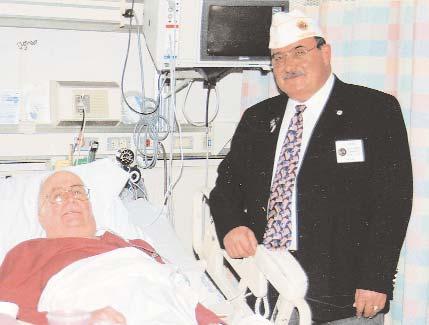
Commander Condemns Proposed VA Budget As ‘Health Care Tax’
National Commander Tom Cadmus, reacting on behalf of the 2.7 million men and women of the American Legion, has decried the effects that President Bush’s budget plan will have on veterans. He called it a smoke screen to raise revenue at the expense of veterans. This is not acceptable,” said Commander Cadmus. “It’s nothing more than a health care tax designed to increase revenue at the expense of veterans who served their country.”
Cadmus was referring to the portion of the proposed budget that would double the co-payment charge to many veterans for prescription drugs and would require some to pay a new fee of $250 a year to use their own their own health care system.
“Is the goal of these legislative initiatives to drive those veterans paying for their health care away from the system designed to serve veterans?” Cadmus asked. “The President is asking Congress to make “health care poaching” legal in the world’s largest health care delivery system.”
When the President first came to Washington, among his first official acts was to triple the prescription co-payment from $2 to $7,” Cadmus said. "Once again, the President wants to double the copayment and fortunately, Congress has wisely rejected that proposal. Making veterans ‘pay for timely access to quality health care is wrong.”
This is the third year in a row the
President has attempted to establish an enrollment fee for those veterans making co-payments and thirdparty reimbursements to the VA.
“Many of these veterans are Medicare-eligible and already paying the federal government for their part A and B coverage, so why should they have to pay an additional enrollment fee? VA can't even bill Medicare," Cadmus said. "Other veterans with private health insurance make co-payments and then VA is reimbursed for services. Again, why should they be forced to pay an additional $250 to go to VA medical facilities?”
“During my visits to VA hospitals, I have not run into Bill Gates, Donald Trump, or Ross Perot seeking care. I see mostly veterans trying to make ends meet and exercising their very best health care option.”
Cadmus observed.
“Veterans’ health care is an ongoing expense of war,” he added. “You don’t thank veterans for serving their country and then tell them, ‘By the way, better not get wounded or you’ll have to pay extra for your health care.’ This is offensive to every veteran in America. That is why this government must move VA health care out from under the umbrella of discretionary spending to mandatory spending,” Cadmus stressed.
The American Legion has requested a $3..5 billion increase in health care spending in FY 2006. The President is proposing $9.5 billion in foreign aid, about $2.1 billion more than the current level.
As young Americans in uniform battle terrorism in Iraq and Afghanistan, as well as 119 other countries, it is incomprehensible that our veterans will pay for the shortfall in VA health care funding from their own pockets as tax dollars flow out the back door of America,” Cadmus said.
“We reminded the President of our position on veterans’ health care needs during his campaign and I personally testified on the issue on Capitol Hill last September,” Cadmus added. “Our budget request is very realistic when you consider the Secretary has slammed the door in the face of hundreds of thousands of veterans eligible, but currently forbidden from seeking quality care from VA.”
The current appropriations process is broken and is not adequately funding VA medical care,” Cadmus said. “President George W. Bush’s Task Force to Improve Health Care Delivery for Our Nation’s Veterans on May 26, 2003, identified the mismatch between demand and funding as a major obstacle in meeting the nation’s commitment to veterans. The American Legion and nine other veterans’ organizations believe the answer lies in changing VA health care funding from discretionary to mandatory appropriation.”
“No active-duty service member in harm’s way should ever have to question the nation’s commitment to veterans. This is the wrong message at the wrong time to the wrong constituency.”
Why do Hoosier veterans receive fewer federal veterans’ benefits service dollars than veterans in most other states?
It’s most likely because Indiana perceives veterans services as a bud-
 John Hickey Department Service Officer
get liability instead of an investment.
Most all other states either maintain a well staffed veterans’ claims office or provide adequate financial supplements to veterans’ service organizations that provide accredited VA claims representation.
The state of Indiana has no accredited claims representatives, and the service organizations receive very small state supplements in comparison to the costs of staffing and operating an accredited veterans claims office.
Even though veterans’ service organizations such as The American Legion dedicate large portions of their budget to veterans’ services and claims representation, the demand for claims representation is larger than the combined budgets of all the VSOs. There are more than 555,000 veterans in Indiana, and only 12 full time accredited veterans’ organization service officers providing claims representation services. Granted — not all veterans have active VA claims, but many do, and they deserve adequate representation.
There are many claims, however, that never reach the office of an accredited representative or the VA regional office, because they are never filed: potential claimants fail to fully understand their entitlements.
Service organizations inform their members about veterans’ benefits through a network of volunteer veterans service officers. Veterans who do not join veterans service organizations, however, often never fully understand their entitlements or are unaware when a new law or regulation comes into effect making them entitled to something new. County governments employ County Veterans Service Officers to instruct local veterans about their benefits and assist with filing claims. The problem with the CSO system in Indiana, however, is that most county governments see the position as a financial liability and allocate very little if any funding for the office or position.
The solution: The state of Indiana
The state needs to provide veterans’ service organizations offering professional accredited claims and appeals representation an adequate financial supplement based upon the number of new clients the organization serves each year. The state also needs to set up a just and fair funding model to make sure counties have resources to properly staff local county veterans’ service offices for making sure all veterans within their counties know what they are entitled and how to apply.
Furthermore, elected state officials need to become more involved when they learn of VA plans to close or reduce services at VA medical centers, such as the reduction of inpatient services at VA’s Northern Indiana healthcare facilities.
So you say, that’s nice, but where does the money come from – especially considering the state’s current budget crisis? The money will come back in greater amounts through federal veterans’ benefit dollars.
For example: in 2003 we had 555,173 veterans in the state (we likely have more now), with an average federal veterans’ benefit return of only $1,725 per veteran. This is $665 less than the National average federal veterans benefit return per veteran. Indiana should at least be able to meet the national average by providing an adequate means for veterans’ services. This would bring another $369,190,045 into the state’s economy. Considering only the six percent sales tax return once most of these funds are spent within the state, Indiana would see a direct financial return of $22,151,402. This is in addition to obtaining a better work force through VA education and training, employing more people in good federal jobs, reducing the welfare rolls, reducing state sponsored healthcare costs, etc.
The Indiana State General Assembly currently has before it House Bill 1385 that at least starts to address some of these issues. Please contact your state legislator and ask for his assistance with getting that bill passed.
Veterans have served and protected this nation and state. They were not a liability then, nor are they a liability now. We can only hope, pray for, and encourage our new governor and state legislators to recognize the difference between a liability and a national asset.
Proposed VA Budget At-A-Glance
President Bush will seek a record $70.8 billion in the fiscal year 2006 budget for the Department of Veterans Affairs, with the overwhelming majority of these resources targeted for health care and disability compensation.
Most controversial among the budget proposals are the doubling of co-payments for prescriptions drugs and an annual enrollment fee of $250 for Category 7 and 8 veterans who opt for health care in VA facilities. These proposals require action by Congress.
Here are highlights from the President’s VA budget proposal:
• $750 million for the Capital Asset Realignment for Enhanced Services (CARES) program, bringing the total department investment to date to $2.15 billion. The proposal includes 28 new outpatient clinics;
• $2.2 billion in enhanced mental health services;
• $1.2 billion for prosthetics and sensory aids, a $100 million increase over FY ’05;
$400 million for non-institutional long-term care;
$90 million for construction projects, including funds for the purchase of land for six new national cemeteries, none in the Mid-west, but does include $32 million for new state cemetery grants;
•Educational assistance up to $1,004 per month – a record amount – for full-time education or training in an approved institution;
In addition, the VA’s support to service members and veterans purchasing or improving homes through the home loan guaranty program will remain at current levels, while vocational rehabilitation and employment benefits for service-disabled veterans will increase by $64 million.
The President’s 2006 budget also includes legislative proposals that include:
•Ending all co-payments for former prisoners of war;
•Ending co-payments for hospice care;
Commanders Tour
Continued from page 1
Conference, I wanted to come up with a way to show off the Legionnaires, Posts and Districts who have been successful in a number of way, including membership," said Commander Firkins.The commander – known to friend and supporters as "Bear" Firkins for his bruin-like appearance, demeanor and throaty growl – was assisted as the rally by a large
brown bear as he unveiled the newest traveling trophy for membership success.
The ‘Big Bear Award’ will be presented each target date to the leading District Commander. The award went to the First District for its achievements up to the conference, but when the dust settled after the Conference, it was given over to the new leader, the Seventh District.
•Authorizing VA to pay for emergency room care or urgent care for enrolled veterans in non-VA medical facilities; Allowing more resources to be devoted to the homeless providers grant and per diem program;
• Establishing a priority system for veterans receiving care in state veterans homes;
•Increasing pharmacy co-payments from $7 to $15 for a 30-day supply of drugs;
• Establishing an annual enrollment fee of $250.
The proposals concerning pharmacy co-payments and enrollment fees ask that non-disabled, higher income veterans assume a share of the cost of their health care, in line with amounts required of military retirees who have served at least 20 years in uniform or who were retired early due to service-related disabilities. Under no circumstances will a veteran make a co-payment of any kind for the treatment of a serviceconnected condition.
Posts in Action
Continued from page 5
American window flag. Then, when people see the flag flying in the wind they know that this is a veteran going home to his or her final resting place. At this time in our country when patriotism is on everyone’s mind, it would be a nice tribute for all to see.”
Letters to newspapers, funeral homes and other influential groups can make this happen.
K Page6HoosierLegionnaireJanuary/February2005 Veterans Spotlight
Bedside Manner
‘Family’Shines Through During Tour
It was my privilege to spend the better part of two days on the National Commander’s tour of the Department last month. It was the kind of experience that one has to consider for a few days before the full impact and impression of it settles in.
For me, I have decided, the Commander’s Tour became one of the finest expressions of brotherhood I have experienced in my many years of Legion service. It also was living proof of Commander’s Firkins’ firmly held belief that "We are Family," the slogan under which we have worked and played together this year.
I come from a background that is not privileged in the sense that we so often think of as privilege. But in another sense, I was privileged to grow up knowing what it means to be family, to pitch in on the difficult and backbreaking tasks so necessary to keep hearth and home together. For me, family meant another pair of hands – hands to work the fields, yes, but also hands to rub weary shoulders and welcome me home at the end of a day, a semester, a tour of duty.
That is how I experienced my time on the commander’s tour. No matter where we went, no matter whose threshold we crossed, we were greeted warmly, fed well, and offered the hand of friendship and family. It was as if we were not visitors, but family, long gone and finally at home.
I am grateful for the men and women of The American Legion for that, and I am grateful to the Commander for giving me the opportunity to serve as one of his officers.
Second District
Takes Big Bear Award
During the Mid-Winter
Paul Steward Membership Chairman
Conference, Commander Firkins with a little help from an unknown bruin, unveiled the Big Bear Award. This uniquely and specially designed traveling trophy will be kept by the leading District Commander as of each of the remaining Target Dates.
Because the award was unveiled during the reign of the First District, Commander Ralph Perez took possession of the trophy, but only briefly. By the time the January turn-ins were completed, the award had begun its travels, jumping from Commander’s Ralph’s hands into those of the Second District Commander, Mike Davis, who will keep it until the standings at the February target date are determined.
Congratulations to both and good luck to the rest of the Districts.
Districts Standings
Here are the standings as of the January Target Date:
•First Place: District 2 with 13,065 (87.10%)
•Second Place: District 7 with 10,472 (86.87%)
Third Place: District 4 with 14,690 (86.49%)
•Fourth Place: District 9 with 9725 (86.44%)
•Fifth Place: District 3 with 10,225 (85.25%)
•Sixth Place: District 1 with 6,451 (84.88%)
One Hundred Percent Posts
Second District
WILSON-BATES190HEBRON105.172
BROOK364BROOK105.172
LAKE VILLAGE375LAKE VILLAGE103.333
WILLIAM CHIZUM146MOROCCO100
ANCIL GEIGER226MILFORD100
WILLIAM REDILYACK301KOUTS100
SILVER LAKE431SILVER LAKE100
WALLACE SNIFFIN506MONTMORENCI100
Third District KOSELKE MAYFIELD403WANATAH103.684
ORVILLE EASTERDAY189WALKERTON100.299
HANNA472HANNA100
Fourth District
KEITH BROWN420MONROEVILLE100.347
Fifth District
RUSSELL WEAVER166MARION127.778
DONALD E. CONVERSE85HUNTINGTON106.364
SUNSET402LAKETON101.389
HOMER CAMERON342ROSSVILLE100
FLOYD MARSHALL412RUSSIAVILLE100
Sixth District
HOCHSTEDLER318WESTFIELD110.811
FULTON-BANTA291COVINGTON101.923
C. W. SCRIBNER255RUSSELLVILLE100
JAMESTOWN395JAMESTOWN100
Seventh District
OWENSVILLE51OWENSVILLE107.692
ODON293ODON101.667
MOORESVILLE103MOORESVILLE101.096
Eighth District
CONRAD179PETERSBURG102.857
RIVER CITY42FLOYDS KNOBS100.526
TENNYSON463TENNYSON100
Ninth District
KENNETH L. DIVER337SUNMAN116.154
NORTH DEARBORN452NEW ALSACE105.714
ST. JOSEPH464ST. LEON105.667
SCOTT234SCOTTSBURG104.103
PATTON-CHASTAIN195CAMPBELLSBURG100
Tenth District
MEREDITH-LOW134WESTPORT105
NEW PALESTINE182NEW PALESTINE105
Eleventh District
POLICE56INDIANAPOLIS104
ATKINS SAW355INDIANAPOLIS103.913
FRANK MCKINNEY SR.510INDIANAPOLIS100
•Seventh Place: District 6 with 9,239 (83.99%)
•Eighth Place: District 8 with 8,651 (83.99%)
•Ninth Place: District 5 with 9,556 (81.33%)
•Tenth Place: District 10 with 8,159 (80.54%)
•Eleventh Place: District 11 with 7,172 (80.10%)
Final Renewal Notices Scheduled
There are only two more renewal notices scheduled for the remainder of this membership year. The first of them is set to go out on March 15, while the final notice is scheduled for May 1.
I know many of you are working membership very hard and although it may seem that mem-
bership is getting harder and harder to collect, we still have many potential non-renewed and new members out there. All the efforts you put into drive-arounds, door to door visitations and personal phone calls do make a difference. I encourage you to use the renewal notices as tools, and not to rely on them alone to bring in the balance of your membership. You can get a
list, if you don’t have a current roster, of all the members in your Post who will receive a notice, and it would be a good idea to contact them, either ahead of time or as a follow up when you know the notice has been mailed.
You can get all the information and guidance you need from the Department membership office and me. All you have to do is call.
Where to Now?
A weary National Commander Tom Cadmus,with another load of membership cards tucked under his arm,heads for the next stop on his four-day,45-post tour ofthe Department last month.Hoosier Posts and Districts handed the Commander more than cards during the road trip,which propelled the department to 105,000 members and 85 percent ofits 2005 goal.
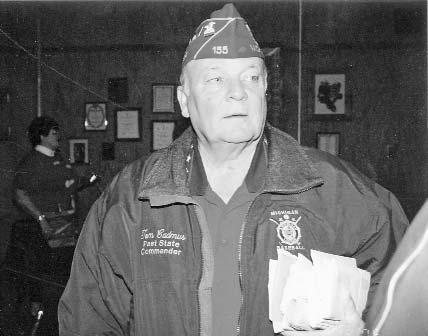
Due With Every Card Transmitted
Dear Jessie: Is it OK for a Post to turn membership cards in without money and reimburse the Department later?
Dear Floater:
Riding the Float
Absolutely not. This question has come up several times in the past few months, and I am not sure where the confusion came from. Let’s be clear: The constitution requires the Posts to transmit dues – dues – to the Department within 30 days of receipt at the Post. The Department staff is not permitted to count cards unless dues accompany the cards. Certain small balances have been carried in the past, but never because cards were accepted without payment. Do not jeopardize your members’ good standing by holding dues payments.
Dear Jessie: How can I avoid members of my Post receiving renewal notices after they have already paid?
Punching Bag
Dear Punch: Make sure the payments are
Editor’s Note:The "Ask Jessie" feature is designed to answer your questions about the Department Membership program and provide information for both membership workers and interested
received and transmitted to Department well in advance of the renewal notice cutoff dates. At the beginning of each year, every post receives a copy of the Department Membership Guide and Awards manual, and the cutoff dates for each of the five renewal notices in published in it.
Dear Jessie:
I’m interested in purchasing a PUFL membership for my husband for his birthday. Can I do this on my own as a surprise or will he have to go to the Post and fill out the paperwork?
Name Withheld
Dear Mrs.Withheld: Your can do it and he will never know. Just contact the Post adjutant and ask him to help you fill out the form and determine the proper amount to pay. If you prefer, you can contact the Department
Membership Office and we will help you with the application. It usually takes about six weeks for a PUFL membership to be established, and only current paid members can purchase a PUFL membership.
Dear Jessie:
I’m traveling out of state and would like to visit other Posts along the way. Will my membership card be honored by all Posts?
Traveling’Man
Dear Traveling Man: For the most part, your card will be honored, but it is always up to the Post to set the rules for admitting other Legionnaires to the club room. Posts are not required to admit non-local post members, although most do. Your best bet is to contact Posts along your route to see what their rules are.
Dear Jessie: There is not a local Post in my area and I’m interested in establishing one. What steps do I need to take to start this process? New Member
Dear New Member: First of all, welcome to The American Legion. I am glad you decided to join us. In order to form a new post, you must find 15 otherwise eligible non-members willing to apply for a charter and work with the new post as it struggles to its feet. Your District Commander and the Department’s New Post Development and Revitalization Committee will work with you on organizing, recruiting and meetings. You will need to find a regular meeting place, determine the purposes for which your post is established, begin recruiting and fundraising. It is not an easy task, but it is rewarding, and there is plenty of help out there. Do not attempt to do this alone. Call on and rely on your District Commander and his officers for help and advice, and be sure to stay in touch with the Department Membership Office, whose staff will be at your side at a moment’s notice when you need them.
Uncertainty Clouds Future OfVA Health Care
Continued from page 1
match between demand and funding as a major obstacle in meeting the nation’s commitment to veterans. The American Legion and nine other veterans’ organizations believe the answer lies in changing VA health care funding from discretionary to mandatory appropriation.”
Despite the differences, The American Legion has vowed to work with Rep. Buyer to resolve the differences.
Although we may differ on how to fully fund the system, we share the same vision to make sure that the health care needs of our nation’s veterans are met in accordance with the law and our commitment to them as a grateful nation.”
Meanwhile, The American Legion is cooperating with the Disabled American Veterans and the Veterans of Foreign Wars to press for an overhaul of the funding process for the Department of Veterans Affairs.
Representing more than 7 million military veterans, the nation’s Big Three Veterans Service Organizations have formed the Partnership for Veterans Health Care Budget Reform, based on the belief that veterans have earned the right to VA medical care through “their extraordinary sacrifices and service to this nation.”
Yet, according to a joint statement released late last month, “each year funding levels must be determined through an annual appropriations process that is fundamentally
broken. Year after year, veterans have fought for sufficient funding for VA health care and a realistic budget that reflects the rising cost of health care and increasing need for medical services. Despite these continued efforts, the cumulative effects of insufficient health care funding have resulted in the rationing of medical care.”
National Commander Cadmus in releasing the joint statement, said, “The nation's highest priority is national defense. VA health care is an ongoing cost of war. Every veteran answered the nation’s call to arms without reservation. As wartime veterans, Legionnaires understand the importance of the VA health care system. Short-changing VA health care is short-changing every military veteran from Bunker Hill to
Baghdad. America's veterans are not expendable and should never be treated as such.”
The joint statement reports the veterans health care system has had to struggle along for months at the previous year’s inadequate funding level because Congress has failed to deliver a timely appropriations bill for the Department of Veterans Affairs. This underfunding, the VSOs say, is the cause of veterans being denied timely access to necessary VA health care.
And, they say, “the outlook isn’t any better for the thousands – and potentially tens of thousands – of our men and women when they return from Afghanistan, Iraq and the global war on terror, when you consider that they will need care from the VA for decades to come.”
members alike.Please send your questions concerning membership to Jessica Berggren, Senior Membership Specialist,c/o Department Headquarters.And don’t be surprised ifa question from one ofyour phone calls to Jessie ends up in the paper! Ask Jessie One More Time:Payment
Chairman’s Notes
January/February2005HoosierLegionnairePage7 As of the January Target Date, 38 Posts had achieved one hundred percent of their 2005 membership goals. All eleven Districts have at least one hundred percent post, while the
the following
and their membership
Second District leads the pack with eight. The January total compares to 13 one hundred percent posts reported as of the Veterans Day Target Date. Congratulations to
Posts
teams: First District CASIMER PULASKI78EAST CHICAGO100
Commander’s Tour Is High Water Mark
It just keeps on getting better. The Department of Indiana has just had one of its finest months in recent history, and I am honored to have had a role in it. For all the time and travel invested, the payoff has been terrific and you have yourselves to thank for it.
Despite the strangest weather the Hoosier State has to offer, last month we completed the 2005 National Commander’s tour, during which we visited more than forty Hoosier American Legion Posts in four days. The schedule was grueling, the hours were long, but the payoff was huge.
Commander Tom Cadmus personally accepted over 6,000 2005 cards during Post visits ranging as far north as Lake Michigan and as far south as the flooded banks of the Ohio River.
Many accompanying the Commander thought we might have exhausted the wellspring of renewals during the trip, but I was
Special Guests
Mr.and Mrs.Frederick Fouce,Jr. enjoy an embrace and the hospitality ofthe Department during the Commander’s annual Christmas party in December.Fouce,commander ofAmerican Legion Post 166 in Marion,earned the special invitation to the party when his Post was selected in a random drawing from among all Posts that reached their all-time high in membership as ofthe November Target Date.
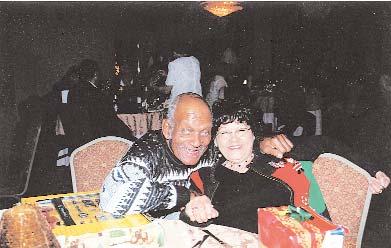
Auxiliary News
not among them. We had extended the card turn-in through the Mid-Winter Conference and the holiday weekend, and the cards just kept coming. At the "Supergoal of Membership" during the conference, we continued to accept cards and when it was over, we had collected 7,700 cards and lifted the department to 85 percent.
Bill Firkins Department Commander
We also unveiled the latest traveling trophy – the "Big Bear Award – which will be presented each target date to the leading District Commander. Initially, the award went to the First District, but when the dust settled after the Conference, it was given over to the new leader, the Seventh District.
Congratulations to both.
I am both humbled and impressed by the hard work and determination all of our members
showed during this membership drive – not just those who we met during the tour, but those hundreds of others who sent in or dropped off their transmittals.
A commander’s year goes by in a flash, and it is the times like this that help to make it such a big year in any commander’s life. Thank you.
About the time you read this, we will have collected more cards on the Lincoln Day turn-in and many of your department officers will be on the bus to Springfield, Ill. to honor the memory of Abraham Lincoln at his burial place. The Lincoln Pilgrimage has a long history in Indiana, and our contingent of Legion, SAL and Auxiliary members is always among the largest in attendance. It is important for us to support our comrades to the west
in celebrating their heritage; I am looking forward to the trip and spending time with other Legion leaders from around the country.
It is also important for us to celebrate our own heritage, right here in Indiana. Many of you may not know it, but our capital city, Indianapolis, has more war memorials and monuments than any other city in the nation, except Washington, DC. In Indiana, we celebrate our native sons and their sacrifices, but we also celebrate the nation’s heroes, too, with such famous memorials as the USS Indianapolis and the Medal of Honor recipients’.
That is why we have decided to cancel our participation in May’s Truman Pilgrimage to Independence, MO, and replace it with a tour of the sights and sites of military significance right here in Indiana. I am looking forward to establishing a new tradition, and sharing special time with current
and future department and district officers.
I hope that you will continue to push for membership in the coming months. We face a variety of challenges, many of which are set forth elsewhere in this issue of the Hoosier Legionnaire. Financial, political, legal… regardless of the nature of the challenges, we can prevail through strength of numbers and the exercise of our will. We can not succeed, however, if we abandon those who brought us this far.
I know many of you are encouraging today’s armed forces personnel by providing membership to
Short Takes
Shake OffThe Blues With Service
Welcome to 2005: “Look alive in ‘05.” Shake off the winter doldrums, roll up your sleeves and let’s make this a banner year for the Legion Family.
The Legion, Auxiliary and SAL are working their programs as in the past, but this year let’s all put forth a little extra effort and put these programs over the top. Wouldn’t it be wonderful to go the National Convention with all three Departments from Indiana at the top of the list with their programs?
The Christmas fruit pass out at the Indiana Veterans Home and the Knightstown Children’s Home Christmas program were well attended by the Legion family. The
residents at the Veterans Home so enjoy our visit and the fruit.
The children at Knightstown are always so excited about their performance for the Legion family and, of course, the visit from Santa. Commander Firkins was a great Santa this year and I really enjoyed playing Mrs Santa. I am a bit of a Christmas nut, so this was a special treat for me. Fortunately the weather was cooperative and the walk around the campus was quite nice.
Phyllis Clark
 Auxiliary President
I participated in the Gift Wraps at Roudebush VAMC, Marion
VAMC, Danville VAMC, and the Richmond and Madison state hospitals. What a rewarding experience. If you ever have an opportunity to participate in this program, please do. You will not be disappointed. We recently accompanied The American Legion on a tour of the state with National Commander Tom Cadmus. What a wonderful and productive trip. We visited 41 Posts in 4 days. We saw snow, ice, sunshine and rain, but the members in the various Districts and Posts turned out to
give the National Commander a big warm “Hoosier Welcome.”
A BIG, BIG thank you for the hospitality extended by the various Posts we visited. We were treated royally and fed especially well
The Auxiliary collected over 1,200 cards on the drive around, which is a really good number for us. We are currently –16th in the nation. After the drive around and including the cards collected at the Mid-winter Conference we are at 82 percent and hoping to meet our 85 percent goal.
Now, let’s beat those winter blahs by working together on our respective goals. The key is to help one another.
Season ofLove Holds Deeper Meaning
The merchants remind us that February is the month of love!
Candy hearts and boxes of chocolates are everywhere. Tons of stuffed animals with words, music and gyrations of all sorts, beg us to buy them for that special someone. Kids still exchange those little cards, though they are quite different from the ones we placed in the decorated shoe boxes at school. Woe to the hubby that forgets his sweetie with at least a small remembrance. An emphasis on love brings warmth and fun to this cold winter month.
For the Legion family, the emphasis on love takes deeper meaning in February as we remember four men of God who gave their all. A German U Boat waited in icy Atlantic waters on February 3, 1943 for its prey to sail into range of her torpedoes. A lumbering troop transport made an easy target and a sure kill. In a matter of moments, six hundred and seventy men were lost as the USAT Dorchester sank to its watery grave. At 12:30 a.m.A.M. in the wintry night the war ended for these men. For most it was their one
and only experience in combat.
There were many heroic acts that saved 230 of the lives aboard. A few were recorded while the majority will remain unknown this side of eternity. Most remembered were the actions performed by chaplains of three faiths. With no regard to their personal safety, the chaplains in unison gave their life vests, gloves, faith and love to many terrified men, directing them to safety as best they could. Making their way to the listing deck, they gathered together for their last earthly worship ushering those with them to their eternal home. Standing in unison calling to their God in prayer was the last image of the chaplains the survivors held as they looked back to the ship before it rolled beneath the waves.
The story of the chaplains becomes a focal point of love, sacrifice, faith and courage. The present of the chaplains reminds us of our
higher calling and purpose. We fight to end war and to restore peace. Our purpose is to defend and to liberate. We do not battle for gain or profit. Our practice has been to transform enemies into allies. The sacrifice of these four men gives a lasting image of these higher goals that lie in the heart of our people. Remembering the chaplains helps us to recall the thousands of others who gave their lives in love for God and country.
The sacrifices continue today. I was speaking recently with my dear friend Past Department Commander Bill Sweet, who recently spent time touring Walter Reed Army hospital. He shared about the young personnel who are recovering from their wounds. He saw first hand the sacrifices made by the young patriots serving in Iraq and Afghanistan. Each one a hero in their own right, sacrificing so we remain free and others might experi-
ence it.
I also recently spoke with Jeff Hallal, whose son gave his life in Iraq last April. His son’s remains now lie in Crown Hill’s Field of Valor. I had the privilege of attending the dedication services on Veterans Day where the Hallal’s were the keynote speakers and another Gold Star family was in attendednce. The price of freedom through these lives comes home when you meet with families who have lost loved ones. Jeff is now promoting the Field of Valor and the honor of those who have given their very lives for love of country.
I find it amazing that those who have given so much never seem to take a rest. Look at our organization and what we do. Comradeship is at the heart for we do care about one another, but we come together so that we might magnify our efforts to continue to give. All that we do falls into three areas: we stand by our troops, support our veterans and encourage our youth. We are inspired by the sacrifices of love given by our comrades and honor them with our continued service.
them at no cost. It is well and good that you do that. But I hope that as you do you do will forget those men and women who have been part of your Posts for 50, 60 years and more. They may be old. They may be poor. And they may believe there is no place for them in their American Legion anymore. Don’t let that catch on. They have given more than many of us can imagine, and if it is in our power in any way, we should keep them on our membership rolls until they answer that final roll in Post Everlasting. It is the very least we can do for them, and it is the very best we can do for ourselves.
Senator Wants Hoosier Vets On The Record
The Department gets hundreds of requests each year for assistance in supporting or publicizing a variety of projects. Most are worthwhile; some are outstanding, and others are, well, just self-serving. An example of an outstanding one, and one that I believe Hoosier Legionnaires ought to get behind, is the National Veterans History Project.
Stephen W. Short Department Adjutant
Senator Richard Lugar’s office contacted me recently concerning the project, which the Senator has supported, in cooperation with the Library of Congress, since its inception. In February 2002, he traveled extensively to ensure that the memories of Hoosier veterans were included, and he has agreed to work with Commander Firkins and the Department to make sure that in 2005 we continue to build on the early successes of this project.
In his letter to the Department, Lugar wrote “So many Americans alive today have faced awesome dangers and intense physical privation, from World War II to the recent battles in remote Afghanistan and Iraq. Upon their return, these servicemen and women have gone back to their families, schools and jobs and consigned the memories of their service to dusty attics and forgotten scrapbooks.
“I believe their stories deserve more than that.
“As Hoosier veterans, you possess a valuable resource in your war-time memories and military knowledge. Many Americans have lost touch with what it means to serve in the Armed Forces or to serve a cause greater than self. Most
simply do not have that intuitive understanding of the sacrifices and hardships involved in life in the military, which cannot be gained by reading books or watching movies. It is therefore incumbent on every veteran to communicate with the next generation the importance of wearing the uniform and serving.
Thanks to the generous spirit of Hoosier veterans, Indiana boasts the single largest donation to the Library of Congress, with nearly 5,000 veterans’ stories already collected. I have thoroughly enjoyed the opportunities I have had to personally interview and listen to Hoosier veterans. Each interview provided me with a window into the life, and the service, of the veteran. My own service in the U.S. Navy was not heroic, but many veterans have had harrowing experiences while in uniform. I was moved with their willingness to sit down and discuss what in some cases were deeply personal memories. While listening to these Hoosiers, I was continually struck by their sense of duty, honor and purpose.”
Senator Lugar has called on all members of Department of Indiana to come forward and share their important stories of military service to ensure that future generations of Americans understand the sacrifices made on behalf of freedom. The Department joins in that call to participate. If you have a story to tell – and I know you do –contact the Senator’s Indianapolis Office at (317) 226-5555 or email him at vetproject@lugar.senate.gov.
Membership Remains Challenge For Sons
The 2004-2005 SAL year is half over and many things remain to be done. The first, and one of the most important, is membership. Our membership percentage after the Mid-Winter Conference was 69.77 percent, which isn’t too bad. However, things are now going to get tougher.
At the membership meeting, several suggestions were made to help Squadrons with retention.
Among those offering suggestions were a squadron at which a list of all members that have not renewed their dues is posted on the bulletin board, a squadron at which a list is prepared and given to the bartenders, and others at which the membership roster is brought to meetings so that all attending can see it and, if they see someone they know not renewed they can contact that member. All of these are great ideas and will be used by everyone, I hope. I want to thank all of the
Roland Baker SALDetachmentCommender
squadrons who brought their donations to the Mid-Winter Conference. Donations are still needed for the following:
• Knightstown Childrens Home: A large gas cooker and furniture for five more dorms
• Children’s Miricle Network: Riley Hospital,
•Indiana Veterans Home: Many items they need on their wish list
• Child Welfare Foundation.
I have visited every district in the state at this time and I’m hoping to get to all of them again before next June. If anyone would like me to attend an event in your district please let me know in advance. All of my visits are first come, first serve, so let me know as soon as possible if you want me to visit.
Last of all I want to thank everyone for the great Hoosier hospitality everywhere I’ve been.
Chaplain’s Corner
Norris Keirn Department Chaplain
Commander’s Message SAL News C C Page8HoosierLegionnaireJanuary/February2005
