From family history to local & social history and a grandfather's influence by Rex Watson
M
any people in retirement take up family history as an interest. This doesn’t apply in my case, in that I have been at it for fifty years! The 1960s were pretty much computer free, microfiche free, even microfilm free, so I did my share of handling dusty documents. I have always tried to flesh out the bones, as it were, by taking an interest in associated local, social, occupational history, etc. Indeed for some aspects the ‘local’ history has for me taken on a life of its own. Fellow RSMs may remember an article I wrote for the newsletter a few years ago on my publication on a Lancashire Baptist church, and there have been a couple more since, on another church, and on the Mormons near Manchester. Recently I wrote an article for the Journal of the Burnley and District Historical Society (‘Retrospect’) on my grandfather’s life. Actually his life hardly feels like ‘family history’, as I knew him well, and was well aware in general terms of his interests, career, etc. I was 18 when he died, in his nineties. He himself was very interested in, and knowledgeable about, the history of the Burnley area. Perhaps I may first just acknowledge his contribution to my mathematical development. He was exceedingly ‘good with figures’, not least because his work as a trade
union secretary required tussling with complicated wage lists for various fabrics (and maybe tussling with employers!). I was introduced to card games at an early age, with the need to calculate scores from the ‘hands’ one had, involving in some cases subtraction as well as addition. The upshot was I could do ‘hundreds, tens, units’ addition and subtraction on paper before I started school. (Do I hear the word ‘sad’ ?) I take it as axiomatic that fellow RSMs love their subject, and indeed intellectual enquiry generally ‘for its own sake’ (even Education !). I should next like to recommend a book published in 2001 : ‘The Intellectual Life of the British Working Classes’, by Jonathon Rose. The author explores with a wide variety of sources the phenomenon of the ‘self-made man’ (in an educational sense), typically in Victorian times. He uses the term ‘autodidact’. (I am afraid it is very largely for the less fair sex.) After reading the book ten or more years ago, I felt that it was acting as a trigger towards a piece on my grandfather, Richard Bright Watson. With the aid of various sources, including particularly newspaper reports, I was able to piece together a brief biography, paying attention particularly to work, political activities, public service, and leisure. It is on the last of these that I wish to say a
rsm newsletter, july 2015, page 8
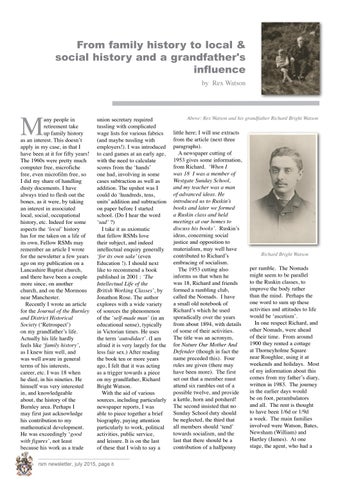
Above: Rex Watson and his grandfather Richard Bright Watson
little here; I will use extracts from the article (next three paragraphs). A newspaper cutting of 1953 gives some information, from Richard. ‘When I was 18 I was a member of Westgate Sunday School, and my teacher was a man of advanced ideas. He introduced us to Ruskin’s books and later we formed a Ruskin class and held meetings at our homes to discuss his books’. Ruskin’s ideas, concerning social justice and opposition to materialism, may well have contributed to Richard’s embracing of socialism. The 1953 cutting also informs us that when he was 18, Richard and friends formed a rambling club, called the Nomads. I have a small old notebook of Richard’s which he used sporadically over the years from about 1894, with details of some of their activities. The title was an acronym, for Nature Our Mother And Defender (though in fact the name preceded this). Four rules are given (there may have been more). The first set out that a member must attend six rambles out of a possible twelve, and provide a kettle, horn and potsherd! The second insisted that no Sunday School duty should be neglected, the third that all members should ‘tend’ towards socialism, and the last that there should be a contribution of a halfpenny
Richard Bright Watson
per ramble. The Nomads might seem to be parallel to the Ruskin classes, to improve the body rather than the mind. Perhaps the one word to sum up these activities and attitudes to life would be ‘ascetism’. In one respect Richard, and other Nomads, were ahead of their time. From around 1900 they rented a cottage at Thorneyholme Square near Roughlee, using it at weekends and holidays. Most of my information about this comes from my father’s diary, written in 1983. The journey in the earlier days would be on foot, perambulators and all. The rent is thought to have been 1/6d or 1/9d a week. The main families involved were Watson, Bates, Newsham (William) and Hartley (James). At one stage, the agent, who had a