Homerton College Alumni Magazine

What a complicated creature is a university. As the Vice-Chancellor told us in his Kate Pretty Lecture (page 4), universities these days are not just expected to teach and to research; they are required to be vehicles for social mobility, to embody society’s values, to conserve the past and to predict the future. They are expected to change never, and constantly; to be, simultaneously, cultural bellwethers and the last bastions of The Way Things Ought To Be Done. And their breadth is exceptional – even in the single academic area of healthcare there is room for social scientists (Mary Dixon-Woods, page 6) and mathematicians (Stephen Burgess, page 15), alongside the infinite variety of medics.
A College, in Cambridge, shares much of this complexity but on a human scale. A Cambridge College puts a magical wrapper around everything the university does, and shrinks it, making it about people, learning from people, supporting people. I got all emotional at the final paragraph of the article (page 20) about Lisa Levytska, which tells of her gratitude that Homerton had helped her family, even though Lisa was so newly arrived. “They didn’t owe me anything”, she says – but that’s not the Homerton way. Once a Homertonian, always – and immediately – a Homertonian.
Matthew Moss Director of External Relations and Development
The Homertonian is Homerton College’s alumni magazine. It is published once a year. Contact us in the Development Office on Telephone 01223 747251 or Email alumni@homerton.cam.ac.uk with feedback, news or letters. All our publications are available to read online on the Homerton College website: www.homerton.cam.ac.uk/alumni-andsupporters/publications
Thank you to all of our contributors and to those who supplied images. The views expressed in this publication do not necessarily represent the views of Homerton College, Cambridge. Cover photograph: Stephen Bond. Design and print management: H2 Associates, Cambridge.
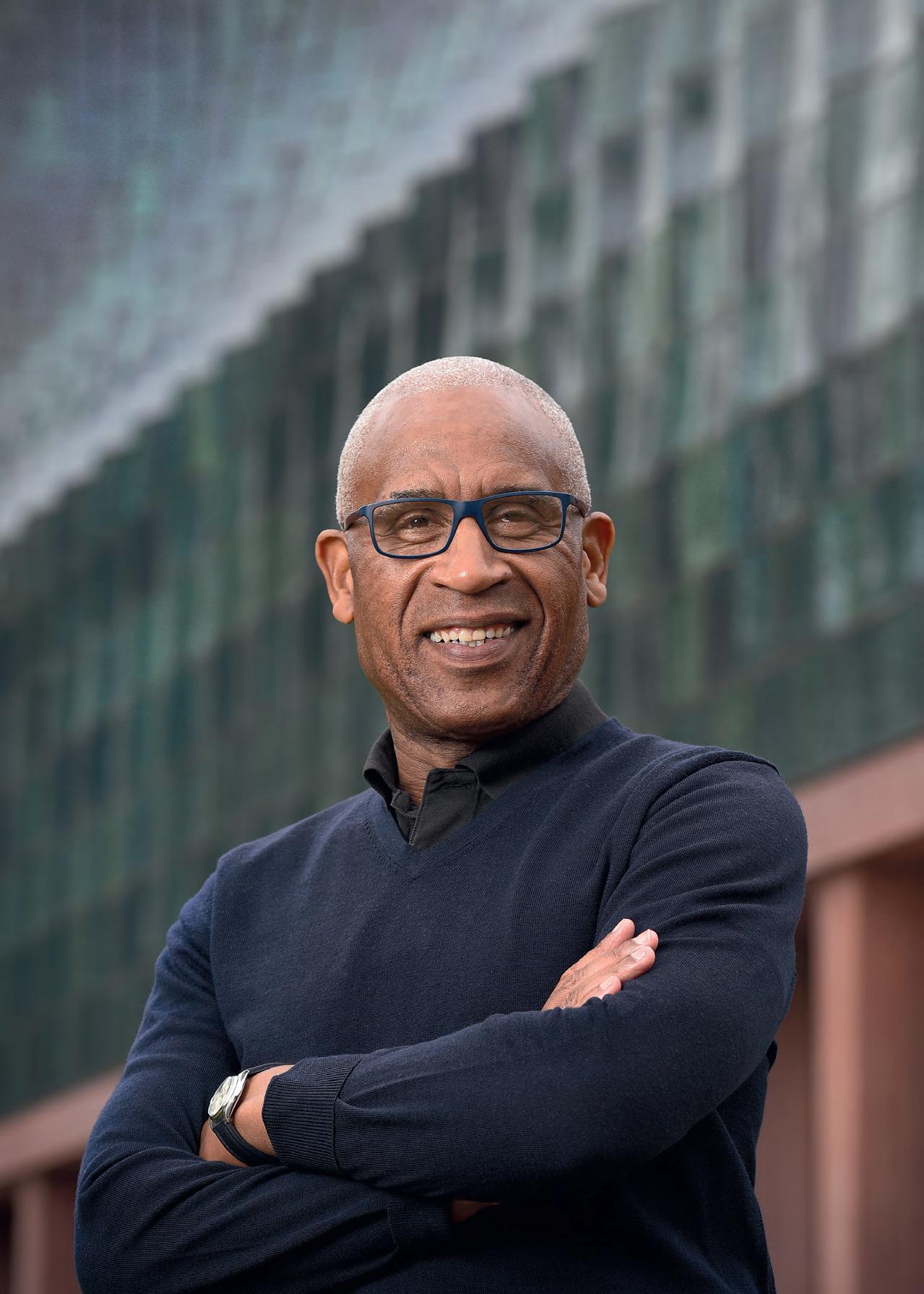
Coming to the end of my first year at Homerton, one might expect that the novelty or exciting newness of the job would wear thin. But no, not a bit. In fact in the mornings, when I cross the lawn from my house to the Principal’s office and see the College waking up around me, or in the evenings after engaging with students and Fellows after a formal dinner in our beautiful new dining hall, the joy of being in the role just increases.
Above all the interaction with students here at Homerton fills me hope.
Some students, both black and white, have stopped me in my tracks to let me know just what my presence means to them, whether it’s seeing themselves in a role like this or hearing the mantra that we all belong.
I am extremely grateful that the interest in my appointment has given me a platform to discuss why the vision and opportunities we offer at Homerton need to be open to all. Access and widening participation have also been hugely important to the outgoing Vice-Chancellor, Professor Stephen Toope, and I was delighted that he chose to give the final speech of his tenure here, at Homerton, for my first Kate Pretty Lecture.
This first year began with a flourish, with landmark visits from both the heir to the throne, His Royal Highness The Prince of Wales, and a personal hero of mine, The Rev’d Jesse Jackson. It has also contained more dinners than I was warned about, and certainly more meetings! But more importantly, the year has been made up of countless quiet opportunities to get to know people. To get to know the students who have worked so hard to get here and
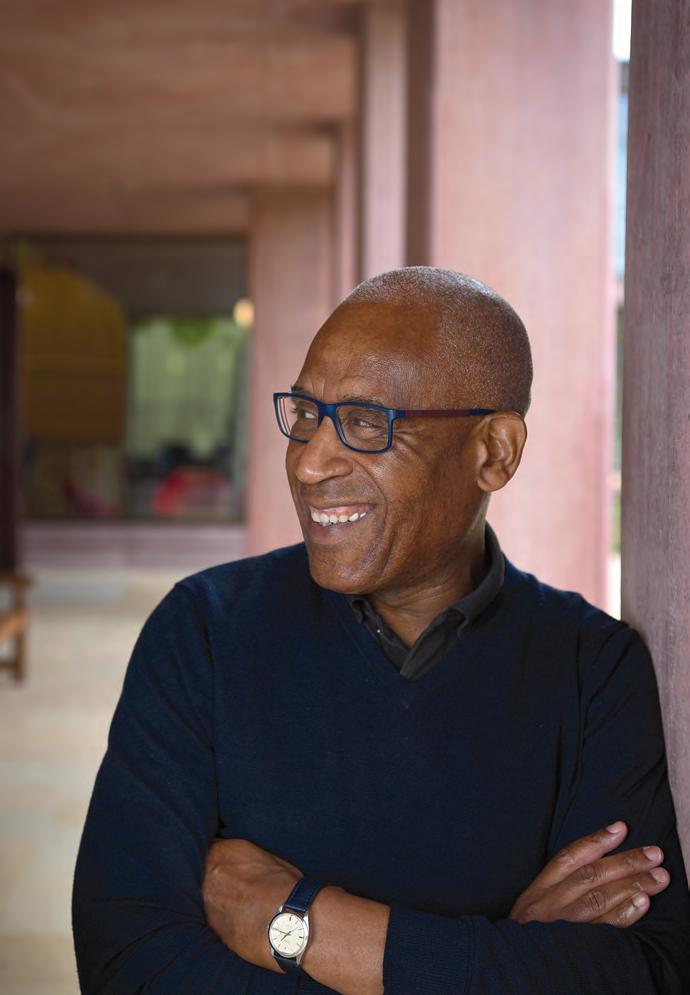
for whom Homerton will play a crucial and transformative role in their lives. To get to know the Fellows and staff, in every department, who keep this amazing place going. And to get to know the alumni, whose stories make Homerton what it is, and whose generosity, as mentors, donors
and volunteers, will help take us into the future.
Thank you to all of you for welcoming me to your home, now my home too. I’m hugely excited about being part of a great team that will take Homerton forward on the next wonderful stage of its story.
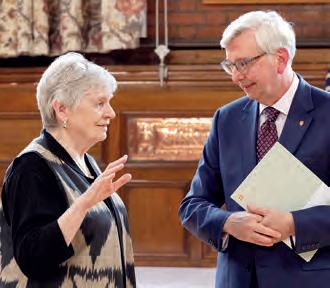
The Vice-Chancellor, Professor Stephen J Toope, delivered the fifth annual Kate Pretty Lecture on 8 June, in Homerton’s Great Hall and to an international online audience. The lecture honours former Principal Dr Kate Pretty, who was in attendance, and who Professor Toope quoted with some emotion in a reference to “the centuries old process: the transference of wonder into knowledge – and knowledge into wonder.”
The Principal introduced the ViceChancellor with gratitude for the welcome he had shown him last autumn, when Lord Woolley took up his post at Homerton, saying “he made me feel I belonged.”
In what is likely to be his final formal speaking engagement before he steps down at the end of the summer, Professor Toope addressed the subject “University Matters? The University of Cambridge in an increasingly complex world”. He emphasised the University’s focus on an international outlook, expanding inclusivity and as a beacon for excellence, values which resonate strongly with Homerton’s own.
Professor Toope explored the tumultuous global changes which have taken place in the five years since he took office, acknowledging that: “We are still reeling, collectively, from what I would characterise as truly paradigm-shifting events, the full consequences of which we have yet to understand.”
Against that backdrop, he interrogated what he termed “three other areas of profound and accelerated change over the past five years”: public expectations of universities; the international landscape post-Brexit; and the surrounding culture.
Unpacking the increasing tendency for universities to be expected to deliver ‘value for money’, Professor Toope said:
“Of course students and their families care deeply about post-graduation prospects and opportunities, and it is right that we offer quality education. But a university education is not a transaction. A university education should be about preparing students for careers, and for contributing to society. A university

Stephen J Toope, Dr Kate Pretty and Lord Woolley
education should be about students’ engagement with established knowledge and with new ideas. A university education should be an enlarging and enriching experience, an opening of eyes and minds to the world’s complexity, to the world’s beauty, and even to the world’s horrors.”
Reflecting on Cambridge’s global outlook, and the impact of Brexit on Britain’s participation in international research, the Vice-Chancellor said:
“A time of global challenges is not the time to retreat into national pockets of academia. Instead, our universities should be doing what we do best - seeking solutions to vexing problems by working with partners around the globe.”
Professor Toope also examined the effect of what he described as the “explosive” combination of the growth of identity politics in parallel with the advance of social media
“What we have witnessed is the emergence of extremism of all stripes. And it has tainted public discourse, which is increasingly intemperate, and intolerant of others. As communities, we have become fragmented, fractious and frayed...
It is the job of our universities to educate minds - our own, and those of the generations of students coming through -
to help us build our self-confidence and better navigate our ill-tempered times.”
While Professor Toope did not shy away from the challenges and difficulties faced by Cambridge and the wider academic world over his tenure, he also stated that he was “incredibly gratified” by the achievements of the University over that period, from its response to climate change through the creation of Cambridge Zero, to the significant advances seen in widening access and participation.
Describing himself as “an inveterate optimist...absolutely convinced that our collegiate University is a force for good in this world,” the Vice-Chancellor ended by saying:
“Our collegiate University is always a work in progress - proud of its past but honouring its future. Never perfect, but always susceptible to improvement. Never finished, but always open to evolution. Because the world never stops changing. And as the world changes, so must Cambridge.”
Lord Woolley thanked Professor Toope for “such a moving lecture, given with passion and from the heart,” and urged him to remain closely connected to the College and to Cambridge as he returns to Canada because “we know how much you care, and we need that valuable insight that helps guide us, as you said, in troubled times.”
The Philippa Pearce Lecture 2022 began with a welcome instruction to “imagine that it is still 2020. For the next couple of hours, you are licensed to indulge the welcome fantasy that the past two years simply haven’t happened,” said Homerton Vice-Principal Dr Louise Joy in her opening remarks.
The event was originally scheduled to take place in April 2020, marking Philippa Pearce’s centenary year. Its speaker, Geraldine McCaughrean, the double Carnegie Medal winning author of over 170 books including Peter Pan in Scarlet and Where the World Ends, was described by Dr Joy as:
“One of the most prolific and expansive authors for children writing today. The sheer eclecticism of Geraldine’s works is breath-taking. It is hard to think of a genre she hasn’t written in. Her work encompasses both the comic and the serious; the historical and the contemporary and the futuristic; forms that are deliberately imitative and forms that push the envelope. Through them all runs a warmth; a restless intellectual curiosity; a love of language; a faith in humanity; masterful storytelling.”
That theme of storytelling ran through an evening which celebrated and demonstrated the instinctive and enduring power of story. Geraldine McCaughrean opened her lecture with a list of the extraordinary range of authors who had been published in the year of Philippa Pearce’s birth, from L.M. Montgomery to F. Scott Fitzgerald, and said “having spent a lifetime doing what I Iove, and being allowed to call it work, I feel like celebrating.”
She described the craving for storytelling as inherent to the human condition.
“The human spirit shrinks from fear, boredom and sorrow, but the mind and soul go out in search of story. Who knows why?”
However she also expressed concern that sensitivities around cultural appropriation could diminish imaginative output, with publishers
nervous of writers stepping too far away from their own lived experience.
“I remember being told as a child ‘write about what you know’, and thinking ‘why would I want to?’ And suddenly it’s back, as an injunction…I firmly believe that an interior world is the greatest resource there is in difficult times.”
She rejected what she saw as a growing trend towards writers being expected to introduce children to concepts such as climate change, presenting them with a duty to solve existential crises which adults had failed to respond to.
“Something inside me recoils at the idea of painting Armageddon on the inside of children’s skulls. When you’re an adult you can scrub it off…my beloved former editor used to say ‘the only difference between adult and children’s fiction is that you owe it to children to leave them in a safe universe at the end of it.’ Entertainment is a noble profession, and we don’t have to lay claim to anything more august.”
Interspersed, without introduction, throughout her talk was a story, Anansi the Spiderman. As each section began, there was a palpable change of focus, as the audience of literary adults settled down, with the same trust and expectation as a class of pre-schoolers, preparing to be carried along by narrative force.
She concluded with a simple explanation of this phenomenon.
“I give you this story, in recompense for the time you have given me today, and to prove a point. It’s hard to listen for an hour to mere talk, but the mind will always latch on to story.”
The power of story was also beautifully demonstrated by an addition to the programme in celebration of the

centenary year. A 20-minute play Inside Her Head by the award-winning playwright and personal friend of Philippa Pearce, Nick Warburton, combined a Pearce short story by the same title with references to her other stories and experiences.
A two-hander by actors Jeremy Whitton Spriggs and Sandra Birnie, the play explored the boundaries between memory, imagination and invention, and involved the audience in a sense of collaboration as a story was constructed in front of them. Following an intellectual probing of why story continues to be so important, it was both fitting and hugely pleasurable to sit back and allow a story to be told, in Philippa Pearce’s own words.
On 21 April, Homerton Fellow Professor Mary Dixon-Woods became an Honorary Fellow of the Royal College of Obstetricians and Gynaecologists, expanding an already impressive haul of honours.

Inaddition to her roles as Director of The Healthcare Improvement Studies Institute (THIS Institute) and Professorial Fellow at Homerton, Mary is a Fellow of the Academy of Social Sciences, Fellow of the Academy of Medical Sciences, Honorary Fellow of the Royal College of Physicians and Honorary Fellow of the Royal College of General Practitioners. She gave the Harveian Oration at the Royal College of Physicians in 2018, the 500th anniversary of the college’s founding.
The breadth of this recognition reflects the widespread impact of THIS Institute, which was launched in January 2018 with a remit to improve healthcare through research.
“Until relatively recently, there was a strong heritage-driven approach to medical
care, with knowledge handed on through the generations in a kind of apprenticeship model,” Mary explains. “But over a 50 year period we saw the emergence of a social movement and an infrastructure to support the principle that treatments should be based on high quality evidence rather than personal opinion or preference. We can see the benefits of this every day, for example during the pandemic.“
It’s only more recently, Mary explains, “that there has been the dawning realisation that there also needs to be science behind how we organise and deliver care as much as for treatment, and that if we’re going to improve quality and safety of care then it needs an evidence base too.”
In June 2016, just a month after Mary had arrived in Cambridge as the RAND Professor of Health Services Research, bids were sought by the Health Foundation for the development of a new research institute to fill this gap. She bid for it and following several rounds of a “very demanding process”, was successfully granted funding of £42.5 million in March 2017. THIS Institute was launched 10 months later in January 2018. It’s had a close affiliation with Homerton, where Mary had become a Fellow in 2016, from the beginning.
“When (former Principal) Geoff Ward approached me about a fellowship I was thrilled – Homerton was top of my list,” she says. “I was so impressed by its vision and boldness and how it had stepped forward in this incredibly bold way. It remains the top College I would want to be associated
with. You can’t have an uninteresting conversation here!”
THIS Institute works directly with patients and NHS staff, as well as with collaborators from many different organisations and disciplines, to produce scientifically rigorous evidence to support healthcare improvement. It funds a national research fellowship scheme that has made awards to 18 universities to date, supporting a new generation of people with the skills and capability to study improvement.
A current project focusing on avoiding brain injury in childbirth was commissioned by the Department of Health and Social Care, in collaboration with the Royal College of Obstetricians and Gynaecologists, and the Royal College of Midwives. It brings together the perspectives of maternity services staff and maternity service users to improve detection of possible foetal deterioration during labour and to support management of an obstetric emergency known as impacted foetal head at caesarean section.
“These new approaches are intended to make care safer, and because they have been co-designed with the people involved, we can be confident that they address the things that matter to them.”
Mary grew up in Ireland and initially studied communications at Dublin City University and statistics at Trinity College Dublin. She spent four years working on energy policy as a civil servant, before moving to the UK to complete an MA in social policy at Oxford, which led to a DPhil in health research. Before her move to Cambridge, she spent 22 years at the University of Leicester.
The Honorary Fellowship was conferred on 21 April, and reflects Mary’s commitment to improving obstetric care and women’s healthcare more broadly.
“It’s a great honour,” she says. “I’m really thrilled.”
Lord Woolley’s memoir, Soar, was published on Thursday 14 April, by Manilla Press, an imprint of Bonnier Books.
Describing his childhood, adopted by a white family on a Leicester council estate; his return to education at the age of 26; the dynamism and ambition he brought to Operation Black Vote over 25 years and his newfound establishment credentials as a member of the House of Lords and Principal of Homerton, the book is a personal account of an extraordinary journey.
In a foreword to the book, the civil rights campaigner Rev. Jesse Jackson, who became an Honorary Fellow of Homerton at the end of last year, says:
“Lord Simon Woolley is not finished yet, not by a long way. His role as the first Black man to head an Oxbridge college is a new and exciting chapter to encourage and inspire generations to believe, no matter
your race or your impoverished start in life you can and must succeed - dream beyond your circumstances.”
The Principal discussed the book in conversation with Alex Clark as part of the Cambridge Literary Festival in April, and with human rights lawyer and the founder of Reprieve, Clive Stafford Smith, at the Charleston Festival in May.

Homerton’s beautiful new dining hall is open for business and, from the clusters of students revising in the Buttery, to the coffee drinkers on the external built-in benches, it has seamlessly become an integral part of College life. Architects Ed Fowles and Eleanor Hedley of Feilden Fowles, whose design won an open competition five years ago, describe how they responded to former Principal Professor Geoff Ward’s ambition for the building, and the thrill of seeing it in use.
What excited you about this project?
Ed: When the competition was announced in 2016 it was a massive long shot for us. We’d never delivered a public building, or something on this scale, and most of our competitors were people we’d looked up to as students. But it’s such a rare opportunity: Cambridge Colleges usually already have a dining hall and in many cases they are hundreds of years old. We were also excited by Homerton’s unique and progressive character and
its beginnings in East London, which really resonated with me, as I’ve lived in Hackney for 15 years.
Eleanor: The fact that Cambridge is where I studied, at Magdalene, meant that I understood the sense of ceremony that the dining hall has to carry. If someone had told me when I was a student that one day I’d design the Homerton dining hall, I’d have been thrilled! It was also very exciting to have a client with such high ambitions for what they wanted to achieve.

How did you approach the design?
Eleanor: Most of the key moves in the design you see today were developed at competition stage where we threw all the effort we could at it – it was such a unique opportunity! The team who worked on the design at the beginning saw it all the way through to completion. We knew as a practice that we could do it, but we did feel like the underdog in the competition as we were against some more established and excellent practices!
Ed: It’s fairly unique in Cambridge to have such an open site with expansive landscaped gardens, so that was a very important influence, leading to a very porous design that opens up to its surroundings. We rotated the hall 90 degrees from the orientation of the Great Hall so that the longest elevation faces the mature trees and meadow to the south. Most halls are very solid and have heavy timber at the base, whereas here you walk in and are immediately met by the views out and lots of light filtering down from the high-level windows.
How did the practical requirements of the building affect the architecture?
Eleanor: It needed to be able to feel domestic and welcoming in the daytime and suitably formal at night. Being able to use shutters to block off the daylight in the hall at ground level was one of the ways in which we achieved this. The hall can be light and open in the day yet intimate and low-lit in the evening.
Ed: We had to balance the more poetic ambitions of the project with the pragmatic brief – the kitchen spaces being highly practical and functional. Paul Coleman, Rob Gamble and the catering team were very helpful throughout the design process. The existing kitchen was so dark, and I’d worked in kitchens as a teenager so I had a lot of sympathy for their need for better working space. The pot-washer now has one of the best views!
How important was the existing architecture of the site?
Ed: Geoff had a nice line, that he wanted the building to be “referential but not deferential” in terms of its relationship with the other historic buildings. The Ibberson building was a great inspiration, and its brick

detailing and Arts and Crafts spirit feed into the new hall. The Great Hall was also a key reference point – the colour and form of its spire acting as an early inspiration for the form of the faience.
Eleanor: Stylistically, we all had the buildings of the existing College and the spirit of the Great Hall in mind while designing.
The faience is hugely distinctive. What made you choose it?
Ed: The faience was part of the design from very early on, and references the richness of the Arts and Crafts Ibberson building. Faience was historically used in Victorian public buildings but also adorns many pubs and tube stations. We wanted something which would change throughout the day –it reflects the trees around the building, and shimmers in the changing light.
Eleanor: Faience was a material we had seen used elsewhere and the glazes can be so beautiful. It was very exciting to find an appropriate opportunity to use it. We worked hard with Darwen Terracotta to develop the glaze colour – the way the glazes work, you don’t always know how
they’re going to come out after firing. We have quite a number of samples in the office which didn’t work at all! It was also hard to represent or completely predict how the final façade might look from a distance, in different weathers and lights. We’re really happy with the final result.
How does it feel to see your concept rising from the ground, and now being used as part of the day-today life of the College?
Ed: We made a lot of models, but nothing quite prepares you for the scale of it. It was a nail-biting moment when the scaffolding was removed! It’s really special to see it in action.
Eleanor: I’ve been on maternity leave so hadn’t seen it for the final few months. When I was sent a video of the choir singing from the balcony after completion, just as we’d imagined they would, it was a hairs on the back of your neck moment. It’s a real privilege to be able to add something to the Cambridge experience for future students, and to be part of the magic. Colleges build with longevity in mind, so it’ll hopefully be part of the landscape for generations to come.

Deborah Griffin OBE
The reward for the hard work of all the staff is seeing the students enjoying the spaces. In the first week when a student sat in one of the wide window sills with their laptop propped on their knees, I had to thank them for using the space as we envisaged! It has also been well-received by the architectural press and we are hoping it might be nominated for an award or two. Watch this space!
As we work out how to use the new spaces and our existing meeting rooms, our Events team, rebranded from the Conference team, are busy launching and selling space to new and old clients. We also now have North Wing, a light and airy 120-seater auditorium with the ability to stream and film presentations, together with 18 hotel-quality guest rooms which we completed in June 2020. We have also refurbished Bamford and Skillicorn and installed AV capable of hosting effective hybrid meetings. Of course our gardens and the highly regarded Homerton BBQs are in great demand as everyone catches up on celebrations and socialising!
As you will appreciate, our Events business has been decimated over the last two years by the pandemic and the College has made significant losses. The income from external business is a vital pillar in the College’s financial sustainability, and even more so with the inflationary increases across all our costs which we will incur in 2022-23. Increases in energy costs and payroll alone are budgeted to add £1m to our cost base. We try to manage the Events business to minimise any impact on the College especially during term time. A dedicated staff member oversees internal events bookings made by staff and
This will be my last piece for the Homertonian as I am retiring after 10 years at the end of September. It has been full on, and never more so than the last two and half years. The last six months have been relatively normal although the completion and opening in April of the new buttery and dining hall, with the associated kitchens, servery and backof-house stretched everyone.
students, and we are currently investing in a software package to make this easier. Even so, we sometimes get accused of running a conference centre rather than a College! This is clearly unfair and students are the main beneficiary of the trading business as it allows us to offer the lowest accommodation rents in Cambridge, and provide Hall food effectively at cost. It is also not a new phenomenon…. the University and Colleges have been attracting conference business for over 100 years.
The effects of the pandemic will be with us for some time to come, especially as many of our students have had very disrupted school education. In the new academic year we are investing in more teaching staff and a wellbeing coordinator to spread the ever increasing workload on our existing staff. We are reconfiguring some of the large rooms on the ground
floor of Cavendish this summer to improve the office accommodation for our increasing Fellowship and staff.
Many of the facilities and additional spaces we have provided over the past six years are intended to allow our students different spaces for work, rest and play. We value their participation in the many activities they contribute to across the University through the Representation Award. This year we awarded 73 awards of £200 each for students participating in University societies and groups as diverse as the Robotic Society and Women in Business. We were also able to resurrect the garden party in May Week on the Principal’s lawn, to which Lord Woolley provided a lively soundtrack. It was a great event to show our students that we value their extra-curricular activities alongside their academic achievements.

Creating new uses for plastic waste is a central aspect of an increasing focus on sustainability. For Pratik Dalmia (BA Land Economy, 2005–8), it is the purpose of a family business which has expanded over the past 15 years.
Founded by Pratik’s father Aditya Dalmia in 2006, Dalmia Polypro produces high quality recycled Polyethylene Terephthalate (PET), as well as flakes and granules of Polypropylene and Polyethylene, serving clients in sectors ranging from fashion to industrial packaging.

“We focus on catering to quality conscious applications,” says Pratik, Executive Director of the company. “We make the raw materials and then sell them on, for example as yarn for companies that make active wear, or to renowned consumer brands, who use our materials in their packaging.”
The company uses waste materials such as drinks bottles which, in India, are often reused multiple times before they are disposed of.
“The nature of plastic waste is very different in India,” Pratik explains. “Bottles are lighter and are used much more frequently than they are in the west.”
Once thrown away, the bottles are collected by informal workers, who gather waste materials of value and sell them on.
“The informal workers then sell the waste products to a neighbourhood trader, who will sort the materials and sell them on to material specific aggregators, who work with recyclers like us.”
In the decade and a half of the company’s existence, its scale and ambition have grown beyond recognition. It now repurposes over 1 billion plastic bottles each year.
Pratik’s own career saw him spend a few years working in investment banking in London, as well as in luxury retail in India, before joining the family firm. As he sees it, the company is meeting a need which is growing ever more urgent.
“Dalmia Polypro is fortunate to have the opportunity to tackle the challenge of plastic pollution. Over the next decade we hope to recover and recycle over 50 billion plastic bottles.”
Dr Alison Wood’s career encompassed music, medicine, English, divinity and history, before she brought them all together to lead Homerton’s unique Changemakers programme. She tells us why she loves seeing how different disciplines collide, and how Changemakers works to inspire students.
You’ve had an extraordinarily wideranging career! How does it all fit together?
I find it hard to fit myself into a 150-word bio. My career has had many turns that look unconventional, but in hindsight there have been two consistent threads.
I’ve always been inter-disciplinary, thinking about how different disciplines work together, where the edges are, and how they can collide. And I’ve always been interested in institution-building: how we build better structures to enable even better thinking and action.
What was your starting point?
Alison explained the Changemakers programme to His Royal Highness The Prince of Wales on his visit last November
I studied English and History at the University of Adelaide, before working as a musician for ten years, teaching piano and singing, and playing professionally, while also undertaking further studies in music. Then, while I was writing my Research MA in English on libretti, I also worked in medicine, co-ordinating a multi-disciplinary Healthy Aging Research Cluster at the University of Adelaide. I could talk, write
and organise, and they wanted someone who wasn’t necessarily from a medical background, but who could think creatively and build organisational structure. We built a network of 100+ researchers from across the University, won a second round of operating costs, and won several large research grants as a result of that crossdisciplinary cooperation.
It was superbly interesting, and I learned so much about how institutional power operates, and how different disciplines can speak to each other.
What brought you to the UK?
I had a yearning to come to the UK to study. King’s College London was offering its first programmes in literature and medicine, and I was initially planning to write on 19th century Jewish texts, a plan which fell apart when my supervisor asked “how’s your Yiddish?”
Instead, I looked into TRR Stebbing, an English evangelical Christian who read Charles Darwin’s On the Origin of Species, converted to Darwinism, and became one

of the world’s leading taxonomists of small crustacea. He also founded natural history societies around the country and advocated for thoughtful science for everyone. My PhD was on how ideas - in this case evolutionary theory – become normal and how intellectual institutions contribute to that process.
You’ve now been in the UK over a decade…
Yes! I only intended to stay four years, but I was constantly building things, from research seminars and networks to programmes to help graduate students think about the richness of their skillset and how that could be intelligently applied within universities and beyond. I was frustrated by the narrowness of some academic structures, which seemed utterly inadequate renderings of what universities really do and can do.
A postdoc position came up at Cambridge spanning Divinity and English, exploring the relationship between the roots of Cambridge University and ideas of the modern research university. The experience confirmed my deep interest in how universities function. It also showed me I loved being in Cambridge for the possibilities it offered – the questions I could ask and the resources I could use to answer them.
CRASSH (The Centre for Research in the Arts, Social Sciences and Humanities) then advertised an interdisciplinary Post-Doctoral Research Fellowship, described at the time as one of the most prestigious fellowships in Cambridge. I pitched a project on existential doubt in English 19th century thought, and then realised I really wanted to continue thinking about universities. And I became very interested in the ways researchers felt they were being funnelled into paths that seemed restrictive. As a postdoc at that time you were neither staff nor student. Postdocs have so much potential and yet they’re often told that they’ve failed unless they get to the next academic stage. I joined University committees agitating for rethinking our mission on how we see researchers and how they see themselves. I wanted postdocs to feel poised to do extraordinary things.
I also became even more interested in how public discourse around universities has changed, and at the same time aware of my discontent that universities no longer seemed to be seedhouses for social
transformation in a way they (sometimes) were historically.
You joined Homerton in 2018 to run the brand-new Changemakers programme. How much of it was already formed, and how much did you create from scratch?
I was at a CRASSH for five years, including two maternity leaves, and then found myself in a wonderful, random conversation about a programme taking root at Homerton, a College I confess I knew nothing about. At that stage Changemakers was a two-page document, and Homerton was looking for someone to turn it into a living entity.
I gave a 10-minute presentation, in which I found myself weaving in everything from doubt to whole system thriving and learning what not to change! I had become more and more committed to the idea of holistic living, bringing together the pleasures of the arts and concerns about the climate crisis for example – it seemed wrong that we were separating out all the elements of being human, and I felt that it was breaking us.
The idea of Changemakers was already formed, as an extra-curricular programme based on Leadership, Resilience, Enterprise and Responsibility, but it needed to be built. I spent a year living with the idea and working out what would best engage students. The first residential in 2018 was a baptism of fire, with 60 students taking part over a full week.
How has the concept evolved since then?
We were hugely fortunate to be able to bring Dr Soraya Jones onto the team, who’s contributed to everything from the intellectual vision to stuffing envelopes. And we have an amazing Steering Group comprised of mostly Homerton Fellows. In four years, a network of almost 200 champions and mentors has also grown, and we’re hugely grateful for the time and energy they give. During the pandemic we did a lot of pivoting, from creating our ‘Mentoring in Pandemic Times’ programme to hosting virtual residentials and teaching everything online.
Changemakers is a bit like me – it can be hard to define in 150 words. It’s a programme equipping students to be wise agents of change in a complex world. It’s
modular and co-curricular, sitting alongside a student’s degree, and open to anyone at Homerton. When our students engage with it, they tell us it’s transformative. It taps into a longing we all have to answer the question “what is my purpose in my life?”. It touches on very large existential questions, but also very pragmatic things: being a lever for change; starting a social innovation; ethical leadership; creating sustainable systems. It pushes people to see that the rules aren’t set in stone. It’s starting to be recognised globally as a new way of thinking about education.
It’s also become central to Homerton. Changemakers was a significant element of the College’s distinctiveness the candidates for Principal picked up on, and in the last round of Junior Research Fellowships most applicants mentioned it. Every fresher now encounters Changemakers as part of their earliest introduction to the College. It’s shaping Homerton culture.
To what extent do you think Changemakers could only have happened at Homerton?
We’re the only Oxbridge College to run a programme like this at this scale. Homerton has a progressive, socially-minded strand of its DNA, and was willing to invest in it.
The College environment is ready-made for inter-disciplinary encounters, and I love working with people from other disciplines and building something meaningful together. We’re all the product of endless decisions and encounters.
Changemakers can embody fit-forpurpose education and inspire beyond our current parameters. It’s genuinely exciting beyond universities – it’s capturing a global movement which says that the old ways of doing things are not enough and that we must evolve. I find it intoxicating.
Changemakers has given me a new voice. It doesn’t tell students what a better world could be, but uses advanced pedagogy to help them work out their own answers. I feel extremely lucky that my life path is the perfect background for this. I’ve worked in eight different disciplines, and on the surface that looks a bit diffuse and disconnected. But I’ve always been engaged in creating new formats for brilliant people to think together more effectively. It’s an extraordinary privilege to be doing this at Homerton.
While rolling lockdowns spelled an end to many College activities, for our Mentoring programme they proved an unlikely springboard.
With internships and work placement opportunities curtailed, students had an increased need for advice and guidance on their entry to the world of work. And alumni, trapped at home, proved touchingly grateful for the opportunity to be of practical support.
as a joint initiative by Homerton Changemakers and the Development Office, ‘Mentoring for Pandemic Times’ matches current students to mentors for a commitment of three to five online meetings over six months. Between July 2020 and June 2022, 165 mentors have been matched with mentees, and the framework, initially devised as a response to the pandemic, has continued unchanged.
“We’re still operating virtually, as it’s easier for both the mentor and the mentee, and it allows it to be global,” says Dr Soraya Jones, Senior Programme Lead for Homerton Changemakers, who describes herself as “the matchmaker”. “It has also been a pleasure working with (Alumni Relations Manager) Sally Nott, my ‘partner in crime’ who helps to recruit most of the mentors. I couldn’t do it without her.”
Some mentees are seeking specific advice for a job application or on entering a particular industry, while other mentoring relationships evolve into a much broader source of support.
“It’s so important to be able to be open and honest with someone outside the College,” explains Soraya. “The mentors are not counsellors, but everything they hear is confidential. It’s not just careers, it’s life guidance from someone the students can trust.”
Following the first round of the programme, 94% of mentors said that they would be willing to participate again. Mentoring has attracted particular interest from younger alumni, with recent memories of the challenges of the job market, who are keen to pass on their knowledge.
“It was lovely to connect with my mentee, and to feel that I was able to help them discover new perspectives on their past experiences, that will support them into the future,” said one.
After completing her BA in Psychological and Behavioural Sciences at Gonville and Caius, Yuwei Zhang began an MPhil in Education at Homerton last autumn. She signed up to the mentorship programme in the Michaelmas term, and was matched with Sarah Bird (PGCE 1981). Having initially intended to use the opportunity to ask for advice on job applications, Yuwei was offered a role in management consulting before her first mentoring session, so the focus became more general.

“I felt that I had quite weak leadership skills, and sometimes struggled with motivation,” says Yuwei. “East Asians tend to be to be brought up to be modest, but it’s really helped to have someone to acknowledge my achievements. At networking events, particularly as someone who looked a bit different, I could be a bit introverted and I’d struggle. Sarah told me: ‘Don’t compare your inside with other people’s outside,’ and that’s really stuck with me. I’ve internalised it. One major improvement is that I’ve become more assertive and self-confident.”
Sarah has taught for 39 years, and is currently Assistant Head of a large comprehensive school in Dorset. Having recently gone part-time she had more time available, and jumped at Homerton’s request for mentors.
“I’ve always worked with trainees and young people, so when I saw the call for mentors I really wanted to do it. I’m responsible for staff wellbeing, and have done lots of work on positive mindsets and helping young people be the best they can be.”
As the mother of two adult children in their 20s, Sarah was particularly struck by Yuwei’s isolation from her own support networks, while studying in the UK.
“Yuwei is just a joy. She’s a young woman in this country with no family here, and she’s obviously exceptionally bright, but even though she’d got a job offer she was worried. I gave her some techniques to boost her confidence, and we explored all sorts of things. I’m so touched that she found it so valuable.”
Yuwei and Sarah are now in regular email contact, and met in person for the first time at the Changemakers Mentoring Dinner in May, reconnecting over breakfast the following day.
“I’d love to do more,” says Sarah. “My PGCE year at Homerton was such a magical time. The course was inspirational, I absolutely loved it, and it fired me up. So I really wanted to help someone from Homerton, which has such a special place in my heart.”
If you’d like to mentor a current student, please contact Sally Nott on alumni@homerton.cam.ac.uk
Do vitamin D supplements benefit all people equally? What is the impact of body fat on an individual’s risk of developing digestive cancer? How does mask-wearing affect viral exposure?
HomertonFellow Dr Stephen Burgess has addressed all of these issues over the past 18 months. But he’s not a doctor or a biologist. Instead, he’s a mathematician.
In a career straddling the Medical Research Council’s Biostatistics Unit and the Cardiovascular Epidemiology Unit (both at the University of Cambridge), Stephen uses statistical data on genetics and medical biomarkers to investigate patterns in diseases.
“The fundamental question is why do some people get sick and others don’t. If we just looked at genetics in isolation that would be quite fatalistic; instead we look at what they tell us about modifiable risk factors.”
Stephen can still remember the element of his undergraduate Maths degree which sparked his interest in his future focus.
“In the third year we looked at the BSE crisis, and the fact that the human form of BSE was disproportionately seen in young males, who are also the demographic most likely to be eating low quality beef. We also looked at correlations between suicide rates and IQ level, both of the individual concerned and of their parents. Thanks to national service, Sweden had several generations worth of data, including IQ levels across generations of the same family. It was fascinating to see what questions that data could be used to answer.”
The discovery of the real-world applications statistics could be put to reignited Stephen’s interest in maths, and he completed a Masters with the same focus.
“People have been doing maths for thousands of years – maths research is hard because people have been doing it for so long! Statistics is newer, and driven by data and computation. The Sherlock Holmes side of it fascinates me; working out what the problem is as well as how to answer it.”

Following his Masters, Stephen worked with a Christian NGO in Russia, based with a Russian-led team in St Petersburg. That experience of the world beyond Cambridge and academia was crucial in establishing his career path.
“If I’d stepped straight from a BA to an MA to PhD, I don’t think I’d be as settled as I am.”
Stephen now specialises in Mendelian Randomisation, the use of genetic variants to understand the relationship between potential risk factors and particular disease outcomes. His work varies between projects which seek out the data to investigate specific questions, and those which make use of existing studies in order to explore something new.
“The disadvantage of the serendipitous approach is that you never quite answer the question you want to answer, you answer the one you’re able to. But often the data are more broadly applicable, so if we’ve done all the work for one disease, why not apply it to another disease?”
The availability of electronic health records has transformed the potential for investigations of this kind, with databases such as UK Biobank providing detailed information which can be applied to multiple queries.
During the past two years, the pandemic has led to multiple instances of biostatistics supplying valuable insights.
“We could see that there were questions that needed to be answered, and areas where we could help – for example by validating drug development. The use of (the immunosuppressive drug) Tocilizumab was one of these cases. Some people have a particular genetic variant which mimics the effect of the drug, and people with this variant have a lower risk of becoming ill with Covid-19. This finding was confirmed in randomised trials, and now the drug is licensed for use in Covid patients.”
As a mathematician whose work is so immersed in the medical world, Stephen laughs that he is always the person who knows either least or most about medicine in the room. But the inter-disciplinary nature of his work is a huge part of its appeal.
“Epidemiology straddles social sciences and hard science; human behaviour and biology. The use of face masks was a case in point – people’s behaviour changes when they are wearing them, which has an impact on studies into their efficacy. Genetics can’t be faked or mis-reported, but creativity is needed to find ways to use this information to answer relevant questions about how our choices affect our health.”
Her first novel, A Terrible Kindness, was published to widespread acclaim at the start of this year and thrust her abruptly into a world of books signings, interviews and television deals. Jo Browning Wroe describes how a book which intertwines choral singing, the intricacies of embalming and the horrors of Aberfan came into being – and explains the unexpected benefits of a childhood in a crematorium.
Forsome authors, research can be a little more intense than for others.
Jo Browning Wroe (BEd 1981–85) recalls the moment when she realised that, in order to accurately represent the work of her central character, embalmer William Lavery, she was going to have to witness an embalming herself.
“I am a fainter, so I was worried. But then I decided that, if I did faint, I would be able to use it in the writing,” she says. “They provided a big leather armchair, just in case. But as soon they made the incision in the woman’s neck I was able to relax. Because you prepare yourself for blood, and when there wasn’t any, I realised it was different. The embalmer talked to the lady he was working on throughout, and was so gentle and respectful. At the end, when she was in the coffin, fully embalmed, I found myself saying to her “It’s all over now Margery.”
The embalmer looked at me and we had a moment of connection. To do that job, you have to believe everyone matters.”
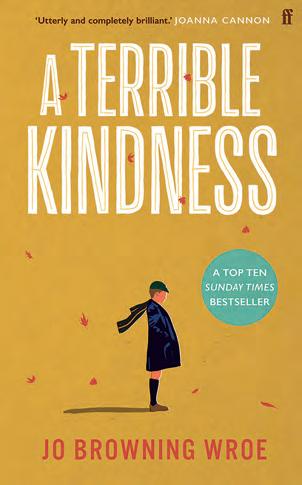
The experience was part of Jo’s preparation for her novel, A Terrible Kindness, which was published in January and immediately became a Sunday Times Top 10 bestseller. Told through flashbacks, it explores the impact on a young embalmer, William Lavery, of the work he does to embalm and prepare for identification the bodies of children killed in the disaster at Aberfan in October 1966. The book grew out of an accidental encounter with the records of the volunteer embalmers who had carried out that work, after heavy rain caused mining debris to bury the village school, killing 116 children and 28 adults.
“I was in the (Cambridge) University Library, reading conference papers of the Institute of Embalmers for a different project I was working on. I came across an account by an embalmer, Billy Doggett, of volunteering at Aberfan, and quickly had to leave the library in tears.”
The subject of death, and those who work with the dead, was one with which Jo was deeply familiar. Her childhood was spent at a crematorium in Birmingham, where her father was the superintendent, a job which came with a house in the grounds. But it wasn’t until she was studying for a Masters in Creative Writing at the University of East Anglia, in 2000, that she recognised the creative gift this upbringing represented.
“I had never thought of growing up in a crematorium as material. But I was taught by the writer WG Sebald, in the last term before he died. He was fascinated by death, and suggested my upbringing would have given me an interesting perspective from which to write.”
At Homerton in the 1980s, where she met her husband, fellow BEd student John Wroe, Jo was startled by the world some of her contemporaries had come from.
“I was sort of lower middle class I suppose – but I didn’t know that sort of wealth and privilege existed. I remember a lecturer asking everyone to put up their hand if their parents had paid for their education, and I was astounded by what a tiny minority I belonged to. I felt that these people had such interesting families and experiences. It was a long time before I realised that my own background was interesting too.”
After Homerton, Jo and John spent two years as youth workers in the United States, before returning to the UK and settling in Cambridge, where they have lived ever since. Jo taught in Royston before quickly pivoting to educational publishing.
“It allowed me to still be in schools, but with much more flexibility – I really struggled with having every minute of my day scheduled in teaching. I’ll never forget, in my first week in publishing, my boss got me a cup of tea and a biscuit, (it wasn’t even breaktime!), and told me my job on a Friday was to read the Times Ed and the Bookseller
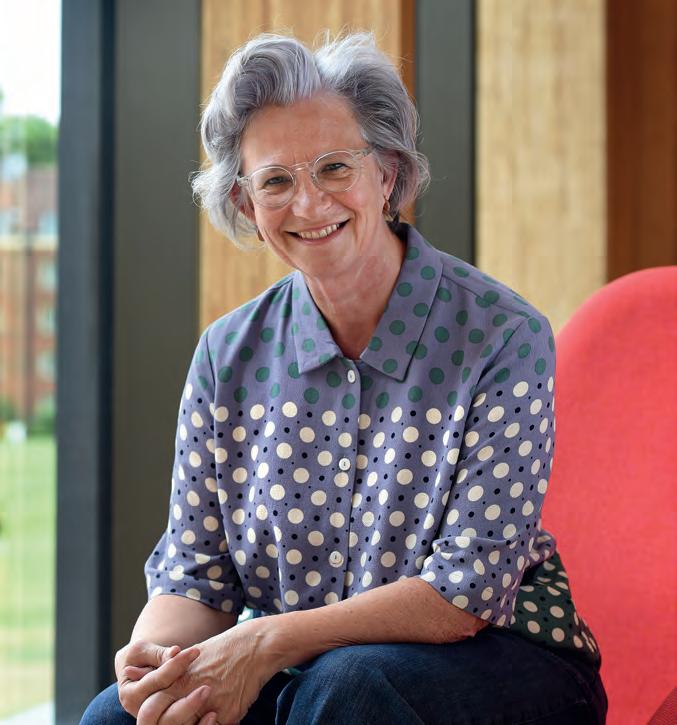
to see if there was anything we should know about. I was in heaven!”
She has written over 25 educational and reading books, many in collaboration with psychotherapist and lecturer at the Faculty of Education Dr Carol Holliday, and for the past eight years has been Creative Writing Supervisor at Lucy Cavendish College.
“Until very recently Lucy Cavendish only accepted women students over the age of 21, so by definition everyone had a story,” she says.
But the story which propelled Jo into the bestseller lists, with reviews and profiles in every broadsheet newspaper and an interview on BBC Radio 4’s Front Row, was not based on her own background. Instead it was the story sparked by that serendipitous discovery in the library.
After reading the account, she contacted the Institute of Embalmers to find out whether any of the people who had volunteered at Aberfan were still alive and willing to speak to her. She flew to Belfast to meet one of them, and spent the next four hours reliving the experience with him in the airport lounge.
“At the beginning he said he wasn’t sure it was a good idea to talk about any of this, and by the end he said ‘perhaps this story could be told’.”
The opening chapters of the book, which describe William’s experiences in Aberfan, are devastatingly raw although written with beautiful sensitivity. They are a difficult read but, Jo says, were “strangely unemotional” to write.
“Listening to the embalmers talking about it was almost unbearably emotional, but when it came to writing it, I was so concentrating on trying to accurately convey the essence of what they’d told me, there was for a while a sense of emotional detachment. In fact, the use of the present tense throughout the book came from the need to represent the immediacy of their account.”
The novel moves around in time between William’s training in the build-up to the tragedy, his life afterwards as he struggles to acknowledge its effects, and his childhood in Sutton Coldfield and as a chorister in Cambridge. We come to realise that earlier events, including the death of his father, an estrangement from his mother, and his choral life, have caused
psychological scars which long predate Aberfan.
The scenes in Cambridge reflect Jo’s lifelong love of the city, and include familiar haunts from Fitzbillies to the Copper Kettle, and the perils of the open gutters on Trumpington Street. Though Aberfan was the novel’s starting point, it is as much concerned with family, friendship, the power of music and the inability of people to accept support from those who love them, as the specifics of the disaster.
“I never had the intention of telling Aberfan’s story, and I wouldn’t presume to do that. I was interested in the impact of it on an outsider, and the enormous asks some professions make of people. I was also fascinated by how we turn away from help, by William’s self-jeopardy.”
Aberfan returned to public attention in 2019 through a searing episode of The Crown, directed by Homerton alumnus Benjamin Caron (BEd 1995–99). Jo admits that this has been an unexpected help, through the awareness it has brought to readers who might otherwise have been unfamiliar with the disaster. Television audiences will soon be granted a different perspective, and the novel’s gorgeous choral soundtrack, as A Terrible Kindness is itself being adapted for the small screen.
“They did ask me if I’d like to write the script, but it’s taken me long enough to write a novel, so I passed on that one!” Jo laughs. “I’m an Executive Producer though, and so I get to approve each episode’s script and have some say over casting.”
The novel has been translated into five languages, leading to some unexpected culture clashes.
“The Dutch translator rang me up and said “we’re not experts at beating children in the Netherlands – you’ll have to explain to me how this works” and I was horrified to find myself listing the possible materials for canes in 1960s boarding schools.”
Her schedule is now packed with readings, literary festivals and book signings, as well as finding time to work on the next novel and anticipating the imminent arrival of her first grandchild. The response to A Terrible Kindness affirms Jo’s instinctive reaction when she first came across those papers.
“I just had a visceral sense that this was a story worth telling.”

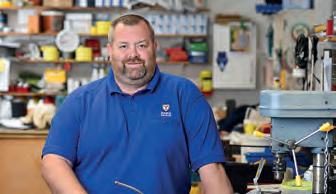
As Building Services Manager, Shaun Fordham oversees the team responsible for keeping Homerton ticking. From fitting out new buildings to responding to leaks and power cuts, he takes us through a typical day.




7–9am
I usually arrive in College at 7 in the morning, and we meet as a team over a coffee before the shift starts at 7.30. I manage a team of seven, and they’re the ones that make my job possible. First thing we look at the emails that have come in overnight and share out the jobs. There are usually about half a dozen overnight requests, ranging from lightbulbs that need replacing to leaky taps and blocked sinks and showers, right through to massive issues like ceilings coming down because the bathroom above has flooded!
8–10am
We have up to 30 reactive jobs a day, which we can’t plan for. Any request comes into the Estates email address for me or Sarah (Culhane, Estates Secretary) to pick up. We then allocate jobs to the team through their phones – they get an alert. They do a live risk assessment when they get to the job; just a quick checklist of yes or no questions but the moment you flag a no it sends an alert so we can check what the problem is.
I brought in the new risk assessment system when I joined three years ago, alongside an alarm system to protect people working alone. There are 26 acres of College grounds, and we have plant rooms underground and in loft spaces. One of the team had a heart attack in a plant room, and it was sheer luck someone found him. Everyone now has a man down alarm: basically a tracker with a panic button which allows you to alert the switchboard if you need help. There were some grumbles when we first brought it in – ‘oh you’re keeping track of me’ – but it’s not that, it’s just taking responsibility for people’s safety.
10am–12pm
Alongside the reactive jobs, we have maintenance schedules for the bigger equipment. We maintain all the boilers and heating systems around the site, and the plumber checks them all each day. We’re also responsible for all the lighting – there are over 2000 emergency lights that have to be tested monthly – and we do a quarterly deep clean of over 1000 showerheads. There’s a 10-year plan to refurbish all 750 bedrooms.
I joined Homerton in November 2019, so was still new when the pandemic hit. The College is massive, so I was still learning how everything worked. We used the absence of students and staff to do a lot of big projects

which would otherwise have been much more complicated, such as refurbishing the top floor of the ABC rooms. Also the North Wing was just being completed, so it gave us time to get that sorted.
We maintained the full team throughout the pandemic, acting as one bubble for most of it, and in two teams working half days when Covid was at its peak, to avoid the whole team having to isolate. We’ve got two electricians, two multi-skilled team members, one plumber and another who can do most of the plumbing jobs, and Raj who covers for me and is also the carpenter/joiner, so we’re nicely split to be able to work as two groups when we have to.
12–1pm
The team always eat together, and if I’m around I’ll eat with them too, or with other staff. My office is always open to anyone.
We do much more internal work ourselves now than we used to, such as refurbs and bigger projects. There’ll always be a certain amount that you have to outsource, as there are only eight of us, but you get more out of the job if there’s something substantial we can look at and say “we’ve done that”. A trained electrician with 30 years’ experience doesn’t want to be spending all day changing lightbulbs. The guys all have their own skillsets, so with ongoing projects, such as a bathroom refit, they all work together.
1–2pm
Since the new sports facilities opened on Long Road, two of the team will go over there on a Monday afternoon to check everything’s working. The new dining hall
took all our labour for a month when it first opened, sorting any teething problems – everything from making sure the lighting and alarms were working to fitting all the toilet roll holders.
2–3pm
I can do a little bit of everything but I’m more of a manager than a trade. That took a bit of getting used to for the team when I first started, but I think they now realise they needed a manager rather than another pair of hands. I can deflect a lot of stuff that would otherwise come their way, so they can get on with the job. It’s all about the team; they’re very behind the scenes and they don’t always get the recognition they deserve. People tend to think we come in in the morning and flick a switch and everything works.
John, the plumber, has piped pretty much the whole College on his own. He’s been here for years and when he retires we won’t know how anything works! It’s not an easy feat to replace someone who’s been here that long. We need to bring in someone younger now, so John can empty his head into theirs.
4pm
We finish at 4pm, depending on the day. Obviously if I’m in a meeting I’m in a meeting, but generally that’s the end of the working day. Before coming here I was a construction manager on the railways. It was 100 miles an hour job, working nights, Christmases, always away. I’ve got five kids, aged 17 down to six, so it’s good to be around a bit more. Weekends are all about the kids, and football!

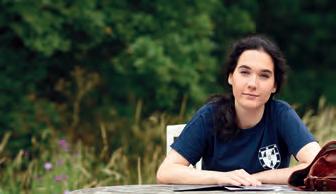
First-year MML student Lisa Levytska had been at Homerton for a term and half when, overnight, her country became a warzone. She describes how focusing on student life has helped her to cope with the news from home, and how her family have all become honorary Homertonians.


Icame to the UK aged 12, seven years ago, to go to boarding school in Yorkshire. My family live in Odessa, south-west Ukraine, right on the sea. It’s a very international city, and has always been somewhere that people have gone for their holidays. But suddenly being on the coast is a disadvantage – there’s no direct escape.
When I rst started at Cambridge, last October, my main reaction was shock that I was suddenly allowed out! After seven years at boarding school, I found myself thinking I was going to be told o every time I went out at night, and telling the Porters where I was going if I went to London for the weekend.
The situation in Ukraine has been very unpredictable for the whole time I’ve been in the UK. In fact the threat of Russian aggression was part of the reason why my sisters and I came to school here in the rst place. My mum had always wanted us to study in England and my dad wasn’t sure, but agreed we would be safer here.
People got used to micro-aggressions from Russia, but we didn’t think it would escalate. The invasion in February was a sudden slap in the face.

I had a BBC noti cation on my phone, and then suddenly everyone posted on my Instagram feed. I woke up to 50 noti cations.
I’d had a couple of classes cancelled due to Covid, so I went to the gym, and then rang my dad. I wasn’t sure how to approach the invasion with my parents. We never talk about the bad stu . My dad brought it up, and I was crying in the gym – I kept trying to change the conversation and he kept shifting it back.

I’m the type of person who doesn’t keep up with the news, so it took me a little while to realise what had happened.
I became very withdrawn from the issue. I felt as though if I thought about it, it would become so all-consuming that I’d end up dropping out of Cambridge. That’s partly why I signed up as a student caller for the Homerton Telethon. I wanted to engage with things that would take up my time, so I wouldn’t have to engage with what was going on at home. My mum and my sister were reaching out to my grandparents and friends back home, getting testimonials on what was going on, and I couldn’t do that. I blocked it o .
the banks were freezing international transfers. The hotel they were staying in gave them another week for free, and then another. My sisters are in Sixth Form at two di erent schools, and they didn’t charge them for this term, and one of the schools took my youngest sister into Year 6 for free.
I spoke to the College about my nances, and Dhiru (Karia, the Finance O cer) was extremely helpful. He opened a hardship fund, which meant I could stay in College over Easter for free, and preloaded my student card so I could buy food each day. My Tutor, John-Mark Winstanley and Dhiru both separately applied for a hardship grant for me from the University before I’d even got round to applying for it myself. John-Mark’s been there for me at all times.


My little sister turned 11 on 25 February, and my mum brought her to London to see my other sisters for halfterm. Then the invasion started and they realised they couldn’t go home. They’d spent their holiday money, and my dad couldn’t transfer money to them because
After two weeks, the hotel where my mum was staying gently made it clear that they couldn’t continue to put her up for free. At that point Homerton stepped in. Penny Barton, the Senior Tutor, o ered her accommodation in a at sometimes used by Fellows, and she’s been there ever since. My sisters come and stay with her there in the holidays –Homerton has become home to all of us.

My dad’s still at home in Odessa. He’s in his 40s, so he can’t leave Ukraine,
but he hasn’t yet had to ght. He loves his job, running a construction company building swimming pools and fountains, but he can’t work at the moment – there’s no work for him to do, because of the war. He’s trying to nd di erent ways of helping, paying his taxes ahead of time, donating equipment and money. He’s still out and about every day, whereas my grandmother has been living in her basement since the invasion. My grandparents, aunt and cousin are all still


there – I don’t know when I’ll next see any of them.
My friends have been fantastic. I can’t talk about it all too much, and they understand that I’m not going to talk it out, but they help in other ways.
I think I had survivor’s guilt for a while. I withdrew a bit from societies and my hobbies, and even gave up dancing which, as I used to dance professionally, was tough. But when I went out and had fun I’d come back and feel guilty.

Working on the Telephone Campaign allowed me to communicate with people about their lives rather than about what was going on in Ukraine, and showed me that I needed to get back out there and live my own life. I need to stay clear-headed for the sake of my education.
I really appreciate what the College has done for me and my family. I only came here in October – nobody owes me anything. They’ve been amazing.


A return to ‘normality’ (or something close to it) brings with it the opportunities that we all missed: not only regular singing, but the chance to perform at special events in College and, of course, to tour abroad. While Covid has not disappeared, we have been fortunate to be able to carry on without significant disruption – something that seems to have been true across the College, much to everyone’s relief.

IfCovid hasn’t been our major challenge this year, then keeping the choir operating during exam season has been more trying. It’s worth remembering that every student sitting exams this year has experienced exam-related disruption for the past two summers, and there was therefore an unusual degree of trepidation around these assessments. However, hopefully coming to choir during this time felt like a break rather than a burden! Everything fell into place for the end of term, when we were able to sing a spectacular final Evensong of the year in honour of the Queen’s Platinum Jubilee, featuring Charles Hubert Parry’s anthem I Was Glad, long associated with Royal events. The choir also made an appearance at the first Charter Dinner in over two years, in the presence of many esteemed guests including former Prime Minister Theresa May.
I n February the Charter Choir sang Evensong at Ely Cathedral for the first time in 10 years, leading one of their lay readers
Forthcoming key dates:
to comment that we were ‘one of the very best visiting choirs’ he had heard in his long association with the cathedral.
This year we have said farewell to more than one third of the Charter Choir, most of whom have been singing with us for several years. However, there is a healthy intake of Freshers on the horizon, and many members of the tenor and bass sections are hoping to stay on in Cambridge after graduation, so the choir’s future is bright. We are hoping for at least one London-based performance next year, so watch this space.
The end of the academic year would not be complete without a tour. Alas, our planned trip to Italy fell through, as an indirect casualty of the pandemic, so we were forced to think creatively and quickly as to an alternative destination. Gibraltar came out on top of our very short shortlist, and Shanna Hart, Assistant Organist, got to work organising. Our six-day tour took us to the King’s Chapel, the Garrison Library, the Roman Catholic Cathedral of St Mary the
Saturday 24 September: Alumni Reunion Concert
Sunday 27 November, 6pm: Advent Carol Service
Tuesday 29 November, 6.30pm: Homerton Carol Service
Crowned, and two Sunday services in the Anglican Cathedral of the Holy Trinity (who hosted us for a barbecue in between).
Although it is a small place, Gibraltar is not short of hills that require climbing, which is never popular when wearing concert gear. However, this was more than made up for by the truly humbling hospitality of the Gibraltarians, including a letter of thanks from the Governor of Gibraltar, and the opportunity to see dolphins up close swimming in the Mediterranean.
I am also grateful to Shanna and to our Organ Scholar Lorenzo Bennett for their excellent accompanying of the choir this academic year. We continue to have an anomaly at Homerton of appointing organists but not having an organ. The Great Hall has recently been freed up as a performance space following the completion of the new Dining Hall, and if and when it is possible to install a pipe organ in the Great Hall gallery, the choir will eventually have a ‘home’ within Homerton. In the meantime, we are ever grateful to the Rev’d James Shakespeare and the Church of St John the Evangelist, Hills Road, for their continual support in providing a place for us to rehearse and perform. Patricia Maude, our Honorary Lay Chaplain, also puts in a lot of work behind the scenes to ensure a continued smooth relationship between the church and Homerton, and our various singing teachers have a huge role to play in developing the voices of individual choir members.
Alumni are always welcome at Charter Choir services and concerts. The Charter Choir website (www.homerton. cam.ac.uk/charter-choir) contains full details of sung services as well as clips of the choir performing. The website also contains biographies, and details of tours and recordings. Alumni are also encouraged to follow the Charter Choir on its Facebook page, at www.facebook.com/ homcharterchoir.
Dr Daniel Trocmé-Latter Director of Music
The Principal, Fellows, students and staff of Homerton College wish to thank alumni and friends who have generously made donations to the College over the last year. Every effort has been made to ensure this list is accurate; do contact us if you believe we have made an omission.
1942
Mrs Kathleen Hayward*
1943
Miss Margaret Rishbeth
1947
Professor Joan Chandler
Mrs Irene Cole
Mrs Brenda Elliott
1948
Mrs Mary Dowse
Mrs Coral Harrow
Miss Elizabeth Rainsbury
1949
Mrs Wendy Cannon
1952
Mrs Shirley Haslam
Dr Alison Littlefair
1953
Mrs Pamela Cooksey
Mrs Pauline Curtis
Mrs Sheila Mackenzie
Mrs Penny Marshall
Mrs Margaret Sharman
Mrs Ruth Orr
Mrs Elizabeth Tunnicliffe
1954
Mrs Gwenda Ackroyd
Mrs Christine Grainge
Mrs Rachel Lewington
Mrs Sheila Pearce
1955
Mrs Elizabeth Benning
Mrs Maureen Champion
Mrs Marguerite and Mr Norman Donkin
Mrs Gillian Hewin
Mrs Doreen Hobbs
Mrs Wendy Oakley
1956
Mrs Julia Davis
Mrs Gillian Figures
Mr Gordon Gaddes in memory of Mrs Pamela Gaddes
Mrs Shena Jones
Mrs Eilidh Scott
Mrs Alice Severs
Mrs Rosemary Viner
Mrs Jennifer Wilson
1957
Mrs Jill Hicks
Mrs Vivien Ivell
Mrs Beryl Izzard
Mrs Wanda Kielbinska
Mrs Christine Lincoln
Mrs Rachel Macdonald
Mrs Judy Manson
Mrs Patricia Stott
Mrs Josephine Sutton
1958
Mrs Dora Beeteson
Mrs Carole Evans
Mrs Diana Hadaway
Mrs Ann Hardie
Mrs Ruth Jerram
Mrs Diana Lucas
Mrs Annmarie Mackay
Miss Gill Rogers
1959
Mrs Jean Clarke
Mrs Clare Clouston
Mrs Sue Dickinson
Mrs Jenifer Freeman
Mrs Jill Fuller
Mrs Rosemary Hill
Mrs Val Johnson
Mrs Janet Mayo
Mrs Erica Rigg
Mrs Jill Taylor
1964
Dr Tricia Cusack
Mrs Wendy Dunnett
Mrs Maggie Meredith
Mrs Sue Rescorla
Ms Marjorie Thorley
Mrs Dilys West
Mrs Jane Woodford
1965
Mrs Sue Bennett
Mrs Bryony Carter
Mrs Margaret Funnell
Mrs Annie Illingworth
Mrs Sue Pinner
Mrs Jill Russell
Mrs Cheryl Trafford
Mrs Janet Webb
Mrs Jennifer McKay
Mrs Rosemary Rees
Mrs Janet Valentine
Mrs Hillary Young*
1960
Mrs Katie Abbott
Mrs Rosemary Allan
Dr J. Norman Bardsley in memory of Mrs Jacqueline Bardsley
Mrs Patsy and Mr John Blythe
Mrs Jan Campbell
Mrs Marilyn Clare
Mrs Anne Hulse
Mrs Joy Kohn
Mrs Susan Lovett
Mrs Sue McFarland
Mrs Jacqueline Swegen
Mrs Caroline Sykes
1961
Mrs Adrianne Ashcroft
Mrs Diana Dalton
Mrs Lynn Dowson
Mrs Marion Foley
Mrs Carole Girdler
Mrs Carole Nolan
Miss Esme Partridge
Mrs Jane Rivers
Ms Claire Stableford
Mrs Jean Thorman
Mrs Gwendolyn Williams
1962
Mrs Carol Bowen
The Revd Dr Anthea Cannell
Mrs Christine Macpherson
Mrs Kate Ryder
1963
Mrs Jean Addison-Fitch
Mrs Andrea Caish
1970
Mrs Patrica Bradley
Ms Fiona Cook
The Revd Sheila Crowther
Mrs Denise Few
The Revd Claire Heald
Ms Janette MacDonald
Mrs Mary McCosh
Mrs Mal Reid
Mrs Rachel Salmon
Mrs Denise Shakespeare
Mrs Sue Smith
Mrs Lois Whittaker
Mrs Mary Wyatt
1971
Ms Catherine Beavis
Dr Jane Clements MBE
Mrs Patty Darke
Mrs Helen Malcolm
Mrs Jan Wilkinson
1966
Mrs Jean and Mr Win Carnall
Lady (Marilyn) Fersht
Mrs Marion Pogson
Mrs Judith Queripel
Mrs Margaret Robbie
Mrs Netti Smallbone
Mrs Linda West
Miss Lorraine Welch
1967
Mrs Marjorie Caie
Mrs Miriam France
Mrs Avril Growcott
Mrs Valerie Hart
Mrs Robyn Mitchell
Mrs Anne Rogers
Mrs Pat Saxton
1968
Mrs Patricia Colyer
Mrs Tricia Coombes
Mrs Lynn Lemar
Mrs Lesley Marriott
Dr Anne Martin
Mrs Lynne Parsons
Mrs Pemma SpencerChapman
Mrs Marilyn Stansfield
1969
Dr Joan Fraser
Mrs Cynthia Garvey
Dr Vicky McNeile
Ms Anne Reyersbach
Ms Tessa Robinson
in memory of Miss Bridget Robinson
Dr Roz Sendorek
Ms Hilary Stokes
Mrs Sarah Taylor
Mrs Helen Wood
Mrs Annie Ryder
Ms Helen Sandle-Baker
Ms Anne Sparrowhawk
1972
Mrs Ros Allwood
Mrs Sarah Flynn
Ms Margaret Howell
Ms Anne Kennedy
Ms Jane Lewin Smith
Mrs Sheila Martin
Mrs Caroline Melrose
Mrs Valerie Mills
Mrs Penny Riley
Mrs Angela Swindell
Mrs Marilyn Thomas
Mrs Jan Thomson
Mrs Maureen Weston
1973
Miss Stephanie Beardsworth
Mrs Jane McLean
Mrs Anne Mellor
Mrs Dilys Murch
Mrs Sue Rodford
Mrs Elizabeth Rose
Mrs Heather Wilkinson
1974
Mrs Helen Shanks
Mrs Vera Sklaar
1975
Mrs Alyson Baker
Mrs Gillian Dirks
1976
Mrs Judy Clarke
Mrs Joan Gibson
Ms Jill Grimshaw
Miss Amanda James
Mrs Ann Kirkby
Mr Tony Little
Mrs Ann Muston
Mrs Jo Newman
Mrs Zena Tinsley
1977
Miss Sheila Berry
Mrs Jane Bishop
Mrs Lalli Draper
Ms Jane Edwards
Mrs Ann Jackman
Ms Brenda Meek
Mrs Helen Mitchell
Mrs Louise Mursell
Mrs Clare Myers
Mrs Carol Onley-Gregson
Mrs Jane Pearson
Mrs Lesley Thomas
Mrs Angela Wimbush
1978
Mrs Vicki Addey
Mrs Marianne Billitt
Ms Jackie Blackmore
Mrs Ruth Briant
Mrs Sandra Burmicz
Mrs Annette Cameron
Mrs Clare Danielian
Mrs Dee Davey
Mrs Susan Dinnage
Miss Jo Manisier
Mrs Mary Powles
1979
Mrs Oyinkan Ade-Ajayi
Mrs Rachel Bond
Mrs Leonie Hyde
Mrs Brenda Thompson
Mr Chris Tottman
1980
Ms Victoria Brahm
Mrs Jo Broughton
Mr Ian Copeland
Mrs Catherine Hicks
Mrs Sarah Holmes
Mr John Turner
1981
Miss Anna Chapple
Ms Liz Clifford
Mrs Cordelia Myers
Ms Sara Wolfson
1982
Lady Katharine Bryan
Mr Mark HanleyBrowne
Mr Brian Howarth
1983
Mrs Theresa Atal
Mrs Alison Brinklow
Mr Jez Crook
Mrs Susan Hill
Mrs Karen Miranthis
Mrs Sarah Palmer
Mrs Frances Surridge
1984
Ms Cathy Graham
Ms Alison Mesher
Mr Peter Ventrella
1985
Dr Kirsty Byrne
Mrs Karen Coombs
Mrs Sally Jaspars
Dr Mark Mullins
Mrs Anna Williams
1986
Mrs Keren Cooke
Ms Nansi Ellis
Mrs Alison Judd
Miss Samantha Taylor
Mrs Yvonne Wiggall
1987
Mrs Kim Chaplin
Mrs Michaela Khatib
Mrs Keeley Rayner
Mr James Thomson
1988
Mrs Tamsin Austoni
Mr Phil Coldicott
Mrs Katie Mayne
Ms Phillipa Rushby
Mr Giles Storch
Miss Jen Svrcek
1989
Mr Tarquin Bennett-Coles
Miss Lucy Bradley
Dr John Dodsworth
Mrs Helen Duffy
Ms Fran Harrison
Mr Carl Howarth
Mrs Charlotte Irving
Mrs Penny Lee
Mr Simon Ray
The Revd Wendy Wale
1990
Mrs Naomi Baynes
Mrs Karen George
Mrs Fiona Gruneberg
Mr Ian Hodgson
Mrs Sharon Holloway
Mrs Sarah McWhinnie
Mrs Beccy Millward
Dr Susi Pinkus
Dr Helen Price
1991
Mrs Joy Bensley
Mr David Chapman
Miss Claire Corkran
Mrs Elizabeth Sartain
Miss Lisa Tiplady
1992
Dr Simon Camby
Mrs Sarah Haines
Mrs Anna McClure
Ms Trudi Miles
Mrs Diane Rawlins
Miss Wendy Smith
1993
Dr Steven Chapman
Miss Helen Diggle
Mrs Helen Morgan
1994
Mrs Claire Brooks
Mrs Carol Carlsson
Browne
Mrs Jenni Trafford
Mrs Torie True
Mrs Emma Vyvyan
1995
Ms Nicola Abery
Ms Sally Overy
Miss Cornelia Swain
1996
Mr Ian Bettison
Miss Jo Cullen
Mr Ian Frith
Mrs Audrey Hinnells
Mr Christopher Shephard
Mrs Louise Tomlinson
Mr Martin Wigg
1997
Mr Matt Buck
Ms Sadeka Choudhuri
Miss Max Cure-Freeman
Mrs Lindsey Davey
Miss Emily Jones
Mrs Amy McDonnell
Mrs Victoria McLafferty
Mrs Barbara Sims
1998
Miss Rebecca Bauckham
Mr Alastair Chipp
Mrs Victoria Harvey
Mrs Emma Holt
Mrs Daisy Lewis-Guinness
Mr John Moore
Ms Julie Seplaki
1999
Miss Dawn Alderson
Ms Dora Callington
Miss Martha Court
Dr Neil Hennessy
Mr Paul Jones
Mr Richard Marshall
Mrs Denise Mieszkowski
Mrs Laura Penrose
Dr Louisa Tipler
Mrs Zoe Yeomans
2000
Mrs Sue Aldred
Mrs Angela Clark
Mrs Abby Deeks
Mr Richard De Orfe
Dr Tom Kitchen
Mr Devin-Paul O’Brien
Mrs Annabelle Payne
Mrs Cheryl Smith
2001
Mr Laurence Ball
Miss Emma Cosby
Mrs Lesley Crooks
Miss Lidia Fesshazion
Mrs Amy Fleming
Mr James Frecknall
Mr Andrew Jenner
Mrs Catherine Kitchen
Mrs Nadine Lloyd
Mrs Kimberley Rayson
Miss Ellen Richardson
Mr Jonathan Ross
Mrs Sarah South
Mrs Sandra Stapleton
Miss Emily Tattoo
Mrs Mandy WarnerBradshaw
2002
Mr Chris Adams
Mr Ali Azeem
Mrs Katy Coles
Mr Raymond Cilia
Dr James Croft
Mr Sam Farmer
Mr Sutherland Forsyth
Mrs Carys Gladdish
Mrs Anne Howell
Mr Chris Kellaway
Mr David Lawrence
Miss Sian Mawditt
Mr Remi Moynihan
Miss Krista Pullan
Ms Henni Saarela
Mr Tim Scott
Dr Lisa Sessions
Mrs Sharron Shackell
Mrs Stephanie Shelmerdine
Mrs Helen Smith
Mrs Angela Woodruffe
Mrs Rhiannon WynneLord
2003
Ms Susanna Bellino
Dr Keith Boyle
Mr Louis Budworth
Miss Katherine Bluck
Dr Jamie Castell
Mr Philip Chapman
Mrs Pauline Hickey
Mr Gregoire Hodder
Mr Jonathan Levine
Dr Feilong Liu
Mrs Elizabeth Mansfield
Mr Daniel Roberts
Mr Tim Rothwell
Dr Tovah Shaw
Mr Jean-Paul Skoczylas
Mr Tristan Stone
Miss Stephanie Tillotson
Mr John White
2004
Mrs Caroline Barker
Mrs Rhiannon Baxter
Mr Nicholas Bebb
Mr Nick Clark
Mrs Leah Crimes
Mrs Emily Davies
Mr Colin Ferguson
Miss Natasha Gray
Mr Richard Hopkins
Mr Ravi Raichura
Dr Jeptepkeny Ronoh
Mrs Sian Shaw
Miss Jennifer Sneyd
Professor Harald Stoffels
Ms Verity Worthington
2005
Dr Enyi Anosike
Mrs Lisa Beacom
Mr Andy Gard
Mrs Mona Nemer
Mrs Rebekah Perry
Dr Oliver Rupar
Mrs Liz Sharp
Mrs Jessica Shingfield
Ms Nadia Syed
Mr Han Tu
Mrs Emma Turner
2006
Miss Aniko Adam
Dr Theresa Adenaike
Mr Andrew Blackburn
Mr Thomas Dix
Mrs Sophie Harrison
Dr Joshua Jowitt
Mrs Chrissie Kelby
Miss Elizabeth Meehan
Miss Afaf Nourallah
Miss Chloe Orchin
Mrs Dawn Pavey
Mrs Lynne Richardson
Mr Tom Robinson
Mr Luke Shepherd
Mr Azam Taiyeb
Mrs Liza de Uphaugh
Miss Elizabeth Wadsworth
Dr Susan Wishart
2007
Miss Isabella Akinseye
Mrs Tracey Harjatanaya
Mr Tom Horn
Mr Joshua Jenkins
Mr John Keene
Miss Teresa Li
Mr Duncan Loweth
Mr Michael Lynch
Dr George Mak
Miss Nic Pollard
Mr Jonathan Prestwich
Mr Joseph RandallCarrick
Mr Matthew Thomas
Miss Beth Wattleworth
2008
Mr Luke Clarke
Mr Felix Danczak
Mrs Kim Dorsett
Mr Mike George
Mr Matthew Linsell
Mr James Lugton
Mrs Susan McGregor
Mrs Sue Morley-Souter
Miss Amy Munro-Faure
Mr Ikenna Obiekwe
Mr Gershwinder Rai
Miss Xiaoye Shan
Mr Michael Stephenson
Mrs Sarah Talland
Miss Rebecca West
2009
Mr Adarsh Bala
Mr Daniel Beresford
Dr Jun Chen
Mr Richard Craven
Miss Danielle Eley
Miss Alice Esuola
Mr Jack Euesden
Mrs Denise Heal
Mr James Henderson
Miss Christine James
Mr Christopher Morgan
Miss Rebecca Phillips
Dr Syed Rizvi
Mr Michael Thorp
Miss Isabel Webb
Ms Rhiannon Williams
2010
Dr Tareq Al-Ansari
Mr Jordan Boddy
Miss Emma Bowell
Mr Nahum Clements
Miss Alexandra Courage
Mr Vasilis Eliades
Dr Kayla Friedman
Mr Gabrielius Glemza
Mr Paul James
Miss Sian Jones
Mr Johann Kamper
Miss Suzannah LangdonShreeve
Dr Dirk Mersch
Mr Rok Nezic
Mrs Helen O’Hara
Mr Richard Peach
Mr Peter Phillipson
Miss Bella Radenovich
Mrs Jessica Taylor
Miss Megan Trimble
Dr Wei Yang
2011
Mrs Cordelia Brown
Mr James Chicken
Mr Richard Fitton
Miss Katherine Gazzard
Mr Jack Hooper
Mr George Jenkins
Miss Helen Lyttle
Dr Nikolas Pontikos
Mr Laurence Pritchard
Mr Thorben Schaefer
Mr Alex Shellum
Mr Thomas Spooner
Miss Angela Stevens
2012
Mr George Clarke
Dr Caia Dominicus
Miss Maureen Gisseleire
Ms Louise Holyoak
Mr Tim Hubener
Mr Thomas Oxenham
Mr Douglas Porter
Miss Ruth Taylor
Mr Theepan Tharmarajah
2013
Mr Daniel Dennis
Dr Clare Harvey
Mr Nigel Ironside
Mr Hachimi Maiga
Mr Alistair McMaster
Mr Chris Wellings
Miss Yiran Zhao
2014
Mrs Alexandra Annett
Mr Joshua Atkins
Mr William Bidwell
Mr Adam Dobson
Miss Harrie Gooch
Mr Richard Jones
Mr Pooya Kamvari
Mr Alexander Schubert
2015
Mr Daniel Burdett
Miss Sally Dickens
Professor Vincent English
Miss Emily Jones
Mr Justin Maroy
Mr Graham Robertson
Miss Jacqueline VyrnwyPierce
Miss Sarah WitkowskiBaker
2016
Mlle Cloe Dugrillon
Miss Mille Fjelldal
Mr Mitchell Hayden-Cook
2017
Ms Roselin Mgbezeh
Mr Mark Nightingale
Dr Neil Papworth
2018
Mr Abdirahim Ahmed
Mr Alexander Lister
Mr Michael Sanchez
Friends of Homerton
Dr Graham Arnold
Mrs Hinna Azeem
Mrs Frances Barrett
Miss Patricia Cooper
Professor Clive Carter
Mr Timothy Edwards
Mr Fabio Galantini
Professor J M Gray
Mr Roger Green
Dr Stephen Hart
Dr Lesley Hendy
Mr Greg Hill
Dr Liz Hook
Dr Louise Joy
Mrs Leslie Lemonick
Dr Anthony Metcalfe
Mr Matthew Moss MVO
Miss Amy Reeve
Dr Tracy Wang
Dr Peter Warner
Mr Aaron Westfall
Professor Stephen Weis
1768 Society
Miss Aniko Adam
Mrs Vicki Addey
Dr Theresa Adenaike
Miss Dawn Alderson
Mrs Rosemary Allan
Dr Enyi Anosike
Mrs Theresa Atal
Dr Norman Bardsley
Ms Catherine Beavis
Miss Sheila Berry
Mr Ian Bettison
Mr Andrew Blackburn
Mrs Patrica Bradley
Miss Lucy Bradley
Ms Victoria Brahm
Mr Matt Buck
Mrs Sandra Burmicz
Dr Kirsty Byrne
Mrs Marjorie Caie
Dr Simon Camby
Mrs Jan Campbell
Mrs Kim Chaplin
Dr Steven Chapman
Miss Shruti Chaudhri
Mr Nick Clark
Mr Nahum Clements
Mr Phil Coldicott
Mrs Katy Coles
Mrs Patricia Colyer
Miss Pat Cooper
Mr Richard Craven
Miss Max Cure-Freeman
Mrs Pauline Curtis
Mrs Diana Dalton
Mrs Clare Danielian
Mrs Patty Darke
Mrs Emily Davies
Mrs Susan Dinnage
Mr Norman Donkin
Mrs Lynn Dowson
Mrs Wendy Dunnett
Mr Timothy Edwards
Professor Vincent English
Miss Mille Fjelldal
Mr Sutherland Forsyth
Mrs Miriam France
Mrs Jill Fuller
Mrs Karen George
Mrs Carole Girdler
Mr Gabrielius Glemza
Mrs Christine Grainge
Miss Natasha Gray
Mr Roger Green
Mrs Fiona Gruneberg
Mr Mark Hanley-Browne
Dr Neil Hennessy
Mrs Jill Hicks
Mr Gregoire Hodder
Mr Ian Hodgson
Ms Louise Holyoak
Mr Richard Hopkins
Mr Tom Horn
Mr Brian Howarth
Mr Carl Howarth
Mrs Anne Howell
Mr Tim Hubener
Mrs Annie Illingworth
Mrs Ann Jackman
Mr Paul James
Mr Joshua Jenkins
Miss Sian Jones
Dr Joshua Jowitt
Dr Louise Joy
Mr John Keene
Mrs Catherine Kitchen
Mr David Lawrence
Mr Jonathan Levine
Ms Jane Lewin Smith
Mr Matthew Linsell
Mr Tony Little
Mrs Susan Lovett
Mrs Diana Lucas
Mr Michael Lynch
Mrs Sheila Mackenzie
Mrs Christine Macpherson
Mr Hachimi Maiga
Mrs Judy Manson
Mr Justin Maroy
Mrs Lesley Marriott
Mrs Sheila Martin
Dr Vicky McNeile
Mrs Sarah McWhinnie
Mrs Caroline Melrose
Mrs Maggie Meredith
Dr Anthony Metcalfe
Mrs Karen Miranthis
Mr John Moore
Mr Chris Morgan
Mrs Sue Morley-Souter
Mr Matthew Moss MVO
Mr Remi Moynihan
Mrs Ann Muston
Mr Ikenna Obiekwe
Mrs Ruth Orr
Mrs Rebekah Perry
Miss Nic Pollard
Mr Douglas Porter
Mr Gershwinder Rai
Mr Ravi Raichura
Mrs Diane Rawlins
Miss Margaret Rishbeth
Mr Graham Robertson
Mr Tom Robinson
Miss Gill Rogers
Mrs Elizabeth Rose
Mr Tim Rothwell
Mrs Kate Ryder
Mr Alexander Schubert
Mrs Denise Shakespeare
Miss Xiaoye Shan
Mrs Sian Shaw
Mr Luke Shepherd
Mrs Netti Smallbone
Mrs Cheryl Smith
Mrs Helen Smith
Mr Tristan Stone
Mrs Sarah Talland
Miss Emily Tattoo
Mrs Jessica Taylor
Mrs Lesley Thomas
Mrs Brenda Thompson
Mr James Thomson
Ms Marjorie Thorley
Mr Michael Thorp
Mr Han Tu
Mr John Turner
Mrs Janet Valentine
Mrs Mandy WarnerBradshaw
Miss Beth Wattleworth
Mrs Janet Webb
Mrs Dilys West
Mr John White
Ms Rhiannon Williams
Mrs Helen Wood
Dr Wei Yang
Cavendish Circle
Dr J Norman Bardsley
Ms Victoria Brahm
Mrs Annie Illingworth
Macaulay Circle
Mr Gordon Gaddes
Mrs Coral Harrow
Mrs Kate Ryder
Mrs Dilys West
FRIDAY 23 TO SATURDAY 24 SEPTEMBER 2022

We are delighted to be able to host Alumni Reunion Weekend in person for the first time since 2019. The best way of booking is via our Alumni Events page on the College website. Alternatively, please contact Sally Nott on alumni@homerton.cam.ac.uk or by phone on 01223 747 251
You are free to attend as much or as little of the weekend as you like. We look forward to welcoming you back to Homerton!
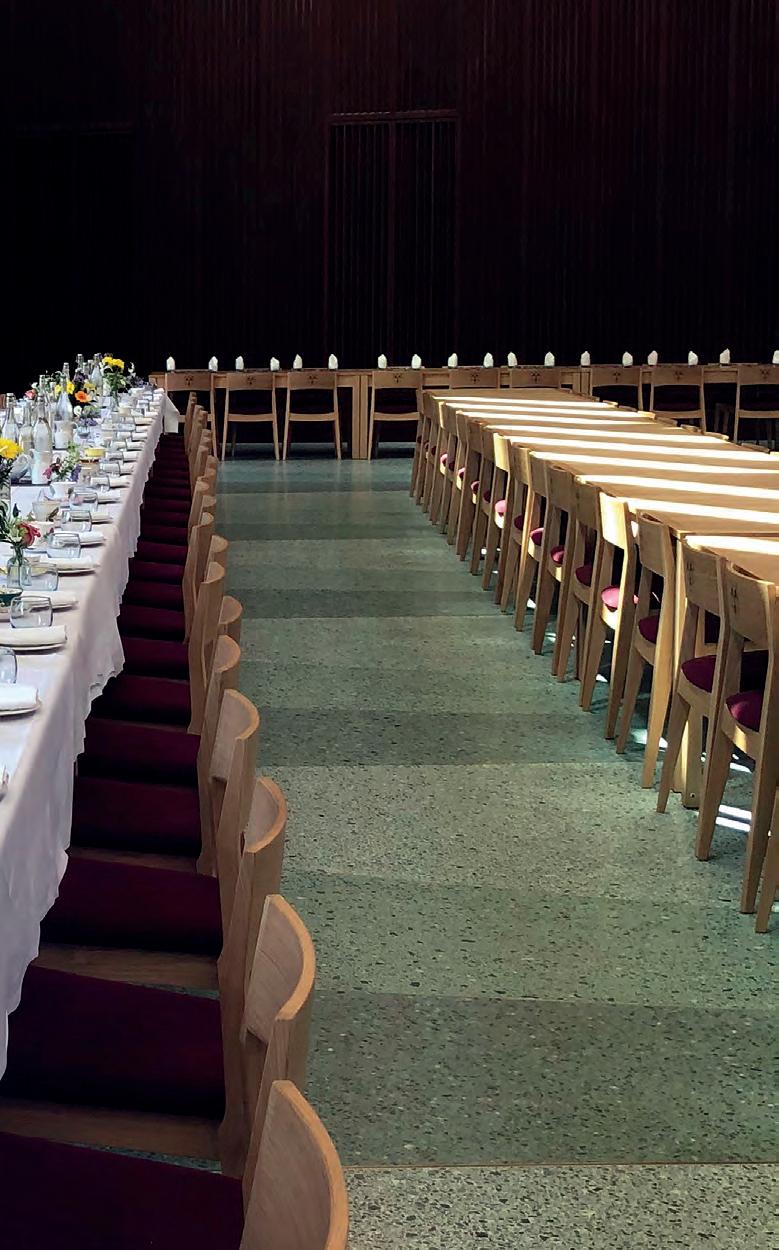
Friday, 23 September
6.30–7.30pm Donor Reception (By invitation)
7.30 for 8.15pm Drinks Reception followed by Dinner
Saturday, 24 September
9–9.30am Registration
9.45–10.30am Welcome address by the Principal and the HUS President
10.45– 11.45am Poetry Workshop with Dr Mariah Whelan
Tour of the College Gardens
Viewing of ‘The Lost Film’
12–1.30pm Lunch
1.45–2.45pm Discussion on Diversity and the Student Experience
3–3.30pm Tour of the Dining Hall
Viewing of ‘The Lost Film’
3–4pm Anniversary Group meetings
4–4.45pm Charter Choir per formance
5–6pm Afternoon Tea
7 for 7.30pm Drinks Reception followed by Dinner
Join us for informal Alumni Drinks in London in October. Details will be available on the College website nearer the time.
As a lifelong member of Homerton and the University of Cambridge you are entitled to a number of benefits. You are very welcome to visit Homerton and use the College Library, Buttery and Bar, and to dine at Formal Hall. Subject to availability, you can also book overnight accommodation at preferential rates and book function rooms for private dinners and events. For more information email alumni@homerton.cam.ac.uk
You can take advantage of great deals at a number of Cambridge hotels, bars, restaurants and retailers by using your CAMCard (issued by the University). You will also receive automatic membership to the University Centre and free entrance into most of the Cambridge Colleges.
To request a CAMCard visit https://www.alumni.cam.ac.uk/benefits/camcard
http://www.homerton.cam.ac.uk/alumni/benefitsandevents
Visit the College website for full details of our alumni events and benefits. You can read College publications online and update your contact details when you move house or job. You can also read about the College’s current fundraising priorities and make a donation to Homerton online.
By email
Have you been receiving our email newsletter? If you haven’t seen an e-newsletter recently, send us an email at alumni@homerton.cam.ac.uk to make sure we have your current contact details.


‘Like’ Homerton College on Facebook to keep up to date with what’s going on. Visit www.facebook.com/HomertonCollegeCambridge
Follow us for the latest news and updates @HomertonCollege
We are on Instagram. Check us out @homertoncollege
You can also connect with Homerton on LinkedIn. Simply search for ‘Homerton College’
Hills Road
Cambridge CB2 8PH
Tel: +44 (0)1223 747251
Email: alumni@homerton.cam.ac.uk
www.homerton.cam.ac.uk
Homerton College is a Registered Charity No. 1137497