Homerton College Alumni Magazine

Laura Kenworthy plans and writes most of the Homertonian magazine, by thinking about the Homerton people and events that yield interesting stories. There isn’t a theme planned in advance, though sometimes a theme becomes apparent after the fact. And that’s the case here: the unplanned theme of this edition is removing barriers, something Homerton excels at.
It shines through in Eve Sergeant’s work to encourage applicants, in Kamal Munir’s work as Pro-Vice-Chancellor, in Sister Bernadette’s selfless devotion to her community (and ours to her), in Christine Andrews’ recollections of the years when Cambridge was still wondering whether women were worthy of degrees, in Charlie Taylor’s work with disadvantaged school students, and in Kevin Glasgow’s testimony of applying to graduate study (“I only really applied to Cambridge for a laugh – I didn’t think I’d get in!...Thank God I got into Homerton”).
But nothing speaks more powerfully of barriers removed than the interviews with our outgoing and incoming Principals. No Black man has ever been the head of a Cambridge or Oxford College, until now – and our incoming Principal Lord Woolley has spent his adult life identifying and nurturing talent in others, in unexpected places. By breaking this barrier he has shown that they’re there to be broken.
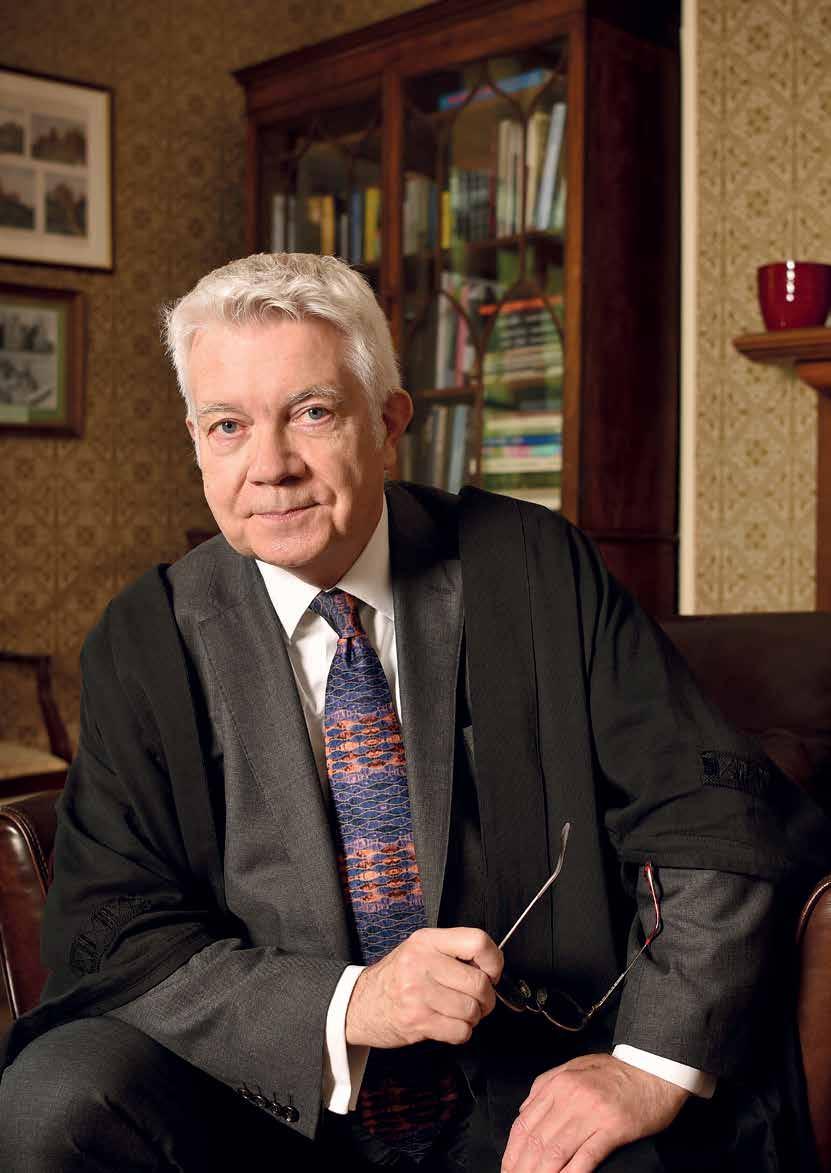
Professor Geoff Ward leaves us, with much affection, after eight years. He’s not one for barriers either: “call me Geoff”, he says to the freshers, “I’m Geoff to the staff, Geoff to the students, Geoff to the Vice-Chancellor”. As Laura writes in her article, “Corridor chats with Geoff have become a defining part of the Homerton experience.”
Homerton is a shared endeavour, and sharing through barriers isn’t possible. Thank you Geoff for making barriers unimportant, and welcome Simon: let’s kick a few more down together.
Matthew Moss Director of External Relations and Development
The Homertonian is Homerton College’s alumni magazine. It is published once a year. Contact us in the Development Office on Telephone 01223 747251 or Email alumni@homerton.cam.ac.uk with feedback, news or letters. All our publications are available to read online on the Homerton College website: www.homerton.cam.ac.uk/alumni/benefitsandevents.
Thank you to all of our contributors and to those who supplied images. The views expressed in this publication do not necessarily represent the views of Homerton College, Cambridge. Cover photograph: Stephen Bond. Design and print management: H2 Associates, Cambridge.
WhenProfessor Geoff Ward joined Homerton as Principal in 2013, he took on a very different College from the one that he is preparing to leave, eight years later. Having just acquired its Royal Charter and become a full College of the University of Cambridge, the culmination of the vision of Geoff’s predecessor, Dr Kate Pretty, Homerton had a new identity to shape.
Taking on Homerton at that time was a unique opportunity to lead a Cambridge College whose sense of self was still in the process of being forged. Despite two and a half centuries of history, this was a new institution in its present form, and the chance to play a central role in taking it forward was irresistible.
“I wasn’t interested in becoming a head of house at an Oxford or Cambridge College per se. But the fact that we’d only just got the Royal Charter meant that whatever happened under my leadership would really matter. Elsewhere, if I’d gone to a College which had had a clear identity for several hundred years, I might never have touched the sides in terms of making a mark.”
However, familiar with the pace of change in Cambridge, Geoff was under no illusions that it would be possible to implement everything he envisaged for Homerton over the eight years of his term in office.
“I was braced for the possibility that none of the important changes would happen on my watch. I knew that I might end up being the Principal who started various processes, and my successor would see them through. But actually, I discovered that the College had a

propensity for nimbleness, or agility –when it chose to it could move at speed. Having previously held senior roles at large universities (Deputy Principal at Dundee University and Vice Principal at Royal Holloway), I found that the scale of a College allows for changes to be implemented much more rapidly.”
One of the most gratifying of these was the introduction of Medicine as a subject available to study at Homerton. Given our proximity to the Addenbrooke’s site, it seems strange now that our first cohort of medical students is preparing to graduate that it took so long to get them on board.
“We’re 12 minutes from Addenbrooke’s, this fantastic, world-leading hospital, and yet we didn’t have Medicine, which I thought was very counter-intuitive. So I asked whether we could offer it, and was told no. There was a nationwide annual quota for medical students, and the Colleges which already offered it had very tight numbers, so for us to take it on, one of the other Colleges would have to give up some of their slots to us, and why would they do that? But then Trinity offered to give one up, which gave us something to push at.”
Several prominent Cambridge medics also promoted Homerton’s cause, and the first Homerton medical students eventually joined the College in 2016. Homerton now offers all the Triposes available to study at Cambridge, a status which Geoff believes is fitting to its size and ambitions, and hopes will be carried forward as a guiding principle as new subjects evolve.
Recognising the aspects of Homerton’s history and distinctiveness which are worth celebrating was a key part of Geoff’s early years in office.
“It was about emphasising Homerton’s difference; identifying things that had always been part of its DNA, but that people hadn’t always been confident about. Things that we’d been doing anyway, serendipitously, and identifying them so that they became part of our raison d’être.”
These included basic factors of geography which the College had historically seen as disadvantages but which, Geoff points out, had clear plus sides.
“Everyone always talked about how we were miles away, out near the station, in south Cambridge. Actually it’s very nice being so near the station, you can get on a train very easily! And south Cambridge is a very exciting place to be, and allows us to build links with the hospital and the biomedical campus.”
As Homerton emerged in its new form as a full College, it had a reputation to build. Initially, most students arriving at Homerton as undergraduates had not applied directly to the College, but had been pooled after applying elsewhere –another potential dent in the College’s emerging sense of self.
“This has now gone away as a problem – most of our students now apply directly to us. But even when they ended up at Homerton through the Pool, they were happy when they got here. And it gave us the opportunity to think about who they
were. Some of them were being pooled because their social and educational background hadn’t given them the interview polish to compete with students who had been more explicitly trained. Our focus on widening participation and social inclusion grew partly out of that, but the more we pursued it the more it grew, and the more important it became to the identity of the College.”
The personal touch Geoff’s own personality – approachable, sociable, inclusive – has also moulded the College, and left an indelible sense that
those attributes are integral to Homerton itself. This has shaped everything from his approach to leadership to his relationship with students.
“When I’m asked what my proudest achievement as Principal has been, I have to say it’s that I don’t think I ever split Governing Body. It’s not the kind of thing people write on your tombstone, but it’s crucial. Being careful to ensure that all views are taken on board, but that you move forward as a shared group. You’re constantly refreshing and renewing support.”
The location of the Principal’s office, at one end of the Cavendish Building, has
facilitated that sense of collegiality – to get a cup of tea requires a long walk along a corridor teeming with potential interactions with staff, Fellows and students. Corridor chats with Geoff have become a defining part of the Homerton experience.
“I knew that I would have a role, but not the extent to which I would either occupy a pre-existing mould, or be able to shape it. It turned out that I could shape it, and that it suited my personality and my gregariousness. It’s a very convivial position, and meant that I could be myself while fulfilling the role. I’ve loved being with students, not just behind a lectern at an

event, but afterwards over jazz in the bar. Students have written to thank me for that – not just me, but that Homerton’s whole way of being is more personal.”
Of course, it is exactly this kind of personal, serendipitous interaction which has been missing over the past 18 months, and of which the current cohort of students have been deprived, a gap which Geoff has been acutely aware of.
“The saddest thing for me has been that I haven’t been able to be the Principal in the way that I’d carved out. Those ways of being together, that vibrancy wasn’t possible. But it hasn’t been lost, it’s just been frozen. It’s
allowed us to think more reflectively, and it’s allowed certain people to come to the fore, especially the Senior Team, who didn’t quail in the face of anything to do with Covid. It hasn’t mean that everything has been diminished or weakened.”
The quieter pace of this time has also allowed Geoff to, as he puts it “rehearse retirement”, although as he is due to take up a new role as Honorary Professor of American Studies at the University of East Anglia, it appears the pipe and slippers are still some way off.
“I’m very lucky – if you’re a medic or a mathematician or a life scientist and you
step off the giddy carousel of research to do something like this job, you may be saying goodbye to your career. Eight years later the field will have moved on. But in English, you can always pick it up again.”
Handing over responsibility for a College in which he has invested so much of himself cannot be easy, but Geoff is clear that there is plenty of scope for his successor to make his mark.
“I wouldn’t presume to give Simon any advice! I think there’s still a lot of room to take things forward. It’s not a completed journey, or a canvas that’s all been filled in.”

At the end of March we announced the election of Lord Woolley of Woodford as the next Principal of the College. Lord Woolley will succeed Professor Geoff Ward on 1st October 2021.
Simon Woolley is the Founding Director of Operation Black Vote, the internationally renowned campaigning NGO which he launched in 1996. OBV works with ethnic minorities in the UK to increase understanding of civic society, participation in Parliament and public life, and to promote equality and human rights. Formerly an Equality and Human Rights Commissioner, in 2018 Lord Woolley was appointed by Prime Minister Theresa May to create and lead the UK Government’s pioneering Race Disparity Unit. The Unit collects, analyses and publishes data on how crime, education and health are affected by ethnicity.
Fostered and then adopted as a small child, Lord Woolley grew up on a council estate in Leicester, and left school without A-levels. He later returned to formal study via an access course and gained a BA in Spanish and English Literature at Middlesex University and an MA in Hispanic Studies at Queen Mary University of London. He is passionate about educational access and the importance of recognising and supporting marginalised potential.
Lord Woolley has a track record of addressing representational imbalances, transforming institutions, and nurturing individuals. His cross-party and cross-sector work with Operation Black Vote has seen the number of MPs from black and minority ethnic backgrounds rise from 4 to 65 over the past two decades. In collaboration with Magdalen College, Oxford, he has been instrumental in the development of Pathway to Success, a programme designed to equip future BME leaders with the tools and knowledge required for senior leadership.
Repeatedly recognised in the Black Powerlist, Lord Woolley is dedicated to promoting opportunity for
underrepresented communities and individuals, and to building consensus across political and community lines.
Simon Woolley was knighted in the Queen’s Birthday Honours in June 2019 and was created a life peer in December of the same year. He sits as a crossbencher in the House of Lords. He was awarded an honorary doctorate by the University of Westminster in 2012. He is a regular contributor to newspapers nationally and internationally on topics relating to equality, diversity and social justice.
Lord Woolley said:
“What a truly great honour to be appointed the next Principal of Homerton College. Its history, from its origins in the East end of London, and its values of inclusion, dynamism and integrity, along with its vision to be a beacon of hope and academic excellence, make this a musthave role. It’s a great privilege to follow in the footsteps of Professor Geoff Ward, and I hope I can balance the College’s friendliness and warmth with ambition, as he has done so well. I’m excited to get to know the staff and students in Homerton and the wider University of Cambridge, and I’m excited for the next part of Homerton’s journey.”
Professor Geoff Ward said:
“I welcome Simon Woolley very warmly, and congratulate him on election to this wonderful job. Throughout my time as Principal, I have taken great pleasure from the Homerton community, particularly our magnificent students, and I am sure he will get a warm welcome from them too. One of the glories of Homerton is that it is never the same today as it was yesterday, and I wish Simon every success in leading the College to ever greater heights.”
Dr Louise Joy, Vice-Principal of Homerton and leader of the search for the new Principal, said:

“We could not be more thrilled to have elected Simon Woolley as our next Principal. Simon’s own inspiring story and his commitment to promoting social justice and nurturing talent across the social spectrum resonates with Homerton’s core values. Simon will be a standard-bearer for the aims of the College. He has the vision, purposefulness and humility to bring together students, staff and Fellows over our shared aspirations to help young people from all backgrounds feel at home at Homerton, and to provide them not only with a world-class education but also with the confidence and skills that they need to thrive and to go on to make a difference in their chosen fields.”
Joseph Saxby, President of the Homerton Union of Students, said:
“I am delighted that Simon will take the reins at Homerton. He has the passion and the experience to keep pushing Homerton in the pursuit of social justice and genuine diversity, and I’m excited to see the waves he will make and the changes that will come. I am also sure Simon is keen to be involved in the breadth of student experience at Homerton. He will challenge students to achieve, support students throughout their time at College and celebrate the non-academic passions that make Homerton students special. I personally cannot wait for Simon to be welcomed into the Homerton family.”
Speaking on the subject of ‘Why does a University need an art collection? Making the most of the Fitzwilliam in Cambridge’, Luke explored changing perspectives on the purpose of museums and their interaction with education; how shifting attitudes to race and gender alter the way the collections are perceived; and how an understanding of the context in which objects and artworks were created can inform both our response to them and our view of our own times.
Moving through the museum, Luke chose a small selection of individual items to discuss and present, allowing the audience an intimate engagement with the collections which would not have been possible at a live lecture. Ranging from a 1,000 year-old Korean teapot to coins stamped with political graffiti by both suffragettes and Irish republicans, the talk was both a wonderfully inviting glimpse of what the Fitzwilliam has to offer, and a manifesto for the urgency of ensuring that collections such as this speak to contemporary concerns.
Over 400 people registered for the lecture, many more than could be accommodated in person. While we look forward to being able to welcome future speakers with our usual hospitality, it was exciting to reap the benefits of such an imaginative approach to distanced speaking.
The lecture is available to view in full at www.homersphere.org/blog/kpl2021
Luke Syson, Director of the Fitzwilliam Museum, who was due to give the Kate Pretty Lecture in 2020, agreed to speak this year instead. A year on, with a year’s familiarity with remote events, we were able to make a virtue of distance, bringing the museum directly into people’s homes.


Deborah Griffin OBE
One of the most hard-working members of staff over the past year has been our Isolation Support Co-ordinator who also doubles up as our Quarantine Coordinator. Bobbie Semple, our Conference Sales Manager, continues to perform these roles diligently and commendably. Many of you may remember Bobbie as the HUS administrator for many years. We hope Bobbie can return to her day job very soon as we need to build our Events business back up as a critical pillar of College finances, although her team is working hard in the meantime. We are really looking forward to welcoming both old and new clients to the new guest bedrooms and auditorium in North Wing which were completed last summer.
As the Dining Hall and Buttery near completion – expected in February 2022 –we are refurbishing the Ibberson rooms to provide high standard meeting rooms to capture new business. In particular we are looking at the audio-visual (AV) provision to be able to host hybrid meetings with both physical and virtual attendees. This is a complicated refurbishment, not only because it is a listed building, but because we are also improving fire and safety provisions so that capacities can be reinstated, and increasing the environmental sustainability of the building as well. Local interior designer Eve Waldron is providing the design element.
We have commissioned a study of the whole campus so that we can develop a plan to reduce our use of gas across the estate and improve sustainability. Who knew we had 32 gas boilers! As you may
As I write this, we are hoping for a little return to normality in College life. In truth, it does not feel much different to last summer when we hoped to be returning to a normal academic year. We await government announcements and developments to understand how we might operate for the rest of the summer and as students return in September… and redo all the risk assessments covering every aspect of College life.
recall, the electricity and heating and cooling capacity of the new Dining Hall and Buttery will be provided by Ground Source Heat pumps (GSHP).
The students were able to use our new sports facilities off Long Road during the year whilst the new pavilion and changing rooms are being built. These are due to be completed by the end of August 2021, just in time for the new academic year. I am looking forward to welcoming our Alumni for “Old” matches against our current students.
During the past year we have been running an architectural competition to choose an architect to design a new building at the Hills Road entrance to house a new Porters’ Lodge, Children’s Literature Resource Centre and additional
group study spaces. Alison Brooks was the successful practice and we are working with them on the design to submit planning permission by the end of the year. We will also take the opportunity to improve the frontage and install covered cycle storage.
With the loss of some student residential and catering income this year and a whole year of Event income, the College is forecasting a loss to 30 June 2021 of c. £1.6 million (FY20 – £933k). We normally budget to break even or make a small surplus.
Our investment portfolio has performed well in the past year and we are looking at a total return for FY21 of nearly 30%. This has allowed us to re-pay the £10m Rolling Credit Facility (RCF) with Lloyds early and fund normal operations and the improvements to the College.

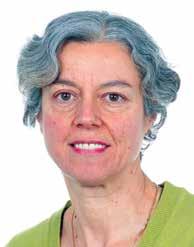
Professor Simone Hochgreb is Homerton Professorial Fellow in Engineering, with a focus on energy, fluid mechanics and turbomachinery. She is currently part of a Cambridge team working to develop a new method of creating a lithium ion battery using flame spray pyrolysis (FSP). If successful, the process could transform the charging capacity of electric vehicles.
What is the overall aim of this project?
There’s a race for higher performance batteries, which means that people with lots of different specialisms are coming together to investigate the possibilities. Material scientists and electrochemists have a number of ideas of what should work, but we do not know what we can produce, so the idea is to combine our expertise.
How do you go about exploring what might work?
We’re looking at the key storage materials, which often involves a metal and an oxide. They form structures through which the lithium can move in and out, so we can then examine how they behave. For example, nickel, magnesium and cobalt oxides form structures that have good storage capacity.
Is the storage capacity the key decider for what might work as a battery?
You also need to have good conductivity. It’s about getting the electrons to move when you want. We’ve been playing around with different forms of carbon and experimenting with how they behave in action. You might be able to simulate a million atoms, but that is too small to represent a real material, so you have to test it.
How do you approach the testing?
The current practice is to grind the different materials together in a mortar and pestle, alchemist-style. In this project, we’re looking at how the materials might be produced in a single process, heating some metal precursor droplets to oxidize them into micronsized particles, followed by a process of coating them with carbon.
What is the ideal result that you’re hoping for?
In an ideal world we’ll be looking at what kinds of materials are best for good storage, and how they can be produced. Ideally it would be carbon-based, because it’s readily available and generally not toxic.
If you find a material that works, do you then have to consider what the environmental implications would be if it was scaled up?
That’s a really interesting question. For example, one of the materials used in batteries is cobalt. Most cobalt comes from the Congo – what political situation do you create by becoming dependent on it?
The technical problems are solvable, and that’s our remit. It’s the political problems which follow that are difficult. But one good thing about metals is that they’re infinitely recyclable, so we wouldn’t be necessarily creating dependence on a finite resource.


Dr Kamal Munir is a Homerton Fellow, Reader in Strategy and Policy at the Judge Business School, Academic Director of the Centre for Strategic Philanthropy and a Race and Inclusion Champion for the University of Cambridge.
Born in Sheffield, where his father was studying, he grew up in Pakistan, and came to Cambridge in 2000.
In April 2021 he was appointed Pro-Vice-Chancellor with responsibility for the University Community and Engagement, a role which he will take up in October.
Your research interests are very multi-disciplinary. What was your starting point?
My first degree, in Engineering, took five and a half years to complete. It was the days of the first Afghan war, and Pakistan served as the pipeline for American weaponry meant for the ‘Mujahideen’. All universities were flush with the latest American and Soviet (captured) weapons, and different student factions had armed themselves so there was often cross-firing between dormitories. Every year an innocent student would be killed and the university would shut down for six months.
During my engineering degree I worked in an engineering design office, working on buildings and bridges, before moving into management consultancy.
How did you move into academia?
I then did an MBA, followed by a PhD in Strategy at McGill University in Montreal. I didn’t know very much about what I was getting myself into, and it was a bit of a long, lonely road. Canada’s a great place but the winters are brutal. When I moved to the UK people would ask me what brought me here and I’d say the weather and they’d assume I was joking but it’s true!
After completing my PhD I had a job offer from Cambridge. Basically, they gave me a tour of the cricket grounds and I said ‘where do I sign?’. I began a lectureship at the Judge Business School, which has now been my home at Cambridge for 20 years.
Apart from the Judge, I have also supervised PhD students in Geography, Development Studies and Politics. It’s one of the big charms of Cambridge, that it has so much to offer.
You describe your research focus as “Strategy in turbulent and disruptive competitive environments”. Could you unpack what that means?
We’re living in a very turbulent time. Businesses are a key stakeholder at JBS, and they’re under attack from lots of different directions.
We used to talk about industries, but now if you ask someone who works for Apple or Amazon what industry they’re in they won’t know – these huge organisations sprawl across multiple industries. Anticipating competition is much tougher when you don’t know where it is going to come from. How to anticipate and adapt to changes, and position yourself strategically in ecosystems is what I focus on.
In particular, I am fascinated by how organisations either cannot see change coming, or are unable to adapt to it. Think about Kodak. They pretty much created popular photography (before Kodak, there was no ‘Kodak Moment’!), but although they had a quarter of a century to adjust to digital, they couldn’t. I see the same thing now in banking. It’s very difficult to persuade companies that threats are real. Faced with uncertainty, we double down on what we know how to do best.
I advise businesses, but I also learn from them. At the end of the day I’m a researcher and when I spend time with businesses it all feeds back into my understanding. Businesses are often overly focused on one thing but as an outsider I am able to see similarities across widely different industries.
Recently, with a PhD student, I’ve been working with a large NHS trust and it’s been fascinating seeing how they’ve adapted to the demands of the pandemic. Hospitals have mechanisms in place to deal with change, but something as prolonged as Covid requires adaptation on a different scale. Hopefully our research will make them much better equipped to handle such crises.
What have you been concentrating on over the past year?
I’ve mainly been looking at inequality in organisations. Organisations can very easily become vehicles for perpetuating inequality, so I’ve started focusing on what we do in organisations that exacerbates gender, race and class-based inequality. All organisations claim to be meritocratic, but in everyday practices, that can be far from true.
You’re also the Academic Director for the Centre for Strategic Philanthropy at the Judge. What are its aims?
The CSP came about thanks to a donation from a philanthropist and businessman based in the Middle East. Its focus is on emerging markets, where we want to track and shape how philanthropy happens. While philanthropy is not the only solution, it has traditionally played an important role in
society. People want to give in a way that has impact, but we lack data on who is giving to whom and how much impact it is having.
We set up the centre at the beginning of 2020, and almost immediately Covid happened. The pandemic has had a huge impact on patterns of giving, and also on our own operations. Our former centre manager joined in March 2020 and left in January 2021. She’d never set foot in the building, and I’d never met her physically!

As if two jobs weren’t enough, you have a further role as a Race and Inclusion Champion for the University.
Yes – I’ve been doing it for four years now, but it’s been much more noticed since the Black Lives Matter movement. I hope things are changing in the University. Certainly, we’re having conversations that just weren’t happening a few years ago. We’re collecting data, which was previously very patchy, on representation. There’s a whole team of us working on diversity and inclusion, and we’ve come a long way, for which a lot of credit must go to the ViceChancellor. We used to get people saying “It’s great what you’re doing, but try not to use the ‘r’ word,” meaning racism. The ViceChancellor has never been shy of putting fighting racism on the agenda.
We act on behalf of the University, so we can’t tell the colleges what to do, which is why I’m so thrilled by how proactive Homerton has been.
You were part of the University for a long time before you became affiliated with a College. How have you found that relationship?
There’s an extremely friendly, welcoming community at Homerton, and I really cherish that. It adds a different dimension to life in Cambridge. You also get to know more students through being part of a College, and discover other issues that you can contribute to.
You’re about to take up a new position, as one of the five Pro-ViceChancellors providing academic leadership to the University. What are you most looking forward to?
The role has been restructured with a greater emphasis on diversity, which is quite exciting. We started doing some work on this a few years ago, but it’s really intensified over the past year. We really want Cambridge to be a leader in terms of how diverse, forward-thinking and progressive it is.
I am also working with the university museums on the legacies of enslavement project. The conversations we’re having will problematise the collections we have, but they will also become a bridge for the museums to engage with the wider world.
As Lord Woolley of Woodford prepares to begin his new role as Principal in October, we talked to him about what makes Homerton different, the importance of widening access, and how it feels to take on a College you’ve never visited.

How did the position of Principal first come to your attention? Were you approached by the recruiters or did you see it advertised?
I was approached by the recruiters. I had been approached about a number of Colleges and hadn’t really given it much thought. Then I saw Homerton and immediately thought “Homerton’s different.” I had worked in Hackney for 25 years, so I knew Homerton in East London very well and wondered whether it had any link to the College. When I found out that it did, I liked the connection. It felt like a place with strong working class roots that nevertheless aspires to greatness, and I liked that.
Your interview process was all conducted remotely, and you didn’t visit the College until after you had already accepted the role. Did you feel that you were able to build up a reasonably accurate impression of it?
I had seen a lot of pictures, but I couldn’t get the heart and soul of the place from those. But the heart and soul emerged from the conversations I had – with staff, with Fellows, with students, with cleaners, with maintenance staff. They all spoke with such passion about the College, about it not being puffed up, about it being a family. I thought “this is something quite special”.
What is it about Homerton that particularly excites you?
I like the idea that it doesn’t just aspire to greatness, but tries to instil a sense of responsibility, a sense that part of the privilege of receiving a world-class education is a duty to give back. We have enough selfish bankers and immoral politicians – we don’t need to nurture any more of them.
I feel very lucky to be taking the reins from Geoff. We’re custodians of this wonderful institution and he’s handed it to me in great shape. He’s said to me: “Now you’ve got to take it to the next level,” which is very exciting.
What interactions with Cambridge have you had before, and what preconceptions do you have that you’re hoping to disprove?
Absolutely none, except for one visit when I was 26 which inspired me to give education another go – I ended up returning to university via an access course. I suppose my preconception is that Oxford and Cambridge are very privileged places that too often can lock talent out and lock privilege in. It’s a marathon, not a sprint, to make them more representative. But I hope to ride the crest of that wave towards greater representation, to demonstrate that Homerton is open to talent and dynamism on every street.
Your career to date has focused on racial inclusion, and supporting the participation of people from minority ethnic backgrounds in democracy. How does that translate to your new role?
We have to ensure that pathways to Homerton are much clearer, and that when people are here, that they’re well supported. It can be intimidating for anyone, coming to somewhere like this, but particularly for those from disadvantaged backgrounds. Although really, it doesn’t have the feel of somewhere that screams “you don’t belong”. But I want to make that beacon shine brighter.
I also want to bring in more diverse talent, bring in great Fellows and nurture our own.
Your appointment has been met with huge excitement, not least among those students and alumni who see their own story reflected in yours. But what would you say to those who might be concerned that your focus will be too narrowly engaged with one community?
I would say that my appointment is not a zero-sum game – because I and others like me win doesn’t meant that anyone has to lose. Embracing diversity gives us all a chance to shine, and to learn about each other.
The announcement of your appointment coincided with the release of the Sewell report (the report by the Commission on Race and Ethnic Disparities), of which you’ve been a vocal critic. What in particular did you object to?
The Sewell report missed an opportunity to talk about people’s lived experience and formulate a strategy that could get all our institutions to a better place. But in reality, most businesses and institutions seem to be on the right side of the curve in acknowledging the inequalities we’ve all seen laid bare.
Operation Black Vote has been a hugely significant part of your life for the past 25 years. How does it feel to step away from it?
Leaving Operation Black Vote is like seeing a child go off to university –you’ve done everything you can for them and you have to let them go. I’ve been utterly privileged to be able to make a difference in British politics. But it’s time for the next stage of the journey – I’m in Homerton mode from now on!
What are you most looking forward to?
I’m looking forward to the energy of all these wonderful people in academia. My role is facilitator-in-chief, ensuring people can flourish. It’s a huge privilege, and a huge responsibility, particularly in this Covid space. But while we are sensible in navigating that, the optimism of what we’re embarking on will carry me to work each day. There’s a lot of goodwill for me in this role, and I hope that I can do the Homerton family proud, and help Homerton to be a wonderful beacon of hope and ambition.
For Christine Andrews (née Harbottle), coming to Homerton in 1947 changed the course of her life. We talked to her on International Women’s Day about feminism, raising aspirations, and how the world has changed for women.
One of five children – “three girls, bookended by boys” – Christine had received what she describes now as “a wartime education – I’d been to four schools in five years and I didn’t really know anything.” Having left school without much sense of what she might do next, she accepted the nudging of her “pushy mother”, who got her a job as a nursery assistant at Newcastle Church High School.
“The very fierce head-teacher called me in and said ‘What are you going to do for a career?’ which hadn’t really occurred to me. But I loved working with children, so she suggested I train as a teacher.”
Although Cambridge at the time was in the midst of the debate over women’s degrees, which were only awarded from 1948, Christine doesn’t remember this imbalance generating anger among the Homerton students, whose own qualifications were unaffected.
“We weren’t feminists – it hadn’t occurred to us. We accepted our place in society. It was only in the 1950s and 60s that we realised we were being put upon!”
Instead, she remembers a Homerton which was seen very much as part of the wider university, thoroughly integrated into a social network of dances, mixed hockey games, and cycling back from town to meet the 10pm curfew.
In the context of a male undergraduate population which was older than usual, having been through the war, Homerton was “not differentiated from the rest of the university in people’s minds. It was a source of women!”

But between the socialising and the boys, and the excitement at being away from home, Homerton also gave Christine, now 92, a hunger for learning which she has never lost.
“It excited my brain,” she says now. “It gave me a real interest in learning, and set me on a pathway which was quite different from the aspirations of my parents and most of my contemporaries.”
While her parents were already unusual for the time in their willingness to fund higher education for their daughters, Christine used Homerton as a launchpad to far greater autonomy than they had envisaged. Until just three years before she trained, teachers had been expected to give up their jobs on marriage. Far from following suit, Christine carried on working throughout the childhood of her own four children.
“My husband, Michael, was very accommodating – several friends said
they wouldn’t dream of letting their wives go out to work! But I always wanted to hold onto my independence.”
While teaching and bringing up her children, Christine also continued her own education, completing a diploma in Sociology at London University, and eventually converting her Certificate in Education to a BEd through parttime study.
In retirement she took on a second career, which she pursued well into her 80s, devising and implementing training for play-workers running after school clubs and holiday programmes. She also volunteered to set up play schemes for children visiting their mothers in prison.
“If a man goes to prison, things carry on at home. If a women goes, the family falls apart. And over this past year, many children whose parents are in prison haven’t been able to visit them at all. It’s appalling.”
Having “always hated being called Mrs Andrews,” she adopted Ms as her preferred title “as soon as it was invented.”
“I deeply regret changing my name, but it really wasn’t an option not to when we got married in 1952. My mother would have died a thousand deaths if I’d suggested it.”
Her own daughter, Jo, studied PPE at Lady Margaret Hall, Oxford, in the 1970s, and became a broadcast journalist. After many years as senior political correspondent at ITN, she moved into the charitable sector, before co-founding Equileap, which provides data on gender equality in the workplace in order to accelerate progress.
Jo credits the confidence Christine developed at Homerton for the fact that her own feminism, and belief in her right to pursue her own ambitions, were always a given.
“As the only girl in a family of three boys, I always knew I was completely equal to them, and that my parents had completely equal expectations of us. I didn’t take that for granted – I had a friend who wanted to be a doctor, but her parents told her not to be silly, to become a nurse and to marry a doctor. And even when I was going to Oxford, there were friends of my parents who said ‘oh, so you’re going to be a bluestocking?’
My parents’ fierce belief in equality was hugely important to me.”

Seventy-four years after Christine’s student days, expectations of and opportunities for women have changed beyond recognition. But she is far from complacent about how far we have come.
“Now the world is wide open to you –women can even go into space! But girls are still not sufficiently encouraged to be aspirational. We still have a long way to go.”
Christine has instilled that aspiration in generations of schoolchildren, all of
whom have benefited from the training she received in Cambridge. But for her daughter, the impact of that training is closer to home.
“My own feminism really comes straight from my mother’s backing and support, and I see that as coming straight from Homerton. Our lives, and my life, would not have been nearly so interesting and fulfilling as they have been, had my mother not been to Homerton.”
Taking on a new position in lockdown is a bizarre experience, no matter how high profile the role. Six months on from becoming HM Chief Inspector of Prisons, Charlie Taylor “still hasn’t met half the staff”, though he has been able to conduct prison visits.
Aftercompleting a BEd with English and Drama at Homerton in 1988, Charlie taught at various primary schools in south London, becoming increasingly interested in children with behavioural difficulties. After publishing two acclaimed books on toddler and teenage behaviour, Divas and Dictators, and Divas and Doorslammers, he was appointed head of The Willows, a school for children excluded from mainstream education. Under his leadership the school achieved two Ofsted ‘Outstanding’ ratings.
Under Michael Gove as Education Secretary, he spent several years at the Department for Education as an expert adviser in behaviour, before moving to the Ministry of Justice where he became Chair of the Youth Justice Board.
What do you remember of Homerton?
At the time, everyone was studying education, so it was semi-vocational, though only around 50% actually went into teaching. It was fairly evenly split between the people who had always wanted to teach, and the people who were there because it was a way of being at Cambridge.
It was about 90% women, which was a bit of a change after an all-boys school, but I don’t remember that being too strange. If anything, because there were so few boys it meant you got on with people you probably wouldn’t have got on with if it had been 90% boys – we were all thrown together.
I still think about some of the children I taught while training. There was a boy who really stuck with me – in fact thinking about it, he may have been the initial reason for my interest in children with behaviour problems.
Had you always planned to go into teaching yourself?
No, I thought I was part of the other 50%! I enjoyed my teaching practice but I somehow thought it wouldn’t be for
me as a career. I started supply teaching in about 1988, and got sucked in.
I became interested in children with behavioural difficulties and what made them tick. In 2005, having been working on the pilot for a new educational initiative in Hillingdon, I had visited The Willows and was interested in what they were doing. I wanted to get back into teaching, and thought the head might be due to retire, so I opened the TES and it fell open on the advert for his job.
Your work at The Willows attracted a lot of attention, not least your introduction of ‘tea and toast’ for students and staff. What was the thinking behind that?
On a practical level, lots of the children hadn’t had breakfast when they arrived in school, so we needed to get some food into them to enable them to learn. But it was also an opportunity to teach social skills. These were kids who hadn’t sat round a table, who didn’t sit down for dinner with their families. Just sitting and eating with adults and learning to say “could you pass the sugar, please” was hugely valuable.
We’d also get teachers to role play conflict, so that the children could see, in a way a lot of them didn’t at home, that it’s possible to resolve disagreements peacefully. You could see, as soon as there was a suggestion of even imaginary conflict, some of them would tense, assuming it would lead to violence.
These were kids with very troubled lives, and we’re never going to be able to fix all that. But you never know the good you’re doing and what might stick.
Under the Coalition government, you were appointed as an expert adviser in behaviour to the Department for Education. How was that?
I came from the chaos of a failing school, which I had just taken over, that was in real difficulties to Whitehall – it was fascinating to see a government department in action. I produced a “behaviour checklist” that still

gets used, which is really rewarding. In fact, I met someone the other day who had done their Masters’ dissertation on it, and I had to pretend to be blasé but I was so excited!
Since then you’ve moved from education to the justice system, which sounds like a leap, but with the common thread of your interest in behaviour it makes a lot of sense. The principles are broadly similar in families, schools and prisons – light touch sanctions and rewarding the behaviour you want to see. People seem to think that if you can refine the punishment you’ll stop the behaviour. But children with severe behaviour problems or adults in prison often have nothing to lose. Punishment makes no difference. I’ve spent my career looking for what works, and what it comes down to is positive relationships.
When I go around a prison I’m familiar with most of the stories. Substance abuse,
familial breakdown…these are the same issues faced by the children I taught. In some ways it’s inevitable that people who’ve had difficult and troubled childhoods are the same people who go on to have difficult and troubled lives.
What perspectives did a background in teaching give you on the world of prisons?
When I moved, in 2015, from the Department for Education to the Ministry of Justice, to review the Youth Justice System, what really struck me was that what was happening in the best special schools and Pupil Referral Units just wasn’t happening in prisons. I found two job ads, one for a teaching assistant in a school for pupils with behaviour problems, and one for a prison officer. They were about the same pay grade but what hit me was that one was all about hope and change, the other was all about containment and
control. I showed them to the Minister and said “just look at the language here.”
We’ve since proposed a system of secure schools, to support sentenced or remanded children, and the first is due to open in Medway next year.
You were appointed as HM Chief Inspector of Prisons in November 2020. Is it a fixed-term role, and what do you hope to achieve?
It’s a three-year appointment, and it’s completely independent. My predecessors have always been fierce defenders of that independence, so I’m very lucky that it’s well established.
I want to focus on the quality of leadership in prisons. It’s strange coming from education, where leadership is the first thing that gets reported on. Ultimately, that’s the biggest factor in terms of improving any institution, whether it be a school, or a Cambridge college, or a prison.
After graduating from Jesus College with a BA in History, Eve joined Homerton in August 2019 as Schools Liaison Officer, responsible for building Homerton’s relationship with schools and encouraging students in our Link Areas to consider higher education and apply to Cambridge.
9–10am
Usually, two days a week I’ll be out visiting schools. Each college has a Link Area where they are responsible for making connections with local schools. Homerton’s are Scotland, South Yorkshire, Buckinghamshire and Richmond, Hounslow and Kingston in London. The Link Area scheme has existed since 2010, so some schools have good established links with us. There was already a mailing list of about 150 schools when I joined, and I send them a monthly e-newsletter and keep them up to date.
But sometimes schools we’ve had no previous contact with will reach out to us, or I’ll suddenly be successful in getting engagement from a school we’ve previously had no luck with. Sometimes there’ll be one very keen teacher for a term or so, and then the role will move to someone else and we’ll lose traction.

10–11am
If I’m visiting a school, I might be speaking in assembly to several hundred students, or running a small workshop with ten. I enjoy the bigger assemblies, but they’re probably the least impactful way that we engage. It’s much more powerful to be able to talk to smaller groups, or to bring students to Cambridge themselves.
Around 50% of the students I work with are sixth formers, but we do a lot with Year 11 too. They’re a really good age group to target – if you raise aspiration at that point it can make all the difference. I’ve worked with children as little as Year 6 too. At that point it’s not about telling them to apply to Oxbridge; it’s more about giving them a fun day out, raising aspirations and hoping that something sticks.
11am–12pm
At least one day a week we have school groups visiting the College. I’ll put together a timetable in advance with their teacher, but usually they’ll spend the morning having student-led tours in small groups, with lots of opportunities to ask questions, as well a larger presentations and Q&A sessions. With the older ones we’ll also try to build in some subject-specific sessions. They’re usually just on a day trip, so for the schools we work with in Yorkshire that might mean they’ve set off at 5am. They arrive a bit bleary-eyed, but so excited!
12–1pm
If we have a school group visiting, they’ll all have lunch in the Hall. The looks on their faces when they see the Hall for the first time are always wonderful. That’s probably the thing I’ve missed most over the past year, when everything has had to be remote.

1–2pm
Around 90% of my role is access and outreach, and the remaining 10% is admissions. December is completely taken up with interviews. In normal times I coordinate the student helpers who look after the applicants and show them where they need to go. This year the interviews were all conducted remotely, but we still had a virtual waiting room on Zoom so that the applicants could chat to current students, which a lot of them did.
Then in August, when A level results come out, I help to sort out the Pool, and all calls to Admissions are redirected to me. In 2020, (when results were decided by an algorithm, until a Government U-turn meant that they were decided on the basis of teacher assessment) I had a lot of crying students and parents on the phone. It was an exhausting couple of days, but it must have been so much more so for them, and I felt that the least we can do as a College is to provide a human they can get at. Fortunately most of them were helped by the U-turn and ended up with the results they deserved.
2–3pm
Usually in the summer we would travel to Scotland for a week with a group of student helpers to visit lots of schools in one go, and we would also host a residential week in College for 60–100 school students.
None of that has been possible this year, but instead we’ve hosted taster days and sessions on Zoom, as well as webinars that mirror what a day at Homerton would be like for different subjects.
Last summer, we also launched the Homerton access course, aimed at Year 12 in our link areas, but open to anybody. It’s nine weeks long, with themed webinars covering each aspect of the application process, from personal statements to interviews to subjects. I do the same session live four times each week, and students watch from home.
For the first course we had 250 participants, and over 700 have signed up for the spring one, from Hounslow to the Highlands. It would be impossible to replicate that in real life – before Covid I’d have had to squeeze all that information into one assembly. It’s one real positive that I’ll take away from this time, realising how useful virtual engagement can be. When this year’s applications came in, several of them mentioned that they’d taken part in the access course.
3–4pm
For two days a week I’m usually planning, based in the Tutorial office. The student community is so strong at Homerton, and people are so willing to help. When I first started I did some training with student helpers on how to answer difficult
questions, and 150 of them turned up. I’ve really missed being around them all.
I came to Cambridge from a big state school in Wymondham, Norfolk. My mum had been to university but no one else on either side of my family had. I hadn’t realised before I started that there was a whole community of students who were interested in access, and I quickly got very involved in that.
By the time I graduated I knew that I wanted to work in education or for a charity. I already knew Homerton well because I’d had a lot of my supervisions there, with Bill Foster (Director of Studies in History). It’s just as friendly as everyone says it is, so this really felt like my dream job when I saw it advertised.
4–5pm
I’ve spent almost all of the past year working from my parents’ home in Norfolk, which has been a bit strange! We do quite a lot of work with external partners and educational charities such as the Brilliant Club, the Sutton Trust and the Social Mobility Foundation, so I’ve been keeping those connections going.
I miss travelling and engaging with students and teachers, but mostly I just miss seeing the looks on students’ faces when they see everything for the first time. Cambridge and Homerton, by existing, do half of my job for me.
Since training as a teacher at Homerton, Sister Bernadette Chabongora (BEd 1981–85) has juggled a career at the top of Zimbabwe’s education system with a life of service caring for her community as a member of a religious order. She talked to the Homertonian about her time at Cambridge, the opportunities it led to, and how the friends she made at Homerton rallied round when the pandemic hit four decades later.
Sister Bernadette Chabongora’s early education was disrupted by two things – her decision, in her late teens, to join the Sisters of the Child Jesus convent, and guerrilla warfare.
Having attended her local village school and a boarding school, both in rural Zimbabwe, Sister Bernadette continued to study for her A levels after taking her vows and becoming a nun. But the unrest due to the protracted guerrilla war caused her school to be closed, barely a month after starting A level studies, so she and a fellow junior nun were sent to London to complete the course.
“I’d never left Zimbabwe before,” Sister Bernadette recalls now. “We stayed in a hostel run by nuns, in Swiss Cottage.”
After finishing her exams Sister Bernadette decided to stay on in the UK to train as a teacher, arriving at Homerton in the autumn of 1981.
“It helped that I had been to boarding school,” she says of the transition to College life. “It prepared me to live with people from different backgrounds. I was so excited to be going to university.”
Older than her classmates, a member of a religious order, and one of very few Black students in Cambridge at the time, it can’t have been easy to have had so many points of difference between herself and her contemporaries, while so far away from home. But Sister Bernadette thoroughly enjoyed the training, and still remembers those who helped her to feel welcomed.
“There were some other Catholic girls in College, so we used to go to church together. And I used to visit the convent up the road. Also the caretaker’s wife used to invite me over and make me feel at home. We were placed on the corridor according to our surnames, so I was next


to a girl called Anna Chapple. One year, when I wasn’t able to stay in the hostel over Christmas, her mother phoned me up and told me to come and stay with them in London – we’re still in touch! I can’t remember any distressing incidents, everyone was very friendly.”
Returning to Zimbabwe after her degree, Sister Bernadette worked as a teacher and in teacher training, later completing her MPhil. Rising through the ranks of the country’s education system, she spent time as the National
Chief Examiner, as well as working as Education Secretary for the Diocese of Gweru, where her convent is based.
In 2011 she completed her PhD in South Africa, returning to Cambridge to write up her dissertation.
“There was so much pressure, and my supervisor arranged for a small scholarship for me to complete my write up and asked where I’d like to go. I came back to Cambridge so that I could make use of the University Library, which also meant that I was
able to attend my year group’s 30th anniversary reunion at Homerton, which was wonderful!”
In 2013 Sister Bernadette became part of the order’s leadership team, a full-time role which meant that for six years her commitments in education had to take a back seat to overseeing the order’s community projects. These include a children’s home which cares for around 70 orphans and vulnerable children; a home for around 150 children with intellectual disabilities; a health centre looking after patients with HIV as well as providing general health care; and a school supporting young mothers to continue their secondary education.
This crucial role of community support which the nuns provide meant that they were in the frontline when the pandemic hit Zimbabwe in 2020. With no medication or protective equipment, Covid-19 hit Gweru hard, with the convent providing the bulk of the care for those affected. Hyper-inflation meant that the nuns were already struggling to meet their ongoing costs, and were unable to cover the additional expenses of masks and PPE.
When Sister Bernadette’s Homerton contemporaries heard of the difficulties the convent was facing, they rallied round. Four friends worked to spread the word, managing to reach out to 80% of their original year group via a WhatsApp group. Through a Crowdfunder, and a story shared on Homerton’s social media platforms, they raised over £5,000 to support the community through the Covid crisis.
“It’s really amazing, that after 40 years so many people want to help,” says Sister Bernadette. “It’s been very scary and difficult – we lost five sisters and the rest of us have been left very shaken. But it’s been such a surprise to have this support from nowhere from my Homerton friends. I was really overwhelmed.”
To keep up to date with how Homertonians and their families and friends are supporting the community in Gweru, follow Zimbabwe in Need (zimbabwedrive.blogspot.com)

Kevin Glasgow is in the first year of his PhD, having previously completed a PGCE and an MPhil in Science Education at Homerton. He spoke to us about how one degree led to another, and how Homerton shattered his preconceptions of Cambridge.
Asan undergraduate I studied Genetics at the University of Glasgow. My mum’s a geneticist there (though she never taught me) and I lived at home, so although I had a great time I was keen to move away by the time I graduated!
In my third and fourth years I got involved in outreach and really enjoyed it, so I started to consider teaching. But I was also already fairly sure that I wanted to do further study in science education. I spoke to Glasgow University about a possible PhD at that stage, but was told that it would be better to have trained as a teacher first, in order to better understand the world I’d be studying. It also meant that I would always have a fall-back career.
I applied to several London universities, and only really applied to Cambridge for a laugh – I didn’t think I’d get in! For the PGCE, you don’t apply to a College until you’ve already been offered a place on the course. I applied to Homerton, because of its proximity to the Faculty of Education, and to Jesus because it was the only other College I’d seen when I visited! Thank God I got into Homerton. So many of the events

relating to the course happen there, and I wouldn’t have made the vast majority of my friends if I hadn’t been there.
In the first term of my PGCE I went to everything. It was the first time I’d lived away from home and I didn’t know anyone, so I tried out all the societies. The two I settled into and have stayed with ever since were the Boat Club and the Sign Language Society, which have both been a huge part of my Cambridge experience.
I was surprised when I first arrived by how few Scottish people there were at Cambridge – I hardly ever come across another Scottish accent. But I was also pleasantly surprised by how not-posh it was. I know other colleges might be different, but Homerton has a much broader social mix than I anticipated and it’s very socially liberal.
While I was doing my PGCE I was living in College accommodation, which was great as I met lots of people, and my now flatmate and I were able to try out living in close proximity to each other before moving into a private flat.
As I knew that I wanted to go onto further academic study rather than into teaching, I was a bit worried that the PGCE course directors would resent the fact that they had put all this effort into training me to be a teacher when I wasn’t going to be one! But of course when I mentioned it that wasn’t the case at all. I was the only person from the course who stayed on to do more full-time study, and it felt a bit strange applying for the MPhil and taking on student debt at the point when all my friends were applying for teaching jobs and looking forward to having a salary. But I was fortunate that, having done my first degree in Scotland, I hadn’t had to pay fees, so I didn’t have any undergraduate debt.
I did the MPhil in Science Education the year after my PGCE, and applied for my PhD a month into the course. I’m now in the first year of my PhD, looking at perceptions and experiences of science and religion in Scottish Catholic schools.
Having been to a Catholic school in Glasgow myself (15% of state schools in Scotland are Catholic), I’m fascinated by the impact of the religious ethos of the school on the way that the two subject areas are taught.
I do put my PGCE to practical use though, working as a supply teacher in the university holidays, which I really enjoy. I’ve also been working in research assistant roles, and am applying for internships in social science and policy.
I feel so lucky that I ended up at Homerton. Because it’s such a big College, it’s possible for everyone to find a group of like-minded people. It’s really nice to be able to be so familiar with the staff – I regularly sit and have a coffee with Deborah (Griffin, the Bursar) or Melanie (Keene, the Graduate Tutor) and Geoff (Ward, the Principal) sent me a Christmas card!
There’s a huge emphasis on welfare. Melanie is fantastic at making sure everyone’s ok, and Paul (Coleman, Head of Catering) makes a point of asking everyone about dietary requirements and you really feel he means it. I’d feel comfortable bringing any friend to eat at Homerton knowing that Paul would look after them – and the food’s great! The Porters are absolutely amazing too – I’ve really had to rely on them before and they went above and beyond.
But the best thing is how tolerant and liberal the student body is, and I feel that’s mirrored from the staff. I’m so grateful I ended up here.
Well, what a year.
The Charter Choir’s first two performances of the academic year took place in October 2020 – it wasn’t until May 2021 that the third happened. Easter Term was, across the board, the most ‘normal’ term that we at Homerton have experienced since Lent Term 2020. For the choir, part of this was due to being able to sing live again, in a regular Tuesday Evensong setting at St John the Evangelist, Hills Road.
After the disruption of Michaelmas Term (a Homerton mass-isolation followed immediately by the second national lockdown), and with Lent Term being a non-starter with almost all students studying remotely during the third national lockdown, Douglas Coombes generously led weekly choir rehearsals online from January until March. However, the relief of returning to live music-making in May was evident. I would like it put on record how incredibly impressed by – and grateful for – our choir members’ unshakingly positive attitude I have been. Singing in smaller groups, we avoided the need to be spread too far across the church aisles, making communication between conductor, organist, and singers at the back a bit more effective than it otherwise would have been if we’d been at full strength but scattered across a larger area. Despite smaller numbers, we worked our way up to some challenging repertoire, including a little-
known five-part Renaissance motet and Howells’s Evening Service in B minor.
Looking ahead, we intend to have a short domestic tour to the south and southwest of England at the end of August. We’ll be singing Evensong in three cathedrals: Portsmouth (23 August), Truro (24 August) and Wells (26 August). Keep any eye on our website or Facebook page for further information – it would be lovely to have support from any Homerton friends or alumni in those parts of the country. Given that our 2020 tour to Italy had to be cancelled, I’m delighted that we’re going to be joined by all five of last year’s choir leavers. So long as everyone remains healthy, it should be a low-pressure way to ease back into regular choral singing.
As far as music-making goes, bring on the return to ‘normality’!
Dr Daniel Trocmé-Latter Director of Music

The Principal, Fellows, students and staff of Homerton College wish to thank alumni and friends who have generously made donations to the College over the last year. Every effort has been made to ensure this list is accurate; do contact us if you believe we have made an omission.
Alumni
1943
Mrs Kathleen Hayward
Miss Jean Robinson*
1947
Mrs Maureen Grover
Mrs Mary Warne
1948
Miss Elizabeth Rainsbury
1949
Mrs Coral Harrow
1950
Mrs Mavis Blow
1951
Mrs Shelia Duncan*
Mrs Sheila Smith
1952
Mrs Shirley Haslam
1953
Mrs Janet Edgar
1954
Mrs Diane Bilson
Mrs Pauline Curtis
Mrs Penny Marshall
Mrs Wynne Thorndike
1955
Mrs Gwenda Ackroyd
Mrs Maureen Champion
Mrs Christine Grainge
Mrs Anthea Griggs
Mrs Gillian Hewin
Mrs Doreen Hobbs
Mrs Loraine Schorter
Mrs Hazel Thornley
1956
Mrs Marguerite Donkin
Mrs Pamela Gaddes*
Mrs Eilidh Scott
Mrs Alice Severs
1957
Mrs Julia Davis
Mrs Gillian Figures
Mrs Jacqueline Fleetwood
Mrs Joan Hollinghurst
Mrs Pamela Judge
Mrs Christine Lincoln
Mrs Judy Manson
Mrs Val Read
Mrs Doris Stephenson
Mrs Josephine Sutton
Mrs Joan Taylor
Mrs Rita Wardle
1958
Mrs Nancy Cook
Mrs Diana Hadaway
Mrs Vivien Ivell
Mrs Beryl Izzard
Mrs Rachel Macdonald
Mrs Wendy Powell
Mrs Patricia Stott
Mrs Dorothy Waite
1959
Ms Madeleine Gair JP
Mrs Diana Lucas
Mrs Annmarie Mackay
Miss Gill Rogers
1960
Mrs Rosemary Allan
Mrs Patsy Blythe
Mrs Sue Dickinson
Mrs Jenifer Freeman
Mrs Jill Fuller
Mrs Rosemary Hill
1966
Mrs Elaine Beale
Lady (Marilyn) Fersht
Mrs Margaret Funnell
Mrs Judy Martin-Jenkins
Mrs Joy Voisey
Mrs Linda West
1967
Mrs Marjorie Caie
Mrs Miriam France
Mrs Netti Smallbone
1968
Mrs Valerie Hart
Mrs Lesley Marriott
Mrs Lynne Parsons
Mrs Pemma SpencerChapman
Mrs Marilyn Stansfield
Mrs Alison Syner
1969
Mrs Tricia Coombes
Mrs Cynthia Loudon
Mrs Jacqueline Swegen
Mrs Christine Kershaw
Mrs Jennifer McKay
1961
Mrs Marilyn Clare
Mrs Joy Kohn
Mrs Susan Lovett
Mrs Jill Niblett
Mrs Caroline Sykes
Mrs Jean Thorman
1962
Mrs Adrianne Ashcroft
Mrs Carol Bowen
Mrs Diana Dalton
Mrs Lynn Dowson
Mrs Marion Foley
Mrs Carole Girdler
Miss Esme Partridge
1963
Mrs Jean Addison-Fitch
The Revd Dr Anthea Cannell
Mrs Christine Macpherson
Mrs Erica Rigg
Mrs Kate Ryder
1964
Mrs Elizabeth Maycock
Mrs Sue Rescorla
Mrs Jill Taylor
Mrs Jane Woodford
1965
Mrs Sue Bennett
Mrs Lorna Cordell-Smith
Dr Tricia Cusack
Mrs Annie Illingworth
Mrs Janet Webb
Mrs Dilys West
Ms Sarah Jacobs
Mr Tony Little
Mrs Ann Muston
Mrs Jo Newman
Mrs Zena Tinsley
1977
Miss Sheila Berry
Mrs Ann Jackman
Ms Brenda Meek
Mrs Helen Mitchell
Mrs Jane Pearson
1978
Mrs Vicki Addey
Mrs Sandra Burmicz
Mrs Annette Cameron
Mrs Clare Danielian
Mrs Dee Davey
Mrs Mary Powles
1979
Mrs Oyinkan AdeAjayi
Dr Vicky McNeile
Ms Anne Reyersbach
Mrs Sarah Taylor
1970
Ms Fiona Cook
The Revd Sheila Crowther
Mrs Mary McCosh
Mrs Denise Mitchell
Dr Roz Sendorek
Mrs Helen Wood
Mrs Mary Wyatt
1972
Ms Catherine Beavis
Mrs Sarah Flynn
Mrs Margaret Howell
Mrs Fiona Karlin
Ms Anne Kennedy
Mrs Caroline Melrose
Mrs Valerie Mills
Mrs Penny Riley
Mrs Angela Swindell
Mrs Maureen Weston
1973
Mrs Fran Comley
Mrs Anne Mellor
Mrs Dilys Murch
Mrs Heather Wilkinson
1974
Mrs Jenny Little
Mrs Elizabeth Rose
Mrs Vera Sklaar
1975
Mrs Judith Davidson
Mrs Helen McRoberts
1976
Mrs Judy Clarke
Mrs Joan Gibson
Ms Jill Grimshaw
Mrs Elizabeth Dickinson
Mrs Lizzie Habashi
Mrs Leonie Hyde
Mrs Deborah Moss
Mrs Amanda Renwick
Mrs Brenda Thompson
1980
Mrs Jo Broughton
Mrs Sarah Holmes
Mrs Rachel Linfield
Mr John Turner
1981
Mrs Susan Cains
Miss Anna Chapple
Professor Gregory Clark CBE
Mrs Amanda Edwards
Mrs Cordelia Myers
Mr Graeme Plunkett
1982
Mr Stephen Bell
Lady Katharine Bryan
Mr Mark HanleyBrowne
Mr Brian Howarth
1983
Mr Jeremy Crook
Mrs Susan Hill
Ms Linda Slade
1984
Mr Peter Ventrella
1985
Dr Kirsty Byrne
Mrs Rosemary Gwinnett
1986
Ms Nansi Ellis
Mrs Yvonne Wiggall
1987
Mrs Alison Allen
Mrs Kim Chaplin
Mrs Michaela Khatib
Mrs Elizabeth McCaul
Mr James Thomson
1988
Mr Phil Coldicott
Mrs Katie Mayne
Mrs Sarah McWhinnie
Ms Philippa Rushby
Ms Adrienne Saldana
Miss Jen Svrcek
1989
Miss Lucy Bradley
Mr Carl Howarth
Mrs Penny Lee
Mr Simon Ray
1990
Mrs Naomi Baynes
Mrs Karen George
Mrs Fiona Gruneberg
Mr Ian Hodgson
Mrs Sharon Holloway
Mrs Beccy Millward
Dr Susi Pinkus
Dr Helen Price
1991
Mrs Joy Bensley
Mr David Chapman
Miss Helen Diggle
1992
Mrs Claire Brooks
Mr Simon Camby
Mrs Sarah Haines
Miss Caroline Mander
Mrs Diane Rawlins 1993
Dr Stephen Chapman
Mrs Helen Morgan
Mrs Margaret Prince
Ms Sara Stanley 1994
Mrs Torie True
Mrs Emma Vyvyan
1996
Mr Ian Bettison
Mrs Serena O’Connor
1997
Ms Caroline Bell
Mr Matt Buck
Mrs Amy McDonnell
1998
Mr Alastair Chipp
Mrs Elisabeth Hackett
Mr John Moore
Ms Julie Seplaki
1999
Dr Neil Hennessy
Mr Paul Jones
Mrs Susan Lyons
Mrs Laura Penrose
Mrs Louisa Tipler
2000
Mrs Sue Aldred
Mrs Robyn Brown
Mrs Angela Clark
Mrs Abby Deeks
Dr Tom Kitchen
Mrs Cheryl Smith
Mrs Lesley Crooks and Mr Gareth Crooks
Miss Lidia Fesshazion
Mrs Amy Fleming
Mr James Frecknall
Mrs Catherine Kitchen
Mrs Nadine Lloyd
Mrs Kimberley Rayson
Mrs Mandy WarnerBradshaw
2002
Mrs Katy Coles
Mr Sam Farmer
Mr Sutherland Forsyth
Mrs Carys Gladdish
Mr David Lawrence
Mr Remi Moynihan
Miss Krista Pullan
Mr Tim Scott
Mrs Helen Smith
Mrs Rhiannon WynneLord
2003
Ms Susanna Bellino
Mr Louis Budworth
Mr Philip Chapman
Dr Wing Chuang
Mr Raymond Cilia
Mr Gregoire Hodder
Mrs Anne Howell
Mr Jonathan Levine
Dr Feilong Liu
Dr Miranda Malins
Mrs Elizabeth Mansfield
Mr Daniel Roberts
Mr Tim Rothwell
Mr Jean-Paul Skoczylas
Mr Tristan Stone
Mr John White
2004
Mrs Emily Davies
Mr Chris Gerdes
Miss Natasha Gray
Mr Richard Hopkins
Miss Charlotte Pocock
Mr Ravi Raichura
Mr Adam Sergeant
Mrs Sian Shaw
Mrs Alexandra White
2005
Dr Enyi Anosike
Mrs Caroline Barker
Mr Nicholas Bebb
Mr Nick Clark
Mrs Rebekah Perry
Dr Oliver Rupar
Ms Nadia Syed
Mr Han Tu
Mrs Emma Turner
2006
Miss Aniko Adam
Dr Theresa Adenaike
Mr Andrew Blackburn
Mrs Liza de Uphaugh
Mr Thomas Dix
Miss Hannah Drew
Mr Vlad Hanzlik
Dr Joshua Jowitt
Dr Zhaoru Lin
Miss Afaf Nourallah
Mr Tom Robinson
Mrs Dawn Pavey
Mr Luke Shepherd
Miss Rosie Shimell
2007
Mr Ben Hayward
Mr Tom Horn
Mr John Keene
Miss Teresa Li
Mr Michael Lynch
Dr George Mak FRAS FRHistS
Mrs Pippa Pennington
Mr Joseph Randall-Carrick
Miss Beth Wattleworth
Dr Susan Wishart
Mr George van der Blom
2008
Mr Luke Clarke
Miss Helen Etheridge
Mr Mike George
Mr Matthew Linsell
Mr Philip McNerney
Miss Amy MunroFaure
Mr Ikenna Obiekwe
Mr Gershwinder Rai
Mr Kenichi Udagawa
Miss Rebecca West
2009
Miss Sophie Bell
Mr Daniel Beresford
Mr Bhavin Bhatt

Mrs Ratna Bhusal
Mr Iain Cameron
Ms Shruti Chaudhri
Dr Jack Euesden
Miss Christine James
Mrs Gabriella Mimran
Mr Christopher Morgan
Dr Syed Rizvi
Mr Michael Thorp
Ms Rhiannon Williams
2010
Miss Emma Bowell
Mr Nahum Clements
Miss Alex Courage
Mr Richard Craven
Mr James Henderson
Mr Paul James
Miss Sian Jones
Miss Suzie LangdonShreeve
Mr Richard Peach
Mr Peter Phillipson
Mrs Jessica Taylor
Miss Yuanjia Yin
2011
Mr James Atkins
Mr Jack Hooper
Mr Cuong Kasperzyk
Mr Ted Levermore
Miss Abigail ThurgoodBuss
Miss Vicki Waller
2012
Mr Joshua Cozens
Ms Louise Holyoak
Mr Tim Hubener
Ms Samantha Kellow
Dr Peter Marber
Mr Douglas Porter
2013
Mr Mark Boother
Mr Hachimi Maiga
2014
Mrs Alexandra Annett
Mr Ivan Dimov
Mrs Melanie Hardcastle
Mr Nigel Ironside
Mr Alan Kaydul
Dr Jiun-Lin Yan
2015
Mr Adam Dobson
Miss Sarah WitkowskiBaker
Dr Zamir Zulkefli
2016
Miss Mille Fjelldal
Mrs Ruth Eaves
Mr Graham Robertson
2017
Mr Matthew Rihan
2018
Major Rohan Bate
Friends of Homerton
Dr Norman Bardsley
Mr John Blythe
Miss Patricia Cooper
Mr Norman Donkin
Mr Timothy Edwards
Mr Gordon Gaddes
Dr Lesley Hendy
Mr Michael Karlin
Mrs Leslie Lemonick
Mr Matthew Moss MVO
Dr Kate Pretty CBE
Dr David Whitebread*
1768 Society
Mrs Vicki Addey
Mrs Rosemary Allan
Dr Enyo Anosike
Ms Catherine Beavis
Miss Sheila Berry
Mr Ian Bettison
Mr Andrew Blackburn
Mr Matt Buck
Mrs Sandra Burmicz
Dr Kirsty Byrne
Mrs Marjorie Caie
Mr Simon Camby
Mrs Kim Chaplin
Dr Steven Chapman
Ms Shruti Chaudhri
Mr Nick Clark
Mr Phil Coldicott
Mr Richard Craven
Mrs Pauline Curtis
Mrs Diana Dalton
Mrs Clare Danielian
Mrs Marguerite Donkin
Mrs Lynn Dowson
Mrs Sheila Duncan
Miss Mille Fjelldal
Mr Sutherland Forsyth
Mrs Miriam France
Mr Gordon Gaddes
Mrs Karen George
Mrs Carole Girdler
Mrs Christine Grainge
Miss Natasha Gray
Mrs Fiona Gruneberg
Mr Mark HanleyBrowne
Dr Neil Hennessy
Mr Gregoire Hodder
Mr Ian Hodgson
Ms Louise Holyoak
Mr Richard Hopkins
Mr Tom Horn
Mr Brian Howarth
Mr Carl Howarth
Mrs Anne Howell

Mr Tim Hubener
Mrs Ann Jackman
Mr Paul James
Mr John Keene
Mr David Lawrence
Mr Jonathan Levine
Mr Matthew Linsell
Mrs Susan Lovett
Mrs Diana Lucas
Mr Michael Lynch
Mrs Christine Macpherson
Mr Hachimi Maiga
Mrs Lesley Marriott
Mrs Helen McRoberts
Mrs Sarah McWhinnie
Mr Remi Moynihan
Mrs Ann Muston
Mr Ikenna Obiekwe
Mr Douglas Porter
Mr Ravi Raichura
Mrs Diane Rawlins
Miss Gill Rogers
Mrs Elizabeth Rose
Mrs Kate Ryder
Mr Luke Shepherd
Mrs Netti Smallbone
Mrs Cheryl Smith
Mr Tristan Stone
Mrs Jessica Taylor
Mrs Lesley Thomas
Mrs Brenda Thompson
Mr James Thomson
Mr Michael Thorp
Mrs Dilys West
Mr John White
Dr Susan Wishart
Mrs Helen Wood
Dr Norman Bardsley
Mrs Annie Illingworth
Macaulay Circle
Miss Patricia Cooper
Mr Gordon Gaddes
Mrs Coral Harrow
Miss Jean Robinson*
Mrs Kate Ryder
Mrs Dilys West
As a lifelong member of Homerton and the University of Cambridge you are entitled to a number of benefits. You are very welcome to visit Homerton and use the College Library, Buttery and Bar, and to dine at Formal Hall. Subject to availability, you can also book overnight accommodation at preferential rates and book function rooms for private dinners and events. For more information email alumni@homerton.cam.ac.uk
You can take advantage of great deals at a number of Cambridge hotels, bars, restaurants and retailers by using your CAMCard (issued by the University). You will also receive automatic membership to the University Centre and free entrance into most of the Cambridge Colleges.
To request a CAMCard visit https://www.alumni.cam.ac.uk/benefits/camcard
http://www.homerton.cam.ac.uk/alumni/benefitsandevents
Visit the College website for full details of our alumni events, local branches and alumni benefits. You can read College publications online and update your contact details when you move house or job. You can also read about the College’s current fundraising priorities and make a donation to Homerton online.

Have you been receiving our email newsletter? If you haven’t seen an eNewsletter recently, send us an email at alumni@homerton.cam.ac.uk to make sure we have your current contact details.


‘Like’ Homerton College on Facebook to keep up to date with what’s going on. Visit www.facebook.com/HomertonCollegeCambridge
Follow us for the latest news and updates @HomertonCollege
We are on Instagram. Check us out @homertoncollege
You can also connect with Homerton on LinkedIn. Simply search for ‘Homerton College’
Alumni Reunion Weekend will take place online from 24–26 September.
We are putting together an exciting programme and hope that you will be able to join us for talks, events and social get-togethers in virtual form.
Please note the date in your diaries and keep an eye out for further details.
HOMERTON COLLEGE UNIVERSITY OF CAMBRIDGE
Hills Road
Cambridge CB2 8PH
Tel: +44 (0)1223 747251
Email: alumni@homerton.cam.ac.uk www.homerton.cam.ac.uk
Homerton College is a Registered Charity No. 1137497