Homerton Roll Newsletter, 2010 15 ----------------------------------------------------------------------------------------------------------------------------------blood that was so exciting, rewarding and surprisingly enlightening. Years later I was fortunate enough to have three months ‗free‘ between the end of my job in Cairo, Egypt (I was there for 4 years as Drama teacher and head of Performing Arts) and the start of my fulltime MA (for one year) at Warwick University, so I decided it was time to plunge myself into some cultural Arts experience again. So I headed to Kerala, India. With the requirements of the world theatre practices in the IB Theatre programme at the back of my mind, I enrolled at the Vijnanakalavedi cultural centre in the little village of Aranmula. I headed to my mosquito infested housing to immerse myself in conservative Southern India and learn forms of Indian dance and drumming that would change the shape of my body, my mind and my future. In the pursuit of knowledge I lived alongside a group of Indian performing Arts teachers and foreign artists from all over the world. We ate together for each meal, sitting around a large wooden table and enjoyed south Indian delicacies, cooked in coconut oil and served on banana leaves. Each day started with an hour of yoga, then we headed off to the two hours of intensive personal teaching in our first subject. My first subject was Kathakali – a form of Indian Dance theatre that is about 500 years old, done traditionally by men, and performed in temples as an offering to the gods. Kathakali literally means ‗story-play‘, and through the performances stories from the Hindu epics ‗The Ramayana‘, ‗The Mahabharata‘ and the ‗Purana‘ are told. Training each day started with body strengthening exercises and footwork. Kathakali is very specific and there is no room for individual interpretation, so my teacher drilled me on these moves until I had mastered them exactly. For Kathakali dance the performers dance on the sides of their feet with their knees bent and their body straight, arms bent at the elbow and held at chest height. Holding this posture for hours on end is hard enough, but add the stamping foot work on a stone floor and it becomes challenging. This all prepares the dancer for the 50kg of costume that will be worn later in performance. Needless to say, many students dropped out of the Kathakali classes quite early on, and chose a softer option like singing or cooking! My afternoons were spent practising my footwork, learning the mudras (hand gestures), and reading up on Kathakali plays and characters.
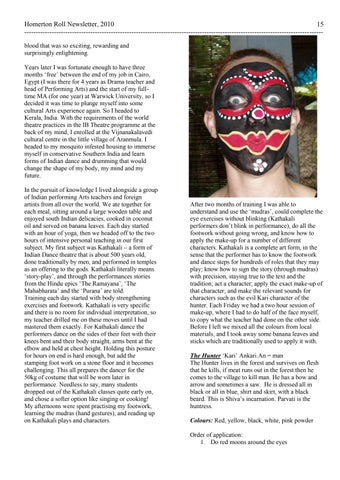
After two months of training I was able to understand and use the ‗mudras‘, could complete the eye exercises without blinking (Kathakali performers don‘t blink in performance), do all the footwork without going wrong, and know how to apply the make-up for a number of different characters. Kathakali is a complete art form, in the sense that the performer has to know the footwork and dance steps for hundreds of roles that they may play; know how to sign the story (through mudras) with precision, staying true to the text and the tradition; act a character; apply the exact make-up of that character; and make the relevant sounds for characters such as the evil Kari character of the hunter. Each Friday we had a two hour session of make-up, where I had to do half of the face myself, to copy what the teacher had done on the other side. Before I left we mixed all the colours from local materials, and I took away some banana leaves and sticks which are traditionally used to apply it with. The Hunter ‗Kari‘ Ankari An = man The Hunter lives in the forest and survives on flesh that he kills, if meat runs out in the forest then he comes to the village to kill man. He has a bow and arrow and sometimes a saw. He is dressed all in black or all in blue, shirt and skirt, with a black beard. This is Shiva‘s incarnation. Parvati is the huntress. Colours: Red, yellow, black, white, pink powder Order of application: 1. Do red moons around the eyes