
HOMERTONIAN
IN THIS ISSUE
The Vice-Chancellor gives the inaugural Kate Pretty Lecture
Be part of celebrating 250 years of freethinking education
Finding John Conder
Homerton College Alumni Magazine
21
Student life is full of opportunity, and our students seize those opportunities with both hands – and make their own. In this edition of the Homertonian we hear from Signe (p.22), who used a summer internship bursary to do important work for the city of Copenhagen; and Justin (p.16), who is balancing his undergraduate studies with organising volunteers in India and now Africa. Students grow into their future selves at university, and it’s a joy to support them on that journey.
The skill of those who teach our students is also celebrated in these pages: Dr Anthony Ashton (p.10), winner of a University of Cambridge Pilkington Prize for inspiring teaching, tells us of his love of mathematics and how he conveys that love to students in his lectures and supervisions.
And we uncover a couple of stories of ‘life after Homerton’: Elspeth (p.18) tells of providing healthcare in Malawi as part of an adventurous life (I particularly enjoy the throwaway line, ‘possibly I was the first female to drive across Saudi Arabia’…); and Tarquin (p.24) explains how he ended up using the skills he developed as a teacher in an unexpected career which includes helping to recruit the head of a $2 billion organisation to prevent infectious disease.
As the Principal says in his introduction, Homerton is the stage-set across which all these actors move, and more than that, an empowering place of learning and exploration. We are all indebted to John Conder, the Principal (or perhaps President?) who led the College in its very beginnings in London in 1768. His story is unearthed by Peter Warner on p.20 and his legacy is a 250-year-old institution that still feels very fresh and relevant to today’s world.
Matthew Moss
Director
of
External Relations and Development
The Homertonian is published once a year to keep members informed with College and alumni news. Contact us in the Development Office on Telephone 01223 747066 or Email alumni@homerton.cam.ac.uk with feedback, news or letters. All our publications are available to read online on the Homerton College website: www.homerton.cam.ac.uk/alumni/publications.
Thank you to all of our contributors and to those who supplied images. The views expressed in this publication do not necessarily represent the views of Homerton College, Cambridge. Cover photograph: James Appleton. Design and print management: H2 Associates, Cambridge.

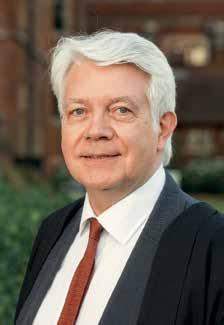
Back in October 2013, excited at taking up my new post as Principal, I thought I would take a morning walk around the College grounds. I did this partly in order to familiarise myself with my new place of work, but partly to test out the claim, one I had heard so many times, that ‘Homerton is Cambridge’s friendliest College’. Trouble was, there didn’t seem to be anyone around to befriend. I had come from a college in London where I bumped into students as soon as I left my office, but here, although the trees of early autumn nodded in seeming acceptance and the green pathways beckoned – Homerton just didn’t seem to have any students, friendly or otherwise.
Of course, as on any weekday morning, they were mostly offsite in laboratories or lecture halls, and when the human wave poured back in for supervisions, for downtime, and for dinner, the rhythms of the place began to pick up and resonate for me. Homerton, I now saw, was home, the place of return. Yet it was also the place of departure, and in the best sense, a stage-set – waiting for its actors to appear and make use of its inner sanctums and outside spaces to launch their careers, lives and dreams.
This dual identity is one I have continued to think hard about, which we all should as a community, to make it the best. Our students need the right spectrum of spaces in which to study, relax and share their thoughts. So I am delighted that we will soon have new spaces that will help them to do this. Following an architectural competition in which 155 practices
PRINCIPAL’S WELCOME
expressed interest, these being whittled down to 25 and then 2, the College has chosen Feilden Fowles Architects to give us a spectacular new Dining Hall for the centuries to come. The new Hall will echo the Arts and Crafts elements existing in the beautiful Ibberson Building and also the neo-Gothic splendour of the Great Hall, whose kitchens and serving areas can no longer cope with our numbers. Though the new Hall will refer, it will not defer to the buildings alongside it, but will give us a light and beautiful environment with state-ofthe-art catering and functionality. It will also allow the construction of new study spaces for students who at present have to be satisfied with a pleasant but small and crowded buttery, doing double duty.
A College is vibrant and successful when the activities it hosts are at a consistent level of excellence that encourages personal development and further success. We were delighted when Claire Lambe and Alice White rowed in the successful Women’s Boat in this year’s Oxford and Cambridge Boat Race. We are honoured as well that so many prominent individuals are ready to come and join us as Fellows. This year we added to the list of Honorary Fellows Sir David Harrison, a key player in the transition to gaining the Charter in 2010, prize-winning author Meg Rosoff, Dame Evelyn Glennie CH, maestro solo percussionist and motivational speaker, and Dame Sally Davies, the Chief Medical Officer for England. We were also honoured that the Vice-Chancellor,
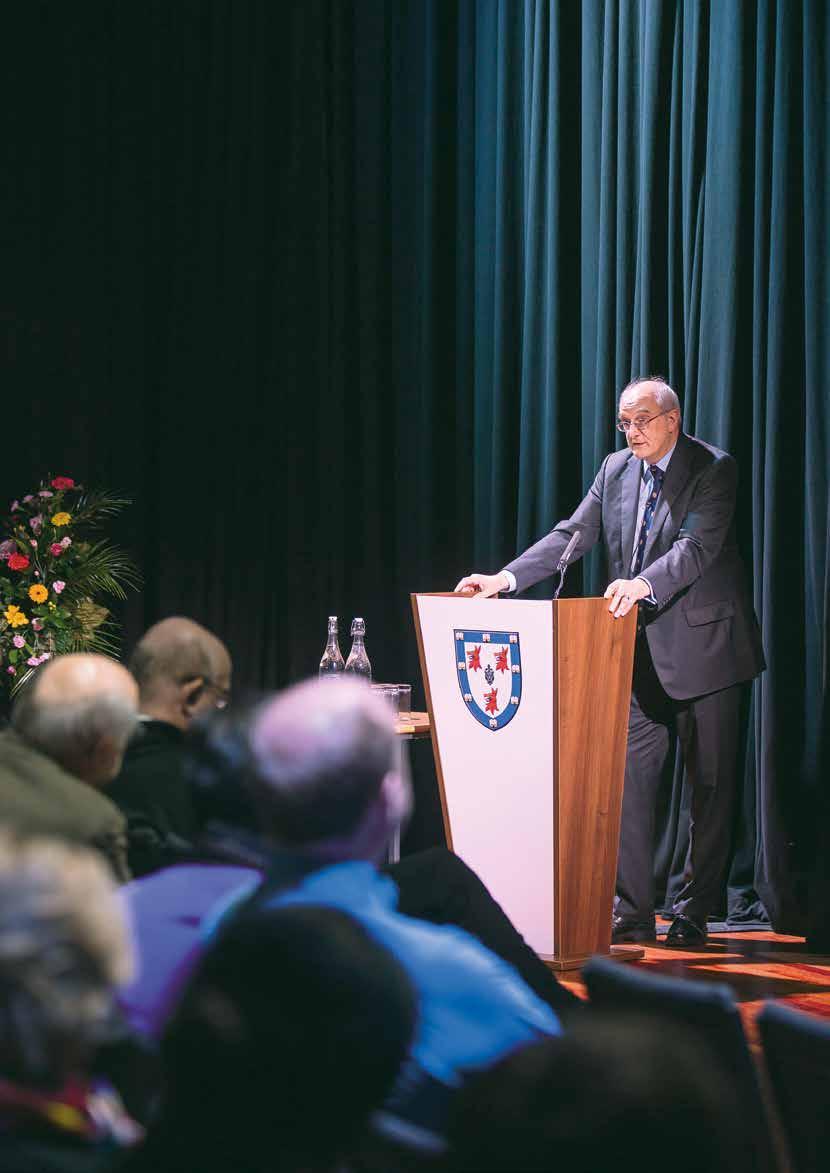
Professor Sir Leszek Borysiewicz FRS, initiated our new series of annual Kate Pretty Lectures with a forceful and thought-provoking picture of The Cambridge of Tomorrow.
The Homerton of tomorrow, and the origins of the College in the nonconformist 18th century, will both feature prominently next year, when we celebrate our 250th Anniversary. We are hoping to produce a small batch of Homerton 1768 gin, distilled using botanicals from the College gardens. A more intellectual form of intoxication will be supplied by a series of events on ‘burning questions’ of the day. For example, 2018 will provide an opportune moment to ponder the possible futures of the National Health Service. Mary Dixon-Woods, newly elected as a Professorial Fellow of the College and Director of an important new improvement research institute funded by the Health Foundation, will orchestrate the discussion. We attract the people to this place who are best positioned to address the questions of health, identity, choice and change that affect the lives of all.
Our anniversary year will offer an opportunity to showcase what the College does, how far it has come, and how far it can still go. This is still the College of 1768, ready for intellectual dissent where the cause is right. It will be the College of the future, for students not yet here or not yet born. It is now the stage-set and the home for its current brilliant students – and it is your College. Welcome, once again.
Professor Geoff Ward Principal
Homerton has appointed the emerging architectural firm of Feilden Fowles for its showpiece new Dining Hall.
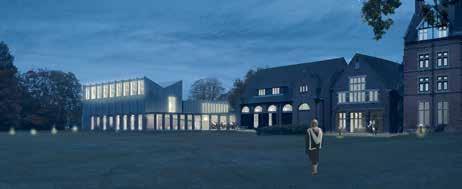
ARCHITECTS CHOSEN FOR NEW DINING HALL
Feilden Fowles described their winning concept design as an Arts and Crafts building for the 21st century, conveying formality at times, and comforting familiarity at others. Their submission declared an intention to ‘celebrate the integrity and inherent beauty of materials and craftsmanship’. The competition attracted huge interest from the UK architectural community, with 155 firms competing to win the contract.
The College concluded last year that it would not be possible to improve the
kitchen that supports the 19th century Great Hall to meet future requirements. The decision was then made to build a landmark new dining hall on a new site, to the west of the listed 1914 Ibberson Building.
Like the Great Hall, the new 300-person dining hall will provide the backdrop both for formal, set-piece ceremonial events and for daily gatherings. The Great Hall will be used for theatre performances, concerts, lectures, and smaller dinners.
For the Principal, Professor Geoff Ward, the development will encapsulate much of
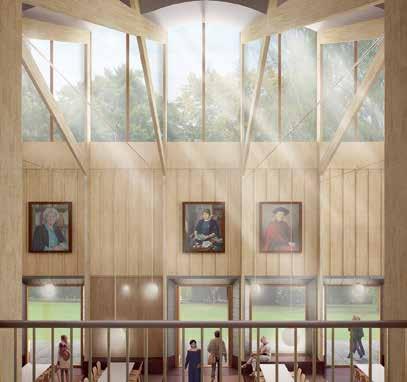
what Homerton is about: ‘The opportunity to make an environment that is physically beautiful and that functions elegantly is a rare privilege, and if on a deep level it can also encourage mutuality, the sharing of ideas, then it really has the power to inspire current and future generations. We are particularly pleased to be able to start this work in 2018, when the College will have a year-long public celebration of our 250th Anniversary. Feilden Fowles’ concept design for the dining hall relates subtly to the existing ensemble of buildings and the garden setting, and yet has the poise to convince as a showpiece. What appealed so strongly about the team’s particular approach was their openness to creating many opportunities for dialogue. We are looking forward to working with them as they develop the detailed design.’
Fergus Feilden, Director of Feilden Fowles, is excited at the possibilities. ‘The project offers a unique chance to create a transformational space at the heart of an already stunning site. This is a privilege we do not take lightly and we are determined to deliver a world class facility. We can’t wait to get started.’
Feilden Fowles is making a reputation for delivering projects in highly sensitive and challenging historic settings. The Londonbased practice was named Building Design’s ‘Young Architect of the Year’ in 2016. It has won numerous awards including three RIBA Awards, a Civic Trust Award and a RICS Community Benefit Award.
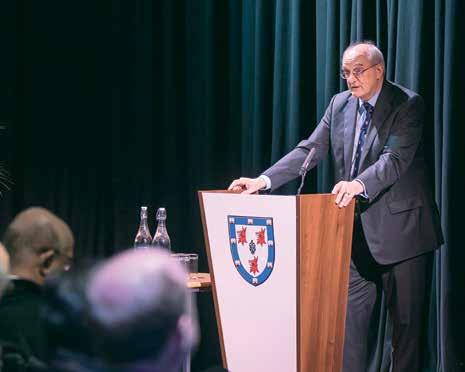
Over 200 guests visited Homerton College in February for the inaugural Kate Pretty Lecture, ‘The Cambridge of Tomorrow’, delivered by the Vice-Chancellor of the University of Cambridge, Professor Sir Leszek Borysiewicz FRS.
WHAT HAS THE UNIVERSITY OF CAMBRIDGE DONE FOR US?
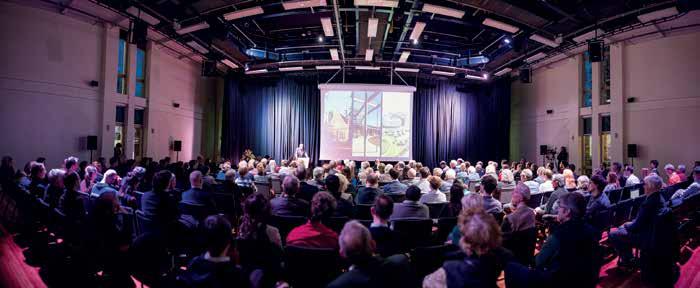
Thelecture addressed the University’s role as a community of experts, at a time of decreased trust – and asked how Cambridge, as a university and as a city, can continue thriving despite the UK’s exit from the European Union. Sir Leszek looked to a future of greater income equality in the Cambridge region, and a University with an enhanced regional as well as global impact:
‘If society at large cannot see that the research we carry out helps to save lives and to improve livelihoods, from East Anglia to East Africa, then it is on us to make sure it knows.’
This new annual lecture honours Dr Kate Pretty CBE, Principal of Homerton College (1991–2013) and Pro-Vice-Chancellor of the University of Cambridge (2004–2010) responsible for international strategy, outreach, lifelong learning, and museums and libraries. An archaeologist, Dr Pretty served as President of the Council for British Archaeology from 2008–2013.
Full text and a video recording of the lecture is available on the Homerton College website.
Professor Sir Leszek Borysiewicz delivering the inaugural Kate Pretty Lecture.
© James Appleton ©
James Appleton
The University of Cambridge, with Homerton as a key partner, has been announced as the home of a new healthcare improvement research institute, the first of its kind in Europe.
THE ROAD TO BETTER HEALTHCARE
The Health Foundation, an independent charity, will be awarding in the region of £40 million over a period of 10 years to fund the new institute. The grant recognises the huge potential for research to shed light on how sustainable and replicable improvements to the quality of patient care can be made in the NHS more quickly.
The institute will be led by Mary Dixon-Woods – RAND Professor of
Health Services Research at Cambridge and a Fellow of Homerton College. It will help the NHS become the world’s largest producer of systematic learning about how to improve healthcare.
Homerton will be the intellectual home of events organised by the institute, hosting visiting fellows from all over the UK and supporting researchers to strengthen the scientific foundations of improvement research to help solve real-world problems.
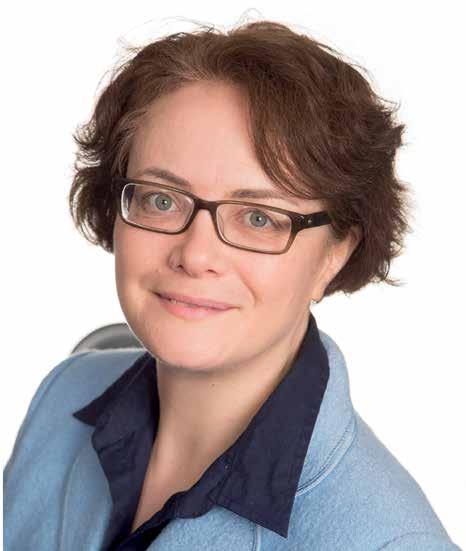
‘The NHS, like health systems around the world, is faced with pressing challenges of quality and safety,’ says Professor Dixon-Woods. ‘Yet the science of how to make improvements has remained under-developed. This award is a tremendous opportunity to produce new knowledge about how to improve care, experience and outcomes for patients. Together with our partners, the University of Cambridge is hugely excited at the chance to work with NHS staff, patients and carers to identify, design and test improvements.’
As the Principal, Professor Geoff Ward, sees it, the institute gives the College a platform to extend its reach. ‘The improvement research institute will bring huge benefits over a ten-year period to the patients and staff of the NHS, the University of Cambridge, and Homerton College. Homerton exists to serve society’s needs, and we pride ourselves on innovative partnerships. Our partnership with the institute, under the leadership of our Professorial Fellow Mary Dixon-Woods, brings academic research and public benefit together in an association of which we are proud, and which we hope will generate further interdisciplinary projects as it develops.’
Funding the new institute is part of the Health Foundation’s ongoing work to bring about better health and health care for people in the UK and builds on the charity’s strong history of supporting and developing improvement research. The institute will formally launch in early 2018.
Mary Dixon-Woods
TWOS AND BLUES
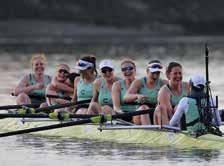
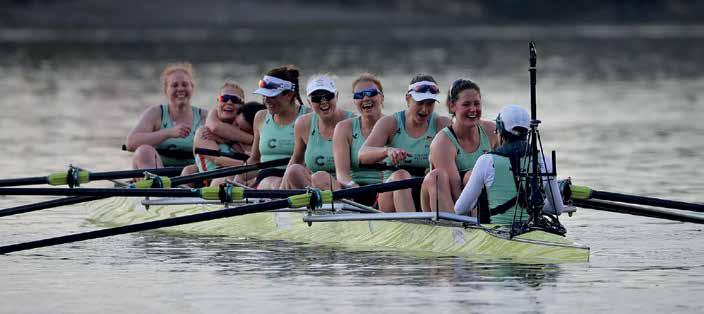
On Sunday, 2 April, two students from Homerton, Alice White and Claire Lambe, competed in the Cambridge Women’s Blue Boat for the 2017 Cancer Research UK Boat Races.
Originally from New Zealand, Alice is currently studying for an MPhil in Basic and Translational Neuroscience and has previously competed at the U23 and Junior World Rowing Championships. Her interest in rowing was piqued after watching the Evers-Swindell twins who won gold in the women’s double sculls at the Beijing
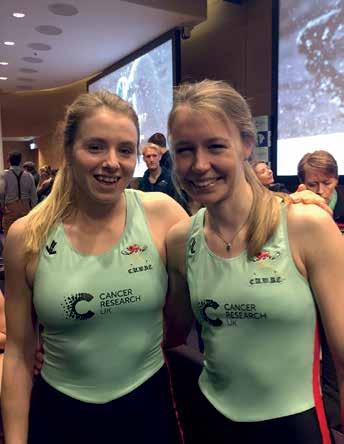
Olympics in 2008. Claire is currently studying for an MPhil in Engineering and Sustainable Development. She represented Ireland in the Olympic Games in Rio in 2016, in the lightweight women’s double sculls, the first Irish crew in that class to qualify and the first Irish women’s crew to reach the final.
The April Boat Race was a clean win, with Claire in seat three and Alice at number six. After the Oxford crew caught a boatstopping crab as the umpire’s flag fell, the Cambridge boat took a strong lead, speeding ahead by nearly two lengths and double this within the first two minutes. Winning the race, the Light Blues also set a new course record time of 18 minutes 33 seconds. This win was particularly important to the crew after last year’s women’s boat took on too much water and dramatically sank. Both Alice and Claire showed their experience well and the crew was commended for their consistent performance and excellent form during the live commentary.
Claire is appreciative of Cambridge’s overlapping support structures. ‘Between CUWBC, Homerton and my department, each has been so supportive in their own way’, she says. ‘The Cambridge environment has just been such a great network to be a part of. The majority of girls in our squad started rowing in Cambridge but are just as competitive as the girls who’ve come from an international background.’
Alice White and Claire Lambe.
© Chris Down
(Light Blue Images)
The winning boat at the finish line.
HOMERTON STUDENTS AMONG THE TOP 100 WOMEN TO WATCH FOR 2017
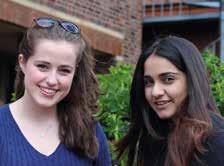
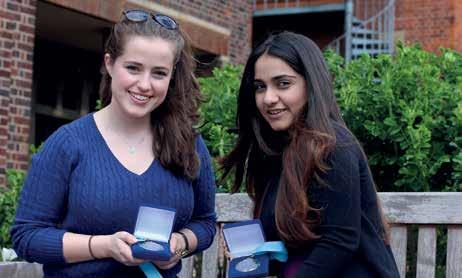
Olivia Buckland and Suroor Rahimtoola, both current Homerton students, were voted onto The Tab Future 100 in April, a list of high achieving women at UK universities. Six students were selected overall from the University of Cambridge.
Those who featured on the list were voted for by 215,841 students and included charity ambassadors, successful young business women and dedicated activists.
Barclays was the official sponsor of The Tab’s list and their aim was to help celebrate the achievements of young women across the country.
Olivia Buckland, who is in her second year studying Education with English and Drama, is a two-time cancer survivor and the current President of Pink Week, a charitable organisation. This year she has helped raise over £33,500 across 63 events in one week for Breast Cancer charities and research. After years of chemotherapy, surgeries, and a stem cell transplant, Olivia returned to rowing and is now the Women’s Boat Club Captain for Homerton College. She is also a Homerton Union
of Students Committee member. In her spare time, Olivia runs OJB Photography, specialising in UK Wedding and Lifestyle photos. She also recently took part in the Round the Island Yacht Race with the Ellen MacArthur Cancer Trust, and has hopes of one day sailing around Britain.
Suroor Rahimtoola joined Homerton College in 2016 and is in her first year studying Land Economy. Upon arriving, she became the Freshers’ representative for the Pakistani Society and then won a place on the Homerton May Ball Committee. Prior to this, Suroor was part of the Karachi Grammar School team who won the Best International Delegation Award at the Harvard Model United Nations conference last year. She was also the President of the Helper’s Society and House Captain at her school. Suroor has attended summer schools at Le Rosy,
Switzerland and Phillips Academy and featured earlier this year in Hello! 100 People to Watch for Pakistan.
On 3 May 2017, Olivia and Suroor travelled to Barclays Headquarters in Canary Wharf for an awards ceremony where they were presented with medals for their outstanding achievements. Olivia commented that ‘the event was focussed on women in positions of leadership and we heard talks from senior executives and women in business who inspired us to be bold and brave about what we wanted to achieve’. Suroor spoke about Homerton as a ‘friendly and accepting place of opportunity with support available for whatever you want to do, whether in work or outside of work’ and that the College would make her ‘transition into a higher pressured work place much easier’.
Olivia Buckland and Suroor Rahimtoola with their medals for outstanding achievement.
Matthew Moss Director of External Relations and Development
It’s official. Homerton is the biggest College in Cambridge, not only by number of current students, but also by number of former students: this year we broke the 14,000 mark of contactable Homerton alumni.
DEVELOPMENT UPDATE
Astackof Homertonians (the publication, not the individuals: we’re fully healthand-safety compliant even in metaphors) would tower 18 feet high. And it’s terrific to know how much Homerton means to you. Our 17 student callers in this year’s Easter telethon spoke to 827 Homerton alumni, and were delighted to hear your memories of the College. Many of our current students have no idea about queuing for the telephones in Paupers’ Walk, or ‘bath block’, or how rigorous the CertEd and BEd courses were, and they had some fantastic conversations. Through talking about the 1768 Society (for donors giving at least £17.68 a month), both the callers and the callees are often surprised to learn that the College was founded so long ago! The 1768 Society now numbers 97 tremendous donors – and of course we shall be spreading the word about Homerton’s long history next year, the 250th Anniversary.
We enjoy meeting alumni at all our events – the Leavers’ Dinner, the 10-yearsout Dinner, and London drinks receptions, as well as the annual Alumni Reunion Weekend in September. It’s a pleasure to know what became of you after you left Homerton, and to reconnect you with your
College. We say to new students that they are joining a College community for life, and we take seriously the responsibility of making that relationship permanent and meaningful. You’ll see on the back page the benefits and services that the College and University offer you: do take them up!
Queen’s Wing is being refurbished this year, and when it emerges from under its scaffolding, our gardeners will design new planting in the borders to commemorate the late Jacqueline Welford, née Thompson (CertEd 1943-45), who left a generous legacy to Homerton. An obituary of Jacqueline appeared in the Annual Review 2015 Legacies have helped fund student life at Homerton since the earliest days: many alumni tell us that though they may not be able to make a donation in their lifetime, they are happy to include the College in their Will. It is straightforward to do so and the College Development Office can help. As with all the donations you give us, the beneficiaries are our students – your successors as Homertonians.
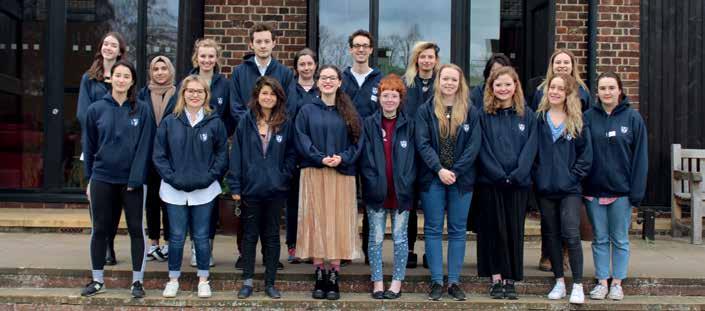
The 2017 student calling team including the HUS President and an alumna.
FELLOW IN FOCUS
Dr Anthony Ashton
Dr Anthony Ashton is a Fellow, Lecturer, Tutor and Director of Studies in Mathematics at the College. This year Anthony was awarded a prestigious Pilkington Prize by the University of Cambridge in recognition of his outstanding contribution to teaching.
How do you motivate your students?
I find mathematics an incredibly interesting subject, so one way I try to motivate the students is to share that enthusiasm with them. I try to teach students to treat mathematics not as a collection of isolated topics, but as a rich tapestry in which ideas are often intertwined. This often helps develop intuition and allows the students to see the bigger picture.
How did you end up at Homerton?
I’m from a town called Rhyl on the North Wales coast. I went to the local sixth form to study Mathematics, Physics and Chemistry. I found Maths the most interesting so it seemed natural to study it at degree level. I studied at Peterhouse, Cambridge for my Mathematics undergraduate degree. Before I came up to Cambridge I had no intention of staying beyond the standard three years. I was certain that I’d want to leave and find a job in the City. However, I found that the more I studied mathematics, the more interested I became in it. After three years at Cambridge and two less-than-exciting summer internships at an investment bank in the City, I decided to stay on to do a bit more maths.
After my undergraduate degree I took Part III of the Mathematical Tripos, within which I studied a range of subjects from functional analysis to mathematical physics. I found it quite difficult to focus on just one area, everything seemed very interesting! I realised I was best suited to pursue research in applied analysis: the application of abstract results in analysis to real world problems. After completing Part III I took up a PhD in the Department of Applied Mathematics and Theoretical Physics, under the supervision of Professor Thanasis Fokas. Based on the research I produced during my PhD, I was awarded the EPSRC Doctoral Prize. This allowed me to extend some of the projects I’d been working on during my PhD and also gave me some time to apply for some academic positions. I was fortunate enough to be awarded a Junior Research Fellowship at Emmanuel College, which ran from 2010-2013.
During my time at Emmanuel I worked on a variety of problems associated with the spectral analysis of strongly elliptic boundary value problems. Based on the results I produced during this period I was awarded the Stokes Fellowship at Pembroke College, which I took up in October 2013. I joined Homerton two years into that position.


What research projects are you involved in at the moment?
My research involves the study of objects known as elliptic boundary value problems. Elliptic boundary value problems are ubiquitous throughout applied mathematics, physics and engineering. They arise in many important mathematical models, from electricity to elasticity, from fluid dynamics to gravitation. A particular example that will be familiar to many is the dreaded Wi-Fi signal, or lack thereof.
A Wi-Fi router emits high frequency electromagnetic waves that bounce around the rooms of your house and, if you’re lucky, some of them will arrive at your laptop so you can connect to the Internet. The propagation of these electromagnetic waves is governed by the Helmholtz equation, a famous elliptic equation. The walls, floors and ceilings of your home constitute a boundary through which these waves struggle to propagate, so to understand where best to place your Wi-Fi router, you will want to study the Helmholtz equation with your ceilings, walls and floors constituting boundary conditions. This is an example of an elliptic boundary value problem.
Whilst elliptic boundary value problems arise all over the place in the real world, my research involves quite abstract results. I use techniques from functional analysis to prove results about the solutions to abstract elliptic boundary value problems.
What are your interests outside of College?
My wife and I live in a small village to the North of Cambridge with our two dogs. We’re very fond of the outdoors, so we spend a lot of our time out in the countryside. I’m a lapsed Manchester United fan and a keen tennis player whenever the weather permits. I also quite enjoy building things: my latest project is a homemade arcade machine that lets me relive some of my misspent youth!
What would you like to achieve in the next five years?
Predictions like this can be a little tough in mathematics, because research meanders, ideas evolve and it’s difficult to see precisely which problems you’ll be working on. There are a couple of less well understood problems in numerical analysis that I’d like to work on – any progress in those areas would be great!


In 2018, Homerton College will celebrate 250 years of free-thinking education. We are going to mark this with an exciting, year-long programme of Homerton 250 events that will be big, serious and fun.
BE PART OF CELEBRATING 250 YEARS OF FREE-THINKING EDUCATION
The programme will showcase the depth, quality and impact of our teaching and research – and ask how we might better serve the challenges of our times. It will celebrate the diversity of our students, the excellence of their experience and the contribution they make to society – and ask how we might even better prepare them for a changeable world. It will tell the curious tale of our dissenting history, full of creative energy and imaginative reinventions – and it will invite a conversation about our ambitions.
During the year, there will be three public and high-profile Burning Question events to explore perennial and topical questions facing society.
On 27 October 2018, our 250th Foundation Day will be celebrated with a one-day festival. This will bring together students, Fellows and staff, family, friends, teachers and relatives; alumni across the generations; distinguished and influential guests – and the city of Cambridge. Featuring research spectacles, fun activities,
teaching and research showcases and arts events, it will be a day to remember. As 2018 draws to a close there will be a closing concert featuring the College’s seriously impressive musical talent.
To help us tell the world about Homerton College in its 250th year we are building a mini-website that will go live in October this year. This will provide information about the events we have planned but we also want to showcase the people, stories and objects that have made Homerton College what it is today. And for this we need your help!
Can you nominate a person, an object or a story that will help us to showcase Homerton College?
The legendary Love Sofa is an example of an object with a lively story, and Michelle is one person who epitomises the warm, friendly and caring heart of Homerton. Who or what would you nominate and why? Drop us a line at 250@homerton.cam.ac.uk and tell us what you’d love to see on the new website!
PEOPLE
Michelle O’Shea
‘Michelle always made it a point to ask me how things were going and whether I was keeping my head above water with work. She was also very keen to hear about my latest haircut misadventures and whether or not I was dating the various people she’d seen me about College with. She was always genuinely interested in the students and wanted to make sure we all felt looked after, and I did’.
Oliver Sibley (MMath, 2016)
WHAT
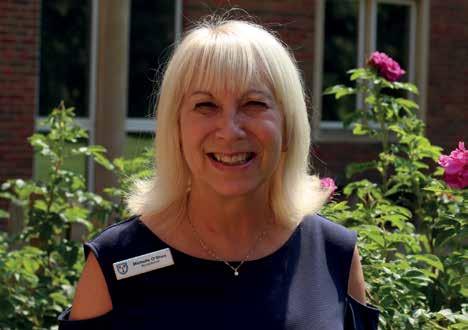
Homerton College Receptionist, Michelle O’Shea.
PEOPLE AND OBJECTS TELL YOUR HOMERTON STORY?
OBJECTS
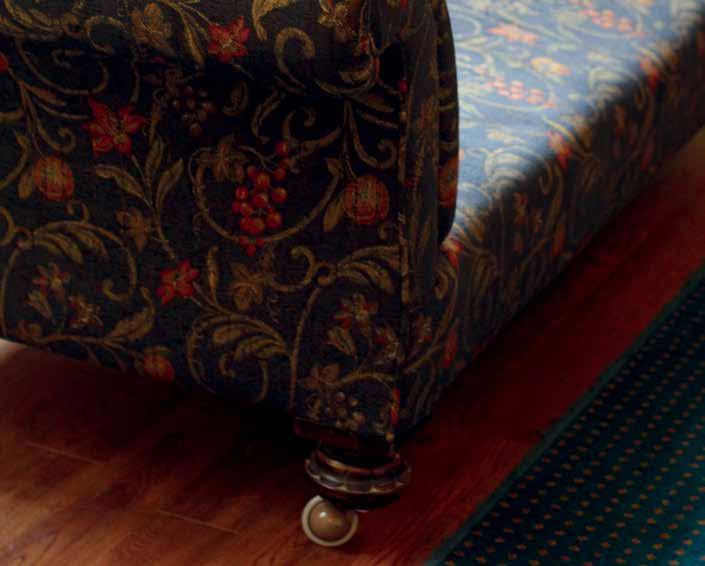
Two for Tea Settee
In the days when Homerton was all-female and when most of the Cambridge Colleges were all-male, access between the two was very strictly regulated. In the early days men were not allowed on Homerton premises, but after the First World War they were permitted in the Drawing Room ‘under special conditions by permission of the Principal.’ As a consequence the Drawing Room became a hallowed place; indeed we have as many post-card photographs of it as we have of the Hall in the Archives. Furnished as a large middle-class family drawing room would have been, with cane chairs, tables and a large fireplace, at the back of the room stood a long settee partly hidden by a screen. Here hapless men were entertained to tea, always in the presence of a female staff chaperone. These encounters derived from fleeting meetings with men at church, or College chapels on a Sunday; it was not until much later that trips to the theatre and the cinema were permitted. Meetings on this settee must have been memorable, even if conversations were cringingly stilted. Brave men who persevered were amply rewarded. We know that in the inter-war years, many proposals of marriage were made on this settee – not all of them accepted! If this story triggers any happy memories for you and your partner, and you would like to share them, please let us know!
A DAY IN THE LIFE OF… THE BURSAR
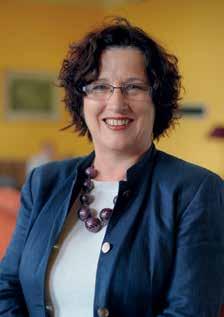
Deborah Griffin OBE became Bursar and Fellow of Homerton College in 2012. Here, Deborah takes us through a ‘typical day’ in the life of a College Bursar.
I usually cycle to work which only takes about 10 minutes; it is one of the wonderful parts of life after 20 years of commuting from Twickenham into the City every day.
8.15am
I try to get in early before any meetings to deal with the enormous number of emails that hit the inbox. I am also guilty of responding to emails at night, weekends and holidays although I try not to! The breadth of the Bursar’s work is both interesting and sometimes overwhelming so emails may be about personnel issues, requests for funding, budgets and building planning work or …. Sarah Culhane, our Estates Administrator, arrives at 8.30am and the first of many coffees is brought to my desk.
9.30am
Sue Conrad, my PA, arrives along with another coffee. Sue has been at Homerton College for 28 years and provides me with invaluable support and advice. Paul Coleman, the Catering and Conference Manager, joins me in my office for our weekly meeting. I meet with all the senior management team on a weekly basis individually and then once a month we all meet to just to go through any current developments or issues. Paul and I might discuss any staff issues or changes he is looking to make to improve the service. All my management team have a real desire to provide the best environment and experience for our students.
10am
Next I chair a meeting of Colokate, the joint venture partnership with Hill Residential, which has developed the 87 unit housing development next to the College. During
2015 and 2016 we had three large building projects on the go – the new graduate accommodation Morley House which opened in September 2016, the commercial development for Abbey College which is part of the investment property portfolio and the housing development, the sales of which have paid for the construction of the housing and commercial development. We now have less than 5% of the houses and flats to sell so are planning the winding down of this entity although we are responsible for ongoing management of the estate.
11.30am
I return to my office to catch up with Sue and more emails and more coffee. I write a couple of papers for the next Bursars’ Committee which the Bursars of all 31 Colleges attend. It meets twice a term and all Bursars sit on a variety of other committees
which report back. I am the Bursars’ representative on the Project Connect Board which is overseeing the new £2m Library management system for the University Library as well as over 90 Faculty and College libraries and I’m the Bursars’ Representative on the University Sports Committee.
1pm
Lunch in the Great Hall! The food is always delicious and I always fail to resist the puddings. I sit on the Fellows’ table which is an opportunity to catch up with colleagues on developments on the academic side.
1.30pm
I collect another coffee from the Combination Room and return to my desk. I dial into a conference call to join a meeting at the Rugby Football Union looking at the RFU’s response to Sport England’s new Governance Code. Since 2010 I have been a Council member representing Women and Girls’ Rugby and since 2014 also a Director on the Board. I do try and attend the meetings in Twickenham but where this clashes with other meetings in Cambridge I dial in.
3.30pm
I cycle into town to the Office of Intercollegiate Services (OIS) for a meeting of the Meet Cambridge Board. I took over as chair earlier this year. Meet Cambridge is owned by the Colleges collectively and is the enquiry office for anyone wanting to hold an event or meeting in Cambridge. As well as extensive marketing, the team handle over 3000 enquiries a year. Conferences and meetings are so important to the finances of the Colleges which together took over £36 million of business last year. Homerton is one of the leading Colleges for conferences and Meet Cambridge provides many of the new leads for business. The OIS offices are opposite King’s College and it is always exciting to ride along King’s Parade but after yet another large group of tourists steps aimlessly into the road, I feel glad when I get back to Homerton.
6.30pm
There are often meetings in the evenings (especially for rugby) or a dinner or reception. Tonight is thankfully quiet so I work for another hour on various projects and then cycle home for an evening in front of the television.
Deborah Griffin
CHARTER CHOIR TOUR
Dr Daniel Trocmé-Latter Director of Music
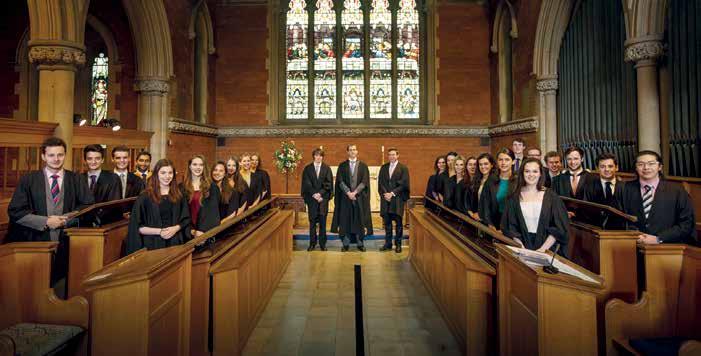
“We should always make it a point to habituate the youth to enjoy the art of music, for it produces fine and skillful people”. Thus wrote Martin Luther, who in 1517 sparked the Protestant Reformation. These words are as true today as they were 500 years ago, and at Homerton, as we continue to foster music as an academic subject and extra-curricular activity, we see increasing evidence of this. More of
TOUR VENUES
Where the Choir performed in July:
our Music graduates are going on to high-profile jobs or to study for higher degrees. Half of those entering this year’s Performance Competition, all of whom performed to an extremely high standard, studied a subject other than Music. Members of the Charter Choir study a whole range of disciplines, from History to Natural Sciences, English to Psychiatry. Luther’s enthusiasm for the art of music is well known, and many of his hymns entered the English nonconformist tradition which plays such an important part in Homerton’s own history. And so in April the Charter Choir sang part of
Sunday, 23 July: Gottesdienst, Stiftskirche, Stuttgart
Sunday, 23 July: Mass and Concert, Dom St Martin, Rottenburg
Tuesday, 25 July: Mass and Concert, St Konrad, Grünmettstetten
Wednesday, 26 July: Mass, St Georg, Ulm
Friday, 28 July: Concert, Frauenkirche, Munich
FORTHCOMING DATES:
Saturday, 23 September, 4pm: Alumni Reunion Concert, Homerton College
Tuesday, 28 November, 6.30pm: Homerton Carol Service
J.S. Bach’s cantata no. 80, Ein feste Burg, based on the same hymn by Luther, at a special Evensong to commemorate the 500th anniversary of the Reformation. We followed this up with a summer tour to Germany; where we performed in Stuttgart and Munich at the end of July (full details in the box).
Of course, more anniversaries are to follow: Homerton’s 250th celebrations will take place in 2018 and the Charter Choir will form an important part of those. On the cards is a come-and-sing reunion event open to all current and former members of the Choir (despite the fact that the Charter Choir is less than a decade old, we have amassed around 60 alumni – fine and skillful people – during that time). The repertoire has yet to be decided, but more details will follow.
All alumni are always welcome at Charter Choir services and concerts. The Charter Choir website (www.homerton. cam.ac.uk/charterchoir) contains full details of sung services as well as clips of the Choir performing. The website also contains biographies, and details of tours and recordings. Alumni can also follow the Charter Choir on their Facebook page, at www.facebook.com/homcharterchoir
JUSTIN MAROY
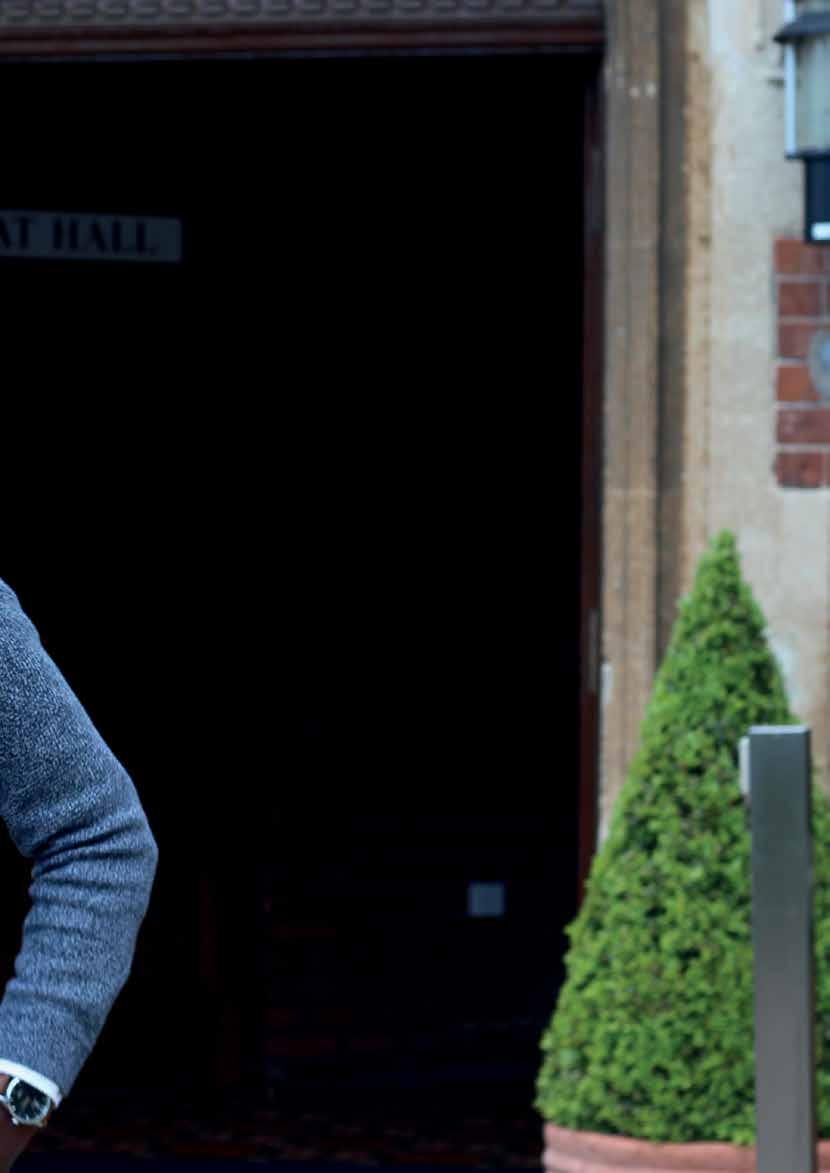
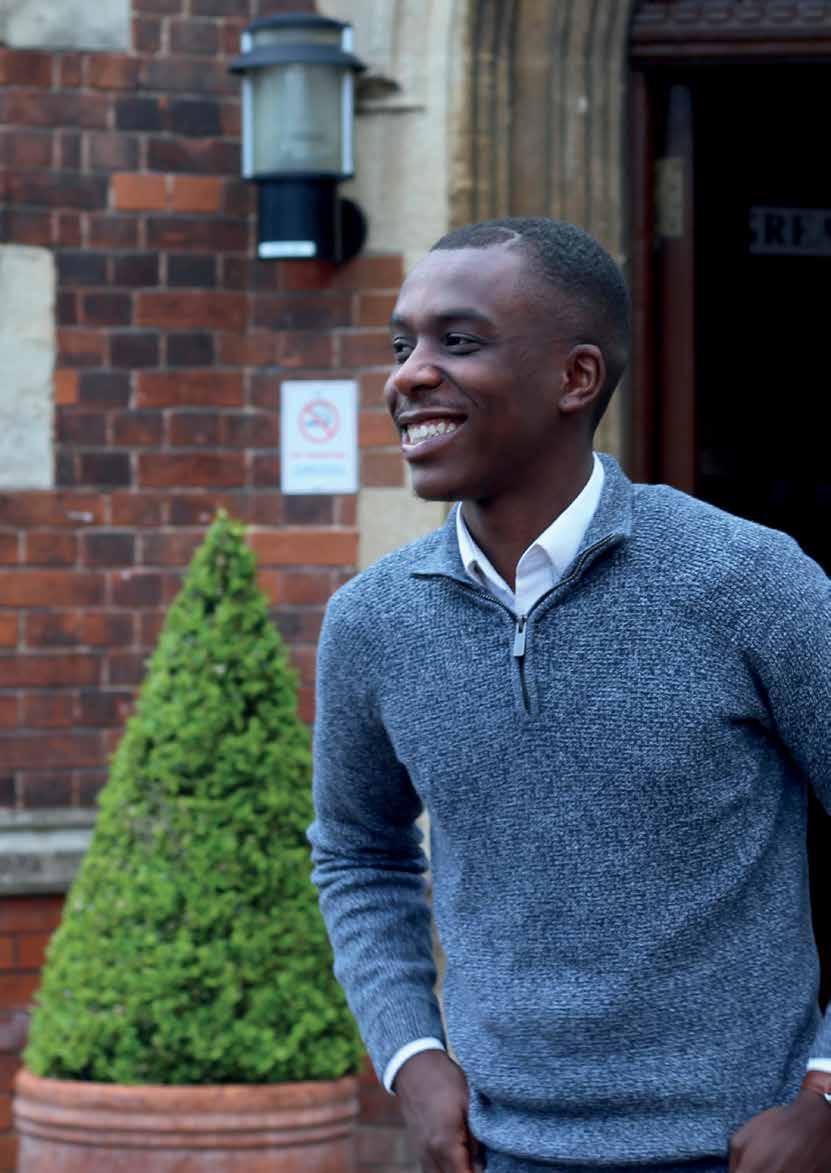
Justin Maroy is a second year student of Human, Social and Political Sciences specialising in Politics and International Relations. He spoke to us about Homerton, overseas aid and a young child called Jonas.
My life at Homerton
I love Homerton. I think it’s a beautiful College, especially the grounds. It’s very relaxed and friendly, it has a reputation for that. I always say Homerton feels like a home away from the busy centre of Cambridge. You can enjoy the centre but then have your own space back at College. I take part in several extra-curricular activities here, such as The King’s Head Debating Society, the College football team and the Christian Union. My work keeps me very busy so I use my extracurricular activities as a break. My Tutor here is Dr Timos Kipouros. He’s fantastic at what he does, very friendly. My Director of Studies, Dr Christopher Brooke, is one of my favourite academics in Cambridge – a firehouse intellectual. He’s a great man, he definitely inspires me.
Meeting Jonas
During my Gap Year, I went to India and saw things I wanted to change. In Goa, I was working with a Roman Catholic orphanage called ‘Sister Valentine’s Little Heaven’. I taught English, poetry and maths. It was a fantastic experience and I really had a bond with the kids, particularly one called Jonas. I don’t know why but when I walked in, he came straight towards me, there were ten volunteers and I was at the back, but he pushed past everyone as though he’d picked me out for a hug. We were close from then on. I’d go in every day and he’d always be by my side, eager to learn and get things done. But then one day he got a skin condition, a rash that was pretty bad. The next time that we went there, all the other children had the skin condition as well. The reason being because they all shared the same clothes. This seemed so ridiculous and upsetting because it could so easily be prevented. I think that was the moment when I really started thinking about what I could do to help and from there, things unexpectedly grew.
Growing from a small idea I set up an NGO to help provide services to local communities, starting in India, and now moving to the Congo. We focus on education, healthcare, and female empowerment. Each focus we have is important in its own right but interlinked is where you can really see the inequality and what is needed to change things for the future. We began with the simple idea of sending clothes, books and utilities to an orphanage where I worked in India, and now we also provide volunteering programs for students from the UK and internships for prospective medical students in India. I always knew that I
wanted to move this work over to Africa, but of course the political climate is completely different, there’s still heavy levels of corruption in some areas and it’s generally not as developed. Starting out in Asia allowed me to learn what was needed for the next step in Africa.
I have a lot of support. We have an experienced CEO, and my father works in Africa as a director for a British company, so he has contacts on the ground there – and we work through partner organisations who each have their own teams. Balancing this work alongside my degree is difficult, but manageable. I enjoy both and find they cross over a lot, informing each other. I’d like to think this is just the beginning, it’s the career I have in mind for when I leave university.
The future
I’m planning to go back to India next summer to catch up with the kids and see the orphanage. This summer I’m going back to the Congo to begin setting up the ‘Maroy Foundation’ there. I was born in the Congo, but left when I was 3. I went back there last summer for the first time which was quite emotional. I saw people who were in the same situation as many in India, but it felt much closer to home. When I’ve finished studying, my goal is to move back. I have so many plans, ideas and things I want to do and change there, but I’ll need to be on the ground to help properly.
I’m not anticipating leaving Cambridge just yet, I’m not ready to leave. But when I do, I imagine the feeling of achievement will be immense.
I have a lot of really good friends here, I’d like to think a few of them will be lifelong. Cambridge has been intellectually rigorous and looking back I’ve learnt so much. I think it’s important to remember what a privilege all of this is and how important it is to use our time at this university for the greater good. We’re really very lucky.
A SURGEON’S WIFE IN AFRICA
Elspeth King (née Calder) was one of the first students in 1956 to join the one-year Education Postgraduate Course at Homerton College. Elspeth is a regular at Homerton alumni events and for many years she lived an exciting life as a surgeon’s wife in Africa.
In 1956, I joined twelve other students in the first one-year Homerton College Postgraduate Course. As the Queen Mother arrived to open Queen’s Wing in May 1957 I remember we lined the drive to greet her. Afterwards Miss Skillicorn said Her Majesty thought ‘you were all looking charming’. Playing violin in Trinity orchestra, I met Michael King – a medical student at St John’s, and we married in 1960.
Michael and I worked in poor countries for thirty-nine years. In 1967, we went to Malaysia for three years to teach the first graduating doctors where I lectured part-time. In 1970, along with our young children, we came back to the UK the slow way – going by ship across the Bay of Bengal with our camping kombi, which we drove from Madras to Calais in ten weeks. We camped near nomadic camel caravans crossing the deserts in Afghanistan and Iran, with
their tents, families and flocks of sheep.
Michael’s next post (supported by British Aid) was in Swaziland, ruled by King Sobhuza with his 97 wives. In lectures to nurses and in newspapers I suggested that contraceptives end the need for polygamy!
After two years back in Britain, the family set off to Africa again in 1976 – driving the same kombi across Europe and camping in the deserts of Turkey, Syria, Jordan and Saudi Arabia (possibly I was the first female to drive across Saudi Arabia), before flying from Jeddah to Malawi.
Michael was Chief Government (very general) Surgeon at the very busy Queen Elizabeth Hospital in Blantyre, employed there for 19 years by British Government Aid. We enjoyed climbing mountains and sailing on Lake Malawi. Our teenage daughters attended the local international school for five years – where I taught biology and violin and cello. Afterwards
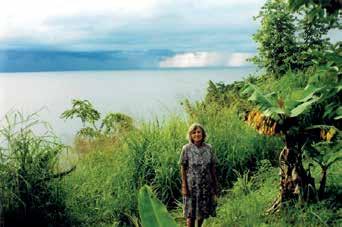
Elspeth in her cottage garden home with a storm brewing over the Mozambique mountains across Lake Malawi.
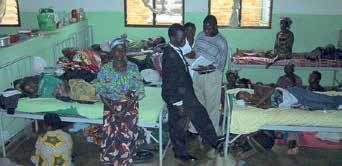
Clinical Officers on their ward rounds.
Fiona went up to Girton and Sheenagh came to Homerton for her PGCE.
As a University of Malawi lecturer (1980–94), I taught classes of 150 students and supervised their research projects. My students bravely resisted President Banda’s brutal regime, demanding free politics and journalism. And with witchcraft scaring blood donors, I persuaded some nurses to go out collecting blood. The Queen Mother congratulated us by post.
In 1995, we retired to build a one room cottage in the bush beside Lake Malawi at Nkhata Bay. Sun-dried mud bricks were burnt in a wood kiln; we bought corrugated iron sheets for the roof and cement to mix with sand carried up from the beach. Our pit latrine was dug. Solar panels charged our batteries and we cooked on a paraffin stove or wood fire. For 14 more years, as Rotary Volunteers, we drove our old Mini Metro hundreds of miles to crowded, district hospitals often with two patients to a bed and many others lying on the floor. With no doctors, paramedics did all the emergency surgery, caesarean sections, trauma and fractures, and anaesthesia as well as managing the paediatric and medical patients – splendid people.
Whilst Michael was teaching and operating on long lists including breast cancers, hysterectomies, cleft lips, skin grafts, broken bones and caesarian sections, I was warmly welcomed in wards where
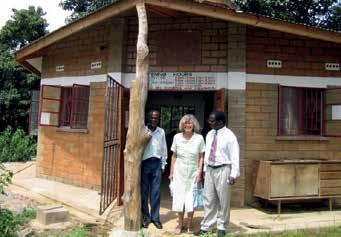
With librarians outside Nkhata Bay Public Library which Elspeth and Michael helped to design and build.
victims of hippopotamus, crocodile and snake bites, lay beside cases of malaria, pneumonia, bilharzia, malnutrition, HIV, TB and sleeping sickness.
Critically ill babies lay on shelves –each with an intravenous fluid solution suspended from a nail in the wall above. Only one very dedicated Malawian nurse would manage about 80 patients in most wards. The international recognition of qualifications has caused many African doctors and nurses to move to the rich world – thus depriving millions of poor patients of medical care.
At least one HIV-infected mother died each week in most hospitals. Pregnancy compromises immunity and so hastens a female’s progress to her final AIDS related
READ MORE FROM ELSPETH AND MICHAEL KING
Great Rift –Africa, Surgery, AIDS, Aid 978-0953929009
AIDS, Surgery and Life – a Malawi Mosaic 978-0953929016
illness. Often antenatal mothers developed severe HIV-anaemia resulting in heart failure and death during the effort of labour, when even a small haemorrhage may be fatal. With Rotary help in Cambridge, we collected discarded surgical instruments, dressings, an operating theatre table, and school books to transport to Malawi to help these women.
After busy days we were glad to return to our cottage- climbing down the steep wooded path to our beach to swim in the Lake at dusk. We often paddled our canoe to town to buy fish from dugout boats on the beach or fruits in the market.
We enjoyed working in this lovely country with its warm hearted people for 33 years, before retiring to Cambridge.
The Story of Medicine and Disease in Malawi 978-9990890006
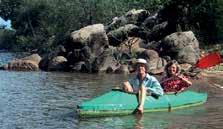
With Michael, launching their canoe on Lake Malawi to paddle to market.
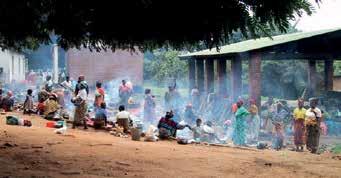
Patients’ relatives cooking food outside the hospital.
Dr Peter Warner is an Emeritus Fellow of the College and formerly Senior Tutor. He is Keeper of the Roll and Chair of the Retired Senior Members Association. Here, Peter goes in search of our first Principal.
FINDING JOHN CONDER
It is a great privilege to be ‘Keeper of the Roll’ for the forthcoming Homerton 250 celebrations. The role brings me close to alumni of all ages; we have just had our Leavers’ Dinner for last year’s graduates who are just over a term out, and also our 10-years-out Dinner in May. Over the course of the year there will be other events including the annual Alumni
Reunion Weekend in September where we usually welcome one or two of our oldest members.
In gathering together a history of the College in the 18th century for publication next year, I have been looking back at some of our earliest Homertonians. And who more significant than John Conder, our first Principal or ‘Resident Tutor’ at the new Homerton Academy beginning in Homerton High Street in 1768? You can be forgiven if you have never heard of Dr Conder: Homerton College has been shy about its early history as a nonconformist seminary, but Conder is an interesting man and that is why I have been in search of him.
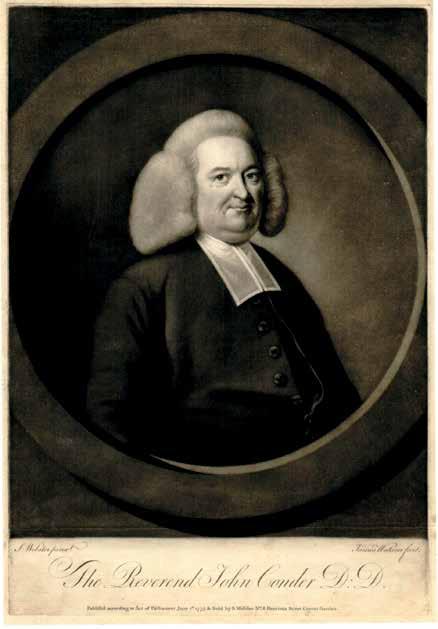
Finding his portrait was easy on the National Portrait Gallery website. An engraving by James Watson shows a typical ‘divine’ of the eighteenth century in cassock and bands. A kindly, gentle smiling face with twinkling eye looks out beneath an imposing wig. There is no hint of the severity so often seen in portraits of divines from this period. This looks like a copy of a portrait in oils: perhaps the original portrait hung in the hall of the old Academy building, but is now lost. Described as ‘an eminently skilful and gracious minister’, his impact on several decades of Homerton students was profound. He set the standard of theological teaching at Homerton Academy, which then hardly changed until the mid-nineteenth century. When there was a challenge to the more liberal teaching of John Pye Smith (Principal from 1800–1849), the measure used by the Trustees was that his teaching was as orthodox as in Conder’s day.
I then found myself in London at a rather dull meeting in an office in Moorfields, and I took the opportunity to wander up City Road and explore the extraordinary dissenters’ cemetery of Bunhill Fields. It is overlooked by the
Portrait of the Reverend John Conder.
© National
Portrait Gallery
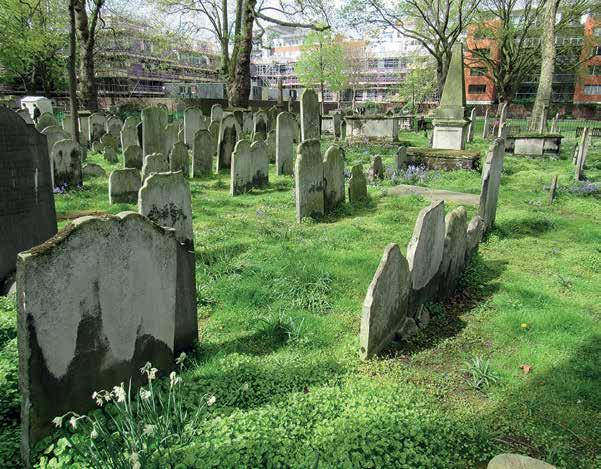
more famous John Wesley’s House, just a short walk from Liverpool Street Station. This is where you will find the hallowed graves of William Blake, Daniel Defoe, Issac Watts and John Bunyan – names of international importance. And among them somewhere lies John Conder. Part of the cemetery has been cleared for office workers to eat their picnic lunches and sit on the grass. Of course there is now a website with a plan of the cemetery, but I came armed with an old map from a book on Bunhill Fields written and illustrated by Alfred W Light in 1913. Conder has two whole pages, including one of his hymns, and a drawing of his gravestone.
Sadly John Conder’s grave is in the middle of the cleared area, but I soon spotted his gravestone, moved to one side against a wall, very badly decayed, but clearly visible. ‘In Memory of the Rev JOHN CONDER DD, Pastor of a church at Cambridge 16 years and afterwards at Moorfields London 21 years, PRESIDENT of the Independent College Homerton…’ Stylistically it looks mid-nineteenth century and the use of the word ‘College’ suggests that his monument was raised after 1824 when Homerton changed its name from Academy to College. The use of the word
‘President’ is unique in the history of the College but may indicate his importance as the first Principal. All this suggests that he was still revered by the College many years after his death in 1781.
John Conder was born in Wimpole, Cambridgeshire. He joined the Hog Hill Independent Chapel in Cambridge and was ordained in 1739. There he gained a reputation as a preacher – several of his sermons survive in the Cambridge University Library. In 1754 he took up the post as tutor at the Mile End Academy, then just outside the East End of London, where students of the Congregational Fund Board and the King’s Head Society were sent for their ministerial training. During this time he published a number of theological works and hymns, mostly now forgotten, but they enhanced his reputation at the time.
When the Board and the Society combined to purchase a house in Homerton High Street in 1768, they secured his services as first Resident Tutor and with him came his students from nearby Mile End Road. The new Academy was established by Trust Deed, now a treasured parchment in our Archives at Cambridge. From this point in time we
trace the College’s name, our governance by Trustees, Conder as our first Principal, our first lecturers and tutors, and above all our first alumni. John Conder was a busy man. Not only was he the first resident Principal of the Academy, but he was also a Pastor with a large congregation. This dual role was a necessity; tutoring did not provide sufficient income to support a family. He was Pastor of the Pavement Chapel in Moorfields from 1763. The Pavement served as a terminus for traffic coming down the new North Road Turnpike, created just two years earlier.
One of the most important gateways into London, it was the Heathrow of the eighteenth century. He remained Pastor there until his death in 1781 at the age of 67. So for the last thirteen years of his life he travelled constantly back and forth between the Academy in Homerton High Street and his Pavement Chapel in Moorfields.
John Conder is a forgotten hero in the history of Homerton College, but next year we have the opportunity to remember him and all those who helped to establish the reputation of the College in its earliest years. If you happen to be in London, please pay him a visit.
The dissenters’ cemetery, Bunhill Fields, London.
THE CITY OF COPENHAGEN’S 2025 CARBON NEUTRAL PLAN
Signe Kossmann is a final year student, studying Human, Social and Political Sciences. In September 2016, she was awarded a Victoria Brahm Schild Internship Bursary to help fund an internship at the City of Copenhagen’s Climate and Technical Department. Whilst there, she worked on the 2025 Plan that aims to make Copenhagen the first carbon neutral city in the world, in just nine years.
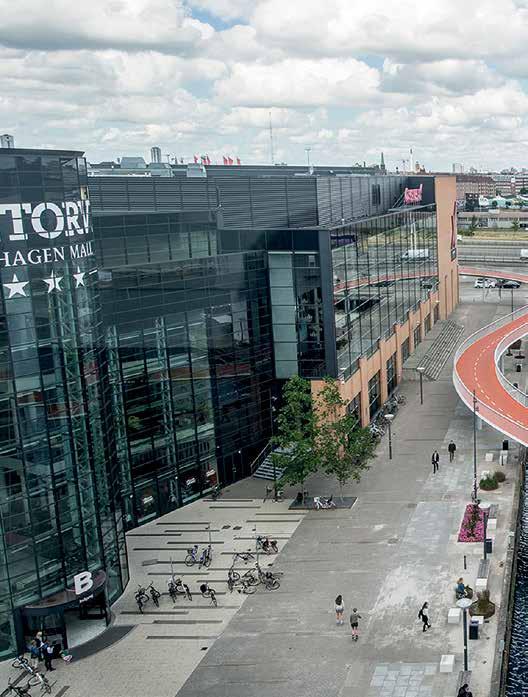
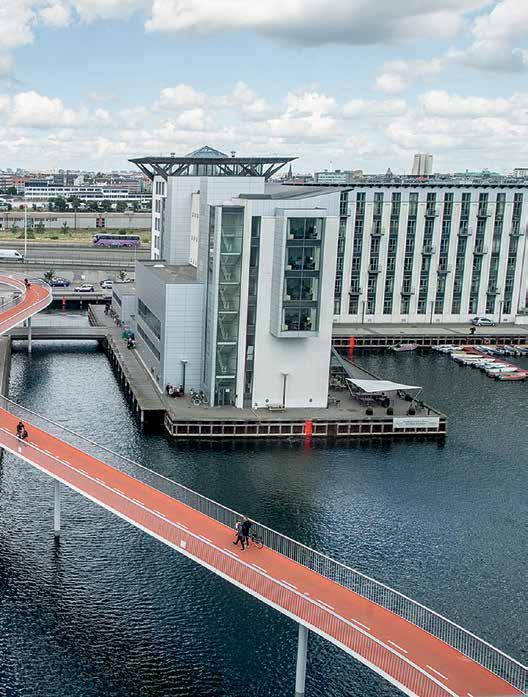
One of the projects, the Cycle Super Highway.
My work on Copenhagen’s Carbon Neutrality Plan was varied. My first assignment was to analyse the latest publication of the 2025 Climate Report, which was an assessment of how successful their projects had been in reaching their targets in four categories: Energy Supply, Energy Production, Green Mobility, and the City of Copenhagen’s Initiatives. Other projects ranged from innovative biomass waste-to-energy generation through to the use of Smart Technology. I also learnt about unique means for measuring the City’s
carbon emissions and reviewed Danish –English translations for accuracy.
My second task was to assess all of the literature that existed on Copenhagen’s Cycling Initiative, which is one of their main projects to reduce CO2 emissions. Copenhagen is known as the City of Cyclists, with 50 percent of all journeys made to work and academic institutions by bike. The condensed summary I had to write was to be used for PR and research purposes for international City delegations; it involved reviewing a variety of policy
Signe
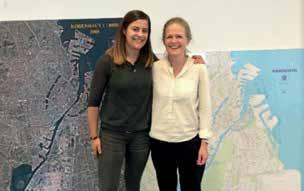
Kossmann with her supervisor Ane Kollerup Nielsen.
briefs and conducting interviews. Through engaging in policy, I was also made more aware of the politicised dimensions of all initiatives, whose successes are impacted by the government’s political orientations, and their attitude towards the climate.
Another task I worked on was the question: how do you alter the current perception of waste as valueless, when it should instead be perceived as a resource with value? How do you change societal norms? As part of the Project, our aim was not only to increase the amount of sorted waste, but also to reduce the amount of waste altogether. Given the lack of quantitative data on ‘what works’ when it comes to motivating Copenhageners to recycle and sort waste, my boss and I worked on a social experiment to test various methods. I also came up with my own ideas for affecting the norm, especially in regard to reaching out to the Danish youth, the main target group, via vloggers and other forms of social media. In addition, I was tasked with editing articles to be published in the Climate Projects Annual Report. To make the most of the experience, I arranged to meet with colleagues in the Department, which was a great opportunity to ask about what work in the public sector is like.
I really enjoyed the experience overall and was made to feel very welcome. My boss and colleagues were very kind; they’d ask if I was enjoying my work and if I felt challenged. The emphasis on working as a team and on shared projects, as well as independently and putting your own ideas into effect, was great. I felt I could always ask questions about absolutely anything and I felt fully involved in the team and their projects from the very start.
This internship was made possible due to a generous donation made by Victoria Brahm Schild (BEd, 1980–84). This fund enables students to accept internships either by financing their College based accommodation or by helping with travel and living expenses related to internships outside of Cambridge. The Victoria Brahm Schild Internship Bursaries increase access to career enhancing opportunities, regardless of nationality, family background or location of the internship opportunity. Signe was one of thirty students who benefitted from the scheme in 2016/2017.
TARQUIN BENNETT-COLES
We spoke to Tarquin Bennett-Coles (BEd Hons, 1989 – 1993) about Bill Gates, karate at Homerton and how a teacher ended up in recruitment.
Where did life take you after graduation?
I never left Cambridge! After graduating I had a number of teaching jobs in and around the city. It is very satisfying to still see those children (now adults) and hear where life has taken them. I loved that time but my personal circumstances changed and I knew I would have to leave the classroom. I joined some local Cambridge networks, one of which was the Junior Chamber of Commerce. I met someone who reviewed my CV and said ‘why don’t you join me, I’m setting up a recruitment company for Med-Tech’ my response was ‘what?’ and I have ended up working in recruitment for nearly twenty years! I really do love what I do and I chose life sciences research because I knew, in theory, that there was a positive outpoint: that if I did my job well then that might benefit a company getting a
product or device out to market which could have an impact and potentially save lives.
Are you building on your studies, or starting anew?
Training to teach gives you a couple of real life skills that you take with you through everything that you do. One is the ability to truly study; you can’t wing it in a classroom. The second is that you need to be open to new ideas and concepts. I enjoy the part of my job that involves researching and analysing new converging technology and therapeutic developments.
What has been a career defining moment for you?
I was very fortunate to recently work on a project for the Coalition for Epidemic Preparedness Innovations (CEPI) to recruit
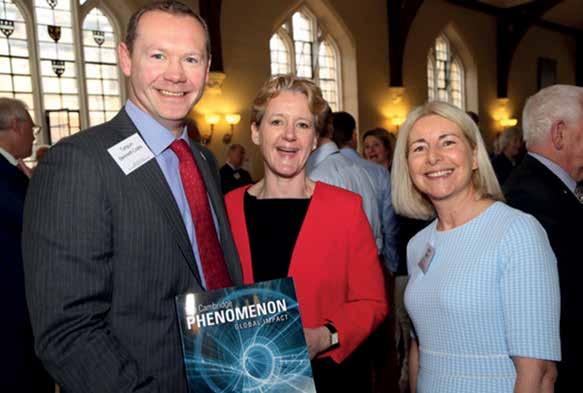
Tarquin BennettColes with Kate Kirk (middle), writer and speaker on entrepreneurship and the Cambridge technology cluster, and Jeanette Walker (right), Director of the Cambridge Science Park.
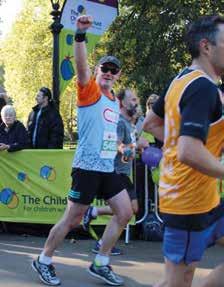
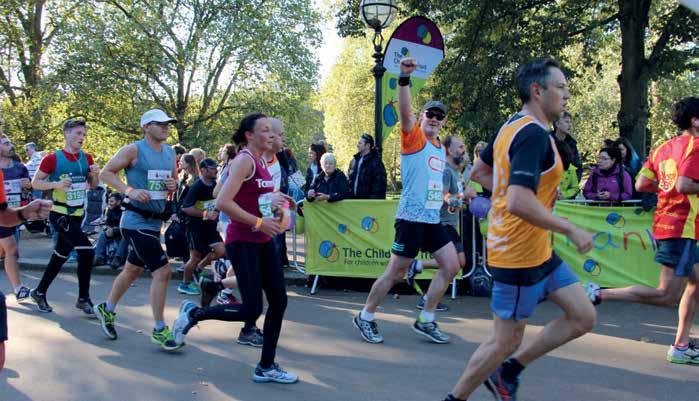
Tarquin (arm raised) running the Royal Parks Half Marathon for Findacure.
their new CEO. CEPI looks at the World Health Organization’s blueprint for how to respond to future outbreaks of viruses and infectious diseases. The goal is to get vaccines to the market quicker and to get them to places that can’t traditionally afford them.
When CEPI was first created they needed an organisation to act as a focal point and Bill Gates has always been very vocal about vaccines. Along with the Governments of Norway, India, Japan, Germany and the Wellcome Trust, the Bill and Melinda Gates Foundation helped to fund CEPI, investing over $300 million with the coalition raising over $1billion in total so far, with another $1billion in the pipeline. For me the most incredible moment of my career to date, was that before Richard Hatchett had been appointed as the CEO he was asked to meet with Bill Gates. I received a call about Richard’s CV and was asked to send a copy across. I knew what I was sending had my name on it and would be presented to Bill Gates. Dr Richard Hatchett accepted the role and began in April 2017. I feel very proud to have been involved in this important global initiative. I truly hope that with Richard now in post there will be people in the world who will gain access to vaccines in the future and receive life-saving treatment.
I owe a lot of my recent success to my children Ellie (12), Harry (10) and my wonderful partner Sally Williams who
provide me with so much support, belief and confidence. I also owe a debt of gratitude to the education, staff, friends and training I received at Homerton, in particular to my College Tutor David Whitley and the late Julia Swindells. I’m still in touch with many of my Homerton friends from my time on the HUS Committee: Lisa Adams (née Skinner, BEd, 1990), James Thomson (BEd, 1987), Julia Weights (née Maxfield, BEd, 1988), Rick Weights (BEd, 1988), Sarah McWhinnie (née Jenkins, BEd, 1988), Tamsin Austoni (née Smith, BEd, 1988) and Louise Browning (BEd, 1990) to name a few. I love that I can go on Facebook and Instagram and see people from College; there is something very special about being able to share moments about your life or about your children with those people.
What defined your time at Homerton?
Three things about Homerton stand out to me. One was the sense of being on the outside looking in. In those days we were still considered a teacher training College and there was an association with that that meant some of the other Colleges were resistant to us. One of the ways I overcame that was to loan myself out to other Colleges’ sports teams. I played rugby for Gonville and Caius, and water polo for Trinity Hall. I also got to coach both the Homerton and University Ladies’ Rugby teams and play in
the first Homerton Men’s Rugby team for both Sevens and Cuppers.
Second was becoming the University Karate Club Captain and representing Homerton as I led us out against Oxford in the Varsity Match. This also gave us the chance to host Keio University at Homerton in 1993 and put on an exhibition sparring match in the Great Hall.
The third was that on graduation day I was given the Westall prize for outstanding contribution to College life. It was a special day and it was great to be recognised for those social interactions and in front of my father, brother and sister.
Do you have any hobbies?
I have always been active in sport, especially mixed martial arts and rugby. I currently coach at Shelford and try to practice martial arts regularly. I also do some volunteer work. I have a personal interest in AIDS awareness having lost my mother to the virus, and I’ve led a number of training courses and outreach programmes. Recently I have supported Findacure. They help patient groups and other charities look at repurposing drugs that are already on the market for rare diseases. Having spoken with Findacure, they wanted support for the Royal Parks Half Marathon last year so I signed up and raised some money for them. They’re a great Cambridge charity based by the station, trying to do the right thing.
OUR DONORS
1 July 2016 – 30 June 2017
The Principal, Fellows, students and staff of Homerton College wish to thank alumni and friends who have generously made donations to the College over the last year. Every effort has been made to ensure this list is accurate; do contact us if you believe we have made an omission.
Key: (d)* = deceased
Alumni
1943
Mrs Kathleen Hayward
Miss Jean M Robinson
1944
Mrs Gwenda M Carveth
Mrs Joan M Gray
Miss Margaret Rishbeth
1945
Ms Margaret A Benson (d)*
1946
Mrs Zoe M Coombe
1947
Ms Christine B Andrews
Lady (Dorothy) Franklin
1948
Dr Brenda J Buchanan FSA
Mrs Jane A Charman (in memory of Ruth Pearson)
Mrs Janet K Farley
Miss Ruth Pearson (d)*
Miss Elizabeth W Rainsbury
1949
Mrs Margaret Blott
Mrs Wendy A Cannon
Mrs Mary L Dowse
Mrs Margaret Eedle
Mrs Coral Harrow
Mrs Molly D Payne
1950
Mrs Cathleen M Butler
1951
Mrs Heather Bracewell
Mrs Sheila A Duncan
Mrs Patricia M Stockdale
Mrs Joan Watcham
1952
Mrs Shirley D Haslam
Mrs Evelyn P Parker
1953
Ms Brenda M Liddiard
Dr Alison B Littlefair
Mrs Margaret D Trow
Mrs Elizabeth Tunnicliffe
1954
Mrs Pauline M Curtis
Mrs Carol Hammerton
Mrs Margaret R Orr
1955
Mrs Ellen G Ackroyd
Mrs Wendy E Darr
Mrs Christine P Grainge
Mrs Gillian M Hewin
Mrs Doreen E Hobbs
Miss Gwendoline E Lancaster
Mrs Rachel I Lewington
Mrs Jane R Matthews
Mrs Sidella Morten
Mrs Wendy E Oakley
Mrs Joyce M Simpson
Mrs Elizabeth M Tomlinson
Mrs Maralyn Westwood
Mrs Gillian Williams
1956
Mrs Marguerite M Donkin
Mrs Alice A Severs
1957
Mrs Gillian E Figures
Mrs Susan E Holland
Mrs Chistine M Lincoln
Mrs Elisabeth A McOwan
Mrs Valerie B Read
Mrs Gillian Reitsma
Mrs Josephine M Sutton
Mrs Rosemary M Viner
1961
Mrs Janet M Campbell
Mrs Frances M Clare
Dr Olivia Craig
Mrs Anne C Hulse
Mrs Joy M Kohn
Mrs Susan M Lovett
Mrs Susan McFarland
Mrs Jillian M Niblett
Mrs Caroline E Sykes
Mrs Jean Thorman
Mrs Andrea Woodward
1962
Mrs Jean M Collins
Mrs Diana Dalton
Mrs Marion W Foley
Mrs Maureen R Frost
Mrs Carole Girdler
Mrs Carole R Nolan
Mrs Christine O’Neill (neé Scard)
Miss Esme J Partridge
Mrs Gwendolyn J Williams
1958
Mrs Christine and Mr Philip Carne
Mrs Gillian M Ganner
Mrs Wendy J Garforth
Mrs Jane M Grant
Mrs Jill R Hicks
Mrs Beryl A Izzard
Mrs Wanda V Kielbinska
Mrs Rachel M Macdonald
Mrs Judy N Manson
Mrs Patricia K Stott
1959
Mrs Dora Beeteson (in memory of Fran Essen)
Mrs Christine H Frost
Mrs Diana Hadaway
Dr Susan B Hilliam
Mrs Ruth E Jerram
Mrs Diana M Lucas
Mrs Annmarie Mackay
Mrs Marilyn Martin
Miss Doreen G Rogers
1960
Mrs Rosemary L Allan
Mrs Sylvia R Avgherinos MBE
Lady (Gillian) M Baker
Ms Jacqueline and Dr Norman Bardsley
Mrs Patricia and Mr John Blythe
Mrs Jean M Clarke
Mrs Susan Dickinson
Mrs Jenifer A Freeman
Mrs Jill Fuller
Mrs Jean E Jeffery
Mrs Christine A Kershaw
Mrs Jennifer S McKay
Mrs Gilliane P O’Keeffe
Mrs Christine A Parkyn
Mrs Jacqueline Swegen
Mrs Rosemary Thomas
Mrs Janet E Valentine
Mrs Hillary J Young
Mrs Sheila E Stephens
Mrs Susan M Straker-Smith
Mrs Cheryl A Trafford
Mrs Linda J West
Mrs Janet Wilkinson
Mrs Elizabeth A Wilson
1967
Mrs Marjorie Caie
Mrs Susan D Folwell
Mrs Miriam France
Dr Diana M Gallop
Mrs Avril H Growcott
Mrs Moira E Pitchford
Mrs Marion A Pogson
Mrs Patricia M Saxton
Mrs Annette Smallbone
1968
Mrs Kathleen L Down
Mrs Valerie J Hart
Mrs Constance L Marriott
Mrs Robyn A Mitchell
Mrs Lynne Parsons
Mrs Anne R Rogers
1963
Mrs Jean Addison-Fitch
Mrs Andrea D Caish
Mrs Christine W Macpherson
Mrs Erica R Rigg
Mrs Catherine Ryder
1964
Ms Sylvia M Dibble
Mrs Corinne M Haworth
Mrs Celia M Jones
Mrs Margaret Meredith
Mrs Pamela and Dr Anthony R Metcalfe
Ms Christine Purkis
Mrs Rosemary A Rees
Mrs Susan Rescorla
Ms Marjorie Thorley
Mrs Janet R Woodford
1965
Mrs Lorna Cordell-Smith
Dr Patricia Cusack
Mrs Wendy A Dunnett
Mrs Elaine R Maunder
Mrs Dorothy M Nicholls
Mrs Anne B Perrin
Mrs Susan M Pinner
Dr Patricia A Pugh
Mrs Ruth Watkin
Mrs Janet S Webb
Mrs Dilys West
1966
Mrs Linda and Mr David Birtwhistle
Mrs Jean D Carnall
Mrs Susan B Carter
Mrs Wendy E Farmer
Lady (Marilyn) Fersht
Mrs Margaret G Funnell
Mrs Margaret and Malcolm Prue
Mrs Judith O MartinJenkins
Mrs Margaret C Robbie
Mrs Pamela R Sarginson
Mrs Penelope M SpencerChapman
Mrs Alison F Syner
1969
Mrs Eileen P Coombes
Ms Susan Durston
Dr Kathryn J Fraser
Mrs Lynn Lemar
Dr Victoria M McNeile
Ms Anne L Reyersbach
Mrs Gillian M Sallis
Ms Hilary V Stokes
Mrs Sarah Taylor
Mrs Kenzie K Thompson
Miss Joyce L Welch
1970
Mrs Jennifer E Aspinall
Mrs Patrica A Bradley
Miss Fiona S Cook
The Rev Sheila A Crowther
Mrs Cynthia Garvey
The Revd Claire M Heald
Mrs Mary E McCosh
Mrs Denise M Mitchell
Dr Rosslyn J Sendorek
Mrs Denise E Shakespeare
Dr Anne J Sinkinson
Mrs Helen E Wood
Mrs Mary Wyatt
1971
Mrs Patricia Darke
Mrs Denise E Few
Mrs Sally E Mabon
Mrs Marilyn S Reid
Ms Helen R Sandle-Baker
Ms Anne Sparrowhawk
Mrs Marilyn Stansfield
1972
Mrs Rosalind M Allwood
Ms Catherine M Beavis
Mrs Lesley T Dover
Mrs Susan M Dunkerley
Mrs Sarah Flynn
Mrs Fiona and Mr Michael Karlin
Ms Anne M Kennedy
Mrs Helen and James Malcolm
Mrs Caroline C Melrose
Mrs Valerie J Mills
Mrs Merilyn J Parker Armitage
Mrs Penelope M Riley
Mrs Anne and Timothy Ryder
Ms Jane Lewin Smith
Mrs Marilyn J Thomas
Mrs Maureen and Mr Neil Weston
1973
Miss Stephanie A Beardsworth
Mr Anthony R Little
Mrs Sheila A Martin
Mrs Elizabeth J McLean
Mrs Anne Mellor
Mrs Dilys E Murch
Mrs Susan Rodford
Mrs Helen E Sheppard
Mrs Tessa M Vivian
Mrs Heather R Wilkinson
1974
Mrs Alison M Over
Mrs Elizabeth J Rose
Mrs Vera E Sklaar
Mrs Karen Whitaker
1975
Mrs Alyson E Baker
Mrs Judith Davidson
Mrs Helen McRoberts
Mrs Ruth A Saunders
1976
Mrs Judith A Clarke
Mrs Sally J Collins
Mrs Joan H Gibson
Ms Jill M Grimshaw
Miss Amanda E James
Mrs Ann J Kirkby
Mrs Ann P Muston
Mrs Alison Roberts
Mrs Zena P Tinsley
1977
Miss Sheila M Berry
Mrs Helen M Draper
Ms Jane E Edwards
Mrs Elizabeth C Harding
Mrs Ann E Jackman
Ms Brenda C Meek
Mrs Helen M Mitchell
Mrs Louise M Mursell
Mrs Clare L Myers
Mrs Jane M Pearson
Mrs Elizabeth L Thomas
1978
Mrs Marianne J Billitt
Mrs Ruth M Briant
Mrs Sandra E Burmicz
Mrs Annette P Cameron
Mrs Clare M Danielian
Mrs Mary G Powles
Mrs Elizabeth S Thomas
Mrs Victoria L Thornton
1979
Mrs Jane S Bishop
Mrs Jill C Burton
Mrs Leonie M Hyde
Mrs Alison M Knights
Mrs Deborah Moss
Ms Karen W Ready
Mrs Amanda J Renwick
Mrs Brenda J Thompson
Mrs Sarah H Westcar
1980
Mrs Sheila G Anstey
Mrs Elizabeth R Bond
Ms Victoria Brahm Schild
Mrs Jacqueline A Butler
Mrs Catherine J Hicks
Mrs Sarah E Holmes
Ms Julia A Stone Hallee
1981
Mrs Gayatri Basu
Miss Anna J Chapple
Mrs Amanda J Edwards
Mrs Sally M Lomax
Mrs Cordelia A Myers
Mrs Annabel Nnochiri
Mrs Sarah J Palmer
1982
Mrs Della A Allen
Mr Mark D HanleyBrowne
Mr Brian J Howarth
1983
Mrs Alison Brinklow
Mr Charles W Dod
Mrs Karen L Miranthis
Mrs Frances R Surridge
Ms Rhiannon D Williams
Ms Sally M Woodcock
1984
Ms Alison Mesher
Mrs Helen E O’Hara
Mrs Ruth E Pavey
Mr Peter J Ventrella
1985
Dr Kirsty N Byrne
Mrs Lorraine G Carlton
Mrs Karen E Coombs
Mrs Rosemary S Gwinnett
Mrs Julia A Harker
Mrs Sally E Jaspars
Mrs Susan J Stirrup
1986
Mr Colin Cook
Mrs Keren E Cooke
Mrs Virginia C Eves
Mrs Rajeet K Loibl
Miss Samantha J Taylor
1987
Mrs Alison E Allen
Mrs Kim C Chaplin
Mrs Michaela R Khatib
Mrs Elizabeth M McCaul
Mrs Kerry A Merriam
Mr James D Thomson
1988
Mrs Tamsin J Austoni
Mr Phil C Coldicott
Mrs Hayley C Hobbs
Mr Arjun Kumar
Mrs Katherine Mayne
Mrs Sarah H McWhinnie
Ms Linda B Quinn
Ms Phillipa C Rushby
Miss Adrienne L Saldaña
Mr Giles D Storch
Miss Jennifer D Svrcek
1989
Mr Tarquin V BennettColes
Dr John N Dodsworth
Mrs Charlotte and Mr Matthew Irving
Mr Simon Ray
Mrs Penelope Smith
The Revd Wendy A Wale
Mrs Lesley A Westbrooke
1990
Mrs Naomi A Baynes
Dr Robert S Cawley
Mrs Nicole S and
Mr David L Cohen
Mrs Karen J George
Mrs Fiona J Gruneberg
Mr Ian C Hodgson
Mr Paul T Norris
Dr Susanna J Pinkus
1991
Mr David W Chapman
Mr Dennis S Gilbey
The Revd Simon L Goddard
Miss Julie A Hogg
Ms Kerry A Pentney
Mrs Elizabeth R Sartain
Mr John A Strookman
Miss Lisa C Tiplady
1992
Ms Caroline Bell
Mrs Claire E Brooks
Mr Ian P Derwent
Mrs Hannah J GrossmithDwek
Mrs Sarah and Colin Haines
Mrs Louise E Hawksley
Mrs Michelle Henly
Mrs Diane M Rawlins
Mr Christopher J Wardle
1993
Miss Manjit K Hayre
Mrs Helen N Morgan
Mrs Jane H Riordan
1994
Ms Luzita Ball
Mrs Marion Durnin
Miss Jennifer C Holtham
Mr Timothy G Howe
Mrs Lucy A Partridge
Mrs Victoria M TrueBhattacharyya
Mrs Emma R Vyvyan
1995
Ms Evroulla Agathangelou
Mrs Carol W Carlsson Browne
Mrs Helen N Currie
Dr Bernadette Tynan
Dr Jane F Ward-Booth
1996
Mr Ian Bettison
Dr Andrew T Holder
Mrs Serena C O’Connor
Mr Christopher P OwenSmith
Mrs Victoria Richardson
Mr Christopher A Shephard
Mr Martin R Wigg
1997
Mr Matthew Buck
Mrs Francesca S Charlton
Mrs Lynn S Dowson
Mrs Elizabeth A Fryer
1998
Mr Paul Fannon
Miss Anne-Sophie Paste
1999
Ms Erin L Bond
Dr Neil J Hennessy
Mrs Elizabeth C Jestica
Mr Paul R Jones
Mrs Laura M Penrose
Miss Hayley Romain
Ms Louisa M Tipler
Mrs Zoe G Yeomans
2000
Mrs Susan B Aldred
Mrs Abigail E Deeks
Mrs Maria J Della Maestra
Miss Katharine James
Dr Thomas E Kitchen
Mrs Cheryl D Smith
Ms Amy J Stuttle
Mr Andrew J Wells
2001
Mr Laurence M Ball
Mrs Elisabeth J Craigen
Mrs Lesley-Anne and Mr Gareth Crooks
Miss Lidia Fesshazion
Mrs Amy V Fleming
Dr Robert J Fulford
Mrs Nyla Khan
Mr David J Lawrence
Mrs Kirsty Nottage
Miss Catherine L Payne
Mrs Sandra A Stapleton
Mrs Jenny Walsh
2002
Ms Lisa J Aspinall
Miss Katrina Bevan
Miss Bernadette M Crossley
Mr Sam Farmer
Mr Sutherland Forsyth
Mrs Carys A Gladdish
Miss Katy M Johnson
Miss Sian M Mawditt
Mr Remi H Moynihan
Miss Krista A Pullan
Mr Thomas E Savill
Mr Timothy D Scott
Mrs Angela J Woodruffe
Mrs Katie Wright
Mrs Rhiannon L Wynne-Lord
2003
Mrs Rachel E Bardon
Miss Katherine J Bluck
Mr Raymond C Cilia
Miss Denise Djokic
Mrs Elisabeth S Hackett
Mr Gregoire A Hodder
Mrs Anne M Howell
Mrs Laura F Latham
Mr Jonathan S Levine
Dr Feilong Liu
Ms Nansi Mellor
Mr Daniel W Roberts
Dr Tovah N Shaw
Miss Stephanie A Tillotson
Mr John J White
2004
Mr Michael J Dangerfield
Miss Natasha R Gray
Mr Richard A Hopkins
Miss Emily Ikelle
Mr Duncan R Loweth
Mrs Liisa M Metsaranta
Mr Ravi P Raichura
Mrs Nina J Sever
Miss Jennifer R Sneyd
Mrs Samantha A Taylor
2005
Mr Nicholas A Clark
Mrs Janice Frankham
Mrs Lisa and Mr Fabio Galantini
Mr Andrew C Gard
Miss Casta Jones and Mark Littlewood
Mr Daniel A Martin
Mrs Rebekah H Perry
Mr Jonathan D Poland
Mrs Holly E Ranger
Mrs Elizabeth M Sharp
Mrs Jessica L Shingfield
Ms Maureen Su
Ms Nadia S Syed
Mrs Emma L Turner
Mrs Di Wu
2006
Miss Aniko Adam
Dr Theresa Y Adenaike
Mr Michael J Allen
Mrs Abigail Barclay
Mrs Aimee Beasley
Mr Andrew Blackburn
Miss Emily C Crowhurst
Mrs Eliza M de Uphaugh
Mr Thomas C Dix
Ms Natalie J Mansfield
Mrs Felicity A Mottram
Miss Chloe Orchin
Mr Luke Shepherd
Miss Elizabeth J Wadsworth
Miss Emma K Wallace
2007
Ms Claire-Audrey Bayan
Hon Leo Buscombe
Miss Elena Coates
Mr Jonathan D Coles
Miss Tracey V Evans
Miss Fay Hendry
Mr Je Hyeong Hong
Mr Thomas D Horn
Mrs Chloe J Kee
Miss Xiajuan Li
Mr Michael Lynch
Mr Benjamin N Mills
Miss Gillian A Nesbitt
Miss Nicola Pollard
Mr Joseph J RandallCarrick
Dr Susan L Wishart
Mrs Chikako Woodgate
2008
Mr Luke Clarke
Miss Adele L Fox
Mr James Jones
Mr Malcolm C Kane
Mr James D Lugton
Miss Amy L Munro-Faure
Mr Gershwinder Rai
Mr David Z Rosenberg
Mrs Bethany A Tobutt
Mrs Dominique E Turnham
Mr Kenichi Udagawa
Miss Lauren S Weller
2009
Mr Daniel J Baker
Mr Adarsh Bala
Mr Daniel S Beresford
Mr Bhavin Bhatt
Miss Claire Buddenberg
Miss Shruti Chaudhri and Mr Iain Cameron
Mr Jonathan D Edge
Mrs Elaine Elliot
Miss Alice M Esuola
Mr Jack P Euesden
Miss Christine D James
Mr Christopher Morgan
Mr William C Quinn
2010
Ms Rachel L Abbott
Miss Jessica Burgess
Miss Alexandra K Courage
Mr Joshua Dale
Dr Kayla S Friedman
Mr Millad Jallali
Dr Dirk Mersch
Mr Nicholas J Pannell
Ms Alexandra Thur
Miss Megan Trimble
2011
Mr James M Chicken
Mr Thomas J Danby
Mr Jack Hooper
Miss Lauren A Hutchinson
Miss Cordelia E Jackson
Ms Melissa Marsden
Mrs Maura Rutter
Mr Thorben Schaefer
Miss Abigail I ThurgoodBuss
Mr Alexander Wright
2012
Miss Louise Holyoak
Mr Tim Hubener
Miss Krisztina Zaborszky
2013
Mrs Juliet L Frost
Mr Marc-Jullian E Hensel
2014
Mr Alexander Schubert
Friends of Homerton
Dr Roger Ali
Mr J Arthur
Mr John N Ball
Mrs Frances Barrett
Mr David N Berman Howarth
Mr Brent Borders
Ms Eileen Byfield
Miss Patricia K Cooper
Ms Muriel K Cordell
Dr Constance Counts (in memory of John Hammond)
Mr Ian Dawson
Mr David and Mandy Fletcher
Mr P Friend
Mr Gordon Gaddes (in memory of Pamela Gaddes)
Ms Deborah Griffin OBE
Mr N J Hallmark
Professor Robert Innes
Ms Elizabeth Jared
Mr Dean M Johnson
Dr Richard Mangnall
Helen Mathieson
Dr Grahame B Miles
Mr Matthew Moss MVO
Ms Caroline Myddelton
Mr Richard W Price
Dr Peter H Raby
Dr Karen Stockham
Professor Keith S Taber (in memory of Philippa Taber)
Mrs Elizabeth A Thwaites
Mr Stephen P Tomkins
Mrs Frances E Turner (d)*
Dr Peter M Warner
Dr Roberta S Wells
Dr David Whitebread
Dr Margaret E Whitehead
Corporations
CamBioScience Limited
Santander UK plc
Trusts
Backstage Trust
The Plowright Charitable Trust
The Roger and Miriam Pilkington Trust
1768 Society
The 1768 Society recognises alumni and friends of Homerton who are regular donors to the College, making a gift of at least £17.68 a month.
Ms Catherine M Beavis
Mr Ian Bettison
Mr Andrew Blackburn
Dr Brenda J Buchanan FSA
Mrs Sandra E Burmicz
Dr Kirsty N Byrne
Mrs Marjorie Caie
Mrs Janet M Campbell
Mrs Kim C Chaplin
Miss Shruti Chaudhri
Mr Nicholas A Clark
Mrs Nicole S and Mr David L Cohen
Mr Phil C Coldicott
Mrs Pauline M Curtis
Mrs Diana Dalton
Mrs Clare M Danielian
Mr Ian P Derwent
Mr Charles W Dod
Mrs Marguerite M Donkin
Mrs Lynn S Dowson
Mrs Sheila A Duncan
Mr Jonathan D Edge
Mr Sutherland Forsyth
Mrs Miriam France
Mrs Gillian M Ganner
Mrs Karen J George
Mrs Carole Girdler
Mrs Christine P Grainge
Miss Natasha R Gray
Mr Roger Green
Mrs Fiona J Gruneberg
Mr Mark D HanleyBrowne
Mrs Elizabeth C Harding
Mrs Julia A Harker
Miss Manjit K Hayre
Mrs Michelle Henly
Dr Neil J Hennessy
Mrs Jill R Hicks
Mr Gregoire A Hodder
Mr Ian C Hodgson
Miss Julie A Hogg
Miss Louise Holyoak
Mr Richard A Hopkins
Mr Thomas D Horn
Mr Brian J Howarth
Mrs Anne M Howell
Mr Tim Hubener
Mrs Celia M Jones
Mr Malcolm C Kane
Mr Jonathan S Levine
Ms Jane Lewin Smith
Mr Anthony R Little
Mrs Susan M Lovett
Mr Michael Lynch
Mrs Christine W Macpherson
Mrs Constance L Marriott
Mrs Jane R Matthews
Mrs Helen McRoberts
Mrs Sarah H McWhinnie
Mrs Margaret Meredith
Mrs Pamela and Dr Anthony R Metcalfe
Mrs Liisa M Metsaranta
Mrs Karen L Miranthis
Mr Matthew N Moss MVO
Mr Remi H Moynihan
Mrs Ann P Muston
Mr Ravi P Raichura
Mrs Diane M Rawlins
Mrs Rosemary A Rees
Mrs Susan Rodford
Miss Doreen G Rogers
Mrs Elizabeth J Rose
Mrs Catherine Ryder
Mr Thomas E Savill
Mr Luke Shepherd
Mrs Annette Smallbone
Mrs Cheryl D Smith
Mrs Elizabeth L Thomas
Mrs Brenda J Thompson
Mr James D Thomson
Ms Alexandra Thur
Mr Andrew J Wells
Mrs Dilys West
Mr John J White
Ms Rhiannon D Williams
Dr Susan L Wishart
Mrs Helen E Wood
Mrs Katie Wright
Cavendish Circle
The Cavendish Circle recognises alumni and friends of Homerton who make an annual gift of £1000 or more to the College.
Ms Jacqueline and Dr Norman Bardsley
Mr Tarquin V Bennett-Coles
Ms Victoria Brahm Schild
Mrs Lesley T Dover
Dr Ahmad T Hindawi
Mr Arjun Kumar
The Plowright Charitable Trust (Sally and David Gibbons)
Morley Circle
The Morley Circle recognises alumni and friends of Homerton who make gifts of £100,000 upwards.
Mr Jan and Mrs Erika Hummel
Macaulay Circle
We are grateful to those who have indicated they intend to leave a gift to Homerton in their Will.
Mr John N Ball
Mrs Heather Bracewell
Miss Patricia K Cooper
We are always delighted to receive your emails and letters, and in future editions would love to feature more of those we receive.
If you have a memory of the College that you would like to share, please get in touch. You can email us at alumni@homerton.cam.ac.uk or write to us at: Development Office, Homerton College, Hills Road, Cambridge CB2 8PH.
Writing with Kipling
Doyou teach Year 5 or have a friend who does? I have news that you might be pleased to hear, and if I once taught you myself (I was at Homerton 1977 to 1989), I

Mrs Susan M Dunkerley
Mr Paul Fannon
Mr Gordon Gaddes (in memory of Pamela Gaddes)
Mrs Joan M Gray
Ms Deborah Griffin OBE
Mrs Coral Harrow
Dr Susan B Hilliam
Miss Julie A Hogg
Mrs Susan E Holland
Mrs Elaine R Maunder
Mrs Karen L Miranthis
Mrs Sidella Morten
Mrs Gilliane P O’Keeffe
Mrs Merilyn J Parker Armitage
Mrs Moira E Pitchford
Mrs Margaret and Malcolm Prue
Mr Simon Ray
Dr Anne J Sinkinson
Mrs Victoria Richardson
Miss Jean M Robinson
Mrs Rosemary Thomas
Mrs Kenzie K Thompson
Dr Bernadette Tynan
Dr Peter M Warner
Mrs Dilys West
Mrs Karen Whitaker
We are also very grateful to those friends and supporters who have given in memory of Professor John Murrell, those who give up their valuable time in support of the College, those who have made gifts of artworks and books, and 96 donors who wish to remain anonymous.
YOUR LETTERS
hope you’ll be extra interested!
A year or two back I was wondering, with other members of the Kipling Society, how we might make it easier for more children to discover Kipling and his stories.
Some of us had been teachers: deploring the impoverished curriculum, we thought children might respond enthusiastically to the riches of the Just So Stories and The Jungle Book.
We came up with a pilot scheme for a writing project for children in Year 5. Known as ‘Writing with Kipling’ it asks children to create a ‘Just So’ story of their own. Every child who enters gets a certificate and there’s a prize for the best entry from each class, plus generous First, Second and Third prizes, and cash for the school of the overall winner.
We don’t really care about who’s best: the aim is to get children writing and discovering themselves as writers
alongside a famous one. We had over 160 entries—some exuberantly illustrated—last year, and all of them a delight. Their teachers, to whom we gave lots of support, told us they’d loved it and so had the children.
Now we want more schools to enter and to get more children writing. Briefly, this is how it works: we provide teaching materials that can be used to introduce a class to the Just So Stories over a term, while the children are invited to write their own in response. Copies of these are mailed in to us by the end of March. This year David Mitchell is judging the shortlist. I hope you’ll want to hear more and to get your class involved in 2018: do get in touch with me on 1maryhamer@gmail.com.
All best wishes Mary Hamer mary-hamer.com
One of the ‘exuberantly illustrated’ entries from Year 5.
ALUMNI REUNION WEEKEND
Friday, 22 to Saturday, 23 September 2017
PROGRAMME
Friday, 22 September
18.30 – 19.30 Donor Reception Drinks and canapés by invitation
19.30 for 20.00 Dinner in the Great Hall
Saturday, 23 September
09.30 – 10.30 Registration
10.30 – 11.00 Welcome address from the Principal and the President of the HUS
11.15 – 12.15 Anniversary Group meetings College garden tours
12.30 Lunch in the Great Hall
14.30 – 15.30 Education Panel – Teach First? Learn first? How should teachers be trained in 2017? Retired Senior Members Association AGM College building tours
16.00 – 17.00 A performance by the Charter Choir College building tours College garden tours
17.00 – 18.00 Afternoon Tea
19.00 for 19.30 Dinner in the Great Hall
The Library will be open during Saturday, 23 September displaying a selection of artefacts and photographs of Homerton from the archives.
This year, bookings will close on Monday, 4 September. Please do ensure that we receive your booking and payment by this date. The best way of booking for the Reunion Weekend is via our Alumni Events page on the College website. If you wish to book using the booking form attached to the back cover of the Homertonian, please ensure you post it to arrive before the deadline.
We look forward to welcoming you back to the College in September!
CAN’T MAKE THE ALUMNI REUNION WEEKEND?
Join us for informal Alumni Drinks in London on Thursday, 26 October 2017. Booking details available on the College website.
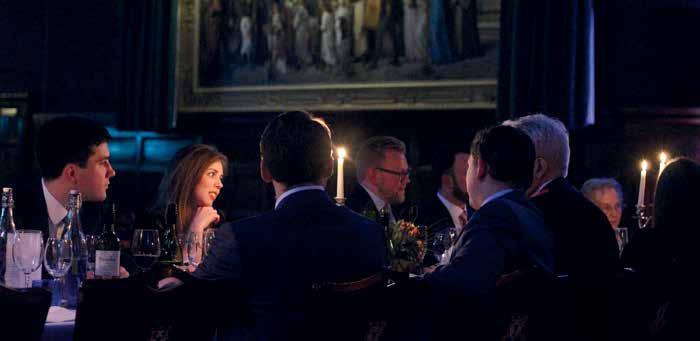
ALUMNI BENEFITS
As a lifelong member of Homerton and the University of Cambridge you are entitled to a number of benefits. You are very welcome to visit Homerton and use the College Library, Buttery and Bar, and to dine at Formal Hall. Subject to availability, you can also book overnight accommodation at preferential rates and book function rooms for private dinners and events. For more information email alumni@homerton.cam.ac.uk
You can take advantage of great deals at a number of Cambridge hotels, bars, restaurants and retailers by using your CAMCard (issued by the University). You will also receive automatic membership to the University Centre and free entrance into most of the Cambridge Colleges. Alumni can also sign up for cantab.net, the University’s email for life service, and continue to use the University Careers Service.
For further information about alumni benefits, visit www.homerton.cam.ac.uk/alumni/alumnibenefits
KEEPING IN TOUCH
www.homerton.cam.ac.uk/alumni
Visit the College website for full details of our alumni events, regional branches and alumni benefits. You can read College publications online and update your contact details when you move house or job. You can also read about the College’s current fundraising priorities and make a donation to Homerton online.
By email
Have you been receiving our email newsletter? If you haven’t seen an eNewsletter recently, send us an email at alumni@homerton.cam.ac.uk to make sure we have your current contact details.
Social Media


‘Like’ Homerton College on Facebook to keep up to date with what’s going on. Visit www.facebook.com/HomertonCollegeCambridge
Homerton College is on Twitter! Follow us for the latest news and updates @HomertonCollege
We are on Instagram. Check us out at @homertoncollege
You can also connect with Homerton on LinkedIn. Simply search for ‘Homerton College’.
Groups of Homertonians meet in local branches throughout the country and around the world. All of Homerton’s alumni branches are looking for new members and alumni are always welcome to attend their events. If you would like to get involved, please contact the branch leaders below. You can find the University of Cambridge Worldwide Branch Directory at www.alumni.cam.ac.uk/getinvolved/find-an-alumni-group if there isn’t a Homerton Branch in your area.
China
Xianwen Meng (2011–2012) mengxianwenhf@gmail.com
London (‘The London Rollers’) Stephanie Beardsworth (1973–1977) stephanie.beardsworth@btinternet.com
Newcastle upon Tyne and Durham Elise Wylie (1958–1960) elise.wylie@gmail.com
Oxford
Lucy Barnett (1961–1964) glebecottage@gmail.com
Southern California
Angela Clark (Das) (2000–2003) ad301@cantab.net
Wessex
Coral Harrow (1949–1951) coralharrow@icloud.com
HOMERTON CAREERS CONNECTIONS
Thank you to all those who have volunteered to be part of Homerton Careers Connections – we have been overwhelmed with the response! We have been working closely with student representatives to perfect the scheme and to run pilot sessions with members of the HUS. We will launch to the student body later in the year and will keep you updated in the College eNewsletters.
Homerton Careers Connections aims to give students a helping hand in embarking on their chosen career by putting them in touch with Homerton alumni who have experience in relevant fields. It is a great opportunity for alumni to help today’s students with their real-world knowledge, experience and insight. For more information and to register, visit www.homerton.cam. ac.uk/alumni/careers
We have the largest
student population of all the Cambridge Colleges
more
en-suite rooms than any other Cambridge College and our rents are among the lowest
Our undergraduates study
36
of Homer ton students are employed or in further study within 6 months of graduating
We are the University’s newest College, though we’ve been in
125 and in London for over Cambridge for nearly different subjects including Medicine, Engineering and Natural Sciences
We are the only College to elect a full-time sabbitical President of its
Student Union
We have years years before that
100% of our undergraduates can live on site throughout their course
125
Each academic year we spend over half a million pounds on outstanding welfare provision for our community
half a million