12 minute read
LIFTING ATTACHMENT TOOL APPLICATIONS


Picking Up the Load
Inspect the load before picking it up. If it appears unstable, DO NOTattempt to move it. DO NOT attempt lifting double-tiered loads, or straddling sideby-side pallets one on each fork. NEVER add extra unauthorized counterweights to the machine.
Warning
Operating conditions such as slopes or soft ground can reduce the machine’s safe operating capacity. Exceeding the capacity when raising or extending the boom will cause the machine to tip forward.
Approach the load squarely and slowly with the machine straight and level. Adjust the space between forks, if necessary. Engage the load equally on the forks until the load touches the carriage backrest. Tilt the forks back to position the load for travel.
Carrying the Load
If the load obstructs the view, have a helper direct the operator. Maintain ground speed consistent with ground conditions and which permit stopping in a safe manner.
Warning
NEVER travel with the boom above the carry position (attachment tool should be at minimum ground clearance). Boom should be fully retracted.
Use lower gears when traveling down an incline. NEVER coast with the transmission in neutral. Travel up and down grades slowly.
DO NOT operate the machine on a slope or grade that exceeds 22% or 12o.
Load Elevation and Placement
For ground level load placement, be sure the area under the load and around the machine is clear of equipment and personnel. Lower the load to the ground, tilt the forks to the horizontal position, and then carefully back away to disengage forks from the load.
For elevated or overhead placement, bring the machine as close as possible to the landing point, and then:
1.Level the machine BEFORE raising the load. Use extreme caution for high placement. Be sure personnel are clear of the area where the load or the machine could tip or fall.
2.Set the parking brake, hold the service brake pedal in fully applied position and slowly raise the load, maintaining a slight rearward tilt to cradle the load.
3.As the load approaches the desired height, feather the boom control at minimum speed until the load is slightly higher than the landing point.
4.Continue the feathering technique and lower the load into place.
5.Free the forks from the load by alternately retracting and raising the boom. If this process is not possible, very slowly and carefully reverse the telehandler to free the forks from the load.
6.Lower the forks to travel height.
Installing a Work Platform (WP)
Warning
The machine must not be used to lift or carry personnel or be fitted with any form of Work Platform unless fitted with the optional WPS System.
If fitted with the WPS System, the Mandatory Work Platform Safety Rules (p. 14) must be followed at all times while lifting personnel.
1.Center the forks on the carriage, spaced apart to match the distance required to engage the WP.
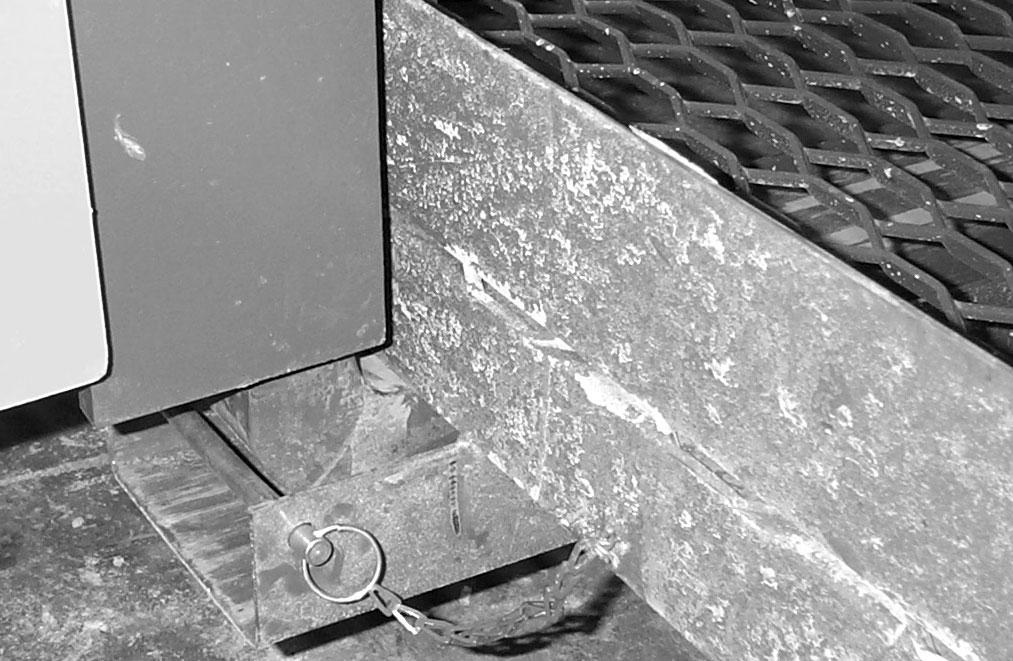
2.After the forks are fully engaged in the WP, secure the WPto the forks. This can be accomplished by means of a retaining pin behind the heel of the forks as shown on the next page.
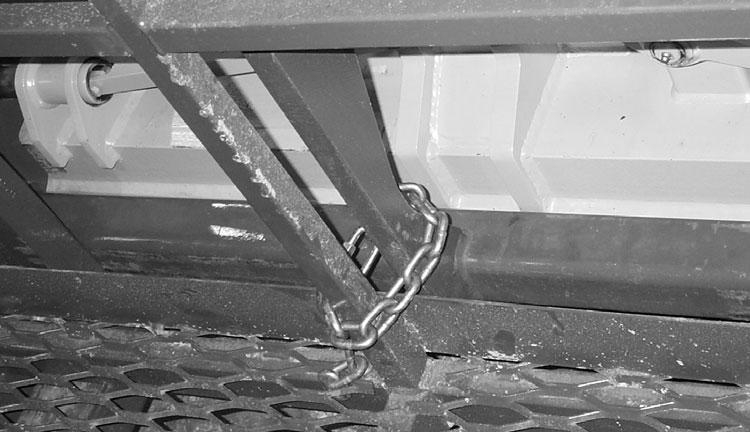
3.Secure the forks from pivoting upward in case the WPis lowered onto an obstruction. This can be accomplished by using the chain supplied with the WP, to secure the lower portion of the WPto the bottom of the carriage, as shown.
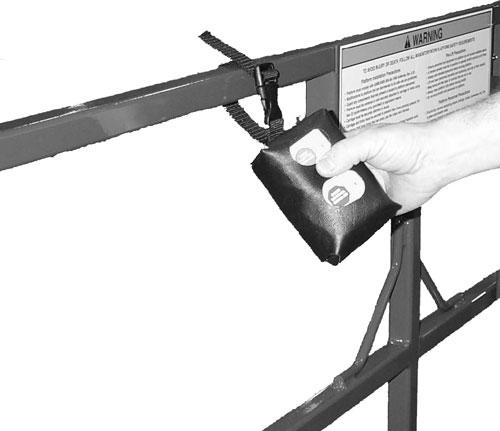
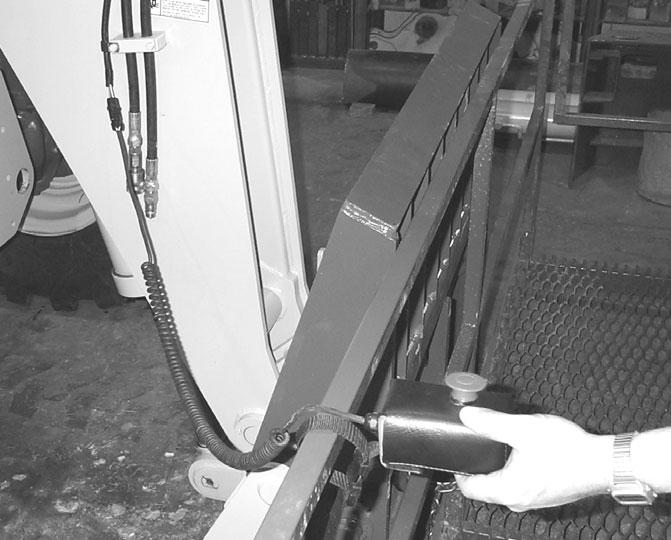
5.On 1155 models, the remote shutdown switch is wireless-operated. Secure the remote shutdown switch to the WPusing the strap attached to the switch, as shown below.
Warning
The WPmust meet ANSI/ITSDF B56.6-2005, Section 8.24. (See page 16 in the Safety chapter for WPdesign requirements.) If the WP being used does not offer means to secure the WPto the forks and to secure the forks from pivoting, as shown in Steps 2 and 3, then an alternate method must be used.
4.On 742 and 944 models, connect the coiled wire from the remote shutdown switch to the connector on the end of the boom. Secure the remote shutdown switch to the WPusing the strap attached to the switch, as shown below.
6.Secure the lanyard from the body harness to the WP(or the boom). Each person in the WPmust have a body harness with a lanyard attached to the WP(or the boom).
Lifting Personnel
The Telehandler is primarily intended for use as a material handler. It should only be used to lift personnel if it is equipped with the (optional) WPS System when there is no other practical option. If this machine is to be used to lift personnel, then use only an approved work platform, lift personnel only with the WPS System activated, and follow the “Mandatory Work Platform Safety Rules” (p. 14 Safety chapter).
If the Telehandler is equipped with a WPS System and is to be used for lifting personnel, the system must be activated by using the "WPS System" mode switch, which is located in the left switch bank. To activate the system, press the top of the WPS rocker switch, apply and hold the service brakes on for three or more seconds. The system is activated when the lamp in the WPS System rocker switch is on continuously.
Warning
ALWAYS check the WPS System for proper operation prior to use. (See page 54 for WPS System checking procedure.)
When the WPS System is active: transmission is de-clutched into Neutral, parking brake is applied, rear axle stabilizer cylinder is locked, frame leveling speed is reduced, auxiliary hydraulic and carriage tilt and swing functions are disabled, machine inclination sensor is activated, with the result that the Telehandler must be level laterally (side-to-side) and longitudinally (front-toback) to the factory pre-set limits before the boom control joystick will function, and
(for 742 and 944 models) remote shutdown switch is activated, meaning that the switch must be connected and in the “on” position for the boom control joystick to function. Pressing the red button will disengage the boom control joystick and stop all platform movement. The remote shutdown switch box is supplied with a coiled electrical cable, which must be connected to the outlet on the front of the innermost boom section near the carriage. The switch must be accessible to the platform personnel at all times when the platform is to be moved.
(for 1155 model) remote shutdown switch is activated, meaning that the switch must be “on” for the boom control joystick to function. Pressing the red button will disengage the boom control joystick and stop all platform movement. The remote shutdown switch box is a wireless remote control, so there is no direct connection to the Telehandler. The switch must be accessible to the platform personnel at all times when the platform is to be moved.
To de-activate the WPS System, apply the service brakes and press the bottom of the WPS System rocker switch. The system is de-activated when the lamp in the WPS System rocker switch is off.
NOTE: If the lamp in the WPS System rocker switch is flashing, apply the service brakes until the lamp goes off.
Warning
In an emergency, if the platform worker has activated the remote shut-off switch and then is not able to re-activate the switch, such as if the worker fainted, then the Telehandler operator is permitted to turn off the WPS System to regain control of the boom functions, in order to lower the work platform and come to the aid of the worker. But, understand this is only permitted in case of an emergency. Otherwise, the WPS System must be used at all times when there are workers on the platform. This is the only exception!
Stabilizer System
This is an additional safety function while elevating loads for placement. At a pre-determined boom angle, the stabilizer cylinder on the rear axle will lock. When this happens, the parking brake activates and the frame leveling function slows down. Other than moving the boom and slowly levelingthe frame, the machine will not be able to move until the boom is lowered below the pre-determined angle.
Warning
The machine becomes less stable as the load is raised higher.
NEVER use frame leveling to position an elevated load. Always lower the load to the ground and reposition the machine.
If a hydraulic boom circuit hose should break with the boom up, shut down the machine. DO NOT attempt to bring down the boom or make repairs. Call your Mustang dealer immediately.
As lift height increases, depth perception decreases. High elevation placement may require a signal person to guide the operator.
DO NOT ram the lift cylinders to the end of the stroke. The resulting jolt could spill the load.
The truss boom attachment tool should ONLY be used to lift and place loads when the machine is in a stationary position. DO NOT use to transport loads around the jobsite. This can cause the load to swing, resulting in either the load dropping or machine tipping over.
Suspended Loads
DO NOTexceed the Telehandler capacity as equipped for handling suspended loads. Only lift the load vertically and NEVER drag it horizontally. Use tag lines to restrain load swing, whenever possible.
The handling of suspended loads by means of the truss boom or other similar device can introduce dynamic forces affecting the stability of the machine that are not considered in the stability criteria of industry test standards. Grades and sudden starts, stops and turns can cause the load to swing and create a hazard.
Guidelines for “Free Rigging/Suspended Loads”
1.The rigging equipment must be in good condition and comply with U.S. OSHARegulation 1910.184, “Slings,” or 1926.251, “Rigging equipment for material handling.”
2.The rigging equipment must be secured to the forks such that it cannot slip or slide either sideways or fore and aft.
3.The capacity of the fork(s) and the machine (whichever is less) must not be exceeded.
4.The load center must remain at 24” (610 mm) or less.
5.No lifting of material may be done when anyone is on the load, rigging or forks.
6.Multiple pickup points on the load are preferred to prevent the load from rotating, but a single pickup point may be used if one or more tag lines are utilized. And, of course, the load must never be positioned over personnel at any time.
Materialhandling Bucket Toolapplication
IMPORTANT: The 1155 model is not intended for ground or material pile engagement. The bucket should be used for light-duty site cleanup only.
Material Densities
The table on this page lists densities for some common materials that could be carried in a Telehandler bucket tool. The densities listed are average values and intended only as a guide.
Ashes945-1350560-800
Brick-common30241795
Cement29701760
Charcoal621370
Clay2160-27001280-1600
Coal1431-1701850-1010
Concrete31051840
Cinders1350800
Coal-anthracite25381505
Coke810480
Earth-dry loam810480
Earth-wet loam17551040
Granite2511-29971490-1780
Gravel-dry17821060
Gravel-wet24301440
Gypsum-crushed31051840
Iron Ore39152320
Lime1620960
Limestone24301440
Manure-liquid17551040
Manure-solid1215720
Peat-solid1269755
Phosphate-granular24301440
Potash18361090
Quartz-granular29701760
Salt-dry27001600
Salt-Rock-solid36452160
Sand-dry29161730
Sand-wet33752000
Sand-foundry25651520
Shale-crushed24301440
Slag-crushed18901120
Snow405-1350240-800
Sulpha25651520
Taconite28891715
Digging and Loading
Refer to the illustration on the next page. Retract and lower the boom, then tilt the bucket’s cutting edge down into contact with the ground. Drive the bucket into the material. As the engine loads, roll the bucket back slowly and, at the same time, decrease travel speed.
IMPORTANT: ALWAYS fully retract the boom before driving into material.
NOTE: When attempting to fill the bucket while working with most hard-packed materials, it will usually be necessary to raise the boom while rolling back the bucket.
When the bucket is filled, back the machine away from the material and roll back the bucket before proceeding to the dumping area.
Dumping the Load onto a Pile
Carry the loaded bucket as low as possible until reaching the pile. Slowly stop forward motion, then raise and extend the boom high enough so that the bucket clears the top of the pile. Then slowly move the machine ahead to position the bucket, and dump the material on top of the pile. Empty the bucket. Back the machine away while retracting and lowering the boom, and rolling back the bucket.
Dumping the Load into a Truck
Carry the loaded bucket low and approach the truck or trailer box, square with the side of the box. Stop as close to the side of the box as possible while still allowing clearance for raising and extending the boom. Raise and extend the boom until the bucket clears the top of the box, and slowly position the bucket over the inside of the box. Then tilt the bucket forward. After the material is dumped, slowly back away from the box, and then retract and lower the boom while rolling back the bucket.
Dumping the Load over an Embankment
Carry the loaded bucket as low as possible while slowly traveling toward the dumping area. Stop the machine at the position where the bucket extends halfway over the edge of the embankment. Then tilt the bucket forward, and raise and extend the boom to dump the material. After the material is dumped, slowly back away from the embankment while retracting and lowering the boom, and then rolling back the bucket.
Warning
Digging, Loading and Carrying Material
Warning
DO NOT drive too close to an excavation or ditch. BE SURE the surrounding ground has adequate strength to support the weight of the machine and load.
ALWAYS carry a loaded bucket as close to the ground as possible. For additional stability when operating on inclines, ALWAYS travel with bucket end of the machine toward the top of the incline.
Scraping with a Bucket
Refer to the illustration on the next page. For scraping, the machine should be operated in the forward direction. First, position the boom retracted and down. Next, tilt the bucket cutting edge forward at a slight angle. Then travel slowly forward. With the bucket in this position, material can flow over the cutting edge and collect inside the bucket.
Leveling with a Bucket
First, drive the machine to the outer edge of the area to be leveled. Then, with the boom retracted and down, tilt the bucket forward to place the bucket cutting edge at a 30 to 45 degree angle to the surface being leveled. Next, drive the machine rearward while feathering the boom control joystick, dragging the dirt and, at the same time, leveling it.
NOTE: ALWAYS follow ALLstate and local regulations regarding the operation of equipment on or across public highways. Whenever there is an appreciable distance between jobsites, or if driving on public highways is prohibited, transport the machine using a vehicle of appropriate size and capacity.
Transporting Between Jobsites
When transporting the Telehandler, know the overall height to allow for clearance of obstructions. Remove or tape over the Slow-Moving Vehicle (SMV) emblem if it will be visible to traffic.
ALWAYS abide by the following recommended procedures and guidelines when using ramps to load the machine onto (or unload it from) a truck or trailer. Failure to heed can result in damage to equipment and serious personal injury or death!
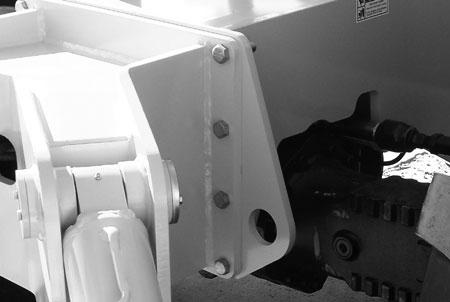
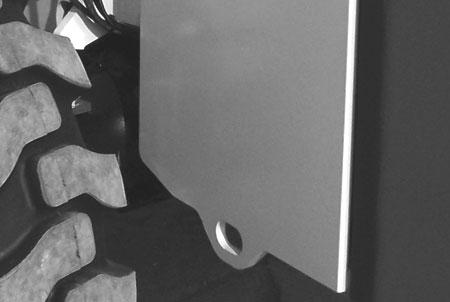
Tie-down slots are provided for inserting chains through to secure the machine while transporting.
Scraping and Leveling with Bucket
Road Travel
For short distance highway travel, attach a SlowMoving Vehicle (SMV) emblem (purchased locally) to the back of the Telehandler. Activate the hazard lights on the machine. For highway operation, obtain and install an amber flashing beacon.
Loading Machine Using Ramps
NOTE: Amatched pair of ramps is required.
1.The ramps MUSTbe of sufficient strength to support the machine. The use of strong steel ramps is recommended, as well as center supporting blocks.
2.The ramps MUSTbe firmly attached to the truck or trailer bed with NO step between the bed and the ramps.
3.The incline of the ramps MUSTbe less than 15 degrees (ramp length MUSTbe at least 16 feet (4.9 m) long).
4.Ramp width MUSTbe at least 1-1/2 times the tire width.
5.Block the front and rear of the tires on the truck or trailer. Engage the parking brake.
6.Position the machine (with the boom facing toward the front of the truck or trailer) so that it is straight in line with the ramps.
7.Slowly (at the lowest engine speed possible) and carefully drive the machine up the ramps.
8.Secure the machine to the bed of the truck or trailer. Tie-down slots are provided on the front and rear sides of the frame structure.
Warning
NEVER adjust travel direction (even slightly) while traveling on the ramps. Instead, back down off the ramps, and then realign the machine with the ramps.
Warning
NEVER transport the machine with the boom raised or extended. BE SURE to secure the machine (including boom) to the truck or trailer bed using chains and binders or steel cables, to prevent any movement while transporting.
Unloading Machine Using Ramps
NOTE: Amatched pair of ramps is required.
Repeat Steps 1 through 5 and proceed as follows to unload the machine:
6.Remove the tie-down chains/cables.
7.If necessary, adjust the machine so that the wheels are in line and centered with the ramps.
8.Slowly (at the lowest engine speed possible) and carefully drive the machine down the ramps.
Theft Deterrents
Mustang has recorded all major component part numbers and serial numbers. Users should take as many of the following actions as possible to discourage theft, to aid in the recovery in the event that the machine is stolen, and to reduce vandalism:
1.Remove keys from unattended machines.
2.Attach, secure, and lock all anti-vandalism and anti-theft devices on the machine.
3.Lock doors of cabs when not in use.
4.Inspect the gates and fences of the vehicle storage yard. If possible, keep machines in well-lighted areas. Ask the local law enforcement agency to make frequent checks around the storage and work sites, especially at night, during weekends, and on holidays.
5.Report any theft to the dealer and insurance company. Provide the model and serial numbers. Request your dealer forward this information to Mustang Manufacturing Company.