7 minute read
OWNER SERVICE


The information in this section is written for operators who possess basic mechanical skills. If you need help, your dealer has trained service technicians available. For your protection, read and follow the safety information in this manual
Full chain shielding must be installed when operating in populated areas or other areas where thrown objects could injure people or damage property.
•If this machine is not equipped with full chain shielding, operation must be stopped when anyone comes within 300 feet (92 m).
•This shielding is designed to reduce the risk of thrown objects. The mower deck and protective devices cannot prevent all objects from escaping the blade enclosure in every mowing condition. It is possible for objects to ricochet and escape, traveling as much as 300 feet (92 m).
Always wear relatively tight and belted clothing to avoid getting caught in moving parts. Wear sturdy, rough-soled work shoes and protective equipment for eyes, hair, hands, hearing, and head; and respirator or filter mask where appropriate.
Blocking Method
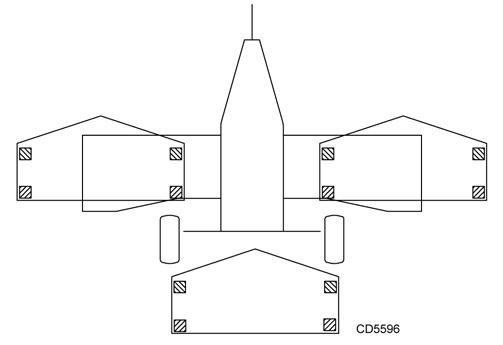
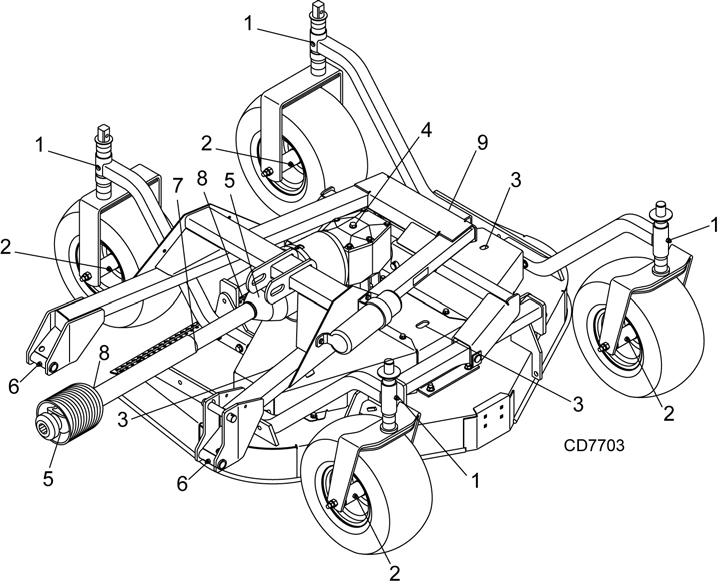
The only approved blocking devices for this mower are jack stands with a load rating of 1,000 pounds or more. Twelve jack stands, located as shown in Figure 6, must be installed before working underneath this unit.
Keep hands and body away from pressurized lines. Use paper or cardboard, not hands or other body parts to check for leaks. Wear safety goggles. Hydraulic fluid under pressure can easily penetrate skin and will cause serious injury or death.
Make sure that all operating and service personnel know that if hydraulic fluid penetrates skin, it must be surgically removed as soon as possible by a doctor familiar with this form of injury or gangrene, serious injury, or death will result. CON-
TACT
A Physician Immediately If Fluid
Do not work underneath mower unless it is properly attached to tractor and blocked securely. When properly attached, the unit will be anchored to minimize front to rear movement.
ENTERS
Skin
OR
EYES.
DO NOT DELAY. Keep all persons away from operator control area while performing adjustments, service, or maintenance.
Do not disconnect hydraulic lines until engine is stopped, power unit is properly secured, equipment and all components are lowered to the ground, and system pressure is released by operating all valve control levers.
Before dismounting power unit or performing any service or maintenance, follow these steps: disengage power to equipment, lower the 3-point hitch and all raised components to the ground, operate valve levers to release any hydraulic pressure, set parking brake, stop engine, remove key, and unfasten seat belt.
Before blocking, be sure that the mower is securely attached to the tractor. Lower mower units to the ground. Raise the mower units as needed for working room and securely block them. Set tractor brakes, turn engine off and remove key, then disconnect mower driveline.
When blocking, you must consider the overall stability of the unit. Just placing jackstands under the unit will not ensure your safety. The working surface must be level and solid to support the loaded weight of the jack stands. Ensure that jackstands are stable at both top and bottom. Before working under any portion of the mower, test the stability of your blocking with the full weight of the mower units lowered onto the jackstands.
Lubrication Information
When lubricating telescoping PTO drives, keep fingers out of shield access slots to prevent injury. Do not let excess grease collect on or around parts, particularly when operating in sandy areas.
Figure 7 and Figure 8 shows lubrication points. The accompanying charts give the frequency of lubrication in operating hours, based on normal operating conditions. Severe or unusual conditions may require more frequent lubrication.
Use a lithium grease of #2 consistency with a MOLY (molybdenum disulfide) additive for all locations unless otherwise noted.
Be sure to clean fittings thoroughly before attaching grease gun. When applied according to the lubrication chart, one good pump of most guns is sufficient. Use SAE 90W gear lube in gearboxes.
Daily lubrication of PTO slip joints is necessary. Failure to maintain proper lubrication can result in damage to U-joints, gearboxes and/or drive shafts. Raise or lower mower until grease fittings in PTO shields are exposed. Insert grease gun through slots and apply grease to all sides of shafts. Always stand clear of mower and wing arm mechanism to avoid being pinched or crushed should the mower or wing suddenly lower.
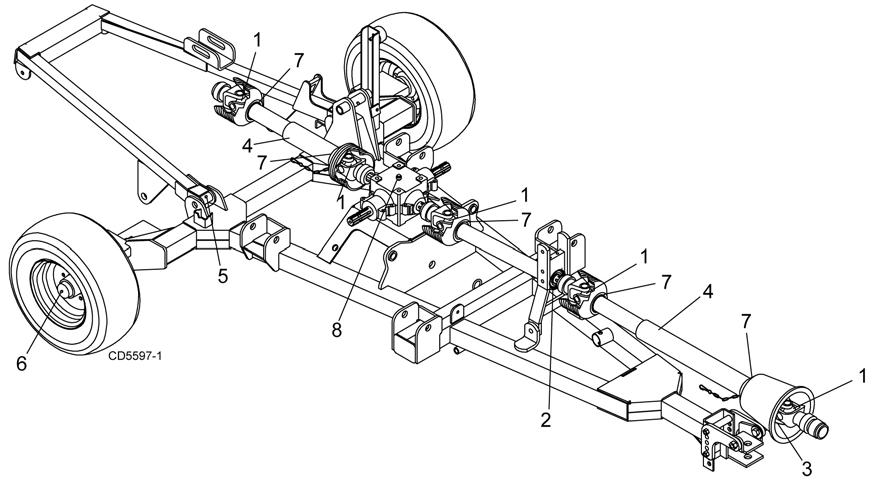
Raise and lower mower after applying grease so that it spreads over the slip joint working area.
4Telescoping Shaft8 Hours
5Rear Deck Pivot Arm8 Hours
6Transport Wheel Hub8 Hours
7Shield Bearing8 Hours
8Splitter Gearbox (Fill 1/2 Check For Leaks Daily full w/SAE 90W gear lube)
Belt Service
Belt Replacement
One of the major causes of belt failure is improper installation. Before installing a new belt, check the following:
1. Check pulley shafts and bearings for wear.
2. Check pulley grooves for cleanliness.
3. Make sure spindles turn freely and without wobble.
If grooves require cleaning, moisten a cloth with a nonflammable, non-toxic degreasing agent or commercial detergent and water.
Avoid excessive force during installation. Do not use tools to pry belt into pulley groove. Do not roll belt over pulleys to install. This can cause hidden damage and premature belt failure.
Belt Installation
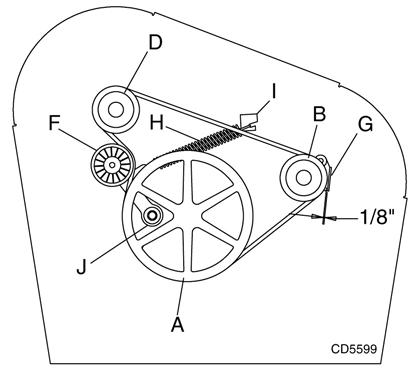
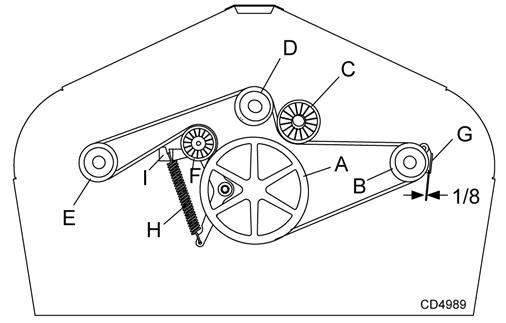
Wing Deck - FM1012 (Figure 9 & Figure 10)
Use care when installing or removing belt from spring-loaded idler. Springs store energy when extended and, if released suddenly, can cause personal injury.
4. Slide belt under drive pulley A and over idler arm. Position the belt around drive pulley A.
5. Loosen the bolt holding belt guide G and swing it away from pulley B. Route the belt around pulley D as shown.
6. Make sure the belt is on drive pulley A; route around idler F.
7. Grasp the belt between spindle pulley B and spindle pulley D. Drive pulley A. Pull spring loaded idler with belt to obtain enough belt length to route it over pulley B. Make sure spring loaded idler pivots freely with belt installed.
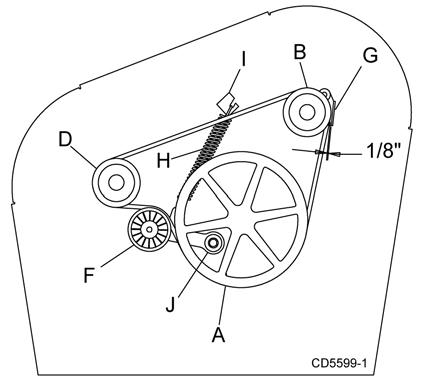
8. Adjust belt guide G to provide 1/16" to 1/8" clearance from belt. Tighten the bolt to 85 lbs./ft.
Rear Deck - FM1012
All Decks - FM1015 & FM1017(Figure 11)
Use care when installing or removing belt from spring-loaded idler. Springs store energy when extended and, if released suddenly, can cause personal injury.
1. Slide the belt under drive pulley A and over idler arm. Position the belt around drive pulley A.
2. Loosen the bolt holding belt guide G and swing it away from pulley B. Route the belt around pulley B, idler C, and pulley D as shown.
3. Make sure the belt is on drive pulley A; route around idler F.
4. Grasp the belt between spindle pulley E, spring loaded idler F, and spindle pulley D. Pull spring loaded idler with belt to obtain enough belt length to route it over pulley E. Make sure spring loaded idler pivots freely with belt installed.
5. Adjust belt guide G to provide 1/16" to 1/8" clearance from belt. Tighten bolt to 85 lbs-ft.
Blade Servicing
Before servicing blades, raise and lock mower in transport position, turn off engine, set parking brake and remove key.
Keep all persons away from operator control area while performing adjustments, service, or maintenance.
Blade Sharpening Notice
■ When sharpening blades, be sure to balance them. Unbalanced blades will cause excessive vibration that can damage blade spindle bearings. Vibration may also cause structural cracks in mower housings.
1. Remove blades.
2. Always sharpen both ends to maintain balance.
3. Follow original sharpening pattern.
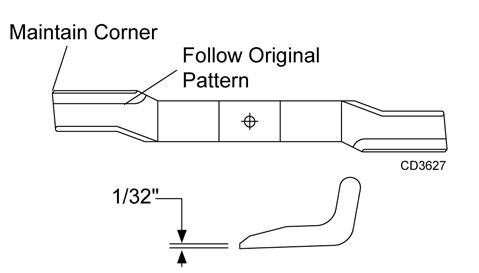
4. Do not sharpen blade to a razor edge. Leave from 1/32" to 1/16" blunt edge.
5. Do not sharpen back side.
12
Frequently check blades. They should be sharp, free of nicks and cracks, and securely fastened.
1. Raise mower decks to the transport position and make sure transport locks are engaged.
2. Shut off tractor, relieve hydraulic pressure in cylinders, set parking brake and remove key.
3. Inspect blades before each use to determine that they are mounted securely and are in good condition.
4. Replace any blade that is bent, excessively nicked, worn, or has any other damage.
5. Small nicks can be ground out when sharpening.
Blade Removal
Do not handle knives with bare hands. Careless or improper handling may result in serious injury.
1. Remove cap screws (3) & lock nut (4), Figure 12.
2. Remove blade.
Blade Installation
Your dealer can supply genuine replacement blades. Substitute blades may not meet original equipment specifications and may be dangerous.
Notice
■ When installing blade, the lift of the blade must be toward the spindle blade housing as shown in Figure 12.
1. Place cap screws (3) through outer holes in blade and spindle shaft.
2. Make sure blade cutting edge is positioned to lead in a clockwise rotation, as viewed from top of mower.
3. Place locknuts (4) on screws and torque to 84 lbsft.
1.Spindle assembly
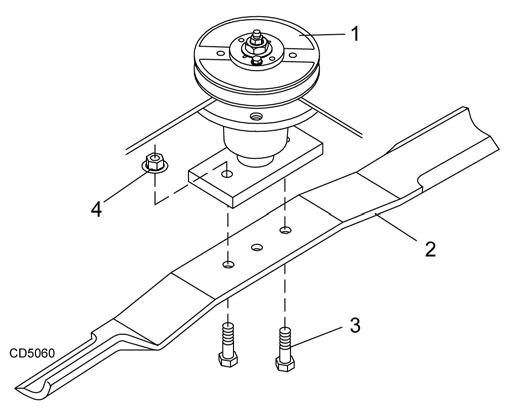
2.Blade
3.Screw, HHCS 1/2 NC x 1-1/2 GR5
4.Nut, flange lock 1/2 NC
Periodically or Before Extended Storage
● Clean large debris such as clumps of dirt, grass, crop residue, etc. from machine.
● Remove the remainder using a low-pressure water spray.
1. Be careful when spraying near scratched or torn safety decals or near edges of decals as water spray can peel decal off surface.
2. Be careful when spraying near chipped or scratched paint as water spray can lift paint.
3. If a pressure washer is used, follow the advice of the pressure washer manufacturer.
● Inspect machine and replace worn or damaged parts.
● Sand down scratches and the edges of areas of missing paint and coat with Woods spray paint of matching color (purchase from your Woods dealer).
● Replace any safety decals that are missing or not readable (supplied free by your Woods dealer). See Safety Decals section for location drawing.
Cleaning
After Each Use
● Remove large debris such as clumps of dirt, grass, crop residue, etc. from machine.
● Remove belt shields and clean out all accumulated grass, dirt and other debris.
● Inspect machine and replace worn or damaged parts.
● Replace any safety decals that are missing or not readable.