5 minute read
Maintenance

When acquiring a battery for the truck, pay attention to the following sections of the standard EN 1175-1:
• 5.1 Traction batteries (includes the requirements for the protective cover of the battery case, ventilation and interior surface treatment) • 7.4 Minimum markings (includes the requirements specified on the truck battery plate)
The battery plate should provide at least the following information:
• Manufacturer • Type • Serial number • Rated voltage • Capacity (Ah/5h) • Service weight
Battery charging with an inbuilt charger
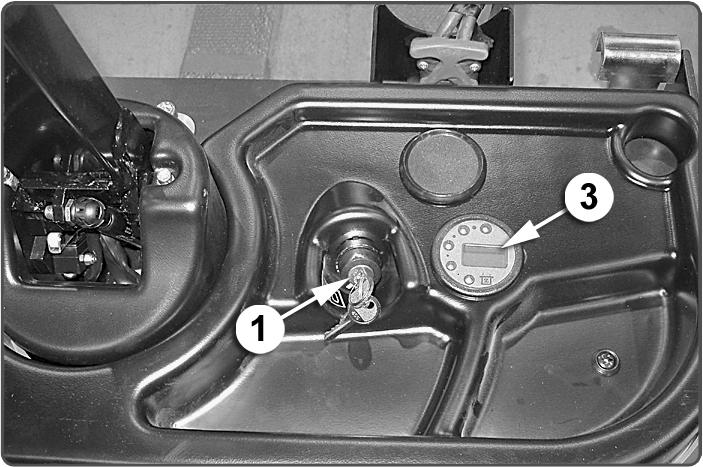
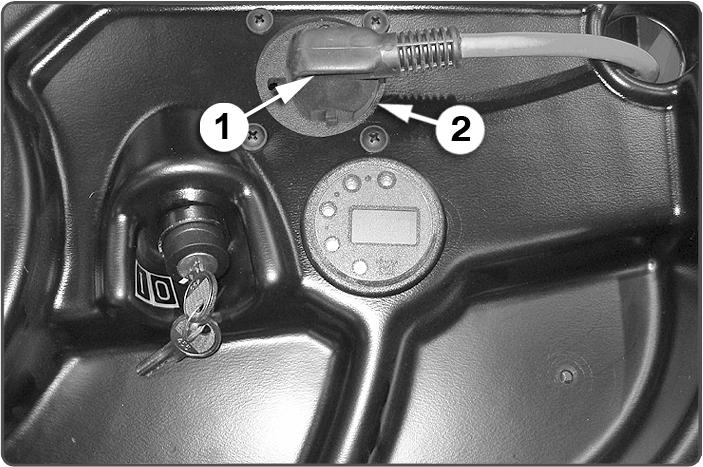
You can access the plug (1) for the power supply of the integrated charger from the outside of the truck. To activate the charger, extract the plug for the power supply from the safety socket on the machine and insert it into the correct outlet (230 V ±10% / 50 Hz). After activating the charger, charging starts automatically
The charging phase is indicated with two indicator lights (2):
• Flashing green and yellow (the power is connected to the charger) • Yellow (charging begins) • Flashing yellow (charging in progress) • Green (fully charged) • Flashing green indicates a fault in the system and charging is stopped automatically.
The charger will stop automatically after the charging is complete and you can unplug the charger plug and connect it to the safety socket of the truck. NOTE If the plug is not connected to the safety socket, all electrical functions will remain switched off and the truck cannot be used.
WARNING!
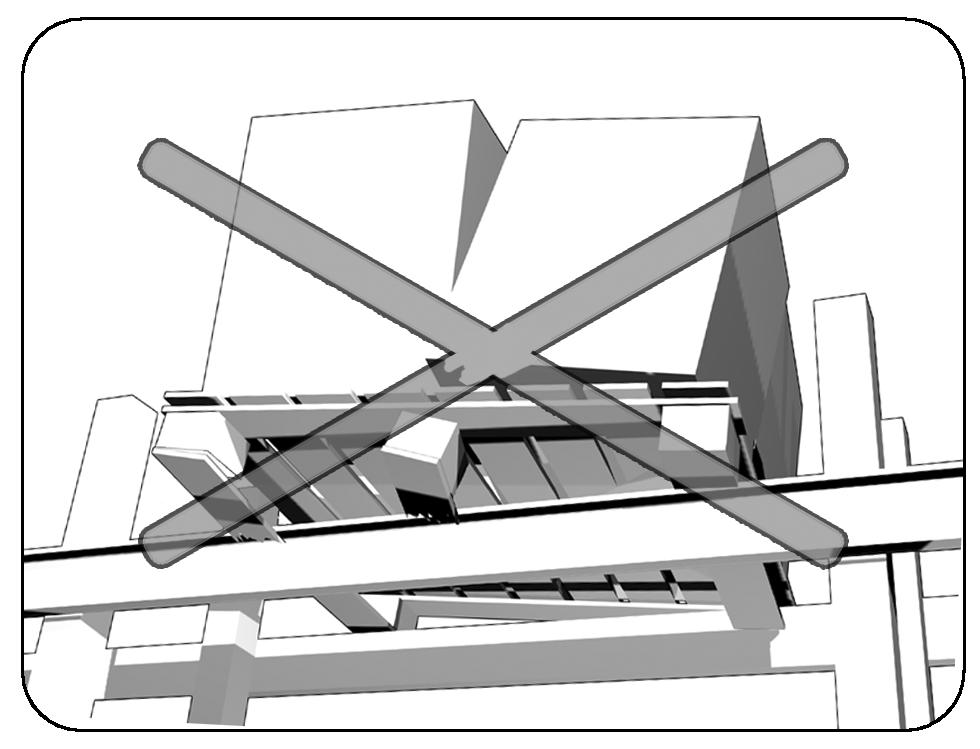
No inflammable materials are allowed within 2 meters of the truck under charge or the charger.
Only adequately trained people are allowed to carry out daily and weekly maintenance. The terms of the warranty prescribe appropriate maintenance of the truck. All spare parts must be original ones. It is recommended that you sign a maintenance agreement with the truck dealer, who can also supply spare parts. Only professional service ensures long-term, trouble-free truck operation. Service program monitoring becomes easier if you enter the service dates in a service logbook. Contact our maintenance department or your truck dealer for qualified, authorized and efficient maintenance service.
Safety instructions for maintenance
• Keep the service area clean; oil, grease, and water make the floor slippery. • Remove all rings, watches and other metal jewellery. Short-circuits and burns may occur if a metal object touches a charged electrical connection when working with the truck's electrical system. • Switch off the truck's power before opening the cover of the drive unit or the electrical system. • Release the hydraulic pressure before opening the system. • Do not use your hands to check for oil leaks. • Remember that the surfaces of the hydraulic system and the motors may be hot. • Only use clean oil in the hydraulic system. • Always disconnect the battery when welding. Remove paint from a 10 cm radius from the welding point to avoid creating toxic gases during welding. • The truck must always be supported on jacks if someone needs to work underneath it.
WARNING!
Do not make any alterations or repairs that can weaken the truck’s structure or endanger safety.
Daily checks
• Check the truck externally to see that there are no oil leaks. • Check all wheels for damage or outerwear. • Check the battery fluid in each battery cell. Top up with battery water if needed. The fluid surface should be about 15 mm above the plates (this does not apply to maintenance-free batteries). • Check the gearbox for leaks. Also check the hydraulic pipes, hoses and connectors. No leaks or damage should be found. • Switch on the power and test the operation of the lifting hydraulics by raising and lowering the forks. • Check the operation of the accelerator and steering by driving slowly forward and backward. • Also check the operation of the other electrical functions. • Check that the batteries are charged and locked in place. • Check that the safety button functions. • Check that the emergency stop operates properly. • Make sure that the tiller arm returns to the up position and the parking brake functions properly. • Check the operation of the horn.
Weekly maintenance
• Check and clean the battery cable fastenings. • Ensure that the air holes of the battery cell plugs are not plugged up (this does not apply to maintenance-free batteries). • Clean the batteries with a dry rag. If necessary, you can wash the batteries with warm water or a mild soda solution, which neutralises the battery acid. Dry the battery carefully after the wash. • Check that the hydraulic system has no leaks. • Check the hydraulic oil in the oil tank. Add if necessary. • Check that the machine plates and labels are securely fastened and fully legible. • Clean the truck if necessary. • Check that all the screws, nuts, and pipe connections are tight. • Check that the fastening bolts of the drive wheel are tight.
Semi-annual maintenance (or 600 hours)
Check and, if necessary, adjust or repair:
• Connections of the drive motor and pump motor • Accelerator operation • Speed limit switches • Microswitches or inductive sensors • Contactors and solenoids • Cables • Tiller arm gas spring • Lift cylinder function • Play of the fork carriage, and the slope of the forks and their condition • Air gap in the brake: 0.2 mm when new, maximum gap 0.55 mm • Brake pad thickness: 8.5 mm when new, minimum thickness 5.5 mm
Monthly hydraulics maintenance
The truck's lubricating points should be lubricated once a month:
• Turning bearings of the load wheels • Bearings of the side castor wheels • Suspension rail of the drive unit • Turning bearings of the drive unit
Lubricant recommendation
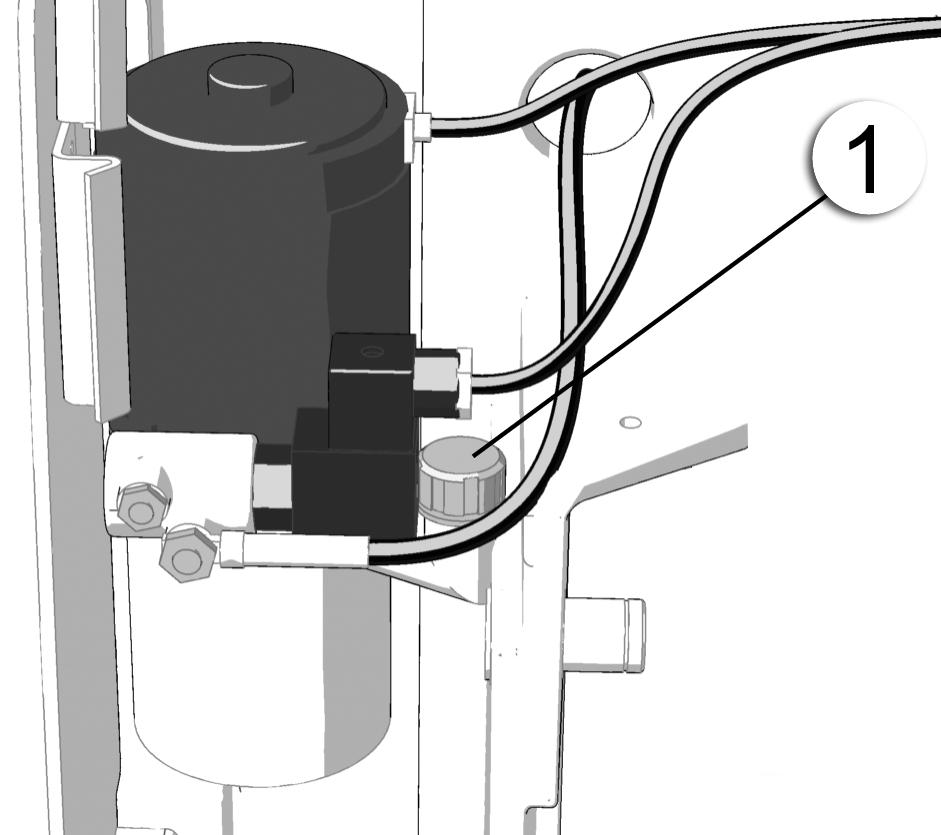
Filling hole for hydraulic oil (1)
Hydraulic oil: ISO 11158 HM/HV/HR - VG 32 In freezer warehouses: ISO 11158 HM/HV/HR - VG 15 Fill the tank to ¾ volume.
Transmission lubricant recommendation
Transmission oil: EP 80/90 In freezer warehouses: NLGI No. 1 or No. 0 Fill to the volume of 0.6 l. The oil level must reach the lower edge of the checking hole.
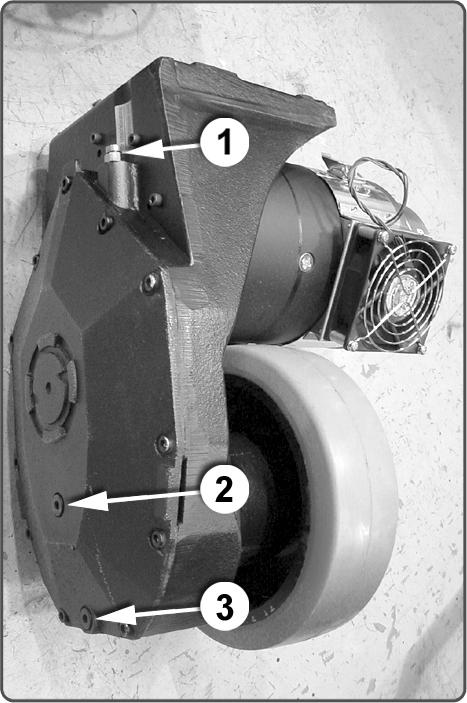
Filling hole for transmission oil (1)
Opening to check the oil level (2)
Oil outlet (3)
Additional maintenance work for service personnel
• Change the hydraulic oil once a year (or 1200 h). • Change the transmission oil once a year (or 1200 h) • Clean the oil filter. • Check the operation of the hydraulics and the pressure relief valves. • Check the fastening of the gearbox and the amount of transmission oil; add if necessary. • Check the fastening of the tiller arm. • Check the condition of the side castor wheels and load wheels. • Check the wear of the drive wheel: • 230 mm when new • Needs to be changed when the diameter is 218 mm
Location of fuses in the speed control unit
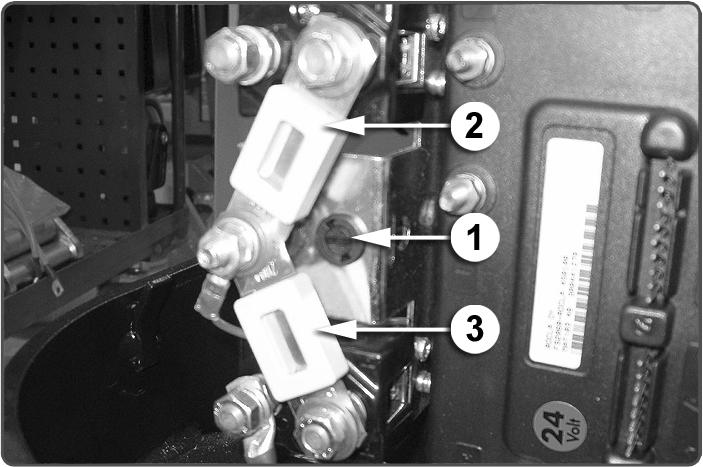
Control circuit fuse (1) Drive motor fuse (2) Pump motor fuse (3)