Suzanne O’Callaghan is HFA Policy Research and Education Manager
QUALITY OF LIFE IN A CHANGING WORLD Suzanne O’Callaghan
WHAT DOES QUALITY OF LIFE MEAN TO YOU? LIVING WITH (AN INHERITED) BLEEDING DISORDER IN A CHANGING WORLD Moderator: Deon York, Board Member, World Federation of Hemophilia; President of the Haemophilia Foundation of New Zealand
Nat i onal H aem ophi l ia No. 211 , Sept ember 2020
The session on what quality of life means to you at the Virtual Summit took us on an exploration of the challenges and motivations that impact on quality of life, both for the person with a bleeding disorder and the health professionals who care for them. I found it to be an honest, thoughtful and sometimes confronting journey as the presenters gave their individual perspectives on quality of life. The session also took into account the effect of COVID-19 and the complexities of this experience. Cathy Harrison’s presentation, for example, highlighted the positive and negative outcomes of this pandemic. Overall it left us with a strong message: what defines each person’s quality of life will be individual to them and it is important to ask them and not make assumptions.
MENTAL HEALTH AND HOW IT CORRELATES WITH CHRONIC CONDITIONS Nathalie Roussel, Assistant Professor, Musculoskeletal Physiotherapy, University of Antwerp How we think about our health affects how we feel. This seems like a simple statement, but Natalie Roussel explained just how complex this can be in relation to bleeding disorders and quality of life. Using the example of pain, she described how the negative emotions like fear and anxiety can affect a person’s experience of pain and will affect their entire day. Current research has
underlined that this way of thinking is ‘plastic’; that it can be changed into a more positive way of thinking about and experiencing pain. In haemophilia, joint problems such as target joints will reduce quality of life over a lifetime. Although it might seem counter-intuitive, it has been found that increased physical activity may help to improve pain. Natalie pointed out that overcoming a fear of movement in people with haemophilia would not only decrease their pain but also increase their sense of self-efficacy. Stress management may help them to have better coping strategies. All of these come together to improve quality of life. NURSING PERSPECTIVE Cathy Harrison, Advance Nurse Practitioner, Sheffield Haemostasis & Thrombosis Centre
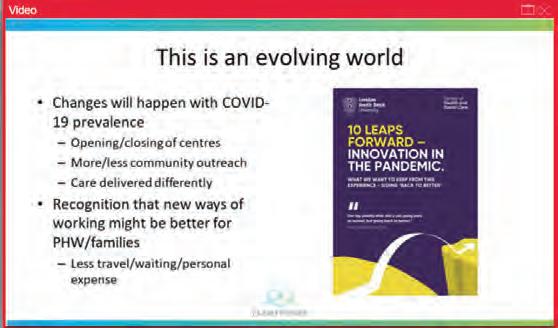
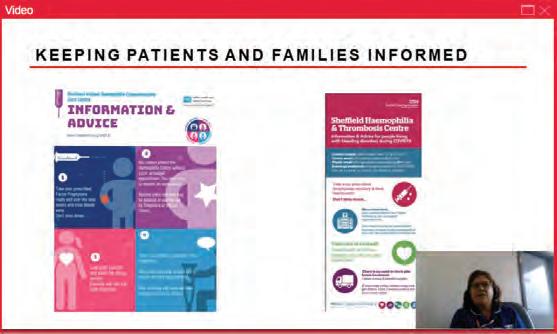
Cathy Harrison gave an interesting personal view of the COVID-19 crisis from her perspective as a haemophilia nurse. She began by pointing out the effect of COVID-19 on mental health and on those who are more vulnerable in the community. In early surveys in China, although many people did not feel personally at risk from COVID-19, they nevertheless reported generalised feelings of apprehension and horror about COVID-19. Managing the stress of COVID-19 for her patients was very important to Cathy. At the beginning of the pandemic in the UK, the HTCs were concerned to make sure services were maintained to people with bleeding disorders and worked together as a team to achieve this. The process was exhausting, especially as the team was slowly separated through redeployment and illness. Even when she herself contracted COVID-19, Cathy continued to work from home to support the HTC team. They realised that it was crucial to keep their patients informed to reduce feelings of
10
200911 HFA_journal-Sept_2020_2.indd 10
4/9/20 10:58 am