3 minute read
VWD update

Suzanne O’Callaghan is HFA Policy Research and Education Manager VWD UPDATE Suzanne O’Callaghan
INTERNATIONAL VWD CLINICAL GUIDELINES
The WFH Virtual Summit provided an update on the
international von Willebrand disease (VWD) clinical
practice guidelines and it was exciting to hear that the guidelines are to be published in December 2020.
The clinical practice guidelines are a collaboration between several organisations: the American Society of Hematology (ASH), the International Society on Thrombosis and Haemostasis (ISTH), the World Federation of Hemophilia (WFH) and the National Hemophilia Foundation (NHF). have been developed for VWD. The comments by
There are two panels, diagnosis and clinical management, and there are clinical and patient representatives on both panels, including Australian clinicians and patients.
THE PATIENT VOICE
Over the last two years there have been a couple of opportunities for the global VWD community to participate in the development. The most recent was the online survey in April-May 2020 and our thanks to the Australian community members who contributed their feedback. At the update session Dr Nathan Connell, clinical vice chair of the guideline development panels, explained how critical the patient voice had been to the approach and focus of the guidelines. The patient involvement has helped the panels to align the guideline development to the patient journey and what patients value highly, for example: The WFH Virtual Summit provided an opportunity to
A d iagnosis that gives access to appropriate management C lear diagnostic thresholds to give a definitive diagnosis C linical management that reduces the risk of bleeding, especially the effect of bleeding on quality of life S hared patient-doctor decision-making about risks and benefits R ecognition that values and preferences are likely to T he importance of education material for patients and clinicians about long-term prophylaxis for decisionmaking.
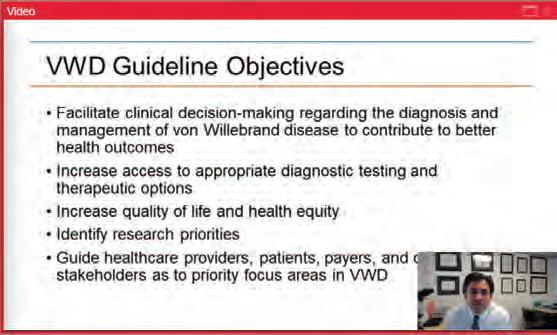
Dr Nathan Connell presenting virtually on the VWD guidelines
NEXT STEPS
This is the first time that international clinical guidelines stakeholders are currently being reviewed before publication. When the international guidelines are published, the Australian Haemophilia Centre Directors’ Organisation (AHCDO) will review them to develop Australian guidelines for a consistent national approach to diagnosis and management. HFA will then use the AHCDO guidelines as the basis for updating our VWD education materials. Watch this space!
GLOBAL VWD CALL TO ACTION
vary among individual patients highlight information about VWD in several of the sessions:
A medical session updating on the latest in VWD diagnosis and treatment
A multidisciplinary session on the perspectives of people with VWD and the differences between men and women
The WFH session on the international VWD clinical guidelines
And multiple sessions about issues for women and girls.
You can access the Virtual Summit sessions on demand at https://www.wfh.org/virtual-summit/
WFH leads a worldwide call to action on VWD, ‘to acknowledge the work that needs to be done, to make a commitment to recognizing VWD and other rare bleeding
disorders by taking action to create awareness, resources and provide support to improve the lives of those living with VWD’. Australia joined the call to action in 2018 and HFA is a member of the WFH VWD Global Group, which supports this work.
In a recent article in the WFH magazine Hemophilia World (https://tinyurl.com/WFH-VWD2020), WFH described the impact of raising awareness about VWD and improving access to diagnosis and treatment, using South Africa, Nicaragua, Sudan, Bangladesh, Colombia and the Netherlands as examples. HFA is looking forward to opportunities to raise awareness about VWD during Bleeding Disorders Awareness Week, 11 to 17 October 2020. We will be looking for personal stories about the experience of living with VWD. For more information, check the Bleeding Disorders Awareness Week page on the HFA website - https://tinyurl.com/ BDAW2020. Do you have a personal story to tell? Perhaps now is the time to share your story!
HFA also has a VWD Focus Group of men and women with VWD, who give ideas and feedback on HFA’s VWD awareness and education activities, generally via email or online survey. If you would be interested in participating in this group, contact Suzanne at HFA on socallaghan@ haemophilia.org.au or phone 1800 807 173.
Photo by dlritter, FreeImages